







How will GIGABYTE’s entry level Intel Z77 GA-Z77MX-D3H stack up? We put it through its paces with Intel (Ivy Bridge) Core i5-3570K.

Product on Review: GA-Z77MX-D3H
Manufacturer and Sponsor: GIGABYTE
Street Price: £105inc. VAT (At time of review)
This week Intel launched their new 3rd Generation Processors to pair up with their recently launched Intel Z77 chipset motherboards. Though the Z77 motherboards have been available to buy for quite a number of weeks now, performance could only be demonstrated with Intel Sandy Bridge processors and it isn’t until now that we can reveal how Ivy Bridge runs on the Z77 chipset.
Today we will be taking a look at what GIGABYTE offer at the low-end via the M-ATX Z77MX-D3H. This motherboard features Ultra Durable 4 components and seeks to provide a stepping stone for those wanting to build a compact Intel Z77 system on a budget.
GIGABYTE on their Z77 motherboards
GIGABYTE 7 series motherboards combine a host of new and exciting technologies with the latest Intel Z77 Express Chipset, creating a unique range of motherboard designs that harness the outstanding performance of the new 3rd generation Intel® Core™ processors. With an exclusive ‘Digital’ VRM design, GIGABYTE 3D Power and GIGABYTE 3D BIOS (Dual UEFI), GIGABYTE 7 series motherboards ensure exceptional power delivery and absolute control, with additional features that ensure an unrivalled experience on your next PC build.
Technical Specifications
CPU
Support for Intel Core i7, i5, i3, Pentium and Celeron 1155 processors(Go to GIGABYTE’s website for the latest CPU support list.)
Chipset
Intel Z77 Express Chipset
Memory
4x DDR3 1600/1333/1066 MHz memory modules
Onboard Graphics
1x D-Sub, 1x DVI-D (1920×1200 max res), 1x HDMI (1920×1200 max res)
Audio
VIA VT2021 codec High Definition Audio 2/4/5.1/7.1-channel w/ Support for S/PDIF Out
Multi-Graphics
Support for AMD CrossfireX/NVIDIA SLI Technology
LAN
1 x Atheros GbE chip (10/100/1000 Mbit)
Expansion Slots
1 x PCI Express x16 slots, running at x16
1 x PCI Express x16 slots, running at x8
1 x PCI Express x16 slots, running at x4
1x PCI Express x1 slot
Storage Interface
2 x SATA 6Gb/s connectors
4 x SATA 3Gb/s connectors
USB
USB 3.0/2.0 : 2x on the back panel, 2x via USB brackets on headers
USB 2.0/1.1 : 6x on the back panel, 4x via USB brackets on headers
Internal I/O Connectors
1 x 24-pin ATX main power connector, 1 x 4-pin ATX 12V power connector, 2 x SATA 6Gb/s connector, 4 x SATA 3GB/s connectors, 1 x CPU fan header, 2 x system fan headers, 1 x front panel header, 1 x front panel audio header, 1 x S/PDIF Out header, 2x USB 2.0/1.1 headers, 1x USB 3.0/2.0 headers,1 x clearing CMOS jumper, 1 x TPM header
Back Panel Connectors 1 x PS/2 keyboard/mouse port, 1 x D-Sub, 1 x DVI-D, 1 x HDMI, 1 x Optical S/PDIF Out connector, 2 x USB 3.0/2.0 ports, 6 x USB 2.0/1.1 ports,1 x RJ-45 ports, 5x audio jacks
BIOS
2 x 64 Mbit AMI EFI BIOS, Support for DualBIOS™
Form Factor
mATX Form Factor; 24.4 x 24.4cm
Warranty 3 Year Gigabyte Warranty
Support for Intel Core i7, i5, i3, Pentium and Celeron 1155 processors(Go to GIGABYTE’s website for the latest CPU support list.)
Chipset
Intel Z77 Express Chipset
Memory
4x DDR3 1600/1333/1066 MHz memory modules
Onboard Graphics
1x D-Sub, 1x DVI-D (1920×1200 max res), 1x HDMI (1920×1200 max res)
Audio
VIA VT2021 codec High Definition Audio 2/4/5.1/7.1-channel w/ Support for S/PDIF Out
Multi-Graphics
Support for AMD CrossfireX/NVIDIA SLI Technology
LAN
1 x Atheros GbE chip (10/100/1000 Mbit)
Expansion Slots
1 x PCI Express x16 slots, running at x16
1 x PCI Express x16 slots, running at x8
1 x PCI Express x16 slots, running at x4
1x PCI Express x1 slot
Storage Interface
2 x SATA 6Gb/s connectors
4 x SATA 3Gb/s connectors
USB
USB 3.0/2.0 : 2x on the back panel, 2x via USB brackets on headers
USB 2.0/1.1 : 6x on the back panel, 4x via USB brackets on headers
Internal I/O Connectors
1 x 24-pin ATX main power connector, 1 x 4-pin ATX 12V power connector, 2 x SATA 6Gb/s connector, 4 x SATA 3GB/s connectors, 1 x CPU fan header, 2 x system fan headers, 1 x front panel header, 1 x front panel audio header, 1 x S/PDIF Out header, 2x USB 2.0/1.1 headers, 1x USB 3.0/2.0 headers,1 x clearing CMOS jumper, 1 x TPM header
Back Panel Connectors 1 x PS/2 keyboard/mouse port, 1 x D-Sub, 1 x DVI-D, 1 x HDMI, 1 x Optical S/PDIF Out connector, 2 x USB 3.0/2.0 ports, 6 x USB 2.0/1.1 ports,1 x RJ-45 ports, 5x audio jacks
BIOS
2 x 64 Mbit AMI EFI BIOS, Support for DualBIOS™
Form Factor
mATX Form Factor; 24.4 x 24.4cm
Warranty 3 Year Gigabyte Warranty
Packaging & First Look
The MX-D3H arrives in a small white box with respective feature logos on the front. GIGABYTE has been late to the UEFI party and with their new Z77 range they are keen to push their 3D BIOS – this can clearly be seen on the front.
Even more detail and specifications can be found on the reverse of the box.
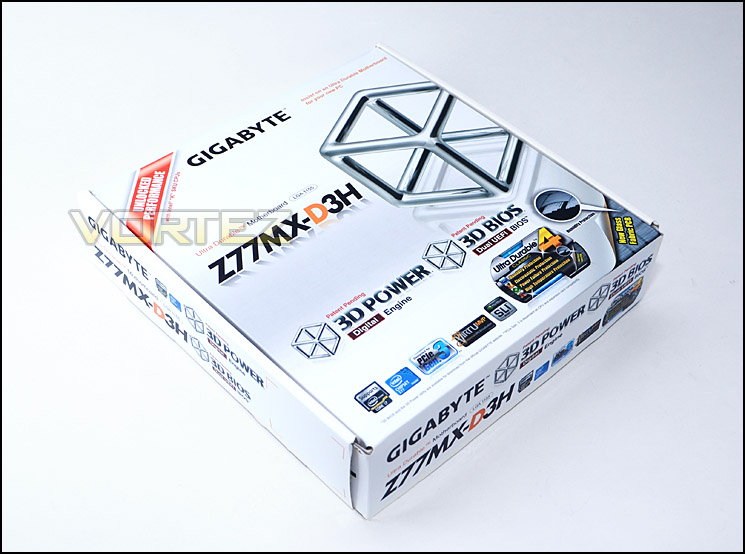
Z77MX-D3H packaging
Inside the box there are only a few items with MX-D3H. The bundled accessories consist of:
• User’s manual
• Software CD
• 4x SATA cables (3GB/s and 6GB/s)
• NVIDIA SLI bridge (flexible)
• Rear IO shield
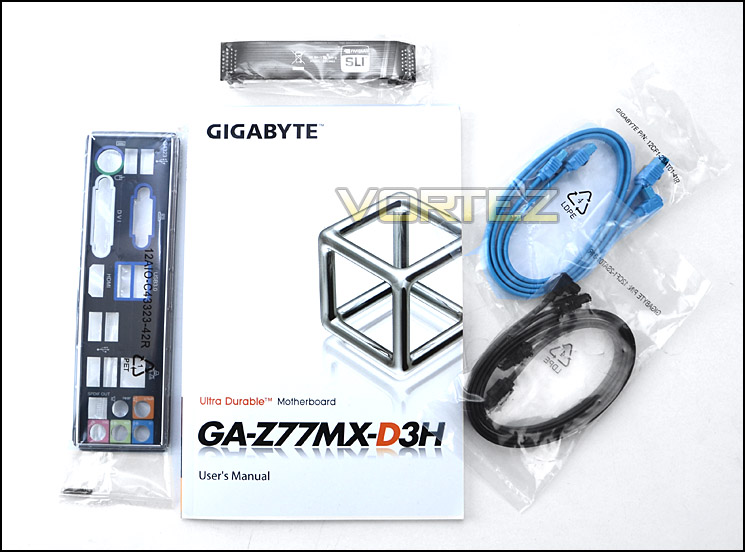
The accessories bundle
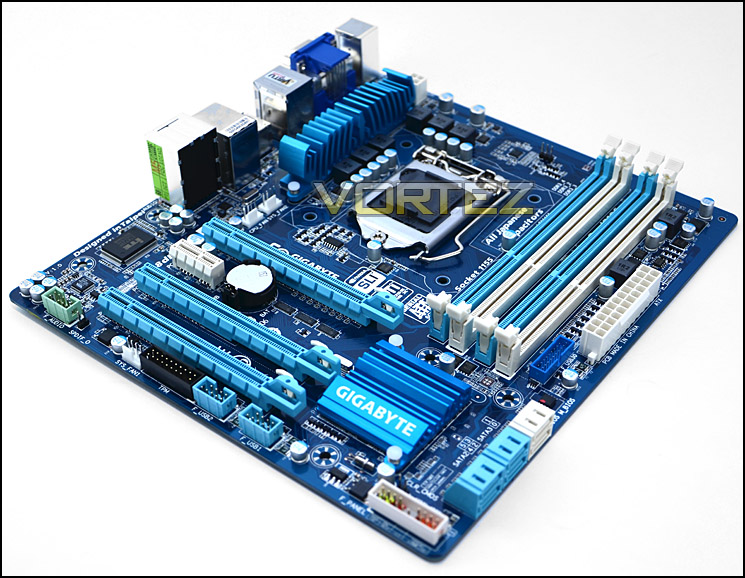
Getting the motherboard out of its box we can get our first glimpse of the MX-D3H.This motherboard is of course MATX and in similar fashion to their graphics cards the PCB on this motherboard is blue. MX-D3H sits inside the entry level range, many will be familiar with GIGABYTE’s mid-high end range that come with a stealthy black appearance – the MX-D3H doesn’t have strong aesthetics. There are baby blue and white ports, slots and heatsinks.
An overview of the motherboard. Love it or hate it?
On the next page we will take a closer look at the MX-D3H.
Closer Look
With MX-D3H using the Intel Z77 chipset, our motherboard is LGA1155 and has support for Intel’s 2nd and 3rd Generation of CPUs (Sandy Bridge and Ivy Bridge).
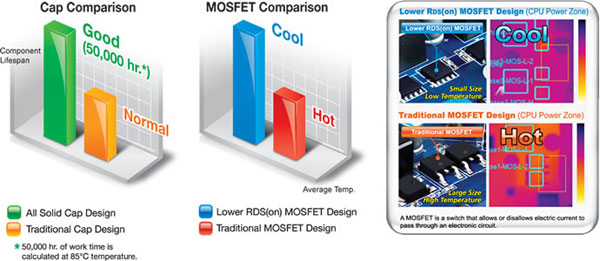
Unlike a vast majority of other Z77 motherboards, MX-D3H only has one heatsink covering the vertically positioned MOSFETs. The MOSFETs that are horizontal have no heatsink covering them this is because GIGABYTE use Lower Rds(on) MOSFETs which don’t generate as much heat as traditional MOSFETs. This ultimately means that only one heatsink is needed to cover the digital PWM on this particular motherboard. The single heatsink is also rather small and compact compared to what we have seen both from GIGABYTE and other brands. GIGABYTE have implemented a 4 + 2 phase power design on this motherboard.
The MX-D3H uses 4-pin CPU power – suggesting that this motherboard is going to require less power and be more efficient.
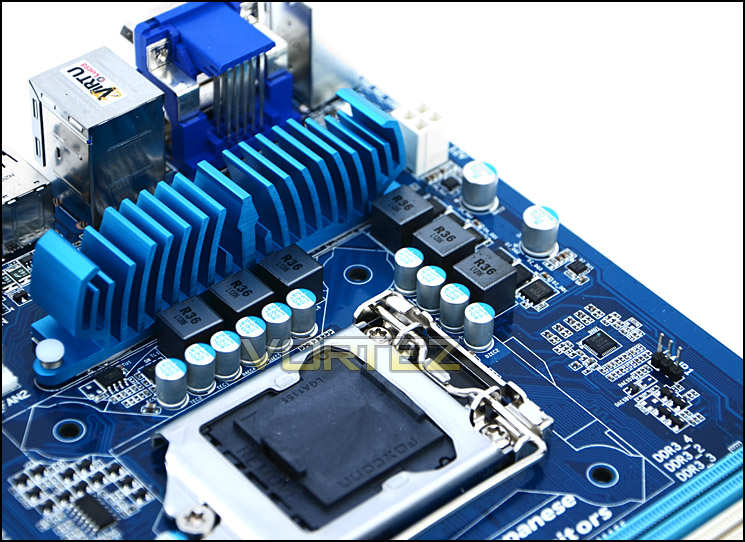
Less cooling around the CPU socket
Turning our attention to the memory slots MX-D3H has support for dual channel DDR3 and Intel XMP. This motherboard can support memory kits from 1066MHz up to 1600MHz and a maximum capacity of 32GB. It’s strange to see such a limitation on the maximum frequency of memory on such a motherboard.
Next to the memory slots is a native USB 3.0 port and dual BIOS chips.
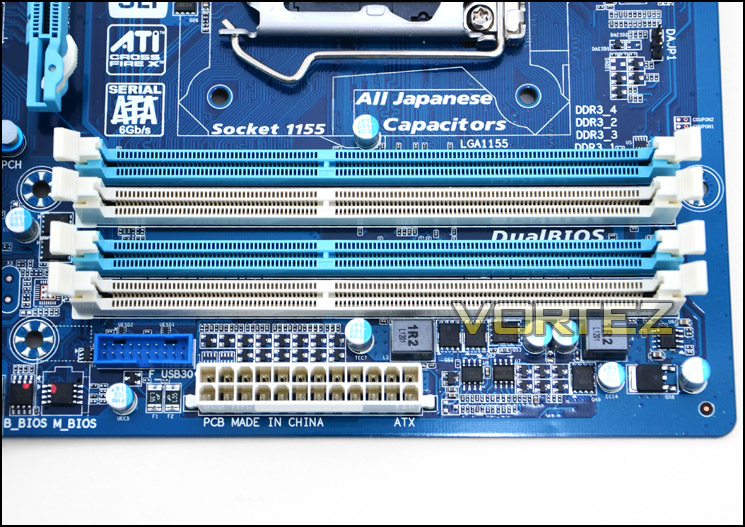
Dual channel DDR3 slots
In terms of storage there are 4x SATA 2 – 3GB/s ports and 2x SATA 3 – 6GB/s ports. There is notably less SATA 3 ports on MX-D3H than what you would get on a full-sized Z77 motherboard but then we are dealing with low-end here. The SATA 3 ports are supplied by the Intel Z77 chip.
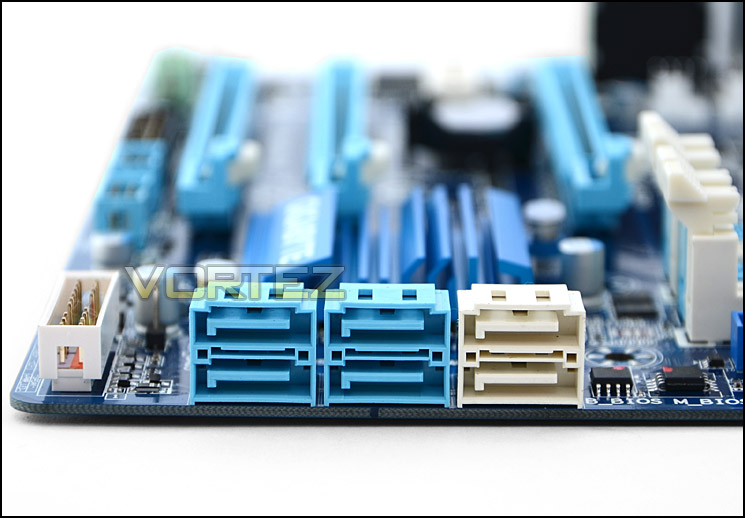
SATA storage ports – 3GB/s and 6GB/s
Suprinsgly for such a small motherboard and target audience, there is support for NVIDIA SLI and AMD CrossfireX. The bottom and top PCI-E slots are PCI-E 3.0 and give x16 and x8 whilst the middle is PCI-E 2.0 and x4. So for those with a single graphics card it would be best to use the top slot and for a dual graphics card configuration the top and bottom slots should be used. The middle PCI-E slot is very close to the bottom slot and would only allow for a single slot solution.
It’s also worth noting that there is just one PCI-E x1 slot underneath the top PCI-E slot.
To the right of the PCI-E slots is a blue heatsink that covers the Intel Z77 chip, this is passive and relatively small.
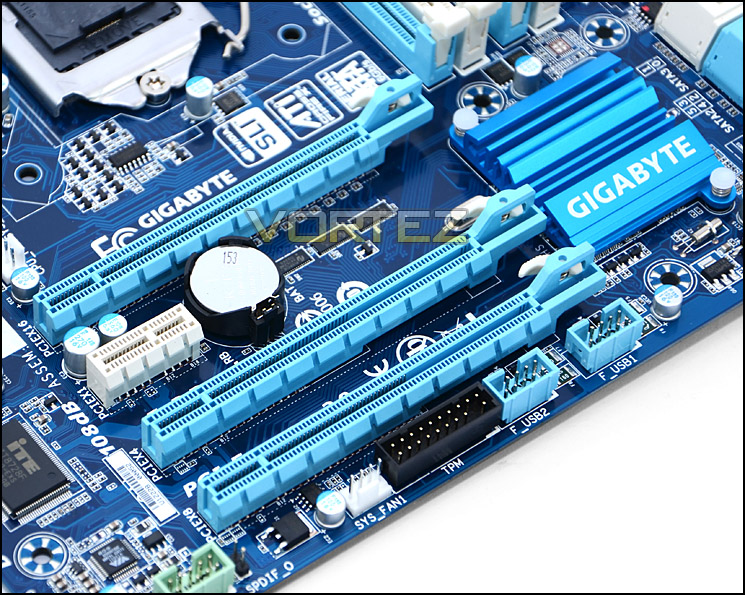
Support for NVIDIA SLI and AMD CrossfireX
Lastly we come to the rear IO. Here there is quite a selection of functionality, from left to right:
• 2x USB 2.0 ports
• PS2 keyboard/mouse
• VGA/DVI video ports
• 2x USB 3.0 ports
• HDMI port
• 2x USB 2.0 ports
• Gigabit LAN (RJ45)
• 2x USB 2.0 ports
• 5x audio jacks with optical S/PDIF (VIA VT2021 codec)
The video ports on this motherboard allow users to take advantage of the IGP on Intel’s 2nd and 3rd Generation processors via Lucid Virtu MVP. Check out a quick demo of Lucid VIRTU MVP during our CeBIT 2012 visit.
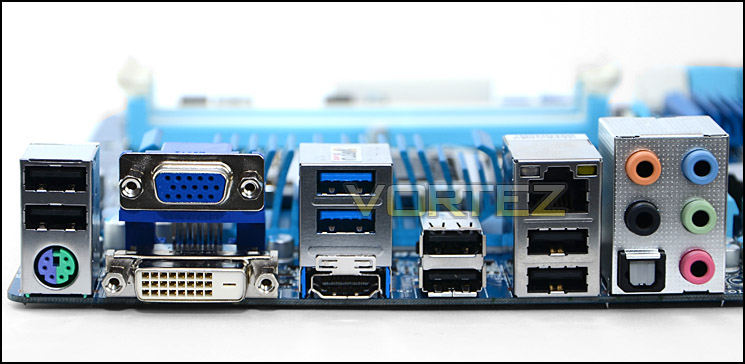
Rear IO with plenty of options
Ultra Durable 4 – Features
Continuing their series of “Ultra Durable” components and features, GIGABYTE offer Ultra Durable 4 with their Intel Z77 motherboards. This encompasses the following feartures:
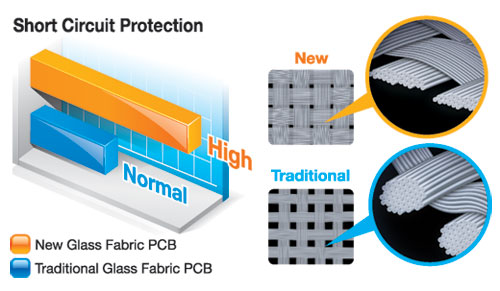
Humidity Protection
Those in certain climates will have to deal with humidity on a daily basis. As a result this can damage components and cause electrical shorts. GIGABYTE have implemented a Glass Fabric PCB which is designed to combat this problem, by using this material there are less gaps between the spaces on the PCB filaments and this in-turn prevents humidity causing problems.
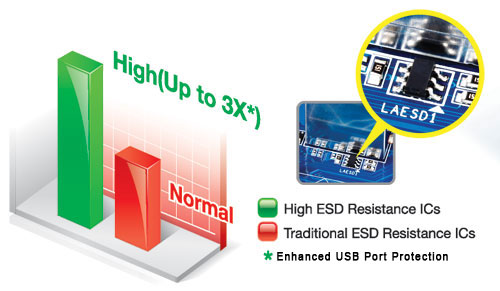
Electrostatic Protection
The next feature is Electostatic Protection. GIGABYTE have armed their Z77 motherboards with High Resistance ICs. Put simply, these help protect against electrostatic discharge!
Power Failure Protection
On GIGABYTE Intel Z77 motherboards, GIGABYTE have implemented dual BIOS so that even if there is a power surge or another type of fault – the secondary BIOS is used and avoids having a complete system shutdown. Anti-surge ICs have also been included to prevent power surges from taking place.

High Temperature Protection
The last feature concerns high temperatures. There are solid CAPs used throughout GIGABYTE’s Z77 motherboards and low RDS(on) MOSFETs work well with high-temperatures. This provides added high-temperature protection and up to 50K hours of component lifespan.
GIGABYTE 3D BIOS
At the tail-end of last year (2011) GIGABYTE displayed their new 3D BIOS. GIGABYTE were late to the UEFI party this 3D BIOS hopes to satisfy GIGABYTE fans who thought they were missing out.
For those who want to see a working version of this BIOS, check out GIGABYTE’s video tour of 3D BIOS below:
GIGABYTE 3D BIOS have two different modes which you can switch between. The first mode is below with an illustration of the BIOS which requires you to move your mouse over various parts to get more info and tweak settings.
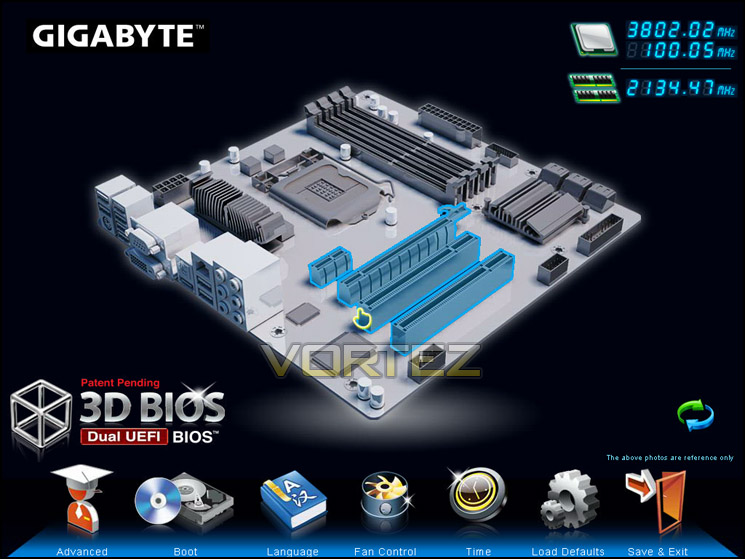
The second mode is what most will be familiar with. In this mode you can alter various settings and there is a great BIOS update tool for flashing to the latest version as well as a feature that allows you to screenshot (these images were taken using this feature) to a USB stick.
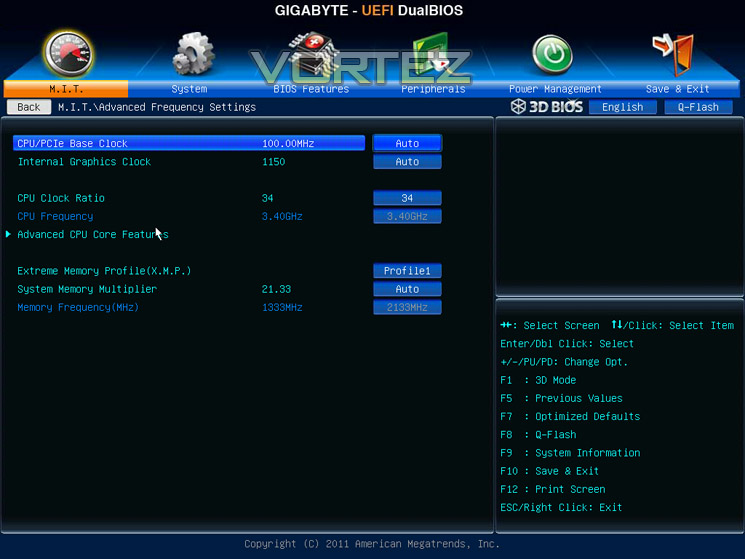
I’ll be honest with you, after using other vendor’s BIOS and then coming to 3D BIOS I was a little underwhelmed. The illustration of the motherboard in the first mode feels like a gimmick. Moving into the second mode the navigation of the mouse isn’t as smooth as I would have liked and I did have trouble getting my laser gaming mouse to even work at some moments.
GIGABYTE need to work on the navigation of their BIOS. It needs to be more fluid. Users, especially advanced users will want to get in and out of the BIOS quickly and at the moment – certainly from my experience it isn’t very responsive.
Lucid VIRTU MVP
An interesting feature that first appeared on the desktop environment with the Sandy Bridge architecture was the integrated graphics on the CPU. This meant that regardless of if you had a discreet graphics solution you always had the ability to use “Built in” processing power to watch movies, view 3D content and take part in some casual gaming.
With Ivy Bridge, Intel have stepped up with new graphics architecture by delivering full DX11 functionality. With HD-4000 there is a significant increase in execution units which mean even greater performance enhancements when compared to HD 2000/3000 – found on Sandy Bridge CPUs. To the end user this should translate to being able to handle 1080p movies, more complex gaming titles and even more intense 3D renders.
This motherboard has HDMI/VGA/DVI ports to allow connectivity to Intel’s IGP with support via Lucid VIRTU MVP. What VIRTU does is – it allows the user to utilise both discrete GPU and Intel’s IGP (built in graphics on the CPU) without the need to change hardware or switch the outputs.
VIRTU brings in many unique features, a great deal of them are associated with power management – relating to heat, fan speed, and other useful elements. There are two different modes to use when considering VIRTU:
i-Mode
This provides the user with Intel features and power saving options when not being used for 3D gaming. Display must be connected to video output on the motherboard to use this feature.
d-Mode
This mode allows gamers to enhance their 3D experience and performance – combining a discrete graphics solution and the iGPU. In this mode we can use VIRTU to assist with things like transcoding and media encoding in general. The overriding thought on this is that even entry level AMD and NVIDIA graphics cards have their own technologies for handling media encoding such as AMD Stream and NVIDIA CUDA – both of these technologies are deemed as being exceptional alternatives and don’t offer any real advantage over VIRTU using IGP for these types of task.
Display drivers for discreet graphics card must be installed prior to VIRTU drivers.

For more information on VIRTU please go to: Lucidlogix Virtu MVP
Test Setup & Overclocking
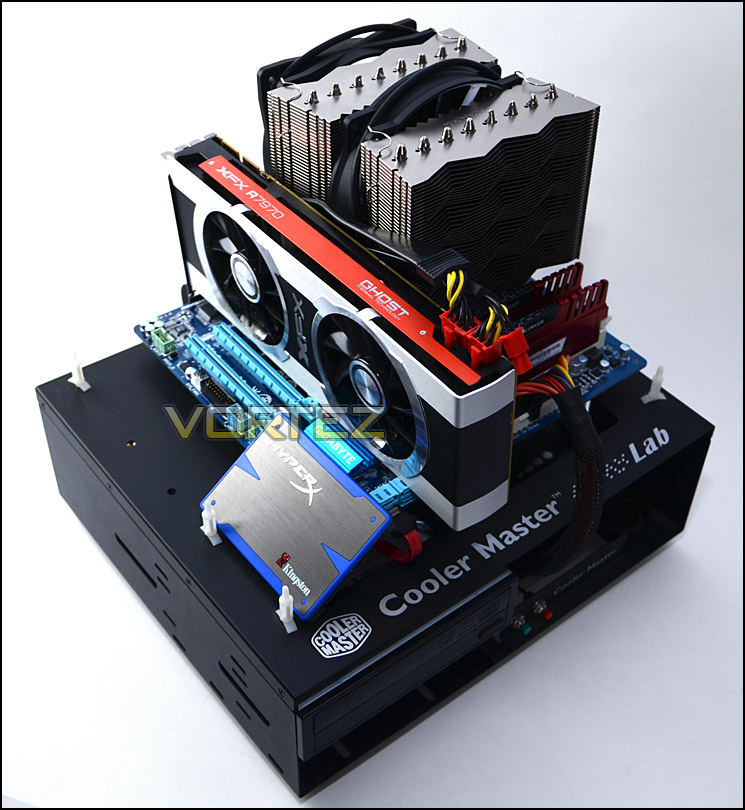
CPUs Intel Core i5 3570K (3.40GHz) Ivy Bridge
Cooling Alpenfohn K2 – Mount Doom
Motherboard GIGABYTE Z77MX-D3H
Memory Corsair Vengeance 8GB 2133MHz CL11 DDR
Graphics XFX R7970 Black Edition
Storage Kingston HyperX 240GB SSD
PSU OCZ Fatal1ty 750W
Cooling Alpenfohn K2 – Mount Doom
Motherboard GIGABYTE Z77MX-D3H
Memory Corsair Vengeance 8GB 2133MHz CL11 DDR
Graphics XFX R7970 Black Edition
Storage Kingston HyperX 240GB SSD
PSU OCZ Fatal1ty 750W
Benchmarks
Cinebench 11.5 – CPU Score
x264 HD 4.0 – 1st and 2nd pass encoding
SiSoftware SANDRA 2012 – CPU & Memory benchmarks
AIDA64 – CPU benchmarks
3DMark 11 – DX11 3D Performance and Extreme preset
Games – DIRT 3, Skyrim and Battlefield 3
Other Software
Core Temp
LinX stress Test
CPU-Z
Overclocking
As previously mentioned in our Intel Core i5 Sandy Bridge Roundup – overclocking with Ivy Bridge is identical to Sandy Bridge. It is achieved by altering the multiplier rather than the BCLK. So the BCLK stays at 100MHz and the multiplier is modified. So if we have 100MHz on the BCLK and 40 for the multiplier this will obviously output 4GHz.
For this section of the review the maximum overclock was achieved by using the Intel Core i5 3750K and monolith CPU cooler – Alpenfohn K2 with 2x 120mm and 1x 140mm fans. The multiplier for Core i5-3570K was nudged up in small increments starting with 43 and upon booting into windows LinX was run 5 times in order to observe temperatures and confirm stability.
The 3750K managed to overclock up to 45 – 4.5GHz from 3.40GHz, a 32% overclock. This is a significant increase and required 1.38 vcore. I pushed beyond this but sadly even with 1.42v running through the CPU it locked up on POST. Temperatures at 4.5GHz with 1.38v rose to approx. 75C across all cores.
NOTE CPU-Z isn’t reading the vcore properly in the screenshot.
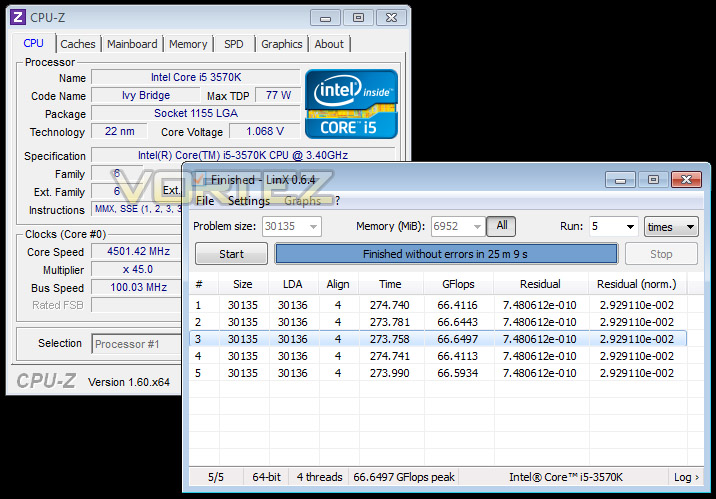
This maximum overclock will be used throughout our benchmarks – as well as stock 3570K frequency with turbo boost enabled.
Power Consumption
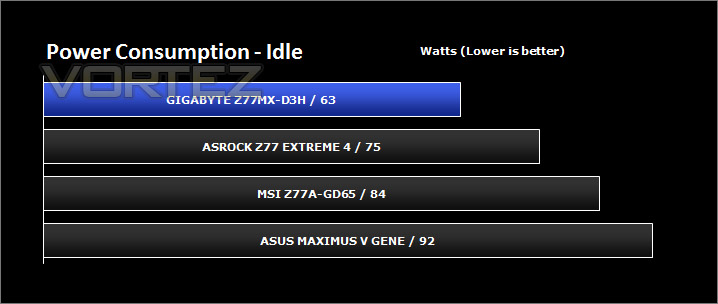
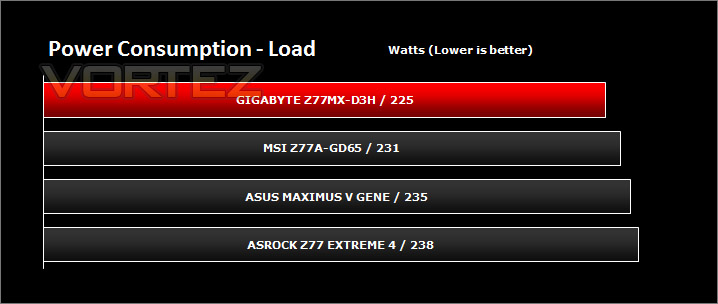
It’s interesting to note the power consumption across all motherboards. Although they are using P67 and Z68 chipsets, energy results can fluctuate between manufacturers due to the features and specifications that are integrated. First of all, for the idle tests the system is cold booted into Windows and no additional applications are executed – the watts are noted on the external energy monitor we use and then the system is loaded with 3DMark 11 – watts are again monitored for the duration of the test and the highest rated wattage result is then noted down. Below are the results of this energy test.
Encoding Performance – X264 HD
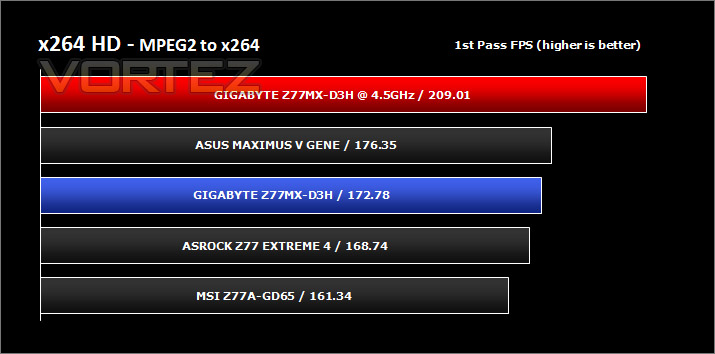
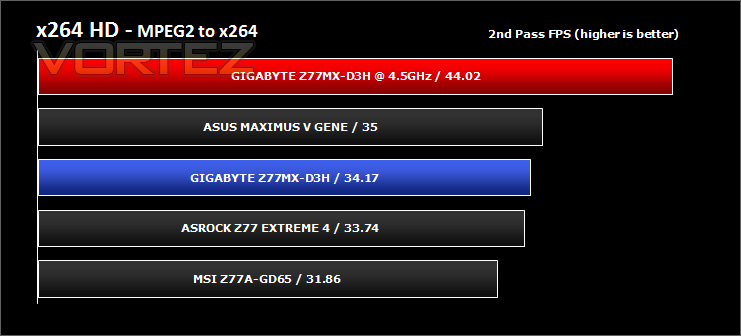
Simply put, this test measures how fast your machine can encode a short, DVD quality MPEG-2 video clip into a high-quality x264 video clip. What’s x264, you ask? It’s more or less the next-generation Xvid/DivX codec. I think it’s ideal for a benchmark because the application (x264.exe) reports fairly accurate compression results (in frames per second) for each pass of the video encoding process, and it uses multi-core processors very efficiently.
x264 HD gives results for 2 passes when compressing an MPEG-2 clip into x264. It presents 4 separate results for each pass giving a total of 8 – all results are given in FPS. For each pass I have averaged out the results.
Processing Features Performance – AIDA64
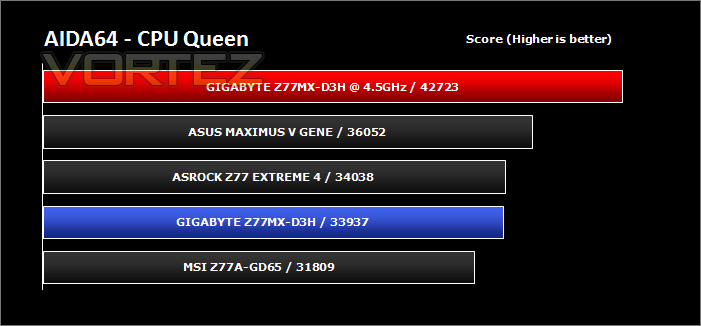
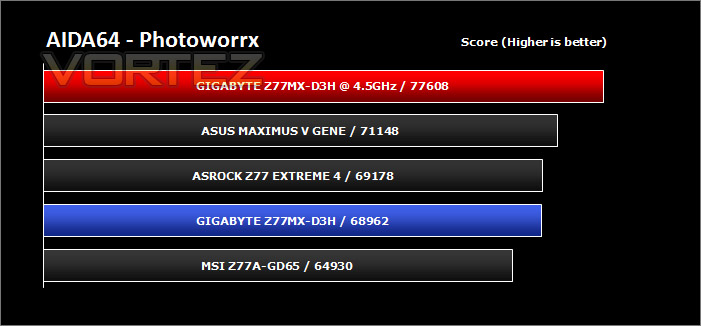
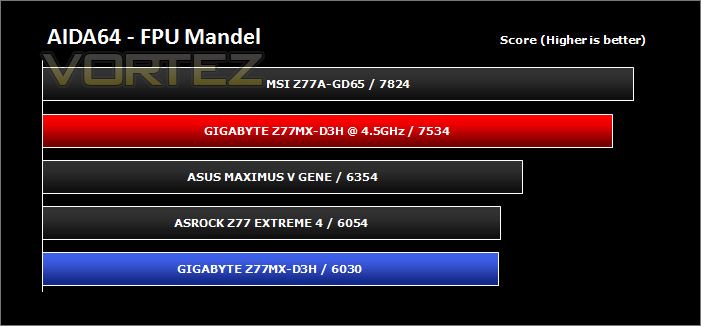
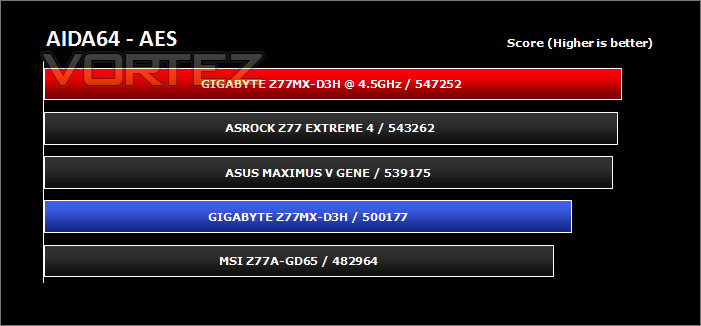
Get your copy of AIDA64 here!This simple integer benchmark focuses on the branch prediction capabilities and the misprediction penalties of the CPU. It finds the solutions for the classic “Queens problem” on a 10 by 10 sized chessboard. At the same clock speed theoretically the processor with the shorter pipeline and smaller misprediction penalties will attain higher benchmark scores. For example — with HyperThreading disabled — the Intel Northwood core processors get higher scores than the Intel Prescott core based ones due to the 20-step vs 31-step long pipeline. CPU Queen test uses integer MMX, SSE2 and SSSE3 optimizations.
Processing Power Performance – Cinebench
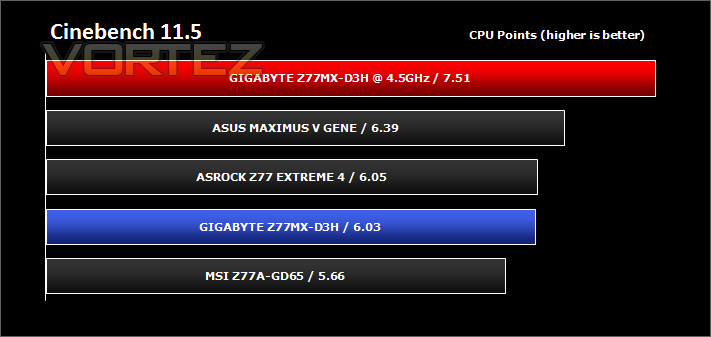
CINEBENCH can measure systems with up to 64 processor threads. This test scene contains approximately 2,000 objects which in turn contain more than 300,000 polygons in total, and uses sharp and blurred reflections, area lights, shadows, procedural shaders, antialiasing, and much more. The result is displayed in points (pts). The higher the number, the faster your processor.
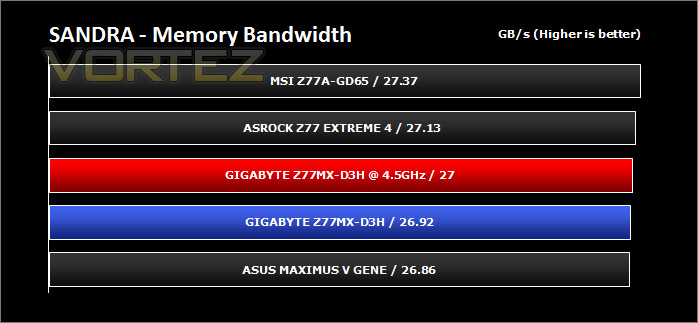
Bandwidth Performance – SiSoftware SANDRA
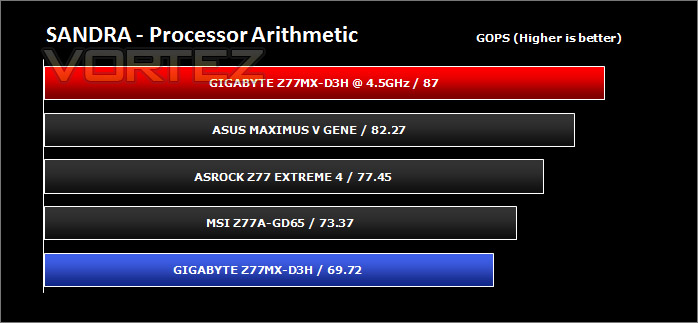
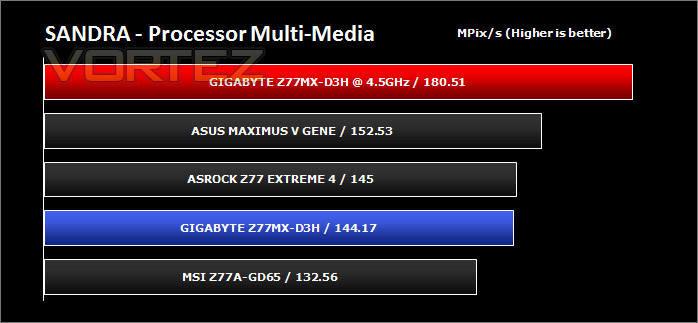
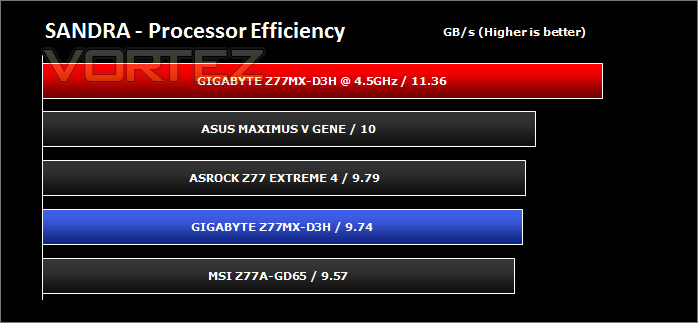
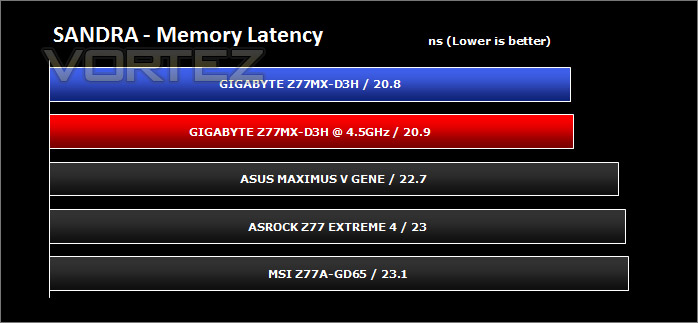
SANDRA isn’t always a benchmark that is included in hardware reviews but I believe it shouldn’t be ignored. SANDRA provides a vigorous package that tests your system in a rather large array of benchmarks. There are many aspects of benchmark that can be executed. We will be considering – CPU and memory tests.
3D Performance – 3DMARK 11
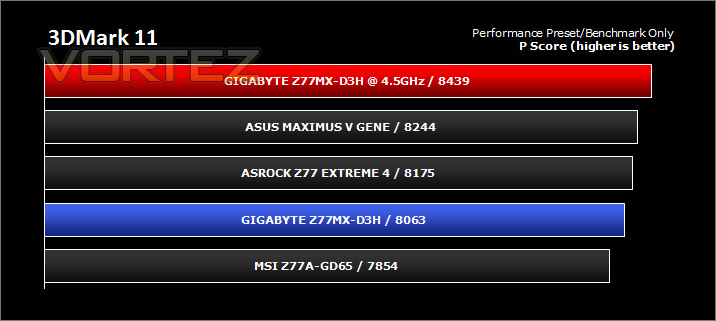
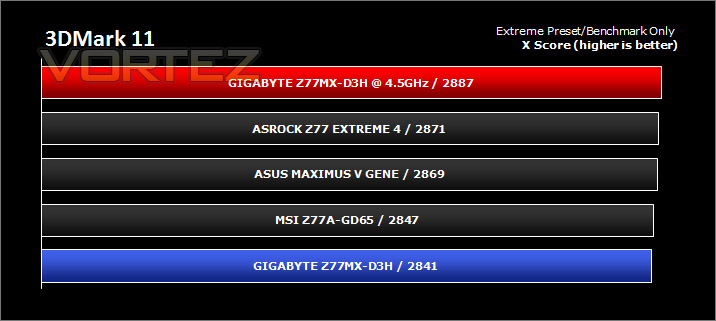
Designed to measure your PC’s gaming performance 3DMark 11 makes extensive use of all the new features in DirectX 11 including tessellation, compute shaders and multi-threading. Trusted by gamers worldwide to give accurate and unbiased results, 3DMark 11 is the best way to consistently and reliably test DirectX 11 under game-like loads.
3DMark 11 is a very popular 3D performance benchmark suite and needs little introduction. For the test settings both Performance and Extreme presets are run with ‘benchmark only’ being selected. This provides good analysis. Many will only test the performance preset, using the extreme mode we can examine the board under much more severe stressing – at 720p and 1080p.
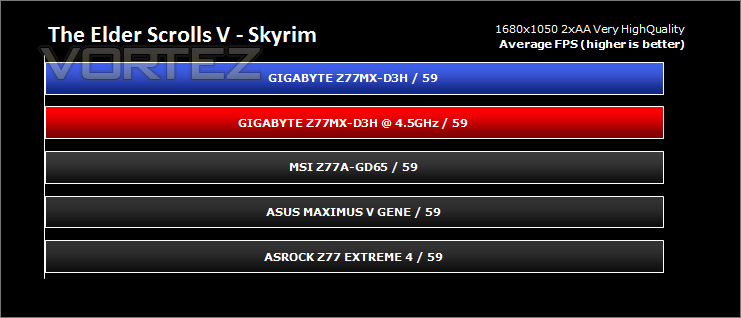
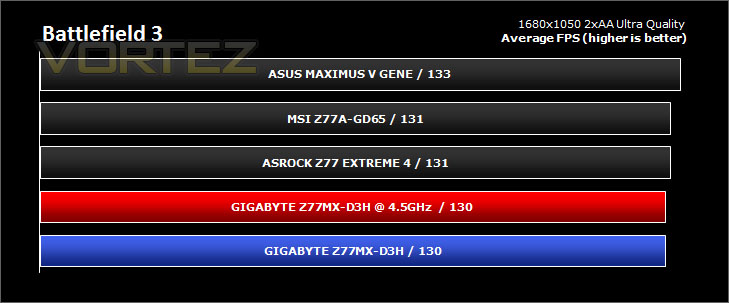
Gaming Performance – DIRT 3, Skyrim & Battlefield 3
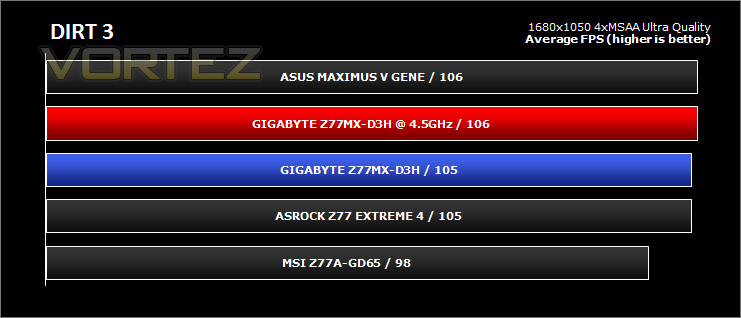
It’s important for us to perform a number of game benchmarks as well as the synthetic tests because gamers will want to know if there are any significant benefits. So here we have a selection of popular gaming titles, critically acclaimed and action-packed.
Settings
DIRT 3
– 1680×1050 4xMSAA – Ultra Quality *Benchmark tool*
Skyrim
– 1680×1050 2xAA – Very High Quality *FRAPS – 1st episode*
Battlefield 3
– 1680×1050 2xAA – Ultra Quality *FRAPS – Sepur Fedelis*
The gaming titles selected demand GPU power over CPU power – in each test the difference is rather marginal.
Conclusion
So far in our Intel Z77 journey we have experienced the might of ASUS, MSI, ASRock with their high-end offerings, and today in our first GIGABYTE review we are to report back on an entry-level M-ATX motherboard. It would be unfair really to compare (in this conclusion) what we have tested so far against the Z77MX-D3H as it is in a totally different league.
MX-D3H managed to hold up quite well against the other products we have had in for review this week. The performance benchmarks revealed that this motherboard can offer similar and in some cases, better performance. Overclocking as per other reviews identified some key advantages were video encoding and raw CPU processing power is concerned.
Overclocking realised a reasonable result – achieving 4.5GHz out of our Intel Core i5-3570K. This may not be as high an overclock as our other Intel Z77 motherboards but then this motherboard isn’t designed for this purpose. MX-D3H can be purchased for around £100inc. VAT making it quite an affordable piece of kit, though the Z77X-D3H can be bought for even less – has a stronger feature-set and looks to suit. Also around this price-range is ASRock’s Extreme4-M which is cheaper and has better aesthetics. It’s quite a battle at this price-point.
The things I don’t like about this motherboard are the aesthetics. It looks dated and lacks any flare. Compared to rival motherboards (even entry level) it looks cheap. I appreciate this is GIGABYTE’s entry level range but a colour-scheme alteration should be in order to spruce things up.
3D BIOS is another area that I think needs some slight improvement. Navigation during my experience was sluggish and with a laser gaming mouse – it was hit and miss if it worked.
Pros
+ Affordable
+ Performance is good
+ Ultra Durable 4 feature-set
Cons
– Lacks visual appeal
– 3D BIOS needs improving
+ Affordable
+ Performance is good
+ Ultra Durable 4 feature-set
Cons
– Lacks visual appeal
– 3D BIOS needs improving

Click here for an explanation of our awards at Vortez.net.


