An affordable NVIDIA GTX 1660 graphics card using the Twin X2 thermal design. Is this the best value for money 1080p GPU you can buy? N16602-06D5-1510VA15

Product on Review: GTX 1660 Twin X2
Manufacturer & Sponsor: INNO3D
Street Price: £199 GBP – $219 USD
Soon after the release of the GTX 1660 Ti comes the GTX 1660, which begs the question – where do the differences lie? Well. The GPU remains the same Turing-based TU116 but with less Streaming Multiprocessors (SMs) which brings the Cuda Core count down to 1408 from 1560. The non-Ti GPU also utilises the reliable GDDR5 rather than GDDR6 but benefits from faster clock speeds.
Based on the specifications, the GTX 1660 should trade blows with AMD’s RX 580 and 590. The question is, will it be a better value for money GPU in the entry-level segment?
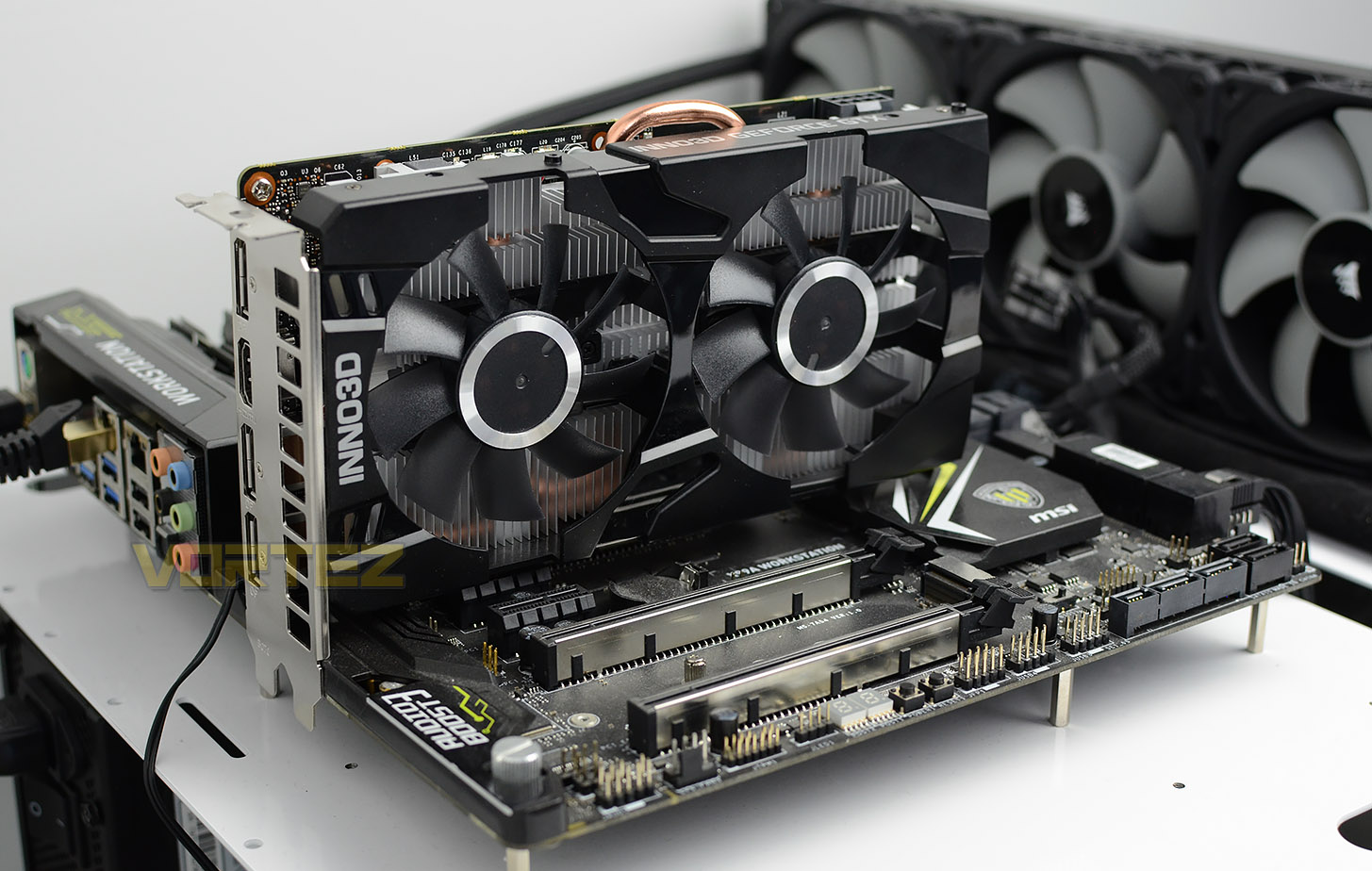
Today we’ll be putting the INNO3D GTX 1660 Twin X2 into the spotlight, which comprises of a double-fan cooler. Twin X2 sits at the base MSRP and as such it lacks the factory overclock you might find on some of the more expensive models on the market.
About INNO3D
InnoVISION Multimedia Limited is a pioneering developer and manufacturer of a diverse range of cutting-edge multimedia PC hardware products established in 1998 Hong Kong. Our manufacturing operations have been set up since 1990 in Shenzhen, China. In this short period of time we focus on manufacturing OEM/ODM products as well as contracting out extensive production and research facilities to specialist companies. We have accomplished international recognition by PC’s top reviewers as becoming an outstanding success and one of the most fast growing companies in Asia.
Technical Specifications
Below are the technical specifications surrounding GTX 1660 supplied directly by INNO3D:
GPU
GTX 1660 (TU116)
Stream Processor
1408
Video Memory
6GB GDDR5
Memory Bus
192-bit
Engine Clock
1530MHz
Engine Clock Boost
1785MHz
Memory Clock
8000MHz Effective
PCI Express
3.0
Display Outputs
3x DisplayPort 1.4
1x HDMI 2.0b
Recommended Power Supply
500W
DirectX
12 API feature level 12_1
OpenGL
4.5
Cooling
Double-fan solution
Slot Size
2
Supported OS
Windows 10
Card Length
190 x 100 x 38 mm
GTX 1660 (TU116)
Stream Processor
1408
Video Memory
6GB GDDR5
Memory Bus
192-bit
Engine Clock
1530MHz
Engine Clock Boost
1785MHz
Memory Clock
8000MHz Effective
PCI Express
3.0
Display Outputs
3x DisplayPort 1.4
1x HDMI 2.0b
Recommended Power Supply
500W
DirectX
12 API feature level 12_1
OpenGL
4.5
Cooling
Double-fan solution
Slot Size
2
Supported OS
Windows 10
Card Length
190 x 100 x 38 mm
Features
NVIDIA’s GeForce GTX 1660’s new TU116 GPU is a brand new design specifically for the mainstream gaming market. Manufactured using TSMC’s 12nm FinFET technology, it incorporates 1408 ‘Turing’ CUDA Cores arraigned in a Shader Module that differs considerably from that of the RTX 2060. Without both Tensor and RT Cores it lacks hardware support for NVIDIA RTX Hybrid/Real-Time Raytracing and AI features such as DLSS, but does roll in other improvements specific to the Turing architecture.
UPDATED CACHE MODEL
Turing moves to a Unified L1 Cache, a schema which offers lower latency, higher bandwidth, and higher capacity compared to Pascal and earlier architectures. NVIDIA describe the design as featuring a more ‘heavyweight’ shader thanks to a 3x increase in L1 Cache Size (from 48 to 128 KB) and 4x increase to L1 Cache Bandwidth.These changes are likely to have a high impact on effective shader Instructions Per Clock, even without accounting for game engine optimisations that take advantage of new dynamic cache allocation features and support for larger data structures. Simply increasing the cache size will increase the chances for a cache ‘hit’, reducing how often slower cache and memory needs to be accessed.
COHERENT FLOATING POINT AND INTEGER OPERATIONS
NVIDIA’s Pascal architecture is capable of executing both Floating and Integer operations, but only sequentially across the shader module by switching between the two modes. Turing shader processors by contrast can execute batches of mixed operations in parallel, greatly increasing total operations per second in mixed workloads.While floating point operations have tended to dominate game engine workloads, modern titles are beginning to roll in integer operations where it’s deemed appropriate as GPU hardware broadens its mixed workload capabilities. As a result the GTX 1660 has a certain amount of future-proofing when compared to a GPU from an older generation with similar performance characteristics.
ADAPTIVE SHADING
Sections of any rendered scene will differ in complexity, from heavily textured objects and surfaces to more plain walls with less detail. From frame to frame large areas with less detail may change very little over time. Adaptive Shading techniques are aware of that contextual difference, and can allocate fewer shading resources to these zones dynamically.Adaptive Shading is one aspect of Variable Rate Shading possible under the RTX technologies umbrella. It’s not clear which aspects won’t be possible with the GTX 16-series, but that will no-doubt become clear as it is used in more games. For now, Adapative Shading is present in Wolfenstein: The New Colossus, and is a factor in the NVIDIA’s projection of a 1.4x performance advantage vs the 1060 6GB.
VIRTUALLINK
The new VirtualLink VR connector standard is a optionally available on the GTX 1660. We already know of a number of partner cards which will not be incorporating the I/O connector, so approach each on a case-by-case basis if it is important to you. From a pure performance perspective the GTX 1660 should be more than capable of current Premium VR rendering support as its anticipated performance exceeds that of the already-validated GTX 1060 6GB.NEW NVENC ENCODING ENGINE
The GXT 1660 supports NVIDIA’s latest NvEnc hardware video encoder. Designed specifically for game broadcasting via Twitch and other streaming platforms, it improves the video stream (x264 fast) encoding bit rates to up to 6000KB/s. Video quality is also improved, now exceeding that of an Intel Core i9-9900K using the same encoding while also offloading processing from the CPU.OC SCANNER
OC Scanner was introduced alongside the RTX 20-series cards as a means of offering automated (one-click) overclocking for a ‘free’ performance boost, and has since been extended to older NVIDIA GPU architectures. It works by scanning for artefacts and other inconsistencies as operating frequencies increase, easing off when detected and failing safely rather than causing hard lockups. OC Scanner is now incorporated into the major aftermarket overclocking tools from EVGA, MSI and ASUS.POWER EFFICIENCY
Currently Turing GPUs are manufactured using TSMC’s 12nm lithography, which has many similarities the GTX 1060 6GB’s 16nm manufacturing process. Power efficiency improvements will tend to be down to architectural changes rather than the manufacturing process, but higher frequencies on similar voltages aren’t out of the question.NVIDIA boast of a 1.4x perf/watt improvement in optimal workloads over the GTX 1060 6GB, which is more than just a little significant. The GTX 1660 has a reference TDP of 120W, the same as the GTX 1060 6GB, which speaks to the expected performance improvement you might see when comparing with the previous generation.
Most GTX 1660 will ship with a single 6-Pin PCIe connector, but some are equipped with an 8-pin connector for a little more overhead.
Closer Look Video Review
For this review we’ve produced a video review showing the physical design of this graphics card, highlighting its features and stripping it down by removing the thermal solution. You can watch the video below or click on this link to watch the INNO3D GTX 1660 Twin X2 Video Review.
Test Setup & Methodology
HOW WE TEST GRAPHICS CARDS
Testing a graphics card is an extremely lengthy process. We sometimes see reviews where a graphics card has been tested using out of date equipment, out of date games and even out of date drivers. While the latter can be excused due to the sheer amount of driver updates making a thorough review impossible we will however notify the reader when we have used a different driver to the normal for example a pre-release driver. For the most part however we will always use the same hardware and latest drivers so this does certainly need to be taken into consideration when viewing our testing results. Each game and benchmark is tested times with the lowest and highest scores omitted out of the 5 results and the average then taken from the three remaining to give us our final result for each resolution and setting used.HARDWARE
Taking Intel’s High-End Desktop platform, our hardware utilises the Intel X99 chipset. Combined with this we use the Intel Core i7-5960X Extreme Edition processor clocked to a realistic and achievable 4GHz to ensure we have no CPU bottlenecks. With 16GB (4x4GB) of DDR4 at 2666MHz and a 750GB SSD there should be minimal paging so the benchmarks we run today will hopefully give a true reflection of the graphics card’s performance.Graphics Cards on test:
INNO3D GTX 1660 Twin X2
GIGABYTE GTX 1660 Ti GAMING OC
ZOTAC GTX 1660 Ti
ASUS STRIX GTX 1660 Ti
NVIDIA GTX 1070
NVIDIA GTX 1060
NVIDIA GTX 1050 Ti
NVIDIA GTX 1050
AMD RX 590
AMD RX 580
AMD RX 570
Special thanks go to Avermedia, Intel, Corsair, MSI and AOC for providing the extreme spec components used for our test bench:
Motherboard: MSI X99A Workstation
CPU: Intel Core i7-5960X Extreme Edition @ 4GHz
RAM – 16GB (4x4GB) Corsair LPX Vengeance (Red) DDR3 @ 2666MHz 16-17-17-35 C1
Power Supply – CORSAIR HX1050
Hard Drive – Samsung 840 EVO 750GB
Cooler – CORSAIR Hydro Series™ H150i Pro 360mm Extreme Performance Liquid CPU Cooler
Monitor – AOC 28″ 4K U2879VF
Capture Card – Avermedia Live Gamer Extreme 2
CPU: Intel Core i7-5960X Extreme Edition @ 4GHz
RAM – 16GB (4x4GB) Corsair LPX Vengeance (Red) DDR3 @ 2666MHz 16-17-17-35 C1
Power Supply – CORSAIR HX1050
Hard Drive – Samsung 840 EVO 750GB
Cooler – CORSAIR Hydro Series™ H150i Pro 360mm Extreme Performance Liquid CPU Cooler
Monitor – AOC 28″ 4K U2879VF
Capture Card – Avermedia Live Gamer Extreme 2
BENCHMARKS
If you are a regular reader of our reviews you will know we like to test the latest hardware with the latest games and benchmarks on the market. Here are the games we’ve chosen:Fortnite
Middle Earth: Shadow of War
Apex Legends
Shadow of the Tomb Raider
F1 2018
Battlefield V
Middle Earth: Shadow of War
Apex Legends
Shadow of the Tomb Raider
F1 2018
Battlefield V
To capture framerates we use a combination of in-game benchmark tools and FRAPS.
We also take into consideration the benchmarkers out there so have included three of the more popular synthetic benchmarks available:
Let’s see how today’s graphics card performed…
Power, Temperatures, Acoustics
To test for power consumption, we take a measurement from the plug socket. It is important to note that the figures below represent total system power use and not just the GPU. The CPU was always in a fixed state (4GHz overclock) so did not affect the additional power load when the GPU was placed under 100% load using Heaven 4.0 which was ran for 20 minutes at which point a load reading was taken. Idle readings were taken 5 minutes after system boot to ensure any background services and applications had loaded.
TEMPERATURE
To test temperatures we measured idle temperatures after booting windows, letting all applications finish loading and ran a few benchmarks. Once the benchmarks were complete we left the card to reach a cooling plateau where we then took the idle temperatures. For the load tests we set Heaven 4.0 running continuously for ~30 minutes recorded the peak/maximum GPU temperature.ACOUSTICS
The Twin X2 is quiet under full load – presenting no serious concerns about noise. The fans stop spinning during idle state to render the card “silent”.Overclocking
To overclock the GTX 1660 we used MSI Afterburner to modify the frequencies.
We were able to nudge up both the GPU and memory clock speeds on this graphics card – shifting the GPU boost to 1981MHz and the memory clock to 2126MHz. This is impressive it allows us to tap into extra frames in-game:
DX12: 3DMark Time Spy
Download your copy nowWith its pure DirectX 12 engine, which supports new API features like asynchronous compute, explicit multi-adapter, and multi-threading, 3DMark Time Spy is the ideal benchmark for testing the DirectX 12 performance of the latest graphics cards.
DX11: 3DMark FireStrike
Download your copy nowFire Strike is the new showcase DirectX 11 benchmark designed for high-performance gaming PCs. It is UL’s most ambitious and technical benchmark ever, featuring real-time graphics rendered with detail and complexity far beyond what is found in other benchmarks and games today.
DX11: Unigine Heaven 4.0
Heaven Benchmark with its current version 4.0 is a GPU-intensive benchmark that hammers graphics cards to the limits. This powerful tool can be effectively used to determine the stability of a GPU under extremely stressful conditions, as well as check the cooling system’s potential under maximum heat output. It provides completely unbiased results and generates true in-game rendering workloads across all platforms.
DX11: Unigine SuperPosition
Superposition is a new-generation benchmark tailored for testing reliability and performance of the latest GPUs. Top-notch visuals, support for VR-devices and an interactive mode with mini-games — the list of features built into Superposition could go on and on.
DX11: Fortnite
Fortnite Battle Royale is the FREE 100-player PvP mode in Fortnite. One giant map. A battle bus. Fortnite building skills and destructible environments combined with intense PvP combat. The last one standing wins.DX11: Middle Earth: Shadow of War
Middle-earth: Shadow of War is an action role-playing video game developed by Monolith Productions and published by Warner Bros. Interactive Entertainment. It is the sequel to 2014’s Middle-earth: Shadow of Mordor.DX11: Apex Legends
Apex Legends is a free-to-play battle royale game developed by Respawn Entertainment and published by Electronic Arts. Set in the same universe as Titanfall, the game was released for Microsoft Windows, PlayStation 4, and Xbox One on February 4, 2019.DX12: Shadow of the Tomb Raider
Shadow of the Tomb Raider is an action-adventure video game developed by Eidos Montréal in conjunction with Crystal Dynamics and published by Square Enix. It continues the narrative from the 2013 game Tomb Raider and its sequel Rise of the Tomb Raider, and is the twelfth mainline entry in the Tomb Raider series.
DX11: F1 2018
F1 2018 is a racing video game and the tenth instalment in the Formula One video game franchise developed and published by Codemasters. The game is based on the 2018 Formula One World Championship and includes all twenty-one circuits from the calendar and all twenty drivers and ten teams competing in the season.
DX11: Battlefield V
Battlefield V is a first-person shooter video game developed by EA DICE and published by Electronic Arts. Battlefield V is the sixteenth installment in the Battlefield series.Overall Performance
Here we take a look at the overall performance of the graphics card. This figure is determined by finding the average FPS across all of the settings used in a particular benchmark(game) to give us an overall value.
Value For Money
We make a simple calculation for this set of results. For each game we add all of the resulting FPS totals together and then divide by the four sets to give us an overall performance figure. While the figures alone do not give you an accurate picture of how the card will perform in any given scenario, they do tell you, when averaged, which GPU is the more capable across all of the benchmarks and settings tested.
Please note: we’ve used GBP for currency but since this is relative – regardless of which currency you use, this will give you a good indication of value for money.
Conclusion
The GTX 1660 Ti came with quite a surprise earlier this month, but the arrival of GTX 1660 was certainly more foreseeable. Aiming squarely at 1080p, is this new GPU a better value for money solution to go with?
Let us start by saying that INNO3D are known for supplying more affordable options compared to key NVIDIA rivals and the Twin X2 is no exception. This card comes in at the base MSRP of £199 GBP / $219 USD. For that price you get a graphics card which is as basic as they come, there are no supplementary features nor is there a factory overclock, however do receive a capable custom thermal solution.
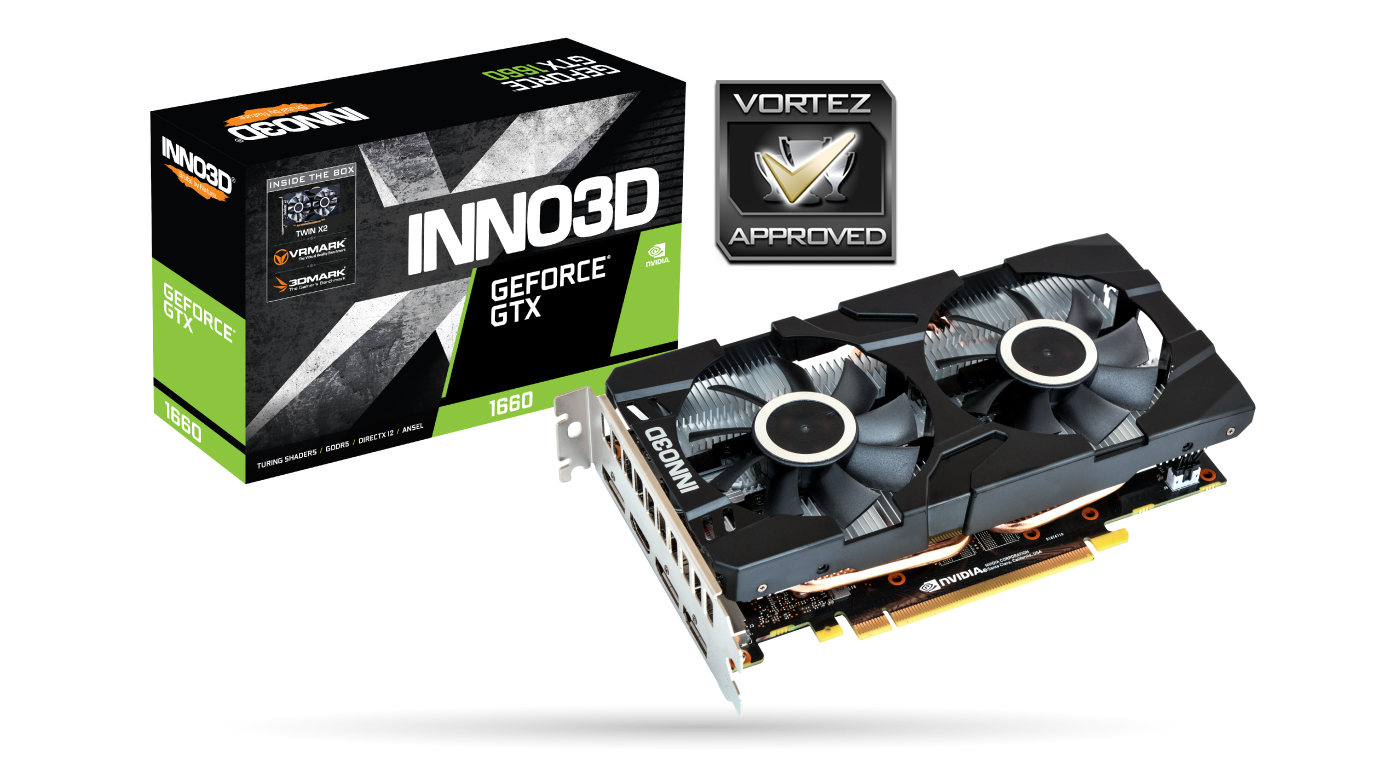
The double-fan cooler on this graphics card will keep GPU temperatures within the realms of ‘safe’, while giving enough headroom to nudge up the frequencies too. What is most impressive about the cooler is the low-noise properties which present us with no disruptive drones or whirs. Furthermore, under idle usage the fans will stop spinning to achieve silence.
Putting Twin X2 into some of the latest gaming highlights prowess, specifically in the 1080p area. This graphics card has no problems in handling the latest games with the detail maxed out and 1440p is also an option, but we would suggest dropping the detail down to tap into playable framerates.
The benefit to buying such a GPU like this (based on the low-cost) is the ability to apply a manual overclock – moving the frequencies beyond that of pre-clocked models which cost considerably more. We can confirm that Twin X2 is able to sustain a decent overclock, which, in turn will translate to extra performance in-game.
Looking to replace an aging entry-level GPU? The GTX 1660 Twin X2 from INNO3D is a great route to take!
Pros
+ Neutral design without RGB
+ Compact design suited for Mini-ITX
+ Low-noise cooler
+ Excellent 1080p performance
+ Good value for money
+ Overclocks well
Cons
– No backplate
– Cheap looking shroud
+ Neutral design without RGB
+ Compact design suited for Mini-ITX
+ Low-noise cooler
+ Excellent 1080p performance
+ Good value for money
+ Overclocks well
Cons
– No backplate
– Cheap looking shroud
Click here for an explanation of our awards at Vortez.net.
Stay connected with the Vortez Social Media pages:
Join in with the discussions on Discord