




A simple refresh or ground breaking performance enhancements? We find out as we put Intel’s flagship Ivy bridge-E CPU to the test…

Product on Review: Core™ i7-4960X Extreme Edition
Manufacturer : Intel
Street Price: £769.99
It’s been a little over 2 years since we reviewed Intel’s Core i7-3960X CPU which blew us away with the stupendous amount of processing power available. Today we get to sample the replacement CPU in the form of the Core i7-4960X, the X signifying that this too is part of the Extreme Edition processor line-up.
The new processors architecture codenamed Ivy-Bridge is the successor to the Sandy-bridge range of CPUs for the ageing X79 chipset which was our only criticism of the 3960X, that and of course the astronomical price tag inherently attached to the Extreme range of CPUs. We are still waiting for an update of X79 which when compared to the Z87 based motherboards specification looks decidedly underwhelming. With X79 we still have no native USB 3.0 and only two native SATA 6.0GBps ports. The Z87 chipset also holds the advantage of having a CPU which is one step ahead of it’s bigger brother with CPUs now based on the refreshed Haswell architecture, a step up from Ivy-bridge which forms the basis of today’s CPU. It is important not to confuse the two processor lines though because the i7 Ivy-bridge E is a different beast altogether from its socket 1155 brethren.
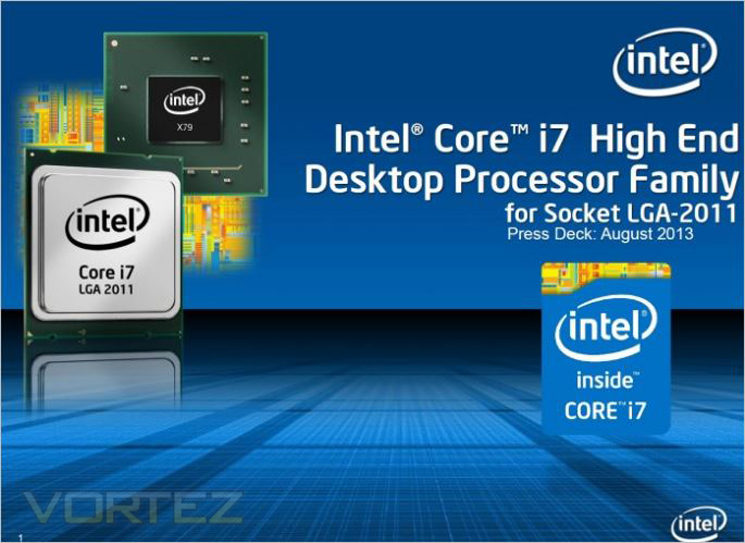
First off there is no on-board GPU, instead the room used for integrated graphics is taken up by two extra cores and the extra cache afforded to the LGA2011 CPU. We cannot confirm or deny rumours that the future Haswell-E range of CPU’s (if Intel do not skip straight to Broadwell-E)will also have on-board graphics processing omitted but we suspect this to be the case. The good news is that those who already have an X79 based motherboard will simply have to perform a BIOS update to accommodate the new range of CPUs which will help keep costs down. Going by the retail price of £770, any cost reduction will certainly be welcome!
Perhaps the biggest change though and the main selling point of the Ivy-Bridge E 4960X is the reduction in fabrication process from 32nm to 22nm which should equate to the new CPU being much more power efficient. For the overclockers this means less heat which hopefully will equate to higher overclocking. Our bomb proof Intel i7-3960X was capable of hitting 4.8GHz with regularity so we hope to reach this level with the i7-4960X as a minimum. Less voltage requirements and less heat production would obviously be welcome too.
Let’s take a closer look at the specifications…
Specification, Features & Architecture
Features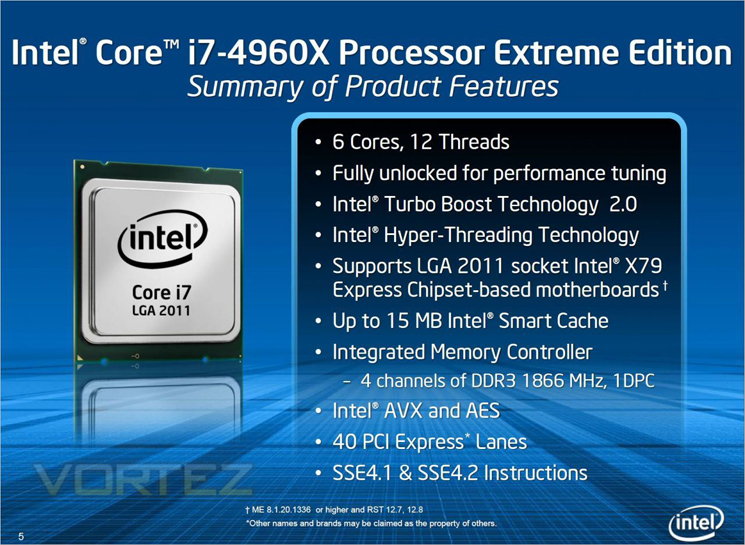
There are very few changes to the feature set of the i7-4960X when compared to the i73960X. Both CPUs have a 6/12 core/thread (hyper-thread) ratio and the new chip retain Turbo Boost technology. Both cores are capable of controlling up to 40 PCI Express lanes and have 15MB of cache at their disposal. Apart from the die shrink the only stand out difference is the IMC rating which has been bumped from 1600MHz to 1866MHz.
Tick-tock
Ivy Bridge is a refresh of existing architecture meaning that this generation is a tick in Intel’s tick/tock upgrade strategy. Based on 22nm manufacturing process you could be forgiven for thinking this is cutting edge technology, especially as LGA2011 is heavily touted as ‘Enthusiast’ grade technology. The truth is though that the mainstream range is already enjoying the benefits of both Ivy-bridge and Haswell which have been on 22nm for quite some time. Odd then that the cheaper units enjoy benefits of 22nm considerably earlier than the enthusiast models. Normally we would see the high end technologies handed down to more mainstream parts but it appears the exact reverse has happened in this case. No wonder then that the mainstream parts have proven much more popular among ‘enthusiasts’ than the products designed for that market. Whoever dreamt up this marketing strategy at Intel surely shot the company in the foot with this one!
To the core
While the i7-3960X was a 6 core processor with 12 threads, it started out in life as 8 cores with 2 cores either being disabled or found defunct during the manufacturing process resulting in the final 6 cores going to retail. With the i7-4960X you get the same 6 cores but this is how it is designed from the ground up with no additional, wasted space spent on disabled silicon.
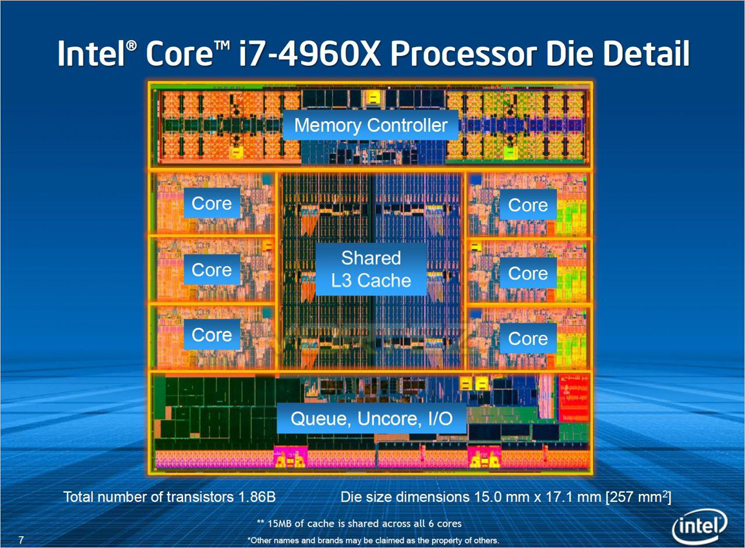
Intel will inevitably reap the benefits of higher profits by producing more cores per wafer while the end user could potentially see lower power consumption as no power is leaked to the defunct cores. There are of course more powerful processors with a higher number of cores but these are reserved for the ultra high end Xeon chips.
Current lineup
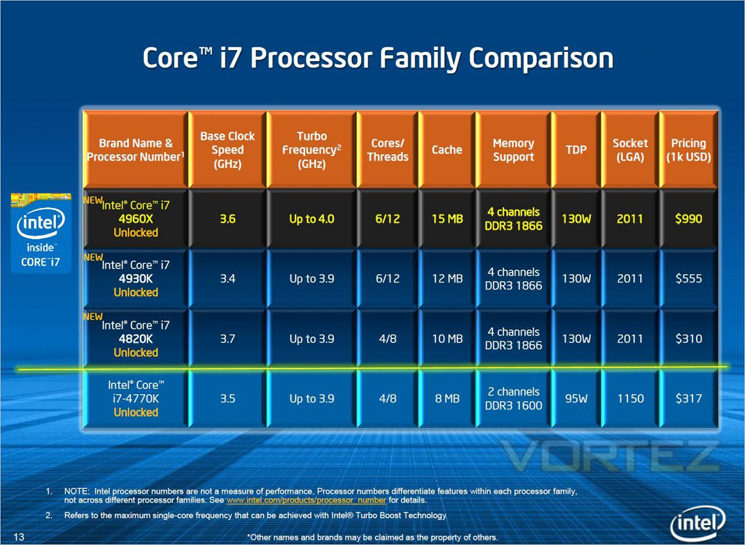
Above we can see the family comparison of i7 CPU’s. Note that we will also see both 4930K and 4820K as with previous generation 3930K and 3820K chips which were more popular due to the huge reduction in price the further down the performance ladder you go.
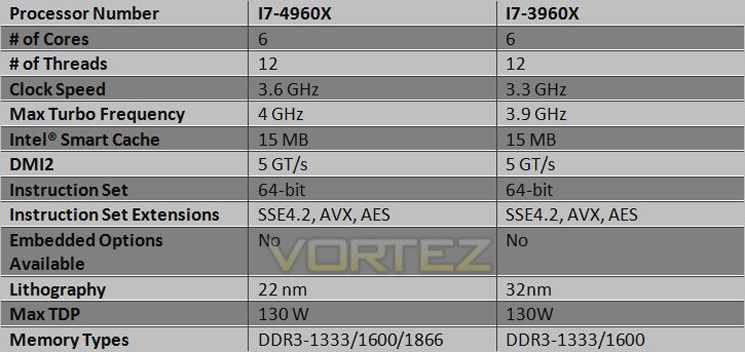
Compared against the processor it replaces, the i7-4960X has the benefit of a slightly higher clock/boost speed of 3.6/4.0GHz compared to 3.3/3.9GHz. It is also interesting to note that the 4960X natively supports DDR3 rated at 1866MHz where previously 1600MHz was the limit. Of course, this made little difference to enthusiasts who regularly used memory with speeds up to 2400MHz in regular use. The baseline improvement may however hint at better memory control – good news to overclockers!
Product Snapshot
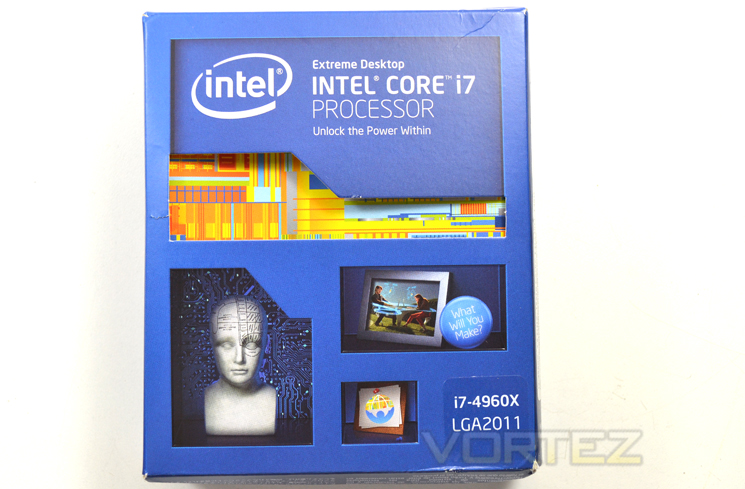
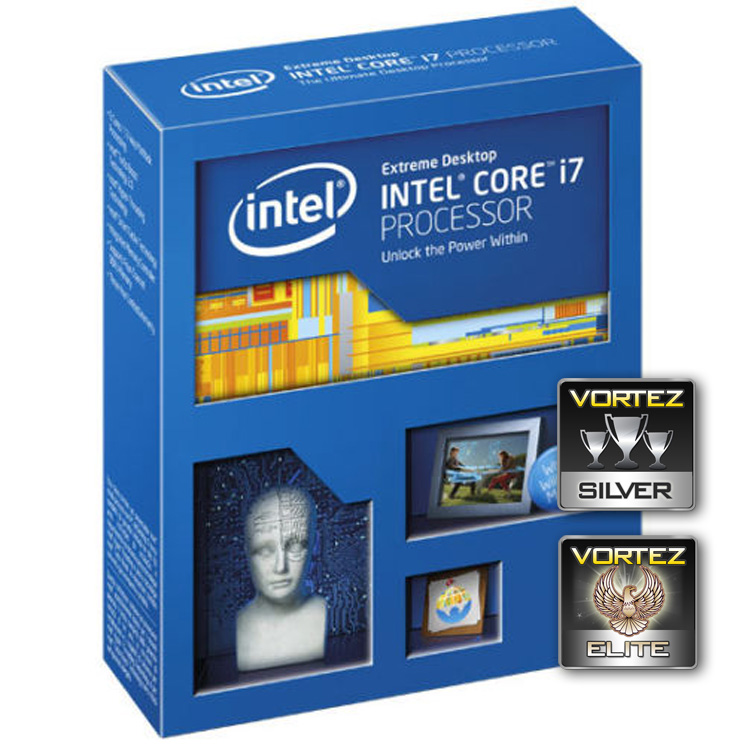
Despite the huge cost, the box exterior packaging is quite underwhelming. Smaller than your average SSD packaging, the Intel i7-4960X arrives in the typical Intel blue packaging which was also a slight disappointment as being an ‘Extreme’ chip we were hoping for a niche black box. We can only assume at this point that Intel will refresh the 4960X with a 4970X as they did with the Sandy-bridge versions.
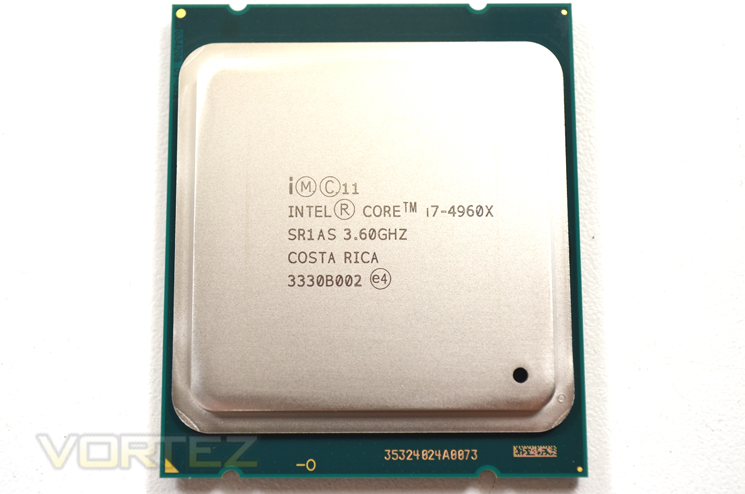
The chip itself, from the exterior at least looks pretty much like any other LGA2011 socket compatible processor. The IHS is nickel coated copper and users would do well not to consider ‘de-lidding’ this processor as it is soldered to the silicon beneath and thus would like be destroyed if the procedure was attempted.
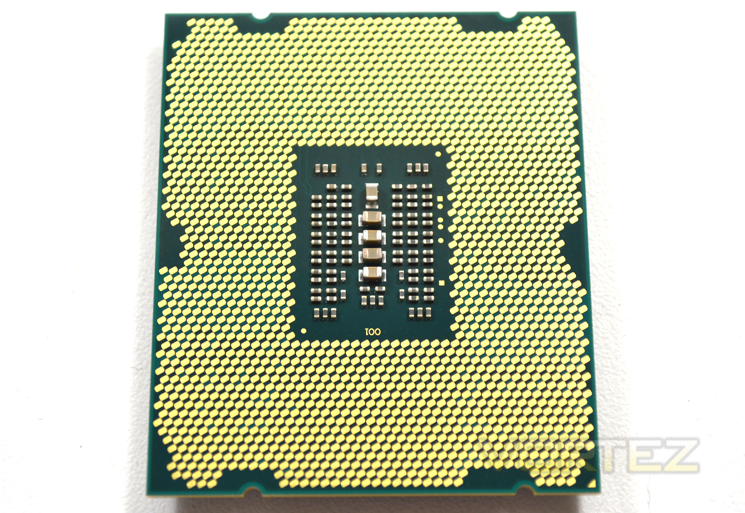
To the rear there are 6 less IC’s (5) than are found on the component being replaced, the 3960X which has 11. The pin count does however remain identical to its predecessor.
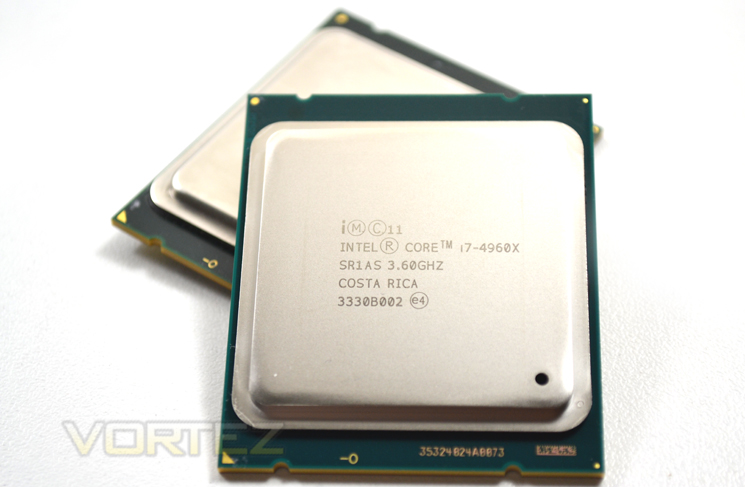
Overall, we would have liked a little more exclusivity with this enthusiast grade CPU. While the money you spend generally goes into the product itself, we would have liked at least to have been given an accompanying cooling solution. Perhaps not Intel’s own liquid cooling components which would add more to an already exasperated price but a simple air cooling design which would go some way to bulking out the product some and perhaps serving as a backup to a more advanced cooling design. Intel can however be forgiven for this omission as it is likely that a CPU such as this is very unlikely to be used with anything less than a very good custom built watercooling solution.
Test Setup
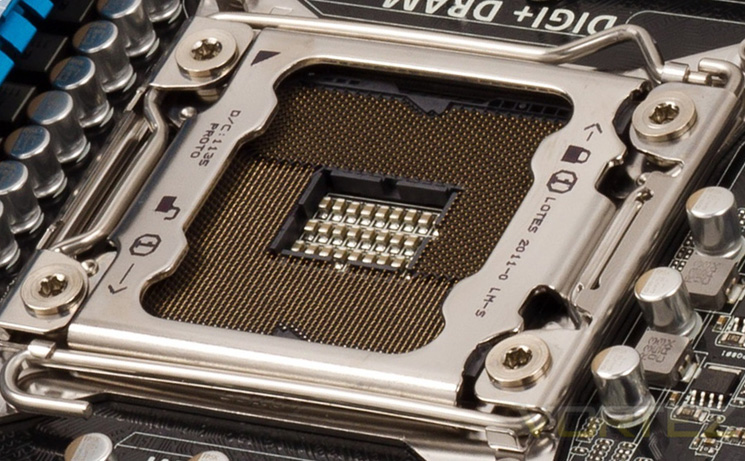
Motherboard: ASUS P9X79 Pro
RAM – 16GB (4x4GB) Corsair Vengeance (Red) DDR3 @ 1866MHz 9-10-9-27
GPU – SAPPHIRE HD 7950 3GB OC GDDR5
Power Supply – Thortech Thunderbolt Plus 1200W
Hard Drive – Kingston HyperX 240GB
Cooler – Corsair H100
RAM – 16GB (4x4GB) Corsair Vengeance (Red) DDR3 @ 1866MHz 9-10-9-27
GPU – SAPPHIRE HD 7950 3GB OC GDDR5
Power Supply – Thortech Thunderbolt Plus 1200W
Hard Drive – Kingston HyperX 240GB
Cooler – Corsair H100
CPUs
Intel Core i5 4960X (3.6/4.0GHz – Turbo boost enabled) Ivy Bridge E
Intel Core i5 3960X (3.3/3.9GHz – Turbo boost enabled) Sandy Bridge E
Intel Core i7 3930K (3.2/3.8GHz – Turbo boost enabled) Sandy Bridge E
Intel Core i5 4960X (3.6/4.0GHz – Turbo boost enabled) Ivy Bridge E
Intel Core i5 3960X (3.3/3.9GHz – Turbo boost enabled) Sandy Bridge E
Intel Core i7 3930K (3.2/3.8GHz – Turbo boost enabled) Sandy Bridge E
Benchmarks
AIDA 64 – CPU & Memory/Cache Performance
SiSoft Sandra – Compute Performance
x264 HD – Encoding Performance
Cinebench 11.5 – Image processing Performance
Futuremark 3DMark (Firestrike) – Graphical Performance
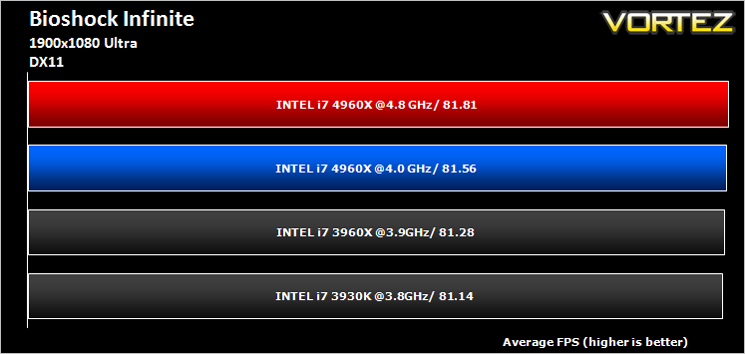
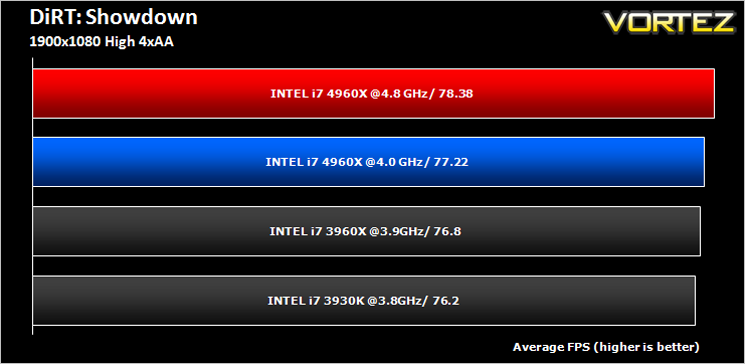
Bioshock Infinite & DiRT Showdown – Gaming Performance
AIDA 64 – CPU & Memory/Cache Performance
SiSoft Sandra – Compute Performance
x264 HD – Encoding Performance
Cinebench 11.5 – Image processing Performance
Futuremark 3DMark (Firestrike) – Graphical Performance
Bioshock Infinite & DiRT Showdown – Gaming Performance
Overclocking
Overclocking our old Sandybridge-E was simply a matter of raising the multiplier while adding incremental voltage changes until the processor until the sliver of silicon ran out of steam. At this point we would raise VCCSA and VTT along with adjusting PLL voltages. For some reason the 3960X we sampled a couple of years ago did not respond kindly to either baseclock adjustments or changes in the CPU strap. Both would result in none booting scenarios. We did however on occasion manage to reach 5GHz although at 1.5v on the Vcore we wouldn’t advise running this voltage 24/7. Instead we opted for 4.5GHz as our 24/7 voltage which seemed happy with a much healthier (but still very high) 1.42v.
Two years on and with the 4960X being cooled gently by our test setup H100 which we feel is representative of high end air cooling performance/low end water we set about overclocking this CPU.
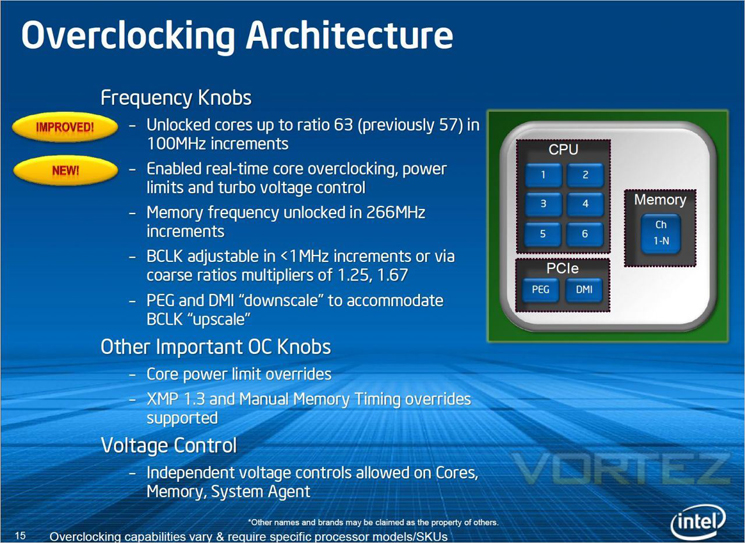
Intel have made some small changes to the processor overclocking architecture as stated above so we were intrigued to see if this CPU could be pushed further than its predecessor.
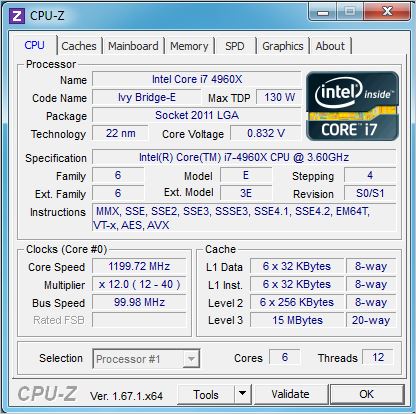
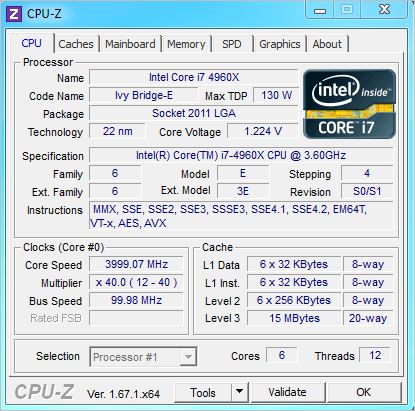
Above you can see the starting point with the reference and Turbo Boost clockspeeds.
We started out by adjusting the CPU strap to 1.25 which unlike our 3960X caused the 4960X no such problems. We then played around with the baseclock which again, the 4960X responded well to although anything above 105 proved unstable.
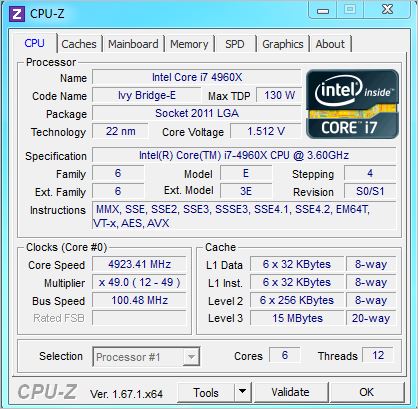
Reverting to the tried and tested method of simply adjusting the multiplier and vcore, we hit a wall at 4.3GHz. Undeterred, we played around with a combination of PLL, VCCSA, VTT voltages along with loadline calibration and managed an impressive 4.923 GHz! We have no doubts that under extreme cooling 5GHz would easily be surpassed. Unfortunately at this screaming speed, a very high (unsafe) voltage of above 1.5v was needed to stabilise (8hrs Prime95) and while temps were within spec (71c), we would not be comfortable running this voltage 24/7 on low end watercooling/high end air cooling as the silicon would likely suffer from electron migration and thus degrade over a shorter period of time.
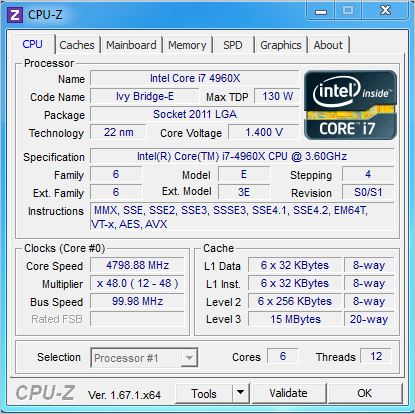
So, we dialled in a Vcore we were more comfortable with (1.4v) and after a day tweaking settings, testing, re-testing and benchmarking, we settled for a very respectable 4.8GHz.
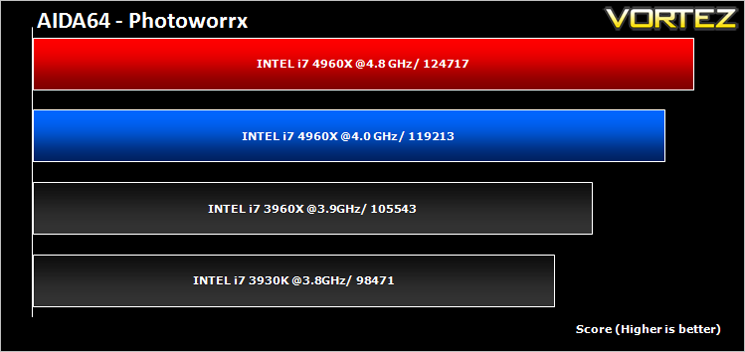
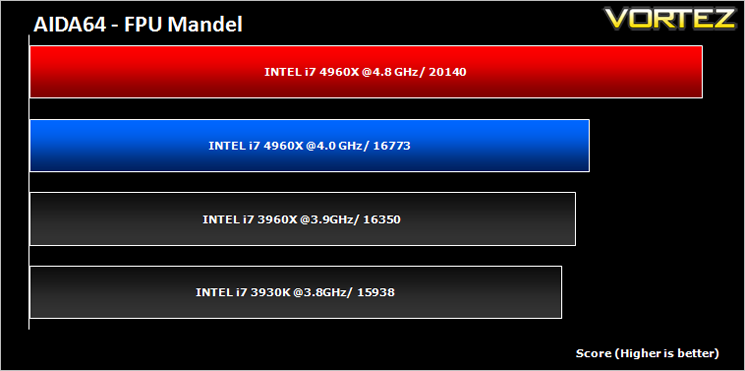
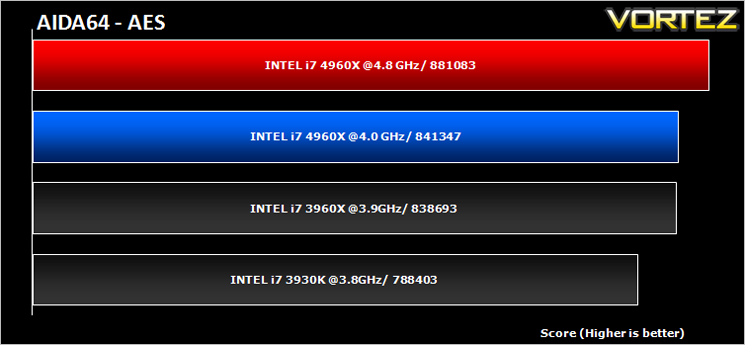
AIDA64 – CPU
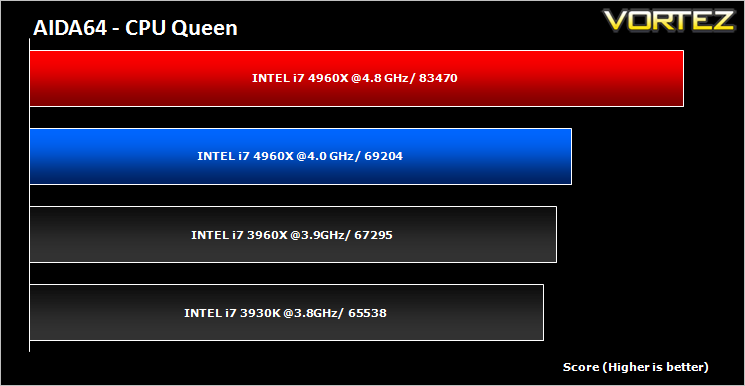
This simple integer benchmark focuses on the branch prediction capabilities and the misprediction penalties of the CPU. It finds the solutions for the classic “Queens problem” on a 10 by 10 sized chessboard. At the same clock speed theoretically the processor with the shorter pipeline and smaller misprediction penalties will attain higher benchmark scores. For example — with HyperThreading disabled — the Intel Northwood core processors get higher scores than the Intel Prescott core based ones due to the 20-step vs 31-step long pipeline. CPU Queen test uses integer MMX, SSE2 and SSSE3 optimizations.
AIDA64 – Memory
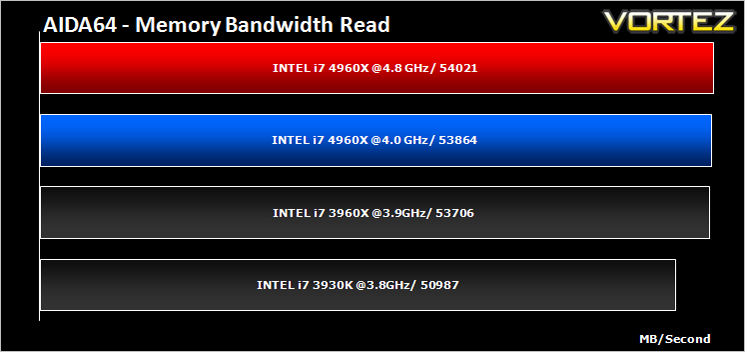
Memory bandwidth benchmarks measure the maximum achievable memory data transfer bandwidth. The code behind these benchmark methods are written in Assembly and they are extremely optimized for every popular AMD, Intel and VIA processor core variants by utilizing the appropriate x86/x64, x87, MMX, MMX+, 3DNow!, SSE, SSE2, SSE4.1, AVX, and AVX2 instruction set extension.
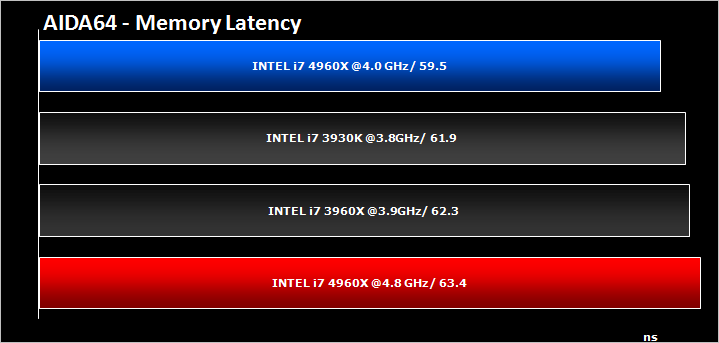
The Memory Latency benchmark measures the typical delay when the CPU reads data from system memory. Memory latency time means the penalty measured from the issuing of the read command until the data arrives to the integer registers of the CPU.
The Memory Latency benchmark measures the typical delay when the CPU reads data from system memory. Memory latency time means the penalty measured from the issuing of the read command until the data arrives to the integer registers of the CPU.
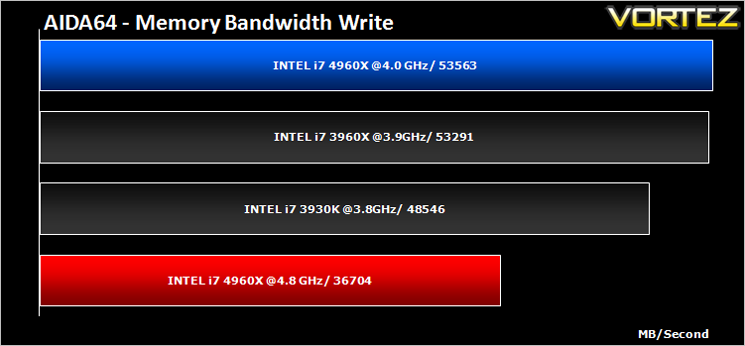
*Note: The above result was repeated multiple times showing the same result. Bizarrely, the 4960X showed a significant decrease in write performance when overclocked!
Synthetic Compute Performance
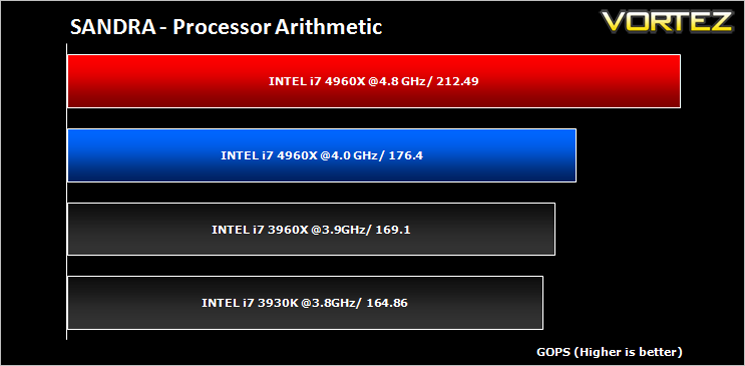
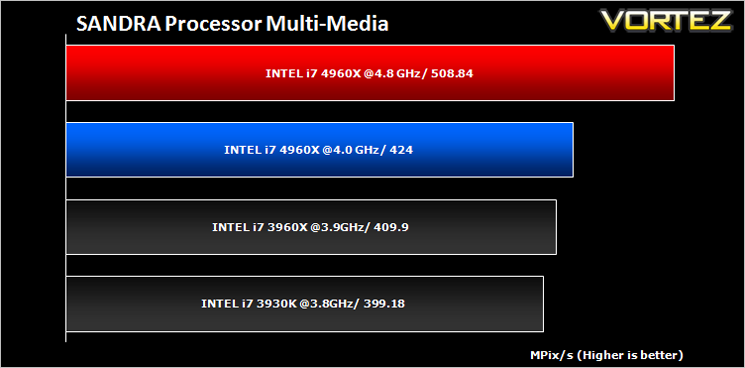
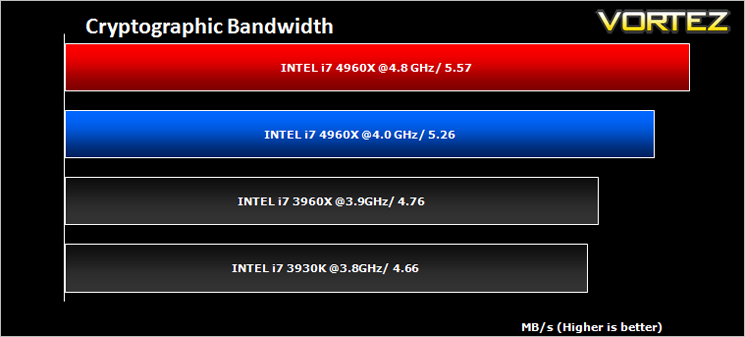
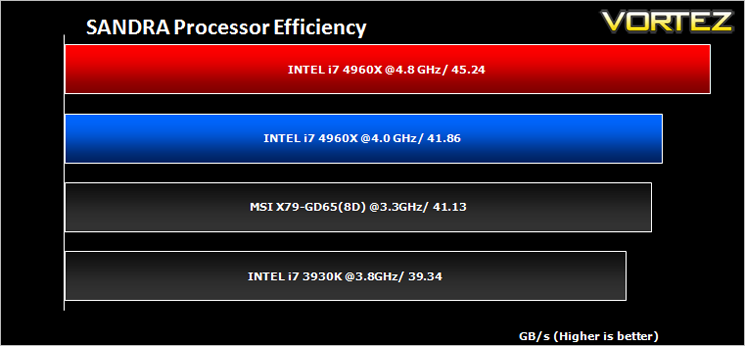
SANDRA isn’t always a benchmark that is included in hardware reviews but I believe it shouldn’t be ignored. SANDRA provides a vigorous package that tests your system in a rather large array of benchmarks. There are many aspects of benchmark that can be executed.
Encoding Performance – X264 HD
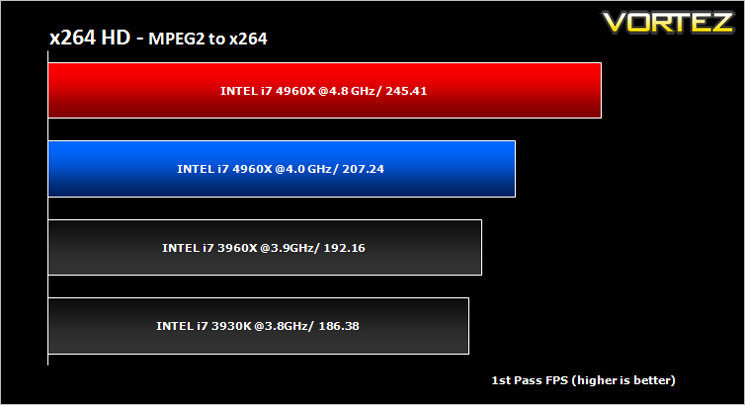
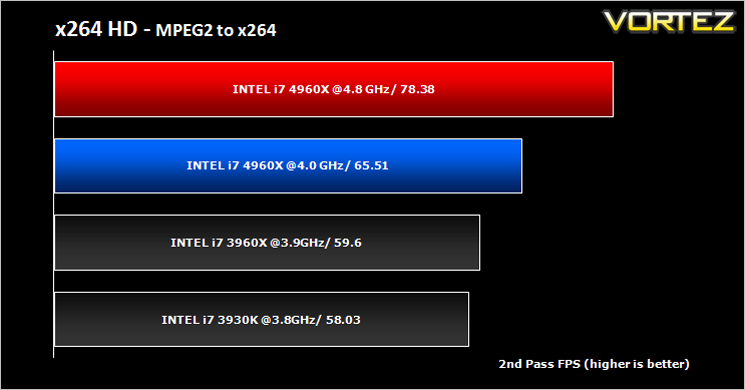
Simply put, this test measures how fast your machine can encode a short, DVD quality MPEG-2 video clip into a high-quality x264 video clip. What’s x264, you ask? It’s more or less the next-generation Xvid/DivX codec. I think it’s ideal for a benchmark because the application (x264.exe) reports fairly accurate compression results (in frames per second) for each pass of the video encoding process, and it uses multi-core processors very efficiently.
x264 HD gives results for 2 passes when compressing an MPEG-2 clip into x264. It presents 4 separate results for each pass giving a total of 8 – all results are given in FPS. For each pass I have averaged out the results.
Processing Power Performance – Cinebench 11.5 64-bit
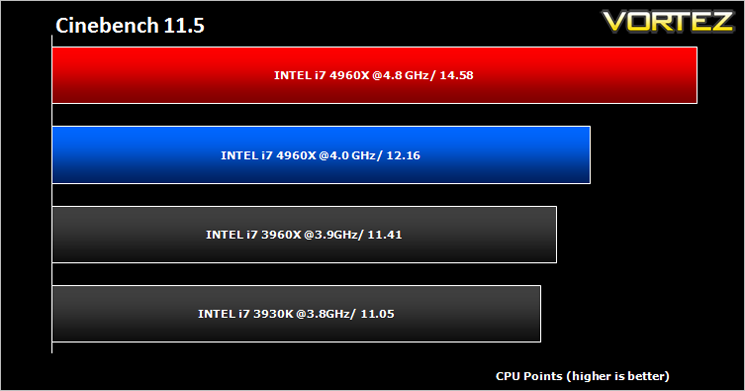
CINEBENCH can measure systems with up to 64 processor threads. This test scene contains approximately 2,000 objects which in turn contain more than 300,000 polygons in total, and uses sharp and blurred reflections, area lights, shadows, procedural shaders, antialiasing, and much more. The result is displayed in points (pts). The higher the number, the faster your processor.
In the Cinebench test the raw processing power is challenged and both Haswell CPUs push the boundaries, showing significant advances over their predecessors.
Futuremark 3DMark Fire Strike
3DMark FireStrike Product PageFire Strike is our new showcase DirectX 11 benchmark designed for high-performance gaming PCs. It is our most ambitious and technical benchmark ever, featuring real-time graphics rendered with detail and complexity far beyond what is found in other benchmarks and games today. Fire Strike will only be available in the Windows editions of 3DMark initially.
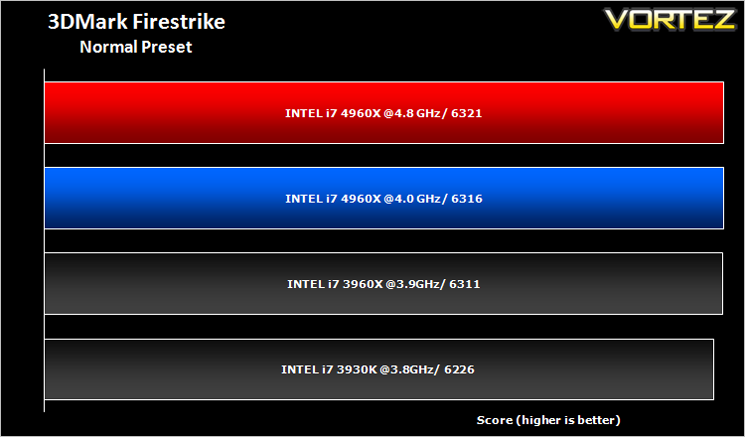
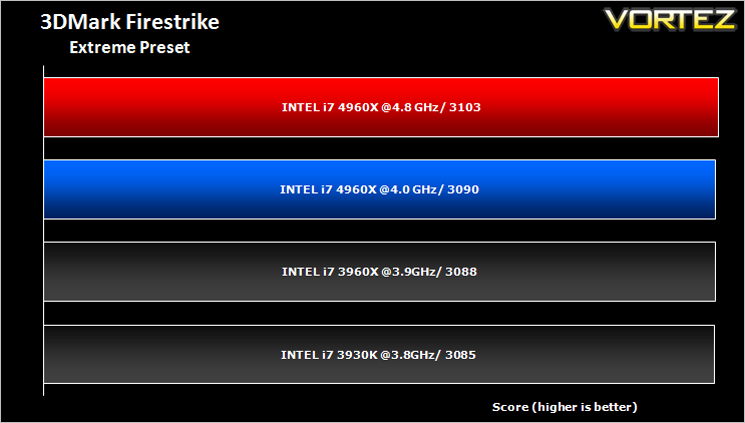
Gaming Performance
It’s important for us to perform a number of game benchmarks as well as the synthetic tests because gamers will want to know if there are any significant benefits. So here we have a selection of popular gaming titles, critically acclaimed and action-packed.
Bioshock Infinite
Set in 1912 during the growth of American exceptionalism, BioShock Infinite is a thrid person shooter developed by Irrational games and published by 2K Games. It is the third instalment of the BioShock franchise. the game utilises the Unreal Engine 3, modifying it with their own lighting engine to present a visually stunning experience like no other.
DiRT: Showdown
DiRT Showdown is the new arcade racing game from the team that brought you the award-winning DiRT series, uncaged in 2012. Pick up and play controls combine with electrifying events, frenzied crowds and stunning graphics to deliver high octane, dive in and drive thrills from event one.
Conclusion
The Intel Core i7-4960X brings little new to the table. While that will be disappointing to most, we were quite impressed with the CPU. Sure it isn’t the cheapest (by a long way) and it can hardly be accused of being ground breaking but what it does do is improve upon a very fast and powerful CPU.The main improvement is of course the reduction in power consumption. While this may not provide an immediate benefit to the enthusiast, it will do so over long periods of time, especially if your machine is used for number crunching/folding. The efficiency continues in that it emits less heat than the 3960X meaning whatever cooling solution you run, the fans can be run slower, ergo less noise. Couple this with a slightly higher base and boost clockspeed and it becomes hard to criticise Intel on their flagship desktop CPU.
Despite the above their are some criticisms that can be directed toward Intel. Firstly and perhaps indirectly, the platform upon which the i7-4960X will be used on is ancient in enthusiast terms. While it retains quad channel, it has less SATA 6 ports and no native USB 3.0. This is unforgiveable from an enthusiast perspective; who demand cutting edge technologies. Couple this with the 4960X being based on Ivy-bridge when the lower model range has been enjoying Haswell for months makes the i7-4960X a difficult proposition to make. Yes, the CPU is the most powerful Desktop CPU to date but when it is crippled by an ageing chipset one has to question the need to spend over £700 on a processor when there is a platform with newer technologies available for less? Few would take the opportunity to invest in a two year old chipset for such expense. Even less enthusiasts who already own a 3960X/3970X for such a small increase in performance.
Overall then, if you already own an Extreme processor then we see little need to upgrade unless that is power reduction means a great deal to you. I think it is fair to say, to most enthusiasts it doesn’t. If on the other hand you are looking for the best of the best then you should certainly consider this processor. It is a powerhouse which will outperform everything this side of a Xeon. Just be aware that there are more feature packed chipsets available than X79 which, if rumours are correct, will be superseded itself in the near future which is likely to mean a new socket too rendering your £800 CPU useless on latter chipsets.
Pros
+ Most powerful Desktop processor bar none
+ Power efficient
+ Great overclocking potential
+ Quad Channel Memory support
Cons
– Based on older Ivy-Bridge technology
– Crippled by an ageing chipset
– No included cooling
+ Most powerful Desktop processor bar none
+ Power efficient
+ Great overclocking potential
+ Quad Channel Memory support
Cons
– Based on older Ivy-Bridge technology
– Crippled by an ageing chipset
– No included cooling

Click here for an explanation of our awards at Vortez.net.


