Intel is looking to take back leadership in the desktop CPU market with their new 12th Generation Alder Lake processors. Are they able to take the spotlight off AMD’s success with Ryzen? We examine the Core i5-12600K and Core i9-12900K CPUs.

Product on Review: Core i9-12900K & Core i5-12600K
Manufacturer: Intel
Street Price:
Core i9-12900K: AUD 1059 | USD 620 | GBP 600
Core i5-12600K: AUD 519 | USD 299| GBP 289
November 4th 2021 is a big day for the desktop PC. Dubbed the ‘biggest revision’ in CPU design since the Core architecture of 2006, Intel’s Alder Lake processors are finally at retailers and on sale. They take centre stage alongside their partners in performance – motherboards equipped with the brand new Intel Z690 chipset – in what might be a make-or-break debut; it’s no exaggeration to state that their reception will largely dictate market trends in months and perhaps years to come. And that’s not just due to performance, but also a raft of technologies that will premier with Intel’s 12th Generation Core CPUs this holiday season.
Part of the allure of Alder Lake is being first with your hands on features such as DDR5 DRAM, PCI-Express 5.0 and hybrid core design, the latter of which is ideally exploited by the updated thread scheduler present in Microsoft’s Windows 11 OS. It’s our first glimpse into what some (most notably Intel themselves) see as the future of desktop computing on many levels, and goes head-to-head with AMD Ryzen’s thus-far successful many-cores approach. Beyond eating into market share, Intel will be hoping that the 12th Gen. can eat into Ryzen’s mind-share in the consumer space after a miraculous post-2017 change in fortunes for both companies.

Alder Lake’s most revolutionary aspect is the hybrid core design, sometimes called a big.LITTLE approach. It marries large Performance Cores to clusters of smaller Efficiency Cores, two mis-matched cores that are optimised for very different workloads and operating at different frequencies. The P-Core is roughly analogous to the meaty cores of a Skylake CPU, whereas the E-Core is more akin to low-power Atom cores. Only both have far more punch than those older designs.
The 12th Generation Core’s launch firmly occupies the gaming-to enthusiast segment, comprising three discrete performance bands and six individual SKUs. The Core i9-12900K is the flagship, boasting 8 P-Cores, 8 E-Cores, 30MB of L3 cache and a maximum Turbo Mode of over 5 GHz. One notch down is the Core i7-12700K, an 8 P-Core and 4 E-Core processor with equally competitive operating frequencies. Finally, what might be called the ‘gamers choice’ is the Core i5-12600K, a 6 P-Core and 4 E-Core processor that will nip at the heels of its more performant siblings in games.
The other three processors in the launch lineup are F-series variants of the above processors – parts with integrated GPU disabled but otherwise effectively the same performance characteristics. Lower specced including entry level/Pentium/Celeron SKUs remain undisclosed at this time.
It’s significant that Alder Lake is debuting in this segment, rather than their bread-and-butter mobile or Xeon markets. Enthusiast consumer desktop is where the brand is weakest, but also where it needs to make inroads ahead of the discrete consumer GPU launch in 2022. An exceptional launch could kill two birds with one stone, setting Intel up perfectly for the debut of their ‘Alchemist’ Xe-HPG GPUs early next year.
This generation is a whole new platform, mandating a new processor and motherboard combination with the LGA1700 socket. This too will require new CPU coolers or revised cooler mounting kits, but that more significantly DDR5 memory will be an option for the majority of Z690 motherboards. Offering both greater bandwidth and more rigorous error-correction capabilities than standard DDR4, only the cost might be a concern to the early adopter. Nonetheless, a minority of Z690 motherboards will instead be equipped with DDR4 support, potentially making platform adoption a little more affordable in the short-term.
Intel have a tough task ahead of them if they want to return to pre-eminence in the consumer desktop market. The Ryzen 5000-series rules the desktop roost even after the release of a much-improved Rocket Lake platform earlier this year. The Ryzen 9 5950X is a brute of a processor, the Ryzen 5 5600X is a good mid-range chip for gaming, and worse of all the entire range has a cache about them that Intel hasn’t had for half a decade.
So lets get started by introducing you to the two processors we’re reviewing for you today: the Core i5-12600K and Core i9-12900K.
Technical Specifications
Processor Number:- i9-12900K
Lithographic Process:- Intel 7 (10nm Enhanced SuperFin)
Socket:- LGA1700
Processor Cores (P+E):- 16 (8P + 8E)
Processor Threads:- 24
Intel® Smart Cache (L3):- 30MB
Total L2 Cache:- 14MB
Processor Turbo Frequency:
– Intel® Turbo Boost Max Technology 3.0 Frequency (GHz): Up to 5.2
– P-core Max Turbo Frequency (GHz): Up to 5.1
– E-core Max Turbo Frequency (GHz): Up to 3.9
Processor Base Frequency:
– P-core Base Frequency (GHz): 3.2
– E-core Base Frequency (GHz): 2.4
Unlocked:- Yes
Processor Graphics:- UHD 770
Total CPU PCIe Lanes:- 20
– PCI-Express 5.0: 16
– PCI-Express 4.0: 4
Max Memory Speed:- DDR5 4800 MT/s ; DDR4 3200 MT/s
Memory Channels:- 2
Maximum Memory Capacity:- 128GB
Processor Base Power (W):- 125
Maximum Turbo Power (W):- 241
—–
Processor Number:- i5-12600K
Lithographic Process:- Intel 7 (10nm Enhanced SuperFin)
Socket:- LGA1700
Processor Cores (P+E):- 10 (6P + 4E)
Processor Threads:- 16
Intel® Smart Cache (L3):- 20MB
Total L2 Cache:- 9.5
Processor Turbo Frequency:
– Intel® Turbo Boost Max Technology 3.0 Frequency (GHz): n/a
– P-core Max Turbo Frequency (GHz): Up to 4.9
– E-core Max Turbo Frequency (GHz): Up to 3.6
Processor Base Frequency:
– P-core Base Frequency (GHz): 3.7
– E-core Base Frequency (GHz): 2.8
Unlocked:- Yes
Processor Graphics:- Intel UHD 770
Total CPU PCIe Lanes:- 20
– PCI-Express 5.0: 16
– PCI-Express 4.0: 4
Max Memory Speed:- DDR5 4800 MT/s ; DDR4 3200 MT/s
Memory Channels:- 2
Maximum Memory Capacity:- 128GB
Processor Base Power (W):- 125
Maximum Turbo Power (W):- 150
Lithographic Process:- Intel 7 (10nm Enhanced SuperFin)
Socket:- LGA1700
Processor Cores (P+E):- 16 (8P + 8E)
Processor Threads:- 24
Intel® Smart Cache (L3):- 30MB
Total L2 Cache:- 14MB
Processor Turbo Frequency:
– Intel® Turbo Boost Max Technology 3.0 Frequency (GHz): Up to 5.2
– P-core Max Turbo Frequency (GHz): Up to 5.1
– E-core Max Turbo Frequency (GHz): Up to 3.9
Processor Base Frequency:
– P-core Base Frequency (GHz): 3.2
– E-core Base Frequency (GHz): 2.4
Unlocked:- Yes
Processor Graphics:- UHD 770
Total CPU PCIe Lanes:- 20
– PCI-Express 5.0: 16
– PCI-Express 4.0: 4
Max Memory Speed:- DDR5 4800 MT/s ; DDR4 3200 MT/s
Memory Channels:- 2
Maximum Memory Capacity:- 128GB
Processor Base Power (W):- 125
Maximum Turbo Power (W):- 241
—–
Processor Number:- i5-12600K
Lithographic Process:- Intel 7 (10nm Enhanced SuperFin)
Socket:- LGA1700
Processor Cores (P+E):- 10 (6P + 4E)
Processor Threads:- 16
Intel® Smart Cache (L3):- 20MB
Total L2 Cache:- 9.5
Processor Turbo Frequency:
– Intel® Turbo Boost Max Technology 3.0 Frequency (GHz): n/a
– P-core Max Turbo Frequency (GHz): Up to 4.9
– E-core Max Turbo Frequency (GHz): Up to 3.6
Processor Base Frequency:
– P-core Base Frequency (GHz): 3.7
– E-core Base Frequency (GHz): 2.8
Unlocked:- Yes
Processor Graphics:- Intel UHD 770
Total CPU PCIe Lanes:- 20
– PCI-Express 5.0: 16
– PCI-Express 4.0: 4
Max Memory Speed:- DDR5 4800 MT/s ; DDR4 3200 MT/s
Memory Channels:- 2
Maximum Memory Capacity:- 128GB
Processor Base Power (W):- 125
Maximum Turbo Power (W):- 150
Platform Features PT1
INTEL 7 PROCESS
AMD have enjoyed a lithographic process lead for the last couple of desktop CPU generations thanks to TSMC’s 7nm technology, but Intel are finally fighting back. ‘Intel 7’, AKA the Intel 10nm Enhanced SuperFin Process, was renamed to draw parallels with TSMC’s 7nm tech as similar sized physical structures are prevalent on both.As an matured process, Intel 7 boasts 10-15% perf/watt over the previous generation as well as more dense packing of transistors. NVIDIA have also needed to improve sustained operating frequencies to reach the required levels of performance for desktop, which the listed specifications indicate they have achieved.
Alder Lake CPUs are the first 10nm CPU series they’ve released in this segment. The die present on the three CPUs available is slightly smaller than the 14nm Rocket Lake processors released earlier this year, despite the larger package footprint.
LGA 1700 SOCKET
With a larger package comes a new socket. LGA1700 processors are incompatible with previous Intel platforms, and motherboards with the socket have a different set of CPU cooler mounting points than LGA1200 and earlier. Fret not however, coolers are now shipping with LGA 1700 mounting kits and many premium manufacturers are offering free upgrade kits for suitable coolers already in the hands of consumers.While the package footprint is larger, the processor die is actually thinner than its Rocket Lake equivalent. Solder TIM and an IHS with identical thickness to the predecessor generation should mean better thermal characteristics and faster conduction of heat away from the die. And that’s going to be essential given that the processors are rated for up-to 241W of continuous power draw.
P-CORES AND E-CORES
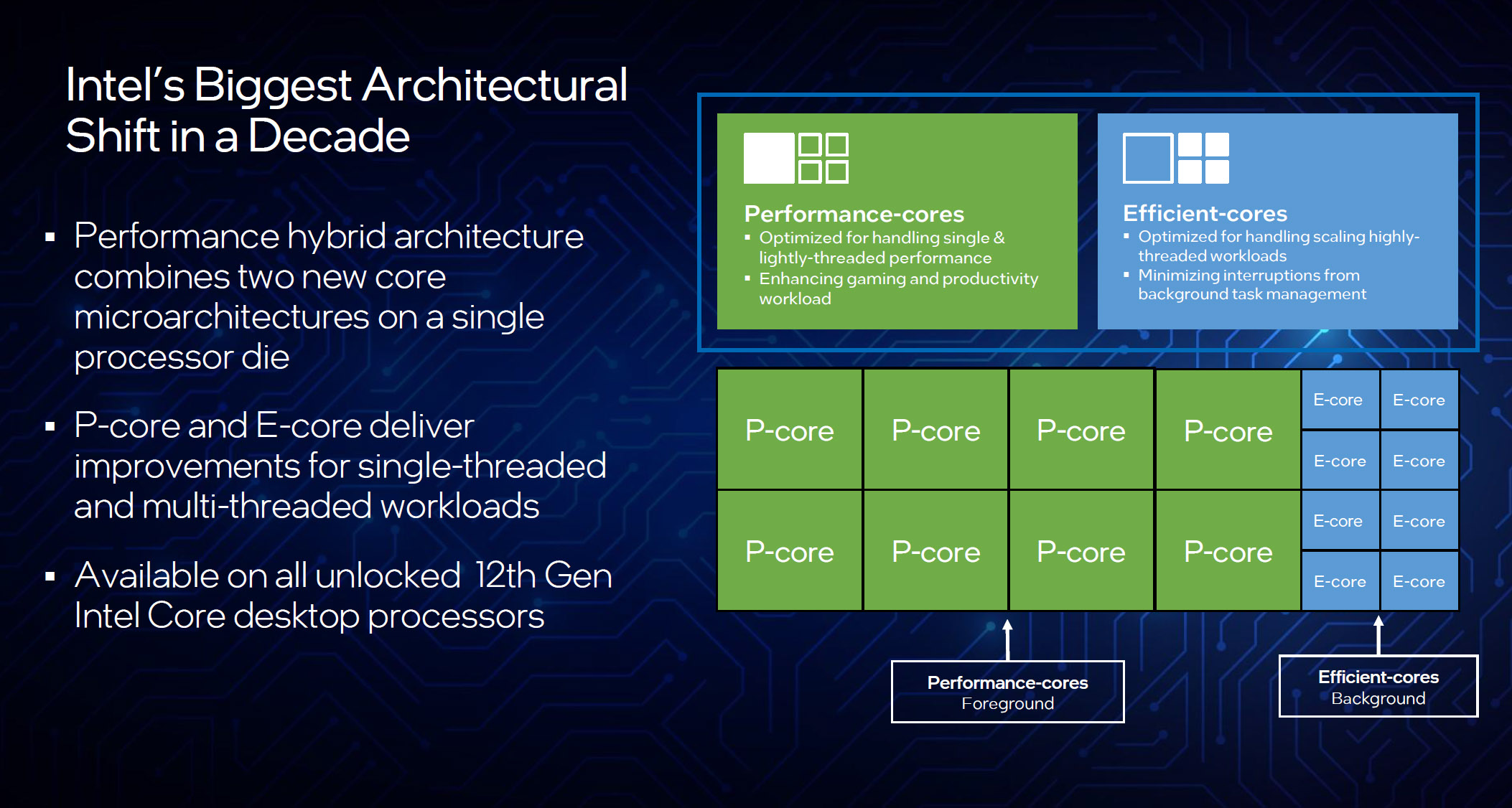
The Alder Lake architecture arrives with two major new building-blocks for Intel’s CPUs: the Performance Core, and the Efficiency Core. They’re a blend of techniques applied to their high-power desktop line and low-power desktop and mobile CPUs, integrated onto the same CPU core, with the aim of greatly improving both characteristics in a scalable manner.The performance cores have been dubbed P-Cores and are based on Intel’s Golden Cove core architecture. They’re large elements on the chip roughly analogous to Rocket Lake’s Cypress Cove cores that support Hyperthreading. Each is however meatier – they incorporate 1.25MB of L2 Cache each, up from 512KB on Rocket Lake cores, and incorporate further improvements to the pipeline.
P-Cores are workhorse cores for lightly threaded workloads operating at high frequencies. You may have seen headline figures of an ~19% IPC improvement averaged across workload cases compared with Rocket Lake, and it’s operations with this core that the figure refers to.
Efficiency cores meanwhile have been dubbed E-Cores, and they’re based on the new Gracemont core architecture that’s comparable to the highly efficient Intel Atom core architectures of the past. They’re physically smaller than the P-Cores, don’t support Hyperthreading, and on an Alder Lake CPU they’re arranged in clusters of four. Each cluster of four is equipped with 2MB of shared L2 Cache, making the cluster overall remarkably well suited to multi-threaded operation. Their design also makes them ideal for background tasks, and off-loading tasks from the P-Cores when the CPU encounters heavy load.
An example given by Intel where E-Cores might be leveraged alongside P-Cores is when playing a demanding game while also streaming it. The key game threads would be processed by the P-Cores, while less demanding activities including background tasks and OBS would be assigned to the E-Cores. Compared to an 8-Core Rocket Lake CPU, Intel estimate that in-game performance in such a scenario would be up to 87% faster with the flagship Alder Lake CPU.
A not insignificant part of Windows 11 development was making the Windows Scheduler aware of this new hybrid core architecture. In operation it will be aided by the new Intel Thread Manager, which provides recommendations to the Scheduler of where to assign threads based on criteria such as core load, power overhead etc at runtime.
Base frequencies of both P-Cores and E-Cores increase down the series, taking advantage of the TDP headroom afforded by fewer cores overall. Boost Frequencies are lower however, maintaining the overall performance advantage across workloads as we go up the SKUs. When overclocking both P-Cores and E-Cores can be adjusted independently through separate ratios, providing yet another tier of tinkering to enthusiasts.
The Core i9-12900K is equipped with 8 P-Cores and 8 E-Cores, supporting a total of 24 independent threads. The Core i5-12600K incorporates 6 P-Cores and 4 E-Cores for 16 independent threads. Lower tier SKUs may have fewer – or even none – of any particular core, but that’s beyond the scope of this launch.
L3 CACHE
Significant portions of the CPU die given over to increased cache pools compared to the prior generation. We’ve already noted the L2 cache arrangements of the P-Cores and E-Cores, but should also mention the sizeable shared L3 Cache serving as a Last Level Cache for the processor cores.The processor family features up to 30MB of L3 (Smartcache), a huge increase over the 16MB for Rocket Lake’s flagship i9-11900K. This cache is accessible by each P-Core and E-Core cluster, and thus should greatly improve all aspects of performance so long as the queue isn’t clogged by access requests from this plethora of cores.
Some of the L3 cache is shaved off for lower-spec SKUs, i.e. 25MB is present on the i7-12700K and 20MB on the i5-12600K. That’s still far more than the equivalent Rocket Lake SKU.
While the amount of L3 Cache is slightly smaller than that available on a Ryzen Zen 3 CCD, we should remember that Intel don’t have to compensate for both memory and I/O controller being off-die. It’s therefore not serving to mitigate the performance impacts of these design requirements, and instead can reap all of the benefits but without the associated latency downsides.
Platform Features PT2
DDR5 DRAM
A new feature important for, but not integral to, Intel’s 12th Gen. launch is dual-channel DDR5 SDRAM support, the new JEDEC memory standard and successor to DDR4. Laid out as a finalised standard in July 2020, DDR5 improves on DDR4 by increasing bandwidth, lowering voltage requirements, allowing dynamic frequency changing, and integrating on-die ECC*. Increased DIMM capacities are also expected to be rolled out for DDR5 which may increase the conventional configurations of gaming and prosumer PCs from 16/32GB to 32/64GB.Alder Lake’s memory controller supports both DDR4 and DDR5, and some motherboards are being shipped with DDR4 rather than DDR5 memory slots. In the short term this may help to promote early adoption of Alder Lake as a platform, particularly if DDR5 turns out to be more expensive than anticipated at launch, but key differences in timing metrics and software sensitivity to those metrics may mean that high performance DDR4 won’t be sunset quite yet.
In addition to the improved bandwidth, a key aspect of DDR5 is better allocation of memory resources. That’s thanks to on-board logic that’s no longer the sole domain of the CPU memory controller, but may serve to increase the overall cost of DDR5 in the short term.
DDR5 DIMMs being shipped today are operating from DDR5-4800MT/s, the limit of conventional performance on the Alder Lake platform, but JEDEC has so far defined profiles up to DDR5-8400MT/s. DDR5-5200MT/s and higher rated RAM that’s being sold today is supported by Alder Lake in OC modes.
DDR5 5200MT/s DIMMs are typically being shipped with a CL subtimings of 38-38-38, but some CL42 DIMMs are also being advertised. Clamping down on DDR5 sub-timings will be an interesting aspect of platform tinkering as Alder Lake matures.
Our test configuration utilises a 64GB (2 x 32GB) CORSAIR’s Dominator Platinum 52000MHz Kit rated at CL38, but they also advertise a CL36 special edition variant for a slight premium.
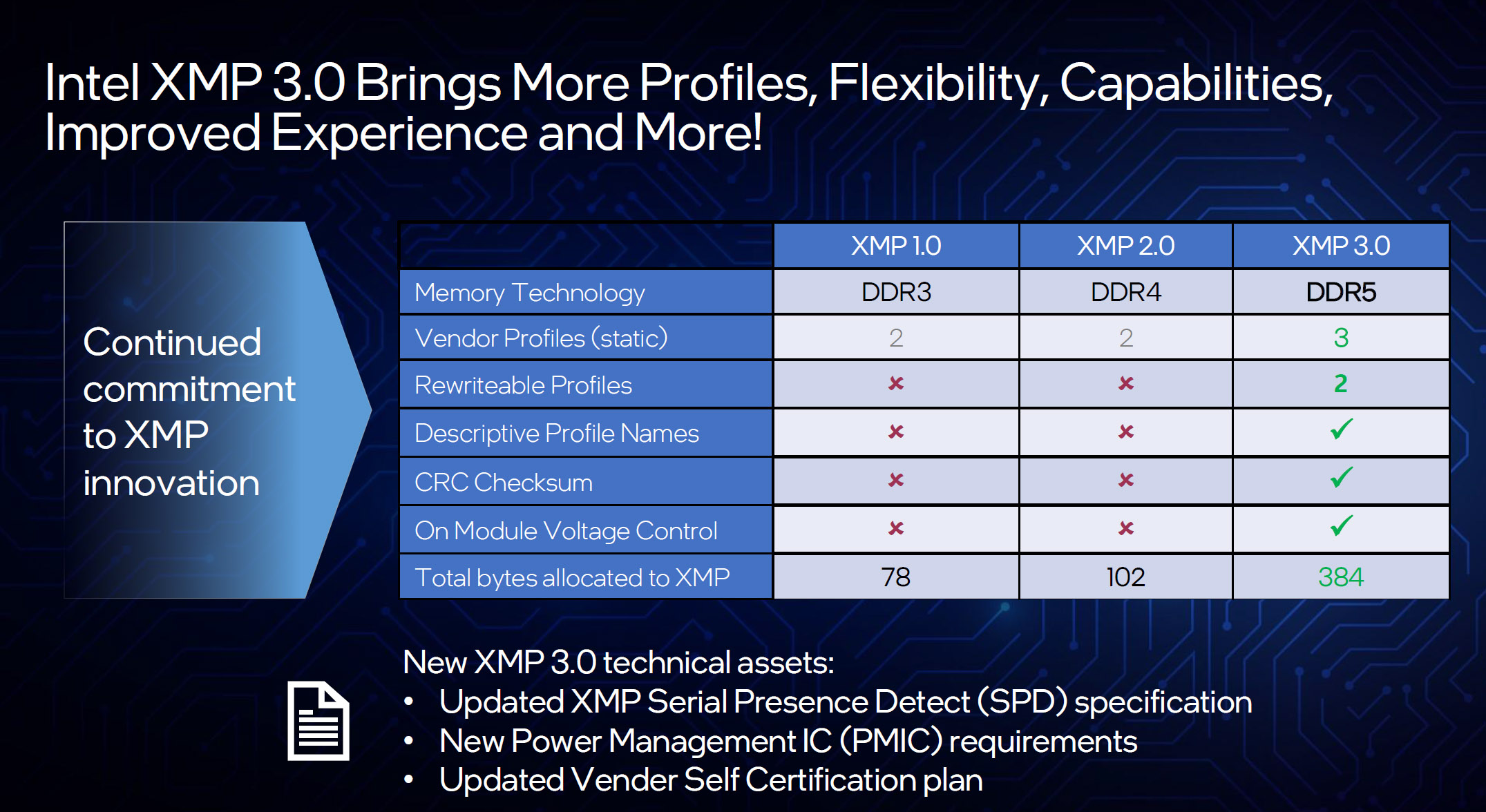
The final aspect we’d like to touch on when it comes to DDR5 support specifically is the use of profiles. To complement the onboard processing DDR5 DIMM vendors can now store two writable on-board profiles with performance and voltage settings alongside the DIMM’s JEDEC defined defaults. Some vendors will also allow the end-user to edit these profiles, even giving them an identifier string, but Intel’s use of profiles goes beyond this.
Intel XMP 3.0 and Dynamic Memory Boost together allow supported DDR5 memory to operate according to higher performance profiles depending on requirements, falling back to JEDEC defaults automatically when this performance isn’t required to reduce power draw. It’s not quite as granular as CPU Turbo automatic overclocking technologies, but it’s still pretty smart.
* Note that this is not the same as all DDR5 DIMMs having full ECC support. The on-die ECC is primarily to improve reliability with denser RAM chips, whereas on-DIMM ECC includes dedicated communication channels to provide feedback to the CPU.
PCI-EXPRESS 5.0
PCI-Express 5.0 support is perhaps the clearest example of the forward-thinking involved in Intel’s 12th Gen. platform. Currently no consumer hardware component, not even high-performance GPU and Storage, supports the new standard and we wouldn’t expect wide-spread adoption until 2022. That wasn’t the case with the introduction of PCIe 4.0 with the Ryzen 3000-series; the technology had almost day-one support from storage manufacturers and their own GPUs, but many in the industry have opined that the standard was adopted late.PCIe 5.0 doubles the bandwidth per lane to 32 GT/s, or up to 128GB/s aggregated across an x16 link. The speed increase will be mouthwatering for the enterprise market that even now is labouring against the restrictions of PCIe 4.0, but consumer applications are unlikely to realise the benefits in the near term.
Alder Lake offers 16 PCIe 5.0 lanes off the CPU for discrete Graphics and 4 PCIe 4.0 lanes for NVMe storage. Eight further PCIe 4.0 equivalent lanes are used for the upgraded DMI 4.0 interface between CPU and PCH, which is twice as fast as that present on Rocket Lake/500-series motherboards.
For this feature specifically Intel have truly surpassed AMD, but the 12th Gen. will have to wait a little while for the industry at large to catch up. Catch up they will however, particularly as AI and Machine Learning become more prominent in both commercial and consumer sectors.
Z690 CHIPSET MOTHERBOARD
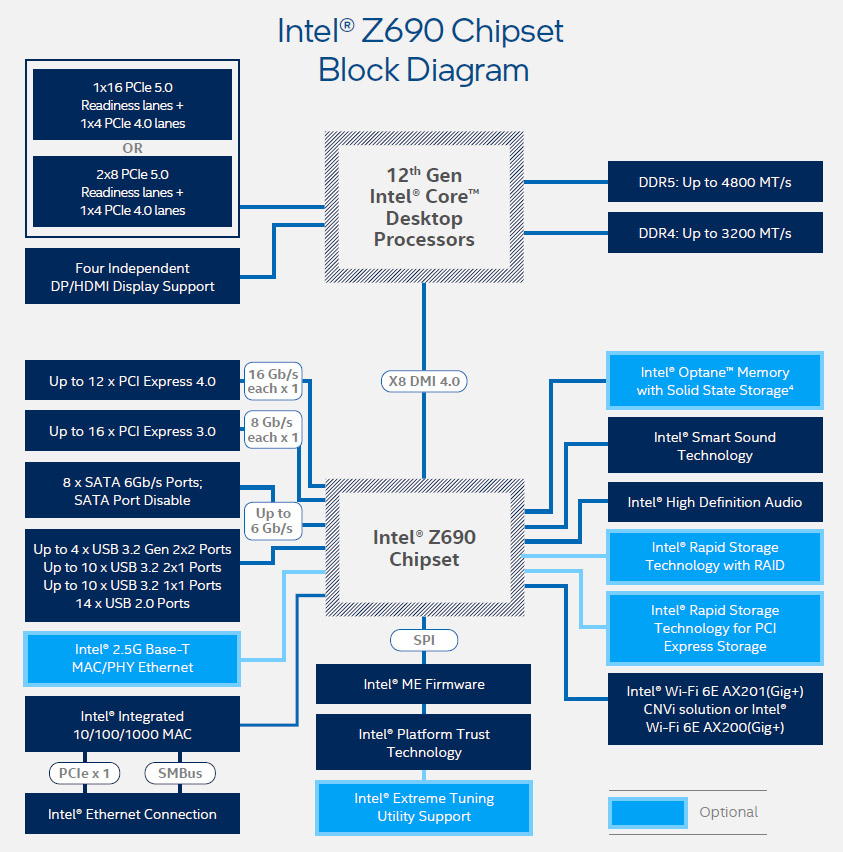
The final piece of the 12th Generation platform puzzle is of course the 600-series chipset. Today’s range of K-series 12th Gen. CPUs are launching alongside Z690 motherboards, the most fell-featured designs in the consumer space that also support the overclocking options available to Intel K-Series CPUs. They’ll get some time of their own in the spotlight soon, but for now let’s restrict things to their key features.Z390 motherboards are equipped with LGA1700 sockets and are only compatible with 12th Generation Core CPUs. Coolers too will need new LGA1700 mounting kits, so you may finally have to retire that trusty Hyper-212 that has been with you since the Sandy Bridge era. But that aside, there should be few gremlins laying in wait in terms of the motherboards physical aspects – they still conform to standard ATX sizings and layouts.
The DMI link between CPU and chipset has been upgraded with Alder Lake to 8x DMI 4.0 lanes, doubling the bandwidth available to peripheral devices without needing to add active cooling to the PCH. This also means that the chipset is able to lay on additional PCIe 4.0 lanes for devices that don’t require direct connection to the CPU such as tertiary storage, and will be a driving factor in many premium motherboards now being bedecked with M.2 NVMe storage slots.
Z690 motherboards will optionally support the integrated Intel WiFi 6E, a high-performance wireless protocol that leverages the newly available 6GHz wireless spectrum for faster wireless networking and improved network management in congested locations. The technology had been integrated into some 500-series designs but typically through 3rd party components. Improved I/O provision also allows full operation alongside 2.5G Ethernet, another new feature that should be standard across Z690.
Lack of true USB 3.2 Gen2x2 support has been a bugbear for many peripheral manufacturers trying to exploit the new high-speed 20Gbps (bidirectional) connector, but the tech is finally coming to the desktop as standard. It joins Thunderbolt 4 on many motherboards in giving you as many connectivity options as possible.
Finally, it’s well understood that the different Z690 designs will vary their power delivery according to the different market tiers and associated overclocking expectations. On-board cooling – VRM heatsinks etc. – will similarly vary in size and complexity. One aspect that appears to be exceptionally common however is the use of 8+4 or 8+8 connectors for CPU power, typically located on the top-right of the motherboard.
This, more than any other aspect of the motherboard design, speaks to the anticipated power requirements of the Alder Lake platform in its default configuration (which, we should note, ships with indefinite duration PL2 power states). It also may require a new PSU – Intel haven’t provided any specific PSU recommendations, but models with at least 8+4 12V connectors aren’t as common as you’d like among designs below 650W. For reference, 8+8 wasn’t uncommon on AMD’s X570 platform, but 8+4 was typical and even single 8-pin configurations (such as the GIGABYTE X570 GAMING X) were also available.
Test Setup & Testing
For the purpose of testing Intel Alder Lake we used the MSI Z690 CARBON WiFi since it is placed as a high-end motherboard, this should give us the capabilities of showing the true potential of this chip.
CPU being tested
Intel Core i5-12600KIntel Core i9-12900K
TEST SETUP
Cooling CORSAIR H150i ELITE LCDMotherboard MSI Z690 CARBON WIFI
Memory 64GB CORSAIR Dominator Platinum RGB 5200MHz DDR5
Graphics ZOTAC RTX 3070 Ti HOLO Extreme
Storage CORSAIR Force LX 512GB SSD
PSU Corsair RM 1000 80 Plus Gold Certified PSU
Monitor AOC U2879VF
BENCHMARKS
Cinebench R23 – Single/Multi-core CPU Renderingx264 HD 4.0 – 1st and 2nd pass encoding
SiSoftware SANDRA – CPU & Memory benchmarks
POV-RAY – CPU Ray Tracing
TrueCrypt – CPU Encryption Read/Write
AIDA64 – CPU benchmarks & Memory
PCMARK 10 – CPU Productivity
Davinci Resolve – Puget Benchmark
Blender – Classroom Benchmark
Games – Assassin’s Creed Odyssey & Total War: WARHAMMER II
OTHER SOFTWARE
Temperature Analysis: CoreTempStress Testing Software: AIDA64 Stability Test
CPU Specification Monitoring: CPU-Z
Temperatures & Overclocking
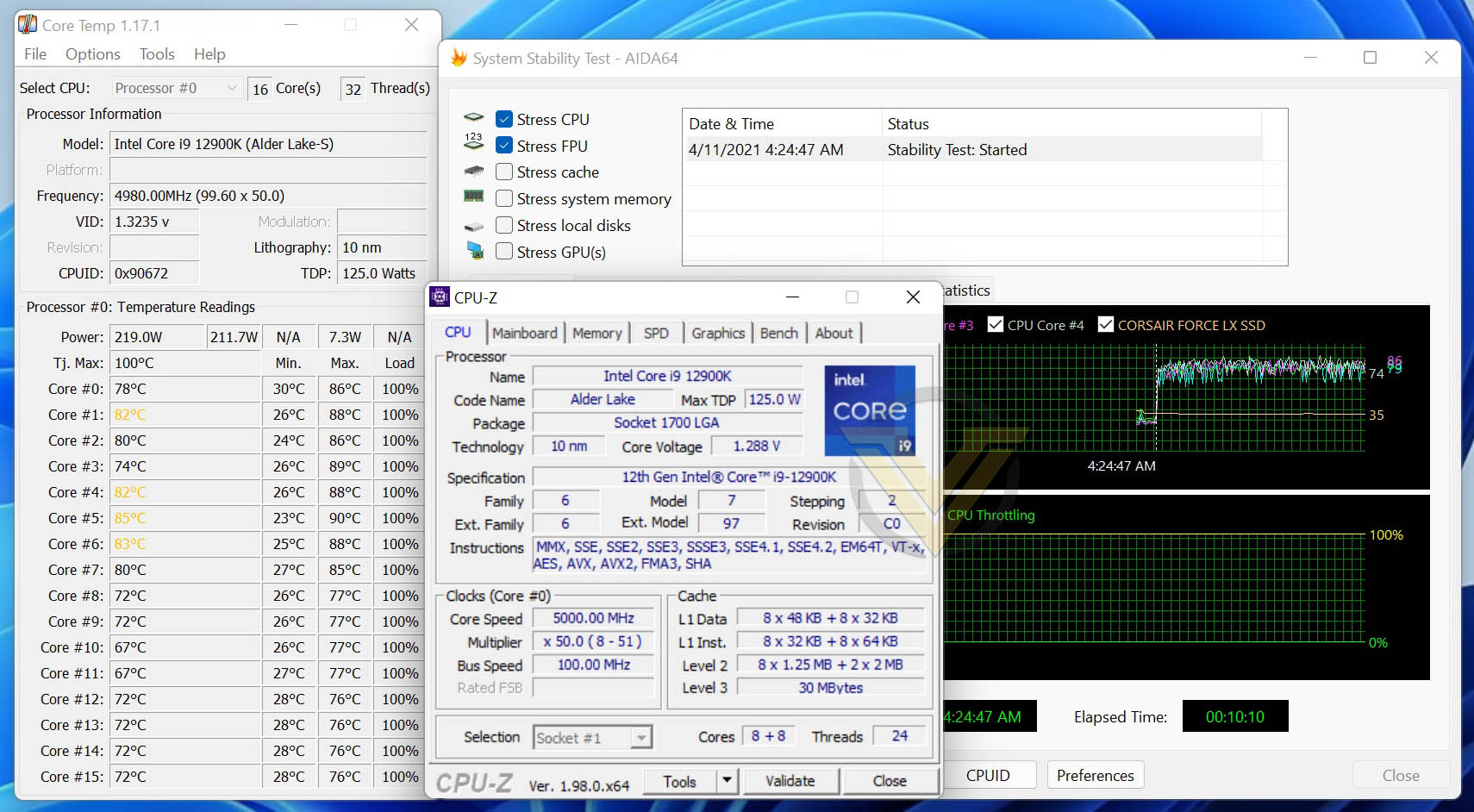
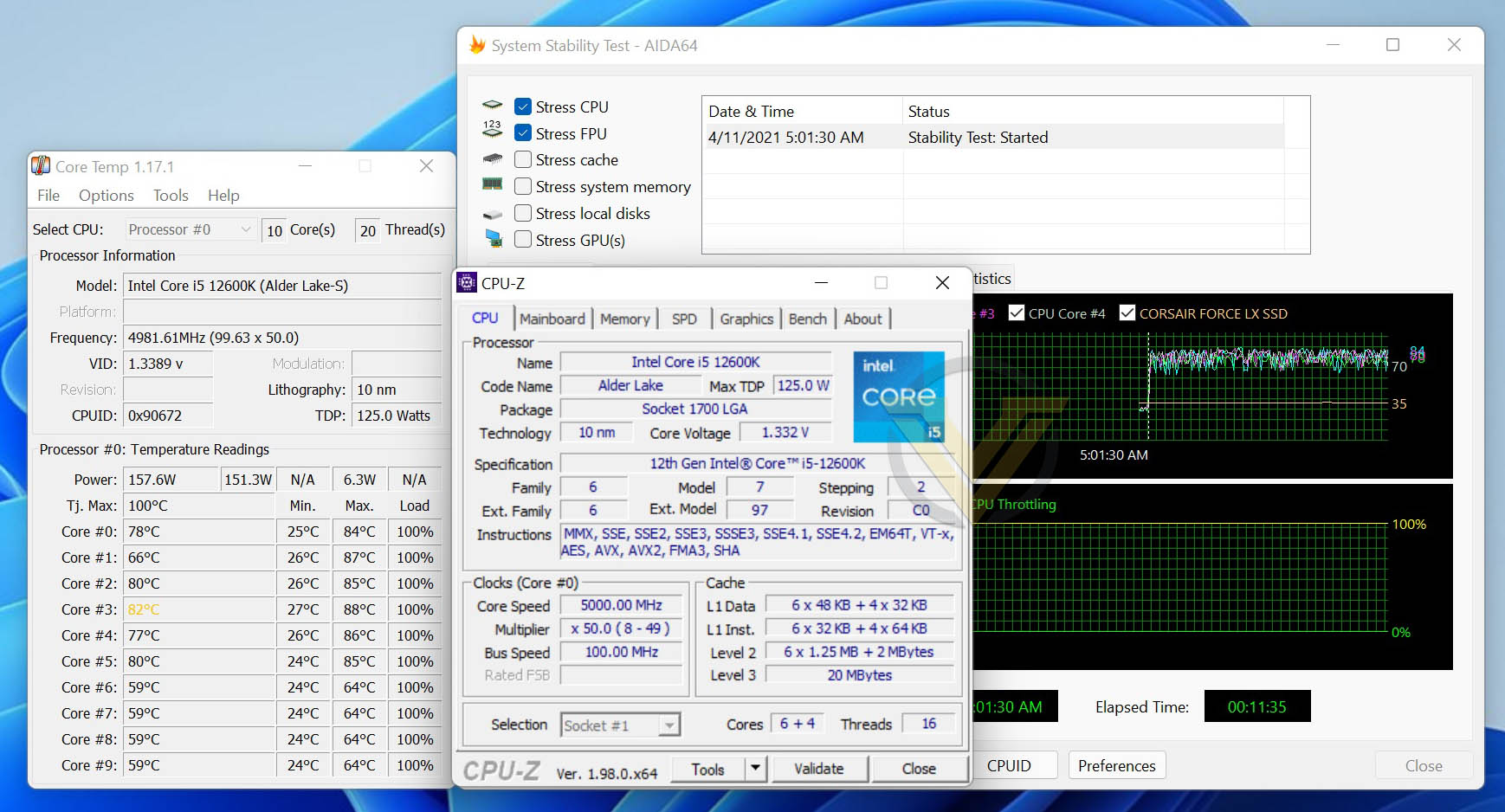
Below are the temperatures for each of the CPUs – without any overclock applied. We’ve also compared to previously released AMD and Intel counterparts (which we’ve also benchmarked against on the subsequent pages too):

OVERCLOCKING
Moving to the overclocking phase of our review, the goal is to see how far we can push the processor over it’s stock/reference settings. For this overclock, we only modify the P-Cores.We quickly established that there wasn’t a great deal of headroom with the 12900K and it hit a ceiling at 5GHz – requiring a minimum of 1.34v. The 12600K also had a limit of 5GHz (1.39v) but, this is a greater achievement for this CPU due to its stock base/turbo frequencies.
Power Consumption
It’s interesting to note the power consumption across all processors. Although they are using a combination of different motherboard chipsets, energy results can fluctuate between manufacturers due to the features and specifications that are integrated. First of all, for the idle tests the system is cold booted into Windows and no additional applications are executed – the watts are noted on the external energy monitor we use and then the system is loaded with 3DMark FireStrike – watts are again monitored for the duration of the test and the highest rated wattage result is then noted down. Below are the results of this energy test.
Ray Tracing Performance – POV-Ray 3.7
Persistence of Vision Raytracer’s PovRay is a free and open source 3D animator application with versions for computers with different operating systems.
This product allows users to build their custom 3D worlds with excellent quality despite their computer’s hardware. It has adjustable options for levels of radiance, refraction, and reflection. Calculation time may vary depending on the computer model, but PovRay can adapt to many computer builds, and is supported by the open source community.
This product allows users to build their custom 3D worlds with excellent quality despite their computer’s hardware. It has adjustable options for levels of radiance, refraction, and reflection. Calculation time may vary depending on the computer model, but PovRay can adapt to many computer builds, and is supported by the open source community.
AES Encryption Performance – TrueCrypt 7.1a
TrueCrypt is a discontinued source-available freeware utility used for on-the-fly encryption (OTFE). It can create a virtual encrypted disk within a file or encrypt a partition or (under Microsoft Windows except Windows 8 with GPT) the entire storage device (pre-boot authentication).
Encoding Performance – X264 HD
Simply put, this test measures how fast your machine can encode a short, DVD quality MPEG-2 video clip into a high-quality x264 video clip. What’s x264, you ask? It’s more or less the next-generation Xvid/DivX codec. I think it’s ideal for a benchmark because the application (x264.exe) reports fairly accurate compression results (in frames per second) for each pass of the video encoding process, and it uses multi-core processors very efficiently.
x264 HD gives results for 2 passes when compressing an MPEG-2 clip into x264. It presents 4 separate results for each pass giving a total of 8 – all results are given in FPS. For each pass I have averaged out the results.
Processing Features Performance – AIDA64
AIDA64 Product Page
This simple integer benchmark focuses on the branch prediction capabilities and the misprediction penalties of the CPU. It finds the solutions for the classic “Queens problem” on a 10 by 10 sized chessboard. At the same clock speed theoretically the processor with the shorter pipeline and smaller misprediction penalties will attain higher benchmark scores. For example — with HyperThreading disabled — the Intel Northwood core processors get higher scores than the Intel Prescott core based ones due to the 20-step vs 31-step long pipeline. CPU Queen test uses integer MMX, SSE2 and SSSE3 optimizations.
Memory Transfer Performance – AIDA64
AIDA64 Product PageThis simple integer benchmark focuses on the branch prediction capabilities and the misprediction penalties of the CPU. It finds the solutions for the classic “Queens problem” on a 10 by 10 sized chessboard. At the same clock speed theoretically the processor with the shorter pipeline and smaller misprediction penalties will attain higher benchmark scores. For example — with HyperThreading disabled — the Intel Northwood core processors get higher scores than the Intel Prescott core based ones due to the 20-step vs 31-step long pipeline. CPU Queen test uses integer MMX, SSE2 and SSSE3 optimizations.
Processing Power Performance – Cinebench R23
CINEBENCH can measure systems with up to 64 processor threads. This test scene contains approximately 2,000 objects which in turn contain more than 300,000 polygons in total, and uses sharp and blurred reflections, area lights, shadows, procedural shaders, antialiasing, and much more. The result is displayed in points (pts). The higher the number, the faster your processor.
Bandwidth Performance – SiSoftware SANDRA
SiSoftware Product Page
SANDRA isn’t always a benchmark that is included in hardware reviews but I believe it shouldn’t be ignored. SANDRA provides a vigorous package that tests your system in a rather large array of benchmarks. There are many aspects of benchmark that can be executed. We will be considering – CPU and memory tests.
Overall System Performance – PCMark 10
PCMark 10 Product Page
Developed in partnership with Benchmark Development Program members Acer, AMD, Condusiv Technologies, Dell, HGST, HP, Intel, Microsoft, NVIDIA, Samsung, SanDisk, Seagate and Western Digital, PCMark 10 is the latest version in FutureMark’s popular series of PC benchmarking tools. Improving on previous releases, PCMark 10 includes new tests using popular applications from Adobe and Microsoft.
4K Editing Performance – DaVinci Resolve PugetBench
DaVinci Resolve is not only an industry-standard coloring tool, but also includes features for video editing, VFX, and more. While we also have benchmarks for Premiere Pro, After Effects, and other creative applications, every application will utilize the hardware in a computer in very different and unique ways which can make it extremely difficult to determine exactly what hardware will give the end user the best possible performance.
Rendering Performance – Blender
Blender is a free and open-source 3D computer graphics software toolset used for creating animated films, visual effects, art, 3D printed models, motion graphics, interactive 3D applications, virtual reality, and computer games. Blender’s features include 3D modeling, UV unwrapping, texturing, raster graphics editing, rigging and skinning, fluid and smoke simulation, particle simulation, soft body simulation, sculpting, animating, match moving, rendering, motion graphics, video editing, and compositing.
Gaming Performance – AC: Odyssey & Total War: WARHAMMER II
It’s important for us to perform a number of game benchmarks as well as the synthetic tests because gamers will want to know if there are any significant benefits. So here we have two recent gaming titles benchmarked with the RTX 3070 Ti. Both gaming titles are CPU-intensive – AC Odyssey is the last AC title in the series to be CPU-bound. Valhalla uses DX12 API.
Conclusion
Billed as a true game-changer for the company sometimes known as Chipzilla, Intel’s 12th Generation Core codenamed ‘Alder Lake’ is now available to buy from retailers. So, the question now is, with our results now in the books, can we recommend the new consumer platform?
The answer is an almost unqualified yes. From a performance perspective the new architecture is an excellent generational improvement over Rocket Lake, extending the performance advantage where they already had a lead and obliterating AMD’s advantage in benchmarks where they were weaker.
Heavily multi-threaded benchmarks, where three generations of AMD Ryzen architectures have dominated in the consumer space, are no longer quite so one-sided. The i9-12900K trades blows with the Ryzen 9 5950X despite ostensibly supporting fewer threads, which we have to attribute to the massive architectural improvements made with Alder Lake. The i5-12600K meanwhile makes the Ryzen 5800X look decidedly ordinary at a much lower price point, stealing its lunch money in gaming and multi-threaded benchmarks alike.
Commercial and prosumer applications which thrive on memory capacity and bandwidth will love Alder Lake as the platform offers DDR5 support, a feature that just isn’t available with Ryzen. PCI-Express 5.0 support however isn’t quite so in demand currently, but we wouldn’t be surprised to see high-performance storage manufacturers push the standard hard as they butt up against the limits of four PCIe 4.0 lanes.

Two caveats remain in our thoughts however, the first is obvious – cost as a barrier to entry. The processors themselves are exceptionally competitively priced compared to their AMD counterparts, to the extent that AMD surely must respond. We have yet to see the full breadth of motherboard pricing however, an aspect that Intel have sought not to clamp down on.by launching with Z690 only. Without equivalent B660 designs for those who won’t dabble in overclocking, AMD Ryzen will be the more affordable platform even before considering the premium DDR5 DIMMs will impose for the early adopter.
Perhaps the greatest shame is that there are no affordable GPUs to match Alder Lake to if buying a brand-new system today. A Core i5-12600K paired with an RTX 3060/3060Ti should be a crushing system for enthusiast gaming at up to 1440p without breaking the bank, but inflated graphics card pricing will inevitably put a damper on those aspirations. Upgrading from a few generations ago, perhaps a quad-core system that already has an adequate GPU but needs some pep as we transition to the Windows 11 era? At this point Intel’s 12th Gen platform is the only sensible option for the vast majority of consumers.
As for our other caveat – it’s power draw, but you probably already guessed that. Alder Lake brings performance, but at the cost of drawing more Watts from the wall than any other platform, by a very large margin. The fact that the CPU can handle this amount of power for any length of time is a borderline marvel, but it does make us concerned whether it’s sustainable long-term. Early indications are that the 12900K had very little overclocking headroom, suggesting that the ‘factory overclock’ of allowing the core to operate at PL2 power levels indefinitely is close to the limit of the silicon with conventional cooling. That being said, Ryzen 5000-series chips aren’t exactly renowned for their overclocking headroom either.
Pros
+ Superior to AMD’s 5950X in most benchmarks
+ Improved gaming performance
+ Superb single/multi-core performance
+ Both CPUs offer integrated graphics
+ 12900K marginally cheaper than 5950X
Cons
– Extremely power hungry
– Costly to upgrade to
+ Superior to AMD’s 5950X in most benchmarks
+ Improved gaming performance
+ Superb single/multi-core performance
+ Both CPUs offer integrated graphics
+ 12900K marginally cheaper than 5950X
Cons
– Extremely power hungry
– Costly to upgrade to
Click here for an explanation of our awards at Vortez.net.
Stay connected with the Vortez Social Media pages:
Join in with the discussions on Discord