




With the help of Plextor’s M6e we put one of the key features of Intel’s Z97 chipset under the spotlight to see if it can really dethrone SATA 3.
Product On Review: M6e 256GB SSD
Manufacturer: Plextor
UK Street Price: £199.99 (inc. V.A.T)
Despite its release with much fanfare earlier this month Intel‘s 9-series motherboard platform, of which Z97 is the major chipset, has brought few genuinely new features relevant to the mainstream market. In fact perhaps the only significant exception is the implementation of the SATA Express bus interface through the use of two new storage connectors – M.2 and SATA Express – either of which unlocks the possibility of faster storage than the now ageing SATA. Whilst they won’t each appear on every Z97 motherboard, together they push forward standards which have plateaued slightly since SATA 3 was implemented.
Even now, with Z87 phased out and Z97 being the dominant motherboard chipset on new PCs, SATA-Express as a connector is at present not particularly well supported by the market; the first major drive releases are expected to be announced at Computex this June. By contrast M.2 storage devices have been established for some little time thanks to embedded systems and selected Z87 motherboard models, but there is still some time to go before it has the reach of even mSATA. Eventually M.2 is expected to largely replace mSATA, but understandably is only now finding its feet.
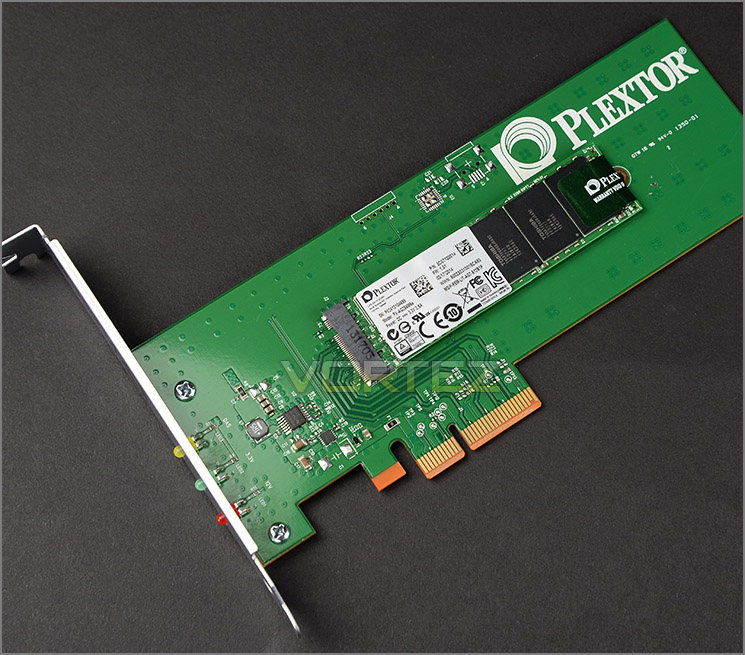
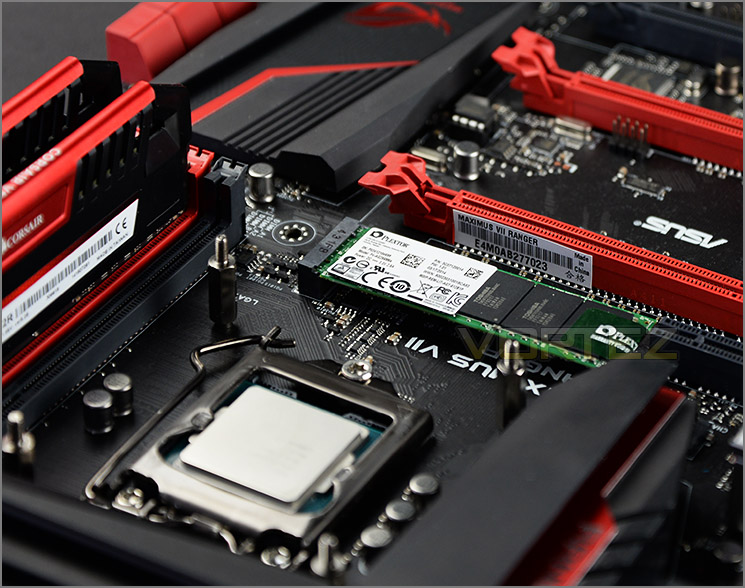
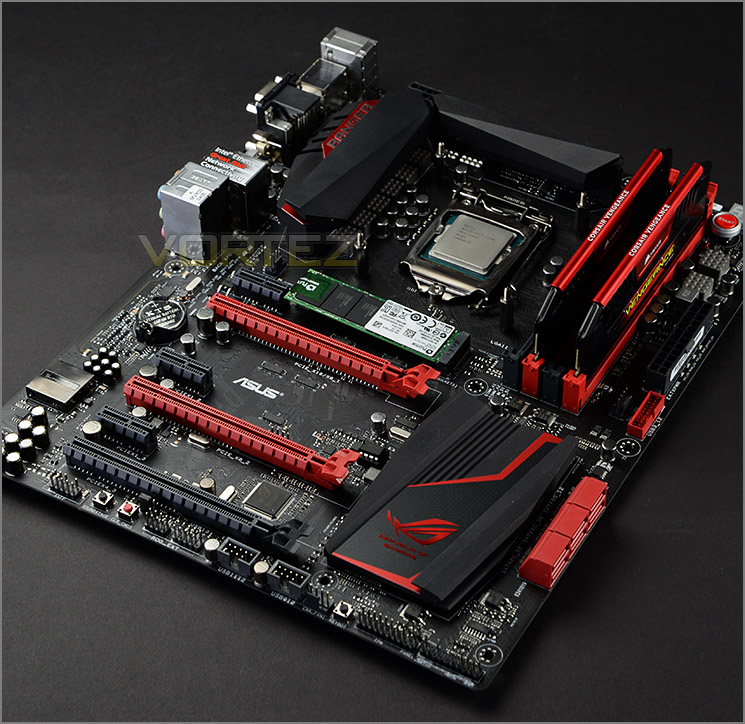
In this review we’re taking our first detailed look at a M.2 drive thanks to Plextor’s 256GB M6e SSD and the new ASUS Maximus VII Ranger, based on Intel’s Z97 chipset. We’ll seek to compare it to the existing SATA III interface, and discuss some of its pros and cons.
About Plextor
PLEXTOR is a world-leading developer of award-winning solid state drives, and other high-performance digital storage devices for professionals, consumers, and enterprises. The PLEXTOR brand of storage and multimedia products is owned by Shinano Kenshi of Japan.
[..]
PLEXTOR SSDs—Modern Storage Comes of Age
PLEXTOR answered the customers’ needs for the replacement of aging hard-drive technology with higher speed storage with the debut of its first SSD in 2009. In response to demand for our acclaimed SSDs, PLEXTOR is undertaking an aggressive expansion program and operating in more markets worldwide. This brings us closer to the users, which allows us to better meet their requirements. For example, we were one of the first to develop drives supporting SATA 6.0Gb/s, providing the performance needed for data- intensive applications.
PLEXTOR is a world-leading developer of award-winning solid state drives, and other high-performance digital storage devices for professionals, consumers, and enterprises. The PLEXTOR brand of storage and multimedia products is owned by Shinano Kenshi of Japan.
[..]
PLEXTOR SSDs—Modern Storage Comes of Age
PLEXTOR answered the customers’ needs for the replacement of aging hard-drive technology with higher speed storage with the debut of its first SSD in 2009. In response to demand for our acclaimed SSDs, PLEXTOR is undertaking an aggressive expansion program and operating in more markets worldwide. This brings us closer to the users, which allows us to better meet their requirements. For example, we were one of the first to develop drives supporting SATA 6.0Gb/s, providing the performance needed for data- intensive applications.
The Importance Of M.2
It is plain to anyone who takes interest in SSDs that raw bandwidth has become bottlenecked by the SATA 3 interface. Capable of 6Gbps (550MB/s) optimally, SSDs are routinely hitting this figure both on read and write rates, to the extent that competition is now largely through pricing and higher IOPS. Something had to give, and the SATA steering committee eventually finalised the next generation of SATA – SATA Express.
SATA Express was conceived as a backwards compatible standard that added support for PCI-Express signalling, removing a layer of abstraction between the system bus and storage controller. PCI-Express was already proven as a viable system, and bringing it into the consumer space makes a lot of sense from a speed and cost perspective. By tying in two PCIe 2.0 lanes the protocol is capable of up to 1GB/s (2 x 5GT/s with 8b/10b encoding) in both directions when connected to a suitable device and can be scaled to PCIe 3.0, but timing tricks and robust cable shielding is necessary to ensure high speed and reliability. The physical connector is also bulky, a trade-off to enable backwards compatibility.
M.2, formerly known as the Next Generation Form Factor (NGFF), builds on the SATA Express specification by implementing a standard for internally mounted expansion cards including high speed storage. Broadly speaking it replaces and surpasses mSATA, with functions that encompass and build upon mSATA to include PCI-Express and USB 3.0 signalling. In the process it is more space efficient than its predecessor, including variable lengths, widths and allowing components on both sides of the PCB.
The current M.2 definition document outlines support for signalling via SATA, SATA-Express via ACHI, and SATA-Express via NVMe, the latter of which is a protocol designed specifically for solid state storage but is currently unsupported by a majority of SSD controllers and operating systems. For this reason some M.2 devices will top out at 6Gbps read/write rates due to legacy compatibility, others will be capable of up to 1GB/s thanks to a native PCI-Express storage controller.
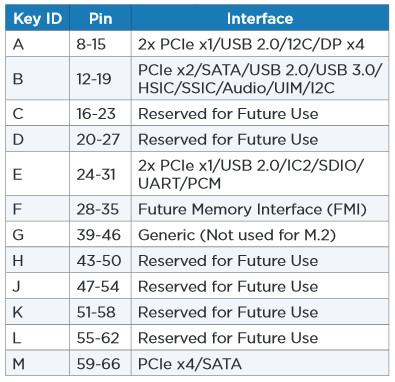
The M.2 connector has 75 pin positions, some of which are removed as keying notches depending on the use case of the attached card.*
There is a huge potential for variation in the dimensions of M.2 devices but a width of 22mm and 30/42/60/80/110 mm lengths are the most common packages. Motherboards which support M.2 are typically compatible with 42-80mm, whilst others should be taken on a case-by-case basis.
Theoretical speeds for M.2 storage devices utilising PCI-E signalling are significantly higher than SATA3’s 6Gbps (~550MB/s). Initial solutions utilise two PCI-E 2.0 lanes for a total bandwidth of 1GB/s, whilst draft specifications outline support for as many as four PCI-E 2.0 lanes or extend support to PCI-E 3.0, effectively doubling the maximum available bandwidth to 2GB/s. The flexibility of the standard also allows for additional modifications to be made at a later date should it prove necessary.
M.2 therefore should be a hit in the embedded, mini-PC and laptop arenas where high performance in a miniature form factor is a major selling point. It’s role on Z97 motherboards is less clear except that it provides next-generation storage speeds for devices which are already on the market, whereas the alternative SATA-Express connector has no comparable drives available to consumers.
*M.2 Connector pin-out via http://uk.farnell.com/images/en_UK/pdf/TE_M.2datasheet.pdf
The Plextor M6e 256GB
Plextor was one of the first SSD manufacturers to bring M.2 SSD modules to the market, catching a march on competitors and offering early adopters of the standard an outlet for the needs. Their M6e comes in 128GB, 256GB and 512GB flavours with each adhering to the 80mm form factor, making it compatible with the majority of Z97 mainboards that include either surface-mounted M.2 slots.
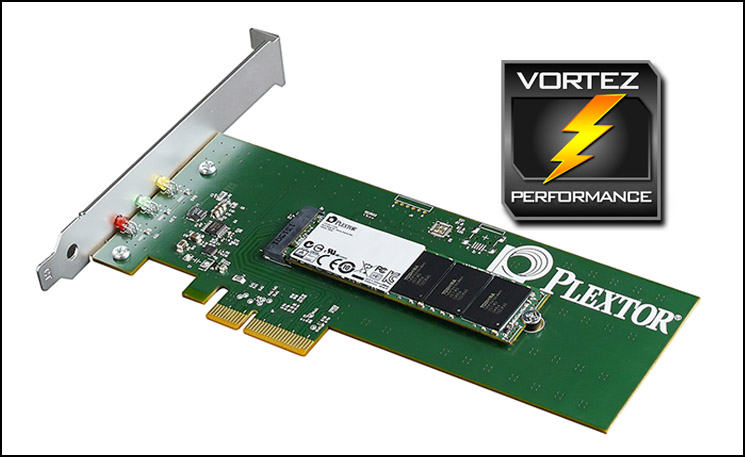
Plextor don’t just cater to the new motherboards however – each M6e also includes a full height PCIE bracket for the M.2 drive, making it compatible with any motherboard that has a spare 4x PCI-E slot. The full-height bracket also includes three indicator LEDs detailing SSD status.
The M6e utilises a Marvell® 88SS9183 dual-core server-grade controller, synchronous Toshiba Toggle NAND flash, and has firmware developed and tested by Plextor’s in-house team. Said controller makes use of two PCI-Express 2.0 lanes, allowing it to reach speeds of up to 770MB/s and approach the heights of the much more expensive dedicated PCI-Express card-based SSDs such as the OCZ RevoDrive. Other M.2 drives tend to use legacy SATA, hence capping out at ~550MB/s.
Installation of the M6e is supremely straightforward as you would expect and leaves no trailing wires. In fact the only aesthetic downside is the green PCB on both bracket and module; hopefully black PCBs from Plextor and other manufacturers will be a high priority in the future.
As an AHCI SSD the M6e is directly bootable and will not require drivers with supporting motherboards (including the vast majority of Intel 9-series and 8-Series motherboards). As you would expect TRIM, S.M.A.R.T. And NCQ are all supported, as is both Legacy and UEF boot for high-speed start up.
Technical Specifications
– Interface: M.2/PCI-E, exceeds SATA3 limitations with upto 1.5x performance boost.
– Duo BIOS Support: Set as boot device under UEFI BIOS or the legacy BIOS
– Compatibility: AHCI Support, no drivers needed.
– Read Speed: 770MB/s
– Write Speed: 335MB/s
– Read IOPS: 96,000
– Write IOPS: 83,000
– Controller: Server Grade Marvell PCI-e Control Chip (88SS9183)
– Supports TRIM with compatible OS
– Warranty: 5yr
– Duo BIOS Support: Set as boot device under UEFI BIOS or the legacy BIOS
– Compatibility: AHCI Support, no drivers needed.
– Read Speed: 770MB/s
– Write Speed: 335MB/s
– Read IOPS: 96,000
– Write IOPS: 83,000
– Controller: Server Grade Marvell PCI-e Control Chip (88SS9183)
– Supports TRIM with compatible OS
– Warranty: 5yr
Testing Setup & Methodology
In this review we’re seeking to directly compare the Plextor M6e with a high quality SATA 3 drive and assess the differences (if any). In this vein we’ve chosen to utilise one of the best performing 2.5” SSDs to come through our offices thus far, a 480GB Corsair Neutron GTX. Driven by a Link_A_Media (LAMD) Controller rather than the more popular Sandforce, it is competitive with most SATA 3 drives currently on the market and inside consumer systems today.
Unfortunately our typical X79 SSD review platform doesn’t include an M.2 slot and necessitates a swap to Z97 and Haswell specifically for this review. Due to the relative immaturity of Z97, and desire to have a broader understanding of the chipsets performance variations (which are expected to be minor), we’re taking a snapshot rather than publishing our findings with the whole of our SSD results. Once we’ve had more experience with Z97, including the expected performance range for M.2 across these new motherboards, we’ll be rolling finalised results into the full dataset.
For reference our current results listing (at the time of writing) can be found in their entirety here.
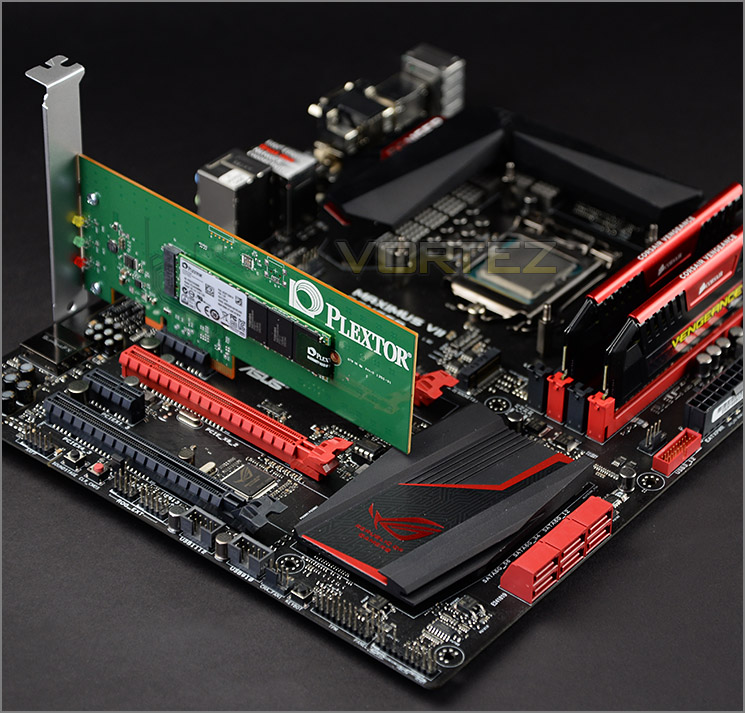
The test system is formatted and a fresh version of Windows is installed with just drives in place – no additional applications. Windows is then updated to the latest release and the drivers are installed. In addition to testing the M6e installed into the M.2 slot we also intend to asses whether the use of the PCI-Express incurs any performance penalties. Included in the list of benchmarks are the following applications:
Benchmarks
– ATTO Disk Benchmark v2.46
– AS SSD
– CrystalDiskMark 3.0
– Iometer
– SiSoftware SANDRA 2012
– HDTune Pro 5.5
– ATTO Disk Benchmark v2.46
– AS SSD
– CrystalDiskMark 3.0
– Iometer
– SiSoftware SANDRA 2012
– HDTune Pro 5.5
Test Setup:
CPU: Intel Core i7 4770K (Haswell) @3.5GHz
Motherboard: ASUS Maximus VII Ranger (Z97)
Memory: 16GB Corsair Vengeance Pro 2800MHz CL12 DDR3
Graphics: XFX R7970 Black Edition
PSU Corsair HX1050 80 Plus Gold Certified PSU
Storage:
– 256GB Plextor M6e via M.2 Slot
– 256GB Plextor M6e via PCI-E Bracket-base
– Corsair Neutron GTX 480GB via SATA 3
Motherboard: ASUS Maximus VII Ranger (Z97)
Memory: 16GB Corsair Vengeance Pro 2800MHz CL12 DDR3
Graphics: XFX R7970 Black Edition
PSU Corsair HX1050 80 Plus Gold Certified PSU
Storage:
– 256GB Plextor M6e via M.2 Slot
– 256GB Plextor M6e via PCI-E Bracket-base
– Corsair Neutron GTX 480GB via SATA 3
Benchmarks: ATTO
The ATTO Disk Benchmark performance measurement tool is compatible with Microsoft Windows that measures your storage systems performance with various transfer sizes and test lengths for reads and writes. Several options are available to customize your performance measurement including queue depth, overlapped I/O and even a comparison mode with the option to run continuously. Use ATTO Disk Benchmark to test any manufacturers RAID controllers, storage controllers, host adapters, hard drives and SSD drives and notice that ATTO products will consistently provide the highest level of performance to your storage.
Benchmarks: AS SSD
AS SSD Benchmark is a straightforward tool for measuring the speed of your SSD drive.
Simply launch the program, choose your drive, click Start, and it’ll test your SSD’s read and write speed in a variety of ways, delivering a score for each when it’s done. And if that’s not enough, there are also additional file copy and compression-related benchmarks available from the Tools menu. (The author’s support page is German only, but if you need further English explanations then there’s a thread on the program at the OCZ Technology forum.).
Simply launch the program, choose your drive, click Start, and it’ll test your SSD’s read and write speed in a variety of ways, delivering a score for each when it’s done. And if that’s not enough, there are also additional file copy and compression-related benchmarks available from the Tools menu. (The author’s support page is German only, but if you need further English explanations then there’s a thread on the program at the OCZ Technology forum.).
Benchmarks: CrystalDiskMark 3.0
CrystalDiskMark is a disk benchmark software that analyses different types of hard drive, giving sequential benchmark write and read statistics in MB/s. A simple program that is very useful and straightforward enough that even novices can use it to quickly test their drive performance.
Benchmarks: Iometer
Iometer is based on a client–server model, where one instance of the Iometer graphical user interface is managing multiple ‘workers’ (each one representing a separate Dynamo.exe process) which are performing the I/O. Iometer performs Asynchronous I/O – accessing files or block devices (later one allowing to bypass the file system buffers).
Iometer allows the configuration of disk parameters such as the ‘Maximum Disk Size’, ‘Starting Disk Sector’ and ‘# of Outstanding I/Os’. This allows a user to configure a test file upon which the ‘Access Specifications’ configure the I/O types to the file.
Iometer allows the configuration of disk parameters such as the ‘Maximum Disk Size’, ‘Starting Disk Sector’ and ‘# of Outstanding I/Os’. This allows a user to configure a test file upon which the ‘Access Specifications’ configure the I/O types to the file.
Benchmarks: SiSoftware SANDRA
SiSoftware Sandra (the System ANalyser, Diagnostic and Reporting Assistant) is an information & diagnostic utility. It should provide most of the information (including undocumented) you need to know about your hardware, software and other devices whether hardware or software.
Sandra is a (girl) name of Greek origin that means “defender”, “helper of mankind”. We think that’s quite fitting.
It works along the lines of other Windows utilities, however it tries to go beyond them and show you more of what’s really going on. Giving the user the ability to draw comparisons at both a high and low-level. You can get information about the CPU, chipset, video adapter, ports, printers, sound card, memory, network, Windows internals, AGP, PCI, PCI-X, PCIe (PCI Express), database, USB, USB2, 1394/Firewire, etc.
Sandra is a (girl) name of Greek origin that means “defender”, “helper of mankind”. We think that’s quite fitting.
It works along the lines of other Windows utilities, however it tries to go beyond them and show you more of what’s really going on. Giving the user the ability to draw comparisons at both a high and low-level. You can get information about the CPU, chipset, video adapter, ports, printers, sound card, memory, network, Windows internals, AGP, PCI, PCI-X, PCIe (PCI Express), database, USB, USB2, 1394/Firewire, etc.
Benchmarks: HDTune Pro
A new utility we have added to our line-up of benchmarks is the ever popular HDTune Pro. HD Tune Pro is a hard disk / SSD utility with many functions. It can be used to measure the drive’s performance, scan for errors, check the health status (S.M.A.R.T.), securely erase all data and much more.
Conclusion
Once again the balance of our results speak for themselves. The Plextor M6e excelled in sequential and randomised read/write despite the relative immaturity of both the platform and the interconnect, reaching a peak of 770MB/s read and 570MB/s write in our ATTO 1,024 tests which matches up extremely well with Plextors own claims for the device. The only slight hiccups in performance were HDTune results, a test which has been hard on all our previous candidates but for some reason hit the M6e particularly hard, and IOMeter results that were very good but not quite the highest ever performer. There was also a times significant variation in performance between M6e in M.2 and PCI-Express configuration particularly under heavy non-sequential workloads, potentially speaking to the Z97 platform’s immaturity at this time.
In terms of raw throughput it is by some margin the fastest drive we have tested thus far, and will remain comfortably ahead of SATA III drives in the future. The performance of Marvell’s 88SS9183 scales with capacity, and our 256GB model will also be surpassed by 512MB version for write rates well in excess of 600MB/s. All-in-all that’s extremely impressive for a relatively new technology, and reflects well on Plextor’s initial implementation.
For this performance you will however pay a premium, although it should be noted that the prices per GB of these drives wouldn’t be blinked at this time last year. The inclusion of a PCI-Express bracket will also tend to add to overall costs – both in terms of raw materials and packaging – and so if M.2 demand peaks then ‘just-drive’ releases should reduce overall prices even without more competion. The new server-grade controller should also be substantially more durable than competing products, and Plextor back it up with a 5-year guarantee which is three more than most.
Plextor’s M6e certainly gets our recommendation if you’re in need of far faster speeds than current SSDs allow or a more streamlined system than would be possible with a relatively bulky 2.5” drive kicking around. The only drawback is one of aesthetics, and hopefully manufacturers will get cracking on a black PCB variant soon. It easy attains our Performance Award
Pros
+ Raw speeds surpassing SATA 3
+ Compact form factor suitable for a diverse range of systems
+ Backwards compatible with older systems thanks included bracket
Cons
– Price
– Not quite as
+ Raw speeds surpassing SATA 3
+ Compact form factor suitable for a diverse range of systems
+ Backwards compatible with older systems thanks included bracket
Cons
– Price
– Not quite as
As for M.2 in general, the standard is a significant step up from the mSATA solution and provides provably better performance than SATA 3. It’s also very early days for the standard and much more remains the pipeline including NVMe, additional bandwidth and the potential for non-storage devices in the future. However it still requires appropriate controllers from the the likes of Marvell, Sandforce, LAMD and the diverse in-house solutions developed by some. By all accounts we will be waiting some time before these are likely to appear en mass, but Z97 finally provides a much needed universal platform.
So, who should be looking to upgrade to M.2? Well the obvious answer is those who demand the highest speed without looking for more exotic PCI-E solutions, but it’s not limited to this rather small niche. Systems built within tiny form factors can now enjoy extremely fast storage without needing to take up space with a 2.5” drive or PCI-E slot, and that should immediately interest modders keen to show their skills as well as companies with off-the-shelf mini-PC lines. PCI-E-speed solutions also become available to MATX/Mini-ITX systems with all PCI-E slots already full, potentially improving the overall speed of small form factor dual-GPU PCs.
The large question mark having over M.2 is the eventual adoption of the SATA-Express connector, the alternate means of tapping into PCI-Express storage which also provides some measure of backwards compatibility to SATA 3. This competing method is at an earlier implementation stage than even M.2 however and also suffers from downsides related to the size of the connector and cable, whilst on the plus side having the benefits of greater user confidence in installing. At present both M.2 and SATA-Express only allow up to one drive each, so the benefits of most chassis being well set-up for multiple 2.5”/3.5” drives is irrelevant.
Presupposing that costs of high performance SATA 3-beating drives can be brought down M.2 is looking like an excellent standard for mainstream Z97 systems owned by those comfortable with installing such cards. Making use of one as the main system drive is something of a no-brainer, but SATA 3 will still have a place for legacy storage well into the future. SATA Express drives which use the wide connector by contrast may struggle to find a market.

Click here for an explanation of our awards at Vortez.net. Our thanks go to Plextor and ASUS for supplying some of the hardware for use in this review.


