







Utilising SLC NAND for best possible endurance and boasting exceptional write speeds, just how good is this eye-catching USB 3.0 flash drive?

Product On Review: MX-ES
Manufacturer And Sponsor: Mach Xtreme Technology
UK Street Price: £41.99
You’d be forgiven for being unfamiliar with Mach Xtreme and their range of products. Based out of Taiwan and relative newcomers having been around only since 2010, they’ve carved out a very strong niche by specialising only in higher performance flash memory devices for the enterprise and power user market.
As you’d expect for any company with a name like Mach Xtreme speed is their watchword and time their focus. By bringing fast storage and memory to the user they aim to increase the former whilst saving the latter. They currently specialise in SSDs encompassing a comprehensive range of form factors, High Performance and Affordable USB thumb drives, and System RAM.
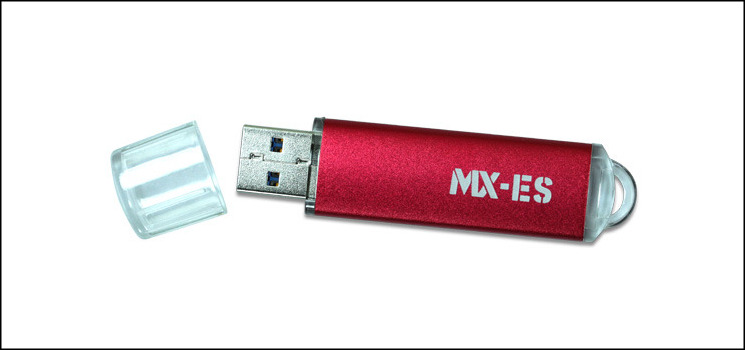
Today we’re taking a look at the 32GB MX-ES, a high performance USB3.0 Flash Drive built on Single Level Cell NAND. The drive is also available in 8GB and 16GB flavours with lower headline performance.
About The MX-ES
Thanks to its use of advanced SLC NAND flash technology, the MX-ES USB3.0 flash drive transfers data in the fast lane, featuring ultra high transfer rates making data transfer easy. The MX-ES Series USB3.0 pendrive utilizes SLC NAND flash to offer higher performance and longer endurance over traditional MLC NAND flash, which is typically used in other USB3.0 pendrives.
Thanks to its use of advanced SLC NAND flash technology, the MX-ES USB3.0 flash drive transfers data in the fast lane, featuring ultra high transfer rates making data transfer easy. The MX-ES Series USB3.0 pendrive utilizes SLC NAND flash to offer higher performance and longer endurance over traditional MLC NAND flash, which is typically used in other USB3.0 pendrives.
NAND cells of all types have a specific failure rate, and are usually good for a certain number of read-write cycles before failure. This is one of the reasons why SSDs have overprovisioning within their specs – to attempt to equalise out the number of times any cell is written to over the whole drive. Multi Level Cell NAND is typically used in flash products which prioritise cost, rather than SLC which is more durable and has significantly higher write speeds.
By choosing SLC NAND Mach Xtreme can reach far higher write speeds with fewer controller channels than comparable products with a similar capacity, as well as boast better durability. The trade-off is one of cost, although by keeping the price well under £50 Mach Xtreme are keeping the MX-ES competitive within the wider drive ecosystem. Depending on your workload, the cost may very well be worth it.
Technical Specifications
Model Name:- MXUB3SES-32G
Capacity:- 32GB
Interface Type:- USB 3.0
Dimension:- 69.5 x 17.0 x 8.2mm (LxWxH)
Lightweight:- 32g
Max. Read Performance:- Up to 170MB/s*
Max. Write Performance:- Up to 185MB/s*
Hot Plug / Removal:- Support
Shock Resistant:- 1,500G
Vibration:- 20G
Altitude:- 80,000ft
Operating Temp.:- 0℃ ~ +70℃
Storage Temp.:- -45℃ ~ +85℃
Certifications:- RoHS / FCC / CE / Windows 8 / Optimized for ASUS USB 3.0 mainboards
OS Support:- Windows 8 / Windows 7 / Windows Vista / Windows XP / Mac OS X
Other features:- SLC NAND Flash / Ultimate Endurance / World-class Reliability
Warranty:- 5 Years
Packaging And Close Look
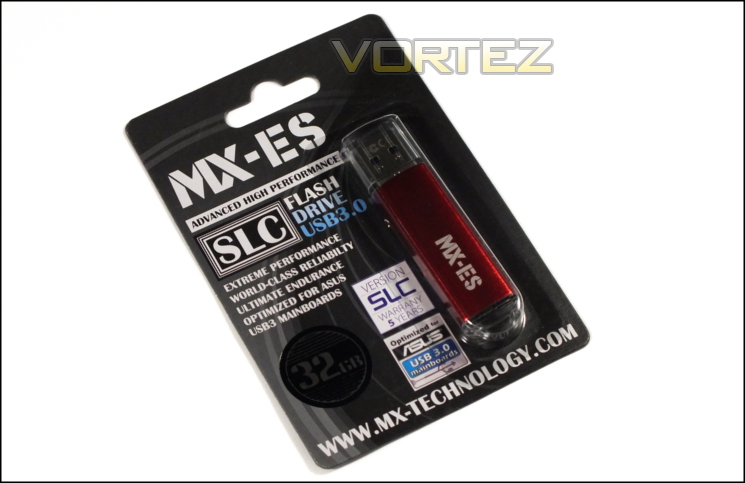
Mach Xtreme are giving nothing away when it comes to the packaging. The blister pack could be selling any thumb drive on the market, and belies its high performance characteristics. Anyone who has seen some of the more exotic packaging for Mach Xtreme’s SSDs would probably be quite surprised by the almost sober exterior – that is sober, except for the bright red thumb drive inside.
Whilst SLC memory may not be recognisable to some, the MX-ES makes it quite clear how important it is in offering ‘Extreme Performance’ and ‘Ultimate Endurance’; this is certainly no $5 Christmas Cracker gift. Thankfully they’ve also included the 32GB capacity plainly too, whereas for others it can be a little difficult to determine exactly what you’re purchasing.
Interestingly the packaging also makes note of being optimised for ASUS USB 3.0 mainboards. In the past we have briefly covered ASUS’s USB 3.0 Boost Technology, which makes use of a more efficient protocol for data transfers over USB. Although the MX-ES isn’t a UASP-capable drive, it’s likely compatible with ASUS’s Boost – Turbo tech., and hence would benefit somewhat when transferring smaller files over USB.
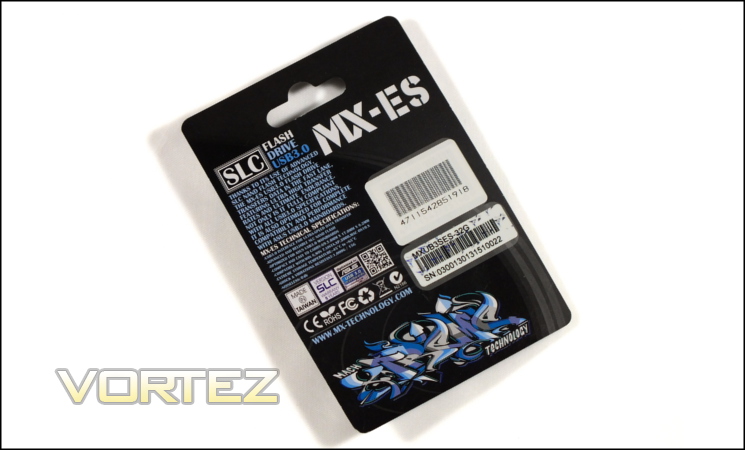
The back of the packaging contains much more detailed specifications including compatibility and durability information. No mention is made of actual speeds, so were you to come across it in store you’d likely need to look up the QR code online to get the full specs. The most critical information is all there though, and so there’s little chance that someone who buy the drive and discover it’s not suitable for them.
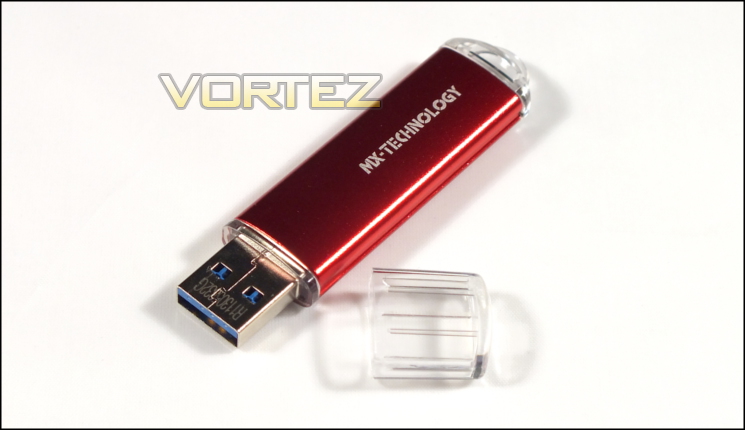
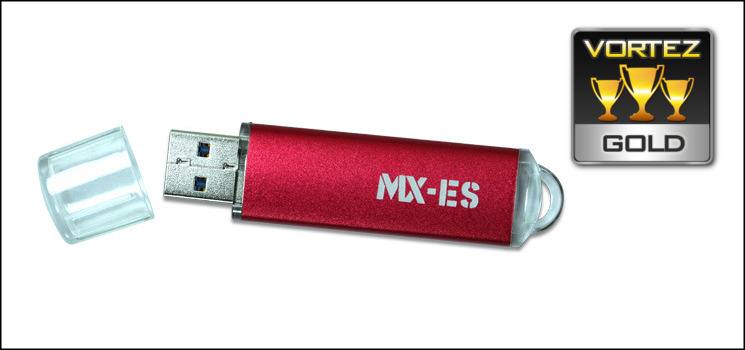
With the MX-ES what you see is what you get. There are no additional parts to the pack, making it clear that Mach Xtreme are trying to keep the drive as affordable as possible. Nonetheless the drive has a durable metal exterior and plastic cap, whilst the rear also has a loop for affixing to a keychain. The cap itself will no clip to the back of the drive, so you’ll need to marshal it accordingly.
Compared to other thumb drives the MX-ES is slimline, measuring only 70 x 17 x 8mm. With other high speed drives we’ve had difficulty with the housing obstructing adjacent USB ports, but with this there will be no such problem.
When inserted into a USB port a blue LED illuminates, and flashes during activity, providing important information of when it’s not suitable to remove beyond the say-so of Windows Explorer.
Testing Methodology
Test System
The following are the crucial system specs for this test.
CPU:- Intel i5-3570K @ Stock
RAM:- 8GB GEIL DDR3-1600
Motherboard:- MSI Big Bang Marshal (P67-B3) – NEC/Renasas USB 3.0 Controller
SSD:- Kingston SSDNow V+100 (230MB/s / 180MB/s Read/Write)
RAM:- 8GB GEIL DDR3-1600
Motherboard:- MSI Big Bang Marshal (P67-B3) – NEC/Renasas USB 3.0 Controller
SSD:- Kingston SSDNow V+100 (230MB/s / 180MB/s Read/Write)
Test Criteria
When testing the drive we wanted to evaluate the general speed of the drive under a couple of different conditions. As many users are still without USB 3, especially in a corporate environment, we also felt that testing the potential of the drive under USB 2.0 was important. Ideally a fast USB 3.0 drive should max out the available bandwidth of USB 2.0 – 480Mbps or 35MB/s theoretically – rather than only show an improvement under optimal conditions.
USB 3.0
The Maximum theoretical bandwidth of USB 3.0 is 5Gbps (625 MB/s); under the most common data encoding parameters this figure drops to ~400MB/s, still dwarfing the spec limits of most USB 3.0 thumb drives. Though the absolute maximum data transfer rate for the drive under reasonable conditions is generally of primary importance, it’s also sensible to capture the performance with small file sizes and IOPS to allow a detailed comparison with other USB 3 drives and usage scenarios.
We’re able to test the drive against the high performance 64GB Kingstone DataTraveler HyperX 3.0 previously reviewed. Note that this drive is in a higher market segment than the 32GB MX-ES, but doesn’t boast the SLC NAND of the newer drive. Over time we hope to have the opportunity to increase the data pool by testing additional thumb drives.
USB 2.0
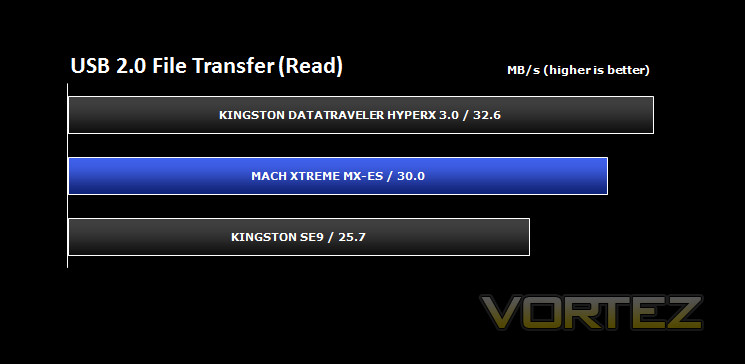
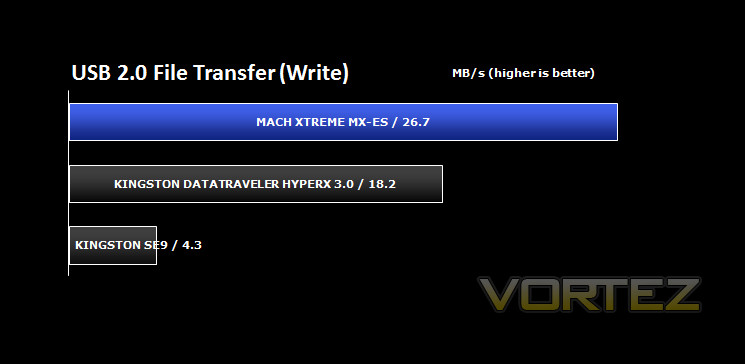
Here, all we wish to test is the speed of the drive in relation to more affordable USB 2.0 drives, and assess whether it can make the most of the 35MB/s available in this configuration. We will be comparing the 32GB MX-EX against the DataTraveler HyperX 3.0 and a Kingston 8GB DataTraveler SE9, which has fairly typical specs for USB 2.0 flash drives.
Testing Notes:-
1. Poorly configured or malfunctioning USB 3.0 ports may not recognise USB 3.0 devices, but still work in USB 2.0 mode for USB 2.0 devices. Do not assume that the drive is at fault if this occurs, especially if other USB 3.0 devices have yet to be tested.
2. For reasons unknown, some USB 3.0 ports may be limited to ~135MB/s read/write operation. Though not an issue for most drives, external USB 3.0 SSD enclosures and flash drives which are capable of greater speed will suffer.
3. The MX-ES comes pre-formatted at FAT32, allowing file sizes up to 4GB. In order to test with larger files we re-formatted the drive as NTFS.
Benchmarks: CrystalDiskMark 3.0
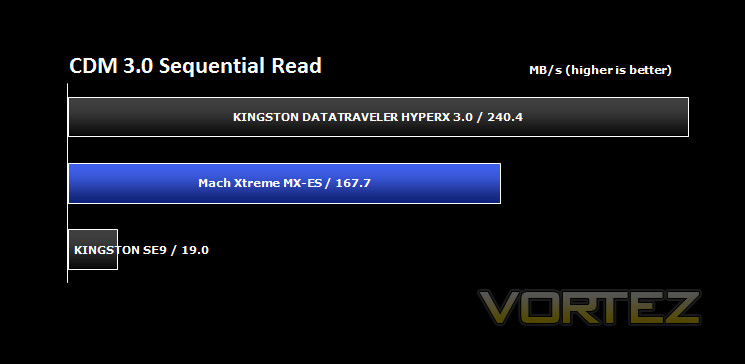
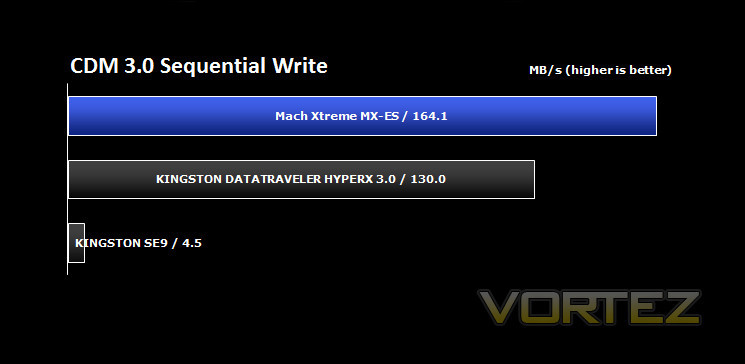
CrystalDiskMark is a disk benchmark software that analyses different types of hard drive. Giving sequential benchmark write and read statistics in MB/s. A simple program that is very useful.
CrystalDiskMark’s sequential read/write test provides generally good best case results for various storage media. The data is compressible, which is why Sandforce-based drives tend to perform well in this benchmark over suites with incompressible data; comparing these results with those for AS SSD should allow the assessment of whether drive write operations are benefiting from undocumented write compression.
Benchmarks: ATTO Disk Benchmark v2.46
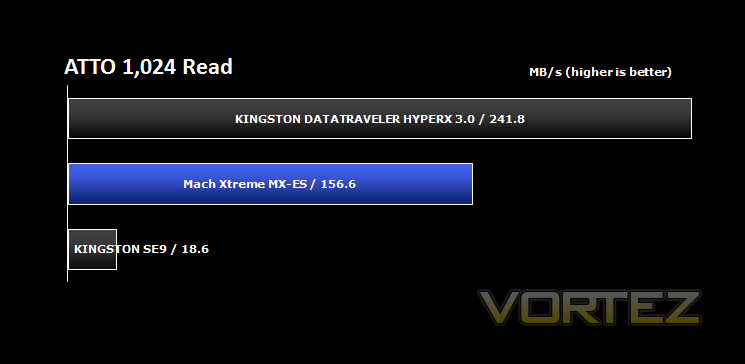
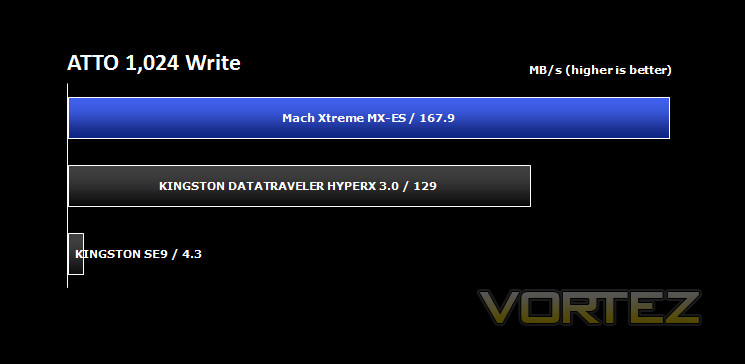
The ATTO Disk Benchmark performance measurement tool is compatible with Microsoft Windows. Measure your storage systems performance with various transfer sizes and test lengths for reads and writes. Several options are available to customize your performance measurement including queue depth, overlapped I/O and even a comparison mode with the option to run continuously. Use ATTO Disk Benchmark to test any manufacturers RAID controllers, storage controllers, host adapters, hard drives and SSD drives and notice that ATTO products will consistently provide the highest level of performance to your storage.
Benchmarks: AS SSD v1.6.4237
AS SSD Benchmark is a straightforward tool for measuring the speed of your SSD drive.
Simply launch the program, choose your drive, click Start, and it’ll test your SSD’s read and write speed in a variety of ways, delivering a score for each when it’s done. And if that’s not enough, there are also additional file copy and compression-related benchmarks available from the Tools menu. (The author’s support page is German only, but if you need further English explanations then there’s a thread on the program at the OCZ Technology forum.).
Simply launch the program, choose your drive, click Start, and it’ll test your SSD’s read and write speed in a variety of ways, delivering a score for each when it’s done. And if that’s not enough, there are also additional file copy and compression-related benchmarks available from the Tools menu. (The author’s support page is German only, but if you need further English explanations then there’s a thread on the program at the OCZ Technology forum.).
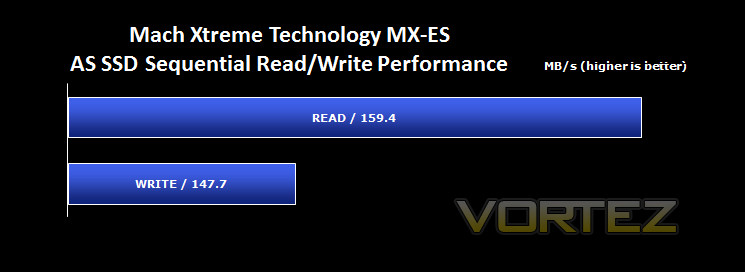
As previously noted, the AS SSD benchmark includes the facility to use incompressible data, representing data such as RAR files or encoded video which has already undergone compression. If the flash controller of the Mach Xtreme MX-ES utilised compression, we would expect a heavy (40-50%) penalty to Write rates vs the CrystalDiskMark and ATTO benchmarks.
Benchmarks: IOMeter
Iometer is based on a client–server model, where one instance of the Iometer graphical user interface is managing multiple ‘workers’ (each one representing a separate Dynamo.exe process) which are doing the I/O. Iometer performs Asynchronous I/O – accessing files or block devices (later one allowing to bypass the file system buffers).
Iometer allows the configuration of disk parameters such as the ‘Maximum Disk Size’, ‘Starting Disk Sector’ and ‘# of Outstanding I/Os’. This allows a user to configure a test file upon which the ‘Access Specifications’ configure the I/O types to the file.
Iometer allows the configuration of disk parameters such as the ‘Maximum Disk Size’, ‘Starting Disk Sector’ and ‘# of Outstanding I/Os’. This allows a user to configure a test file upon which the ‘Access Specifications’ configure the I/O types to the file.
For USB Pen Drives, an IOPS test is pretty much the definition of ‘unfair’ as it simulates scenarios for which USB drives are not typically designed. Our test, which we put desktop storage through, uses IOMETER to perform 4K 50%/50% read/write cycles with 100% Random Distribution – reporting back on IOPS. This generally represents heavy database gruntwork, not something your average thumb drive should have to cope with.
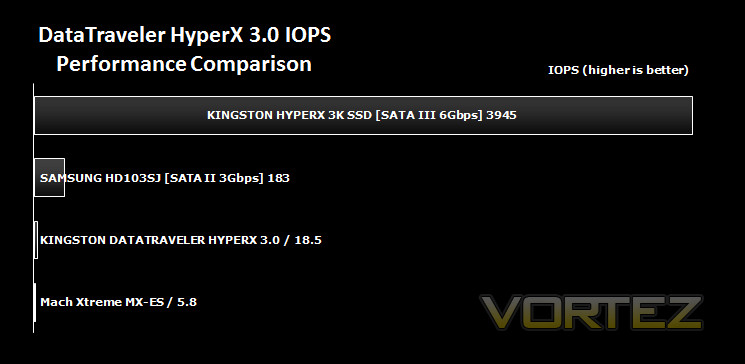
As you can see, a thumb drive which in terms of peak data transfer rates can generally trounce mechanical HDDs struggles to keep up in raw IOP performance.
Benchmarks: USB 2.0 File Transfer Speeds
Although USB 3.0 capability is becoming all the more ubiquitous within mainboard chipset definitions, USB 2.0 is still important for businesses and educational organisations with a longer hardware in-service times. USB 3.0’s backwards compatibility is especially useful, and improved controllers in modern drives may allow full use to be made of USB 2.0’s available bandwidth.
The test implemented is straightforward:- measure the time to transfer (and hence MB/s transfer speed) a sufficiently large file when using a USB 2.0 interface. In this case we have chosen a 1.546 GB MPEG4-encoded video file.
The test implemented is straightforward:- measure the time to transfer (and hence MB/s transfer speed) a sufficiently large file when using a USB 2.0 interface. In this case we have chosen a 1.546 GB MPEG4-encoded video file.
Conclusion
The results of our testing of the Mach Xtreme MX-ES really speak for themselves. Both Read and Write rates of contiguous data each top out at over 150MB/s, with write speeds particularly impressive at 164MB/s in the Crystal Disk benchmark.
Crucially, Mach Xtreme are able to reach these speeds without going to 64GB in size and leveraging the benefits of this consequent increase in the number of data channels and NAND modules on the drive. Instead it’s due to their use of SLC NAND, which has far higher write speeds than Multi Level Cell NAND typically used in non-enterprise flash products. As a result the speeds are lightning fast for the capacity, especially when it comes to peak write rates.
Another benefit of SLC NAND is higher durability, which is why Mach Xtreme have seen fit to offer a 5 year warranty on the MX-ES.
The point which may trip up the MX-ES is perceived value for money. We can generally disregard 32GB drives which cost less than £40.00 as they tend to be heavily restricted in speed with write speeds often topping out at a lowly 50MB/s. Ultra-fast drives are available if you’re willing to push your budget to over £65, but they also will not typically reach the sorts of write speeds you see here. Therefore, if you really need high bandwidth data transfer but are on an extremely tight budget, the MX-ES would be the way to go.
Of course you should also pay careful attention to your workload. USB drives are ideal for sequential writes of large files, and performance will drop out in other circumstances. If these latter data types are more typical then an ESATA solution would be more suitable simply due to the limitations of USB 3.0, although it would also tend to be moth more costly and restrictive of compatibility with older PCs. However, transporting large images, videos, audio and similar data ideally matches the characteristics of the MX ES admirably, and USB is a far more convenient connection type to boot.
Relative newcomers Mach Xtreme have an ultra fast drive on their hands with the MX-ES, easily breaching the 160MB/s barrier on file writes. Use of SLC Memory offers great reliability and high speed writes, whilst Mach Xtreme back up their promises with a 5-year warranty. Also optimised for ASUS USB 3.0 Boost Turbo Mode, which could see further improvements of up to 120% in some workloads, the MX-ES is a worthy achiever of our Gold Award
Pros
+ High-Speed USB 3.0 read rates.
+ Blisteringly fast USB 3.0 write rates.
+ Long-lasting SLC NAND
+ Sleek exterior for maximum compatibility around USB ports
+ High visibility for the accident prone
Cons
+ Relatively high price per gigabyte
Tips
= Pair with an ASUS motherboard for even higher performance
+ High-Speed USB 3.0 read rates.
+ Blisteringly fast USB 3.0 write rates.
+ Long-lasting SLC NAND
+ Sleek exterior for maximum compatibility around USB ports
+ High visibility for the accident prone
Cons
+ Relatively high price per gigabyte
Tips
= Pair with an ASUS motherboard for even higher performance

Click here for an explanation of our awards at Vortez.net.


