




An exclusive look at MSI’s upcoming Intel X79 (LGA2011) motherboards with Intel Sandy Bridge-E being overclocked by BenchTec UK using Phase/Water/Air Cooling methods.
It was a warm Friday in October. Something special was being planned by MSI and BenchTec, and Vortez.net was lucky enough to have been granted an invite to a one-off event. Not ones to miss out, Tony, Tim and Dave braved the trains and motorways from all parts of England to be there. The Event:– an overclocking and testing session of MSI’s X79 launch range, specifically to evaluate stability and provide feedback to on-site MSI engineers.

A little background is required. MSI are known for their leading motherboard, graphics cards and laptops with military grade components. Their claims are not idle boasting – they really do test components to military standards and over-engineer products specifically for stability and overclocking. This is perhaps best exemplified by their Lightning range of AMD and NVIDIA Graphics Cards, but that ethos runs through their entire Military Class range.
BenchTec, in their own words:
BenchTec was formed in November 2007 to be the home of UK extreme hardware benchmarking. Bringing together UK-based members of several other teams, we exist to provide a one-stop site to showcase the best talent in the UKs performance computer hardware scene.
If you’re seeking to test unreleased hardware to their limits, you’ll find no better team in the UK. Of this elite team, the members in attendance were El Gappo, scooter.jay, kr0nz3, kitfit1, borandi and ARandomOWl.
Hardware Used
So, with the introductions out of the way, we really should move on to the delicious hardware. First up, four of Intel’s i7 3960X Extreme Edition – the highest end in their launch range of Sandybridge-E CPU’s. These chips were all Intel’s latest C1-Stepping, and represent what consumers will be seeing once Sandybridge-E is formally released later this year.
A killer feature of SandyBridge-E and the X79 platform is Quad-Channel memory, so of course for this session the BenchTec team were keen to push this feature as far as they could. GSkill felt they were up to the awesome channel of doing Sandybridge-E justice, and generously provided a set of 16GB kits for the session. We’re reliably informed they “‘clocked like crazy”.

The third piece to the puzzle came in the way of OS drives and PSU’s. Trying to keep system bottlenecks to a minimum is key, and solid state drives are the obvious direction to turn without compromising stability and set-up time. Furthermore, power stability is essential in any sort of stability testing and overclocking session. OCZ contributed in fine style by providing both 1KW Z-Series PSUs and enough Vertex SSD’s to go around.
As you would expect, MSI showed utmost confidence in their own products by supplying the team with a range of MSI Graphics cards from both NVIDIA’s 500 and AMD’s 6000 series. Yes, we also love the look of the Twin Frozr III cooler, and it’s a great sadness it’s not available as a standalone product.
MSI X79 Motherboards
Three motherboard variants were already set-up on four test benches, each of which fulfilled a clear market niche. MSI’s design aesthetic was stamped heavily on each board; you won’t mistake any for being from a different brand.
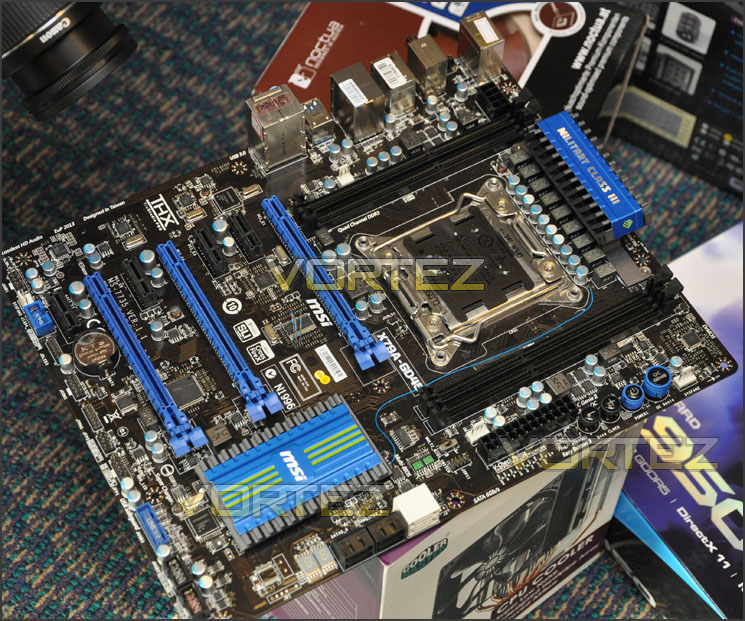
MSI X79 GD45 Not a final version – threads will be removed!!
First up was the 4-DIMM GD45. Whilst strictly the entry-level board offered by MSI’s X79 range, the GD45 still boasts Quad-Channel Memory, SLI and CrossfireX within an ATX form-factor. This great piece of kit also comes with all the high-quality power circuitry of its’ bigger brothers, and so doesn’t compromise on stability and overclock potential. Unsurprisingly, the popular OC-Genie one-button overclocking functionality present on P67 and Z68 makes an appearance, but enthusiasts will also relish the options presented within the revised UEFI BIOS to get every last scrap of performance out of their systems.
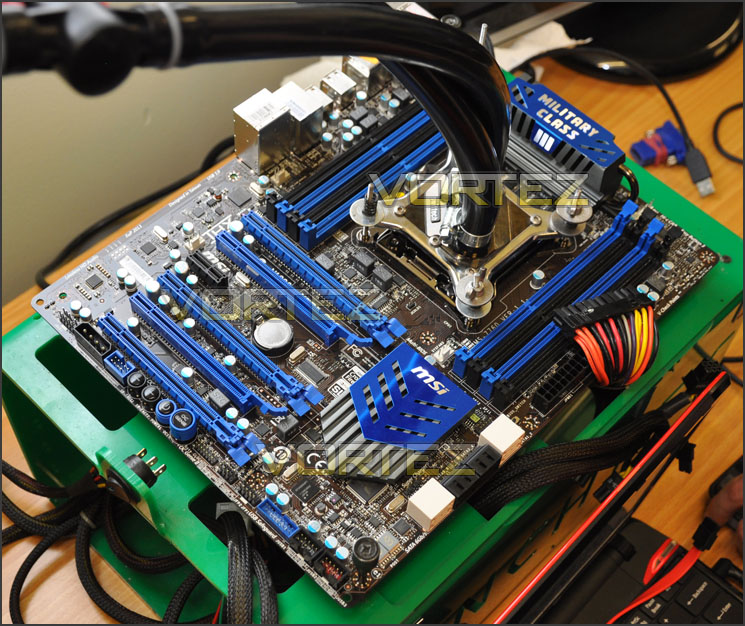
MSI X79 GD65 ready to be water-cooled
The GD45’s bigger brother is the 8-DIMM GD65. If you absolutely positively need 64GB of Quad-channel RAM, or perhaps even 32GB in more affordable 4GB modules, then this should be your first port of call. Once again featuring all the utility you expect to see in a high-end X79 motherboard, it looks the part too thanks to the Black/Blue colour-scheme throughout.
The dense component layout of the GD65 speaks to how tight a fit that sort of functionality is within the ubiquitous ATX form-factor. However, users that choose the GD65 over the GD45 will no doubt benefit greatly from the additional SATA ports and AUX. PCI-E power for 3-way SLI.
Finally, present but un-pictured by MSI’s request, was a 4-DIMM mATX X79 variant which appeared to be slightly earlier along its’ development path. Without even a release code-name, this little board excited plenty of comment from the BenchTec guys who repeatedly asked for confirmation that it was going to be released. The board is obviously cramped due to the same no-compromise approach for power infrastructure on all the X79 range, even more so than the GD65, but MSI were confident that with a little inventive design they’d be able provide the user with everything they could need. We’re not sure when it’ll reach retail channels, but it certainly seems one to look out for if your render box needs
to be small but pack a whole lot of punch.
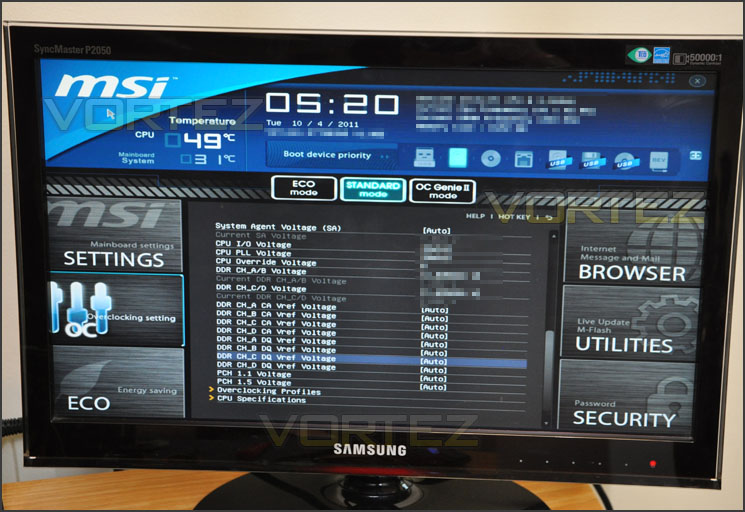
MSI’s dazzling new UEFI BIOS will feature on all X79 motherboards
All the X79 range will of course have the newly designed MSI UEFI BIOS which looks quite spectacular. This update from the earlier P67 ClickBIOS was first introduced with the new Z68 Gen3 range, and has been revamped for optimal compatibility with X79’s feature set. I think you’ll agree that it looks great, and nicely complements MSI’s branding with a black/blue colour scheme of its’ own. Most importantly for Intel’s enthusiast chipset, MSI’s UEFI doesn’t scrimp on the overclocking options needed to squeeze every ounce of performance from your system.
BenchTec's X79 Cooling and Testing Methods
The BenchTec team are no strangers to extreme cooling, regularly employing techniques more reminiscent of something from a chemistry lab than your average enthusiasts study. Such extreme sub-zero temperatures weren’t required for this session however, and so they turned their hand at tools we found slightly more familiar.
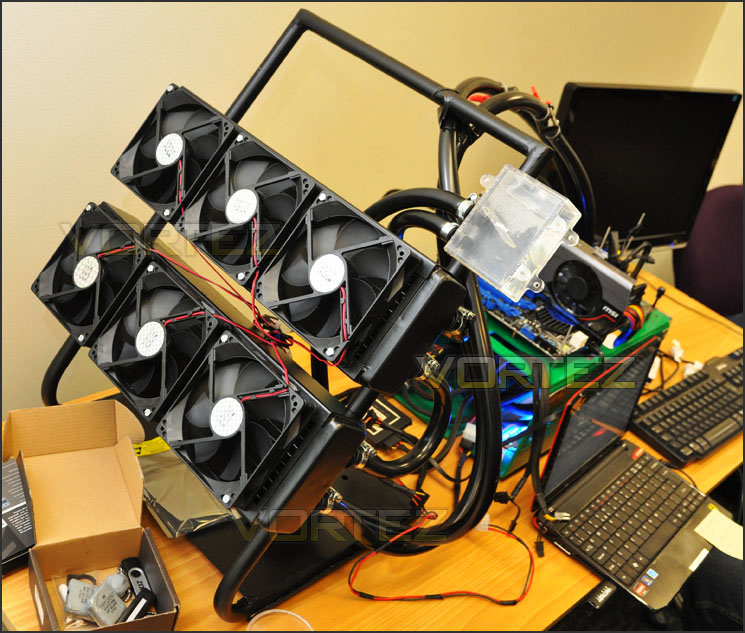
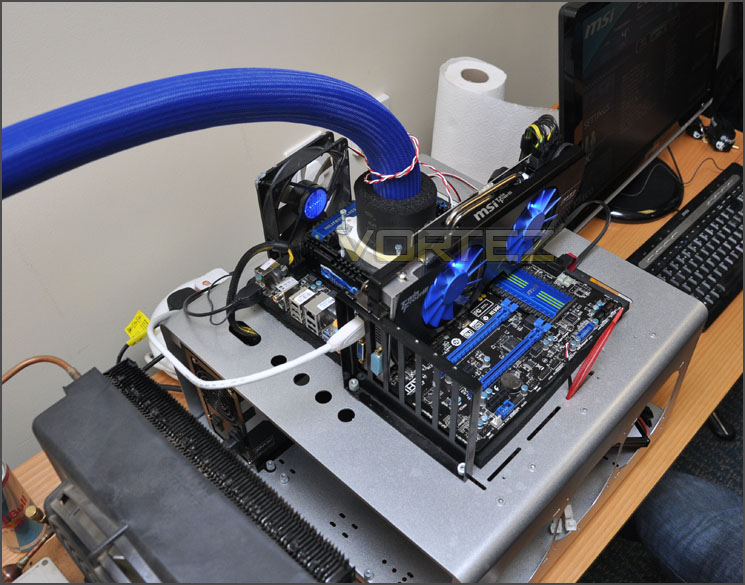
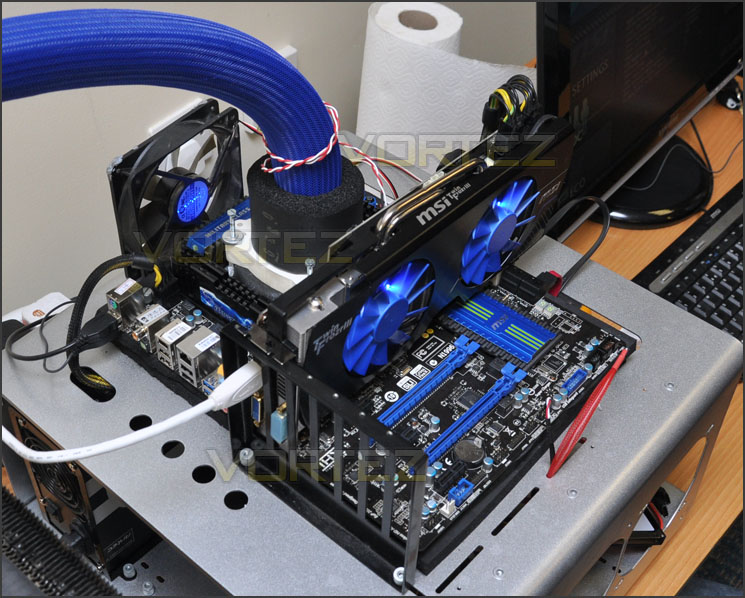
Water-cooling used on GD65
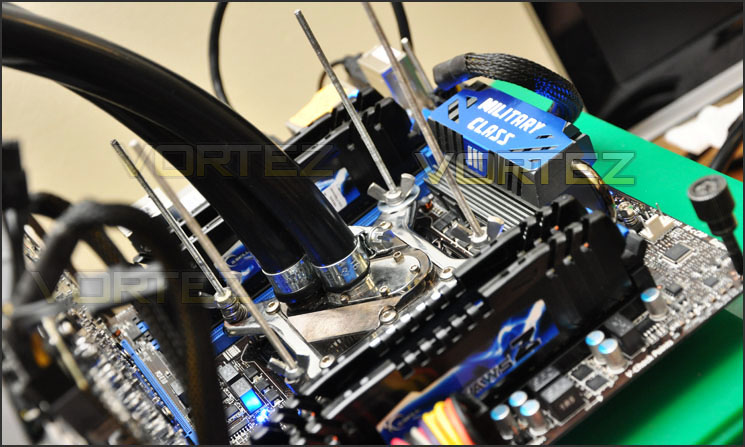
A closed up of the GD65 being water-cooled
Most recognisable was the bespoke water-cooling rig (if you can believe it, assembled the day before) of BenchTec team member kr0nz3, which cooled the GD65 with i7 3960X EE to 42C in memory benchmark sessions with CPU approaching the 5GHz. Whilst elaborate, this dual-radiator set-up isn’t uncommon amongst enthusiasts.
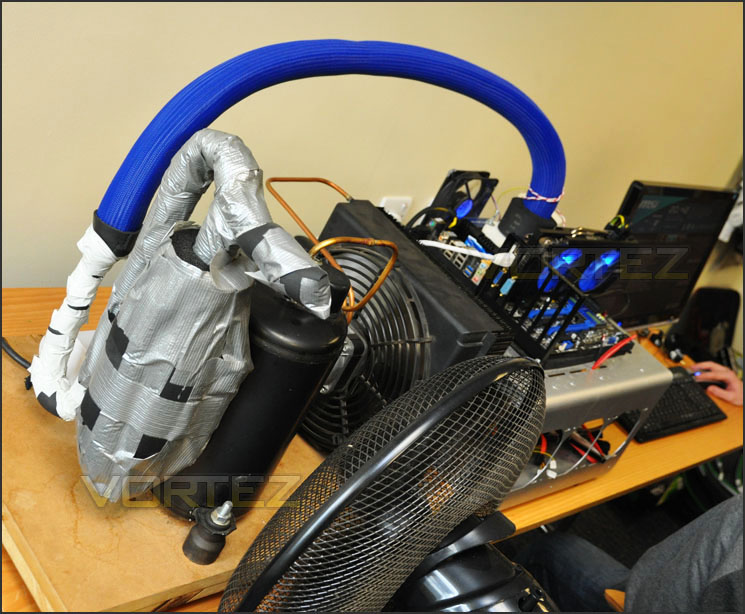
Phase-Change Cooling on a GD65
Reaching a daunting tier of sub-zero cooling, kitifit1’s single-stage phase change cooler was to be seen to be believed. This example was able to cool the Sandybridge-E CPU down to a chilly –60C on the GD45 for stable benchmark runs. If you can get the cooling, MSI and Sandybridge-E are obviously a strong combination.
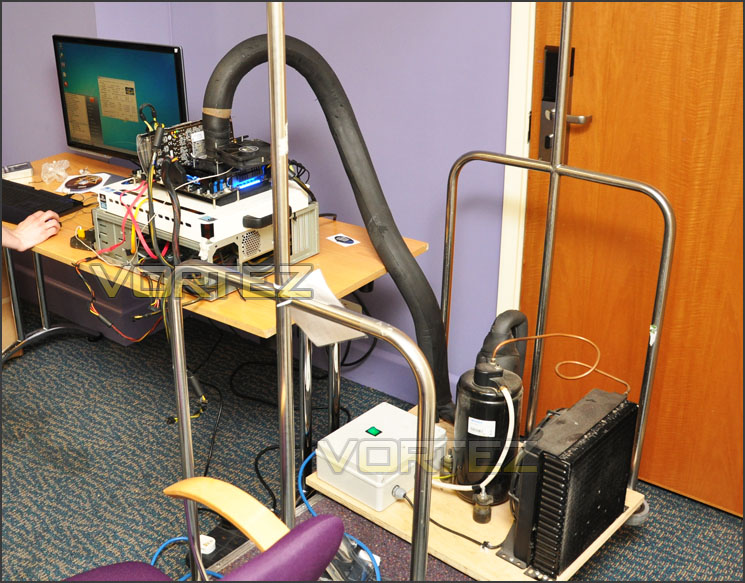
Another Phase-Change solution cooling on GD45
Also featured on the second GD45 setup was a further phase-change solution, details of which we couldn’t find before publication.
A range of testing applications were used to determine system stability and benchmarks. Staple of both GPU and CPU assessment, Futuremark’s CPU suite was crucial for assessing stability with many a borderline overclock being rejected due to failing the test. SiSoft Sandra’s memory benchmarking tool showed the strength of the platform versus Sandybridge Z68. CPU-Z allowed clock-speeds to be verified for immediate verification prior to more in-depth testing.
Conclusion and Final Thoughts
Firstly, the Vortez team would like to thank MSI and the BenchTec team for inviting us to this event and having a peek at what X79 and SandyBridge-E has to offer. Without exception every individual was gracious and as accommodating as possible with our no-doubt noddy questions and endless requests for information. Simply attending an event like this can rejuvenate your enthusiasm for overclocking your own PC, appreciate the skills of the very best the UK overclocking scene has to offer, and put a human face to the manufacturer of some of the kit you own.
Benchmarks and CPU specifications are still covered by the Intel NDA, preventing us from posting detailed information on the results. Sadly, that means you’re going to have to wait for our upcoming X79 comprehensive benchmarking article to see just what SandyBridge-E is capable of. I can provide you with a hint though: the memory benchmarks are outstanding. In addition, make sure you take note of the CPU stepping in X79 review articles – C1 and not C0 processor results are those you should heed.
We were impressed by the stable benchmarks seen throughout the day. Although more than capable, the testers weren’t seeking to push the CPU’s as far as they would go simply for a CPU-Z screenshot, as if an arbitrary number would be valuable for the likely end-user. Instead, a rigorous investigation (as time allowed) of system stability conservative overclocks were conducted to gain an insight of achievable performance and platform weaknesses. Despite the pre-release nature of the boards results were impressive, even whilst key frustrations such as long POST times could be relayed back to the engineers directly.
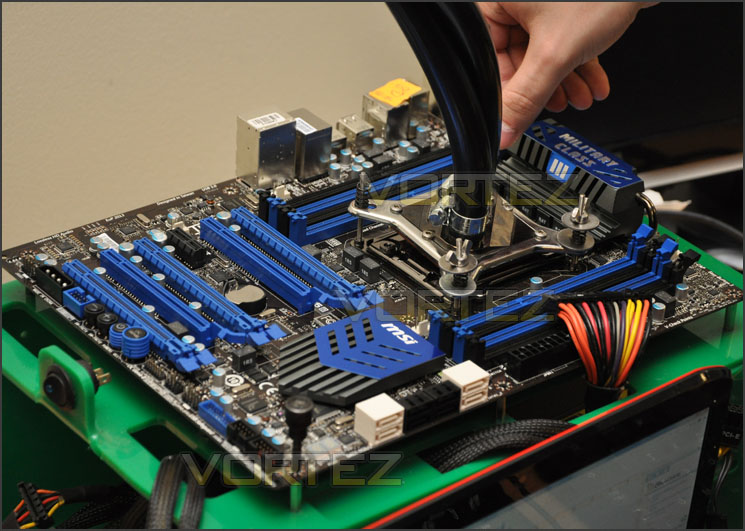
GD65 with Military Class III components
Socket 2011 is worth mentioning in its’ own right. Unsurprisingly, the CPU requires significantly more pressure to maintain good contact with all two thousand pins than the S1366, which has necessitated a new mounting standard of four screw-in posts. The BenchTec team utilised a modification of the 1366 mounting system for their cooling solutions, but the end-user should not expect 1366 HSF’s to be compatible with S2011 out-the-box. Furthermore the location of power circuitry above the socket, rather than to the left/right, makes a HSF exhausting air upwards beneficial. Contacting your HSF manufacturer prior to upgrading to ensure compatibility would be advisable.
MSI’s X79 range is shaping up very nicely. We were impressed with the observed stability and performance potential of the boards on display under extreme cooling, water cooling and standard non-elaborate air cooling. The GD45 is a quality entry-level product, exemplifying high-quality build standards coupled with good functionality and enough value-plus features to satisfy most of those who will upgrade to X79. Even though the GD45 is such a strong product, the GD65 adds enough to the platform to tempt the tightest of wallets; you’re more likely to be cursing the limitations of the ATX form-factor than this peach of a board. If you’re running 3-Way Sli on X79, the GD65 will almost certainly be in your sights.
Even though we think highly of those motherboards, we have a soft-spot for the mATX one on display. We’ve no idea how they broke the laws of physics to get that many power phases – and all the other standard ATX features – into the mATX form factor, but it is an engineering feat. The boards’ potential is enormous, and I can quite imagine demand being very high once it reaches retail channels.
GD45 with Phase-Change cooling
High-end users, those who demand the best of the best, will be pleased to note that the range should be expanded to the premium-end of the market. A Big Bang X79 is very likely, leveraging the larger EATX or XL-ATX form factors for Quad-SLI and other perks suitable for those on the bleeding edge.
We’re left with one final question – who should upgrade to X79? Well, the obvious answer is anyone currently utilising X58. The improvements in architecture from Nehelem to Sandybridge were significant and Sandybridge-E builds further on these. Those who require enormous memory bandwidth will relish what X79 brings to the table over both X58 and Z68, and the true overclocking enthusiast will appreciate the tweaking potential possible with SB-E and MSI’s improved UEFI BIOS. MSI’s X79 range will be a strong successor to X58.
VIDEO Preview of MSI X79 Event


