




Industrial PPC fans are designed for heavy duty applications that require enhanced cooling performance at 2000-3000 RPM – with dust and water protection.

Product on Review: industrialPPC
Manufacturer & Sponsor: Noctua
Street Price: £20-25 GBP / $30-32 USD
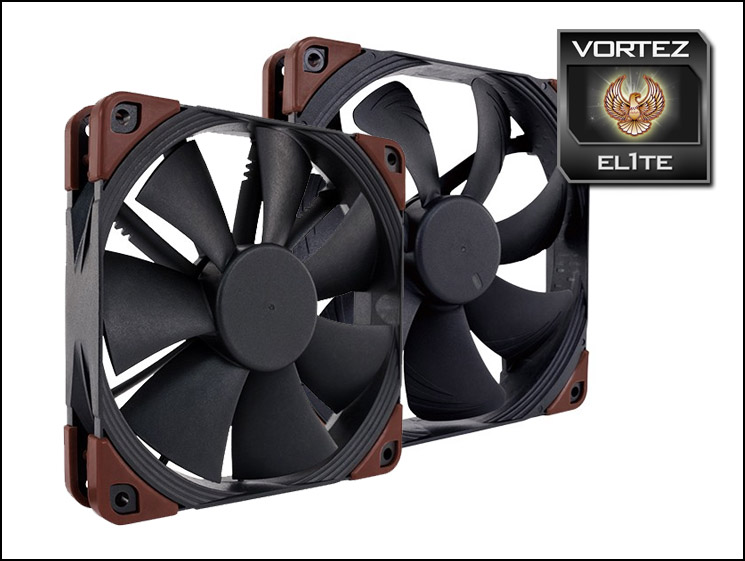
At the time Noctua announced its redux fans and accessory kits, they also introduced a series of industrial “Protected Performance Cooling” fans. These are “ruggedised high-speed versions” of two of their most promising fans – the 120mm NF-F12 and the 140mm NF-A14. More than merely ruggedized and sped-up, these fans have undergone a change to charcoal black impellers and frames. And in keeping with the industrial nature of these fans, they have gone from four-magnet motors to six magnets apiece. As a result, these fans draw very little current for all their push, so they should suit industrial applications, where current draw figures into the total cost of ownership. If these improvements just so happen to make these fans perfect for mounting on radiators, so much the better.
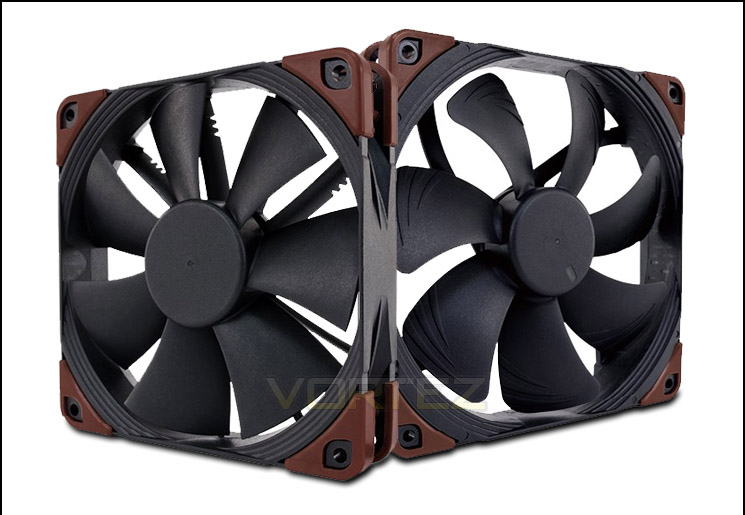
Noctua has these things to say about their industrialPPC fans:
Thanks to their elevated top speed, the industrialPPC fans provide a significant performance boost over the retail versions. Combined with the industrialPPC series’ robust polyamide construction and advanced protection features, this makes the fans ideal for challenging industrial applications.
While most axial fans use single-phase motors with 4 slots, Noctua’s industrialPPC fans feature a three-phase design with 6 slots, which provides smoother transitions between the slots and thus allows for even higher running smoothness, further reduced vibrations and unprecedented energy efficiency.
Both the impeller and the frame of Noctua’s industrialPPC fans are made entirely from fibre-glass reinforced polyamide. This material can withstand temperatures up to 140°C and makes the fans even more robust and break-proof than Noctua’s standard fibre-glass reinforced PBT fans.
Thanks to a special varnish coating that covers the motor and PCB, the industrialPPC complies with the ingress protection rating IP52. This means that it is not only highly dust resistant but also withstands dripping water equivalent to 3mm rainfall per minute.
The motor and PCB of the IP67 version are completely cast in a special, highly heat conductive resin that combines thoroughgoing protection and effective motor heat dissipation. Complying with the ingress protection rating IP67, this fan is not only fully dust tight but also completely waterproof up to 1m water depth.
While most axial fans use single-phase motors with 4 slots, Noctua’s industrialPPC fans feature a three-phase design with 6 slots, which provides smoother transitions between the slots and thus allows for even higher running smoothness, further reduced vibrations and unprecedented energy efficiency.
Both the impeller and the frame of Noctua’s industrialPPC fans are made entirely from fibre-glass reinforced polyamide. This material can withstand temperatures up to 140°C and makes the fans even more robust and break-proof than Noctua’s standard fibre-glass reinforced PBT fans.
Thanks to a special varnish coating that covers the motor and PCB, the industrialPPC complies with the ingress protection rating IP52. This means that it is not only highly dust resistant but also withstands dripping water equivalent to 3mm rainfall per minute.
The motor and PCB of the IP67 version are completely cast in a special, highly heat conductive resin that combines thoroughgoing protection and effective motor heat dissipation. Complying with the ingress protection rating IP67, this fan is not only fully dust tight but also completely waterproof up to 1m water depth.
About Noctua
Noctua is a “cooperation” of the Austrian firm Rascom Computerdistribution with the Taiwanese cooling specialist Kolink International Corporation. According to information in Wikipedia (take this with a grain of salt), Noctua is a company, a joint venture between Rascom and Kolink. Whatever the legal niceties, Noctua has been delighting computer enthusiasts since 2005 with their high quality products.
Technical Specifications for Noctua iPPC fans
Noctua industrial PPC specifications clearly put them in another class from other consumer grade fans. The SP noted below means static pressure, the pressure a fan makes when its outflow is blocked. Note how little current these fans draw.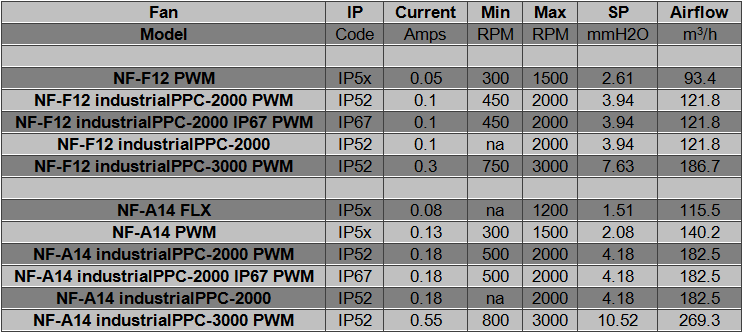
IP codes cover intrusion protection from everything solid from fingers to dust, and water protection from light sprinkles to full immersion. The IP code 5- means that the equipment is dust-proof (of several references consulted, Wikipedia was the clearest). A code of 6- means it is dust tight – no dust gets in at all. The IP code -2 means that the equipment is proof against a light rain, as long as it is canted to at least 15 degrees. The IP code of -7 means the equipment can handle being submerged up to 1m depth for as long as a half hour. So Noctua warrants that its normal iPPC fans are dust proof and can handle a light spray, while their IP67 fans can tolerate a good dunking. Well, we’ll see.
But now we were curious: how well protected are normal Noctua fans? Vortez wrote to Noctua. They responded, “The standard ones are not certified, but would qualify as IP5X (dust protection but no water protection).” So those codes were added to the spec table above.
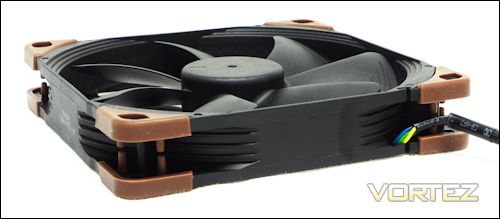
If you have looked for aluminum frames or water proofing or other protections in the fans made by other manufacturers, you know how hard they are to acquire and how much they cost. You will normally pay quite a premium for ruggedized fans. Noctua’s MSRP for the IP67 fans is $34.90/€29.90, less for IP52 fans (see Noctua’s product line page).
The Noctua industrialPPC fans also have SSO2 bearings, three phase electric motors and a six year warranty.
Packaging
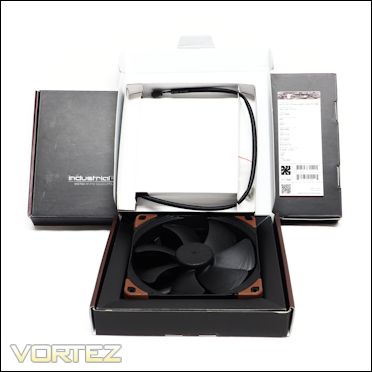
Noctua has taken the environmentally-friendly packing for their redux fans and extended the concept to their industrialPPC fans.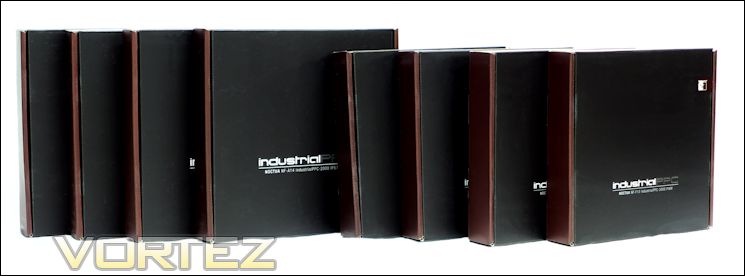
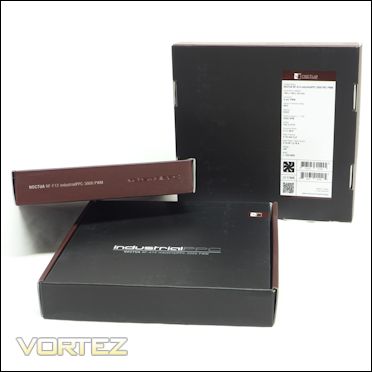
The boxes tell you what is inside them and show you’re their specs. Inside the fans are well-protected in cardboard cocoons. The power cables are all 40cm (16 inches). Aside from a set of screws, there are no accessories; hence, nothing to throw out. The entire kit can be recycled with no fuss.
Noctua iPPC fans – A Closer Look
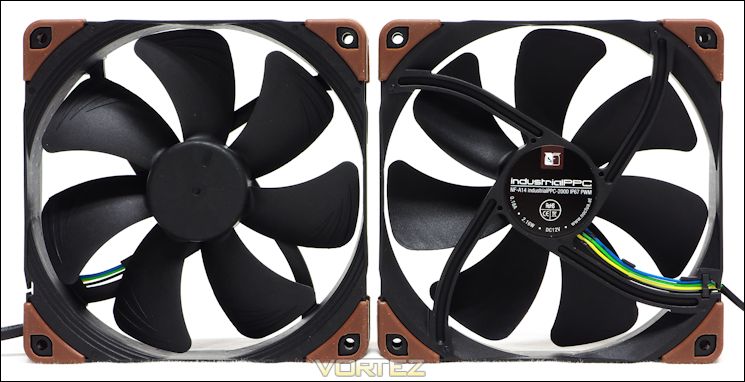
Noctua’s industrialPPC fans have a heft to them you only feel with other industrial fans. But for the most part you will recognize these fans. Not only do they carry the model numbers of slower fans, they look exactly like them. Like their smaller kin, these fans have such Noctua technology as AAO frames (Advanced Acoustic Optimisation) with integrated anti-vibration pads, as well as Noctua’s proprietary Stepped Inlet Design, Inner Surface Microstructures, and Flow Acceleration Channels on impellers.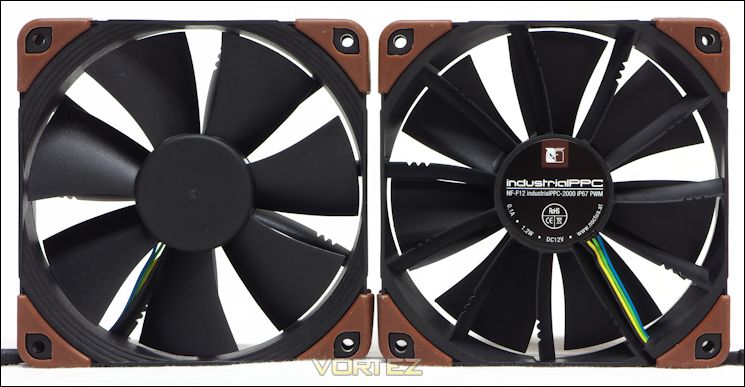
Hearkening back to the specifications table, you can see that these fans have a substantial static pressure. Having a square frame and being able to rev up to 2000 or 3000 RPM makes these fans just the thing for mounting on a radiator. The availability of PWM controls allows you to control the speed of several fans with one 4-pin fan header; and having the ability to ramp way down allows your system to get very quiet when it is not working hard.
Testing Setup
With such fans as these, we simply must test them. Fans have four performance aspects that can be measured: their speed (RPM), the noise they make (approximated by measuring the Sound Pressure Level), the amount of air they push (CFM) and their static pressure (mm H2O). Since Noctua fans report their RPM’s, the speed can be obtained directly from software. SPL (in dBA) and CFM must be measured. The measurement tools used in this review are the Tenma 72-942 SPL meter and the Extech AN100 Anemometer.
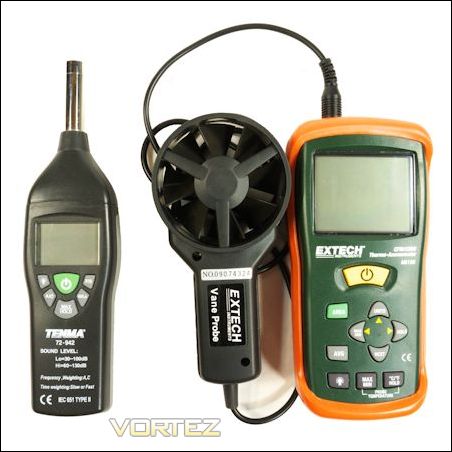
The Tenma is advertised as measuring sound pressure levels accurately down to 30 dBA. Not coincidentally, 30 dB is the SPL of what sounds like silence to you (so much for equating SPL with perceived noise). Outside of a room-sized anechoic chamber, a 30-dB basement is about as quiet a place as any to measure SPL. These Noctua fans had their SPL measured at 10 cm. A correction was applied to give the equivalent of the industry-standard 1 meter. While this is not a perfect system, it does give you a practical measure of how loud each fan is.
Fans have hubs, so the airflow is annular. The airflow also changes as you get further from the center of the fan. To get a single measurement of the airflow from a fan you must mix the air before you measure that flow. Special testing boxes were made to test these fans, with inlet and outlet holes fitted to each size class. Basically, the theory is that what goes in must come out. You measure what comes out. The anemometer can average measurements; each run represents an average of at least 10 readings.
In addition to open-outlet measurements, the 140mm and the 120mm fans were also measured with dust filters made from the same metal mesh. The outputs of the 120mm fans were additionally measured as they blew through a radiator with 30 fins per inch (Hardware Labs Black Ice GT Stealth). So we will be able to see how well the fans pulled through dust filters, and how well the 120mm fans pushed through a restrictive radiator.
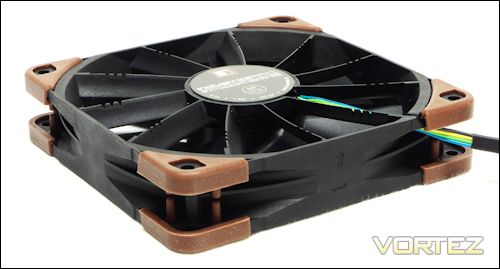
The fans tested for this review were supplied by Noctua.
Results of Testing
The charts below show standard and industrialPPC fans. On the left you will see the fan model followed by the nominal or measured RPM. On the bar side, in blue, we first have the nominal or measured SPL, measured in dBA. In brown we have the airflow through the rad, in green through the filter, and in red the unobstructed airflow. For the fan specifications, the airflow was restated in CFM. Where you see “avg,” the SPL and the output of two fans was averaged to produce the results you see.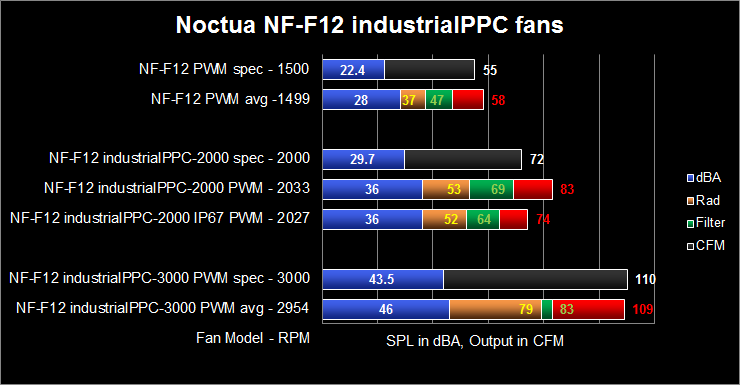
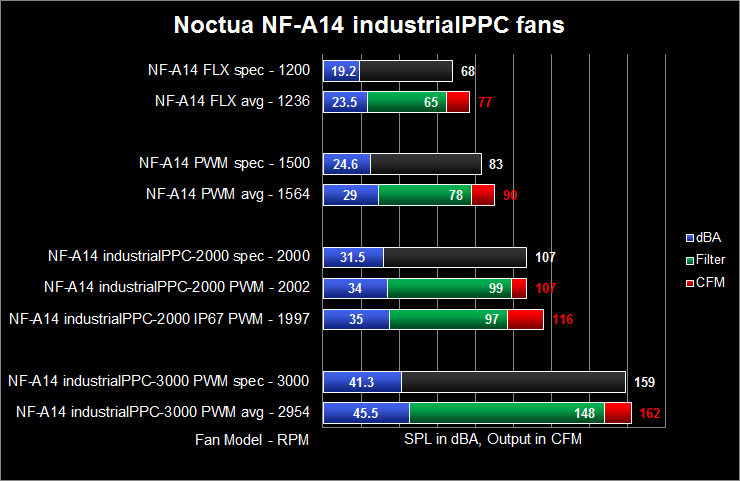
Oh yes: qualitative listening revealed zero clicking on all the fans.
Fans Under Water
When Noctua sends you IP67 fans, it would be a shocking waste of an opportunity not to test them by putting them under water. Accordingly, a sink was filled with 30cm (a foot) of tap water, and the fans were submerged, and the timer set for 15 minutes. In the picture below, you can see where the water comes up to the 30cm mark on the ruler. And there, underneath, are the two IP67 fans.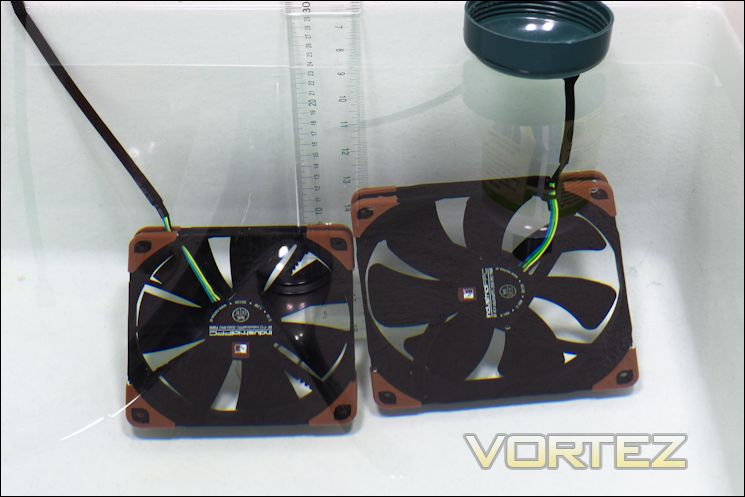
When the timer sounded, the fans emerged. Allowing them a little time to drip, but not enough to dry, their outputs were measured again.

The difference is well within the margin of error on these tests. In essence, the fans blew the same amount of air before and after they were dunked.
Conclusion
Noctua has extended their fan line into radiator territory — these are powerful fans with the right form factor for rads. The relatively low prices, the ruggedness, the standard IP52 protection, the availability of IP67 protection, the long MTBF and the low, low current draw of these fans make them perfect for industrial uses as well. Finally, the color change is just what a number of people have asked for.
And Noctua did not stop with increasing their 1500 RPM fans to 2000. The 3000 RPM models are where the industrialPPC fans really shine. With a simple 50% rise in output, these fans really punch out the air, both in flow and with pressure. The NF-A14 iPPC-3000 more than doubles its static pressure as it moves from 2000 RPM to 3000.
For an industrial designer, these are fine fans. For a waterhead, get out of the way! Noctua has taken their game to a whole new level by introducing a superb product which is packed full of value. After our findings we are pleased to hand out our Elite Award.
Pros
+ Outstanding performance
+ Form factor fitted for both industry and for water coolers
+ PWM circuitry is silent
+ Integrated anti-vibration pads
+ Low current draw keeps TCO low
+ Low price keeps TCO low
+ PWM is widely available on all industrialPPC versions
+ Packaging is fully recyclable
+ industrialPPC fans are Black
Cons
– None
+ Outstanding performance
+ Form factor fitted for both industry and for water coolers
+ PWM circuitry is silent
+ Integrated anti-vibration pads
+ Low current draw keeps TCO low
+ Low price keeps TCO low
+ PWM is widely available on all industrialPPC versions
+ Packaging is fully recyclable
+ industrialPPC fans are Black
Cons
– None

Click here for an explanation of our awards at Vortez.net.


