







We suspected that NVIDIA had a card waiting in the wings to take back the entry level crown. Well, here it is: The GTX650Ti BOOST…

Product on Review: NVIDIA GTX650Ti BOOST 1GB GDDR5
Manufacturer and Sponsor: NVIDIA
Price: MSRP of £124 incl. VAT
In our recent evaluation of the AMD Radeon HD7790, we saw it take the entry level crown away from the NVIDIA GTX650Ti. We suspected that NVIDIA has an answer waiting in the wings and that has been borne true with today’s release of the NVIDIA GTX 650 Ti BOOST. The keyword being BOOST as the GTX650Ti has undergone a refresh to combat the new threat poised by AMD. When we reviewed the original GTX650Ti were were impressed with the FPS that the little card churned out however we were left wanting because for the most part, gaming at today’s most popular resolution of 1920×1080 proved troublesome. NVIDIA admitted this in the media press pack for the new release so hopefully, we will not see a repeat performance today as the AMD HD7790 has proven that you don’t need to spend a fortune to play games at 1920×1080 to a playable FPS level.
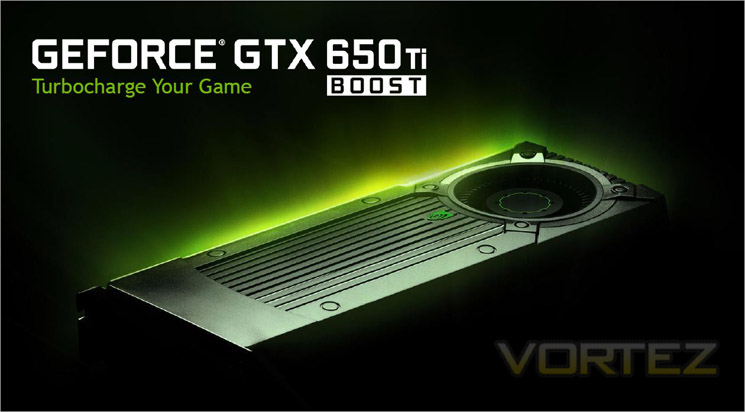
The GeForce GTX650Ti and the new BOOST version is aimed squarely at those looking to gain a foothold in the gaming market while still keeping a close eye on cost. The GTX650Ti was criticised for not including GPU BOOST (an automatic overclocking feature) in the original concept which, as the new naming suggests, is now included in the refresh. Also included is and improved memory interface, increasing from 128bit to 192bit. The final enhancement of this card is the option of SLI, a key feature missing from the original design.
The NVIDIA cards in this range have moved on quite a lot in the past five years with the 9600GT in 2008 to the GTX550Ti in 2011, Today’s GPU which is the latest in the evolution is almost 6.5 times faster than the 9600GT and some 3x faster than the 550Ti so if you are looking to replace like for like you will see quite a healthy ‘boost’ in performance.
About NVIDIA
NVIDIA awakened the world to computer graphics when it invented the GPU in 1999. From our roots in visual computing, we’ve expanded into super, mobile and cloud computing. NVIDIA’s mobile processors are used in smartphones, tablets and auto infotainment systems. PC gamers rely on GPUs to enjoy spectacularly immersive worlds. Professionals use them to create visual effects in movies and design everything from golf clubs to jumbo jets. And researchers utilize GPUs to advance the frontiers of science with high-performance computers.
NVIDIA awakened the world to computer graphics when it invented the GPU in 1999. From our roots in visual computing, we’ve expanded into super, mobile and cloud computing. NVIDIA’s mobile processors are used in smartphones, tablets and auto infotainment systems. PC gamers rely on GPUs to enjoy spectacularly immersive worlds. Professionals use them to create visual effects in movies and design everything from golf clubs to jumbo jets. And researchers utilize GPUs to advance the frontiers of science with high-performance computers.
Specification
Graphics Processing Clusters: 2 or 3
Streaming Multiprocessors: 4
CUDA Cores: 768
Texture Units: 64
ROP Units: 24
Base Clock: 980 MHz
Boost Clock: 1033 MHz
Memory Clock: 6008 MHz
L2 Cache Size: 384K
Total Video Memory: 2048MB GDDR5
Memory Interface: 192-bit
Total Memory Bandwidth: 144.2 GB/s
Texture Filtering Rate (Bilinear): 62.7 GigaTexels/sec
Fabrication Process: 28 nm
Transistor Count: 2.54 Billion
Connectors:
2 x Dual-Link DVI
1 x HDMI
1 x DisplayPort
Form Factor: Dual Slot
Power Connectors: One 6-pin
Recommended Power Supply: 450 Watts
Thermal Design Power: (TDP)140 Watts
Thermal Threshold: 98° C
Streaming Multiprocessors: 4
CUDA Cores: 768
Texture Units: 64
ROP Units: 24
Base Clock: 980 MHz
Boost Clock: 1033 MHz
Memory Clock: 6008 MHz
L2 Cache Size: 384K
Total Video Memory: 2048MB GDDR5
Memory Interface: 192-bit
Total Memory Bandwidth: 144.2 GB/s
Texture Filtering Rate (Bilinear): 62.7 GigaTexels/sec
Fabrication Process: 28 nm
Transistor Count: 2.54 Billion
Connectors:
2 x Dual-Link DVI
1 x HDMI
1 x DisplayPort
Form Factor: Dual Slot
Power Connectors: One 6-pin
Recommended Power Supply: 450 Watts
Thermal Design Power: (TDP)140 Watts
Thermal Threshold: 98° C
The card remains based on Kepler Technology by using the GK106 core and utilising a 28nm manufacuring process. Perhaps the most notable difference between the specifications above and that of the original GTX650Ti is that the memory interface has seen an improvement from a 128bit to a 192bit interface (3x64bit controllers). The card is also clocked to 980MHz however users will see a typical BOOST speed of 1033MHz. NVIDIA claim most users will be able to overclock the card past 1100MHz (card dependent) which seems feasable.
It is also worthy of note that the BOOST version of the GTX650Ti we have for review today also features SLI, a key features that was missing from the vanilla GTX650Ti.
Power consumption is however slightly increased slightly to around the 115W in normal operating conditions with this figure increasing depending on the load conditions.
Features
SMX
Kepler GPUs feature our next-generation Streaming Multiprocessor, SMX. To improve performance, SMX features substantially more shader, texture, and geometry processing units, while the double speed processor clock present in prior GeForce GPUs has been eliminated in favor of more CUDA cores operating at the lower-speed graphics clock. This change dramatically improves Kepler’s performance per watt.
Anti-Aliasing
NVIDIA FXAA technology harnesses the power of the GPU’s CUDA Cores to reduce visible aliasing. It is applied with other post-processing steps like motion blur and bloom. For game engines making use of deferred shading, FXAA provides a performance and memory advantage over deferred shading with multi-sample anti-aliasing (MSAA). FXAA reduces but does not completely eliminate shader aliasing. FXAA’s chief advantage over traditional MSAA is higher performance. In many cases, FXAA can be applied at a cost of 1ms per frame or less, resulting in frame rates that are often 2x higher than 4xMSAA with comparable image quality.
TXAA is a new film-style AA technique that’s designed to exploit GeForce GTX600 series high texture performance. TXAA combines the raw power of MSAA with sophisticated resolve filters similar to those employed in CG films. TXAA is available with two modes: TXAA 1 and TXAA 2. TXAA 1 offers visual quality on par with 8xMSAA with the performance similar to 2xMSAA, while TXAA 2 offers image quality that’s superior to 8xMSAA, with performance comparable to 4xMSAA.
NVIDIA 3D Vision
NVIDIA® 3D Vision™ technology is a combination of Graphics Processor Units (GPU), specialized 3D glasses, software, and certified displays and projectors that deliver an immersive 3D experience on your PC or workstation. For a complete list of system requirements for NVIDIA 3D Vision Technology
NVIDIA 3D Vision Surround
NVIDIA 3D Vision Surround expands your field of view across three 3D monitors for Breathtaking panoramic gaming. At an ultra-wide resolution of 5760×1080, games like Battlefield Bad Company 2 have to be played to be believed.
CUDA
CUDA is NVIDIA’s parallel computing architecture that enables dramatic increases in computing performance by harnessing the power of the GPU to speed up the most demanding tasks you can run on your PC.
SLI
NVIDIA SLI technology links multiple GeForce GPUs together for dramatically improved graphics performance. With over 1000 supported applications and used by over 94% of multi-GPU PCs on Steam, SLI is the technology of choice for gamers who demand the very best.
NVIDIA PureVideo
Blu-ray and HD DVD movies are bringing a new level of movie-viewing experience; with high-definition image quality far surpassing standard-definition DVDs. NVIDIA PureVideo™ HD2 technology provides unsurpassed Blu-ray and HD DVD movie picture quality.
Dual Link DVI
Dual-link DVI convertible output supports Video/Audio signal integration through DVI to HDMI interface, which drivers resolution of a digital display up to 1920×1200 or higher.
PhysiX
PhysX™ is designed specifically for hardware acceleration by powerful processors with hundreds of cores. Combined with the tremendous parallel processing capability of the GPU, PhysX™ will provide an exponential increase in physics processing power and will take gaming to a new level delivering rich, immersive physical gaming environments
Kepler GPUs feature our next-generation Streaming Multiprocessor, SMX. To improve performance, SMX features substantially more shader, texture, and geometry processing units, while the double speed processor clock present in prior GeForce GPUs has been eliminated in favor of more CUDA cores operating at the lower-speed graphics clock. This change dramatically improves Kepler’s performance per watt.
Anti-Aliasing
NVIDIA FXAA technology harnesses the power of the GPU’s CUDA Cores to reduce visible aliasing. It is applied with other post-processing steps like motion blur and bloom. For game engines making use of deferred shading, FXAA provides a performance and memory advantage over deferred shading with multi-sample anti-aliasing (MSAA). FXAA reduces but does not completely eliminate shader aliasing. FXAA’s chief advantage over traditional MSAA is higher performance. In many cases, FXAA can be applied at a cost of 1ms per frame or less, resulting in frame rates that are often 2x higher than 4xMSAA with comparable image quality.
TXAA is a new film-style AA technique that’s designed to exploit GeForce GTX600 series high texture performance. TXAA combines the raw power of MSAA with sophisticated resolve filters similar to those employed in CG films. TXAA is available with two modes: TXAA 1 and TXAA 2. TXAA 1 offers visual quality on par with 8xMSAA with the performance similar to 2xMSAA, while TXAA 2 offers image quality that’s superior to 8xMSAA, with performance comparable to 4xMSAA.
NVIDIA 3D Vision
NVIDIA® 3D Vision™ technology is a combination of Graphics Processor Units (GPU), specialized 3D glasses, software, and certified displays and projectors that deliver an immersive 3D experience on your PC or workstation. For a complete list of system requirements for NVIDIA 3D Vision Technology
NVIDIA 3D Vision Surround
NVIDIA 3D Vision Surround expands your field of view across three 3D monitors for Breathtaking panoramic gaming. At an ultra-wide resolution of 5760×1080, games like Battlefield Bad Company 2 have to be played to be believed.
CUDA
CUDA is NVIDIA’s parallel computing architecture that enables dramatic increases in computing performance by harnessing the power of the GPU to speed up the most demanding tasks you can run on your PC.
SLI
NVIDIA SLI technology links multiple GeForce GPUs together for dramatically improved graphics performance. With over 1000 supported applications and used by over 94% of multi-GPU PCs on Steam, SLI is the technology of choice for gamers who demand the very best.
NVIDIA PureVideo
Blu-ray and HD DVD movies are bringing a new level of movie-viewing experience; with high-definition image quality far surpassing standard-definition DVDs. NVIDIA PureVideo™ HD2 technology provides unsurpassed Blu-ray and HD DVD movie picture quality.
Dual Link DVI
Dual-link DVI convertible output supports Video/Audio signal integration through DVI to HDMI interface, which drivers resolution of a digital display up to 1920×1200 or higher.
PhysiX
PhysX™ is designed specifically for hardware acceleration by powerful processors with hundreds of cores. Combined with the tremendous parallel processing capability of the GPU, PhysX™ will provide an exponential increase in physics processing power and will take gaming to a new level delivering rich, immersive physical gaming environments
First Look
Card Top
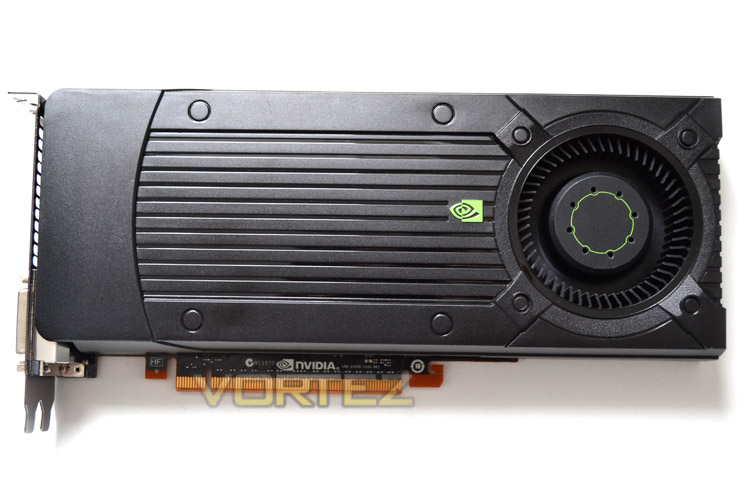
The NVIDIA GTX650Ti we have for review today is a reference design so it is important to stress at this point that NVIDIA’s board partners will be given free reign to create their own designs. For the most part though the key features will remain the same. Our sample, as shown features the reference design cooler we first saw on the GTX670.
Black PCB
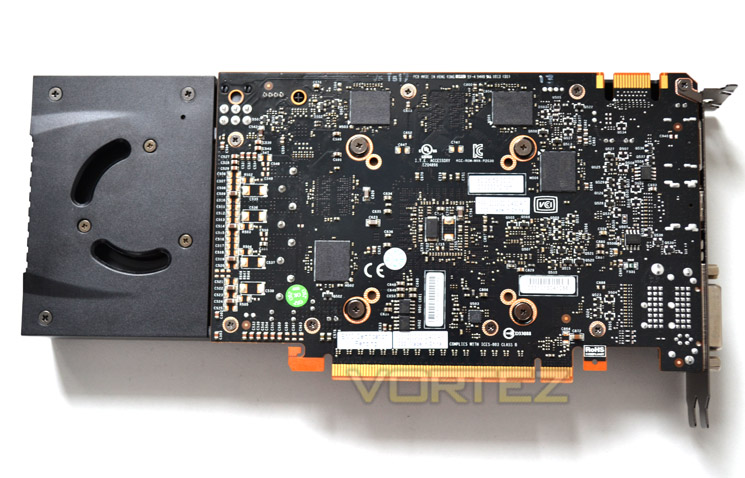
The rear of the card shows us that NVIDIA opted for a black PCB, which we love here at Vortez as it matches any PC build rather than some manufacturers who prefer to use a coloured PCB. As the GTX650Ti BOOST features 2GB of GDDR5 we can only assume that the 4 memory IC’s found on the back of the PCB will be matched by a further four IC’s innermost making an 8x256MB (2GB) configuration.
I/O Backplate
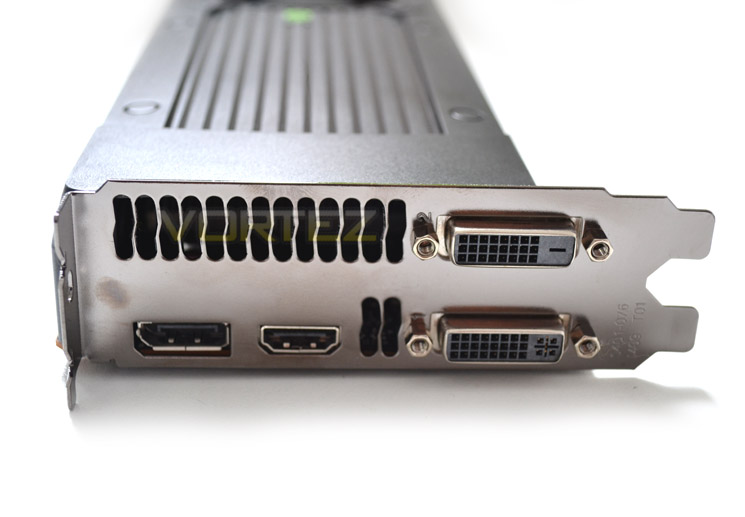
The connectivty of the GTX650Ti BOOST matches that of the AMD’s HD7790 by having both DVI-D and DVI-I ports along with HDMI and DisplayPort connections.
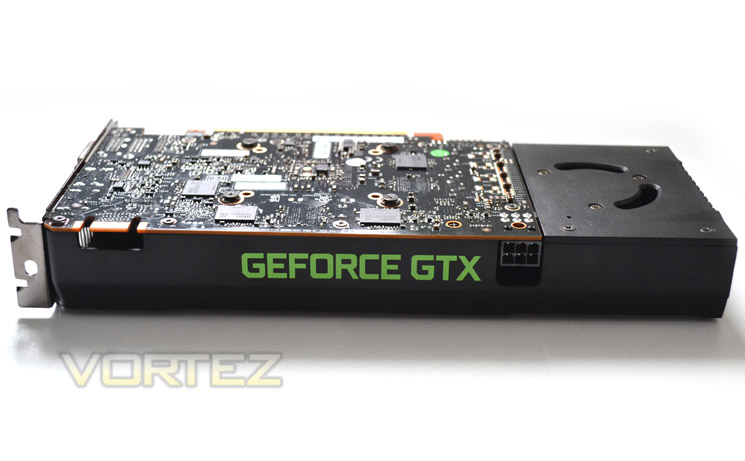
Profile
The GTX650Ti is still a twin port design, taking up two PCI slots. Hopefully a board partner will release a single slot design for those looking for as small a footprint as possible, however this would likely sacrifice cooling so it is unlikely.
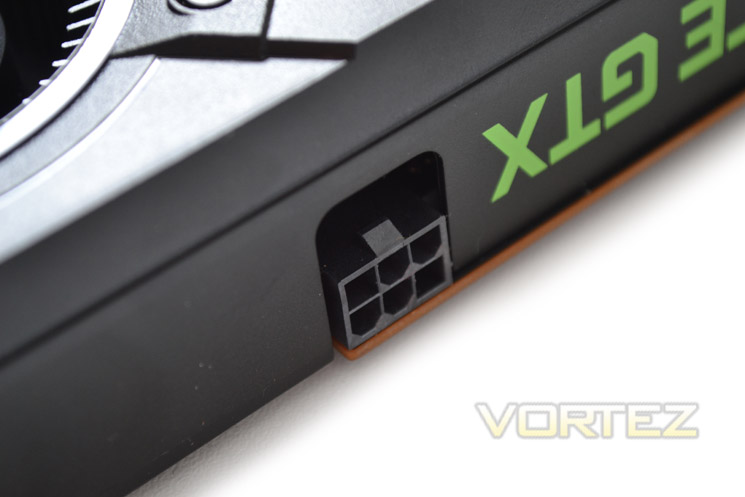
Power Ports
The card is powered by a single 6pin PCIe power plug which most modern PSU’s should have at least one of. We would expect this power design to be carried over to retail versions of the card with a 400W PSU being the staple power supply requirement for cards in this range.
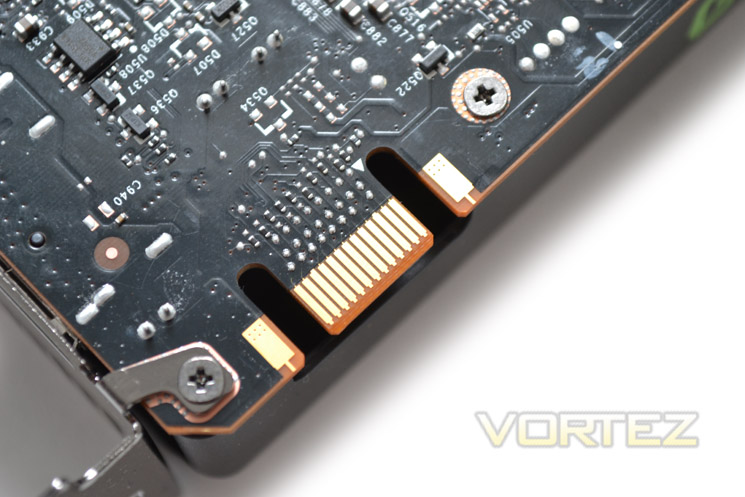
SLI
A key feature of the GTX650Ti BOOST is the capability to match it up with another card from the same GPU family for SLI scaling. This should ensure the card offers an upgrade path for those on a budget by adding a second card to BOOST performance.
Let’s delve a little deeper and take a closer look at today’s sample…
Closer Look
NOTE: As previously stated, NVIDIA’s board partners will be releasing there own card designs so the following should be viewed with this in mind as it may not follow what is found on retail versions.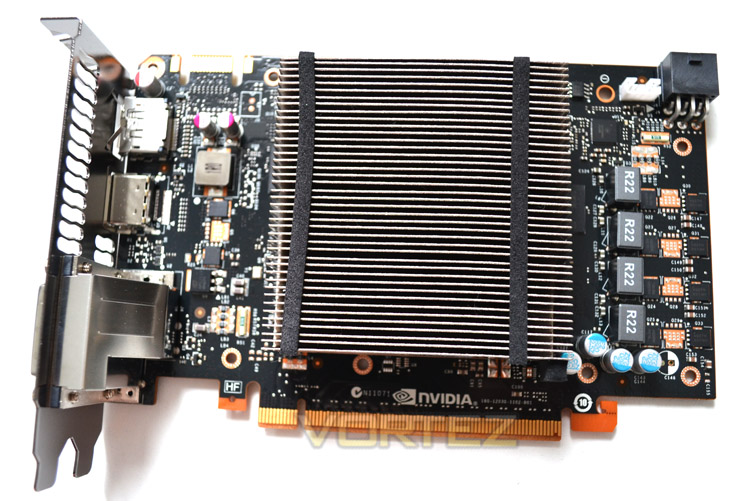
Cooling
The cooling on the GTX650Ti BOOST is a reference design heatsink and thus comprises of an enclosed unit which sucks air in from the fan and then pushes the air over the heatsink with the resulting hot air exhausted out of the vented IO plate at the rear of the card.
Naked
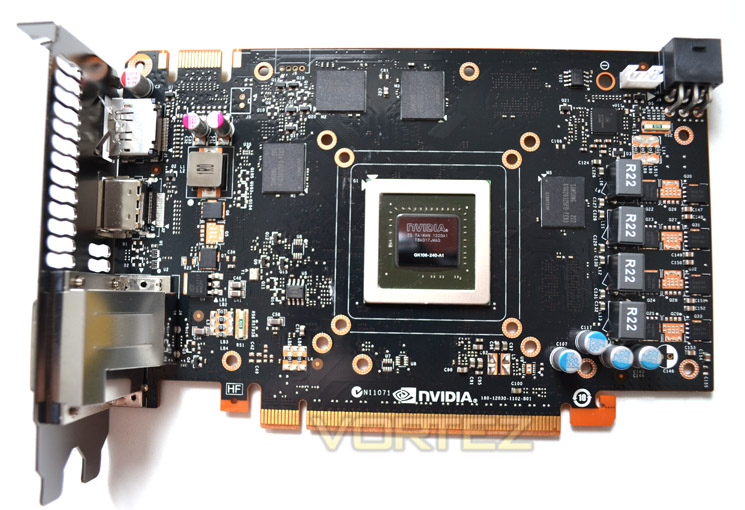
The actual PCB of the GTX650Ti has a very small PCB, measuring just 173mm in length compared to the GPU’s overall length of 240mm. With small form factor PC’s popularity on the rise, the GTX650Ti Boost will prove to be popular because of this small footprint.
VRM
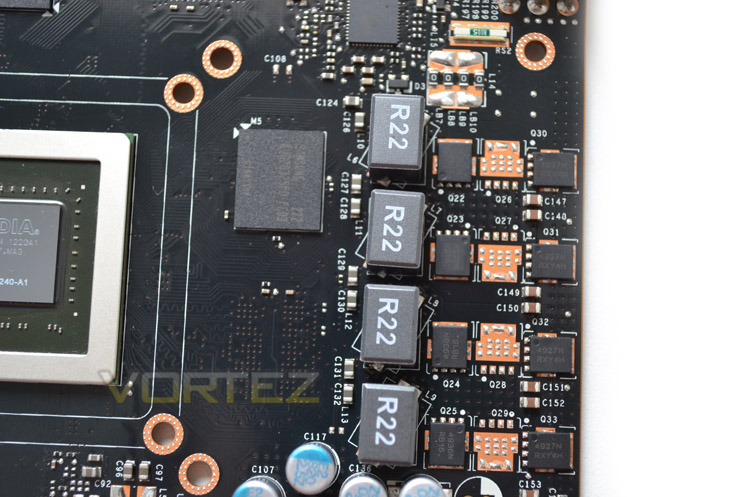
The GTX650Ti Boost has a 4+1 power phase design which is increased over the 3 phases of power afforded to the GPU in the stock reference GTX650Ti, most likely due to the additional overclocking/power requirements of this new design.
Memory
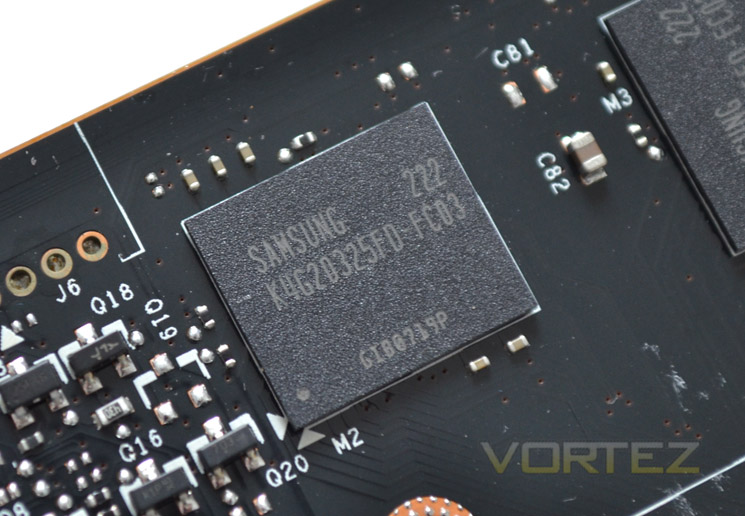
The GDDR5 memory hails from Samsung and is an 8x256MB (2GB) design (4 on the back, four on the front). Rated to 6000MHz (effective) the product code of K4G20325FD tells us that the VRam has a Vdd/Vddq(V) of 1.455 to 1.545. How this will effect our overclocking results remains to be seen but with it being so highly clocked, we doubt it can be pushed much further if previous results are anything to go by which is no bad thing as this allows us to concentrate on overclocking the core!
GK106 Core
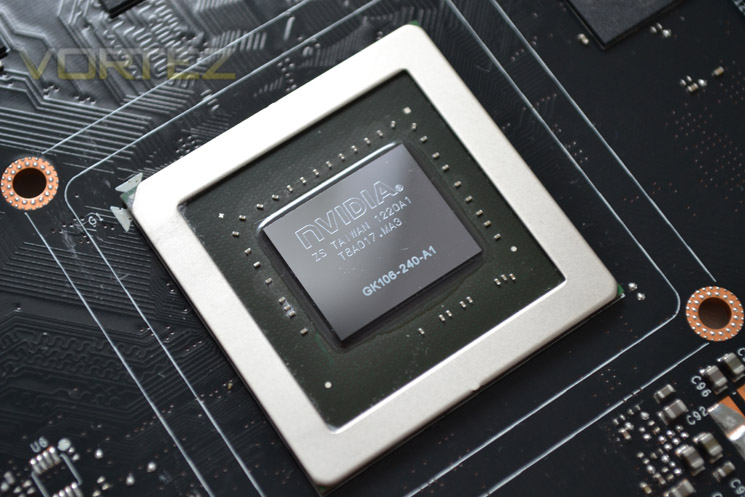
The GK106 Core is built on the same 28nm manufacturing process as the rest of the Kepler family. Equipped with 768 CUDA cores and an improved 192 bit memory interface the GTX650Ti Boost along with overclocking now enabled (GPU Boost) should make this little card a little powerhouse.
Let’s take a look at today’s test setup and methodology…
Test Setup
With the latest Intel chipset release we decided to update our ageing X58 setup to the new X79 chipset. Not only that but we will be using the flagship Core i7-3960X Extreme Edition processor clocked to 4.5GHz to ensure we have no CPU bottlenecks. With 16GB of ram on board there should be minimal paging so the benchmarks we run today will hopefully give a true reflection of the graphics card’s performance.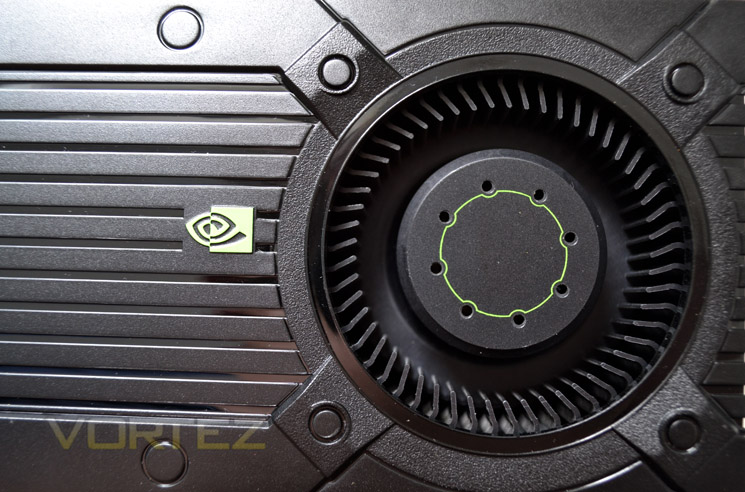
Some of the components for our test bench were kindly donated by CORSAIR who provided the majority of components without whom we would not have been able to bring you this review so a big thanks to them.
Graphics cards on test:
NVIDIA GTX650Ti BOOST 2GB GDDR5
NVIDIA GTX650Ti BOOST 2GB GDDR5 OC
GIGABYTE HD7790 1GB GDDR5
GIGABYTE GTX650 Ti 2GB GDDR5
AMD HD7770 1GB GDDR5
ZOTAC GTX660 2GB GDDR5
AMD HD7750 1GB GDDR5
MSI GTX560Ti-448 Twin Frozr III 1280MB GDDR5
MSI GTX560Ti-384 Twin Frozr III 2GB GDDR5
Motherboard: MSI X79 Big Bang X-Power II
CPU: Intel Core i7-3960X Extreme Edition @ 4.5GHz
RAM – 16GB (4x4GB) Corsair Vengeance (Red) DDR3 @ 1866MHz 9-10-9-27
Power Supply – ANTEC High Current Pro 1200W
Hard Drive – Kingston HyperX 240GB
Cooler – Corsair H100
CPU: Intel Core i7-3960X Extreme Edition @ 4.5GHz
RAM – 16GB (4x4GB) Corsair Vengeance (Red) DDR3 @ 1866MHz 9-10-9-27
Power Supply – ANTEC High Current Pro 1200W
Hard Drive – Kingston HyperX 240GB
Cooler – Corsair H100
Benchmarks
Normally we would run the tests at four settings however at 2560×1600 both the GIGABYTE HD7790 and NVIDIA GTX650 Ti could not produce adequate (playable) frames per second at 2560×1600 so these tests were omitted as they served no purpose other than to state that 1920×1080 is the maximum resolution one could hope to utilise these two cards for.
Battlefield 3
Crysis Warhead
Metro 2033
Elder Scrolls: Skyrim
DiRT 3
Futuremark 3DMark 2011
Unigine: Heaven 2.5
Crysis Warhead
Metro 2033
Elder Scrolls: Skyrim
DiRT 3
Futuremark 3DMark 2011
Unigine: Heaven 2.5
Let’s see how today’s graphics card performed..
Overclocking (GPU BOOST)
We made quite a fuss in our previous GTX650Ti reviews because for whatever reason, NVIDIA thought it would be a good idea to remove the excellent GPU Boost feature from this range. This in our view crippled the card, resulting in sub-par performance. Thankfully, NVIDIA have come to their senses and re-instated this tool for this revision which allows us to truly unlock the performance of the GTX650Ti.
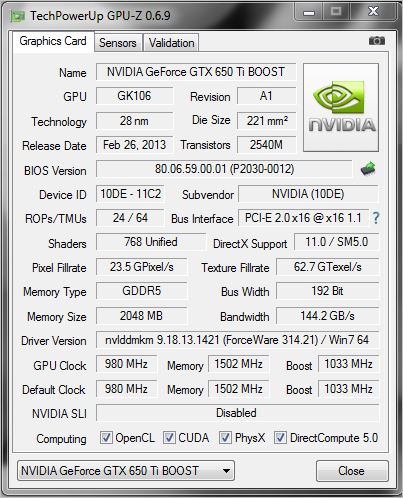
In stock form you can see that the card, when placed under load boosts to over 1GHz (1033MHz). This figure will also be surpassed occasionally depending on load requirements.
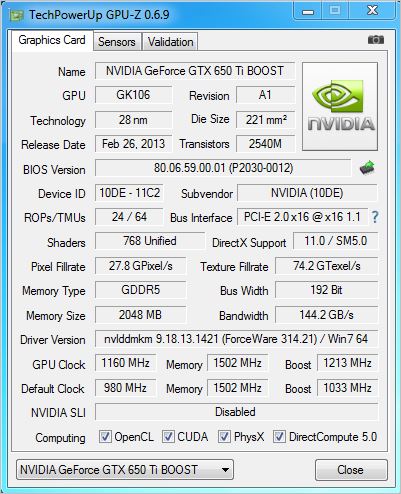
To overclock the card we used EVGA’s Precision tool which allows us to alter both the GPU and memory offset figures along with making voltage adjustments to the core. By raising the voltage to the maximum we hit 1200Mhz however this figure became unstable when ‘boosted’ so we dropped back until we gained 100% stability (proven by looping Unigine Heaven and other benchmarks for a period of 4 hours). We settled for 1160Mhz, a 180MHz increase over stock. When you factor in that the card will boost to well over 1200MHz under load, this is a great overclock and will add a good deal of grunt to the card’s performance.
We also overclocked the memory by 200MHz (effective) although we encountered a few anomalies and so reduced the clockspeed back to stock speed during testing.
Temperature, Acoustics and Power Consumption
Power ConsumptionTo test for power consumption we do not use anything too technical, just a wall meter which measures the total system power draw minus the monitor.
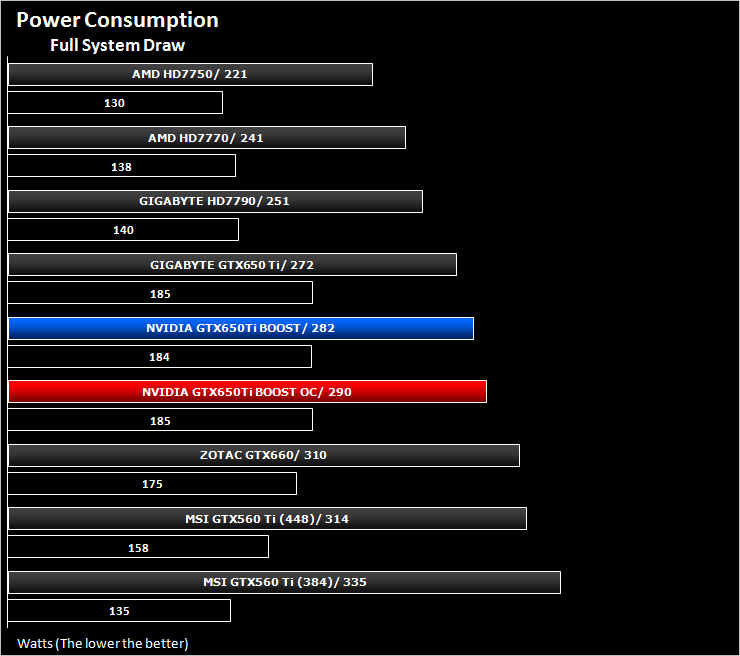
The GTX650Ti is not a hungry beast nor can it be described as frugal. In our testing we ran a few games and took an average reading which resulted in this card consuming a little more than the stock GTX650Ti and some 30w more than the NVIDIA cards competitor, the AMD 7790.
Temperature
To test temperatures we measured idle temperatures after booting windows, letting all applications finish loading and ran a few benchmarks. Once the benchmarks were complete we left the card to reach a cooling plateau where we then took the idle temperatures. For the load tests, we would normally run Furmark for 20 minutes, taking the absolute maximum temperature attained however we found that this throttled the card and resulted in spurious results. So we set Heaven running continuously for 20 minutes and used this as a temperature result as the card did not throttle with this application.
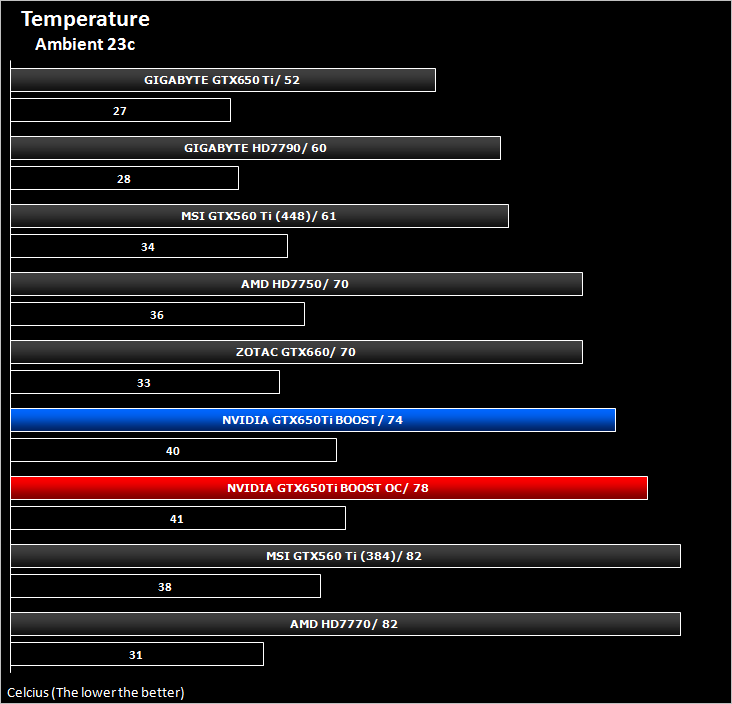
Because this is an OEM part, it is worth noting that board partners are likely to incorporate their own cooling designs however, the reference design did not disgrace itself although it was considerably hotter than the custom cooled GIGABYTE GTX650Ti we tested earlier in the year so I would expect temperature levels to lesson when different, upgraded cooling design are used.
Acoustics
Despite the reference design, the card was very quiet, even when placed under tremendous heatload and during various heat cycles. While noise is subjective, we would certainly argue that this card is not a be a howling banshee, rather it just goes about it’s business, pulling air across the heatsink without much fuss….or noise.
Battlefield 3
Battlefield 3 leaps ahead of its time with the power of Frostbite™ 2, the next installment of DICE’s cutting-edge game engine. This state-of-the-art technology is the foundation on which Battlefield 3 is built, delivering enhanced visual quality, a grand sense of scale, massive destruction, dynamic audio and incredibly lifelike character animations. As bullets whiz by, walls crumble, and explosions throw you to the ground, the battlefield feels more alive and interactive than ever before. In Battlefield 3, players step into the role of the elite U.S. Marines where they will experience heart-pounding missions across diverse locations including Paris, Tehran and New York.
Average and minimum frames per second were measured using Fraps during the parking lot scene on Operation Sword Breaker. High and Ultra presets were loaded at both resolutions.
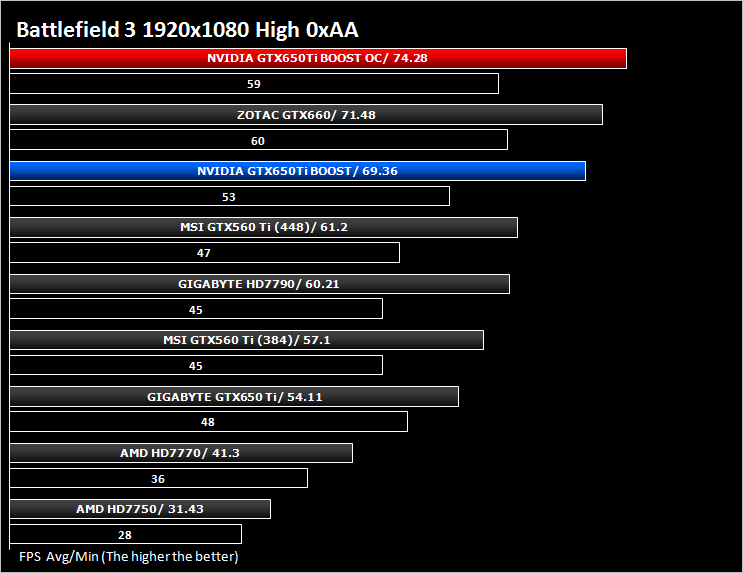
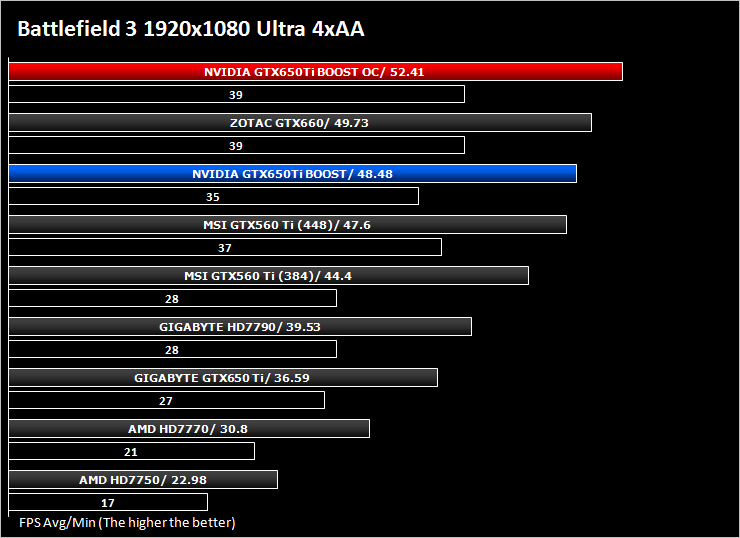
Crysis Warhead
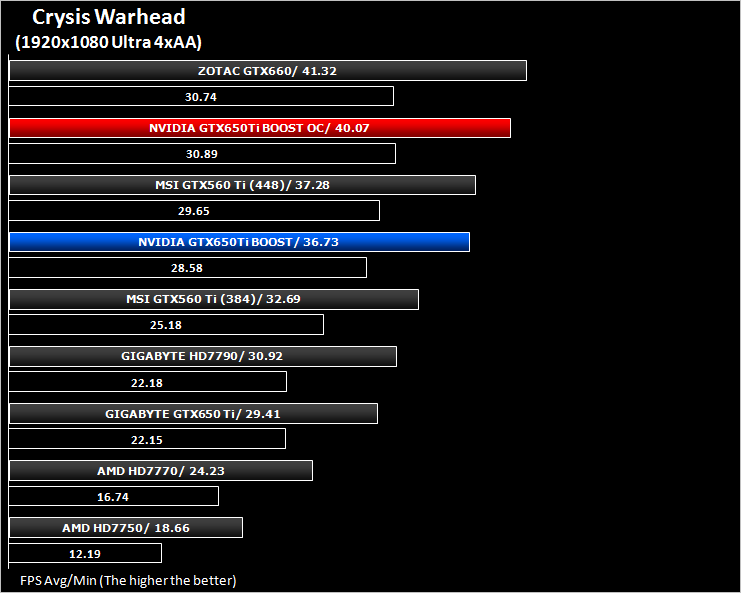
Following the success of Crysis, the stand alone expansion “Warhead” was hotly anticipated to bring more game play, more weapons, improved visuals whilst maintaining better performance, the latter being what gamers wanted most. After all how many people upgraded their rigs just to play this game… In the game, you play as the upbeat Brit Sergeant “Psycho” Sykes, chasing down a Korean nuclear warhead. Throw in some ice shooting aliens and we’re bound to have a great game. It sure delivered.
Testing was done using Framebuffer’s Crysis Warhead benchmarking tool. The tests were configured to DirectX 10 at Enthusiast levels. Each test on the Ambush map was looped three times from which the average FPS was recorded.
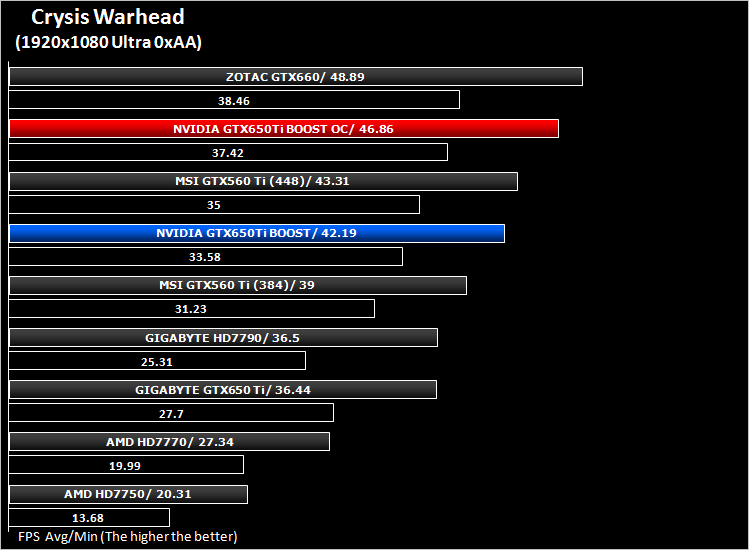
The Elder Scrolls: Skyrim
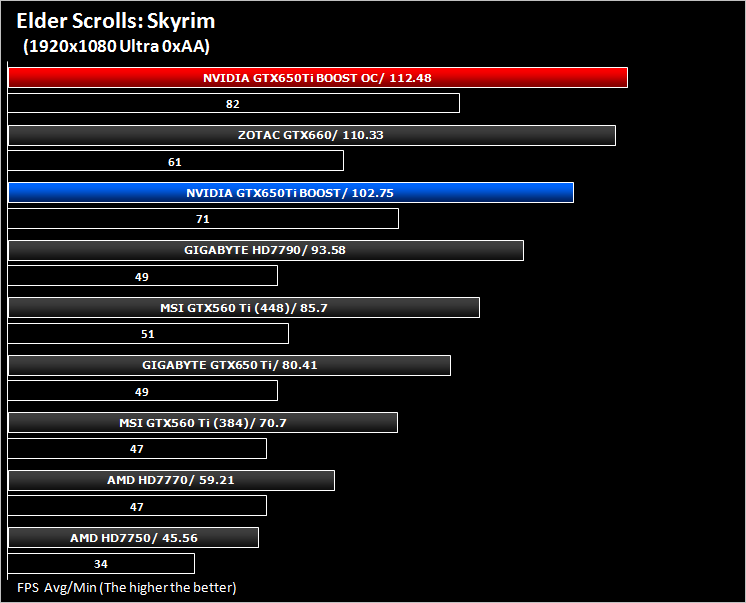
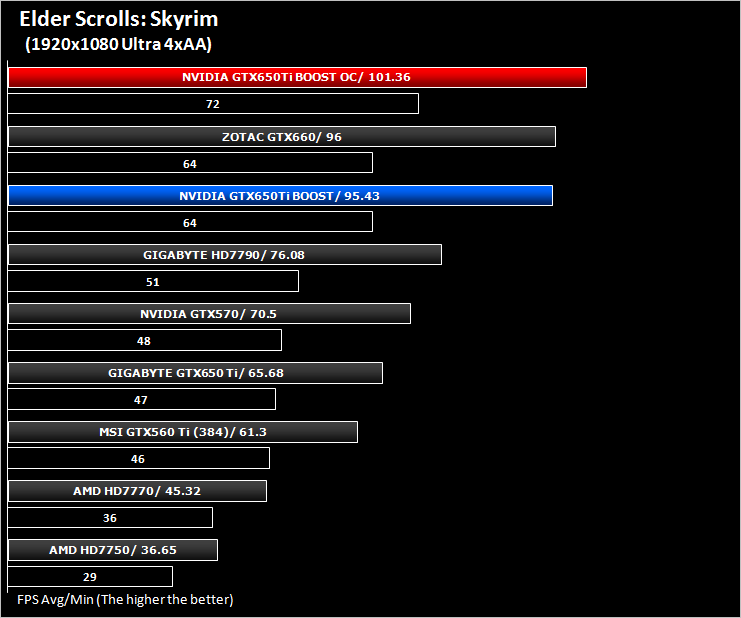
Skyrim is not a direct successor to the very popular Oblivion. Instead it takes place 200 years after the events of Oblivion. The non-linear playing that made the Elder Scrolls such a popular series does however make a return along with the beautiful scenery the encompasses the world of Skyrim.
Average and minimum frames per second were measured using Fraps during the drop down passage to Riverwood. V-sync was disabled to allow fluctuating (higher the 60) FPS for these runs. It is however recommended that v-sync is left enabled during normal gameplay due to the games dynamics.
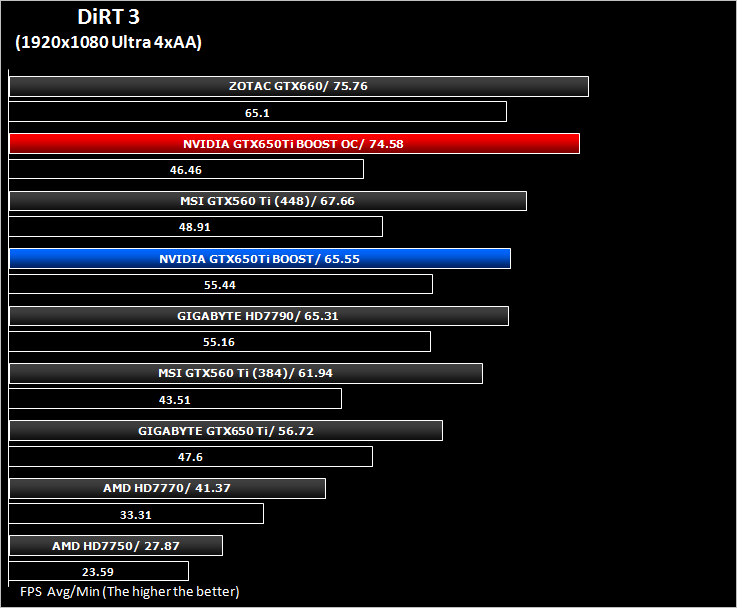
DiRT 3
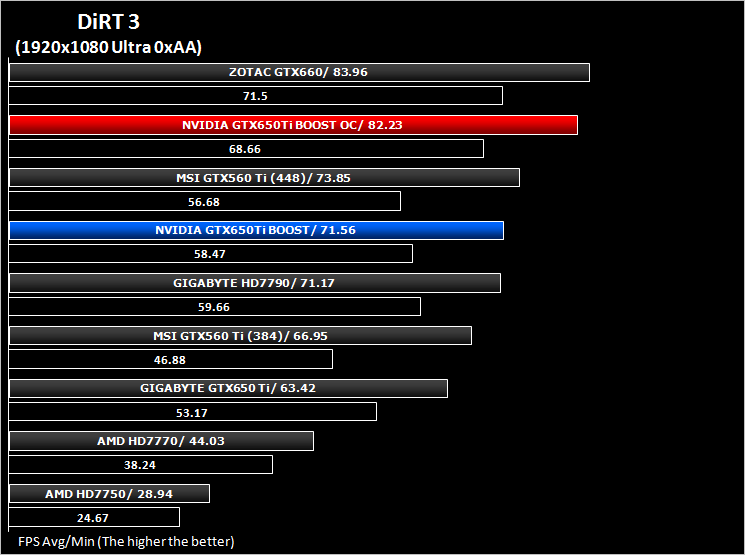
As players race to elevate their global standing, DiRT 3 is back delivering mud, sweat and gears world over: from the intense weather-beaten rally stages of Europe, Africa and the US, to executing performance driving showcases and career challenges where car control is pushed to spectacular limits.
The in-game benchmarking tool was used to test performance. All the display settings were set to the maximum available and DirectX 11 was applied. The average FPS was recorded at the end.
Metro 2033
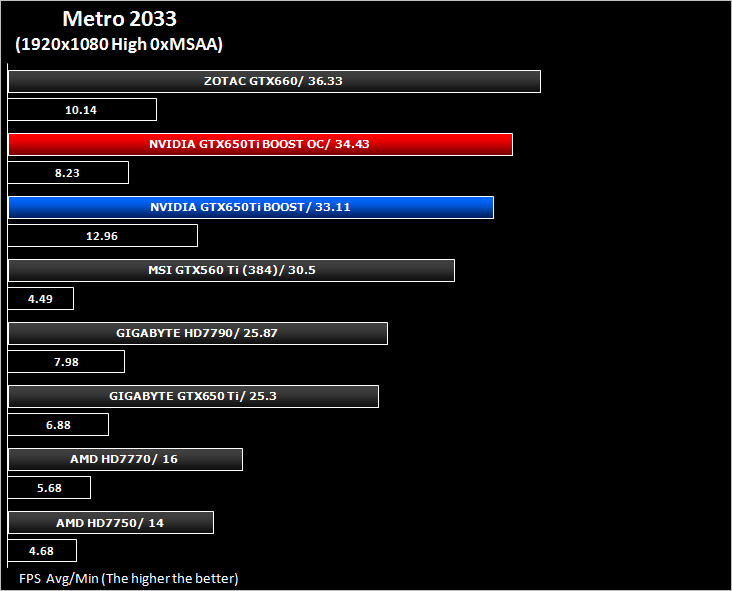
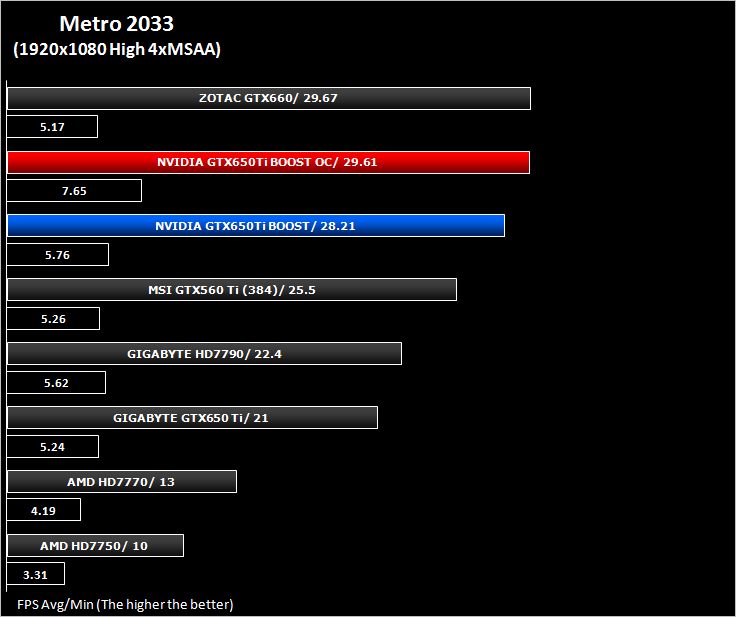
Based on the novel by the same name, Metro 2033 is a first person shooter with elements of survival horror. As Artyom, you trawl through the mutant infested metro systems of post-apocalyptic Moscow. The game delivers presents a grim ambience that reflects on the overall atmosphere of the underground setting. Metro 2033 uses the setting as a back drop to showcase some of the best visuals of any games out now, making it the ideal benchmark for those looking for the best graphics card.
The bundled benchmarking tool was used on Metro 2033, configuring the settings to High and making use of DirectX 11. The frontline scene was looped 3 times for each configuration. The average FPS was recorded at the end.
Futuremark 3DMark 11
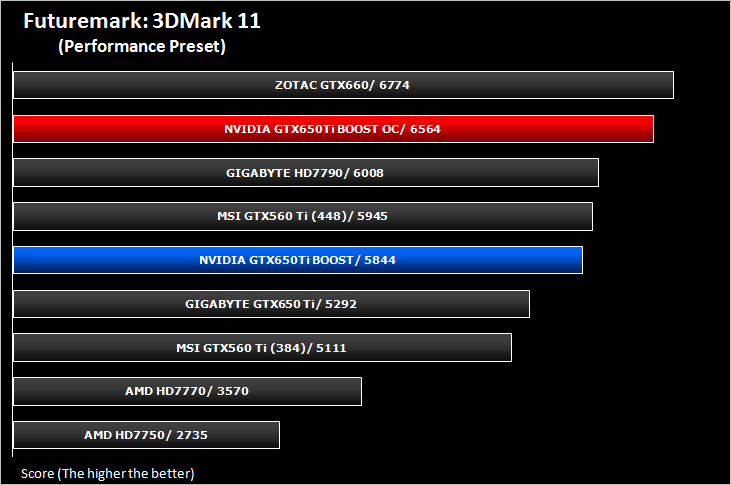
3DMark 11 is the latest version of the world’s most popular benchmark. Designed to measure your PC’s gaming performance 3DMark 11 makes extensive use of all the new features in DirectX 11 including tessellation, compute shaders and multi-threading. The benchmark was run in both Performance and Extreme presets.
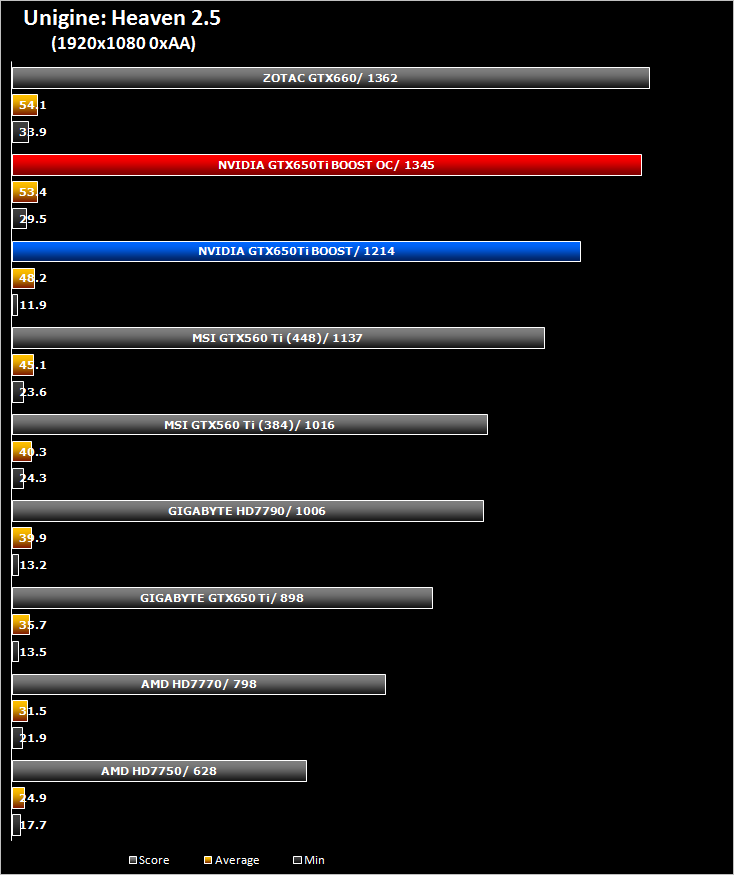
Unigine: Heaven 2.5
Heaven Benchmark is a DirectX 11 GPU benchmark based on advanced Unigine™ engine from Unigine Corp. It reveals the enchanting magic of floating islands with a tiny village hidden in the cloudy skies. Interactive mode provides emerging experience of exploring the intricate world of steampunk.
Conclusion
NVIDIA are very sharp when it comes to marketing a card. The GTX650Ti when it was originally released did ‘just enough’ to see off the competition and in doing so keeping the green team on the entry level pedestal, cementing it’s position as the best manufacturer throughout the range of graphics processing units. Like most, we were however disgruntled by the fact that the original design had features such as SLI and perhaps most importantly GPU BOOST missing, these omissions inevitably left a bitter taste in our mouths, regardless of the fact that the GTX650Ti was the best card in it’s class.
The AMD HD7850 it was pitched against was no slouch either and most recently, the AMD HD7790 which replaces it, ensured AMD were once again number 1. That victory however was (very) short lived because with the release of the GTX650Ti BOOST, NVIDIA are once again cream of the crop, top of the pops, numero uno.
With such a swift response from NVIDIA, we can’t help feeling that they were just holding this card back, waiting for AMD to release their card before showing their hand. A tactical move which has paid dividends but the owners of the original GTX650Ti may well feel short changed with this release and rightly so because the BOOST version is everything the original design should have been.
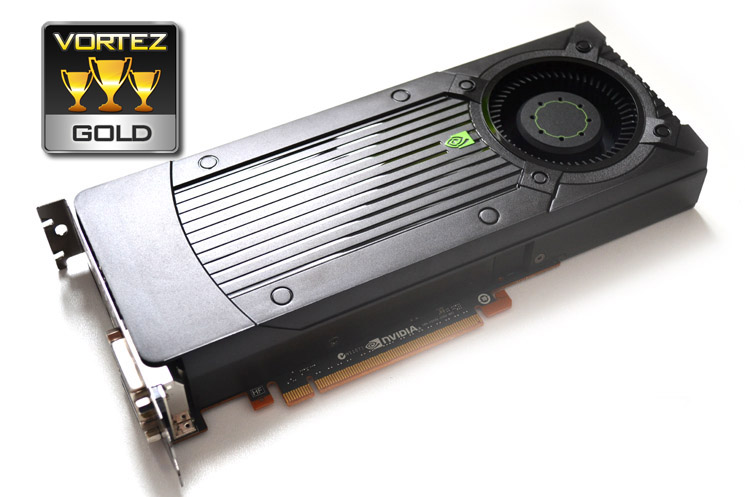
While we are happy to give the NVIDIA GTX650Ti BOOST our Gold award due to it being the best in class, we do so begrudgingly because you can’t help feeling for those who bought the first GTX650Ti when for approximately £20-25 more you could have an extra GB of GDDR5 and the ‘BOOST’ features which make this card much more appealing. We expect the NVIDIA GTX650Ti BOOST to retail around the £150 mark which may seem expensive for what is in effect an entry level card to high resolution gaming but it seems fair considering the comparative performance of both its brethren and competitors. Also bear in mind that it arrives with 2GB of GDDR5 which will also add to the cost when comparing the price against the 1GB version of the GTX650Ti. It is however close to HD7870 and GTX660 levels so only you can decide if it worth saving that little bit extra – but then where do you stop?
In summary the NVIDIA GTX650 Ti BOOST is the highest performing GPU at this level capable of producing playable framerates at today’s most popular resolution.
Pros:
+ Best Entry Level GPU available
+ Faster than a HD7790
+ GPU Boost featured
+ Good Overclocking
+ SLI Capability
+ Improved memory interface
Cons:
– Struggles above 1920×1080 resolution
+ Best Entry Level GPU available
+ Faster than a HD7790
+ GPU Boost featured
+ Good Overclocking
+ SLI Capability
+ Improved memory interface
Cons:
– Struggles above 1920×1080 resolution

Click here for an explanation of our awards at Vortez.net.


