NVIDIA’s third Pascal-based graphics card is here courtesy of the GTX 1060. Is this Founders Edition a worthy successor to the GTX 980?

Product on Review: GeForce GTX 1060
Manufacturer & Sponsor: NVIDIA
Price: £275 GBP
NVIDIA’s Pascal architecture has come roaring out of the gate this summer starting with the GeForce GTX 1080 and following up with the GTX 1070. Built around their current flagship GP104 GPU, both cards have set new records for performance and are already in the hands of eager gamers with money in their pockets and a frame rate target to reach. With both costing north of £400 however there’s not been much on offer Pascal-wise for the more discerning mainstream gamer, whilst AMD have already brought the popular Radeon RX 480 to the market; this changes today as NVIDIA launches the GeForce GTX 1060
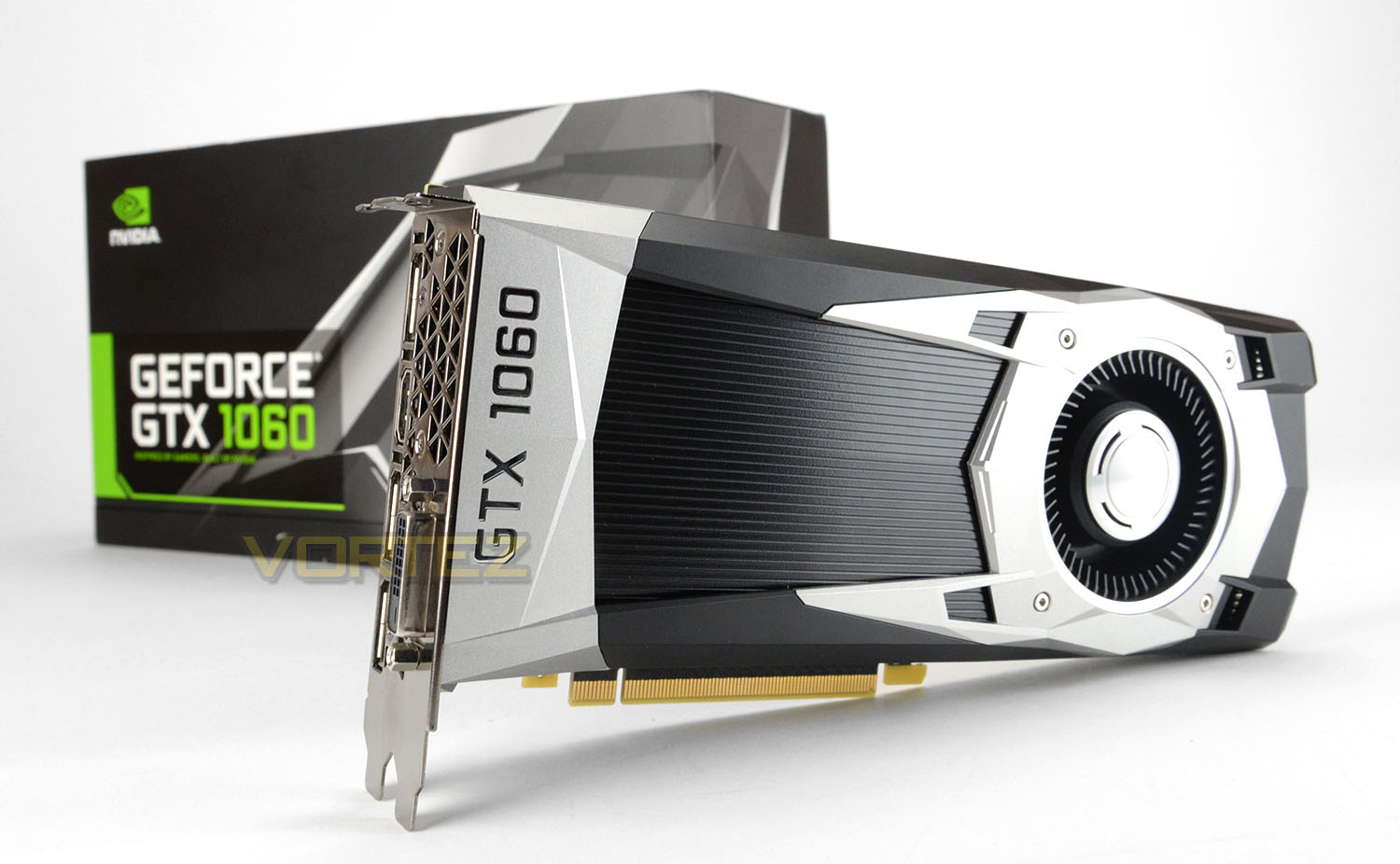
The debut outing for NVIDIA’s slimmer GP106 GPU, the GeForce GTX 1060 effectively replaces both GTX 980 and 970 in NVIDIA’s product stack, starting from $249 for partner cards and $299 for the ‘reference’ Founder’s Edition. On paper performance claims are startling, approaching (and even surpassing) the GTX 980 for substantially less outlay, lower power requirements, and with a far more compact GPU core. In contrast to the transition from the 700-series to the 900-series therefore the GTX 1060 represents a substantial performance improvement at this price bracket, and a key upgrade target for those currently rocking an GTX 960 or earlier GPU.
In contrast to the GTX 1080 and 1070 Founder’s Editions, the GTX 1060 FE we’re reviewing today is only available direct from NVIDIA, priced at £275 inc. V.A.T. in the UK. If you’ve fallen in love with this aesthetic, or simply demand a cooler which exhausts hot air directly from your system, retailers are unlikely to satiate you. That said, a myriad of partner designs are available on launch with some excellent cooling solutions, so if you’re a little more flexible in your requirements be sure to shop around.
Rather than 4K resolutions or premium VR solutions, NVIDIA’s new card is more suited to the everyman. Excellent frame rates with high image quality settings at 1080p are anticipated, perhaps even stretching to 1440p in many instances, whilst the GTX 1060 is also likely to replace the GTX 970 as NVIDIA’s entry point to Virtual Reality on the Oculus Rift or HTC Vive. New Pascal-specific features such as Simultaneous Multi Projection and 4th Gen. Delta Color Compression will both aid the 1060 in that aspiration.
In theory the GTX 1060 is a competitor to AMD’s Radeon RX 480, but the realities of the situation make the claim less clear-cut than it might be. Price disparities between these two cards may stymie hopes of a head to head battle, so it’s best not to view one card beating the other in terms of raw performance as a cast-iron recommendation.
So, without further ado, it’s time to talk Features.
Technical Specifications
OverviewChipset:- GeForce GTX 1060
Digital max resolution:- 7680×4320
Core Clock:
– Base: 1506MHz
– Boost: 1709MHz
Memory Clock:- 8 Gbps
Process Technology:- 16 nm
CUDA Cores:- 1280
Memory Size:- 6GB GDDR5
Memory Bus:- 192-bit
Card Bus:- PCI-E 3.0
Memory Type:- GDDR5
DirectX:- 12
OpenGL:- 4.5
PCB Form:- ATX
Multi-view:- 4
I/O:
– 1x Dual-link DVI-I
– 1x HDMI 2.0
– 3x Display Port 1.4
Suggested Power requirement:- 500W (6-pin external power connector)
Card Size:- 248mm x 98mm
Digital max resolution:- 7680×4320
Core Clock:
– Base: 1506MHz
– Boost: 1709MHz
Memory Clock:- 8 Gbps
Process Technology:- 16 nm
CUDA Cores:- 1280
Memory Size:- 6GB GDDR5
Memory Bus:- 192-bit
Card Bus:- PCI-E 3.0
Memory Type:- GDDR5
DirectX:- 12
OpenGL:- 4.5
PCB Form:- ATX
Multi-view:- 4
I/O:
– 1x Dual-link DVI-I
– 1x HDMI 2.0
– 3x Display Port 1.4
Suggested Power requirement:- 500W (6-pin external power connector)
Card Size:- 248mm x 98mm
Detailed Specifications
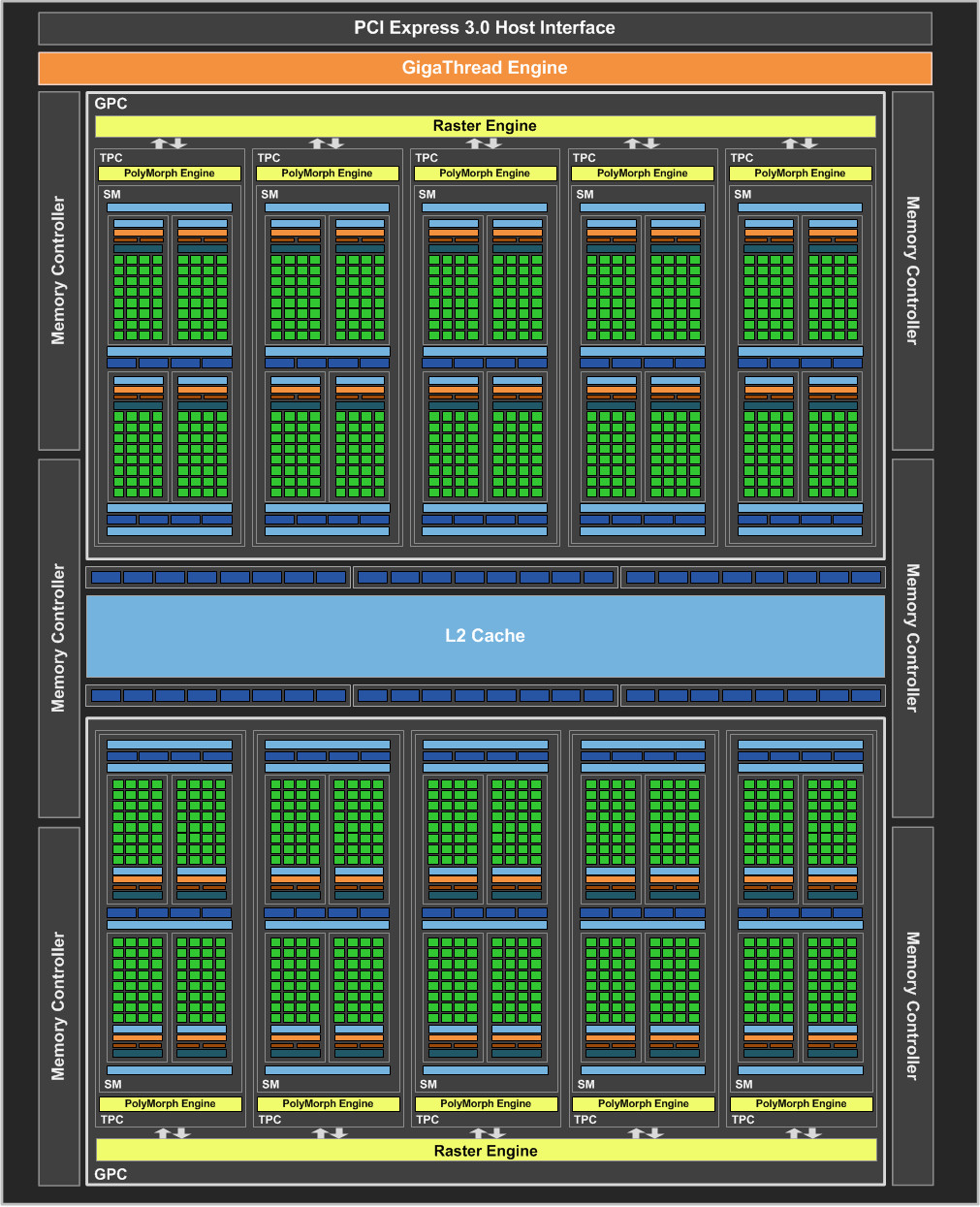
GP106 Block Diagram
SMs:- 10
CUDA Cores:- 1280
Base Clock:- 1506 MHz
GPU Boost Clock:- 1708 MHz
Texture Units:- 80
Texel fill-rate:- 120.5 Gigatexels/sec
Memory Clock (Data Rate):- 8,000 MHz
Memory Bandwidth:- 192 GB/sec
ROPs:- 48
L2 Cache Size:- 1536 KB
TDP:- 120 Watts
Transistors:- 4.4 billion
Die Size:- 200 mm²
Manufacturing Process:- 16 nm
CUDA Cores:- 1280
Base Clock:- 1506 MHz
GPU Boost Clock:- 1708 MHz
Texture Units:- 80
Texel fill-rate:- 120.5 Gigatexels/sec
Memory Clock (Data Rate):- 8,000 MHz
Memory Bandwidth:- 192 GB/sec
ROPs:- 48
L2 Cache Size:- 1536 KB
TDP:- 120 Watts
Transistors:- 4.4 billion
Die Size:- 200 mm²
Manufacturing Process:- 16 nm
The GP106 at the heart of the GTX 1060 is composed of 10 Shader Modules, with a hefty 128 CUDA Cores per SM. We understand that this is the full configuration of the GP106 and so wouldn’t anticipate a ‘GTX 1060Ti’ based on the same GPU. There’s plenty of scope for reduced specification GP106’s to be introduced lower down the range (notably including the rumoured 3GB variant with one fewer SM); this is unlikely to be the last we’ll see of this GPU model.
Comparisons with the Maxwell-era GTX 960 make for some pleasant reading. Despite a more compact Die Size (thanks in part to the new 16nm manufacturing process) and identical TDP, the GTX 1060 packs in 50% more transistors alongside 20% more CUDA cores. A wider 162-bit memory bus results in a 70% greater Memory Bandwidth, whilst the frame buffer size has been doubled to 6GB. All this, whilst the GPU engine still clocks to well over 1.7GHz in boost, as opposed to 1.2GHz for the GTX 960. It would be a shock of Leicester City proportions for the GTX 1060 to be beaten out but the 960, so lets see how it stacks up against more capable opposition.
Comparative Specs
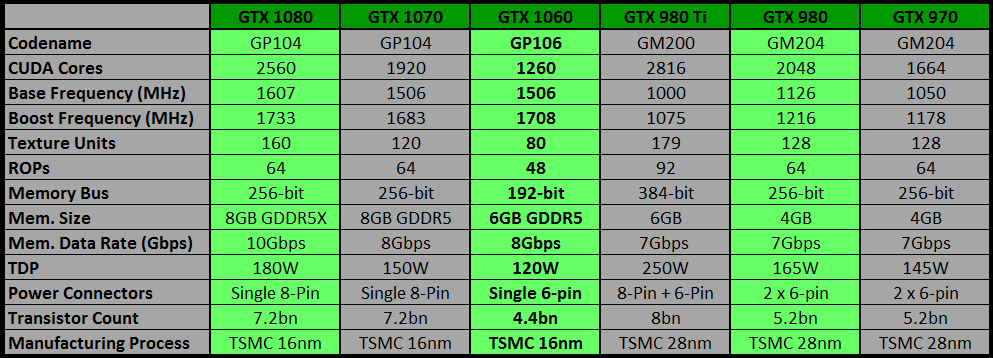
Placed against the other members of the new Pascal range the GTX 1060’s position is clear. It features around half the CUDA cores of the GTX 1080 and less memory than the GTX 1070, resulting in a card that clearly targets lower resolutions and texture quality settings. On the flip side, the GTX 1060 still boasts the fast 8Gbps GDDR5 memory that has been used to great success in the GTX 1070 and premium Maxwell-era cards, so you can hardly accuse NVIDIA of opting for the cheap option.
The latest Pascal GPU also retains Pascal’s reputation for extremely high core clock capability, to the benefit of performance. NVIDIA have touted their dual-FET power supply design, which is in use for both core and memory power sources and improves power efficiency, whilst a low-impedence power delivery system and custom VRM’s should all serve to improve voltage stability. GTX 1060 hits higher boost clocks even than the GTX 1070, for which we have to thank both improved power efficiency and cooling more appropriate to the GPU. ASIC partners must be eager to show off what their own designs are capable of independent of the Founder’s Edition cooler design.
Additional Features
Simultaneous Multi-ProjectionOne component of their GPU architecture which NVIDIA revised significantly in the transition to Pascal is the PolyMorph Engine, which it now in its fourth iteration. In order address display issues for curved monitors and VR HMDs, a concern for the current generation of graphics hardware, PolyMorph Engine 4.0 integrates a feature known as Simultaneous Multi-Projection (SMP).
Unveiled with the launch of the GTX 1080, and a core component of the Pascal architecture, SMP is located at the end of the geometry units within the PolyMorph Engine, just ahead of the Raster units. Its function is to allow simultaneous rendering of graphical primitives into up to 16 different projections of the same mono or stereo viewport.
That’s a little wordy, but in essence it breaks down a single view into up to 16 views that are slightly apart in angle but focus at the same distance. By knitting these together the overall image has a curved aspect which can more closely match that of a curved monitor, or even compensate for angled monitors in a multi-monitor display. No longer would a curved display have skewed perspective due to mapping a flat image to a curved display. By performing this simultaneously frame rates are more consistent and higher overall, a crucial requirement for VR.
SMP is currently being integrated into both Unreal Engine 4 and Unity, so whilst it’s not currently a part of any game on the market it’s a tool which a legion of developers will have access to. Thirty games are in already development with SMP capability including Unreal Tournament and Adrit, whilst the Everest VR tech demo also leverages the technology.
New Memory Compression Techniques
The release of 2nd generation Maxwell GPUs in 2014 saw the implementation of a much-touted improved Delta Colour Compression technique. Described as a 3rd generation lossless method of color compression, it increased the ‘effective’ memory bandwidth available to the GPU by as much as 30% compared with Kepler.
Pascal, including the GTX 1060, sees the next iteration of NVIDIA’s delta color compression algorithm. Both 4:1 and 8:1 modes have been added to the architecture’s repertoire, adding an estimated 20% additional ‘effective’ memory throughput. This in particular will compensate for the slightly reduced memory bandwidth of the GTX 1060 compared with the GTX 980, and unlock higher performance at high resolutions and texture qualities.
NVIDIA Ansel and VRWorks
Announced alongside Simultaneous Multi-Projection, Ansel and VRWorks have both been discussion previously and are now available in a limited release. Both these tools are compatible with older architectures, but the performance and specific features present in Pascal will make the latest generation of cards the most suitable.
SLI
Those tuned in to the GTX 1060’s pre-release coverage will be well aware of one of its most controversial feature omissions, but we should reiterate for the uninitiated: the GTX 1060 has no SLI connector, and hence doesn’t support NVIDIA SLI. It does however support DirectX 12 MDA Mode or LDA Explicit for multi-GPU configurations where implemented by software developers.
Power & Cooling
The GTX 1060 has the same TDP as the GTX 960 before it, and similarly relies on a single 6-pin PCI-E power connector when in its reference configuration. As a result upgrades from this card and most mainstream gaming design from the past five years will not require a PSU upgrade, and this is reflected in the GTX 1060’s 500W PSU recommendation*.
NVIDIA have equipped the Founder’s Edition model with a blower cooler design functionally similar to that of the GTX 1080 and 1070 Founder’s Edition, although the shortened PCB did necessitate a slight modification. Unlike reference 2nd Gen Maxwell cards NVIDIA have extended traces to the rear of the cooler to relocate the PCI-E power connector, making installation in most systems both easier and better looking. This modification will be a problem if you intend to remove the cooler and replace it with a bespoke solution.
Including the cooler the card is 9.8″ long, but the short PCB makes it clear that compact variants from partners for small form factor systems are guaranteed.
* As usual, we recommend that users purchase quality PSUs from respected manufacturers including Corsair (who we should disclose supplied the PSU used in our testing system), bequiet, Antec, SilverStone, Seasonic and more. Power is less important than reliability and safety, even if it means spending a few more pounds.
Detailed Look & Video Review
For this review we’ve produced a video review over on our YouTube channel which details all of the included features, and takes a close look at the PCB/cooling solution. Please check out our video review or hit play on the video below:
Test Setup & Methodology
How we test graphics cards
Testing a graphics card is an extremely lengthy process. We sometimes see reviews where a graphics card has been tested using out of date equipment, out of date games and even out of date drivers. While the latter can be excused due to the sheer amount of driver updates making a thorough review impossible we will however notify the reader when we have used a different driver to the normal for example a pre-release driver. For the most part however we will always use the same hardware and latest drivers so this does certainly need to be taken into consideration when viewing our testing results. Each game and benchmark is tested five times with the lowest and highest scores omitted from the results and the average then taken from the three remaining to give us our final result for each resolution and setting used.
Hardware
Our testing platform is based on Intel’s High-End Desktop platform, utilising the Intel X99 chipset. Combined with this we use the Intel Core i7-5960X Extreme Edition processor clocked to a realistic and achievable 4GHz to ensure we have no CPU bottlenecks. With 16GB (4x4GB) of DDR4 at 2666MHz and a 750GB SSD there should be minimal paging so the benchmarks we run today will hopefully give a true reflection of the graphics card’s performance.
High End Graphics Cards on test:
ZOTAC GTX 1080 AMP! Extreme (NVIDIA 368.81)
ASUS STRIX GTX 1080 (NVIDIA 368.81)
Gainward GTX 1070 Phoenix Golden Sample (NVIDIA 368.81)
MSI GTX 1060 Gaming X (NVIDIA 368.64)
Gainward GTX 1060 Phoenix Golden Sample (NVIDIA 368.64)
NVIDIA GTX 1060 (NVIDIA 368.64)
NVIDIA GTX 980Ti OC (NVIDIA 368.81)
NVIDIA GTX 980 (NVIDIA 368.81)
NVIDIA GTX 970 (NVIDIA 368.81)
AMD Radeon RX 480 CrossFire (Crimson 16.7.2)
AMD Radeon RX 480 (Crimson 16.7.2)
XFX R9 FURY (Crimson 16.7.2)
AMD Radeon R9 390X (Crimson 16.7.2)
ASUS STRIX GTX 1080 (NVIDIA 368.81)
Gainward GTX 1070 Phoenix Golden Sample (NVIDIA 368.81)
MSI GTX 1060 Gaming X (NVIDIA 368.64)
Gainward GTX 1060 Phoenix Golden Sample (NVIDIA 368.64)
NVIDIA GTX 1060 (NVIDIA 368.64)
NVIDIA GTX 980Ti OC (NVIDIA 368.81)
NVIDIA GTX 980 (NVIDIA 368.81)
NVIDIA GTX 970 (NVIDIA 368.81)
AMD Radeon RX 480 CrossFire (Crimson 16.7.2)
AMD Radeon RX 480 (Crimson 16.7.2)
XFX R9 FURY (Crimson 16.7.2)
AMD Radeon R9 390X (Crimson 16.7.2)
Special thanks go to Intel, Corsair, MSI and AOC for providing the extreme spec components used for our test bench:
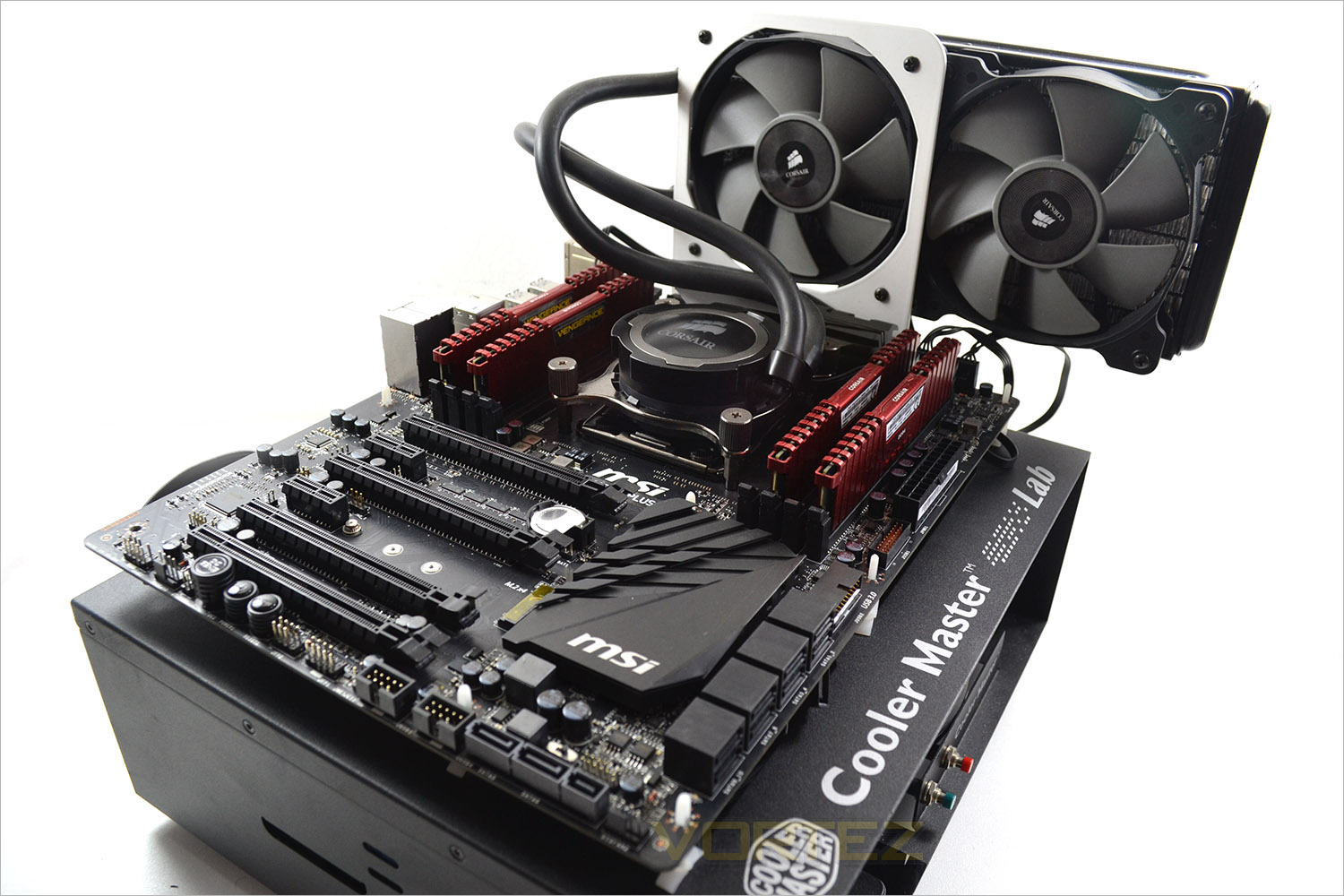
Motherboard: MSI X99S GAMING 9 AC
CPU: Intel Core i7-5960X Extreme Edition @ 4GHz
RAM – 16GB (4x4GB) Corsair LPX Vengeance (Red) DDR3 @ 2666MHz 16-17-17-35 C1
Power Supply – CORSAIR HX1050
Hard Drive – Samsung 840 EVO 750GB
Cooler – CORSAIR Hydro Series™ H105 240mm Extreme Performance Liquid CPU Cooler
Monitor – AOC 28″ 4K U2868 PQU
CPU: Intel Core i7-5960X Extreme Edition @ 4GHz
RAM – 16GB (4x4GB) Corsair LPX Vengeance (Red) DDR3 @ 2666MHz 16-17-17-35 C1
Power Supply – CORSAIR HX1050
Hard Drive – Samsung 840 EVO 750GB
Cooler – CORSAIR Hydro Series™ H105 240mm Extreme Performance Liquid CPU Cooler
Monitor – AOC 28″ 4K U2868 PQU
Benchmarks
If you are a regular reader of our reviews you will know we like to test the latest hardware with the latest games and benchmarks on the market. Here are the games we’ve chosen:
DOOM (OpenGL 4.5 & Vulkan)
Total War: Warhammer
Rise of the Tomb Raider
HITMAN
DiRT Rally
Total War: Warhammer
Rise of the Tomb Raider
HITMAN
DiRT Rally
To capture framerates we use a combination of in-game benchmark tools, FRAPS and PresentMon.
We also take into consideration the benchmarkers out there so have included three of the more popular synthetic benchmarks available:
Unigine: Valley
Unigine: Heaven 4
Futuremark 3DMark Firestrike
Futuremark 3DMark Time Spy
Unigine: Heaven 4
Futuremark 3DMark Firestrike
Futuremark 3DMark Time Spy
Let’s see how today’s graphics card performed…
Power, Temperatures, Acoustics
To test for power consumption, we take a measurement from the plug socket. It is important to note that the figures below represent total system power use and not just the GPU. The CPU was always in a fixed state (4GHz overclock) so did not affect the additional power load when the GPU was placed under 100% load using Heaven 4.0 which was ran for 20 minutes at which point a load reading was taken. Idle readings were taken 5 minutes after system boot to ensure any background services and applications had loaded.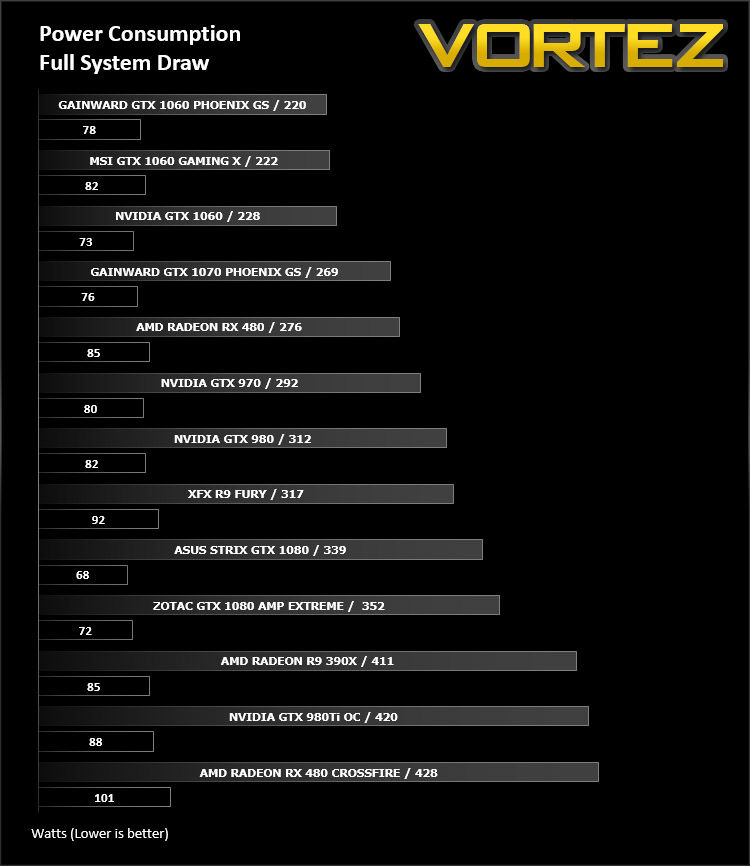
Temperature
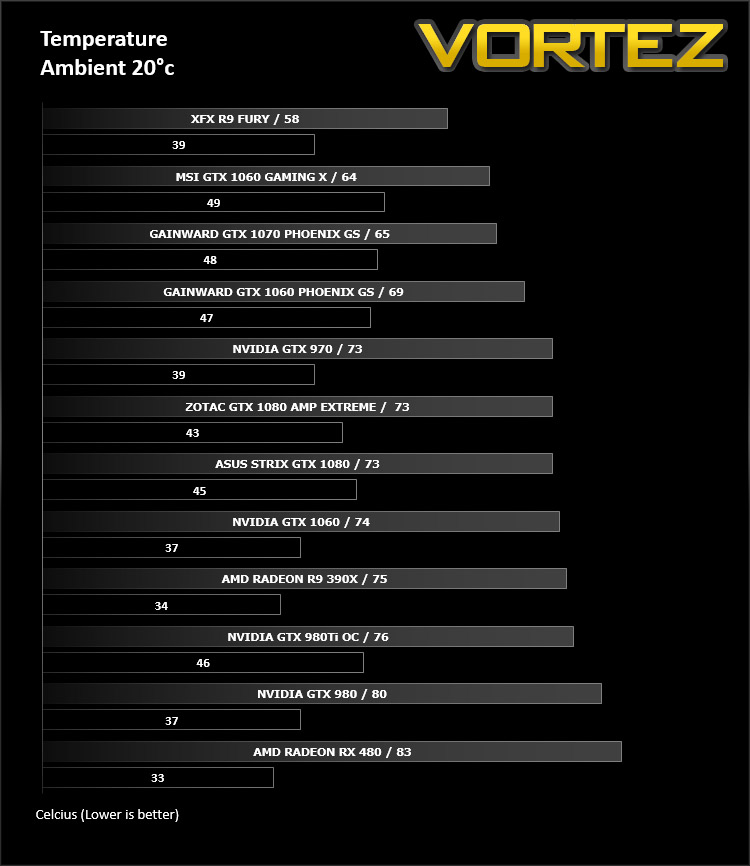
To test temperatures we measured idle temperatures after booting windows, letting all applications finish loading and ran a few benchmarks. Once the benchmarks were complete we left the card to reach a cooling plateau where we then took the idle temperatures. For the load tests we set Heaven 4.0 running continuously for ~30 minutes recorded the peak/maximum GPU temperature.
Acoustics
Noise from the cooling fan isn’t disruptive at all, even under full load – take a look and listen on our video.
Overclocking
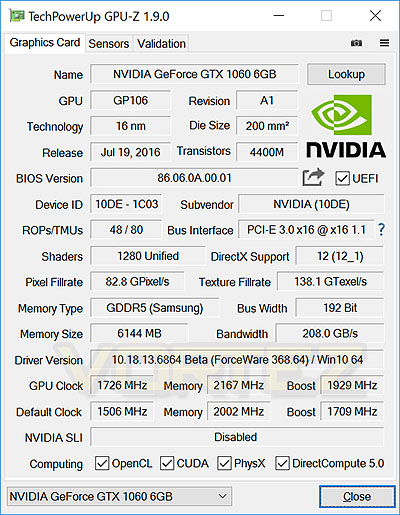
To overclock the GTX 1060 Founders Edition we used MSI Afterburner Tool (4.3.0 Beta 4) since it gives extensive options for modifying the GPU and memory clock.
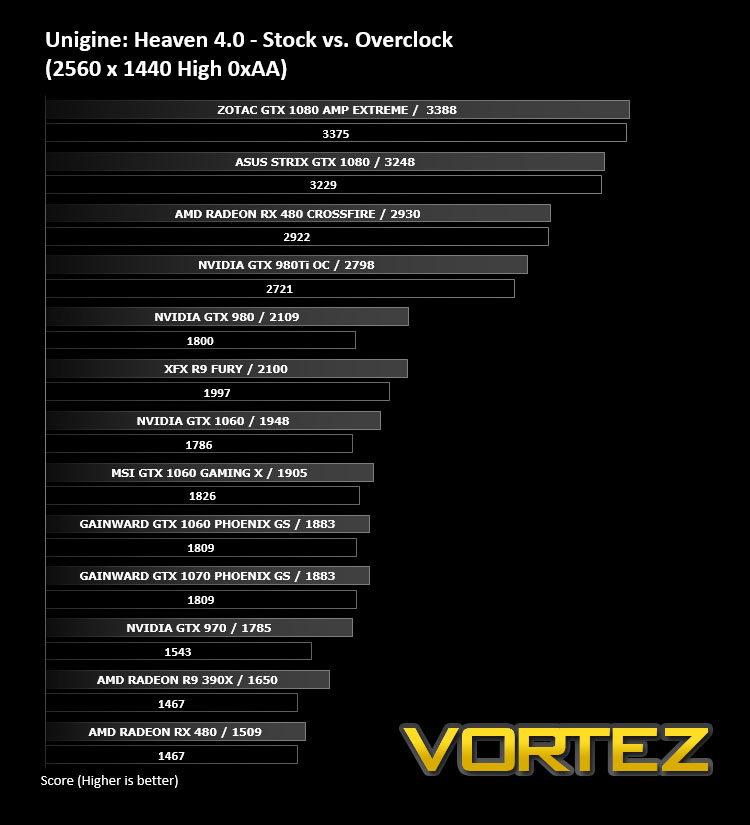
Overclocking the card was easy and we managed to boost the GPU and memory clock to a admirable point. Our result took the GPU clock from 1506MHz to 1726MHz and the memory clock from 2002MHz to 2167MHz. Pushing the card a little further meant we were able to receive a higher score in Unigine Heaven 4.0 which is shown below.
Since this Founders Edition of GTX 1060 hits a peak temperature of around 70C, this gives us plenty of headroom to adjust the speed of the graphics card and still remain within reasonable thermal parameters.
DX12: 3DMark Time Spy
With its pure DirectX 12 engine, which supports new API features like asynchronous compute, explicit multi-adapter, and multi-threading, 3DMark Time Spy is the ideal benchmark for testing the DirectX 12 performance of the latest graphics cards. Scores listed are the Combined values for each GPU on our test system.
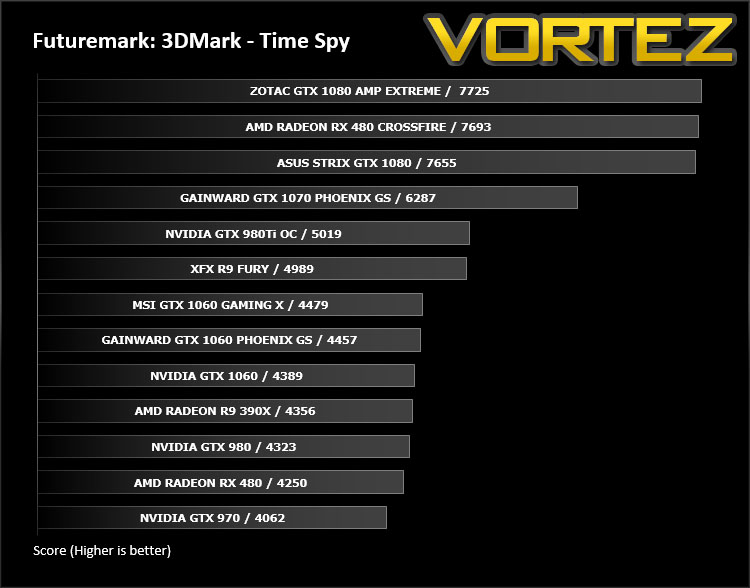
3DMark’s Time Spy is a brand new benchmark and its relevance to existing games performance is currently limited, but still well worth looking at. Broadly speaking it shows DirectX 12 capability, and our cluster of GTX 1060’s surpass the GTX 980 as you might expect. Expect the importance of this benchmark to increase (and new resolutions potentially added) as DirectX 12’s profile in the industry rises.
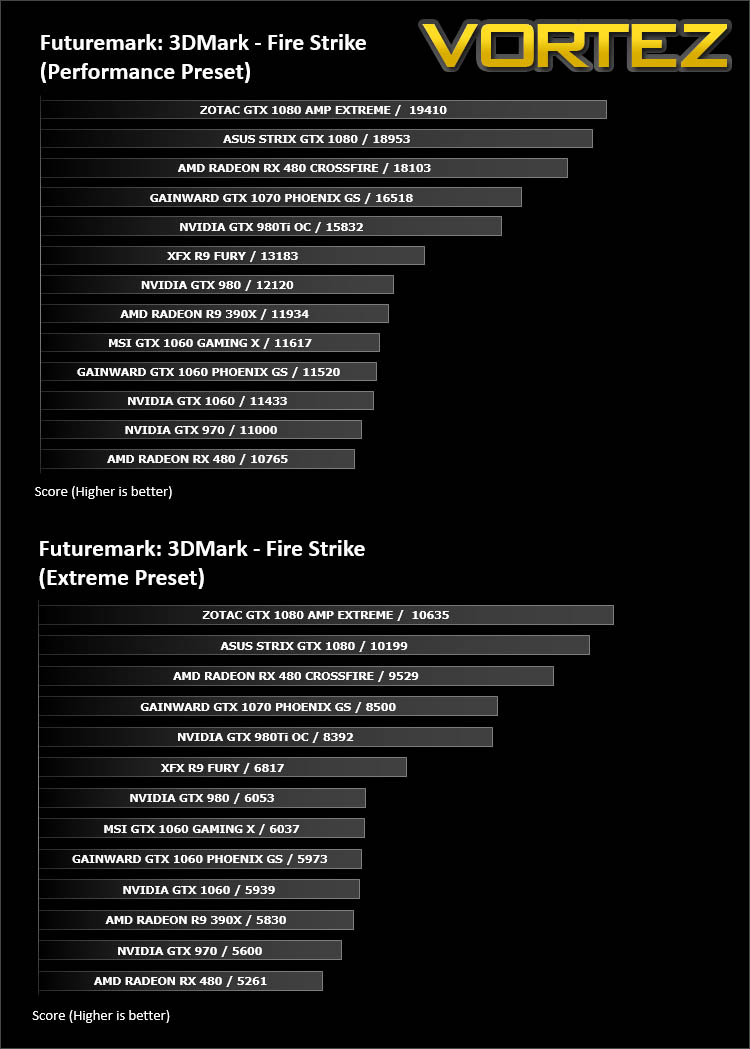
DX11: 3DMark FireStrike
Fire Strike is the showcase DirectX 11 benchmark designed for high-performance gaming PCs. It is Futuremark’s most ambitious and technical benchmark ever, featuring real-time graphics rendered with detail and complexity far beyond what is found in other benchmarks and games today.
Note: Firestrike Performance tests at 1080p, whilst FireStrike Extreme utilises a 1440p resolution.
DX11: Unigine Heaven 4.0
Heaven Benchmark with its current version 4.0 is a GPU-intensive benchmark that hammers graphics cards to the limits. This powerful tool can be effectively used to determine the stability of a GPU under extremely stressful conditions, as well as check the cooling system’s potential under maximum heat output. It provides completely unbiased results and generates true in-game rendering workloads across all platforms.
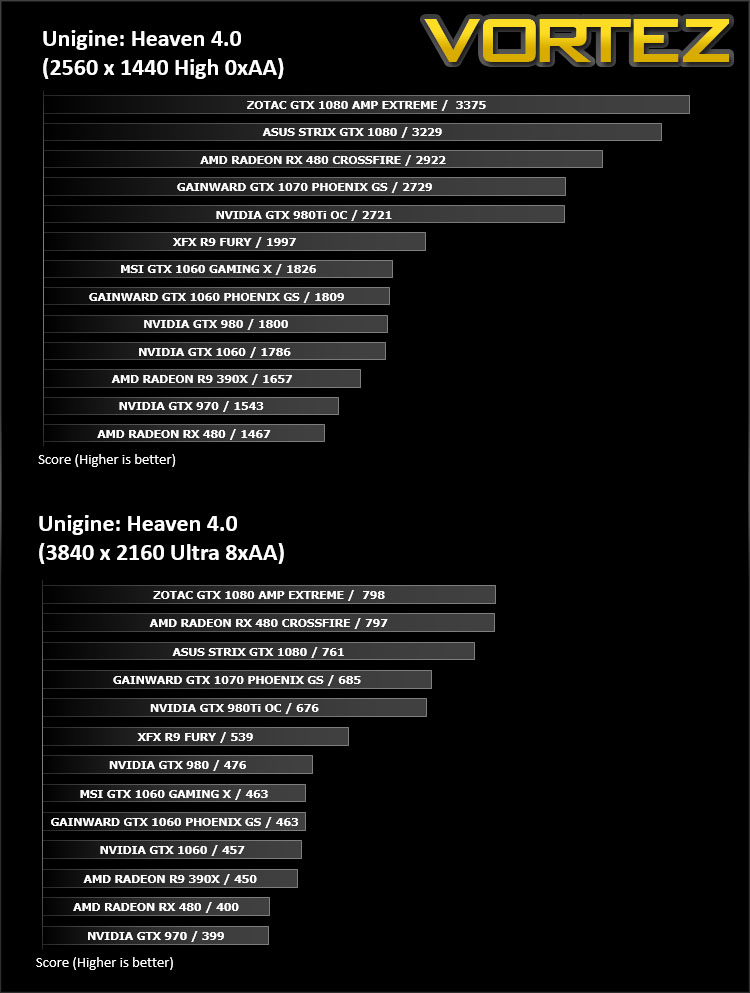
Unigine’s Heaven Benchmark scores are where one might expect. Perhaps most critically it indicates that the GTX 1060 Founder’s Edition isn’t buckling under the load of this test, which is notorious for putting thermal solutions under the spotlight.
DX11: Unigine Valley
Valley Benchmark is a new GPU stress-testing tool from the developers of the very popular and highly acclaimed Heaven Benchmark. The forest-covered valley surrounded by vast mountains amazes with its scale from a bird’s-eye view and is extremely detailed down to every leaf and flower petal. This non-synthetic benchmark powered by the state-of-the art UNIGINE Engine showcases a comprehensive set of cutting-edge graphics technologies with a dynamic environment and fully interactive modes available to the end user.
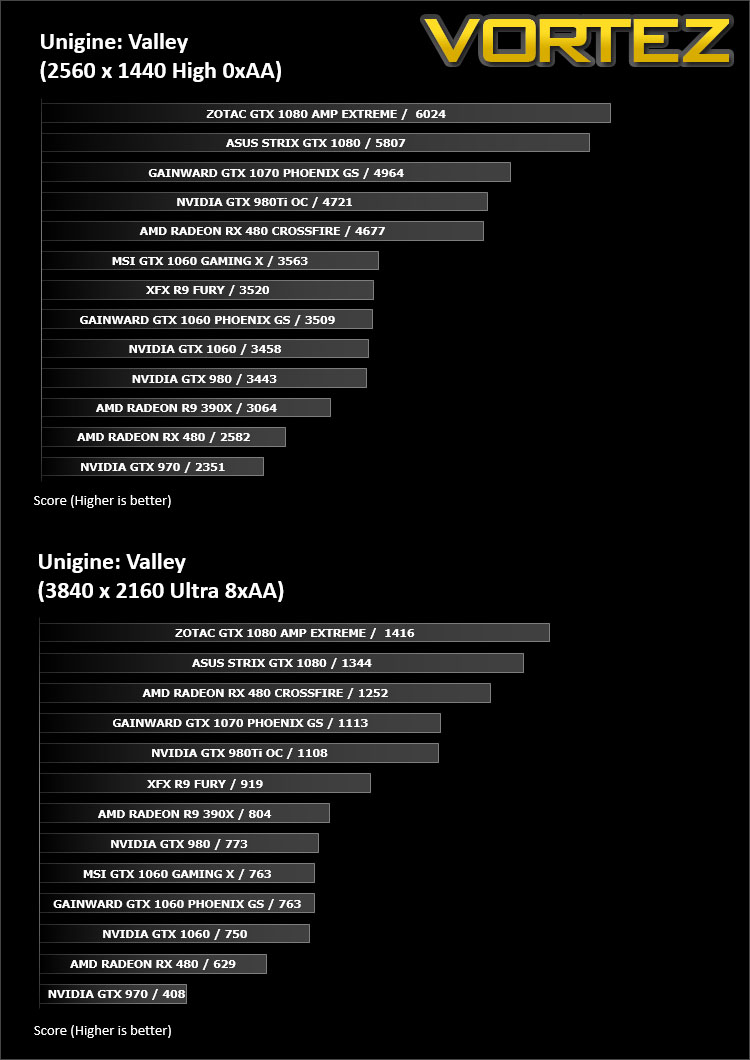
Unigine Heaven 4.0 and Valley both show how the GTX 1060 is neck-a-neck with the GTX 980 and how much of a step up the next performance class is in the form of the GTX 1070.
DX12: DOOM OpenGL 4.5
By default DOOM utilises an OpenGL 4.5 renderer, and is one of relatively few Windows PC titles to not use DirectX 12. It tests how well NVIDIA and AMD’s GPUs deal with a less mainstream approach, especially in regards to driver optimisations, and like all of id titles stretches graphics quality to the limit.

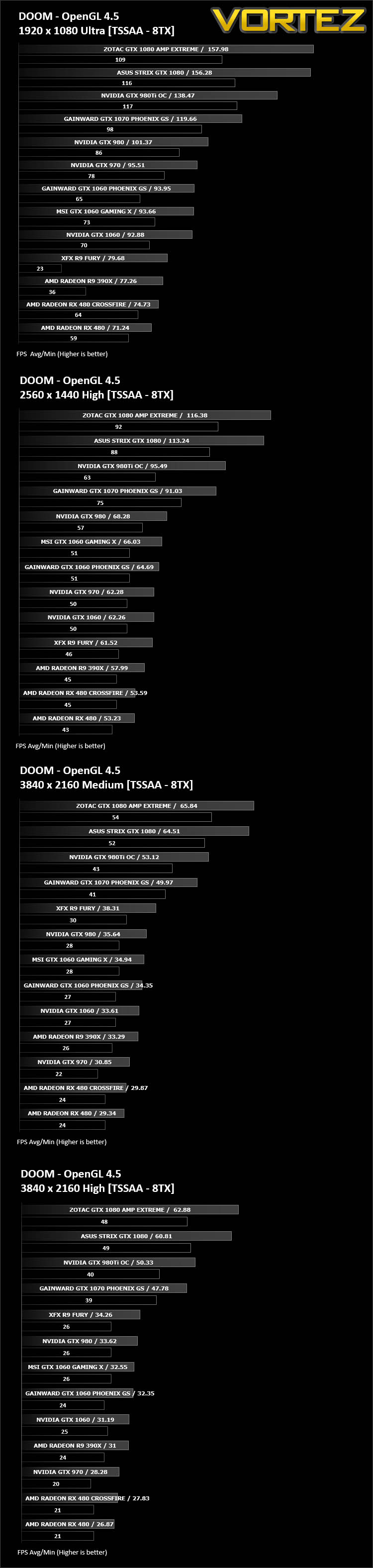
DX12: DOOM Vulkan
id have also released an optional Vulkan rendering path for DOOM. This API is a development of AMD’s Mantle low level which has been taken on board by the Kronos Group for implementation as the next generation of Open graphics APIs. Like DirectX 12 Vulkan is capable of Asynchronous Compute in specific configurations.
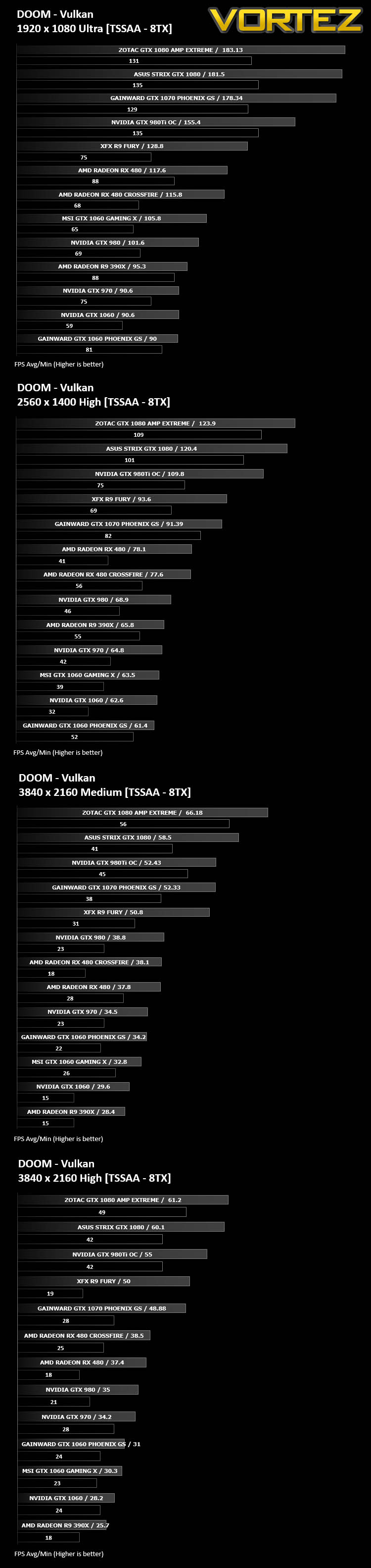
DX12: Total War: WARHAMMER
Total War: WARHAMMER is a pseudo Real-Time Strategy title which leverages DirectX 12 to render huge numbers of complex units on screen at any one time.

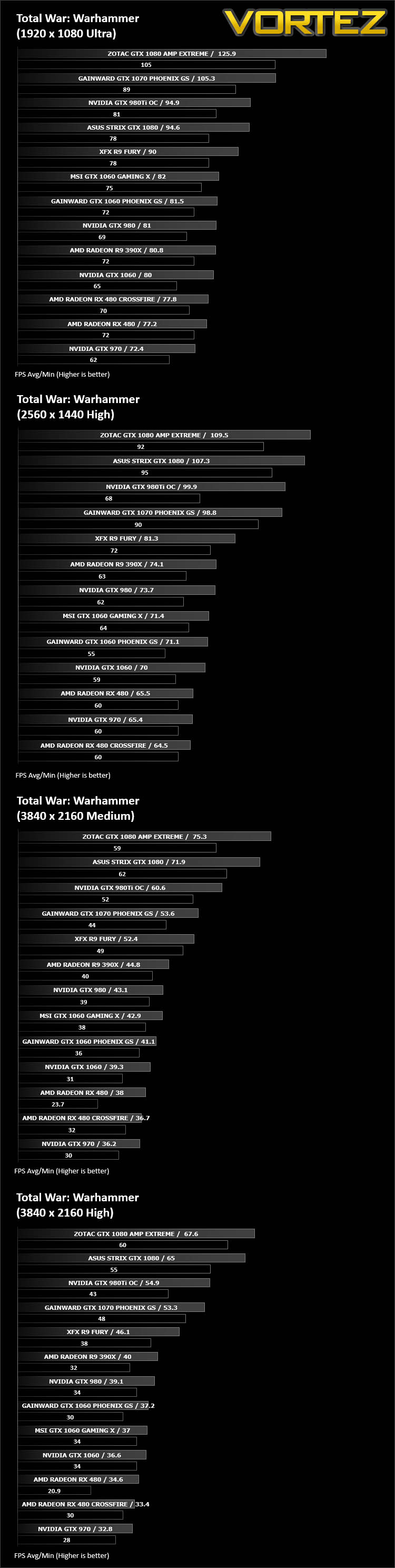
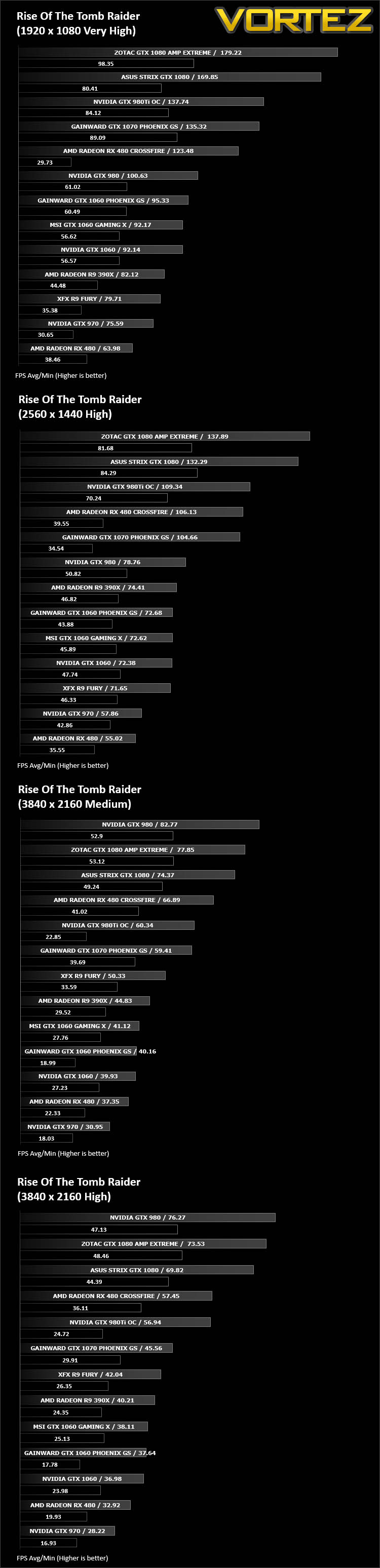
DX12: Rise of the Tomb Raider
Square Enix’s Rise of the Tomb Raider is the sequel to 2013’s Tomb Raider reboot. An enormously challenging title graphically, the developers also released an optional DirectX 12 render path for Windows 10 users. Although it has undergone a number of iterations this rendering pathway notably doesn’t currently utilise the full capabilities of DirectX 12.

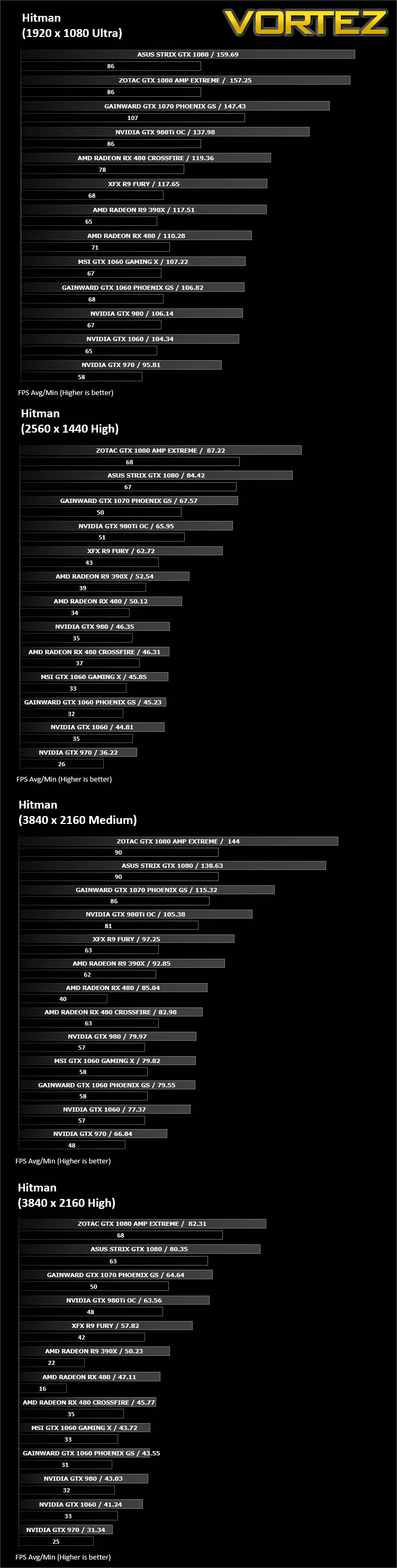
DX12: HITMAN
Yet another DirectX 12 title, 2016’s Hitman from Square Enix and developer IO Interactive has a more robust DirectX 12 implementation than Rise of the Tomb Raider. We’ve tested at a full range of resultions, from 1080p through to 4K, which provides a look at the impact of GPU speed and memory utilisation.

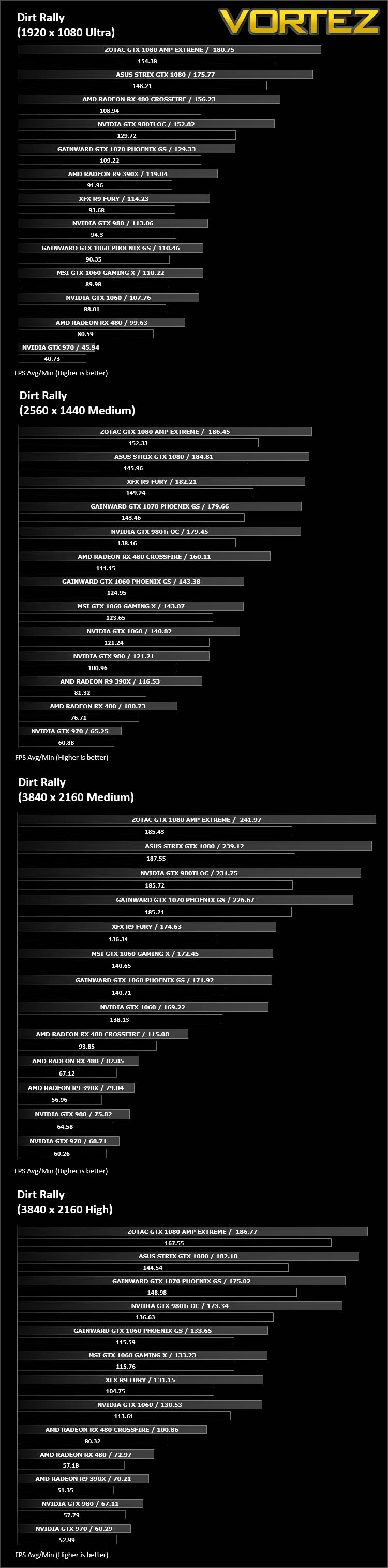
DX11: DiRT Rally

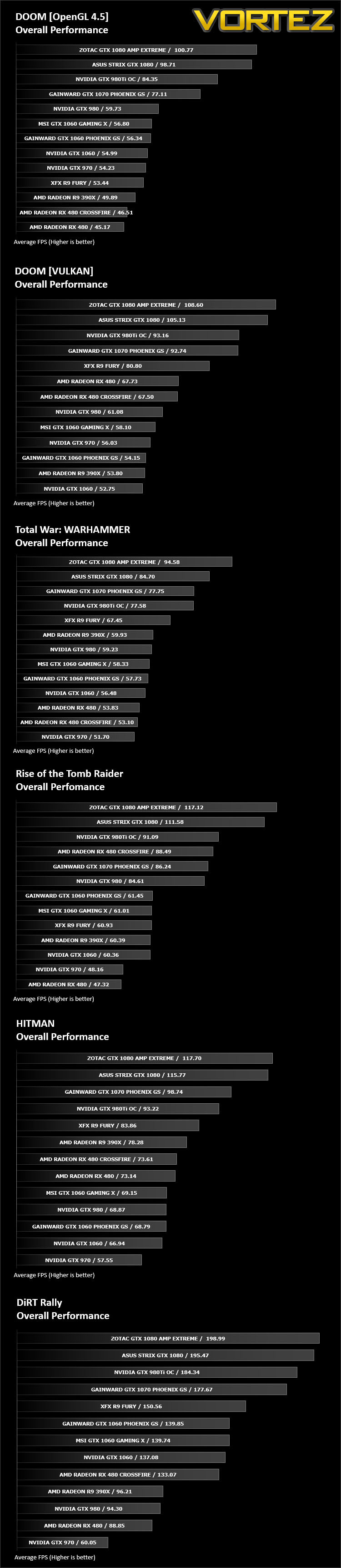
Overall Performance
Here we take a look at the overall performance of the graphics card. This figure is determined by finding the average FPS across all of the settings used in a particular benchmark (game) to give us an overall value.
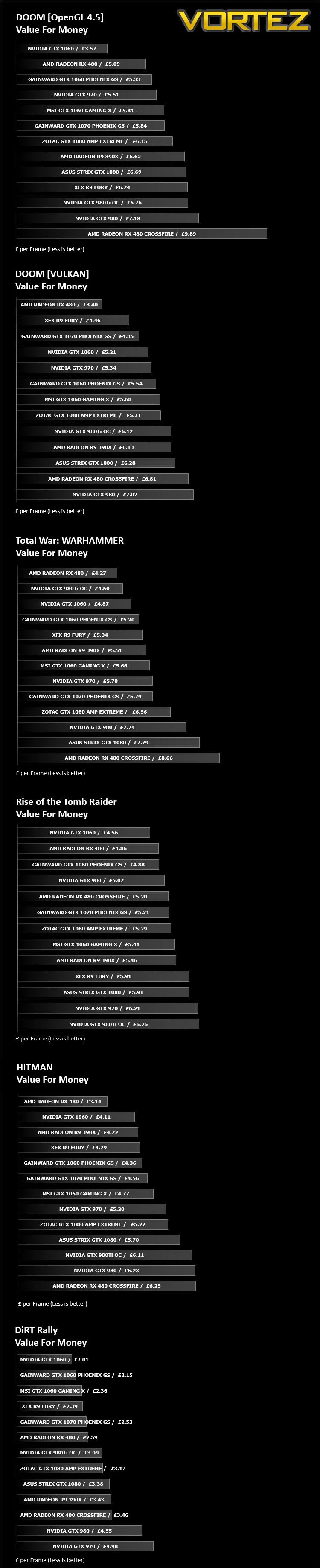
Value For Money
We make a simple calculation for this set of results. For each game we add all of the resulting FPS totals together and then divide by the four sets to give us an overall performance figure. While the figures alone do not give you an accurate picture of how the card will perform in any given scenario, they do tell you, when averaged, which GPU is the more capable across all of the benchmarks and settings tested.
Conclusion
Almost two weeks ago we began our testing on NVIDIA’s GeForce GTX 1060 alongside a swath of older cards expecting little in the way of surprises. The release has been timed with a general overhaul of our benchmarking criteria, so it’s a fresh look with the newest drivers from top to bottom. From this clean slate we discovered just how much of a step forward the GTX 1060 is for the mid-range, and some circumstances where even owners of the GTX 970 might be tempted to move to the newer GPU.
Firstly however let’s address the claim that the GTX 1060 can approach the GTX 980 in performance – suffice it to say that we can certainly agree that this is the case. In the majority of our tests, both synthetic and in-game, the GTX 1060 is within single-digit percentages of the GTX 980 whilst also maintaining equally creditable frame rate minimums. For an NVIDIA x60-class product that’s definitely significant and is the sort of leap in perf/price last seen with the transition from Fermi to Kepler (and 40nm to 28nm process nodes).
Then comes the first surprise – this near-parity with the GTX 980 extends even to high resolutions including 4K. We had anticipated that the narrower memory bus width and lower memory bandwidth would significantly impact the new Pascal card, but it’s clear that the larger frame buffer size and improved delta color compression algorithm more than compensate for other assumed shortcomings.
Comparisons to the most popular card currently in the hands of gamers are equally glowing, both at mainstream and higher resolutions. It’s clear that the GTX 970 cannot keep up with the 1060 under any realistic scenario, and – even though it still posts solid synthetic benchmark numbers – actual frame rates are often eclipsed by 20 or even 30%. Even so, differentials are most pronounced at very high resolutions and texture quality settings where neither the GTX 1060 nor GTX 970 are ideal. So long as the GTX 970 holds up at 1080p 60fps in new titles the performance differential is unlikely to trigger an upgrade for most gamers.
Radeon RX 480 comparisons once again leave the GTX 1060 on top in most scenarios, which is what you would expect given the almost $100 disparity in MSRP for their reference designs. AMD’s latest card does however benefit significantly from a more robust Vulkan implementation than both Pascal and Maxwell-based cards, offering baseline improvements from 1080p all the way to 4k. As more games with comprehensive Vulkan or DirectX 12 integration emerge, AMD’s crop of cards will become more attractive unless NVIDIA are able to pull a rabbit out of the hat with their drivers.
Overclockers will be pleased to hear that achieving a 200MHz OC with the Founder’s Edition card was a quick and painless process, and higher frequencies for more dedicated enthusiasts will be easily reachable. Expect to see partner cards with the most elaborate cooling break 2GHz on overclock.
As far as more mundane aspects of the GTX 1060 are concerned, we’re pleased to see that the Founder’s Edition cooler is more than fit for purpose. There has been some criticism of NVIDIA’s reference cooler on the GTX 1080 but the GTX 1060 doesn’t suffer, and clearly benefits from the increase in heatsink size over that used with the GTX 960. The shroud itself is exceptionally well made and looks great when installed, which is exactly what you should expect when paying a £35 premium over the lowest price partner cards. Don’t purchase one expecting to retrofit water cooling to it however; the means by which NVIDIA have relocated the 6-pin PCI-E power connector away from the PCB means that installing waterblocks will be very tricky indeed, even if one could be designed for the card.
All that aside, we must address the elephant in the room: SLI. By removing SLI support NVIDIA are able to create a more affordable and power-efficient card, but it does inherently reduce consumer choice and the ability to pick up a cheap performance boost at the end of the card’s life-cycle. Perhaps the card is too affordable and would eat into GTX 1070/1080 sales when bought as a pair, or similarly it could be too attractive a configuration for Virtual Reality, similarly cannibalising the sales of higher end cards. Only NVIDIA know for sure.
It is however also fair to say that SLI is an option very rarely utilised by users of their x60-class of cards, so the number affected is probably quite small. In fact GTX 1060 is still capable of DirectX 12 multi-GPU MDA Mode or LDA Explicit Mode, but these will require development time in order to be implemented in-game. Depending on how the DirectX 12 ecosystem evolves (as well as any new additions to NVIDIA product stack) the impact on end-users may well be negligible.
So, in summation, the GTX 1060 Founder’s Edition offers startling performance on par with the GTX 980 for just £275 inc. V.A.T., and is the largest performance improvement for the mid-range since the transition from Fermi to Kepler. New technologies currently in development such as NVIDIA VRWorks and Simultaneous Multi-Projection will eventually give the card an additional leg up over the previous generation, but it may be 2017 before that comes to fruition. Consumers currently using a GTX 960 or lower card could easily justify an upgrade, whilst anyone eyeing a GTX 1070 may instead want to consider this card and a G-Sync Monitor.
If you’re not enamoured with the Founder’s Edition it’s well worth considering partner cards from the likes of MSI, Gainward and ASUS which are available from £239 inc. V.A.T. with their own cooling solution. Before overclocks, performance between these cards is generally at parity.
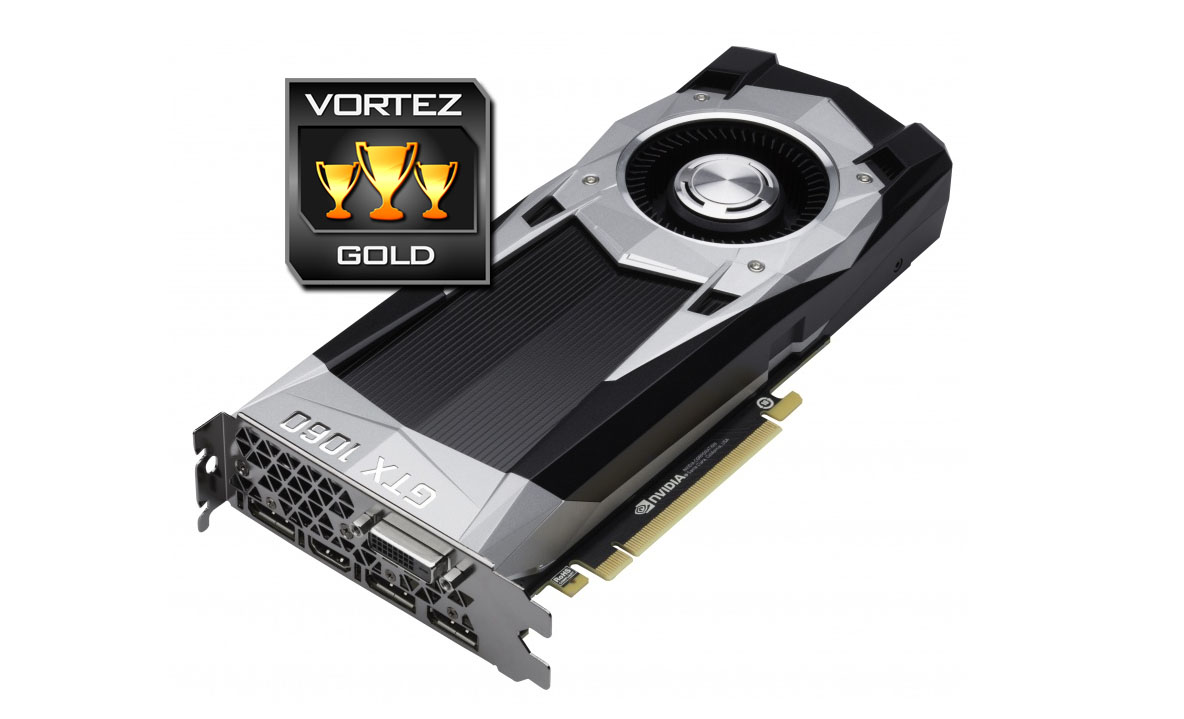
NVIDIA’s GeForce GTX 1060 will be applauded as a card that offers new performance in the <$300 price bracket. If you’re in need of an upgrade for an aging system, or want to jump on Pascal for a new build, the GTX 1060 is the place to start. Powerful but not power-hungry, it’s the new price/performance king. It easily qualifies for our Gold Award.
Pros
+ GTX 980 Performance
+ Less than a GTX 970 in price
+ Capable of new NVIDIA technologies including SMP
+ Excellent 1080p frame rates, scales well to 1440p
+ Only requires a single 6-pin PCI-E connector
+ Partner versions available from Day 1
+ Plenty of room to overclock
Cons
– No SLI
+ GTX 980 Performance
+ Less than a GTX 970 in price
+ Capable of new NVIDIA technologies including SMP
+ Excellent 1080p frame rates, scales well to 1440p
+ Only requires a single 6-pin PCI-E connector
+ Partner versions available from Day 1
+ Plenty of room to overclock
Cons
– No SLI
Click here for an explanation of our awards at Vortez.net.