Gamers around the globe have their expectations satisfied – NVIDIA unveil their new flagship Pascal-based GTX 10 series graphics card. The new performance king is here!

Manufacturer & Sponsor: NVIDIA
Street Price: £699 GBP / $699 USD
Co-Author: Tim Harmer
For all the awesome technology we’re privileged to see here at Vortez on a week-by-week basis, little can evoke our enthusiasm more than a brand new graphics card. And although that’s true for all new GPUs, it’s especially the case when it’s a flagship model from one of the big names; not only does it show us what’s possible today, but also what every PC gamer will be able to look forward to in the not too distant future. Today’s bleeding edge is tomorrow’s mid-range, with a legion of enthusiasts itching to experience games they’ve loved at new heights of visual fidelity.
So, it’s with surpassing pleasure that today we take a look at NVIDIA’s new premier graphics card, the GeForce GTX 1080 Ti. A brand-new entrant into the already well appointed GeForce GTX 10-series, and built with the award-winning Pascal architecture, this disruptive new GPU replaces and demotes the GTX 1080 in NVIDIA’s product stack whilst rivalling the NVIDIA TITAN X as the undisputed king of performance GPUs.
In recent generations GTX x80 Ti models have always been high watermarks for NVIDIA’s range. The tradition (if you can call it that) began with the GTX 780 Ti, a card that confounded and astonished in equal measure as the 700-series’ apex. Even this however was eclipsed by the TITAN Black, the final entrant in of the now retired Kepler architecture. Next came the GTX 980 Ti, a far slimmer model than the Maxwell TITAN X of a similar 2015 vintage. It didn’t boast range dominance, but did come in aggressively priced and turned out to be a very attractive and popular design (as much as a graphics card with $649 price tag could be). Today, the GTX 1080 Ti is expect to surpass the GTX 1080 by more substantial margins than ever before, and there are also whispers that it will even out-pace the current $1200 professional-class top-dog.
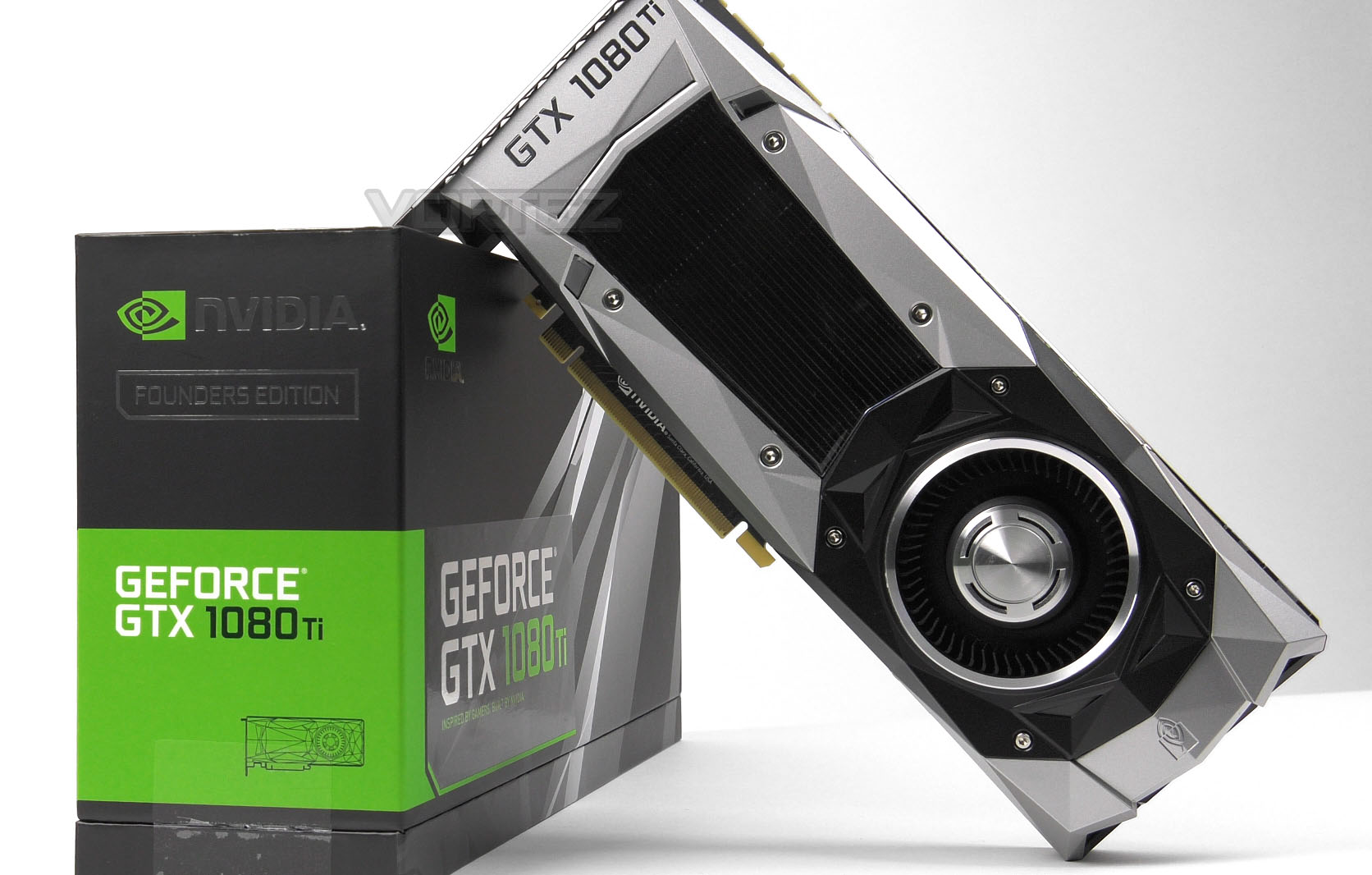
Once again, the launch encompasses a Founder’s Edition reference design, complete with familiar cooling solution and angular aluminium shroud; partner models are expected in the coming weeks. Aside from raw performance highlights include a new GDDR5X memory speed that will be filtered down to other Pascal SKUs, and a larger memory buffer than has been available in the performance segment thus far; but make no mistake – raw performance is definitely the GTX 1080 Ti’s main selling point.
With this release, NVIDIA are pushing the boundaries of high resolution performance, testing the waters of 5K (5 x 1080p resolution) in modern triple-A titles without the need for complex multi-GPU configurations. Gamers without those monitors will instead relish pushing higher frame rates, taking full advantage of a new range of 240Hz monitors released this year by manufacturers like ASUS and AOC AGON. Meanwhile mainstream gamers can absorb today’s findings knowing that in the not too distant future, perhaps just a few years, cards they can afford may offer similar performance at more realistic resolutions.
The GTX 1080 Ti launches at $699 in the US, identical to the June launch MSRP of the GTX 1080, and is available worldwide. As a consequence, the GTX 1080 price has been revised downwards to $499, although this only extends to AIC/partner designs; in some regions the GTX 1070 has been squeezed downward as well. In the UK the GTX 1080 Ti is set to retail at £699 inc. V.A.T. (for those financially inclined this is within 4% of the direct currency conversion), although this will inevitably vary based on demand and stock levels.
GTX 1080 Ti Features
Technical Specifications
Shader Modules :- 28
CUDA Cores :- 3584
Base Clock :- 1480 MHz
GPU Boost Clock :- 1582 MHz
Texture Units :- 224
Texel fill-rate :- 331.5 GT/s
Memory Clock (Data Rate) :- 5505 MHz
Memory Bandwidth :- 484 GB/s
ROPs :- 88
L2 Cache Size :- 2816 KB
TDP :- 250W
Transistors :- 12 billion
Die Size :- 471mm^2
Manufacturing Process :- 16nm
SLI Support :- Yes (High Bandwidth Bridge)
Video Outputs :- HDMI 2.0b, 3 x DisplayPort 1.4
HDCP :- 2.2
CUDA Cores :- 3584
Base Clock :- 1480 MHz
GPU Boost Clock :- 1582 MHz
Texture Units :- 224
Texel fill-rate :- 331.5 GT/s
Memory Clock (Data Rate) :- 5505 MHz
Memory Bandwidth :- 484 GB/s
ROPs :- 88
L2 Cache Size :- 2816 KB
TDP :- 250W
Transistors :- 12 billion
Die Size :- 471mm^2
Manufacturing Process :- 16nm
SLI Support :- Yes (High Bandwidth Bridge)
Video Outputs :- HDMI 2.0b, 3 x DisplayPort 1.4
HDCP :- 2.2
The GeForce GTX 1080 Ti is NVIDIA’s brand new flagship GeForce GTX graphics card, and it’s not hard to see why. Built using the Pascal architecture and based on the same GP102 GPU which is the centrepiece of the NVIDIA TITAN X, the GTX 1080 Ti brings new performance levels to the GeForce line at a price far below that of the professional-class card. It’s tempting to call it a ‘slimmed down TITAN X’, but there’s a little more to it than simply slapping a new shroud on it and calling it a day.
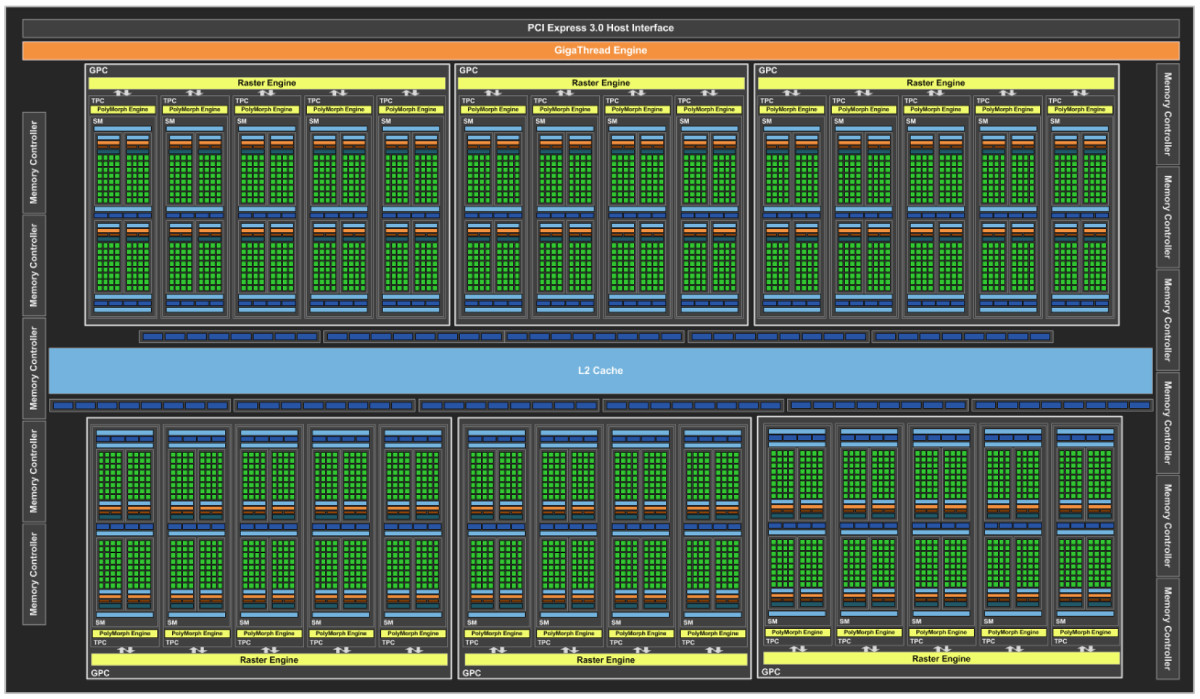
GTX 1080 Ti GP102 Block Diagram (not shown: 4xDP units per SM)
The block diagram of an NVIDIA Pascal-based GPU should now be pretty familiar to everyone. Shader Modules are organised into blocks of six per GPC, all controlled by the GigaThread Engine that distributes highly parallelised workloads. Above is the block diagram for the GTX 1080 Ti’s GP102, indicating both the lower number of 32-bit Memory Controllers (11 vs 12) and less L2 Cache (3096 vs. 2816kb) compared with the TITAN X; not shown are the four Double Precision units per SM.
While the NVIDIA TITAN X might specialise in photorealistic rendering and deep learning applications, NVIDIA have balanced the spec of the GTX 1080 Ti to err towards gaming performance. In the process the bill of materials has gone down, justifying a lower price point and improving the price/performance landscape for desktop GPUs. The consequence is that it still features the same 3584 CUDA cores, but fewer ROPs and lesser frame buffer which are balanced out by higher base and boost frequencies.
The GTX 1080 Ti is also the debut of higher performance GDDR5X VRAM. Now hitting 11Gbps, the VRAM will also be rolled out in the coming weeks on a range of ‘OC’ SKUs for the GTX 1080 and GTX 1060.
Power & Cooling
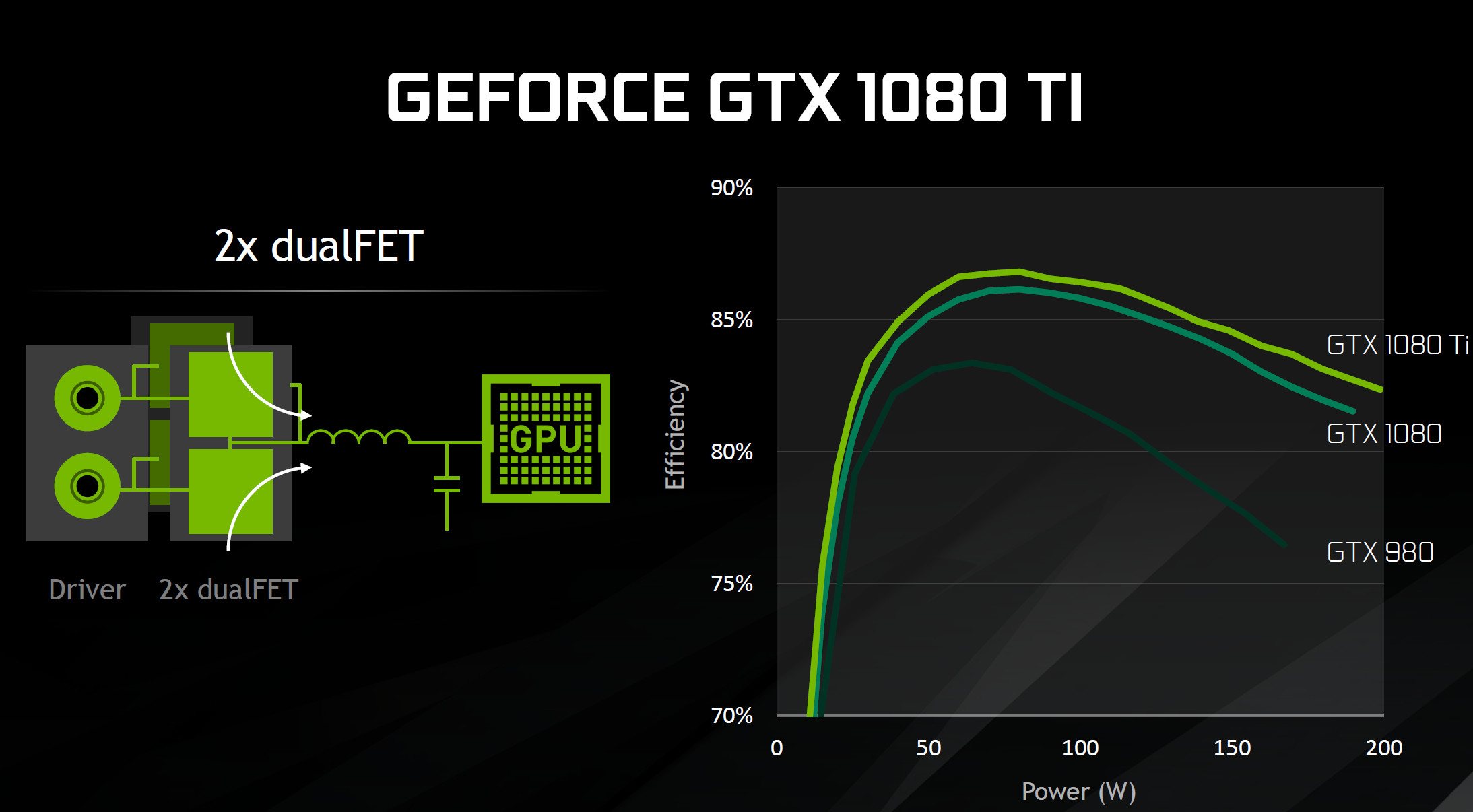
GTX 1080 Ti Power Efficiency vs GTX 1080 & GTX 980 Ti (NVIDIA figures)
The size and complexity of the GTX 1080 Ti compared to the 1080 necessitated a substantial upgrade to its power delivery system. Now sporting a 7-phase 2x dual-FET power supply, it’s capable of supplying up to 250A of conditioned power to the GPU, aiding system stability and reducing thermal waste. Compared with the TITAN X, which sported a 6-phase power design, the GTX 1080 Ti could see higher stable overclocks too.
Nonetheless the 1080 Ti is a power-hungry card, and that inevitably generates heat. Rated at 250W TDP, the increased thermals required a new cooler that can dissipate much more heat than the 180W of the 1080. The cooler’s metal base-plate and back-plate help to cool low-profile surface mounted components, whilst a copper vapour chamber, heatsink and radial fan do the majority of work keeping the GPU itself cool. The vapour chamber itself is mounted on the GPU baseplate which should serve to reduce mechanical stress on the PCB.
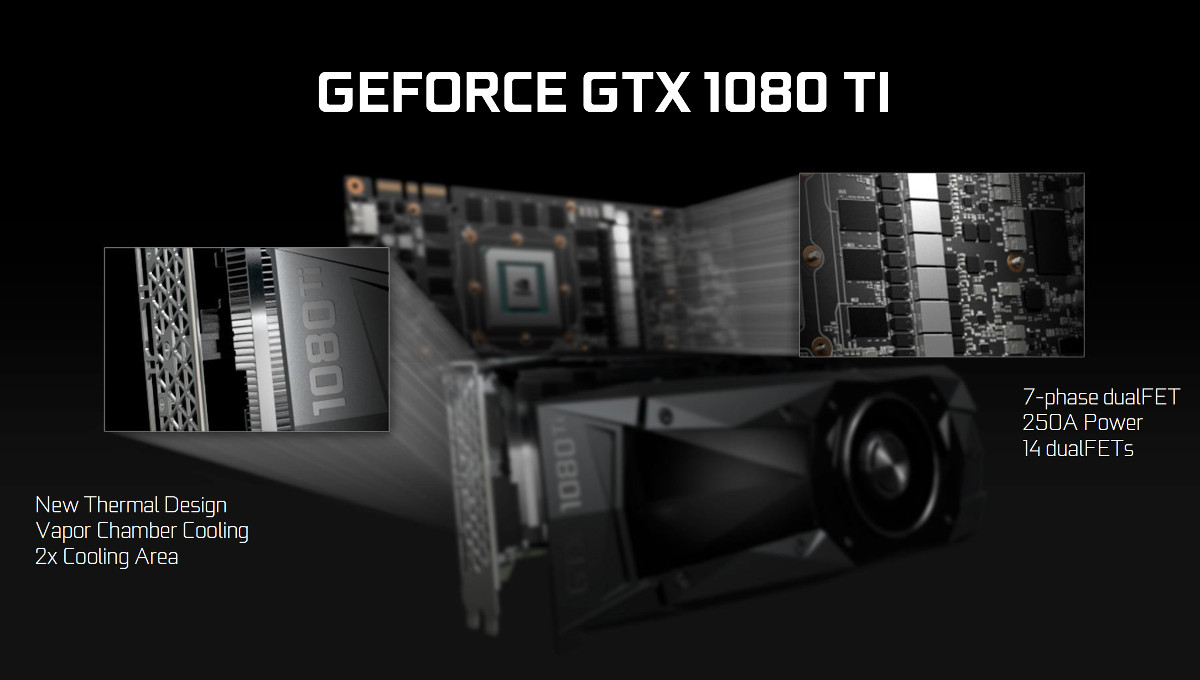
To increase cooling efficiency NVIDIA widened the exhaust vent, removing the DVI/D connector in the process and substituting it for an additional DisplayPort out (for a total of 3x DP, 1 x HDMI on the bottom tier). Additionally, NVIDIA have tweaked the back-plate design – now half the plate can be removed to improve airflow, a handy feature in cramped dual-GPU SLI configurations.
NVIDIA have indicated that internal tests for the 1080 Ti pushed the card up to 2GHz, but as usual take those sorts of numbers with a pinch of salt. The only guarantee are those Base and Boost clocks, although those themselves are impressive.
Comparative Specifications
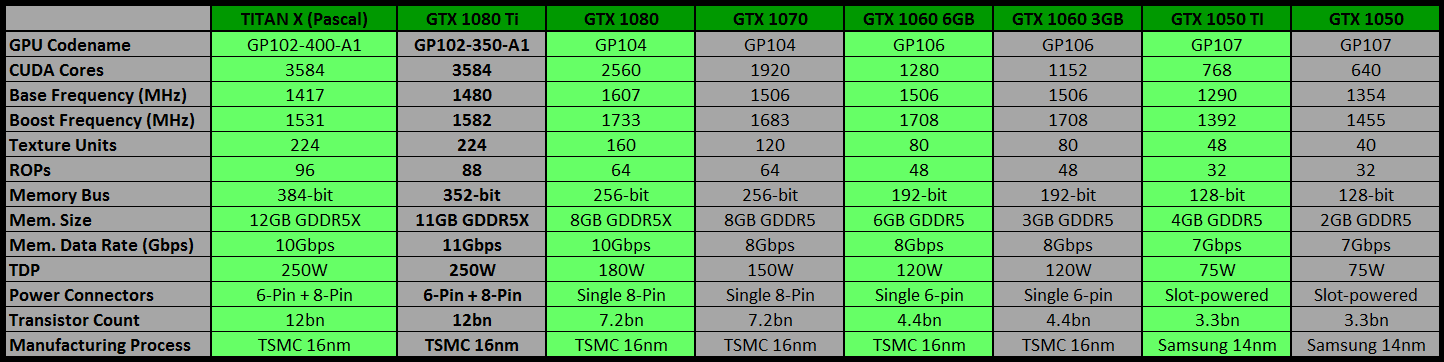
The GTX 1080 Ti is expected to be the final major member of the GTX 10-series, rounding out a release which begun with the much-heralded GTX 1080 in June of last year. However, where other new entrants in the range have cater to mainstream gaming workloads – i.e. 1080p60 gaming – the 1080 Ti is all about high resolutions and frame rates. Don’t be surprised if the design is promoted as the first 5K capable gaming GPU, and one to seriously consider if you need consistent >90fps gameplay at higher than 1440p resolutions and maximised image quality settings.
Tiled Caching

Over the course of architecture launches NVIDIA have allowed enthusiasts to peek behind the curtain a little at some of the memory optimisations present within the updated hardware. One example was 4:1 and 8:1 Delta Color Compression modes, present on all Pascal GPUs but only revealed alongside the GTX 1060 last summer and believed to improve effective memory bandwidth by as much as 20%. The same is true of the GTX 1080 Ti’s launch.
Boosting effective memory bandwidth on NVIDIA GTX GPUs is a technique they’re calling Tiled Caching, present on both Maxwell and Pascal architectures but only revealed at GDC 2017. The revised rendering methodology aims to reduce the high overdraw characteristic of Immediate Rendering modes, taking cues from the Tiled Rendering system often used by mobile GPUs.
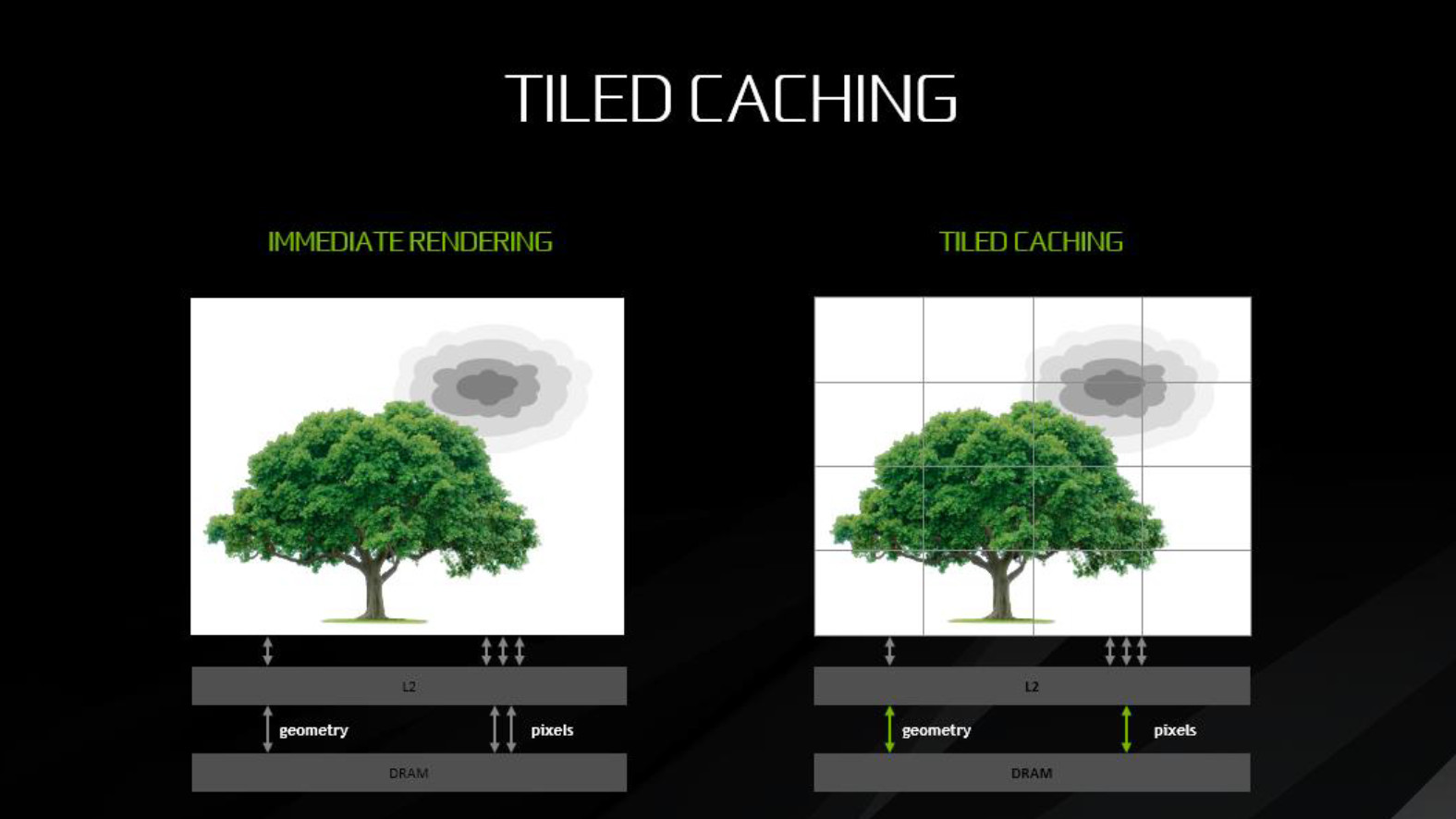
”With a tiled renderer, the screen is broken into many separate tiles, and rendering is performed in two passes. A first pass processes the geometry and determines which tiles are covered by each triangle, and writes this information out to DRAM. Then in a second pass, the geometry list is reprocessed for each tile, one tile at a time– each tile is rendered to completion before moving to the next tile. Tiles are sized so all rendering happens on-chip, with only the final color written the DRAM.
[..]
We stick with the proven immediate rendering model for graphics, with no binning prepass. However, within the immediate rendering pipeline, we add a binner that writes to an on-chip geometry queue in L2. Once the binned data fills a preset buffer size within L2, Pascal renders this geometry, a tile at a time, until the queue is processed. The modified raster behaviour has the effect of modifying the working set of output pixels to naturally stay within the capacity of the existing on-chip L2 cache, whereas single pass rasterization would have overflowed the cache capacity. We call this technique “Tiled Caching” – an approach that uses tiled rasterizer behaviour to improve the effectiveness of the L2 Cache. Compared to a traditional tiler architecture, this architecture realizes similar pixel bandwidth savings benefits, but without any geometry bandwidth tax or binning pass latency.”
[..]
We stick with the proven immediate rendering model for graphics, with no binning prepass. However, within the immediate rendering pipeline, we add a binner that writes to an on-chip geometry queue in L2. Once the binned data fills a preset buffer size within L2, Pascal renders this geometry, a tile at a time, until the queue is processed. The modified raster behaviour has the effect of modifying the working set of output pixels to naturally stay within the capacity of the existing on-chip L2 cache, whereas single pass rasterization would have overflowed the cache capacity. We call this technique “Tiled Caching” – an approach that uses tiled rasterizer behaviour to improve the effectiveness of the L2 Cache. Compared to a traditional tiler architecture, this architecture realizes similar pixel bandwidth savings benefits, but without any geometry bandwidth tax or binning pass latency.”
By investing in the optimisation of memory, both in partnership with vendors to produce higher performance DRAM and improving algorithms and GPU architectures, NVIDIA improves overall hardware performance without incurring the substantial cost of transitioning to new memory paradigms on the desktop platform (such as HBM2).
Performance Expectations
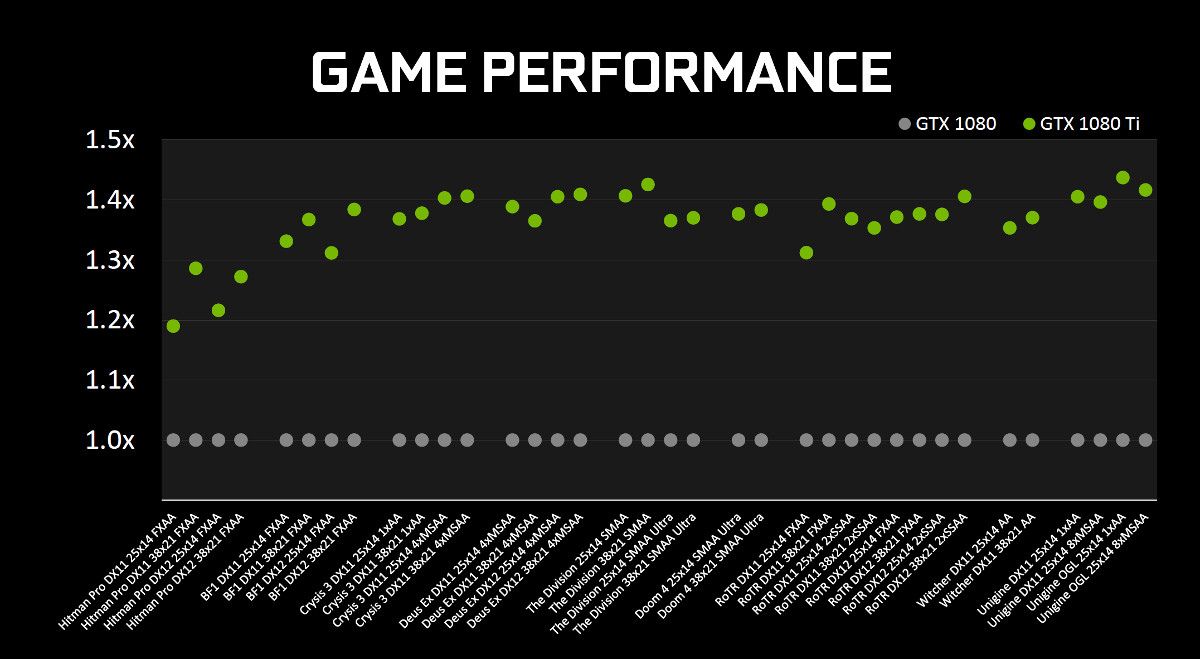
It’s no surprise that the GTX 1080 Ti is being lauded by NVIDIA as being the best Ti to date, 40% more CUDA cores alone will account for an enormous performance improvement over the previous flagship. NVIDIA themselves are stating that overall you would expect to see an average of 35% net benefit compared to the GTX 1080, the largest margin a flagship Ti has held over its non-Ti counterpart for at least three generations.
That said, comparisons will perhaps be more readily drawn with the NVIDIA TITAN X, given their broadly similar specifications. Held up more as a workstation component, the TITAN X features both a larger frame buffer (12GB vs 11GB) and wider memory bus (384-bit vs 352-bit), and yet due to the faster memory on the GTX 1080 Ti total memory bandwidth available differs by less than 1%.
More substantial is the reduction in number of ROPs in the GTX 1080 Ti compared to the TITAN. This will have an impact on both overall frame render times and further influence performance when rendering with hardware anti-aliasing. It’s here, combined with the larger frame buffer, that the TITAN X make a case in professional and enterprise environments.
Where the GTX 1080 Ti pulls ahead is in raw GPU clock speed. Both Base and Boost frequencies receive a small but significant improvement which should have a particular impact in gaming, and of course the GPU is overclockable beyond this.
Detailed Look & Video Review
For this review we’ve produced a video review over on our YouTube channel which details all of the included features, and takes a close look at the PCB/cooling solution along with the addition of some gaming benchmarks. Please check out our video review or hit play on the video below:
Test Setup & Methodology
How we test graphics cards
Testing a graphics card is an extremely lengthy process. We sometimes see reviews where a graphics card has been tested using out of date equipment, out of date games and even out of date drivers. While the latter can be excused due to the sheer amount of driver updates making a thorough review impossible we will however notify the reader when we have used a different driver to the normal for example a pre-release driver. For the most part however we will always use the same hardware and latest drivers so this does certainly need to be taken into consideration when viewing our testing results. Each game and benchmark is tested times with the lowest and highest scores omitted out of the 5 results and the average then taken from the three remaining to give us our final result for each resolution and setting used.
Hardware
Taking Intel’s High-End Desktop platform, our hardware utilises the Intel X99 chipset. Combined with this we use the Intel Core i7-5960X Extreme Edition processor clocked to a realistic and achievable 4GHz to ensure we have no CPU bottlenecks. With 16GB (4x4GB) of DDR4 at 2666MHz and a 750GB SSD there should be minimal paging so the benchmarks we run today will hopefully give a true reflection of the graphics card’s performance.
High End Graphics Cards on test:
NVIDIA GTX 1080 Ti (NVIDIA 378.78)
AORUS GTX 1080 XTREME (NVIDIA 378.66)
ASUS STRIX GTX 1060 (NVIDIA 376.33)
ASUS STRIX GTX 1070 (NVIDIA 372.54)
GIGABYTE GTX 1060 G1 GAMING (NVIDIA 372.54)
GIGABYTE GTX 1070 G1 GAMING (NVIDIA 372.54)
GIGABYTE GTX 1080 G1 GAMING (NVIDIA 372.54)
PowerColor RED DEVIL RX 470(Crimson 16.8.1)
PowerColor RED DEVIL RX 480 (Crimson 16.7.2)
ZOTAC GTX 1080 AMP! Extreme (NVIDIA 368.81)
ASUS STRIX GTX 1080 (NVIDIA 368.81)
Gainward GTX 1070 Phoenix Golden Sample (NVIDIA 368.81)
MSI GTX 1060 Gaming X (NVIDIA 368.64)
Gainward GTX 1060 Phoenix Golden Sample (NVIDIA 368.64)
NVIDIA GTX 1060 (NVIDIA 368.64)
NVIDIA GTX 980Ti OC (NVIDIA 368.81)
NVIDIA GTX 980 (NVIDIA 368.81)
NVIDIA GTX 970 (NVIDIA 368.81)
AMD Radeon RX 480 CrossFire (Crimson 16.7.2)
AMD Radeon RX 480 (Crimson 16.7.2)
XFX R9 FURY (Crimson 16.7.2)
AMD Radeon R9 390X (Crimson 16.7.2)
Special thanks go to Epiphan, Intel, Corsair, MSI and AOC for providing the extreme spec components used for our test bench:
Motherboard: MSI X99A Workstation
CPU: Intel Core i7-5960X Extreme Edition @ 4GHz
RAM – 16GB (4x4GB) Corsair LPX Vengeance (Red) DDR3 @ 2666MHz 16-17-17-35 C1
Power Supply – CORSAIR HX1050
Hard Drive – Samsung 840 EVO 750GB
Cooler – CORSAIR Hydro Series™ H105 240mm Extreme Performance Liquid CPU Cooler
Monitor – AOC 28″ 4K U2879VF
Capture Card – Epiphan AV.io 4K
CPU: Intel Core i7-5960X Extreme Edition @ 4GHz
RAM – 16GB (4x4GB) Corsair LPX Vengeance (Red) DDR3 @ 2666MHz 16-17-17-35 C1
Power Supply – CORSAIR HX1050
Hard Drive – Samsung 840 EVO 750GB
Cooler – CORSAIR Hydro Series™ H105 240mm Extreme Performance Liquid CPU Cooler
Monitor – AOC 28″ 4K U2879VF
Capture Card – Epiphan AV.io 4K
Benchmarks
If you are a regular reader of our reviews you will know we like to test the latest hardware with the latest games and benchmarks on the market. Here are the games we’ve chosen:
DOOM (OpenGL 4.5 & Vulkan)
Total War: Warhammer
Rise of the Tomb Raider
HITMAN
DiRT Rally
Total War: Warhammer
Rise of the Tomb Raider
HITMAN
DiRT Rally
To capture framerates we use a combination of in-game benchmark tools, FRAPS and PresentMon.
We also take into consideration the benchmarkers out there so have included three of the more popular synthetic benchmarks available:
Unigine: Valley
Unigine: Heaven 4
Futuremark 3DMark Firestrike
Futuremark 3DMark Time Spy
Unigine: Heaven 4
Futuremark 3DMark Firestrike
Futuremark 3DMark Time Spy
Let’s see how today’s graphics card performed…
Power, Temperatures, Acoustics
To test for power consumption, we take a measurement from the plug socket. It is important to note that the figures below represent total system power use and not just the GPU. The CPU was always in a fixed state (4GHz overclock) so did not affect the additional power load when the GPU was placed under 100% load using Heaven 4.0 which was ran for 20 minutes at which point a load reading was taken. Idle readings were taken 5 minutes after system boot to ensure any background services and applications had loaded.
Temperature
To test temperatures we measured idle temperatures after booting windows, letting all applications finish loading and ran a few benchmarks. Once the benchmarks were complete we left the card to reach a cooling plateau where we then took the idle temperatures. For the load tests we set Heaven 4.0 running continuously for ~30 minutes recorded the peak/maximum GPU temperature.
Acoustics
While NVIDIA has made adjustments to its thermal design on the GTX 1080 Ti Founders Edition – the noise is still something of a gripe. Under full load the noise can be regarded as disruptive.
Overclocking
To overclock the GTX 1080 Ti we used the MSI Afterburner Tool since it gives extensive options for modifying the GPU and memory clock.
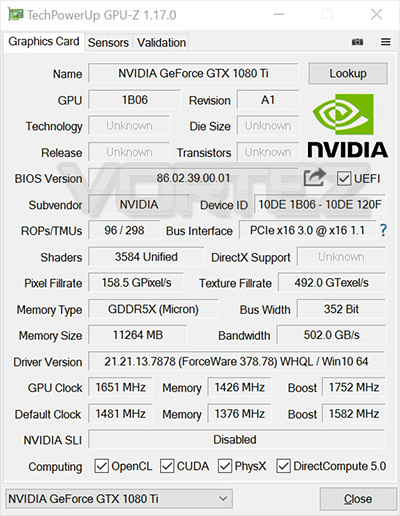
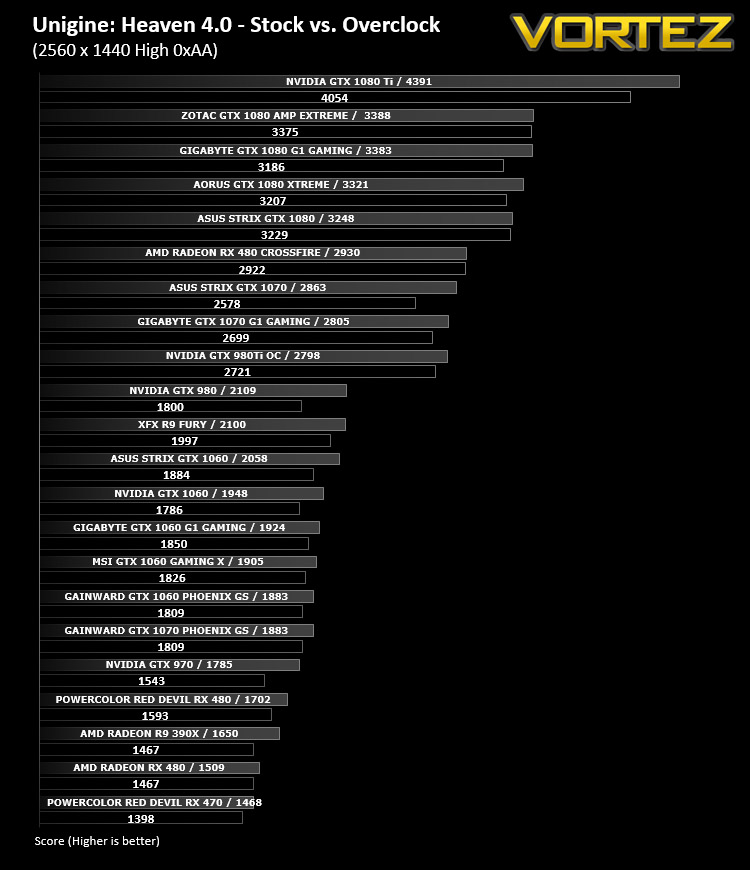
Overclocking the card was easy but there wasn’t as much headroom as we found in the past with NVIDIA’s reference design inside the GTX 10 series. Our result took the GPU clock up to 1651MHz (1752MHz Boost) and modifying the memory clock up to 1426MHz. By tweaking both these elements of the card, we are able to tap into better 3D performance. Below is an example of how the overclock compares to the stock settings in Unigine Heaven 4.0.
DX12: 3DMark Time Spy
With its pure DirectX 12 engine, which supports new API features like asynchronous compute, explicit multi-adapter, and multi-threading, 3DMark Time Spy is the ideal benchmark for testing the DirectX 12 performance of the latest graphics cards.
DX11: 3DMark FireStrike
Fire Strike is the new showcase DirectX 11 benchmark designed for high-performance gaming PCs. It is Futuremark’s most ambitious and technical benchmark ever, featuring real-time graphics rendered with detail and complexity far beyond what is found in other benchmarks and games today.
DX11: Unigine Heaven 4.0
Heaven Benchmark with its current version 4.0 is a GPU-intensive benchmark that hammers graphics cards to the limits. This powerful tool can be effectively used to determine the stability of a GPU under extremely stressful conditions, as well as check the cooling system’s potential under maximum heat output. It provides completely unbiased results and generates true in-game rendering workloads across all platforms.
DX11: Unigine Valley
Valley Benchmark is a new GPU stress-testing tool from the developers of the very popular and highly acclaimed Heaven Benchmark. The forest-covered valley surrounded by vast mountains amazes with its scale from a bird’s-eye view and is extremely detailed down to every leaf and flower petal. This non-synthetic benchmark powered by the state-of-the art UNIGINE Engine showcases a comprehensive set of cutting-edge graphics technologies with a dynamic environment and fully interactive modes available to the end user.
DX12: DOOM OpenGL 4.5
By default DOOM utilises an OpenGL 4.5 renderer, and is one of relatively few Windows PC titles to not use DirectX 12. It tests how well NVIDIA and AMD’s GPUs deal with a less mainstream approach, especially in regards to driver optimisations, and like all of id titles stretches graphics quality to the limit.
DX12: DOOM Vulkan
id have also released an optional Vulkan rendering path for DOOM. This API is a development of AMD’s Mantle low level which has been taken on board by the Kronos Group for implementation as the next generation of Open graphics APIs. Like DirectX 12 Vulkan is capable of Asynchronous Compute in specific configurations.
DX12: Total War: WARHAMMER
Total War: WARHAMMER is a pseudo Real-Time Strategy title which leverages DirectX 12 to render huge numbers of complex units on screen at any one time.
DX12: Rise of the Tomb Raider
Square Enix’s Rise of the Tomb Raider is the sequel to 2013’s Tomb Raider reboot. An enormously challenging title graphically, the developers also released an optional DirectX 12 render path for Windows 10 users. Although it has undergone a number of iterations this rendering pathway notably doesn’t currently utilise the full capabilities of DirectX 12.
DX12: HITMAN
Yet another DirectX 12 title, 2016’s Hitman from Square Enix and developer IO Interactive has a more robust DirectX 12 implementation than Rise of the Tomb Raider. We’ve tested at a full range of resultions, from 1080p through to 4K, which provides a look at the impact of GPU speed and memory utilisation.
DX11: DiRT Rally
Overall Performance
Here we take a look at the overall performance of the graphics card. This figure is determined by finding the average FPS across all of the settings used in a particular benchmark(game) to give us an overall value.
Value For Money
We make a simple calculation for this set of results. For each game we add all of the resulting FPS totals together and then divide by the four sets to give us an overall performance figure. While the figures alone do not give you an accurate picture of how the card will perform in any given scenario, they do tell you, when averaged, which GPU is the more capable across all of the benchmarks and settings tested.
Conclusion
In what is likely to be the final GTX 10-series graphics card from NVIDIA, the GTX 1080 Ti is a clear representation as to how and why the green team has retained dominance at the high-end. This new GTX 1080 Ti is an astounding piece of kit that will fully satisfy the hype and anticipation it has long been associated with.
The specification figures alone are subtle indicators as to the magnitude of this new flagship. Sharing similar attributes to that of the Pascal-based Titan X, the GTX 1080 Ti carries the same shader unit count and other properties like Texture Units – in the GTX 1080 Ti’s favour is a significant bump in GPU and memory frequency which allows this card to edge forward and take the high-performance crown.
Gamers who are using 1440p upwards for their resolution, who indulge in VR activities or who own a 120/240Hz display will benefit the most from the GTX 1080 Ti. However, if you are engaging in heavy workloads which demand ample GPU compute such as video editing, then there are obvious benefits from investing in such a behemoth of a solution.
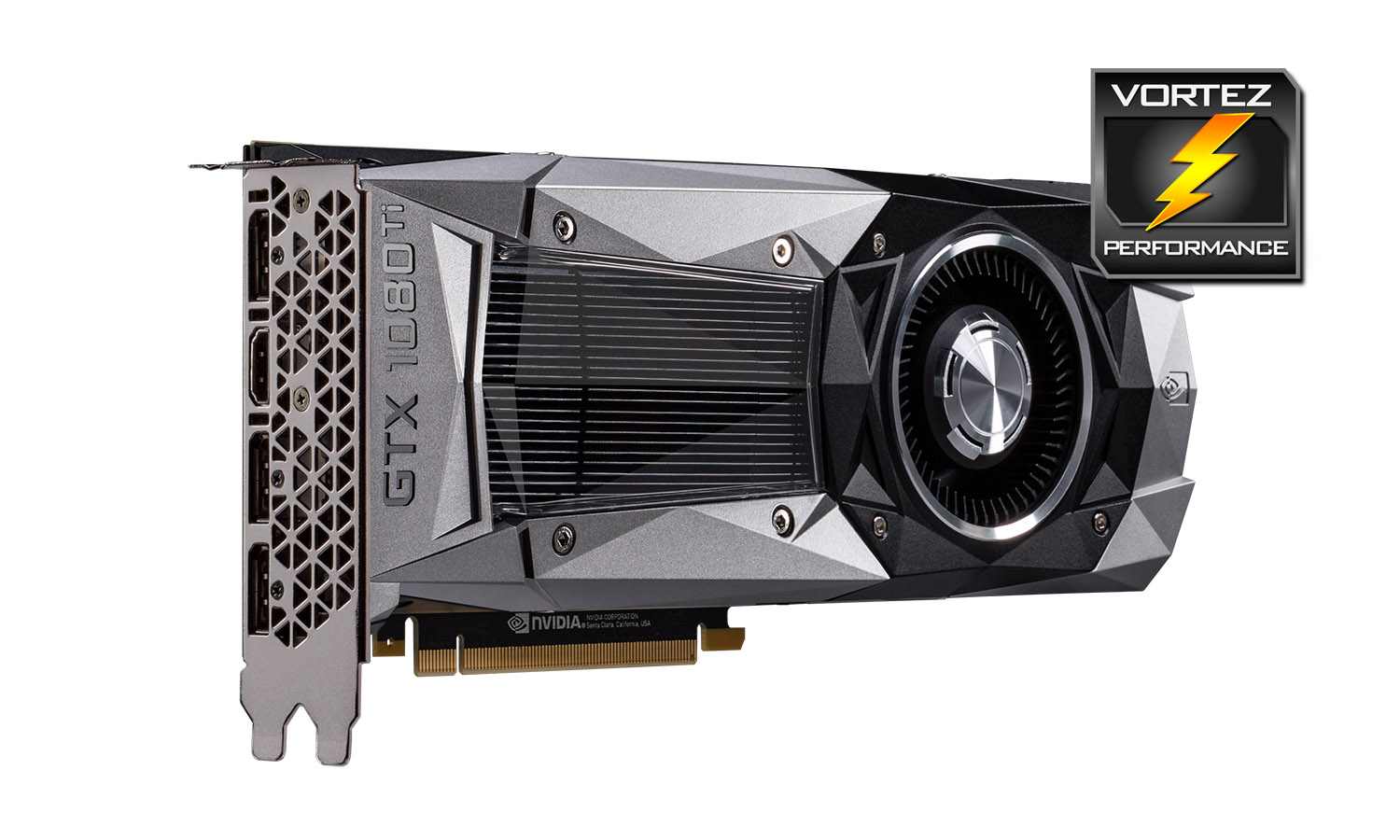
Although NVIDIA has made alterations to the thermal design of their Founders Edition cooler, we still found the solution somewhat inefficient, with the maximum temperature reading hitting 84C. This result was obtained after some 30 minutes had elapsed, throughout longer periods of gaming that figure could likely budge up closer to 90C. But with planned AIB designs just around the corner, we can expect one of the popular thermal designs to shave off a substantial sum of that figure.
Priced at £699 GBP / $699 USD, the GTX 1080 Ti arrives with the same release day price-tag as its sibling the GTX 1080. While the GTX 1080 and other GTX 10-series counter parts have just received a price-drop, this just highlights how much of a good deal the Ti really is.
NVIDIA were correct in naming the GTX 1080 Ti “The Ultimate GeForce”. This new graphics card surpasses all that have gone before it and confidently takes the high-performance GPU crown.
Pros
+ Appealing to the eye
+ Outstanding performance capabilities
+ Includes plenty of video out ports
+ Is ready for 4K/VR
+ Same launch day price as GTX 1080
Cons
– Noisy under load
– Cooler not particularly efficient
+ Appealing to the eye
+ Outstanding performance capabilities
+ Includes plenty of video out ports
+ Is ready for 4K/VR
+ Same launch day price as GTX 1080
Cons
– Noisy under load
– Cooler not particularly efficient
Click here for an explanation of our awards at Vortez.net.