







The OCZ Fatal1ty series expands with the new addition of the 750W PSU. Multi-GPU ready and Bronze Certified.
Product on Review: OCZ 750W Fatal1ty Series PSU
Manufacturer and Sponsor: OCZ
RRP: Approx £100 / $141 / €107
OCZ as well as being a predominant force within the memory market also produce other products one of these product categories being Power Supply Units.
Within the power supply range there is a sub-category named the ‘Fata1lty’ that is endorsed by gaming legend Jonathan ‘Fatalty Wendel. This series is designed specifically for gamers. The idea being that with quality products equipped for hardcore gaming, you will edge closer to gaming stardom. Well, that’s the idea anyway.
OCZ already have a 550W PSU within the Fatal1ty range, earlier in the year this new 750W variant was introduced to support multi-GPU solutions and those having power hungry systems. Today we will be taking a look at this new unit and seeing if its up to powering an aggressive gaming system.

OCZ Take:
Fatal1ty Series high-performance PSUs are co-developed to the high standards of Johnathan “Fatal1ty” Wendel, 12-time World champion to meet the specific needs of fellow gamers. Featuring new “low-profile” flat modular cabling, the Fatal1ty 750W PSU not only provides stable, efficient power, but also unique connectors that allow greater flexibility when organizing an internal case environment. Featuring glowing red LED lights to further personalize and add style to your system, Fatal1ty power supply products are ideal upgrades for users who need a computer setup able to take on hours of non-stop gaming.
Specifications
• 750W Continuous @45C
• Maximum power distribution
• Low-profile flat EZMod modular cabling
• 150 x 160 x 86mm (W x L x H)
• ATX12V v2.2 and EPS12V
• Typical load 85% Efficiency
• 80+ Bronze Certified
• Overvoltage/OverPower/Short-Circuit protection
• Premium Sag &Surge Protection (.98 PFC)
• MTBF: 100,000 hours
• 135mm double ball-bearing fan with red LED lighting
• SLI™ Ready (Dual GPU)
• 5 year warranty backed by OCZ’s exclusive
• PowerSwap Warranty replacement program.
Closer Look
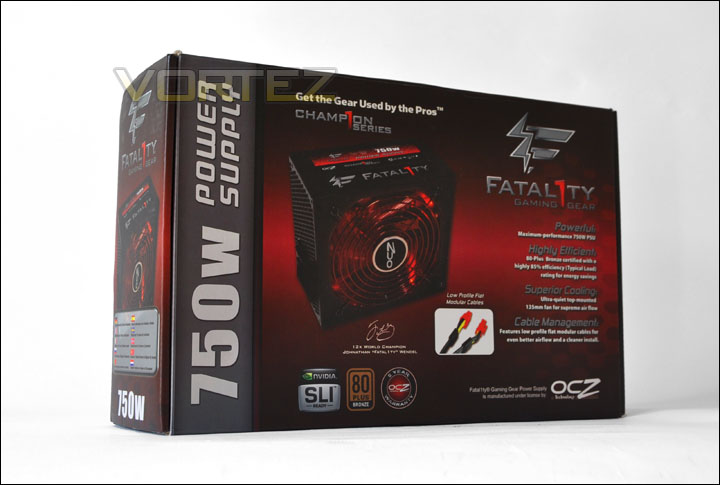
The Fatal1ty 750W unit comes in a traditional ‘Fatal1ty’ styled box. Red being the principal colour. There are various details on the front and rear of the box showing that this unit is SLi ready and comes with an attractive 5 years warranty.
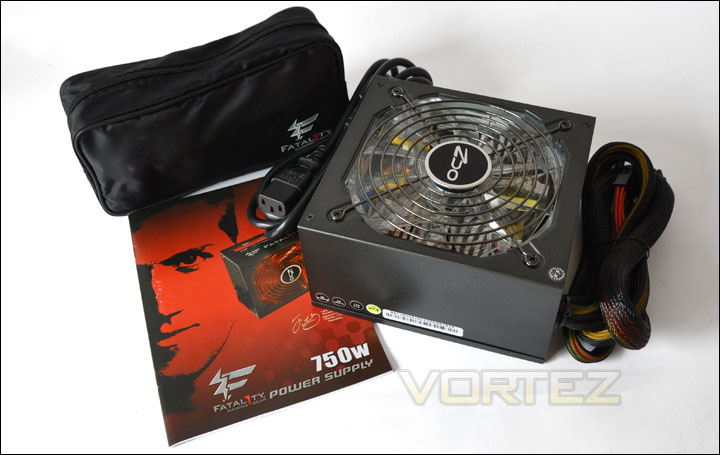
Within the box there is an assortment of extras. Inside there is of course the unit itself, an instructions manual, a small zip-up bag containing modular cables. Aside from this there is only the power cables.
The bundles cables are quite special because they do not conform to the typical nylon netting type covering. All the cables that come with the Fatal1ty 750W incorporate a flat insulating plastic that surely is aimed at optimising the cable management within the case. To me this is a fantastic idea, it keeps cables together and to a low-profile thus making it easy to keep things tidy inside your case.
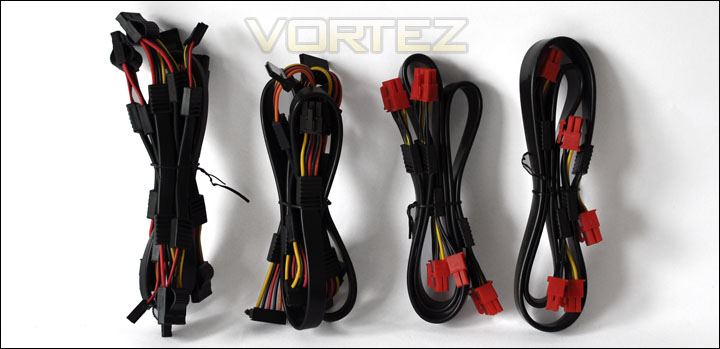
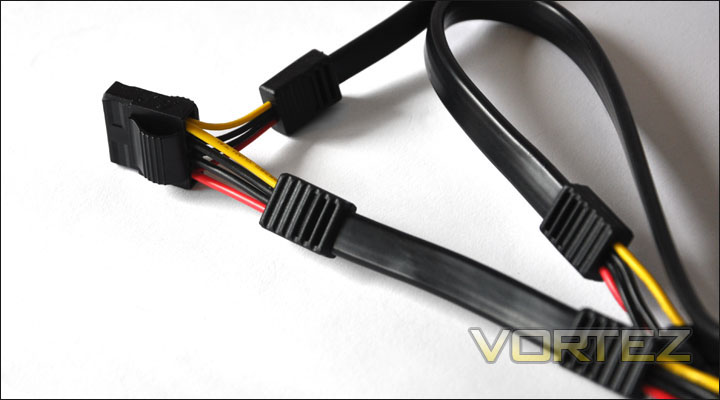
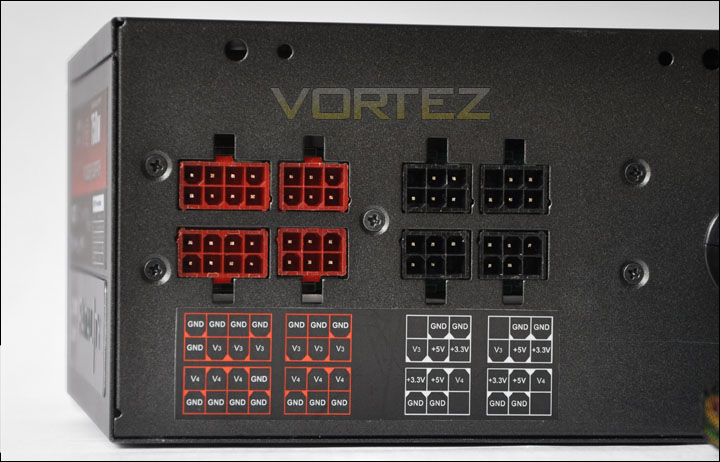
Of the modular cables included, we have 4 x 6+2-pin PCI-E – 6 x Peripheral – 2 x Floppy – 6 x SATA. Hot wired into the PSU we have – 1 x 20/24-pin ATX – 1 x 8-pin CPU – 1 x 4+4-pin CPU. So things have been kept to a minimum with the already wired cables. There is plenty of options to choose from with 8 sockets on the PSU to plug into.
The Fatal1ty 750W certainly looks like an impressive unit. It comes in a deep grey colour on one side there is a metal plate attached featuring a specification table for the rails. Unfortunately though, if you are to mount this at the bottom of your case, this plate will be tucked away facing the motherboard tray and instead you will have a plain grey side facing you.
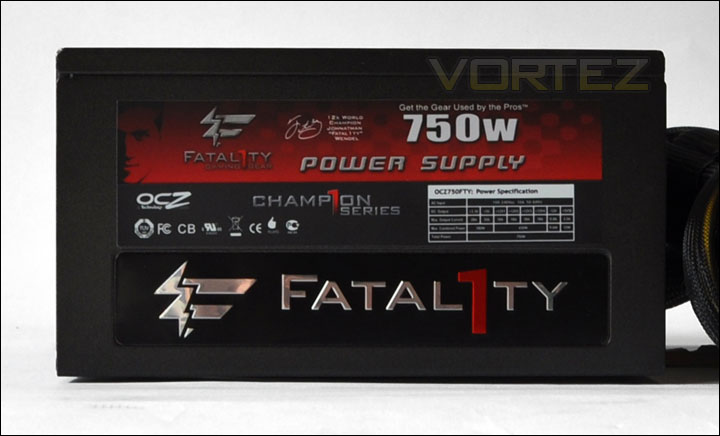
The ratings indicate that the unit provides up to 18A for each of the 4 +12v rails. The 5v rail provides 30A and the 3.3v 28A. More than capable of running multiple graphics cards.
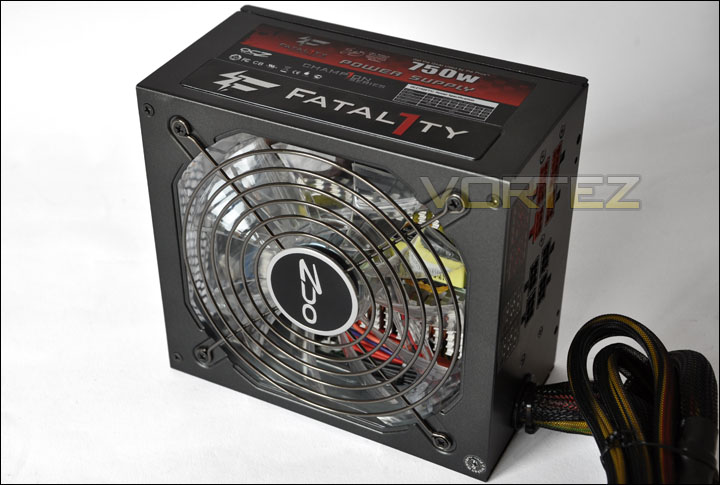
This unit features a 135mm double ball-bearing fan with red LED. Slightly larger than most PSU’s that feature 120mm fans.
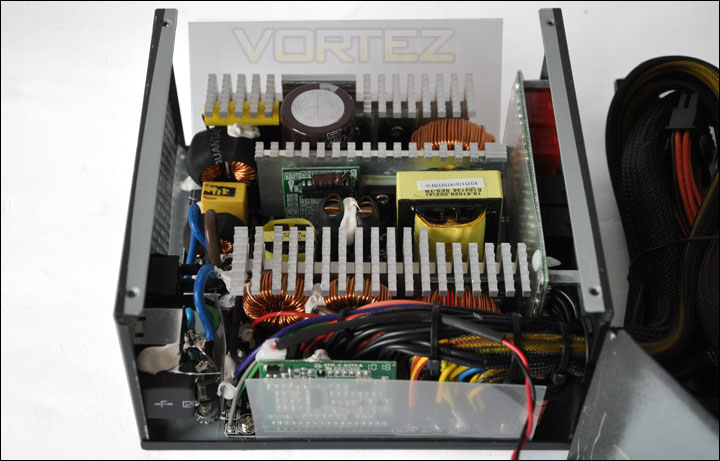
Opening the Fatal1ty 750W unit up, you will notice the insides are quite cramped. The heatsinks are moderate in size. Some units have bigger heatsinks than those found in this particular unit. The cabling does seem quite messy, but they aren’t touching any of the other components or heatsinks. The only other thing worth mentioning is that the key capacitor has a tolerance rating of 100C+ and our unit claims to not exceed 75C at continuous power.
Testing
Our testing methodology for testing Power Supply Units is limited to the multi-meter to show each rails performance due to us not having access to an ATE load tester. We are making plans to invest in equipment as we were directed by Cooler Master when Simon visited their test labs in June 2010.
Although this does constrain us slightly we can still monitor fluctuations on the rails and give the unit a good assessment when we feature it in one of our builds. The way the testing will run is simple, voltages will be observed at idle wattage and then a single GPU will be installed within the system and a combination of OCCT and MSI Kombustor will be executed to provide simulation with just 1 GPU. This will be run for 10 minutes. After this another graphics card will be added to the system giving the setup a dual GPU configuration and again the stress tests will be applied and after 10 minutes voltages monitored. This should give us a good indication of how the Fatal1ty 750W will perform under gaming stresses and beyond. This is a severe load test indeed and a good representation of real-world analysis.
System Components
CPU AMD Phenom II X6 1055T 2.8GHz
Motherboard ASUS M4A89TD PRO (890FX)
Graphics 2 x ATI HD5870
Memory 4GB Mushkin EM3-10666 DDR3
HDD 1 x Samsung Spinpoint 500GB SATA-II
PSU OCZ Fatal1ty 750W
I deliberately configured Crossfire within this test system to give the PSU as much of a draw as it could take. As I mentioned there is no ATE load tester available so generating as much power as possible is key to observing the fluctuations on the rails.
For voltage tolerance levels, ATX specify that a 5% variable fluctuation is acceptable. (Form Factors – ATX Specification PDF – Page 10). So what this means is:
3.3V Rail – 3.135V – 3.465V acceptable
5V Rail – 4.75V – 5.25V acceptable
12V Rail – 11.4V – 12.6V acceptable
Idle test – The system settles in windows without any applications or stressing. 1 GPU (142W)
Single GPU – OCCT/MSI Kombustor run for 10 minutes (330W)
Dual GPU – Crossfire is setup for 2 x HD5870. OCCT/MSI Kombustor run for 10 minutes (537W)
Firstly, its good to see that all the voltages are within the ATX standards for tolerance levels – being within 5%. The 3.3V rail typically used for low powered peripherals did not sustain any significant voltage fluctuation at all. Just 0.03v difference with 2 GPUs loaded plus the system. The 5V rail similarly had very little oscillation. This stayed within 0.04v. The one we really want to pay attention to is the 12V rail. This is the rail that provides the juice for the graphics card and needs to be able to sustain plenty of voltage load not just for one GPU but for two. Although there is a significant difference between the results on the other rails, there is nothing to be concerned with. It’s to be expected, MSI Kombustor is a comprehensive and thorough stress testing tool and puts enormous pressure on the GPU’s. The results are pleasing – just 0.10v difference between idle and using just the 1 GPU and then with 2 GPUs being fully loaded we have 0.12v difference between idle.
These results clearly show that sustained stressing on the PSU causes very little fluctuations and the consumer can rest assured there will be no sporadic performance hits. We have a reliable PSU in the Fatal1ty 750W. During the tests, the fan did obviously ramp up as it was forced to change due to temperatures and stressing. The noise is barely audible coming from the 135mm LED fan, even after a prolonged period.
Conclusion
Remember, the PSU is the backbone of any system. Opting for a cheap brand with little to no standing within the industry may land you in bother. Particularly if the unit happens to blow – taking out all of your precious components. Always invest in quality units – known and reliable brands.
The Fatal1ty range may not suit everyone’s taste with its austere gaming characteristics but from the evaluation, the 750W PSU under review today has been an impressive counter-part to the Jonathan Wendel endorsed product line.
The modular cables that come accompanied for use with the PSU are a very nice touch, unlike traditional cabling there are no nylon nets but instead a low-profile rubber insulation making it even easier to group cables together and get the insides looking tidy.
During the severe MSI Kombustor and OCCT stress tests the unit showed no signs of weakness. In these tests we simulated a real-world gaming scenario where 1 GPU and indeed the system is involved in severe usage, and again with 2 GPUs configured in Crossfire we simulated the environment some gamers may indulge in and in both instances the Fatal1ty 750W was triumphant. The system used in testing achieved 330W overall watts with 1 GPU and 537 watts with 2 GPUs.
For this side of £100 ($141/€107) you will be hard pushed to find a PSU rated at around 750W with the rated specifications the Fatal1ty 750W comes with. Corsair, Antec and Zalman equivalents are generally the other side of £100 in most cases. So I believe this unit is a worthwhile investment.
Pros
+ Reliable performance
+ Very useful modular cables
+ Good price
Cons
– LED lit PSUs aren’t for everyone
+ Reliable performance
+ Very useful modular cables
+ Good price
Cons
– LED lit PSUs aren’t for everyone
Due to performance, price and included features this PSU receives the Gold and Amazing Value award.
We would like to thank OCZ for sending the Fatal1ty 750W PSU. Discuss this review on our forums
