We test performance PSUs from Cooler Master, Antec, Corsair and Enermax, all of which have 80 PLUS efficiency certification.

A few weeks ago an email popped into our inbox from Cooler Master’s European HQ at Venlo in the Netherlands asking if we would like to go and have a look around their facility, and also offering us the use of their very extensively (and expensively!) equipped PSU Test Lab. It was suggested that whilst there we might also like to take a look at their brand new range of PSU’s – the Cooler Master Silent Pro Gold Series which were officially announced only a few days ago on the 1st June!
Power Supplies are difficult things to test. We at Vortez Hardware have done several reviews of PSU’s and have a certain amount of equipment available to us for this very purpose, but to really fully test a PSU needs literally thousands of pounds worth of bench testing equipment – basically a permanent lab set-up dedicated to this one task, and that is something that few review sites can boast. So this opportunity to go and get acquainted with some of the best testing equipment currently available today was heaven sent!
Needless to say we accepted Cooler Master’s offer and I was soon on my way armed with a range of 850W PSU’s from Corsair, Antec and Enermax to pit against the new 800W offering from Cooler Master.
The units we were fortunate enough to be given to test should be pretty familiar to anyone with at least a passing knowledge of performance PC’s…
They are:
1 – Antec CP-850W
2 – Corsair HX850W
3 – Enermax Revolution 85+ 850W
4 – Cooler Master Silent Pro Gold 800W
80 PLUS Certification
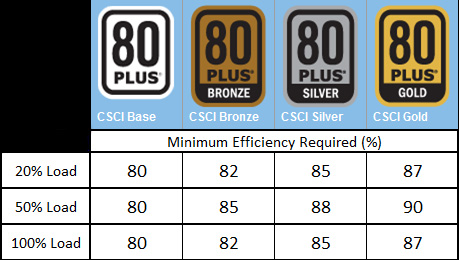
All of the above units have passed the ’80 PLUS’ certification which is a measure of their efficiency at 20%, 50% and 100% of their rated loads. There are four different levels of 80 PLUS certification available – Standard, Bronze, Silver, and Gold.
In basic terms to achieve an 80 PLUS certificate a PSU must show an efficiency of greater than a given amount when tested with an input voltage of 115V 60Hz, and the efficiency must be measured at loads of 20, 50 and 100%.
The following table gives the minimum percentages the efficiencies must reach for each level of certification:
For more detailed information on the 80 PLUS program and the different levels of certification please visit their website www.80plus.org where you can find listings of all PSU’s which have achieved certification along with a wealth of other information regarding power-efficient computing.
Cooler Master's Test Lab – A Brief History

A little about Cooler Master:
OUR MISSION
Cooler Master was founded with the mission of providing the industry’s best thermal solutions. Since its establishment a decade ago, the company has remained faithful to this mission, emerging as a world leader in products and services for companies dealing with devices where heat issues must be resolved.
In pursuing this mission, Cooler Master is absolutely committed to delivering solutions that precisely meet customer requirements for features, performance, and quality. Moreover, we strive to be a reliable long-term partner for our customers that they can truly depend on. It aims to be the first and foremost name that comes to mind for companies around the world seeking thermal solutions, and seeks to build such a reputation through outstanding technology, sophisticated design, and superior service.
OUR BUSINESS PHILOSOPHY
INNOVATION, SPEED & CUSTOMER SATISFACTION
The three cornerstones of Cooler Master’s business philosophy are innovation, speed, and customer satisfaction. It has been Cooler Master’s steadfast commitment to these values and ability to fulfill its promise to honor them that accounts for its sustained record of growth and the many long-term customers it has accumulated. Together, innovation, speed, and customer satisfaction ensure that Cooler Master is the supplier that the companies around the world rely on to deliver the best thermal solutions, creating a win-win situation both for Cooler Master and the companies that become its customers.
Cooler Master was founded with the mission of providing the industry’s best thermal solutions. Since its establishment a decade ago, the company has remained faithful to this mission, emerging as a world leader in products and services for companies dealing with devices where heat issues must be resolved.
In pursuing this mission, Cooler Master is absolutely committed to delivering solutions that precisely meet customer requirements for features, performance, and quality. Moreover, we strive to be a reliable long-term partner for our customers that they can truly depend on. It aims to be the first and foremost name that comes to mind for companies around the world seeking thermal solutions, and seeks to build such a reputation through outstanding technology, sophisticated design, and superior service.
OUR BUSINESS PHILOSOPHY
INNOVATION, SPEED & CUSTOMER SATISFACTION
The three cornerstones of Cooler Master’s business philosophy are innovation, speed, and customer satisfaction. It has been Cooler Master’s steadfast commitment to these values and ability to fulfill its promise to honor them that accounts for its sustained record of growth and the many long-term customers it has accumulated. Together, innovation, speed, and customer satisfaction ensure that Cooler Master is the supplier that the companies around the world rely on to deliver the best thermal solutions, creating a win-win situation both for Cooler Master and the companies that become its customers.
In 2008 Cooler Master decided to expand their diagnostics capabilities by building a PSU Test Lab at their European HQ. It was to be a busy few months!
• In June – they visited Chroma ATE Inc in Taiwan, a leading manufacturer of ATE (Automatic Testing Equipment) as required for providing the test loads for PSU’s.
• In August Yokogawa and Tektronix were invited to showcase various Probes and Oscilloscopes, and by the end of the month Cooler Master had completed all orders for the testing equipment.
• In September the bulk of the equipment was delivered to the new lab at Venlo in the South-East of the Netherlands near to the German border.
• During October all of the test equipment was installed and the new Test Lab was ready to go.
The exact price of all this kit wasn’t disclosed, but a figure in the region of €45,000 was mentioned!
So, what equipment do you need for an enterprise like this and what do you get for your money? Next page to find out!
Cooler Master's Test Lab – The Equipment
Here you can see a general view of the main test suite of equipment – note the extraordinarily tidy cabling – you cannot afford to have tangles and mess in an environment like this!
The first thing you need when testing a PSU is to have a guaranteed (and highly adjustable) supply voltage source, and for this purpose Cooler Master selected the Chroma AC Source 6530 unit. It can be programmed to have a power output anywhere between 0 and 300 Volts. The AC frequency can also be adjusted as can the phase shift, plus you have the option to choose from 30 pre-programmed waveforms (or if that’s not enough you can always program your own!)
To measure and check the input to the PSU a Yokogawa WT210 high precision power meter is responsible for determining power usage, current, voltage, frequency, and power factor (amongst other measures) with an accuracy of up to 0.1%
Next we have the DC load equipment. Cooler Master have furnished their test lab with 3 Chroma 6330 series programmable DC load units of 2 different types – 63303 and 63306, where the last number denotes the maximum power each can load. The 63303 as in the picture above can load up to 300W and is used here to load the 3.3V, 5V, -12V, and 5Vsb rails. The two 63306 units can each load up to 600W and are used for the main 12V rails. Each load unit also has a short circuit button which simulates a short in the load for ease of testing that particular feature.
Keeping tabs on all of this we have a Tektronix DPO3034 – a 300MHz 4-channel digital phosphor oscilloscope which can be used to record all manner of data from the DUT (Device Under Test). The scope has a ‘plug-and-play’ computer interface, and front and rear USB ports for connecting mass storage devices as well as a LAN port. Used in conjunction with this scope is a Tektronix TCP150 current probe which is used to monitor the overall current drawn by the DUT.
Providing the link between the DC Load units and the DUT we have a Chroma Test Fixture. This is basically a large circuit board with on one side a bank of connectors for the cabling from the DC Load units, and then spread over the board are the various connectors for the DUT’s cabling to plug into. There are also measurement points for the various meters and scopes, and also a master On/Off switch for the DUT.
To check the voltage provided by the DUT a Fluke 8845A high precision meter is connected to the Chroma Test Fixture measuring points. This unit has a range of options such as wave and frequency analysis but is mostly used as a very accurate check of the voltage supplied by the DUT on any of it’s outputs, depending on which of the measuring points are selected.
Completing the test equipment suite is a Center 301 K-type 2 channel thermometer. This is used to continually monitor intake and exhaust temperatures of the DUT and is connected to a PC giving a real time graph of the readings.
Now, read on for a look at each of the PSU’s in today’s group test…
Antec CP-850W – Overview
Manufacturer and Sponsor: AntecProduct on Review: Antec CP-850W
Street Price: £94.79

A little about Antec:
| Antec, Inc., is the leading global brand of high-performance computer components and accessories for the gaming, PC upgrade and Do-It-Yourself (DIY) markets. Founded in 1986, Antec is recognized as a pioneer in these industries and has maintained its position as a worldwide market leader and international provider of efficient, quiet, and reliable products. Antec has also achieved great success in the distribution channel, meeting the demands of quality-conscious system builders, VARs and integrators. |
And what Antec have to say about the CP-850W:
| The CP-850 features a unique design with an advanced cooling system, exclusively compatible with some of Antec’s most cutting-edge Gamer and Performance One enclosures, including the Twelve Hundred, P183 and P193. By breaking the mold of standardised power supply size restrictions, the CP-850 design is able to provide an excellent price-to-performance ratio. A silent rear 120mm PWM fan and dual PCB layout also ensure optimal cooling performance and reliability. |
Packaging
The box front is clear and uncluttered with a decent picture of the power supply which immediately shows you that this supply is a little different to most with that 120mm fan bolted to the outside of the casing rather than incorporated internally as most are. Antec also proudly display the 80 PLUS certification badge on the front of their packaging.
The rear of the box has some technical specifications and features in 3 languages and also a further and more detailed explanation of the 80 PLUS certification – something they rightly consider to be of considerable merit. The sides of the box have additional information regarding the power output of the unit, and also a compatibility list of cases into which this PSU is specifically designed to fit, as per their quote about the CP-850 above. This design must surely limit their market for this PSU, but Antec do also have plenty of other PSU’s which conform to standard size restrictions for those without an Antec case on the compatibility list.
Antec CP-850W – A Closer Look
The power supply itself was well protected inside the box, packed in a plastic bag to prevent any scratches and then surrounded by high density foam sheets. The additional modular cables and mains power lead are seperately wrapped in their own plastic bags along with a bag of four screws for mounting the PSU and a brief instruction sheet. You can see that despite having some modular cabling there is still a very large bundle of cables directly attached to the PSU with some of each type of connectors so it is entirely possible that you may not even need to use the seperate modular ones. Some may like this but personally I prefer the ability to only use whatever cables I actually need so as to minimise clutter inside the case and keep airlfow as clean as possible.
With the Antec CP-850W you get a standard 3-pin mains cable and a selection of modular cables as follows: 2 cables each with a single PCI-E 6-pin connector, 2 cables each with 3 molex power connectors, and 2 cables each with 3 SATA power connectors. Of the 4 SATA and Molex power cables only 2 can be used at any one time, but there are additional molex connectors available in the directly attached cabling.
All the cabling, whether directly attached or modular is protected by black cable braiding, except for about an inch or so either side of every connector plug – which makes for a bit more flexibility when actually plugging something in! The braiding and heatshrink are well done, but they don’t completely mask out the underlying cables.
Here you can see the 7-bladed 120mm PWM fan which Antec have bolted to the outside of the casing at what is the front of the PSU when inside your case, and next to that the 4 modular connectors on the main unit – the two red connectors being for the PCI-E and the black ones for the SATA/Molex power cabling.
At the back of the unit you can see that apart from the standard power socket and switch the whole of the backside of the unit is given over to a mesh finish to aid in the direct airflow path going straight through the device as driven by that 120mm fan on the front. This looks like it should provide some pretty decent cooling, but remember that it will be pulling warm air from inside your case through the unit rather than cool air from outside (as a lot of bottom mounted units do these days).
Antec CP-850W – Features and Specifications
• Unique power supply construction compatible with many new Antec cases
• NVIDIA SLI-ready certified
• Advanced hybrid cable management inproves airflow and reduces clutter
• Meets 80 PLUS certification standards
• Electrical compliance with ATX12V version 2.3 and EPS version 2.91
• Dual PCB layout optimises cooling efficiency and allows for heavy duty components
• Quiet 120mm PWM cooling fan
• Four +12V output circuits
• Industrial grade protection: OVP (Over Voltage Protection), SCP (Short Circuit Protection), and OCP (Over Current Protection)
• Universal Input with Active PFC
• Two 8-pin (6+2) PCI-E connectors and two 6-pin PCI-E connectors
• SATA connectors for Serial ATA drive
• MTBF: 100,000 hours
• Saftey approval: UL, FCC, TÜV, CE, C-tick, CCC, CB
You can see that this unit has four +12V rails with a maximum combined load of 768Watts.
• Maximum load for the +3.3V, +5V rails is 160W
• Maximum combined load for +3.3V, +5V, +12V1, +12V2, +12V3, and +12V4 is 827W
The directly attached cabling comprises the following:
• 24-pin (20+4) main connector
• 4-pin ATX 12V
• 8-pin EPS 12V
• 2 x 8-pin (6+2) PCI-E
• 3 x Molex and 1 x floppy
• 3 x SATA
Antec provide a 5 Year Warranty on this unit.
Corsair HX850W – Overview
Manufacturer and Sponsor: CorsairProduct on Review: Corsair HX850W
Street Price: £149.39

A little about Corsair:
| Products to Meet the Demands of Performance Computing Corsair has been a leader in the design and manufacture of high-speed modules since 1994. Our focus has always been on supporting the special demands of mission-critical servers and high-end workstations, as well as the performance demands of extreme gamers. While maintaining this core focus, in recent years, we’ve also brought our expertise, technology leadership and legendary quality and reliability to memory and other technology products for the more mainstream consumer. |
And what Corsair have to say about the HX850W:
| The Corsair Professional Series HX850W PSU utilizes advanced DC-to-DC circuitry and meets 80 PLUS SILVER certification standards for up to 90% energy-efficiency*, reducing wasted energy and lowering the amount of excess heat generated. Corsair Professional Series power supplies are built using industrial grade electrical components, ensuring the stable, clean and reliable voltages that are essential for high-end gaming PCs and workstations. * Tested at room temperature, using a 50% load and 230V AC input |
Packaging
Corsair’s HX850W is packaged in a very attarctively designed box which leaves you in no doubt that this is a modular design power supply showing as it does the detail of the connectors. There are also logo’s indicating that this unit is NVIDIA SLI-ready certified, has 80 PLUS SILVER certified, and finally that it carries a 7 Year Warranty (that’s confidence for you)!
The back of the box gives some detailed information regarding the unit’s features, specifications and also a couple of very basic graphs of noise and efficiency performance. The box top and bottom have some additional information on the modular cabling and other features.
Corsair HX850W – A Closer Look
Corsair have packaged the HX850W inside a velvet draw-string bag for scratch protection. There is a seperate nylon bag containing the modular cabling and you also get a standard 3-pin mains power lead, a basic User’s Manual, and a bag of screws which includes several cable ties and a case badge. The nylon bag is a nice touch and is velcro-fastened allowing you to keep your unused modular cables safe and sound. The whole lot was very securely packed into the box in some very solid feeling foam to keep it all safe from any knocks in transit.
With the Corsair HX850W you get only a very few directly attached cables as the bulk of the cabling is modular. The modular cables are not braided, but rather are of a ‘flat’ design which probably makes for cleaner airflow and they are certainly far more flexible than some of the braided cable sets this reviewer has seen! All in all they are a pleasure to handle and hence it’s very easy to keep your case cabling clean and tidy with these.
Corsair have stuck to the standard specifications for size with the HX850W, but have somehow managed to squeeze a massive 140mm 7-bladed fan in there! Being larger means of course that they can run it more slowly than a smaller fan for the same given airflow, so it should be quieter.
Here you can see the front of the unit showing the modular cable connectors and the captive cable bundle which is braided in black sleeving as is pretty standard these days. The modular connections seen here can be used for pretty much any combination of additional PCI-E cables and of course for SATA/Molex power cables.
The rear of the PSU is finished in mesh to allow for exhaust airflow, and has the standard power socket and switch.
Corsair HX850W – Features and Specifications
• Guaranteed to sustain it’s full rated wattage at an ambient temperature of 50°C
• Up to 90% energy-efficiency under real-world load conditions
• Single +12V rail design providing up to 70A
• Multi-GPU ready
• 105°C solid state capacitors
• Active Power Factor Correction (PFC) with PF value of 0.99
• Supports ATX12V 2.3 and EPS12V 2.91 standards. Backwards compatible with ATX12V 2.01
• Auto switching circuitry for universal AC input from 90-264V
• Over Current/Voltage/Power Protection, Under Voltage Protection and Short Circuit Protection provide complete component safety
• Dimensions: 150mm(W) x 86mm(H) x 180mm(L)
• MTBF: 100,000 hours
• Safety Approvals: UL, CUL, CE, CB, FCC Class B, TÜV, CCC, C-tick
This unit sports a single +12V rail, allowing for up to a massive 70A or 840W maximum load!
• Maximum load for the +3.3V, +5V rails is 150W
The directly attached cabling comprises the following:
• 24-pin (20+4) connector
• 8-pin EPS/12V connector
• dual 8-pin (6+2) PCI-E connectors
Corsair provide a 7 Year Warranty on this unit.
Enermax Revolution 85+ 850W – Overview
Manufacturer and Sponsor: EnermaxProduct on Review: Enermax Revolution 85+ 850
Street Price: £173.20
A little about Enermax:
| Enermax Technology Corporation was founded in Taiwan in 1990 and today is one of the leading manufacturers of PC components (power supplies, PC cases, cooling fans, keyboards, HDD enclosures and other peripherals). Since 2000 the head quarter is located in Taoyuan, Taiwan. Six subsidiaries and numerous affiliates around the world provide an excellent network for ODM/OEM and retail business. Enermax has subsidiaries in Germany, France, Italy, USA, Japan and China. Worldwide, over 600 employees work for Enermax. Since 2004, the Enermax Technology Corporation is listed at the Taiwanese stock exchange. Enermax was not only the first PSU manufacturer which broke the barrier of 1kW but also forces the development of energy efficient technologies and solutions. All PSU series of current product range possess international energy saving certificate 80PLUS®. At the beginning of the year 2010, Enermax launched the 80PLUS® Gold certified Modu87+ and Pro87+ PSU series. They reach up to fabulous 93 per cent at 230V and set new standards in the popular 500 to 800W wattage range. Furthermore Enermax supports international Climate Savers Computing Initiative, a non-profit organisation of consumers, businesses and conservation groups. Its goal is to improve computers’ efficiency and energy consumption especially in standby mode. |
Packaging
Enermax have opted not to put a picture of their product on the front of their packaging, rather to simply emblazon the ‘Revolution 85+‘ name across the front along with a slew of awards and certification labels. We have at top left a variety of prestigious design awards that they have won from 2009 and 2010. To the bottom right we have the NVIDIA SLI-ready certification logo and the 80 PLUS SILVER certificate – first proof of this unit’s efficiency.
The rear of the box has information on what Enermax consider to be 8 of the most salient features in a total of 10 languages! (more about these in the Features and Specifications page later). You do also get a small picture of the power supply itself showing a very stylish and robust looking unit.
The sides of the box give a lot of additional information about such things as the power and load specifications, number and type of modular cables provided, and further info on the 80 PLUS SILVER certification which this unit has.
Enermax Revolution 85+ 850W – A Closer Look
The Enermax Revolution 85+ 850W comes in a plastic bag inside it’s own smaller cardboard box within the main packaging, providing plenty of scratch resistance – although to be honest once you’ve seen the rugged finish of this unit it’s hard to imagine how this could get scratched! In the same inner box as the power supply you also get a User’s Manual, Product Brochure, 3-pin mains lead and strain relief clip, a nylon wallet for storing the unused modular cables, mounting screws, oh and a free 120mm Apollish Fan worth around £18.02! Not a bad haul, but then this is the most expensive PSU on test here today, and by quite a way too, so you’d expect some decent accessories!
The modular cables also come in their own little box within the main packaging, and here you can see that they are all neatly braided in Enermax’s trademark black and yellow sleeving. I do think that they perhaps leave a little too much of the cabling un-sleeved though which slightly spoils the otherwise exceptional finish. They also include several velcro cable-ties to give you even more cable management-ability. The PCI-E cabling (seen at the left of the picture above) is extremely thick and hence it’s pretty stiff so could pose a slight issue with routing around any tight corners.
Enermax have opted to go for a 13.5cm fan here with a 9-bladed design. I’m sure this will be pretty quiet too as Enermax have an enviable reputation for the quality and silence of their fan designs.
You can see from this image the massive size of the captive cable bundle. As per the modular cables it too is nicely sleeved but again I am forced to wonder how much flexibilty is sacrificed for this? The modular connectors can be seen to the front of the unit, the dark red ones being for the additional PCI-E cabling, and next to them a row of black ones for all other cables.
At the back of the unit we again have a standard power socket and switch, but we also get a status led here which has 4 modes: Green = ON, Amber = Standby, Off = OFF, and Red = Failure detected.
Enermax Revolution 85+ 850W – Features and Specifications
| 80 PLUS SILVER World leading modular PSU series with 87-91% efficiency @ 20-100% load Fit4Future CPU Ready for most upcoming CPU generations by 12-pin sockets for possible connector changes, by complying to latest EPS12V PSU design guides for compatibility & by ZERO LOAD Design for C6 state functions Fit4Future GPU Ready for most upcoming GPU generations by 12-pin sockets for possible connector changes, by six massive 12V rails for perfect load distribution & by ZERO LOAD Design for Hybrid Mode functions DXXI ready Full support of most current DX11 graphics cards due to minimum two 6+2-pin (8-pin) PCI-E connectors AHD² Topology Industry-leading “Asymmetric Hybrid DC-to-DC” topology with the world’s highest efficiency & most stable performance Non-Stop @ 50°C Non-Stop industrial class performance at 50°C/122°F ambient 99% 12V Power Leading EPS12V PSU with 99% 12V output capability Fit4Server SSI PSDG 2009 support for latest Intel™ Core™ Extreme/i7, Xeon™ and AMD™ Opteron™ and SLI™ or CrossFireX™ and AMD GAME! or AMD GAME! Ultra systems and downward compatible with SSI PSDG 2008 1.0, EPS12V 2.92, 2.91, 2.8 HeatGuard Keeping PSU fan running for 30-60 seconds after shut down to dissipate the remaining system heat and prolonging system lifetime PowerGuard PSU status monitor with 4-mode LED (Off / Stand-by / OK / Fail) SafeGuard Industry-leading octuple protection circuitry (OCP, OVP, AC UVP, DC UVP, OPP, OTP, SCP, SIP) AirGuard Patented air-inlet with optimal aero-dynamical design reducing noisy air turbulences UltraSilent Ultra-quiet 13.5cm fan with intelligent RPM control guarantees cool performance and silent operation CordGuard Fixing the AC cord tightly to avoid accidental shutdowns of your PC (from SN 9CAAXXXXXX upwards) EMC & Safety Full-scale electromagnetic filtering protects your system against radiation interferences (CE EMC EN61204 compliance) Worldwide compatible 100V – 240V AC input with automatic adjustment and active Power Factor Correction for global usage (1250W only for 220 ~ 240V) EuP/ErP (Lot 3) ready! Support computer system to meet EuP/ErP (Lot 3) standard ENERGY STAR 5.0 ready! Support computer system to meet ENERGY STAR 5.0 standard Compact Size Dimensions (W x H x D): 150mm x 86mm x 190mm Warranty 5 years manufacturer warranty |
Look at that! Six 12V rails, each capable of 30A and a total of 70A across them all giving a maximum load of 840W!
• Maximum load for the +3.3V, +5V rails is 160W
The directly attached cabling comprises the following:
• 24-pin (20+4) connector
• 8-pin (4+4) EPS/12V connector
• dual 8-pin (6+2) PCI-E connectors
• 3-pin fan rpm cable
Enermax provide a 5 Year Warranty on this unit.
Cooler Master Silent Pro Gold 800W – Overview
Manufacturer and Sponsor: Cooler MasterProduct on Review: Cooler Master Silent Pro Gold 800W
MSRP: £114.52 ex vat
Availability: JULY 2010
Cooler Master have only just introduced the Silent Pro Gold series of PSU’s – their first to achieve the 80 PLUS GOLD certification across the entire range, meaning that they give better than 87% efficiency at 20% and 100% load and better than 90% efficiency at 50% load. An impressive set of credentials, but how will this new range fare in testing against some of the more established brands?
Here’s what Cooler Master have to say about their latest range of PSU’s:
Silence is Golden
High-end computers are getting more and more demanding when it comes to power requirements and these days it’s not good enough to have any old power supply if you’re a demanding gamer or overclocker. The latest top of the range graphics cards from both ATI and Nvidia are demanding more power than ever before and the latest flagship motherboards are equally demanding once you start pushing the limits of your system by overclocking it. The new Silent Pro Gold series from Cooler Master addresses all of these problems while maintaining – or even exceeding – an extraordinary 90 percent power efficiency under load at 220V, which gains it an 80 Plus Gold certification.
Innovative and Patented Technologies
The Silent Pro Gold series features an entirely new design with several innovative and patented technologies. Cooler Master has created HTT™ (Heat Transfer Technology), a unique “L-shaped” heat-sink designed to vastly improve the airflow inside the power supply, resulting in lower operating temperatures. Another unique feature to the Silent Pro Gold series is the Hybrid Transformer™ which mounts the transformer directly to the heatsink. This makes for a more compact transformer and improves the power efficiency at the same time.
Yet another feature that helps improve the power efficiency is Hyper Path™ which is a “hyper link” between the transformer and the various power conversion components. The “hyper link” results in almost a loss-less transfer of energy which has never been done before. Combine all three of these features and you got one of the most quiet and power efficient power supplies in its category. The entire range offers a power efficiency that exceeds 90 percent at 220V, starting from a load of about 50 percent (model dependant), with some models never dropping below 90 percent. During normal use (up to about 50 percent load), neither model exceeds 21 dBA of fan noise thanks to the low RPM fan design combined with the new heat-sink design.
High-end computers are getting more and more demanding when it comes to power requirements and these days it’s not good enough to have any old power supply if you’re a demanding gamer or overclocker. The latest top of the range graphics cards from both ATI and Nvidia are demanding more power than ever before and the latest flagship motherboards are equally demanding once you start pushing the limits of your system by overclocking it. The new Silent Pro Gold series from Cooler Master addresses all of these problems while maintaining – or even exceeding – an extraordinary 90 percent power efficiency under load at 220V, which gains it an 80 Plus Gold certification.
Innovative and Patented Technologies
The Silent Pro Gold series features an entirely new design with several innovative and patented technologies. Cooler Master has created HTT™ (Heat Transfer Technology), a unique “L-shaped” heat-sink designed to vastly improve the airflow inside the power supply, resulting in lower operating temperatures. Another unique feature to the Silent Pro Gold series is the Hybrid Transformer™ which mounts the transformer directly to the heatsink. This makes for a more compact transformer and improves the power efficiency at the same time.
Yet another feature that helps improve the power efficiency is Hyper Path™ which is a “hyper link” between the transformer and the various power conversion components. The “hyper link” results in almost a loss-less transfer of energy which has never been done before. Combine all three of these features and you got one of the most quiet and power efficient power supplies in its category. The entire range offers a power efficiency that exceeds 90 percent at 220V, starting from a load of about 50 percent (model dependant), with some models never dropping below 90 percent. During normal use (up to about 50 percent load), neither model exceeds 21 dBA of fan noise thanks to the low RPM fan design combined with the new heat-sink design.
Packaging
Cooler Master Silent Pro Gold 800W – Box Front
Wow! What is it that makes me think that Cooler Master are very pleased with their 80 PLUS GOLD certification?! I’ve got to say though that I reckon they’ve got this box just right, with no clutter to detract from what is a beautifully clean and simple layout.
Cooler Master Silent Pro Gold 800W – Box Rear
The rear of the box has the Specifications, some of the Patented Technology features, and a couple of graphs showing the noise and efficiency curves for different loadings.
The sides of the box are pretty standard with additional information regarding the modular cabling system, and the power output table.
Cooler Master Silent Pro Gold 800W – A Closer Look
Cooler Master stick to the standard trend here of securely packaging their PSU’s inside a plastic bag and then in a ‘nest’ of high-density foam for ultimate protection. The modular cables are contained within the smaller gold coloured box at the right hand end of the picture above, as is the 3-pin mains lead and mounting screws etc.
The gold theme continues here… and why not! You can see too the modular connectors – for the additional PCI-E cabling to the left side and the vertical sockets for the additional power cabling. Unfortunately I do not have any pictures of the included modular cabling, but they are of the ‘flat’ type the same as the Corsair HX850W we looked at a few pages ago which is a great thing and far better in my opinion than the traditional braided cables.
From underneath you can see that Cooler Master have gone with a 120mm 7-bladed fan design for this series of PSU’s and they have even continued their golden theme to the fan cover grille! This much attention to detail on the exterior bodes well for the quality of the build and components used and hence for it’s performance.
It’s quite a small looking package compared to one or two of the others we’ll be testing today, but I like the overall look that Cooler Master have achieved here – it’s sleek and smart with just the right amount of highlighting to not be over-the-top. Even the plain white lettering on the side seems to me to be bang on. The only slight blemish on the review sample we were using was that the metal logo on the centre of the fan grille wasn’t quite fitted correctly and had lifted along one side – not a major drama on what is a purely cosmetic item!
Cooler Master Silent Pro Gold 800W – Features and Specifications
• Heat Transfer Technology™: A unique “L-shaped” heat-sink to remove heat from the PSU
• Hybrid Transformer™: Unique design that combines heat-sink with transformer
• Hyper Path™: Places IC close to transformers leading to huge efficiency ratings
• Flat modularized cables provide easy cable management leads to better airflow
• Compliance with the latest Intel standard ATX 12V V2.3
• Operation with intelligent fan speed control
• High reliability (MTBF > 100,000 hours)
• Double layer EMI filter retrains noise and to avoid affect to users
• Integrating Active PFC with PWN combo controller while increase efficiency
• Multiple protection design (OVP/UVP/OPP/OTP/SCP/OCP)
• Japanese made capacitors
• Single +12V rail up to 65A
• Five year warranty
A single +12V rail capable of providing up to a maximum load of 780W
• Maximum load for the +3.3V, +5V rails is 150W
The directly attached cabling comprises the following:
• 24-pin (20+4) connector
• 8-pin (4+4) EPS/12V connector
• 8-pin (6+2) & 6-pin PCI-E connectors (on a single cable)
The additional modular cabling provides the following connectors:
• 2 x 8-pin (6+2) & 6-pin PCI-E connectors (on a single cable)
• 1 x 2 Molex and 1 Floppy power connector (on a single cable)
• 1 x 2 Molex connector
• 3 x 3 SATA connector cables
Cooler Master provide a 5 Year Warranty on this unit.
Testing Methodology
For each PSU we will perform a number of tests as follows:
• Efficiency & Stability
• Standby Power draw
• Temperature
• Inrush Current
• Hold-Up Time
• Short Circuit Protection
• Overload Protection
Efficiency & Stability
This is the main testing carried out here today. Testing is done in accordance with the 80 PLUS certification standards which require that the Device Under Test (DUT) is loaded at 115v 60Hz AC and to loads of 20, 50, and 100% of rated capacity. Accurate measurements of Power Input (W) and Power Output (W) are recorded using the relevant equipment as already discussed and efficiency is determined by simply dividing Output by Input and expressing the result as a percentage.
We also decided to do additional tests at 2 further fixed loads to give results for what can be considered to be more realistic ‘real-world’ usages. Most PC’s spend the vast majority of their time at idle or thereabouts and this is typically around 10% of the PSU’s rated load, so in our case we will be testing at 85W. When not at idle or under heavy gaming load a typical modern performance PC will draw around 300W so we will also be testing at this set load.
When performing these tests we have to take into account what is called ‘cross-loading’ of the various output rails. That is that the maximum power load as specified for an individual set of rails may not be achievable in conjunction with the maximum specified for another set – you often find that although the +3.3V and +5V are rated to provide up to say 160W, that in reality you cannot run the unit at that load if you wish to draw the full load off the 12V rails.
The 80 PLUS standard, as already stated, requires that we test at 115v 60Hz, but obviously in the UK market we use 230V 50Hz so we will also carry out a second set of efficiency tests at that AC input voltage to give a better picture of real-world usage there too.
In carrying out these tests we will be recording all the currents and voltages on each output of the DUT at each loading level so we will be able to get an idea of the stability of the voltage supplied by the unit and will highlight any which are outside defined tolerances. Section 4.1.4 of the ATX Specification for PC’s dictates the permissable tolerances for each of the PSU’s output voltages as per the following table:
Standby Power draw
An important but often overlooked measurement is the standby power draw. We will measure this by simply seeing what power input is still drawn by the PSU when connected to the load but in standby mode, so only the +5VSB rail is active. In these more environmentally aware times it is important for manufacturers to not only build highly efficient power supplies, but also ones which waste as little energy in standby as is possible.
Temperature
All our testing will be carried out at room temperature as we do not have a ‘hot-box’ to simulate a higher temperature environment. We will measure the intake and exhaust temperatures of the airflow going through the DUT throughout the load testing and will record the maximum difference between the two measurements – called the ‘delta T’.
Inrush Current
Inrush current is a measure of the surge of current which passes through the PSU’s components when it is first switched on. It is seldom read about but is a very important consideration, especially in the hugely powerful PSU’s available these days. It is not that long ago that PSU’s broke through the kW level and I am led to understand that some of the first units suffered issues with the switches melting due to the huge currents that would pass when they were switched on! These days things are far better controlled but we will measure and record these numbers for you using the screenshot facility of the oscilloscope.
Hold-Up Time
Another measure which isn’t frequently mentioned when looking at power supply testing is Hold-Up time. This is a measure of the amount of time in milliseconds that a power supply’s output remains within the specified voltage ranges after it’s input ceases. For a computer PSU’s 12V outputs this is defined as being at least 16ms before the output drops below 80% of it’s nominal level – in other words after power is lost how much time before the 12V output drops below 9.6V – again something we will measure with the screenshot facility of the oscilloscope. Hold-Up time is purely dependant on the capacitance of the DUT, and is important to ensure that any variations or momentary interruptions in the supply voltage can be accomodated.
Short Circuit Protection
This one is pretty obvious really – we simulated a short circuit on each of the 12V rails to check that the built-in protection worked by shutting the unit down thereby preventing any damage to the unit itself or the computer’s internal components.
Overload Protection
We increased the load on the 12V rails up to and then above the rated capacity to see when the built-in protection shut the unit down to avoid damage. This is a useful measure of the DUT’s ability to provide it’s full rated load and it also gives an idea of the ‘headroom’ which each unit has, as well as checking that the advertised protection works of course!
There are some tests which we simply did not have the time to carry out, but we decided to omit some in favour of others to give as well-rounded an overall testing result as possible. For example we did not measure Fan Noise as we didn’t have a decibel meter (or an anechoic chamber for that matter!) and the ambient noise of the testbench itself pretty much precluded anything but a very cursory and subjective test anyway. We also decided to omit Ripple & Noise since these tests tell us very little about the overall performance of the PSU itself and in modern devices of the quality of those we are looking at today they are almost an irrelevance.
And finally… if all else fails when testing at huge currents and loads you may just need one of these! (let’s hope not)
Antec CP-850W – Test Results
Efficiency & Stability Results
Reading the results table is pretty straight forward… In the top 3 result groupings we see in the green column the Antec CP-850W under output loads of 850W (100%), 425W (50%), and 169W (20%) – these are the 3 levels required for the 80 PLUS certification testing. The yellow column to the left shows the Input Power drawn when the AC Input Voltage is 115v 60Hz, and in the yellow column at the far right we see the efficiency results as a percentage (the orange column being AC Input voltage at 230V 50Hz). The bottom 2 sets of results are for our ‘Extended’ testing at 300W and 85W respectively. Each output voltage rail has it’s Voltage and Current recorded, which combine to give the power load on each rail.
You can see that for the Antec CP-850W all voltages are pretty stable, only getting a minor dip on the 12V rails when under full load – this is as expected really and the results here are way within the minimum as required by the ATX Specifications as discussed earlier – a great result from Antec here.
The efficiencies are also pretty good and certainly confirm the Antec CP-850W having an 80 PLUS certificate, although again in our testing it only just passes under 100% load. The Extended testing does show however that the Antec suffers at very low loading – at 85W we are only seeing a 70% efficiency! The 230V efficiencies are as expected just slightly higher than those shown at 115V and this is due to the inherant nature of AC/DC conversion being more efficient at higher voltages.
Standby Power Draw
The PSU is switched off but left connected to the mains supply and load units and the power drawn by the +5VSB rail is measured – the Antec draws 2.00W which is a pretty decent result.
Temperature
At 100% load the difference between the intake and exhaust temperatures on the Antec was recorded as a maximum of 9°C.
Inrush Current
When the PSU is powered up the current drawn is measured and captured on the oscilloscope screen. We set the 1st horizontal measurement line marked with the red ‘a’ to be at zero amps to give a baseline (as you can see in the legend box at top right of the screenshot) and then adjust the 2nd horizontal measurement line ‘b’ to be at the point of maximum deflection. The difference between the two is the value given as the Inrush current – the bottom number on the right of the legend box, 52.0A in the screenshot above.
Hold-Up Time
This time we are looking to see the duration that the 12V output stays above the 80% (9.6V) minimum. The horizontal blue line on the screenshot above represents the 12V output and the yellow line is the current – you can clearly see when the supply current stops, and that is where we set our first vertical measurement line ‘a’. Our second line ‘b’ is set to the point where the 12V line has fallen to 9.6V (as you can see from the middle number on the right of the legend above). The distance between the two vertical measurement lines is defined as the Hold-Up Time and the result is the bottom number on the left hand side of the legend box above, 21.8ms in this case. The minimum here is 16ms so the Antec passes this test with flying colours!
Short Circuit Protection
We tested each of the Antec’s four 12V rails seperately using the short-circuit switch on the Chroma load units and are happy to report that in each case the unit’s protection functioned flawlessly, shutting off the unit within a fraction of a second of detecting the simulated short-circuit.
Overload Protection
We ramped up the total combined current on the 12V rail to the maximum specified and the unit functioned absolutely fine, so we continued ramping up the current until the 12V readings dipped below 11.4V (as the minimum specified operating voltage for the ATX standard). Almost as soon as we reached this point the overload protection kicked in and shut down the unit to avoid damage. At this point the current was up to 81.5A combined on the 12V rails and the total input power drawn was being shown as 1.47kW! The Antec unit powered back up again after this testing and performed flawlessly. This is an incredible amount of overhead capacity and although we don’t of course recommend that anyone runs their power supply at anything like this kind of load it is very impressive nonetheless and speaks volumes about the quality of the design and components used in this unit.
Corsair HX850W – Test Results
Efficiency & Stability Results
The voltage stability of the Corsair HX850W is superb – even under 100% load the single 12V rail barely changes at all (note that since this unit has a single 12V rail the voltage figures quoted are the same for all four measures above). In fact going from a load of 10% (85W) to 100% (850W) only changes the voltage of that single rail by 0.05V – shwoing that this unit is an astonishingly stable piece of equipment.
Efficiency-wise the Corsair is again showing it’s class – although it is only rated as an 80 PLUS SILVER it is almost bang on the GOLD certification level in our testing, with only the 100% loading figure being just 0.41% below what is required for GOLD, (and this could easily be error in measurement). Corsair sent an email along with their review sample which stated that actually the HX850W had achieved the GOLD standard but that they had decided to label it as a SILVER because in their words:
| ”HX850W carries the 80 PLUS Silver logo, but it will generally hit Gold levels (90% or more efficiency at certain loads) especially with a 230V input as in Europe. It was actually Certified 80 Plus Gold by 80 Plus, but we are typically quite conservative with specifications, and we want to be able to guarantee that we deliver what we put on the box for every single PSU we ship” |
And furthermore they go on to say:
| ”You may also be interested to know that the 80 PLUS qualification requires only a single PSU to be tested (and it is tested on a desk, at room temperature, not 50C, as we test), and that any margin over the pass mark is considered a pass. There are PSUs on the Gold list that have passed a test by as little as 0.01% – impossible to guarantee on a production run of 1000s of units! Corsair is extremely honest with our customers here, and I think we’re unique in that respect.” |
Interesting stuff – and kudos to Corsair for down-playing their certification on this just to absolutely ensure that every single individual unit surpasses the level of certification that it is marked with. I can’t comment on whether other manufacturers also down-play their hand in this way, but I would imagine few do!
Another point to note with the graph above are the excellent results achieved in the ‘extended’ testing we carried out – and just look at that 85W reading! The graph is much flatter than the Antec one was showing more consistant results across the full range of load levels tested – this supply will get you good efficiency even when at idle!
Standby Power Draw
The Corsair HX850W draws just 1.90W when in standby mode. Another excellent result.
Temperature
The delta T for the Corsair at 100% load was measured as 14°C. This was actually the highest result of all the units tested today, but Corsair do also rate their unit as ‘guaranteed to sustain it’s full rated wattage at an ambient temperature of 50°C’ so the higher delta T here shouldn’t pose any issues at all.
Inrush Current
Inrush Current for the Corsair was measured to be 42.4A as shown in the screenshot above. This was the lowest of all the units tested today which suggests that the Corsair should have a good life expectancy.
Hold-Up Time
Hold-Up Time was measured at 28.2ms, which exceeds the required 16ms by a good margin, and in fact the HX850W was beaten into second place here only by a fraction of a second – another good showing from Corsair.
Short Circuit Protection
The Corsair only having a single 12V rail has an advantage in having less circuitry to protect, and when the short-circuit was tripped the unit immediately shut down. After the short-circuit was reset the unit powered on as if nothing untoward had happened! A resounding pass for this test.
Overload Protection
The HX850W stayed solid as a rock on it’s 12V output whilst we ramped up the current on the single 12V rail. It wasn’t until we reached about 86A that the voltage started to drop off and at 90A the overload protection cut in and shut the unit down – showing a power draw of around 1.2kW at that time! Again the Corsair shows it’s quality as it survived this test without any problem, starting up again immediately and being rock solid as ever.
Enermax Revolution 85+ 850W – Test Results
Efficiency & Stability Results
The Enermax has six 12V rails, but the testing equipment only has four 12V load units, so on two of the load units we had to double up and run two rails off a single load unit. This is not a problem but we had to remember that those load units needed to run at double the power of the single ones to compensate . Hence in the results above you can see that in each of the load tests the 12V3 and 12V4 load currents are roughly double what the 12V1 and 12V2 currents are. The Enermax is designed to be able to balance the load across it’s six 12V rails and each can handle an individual load of 30A, up to a combined total of 70A across them all, so we’re well within specifications in doing this.
Stability is very good across those 12V rails at all load levels, but look at the +3.3V rail at 100% load – it has dipped alarmingly and has in fact gone just below the minimum tolerance of 3.168V. Not a massive drama though as the likelihood of anyone actually running their PSU at a constant 100% load is nil, but still a small blot on Enermax’s record here already!
The Enermax Revolution 85+ is rated as 80 PLUS SILVER and our results bear this out perfectly, with each of the three measured efficiencies beating the required target by between 0.2% and 0.5% – not a massive margin but there nonetheless. The ‘extended’ tests see the curve dropping off at the lower load end of things with the 85W test only getting 77-79% efficiency. Clearly not as good as the Corsair but also slightly better than the Antec.
Standby Power Draw
The Enermax’s fan is set to run on after the unit has shut down to increase the cooling provided in the first few seconds after power off. After we had let this come to a stop and the readings were stable we were surprised to see that the Enermax still draws 2.89W at idle – this was the highest figure we recorded from all th units on test today.
Temperature
The delta T was recorded at 100% load as usual and was 9°C.
Inrush Current
Inrush Current was recorded as being 44.2A, the second lowest in todays testing.
Hold-Up Time
Hold-Up Time was recorded as being 29.0ms which was the longest of all today, so Enermax beat the Corsair by 0.8ms!
Short Circuit Protection
Here we have six 12V rails to test, and remember that on the load units 3 and 4 we have two rails each. The testing passed with flying colours on load units 1, 2 and 4 – but on unit 3 which was connected to two of the 12V rails (12V3 and 12V5) the test failed with the current starting to climb and the unti showing no signs of shutting down. Naturally we stopped the test as quickly as possible to avoid any damage to the unit. We repeated the test to be sure and the result was confirmed – a failure of the short-circuit protection on either 12V3 or 12V5. I would have liked to have re-plugged the PSU so that we could test both those 12V rails individually as single connections to a load unit, but alas we simply didn’t have the time to do this. I fully expect that this is simply indicative of a faulty unit and it is for reasons such as this that Enermax provide a 5 year warranty with all their PSU’s.
Overload Protection
The Enermax is rated to have a maximum current combined across all six 12V rails of 70A as we have already stated. We managed to get up to 86A before the overload protection shut the unit down and the 12V was still reading 11.6V at that time – still well within the ATX specification!
Cooler Master Silent Pro Gold 800W – Test Results
Efficiency & Stability Results
The Cooler Master Silent Pro Gold has a single 12V rail so all the voltages recorded for the four 12V load units are the same. All voltages recorded here are well within the ATX specification and it’s nice to see that at 100% load the 12V output is almost bang on. The +3.3V and +5V rails are also rock solid.
Cooler Master have achieved 80 PLUS GOLD certification for this series of PSU’s and our results confirm that rating. The ‘extended’ testing also shows that the Silent Pro Gold series is also very efficient at very low loads, achieving 84% at only 85W load, second only to Corsair and streets ahead of the other two. The flat line of the graph also shows how the efficiency stays pretty constant over a much wider range of loads than it did for either the Antec or the Enermax units tested today.
Standby Power Draw
Here the Cooler Master Silent Pro Gold wins the day with a standby power draw of only 1.66W, the lowest of our group test by a decent margin.
Temperature
Here again Cooler Master wins the day with a remarkable delta T of just 4°C! The Silent Pro Gold series has had some new designs incorporated into them, one of which is what they are calling Heat Transfer Technology™: A unique “L-shaped” heat-sink to remove heat from the PSU. This basically works by aligning the heatsink with the direction of the airflow provided by the 120mm fan with the idea that this should increase the cooling capabilities – and I have to say that based on our results it certainly seems to be working well!
Inrush Current
The Cooler Master registers 59A for Inrush Current which is the highest recorded today, being a full 7A more than the Antec recorded. It is still well in touch with the others though, and far below the 100A or so which is thought to be potentially harmful in the longer term.
Hold-Up Time
The Silent Pro Gold’s Hold-Up Time was measured at 20.4ms as can be seen from the above screenshot. This exceeds the required 16ms, but is the lowest figure recorded today, being 1.4ms faster to drop to 80% of nominal on the 12V rail than the Antec.
Short Circuit Protection
With only a single 12V rail to test it was very quick for us to find that Cooler Master passes the short-circuit test – the unit shut down immediately when any of the load units were used to simulate a short-circuit. The Silent Pro Gold powered back up and ran flawlessly after testing.
Overload Protection
The single 12V rail is rated at a maximum of 65A, and we were able to get to 72A before the overload protection cut in and shut down the supply. The 12V rail was still registering 11.8V at this time which is within the ATX specification, and the power load was registering about 1.1kW! As for most of the others tested today that’s quite some overhead to have on tap.
Overall Results & Conclusions
Today we have looked at four power supplies from some of the best-known manufacturers in the high performance gaming PC marketplace. They each have their strengths and weaknesses, but it’s often very hard to choose between one make or another based simply on manufacturers features and specifications. The differences between makes are often so small as to be almost hidden in the mass of data available. I have lost count of the number of forum threads asking for advice in choosing between two very evenly matched PSU’s – and often the choice seems to boil down to factors such as what a certain manufacturers RMA process entails rather than an analysis of the units themselves!
The problem is that to really test a PSU takes some very heavy duty equipment (and the budget of… Greece?!) and few independent review sites have access to said equipment. It is therefore with great pleasure that we at Vortez Hardware bring you this round-up of some of the best PSU’s currently available, and we hope that it will go some way to assisting users to make a more informed choice.
Overall Results
The Corsair HX850W and the Cooler Master Silent Pro Gold are almost identically matched on all efficiency readings at 115V, but for my money the Corsair just edges it, especially when you take the 230V readings into account. Enermax are a solid third in this league and poor old Antec trails in quite a way behind the others.
Standby Power Draw
Cooler Master clearly wins this one, with Corsair second, Antec third, and Enermax coming in last.
Temperature
Cooler Master takes this round too, but this time with Enermax and Antec sharing second place and Corsair trailing in a long way behind. Perhaps heat is the price you pay for such exceptional efficiency performance? Cooler Master’s new heat sink system may just be the difference here.
Inrush Current
In the ‘lower is better’ stakes Corsair takes this just ahead of Enermax, with both having a good lead over Antec in third and surprisingly another decent gap to Cooler Master in last.
Hold-Up Time
Enermax comes to the fore here, just squeezing out another strong showing from Corsair, then again a decent gap to Antec in third and Cooler Master last but not by much.
Short Circuit Protection
All passed this test except for the Enermax, and although it is undoubtedly due to a minor fault with the review sample on one of the six rails I have no option but to mark it down here.
Overload Protection
All units passed this testing with flying colours.
Final Words and Awards
Antec CP-850W
Antec have a good performer in the CP-850W, and in any other company but this it would fare exceptionally well. Unfortunately today it was pitted against competition which was a little too strong for it and it hasn\\\\\\\’t come out on top for any of the tests. That is not to say there is anything wrong with it – far from it. Any PSU which carries an 80 PLUS certificate has clearly been designed and built with high quality components and made to last. Antec\\\\\\\’s decision to go outside the ATX specification and build this PSU into a huge casing is to me a slightly strange one – it will only fit in certain of Antec\\\\\\\’s own cases which must surely be a major limitation in it\\\\\\\’s potential market, but it is also the cheapest unit tested today by a long way.
Pros
• Low purchase price
• PWM fan control
• High quality construction
Cons
• Compatibility
• Low purchase price
• PWM fan control
• High quality construction
Cons
• Compatibility
Overall a decent power supply which fills a niche market and performs well, the Antec CP-850W wins Vortez Hardware\\\\\\\’s Bronze Award.
Enermax Revolution 85+ 850W
Enermax have long been right at the top of the power supply business and it\\\\\\\’s no surprise when you feel the sheer weight and quality of their products. I was very surprised when our review sample failed the short-circuit testing, but it just goes to show that when you are dealng with devices this complex and handling such high loads that even an acknowledged leader in the field can have their bad ones – and it\\\\\\\’s at times like this that their exemplary customer service is invaluable. Another consideration here today is that the Revolution 85+ series have been around for at over a year now and as we all know a lot can happen in that time!
Pros
• Longest Hold-Up Time in testing
• 135mm fan
• Very high quality construction
• CableGuard – mains lead strain relief system
Cons
• High purchase price
• Longest Hold-Up Time in testing
• 135mm fan
• Very high quality construction
• CableGuard – mains lead strain relief system
Cons
• High purchase price
What more can we say? Enermax\\\\\\\’s Revolution 85+ is a superb device worthy of it\\\\\\\’s place in this round-up but beaten in the efficiency stakes. Nevertheless we are pleased to present Voretz Hardware\\\\\\\’s Silver Award.
Corsair HX850W
Corsair it seems can do no wrong. They have taken their undenaibly brilliant flair for design and quality and produced a range of power supplies which seem to attract praise like… well, flies to a – you know what I mean! They offer a longer warranty than any of the others seen here today (7 years against everyone else\\\\\\\’s 5 years), and they admit to actually downgrading their 80 PLUS certification in order to ensure that every unit they produce exceeds the stated performance figures by a significant margin, so they are clearly pretty confident in their product. With good reason. The Corsair HX850W is simply one of the best PSU\\\\\\\’s that I\\\\\\\’ve had the pleasure of handling and testing.
Pros
• Surpasses 80 PLUS SILVER specifications
• 140mm fan
• Very high quality construction
• Flat modular cabling
Cons
• None that I can think of!
• Surpasses 80 PLUS SILVER specifications
• 140mm fan
• Very high quality construction
• Flat modular cabling
Cons
• None that I can think of!
The Corsair HX850W is a superb power supply in every way and it deservedly wins Vortez Hardware\\\\\\\’s Gold Award.
Cooler Master Silent Pro Gold 800W
Cooler Master go from strength to strength and with this latest series of power supplies they have pulled themselves right up into the top echelon of PSU brands. The 80 PLUS GOLD certification is clearly something that they are very proud of (given the whole name/packaging thing they have going on!) – and why not! They have produced a PSU with outstanding efficiency even at idle levels, and one which seems to generate almost no heat either! They have managed to beat the mighty Corsair HX850W in a fair number of our tests, and have come a close second in others. I would have no hesitation in recommending this brand new range of units to anyone looking for a top quality PSU.
Pros
• 80 PLUS GOLD certification
• Superb efficiency right across the load range
• Innovative construction giving ultra low temperatures
• Flat modular cabling
Cons
• None that I can think of!
• 80 PLUS GOLD certification
• Superb efficiency right across the load range
• Innovative construction giving ultra low temperatures
• Flat modular cabling
Cons
• None that I can think of!
It was almost impossible to seperate the Cooler Master Silent Pro Gold 800W from the Corsair HX850W so it is with great pleasure that Vortez Hardware present our Gold Award here as well.
And finally…
I would like to thank all at Cooler Master Europe in the Netherlands for their hospitality during my time there and particular thanks should go to Marloes Rots (Marketing Specialist) for organising everything, and also to René Grau (Technical Marketing Manager) for his invaluable tuition and assistance in using the extensive PSU Test Lab equipment suite.
And DON\\\\\\\’T press this button…!
We would like to thank Cooler Master, Corsair, Antec and Enermax for these samples.
Discuss this review on our forums
Discuss this review on our forums