




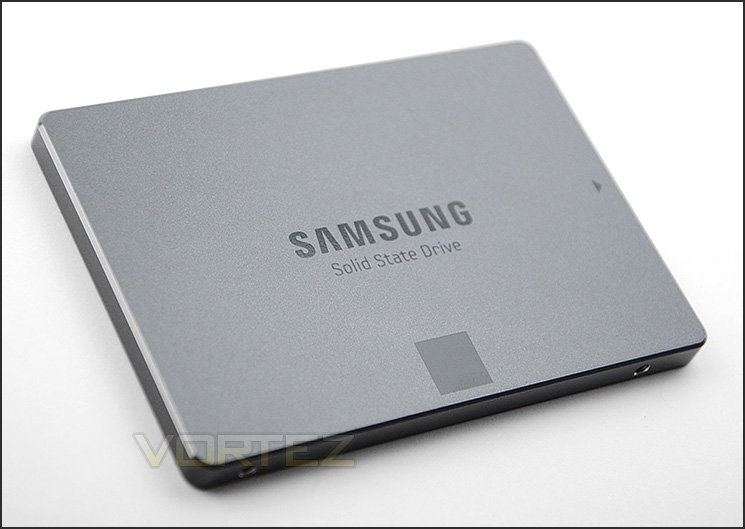
Joining the 840 SSD family today is the all new 840 EVO; heralding huge storage capacities for the solid state drive – including 1TB plus RAPID Mode.

Product on Review: 840 EVO 750GB
Manufacturer and Sponsor: Samsung
Street Price:
120GB: £86.99
250GB: £148.99
500GB: £289.99
750GB: £415.99
1000GB: £509.99
It was only last week that we were involved with the launch of the new Samsung 840 EVO. Key Samsung specialists were on hand to divulge all of the technical information surrounding this new drive and we witnessed a live demo of this very drive being shown at the Global Summit in South Korea. Aside from the assortment of technological inclusions we learned that a burly 1TB model would be available to this new product line – something which hasn’t yet been a possibility in the storage SSD sector.
The new 840 EVO arrives with a new 3-core MEX controller and 1x nm Samsung toggle NAND. Improvements have been made to the hardware specification and an exciting new RAPID mode feature will be available for EVO with Magician V4.2 which pushes transfer speeds beyond 500MB/s. Later in our review we will be delving into the advantages of RAPID mode and seeing how it benefits the user.
Although improvements have been made to EVO over the Pro model, Samsung still have the 840 Pro reserved for unrivalled high-performance whilst EVO is made available for everyday performance usage.
Can Samsung continue to impress with EVO? Let’s find out!
Samsung’s take on 840 EVO
Samsung has released the entry-level SSD ‘840 EVO’ line-up with significantly higher sequential write performance. Utilizing the industry’s most compact 10nm-class 128Gb high-performance NAND, Samsung proprietary controller and Turbo Write drive, the Samsung SSD 840 EVO boasts superior performance. The Samsung SSD 840 EVO also has flexible product supply capacity, making it the most competitive device on the market today.
Compared with the 250GB 840 Series SSD, the highest selling capacity of the 840 lineup, the new 250GB 840 EVO now delivers 520MB/s sequential write speed – making it more than 2 times faster than last generation. In the case of 120GB model, the 840 EVO achieves 410MB/s sequential write speed, which is approximately 3 times as fast as that of the 120GB 840 Series SSD.
Compared with the 250GB 840 Series SSD, the highest selling capacity of the 840 lineup, the new 250GB 840 EVO now delivers 520MB/s sequential write speed – making it more than 2 times faster than last generation. In the case of 120GB model, the 840 EVO achieves 410MB/s sequential write speed, which is approximately 3 times as fast as that of the 120GB 840 Series SSD.
Technical Specifications
Capacity
120GB, 250GB, 500GB,750GB,1TB
Dimensions (L* W* H)
100 x 69.85 x 6.8 (mm)
Interface
SATA 6Gb/s (compatible with SATA 3Gb/s and SATA 1.5Gb/s)
Form Factor
2.5-inch
Controller
Samsung 3-core MEX Controller
NAND Flash Memory
1x nm Samsung Toggle DDR 2.0 NAND Flash Memory (400Mbps)
DRAM Cache Memory
256MB (120GB) or 512MB(250GB&500GB) or 1GB (750&1TB) LPDDR2
Performance
Sequential Read: Max. 540 MB/s
Sequential Write: Max. 520 MB/s (250GB/500GB/750GB/1TB) Max. 410 MB/s (120GB)
4KB Random Read (QD1): Max. 10,000 IOPS
4KB Random Write(QD1): Max. 33,000 IOPS
4KB Random Read(QD32): Max. 98,000 IOPS (500GB/750GB/1TB) Max. 97,000 IOPS (250GB) Max. 94,000 IOPS (120GB)
4KB Random Write(QD32): Max. 90,000 IOPS (500GB/750GB/1TB) Max. 66,000 IOPS (250GB) Max. 35,000 IOPS (120GB)
TRIM Support Yes (Requires OS Support)
Garbage Collection Yes
S.M.A.R.T Yes
Security
AES 256-bit Full Disk Encryption (FDE) TCG-OPAL/eDrive compliant (from Oct. ’13 ~)
Weight
Max. 53g (1TB)
Reliability MTBF
1.5 million hours
Power Consumption Average
0.1W **** (Typical) Idle : 0.045W (Typical, DIPM ON)
Temperature
0°C to 70°C -55°C to 95°C
Humidity
5% to 95%, non-condensing
Vibration Operating
Random: 2.17Grms (7~800Hz) Non-Operating: Random: 3.08Grms (7~800Hz) Shock 1500G & 0.5ms (Half sine)
Etc. Worldwide Name (WWN), LED Indicator support
Warranty
3 years limited
120GB, 250GB, 500GB,750GB,1TB
Dimensions (L* W* H)
100 x 69.85 x 6.8 (mm)
Interface
SATA 6Gb/s (compatible with SATA 3Gb/s and SATA 1.5Gb/s)
Form Factor
2.5-inch
Controller
Samsung 3-core MEX Controller
NAND Flash Memory
1x nm Samsung Toggle DDR 2.0 NAND Flash Memory (400Mbps)
DRAM Cache Memory
256MB (120GB) or 512MB(250GB&500GB) or 1GB (750&1TB) LPDDR2
Performance
Sequential Read: Max. 540 MB/s
Sequential Write: Max. 520 MB/s (250GB/500GB/750GB/1TB) Max. 410 MB/s (120GB)
4KB Random Read (QD1): Max. 10,000 IOPS
4KB Random Write(QD1): Max. 33,000 IOPS
4KB Random Read(QD32): Max. 98,000 IOPS (500GB/750GB/1TB) Max. 97,000 IOPS (250GB) Max. 94,000 IOPS (120GB)
4KB Random Write(QD32): Max. 90,000 IOPS (500GB/750GB/1TB) Max. 66,000 IOPS (250GB) Max. 35,000 IOPS (120GB)
TRIM Support Yes (Requires OS Support)
Garbage Collection Yes
S.M.A.R.T Yes
Security
AES 256-bit Full Disk Encryption (FDE) TCG-OPAL/eDrive compliant (from Oct. ’13 ~)
Weight
Max. 53g (1TB)
Reliability MTBF
1.5 million hours
Power Consumption Average
0.1W **** (Typical) Idle : 0.045W (Typical, DIPM ON)
Temperature
0°C to 70°C -55°C to 95°C
Humidity
5% to 95%, non-condensing
Vibration Operating
Random: 2.17Grms (7~800Hz) Non-Operating: Random: 3.08Grms (7~800Hz) Shock 1500G & 0.5ms (Half sine)
Etc. Worldwide Name (WWN), LED Indicator support
Warranty
3 years limited
Packaging & Closer Look
Similar to the 840 Pro, EVO is presented in a small box. The front has a depiction of the drive, along with the capacity and a logo to identify that all components are proudly supplied by Samsung. This logo (Samsung Activated) will appear on all forthcoming Samsung products to reinforce this.
The back of the box details some of the fundamental features and what is included within the box.
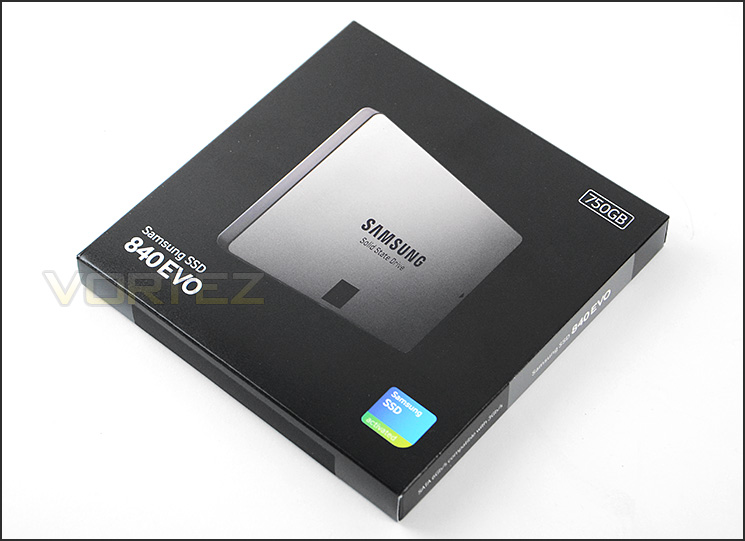
Packaging for 840 EVO
Included within the bundle, inside the box are the following items:
• 840 EVO SSD
• Manual & Software CD
• Warrranty Statement Summary
• Installation Guide
• Samsung Activated stickers
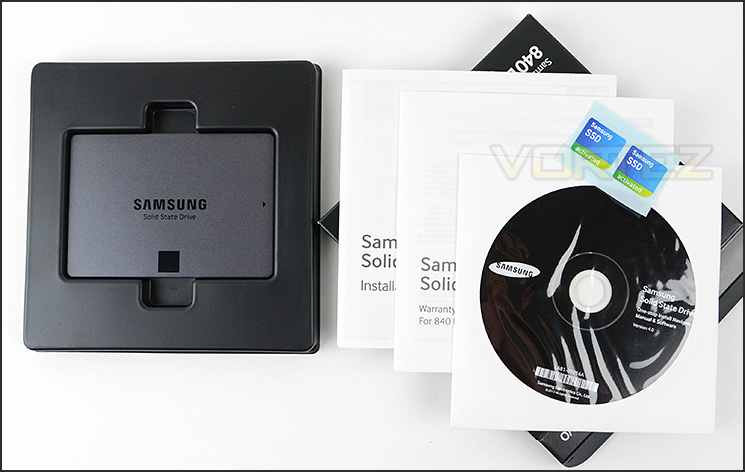
Included items within bundle
As last we come to the drive itself. 840 EVO is supplied with a gunmetal external shell which is constructed of steel and with a mat-textured finish. This understated styling helps to coordinate well with other hardware within the computer chassis.
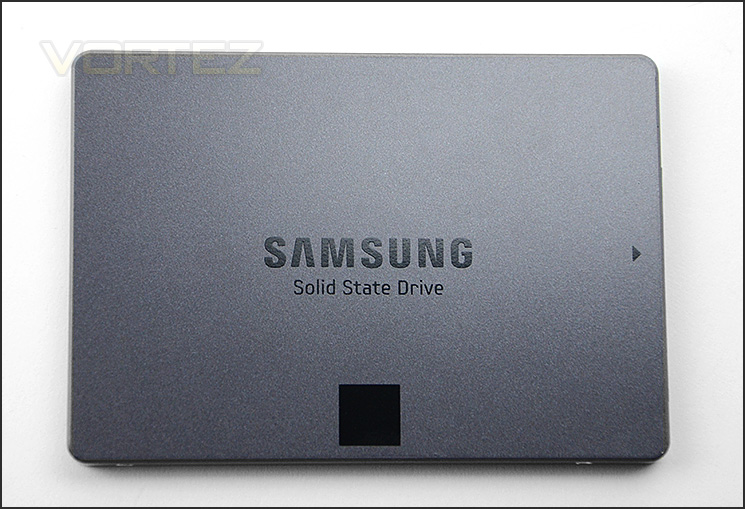
A gunmetal, matt visual appearance[i/]
There are three different versions to choose from: standard, desktop and laptop. The laptop version comes with a spacer for laptops which have larger caddy space and a SATA to USB 3.0 is supplied to perform migrations as fast as possible. The version we are looking at is the desktop variant.
The drive itself is 100 x 69.85 x 6.8 (mm) and weighs a mere 50g.
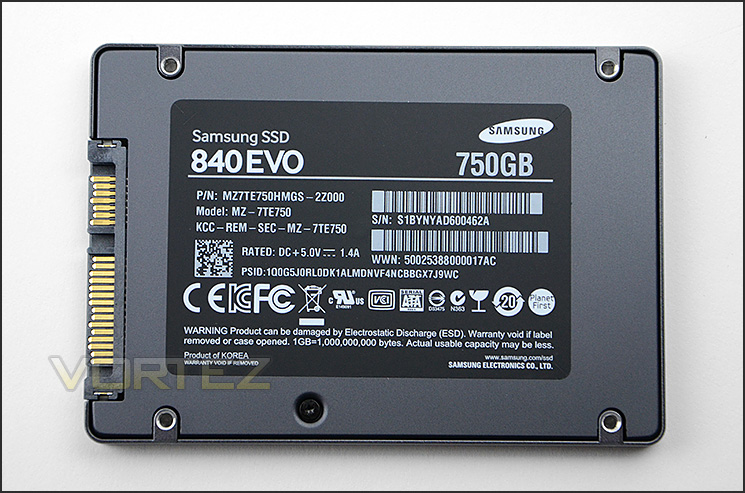
The reverse of EVO with specifications label
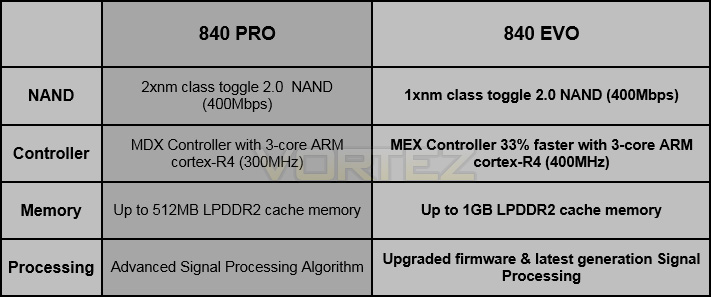
Inside 840 EVO Samsung have given the drive a 3-core MEX controller with 1x nm Toggle DDR 2.0 NAND Flash memory and up to 1GB Samsung Low Power DDR2 SDRAM cache memory. All components inside EVO are supplied directly by Samsung. Unlike other SSD vendors which have to obtain controllers and memory from third parties, Samsung have the unique opportunity to use in-house components and therefore can truly optimise the inner-workings of the drive. Additional to these features is a special TurboWrite buffer. This buffer is a different size for each capacity but for the 750GB model being reviewed we have 9GB buffer size. This buffer enables sustained and consistently high write speeds by transferring data when the drive is idle.
** We are waiting internal pics of EVO – it isn’t possible to remove the covers without specialist tools **
Test Setup & Methodology
Our test system is formatted and a fresh version of Windows is installed with just drives in place – no additional applications. Windows is then updated to the latest release and the drivers are installed. Included in the list of benchmarks are the following applications:
Benchmarks
ATTO Disk Benchmark v2.46
AS SSD
CrystalDiskMark 3.0
Iometer
SiSoftware SANDRA 2012
Windows 7 Boot Time Test
AS SSD
CrystalDiskMark 3.0
Iometer
SiSoftware SANDRA 2012
Windows 7 Boot Time Test
Test system
CPU Intel Core-i7 4770K
Motherboard GIGABYTE Z87X-OC
Graphics MSI R7970 Black Edition
Memory 16GB Corsair Vengeance Pro (2400MHz) CL10
HDD
– Samsung 840 EVO 750GB (Sata 6Gbps)
– Samsung 840 Pro 256GB (Sata 6Gbps)
– Samsung 840 256GB (Sata 6Gbps)
– Toshiba 256GB THNSNH256GCST (Sata 6Gbps)
– OCZ Vector 256GB (Sata 6Gbps)
– Corsair Neutron GTX 240GB (Sata 6Gbps)
– Corsair Force GS 240GB (Sata 6Gbps)
– OCZ Vertex 4 128GB (Sata 6Gbps)
– Kingston HyperX 3K 120GB (Sata 6Gbps)
– Kingston HyperX 240GB (Sata 6Gbps)
– ADATA S510 120GB (Sata 6Gbps)
– Intel 520 480GB (Sata 6Gbps)
– Samsung 830 Series 256GB (Sata 6Gbps)
– Samsung HD103SJ 1TB (Sata 3Gbps)
PSU Corsair HX1050 Gold
OS Microsoft Windows 7 Professional 64-Bit
Motherboard GIGABYTE Z87X-OC
Graphics MSI R7970 Black Edition
Memory 16GB Corsair Vengeance Pro (2400MHz) CL10
HDD
– Samsung 840 EVO 750GB (Sata 6Gbps)
– Samsung 840 Pro 256GB (Sata 6Gbps)
– Samsung 840 256GB (Sata 6Gbps)
– Toshiba 256GB THNSNH256GCST (Sata 6Gbps)
– OCZ Vector 256GB (Sata 6Gbps)
– Corsair Neutron GTX 240GB (Sata 6Gbps)
– Corsair Force GS 240GB (Sata 6Gbps)
– OCZ Vertex 4 128GB (Sata 6Gbps)
– Kingston HyperX 3K 120GB (Sata 6Gbps)
– Kingston HyperX 240GB (Sata 6Gbps)
– ADATA S510 120GB (Sata 6Gbps)
– Intel 520 480GB (Sata 6Gbps)
– Samsung 830 Series 256GB (Sata 6Gbps)
– Samsung HD103SJ 1TB (Sata 3Gbps)
PSU Corsair HX1050 Gold
OS Microsoft Windows 7 Professional 64-Bit
* Some of the drives were tested using the Intel Z77 chipset but we noticed nominal differences between testing with the new Intel Z87 test system and therefore have kept the results for comparison *
Benchmarks: ATTO
The ATTO Disk Benchmark performance measurement tool is compatible with Microsoft Windows. Measure your storage systems performance with various transfer sizes and test lengths for reads and writes. Several options are available to customize your performance measurement including queue depth, overlapped I/O and even a comparison mode with the option to run continuously. Use ATTO Disk Benchmark to test any manufacturers RAID controllers, storage controllers, host adapters, hard drives and SSD drives and notice that ATTO products will consistently provide the highest level of performance to your storage.
Benchmarks: AS SSD
AS SSD Benchmark is a straightforward tool for measuring the speed of your SSD drive.
Simply launch the program, choose your drive, click Start, and it’ll test your SSD’s read and write speed in a variety of ways, delivering a score for each when it’s done. And if that’s not enough, there are also additional file copy and compression-related benchmarks available from the Tools menu. (The author’s support page is German only, but if you need further English explanations then there’s a thread on the program at the OCZ Technology forum.).
Simply launch the program, choose your drive, click Start, and it’ll test your SSD’s read and write speed in a variety of ways, delivering a score for each when it’s done. And if that’s not enough, there are also additional file copy and compression-related benchmarks available from the Tools menu. (The author’s support page is German only, but if you need further English explanations then there’s a thread on the program at the OCZ Technology forum.).
Benchmarks: CrystalDiskMark 3.0
CrystalDiskMark is a disk benchmark software that analyses different types of hard drive. Giving sequential benchmark write and read statistics in MB/s. A simple program that is very useful.
Benchmarks: Iometer
Iometer is based on a client–server model, where one instance of the Iometer graphical user interface is managing multiple ‘workers’ (each one representing a separate Dynamo.exe process) which are doing the I/O. Iometer performs Asynchronous I/O – accessing files or block devices (later one allowing to bypass the file system buffers).
Iometer allows the configuration of disk parameters such as the ‘Maximum Disk Size’, ‘Starting Disk Sector’ and ‘# of Outstanding I/Os’. This allows a user to configure a test file upon which the ‘Access Specifications’ configure the I/O types to the file.
Iometer allows the configuration of disk parameters such as the ‘Maximum Disk Size’, ‘Starting Disk Sector’ and ‘# of Outstanding I/Os’. This allows a user to configure a test file upon which the ‘Access Specifications’ configure the I/O types to the file.
For the purpose of this test. The 4K 50%/50% read/write file will be under the examination with 100% Random Distribution – reporting back on IOPS and MBs per Second.
Benchmarks: SiSoftware SANDRA
SiSoftware Sandra (the System ANalyser, Diagnostic and Reporting Assistant) is an information & diagnostic utility. It should provide most of the information (including undocumented) you need to know about your hardware, software and other devices whether hardware or software.
Sandra is a (girl) name of Greek origin that means “defender”, “helper of mankind”. We think that’s quite fitting.
It works along the lines of other Windows utilities, however it tries to go beyond them and show you more of what’s really going on. Giving the user the ability to draw comparisons at both a high and low-level. You can get information about the CPU, chipset, video adapter, ports, printers, sound card, memory, network, Windows internals, AGP, PCI, PCI-X, PCIe (PCI Express), database, USB, USB2, 1394/Firewire, etc.
Sandra is a (girl) name of Greek origin that means “defender”, “helper of mankind”. We think that’s quite fitting.
It works along the lines of other Windows utilities, however it tries to go beyond them and show you more of what’s really going on. Giving the user the ability to draw comparisons at both a high and low-level. You can get information about the CPU, chipset, video adapter, ports, printers, sound card, memory, network, Windows internals, AGP, PCI, PCI-X, PCIe (PCI Express), database, USB, USB2, 1394/Firewire, etc.
Benchmarks: Windows 7 Boot
Synthetic testing is valuable in the examination of Solid State Drives. But some of the tests may not mean all that much to some readers so the final test in this review is a real world test showing the Windows 7 boot time.
In order to perform this test (and indeed all other benchmarks), a fresh install of Windows 7 Professional was installed on the Vector – the image of this install with no additional applications or drivers was exported for importing onto each drive at the time of testing. This will provide a clean and fair environment for comparing the boot times on each of the drives. The times were monitored using a stopwatch.
In order to perform this test (and indeed all other benchmarks), a fresh install of Windows 7 Professional was installed on the Vector – the image of this install with no additional applications or drivers was exported for importing onto each drive at the time of testing. This will provide a clean and fair environment for comparing the boot times on each of the drives. The times were monitored using a stopwatch.
RAPID Mode Performance Analysis
With Magician V4.2 (available publicly soon) the 840 EVO is able to boost beyond 500MB/s using the SATA 6GB/s interface. Samsung claim that this feature can push transfer speeds even past 1GB. In short, RAPID mode takes advantage of dynamic disk caching technology. This makes use of left over CPU and RAM resources in order to boost the performance of the SSD.
To demonstrate this feature we will show performance results for read/write transfer speeds with and without the RAPID mode enabled within Magician V4.2. (To take full advantage of this feature just install Magician V4.2+ and click RAPID mode – reboot required).
As you can see below, the performance gains on offer by using RAPID mode are rather significant. We tested a range of different benchmarks to simulate different usage and to reveal how flexible this feature really is.
Conclusion
Samsung remain a formidable force in many sectors but even more so for storage and SSDs. The 830 and 840 product lines have persistently taken the limelight due to excellent performance to price ratio.
Part of Samsung’s recipe for success has been the ability for them to push forward with R & D and being able to keep the entire anatomy of the SSD in-house. All components that make up the drive are developed in-house and are Samsung branded, and so there is no need to obtain hardware from third-parties and suffer the discrepancies that this brings.
The new 840 EVO continues to push the boundaries for what we expect from an SSD. Capacity choice is generous, spanning from 120GB to 1TB. The introduction of EVO is the first time that a full 1TB SSD has been made available and when we say “full” we mean just that, 1TB is available for use, nothing less.
RAPID Mode is a new feature which Samsung have introduced with their upcoming version of Magician V4.2 and 840 EVO. This feature accelerates transfer speeds beyond the expected 500MB/s read/write rates which SATA 3 (6G) is constrained to. By utilising spare CPU/Memory cache the EVO and its proprietary software can out-perform its counter-parts. It’s quite clear that Samsung have thought outside of the box with this new feature, by looking for alternative means in order to obtain yet more performance advantage. We’re impressed by how Samsung have found a method of getting round the barrier that the SATA 3 interface presents since the performance plateau is ever present for each and every SSD currently on the market.
In each of the tests we put 840 EVO through on the preceding pages this drive revealed a strong candidate indeed. Results were consistently good for both read and write performance, sequential transfer rates were very pleasing and this particular area only helps to strengthen a remarkable product.
The price is of particular significance with 840 EVO because even the 1TB model surprised us. Prices range from 120GB: £86.99 250GB: £148.99 500GB: £289.99 750GB: £415.99 1000GB: £509.99. All of these prices include VAT and we are satisfied that these prices represent good value for money. Samsung can obviously keep the prices this low for such high-quality kit because they have access to all of the components – they don’t need to source from alternative vendors.
The new 840 EVO pushes the boundaries for SATA 6G performance. Samsung have clearly thought outside of the box with this new product and continue to bring innovation to the table. We are excited by EVO and can whole heartedly recommend it.
Pros
+ High-grade components – Samsung born and bred
+ Brilliant sequential read/write results
+ Consistently strong performance
+ RAPID Mode boosts performance
+ Found method to overcome limitation of SATA 3 interface
+ Magician software is very useful
+ Great value
Cons
– There are none
Tip = Install Magician 4.2+ and use RAPID mode for better transfer performance
+ High-grade components – Samsung born and bred
+ Brilliant sequential read/write results
+ Consistently strong performance
+ RAPID Mode boosts performance
+ Found method to overcome limitation of SATA 3 interface
+ Magician software is very useful
+ Great value
Cons
– There are none
Tip = Install Magician 4.2+ and use RAPID mode for better transfer performance

Click here for an explanation of our awards at Vortez.net.


