







Armed with Samsung’s new Polaris Controller, the 960 EVO follows in the footsteps of the 960 PRO by offering up some blazing fast SSD performance via NVMe.

Product on Review: 960 EVO SSD
Manufacturer: Samsung
Street Price: 500GB: £250 GBP
The introduction of NVM Express has provided us with a worthy successor to the now aging SATA standard which traps users in a 550MB/s bottleneck. To some users SATA-based SSDs are still a valuable asset, but times are swiftly moving on. The humble mechanical drive is now being superseded by high capacity SATA-SSDs and a new kid on the block is taking over as the primary significant.
M.2 slots arrived with the X99 chipset and are now native to the Z170 chipset too, meaning that mainstream users can enjoy the benefits of NVM Express technology. NVMe uses lower latency and can handle up to 64K queues and up 64K commands each while SATA and AHCI can only handle 1 queue and 32 commands each – the benefits are clearly evident.
Soon after the 960 PRO release, Samsung are back with a cheaper alternative in the 960 EVO. Like its sibling the EVO uses Samsung’s new Polaris Controller and the companies 3rd generation V-NAND.
We’ve already seen the capabilities of the 960 PRO, can the EVO follow in its footsteps? Let’s find out.
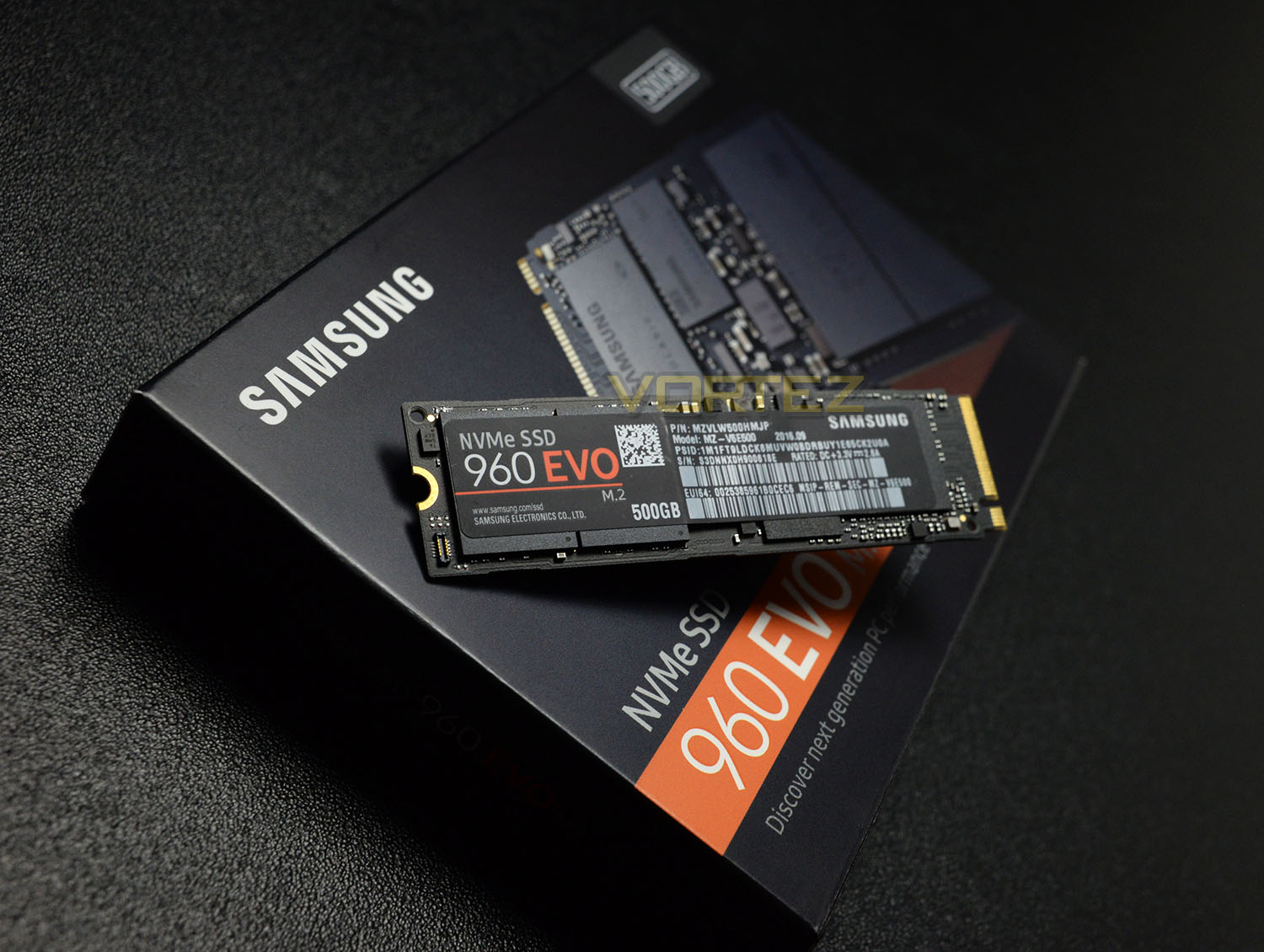
Samsung on their 960 PRO
The new Samsung NVMe SSD 960 EVO expands Samsung’s Client PC NVMe SSD line-up and brings the technology to the mainstream market. The 960 EVO will particularly appeal to those customers that want to discover next generation PC performance. It offers ultimate performance levels and through its availability in 250GB, 500GB and 1TB capacities in combination with its solid reliability make it the smart customer choice.
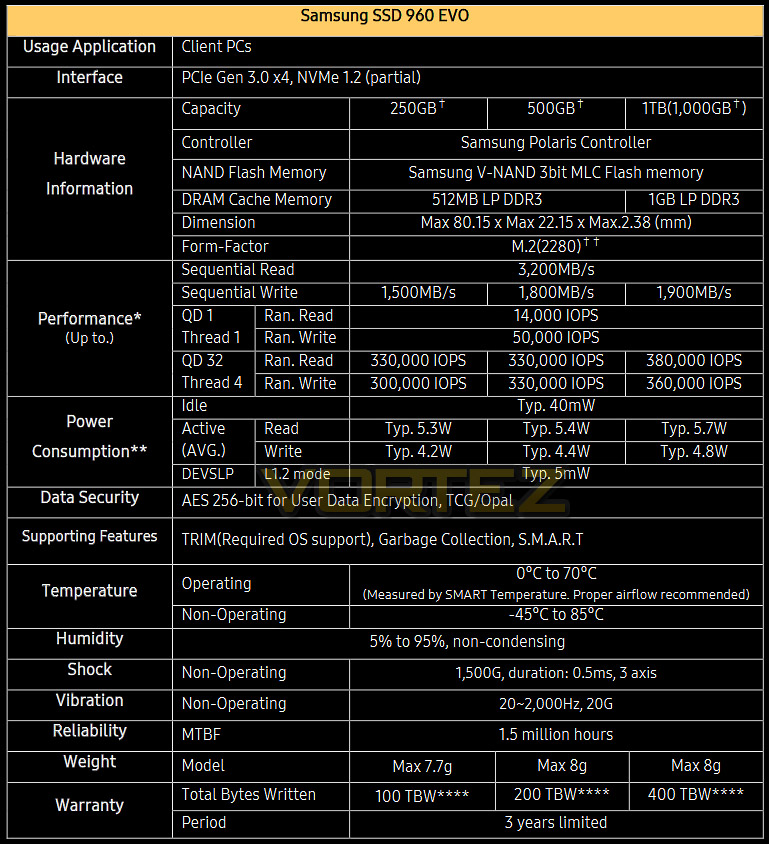
Technical Specifications
Packaging, Bundle & Closer Look
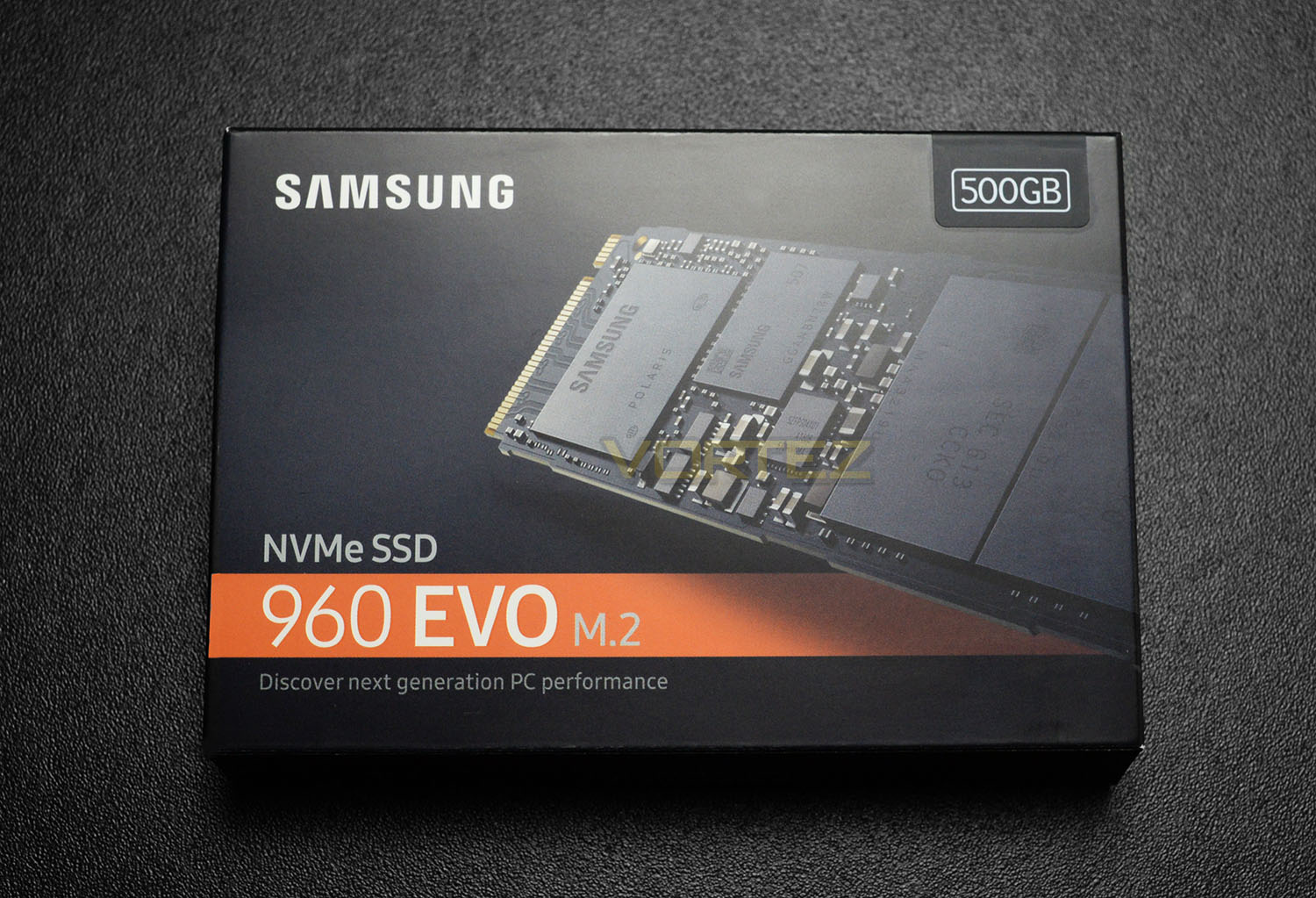
There is clear consistency with Samsung’s line of SSDs, the packaging for the 960 EVO is almost identical to that of the 960 PRO, the differentiator being a use of orange rather than red. An impression of the drive, along with capacity and form factor are printed on the front.
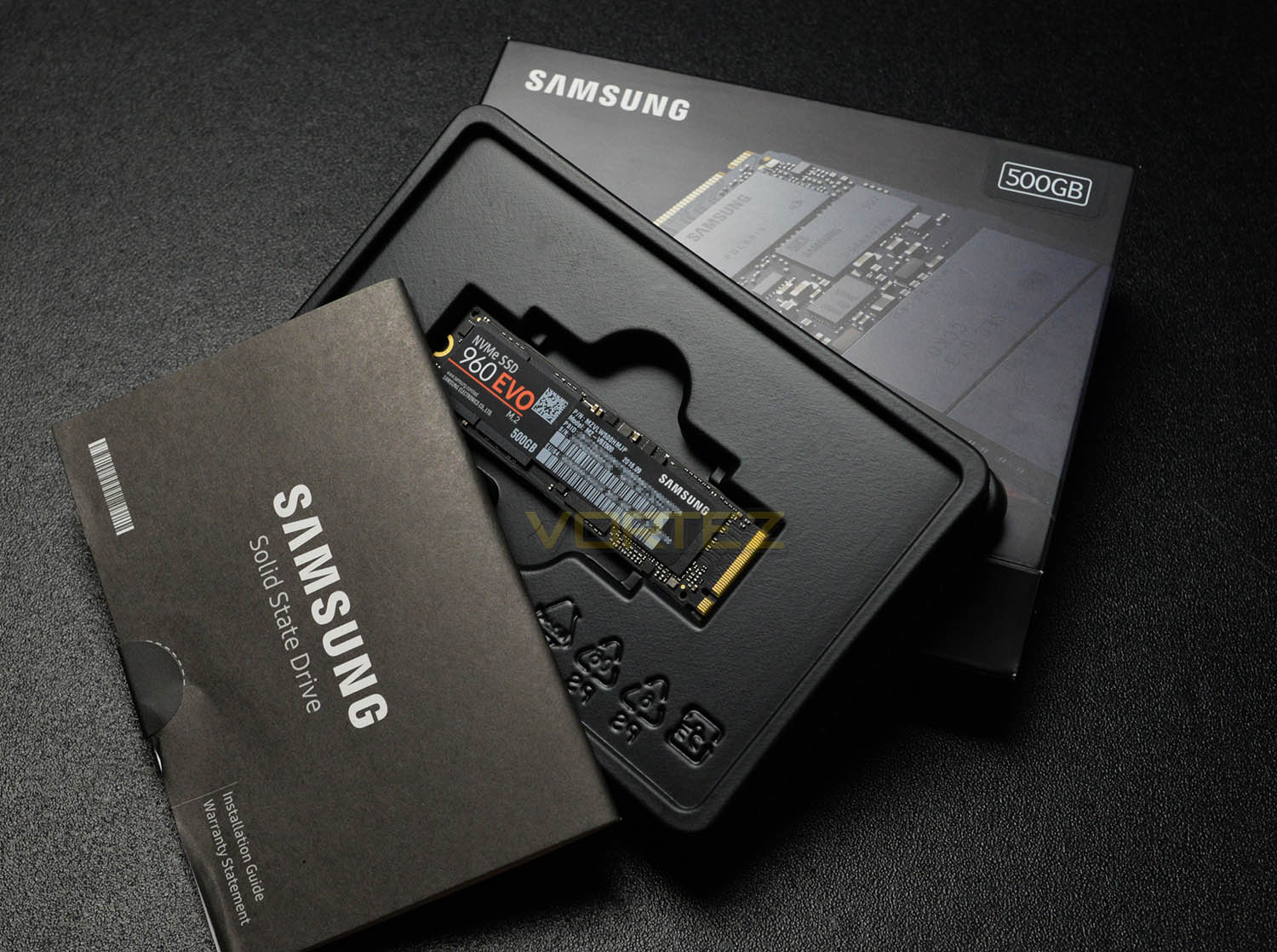
Inside this packet, there is very little by way of a bundle. There is just an instructions manual and the drive in a plastic tray.
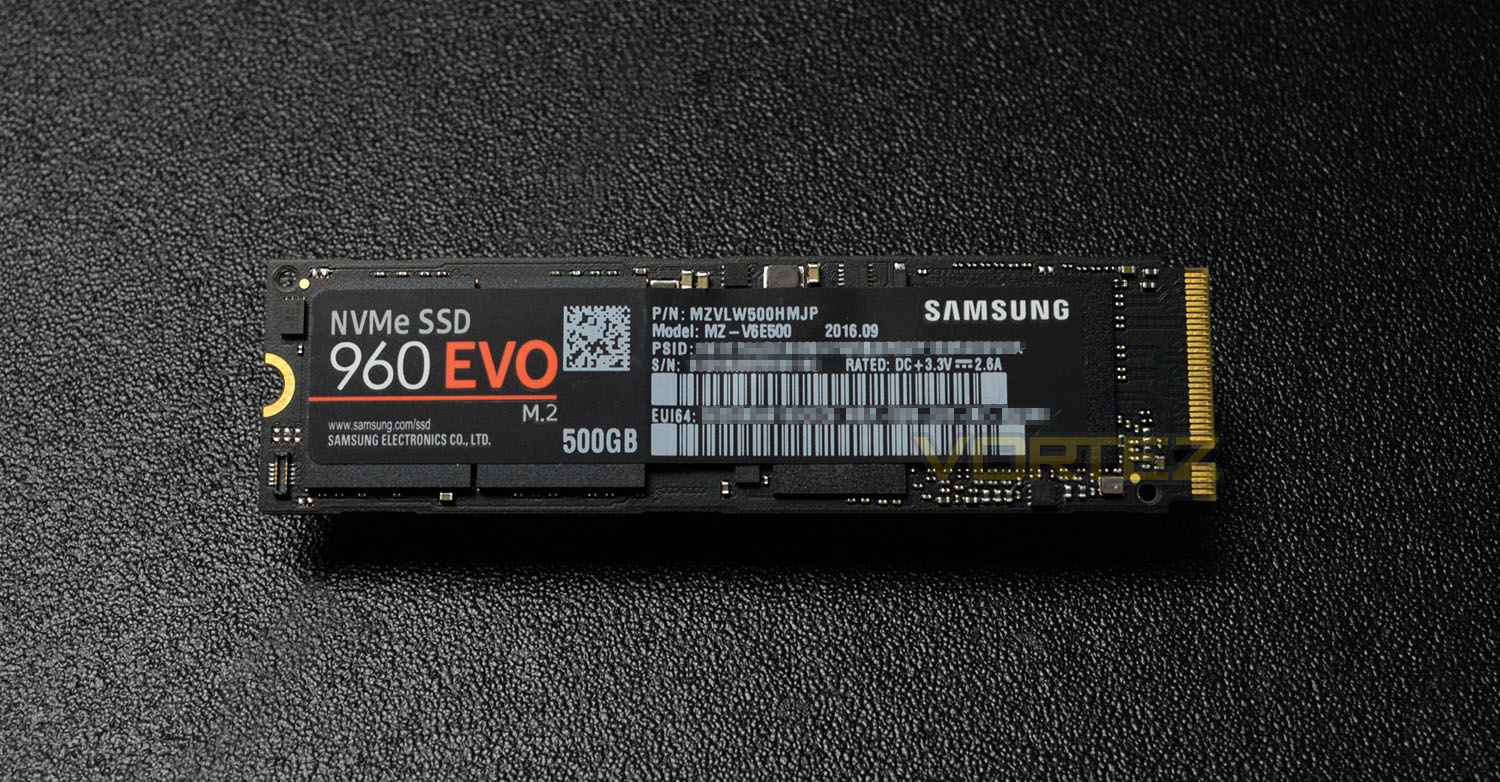
The 960 EVO conforms to 2280 and takes advantage of a sleek, black PCB. M.2 drives are usually on display if you have a side panel on your computer case, so the styling and aesthetics are somewhat important if you are seeking to construct a coherent theme.
Just like its sibling (the PRO), this SSD utilises PCI Express Gen 3 x4 with NVMe 1.2, not only this but our drive also arrives with Samsung’s 3rd generation V-NAND with the new Polaris Controller which pushes the sequential read and write performance to new levels. Samsung state that we should expect 3200MB/s for read and 1800MB/s for write performance, with IOPS hitting 330K on this 512GB model and 380K in the 1TB model. So, the EVO offers up similar IOPS to the PRO but read/write transfer rates are up to 300MB/s less on the EVO.
Other features also worth a mention are AES 256-bit hardware-based encryption and an impressive MTBF of 1.5 million hours!
For today’s review, we’re putting the 500GB model through its paces. Samsung also offer a 250GB and 1000GB model.
Test Setup & Methodology
Our test system is formatted and a fresh version of Windows is installed with just drives in place – no additional applications. Windows is then updated to the latest release and the drivers are installed.
Included in the list of benchmarks are the following applications:
Benchmarks
Anvil Pro
AS SSD
ATTO Disk Benchmark v2.46
Futuremark PCMark 8
AIDA64
AS SSD
ATTO Disk Benchmark v2.46
Futuremark PCMark 8
AIDA64
Test system
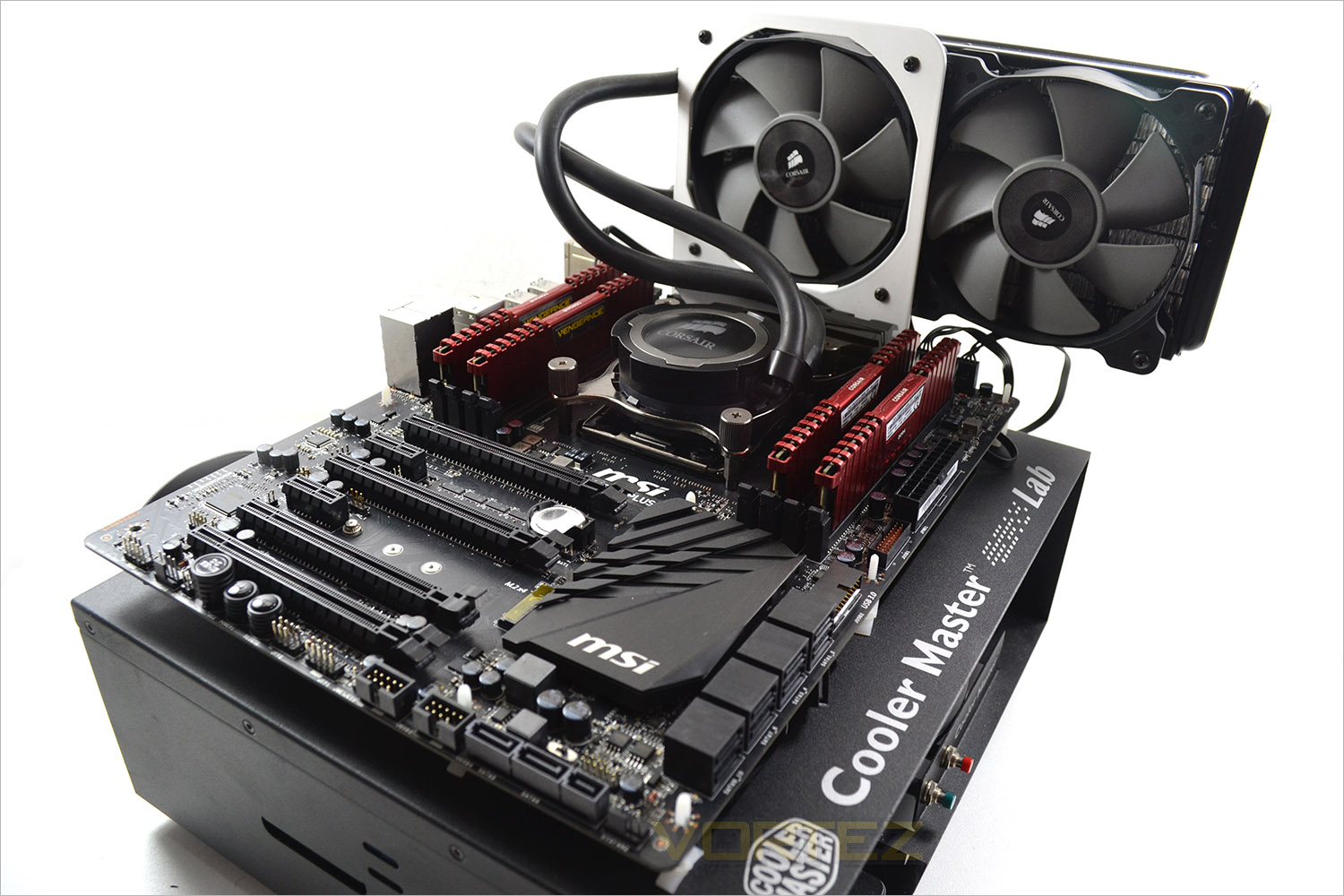
CPU
Intel Core i7-6700K
Motherboard MSI Z170A GAMING M7
Graphics PALIT NVIDIA GTX 760
Memory 32GB Corsair Vengeance LPX 3200MHz DDR4
HDD
– Samsung 960 EVO 500GB (NVM Express)
– Samsung 960 PRO 512GB (NVM Express)
– Samsung 950 PRO 256GB (NVM Express)
– Crucial MX300 750GB (Sata 6Gbps)
– Crucial BX200 960GB (Sata 6Gbps)
– OCZ Vector 180 240GB (Sata 6Gbps)
– Crucial MX200 1TB (Sata 6Gbps)
– Corsair Force LX 256GB (Sata 6Gbps)
– Corsair Neutron GTX 480GB (Sata 6Gbps)
PSU Corsair HX1050 Gold
OS Microsoft Windows 10 Professional 64-Bit
Intel Core i7-6700K
Motherboard MSI Z170A GAMING M7
Graphics PALIT NVIDIA GTX 760
Memory 32GB Corsair Vengeance LPX 3200MHz DDR4
HDD
– Samsung 960 EVO 500GB (NVM Express)
– Samsung 960 PRO 512GB (NVM Express)
– Samsung 950 PRO 256GB (NVM Express)
– Crucial MX300 750GB (Sata 6Gbps)
– Crucial BX200 960GB (Sata 6Gbps)
– OCZ Vector 180 240GB (Sata 6Gbps)
– Crucial MX200 1TB (Sata 6Gbps)
– Corsair Force LX 256GB (Sata 6Gbps)
– Corsair Neutron GTX 480GB (Sata 6Gbps)
PSU Corsair HX1050 Gold
OS Microsoft Windows 10 Professional 64-Bit
Benchmarks: Anvil Pro
Anvil Pro from Anvil Storage utilities is one of the most popular storage benchmarking utilities today thanks to the large suit of tests available. You can test pretty much anything from Read/write Speed to IOPs with many variables to tweak allowing you to get either a single or host of results to compare with other likeminded enthusiasts. In our test we ran the standard suite 5 times, subtracting both the highest and lowest scores and determined the final result from the average of the remaining three results.
Benchmarks: AS SSD
AS SSD Benchmark is a straightforward tool for measuring the speed of your SSD drive.
Simply launch the program, choose your drive, click Start, and it’ll test your SSD’s read and write speed in a variety of ways, delivering a score for each when it’s done. And if that’s not enough, there are also additional file copy and compression-related benchmarks available from the Tools menu. (The author’s support page is German only, but if you need further English explanations then there’s a thread on the program at the OCZ Technology forum.).
Simply launch the program, choose your drive, click Start, and it’ll test your SSD’s read and write speed in a variety of ways, delivering a score for each when it’s done. And if that’s not enough, there are also additional file copy and compression-related benchmarks available from the Tools menu. (The author’s support page is German only, but if you need further English explanations then there’s a thread on the program at the OCZ Technology forum.).
Benchmarks: ATTO
The ATTO Disk Benchmark performance measurement tool is compatible with Microsoft Windows. Measure your storage systems performance with various transfer sizes and test lengths for reads and writes. Several options are available to customize your performance measurement including queue depth, overlapped I/O and even a comparison mode with the option to run continuously. Use ATTO Disk Benchmark to test any manufacturers RAID controllers, storage controllers, host adapters, hard drives and SSD drives and notice that ATTO products will consistently provide the highest level of performance to your storage.
Benchmarks: AIDA64
AIDA64 Product PageThis simple integer benchmark focuses on the branch prediction capabilities and the misprediction penalties of the CPU. It finds the solutions for the classic “Queens problem” on a 10 by 10 sized chessboard. At the same clock speed theoretically the processor with the shorter pipeline and smaller misprediction penalties will attain higher benchmark scores. For example — with HyperThreading disabled — the Intel Northwood core processors get higher scores than the Intel Prescott core based ones due to the 20-step vs 31-step long pipeline. CPU Queen test uses integer MMX, SSE2 and SSSE3 optimizations.
Benchmarks: PCMark 8
PCMark 8 Product PageWe use the Futuremark PCMark 8 utility to measure storage via Photoshop performance under both light and heavy loading conditions. Accelerated (open CL) is used to perform this test. The test is measured in seconds to complete.
Conclusion
Hot on the heels of the 960 PRO, the 960 EVO is another super-quick M.2 drive from Samsung.
Behind the design of the 960 EVO we once again see the new Polaris Controller making an appearance, along with Samsung’s V-NAND MLC flash memory. In reality the EVO will perform in a similar way to the PRO – in some cases just 300MB/s is at stake, which for some could be regardedas marginal. This trade-off comes at a much lower price-tag and yet we still have access to a speedy M.2 drive with class-leading features like Samsung’s TurboWrite technology, TRIM and AES 256-bit data encryption.
We’re pleased to now report that Samsung’s new NVMe driver to support both the PRO and EVO is ready and will supply end users with the best possible bandwidth on offer.
The Samsung 960 EVO will arrive a little later than the PRO – hitting shelves in December with a price-tag of £250. This is approximately £80 cheaper than the PRO but does offer less by way of outright bandwidth and arrives with 3-years warranty (against 5 years).
There is no denying how significant Samsung’s Polaris Controller is – in this second appearance with the 960 EVO, we are able to home in on some incredible bandwidth. If performance is king, look no further!
Pros
+ Impressive performance
+ Clean aesthetics
+ Compact form factor
+ Uses 3rd Gen V-NAND
+ TRIM Support
+ Dynamic Thermal Guard
+ 3 Years Warranty
Cons
– Good case airflow is needed
+ Impressive performance
+ Clean aesthetics
+ Compact form factor
+ Uses 3rd Gen V-NAND
+ TRIM Support
+ Dynamic Thermal Guard
+ 3 Years Warranty
Cons
– Good case airflow is needed
Click here for an explanation of our awards at Vortez.net.