The current king of the hill in the M.2 SSD market, Samsung, have today released the 970 EVO, offering better performance and longevity than the previous generation.

Product on Review: Samsung 970 EVO
Manufacturer: Samsung
Street Price: 250GB – £100.79 / 500GB – £193.79 / 1TB – £375.79 / 2TB – £709.99
The introduction of mainstream solid state storage a few years ago saw a massive adoption within the PC industry, often being regarded as “the best upgrade you can do to your PC”. SSDs are now in almost every computer, helping to speed up tasks multiple-fold compared to a traditional spinning Hard Drive.
The flash storage used in Solid State Drives has come along leaps and bounds, but that performance is now being hindered by a bottleneck; that bottleneck arrives in the form of the SATA interface, limiting bandwidth to roughly 550MB/s; M.2 drives are regularly exceeding 3000MB/s which brings about the need for a faster, more focussed interface. NVMe (Non-Volatile-Memory-Express) is the interface used, capable of roughly 4000MB/s on the current PCI-E x4 channel. M.2 drives are now regularly included on most motherboards, with some manufacturers even coming up with genius solutions to add further options; ASUS have implemented a DIMM-slot-style M.2 expansion card onto a few of their high-end motherboards.
Throughput increases aren’t the only positive improvement over SATA interfaces, latency is also improved as well as queueing data requests. SATA is capable of only a single queue, with 32 requests within, whereas NVMe can handle 65535 queues with 65536 request in each. Those numbers aren’t a mistake, that’s just what kind of difference the M.2 NVMe interface can make.
Samsung were a strong contender within the SATA SSD market, so naturally, we expected to see solid options within the NVMe M.2 form factor. We have been pleasantly surprised so far, with Samsung generally topping most performance charts. Around 18 months ago, the 960 EVO was released, an excellent drive, capable of incredible performance. Today we see the EVOlution of that drive, the 970 EVO.
The 970 EVO is available in 250GB, 500GB, 1TB and 2TB capacities, using 3-bit MLC V-VAND and a newly enhanced Phoenix controller. Samsung have also improved their TurboWrite technology, used to improve speeds within many scenarios. The 970 PRO is also launched today, which we will review later in the week.
Endurance is also improved over the previous generation, with up to 1,200TBW (TeraBytes of Wear). There’s also the inclusion of Dynamic Thermal Guard, to prevent these densely packed storage solutions from overheating during demanding usage.
Samsung on the 970 Evo:
The Samsung SSD 970 EVO is the 2nd generation of Samsung’s 3-bit MLC NVMe SSDs for client PCs. The Samsung 970 EVO is specially designed for tech savvies, gamers and professionals who frequently work on video creation/editing or simulations that require high workloads. Featuring the latest Samsung 3-bit MLC V-NAND technology and a newly enhanced Phoenix controller, the 970 EVO delivers unrivaled next-level performance and exceptional reliability in a small M.2 2280 form factor, offering customers the most advanced Samsung SSD technology currently available for client pcs.
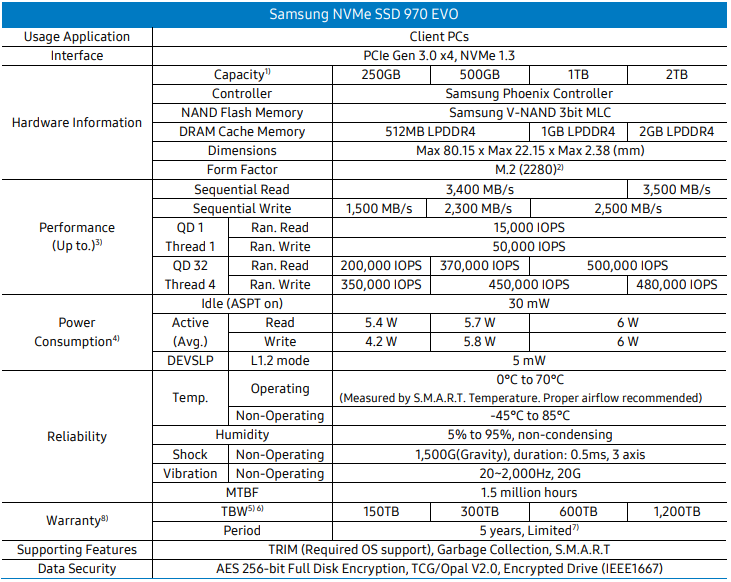
Technical Specifications
Packaging, Bundle & Closer Look
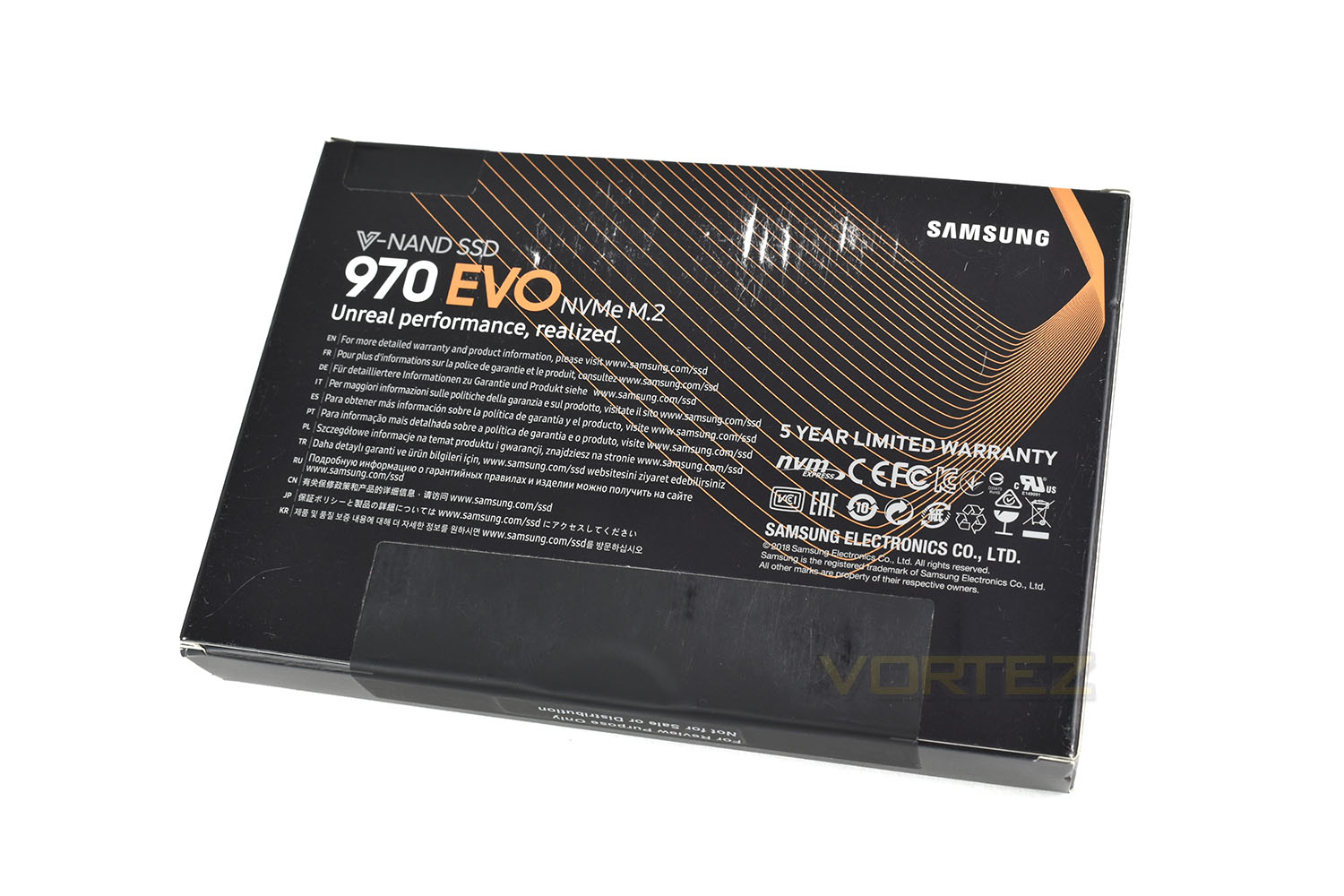
The packaging will be no shock to anyone familiar with Samsung’s lineup of solid state solutions. A black box, arty image and orange writing are the theme here.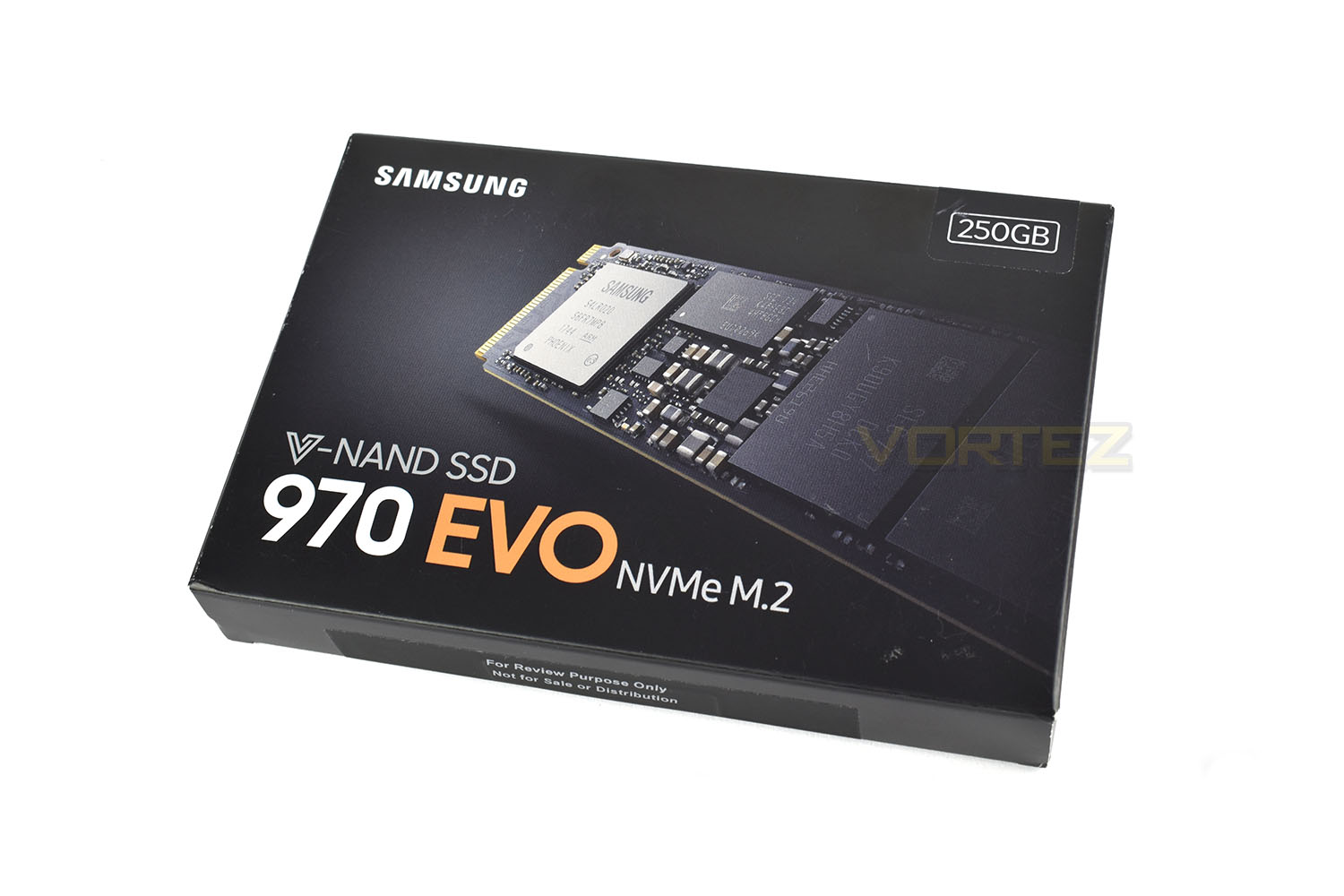
Flipping the box over doesn’t really give much more information, though a link to their website is provided where you can find anything you need.
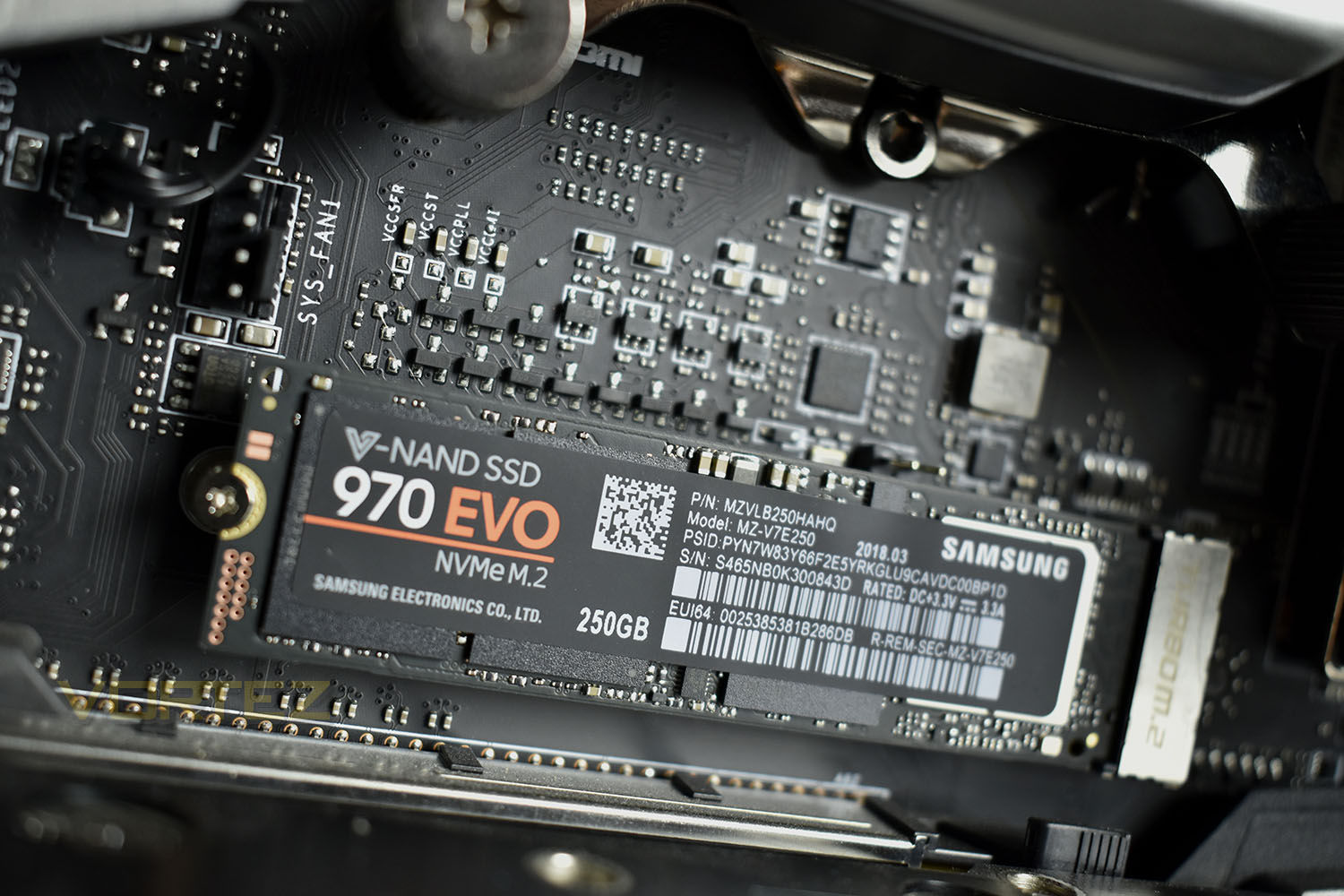
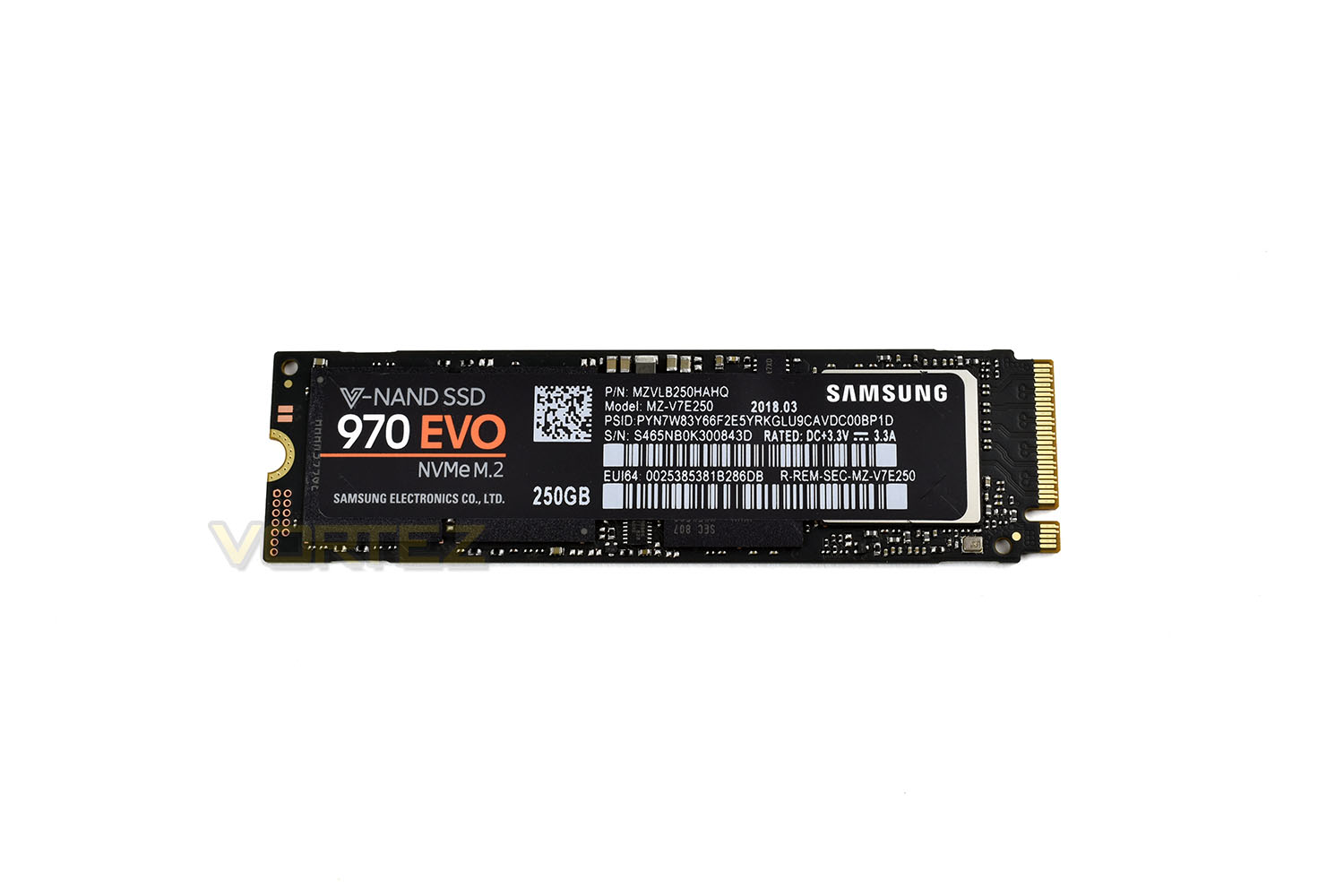
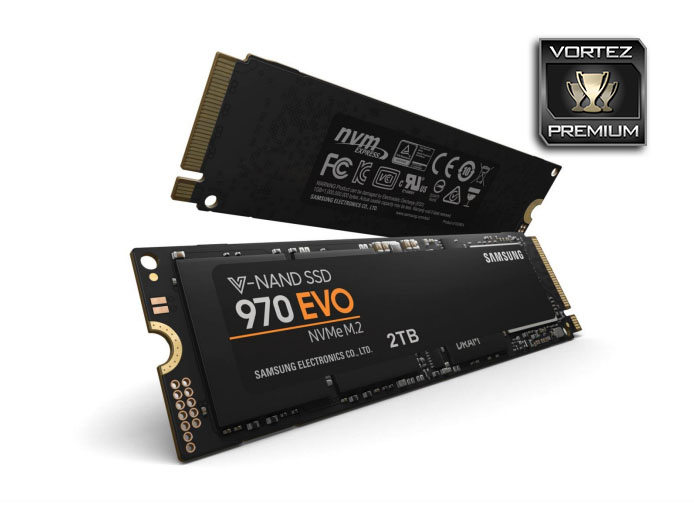
The front of the SSD, as you would see it on the motherboard, has a sticker across the entire front. This sticker also acts as a way of dissipating heat from the flash chips and controller, through a thin layer of copper within the sticker and a nickel plated controller cap.
The black PCB will look good in most systems, with most motherboard manufacturers now using black PCBs. The 970 EVO conforms to the M.2 2280 form factor.
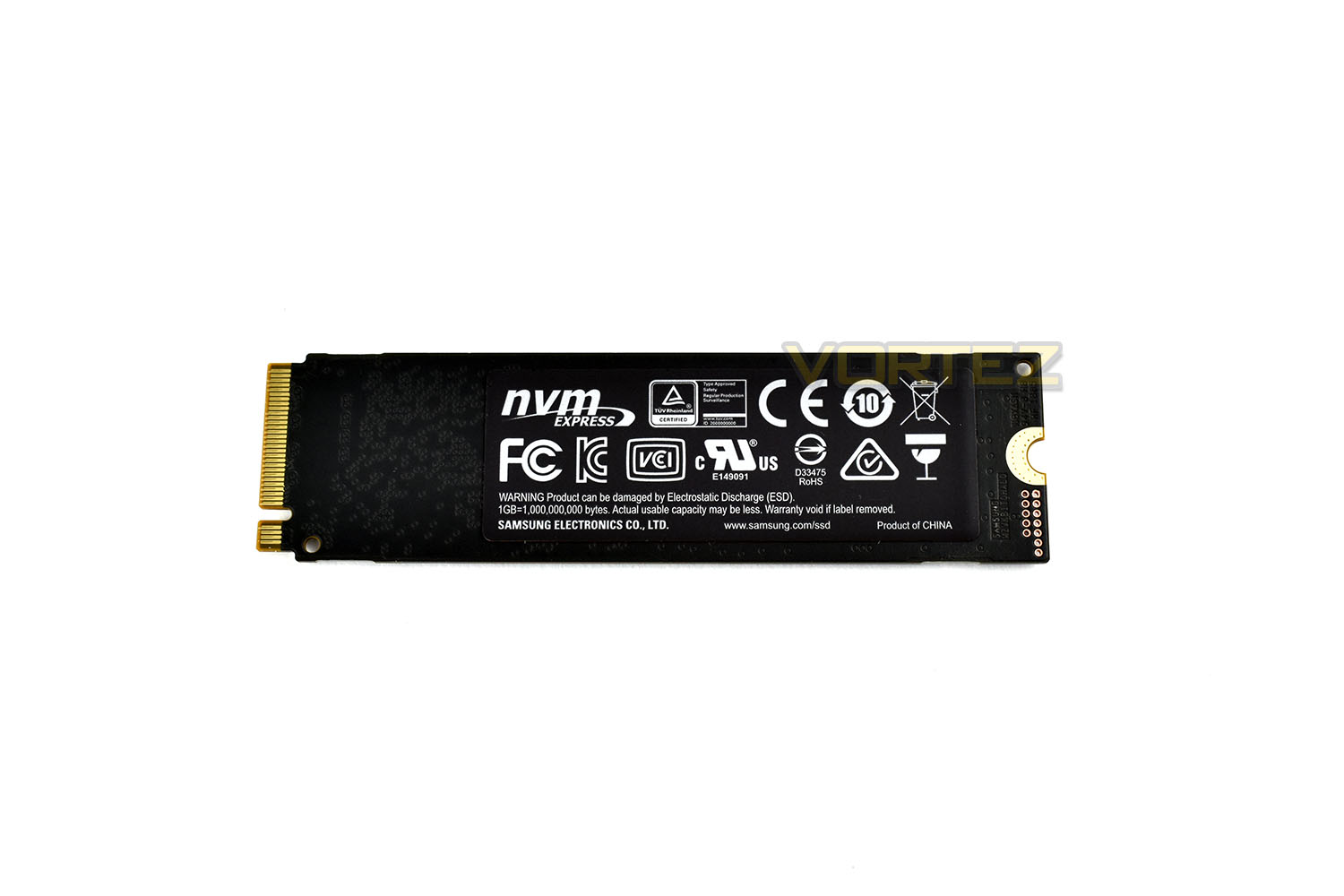
The reverse side of the SSD is flat with information all over.
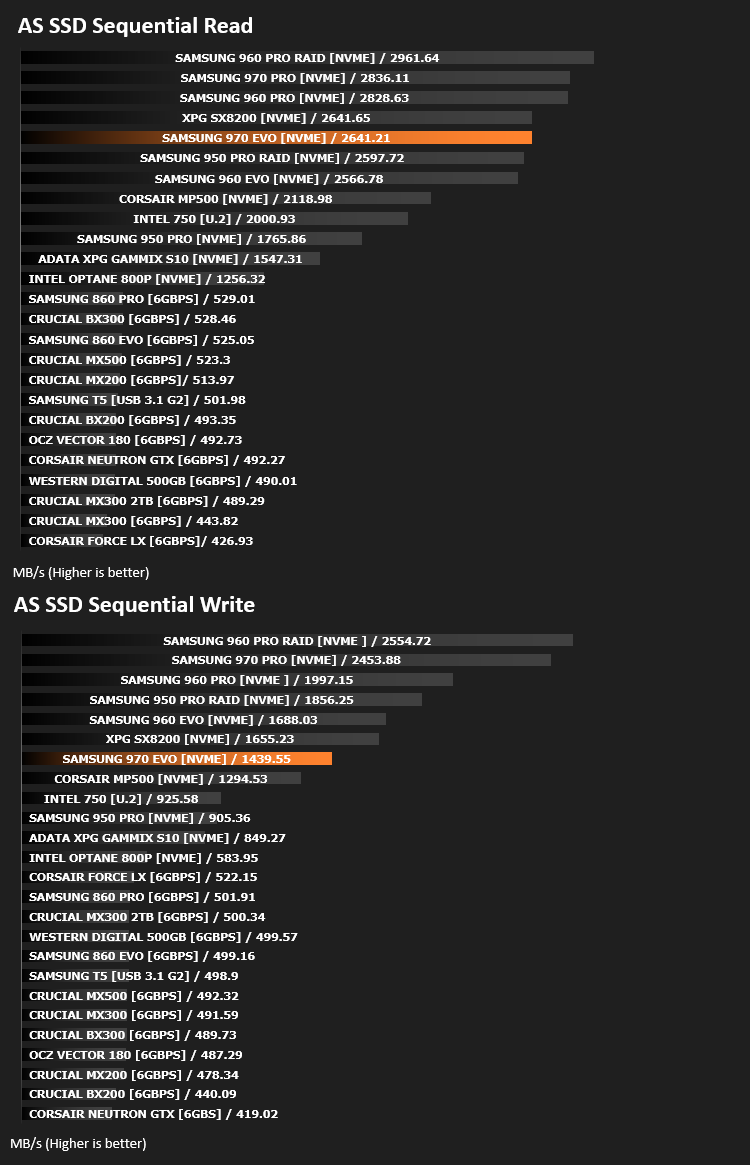
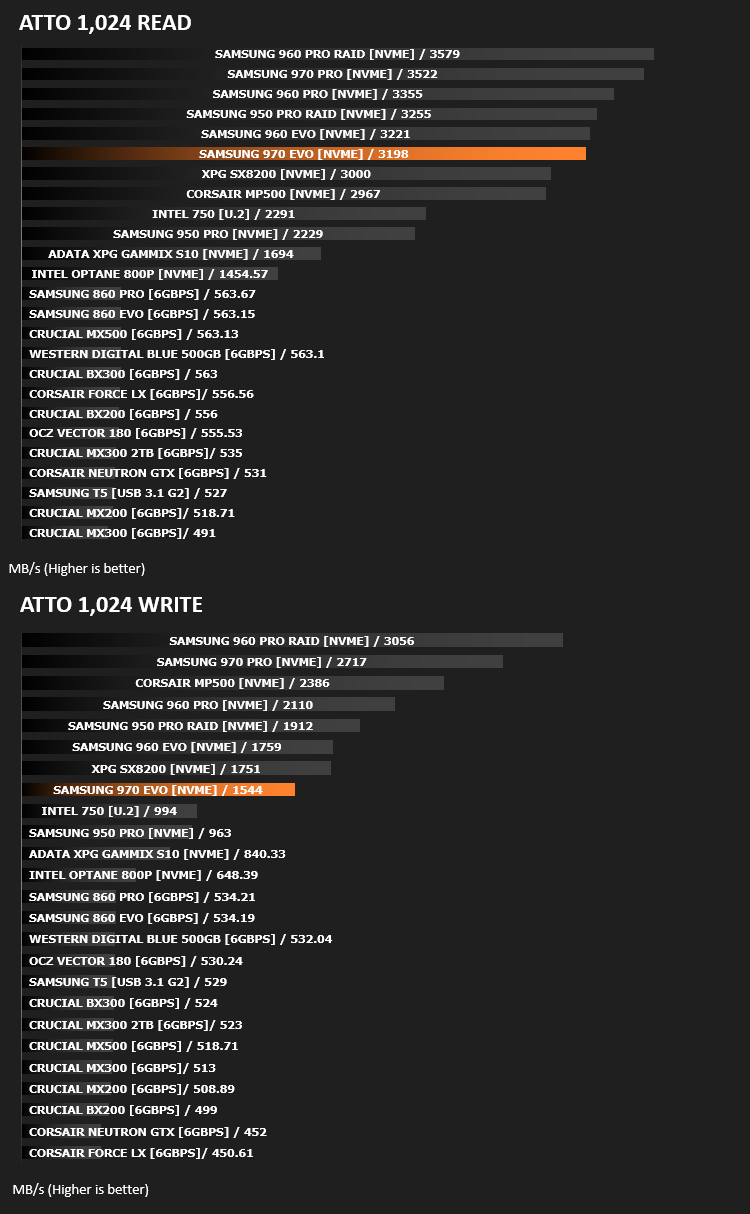
Samsung claim read and write figures around the 3400MB/s and 1500MB/s region, on this particular capacity, as well random reads and writes at 200k and 350k respectively. Read on to see how those numbers compare to our results.
We have the 250GB model for testing, therefore some of the read and write figures aren’t truly comparable to the previous generation that was tested. The 960 EVO was a 500GB model, with 3200MB/s and 1900MB/s quoted speeds, and 330,000 IOPS, both read and write.
Test Setup & Methodology
Our test system is formatted and a fresh version of Windows is installed with just drives in place – no additional applications. Windows is then updated to the latest release and the drivers are installed.Included in the list of benchmarks are the following applications:
Benchmarks
Anvil Pro
AS SSD
ATTO Disk Benchmark v2.46
Futuremark PCMark 8
AIDA64
AS SSD
ATTO Disk Benchmark v2.46
Futuremark PCMark 8
AIDA64
Test system
CPU: Intel Core i7 7700K
Motherboard: MSI Z270 Gaming M7
Graphics: EVGA GTX 1070 SC
Memory: 16GB CORSAIR Vengeance LPX 3000MHz DDR4
Samsung SM961 256GB NVMe
Samsung 970 EVO 250GB SSD
PSU: BeQuiet Straight Power 11 650W
OS: Microsoft Windows 10 Pro 64-Bit
Monitor: ASUS ROG PG279Q
Motherboard: MSI Z270 Gaming M7
Graphics: EVGA GTX 1070 SC
Memory: 16GB CORSAIR Vengeance LPX 3000MHz DDR4
Samsung SM961 256GB NVMe
Samsung 970 EVO 250GB SSD
PSU: BeQuiet Straight Power 11 650W
OS: Microsoft Windows 10 Pro 64-Bit
Monitor: ASUS ROG PG279Q
Benchmarks: Anvil Pro
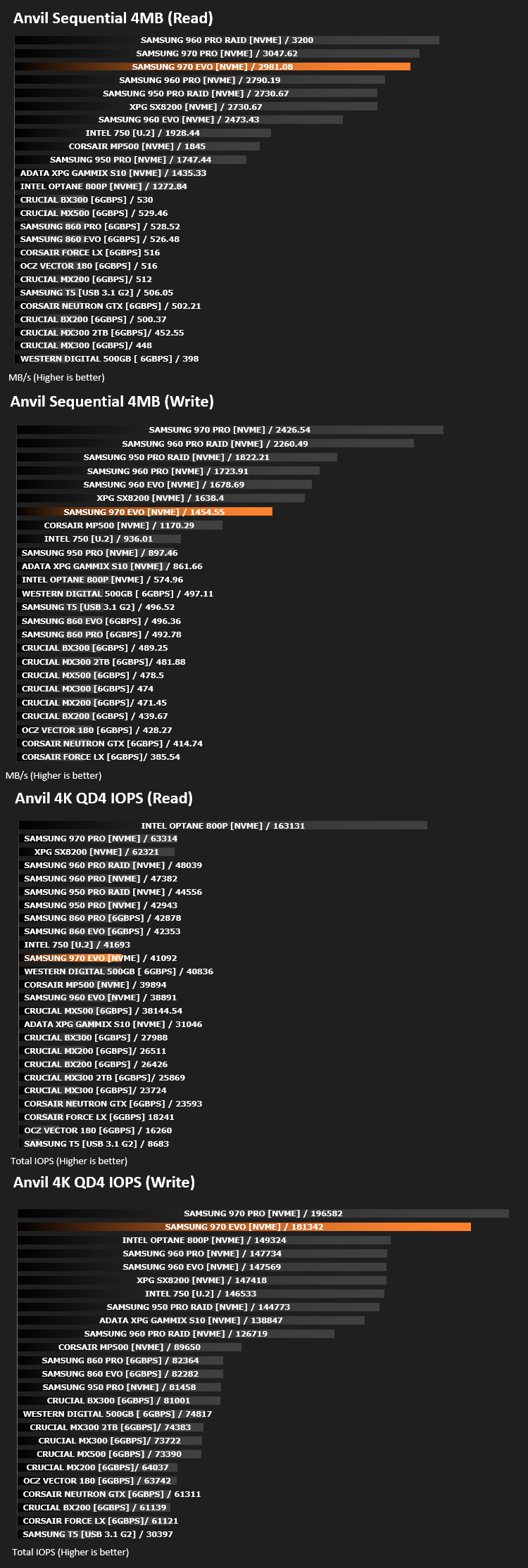
Anvil Pro from Anvil Storage utilities is one of the most popular storage benchmarking utilities today thanks to the large suit of tests available. You can test pretty much anything from Read/write Speed to IOPs with many variables to tweak allowing you to get either a single or host of results to compare with other likeminded enthusiasts. In our test we ran the standard suite 5 times, subtracting both the highest and lowest scores and determined the final result from the average of the remaining three results.
Benchmarks: AS SSD
AS SSD Benchmark is a straightforward tool for measuring the speed of your SSD drive.
Simply launch the program, choose your drive, click Start, and it’ll test your SSD’s read and write speed in a variety of ways, delivering a score for each when it’s done. And if that’s not enough, there are also additional file copy and compression-related benchmarks available from the Tools menu. (The author’s support page is German only, but if you need further English explanations then there’s a thread on the program at the OCZ Technology forum.).
Simply launch the program, choose your drive, click Start, and it’ll test your SSD’s read and write speed in a variety of ways, delivering a score for each when it’s done. And if that’s not enough, there are also additional file copy and compression-related benchmarks available from the Tools menu. (The author’s support page is German only, but if you need further English explanations then there’s a thread on the program at the OCZ Technology forum.).
Benchmarks: ATTO
The ATTO Disk Benchmark performance measurement tool is compatible with Microsoft Windows. Measure your storage systems performance with various transfer sizes and test lengths for reads and writes. Several options are available to customize your performance measurement including queue depth, overlapped I/O and even a comparison mode with the option to run continuously. Use ATTO Disk Benchmark to test any manufacturers RAID controllers, storage controllers, host adapters, hard drives and SSD drives and notice that ATTO products will consistently provide the highest level of performance to your storage.
Benchmarks: AIDA64
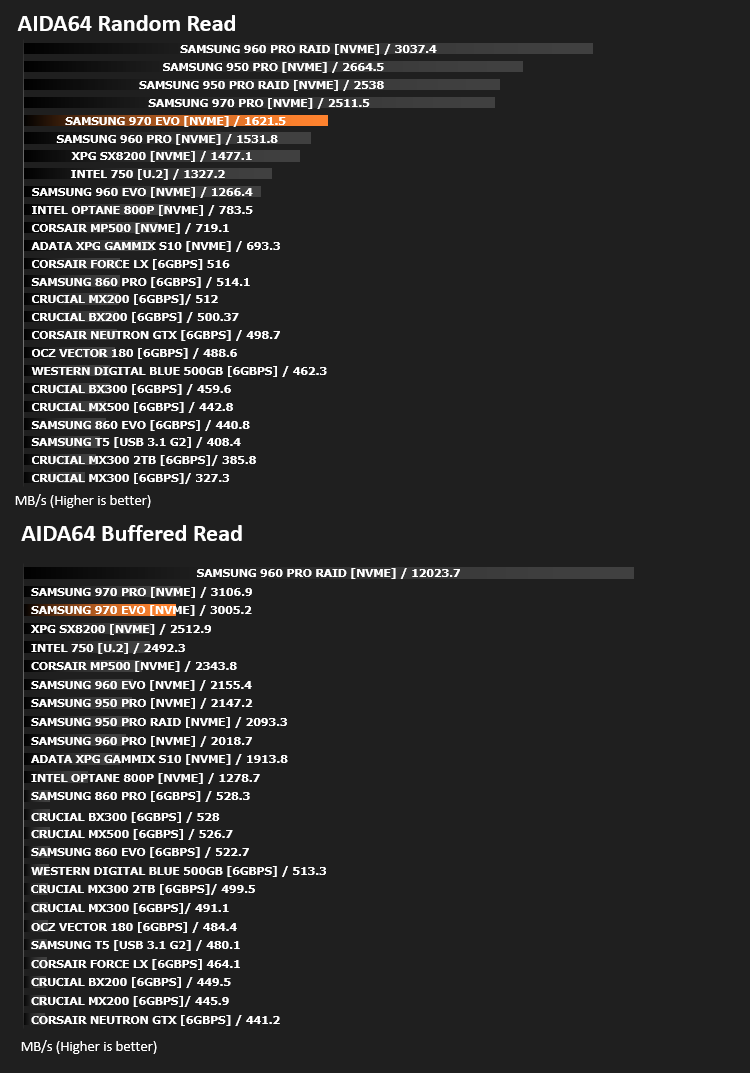
With this module, we can measure the performance of the PC’s storage devices, including (S)ATA or SCSI hard disk drives, RAID arrays, optical drives, solid-state drives (SSD), USB drives and memory cards. It also allows us to perform write tests, which helps us detect fake products and errors on the devices. In order to attain reliable benchmark results we have to make sure to close all background applications.
Benchmarks: PCMark 8
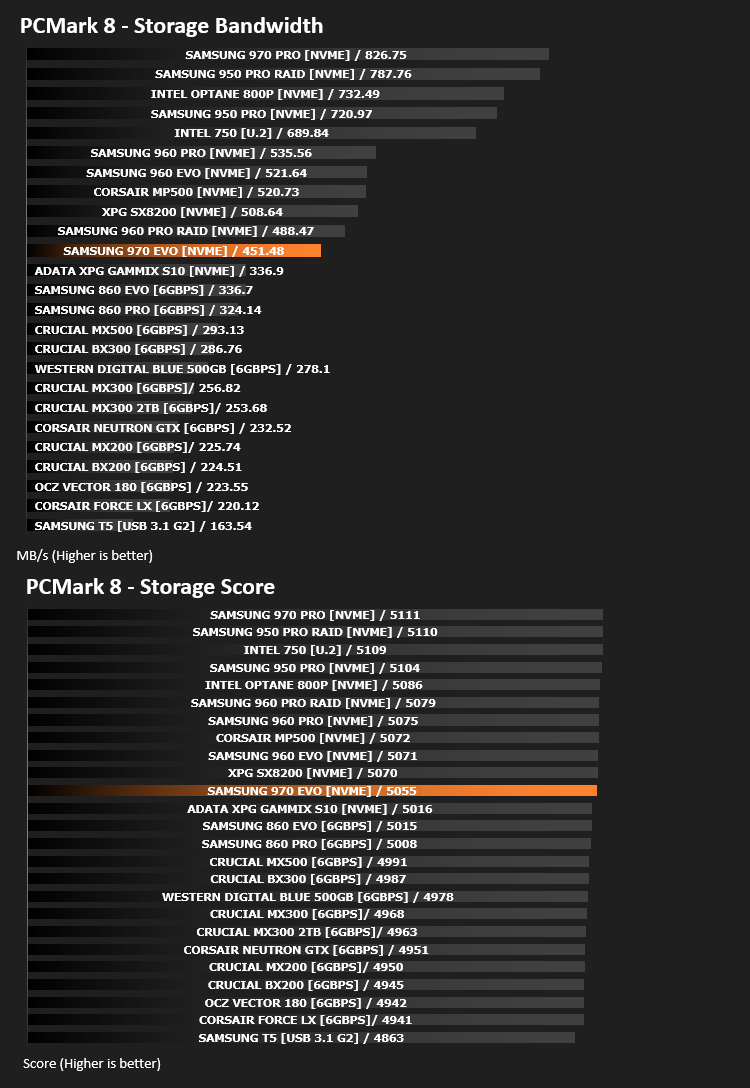
We use the Futuremark PCMark 8 utility to measure storage via Photoshop performance under both light and heavy loading conditions. Accelerated (open CL) is used to perform this test. The test is measured in seconds to complete.
Conclusion
The tests show a distinct increase in speed over the 960 EVO, despite the drop in capacity between the review models, with the 960 EVO being a 500GB drive and therefore featuring higher read/write throughput.AIDA 64 and Anvil Pro both showed some exception results, particularly the 4K QD4 IOPS Write test within the Anvil Pro page, hitting over 180,000 IOPS which is almost 40,000 more than the previous generation.
Price is also much better this generation, with the 250GB arriving with a price tag of only £100, compared to the launch price of the 960 EVO which was closer to the £150 mark. Even the top-tier 2TB drive lands at a relatively cheap price of £709.99.
There’s no questioning the performance of the 970 EVO drive, even in the smallest capacity. The 3-bit V-NAND paired with Samsung’s revised Phoenix controller offers brilliant speeds, both in absolute throughput and IOPS in both directions. The drive is likely best suited to image/video creation scenarios, or where highly storage intensive workloads are common place.
With this latest generation, we also gain some parity in the warranty offered between the EVO and PRO models, both now arriving with a 5-year warranty as standard, instead of the 3-years and 5-years offered on previous EVO and PRO models, respectively.
Considering the price differential between the 970 EVO and PRO, we would have to recommend the EVO every time, unless you explicitly require the raw horsepower of the 970 PRO. Please also bear in mind that the 970 PRO tested is the 1TB model, with optimal performance whereas the 970 EVO is the 250GB version, with some cut backs to absolute throughput as a consequence of the lack of capacity.
If you produce content or just hate waiting around, the Samsung 970 EVO will fulfil your needs, without breaking the bank!
Pros
+ Brilliant performance
+ Lovely black PCB
+ Revised Phoenix controller
+ Samsung Thermal Guard helps prevent throttling
+ 5 years warranty
+ Excellent endurance
Cons
– None
+ Brilliant performance
+ Lovely black PCB
+ Revised Phoenix controller
+ Samsung Thermal Guard helps prevent throttling
+ 5 years warranty
+ Excellent endurance
Cons
– None
Click here for an explanation of our awards at Vortez.net.
Stay connected with the Vortez Social Media pages:
Join in with the discussions on Discord