







In our first look at the AMD R9-285, in the guise of an overclocked sapphire version, we pitch it against both the R9-280 it replaces and the NVIDIA GTX760.

Product On Review: DUAL-X R9 285 2GB GDDR5 OC
Manufacturer: Sapphire
Review Sponsor: AMD
MSRP: $249 / £169.99
Announced at AMD‘s 30 Years of Graphics And Gaming celebration last month, and newly released this week, the Radeon R9 285 is AMD’s first major card launch since the dual-GPU R9 295X2 was released back in April. Indeed it is their new silicon since Hawaii debuted with the Radeon R9 290X in October of last year. All indications are however that this new card isn’t a major architectural revision, instead relied on the tried and tested GCN architecture which served them well through the 7000-series and into the 97 & R9 era, perhaps waiting for a mature 20nm manufacturing node to become available. As a consequence major performance gains from this new GPU, codenamed Tonga, may be too much to expect; AMD have surprised us in the past though.
The Tonga Pro GPU within each R9 285 has specifications quite similar to the (Tahiti Pro-based) Radeon R9 280 it obstensively replaces. In addition to being based on the same 28nm lithography process it also features the same number of shaders, tessellation units, ROPs and an equivalent Z Stenzil Buffer depth as its predecessor. It is also clocked slightly lower and has a narrower memory bus (256bit vs 364bit), and less VRAM overall (2GB vs 3GB). In fact, the only value for which it exceeds the R9 280 is in memory bandwidth (5.5 Gbps vs 5 Gbps).
So if on paper it’s less powerful than the Radeon R9 280, what’s the point? Well, in theory two-fold – as it’s brand a brand new GPU some of the rough edges of the older Tahiti design can be ironed out, allowing for its horsepower to be used more effectively. With an anticipated TDP envelope of only 190W compared to 250W AMD certainly view it as more efficient, and demands only two 6-pin PCIe power connectors as a result.
It’s also the first mid-range AMD GPU to support their TrueAudio Technology. The card therefore has an on-board DSP capable of a significantly more complex soundscape in games, additionally able to reduce CPU load proportionately. Such a card therefore is crucial to showing developers that they’re committed to the technology and pushing it into the hands of customers. Square Enix’s Thief (2014) was the first title to support TrueAudio, whilst the recently released Lichdom: Battlemage leverage’s it in a more significant capacity.
Perhaps therefore we should simply set aside the naming convention, and instead look at its absolute place in the market. It’s priced at £170, comparable with NVIDIA’s GTX 760, and should in theory be ~10-15% faster. Not for the first time therefore AMD is relying on the value of the product to sway customers even if the technology is inherited from previous designs.
Today we’re testing Sapphire’s interpretation of Radeon R9 285’s reference design with bespoke cooler, but it’s notable that AMD’s partners have in the main launched with their own variants offering alternative cooling options and in some cases factory overclocked specifications. Furthermore Sapphire will be releasing a ‘Compact Editon’, reducing the length of the GPU and making it more suitable for cramped system builds without compromising performance. Cards with 4GB VRAM are likely on the way as well, bringing a large frame buffer for more robust performance in high resolution gaming.
Today marks a very important day for AMD graphics. We’re introducing the most compelling product in the market for high resolution gaming with the Radeon R9 285 GPU, and also continuing our dedication to AMD’s Unified Gaming Strategy, with the newest ‘Never Settle’ bundle,” said Matt Skynner, corporate vice president, Computing and Graphics Business, AMD. “These announcements demonstrate our commitment to delivering world-class graphics products and show the strength of our relationship with the world’s most renowned game developers.
Specification
AMD Reference Specification
SKU: Radeon R9 285 2GB
GPU: Tonga Pro
Process: 28nm
Stream Processors: 1792
Engine Clock: Up To 918MHz (controlled by AMD Powertune)
Compute Performance: 3.29 TFLOPS
Texture Units: 112
Texture Fill Rate: Up To 102.8 GT/s
ROPs: 32
Pixel Fill Rate: Up To 29.8 GP/s
Z/Stencil: 128
Memory Configuration: 2GB GDDR5 (4GB variants schedule to become available later)
Memory Interface: 256-bit
Memory Speed: 5.5Gbps
Power Connectors: 2 x 6-pin
Typical Board Power: 190W
PCI-E Standard: PCI-E 3.0
DirectX Support: DirectX 12
Mantle Support: Yes
AMD TrueAudio Technology Support: Yes
GPU: Tonga Pro
Process: 28nm
Stream Processors: 1792
Engine Clock: Up To 918MHz (controlled by AMD Powertune)
Compute Performance: 3.29 TFLOPS
Texture Units: 112
Texture Fill Rate: Up To 102.8 GT/s
ROPs: 32
Pixel Fill Rate: Up To 29.8 GP/s
Z/Stencil: 128
Memory Configuration: 2GB GDDR5 (4GB variants schedule to become available later)
Memory Interface: 256-bit
Memory Speed: 5.5Gbps
Power Connectors: 2 x 6-pin
Typical Board Power: 190W
PCI-E Standard: PCI-E 3.0
DirectX Support: DirectX 12
Mantle Support: Yes
AMD TrueAudio Technology Support: Yes
Sapphire Dual-X OC R9-285 Specification
Display Support 4 x Maximum Display Monitor(s) support
Output 1 x HDMI (with 3D)
1 x DisplayPort 1.2
1 x Dual-Link DVI-D
1 x Dual-Link DVI-I
GPU 965 MHz Core Clock
28 nm Chip
1792 x Stream Processors
Video Memory 2048 MB Size
256 -bit GDDR5
5600 MHz Effective
Dimension 264(L)X113(W)X34(H) mm Size.
2 x slot
Software Driver CD
SAPPHIRE TriXX Utility
Accessory DVI to VGA Adapter
6 PIN to 4 PIN Power Cable x 2
HDMI 1.4a high speed 1.8 meter cable(Full Retail SKU only)
Output 1 x HDMI (with 3D)
1 x DisplayPort 1.2
1 x Dual-Link DVI-D
1 x Dual-Link DVI-I
GPU 965 MHz Core Clock
28 nm Chip
1792 x Stream Processors
Video Memory 2048 MB Size
256 -bit GDDR5
5600 MHz Effective
Dimension 264(L)X113(W)X34(H) mm Size.
2 x slot
Software Driver CD
SAPPHIRE TriXX Utility
Accessory DVI to VGA Adapter
6 PIN to 4 PIN Power Cable x 2
HDMI 1.4a high speed 1.8 meter cable(Full Retail SKU only)
Features
Based on raw specifications alone the Radeon R9 285 compares unfavourably with the R9 280, but in addition to any efficiencies AMD have found in transition from Tahiti Pro to Tonga Pro it should be noted at partners have launched with large factor overclocks, in some instances to over 1GHz on the GPU core. Any attempt to dismiss the new GPU out of hand therefore is unwise.
Of course, as one of the new breed of GCN GPUs the R9 285 also supports Mantle and AMD TrueAudio. By contrast support for Mantle on the R9 280 is less robust, nor does it include the DSP necessary for TrueAudio Technology. The R9 285 therefore is leaner, meaner and more feature-complete than its older sibling.
AMD Crossfire-X
As with the R9-290 and R9-290X, the R9-285 is capable of Crossfire-X without the need for unsightly bridges. AMD CrossFire™ technology is the ultimate multi-GPU performance gaming platform. Unlocking game-dominating power, AMD CrossFire™ harnesses the power of two or more discrete graphics cards working in parallel to dramatically improve gaming performance. With AMD CrossFire™-certified AMD Radeon™ HD graphics cards ready for practically every budget and the flexibility to combine two, three or four GPUs, AMD CrossFire™ is the perfect multi-GPU solution for those who demand the best.
AMD TrueAudio Technology
The news AMD GPUs, including the Radeon R9 285, now incorporate a dedicated onboard Digital Signal Processor. By using this rather than overloading the CPU with ever more complicated soundscapes AMD TrueAudio technology allows for more diverse and directional sound. Robust middleware partner support means that the hardware can be utilised in new and innovative ways. TrueAudio cards don’t replace a soundcard, instead reducing the requirement for CPU resources dedicated to autio tasks.
AMD TrueAudio removes constraints on sound developers by giving sound engineers the freedom to follow their imaginations and the power to make their games sound as convincing as they look. Here are some of the features that make that possible:
– A dedicated digital signal processor (DSP) is built in to the AMD GPU core. That’s a hefty dose of processing power committed just to generating immersive soundscapes. That doesn’t just enable new and exciting audio features in games; it also saves CPU cycles that can be used for other tasks.
– Programmable sound effects bring to audio the same kind of flexibility that programmable shaders brought to graphics. Game developers aren’t stuck with inflexible canned effects anymore. They now have the flexibility to create complex effects and acoustic environments.
– More voice channels and audio objects mean game developers no longer have the unenviable task of determining which sounds are expendable. AMD TrueAudio technology multiplies the number of sounds a game can generate at once, giving developers the capacity to create much more lifelike soundscapes.
– True to life echoes and convolution reverb are finally available on all platforms, meaning programmers can now build these effects into their games rather than relying on basic reverbs. The types of real-world acoustic phenomena that can be faithfully reproduced are massively greater.
– Multi-channel spacialization brings in-headset surround sound with accurate positional audio algorithms to all gamers; not just the ones with the priciest headgear.
By leveraging AMD TrueAudio technology, game developers now have the ability to recreate acoustic environments with incredible fidelity, and to bring them to every gamer. With AMD technology inside all the most popular “next-generation” gaming platforms, including the PC, gamers across the entire industry will finally enjoy the best audio today’s technology can offer.
– A dedicated digital signal processor (DSP) is built in to the AMD GPU core. That’s a hefty dose of processing power committed just to generating immersive soundscapes. That doesn’t just enable new and exciting audio features in games; it also saves CPU cycles that can be used for other tasks.
– Programmable sound effects bring to audio the same kind of flexibility that programmable shaders brought to graphics. Game developers aren’t stuck with inflexible canned effects anymore. They now have the flexibility to create complex effects and acoustic environments.
– More voice channels and audio objects mean game developers no longer have the unenviable task of determining which sounds are expendable. AMD TrueAudio technology multiplies the number of sounds a game can generate at once, giving developers the capacity to create much more lifelike soundscapes.
– True to life echoes and convolution reverb are finally available on all platforms, meaning programmers can now build these effects into their games rather than relying on basic reverbs. The types of real-world acoustic phenomena that can be faithfully reproduced are massively greater.
– Multi-channel spacialization brings in-headset surround sound with accurate positional audio algorithms to all gamers; not just the ones with the priciest headgear.
By leveraging AMD TrueAudio technology, game developers now have the ability to recreate acoustic environments with incredible fidelity, and to bring them to every gamer. With AMD technology inside all the most popular “next-generation” gaming platforms, including the PC, gamers across the entire industry will finally enjoy the best audio today’s technology can offer.
Mantle
Mantle is AMD’s low-level graphics API which is supported by much of their new GCN-based graphics hardware. It works to reduce driver overhead and make the CPU less of a bottleneck, also improving multi-core utilisation in the process. The resultant benefit is a reduced frame to frame time, not only improving average frame rates but also exhibiting a smoother frame rate experience.
From a game developer’s point of view, creating games for the PC has never been especially efficient. With so many combinations of hardware possible in a PC, it’s not practical to create specialized programming for every possible configuration. What they do instead is write simplified code that gets translated on-the-fly into something the computer can work with.
Just as when two people communicate through a translator, this works, but it isn’t efficient. And it’s the CPU that has to do all this extra work, translating and queuing data for the graphics card to process. PCs are meant to be the ultimate gaming platform — they have the power — but all this translation slows things down, and game developers approached AMD asking for something better.
What Mantle does
Mantle is the harmony of three essential ingredients:
– A driver within the AMD Catalyst™ software suite that lets applications speak directly to the Graphics Core Next architecture;
– A GPU or APU enabled with the Graphics Core Next architecture;
– An application or game written to take advantage of Mantle.
Mantle reduces the CPU’s workload by giving developers a way to talk to the GPU directly with much less translation. With less work for the CPU to do, programmers can squeeze much more performance from a system, delivering the greatest benefits in gaming systems where the CPU can be the bottleneck.
What it means for gamers
Now that Mantle has freed up some extra CPU capacity, we expect Mantle will lead to better games, and more of them, since Mantle makes game development easier.
That’s not all Mantle will do for gamers. By shifting work to the GPU, a mid-range or older CPU isn’t the same handicap it was before. With Mantle, the GPU becomes the critical part of the system, and GPU upgrades will have a bigger impact than before.
Just as when two people communicate through a translator, this works, but it isn’t efficient. And it’s the CPU that has to do all this extra work, translating and queuing data for the graphics card to process. PCs are meant to be the ultimate gaming platform — they have the power — but all this translation slows things down, and game developers approached AMD asking for something better.
What Mantle does
Mantle is the harmony of three essential ingredients:
– A driver within the AMD Catalyst™ software suite that lets applications speak directly to the Graphics Core Next architecture;
– A GPU or APU enabled with the Graphics Core Next architecture;
– An application or game written to take advantage of Mantle.
Mantle reduces the CPU’s workload by giving developers a way to talk to the GPU directly with much less translation. With less work for the CPU to do, programmers can squeeze much more performance from a system, delivering the greatest benefits in gaming systems where the CPU can be the bottleneck.
What it means for gamers
Now that Mantle has freed up some extra CPU capacity, we expect Mantle will lead to better games, and more of them, since Mantle makes game development easier.
That’s not all Mantle will do for gamers. By shifting work to the GPU, a mid-range or older CPU isn’t the same handicap it was before. With Mantle, the GPU becomes the critical part of the system, and GPU upgrades will have a bigger impact than before.
4K Ultra HD Gaming
FullHD 1920×1080 has become the industry standard within the display industry, but enthusiasts will never settle for just standard and are always looking for the next big innovation in technology. Ultra HD gaming is the next evolution in immersion that gamers have been waiting for.
Commonly addressed as Ultra HD, UHD or 4K, this new resolution refers to the ultra-high resolutions with approximately 4000 horizontal pixels. Ultra HD resolution also has four times the number of pixels of a typical 1920×1080 resolution.
With four times the pixels, an unprecedented level of immersion can be created for gamers on a single display. Gamers will be able to experience richer details and a new sense of realism with the next generation of gaming on Ultra HD displays.
Your AMD Radeon™ R9 290X features support for Ultra HD resolutions over both HDMI 1.4b (low refresh) and DisplayPort 1.2. We recommend you do all performance testing at Ultra HD resolution to truly test what the product is capable of.
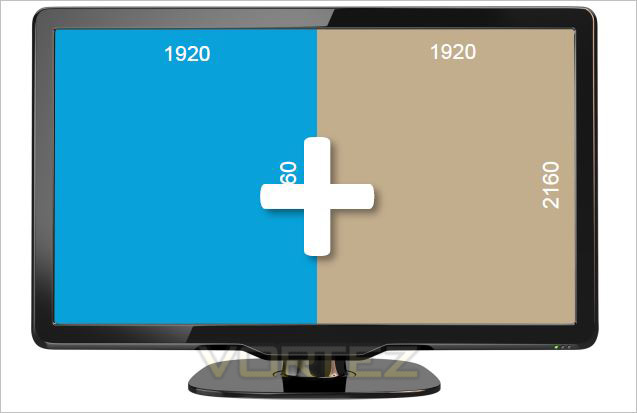
Many UltraHD/4K monitors can achieve a 60 Hz refresh rate using a tiled display configuration. AMD Eyefinity technology can be leverage to support these tiled displays by making two 2Kx2K tiles act as one 4Kx2K monitor. AMD has taken steps to make this easy for end users by providing an Automatic AMD Eyefinity Configuration features. This feature allows an automatic “plug and play” configuration of supported UltraHD/4K tiled displays when a Display Port cable is connected.
When a user hotplugs a tiled 4K monitor (such as the Sharp PN-K321 or Asus PQ321Q), a 2×1 display group will be automatically created and the two tiles will be combined to act as one monitor. This configuration will be remembered and re-enabled when the display is unplugged or the system is rebooted. It is also possible to manually disable the display group in CCC, and have the two tiles act as independent monitors. It should be noted that once the display group is manually disabled, it can no longer be automatically configured as a tiled display via the Automatic AMD Eyefinity Configuration feature.
Additionally, AMD is supporting a new industry standard for tiled displays in VESA DisplayID v1.3. The “Tiled Display Topology Data Block” describes additional display capabilities that can be leveraged to enable the plug and play experience with tiled displays. Tiled displays supporting this data block can be supported by the Automatic AMD Eyefinity Configuration with no driver update required.
Commonly addressed as Ultra HD, UHD or 4K, this new resolution refers to the ultra-high resolutions with approximately 4000 horizontal pixels. Ultra HD resolution also has four times the number of pixels of a typical 1920×1080 resolution.
With four times the pixels, an unprecedented level of immersion can be created for gamers on a single display. Gamers will be able to experience richer details and a new sense of realism with the next generation of gaming on Ultra HD displays.
Your AMD Radeon™ R9 290X features support for Ultra HD resolutions over both HDMI 1.4b (low refresh) and DisplayPort 1.2. We recommend you do all performance testing at Ultra HD resolution to truly test what the product is capable of.
Many UltraHD/4K monitors can achieve a 60 Hz refresh rate using a tiled display configuration. AMD Eyefinity technology can be leverage to support these tiled displays by making two 2Kx2K tiles act as one 4Kx2K monitor. AMD has taken steps to make this easy for end users by providing an Automatic AMD Eyefinity Configuration features. This feature allows an automatic “plug and play” configuration of supported UltraHD/4K tiled displays when a Display Port cable is connected.
When a user hotplugs a tiled 4K monitor (such as the Sharp PN-K321 or Asus PQ321Q), a 2×1 display group will be automatically created and the two tiles will be combined to act as one monitor. This configuration will be remembered and re-enabled when the display is unplugged or the system is rebooted. It is also possible to manually disable the display group in CCC, and have the two tiles act as independent monitors. It should be noted that once the display group is manually disabled, it can no longer be automatically configured as a tiled display via the Automatic AMD Eyefinity Configuration feature.
Additionally, AMD is supporting a new industry standard for tiled displays in VESA DisplayID v1.3. The “Tiled Display Topology Data Block” describes additional display capabilities that can be leveraged to enable the plug and play experience with tiled displays. Tiled displays supporting this data block can be supported by the Automatic AMD Eyefinity Configuration with no driver update required.
First Look
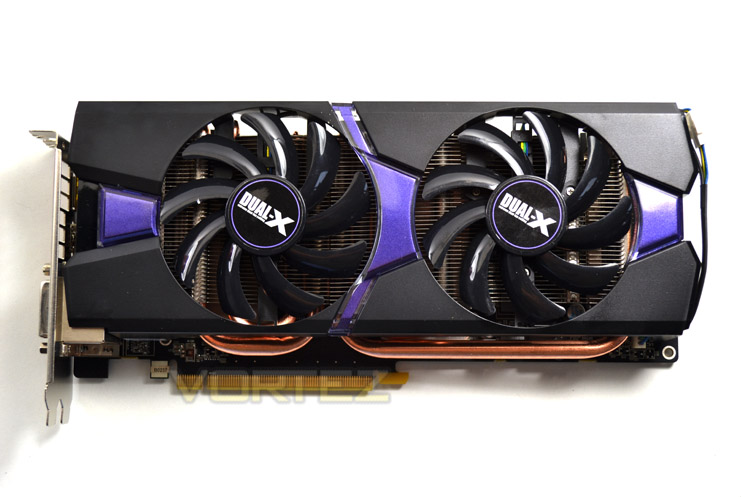
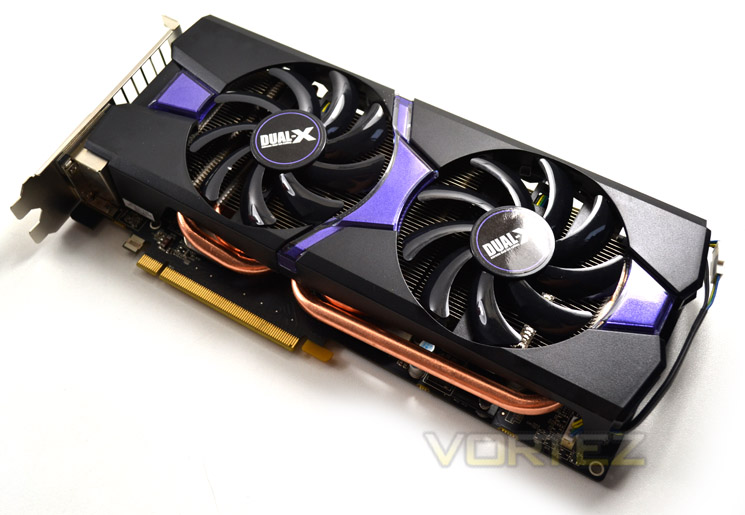
The first thing you will come to realise when shopping for the R9-285 is that there are no reference designs per say. This is especially so with the cooling as each manufacturer will adapt there own existing designs to fit onto the new card. In this case, Sapphire have made use of there Dual-X cooler which as the name suggests, uses twin fans as the basis for moving air over the heatsink hidden away beneath. It has to be said that the contrasting metallic purple and matt black design is very attractive and is a definite break from the normal black/red designs that are now common place among custom cooling designs.
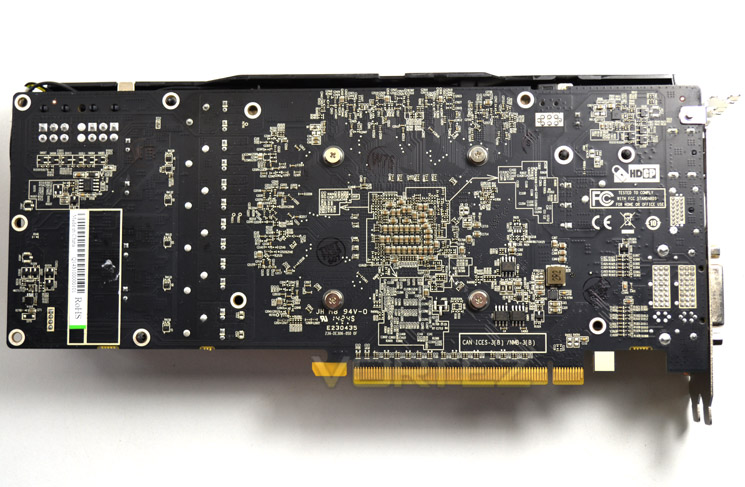
The good news continues here too as Sapphire have had the foresight to ensure the power circuit board is black. Any PCB other than black is a pet hate of ours at Vortez, not because we have a fondness for black but because pcb colouration can disrupt a PC’s colour scheme which is becoming almost as important as the components contained within.
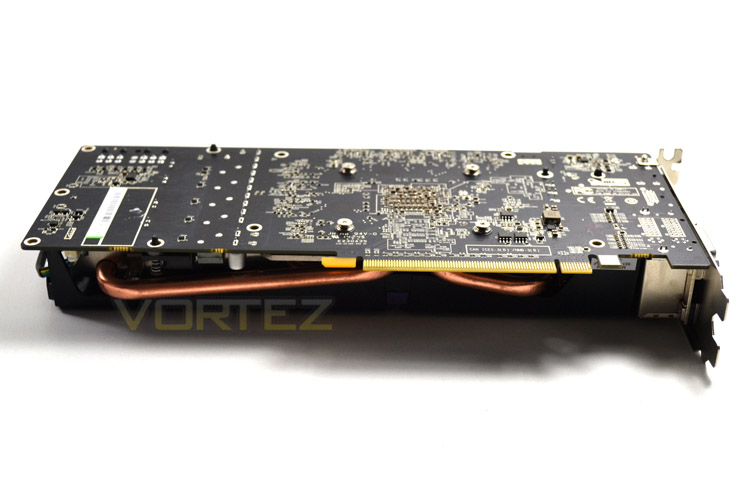
Rather than having the heatpipe exposed on the outer/visible edge, Sapphire have made sure the neat design is continued and hidden away the obtrusiveness of the cooling.
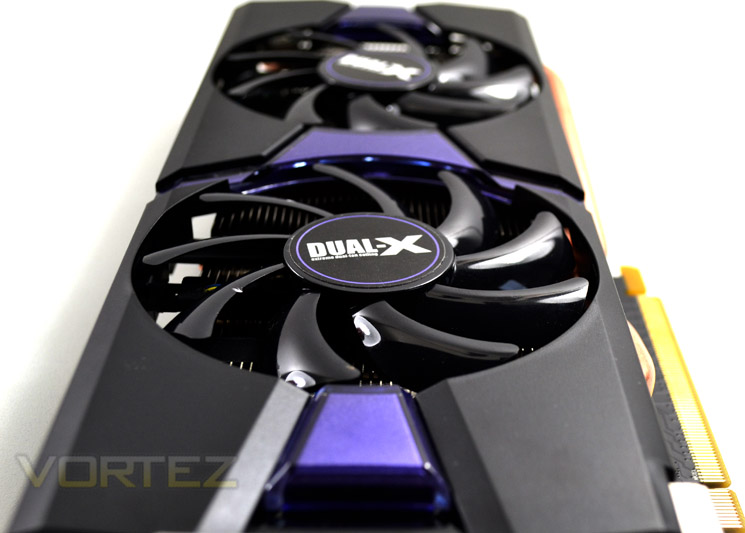
The graphics card measures 264(L) X113(W) X 34(H) mm making this a twin port cooler that is a little shorter on average than the R9-280 which is sure to please the mATX users among us.
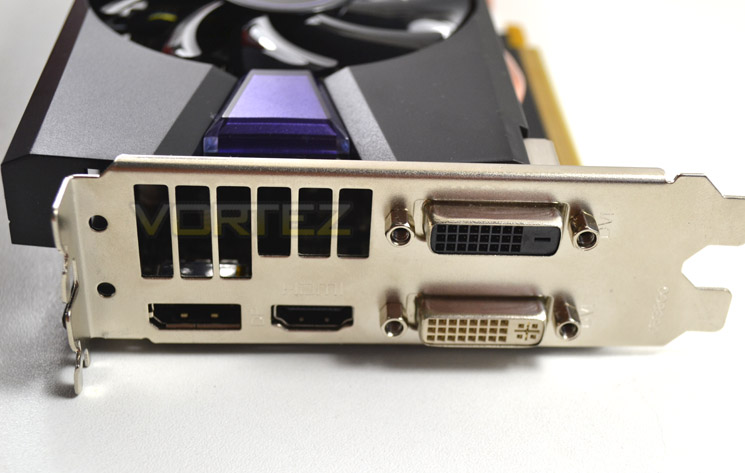
the standard array of ports are available on the R9-285:
1 x HDMI (with 3D)
1 x DisplayPort 1.2
1 x Dual-Link DVI-D
1 x Dual-Link DVI-I
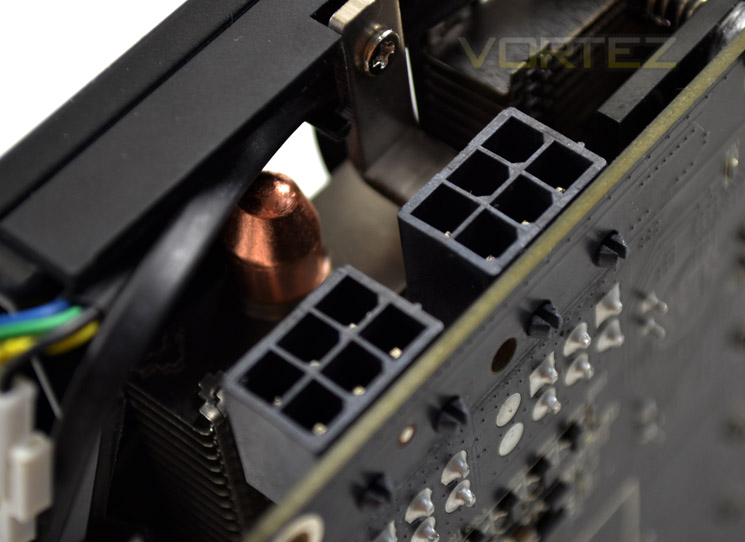
Power is supplied through twin 75W 6-pin PCIe cables. Sapphire recommend a PSU capable of 500W for a single GPU system and 850W for Crossire-X.
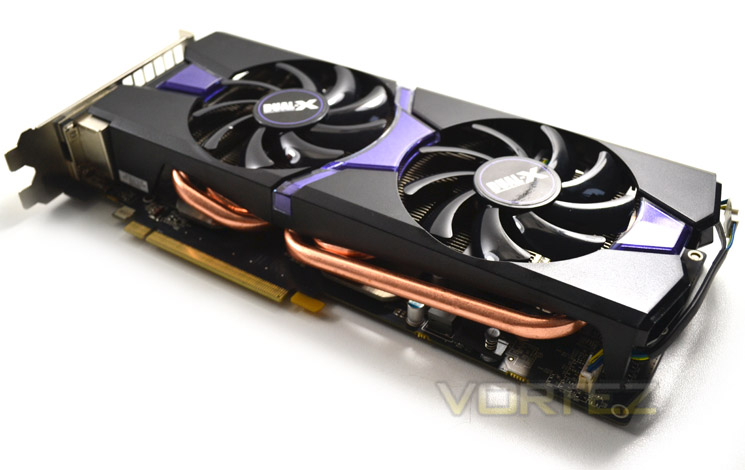
Overall, the Sapphire card impressed visually. We especially liked the purple and black theme Sapphire have going on with this card which is a refreshing and welcome change. Another bonus is the reduction in length how this card will still take up two motherboard slots.
Let’s take a closer look…
Closer Look
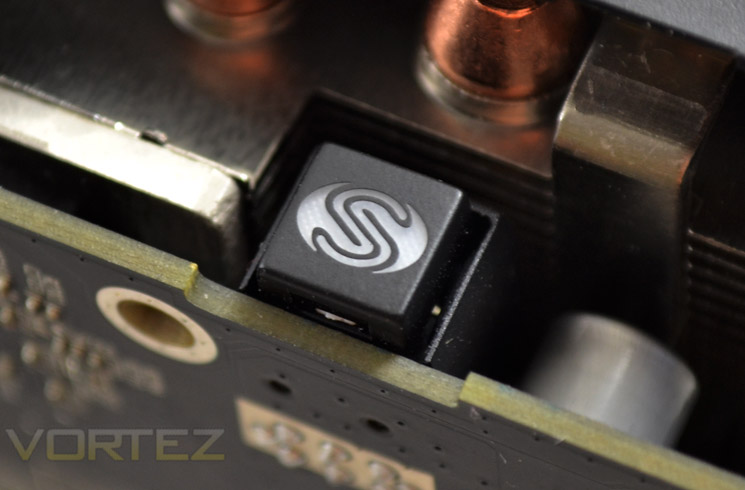
There’s BIOS switch allows the user to select either legacy or UEFI compatibility modes and as an added bonus, the end user can use the switch to flash a custom BIOS while still retaining the safety of the original BIOS which is a great feature and one we wish all cards had.
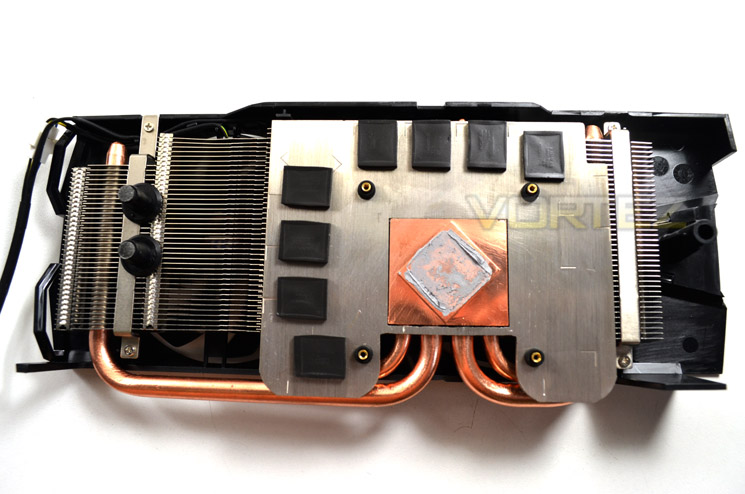
Removing the cooler was a simple task of removing 4 spring-loaded screws. Our sample did not come with any ‘warranty void if removed’ stickers but we would advise you check with your local vendor to ensure this is the case should you wish to apply your own thermal interface material or perhaps add a GPU waterblock.
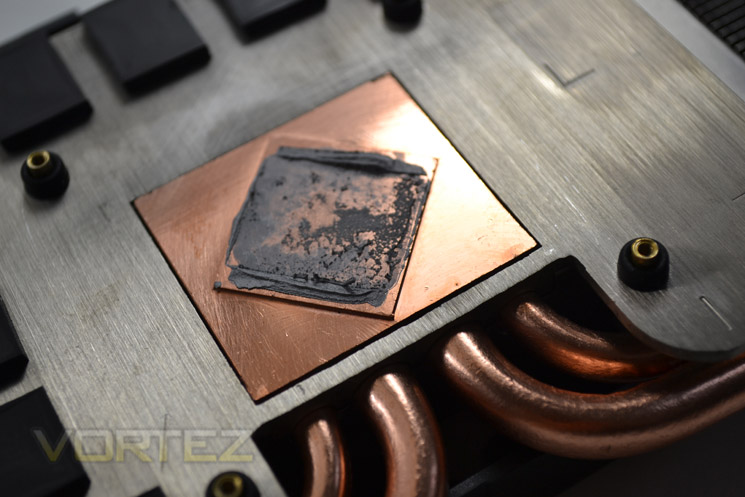
The heatsink itself is made up of a direct contact copper plate which is soldered to four copper heatpipes. These heatpipes stretch out amongst the aluminium finned heatsink array to best dissipate heat produced by the GPU core.
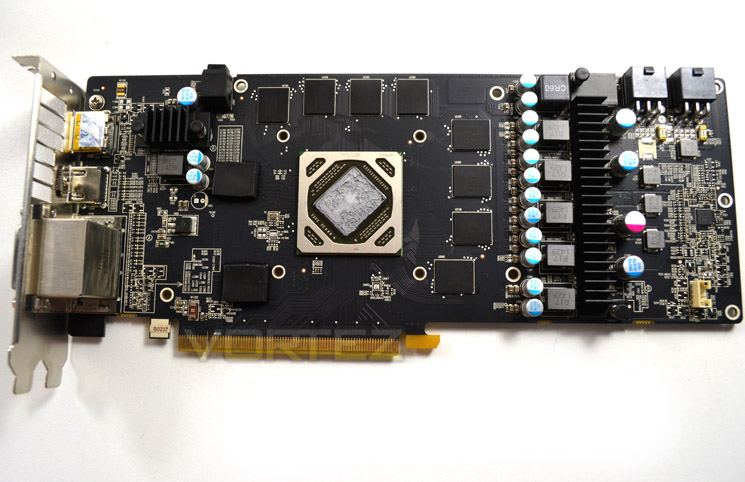
Note the distinct lack of memory here. 2GB we feel is enough for 1080p gaming but any higher than this, especially if you like to add all the ‘bells and whistles’, you would do well to consider and card with more vRam. Also note the heatsinks added to both sets of the VRM which are not cooled directly by the main heatsink assembly.
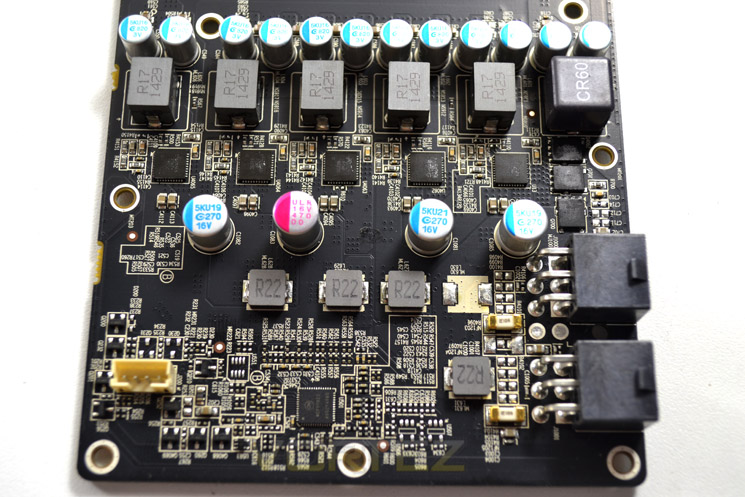
The voltage regulation module is made up of a 6+1 power phase design using DrMOS components. The NCP81022 voltage controller takes care of these voltages which also allow minor voltage changes via Software for overclocking purposes.
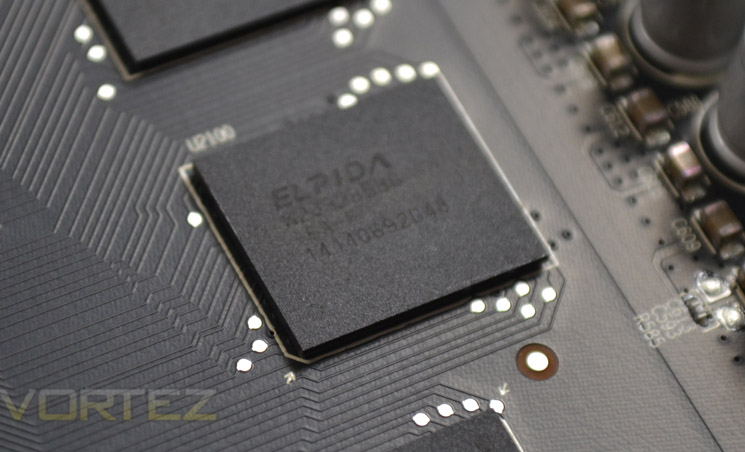
The GDDR5 memory in use comes courtesy of Elpida and carries the product code of W2032BBBG 6A-F meaning they are rated to run at 1500 MHz (6000 MHz GDDR5 effective).
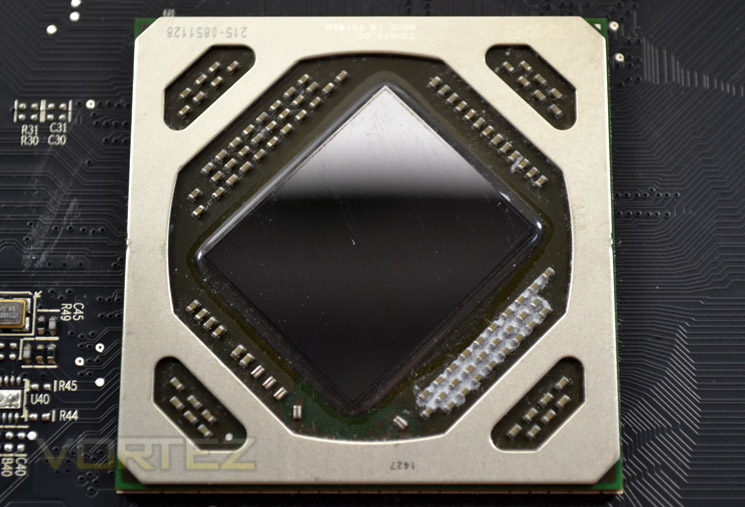
With a transister count around the 5bn count and a die size of 359mm², the new Tonga core utilises a revised version of Graphics Core Next architecture along with a surprising decrease in memory bus-width. This is slightly larger than the Tahiti core it replaces which does present the question of what else is hidden in the core? We suspect a ‘full fat’ version is on the cards which could well be a retaliatory shot being held in reserve for the impending refresh of the NVIDIA GPU family. So with AMD keeping their cards close to their chest, only time will tell the true extent of the Tonga design and capabilities.
Testing Methodology and Benching System
How we test graphics cardsTesting a graphics card is an extremely lengthy process. We sometimes see reviews where a graphic card has been tested using out of date equipment, out of date games and even out of date drivers. While the latter can be excused due to the sheer amount of driver updates making a thorough review impossible we will however notify the reader when we have used a different driver to the normal for example a pre-release driver. For the most part however we will always use the same hardware and latest drivers so this does certainly need to be taken into consideration when viewing our testing results. Each game and benchmark is tested times with the lowest and highest scores omitted out of the 5 results and the average then taken from the three remaining to give us our final result for each resolution and setting used.
Frame Time Analysis
We have also seen the emergence of frame time analysis. We covered this in a separate article here: GPU Reviews: Why Frame Time Analysis is important so we won’t go into the reasoning again but to summarise, our testing comprises both FPS testing and perhaps arguably more importantly, frame time analysis. We also look at overall performance by equating averages across the games and finally before concluding our review we take a look at value for money.
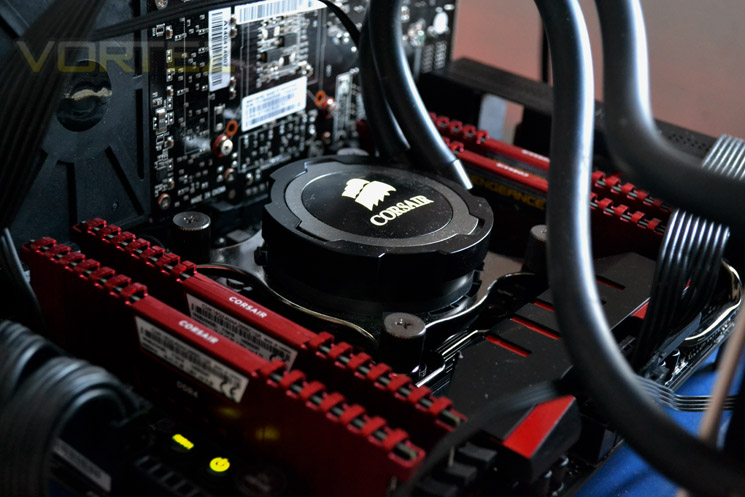
HardwareWith the latest Intel chipset release we decided to update our ageing X79 setup to the very latest X99 chipset. Not only that but we will be using the flagship Core i7-5960X Extreme Edition processor clocked to a realistic, achieveable 4GHz to ensure we have no CPU bottlenecks. With 16GB (4x4GB) of GDDR4 at 2666MHz and a 500GB SSD there should be minimal paging so the benchmarks we run today will hopefully give a true reflection of the graphics card’s performance.
High End Graphics cards on test:
SAPPHIRE DUAL-X OC R9-285 OC
(Catalyst 14.3) XFX R9-280 Black Edition OC 3GB GDDR5(Catalyst 14.3)
PALIT GTX 760GB 2GB GDDR5(Forceware 340.52)
Special thanks go to Intel, Corsair, MSI and AOC for providing the extreme spec components used for our test bench:
Motherboard: MSI X99S GAMING 9 AC
CPU: Intel Core i7-5960X Extreme Edition @ 4GHz
RAM – 16GB (4x4GB) Corsair LPX Vengeance (Red) DDR3 @ 2666MHz 16-17-17-35 C1
Power Supply – CORSAIR RM Series™ RM1000
Hard Drive – CORSAIR Force Series™ LX 512GB SATA 3 6Gb/s SSD
Cooler – CORSAIR Hydro Series™ H105 240mm Extreme Performance Liquid CPU Cooler
Monitor – AOC 28″ 4K U2868 PQU
CPU: Intel Core i7-5960X Extreme Edition @ 4GHz
RAM – 16GB (4x4GB) Corsair LPX Vengeance (Red) DDR3 @ 2666MHz 16-17-17-35 C1
Power Supply – CORSAIR RM Series™ RM1000
Hard Drive – CORSAIR Force Series™ LX 512GB SATA 3 6Gb/s SSD
Cooler – CORSAIR Hydro Series™ H105 240mm Extreme Performance Liquid CPU Cooler
Monitor – AOC 28″ 4K U2868 PQU
Benchmarks
If you are a regular reader of our reviews you will know we like to test the latest hardware with the latest games and benchmarks on the market. Here are the games we have chosen:
Battlefield 4
Watchdogs
Company of Heroes 2
Thief
GRID: 2
Metro: Last Light
Watchdogs
Company of Heroes 2
Thief
GRID: 2
Metro: Last Light
We also take into consideration the benchmarkers out there so have included 3 of the more popular synthetic benchmarks available:
Unigine: Valley
Unigine: Heaven 4
Futuremark 3DMark Firestrike
Unigine: Heaven 4
Futuremark 3DMark Firestrike
Let’s see how today’s graphics card performed…
Temperature, Acoustics and Power Consumption
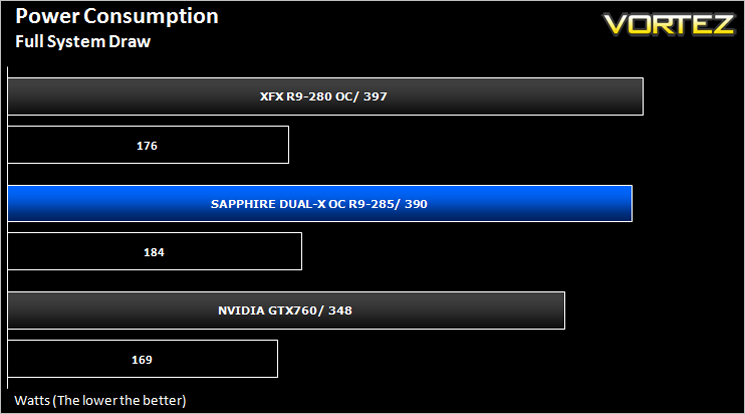
Power ConsumptionTo test for power consumption we take a measurement from the plug socket. It is important to note that the figures below represent total system power use and not just the GPU. The CPU was always in a fixed state (4GHz overclock) so did not affect the additional power load when the GPU was placed under 100% load using Furmark which was ran for 15 minutes at which point a load reading was taken. Idle readings were taken 5 minutes after system boot to ensure any background services and applications had loaded.
Temperature
To test temperatures we measured idle temperatures after booting windows, letting all applications finish loading and ran a few benchmarks. Once the benchmarks were complete we left the card to reach a cooling plateau where we then took the idle temperatures. For the load tests, we would normally run Furmark for 20 minutes, taking the absolute maximum temperature attained however we found that this throttled the card and resulted in spurious results. So we set Heaven running continuously for 20 minutes and used this as a temperature result as the card did not throttle with this application.
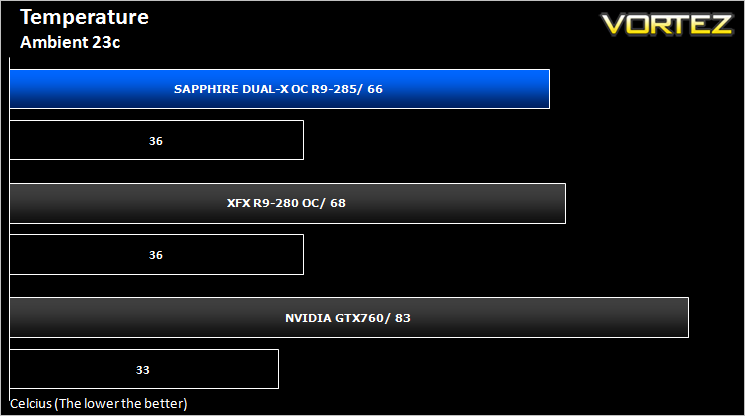
The R9-285 was the coolest card on test. Whether this is a result of the power efficiency of the card of the Sapphire Dual-X cooler is hard to say however at 66c load temp we have zero complaints.
Acoustics
Even under 100% load the card barely raised a murmur. The graphics card was very quiet under all nominal operating conditions save for manually adjusting the fan speed to 100% which did begin to whine a little.
Overclocking
For overclocking today’s sample we will be using Sapphire’s TRIXX tool as this gives us all of the options we require included the additional voltage controls.
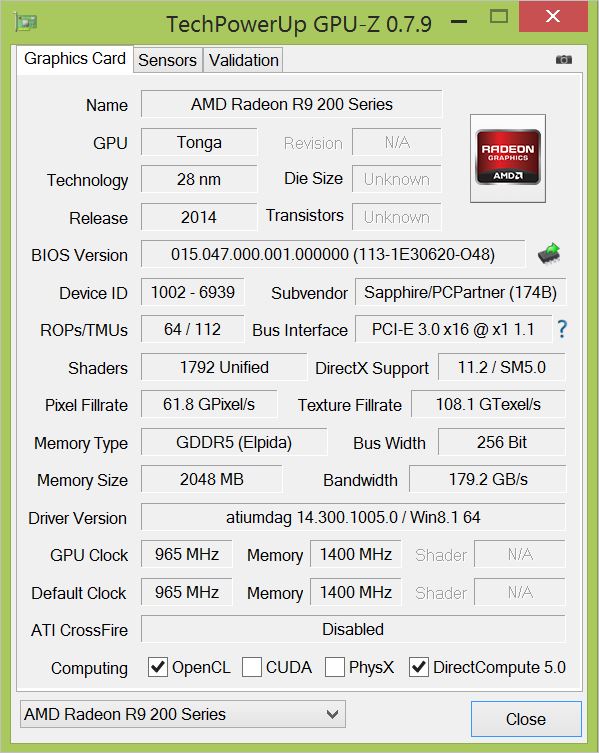
Above is a screenshot of GPU-Z showing the reference (factory overclocked) settings.
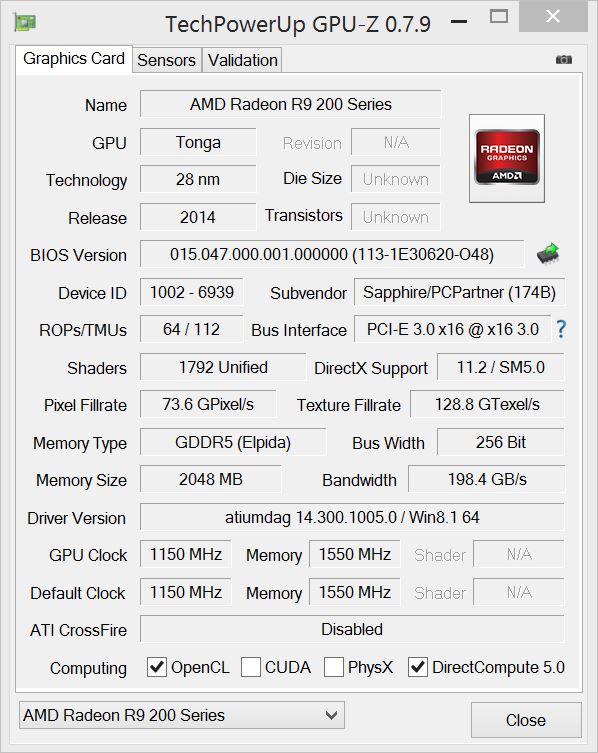
…and manually attained overclock speeds.
Overclocking the Sapphire R9-285 was very easy. The core topped out at 1150MHz which left us little to play with. We would have liked more headroom on the R9-285 and we suspect there will be in latter editions. Memory was a more interesting result in that it did give us a little extra to play with, it was very stubborn. We would have preferred to see SKHynix used which tends to overclock better but the Elpida was still adequate and presented some fun while it lasted.
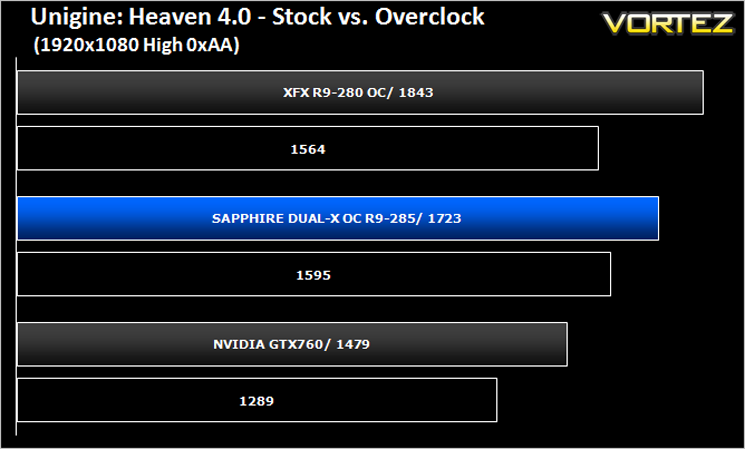
Above we can see the resulting performance increase of the overclock via Unigine Heaven 4.0.
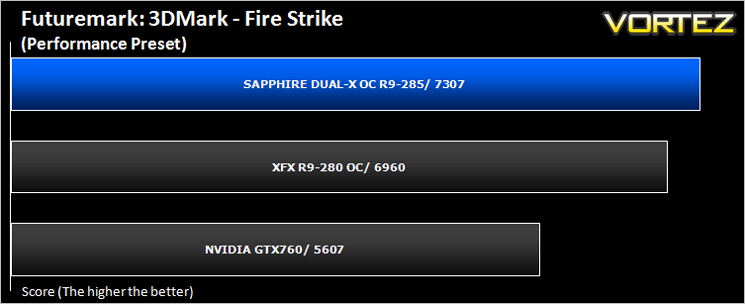
Futuremark 3DMark Fire Strike (Synthetic)
Fire Strike is the new showcase DirectX 11 benchmark designed for high-performance gaming PCs. It is Futuremark’s most ambitious and technical benchmark ever, featuring real-time graphics rendered with detail and complexity far beyond what is found in other benchmarks and games today.
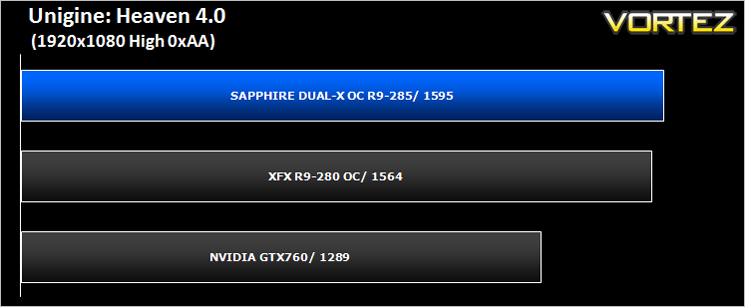
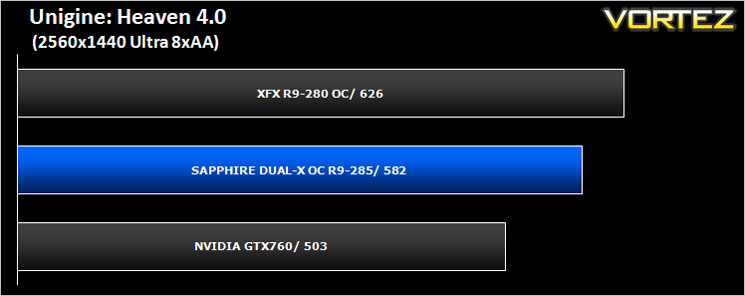
Unigine: Heaven 4 (Synthetic)
Heaven Benchmark with its current version 4.0 is a GPU-intensive benchmark that hammers graphics cards to the limits. This powerful tool can be effectively used to determine the stability of a GPU under extremely stressful conditions, as well as check the cooling system’s potential under maximum heat output. It provides completely unbiased results and generates true in-game rendering workloads across all platforms.
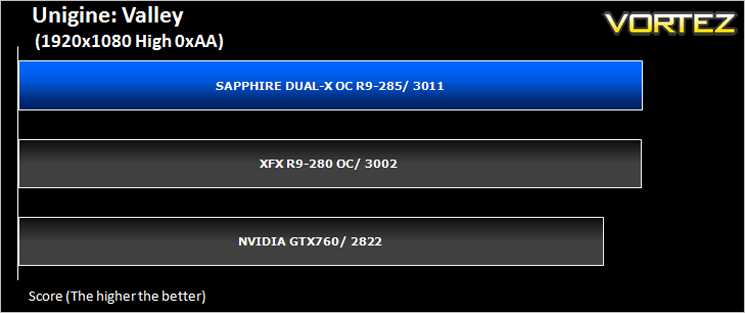
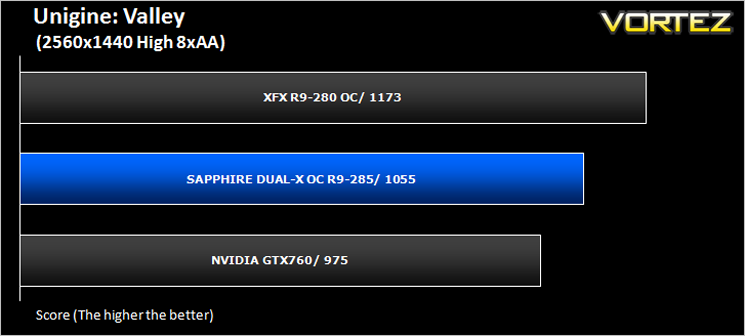
Unigine: Valley (Synthetic)
Valley Benchmark is a new GPU stress-testing tool from the developers of the very popular and highly acclaimed Heaven Benchmark. The forest-covered valley surrounded by vast mountains amazes with its scale from a bird’s-eye view and is extremely detailed down to every leaf and flower petal. This non-synthetic benchmark powered by the state-of-the art UNIGINE Engine showcases a comprehensive set of cutting-edge graphics technologies with a dynamic environment and fully interactive modes available to the end user.
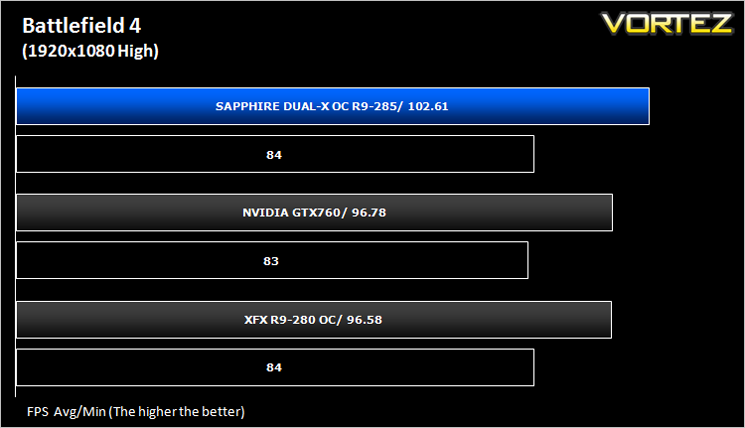
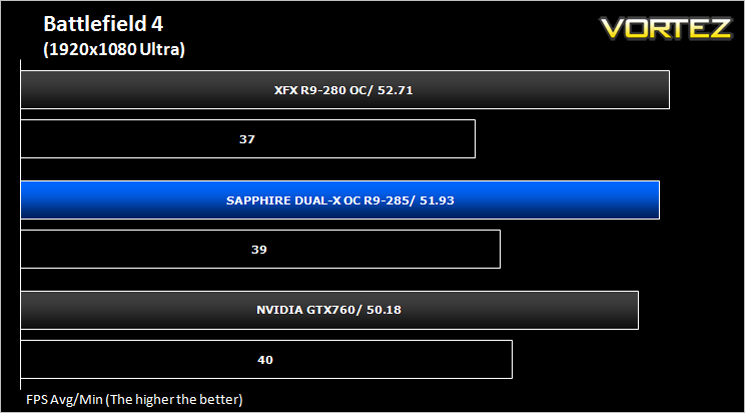
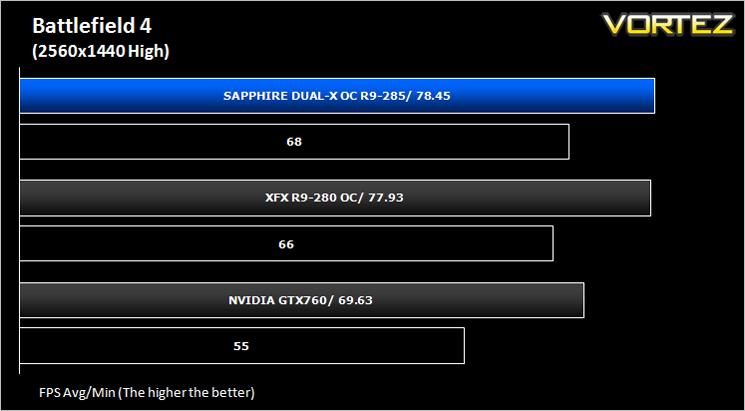
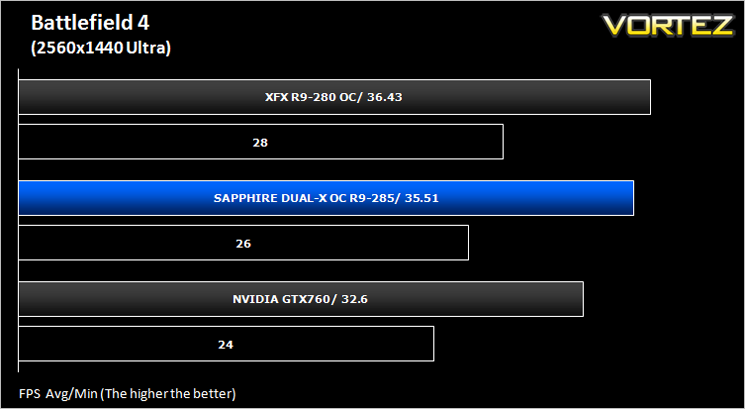
Battlefield 4 (FPS)
Battlefield 4 is a 2013 first-person shooter video game developed by Swedish video game developer EA Digital Illusions CE (DICE) and published by Electronic Arts. It is a sequel to 2011’s Battlefield 3 and is perhaps currently the most popular online First Person Shooter for PC gamers. It has an extremely powerful gaming engine that will stress components more than most FPS titles available.
Watchdogs (Action/Adventure)
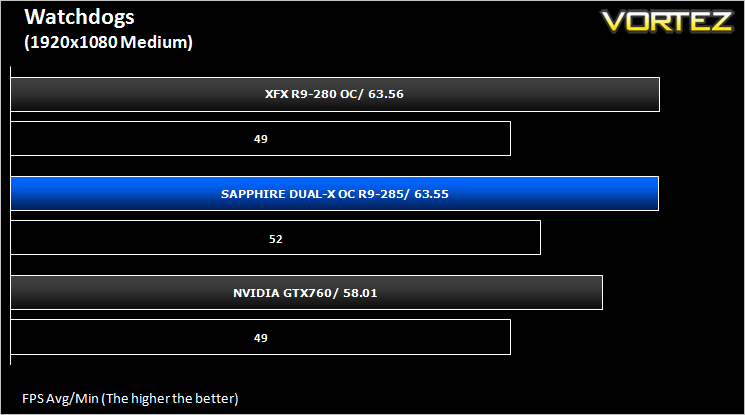
Watch Dogs is a 2014 open world action-adventure video game developed by Ubisoft Montreal and published by Ubisoft. Set within a fictionalized version of Chicago, Illinois, the single-player story follows a hacker and his efforts to seek revenge after the accidental death of his niece. The open world design lets players freely roam Chicago, which includes the urban city, open countryside, and slums. The game is played from a third-person perspective and its world is navigated on-foot or by vehicle. As such this is a very demanding game, especially when graphical options are turned up.
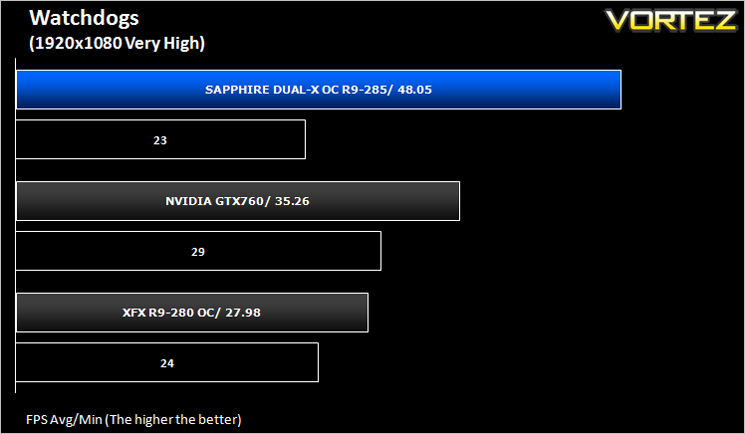
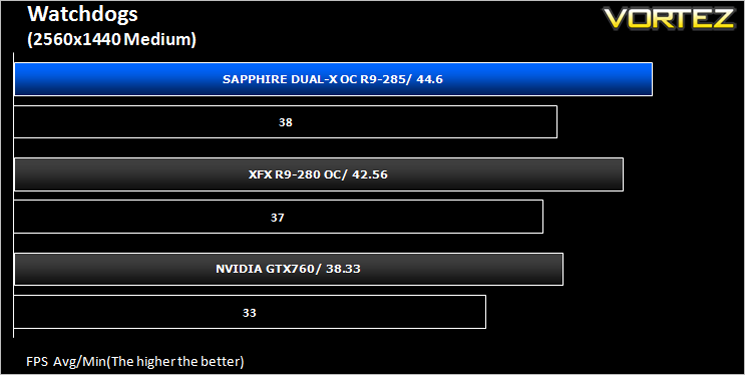
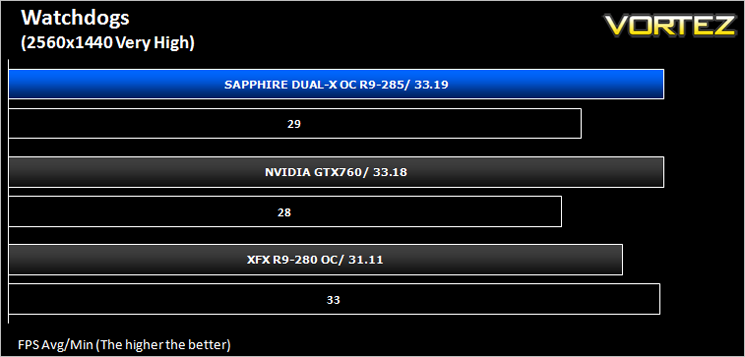
Thief (Stealth)
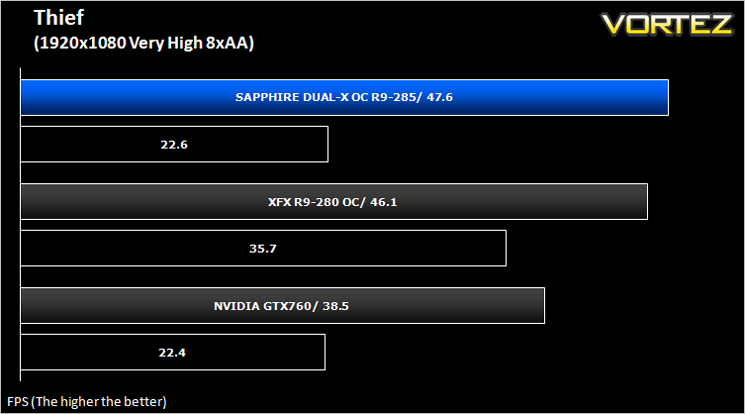
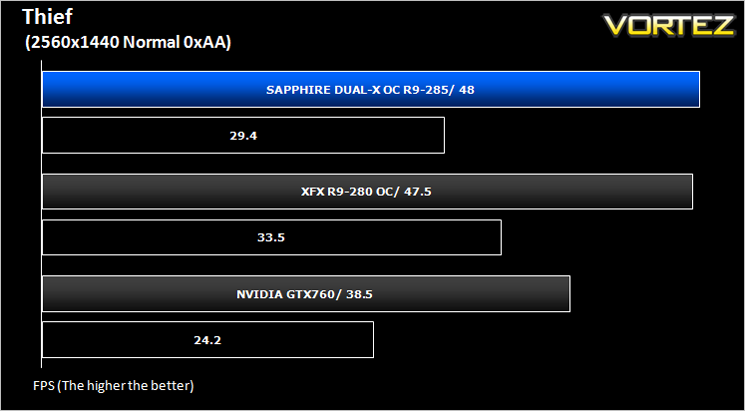
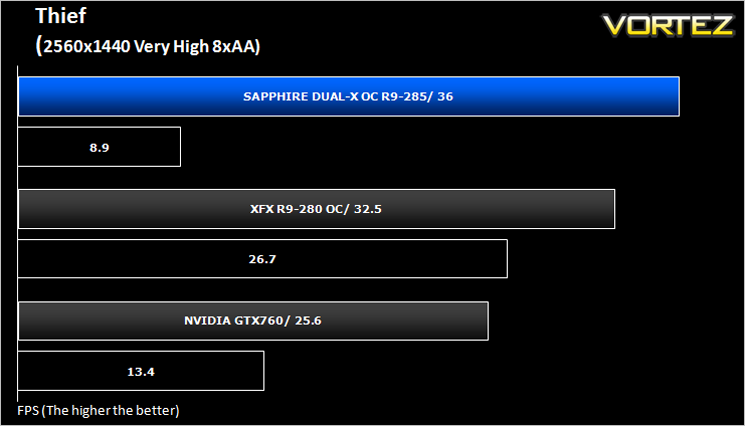
Thief is a stealth video game developed by the Canadian video game developer Eidos Montreal, and published by Square Enix. It is a revival of the cult classic Thief series of stealth games, of which it is the fourth game. Thief is set in a dark fantasy world inspired by Victorian, gothic, and steampunk aesthetics. Using a modified version of the Unreal Engine 3 it makes for a challenging game to pitch against our range of components.
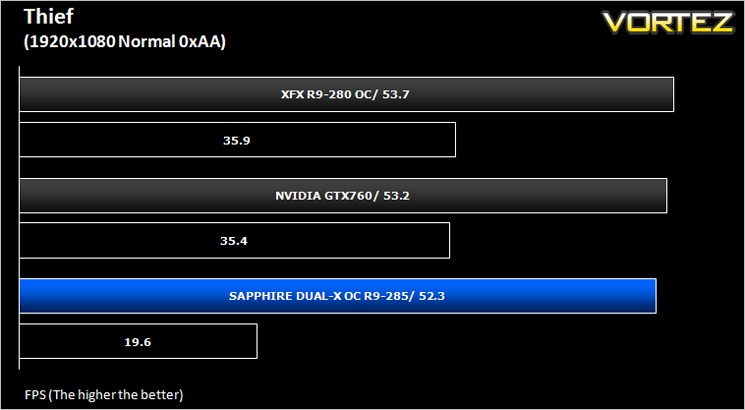
Company of Heroes 2 (RTS)
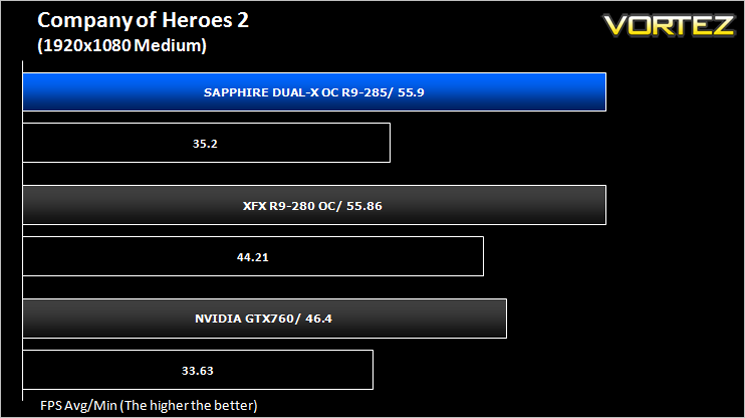
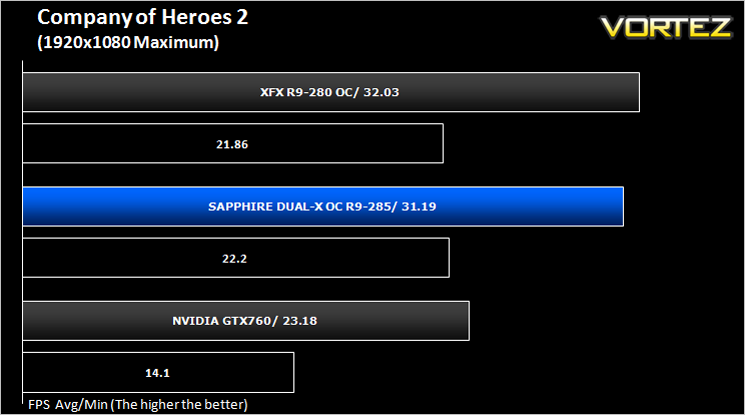
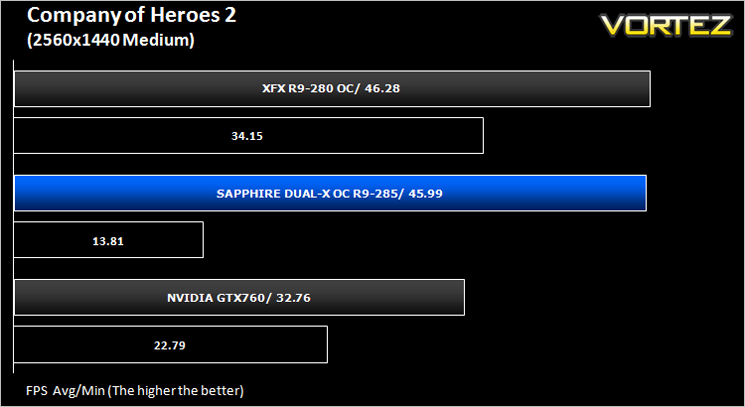
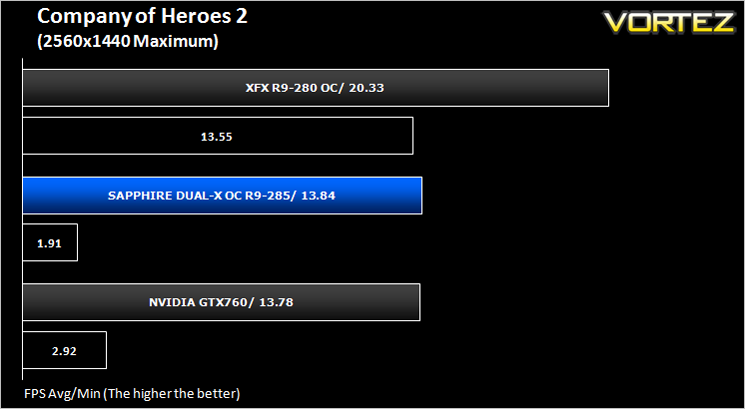
Company of Heroes 2 is a real-time strategy video game developed by Relic Entertainment. It is the sequel to the critically acclaimed 2006 game Company of Heroes.As with the original Company of Heroes, the game is set in World War II but with the focus on the Eastern Front, with players primarily controlling the side of the Soviet Red Army during various stages of the Eastern Front, from Operation Barbarossa to the Battle of Berlin. Company of Heroes 2 runs on Relic Entertainment’s proprietary Essence 3.0 game engine and is extremely demanding of both CPU and GPU.
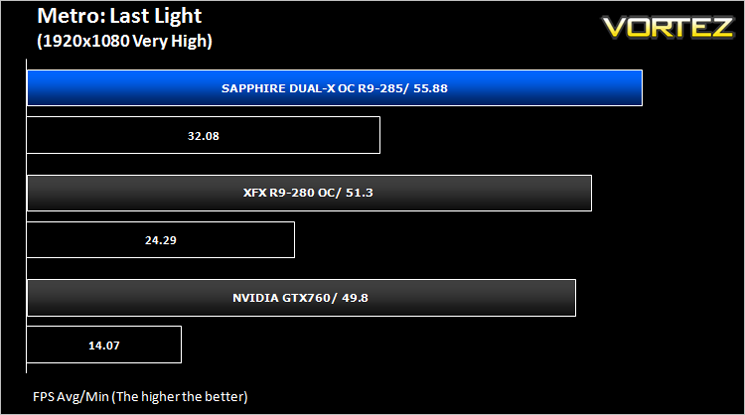
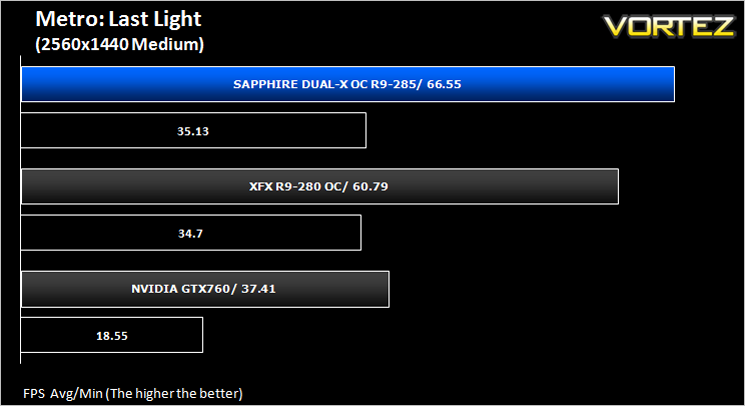
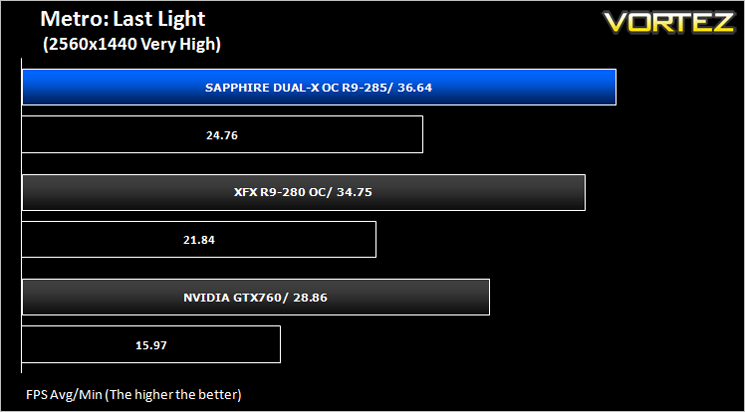
Metro: Last Light (FPS)
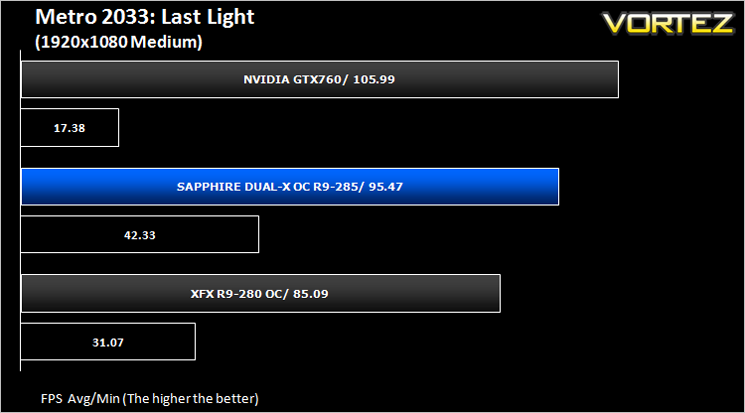
Metro: Last Light is a single-player post-apocalyptic-themed first-person shooter video game with stealth and survival horror elements, developed by Ukrainian studio 4A Games and published by Deep Silver. The game is set in a post-apocalyptic Moscow, part of the universe of the novel Metro 2033 and its sequels, written by Russian author Dmitry Glukhovsky. The second of our FPS titles, it runs on the 4A gaming engine which again, has the capability to stress even the best GPU components.
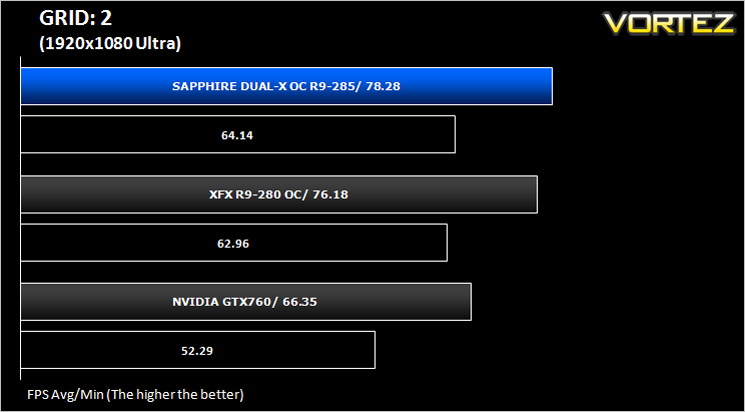
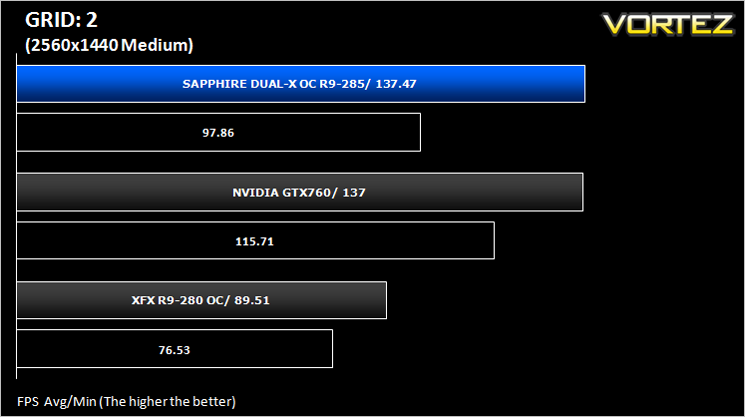
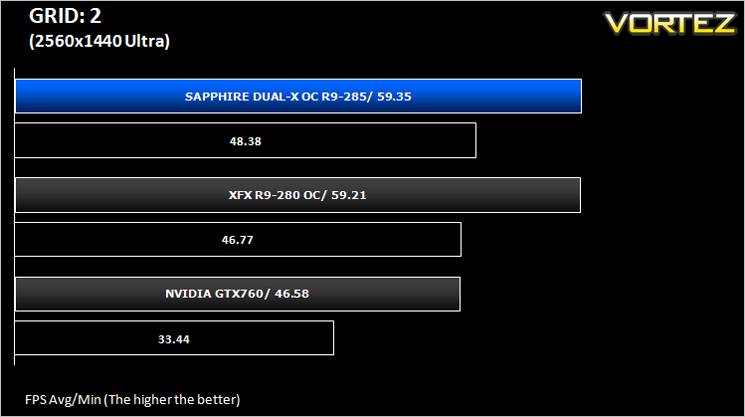
GRID: 2 (Arcade Sim)
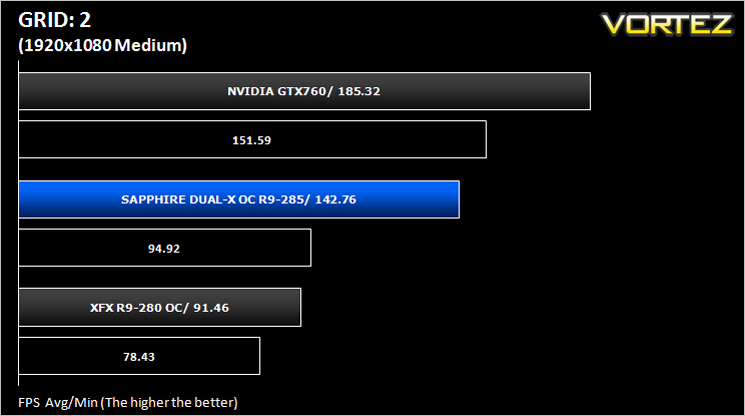
Grid 2 (stylised as GRID 2 and known as Race Driver Grid 2 in Japan) is a racing video game developed and published by Codemasters and is the sequel to 2008’s Race Driver: Grid. The game includes numerous real world locations and cities such as Paris. It also includes motor vehicles spanning four decades. In addition, it includes a new handling system that developer Codemasters has dubbed ‘TrueFeel’, which aims to hit a sweet spot between realism and accessibility. It uses the EGO 3.0 engine which while not overly challenging, is representative of games of this genre.
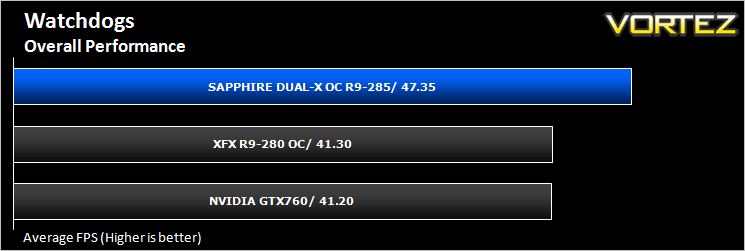
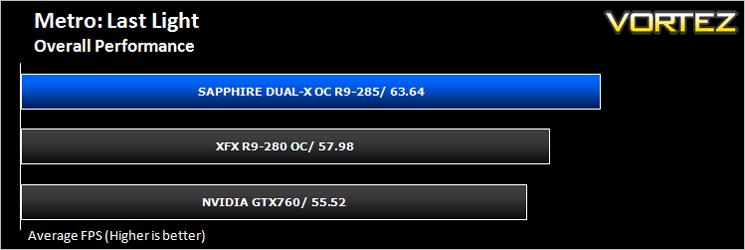
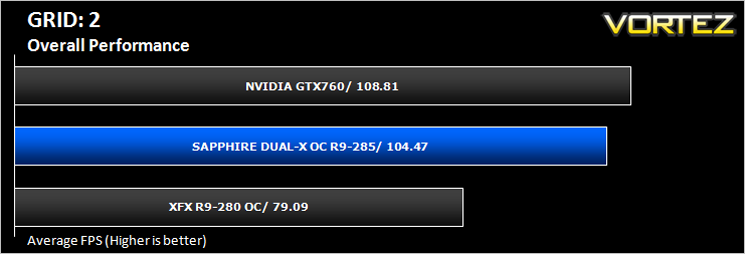
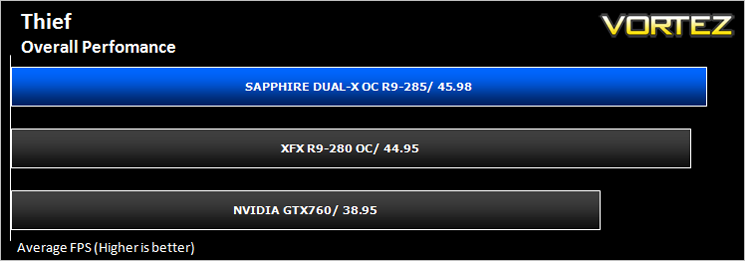
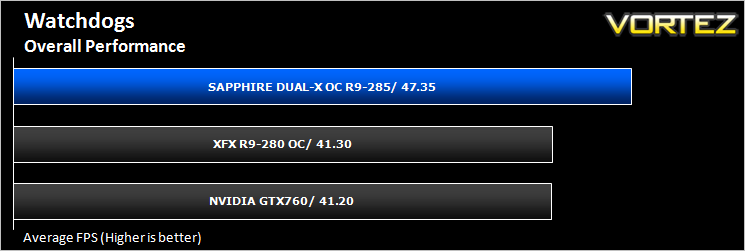
Overall Performance
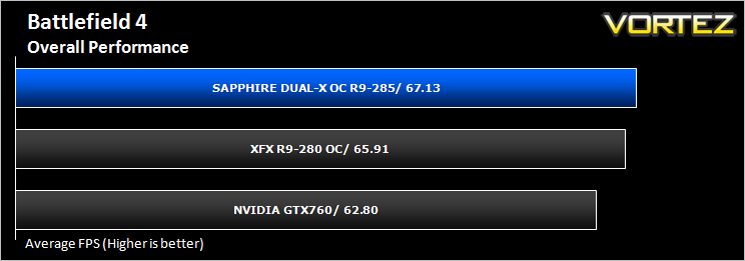
Here we take a look at the overall performance of the graphics card. This figure is determined by finding the average FPS across all of the settings used in a particular benchmark(game) to give us an overall value.
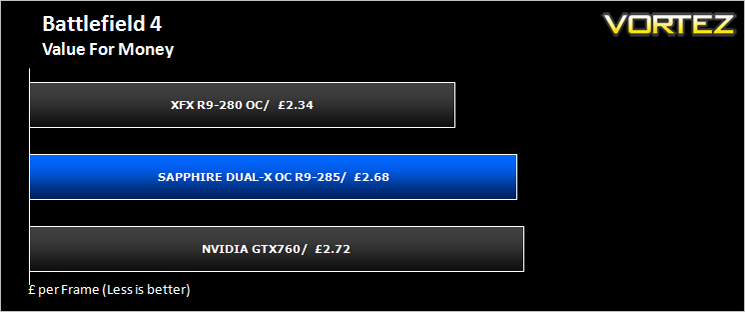
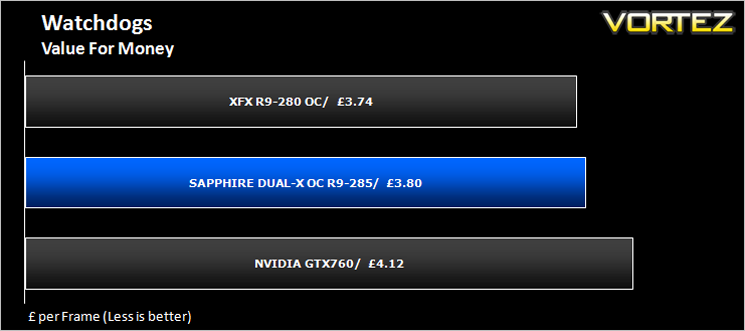
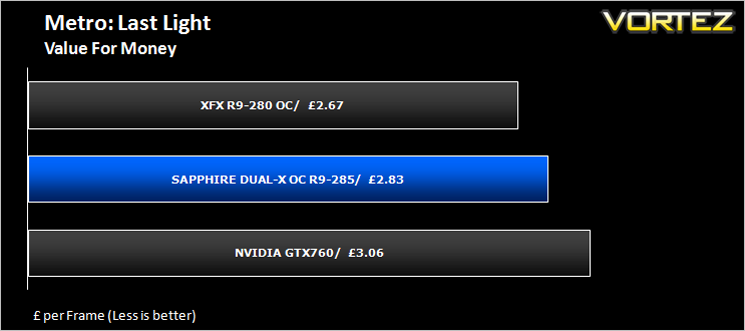
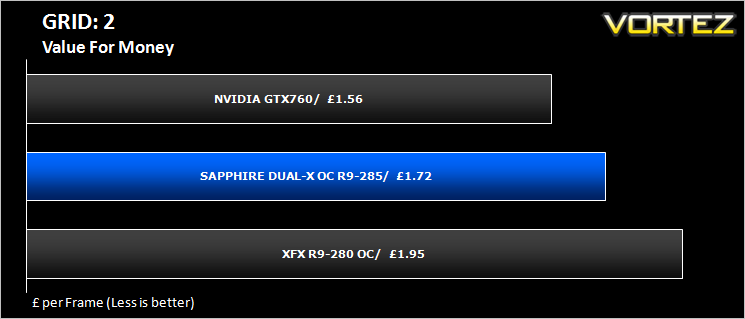
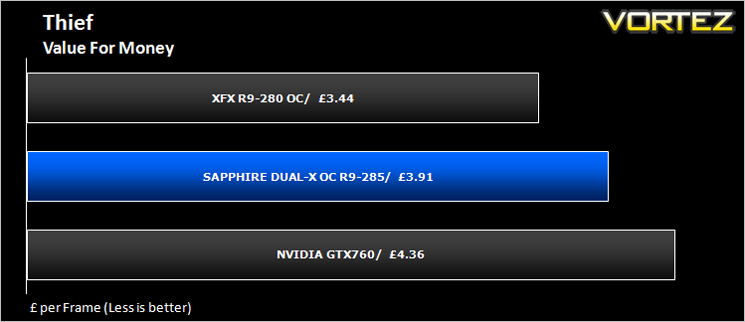
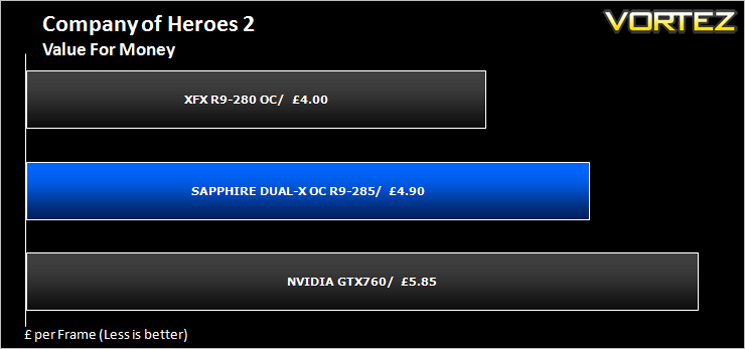
Value For Money
We make a simple calculation for this set of results. For each game we add all of the resulting FPS totals together and then divide by the four sets to give us an overall performance figure. While the figures alone do not give you an accurate picture of how the card will perform in any given scenario, they do tell you, when averaged, which GPU is the more capable across all of the benchmarks and settings tested.
Conclusion
When we first heard about the R9-285 we suspected that this card was a taster of things to come. A teaser card if you will. what we didn’t expect was a different core altogether. We certainly didn’t expect a reduced bus-width which we feel has crippled the card when compared to the R9-280. If more memory and a higher bus-width was applied to the R9-285 we are certain better gains would have been shown. It is now clear the R9-280 was being sold at a break even (or even a loss) to compete with the NVIDIA cards of the same ilk, more so recently as retailers have been clearing remaining stocks of the R9-280 to make way for this replacement. There is simply no sense at all to replace the R9-280 for very little gain other than to hint at what the Tonga core is capable of.
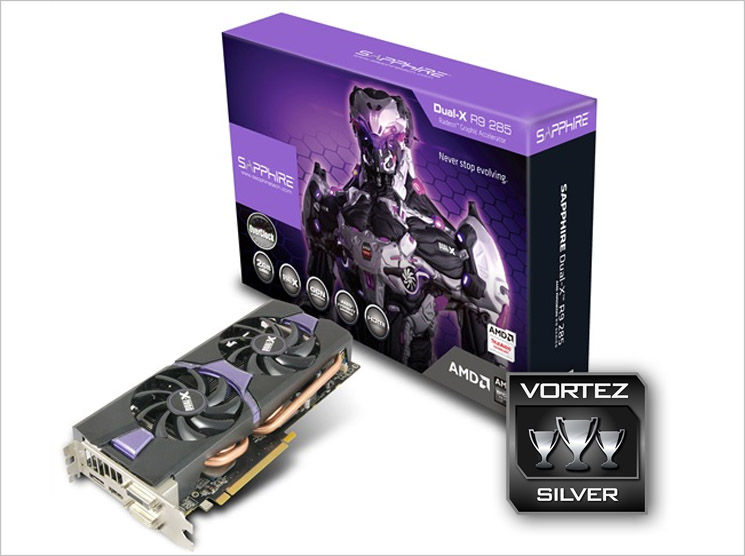
The R9-285 also sees some power and cooling benefits, albeit small, so we shouldn’t be too negative about this release and the Sapphire Dual-X cooler does a good job of keeping temperatures under control. The R9-285 is the slightly faster card when all parameters are considered, that much is clear however, the gains are not quite enough to make us rush out and replace a Tahiti based GPU. The target for AMD is however, the NVIDIA GTX760 and to this end the AMD techs can safely sit back with a celebration cigar and proclaim a job well done because given the choice, we would take the R9-285 every day of the week and twice on Sunday. It is the faster card, simple as that. So, while we may appear to have been over critical regarding the new features here, the R9-285 is a damn good mid-range GPU. It is everything the R9-280 should have been (instead of a re-hashed Tahiti core) but we can’t help feeling however that so much more could have been done with this graphics card. We we will have to wait and see what a ‘full-fat’ Tonga core is capable of with upcoming releases of which, we await with baited breath.
To summarise:
The R9-285 is a capable card with a lot to offer. It is faster than an NVIDIA GTX760 and to that end makes it a mid-range card to be reckoned with.
Pros
+ Good Performance
+ Great Cooling
+ Good looking
+ Fair price
Cons
– Brings too few new tangible benefits to the game
– Starts to suffer at higher settings
+ Good Performance
+ Great Cooling
+ Good looking
+ Fair price
Cons
– Brings too few new tangible benefits to the game
– Starts to suffer at higher settings

Click here for an explanation of our awards at Vortez.net.


