







SilverStone have entered the liquid CPU cooler market with the Tundra Series – join us as we put the TD03 through a series of tests with Intel Sandy Bridge-E.

Product on Review: TD03
Manufacturer and Sponsor: SilverStone
Street Price: £86 (At time of review)
Liquid coolers are fast becoming a popular undertaking for cooling vendors and the latest brand to open up a new product line are SilverStone. Earlier last month, Silverstone announced their new TD02/TD03 – two new products to revive Tundra by way of an all-in-one liquid cooler. Backed by many years of experience in standing out from the crowd, SilverStone are upping the ante with TD02 and TD03 by moving away from traditional design choices, opting for higher quality materials and designs which diversify.
Today we are to look at the TD03, SilverStone’s first 120mm radiator design liquid cooler which comes accompanied by two 120mm cooling fans and styling like no other ALC seen before. There’s been plenty of talk about these new coolers which are joining the Tundra Series since Computex, so we are filled with much anticipation – so let’s begin…
SilverStone on their TD03
The Tundra TD03 is SilverStone’s first all-in-one liquid cooler and is a breakthrough in a market segment filled with similar-looking products. Its unique full alloy water-block is constructed with copper base and aluminium body for better durability compared to plastic-built competitions. The block also has a patented design that eliminates screws in its construction to provide excellent cooling performance and integration of mounting bracket for easy installation. The radiator has another patented design that utilizes brazing fins similar to those used in top air coolers for increased heat transfer efficiency by up to 40% over traditional radiators. With it fully assembled, factory filled and sealed, the TD03 can be used immediately with no need to refill. For those looking to finally have a unique all-in-one liquid cooler that is durable and well-constructed, the TD03 is definitely it.
Technical Specifications
Model No.
SST-TD03
Water block
Dimension 60mm (L) x 55mm (W) x 33.5mm (H)
Material Copper base with nickel-plated aluminum unibody
Pump
Motor speed 2500±200RPM
Rated Voltage 12V
Rated Current 0.28A
Fan
Dimension 120mm (L) x 120mm (W) x 25mm (D)
Speed 1500~2500RPM
Noise level 16~33.5dBA
Rated Voltage 12V
Rated Current 0.3A
Max airflow 92.5CFM
Pressure 3.5mm/H2O
Connector 4 Pin PWM
Radiator
Dimension 159mm (L) x 124mm (W) x 45mm (H)
Material Aluminum
Tube
Length 310mm
Material FEP
Application
Intel Socket LGA775/115X/1366/2011
AMD Socket AM2/AM3/FM1/FM2
Net Weight
1063g
SST-TD03
Water block
Dimension 60mm (L) x 55mm (W) x 33.5mm (H)
Material Copper base with nickel-plated aluminum unibody
Pump
Motor speed 2500±200RPM
Rated Voltage 12V
Rated Current 0.28A
Fan
Dimension 120mm (L) x 120mm (W) x 25mm (D)
Speed 1500~2500RPM
Noise level 16~33.5dBA
Rated Voltage 12V
Rated Current 0.3A
Max airflow 92.5CFM
Pressure 3.5mm/H2O
Connector 4 Pin PWM
Radiator
Dimension 159mm (L) x 124mm (W) x 45mm (H)
Material Aluminum
Tube
Length 310mm
Material FEP
Application
Intel Socket LGA775/115X/1366/2011
AMD Socket AM2/AM3/FM1/FM2
Net Weight
1063g
Packaging, Bundle & Fans
The TD03 is packaged within a small cardboard box which is eye-catching and details the key features on the front. The front of the packaging also shows two depictions of the cooler to whet your appetite and there is even a QR code which takes you directly to the SilverStone website. The technical specifications and further details are printed on the sides and also the back for those who want to obtain more information.
Inside, all of the components are separated and sealed within plastic covers.
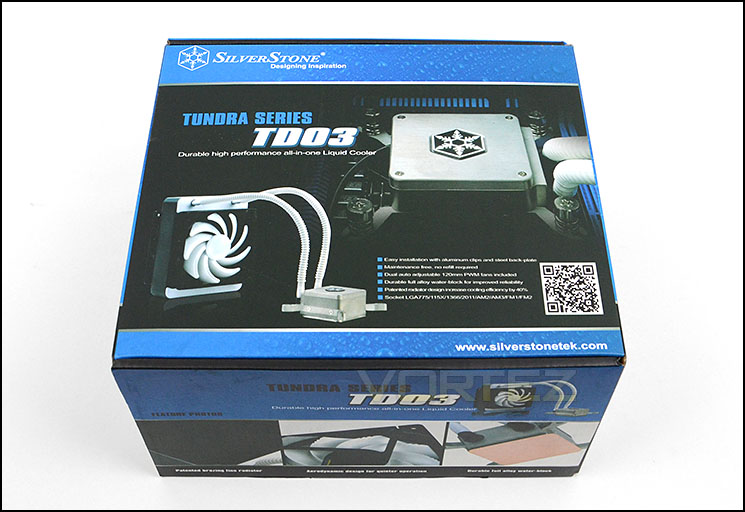
The packaging for TD03
TD03 comes with an assortment of items – it’s nice to see there are dual fans included with this cooler even though the radiator is small in comparison to rival solutions. Included with TD03 are the following:
• Radiator + CPU block
• 2x 120mm cooling fans
• Y-cable adapter
• Instructions guide
• Installation kit for multiple sockets
The installation kit can support a number of different sockets including: Intel Socket LGA775/115X/1366/2011 and AMD Socket AM2/AM3/FM1/FM2.
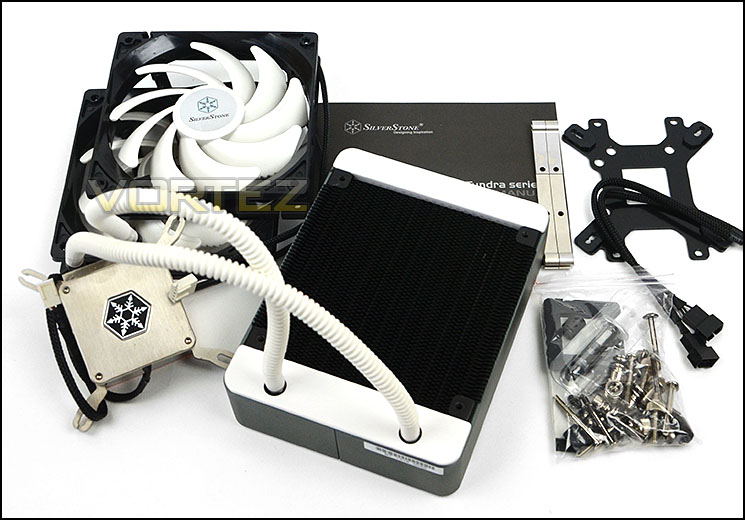
The included items within the bundle
Supplied with TD03 are two 120mm cooling fans – namely AS1225H12. These fans are capable of up to 2500RPM and pair up perfectly with the radiator which is a two-tone colour configuration. There are a fair few computer cases which take advantage of this theme too so there is plenty of opportunity to build a well-coordinated computer system. These fans operate with noise level of 16~33.5dBA and maximum airflow of 92.5CFM.
The cables which are attached to the fans are branded black and require 4-pin fan header connection.
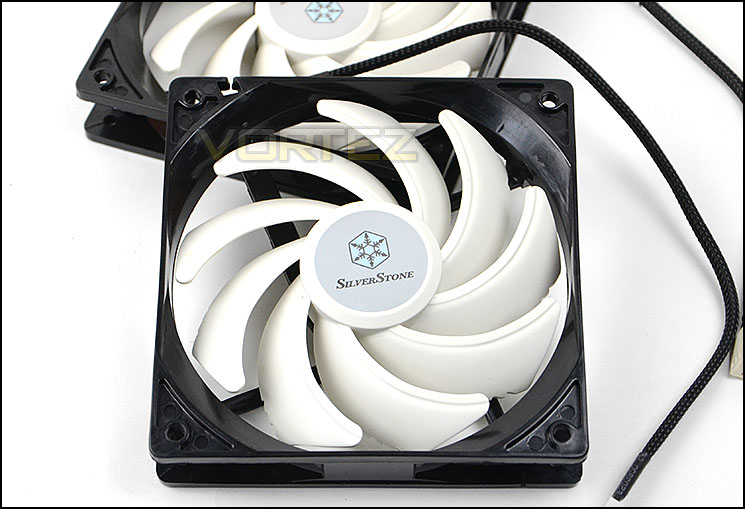
Dual 120mm cooling fans
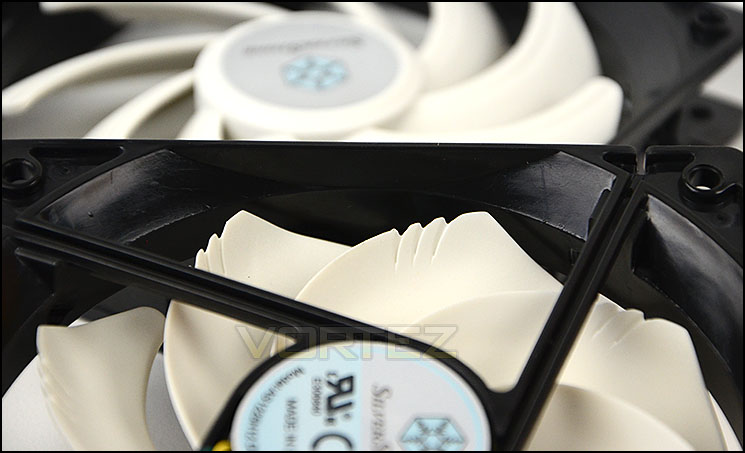
A closeup of the blade design
Closer Look
There are a number of brands who have and are bringing to market ALCs which utilise the traditional water cooling radiator. These radiators typically use the same fin array and are notorious for marking easily and being damaged easily due to the soft cooper used. SilverStone have stepped out of the crowd and given TD03 a radiator which is constructed of aluminium and which uses a dense, premium fin array and is soldered.
Due to the material used these fins do not warp, mark or damage. The dimensions for the radiator are : 159mm (L) x 124mm (W) x 45mm (H).
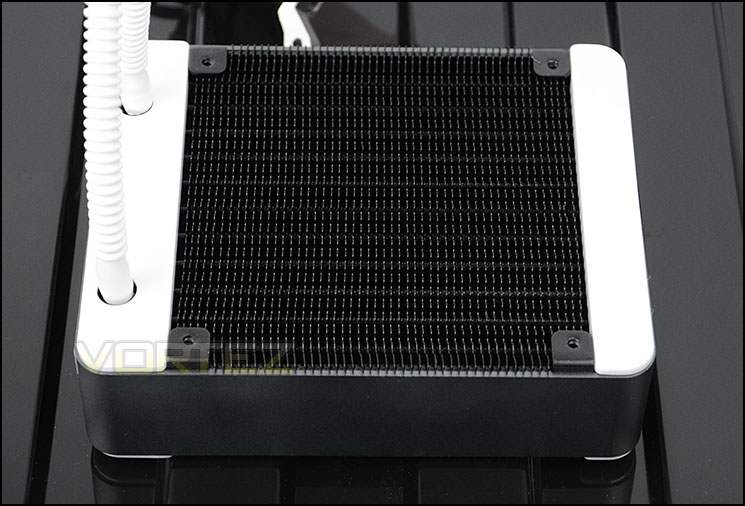
A different approach to radiator design
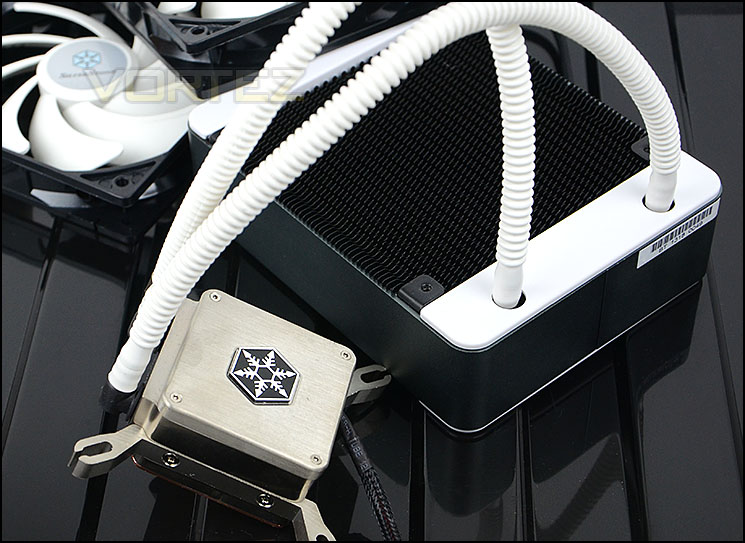
The pump is again, another aspect of TD03 which has been given alternative treatment. Your typical ALC will feature a CPU block/pump which is plastic which instead, SilverStone have furnished TD03 with aluminium and nickel plating. The top plate in particular which features the SilverStone insignia, has a favourable brushed aluminium finish and is far more appealing than a plastic cover.
The overall finish and build quality of this part of the cooler is very good – you get the idea that you are dealing with a premium product even just after first impressions without handling it.
Tubing which connects directly to the pump and is 310mm in length. The tubing is ribbed and made of hardened plastic. We aren’t as keen on this choice over the smooth, soft rubber option that other brands tend to go for. The connection points are supposed to pivot but our unit struggled – they were rather stiff. A 4-pin fan header cable is required to connect to the motherboard for the pump to operate.
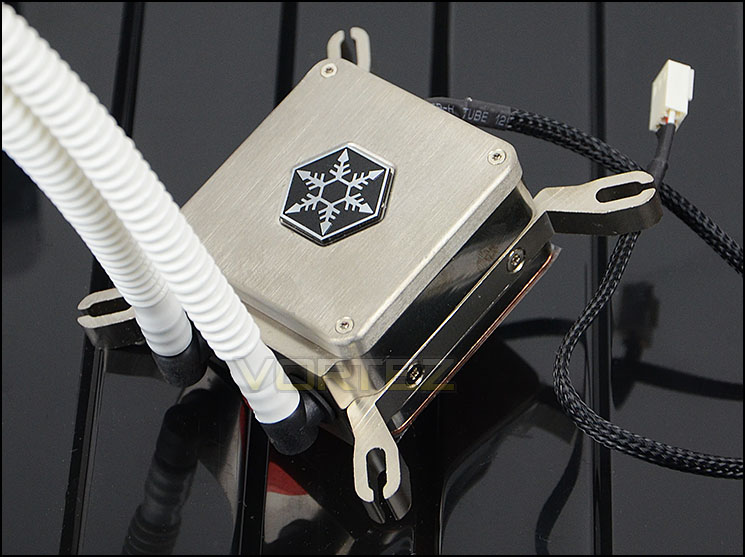
Brushed aluminium finish with SilverStone emblem
Unlike other designs were the screws are found on the copper surface area – SilverStone use a screwless design which has a larger surface area. The underside is of course copper and is smooth in its finish and has large enough to cover bigger chips like SandyBridge-E.
The mounting bracket arms are significantly thicker and again aluminium in their construction to give a durable solution compared to other units we have used in the past. SilverStone have certainly gone to task on this cooler to focus on superior build quality.
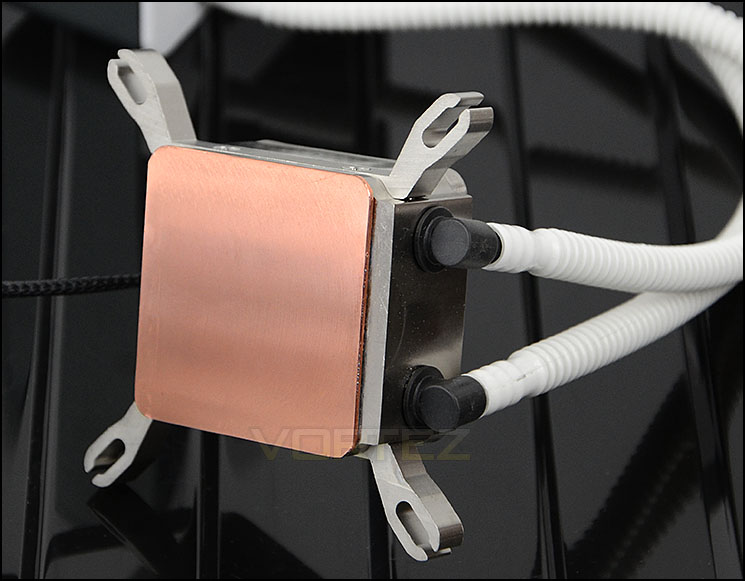
The underside of the block
Installation Process
In order to demonstrate the installation process for TD03 we are installing the cooler on the Intel LGA2011 socket.
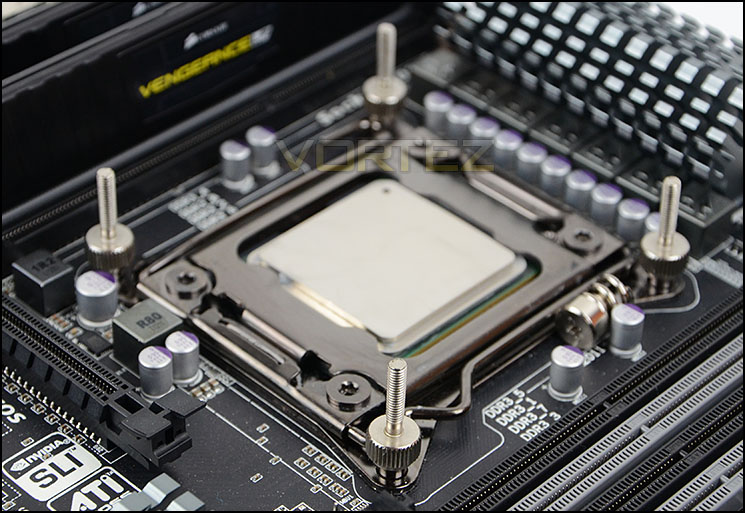
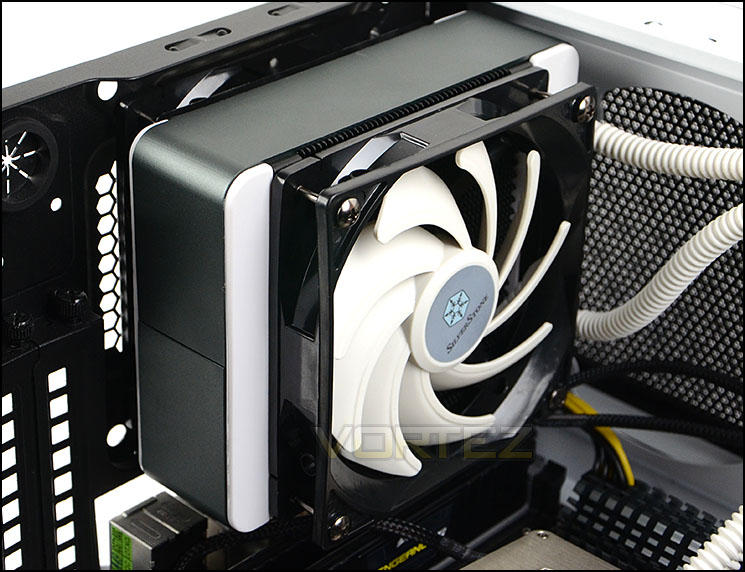
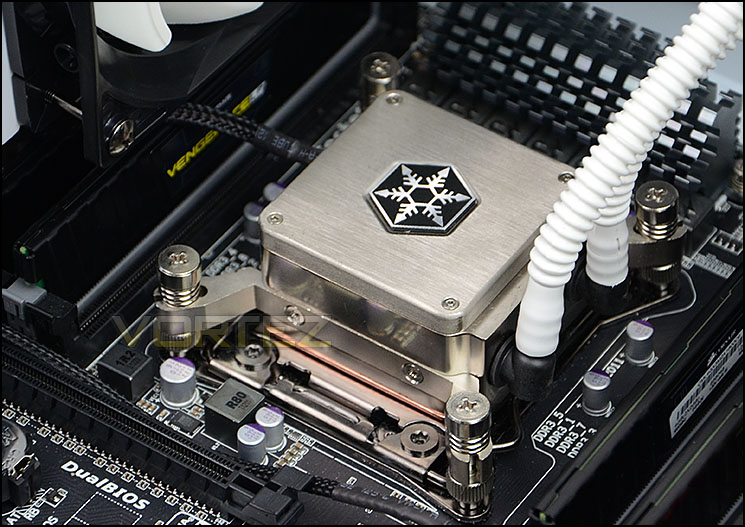
As with most (if not all) LGA2011 installation kits, TD03 requires four thumbscrew standoffs to be attached to the four corners of the socket plate. Once these are in place, the next step is to attach the fans to the radiator and to the computer chassis where the rear exhaust typically sits. A total of right long screws are needed for this part. Once the radiator and fans are fixed in place the only aspect left to fulfil is applying thermal paste to the CPU, placing the block over the CPU and then screwing the four spring compressor screws into the standoffs. This was surprisingly easy to complete since a small amount of pressure is only required and one slight turn before the thread connects with the screw – we recommend tightening in a diagonal sequence and turning just twice for each screw until finally tight in order to apply equal pressure to the CPU.
And that’s it, the installation is really that simple and it takes next to no time to get the TD03 up and running. The only other thing left to do is attaching all the fan header cables to the motherboard. We really like how the TD03 looks within the system, installed on a grey motherboard and within a black/white case it really does co-ordinate perfectly. Top marks for aesthetics.
Memory Clearance
Memory clearance is something which many system builders and enthusiasts are eager to discover since this will ascertain whether a memory kit will be compatible with the CPU cooler or not. To demonstrate this a low profile memory kit is used.
We don’t usually detail memory clearance for liquid coolers but since TD03 uses a dual fan configuration and hangs directly over the memory for LGA2011 near the rear IO we felt this was necessary.
As you can see from the picture, low profile memory modules are fine but if you have a kit which exceeds 4.5cm then you will have difficult fitting the inner cooling fan. So memory kits which are tall will struggle on LGA2011 for this specific cooler.
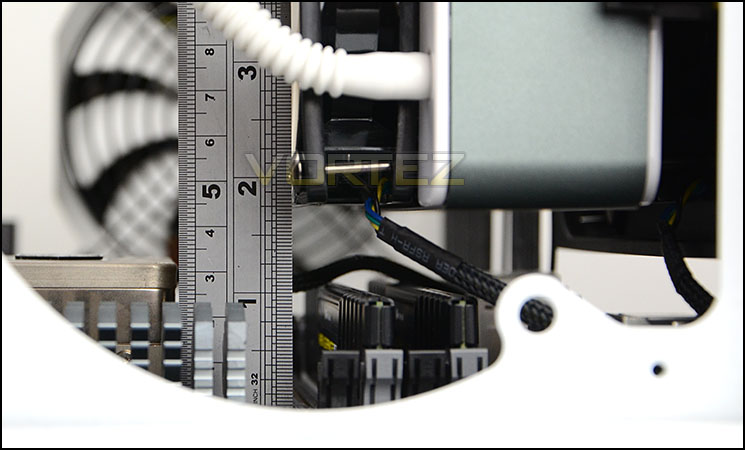
Memory should not exceed 4.5cm in height
Test Setup & Methodology
Test System
CPU – Intel Core i7-3930K (3.6GHz)
Motherboard – GIGABYTE X79-UP4
Memory – 8GB Corsair Vengeance LP 1600MHz CL9
Graphics – Sapphire Radeon HD 6850 1GB
PSU – NZXT Hale90 650W
Hard Drive – Kingston HyperX 240GB SATA III SSD
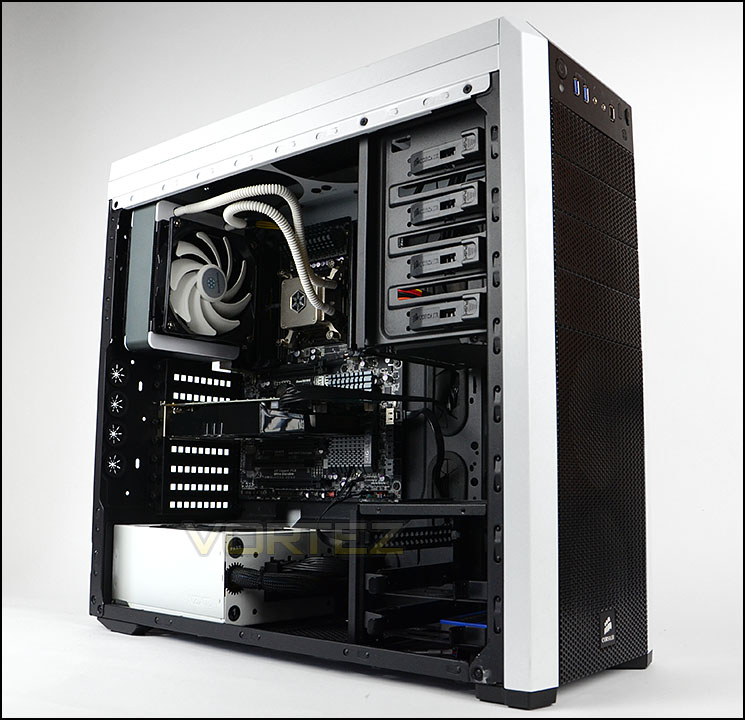
Case – Corsair Carbide 500R White
Motherboard – GIGABYTE X79-UP4
Memory – 8GB Corsair Vengeance LP 1600MHz CL9
Graphics – Sapphire Radeon HD 6850 1GB
PSU – NZXT Hale90 650W
Hard Drive – Kingston HyperX 240GB SATA III SSD
Case – Corsair Carbide 500R White
CPU Coolers
Alpenföhn Matterhorn Pure(120mm Wingboost: 300-1200RPM)
Alpenföhn K2 (120mm Wingboost: 500-1500RPM, 140mm Wingboost: 300-1100RPM)
Alpenföhn Gotthard (140mm Wingboost: 300-1100RPM)
Noctua NH-D14 (120mm NF-P12 PWM + 140mm NF-P14 PWM: up to 1200RPM)
Thermalright SilverArrow SB-E Extreme (Dual TY-143 fans – 600-2500RPM)
Corsair Hydro H100 (Dual 120mm fans – low: 1300RPM, mid: 2000RPM, high: 2600RPM Push Config)
SilverStone HE01 (140mm PWM fan – 500RPM-1200RPM – 500RPM-2000RPM)
be quiet! Dark Rock Pro 2 (135mm + 120mm PWM Fans – up to 1500RPM and 1700RPM)
Thermaltake Water 2.0 Pro (Dual 120mm PWM fans – up to 2000RPM)
Corsair Hydro Series H100i (Dual 120mm fans – up to 2700RPM Push Config)
Be Quiet! Shadow Rock TopFlow(1x 135mm PWM fan – up to 1500RPM)
SilverStone HE02 (Passive – optional fan used: Noctua NF-F12 120mm PWM)
Corsair H55 (Single 120mm fan – 1700RPM Exhaust Push)
Cooler Master Seidon 120M (Single 120mm fan – Up to 2500RPM Exhaust Push)
Zalman CNPS11X Extreme (Single 120mm fan – Up to 1950RPM)
Phanteks PH-TC12DX (Dual 120mm fans – 600-1800RPM)
Noctua NH-U14S (Single 140mm cooling fan – 300-1500RPM)
SilverStone TD03 (Dual 120mm fans – 1500-2500RPM)
Program Suite
Real Temp – Maximum temperature analysis
LinX 0.6.4 – Applies thorough stress test to CPU
CPU-Z – Confirmation of CPU frequency/voltage
AIDA64 Extreme Edition – Confirmation of temperatures/fan speeds
Testing methodology
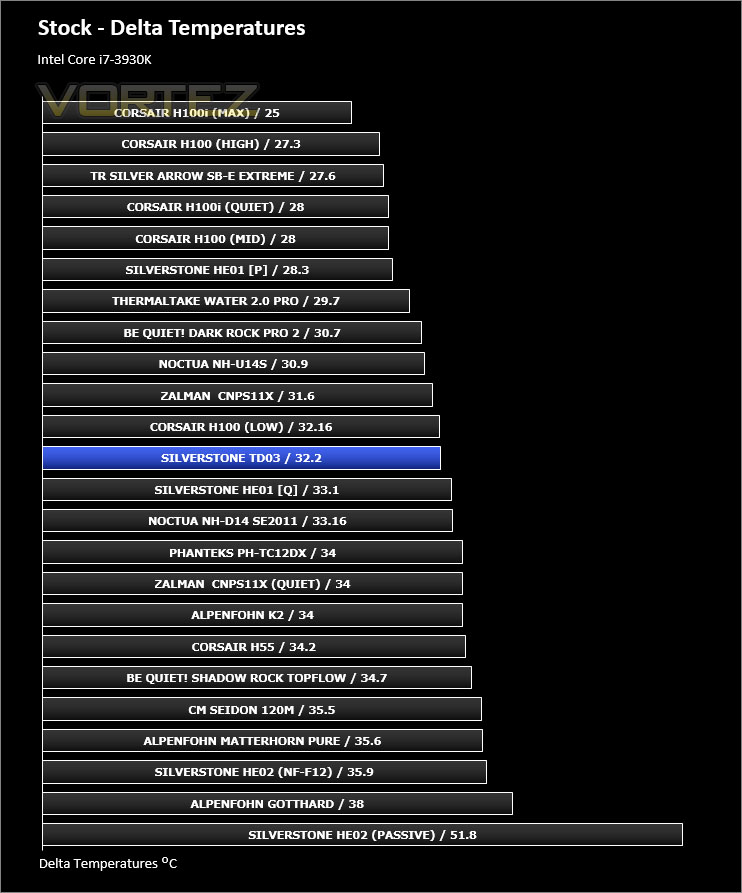
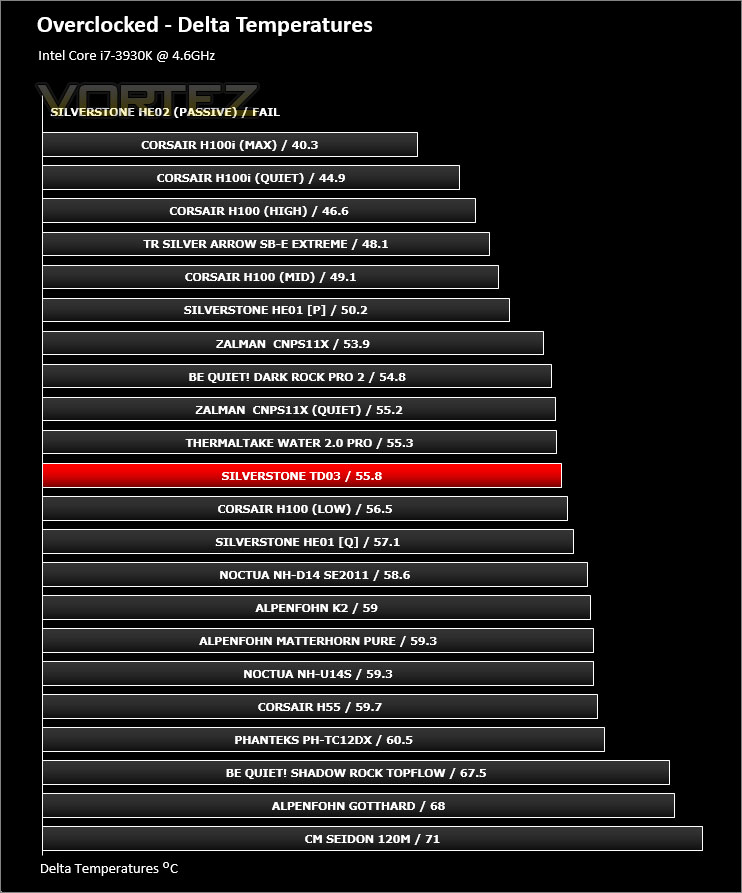
Testing will be based on temperatures recorded by Real Temp after 20 passes of LinX stress test. The maximum absolute temperatures will be recorded after the test and averaged over the 6 cores. The delta is then calculated by subtracting the ambient temperature recorded near the intake fans from the average temperature calculated. Tests are conducted with the Intel i7 3930K at its default 3.6GHz stock speed and overclocked to 4.6GHz @ 1.42V. The tests are done inside the Corsair Carbide 500R chassis to simulate real world conditions. To keep the tests standardised we are using Noctua’s NT-H1 thermal paste on all coolers.
CPU coolers are reviewed as they come out of the box – with their factory cooling fans, as the manufacturer intended and as the consumer expects.
Additional tests include a passive test where the cooling fans are taken away from the heatsink and a comparison between the cooler used with stock thermal paste against our Noctua NT-H1 paste.
A kind thank you to Noctua for supplying us with NT-H1 thermal compound.
Results – Stock Performance
The TD03 does a great job in our cooling league, positioning itself as a rival to some of the renowned air coolers and beating well-known ALCs of similar specification. Throughout the stock test the cooling fans remained at 1800RPM, which was certainly noticeable in terms of noise levels.
Results – Overclocked Performance
Again, in similar fashion – at the overclocked state the TD03 handles the demanding Sandy Bridge-E with admirable results. It’s quite significant that there are other 240mm spec ALCs within less than a degree. The only niggle is that this result was achieved whilst the fans were running at 100% – 2500RPM and this is quite noisy.
Results – Passive Performance
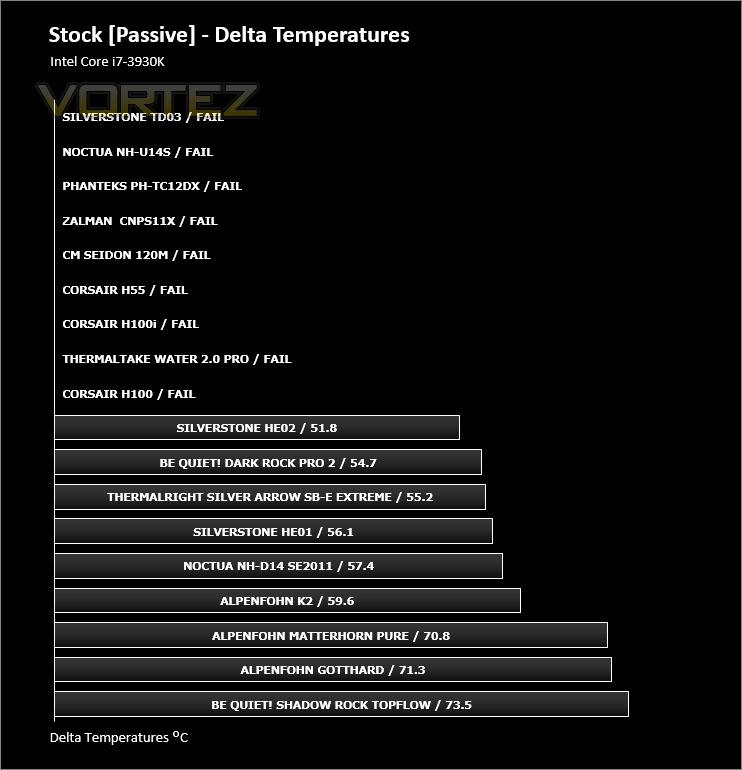
Just like other liquid coolers, TD03 failed in the passive test since it relies upon the cooling fans to dissipate the heat and the radiator isn’t designed with a fin stack like those on a burly dual tower air cooler.
Results – Thermal Paste Comparison
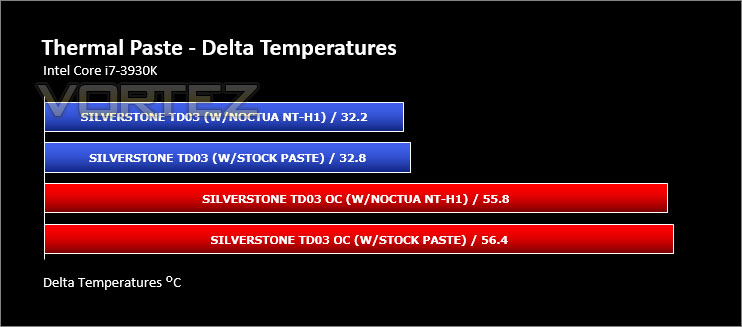
Most CPU coolers come accompanied with thermal paste provided by the manufacturer. For our CPU cooling tests we use Noctua’s NT-H1, so to offer up some interesting analysis we test the thermal paste given with the SilverStone TD03 against NT-H1 to see which gives the best results during stock and overclocked performance and the results really aren’t that much different, the Noctua is only slightly better.
Conclusion
SilverStone’s new Tundra coolers took the spotlight at Computex 2013 and for good reason, they have stepped aside from the traditional design of all-in-one liquid and upped the ante. Turning the tables is a bold move indeed but SilverStone are no stranger to engaging in such a venture – their Fortress and Raven Series of computer cases are a good example of this.
So what have they done that is so significant? Well, the build quality, compared to rival liquid coolers is quite astounding. Gone are the plastic CPU blocks and fragile radiators which can quite easily warp with little pressure and scratch to reveal the copper underlay. Instead we have premium materials used – aluminium with nickel plating not only delivers a superior level of construction by being robust but it looks very appealing to the eye too. The styling looks great and will easily pair up with other components and computer cases – our review kit is testament to this fact.
During our benchmarks the TD03 performed well in our extensive cooling league and demonstrated that it can give other rivals a run for their money. Stock and overclocked results when used on Intel’s high-end Sandy Bridge-E were admirable but noise levels were perhaps on the loud side, especially when overclocked since the cooling fans move up to 2500RPM (100%).
Not only do we like TD03 for its build quality but we found it was very easy to install too and the mounting system can be confidently relied upon – components are again, very good in their quality and easy to use.
Priced at £86, the TD03 may be deemed quite a costly investment. Comparing against similar spec liquid coolers there is a bump in cost but this cooler is vastly different to other solutions, it uses higher quality materials and is far from cheap. Also consider that there are two cooling fans included which would probably equate to £10-15 each just on their own.
SilverStone have diversified with these new additions to the Tundra Series. Their efforts with this new TD03 liquid cooler are to be commended, in our hands is a product which oozes quality. We found this cooler to have numerous qualities and are therefore compelled to hand out our gold award.
Pros
+ Good thermal performance results
+ Excellent build quality
+ Styling and attention to detail is exquisite
+ Co-ordinates well with hardware
+ Easy to install
+ Good mounting system
Cons
– Noisy when overclocked – fans at full speed
– Instructions manual could be easier to follow
+ Good thermal performance results
+ Excellent build quality
+ Styling and attention to detail is exquisite
+ Co-ordinates well with hardware
+ Easy to install
+ Good mounting system
Cons
– Noisy when overclocked – fans at full speed
– Instructions manual could be easier to follow

Click here for an explanation of our awards at Vortez.net.


