

The Siberia 840 wireless headset is accompanied by a Transmitter box that allows for a wide selection of audio sources to be sent over a lag-free wireless connection, to expand on this, SteelSeries have added in Bluetooth connectivity for greater versatility.

Product on Review: SteelSeries Siberia 840
Manufacturer: SteelSeries
Street Price: UK: £299.99, EU: €329.99, US: $329.99
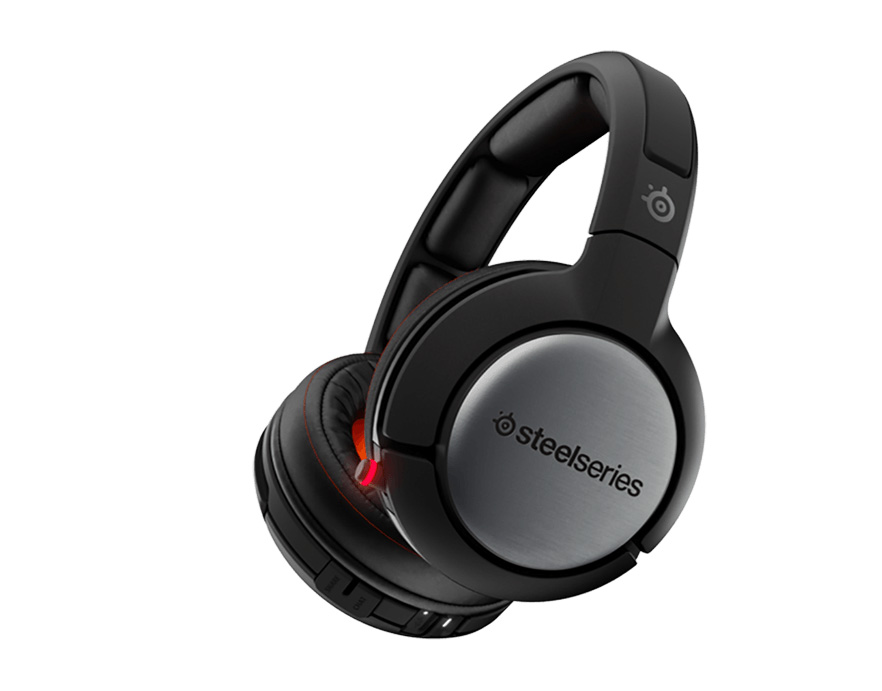
SteelSeries refreshed their H Wireless premium headset, rebranding it as the ‘Siberia 800’, while the Siberia 840 is a refresh to the 800, adding software support and Bluetooth connectivity for the ultimate in multi-media and gaming versatility. It features the renowned, high quality SteelSeries 40mm drivers, USB, optical, 3.5 mm analog wired connectivity along with wireless and Bluetooth connectivity. Much of the magic happens inside the included transmitter box which acts as a signal processor for the wireless audio, if features continuous frequency hopping technology to ensure a lag-free connection, and also acts as a charging dock for the hot-swappable batteries, each with a 20hour charge, ensuring a long lasting wireless up-time.
With the addition of Bluetooth, the Siberia 840 becomes an all encompassing wireless headset that is compatible with virtually all contemporary devices, consoles, and media-centres, becoming a true all-in-one solution for every scenario.
Overview by SteelSeries
The Siberia 840 delivers the professional grade audio that you know and love, with the added bonus of Bluetooth. This headset offers a lag free environment, with low latency, and features three Dolby surround sound technologies. When coupled with Bluetooth, the Siberia 840 works on virtually all platforms.
Technical Specifications
Sound & Microphone
Speaker drivers: 40mm Neodymium Drivers
Headphone Frequency Response: 20-20000 Hz
Max Volume: 100dB* SPL @ 1kHz
Weight: 318g, 11oz (includes battery)
Microphone Frequency Response: 100-10000 Hz
Microphone Pickup Pattern: Unidirectional
Microphone Sensitivity: -44 dB
Microphone Impedance: 2.2K Ohm
Indication: Red LED on mute
Ports: Wired mode, Share port, Chat port, mini USB FW update port
Transmitter
Wireless Range: 12m, 40ft straight line
Latency: < 16ms, fixed
Ports: Analog in, Analog out, mini USB, Optical in, Optical out, Power
Available connections: USB w/included sound card, dual 3.5mm analog, single 4-pole analog
Battery Type: Rechargable Lithium-ion, 1000mAh
Battery Life: 20 hours per pack, typical usage
Box Content
Quick Start Guide
Siberia 840 & Transmitter
2 Battery packs
Optical, USB, Power, Analog, Mobile, Chat cables
Power adapter with 4 worldwide plug ends
Manufactured under license from Dolby Laboratories
Speaker drivers: 40mm Neodymium Drivers
Headphone Frequency Response: 20-20000 Hz
Max Volume: 100dB* SPL @ 1kHz
Weight: 318g, 11oz (includes battery)
Microphone Frequency Response: 100-10000 Hz
Microphone Pickup Pattern: Unidirectional
Microphone Sensitivity: -44 dB
Microphone Impedance: 2.2K Ohm
Indication: Red LED on mute
Ports: Wired mode, Share port, Chat port, mini USB FW update port
Transmitter
Wireless Range: 12m, 40ft straight line
Latency: < 16ms, fixed
Ports: Analog in, Analog out, mini USB, Optical in, Optical out, Power
Available connections: USB w/included sound card, dual 3.5mm analog, single 4-pole analog
Battery Type: Rechargable Lithium-ion, 1000mAh
Battery Life: 20 hours per pack, typical usage
Box Content
Quick Start Guide
Siberia 840 & Transmitter
2 Battery packs
Optical, USB, Power, Analog, Mobile, Chat cables
Power adapter with 4 worldwide plug ends
Manufactured under license from Dolby Laboratories
Packaging & First Look
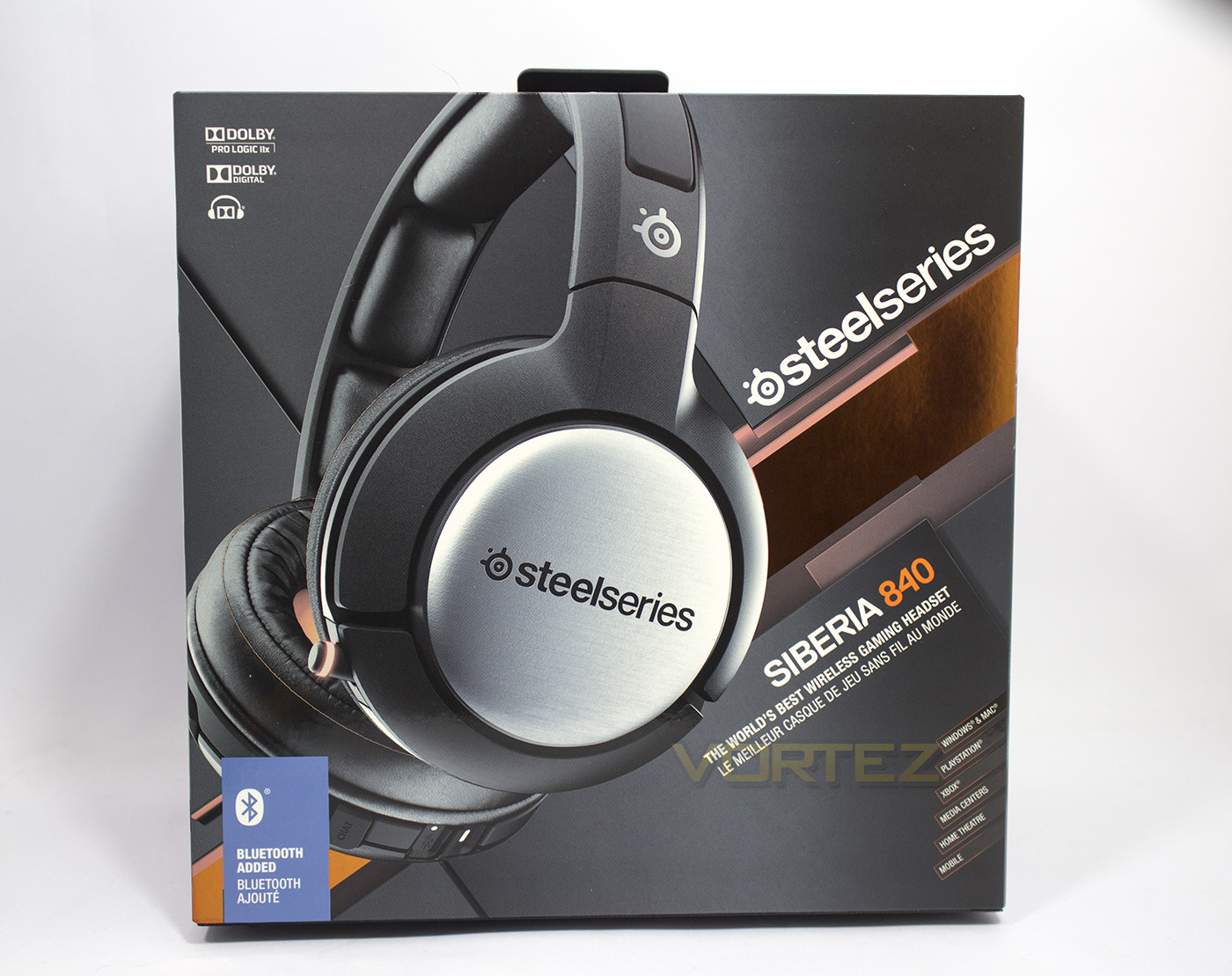
The front livery features a large image of the product along with information about the supported technologies, including Dolby and Bluetooth.
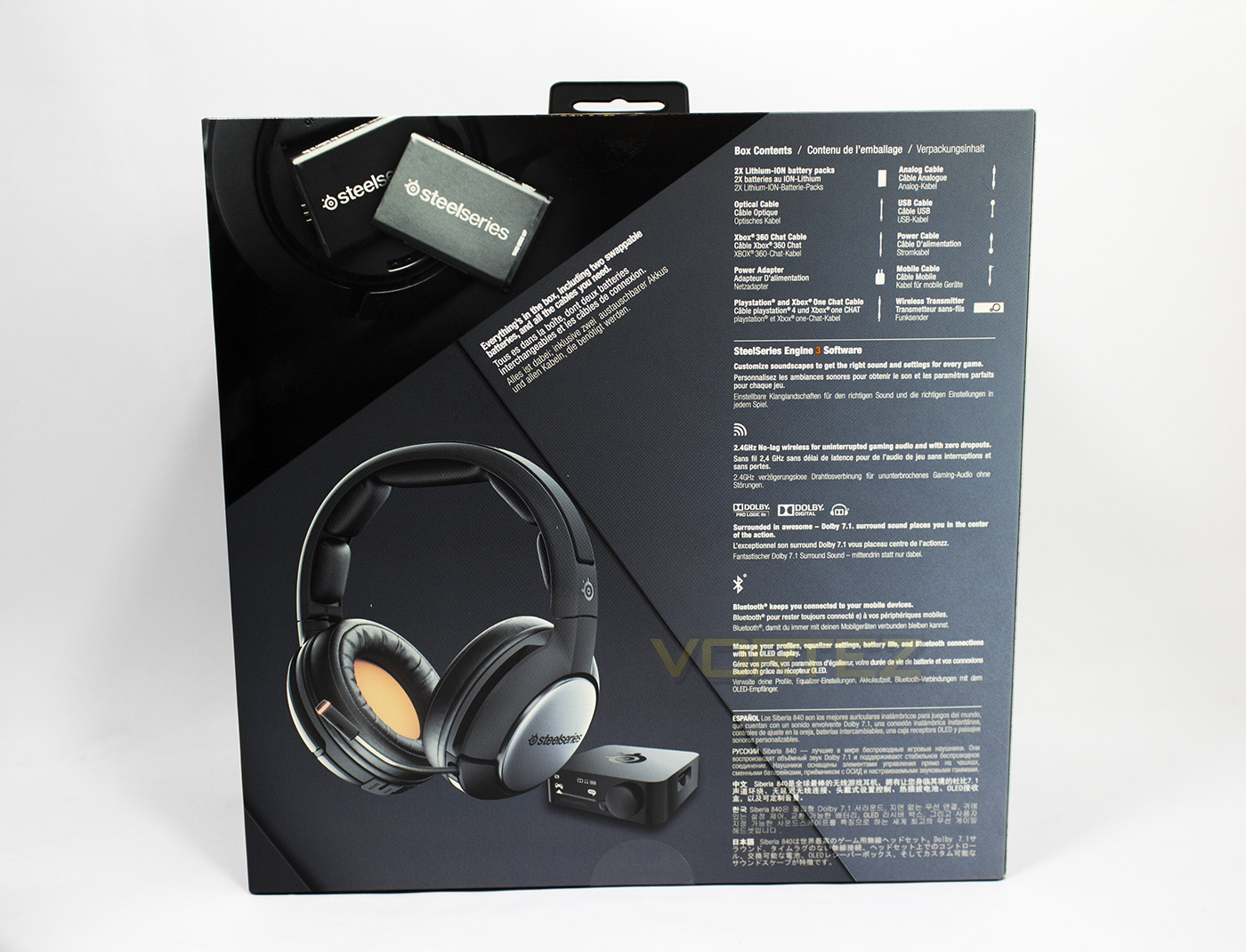
The reverse side features information about all the included items, as well as information about the 2.4GHz wireless connectivity and the transmitter box, and SteelSeries Engine 3 support.
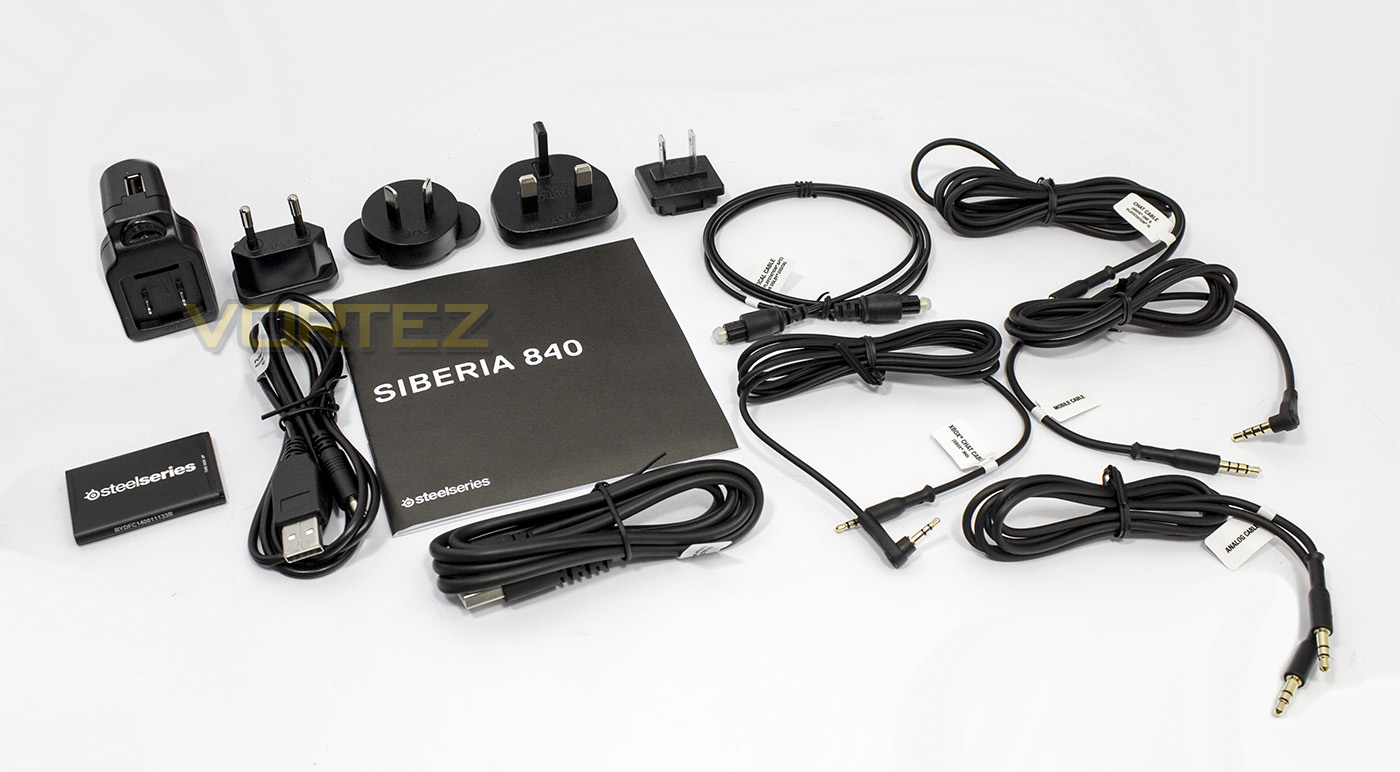
Inside the packaging is a universal power adaptor with US, EU, UK, and JP plug adaptors, 2x 1000mAh batteries (one already installed inside the headset), power cable, USB cable, guide book, optical cable, Xbox 360 chat cable, Xbox one/PS4 chat cable, mobile cable, and an ‘analogue’ cable.
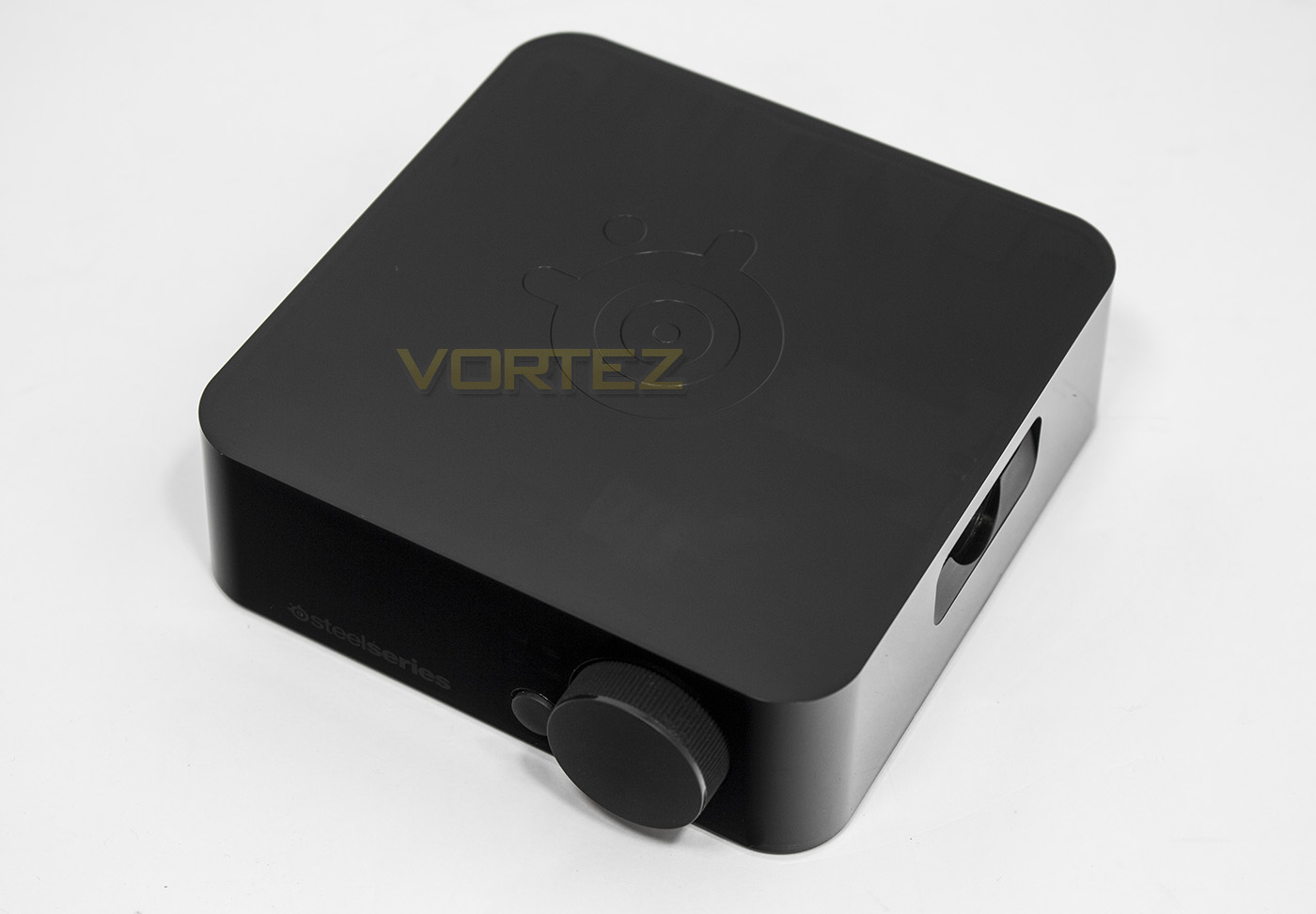
The transmitter box features a large OLED display for easy viewing and navigation for setup/customisation and source selection, a large front dial than can be pressed in, and a menu button.
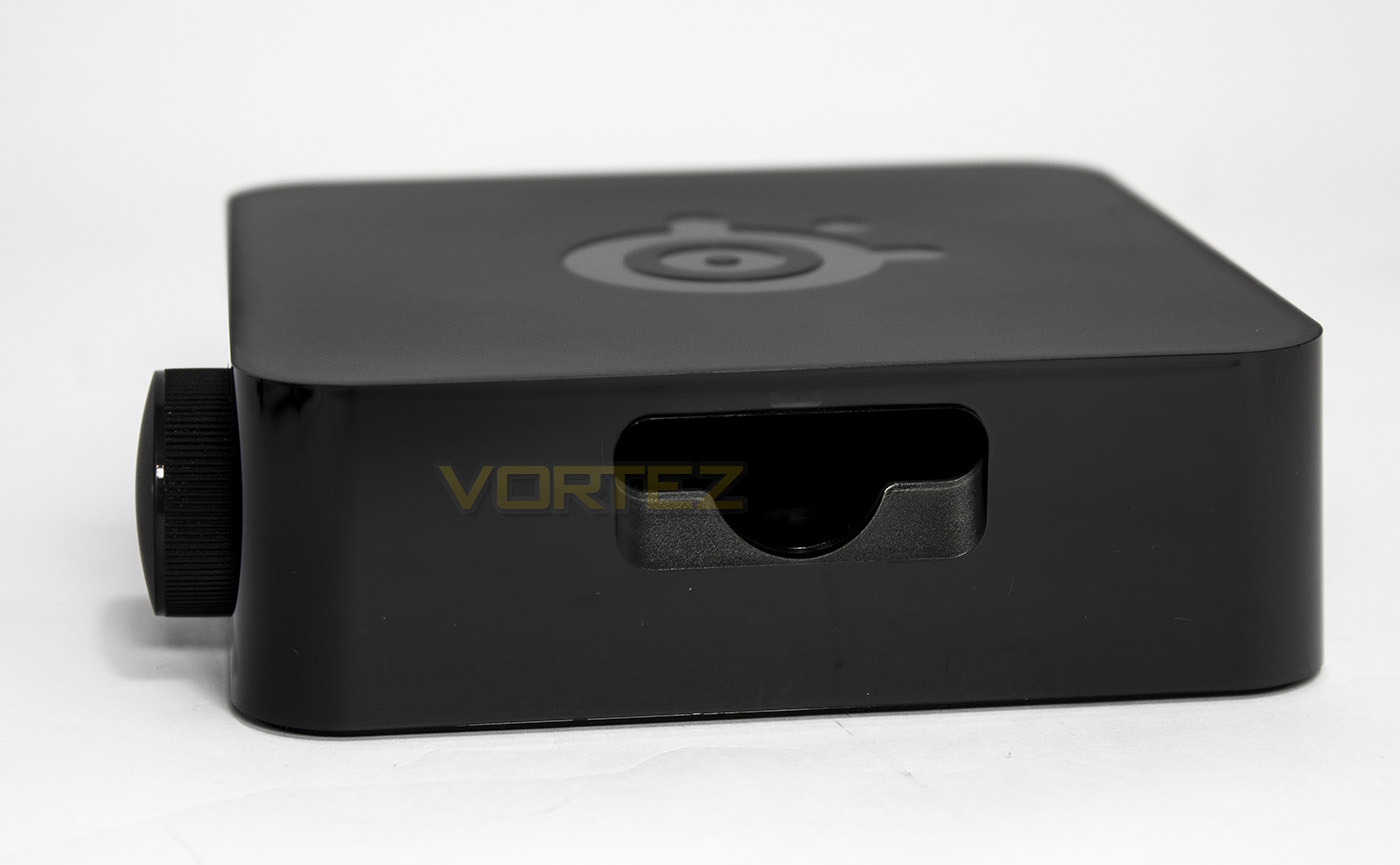
On the right side you will find a slot which is a dock to charge the included batteries. You can only charge one at a time, but this shouldn’t cause any issues for most people.
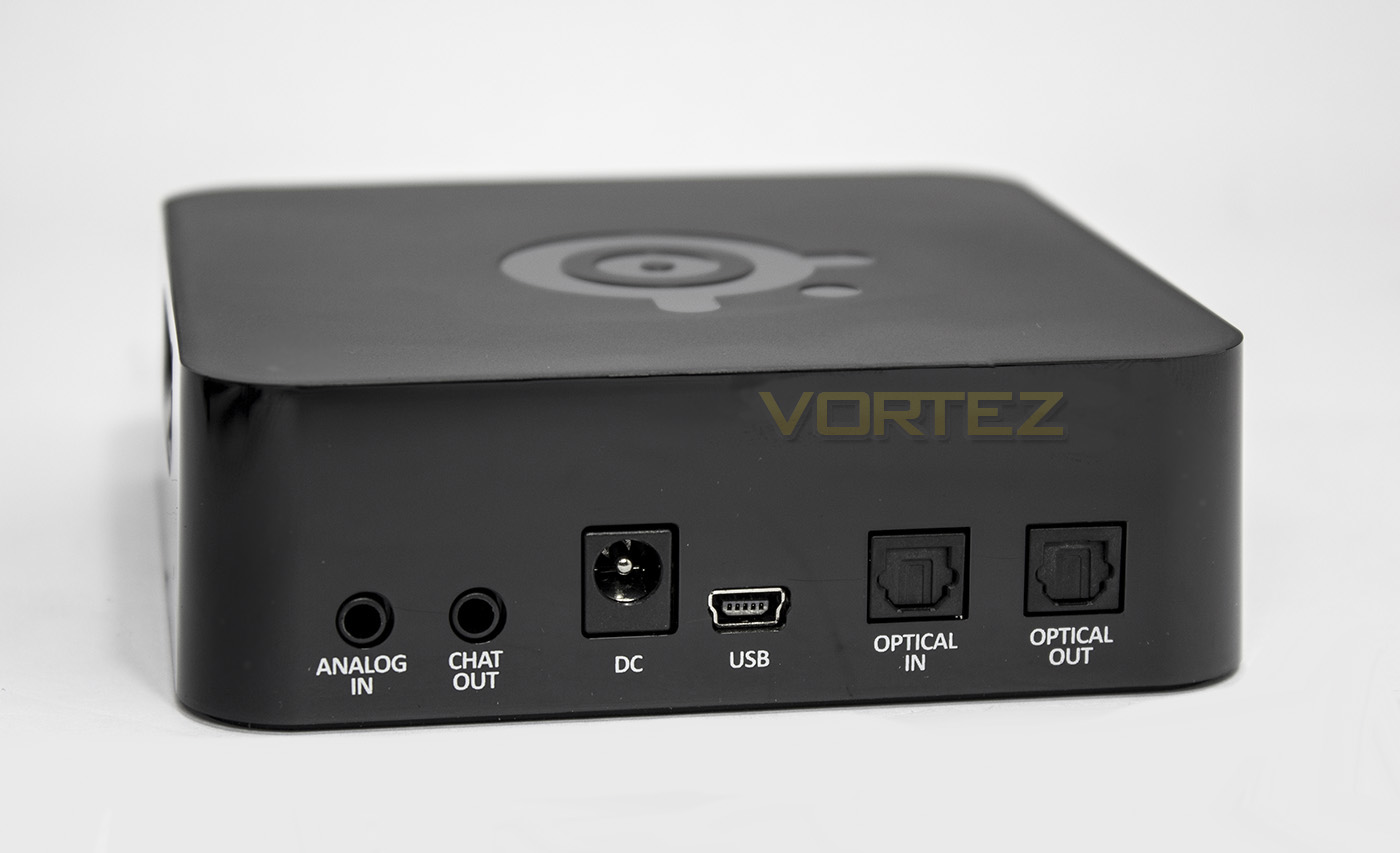
The rear side features an analogue in port, a chat out port, power-in, mini USB connection, and an optical in/out port.
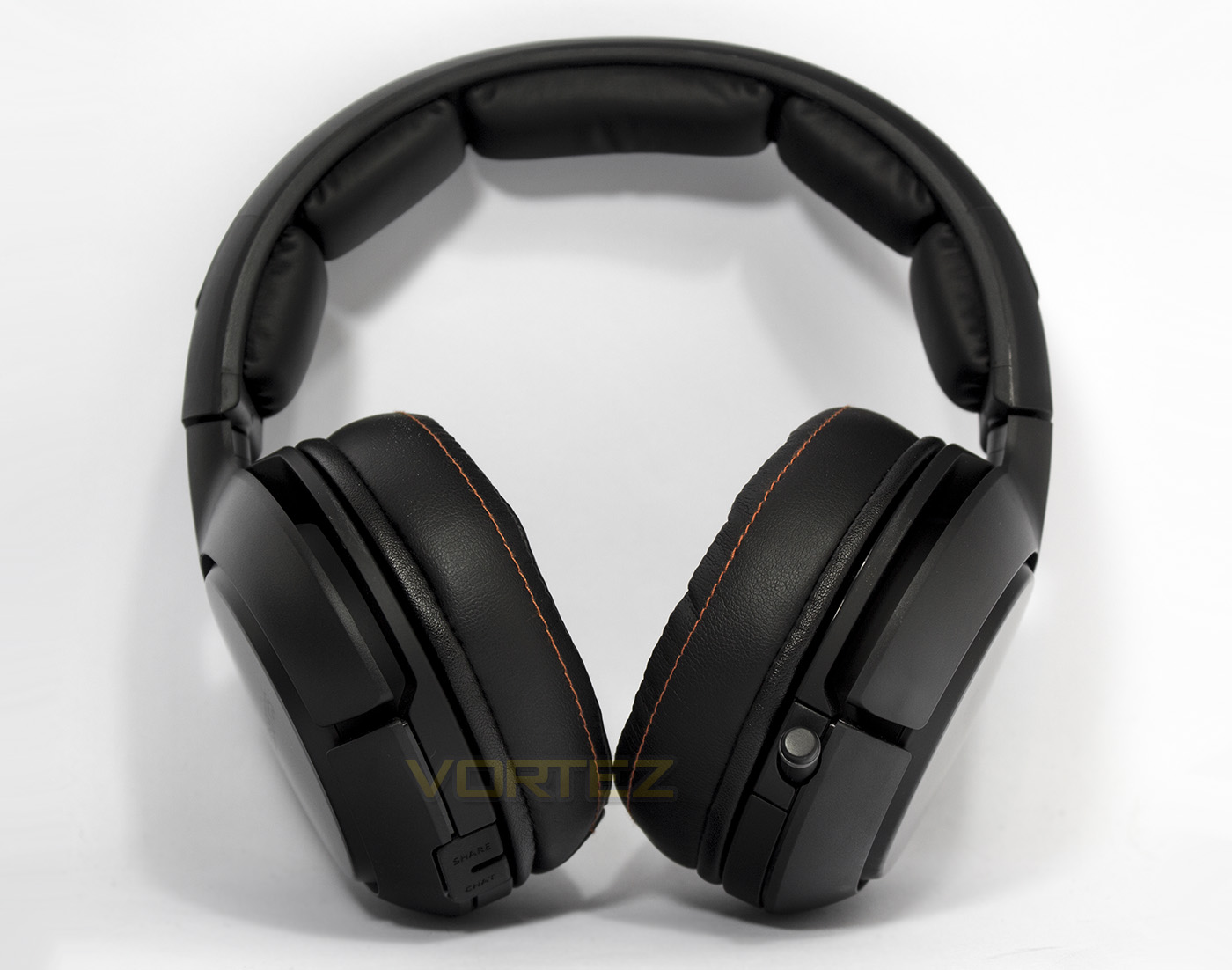
The headset itself features large cushioned earcups highlighted with the SteelSeries burning orange colour. The headset frame is mostly plastic with some metal (plated) parts.
Closer Look
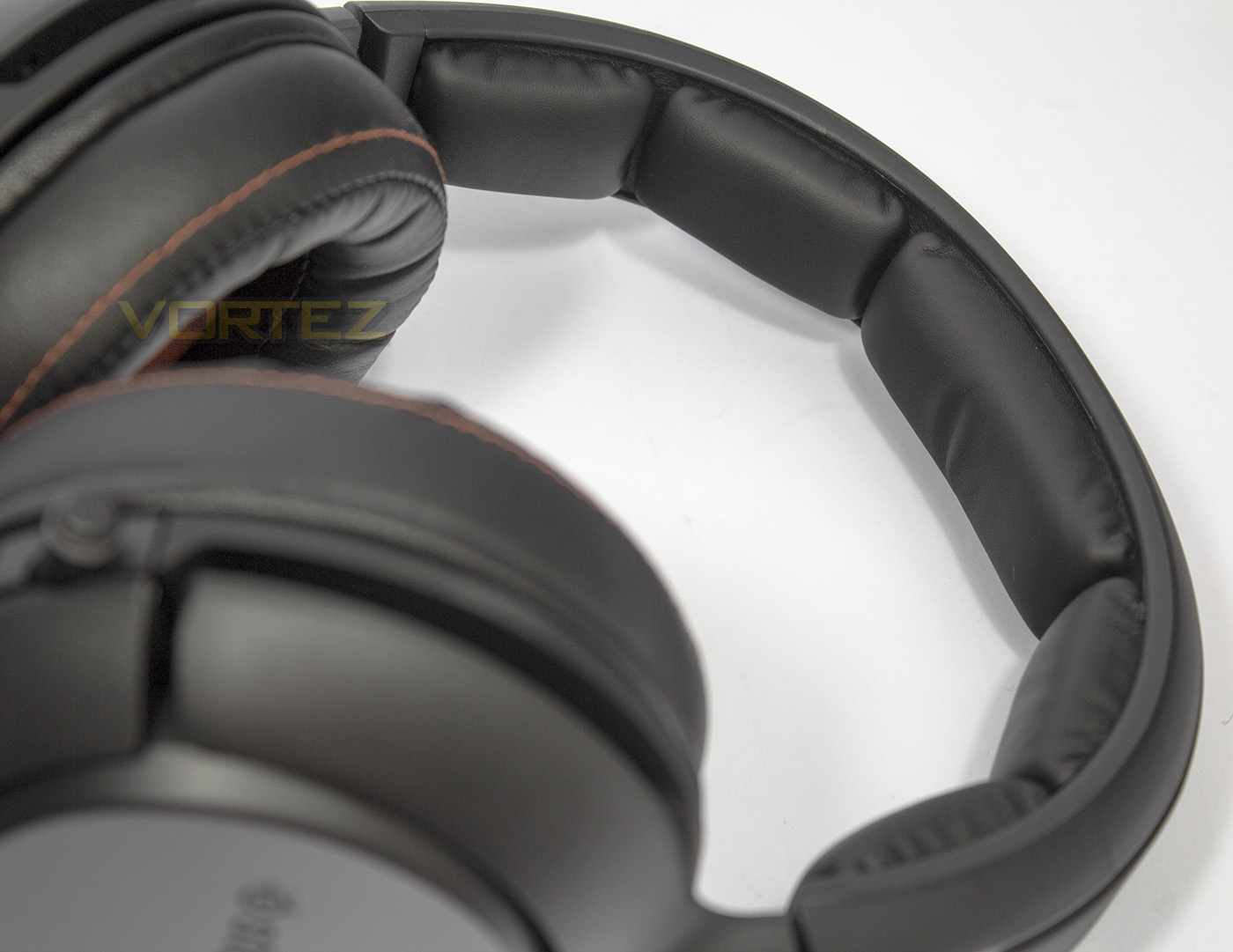
The headband is lined with super soft and squishy memory foam cushions that are held in place with a soft leatherette material.
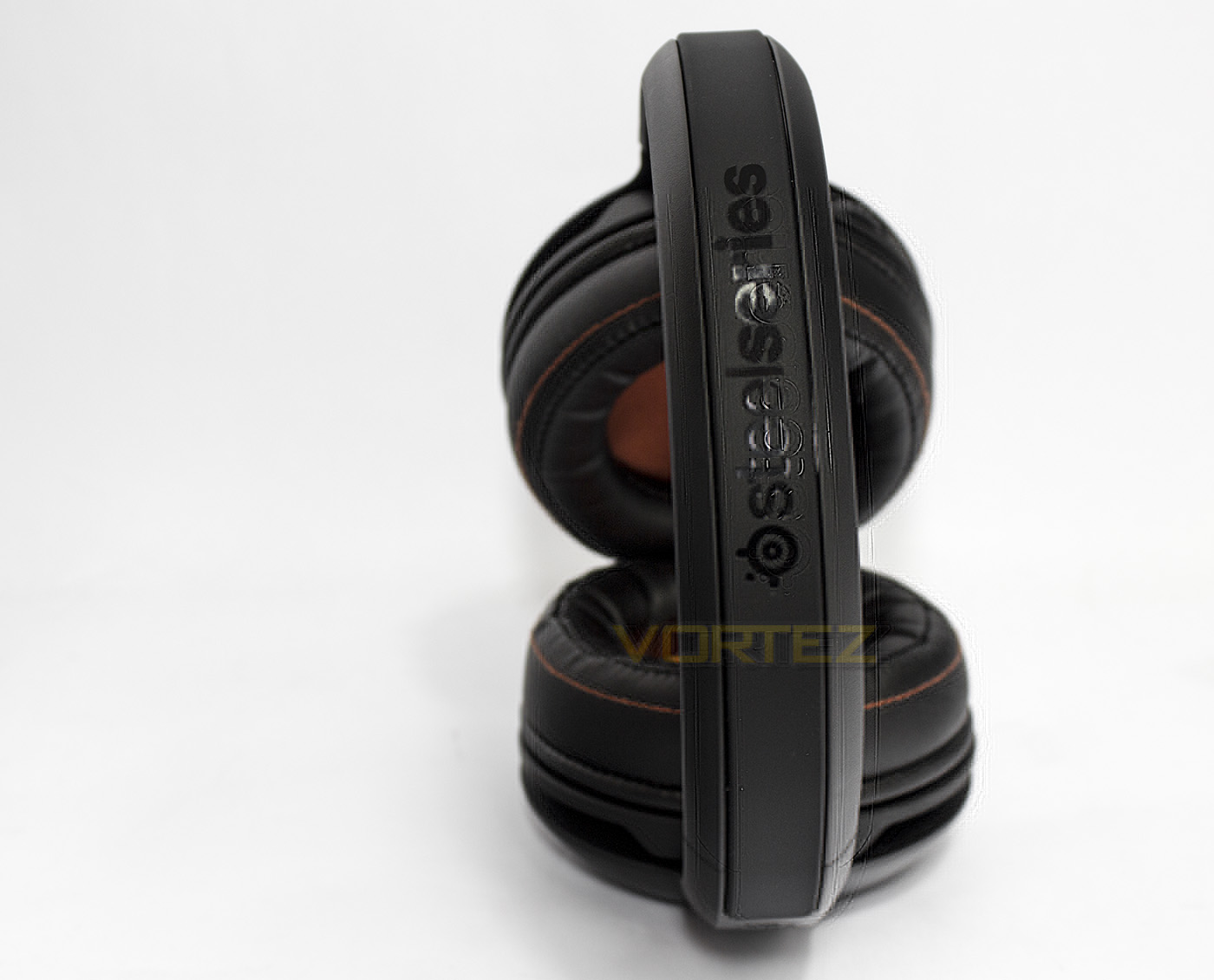
The top side of the headband has the SteelSeries name embossed into a soft rubberised layer.
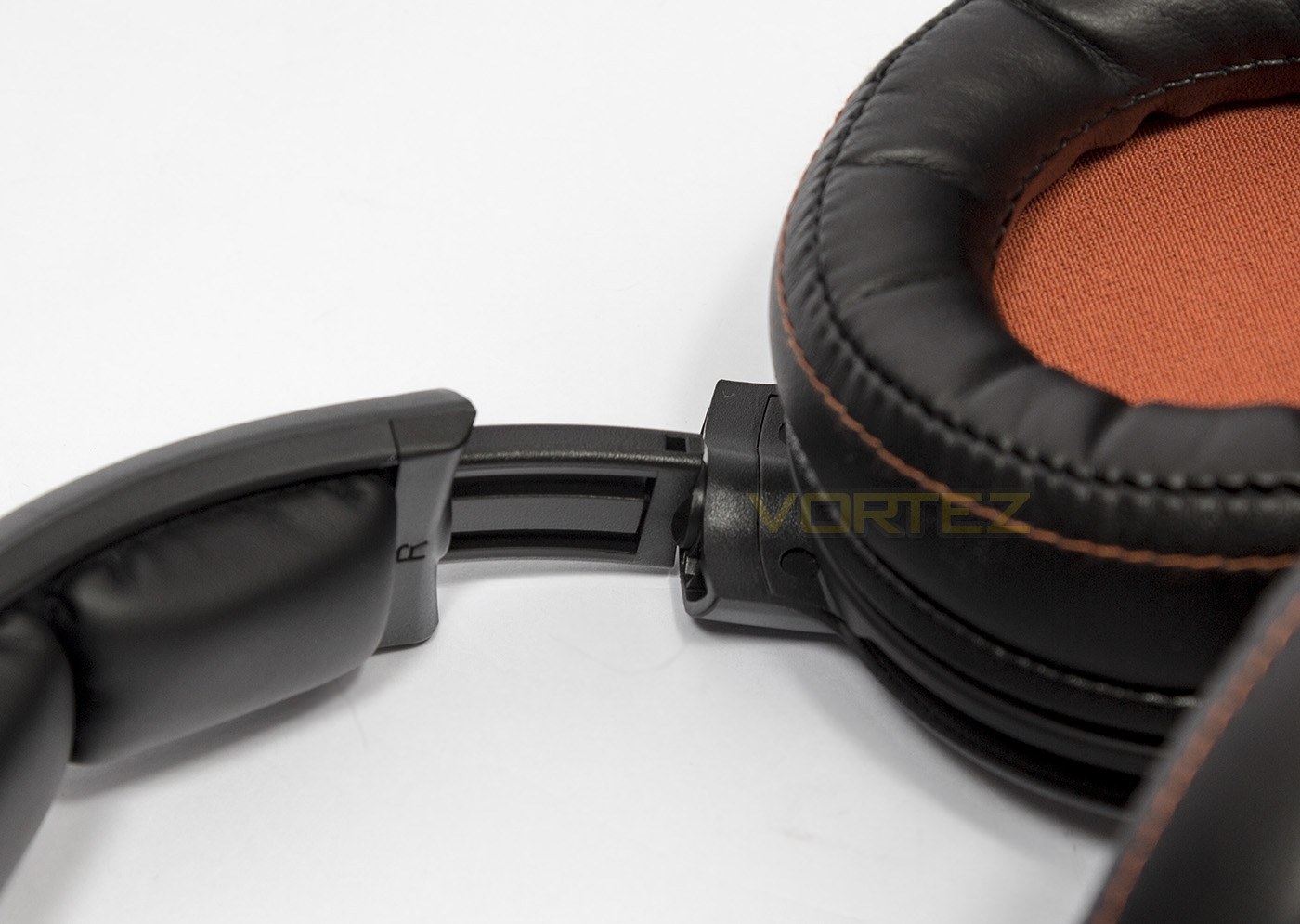
The earcups can rotate flat, while the earcups can be pulled down to adjust the size of the fit. The material seems to mostly be plastic here.
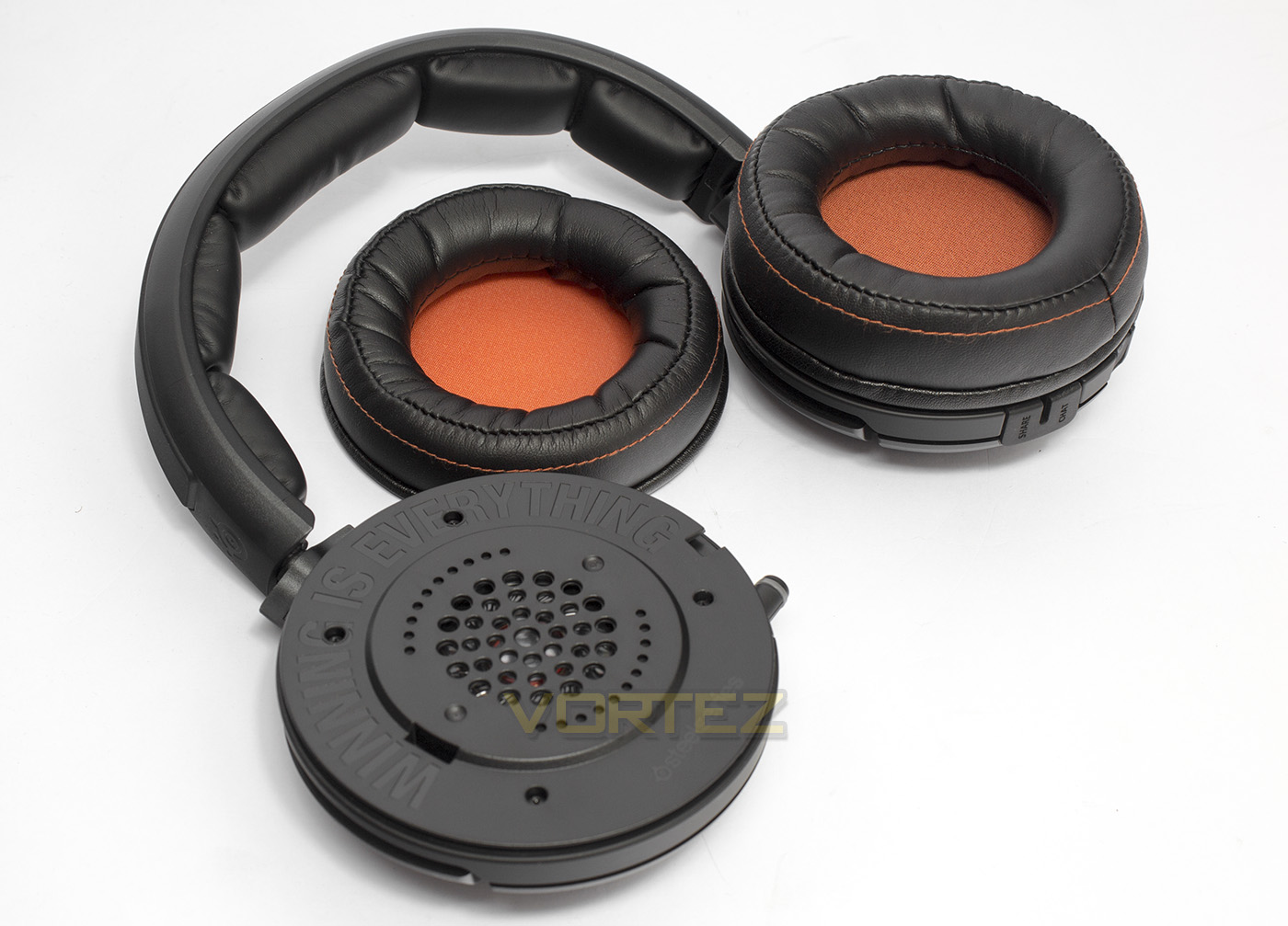
The earcups are large, but the padding is rather thick. Due to the round shape and the thickness of the padding there isn’t much height for the ear (just under 2″/50mm) The ear cushions are easily removed/replaced should they need to be, and are coated in leather (feels real, but could be a high quality PU/synthetic.
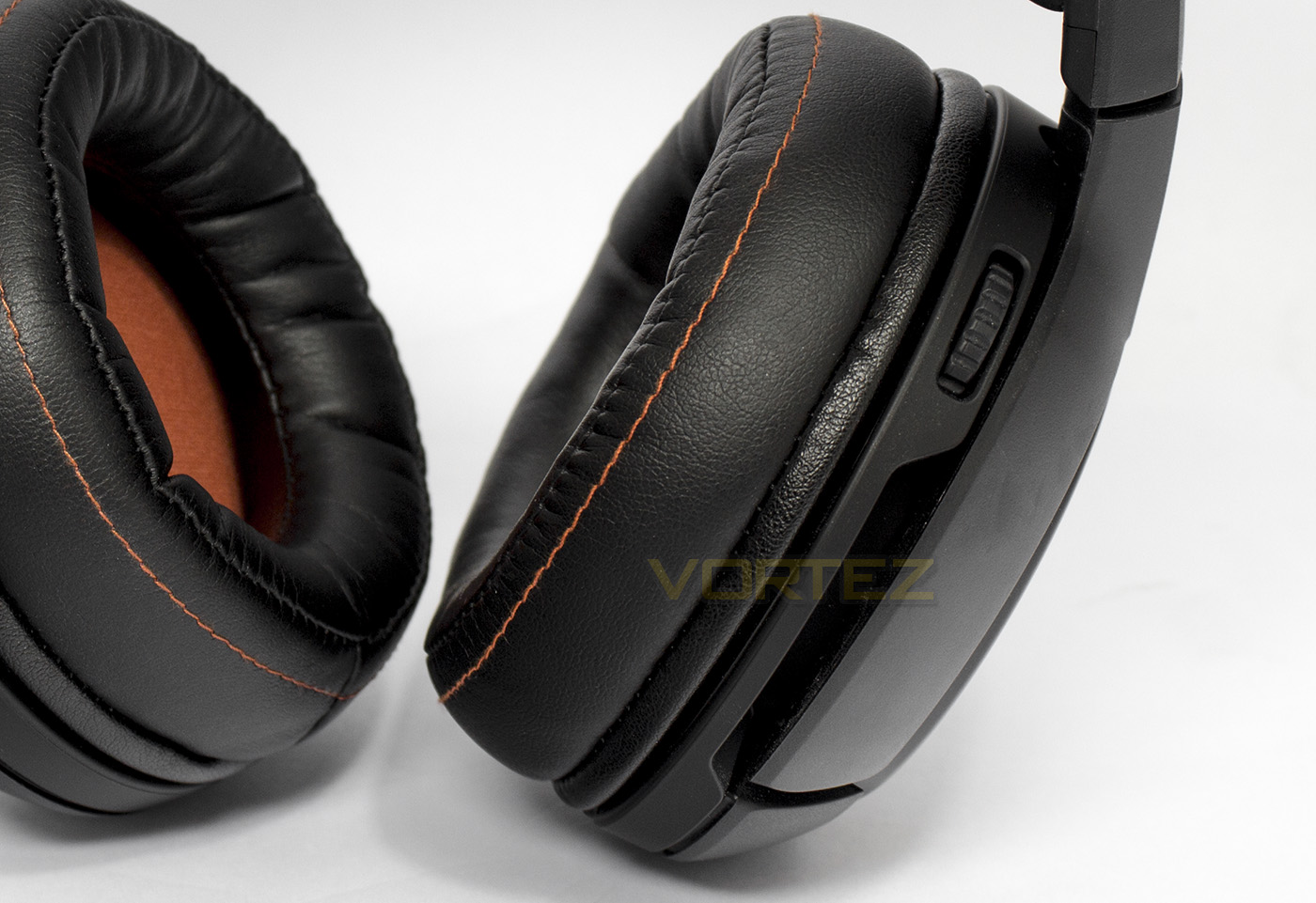
On the rear side of the right earcup, there is a volume dial that also acts as the menu/select button to navigate the options on the transmitter.
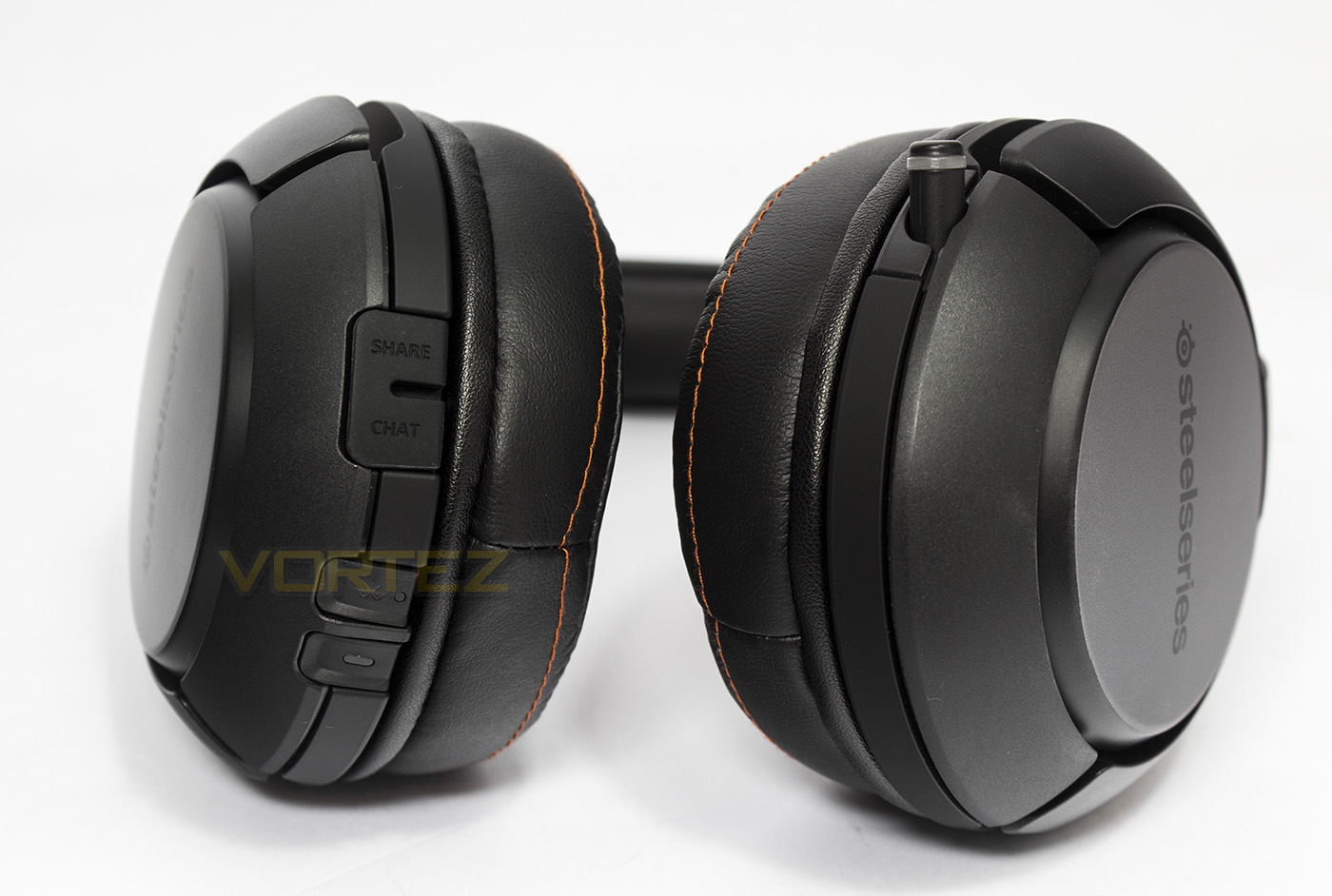
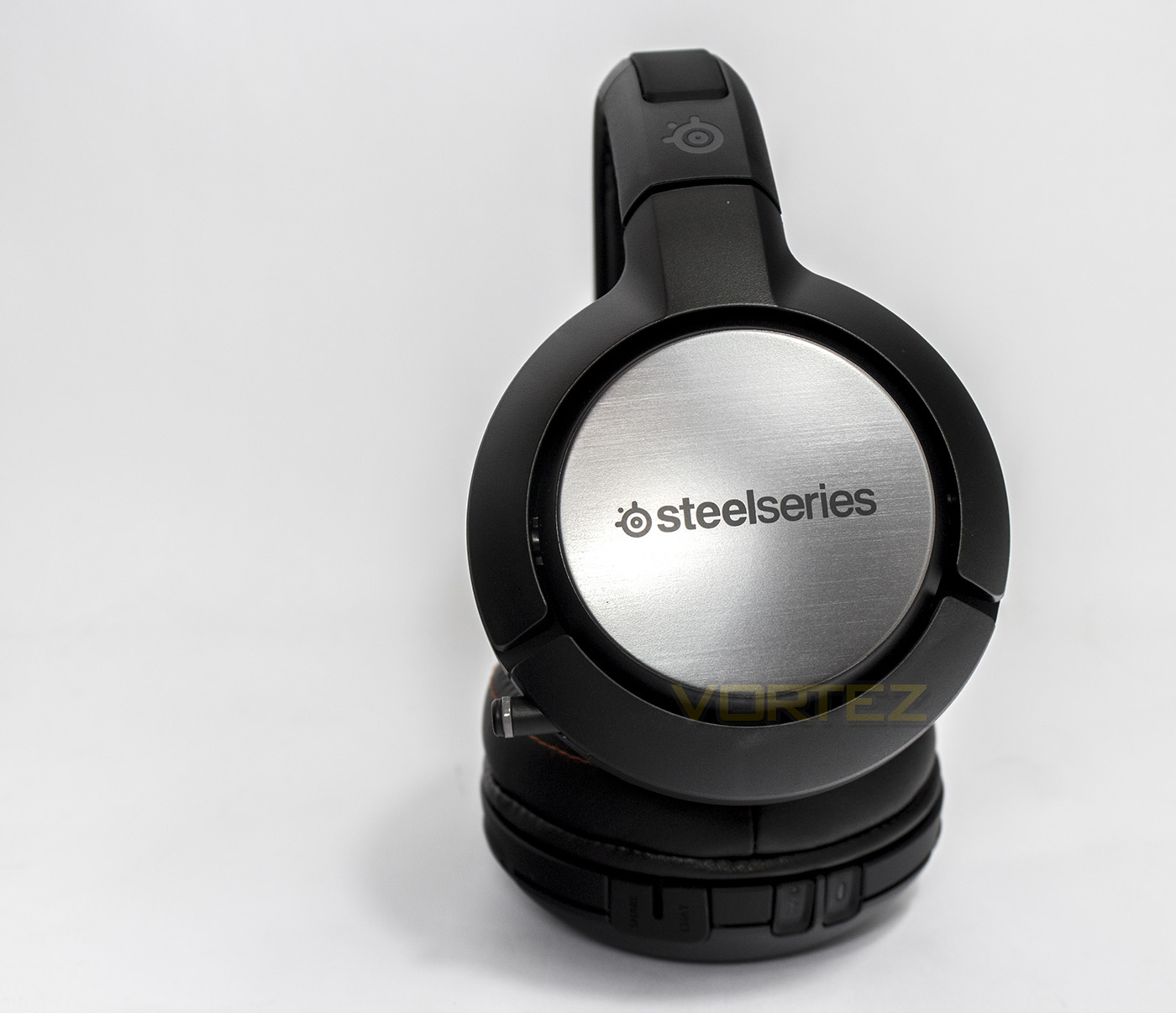
At the base we can see the various controlls including the power/mute/answer call button, the Bluetooth/pairing button, as well as the I/O area for the Analogue/chat/audio share ports.
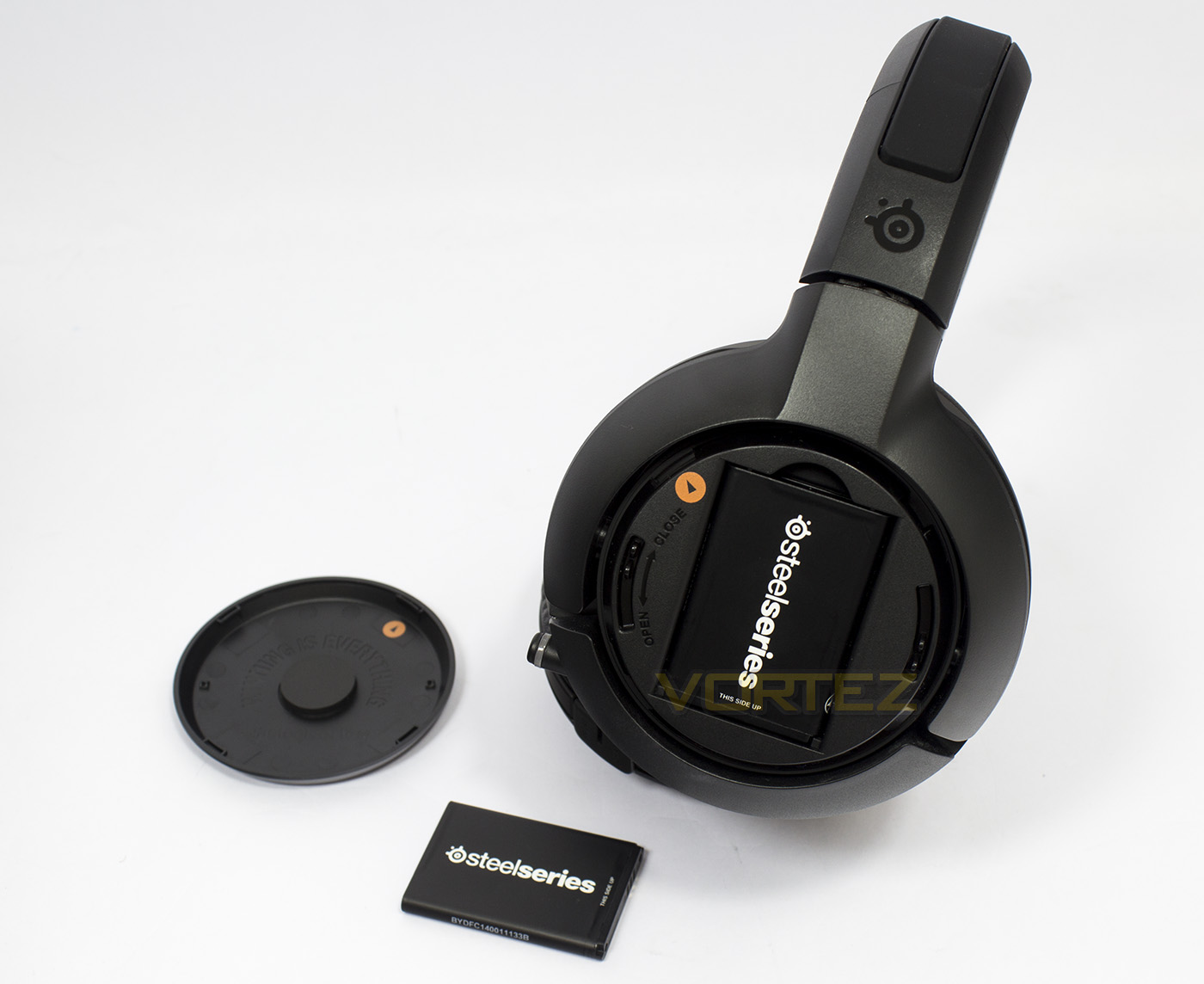
The left-side earcup houses the rechargable lithium ion battery, which can be accessed by rotating the circular outer covering counter-clockwise.
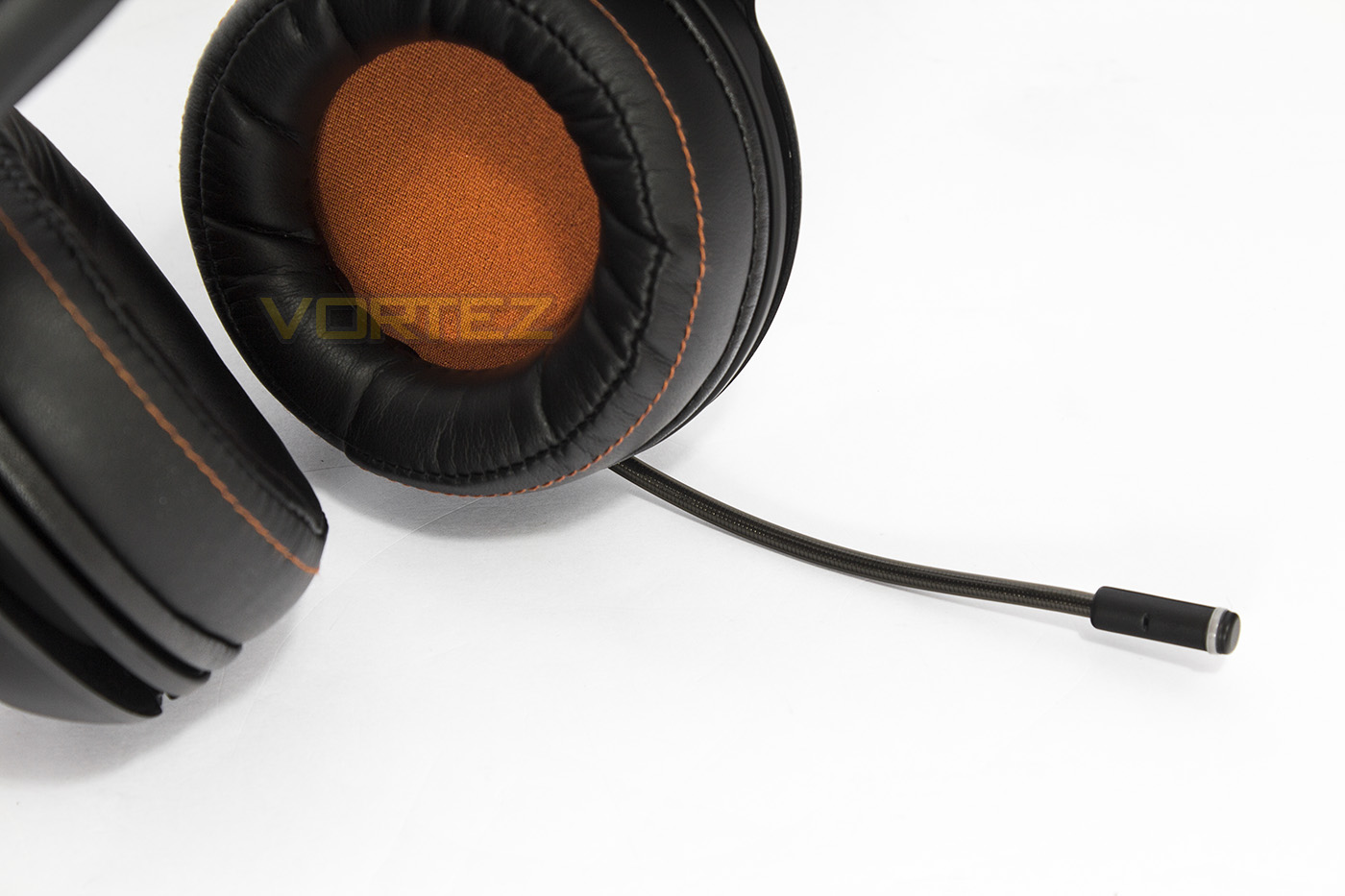
The retractable microphone features an LED mute indication, so if you have muted it (by quickly pressing the power button) the red LED light will show up.
Software
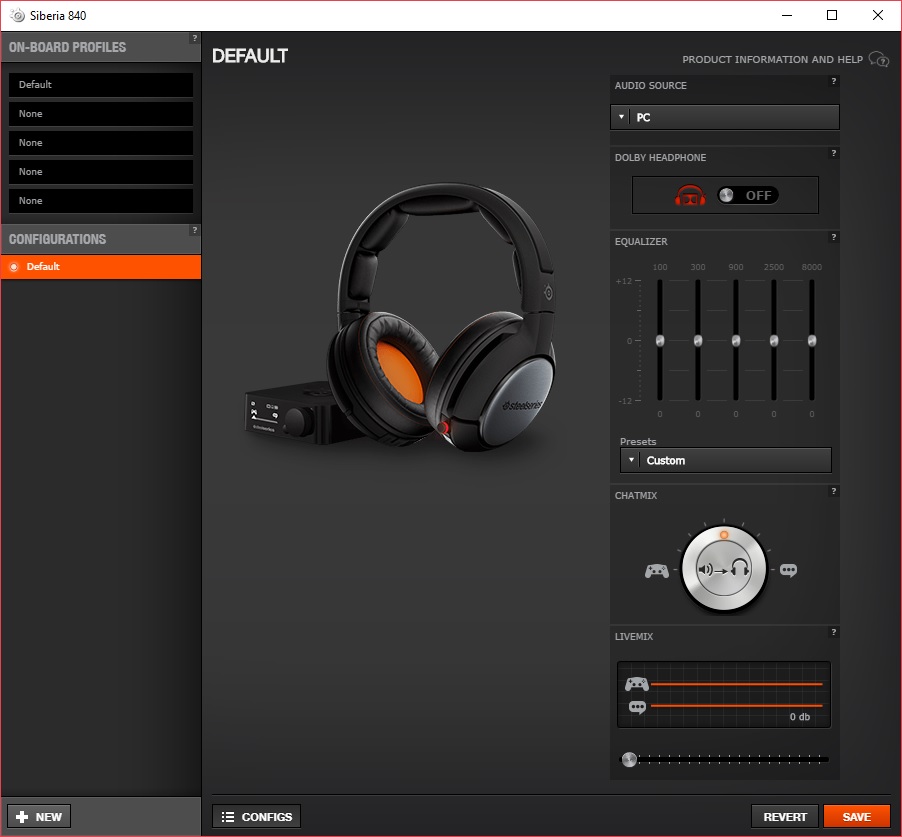
Unlike the Siberia 800, the 840 is compatible with the SteelSeries Engine 3, which is their own unified software driver. Inside the app, you have access to an audio equaliser, a chatmix/live mix features, change the audio source, as well as enable/disable Dolby surround. You can also save various presets here too should you wish.However, all of the functions are built into the Transmitter box to which you do not necessarily require to download/install the software. The OLED display shows off whether your headset is connected, how much battery life it has left, as well as giving clear volume/source/profile navigation. Thought the options, we discovered a volume limiter, which is enabled by default to protect your hearing. Disabling this, you access a slightly higher volume.
You can navigate the menus via the rear-right dial on the headset by pressing the dial inwards and scrolling it up/down to navigate should you be at a distance to the transmitter box.
Performance Testing
Setup, Design & ObservationsSetting up the siberia 840 will require a little time to understand what your uses will be. For example, if you wanted to be able to use the headset with the Xbox 360, you will either have to connect the transmitter box to your TV via analogue cable, or, to your Xbox 360 via the optical. This will give you the primary audio wirelessly, then for the chat audio, you will then have to connect the included Xbox 360 chat cable to the Xbox 360 controller. The same kind of set up will apply to the Xbox ONE, just that you will have to use the different chat cable.To connect to the PS4, you can either connect it via the optical cable, along with the 3.5mm 3pole-4pole chat cable to transmit voice, or you can connect via the USB cable with no need for the chat cable. Setup for PC the manual recommends connecting via the USB and analogue connectors, however I am not entirely sure why it recommends both when audio and voice can be done via USB alone. It is worth noting that the Dolby modes only work via optical and USB connections and not via analogue.
The headset itself appears to be able to mix up to 3 independent sources, for example, you can take a phone call via Bluetooth while gaming using the optical connections.
The best thing about all these connections is that they are geared to give you the best wireless experience and there is enough versatility to customise your setup in various ways. The only thing I think that it is missing, is a direct 4pole input for the PS4/XBONE controllers, as this would free up the transmitter for alternative sources should you constantly be bouncing between various sources. The headset itself does have another cable option in the form of a miniUSB behind the right side earcup cover, opposite to where the batteries are stored. The transmitter box could also be used as a signal processor to connect to some speakers via the optical pass-through.
We love the idea of having hot-swappable batteries in a wireless headset, as battery life is the bane of all wireless headsets, and once they die, you either have to use them wired, or wait till they recharge. Or, worse still, the battery can die over a period of time and you have no way of replacing it. SteelSeries have stepped over this problem by including 2x batteries, one of which can be charging in the transmitter box, while the other is in use, and it is very quick and convenient to swap over.
The build quality of the Siberia 840 is fairly decent, using high quality plastics, leather, PU leather, and memory foam. Though some may find that the ear cups are a little chunky looking. There is a tendency for ’round’ ear cups to lack in the correct dimensions to give enough space for your ears, and I found this to be the case here also. My ears are in no way the largest around, but I found it difficult to get the headset in place without the cushioning pressing down on part of my ear. Combined with the very stiff clamping force, if you don’t pay attention, it can cause some fatigue, however, if you get your ears in the right position, it remains very comfortable for long periods of time. This is a shame because the clamping force and earcup shape are retained from the older model headset.
To connect via Bluetooth, you can hold the Bluetooth button for over 3s to enter pairing mode, once paired, you only need to hold the button <3s to instantly pair again. The Bluetooth button also acts as a multi-function button, with a quick single press acting as play/pause, while a double tap will skip to next track while you are playing music. It can also be used to answer call, or end calls (double tap). To mute the microphone, single press the power button and the microphone LED indicator will come on.
Multimedia
Audio quality is great, sharp highs, slightly dipped mids and a warm bass coming through as standard. The drivers that SteelSeries use respond very well to EQ balancing, so you can adjust the tones to suit your preference. The bass doesn’t quite have as much rumble as some would like, and the overall precision doesn’t reach the same level of clarity as other headsets can at this price point, but we are nit-picking entirely based on price, and that doesn’t go to consider the fact that this is a wireless headset. The maximum volume is restricted by default, and is at a fairly decently level, though if you want that extra kick, you can delimit the volume and have an additional 10% volume. Though not the loudest out there, we felt that there isn’t any need for louder, besides this will be cutting into your battery life.
The Dolby Pro Logic II via USB cable sounds great, really opening up the audio with no real detrimental effects. Spatial awareness in game is certainly improved though, not necessarily better that standard stereo, so this will entirely be down to preference.
Microphone
The microphone is easily extended/retracted and is flexible/opposable. It picks up voice well and some background noise, but doesn’t quite sound as good as many would expect for this price, nowhere near as good as SteelSeries’ own ‘Clearcast’ microphone. That being said, there isn’t any hiss/pops and sounds clear enough, making perfectly feasible for gaming.
Conclusion
The Siberia 840 sounds awesome, and the drivers respond very well to EQ adjustments. By default the mid range is a little dipped, but it is fairly easy to balance things out to create a pleasing, high-grade audio experience. The Dolby v7.1 rendering produced a decently level of spatial awareness, at least notably better than we experienced with the Arctis 7. Though, the greatest asset to the audio quality of these headsets is down to the drivers SteelSeries implement as they always respond incredibly well to custom EQ balancing, enabling everyone to get that audio characteristic they prefer.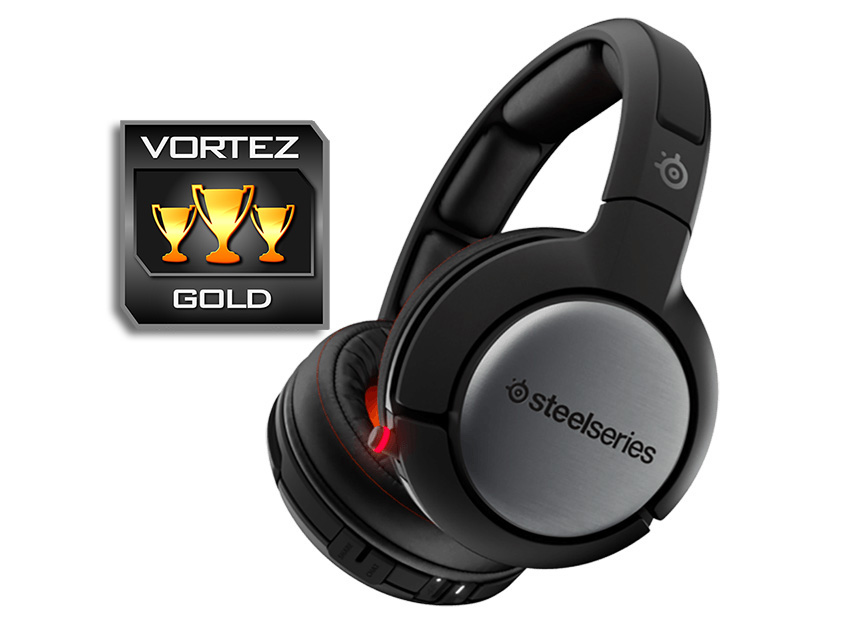
The main appeal of the Siberia 840 will be its versatility, and if you gave on many difference platforms, you will find that this is the ultimate gaming headset for you. Its compatibility easily exceeds that of any other wireless headset we have experienced to date as it caters for pretty much everything in some way. Though, we did note the lack of something that would have simply made it the ultimate headset, and that is a direct 4pole connection. Sure, this would go against the wireless nature of the headset, but it would have expanded its versatility in regards to direct connection to the Xbox One and PS4 controllers, freeing up the connectivity of the transmitter. Despite that, there is a lot of flexibility in what is available on the transmitter box, along with the impressive array of bundled cables; it is a shame that no storage case is included with it.
It is hard to deny that the Siberia 840 headset is an incredibly good wireless gaming headset. Though, we would argue that at this price, it seems largely punitive considering you can currently get the Siberia 800 (the original H Wireless) for £50-70 cheaper, that is a lot of money for added ‘Bluetooth’ and ‘SSE3 support’. Then we have to consider the actual headset design. We could argue that a large part of the value is inside the transmitter box, however, most of the end users interaction happens with the headset itself, and compared to the Arctis 7 (which is half the price), the Siberia 840 seems a little tired. We feel that the Siberia 840 simply isn’t as comfortable as other options, and the lack of that awesome ‘ClearCast’ microphone is disappointing.
The Siberia 840 is the most versatile gaming headset we have yet experienced. Those looking for a genuine do-it-all wireless headset can be sure that this will fulfil all your needs.
Pros.
+ Good quality construction
+ Clear, precise audio (responds well to EQ)
+ Incredibly versatile USB, Optical in/out, and analogue connections inputs
+ Low latency wireless connectivity
+ Bluetooth connectivity
+ Can mix various audio sources
+ Onboard controls
+ Audio-share port
+ Easy to use GUI (both via OLED and SSE3 software)
+ 2x 1000mAh rechargeable batteries
+ Dolby Digital/Pro logic II
+ LED mute indicator
+ Lot of bundled accessories
+ Compatible with SteelSeries Engine 3
Cons.
– Price
– No direct 4pole connection
– Clamping force is a little tight
– Microphone could be better
+ Good quality construction
+ Clear, precise audio (responds well to EQ)
+ Incredibly versatile USB, Optical in/out, and analogue connections inputs
+ Low latency wireless connectivity
+ Bluetooth connectivity
+ Can mix various audio sources
+ Onboard controls
+ Audio-share port
+ Easy to use GUI (both via OLED and SSE3 software)
+ 2x 1000mAh rechargeable batteries
+ Dolby Digital/Pro logic II
+ LED mute indicator
+ Lot of bundled accessories
+ Compatible with SteelSeries Engine 3
Cons.
– Price
– No direct 4pole connection
– Clamping force is a little tight
– Microphone could be better
Click here for an explanation of our awards at Vortez.net.