







Find out what we thought of Tuniq’s mid-range power supply the Potency 550W.
Up for review today is a PSU from Tuniq, a name that is more often associated with high quality air cooling for CPUs but they are now branching out into PSUs and cases. It remains to be seen if this will be a wise move but given the standard of their CPU coolers I have distinct hopes for the PSUs.
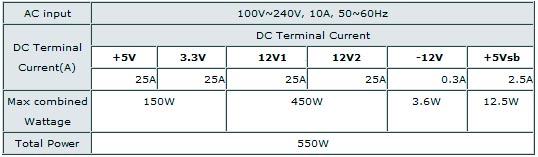
The product in question is the Tuniq Potency 550w which is a fairly standard looking non-modular PSU. The features and specification are as follows.

Features :
* 80 PLUS Certified
* SLI Certified
* Active PFC
* Support 9800 GX2
* Full Circuit Protection (OCP/UVP/OVP/SCP/OLP)
* Silent 120mm Sleeve Bearing Fan
* 3-year Warranty: we will replace new one when the power supply was broken within 3-years.
* Size: 140x150x86 mm
(information taken from the Tuniq website)
As we all know the PSU is one of the most important yet under-estimated components of the modern PC, it is pleasing to see that most of the nominal wattage is available for the 12V line as it should be with a modern PSU. The sharper amongst you may also have noted that the 150w from the 3.3V and 5V lines plus the 450w from the 12V lines doesn’t add up to 550w so the ratings might be slightly on the conservative side which is no bad thing, I’m inclined to believe that the 12V lines have been slightly over-estimated in that both lines cannot produce 25A and still be only 450w. The only way to see how good it is is simply to test it now.
Packaging and Closer Look
Tuniq have gone for a simple and elegant black and white scheme with the packaging here, there ais a single picture of the PSU on the box itself but then again, it is a PSU, for most people it will be installed then largely forgotten about. Taking it out the box reveals a standard sized PSU finished in matt black with sleeved cables, as mentioned at the start of this review this isn’t a modular PSU and it doesn’t feature any fancy touches to make it appeal to those who like PC jewellery. The first and most pleasing thing to note is that there is a fairly substantial weight to the PSU, it is not a hard and fast rule but generally speaking a PSUs quality can be roughly gauged by the weight of it – nb if you find that manufacturers start putting iron filings into their PSUs to increase the weight that this guide no longer stands.
The box also contains 1x kettle lead with UK plug, 4x screws for fitting the PSU, 10x cable ties and an extra molex splitter in case the 4x molex connectors from the PSU weren’t enough for you. The PSU is an active PFC unit so there is no switch between 110/240V, it will do it automatically which means it would work either side of the Atlantic without issue.


Installation and Testing
The PSU is a standard ATX sized unit so slips neatly into any ordinary case, an issue that may be apparent on installation is that due to it being a non-modular PSU you do have a lot of cables to deal with during installation so depending on your case design it might be a problem. However once installed you can easily neaten them up with the supplied cable ties.
The other and more serious issue is that some of the cables seem a touch on the short side, exactly how much of a problem this is will depend on what case and motherboard you use. For reference this was a Coolermaster ATS 110 case with an Asus K8V SE Deluxe motherboard and a Chieftec Dragon Midi Tower case with an Abit IP35-XE motherboard and found in both cases it was a little bit of a stretch for the molex connector at the lowest point (the hard drive and on the motherboard itself respectively). This might not prove to be such a problem for other combinations but neither are particularly large cases. Cable extensions are of course available and the molex splitter in the box would do the job but it is something that should be noted.


Testing
The parts used for testing are as below:
Chieftec Dragon case
Asus K8V SE Deluxe
Geforce 6800GT
4x Sata hard drives
2x IDE hard drives
2x optical drives
3x USB devices
The test initially used a single hard drive and a single USB device just to get a feel for the PSU but it was swiftly realised that wasn’t even causing it to break sweat as the voltages barely moved. The Abit IP35-XE based system mentioned above wasn’t used in final testing due to problems which is a pity as it would have given it a better workout but those problems were entirely unrelated to the PSU I hasten to add.

The current ATX 2.2 specification allows for up to 5% variance in the rails so the PSU is well within acceptable parameters even under load, the 5V rail shows the biggest variance in comparison to the rated voltage but that is to be expected as it was the most heavily loaded under the test and even it barely fluctuates.
Conclusion
This is a very nice PSU and would make a very good addition to a low cost but relatively high powered system, the PSU is certified as compatible with a 9800GX2 and SLi capable so it should cope with most systems without issue. It is available for ~$80 online which compares favourably for a PSU of this quality but again UK stockists seem scarce unfortunately which means that unless you are ordering other parts from the States that you’ll probably be taking a fairly hefty hit on postage which makes it less of a good deal than it should be.The problems of the short(ish) cable lengths and the non-modular nature of the PSU mean that it won’t score perfectly in the performance stakes and the appearance is understated but in value for money terms it rates very highly, with the caveat that you can get hold of one in your country.
We would like to thank Tuniq for supplying us with this power supply unit. You can find discussion on this review over at our Forum. Feel free to post a message!

