Nvidia have finally released a purebred mainstream graphics card solution so let’s see how it fares against the competition.
Product on Review: Zotac GTX460 1GB
Manufacturer and Sponsor: Zotac
MSRP: US $229
Street Price: £189.99/US $217
Nvidia’s first attempt at addressing their missing DX11 mainstream market was by using a cut down version of their flagship GF100 Fermi core in the form of the GTX465. The card was meant to retain all of Fermi’s architectural benefits at a lower price point, lower thermals and lower power consumption, three problems that plagued the GTX470 and GTX480 on release. However, the release of the GTX465 was met with a cold reception. As we saw with the MSI GTX465, Nvidia’s mainstream offering failed to live up to its expectations and fell short of ATI’s HD5850. The main problem was the steep price at which it was introduced that prevented it from being a true compelling alternative to the competition. Since then, a series of price cuts have rendered the GF100 based cards much more affordable and most importantly, Nvidia have released a brand new core that was designed from the ground up to target the mainstream market. Today, we have it here in the form of the GTX460 1GB from Zotac.
The GF104 core is the second derivative from the Fermi family of cards. Rather than being a cut down of the GF100 core, Nvidia have created a chip that shares many of the architectural characteristics of the latter on a smaller die size, thus being a distinctive addition to their line up. It follows Nvidia’s trend of releasing their flagship card first for a halo effect followed by their budget mid range offerings. Sporting fewer transistors, the GF104 core aims to tackle the shortcomings of the GTX465 it has been designed to replace, and that’s heat and power consumption. In terms of performance, the GTX460 is its spiritual successor with a price tag to reflect its position in the market. Here’s where Nvidia makes matters confusing. Officially there are two SKUs sporting the GF104 cores and both make use of the GTX460 moniker. The two variants come with different memory counts, 1GB and 768MB, with the latter also having a reduced ROP count and narrower memory bus. The 1GB model which we will be focussing on in this review is officially priced at $229 with the 768MB variant priced at $199. As to why Nvidia opted for that naming scheme, we aren’t sure.
In our review today, I will be looking at a reference design from Zotac. Although they have released a few custom cards that come pre-overclocked, the reference model is the cheapest solution and should hopefully be a good overclocker. It should be interesting to note the difference between the stock cooler and the Twin Frozr II custom cooler on the GF100 based MSI GTX465.

ZOTAC International is one of the largest producers of NVIDIA VGA and motherboard solutions worldwide.
ZOTAC International (MCO) Limited was established in 2006 with a mission to deliver superb, high quality NVIDIA graphic solutions to the industry. It has strong backing from its parent group, PC Partner Ltd. – with headquarters in Hong Kong, factories in mainland China and regional sales offices in North America, Europe, and the Asia Pacific region. The scale of support ZOTAC provides is currently unrivalled in the world. With 40 surface mount technology (SMT) manufacturing lines, 6,000 workers and a production facility with over 9,000,000 square feet, ZOTAC employs a full array of state-of-the-art technologies and skilled personnel in order to meet your hardware needs. In addition, ZOTAC has over 130 research & development professionals in Hong Kong and mainland China, working to bring you the best from the cutting edge of the industry. ZOTAC’s international bases of operation work together to enable effective and efficient global as well as localized sales and marketing support.
ZOTAC doesn’t just mean top tier quality, it is also synonymous with high performance, absolute reliability and unparalleled value. With a range of products featuring overclocked performance, excellent cooling properties, and unique packaging ZOTAC products routinely meet – and exceed – users’ expectations.
ZOTAC’s unwavering commitment to our users is to bring the latest products quickly to the market with the best value. Needless to say ZOTAC is the right choice for those who demand the highest quality graphics solutions.
For more about Zotac’s philosophy, click here…
Let’s see what awaits us with Nvidia’s new GTX460.
Specifications
The GTX460 is based on the GF104 chip, one that Nvidia designed from the ground up to target the mainstream. While the GTX465 was still essentially a GF100 core with disabled stream multiprocessors (SM), the GF104 is a completely new core, yet still based on the Fermi architecture. So we can expect a lot of the benefits of Nvidia’s new architecture including full support for Microsoft’s DX11 API, excellent tessellation performance and CUDA implementation for PhysX and other applications.
The core boasts an impressive 1.95 billion transistors on a 40nm manufacturing process. Compared to the 3 billion transistors on the GF100 core, the new one should produce much less heat and naturally the die size is much smaller, more akin the ATI’s Cypress core which packs a similar 2.15 billion transistors. In terms of the internal core layout, GF104 is similar to the bigger GF100 core with the same Polymorph engine for each SM and a Raster engine for every 4 SM (4 SM make up a Graphics Processing Cluster (GPC)). The difference comes in the number of stream multiprocessors and their arrangements. Instead of a total of 16 on the GF100 core, GF104 only sports half the amount at 8. As such, the number of GPCs has reduced from 4 to 2. This time however, each SM has been configured to have 48 CUDA cores instead of 32. On top of that, each SM now has 8 texture units instead of 4. The implication of this is that each SM of the new core has more compute and texture power than the original. The result is a core organised in an 8×48 block to give a total of 384 CUDA cores. Additionally, there’s the L1 Cache for each SM and a common L2 Cache shared the by the core’s 8 SMs.
GF100: 16 SMs x 32 = 516 Cores, 16 SMs x 4 = 64 texture units
GF104: 8 SMs x 48 = 384 Cores, 8 SMs x 8 = 64 texture units
When I reviewed the GTX465, I noted that Nvidia had simply disabled the number of SM units to produce three different SKUs from the GF100 core. The flagship GTX480 had one SM disabled for a total of 480 CUDA cores and 60 texture unit, and on the GTX465, 5 were disabled to give 352 cores and 44 texture units. This time, Nvidia have followed the same trend and disabled one SM unit on the GF104 chip to create the GTX460. The end product therefore sports 336 CUDA cores and 56 texture units.
Another notable difference of the GF104 core is the number of memory controllers. The core has 4 in total, instead of the 6 found on the GF100 core, for a 256-bit memory interface. The GTX460 makes full use of the 4 memory controllers for 1024MB of memory whereas the 768MB variant has one disabled. To compensate for the narrower memory bus, Nvidia have teamed the core with GDDR5 memory for much higher bandwidth that could previously be achieved using the same bus width.
GTX480: 15 SMs x 32 = 480 Core, 15 SMs x 4 = 60 texture units
32-bit channel x 12 = 384-bit interface, 256MB x 6 memory controllers = 1536MB memory
GTX465: 11 SMs x 32 = 352 Core, 11 SMs x 4 = 44 texture units
32-bit channel x 8 = 256-bit interface, 256MB x 4 memory controllers = 1024MB memory
GTX460: 7 SMs x 48 = 336 Core, 7 SMs x 8 = 56 texture units
32-bit channel x 8/7 = 256/192-bit interface, 256MB x 4/3 memory controllers = 1024/768MB memory
The card we are looking at today is the 1024MB variant without the “crippled” memory interface. On initial comparisons, we can see that the GTX465 and GTX460 are trying to achieve the same goal using different routes. Despite the lower moniker of the GTX460, which is also reflected by its number of CUDA cores, the card boasts more texture units than the GTX465 and its smaller design will no doubt contribute to lower power consumption and thermal output. Let’s see what other changes Nvidia have made to the clock speeds and how the core/texture unit count differences will impact raw performance.
What the GTX460 lacks in stream processors, it more than makes up in clock speed compared to the GTX465. We can immediately see that the GTX460 ends up the superior offering. The 16 CUDA cores deficit is compensated with an increase of 11% and 12.5% on the core and memory clock speed respectively. This translates to 11-12% increase in memory bandwidth and pixel fill rate over the GTX465, and 6% increase in shader operations. The texture fill rate sees a significant 40% boost thanks to the higher number of texture units on the GF104 chip. This performance gain comes with the added benefit of lower power consumption.
Based on those numbers, Nvidia look to be onto a winner and they have priced the card accordingly to make it very competitive in the mainstream market. The only direct competition that ATI currently offer is the HD5830 and going up the price band, there is of course the popular HD5850. Current pricing puts the Zotac GTX460 at around £180 and the cheapest ATI HD5850 at around £200 so in this review, we will see if Nvidia can claim back this market.
| Product Specifications Graphics Engine: GeForce GTX460 Model: ZT-40402-10P Bus Standard: PCI Express x16 2.0 (Compatible with 1.1) Memory Size(MB): 1024 GDDR5 Memory Interface: 256-bits Core Clock Speed (MHz): 675 Stream Processors: 336 Shader Clock (MHz): 1360 Memory Clock Speed (MHz): 3206 3D API: Direct X 11 & OpenGL 4.0 DVI Output: 2 HDMI: 1 (HDMI 1.3a w/audio (8 channel LPCM & bitstream) + DisplayPort) HDMI-Output: 2 (optional, via DVI to HDMI adaptor) VGA: Supported using DVI-to-VGA adapter) HDCP Support: Yes Dual Link DV1: Yes HDMI Support: Yes Display Output (Max Resolution): 2560 x 1600 SLI/3-Way SLI support: No Card Dimension (mm): 209.55 x 111.15 |
Features
| Here’s what Zotac have to say: Embrace Microsoft DirectX 11 technology with the ZOTAC GeForce GTX460 graphics card with hardware tessellation technology. The ZOTAC GeForce GTX460 graphics card implements DirectX11 technology perfectly to take gamers on breathtaking visual adventures with phenomenal details and unrivalled clarity. Everything performs beautifully on the ZOTAC GeForce GTX460 whether it’s the latest visually demanding gaming masterpiece, GPU-accelerated applications or simple high-definition video playback. NVIDIA® 3D Vision™ readiness ensures the ZOTAC GeForce GTX460 is ready to completely change the gaming and movie playback experience by taking it to the third dimension for unprecedented realism. |
Microsoft® DirectX® 11 Support
DirectX 11 GPU with Shader Model 5.0 support designed for ultra high performance in the new API’s key graphics feature, GPU-accelerated tessellation.
NVIDIA PhysX® Technology
Full support for NVIDIA PhysX technology, enabling a totally new class of physical gaming interaction for a more dynamic and realistic experience with GeForce.
NVIDIA® 3D Vision™ Ready
GeForce GPU support for NVIDIA 3D Vision, bringing a fully immersive stereoscopic 3D experience to the PC. A combination of high-tech wireless glasses and advanced software, 3D Vision transforms hundreds of PC games into full stereoscopic 3D. In addition, you can watch 3D movies and 3D digital photographs in eye popping, crystal-clear quality.
NVIDIA® 3D Vision™ Surround Ready
Expand your games across three displays in full stereoscopic 3D for the ultimate “inside the game” experience with the power of NVIDIA 3D Vision and SLI technologies. NVIDIA® Surround™ also supports triple screen gaming with non-stereo displays.
NVIDIA CUDA™ Technology
CUDA technology unlocks the power of the GPU’s processor cores to accelerate the most demanding tasks such as video transcoding, physics simulation, ray tracing, and more, delivering incredible performance improvements over traditional CPUs.
NVIDIA SLI® Technology
Industry leading NVIDIA SLI technology offers amazing performance scaling for the world’s premier gaming solution.
32x Anti-aliasing Technology
Lightning fast, high-quality anti-aliasing at up to 32x sample rates obliterates jagged edges.
NVIDIA® PureVideo® HD Technology
The combination of high-definition video decode acceleration and post-processing that delivers unprecedented picture clarity, smooth video, accurate colour, and precise image scaling for movies and video.
PCI Express 2.0 Support
Designed for the new PCI Express 2.0 bus architecture offering the highest data transfer speeds for the most bandwidth-hungry games and 3D applications, while maintaining backwards compatibility with existing PCI Express motherboards for the broadest support.
Dual-link DVI Support
Able to drive industry’s largest and highest resolution flat-panel displays up to 2560×1600 and with support for High-bandwidth Digital Content Protection (HDCP).
HDMI 1.4a Support
Fully integrated support for HDMI 1.4a including GPU accelerated Blu-ray 3D4 support, xvYCC, deep colour, and 7.1 digital surround sound including Dolby TrueHD and DTS-HD. Upgrade your GPU to full 3D capability with NVIDIA 3DTV Play software, enabling 3D gaming, picture viewing and 3D web video streaming. See Nvidia’s website for more details.
Packaging and Content
Front of the box
The packaging Zotac uses is a standard cardboard box with a plasticised cut out at the front. The yellow and black theme is in trend with Zotac’s other products and their own company logo. The colour also fits with the honeycombed livery but the relevance of bees to Zotac is a mystery. The front of the box has been made to look very vibrant to appeal to buyers and the various information displayed have been nicely laid out to lessen the clutter that often plagues product packaging. Below the Zotac logo is the omnipresent Pulse logo that Zotac use to symbolise the best engineering and innovation available. It remains to be seen if the logo translates to real world benefits. At the bottom, the product name is clearly labelled in bold with a few of the features the graphics card boasts and users can easily identify it as the 1024MB variant.
A transparent window giving us a glimpse of the graphics card
The transparent window presents us with a view of the actual graphics card inside. This sneak preview is an excellent way to draw people who would rather see the card itself than a graphics art depicting it.
Side of the box: features and specifications
On the side of the box, Zotac have listed the card’s specifications and features which we have already covered in depth over the last two pages. We can expect to see the card supporting all the latest Nvidia technology such as PhysX, SLI, 3D Vision and 3D Vision Surround. Also in small print, they specify that the right drivers, 3D Vision glasses and compatible monitors are required for the features to function. Next to the cut out on the front of the box, a list of additional bundled software is shown under the Zotac Boost Premium heading. These programs aim to enhance the user experience and although they are provided on the driver disc, they can also be downloaded from Zotac’s site. It’s also important to note that Zotac have one of the longest warranties of any graphics card manufacturer. Their “Extended Warranty” scheme lasts 5 years as opposed to the regular 2-3 years provided by other companies.
Back of the box
Turning to the back of the box, Zotac have used the space to showcase how their graphics card can enhance gaming experience through stunning gaming effects thanks to 3D and DX11 support. At the bottom, the list of included extras are given in 8 different languages and at the top, Zotac provide a small extract of what people can expect from their GTX460.
Inside the box
Inside, the graphics card is enclosed in a foam cut-out which is protected by a plastic cover. The card itself doesn’t span the length of the graphics card compartment, suggesting that the packaging is used for Zotac’s other products. If that’s the case, it gives a good indication of how much smaller the GTX460 is in comparison to its bigger brothers. On the side is another compartment for the relevant cables whilst the rest of the manual and driver discs can be found below.
The bundle
The bundle is fairly mundane but comes with Prince Of Persia: The Forgotten Sands. This adds more value to the graphics card depending if the game interests you or not. Rather surprisingly, the game comes in a boxed disc as opposed to the more commonly used paper coupons.
The package includes:
– 1 x DVI-to-VGA adaptor
– 2 Dual MOLEX-to-6-pin PCIe power cables
– User manual
– Quick installation guide
– Zotac Boost Premium
– Prince Of Persia: The Forgotten Sands
– 1 x Nvidia GeForce GTX460
The driver disc was missing with this particular sample but those in retail should have it. For the latest drivers, visit www.nvidia.com.
Closer Look
The Silversurfer…
The Zotac GTX460 uses a reference Nvidia design so there’s nothing spectacular that will set it apart from the competition unless users opt for the AMP! or Synergy editions. Nevertheless, we can still expect excellent quality with a few Zotac finishing touches to ameliorate the stock product. The first striking feature is just how short the card is. Recently when looking at graphics cards, we’ve seen them increasing in length and even the MSI GTX465 ended up with a 24cm PCB. The GTX460, on the other hand, is a mere 21cm long so compatibility is ensured in all cases without conflicts from HDD bays and other components. The card also uses a dual slot design for more efficient cooling, which we will touch on later. To differentiate their card, Zotac have stuck the same graphics art as found on the front of the box. I’m not too sure what the Silversurfer’s role is though…
The GTX460
The card uses a tough plastic shroud to cover the whole card and underneath is the heatsink. The yellow and black theme is visible throughout so it can easily be recognisable as a Zotac card.
Looking at the back of the card
At the back of the card, we can see that the card uses an appealing black PCB. There are no components at the back to cool so the card doesn’t sport a metal backplate. The cooling on the other side is screwed on securely rather than using push pins. It would have been more welcoming to see spring loaded screws for extra ease when removing the cooler but most users won’t have to worry about that. There are also several Hi-c capacitors dotted around to ensure greater efficiency and reliability, similar to those found on the MSI N465GTX Twin Frozr II.
The I/O connectors
The rear I/O panel has a wide selection of connectors. The yellow ones are the traditional Dual Link DVI-I connectors and for those still using VGA outputs, an adapter is provided. On the right is a HDMI 1.3a port and to the left is a DisplayPort connector. These array of connectors makes 3D Vision surround possible with up to three monitors, and unlike ATI Eyefinity, having a DisplayPort monitor isn’t a requirement. The I/O panel also has some air vents for hot air to exhaust out of but the presence of the top DVI-I port does create an obstacle for optimal airflow.
The power connectors
At the other end, the graphics card has 2 6-pin PCIe connectors. These are located at the end but should cause no issue with regards to length when the appropriate cables are connected. Two dual Molex-to-6 pin adapters for good measure so even older power supplies will be compatible.
The single SLI connector
On the side of the card is one SLI connector. Unlike the GTX465, the GF104 core only supports dual SLI hence the single connector.
Closer Look (Continued)
The fan
The cooler is the reference Nvidia design which uses the blower style fan and heatsink. The main advantage is that air is pushed towards the exhaust vents but it does limit sheer cooling potential like the Twin Frozr II style coolers. The fan itself uses small curved fins as opposed to a blade design to achieve this. It also has PWM functionality for temperature based fan management.
The GF104 core and memory modules
Upon removing the heatsink, the GPU core and memory chips are left exposed. The integrated heat spreader on the die is rather large but helps create a larger surface area for heat dissipation. Looking closely, it’s clear that the chip is indeed a GF104 core. The core is surrounded by eight 128MB memory modules to give a total of 1024MB. We saw that the MSI GTX465 had space for 10 modules in total with two removed for that particular SKU. The GTX460, on the other hand, sports a maximum of eight modules with 2 removed on the 768MB variant.
The Samsung K4G10325FE-HC05 memory modules
The memory modules are the same found on other Nvidia cards. These are manufactured by Samsung and sport the model number: K4G10325FE-HC05. The GDDR5 memory is rated at 0.50ns for an effective 4.0Gbps.
The VRM circuitry
Near the end of the card we can see the VRM circuitry. Judging by the number of chokes, the reference design doesn’t look to hold the same robust solution as the MSI card. However, Zotac claim that their cards are manufactured with electrolyte capacitors with aluminium caps for long term reliability. Furthermore, they use SMT choke coils which reduce radiation for a more eco-friendly approach. The VRM circuitry is cooled directly by the fan above.
The direct contact heat pipes
The underneath of the shroud reveals the heatsink and heat pipes. The former uses three direct contact copper heat pipes for improved heat transfer between the core and the cooler. These heat pipes then run towards the heatsink to dissipate the heat. Rather than using an all aluminium and copper design, Zotac use a steel plate for support and the heatsink is screwed onto with spring loaded screws. The shape accommodates for the GF104 core on which it lies but the steel structure does not provide efficient cooling for the memory modules.
The aluminium heatsink
Looking closer at the heatsink, it can be seen that it uses 35 fins to maximise the surface area. Although not packed as densely as the Twin Frozr II cooler, we have to remember that this is a reference designed cooler to reduce costs. Nonetheless, it should be able to cope well with the presumably cooler running core.
Test Setup
CPU – Intel Core i7 920RAM – 6GB (3x2GB) OCZ platinum DDR3 1333mhz
Motherboard – ASUS Rampage III Extreme
Power Supply – Enermax Revolution 85+ 850W
Hard Drive – Samsung F1 320GB
Western Digital Caviar WD3200AAKS 320GB
Cooler – Noctua NH-D14
Graphics Cards:
ZOTAC GeForce GTX460 1024MB – ForceWare 258.96
MSI N465GTX Twin Frozr II 1024MB – ForceWare 257.21
ASUS EAH5850 TOP 1024MB – ATI Catalyst 10.5
XFX HD5870 1024MB – ATI Catalyst 10.5
Benchmark Suite
MSI Afterburner & Kombustor
GPU-z
Crysis Warhead using the FRAMEBUFFER Crysis benchmark tool
Far Cry 2
Resident Evil 5
Street Fighter IV
Unreal Tournament 3 using the HOC Bench tool
Enemy Territories Quake Wars using the HOC Bench tool
Colin McRae DIRT 2
Batman: Arkham Asylum
Battlefield Bad Company 2
GTA IV
Mafia II Demo
Colin McRae DIRT 2
3DMark 06
3DMark Vantage
Unigine V2.1 DX 11 Benchmark
Software Bundle
Zotac bundle a number of GeForce-accelerated software with the GTX460. Unfortunately, the sample I received lack the driver disc but all of them are available on their website. Here’s a description of the applications included:
Enhance
vReveal
Easily stabilise, brighten, and sharpen your high-definition videos using powerful enhancement technology with vReveal. Harnessing the power of NVIDIA CUDA technology and ZOTAC GeForce series graphics cards, vReveal processes videos up to 5x faster than with a CPU.
Edit
Nero Vision Xtra
Edit your home videos with extreme precision and stunning effects with Nero Vision Xtra. Advanced features such as picture-in-picture effects, multi-track timeline, full key frame control and master effect track lets anyone transform home videos into cinematic masterpieces easily with Nero Vision Xtra.
Note that this is the trial version only.
Experience
Cooliris
Experience online photos and videos like never before with Cooliris, a revolutionary browser plug-in. Cooliris transforms your web browser (Microsoft Internet Explorer, Mozilla Firefox and Google Chrome) into the ultimate media browser that scrolls through infinite amounts of photos and videos in a matter of seconds with the option to view the content instantly.
Entertain
XBMC
Transform your PC into a digital entertainment hub with the open-source and award winning XBMC media centre. Enjoying digital audio, video and image content with XBMC media centre is a breeze, whether the content is on physical media such as CDs, flash drives, memory cards, or stored on another system over the network, XBMC media centre can access and play it with ease.
Enjoy
Kylo
Enjoy web browsing on your high-definition television set with the big-screen optimised Kylo web browser. Kylo is the ultimate TV web browser with big fonts and big buttons for easy usability while relaxing on the sofa.
Temperature & Overclocking
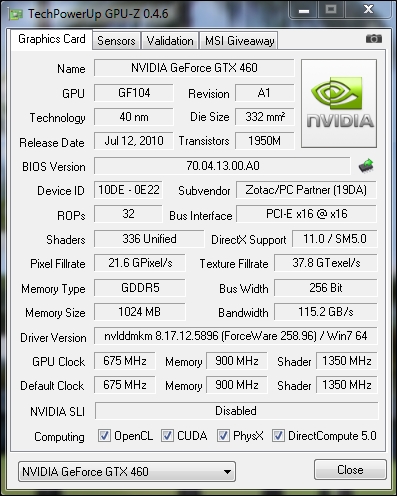
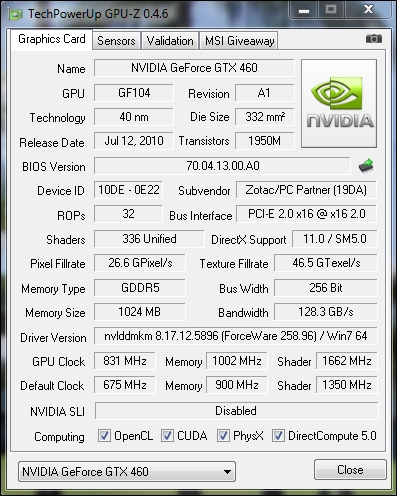
The GTX460 revered to be an excellent overclocker right from release and it didn’t disappoint. Armed with MSI’s Afterburner application, all I had to do was slide the settings to the desired clocks. Since there are no voltage tweaking support on the Zotac, no other settings had to be configured. The default voltage for this particular card was 1.0120V. In the end, the Zotac GTX460 achieved 830MHz on the core from the default 675MHz, and the memory easily reached 4000MHz over the stock 3600MHz. The memory reached the speed rated by Samsung. The shader clock speed remained synchronous with the core speed on a 1:2 ratio.
Stock
Overclocked
The 155MHz overclock on the core represents a 23% increase and the memory overclock is a lower 11% increase which is reflected in the memory bandwidth gain. The 23% core clock speed advantage results in a similar performance increase in pixel and texture fill rate.
Temperature
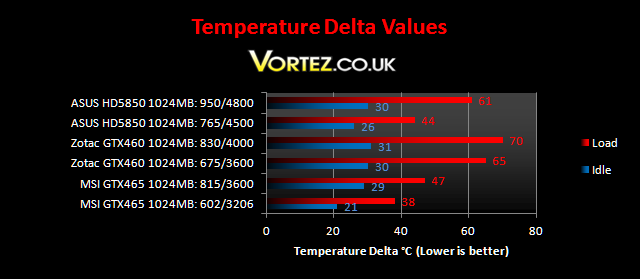
Temperature was definitely not the Zotac GTX460’s strong point. At stock speed, the reference cooler idled with a delta temperature value of 30C, higher than the other two GPUs tested granted they had custom coolers. Overclocking had minimal impact of the idle temperatures thanks to the 2D core clock remaining the same at 405MHz.
Under full load using MSI Kombustor, the fan struggles to tame the temperatures. At stock clocks, the fan ramps up to 64% speed and keeps the delta value at 65C which in this case was a real world temperature of 92C. Overclocking didn’t help matters and despite setting the fan to the maximum possible speed of 70%, the delta value rose by 5C.
Noise
Spinning at around 40% under idle conditions, the Zotac GTX460 remains fairly quiet. When placed under load, the fan speed increases to 64% and 70% for stock and overclocked speeds respectively. Those were definitely audible above the case fans and even during intense gameplay on Battlefield Bad Company 2. It seems that for this reason, Zotac have decided to limit the maximum fan speed to 70% so it couldn’t be turned up for overclocking purposes. For the perfect balance between noise and temperature, MSI’s Afterburner can be used to create fan profiles.
Crysis Warhead
Following the success of Crysis, the stand alone expansion “Warhead” was hotly anticipated to bring more game play, more weapons, improved visuals whilst maintaining better performance, the latter being what gamers wanted most. After all how many people upgraded their rigs just to play this game… In the game, you play as the upbeat Brit Sergeant “Psycho” Sykes, chasing down a Korean nuclear warhead. Throw in some ice shooting aliens and we’re bound to have a great game. It sure delivered.
The GTX460 is pretty much neck and neck with the GTX465 in terms of performance here both at stock and overclocked. At stock speed and no AA applied, the GTX460 takes a slight lead thanks to the extra shader power it has. With AA applied, the Zotac increases its lead but only by a minimal amount. When both Nvidia cards are overclocked, the GTX465 manages to close the gap thanks to its relatively higher overclock. Although it managed to beat the GTX460 with no AA applied, the superior shader power of the latter comes through with AA. The GTX460 makes a good start in showing that it’s a worthy replacement for the GF100 based GTX465.
Compared to the ATI card, the GTX460 is no competition. The pre-overclocked HD5850 has a 25% lead when both cards are at their defaults clock speeds. The overclocked GTX460 edges closer to the stock HD5850 performance but again we have to remember that the latter can also be heavily overclocked.
Far Cry 2
One of the most hyped games of 2008, Far Cry 2 had some big shoes to fill. It was built to be the next best thing since well… Far Cry I suppose. Combining an open-world game play with highly detailed graphics, physics and AI, what more could we possibly want? The game puts us in the body of a malaria inflicted mercenary hunting down the “Jackal” in the heart of Africa, in a bid to stop an ongoing conflict between two rival factions. The storyline can be hard to follow sometimes but I’m no game reviewer, so let’s concentrate on the graphics and performance. After all, we all need to know if our hardware will be able to handle the scorching savannah burning at the hands of our flamethrowers.
In Far Cry 2, we can see that the story repeats itself. At stock speed, the GTX460 pulls ahead of the GTX465 with an increasing lead from 2% to around 6% as higher levels of AA are applied. When overclocked, the GTX465 starts off as the dominant card albeit by a small amount but this advantage is lost at 8xAA.
The ATI cards have a much harder time keeping up in this situation as we see the game preferring the Fermi architecture. Again, the GTX460 loses out slightly with no AA applied compared to the HD5850 but with 8xAA, it has a 16% performance gain over the ATI card, even surpassing the HD5870. When overclocked, the GTX460 win in 5 tests out of 6 with regards to the heavily overclocked and voltage tweaked HD5850, an impressive feat for a card a fraction of the cost. In fact the performance difference at 8x heavily favours the Nvidia card with its 23.5% performance lead.
Resident Evil 5
Resident Evil 5 is the sequel to the Resident Evil series, exploring the life of main protagonist, Chris Redfield. You play as either Chris Redfield or Sheva Alomar in an African desert area in Kijuju. In true Resident Evil fashion, your main objective is to investigate a terrorist bio-organic weapon threat whilst killing infected “Majinis” on your way.
Between the Nvidia cards, the GTX460 again looks to be the better solution with a lead ranging from 1.6% to 6.4%. The performance difference is higher at stock speed but the overclocked GTX465 fails to catch up when both are overclocked. Again, the GTX460 extends its lead with higher levels of AA.
Against the ATI HD5850, the GTX460 faces much stiffer competition. At stock speeds, the HD5850 holds a 12-16% lead and at 1920×1200 8xAA, this increases to 27%. With both cards overclocked, this difference reduces to 10%, and 18% at the highest setting, suggesting that the GTX460 is more proficient with a bump in clock speeds.
Street Fighter IV
Street Fighter is back in its 4th iteration and its bigger and better than ever. Combining fluid, fast based sparring with stunning artistic visuals, the game delivers tremendous game play. Be reacquainted with some of the most popular characters in video game history while you battle your way to the top, be it with Ryu or the mighty Bison. The game might be frustratingly hard in some cases but there’s nothing like the satisfaction of K.O’ing your opponent with a well stringed death bringing combo.
Strangely here, the GTX465 proves to be the better Nvidia solution both at stock and when overclocked. Under stock speeds, the GTX465 leads by 9-10% with 4xAA at both resolution, and 6% with 8xAA. Overclocked, it leads by 15% using the former settings and 11% using the latter. It appears that Street Fighter IV prefers the high end Fermi architecture better for its stylised graphics.
Against the HD5850, the GTX460 has an extensive lead ranging between 14% and 41% when it’s overclocked but this is limited to the 1680×1050 resolution. Increasing this results in the ATI HD5850 performing better and gaining a performance advantage of 6-16%. Yet again, the performance difference is smaller with the overclocked results demonstrating the GF104’s reliance on clock speed.
Unreal Tournament 3 & Batman Arkham Asylum
Unreal Tournament 3
Built around the unreal 3 engine, Unreal Tournament is all about mindless fast paced shooting, decapitation with a plethora of game modes to so in. Not much else can be said really except that it promises hours of enjoyment on multiplier whether it be against bots, your friends at a LAN or online. It was one of the more popular games out there to adopt PhysX in the form of partially destructible maps, tornadoes and hail.
In Unreal Tournament 3, the GTX460 reclaims its supremacy over the GTX465. At stock speeds, the difference is around 6-7% and overclocked the gap reduces to around 5%.
Surprisingly, the GTX460 even manages to claim another win over the HD5850. It’s impressive to see the HD5850’s massive overclock not keeping up with the overclocked GTX460.
Batman: Arkham Asylum
The Dark Knight takes on his greatest challenge yet when he becomes trapped with all of his most dangerous villains inside the insane asylum of Gotham City – Arkham Asylum. The game exposes you to a unique, dark and atmospheric adventure that takes you to the depths of Arkham Asylum, Gotham’s psychiatric hospital for the criminally insane.
Here, the difference between the two Nvidia cards is much less. The GTX460 still comes out on top, especially with PhysX turned on where the lead is up to 10%.
The HD5850 is the better card at stock clocks but when both are overclocked, the GTX460 proves to be much tougher competition.
Enemy Territory: Quake Wars
Earth is struck once again by Extra-Terrestrials, this time in the form of the Strogg. In the game you play as either the humans, defending the their beloved planets, or the Stroggs, attempting to invade with their arsenal of futuristic weapons. The games has vast open battlefields with an enormous array of vehicles and weapons at your disposable promising fast paced strategic battles.
The GTX460 once again generates some impressive results here and at stock speed under the 1680×1050 resolution, it managed to command a 35% lead with Anti-Aliasing. At 1920×1200, the GTX465 does claw back some performance but once both are overclocked, the GTX460 proves to be the best solution.
In this game, the HD5850 proves to be the much better card having a 19% to 30% lead as higher levels of AA are applied. Even with both overclocked to their limits, the performance difference is 10% to 26%.
Colin McRae DIRT 2
DIRT is back and it’s bigger than ever. With an onslaught of famous X-Games competitors such as Ken Block and Dave Mirra, extreme is being brought back to rally. The game not only delivers outstanding gameplay in lush environments but also stunning visuals in the form of Direct X 11 implementation. If you want some fast paced, arcade style racing, then look no further than Colin McRae DIRT 2.
The GTX460 continues its path of glory in DIRT 2. Its performance lead over the GTX465 has grounded it as the best mid-range solution Nvidia has to offer.
Colin McRae DIRT 2 is always touted to be an AMD sponsored game due to the fact that they were the only company to take advantage of the game’s DX11 and tessellation capabilities on release. However, Nvidia have been known to have superior tessellation performance compared to its ATI counterpart. Looking at the HD5850 VS GTX460 results, we can see that the performance difference is very small but the Nvidia card does tend to come out as the winner with a lead of 3-9%.
Battlefield Bad Company 2
Battlefield Bad Company 2 is the new rendition of the widely successful Battlefield series of game. Having more in common with the console release of Bad Company, the sequel hopes to inject the DNA of the timeless Battlefield 2 online experience with the witty action packed single player shooting adventure of the original. As Private Preston Marlowe, your goal as a member of Bad Company is to once again save the world by securing a scalar weapon device.
At stock speed, the GTX460 has a 6% lead over the GTX465 which extends to 9% with AA applied. Overclocked, the difference is minimal.
The HD5850 is much better in Battlefield holding a 20-30% performance lead over the GTX460.
Grand Theft Auto 4
GTA IV follows a whole series of highly successful predecessors and this one is no exception. You play as Nico Bellic, fresh off the boat from Russia, seeking to live the American dream. But Liberty has far more sinister plans for you as you delve quickly into the criminal underworld to make a living and survive. Hours of game play later, it still retains its flare to guarantee that you go back to it at every opportunity.
There is normally very little performance difference between all the graphics cards no matter what settings are used on GTA IV and this is no different here.
Mafia II Demo
Following the success of Mafia back in 2002, the third person action adventure game is back with a new grittier and darker world. As Vito Scaletta, an aspiring made man, your job is to work through the twist and turns of Mafia lifestyle. The more blood spilt, the more you get in return but the lifestyle was never meant to be an ideal one. Set in the visually stunning Empire City, the wartime references provide the ever present back drop to a rife period in America’s history, in which potential for exploitation becomes Vito’s key focus.
In the demo, the GTX460 performs well enough to ensure a good experience. Turning up some settings such as AA or PhysX has an adverse effect on gameplay so the experience isn’t always smooth. Unfortunately, I didn’t have the GTX465 or HD5850 to compare to but relative to the HD5870, the GTX460 is around 2/3rds of the performance for the same relative price difference.
3DMark 06 & Vantage
3DMark 06
Futuremark has been the testing ground for enthusiasts ever since their first release in 1999! While 2006 is long gone, it’s still very popular amongst benchers.
The benchmark has become very CPU limited over the years but here we see that the GTX465 beating the GTX460 both at stock and when overclocked.
3DMark Vantage
This latest benchmark suite from Futuremark introduces DX 10 & PhysX support. Despite being on the verge of DX 11 games arriving, Vantage is still the chosen benchmark amongst enthusiasts these days.
In 3DMark Vantage on the other hand, the GTX460 gains back its crown from the GTX465. The more expensive ATI cards still end up superior with the HD5850 leading by 20% at stock speed and 16% when both are overclocked.
Unigine V2.1 Benchmark
Unigine’s benchmark is to showcase the benefits of DX 11 and the use of tessellation as opposed to normal rendering techniques. The demo has impressive visuals that gives an insight into what we can expect from gaming in the future.
The results here are very interesting. Using DX10, the GTX460 performs better than the GTX465, suggesting much better shader performance thanks to its architecture. This is still not enough to match the ATI HD5850 falling short by 20%.
Using DX11, the results take a dramatic turn. The GF100 core in the GTX465 rules the roost with unparalleled tessellation performance. The GTX460 isn’t as efficient in that respect but Nvidia’s Fermi tessellation performance is still very respectable and a class above ATI’s.
Tessellation
DX 10
DX 11 Tessellation off
DX 11 Tessellation off – wireframe mode
DX 11 Tessellation on

DX 11 Tessellation on – wireframe mode
Let’s focus on a few characteristics of tessellation in the first image. Firstly, when we compare the wireframe mode, it is clear that tessellation, triangular in this case, is adding a lot more features and details, which may at first not be recognisable. The surfaces are divided in many more triangles, allowing the objects to replicate more complex structures. The ground for example is one of the features that benefits from it. To make it as efficient as possible, tessellation becomes a function of distance, generating more polygons closer to the viewer.
Now let’s look at the application of this. If we gaze at the rock pillar closest to us, we can immediately notice that with tessellation, they are not just mere square blocks but instead have irregular surfaces, more representative of a natural rock. Now, let’s move on to the stairs, which again is a notable improvement on past rendering methods. Rather than being flat, they have depth, giving the impression of real steps as opposed to a slide. The same applies to the cobbled road although the compressed/downsized pictures make it hard to judge. The last thing I’ll point out are the tiled roofs. With tessellation, the individual tiles form a more complex/realistic shape instead of appearing flat with repeated textures. You’ll have to take my word for it if you don’t notice them or try the demo for yourself!
Nvidia Sled Demo
It has always been customary of both Nvidia and ATI do showcase their latest technology with some sort of tech demo. For the Fermi generation of card, Nvidia have opted for a mini game in which a character on a homemade rail restricted sled has to speed its way to the finish line without destroying the vehicle. It demonstrates several aspects of the DX11 API, namely tessellation, and also PhysX.
Tessellation off- Wireframe Mode
Tessellation on- Wireframe Mode
In wireframe mode, it is clearer the effect that tessellation has on the visuals. The last picture is able to outline the small crater to the left, thanks to the superior triangulation.
Physics Mode
Physics plays a big part in the demo, with each component of the sled interaction with regards to the velocity at which the vehicle is travelling. It makes the game an interesting balance between speed and stability, prompting the player to race to the end without allowing the sled to disintegrate on the rails. Switching on the velocity vectors, we can see exactly how all the separate components are interacting, both in magnitude and direction.
Power Consumption
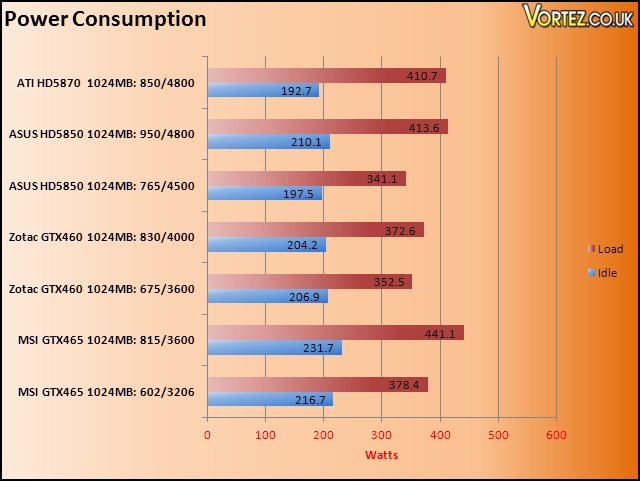
One of the key problems Nvidia wanted to address with the smaller GF104 core was the high power consumption that previously plagued the Fermi GF100 core. The results show that Nvidia have achieved what they set out to do. Comparing it to the GTX465, it consumes around 7% less power at stock speed under full load. Disappointingly however, it is still slightly higher than ATI’s HD5850. The good news is that overclocking doesn’t have a big impact on load power consumption, ending up 15% less than the GTX465 and 10% lower than the HD5850. The latter two cards had the disadvantage of being overvolted but it’s welcoming to see the GTX460 being an overclockable card without a tremendously adverse effect on power consumption.
Conclusion
The Nvidia GTX460 1024MB is an excellent little card. It’s what the GTX465 should have been from the start, both performance wise and in terms of power consumption. It’s no surprise that Nvidia are banking on this card being successful after the fiasco that hit the higher end Fermi cards on release. Thankfully for them, they have created a solution that will not only provide tough competition for ATI but is set to dominate the mainstream market.
First off, we analysed the performance difference between the GTX460 and the GTX465. Throughout the tests, the GTX460 lead by an average of 5-10% and in some cases such as in Quake Wars and DIRT 2, the performance gap ended up much higher. Overclocking both cards reduced the performance difference but not enough to take the winner’s title away from the GF104 based GTX460. This is mainly due to the architectural tweaks that Nvidia made to their new mainstream orientated core. Despite it missing 16 CUDA processors, each of the 7 stream multi-processors in the GF104 chip boasts 8 texture units instead of 4, giving a total of 56 for a higher fill rate and shader operation. Additionally a core clock bump proves to be beneficial to the GTX460 over the GTX465. The other advantages of the GTX460 includes a very high overclocking headroom without the need for voltage tweaking, much lower power consumption and most importantly, a lower price point. Given that the Zotac GTX460 was pitted against the more expensive MSI GTX465 with voltage control, it impressed me to see the numerous advantages it held over its bigger brother. The only downside of the GF104 chip was its lower tessellation performance but this was not a disastrous shortcoming.
The real question is whether Nvidia can wade off competition from ATI? The answer is not clear cut, as is usually the case in these situations. Nonetheless the GTX460 does very well competing against the HD5850, which we have to remember is in a price bracket above it. The only tests where the ATI card has a clear lead is Crysis Warhead, Resident Evil 5, Quake Wars, Battlefield Bad Company 2 and 3DMark Vantage. The GTX460 is distinctively the better card in Far Cry 2, Unreal Tournament 3 and the DX11 Unigine Benchmark. In the other tests, the winner depends mostly on the settings used or whether the cards are overclocked such as Street Fighter IV where the ATI card loses out at the lower resolution, or in DIRT 2 where the GTX460 fares better when both are overclocked. Overall it’s hard to argue against the HD5850 being the superior card but there are many other factors to take into consideration. In our review, the cards used were from Zotac and ASUS, the latter being £80 more expensive and pre-overclocked. In that scenario, the GTX460 looks provide the best value for money. On the other hand, if we solely look at the GPUs and their cheapest offerings, there is a £30 difference. Based on that, the choice would be much harder as they both will provide similar bang for the buck. This is somewhat of a strange scenario because it means both cards can co-existed and appeal to people with different budgets. I have to also note that the GTX460 responds much better to overclocking than the HD5850, often reducing the performance deficit it had in the above mentioned games. So against a non voltage modified HD5850, the GTX460 looks even more appealing. In reality, a HD5830 would have been a better card to compare it against but without a sample to test against, we couldn’t get any more results.
So far we’ve only focussed on the GPU itself rather than the manufacturer. Being a reference model, there’s not a lot of extras that Zotac bundle. Prince Of Persia and a lengthy 5 year warranty are the main attractions of this card but other than that, there is little to get excited about. Unfortunately, the cooler wasn’t adequate enough for cooling and noise was an issue during gameplay. Its price is also higher than other manufacturers’ offering that often come with custom coolers and/or pre-overclocked.
+ Good performance
+ Support for PhysX and CUDA
+ Stable and high overclocking headroom
+ Well packaged
+ Excellent price (GTX460s in general)
+ 5 Years warranty
+ Free bundled game
+ Good tessellation performance
+ Low power consumption
– High temperatures
– Zotac’s solution could be cheaper
I award Nvidia’s GeForce GTX460 1024MB the new Vortez accolade for Amazing Value.