




Under review today we have Zotac’s flagship graphics card the GTX285 AMP! Edition. Lets see how it does!
With the vast selection of graphics cards on the market today choosing one is never going to be easy. This is made particularly difficult when you consider the fact that so many new games come out demanding ever higher specifications. In fact i myself have had many different cards in a surprisingly short space of time for just this reason – only a few cards come to mind that actually offered enough additional performance to allow me to sit back and enjoy games over a longer period of time.
Today we’ll see if the Zotac GTX 285 AMP! Edition we have here is one of those cards.

Zotac says:
ZOTAC International (MCO) Limited was established in 2006 with a mission to deliver superb quality of NVIDIA graphic solutions to the industry. It has strong backup from parent group, PC Partner Ltd. Headquartered in Hong Kong, factory in Mainland China and regional sales offices in Europe, Asia Pacific and North America. The support ZOTAC provides is currently the largest of its kind around the world.
With 40 SMT lines, 6,000 workers and 100,000 square-feet meter, ZOTAC features a full array of state-of-the-art facilities and machineries. In addition, ZOTAC has over 130 R&D professionals in Hong Kong, China and warranty and service center in strategic countries to enable effective and efficient worldwide as well as localized sales and marketing supports.
Zotac are a fairly young company in comparison with many of the other graphic card manufacturers out there. Hopefully the GTX 285 AMP! Edition will not disappoint.
Packaging
The GTX 285 AMP! Edition comes securely packaged in an attractively designed box.


The card itself is safely protected by a foam cut out with a separate compartment for the additional cables and adapters – specifically two sets of molex to PCI-E power cables, a DVI to VGA adapter, a DVI to HDMI adapter and a SPDIF audio cable.

Additionally you get a warranty card, instruction/installation manual, a few CD’s including drivers, a copy of the top selling game ‘Race Driver GRID’ and the benchmarking software ‘3DMark Vantage Advanced’… last but not least i must also mention the presence of the ever popular case sticker – ‘Zotac’ branded of course!


Features
On paper the GTX 285 AMP! looks like a highly capable card offering many improvements over it’s littler brothers the original GTX 260 (192 and 216 stream processor varieties) and even the virtually brand new GTX 275.
It offers more memory (1gb vs 896mb), better memory bandwidth (512bit vs 448bit) and a higher stream processor count (240 vs 192/216) when compared to the 260’s as well as having more available memory and bandwidth than the 275. Indeed it even trumps its original equivalent model the GTX 280 – although not by much. Specs are identical until you get to the manufacturing process size of the G200 core.
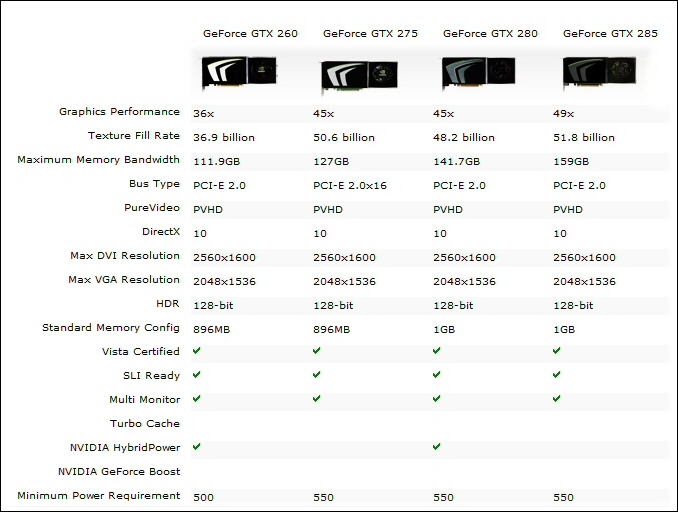
The 280 is built on a warmer running, more power hungry and consequently less efficient 65nm process whilst the 285 is built on a 55nm process. This also means that unlike the GTX280 the GTX285 actually has two 6 pin PCI-E sockets rather than one 6 pin and one 8 pin (far more rare) which makes it a more attractive proposition for people not wanting to use cable adapters.


Lastly, any one worth their salt will spot that the ‘AMP’ designation of any Zotac card refers to an overclocked edition. What we have here is a core clock of 702mhz (up 54mhz over stock), a memory clock of 1296mhz (also up 54mhz) and a shader clock of 1512mhz (36mhz above stock) these numbers may look small but as you will see they do have an impact.
The size of a flagship card like this could introduce some problems if the space in your case is limited. First of all the card is a considerable length so the depth of the case will be a factor. Also, consider airflow for the card. Although the heatsink on this model does a good job it can’t work miracles – decent cable tidying skills and some degree of cool air flowing towards it would definitely be a good thing.


Testing
The GTX 285 AMP! Edition will be tested alongside a pair of standard GTX 260’s (65nm – 192 stream processor model) run both individually and in dual card SLi. Both of these cards are identical to the reference NVidia design running at standard clocks.
Full spec of the test PC is:
CPU: AMD Phenom II 720 Tri-core @ 3.4ghz
Motherboard: ASUS M3N-HT Deluxe Heatpipe
Memory: 8gb (4x 2gb) OCZ Platinum PC8000 DDR2
HDD: 320gb Samsung Spinpoint F1
Operating system: Vista 64 Business
GPU: 2x GTX 260’s and Zotac GTX 285 AMP! Edition
PSU: Tagan Piperock 1100w (modular)
Cooling: Custom watercooling for CPU and motherboard chipset – GPU’s all use their original stock cooling
Case: Mountain Mods – H2g0 enclosure

Initial testing was compiled using Futuremark’s two most recent GPU benchmarking programs – the older 3DMark06 and their newest 3DMark Vantage. These were the newest patched versions at the time of the review.
(Note: In the case of 3DMark Vantage PhysX was enabled in the ‘Nvidia Control Panel’ since it was utilised in the test.)
All the GPU’s were tested using NVidia’s most recent GeForce driver set – 182.50
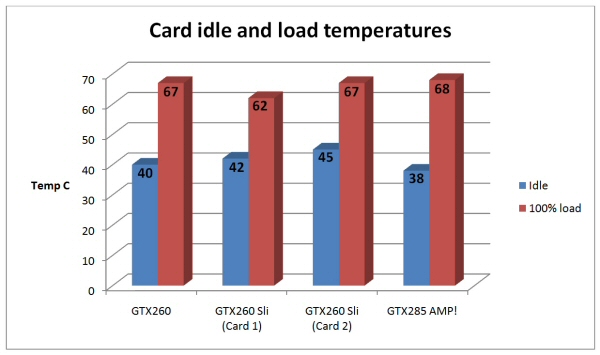
I also considered the operating temperature of the cards – in use the GTX 285 AMP! idled very cool and when fully loaded virtually matched the single 260. To achieve full load temps i looped the Far Cry 2 long Ranch demo.
3DMark06 & Vantage
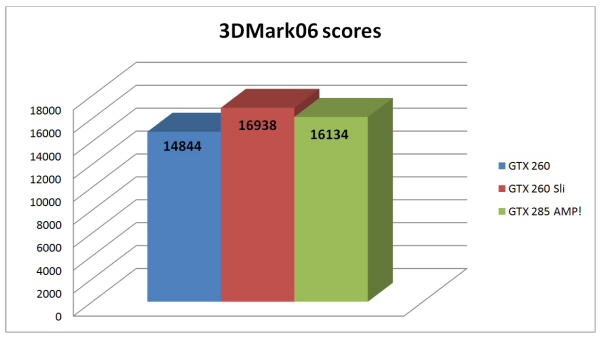
Firstly we look at the 3DMark06 results. Here you can see the single GTX 260 is beaten by the GTX 285 AMP! by almost 1300 points – very impressive and only 800 points off the performance score of dual 260’s in SLi.
Lets see if this performance is carried through to Vantage.
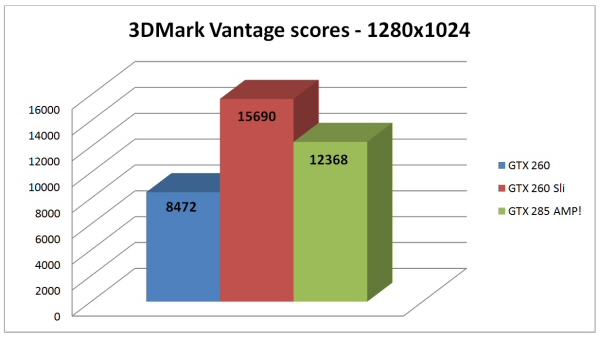
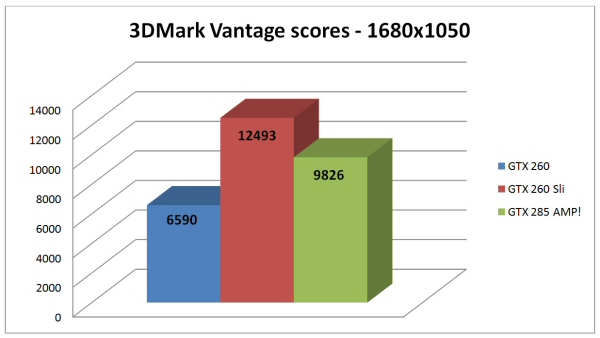
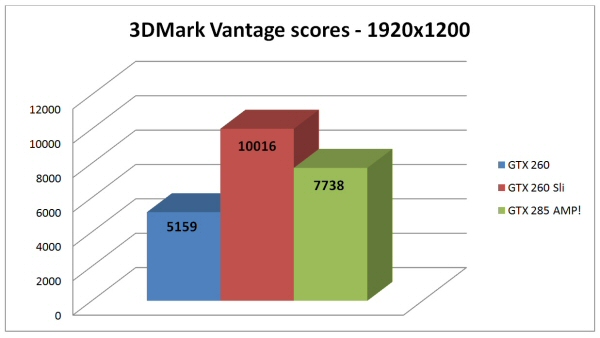
Unlike 3DMark06 Vantage shows GPU specific scores which helps identify performance increase. By looking at the graphs i’ve provided you can see a more clear indication of performance increases with better and multiple cards.
From these results it can be seen that Vantage believes the 285 offers around a 50% increase in performance over a single GTX 260 (core 192).
Lets see if this performance continues into actual game testing.
All the games (besides one) were run at the highest settings with all available AA and AF settings set to full – only Far Cry was run @ 2xAA to allow playability on the single GTX 260 @ 1920×1200. These cards are designed for top flight gaming so on the whole there’s little point in running lower settings.
Bioshock
First up is Bioshock – a well coded and beautiful looking game.
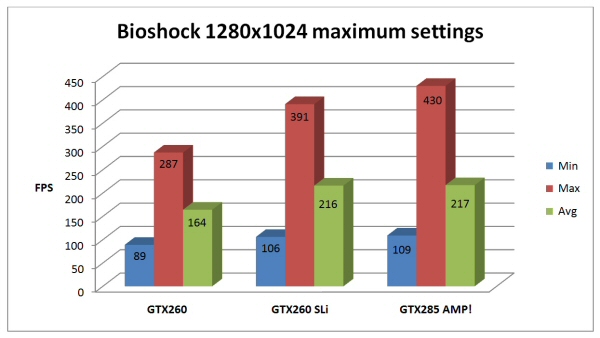
At the lowest 1280×1024 resolution the GTX 285 AMP! really shows it’s muscle and provides the best min/max/avg numbers of all three set ups.
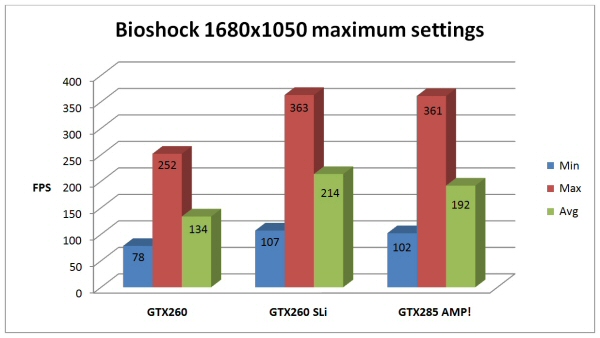
As the resolution increases to 1680×1050 the GTX 285 AMP! continues to beat the single 260 by a very healthy margin – the SLi’d 260’s are starting to show better performance though due to that extra grunt. This game seems to scal;e very well with SLi’d cards.
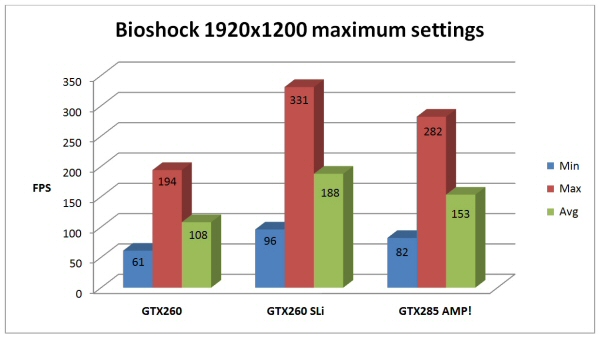
At the highest resolution i can test the SLi’s cards shine. That said the GTX 285 AMP! is an incredibly impressive card showing between a 30% and 50% increase in performance over the single 260. In fact – as you can see from the graph it isn’t a million miles away from the SLi set up.
Blacksite
Blacksite is up next. An often overlooked FPS i found it good fun and a decent test of hardware due to the stunning visuals and expansive game areas.
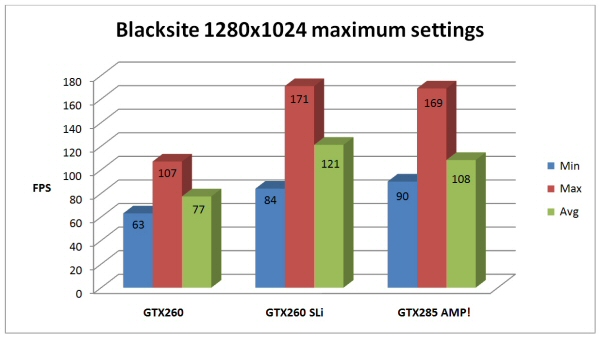
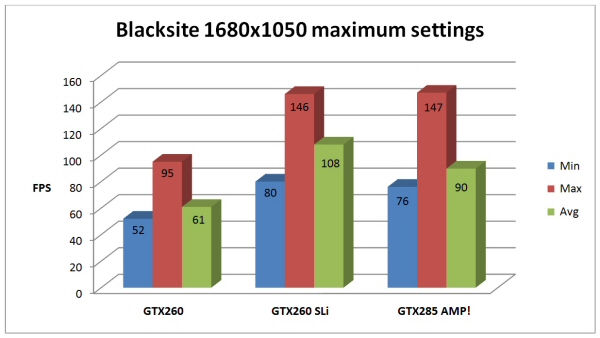
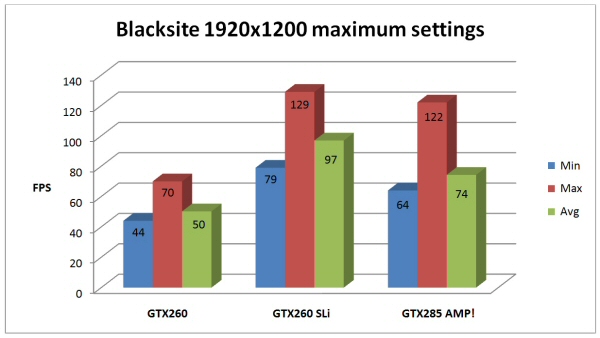
I would comment separately on the individual resolutions but as you can see the GTX 285 AMP! is virtually toe to toe with the SLi setup throughout – indeed, any real difference only begins to show @ 1920×1200 and even then it’s more than playable. The single 260 provides decent performance even up to this resolution but i would not really want to go any higher.
In terms of raw performance the GTX 285 AMP! soundly betters the 260 once again.
Call Of Duty 4
Here’s one for the online gaming community – Call Of Duty 4. A legend in its own lifetime and aside from its shining online credentials a very decent single player to boot. A particularly well coded game – it runs wonderfully well on mid and even lower end hardware. It should prove no problem to these cards.
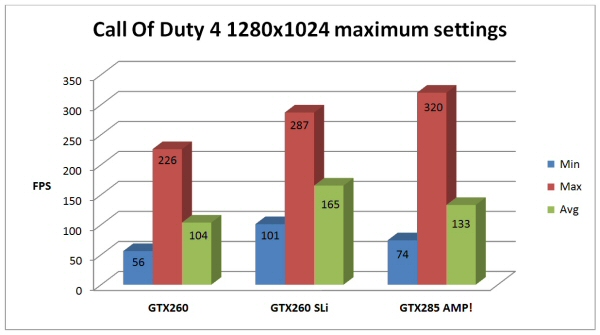
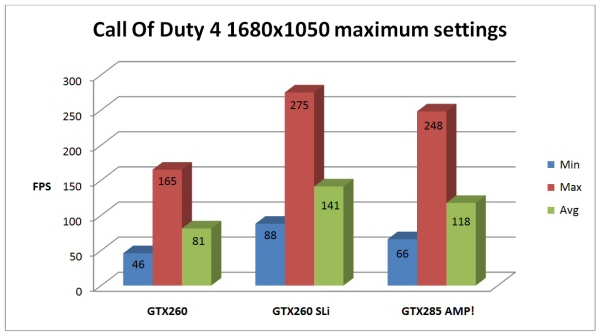
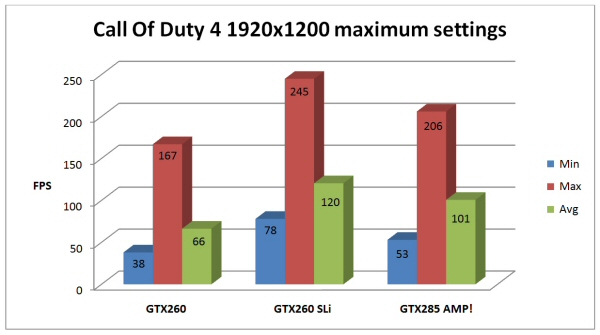
Again the GTX 285 AMP! looks to be performing well and is happily sitting ahead of the single 260. Indeed @ 1920×1200 it is providing an average framerate that is 50% better and a minimum framerate that is 40% better. Many consider a few frames like this to not look like much but it’s generally the difference between a decent headshot and thin air! The SLi cards are up at the top again but with games that take advantage of the technology it’s not really a surprise.
Colin McRea DiRT
Next up is the first of our car racing sims – Colin McRea DiRT.
A slightly older but no less impressive game. It still pushes modern hardware well enough and looks great too.
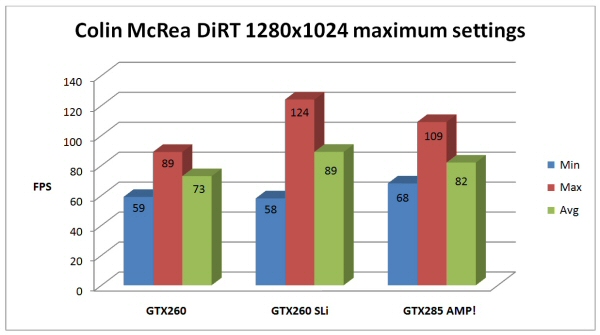
As you can see, at the lower 1280×1024 resolution the advantage between the GTX 285 AMP! and the GTX 260 is quite small.
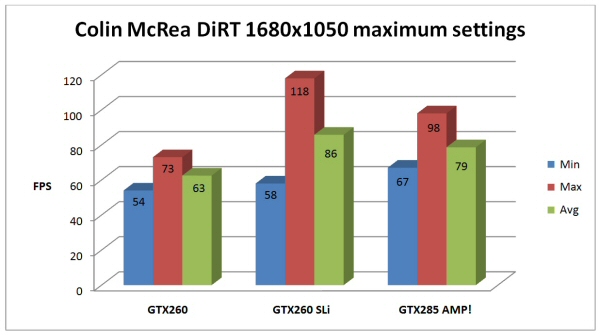
As the resolution climbs to 1680×1050 the performance ratio does increase slightly.
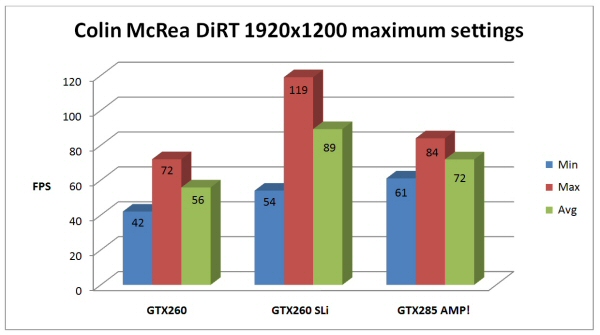
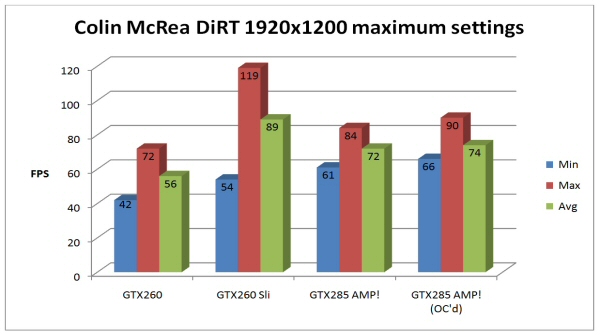
It’s a similar story at 1920×1200 too. The outright performance of the GTX 285 AMP! is a little better still. Not only that but the minimum frame rate is key factor. Considering it against both the single 260 and dual 260’s in SLi the GTX 285 AMP! trumps them by between 7 and 10fps in each case.
I’m a great believer in minimum frame rates since they are what makes some games feel slow or even stutter slightly. The GTX 285 AMP! shows that despite a lower max and average framerate it’s higher minimum framerate could actually deliver a smoother gaming experience.
Dead Space
Dead Space is one of the newer games in the line up. A third person shooter based on a Alien style horror pretense. An atmospheric and beautiful (if that word can really be used) game that should be a worthy test of these GPU’s.
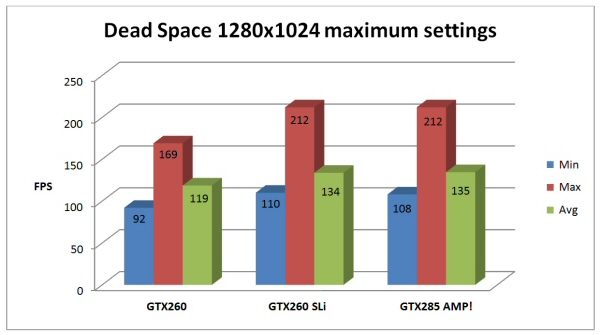
At 1280×1024 the GTX 285 AMP! is trading blows with the SLi 260’s. The single 260 is behind but with the framerates this high it’s not noticeable.
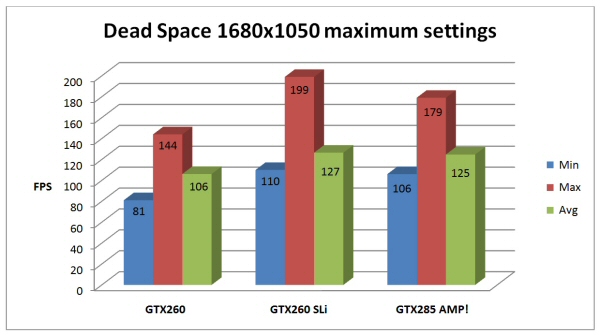
Upping the resolution to 1680×1050 the single 260 is the only card that really takes a performance hit. The GTX 285 AMP! is once again matching the SLi’d 260’s in all but maximum framerate.
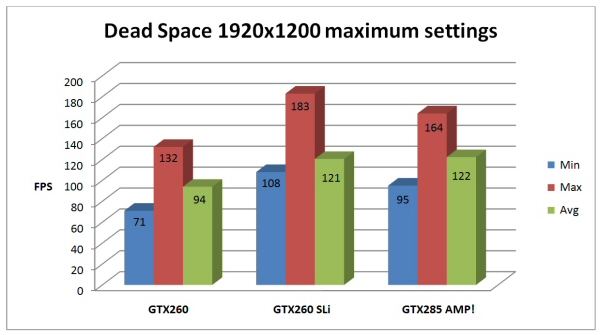
At 1920×1200 the GTX 285 AMP! is on average still effectively alongside the SLi setup and providing performance that is around a third better than the 260. Very impressive!
Fallout 3
Another very popular game up next – Fallout 3 is from the same Bathesda Softworks studio who brought you Oblivion. An expansive and detailed free roaming 1st (and 3rd if you choose) person shooter come adventure.
Large draw distances and populated landscapes mean this could turn out to be taxing for PC hardware.
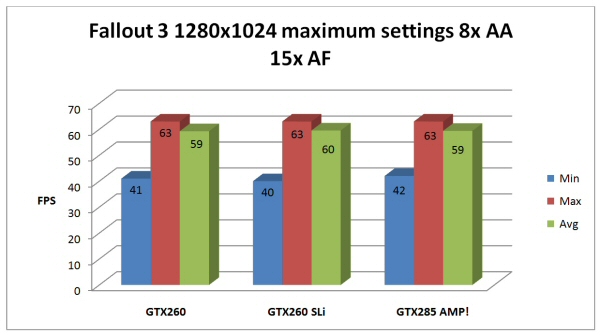
Due to what looks like a framerate cap in the early 60’s the results look incredibly similar (almost identical actually) @ 1280×1024.
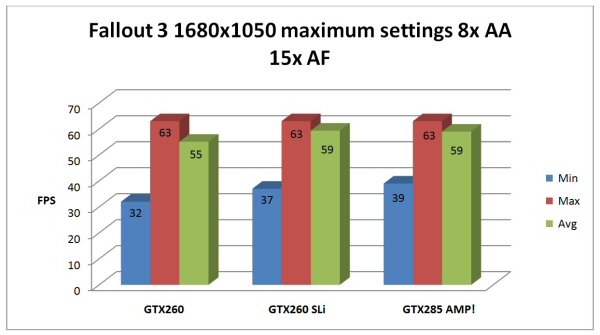
Upping the resolution to 1680×1050 doesn’t help much although the single 260 has taken a slight performance hit. Note that the GTX 285 AMP! has the lead here due to its additional 2fps minimum against the SLi’d setup.
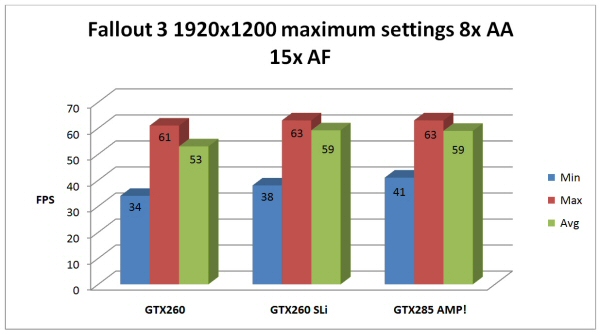
Again at 1920×1200 i was amazed to see similar results again. All settings were maxed with full AA and AF too!
The GTX 285 AMP! once again has the lead by the smallest of margins… astonishing considering the SLi’d cards presence!
Far Cry 2
Next up is the much anticipated Far Cry 2 – although some consider it disappointing as a game it is never the less a decent tool for benchmarking GPU’s.
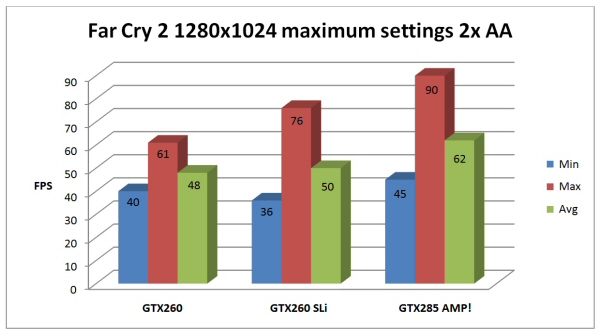
Only thing that can be said is that the GTX 285 AMP! likes this game. It oblitarates the single 260’s results and even beats the SLi’d cards by a margin too.
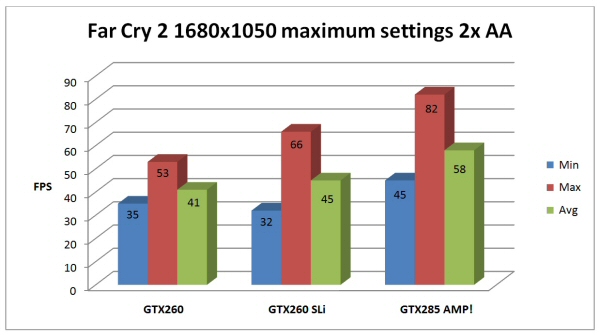
Up at 1680×1050 the story is very similar showing a clear lead for the GTX 285 AMP!
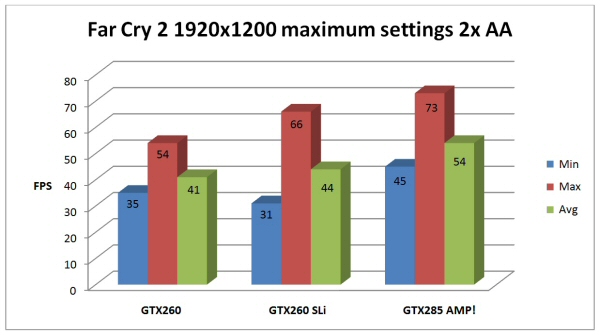
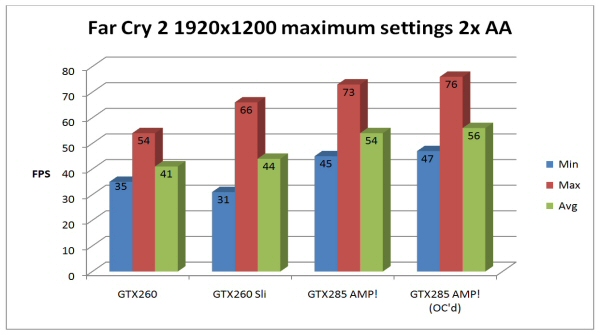
Last test for Far Cry 2 @ 1920×1200 shows the very same. The GTX 285 AMP! is a crushingly good card with this game. I expected it to do well but i was genuinely surprised by the performance it provided here.
One last thing to note is that although the SLi’d 260’s returned better average and max framerates than the single 260 its minimum framerate was in fact smaller at every resolution. This could be an incompatibility between the game and hardware but since the gaming experience was smooth and trouble free with all the hardware tested i’d be inclined to think it was possibly just a limitation of SLi in this case.
Race Driver GRID
Race Driver GRID is the bundled game and it seemed rude not to give it a run out. This is another racer from Codemasters who coded Colin McRea DiRT tested earlier. As it’s newer i was expecting it to be a tougher challenge – lets see how the cards fare.
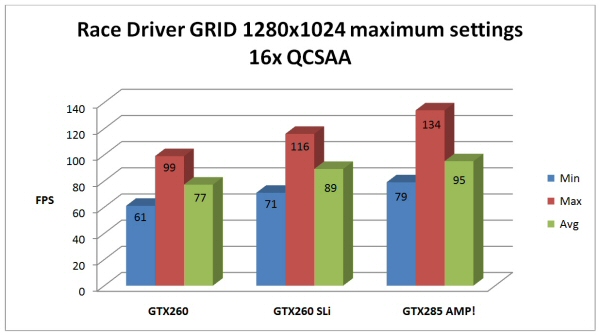
At the lowest resolution the GTX 285 AMP! is showing the others it’s heels again. That decent minimum framerate performance is there again which is always impressive to see.
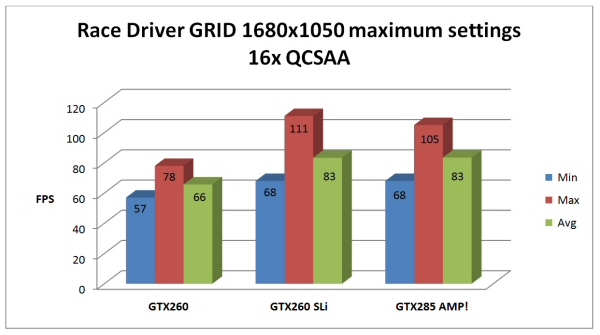
Upping the resolution to 1680×1050 shows the SLi’d 260’s pulling up alongside the GTX 285 AMP! While the single 260 is being left behind.
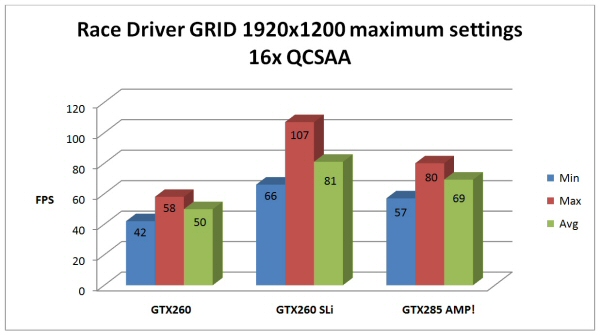
Maxed out settings and 1920×1200 is really pushing the single 260 and even the GTX 285 AMP! is showing signs of slowing. It’s still providing great framerates though so the game would still be very playable at this point. The SLi setup is showing its grunt here with 100+ maximum framerates .
Test Drive Unlimited
Last but not least is the game Test Drive Unlimited. Unlike the other circuit racing games Test Drive takes place on a free roaming Hawaiian island (Oahu) with over 1000 miles of open road.
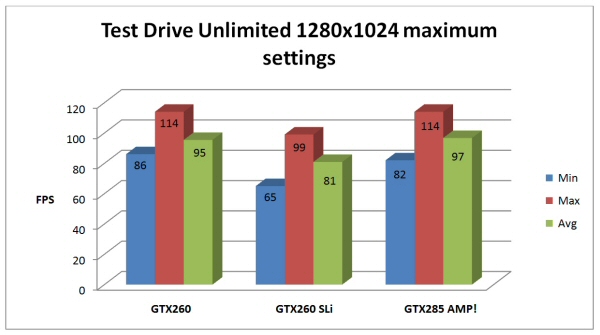
At the lowest resolution the single GTX 260 matches the GTX 285 AMP! blow for blow. The SLi cards look to be restricted here – cpu bottleneck or coding issue? We’ll continue on to the higher resolution to see.
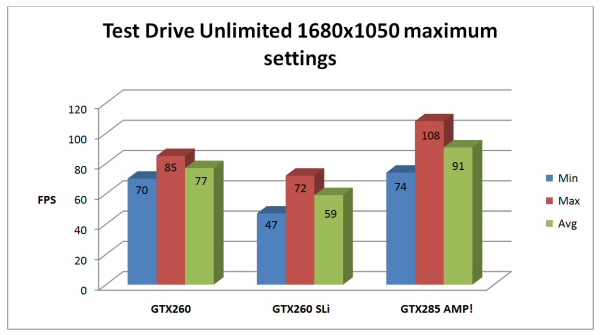
1680×1050 shows the GTX 285 AMP! pulling ahead by a healthy margin. The single 260 is still doing ok but the SLi’d cards are not looking good.
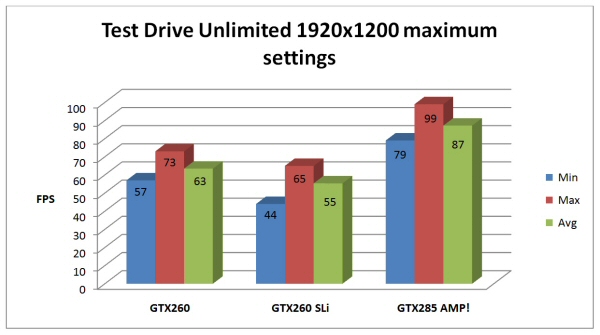
Last chance at 1920×1200 and the GTX 285 AMP! is still heading the pack. The single 260 manages this game and resolution fine but the two 260’s in SLi are wasted. It looks like Test Drive doesn’t like dual card setups since it’s always behind.
Overclocking
Of course this GTX 285 AMP! is sold as a ‘pre-overclocked’ card but just for the sake of it we’ll see if we can get any more out of it.
I used NVidia’s own onboard control panel to adjust the GPU clocks – it managed the following clocks:
Core Clock – 702MHz to 739MHz
Memory Clock – to 1296MHz to 1349MHz
I then tested the performance increase in 3DMark06 and Vantage:
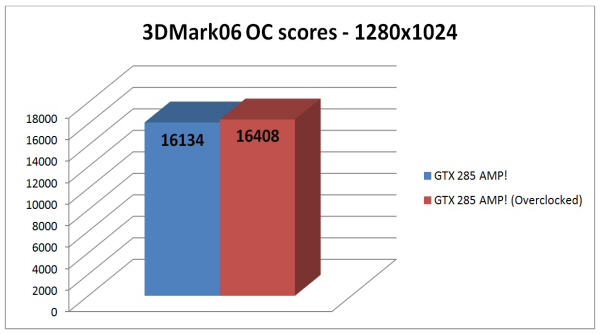
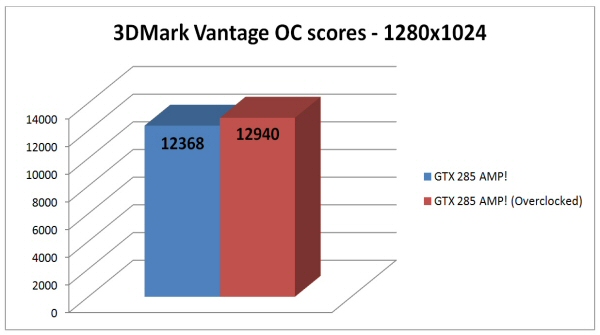
Then i tried some of the games already benched.
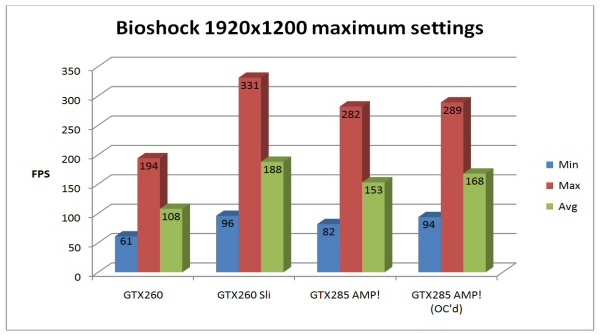
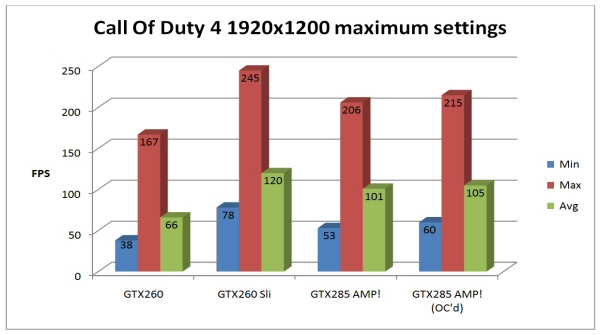
As you can see there’s a fairly healthy increase across the board. If you ever need the extra performance it’s nice to have it available.
Conclusion
Obviously the GTX 285 AMP! is an incredibly capable card and from considering the results is probably the fastest single cored gaming card on the planet. It comes with a staggeringly complete bundle, runs cool and overclocks well.
Understandably for performance like this there is a cost – at around £310 it represents a significant outlay. In fact the cost is close to two cards similar in performance to the 260’s i used in this review. Of course there are additional hidden costs to dual GPU solutions. You’d need a better PSU, a motherboard that can accept dual (or triple) cards, a case large enough to adequately house and cool them and an understanding that you’d be using extra electricity for that additional card.
As such i’ll conclude with this – although not the greatest deal in terms of value, if you want the fastest ‘single cored’ card out there right now and don’t want the headache and hidden additional costs of multi GPU Crossfire/SLi installation then the Zotac GTX 285 AMP! Edition would be a very fine choice.
Vortez Hardware would like to thank Zotac for providing us with the GTX 285 AMP! Edition.
You can discuss this review at our Forum here.
