



Earlier this month we saw the Nvidia’s GTX580, let’s see how ZOTAC’s offering stacks up to the competition.
Product on Review: ZOTAC GeForce GTX 580
Manufacturer and Sponsor: ZOTAC
MSRP: $499
Street Price: £399.99
After a year of anguish trying to compete with AMD in both price and performance, Nvidia have finally managed to gain much needed ground in the market. Their most recent additions to their range of cards are the GTX570 and GTX580, aimed at the upper echelon of consumers wanting extreme levels of raw performance no matter the price. The GF110 GPU on which the two cards are based has been successful in more than just the performance department. The chip has tamed Nvidia’s wild ways and delivered reduced noise, thermals and lower power consumption. Not only has it proven to be a worthy successor to the older GF100 GPU but it also competes favourably with AMD’s offerings, who are famed for their cool running, low power draining graphics cards. Looking back at our ASUS GTX580 review, our only drawback was the sheer price at which their flagship card was being sold at. Otherwise, one could say that the GTX580 was the perfect product in many respects, high performance with little trade-offs.
As we have previously covered, the GF110 derivative in the GTX580 has had some crucial tweaks to make it a better performer than its predecessor, namely that it is a fully unlocked core sporting all 16 stream multi-processors for a total of 512 cores and 64 texture units. If that wasn’t enough, the clock speeds have also been boosted relative to the GTX480 to 772/4008MHz. Architectural tweaks have also been made to improve shader performance so the GTX580 is geared up to be a very promising card. For the most part, Nvidia delivered on their promise by providing a card that produces less noise, has a lower TDP and yet performs better that the already might GTX480.
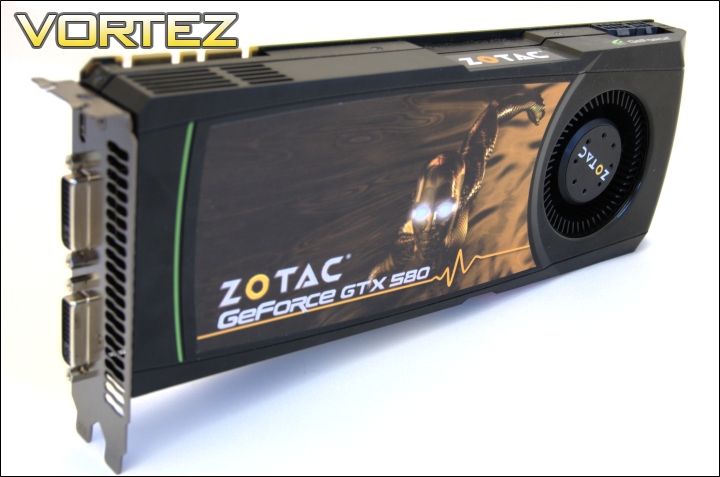
The card we will be looking at today is from ZOTAC. It follows a reference design, similarly to the ASUS card we reviewed earlier this month. The ZOTAC GTX580 comes clocked at 772/4008MHz and on first impression, there isn’t much that stands out from other cards. The question is whether can stay true to their philosophy and deliver the quality we have grown to expect from the company.

A bit about ZOTAC
ZOTAC International is one of the largest producers of NVIDIA VGA and motherboard solutions worldwide.
ZOTAC International (MCO) Limited was established in 2006 with a mission to deliver superb, high quality NVIDIA graphic solutions to the industry. It has strong backing from its parent group, PC Partner Ltd. – with headquarters in Hong Kong, factories in mainland China and regional sales offices in North America, Europe, and the Asia Pacific region. The scale of support ZOTAC provides is currently unrivalled in the world. With 40 surface mount technology (SMT) manufacturing lines, 6,000 workers and a production facility with over 9,000,000 square feet, ZOTAC employs a full array of state-of-the-art technologies and skilled personnel in order to meet your hardware needs. In addition, ZOTAC has over 130 research & development professionals in Hong Kong and mainland China, working to bring you the best from the cutting edge of the industry. ZOTAC’s international bases of operation work together to enable effective and efficient global as well as localized sales and marketing support.
ZOTAC doesn’t just mean top tier quality, it is also synonymous with high performance, absolute reliability and unparalleled value. With a range of products featuring overclocked performance, excellent cooling properties, and unique packaging ZOTAC products routinely meet – and exceed – users’ expectations.
ZOTAC’s unwavering commitment to our users is to bring the latest products quickly to the market with the best value. Needless to say ZOTAC is the right choice for those who demand the highest quality graphics solutions.
For more about ZOTAC’s philosophy, click here…
ZOTAC International is one of the largest producers of NVIDIA VGA and motherboard solutions worldwide.
ZOTAC International (MCO) Limited was established in 2006 with a mission to deliver superb, high quality NVIDIA graphic solutions to the industry. It has strong backing from its parent group, PC Partner Ltd. – with headquarters in Hong Kong, factories in mainland China and regional sales offices in North America, Europe, and the Asia Pacific region. The scale of support ZOTAC provides is currently unrivalled in the world. With 40 surface mount technology (SMT) manufacturing lines, 6,000 workers and a production facility with over 9,000,000 square feet, ZOTAC employs a full array of state-of-the-art technologies and skilled personnel in order to meet your hardware needs. In addition, ZOTAC has over 130 research & development professionals in Hong Kong and mainland China, working to bring you the best from the cutting edge of the industry. ZOTAC’s international bases of operation work together to enable effective and efficient global as well as localized sales and marketing support.
ZOTAC doesn’t just mean top tier quality, it is also synonymous with high performance, absolute reliability and unparalleled value. With a range of products featuring overclocked performance, excellent cooling properties, and unique packaging ZOTAC products routinely meet – and exceed – users’ expectations.
ZOTAC’s unwavering commitment to our users is to bring the latest products quickly to the market with the best value. Needless to say ZOTAC is the right choice for those who demand the highest quality graphics solutions.
For more about ZOTAC’s philosophy, click here…
Read on to find out more about the ZOTAC GTX580.
Specifications
The GF110 chip shares a lot of its roots with the GF100 core. The GPU still packs an impressive 3.2 billion transistors in a die seize 520mm squared. Its default internal configuration has been ported from GF100 in that the GPU features 512 CUDA cores or shader processors as we are more accustomed to. There are organised in a 4x16x32 block where 16 denotes the number of stream multi-processors (SM) and 32 being the number of cores on each SM. Each SM has its own L1 Cache and a common L2 Cache is shared by all 16. The GPU is still manufactured on the 40nm process.
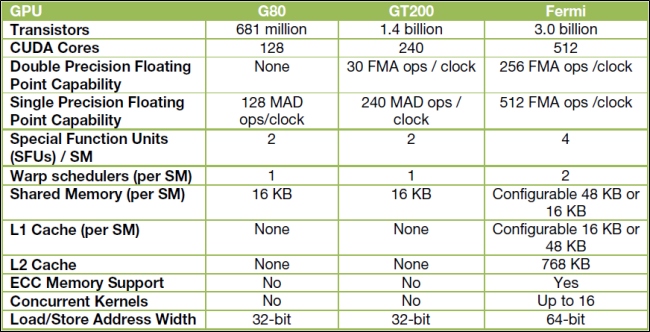
With the GTX480, only 15 of the total 16 SM were enabled to give it 480 CUDA cores and consequently, it boasted 60 texture units. The GTX580 uses a fully-fledged GF110 GPU and thus retains all 16 SM with none being disabled. The result is 512 fully operational CUDA cores and since the number of texture units is based on the number of stream-multiprocessors, the GTX580 sports 64 units instead of the 60. The number of ROPs has remained the same at 48 and the L2 Cache is still 768 KB. In terms of shader and texturing power, having 512 CUDA cores boosts performance by 6.6% over 480 CUDA cores. Nvidia have gone further with the GTX580 though. Not only have they increased the clock speed on the GTX580 compared to the GTX480, but they have also employed the GF104’s superior texture filtering capabilities in their tweaked GF110 GPU. Improvements have also been done to the tessellation engine so the already very capable performance that is expectant of the Fermi architecture has gone a step further.
The number of memory controller on the new GF110 GPU has remained untouched so the GTX580 has 6 memory controllers each sporting a 256MB framebuffer to give 1536MB of available memory. The GTX580, as with the GTX480 it is replacing, has a 384-bit memory interface that has been teamed up with GDDR5 memory for unmatched bandwidth.
GTX480: 15 SMs x 32 = 480 Core, 15 SMs x 4 = 60 texture units
32-bit channel x 12 = 384-bit interface, 256MB x 6 memory controllers = 1536MB memory
GTX580: 16 SMs x 32 = 512 Core, 16 SMs x 4 = 64 texture units
32-bit channel x 12 = 384-bit interface, 256MB x 6 memory controllers = 1536MB memory
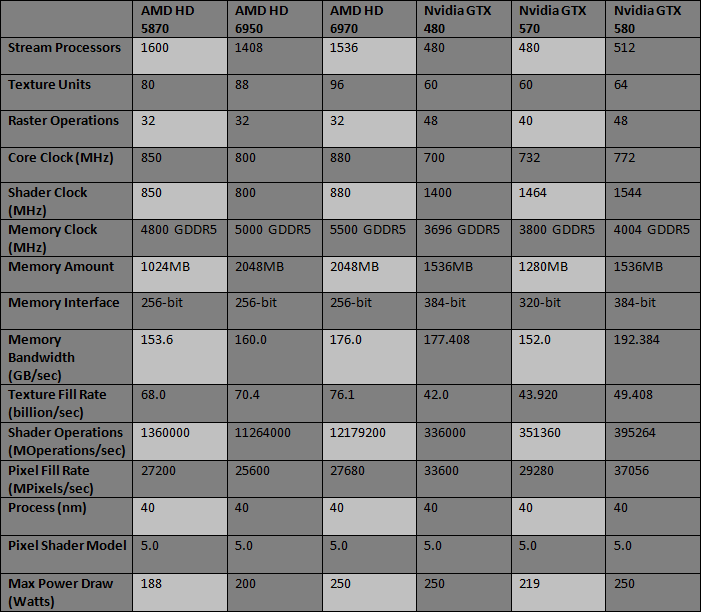
At the same clock speed, the extra 32 CUDA cores alone give the GTX580 a 6.6% shader and texturing performance advantage over the GTX480. Given the 10% and 8% increase in core clock speed and memory clocks respectively, we can expect the GTX580 to widen its lead. Looking at the texture fill rate and shader operations, the GTX580 theoretically provides 17% more performance that the GTX480 it replaces, not a bad upgrade considering that the price points at launch are the same. At a retail price of $499, it is currently the most expensive graphics card on the market but it is yet to be seen if the price premium is worth the performance benefits.
Product Specifications
Graphics Engine: GeForce GTX580
Model: ZT-50101-10P
Bus Standard: PCI Express x16 2.0 (Compatible with 1.1)
Memory Size(MB): 1536 GDDR5
Memory Interface: 384-bit
Core Clock Speed (MHz): 772
Stream Processors: 512
Shader Clock (MHz): 1544
Memory Clock Speed (MHz): 4008
3D API: Direct X 11 & OpenGL 4.1
DVI Output: 2
HDMI: 1 (via Mini HDMI to HDMI adaptor)
VGA: Supported using DVI-to-VGA adapter
Display Output (Max Resolution): 2560 x 1600
HDCP Support: Yes
Dual Link DV1: Yes
HDMI Support: Yes
SLI/3-Way SLI support: Yes
Card Dimension (mm): 268 x 115mm
Graphics Engine: GeForce GTX580
Model: ZT-50101-10P
Bus Standard: PCI Express x16 2.0 (Compatible with 1.1)
Memory Size(MB): 1536 GDDR5
Memory Interface: 384-bit
Core Clock Speed (MHz): 772
Stream Processors: 512
Shader Clock (MHz): 1544
Memory Clock Speed (MHz): 4008
3D API: Direct X 11 & OpenGL 4.1
DVI Output: 2
HDMI: 1 (via Mini HDMI to HDMI adaptor)
VGA: Supported using DVI-to-VGA adapter
Display Output (Max Resolution): 2560 x 1600
HDCP Support: Yes
Dual Link DV1: Yes
HDMI Support: Yes
SLI/3-Way SLI support: Yes
Card Dimension (mm): 268 x 115mm
Features
Experience the world’s fastest graphics processor for a phenomenal gaming experience with the ZOTAC® GeForce® GTX 580 graphics card. The ZOTAC ®GeForce® GTX 580 graphics card takes gaming to unmatched levels of immersion with NVIDIA® 3D Vision™ technology for cinematic stereoscopic 3D visuals when paired with 3D Vision™ compatible hardware and 3D-capable displays for a surreal gaming experience.
NVIDIA® PhysX® technology enables greater in-game realism for more dynamic and realistic interaction in supported titles with the ZOTAC® GeForce® GTX 580 graphics card. NVIDIA® SLI™ and 3D Vision™ Surround readiness enables up to three ZOTAC® GeForce® GTX 580 graphics cards to work to drive up to three monitors for a perfect blend of record-shattering performance and immersion.
NVIDIA® PhysX® technology enables greater in-game realism for more dynamic and realistic interaction in supported titles with the ZOTAC® GeForce® GTX 580 graphics card. NVIDIA® SLI™ and 3D Vision™ Surround readiness enables up to three ZOTAC® GeForce® GTX 580 graphics cards to work to drive up to three monitors for a perfect blend of record-shattering performance and immersion.
3D Graphics
•Full Microsoft® DirectX® 11 Shader Model 5.0 support: o NVIDIA PolyMorph Engine with distributed HW tessellation engines
•BC6H and BC7 texture compression formats
•Gather4 extensions
•OpenGL 4.1 support
•Advanced image quality features: o 32× coverage sample antialiasing
•Transparent multisampling and transparent supersampling
•16× angle independent anisotropic filtering
•128-bit floating point high dynamic-range (HDR) lighting with antialiasing; 32-bit per-component floating point texture filtering and blending
•Interactive ray tracing support
•Full-speed frame buffer blending
•Full-speed FP16 texture filtering
•Advanced lossless compression algorithms for color, texture, and zdata
•Support for normal map compression
•Adaptive z-cull
•Early-Z
GPU Computing
•NVIDIA CUDA™ technology—allows the GPU cores to provide performance improvements for applications such as video transcoding, gaming, ray tracing, and physics. API support includes: o CUDA C
•CUDA C++
•DirectCompute 5.0
•OpenCL
•Java, Python, and Fortran
•Third Generation Streaming Multiprocessor (SM) o 32 CUDA cores per SM
•Dual Warp Scheduler simultaneously schedules and dispatches instructions from two independent warps
•64 KB of RAM with a configurable partitioning of shared memory and L1 cache
•Second Generation Parallel Thread Execution ISA o Unified Address Space with Full C++ Support
•Optimized for OpenCL and DirectCompute
•Full IEEE 754-2008 32-bit and 64-bit precision
•Full 32-bit integer path with 64-bit extensions
•Memory access instructions to support transition to 64-bit addressing
•Improved Performance through Predication
•Improved Memory Subsystem o NVIDIA Parallel DataCacheTM hierarchy with Configurable L1 and Unified L2 Caches
•Greatly improved atomic memory operation performance
•NVIDIA GigaThreadTM Engine o 10x faster application context switching
•Concurrent kernel execution
•Out of order thread block execution
Nvidia Technology
•NVIDIA SLI® technology—patented hardware and software technology allows up to four NVIDIA GeForce GPUs to run in parallel to scale performance and enhance image quality on today’s top games.
•NVIDIA PhysX™ technology—allows advanced physics effects to be simulated and rendered on the GPU.
•NVIDIA 3D Vision™ Ready— GeForce GPU support for NVIDIA 3D Vision, bringing a fully immersive stereoscopic 3D experience to the PC.
•NVIDIA 3D Vision Surround™ Ready—scale games across 3 panels by leveraging the power of multiple GPUs in an NVIDIA SLI configuration. Combine with 3D Vision technology for the ultimate 3 panel stereoscopic 3D gaming experience.
Advanced Display Functionality
•Two pipelines for dual independent display
•Two dual-link DVI outputs for digital flat panel display resolutions up to 2560×1600
•Dual integrated 400 MHz RAMDACs for analog display resolutions up to and including 2048×1536 at 85 Hz
•HDMI 1.4a support including GPU accelerated Blu-ray 3D support, x.v.Color, HDMI Deep Color, and 7.1 digital surround sound. See www.nvidia.com/3dtv for more details.
•DisplayPort 1.1a support
•HDCP support up to 2560×1600 resolution on all digital outputs
•10-bit internal display processing, including support for 10-bit scan out
•Underscan/overscan compensation and hardware scaling
Video
• NVIDIA® Pure Video® HD technology with VP4 programmable video processor
•Decode acceleration for MPEG-2, MPEG-4 Part 2 Advanced Simple Profile, H.264, MVC, VC1, DivX (version 3.11 and later), and Flash (10.1 and later)
•Blu-ray dual-stream hardware acceleration (supporting HD picture-in-picture playback)
•Advanced spatial-temporal de-interlacing
•Noise reduction
•Edge enhancement
•Bad edit correction
•Inverse telecine (2:2 and 3:2 pull-down correction)
•High-quality scaling
•Motion Compensation
•Video color correction
•Dynamic contrast enhancement and color stretch
Digital Audio
•Support for the following audio modes: o Dolby Digital (AC3), DTS 5.1, Multi-channel (7.1) LPCM, Dolby Digital Plus (DD+), MPEG2/MPEG4 AAC
•Data rates of 44.1 KHz, 48 KHz, 88.2 KHz, 96 KHz, 176 KHz, and 192 KHz
•Word sizes of 16bit, 20bit, and 24bit
Power Management Technology
•Advanced power and thermal management for optimal acoustics, power, and performance based on usage:
•ASPM power management
•Adaptive Clocking
•Adaptive Power States
•Advanced fan control
•Power and temperature monitoring
Packaging and Content
The front of the box
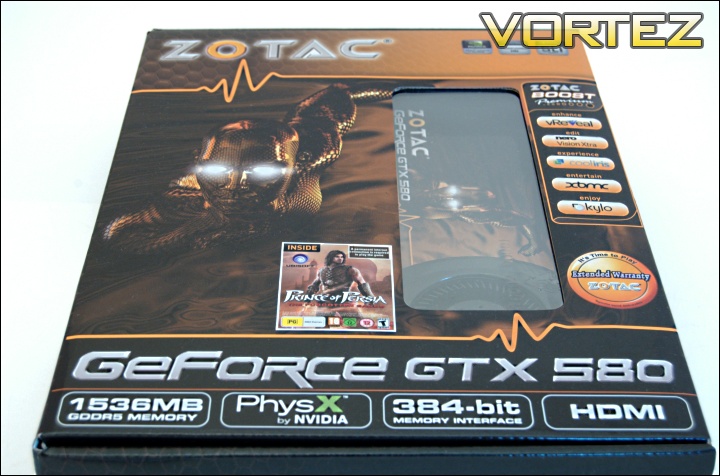
The packaging ZOTAC uses is a standard cardboard box with a plasticised cut out at the front. The yellow and black theme is in trend with ZOTAC’s other products and their own company logo. The colour also fits with the honeycombed livery but the relevance of bees to ZOTAC is a mystery. The front of the box has been made to look very vibrant to appeal to buyers and the various information displayed have been nicely laid out to lessen the clutter that often plagues product packaging. Below the ZOTAC logo is the ubiquitous Pulse logo that ZOTAC use to symbolise the best engineering and innovation available. It remains to be seen if the logo translates to real world benefits. At the bottom, the product name is clearly labelled in bold with a few of the features the graphics card boasts and users can easily identify it as the GTX580.
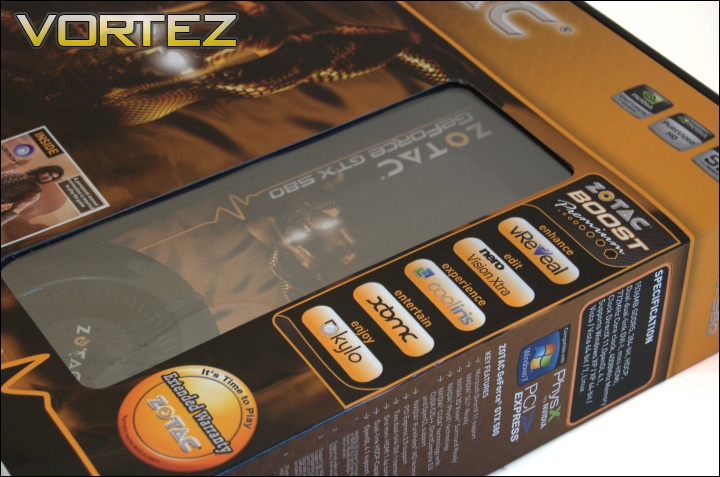
The window and ZOTAC features
The transparent window presents us with a view of the actual graphics card inside. This sneak preview is an excellent way to draw people who would rather see the card itself than a graphics art depicting it.
On the side of the box, ZOTAC have listed the card’s specifications and features which we have already covered in depth over the last two pages. We can expect to see the card supporting all the latest Nvidia technology such as PhysX, SLI, 3D Vision and 3D Vision Surround. Also in small print, they specify that the right drivers, 3D Vision glasses and compatible monitors are required for the features to function. Next to the cut out on the front of the box, a list of additional bundled software is shown under the ZOTAC Boost Premium heading. These programs aim to enhance the user experience and although they are provided on the driver disc, they can also be downloaded from ZOTAC’s site. It’s also important to note that ZOTAC have one of the longest warranties of any graphics card manufacturer. Their “Extended Warranty” scheme lasts 5 years as opposed to the regular 2-3 years provided by other companies.
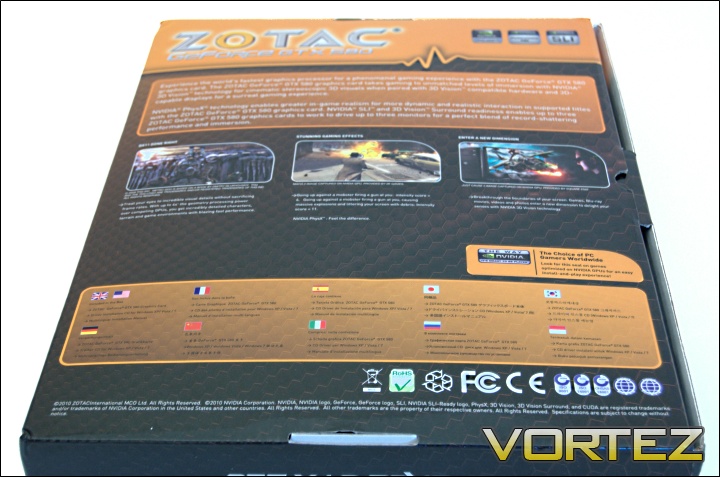
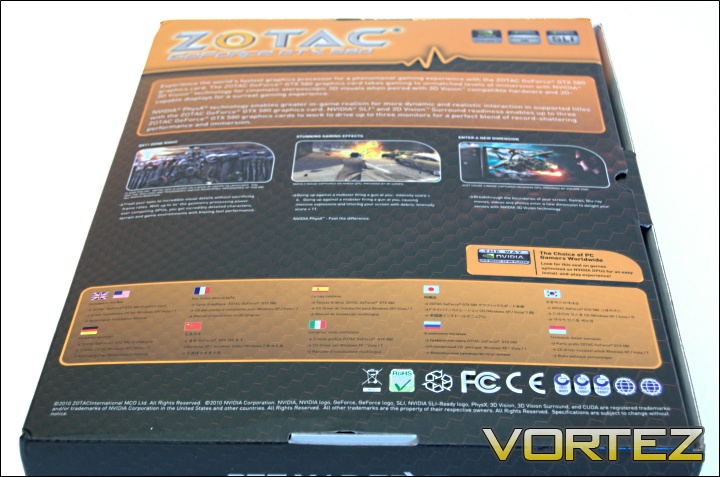
The back of the box
Turning to the back of the box, ZOTAC have used the space to showcase how their graphics card can enhance gaming experience through stunning gaming effects thanks to 3D and DX11 support. At the bottom, the list of included extras is given in 8 different languages.
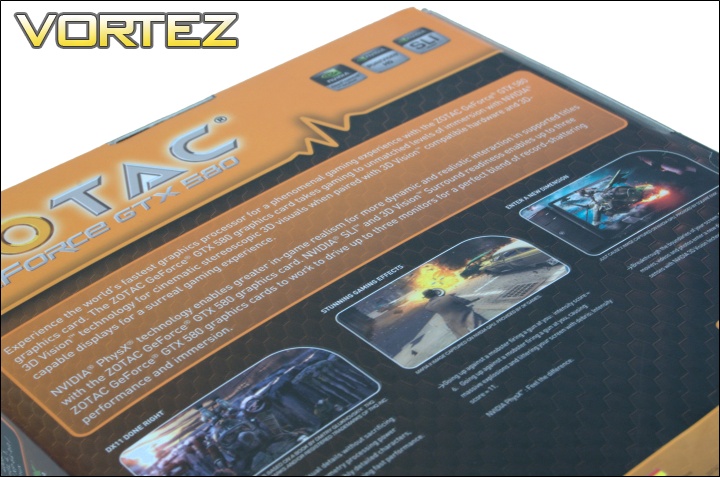
The features
At the top, the small blurb and images illustrate the advantages of the Nvidia graphics card and its features.
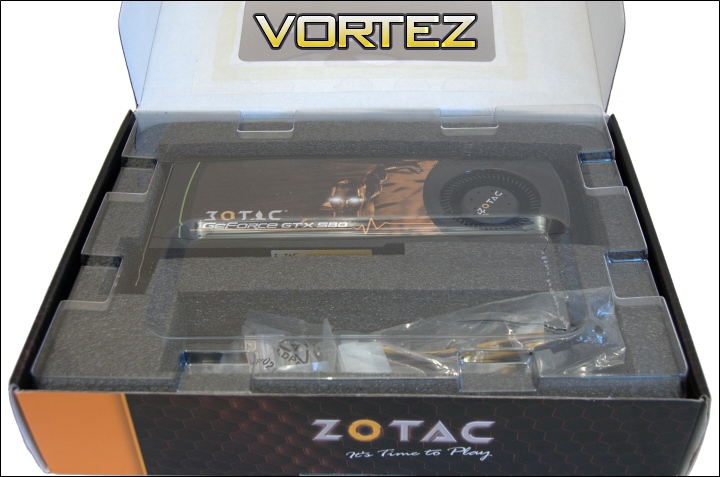
Inside of the box
Inside, the GTX580 is housed in a foam cut-out which is protected by a plastic cover. The ZOTAC GTX460 we reviewed also uses the same packaging suggesting that it is universal across their entire range of cards. On the side is a small compartment for the bundled accessories. The manual and discs are located below the foam enclosure.
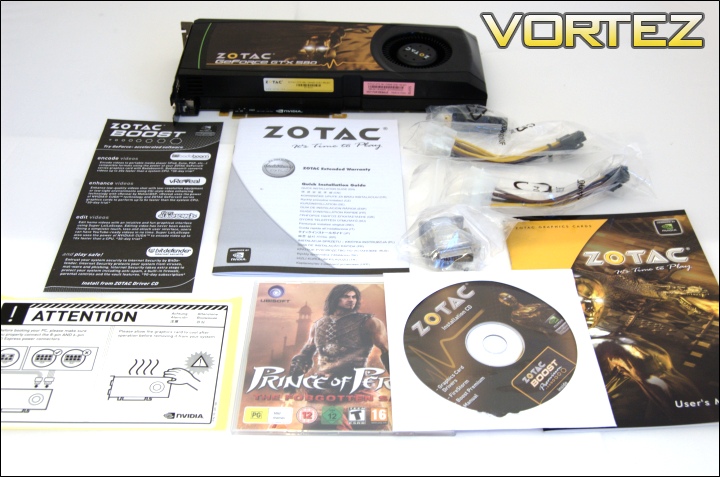
The bundle
The bundle that comes with the ZOTAC card is quite standard with the added benefit of a free Prince Of Persia game. The whole package contains:
The package includes:
– 1 x DVI-to-VGA adaptor
– 1 x Mini HDMI to HDMI adapter
– 1 x Dual MOLEX-to-6-pin PCIe power cable
– 1 x Dual 6-pin PCIe to 8-pin PCIe power cable
– User manual
– Quick installation guide
– Zotac Boost Premium
– Prince Of Persia: The Forgotten Sands
– 1 x Nvidia GeForce GTX580
Closer Look
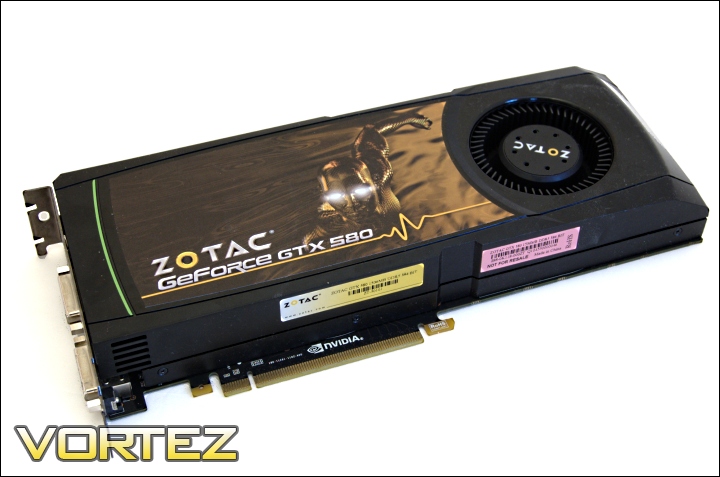
Rise of the Silver Surfer
The ZOTAC GTX580 uses Nvidia’s reference design, the same used by ASUS as well. The card has a black shroud with green accents to signify Nvidia’s traditional colours. Unlike the ASUS card, ZOTAC have printed their own sticker to place on the shroud to add some character. The design follows that found on the front of the box, hence the Silver Surfer making a comeback and the omnipresent Pulse. The front end of the shroud is slightly slanted and lowered to accommodate the fan and to allow more air to flow through in tight SLI configurations. Compared to the Nvidia GTX480, the top of the metal heatsink has not been left exposed, most like because of the new cooler type being employed, which we will look at later on. Very conveniently, all the ports and connectors are protected by a blue plastic cover. The card is approximately 26.8cm in lengthm 6mm short of AMD’s HD6970.
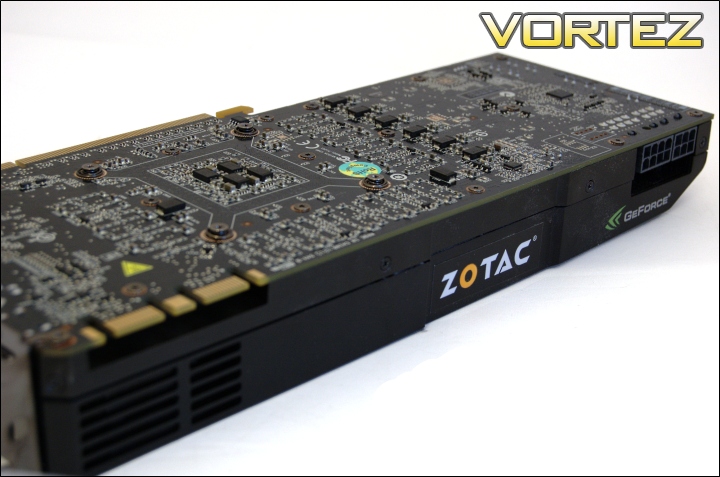
The back of the card
The back of the card reveals the black PCB that has become favoured for its greater appeal in recent times. There is no backplate installed for additional cooling, indicating Nvidia’s confidence in a cooler and more efficient running card. Part of the VRM circuitry can also be seen at the back, making greater use of space to place the MOSFETs. The shroud below is attached using torx screws, shying away from the traditional ones used. The heatsink on the other hand is secured using spring loaded screws.
The side profile
The side profile reveals the ZOTAC emblem printed on the side. The design of the card is very minimalistic but the added curves give the GTX580 some character and appeal.
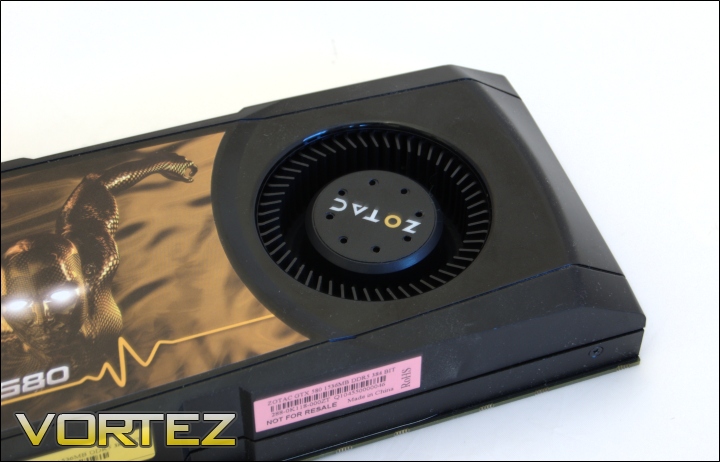
The fan
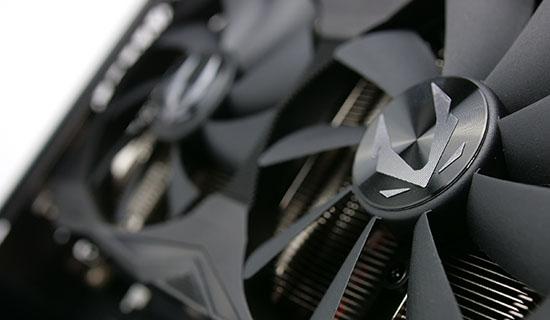
The fan uses a finned blower design to push air towards the rear of the card and hence out of the case. The fan supports PWM functionality and can be controlled by users or temperature based profiles. The fan is similar to those found on most blower style cooler, even ones from AMD such as that used on the reference HD6970.
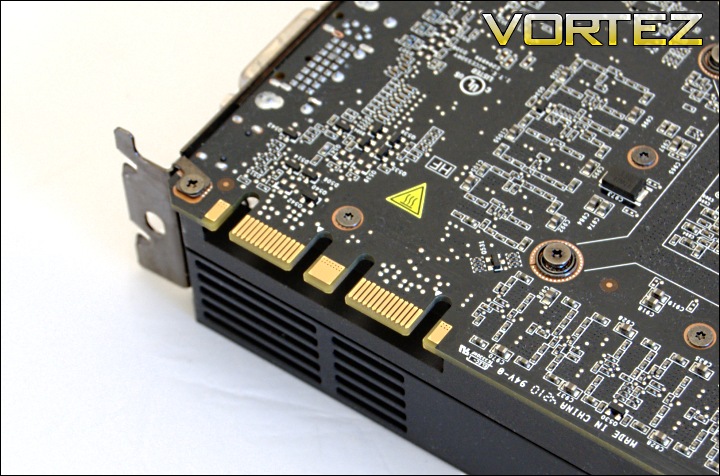
The SLI connectors for dual/triple/quad configurations
On the side of the card are two SLI connectors. The GTX580 can be used in a quad-SLI setup should the motherboard permit (NF200 chipset required). If not tri-SLI is also supported.
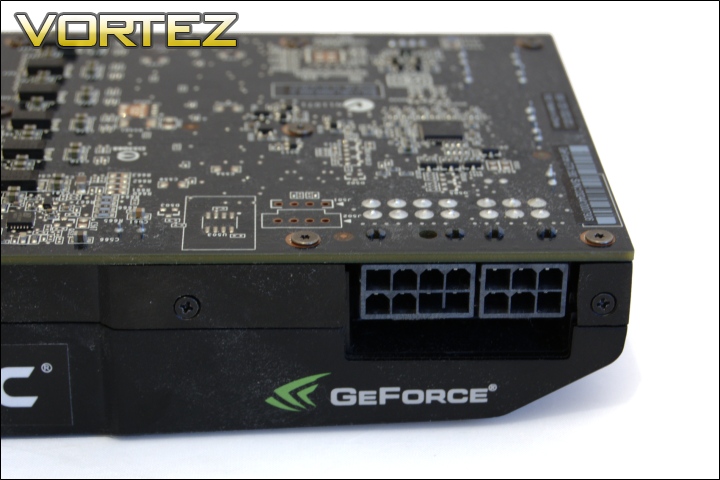
The 6 pin and 8 pin power connectors
Like the GTX480 and AMD’s HD6970, the GTX580 has one 6 pin and one 8 pin PCIe power connectors, immediately suggesting high power draw. These are conveniently situated on the side rather than at the end to ensure that the cables do not get in the way of HDD cages or other components. One dual 6 pin-to-8 pin adapter is bundled for power supplies lacking 8 pin power cables.
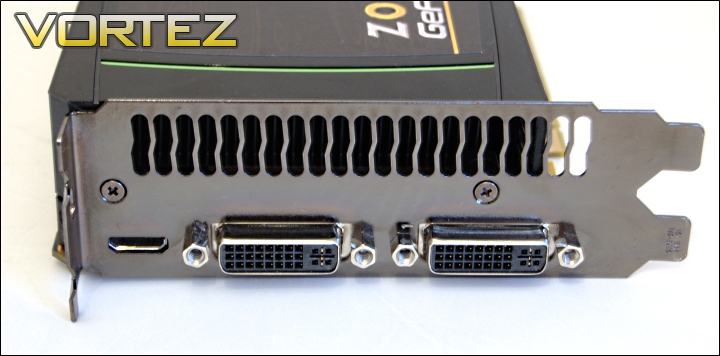
Connectivity on the I/O plate
The ZOTAC card sports two DVI connectors and one mini-HDMI port on the I/O panel. The HDMI port supports the latest 1.4a standard. The ports also support Nvidia Surround technology, without requiring DisplayPort, as long as another GTX580 is used in SLI.
Closer Look (Continued)
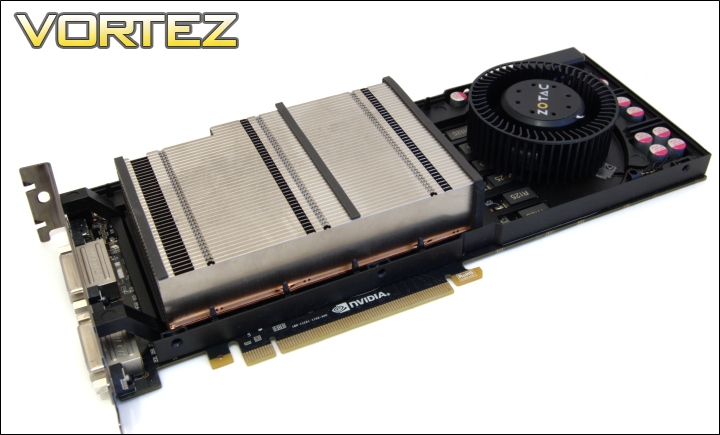
Taking off the shroud
Removing the shroud, we can see a bracket attached to the PCB supporting the fan and heatsink. The fan is a circular shaped with vertical fans as opposed to bladed, making it more ideally suited to pushing air towards the back. The ring surrounding the fins at the top provides stability to prevent fan vibrations. The heatsink itself has departed from heat piped based designs hence the smaller footprint.
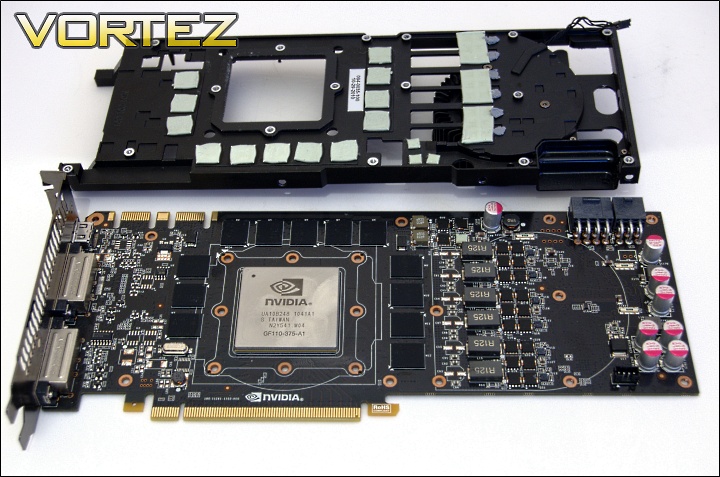
The PCB
And underneath the metal bracket, the PCB is exposed revealing the layout of the individual components. The PCB appears very packed with components and the VRM power circuitry looks very robust. The board employs a 6 phase power design for the core and further 2 phases for the memory, as indicated by the chokes. The thermal pads on the base of the metal brackets are for additional cooling on the memory modules and circuitry.
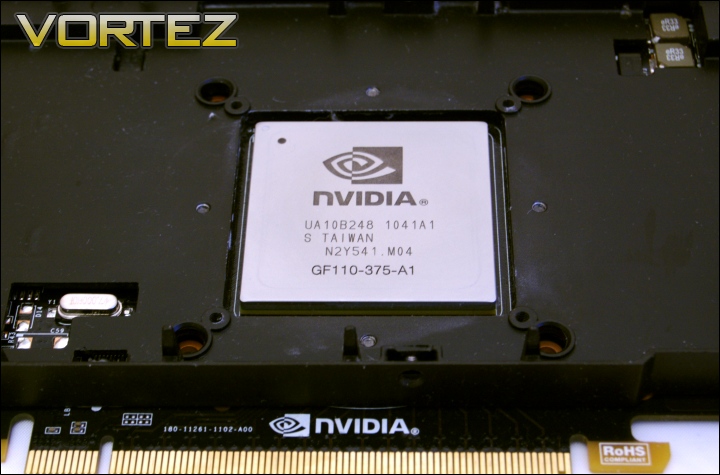
The GF110 GPU
The GF110 core is a monster of a chip, with a 520mm squared die size packing over 3 billion transistors. If anything, the integrated heat spreader is indicative of the core underneath, creating a large enough surface area for maximum heat dissipation.
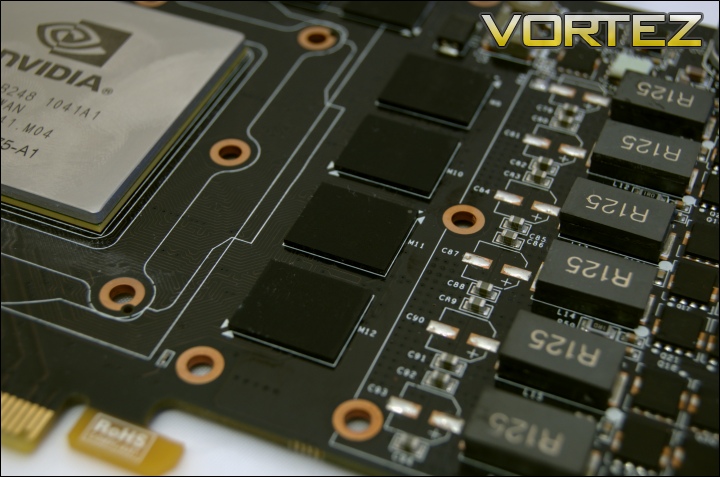
The Samsung K4G10325FE-HC04 memory modules
There are a total of 12 128MB memory modules for 1.5GB of on-board GDDR5 memory. The modules have been sourced from Samsung and carry the model name K4G10325FE-HC04. These are rated at 0.4ns for a rated speed of 5Gbps. The memory on the GTX580 only come clocked at 4008MHz, suggesting high overclocking headroom.
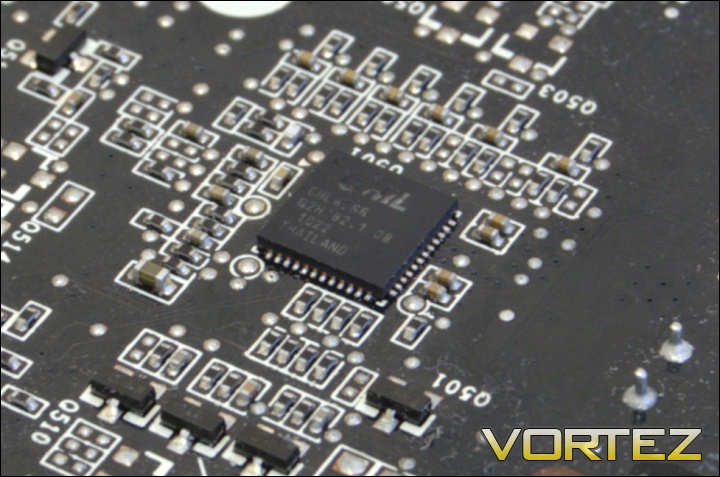
The CHiL CHL 8266 voltage controller
The CHiL CHL 8266 voltage controller enables voltage control and monitoring, making it an excellent addition for overclockers. Although the ZOTAC GTX580 doesn’t come with any overclocking utilities, MSI Afterburner can be used to tweak the voltages and overclock the card.
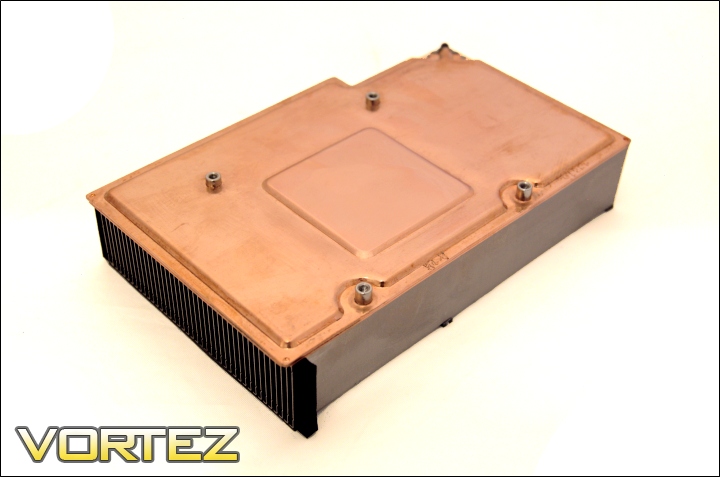
The vapour chamber heat plate
One of the ways Nvidia have attempted to tackle the heat generated by the core is a vapour chamber cooler. The copper heat plate contains liquid in the base (the raised middle part of the plate that is in contact with the GPU). The liquid evaporates and absorbs further latent heat through its phase transition to vapour. This rises and condenses on the outside upper part of the heat plate releasing heat which is then transmitted to the overlying fin array whilst the condenser fluid circulates around the outside of the heat plate. This type of cooler is a first for Nvidia, who have traditionally opted for heat pipe based heatsinks. The advantage of the vapour chamber is the larger surface area of the heat plate for greater heat transfer.
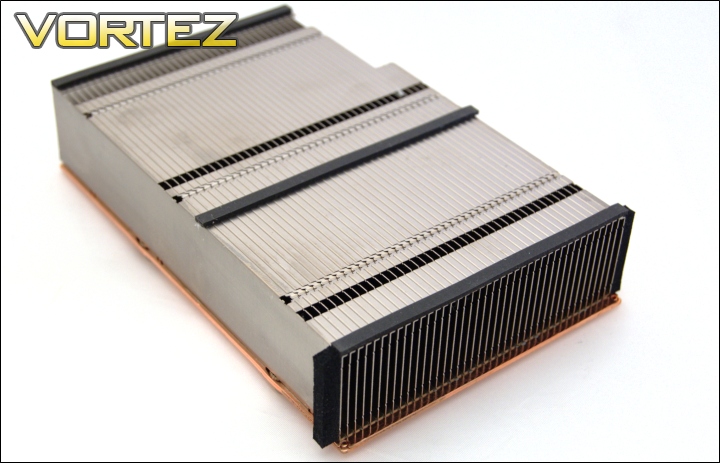
The heatsink fin array
Heat that is transferred to the heat sink across the fins is dissipated by airflow from the fan towards the exhaust port on the rear of the card. The design proved to be very efficient on the ASUS GTX580 and has also been employed on the recently released AMD HD6900 series of cards.
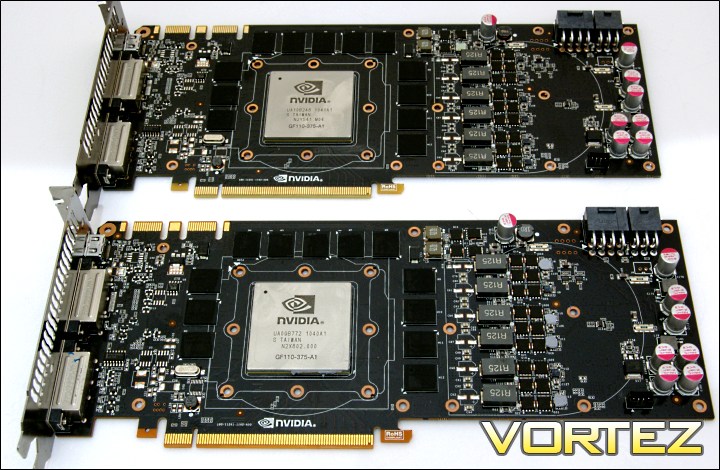
ZOTAC VS ASUS PCB
The two GTX580 seen here are of the ASUS (bottom) and ZOTAC (top) cards. They are identical in layout, components used and circuitry design. Using two GTX580s in SLI should be no issue, regardless of branding.
Test Setup
CPU – Intel Core i7 920
RAM – 6GB (3x2GB) OCZ Platinum DDR3 1333MHz
Motherboard – ASUS Rampage III Extreme
Power Supply – Enermax Revolution 85+ 850W
Hard Drive – OCZ Vertex 2E 120GB
Samsung F3 1TB
Samsung F1 320GB
Cooler – Noctua NH-D14
Graphics Cards:
Zotac GTX580 1536MB @ 772/4000MHz – Forceware 262.99
ASUS GTX580 1536MB @ 782/4000MHz & 903/4220MHz Overclocked – Forceware 262.99ASUS HD6970 2048MB @ 890/5500MHz & 949/5896MHz Overclocked – ATI Catalyst 10.12a (8.790.6.2)
HIS HD6950 2048MB @ 800/5000MHz & 865/5500MHz Overclocked – ATI Catalyst 10.11 (8.790.6.0, 8.790.6.2 & 8.800)
Nvidia GTX480 1536MB @ 700/3696MHz & 799/3906MHz Overclocked – Forceware 260.99
MSI R6870 2PM2D1GD5 1024MB @ 900/4200MHz – ATI Catalyst 10.10
ASUS EAH6850 DirectCU 1024MB @ 790/4000MHz – ATI Catalyst 10.10
XFX HD5870 1024MB @ 850/4800MHz & 942/5200MHz Overclocked – ATI Catalyst 10.10
Benchmark Suite
MSI Afterburner & Kombustor
ASUS SmartDoctor
GPU-z
Crysis Warhead using the FRAMEBUFFER Crysis benchmark tool
Far Cry 2
Resident Evil 5
Street Fighter IV
Unreal Tournament 3 using the HOC Bench tool
Colin McRae DIRT 2
Batman: Arkham Asylum
Battlefield Bad Company 2
Mafia II Demo
Colin McRae DIRT 2
Alien VS Predator
H.A.W.X 2
3DMark Vantage
Unigine V2.1 DX 11 Benchmark
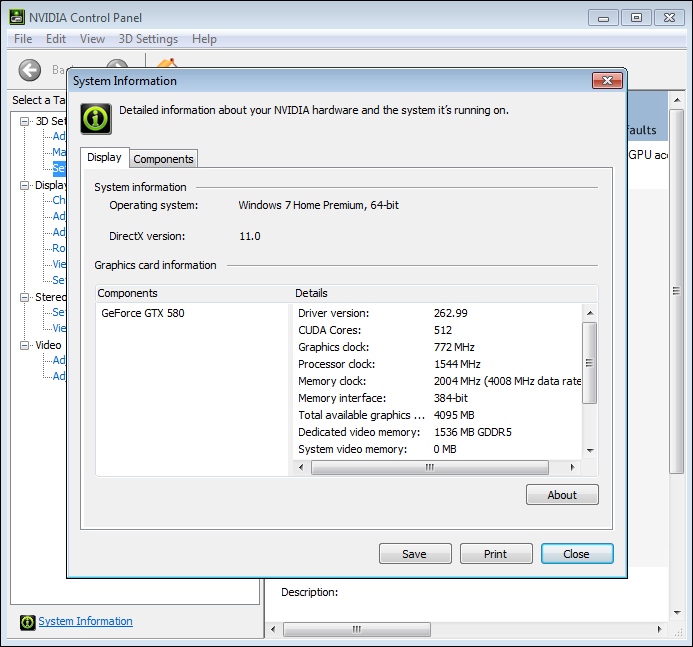
Software Bundle
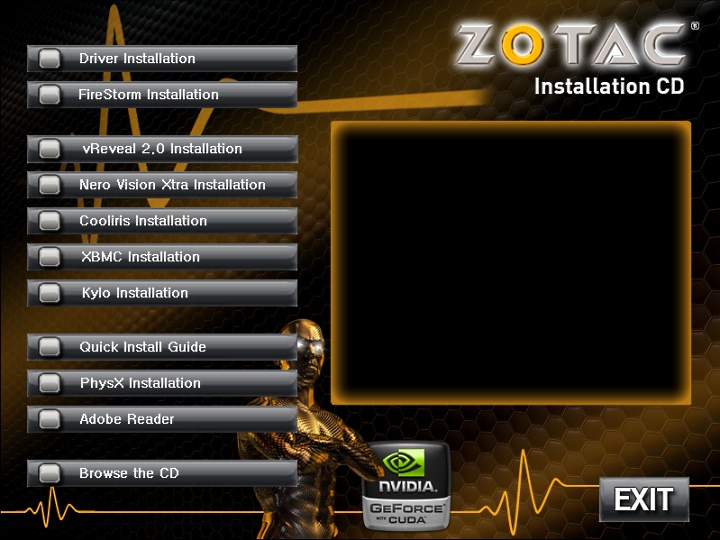
The ZOTAC driver and utilities disc comes with a number of free software and trials. A few of them are GeForce-accelerated, taking full advantage of Nvidia’s CUDA. Here’s a description of the applications included.
Enhance
vReveal
Easily stabilise, brighten, and sharpen your high-definition videos using powerful enhancement technology with vReveal. Harnessing the power of NVIDIA CUDA technology and ZOTAC GeForce series graphics cards, vReveal processes videos up to 5x faster than with a CPU.
Edit
Nero Vision Xtra
Edit your home videos with extreme precision and stunning effects with Nero Vision Xtra. Advanced features such as picture-in-picture effects, multi-track timeline, full key frame control and master effect track lets anyone transform home videos into cinematic masterpieces easily with Nero Vision Xtra.
Note that this is the trial version only.
Experience
Cooliris
Experience online photos and videos like never before with Cooliris, a revolutionary browser plug-in. Cooliris transforms your web browser (Microsoft Internet Explorer, Mozilla Firefox and Google Chrome) into the ultimate media browser that scrolls through infinite amounts of photos and videos in a matter of seconds with the option to view the content instantly.
Entertain
XBMC
Transform your PC into a digital entertainment hub with the open-source and award winning XBMC media centre. Enjoying digital audio, video and image content with XBMC media centre is a breeze, whether the content is on physical media such as CDs, flash drives, memory cards, or stored on another system over the network, XBMC media centre can access and play it with ease.
Enjoy
Kylo
Enjoy web browsing on your high-definition television set with the big-screen optimised Kylo web browser. Kylo is the ultimate TV web browser with big fonts and big buttons for easy usability while relaxing on the sofa.
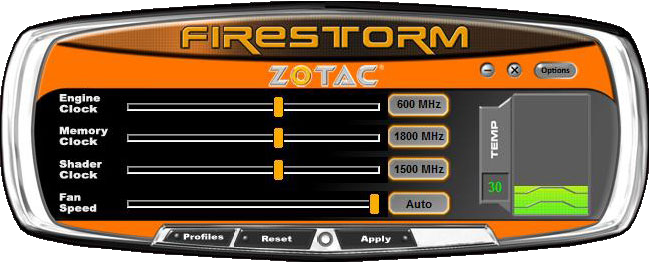
ZOTAC FireStorm is the brand’s take on the already populated world of overclocking utilities. Nonetheless, it is still a good touch for those unfamiliar with other applications such as MSI Afterburner. Unfortunately, the FireStorm application could not be installed from the CD so I was unable to see how it fared against other more popular programs.
Temperature & Overclocking
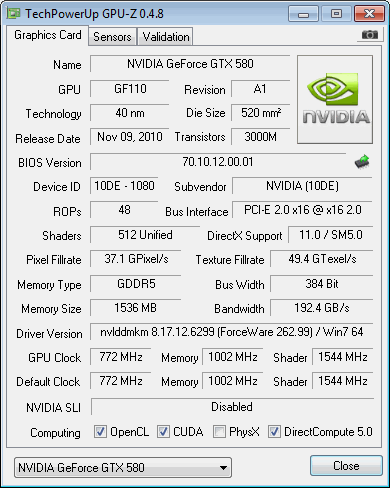
Due to limited time with the sample, I was unable to overclock the ZOTAC GTX580 and produce further results. However, it is important to note that the card, being a reference model, shares the same components as the ASUS one we reviewed previously so we can expect a similar overclocking headroom. MSI Afterburner also allows voltage tweaking on all reference GTX580, the ZOTAC being no exception, so it isn’t necessary to rely on ASUS’s somewhat limited SmartDoctor utility for the feature. The ZOTAC card comes clocked at the reference speed of 772/4008MHz operating at 0.992V under load and 1.014V at idle.
Temperature
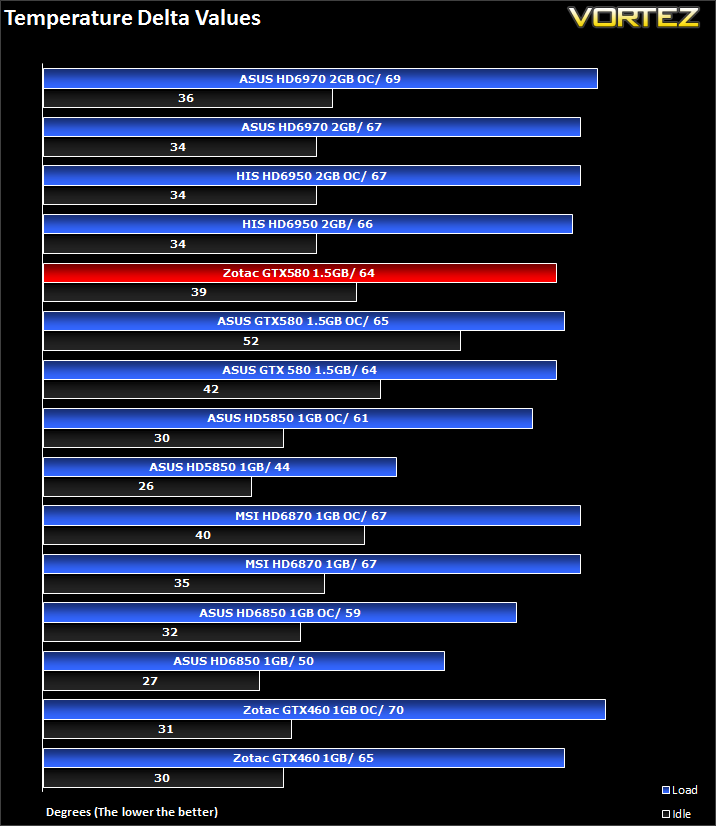
As with the ASUS card, the ZOTAC GTX580 ran very cool, an impressive feat for such a powerful card and large GPU. At the stock clock speeds, the delta temperature was 64C, the same as the pre-overclocked ASUS GTX580. It was also notably cooler than the HD6950 and HD6970. Part of the reason for the lower temperatures was the fan speed which operated at 57% of its capacity at idle and increasing to 84% under load, at which point the noise level became very intrusive. For comparison, the ASUS card operated at 51/69% at idle/load respectively making the latter the much quieter option. It is possible that the vapour chamber on our sample had a defect.
Power Management
Overclocking is nothing without stability and for most enthusiasts; applications such as Furmark, OCCT or MSI Kombustor have been the stress test of choice to truly load graphics cards. However, both AMD and Nvidia have voiced their concerns against the use of such applications due to the number of cards killed as a result of high temperatures and unforgiving load. They believe that stress tests are not representative of gaming loads and should therefore not be used as an indicator for stability.
Last week we saw that AMD have implemented PowerTune to keep their cards’ TDP in line. Nvidia have to be given credit for being the first of the two manufacturers to actually deploy these power saving features on their GTX580. They have taken the hard line approach of making sure that the GTX580 doesn’t draw more than 300W of power by throttling the clock speeds under high load. Typically, such high power consumption can only be expected from stress testing applications such as Furmark, so games will continue to work without any throttling occurring. The main disadvantage compared to AMD’s implementation is that users have no control over the TDP at which the card will throttle and more annoyingly, clock speed changes are not recorded by any monitoring programs, making it harder to visualise any throttling. AMD also fall culprit to the latter issue. With regards to this, overclockers will find it hard to distinguish if their final clock speeds still fall within the limit of the TDP.
In this case, the benefits far outweigh the negatives, the positive being that the GTX580 will have a much longer life expectancy than the power hungry GTX480.
Crysis Warhead
Following the success of Crysis, the stand alone expansion “Warhead” was hotly anticipated to bring more game play, more weapons, improved visuals whilst maintaining better performance, the latter being what gamers wanted most. After all how many people upgraded their rigs just to play this game… In the game, you play as the upbeat Brit Sergeant “Psycho” Sykes, chasing down a Korean nuclear warhead. Throw in some ice shooting aliens and we’re bound to have a great game. It sure delivered.
Testing was done using Framebuffer’s Crysis Warhead benchmarking tool. The tests were configured to DirectX 10 at Enthusiast levels. Each test on the Ambush map was looped three times from which the average FPS was recorded.
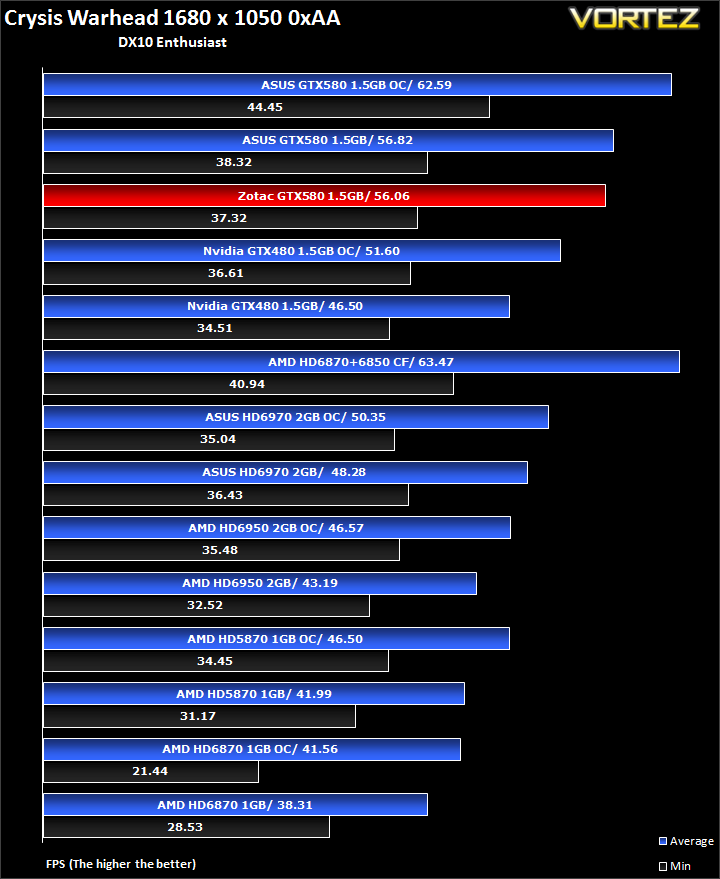
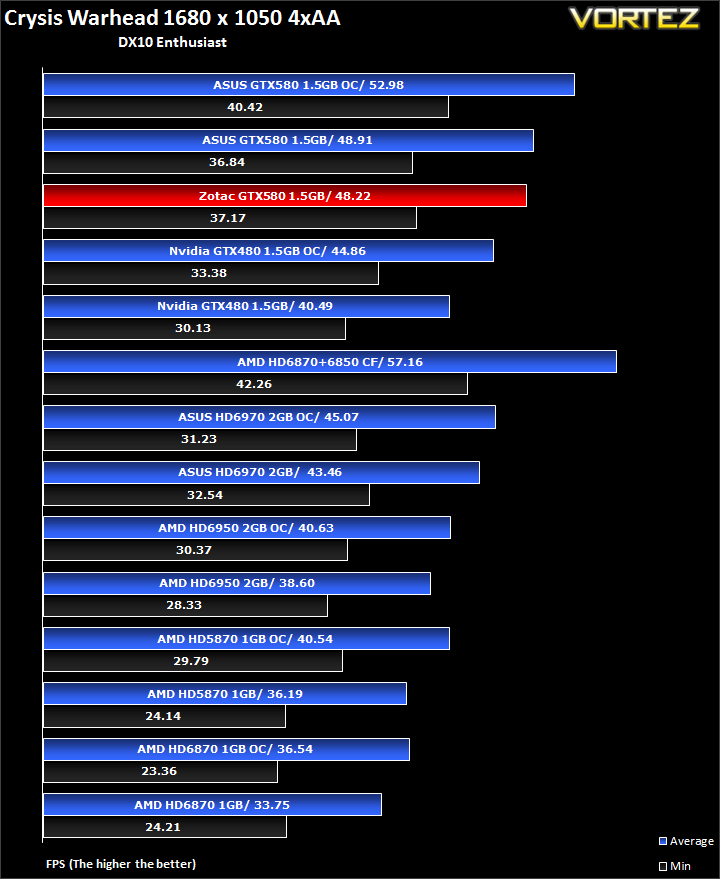
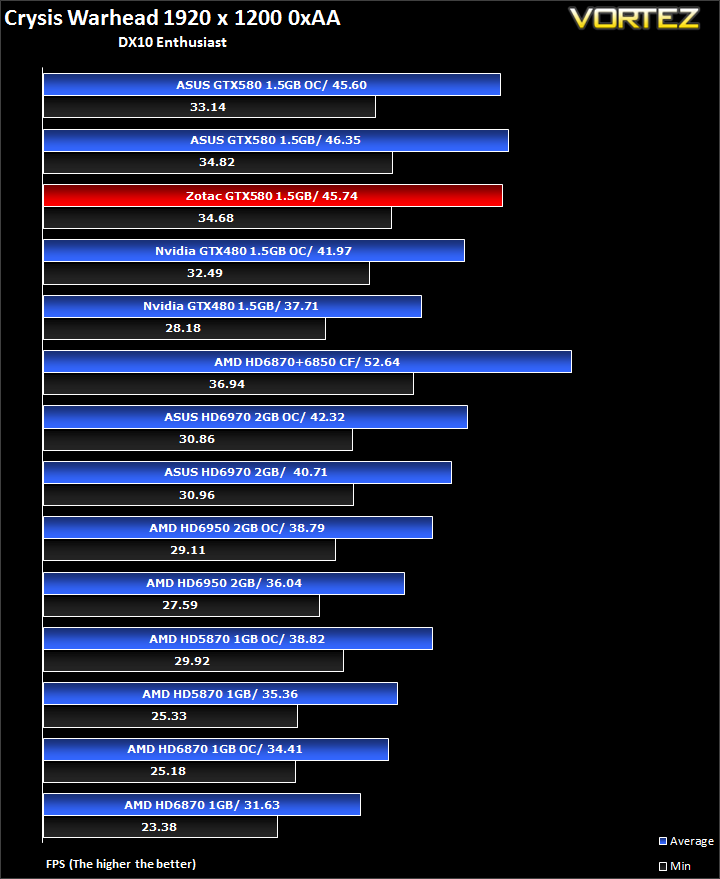
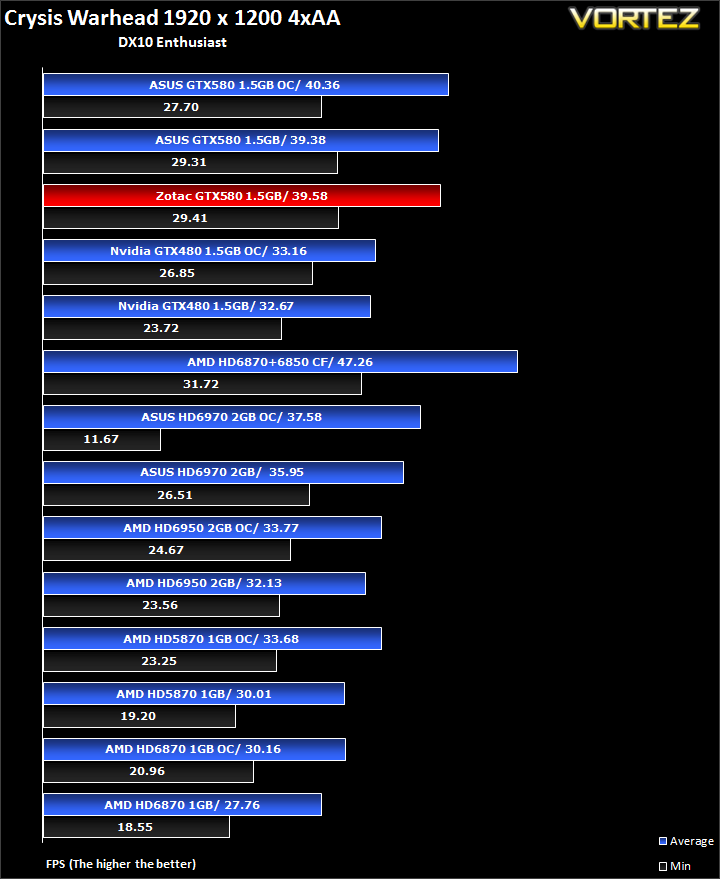
The ZOTAC GTX580, not surprisingly, performs very similarly to the ASUS variant, with a slight 1% disadvantage reflecting to 10MHz pre-overclock on the latter card.
Far Cry 2
One of the most hyped games of 2008, Far Cry 2 had some big shoes to fill. It was built to be the next best thing since well… Far Cry I suppose. Combining an open-world game play with highly detailed graphics, physics and AI, what more could we possibly want? The game puts us in the body of a malaria inflicted mercenary hunting down the “Jackal” in the heart of Africa, in a bid to stop an on-going conflict between two rival factions. The storyline can be hard to follow sometimes but I’m no game reviewer, so let’s concentrate on the graphics and performance. After all, we all need to know if our hardware will be able to handle the scorching savannah burning at the hands of our flamethrowers.
The bundled benchmarking tool was used on Far Cry 2, configuring the settings to Ultra and DX10. The small ranch level was chosen and each configuration was looped three times from which the average FPS was recorded.
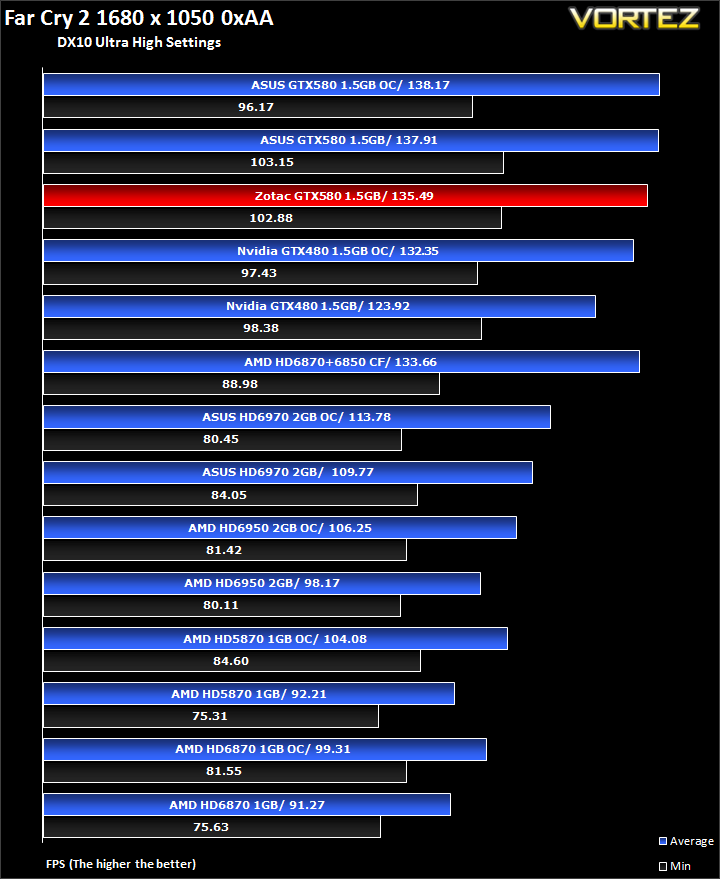
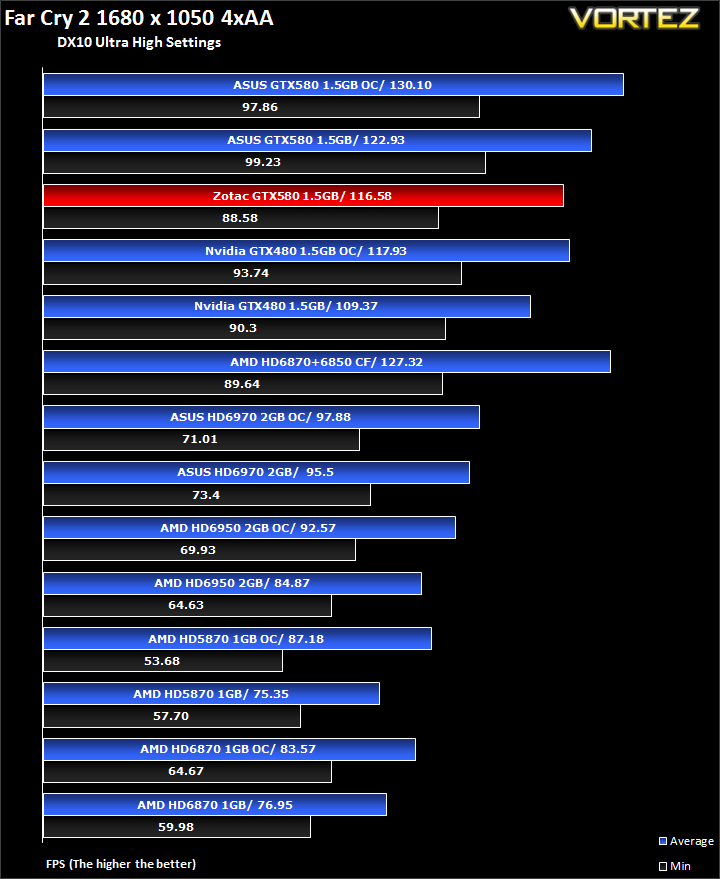
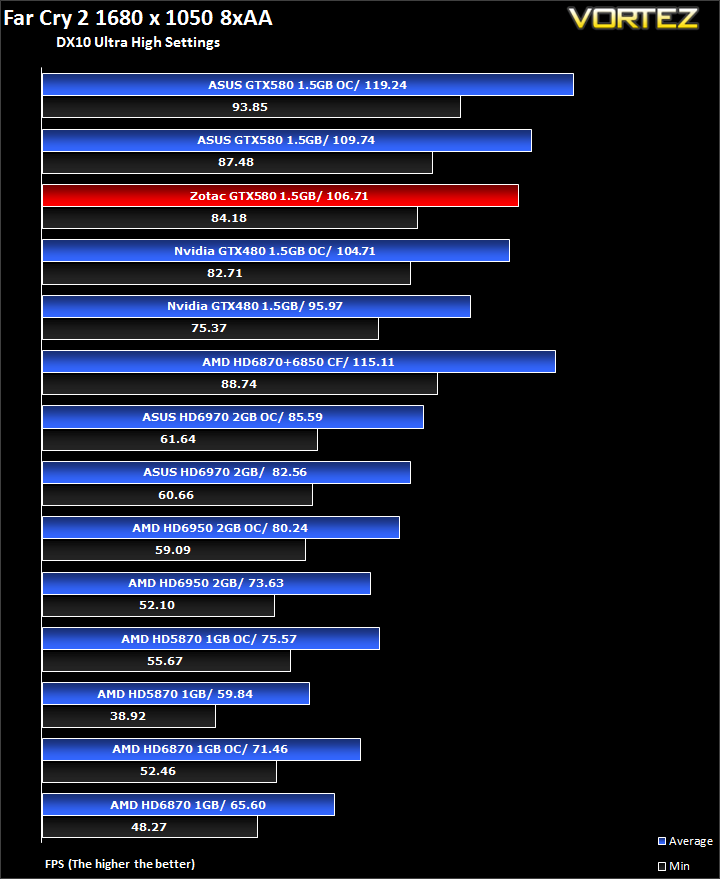
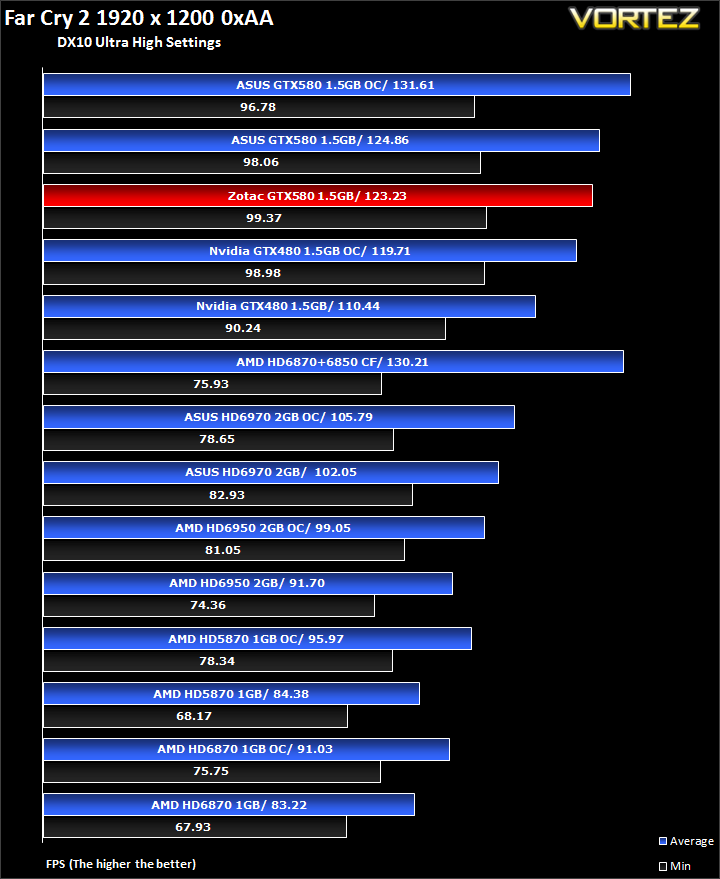
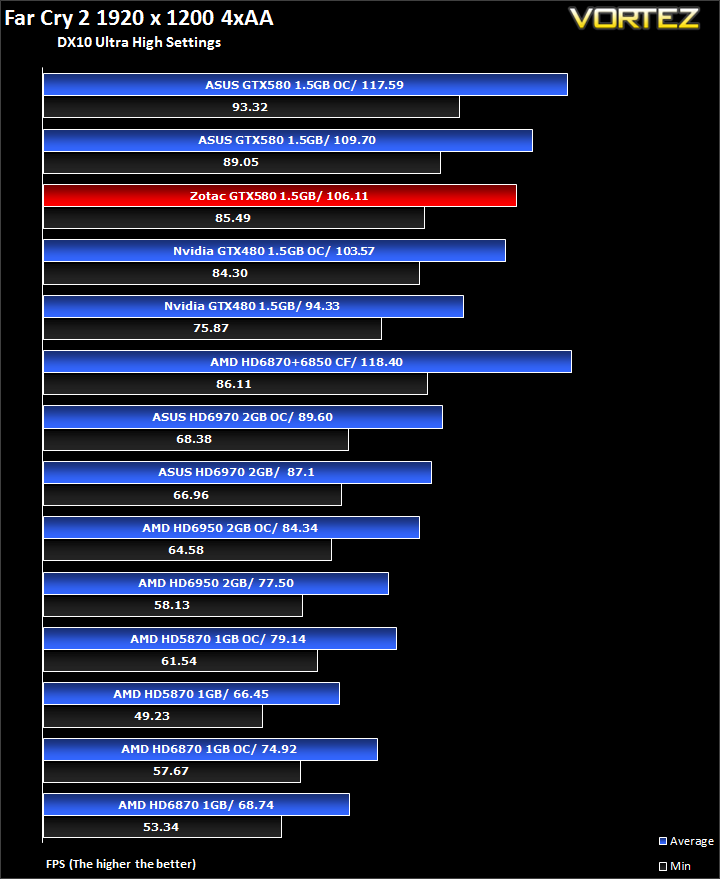
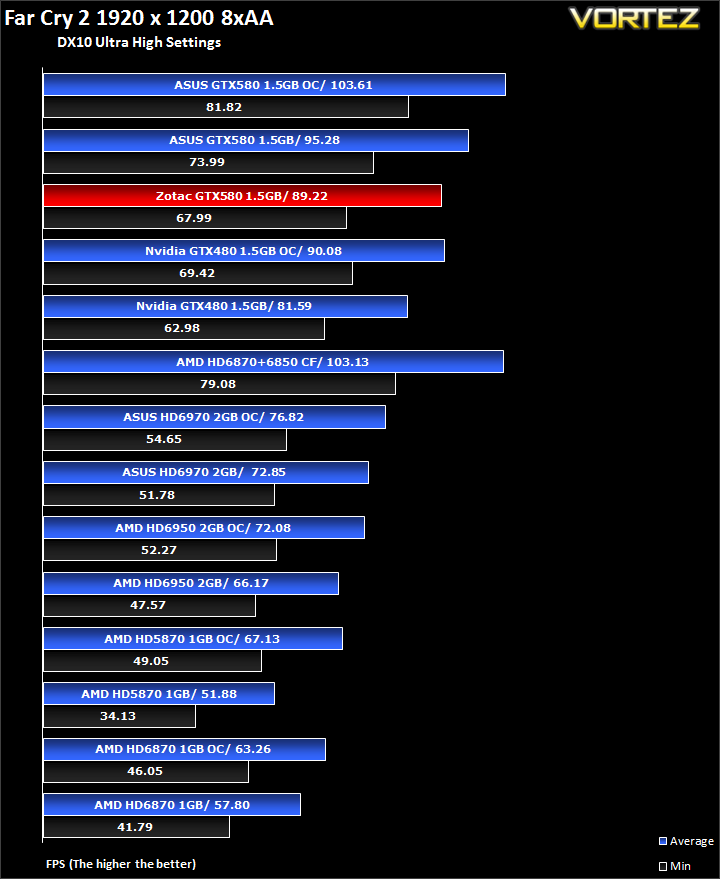
In Far Cry 2, the ZOTAC is outperformed by 3.5% on average compared to the ASUS card, losing out by a greater margin with AA applied. The 10MHz pre-overclock on the ASUS demonstrates greater benefits in this situation. The varying results may well be due to the margin of error when benchmarking as a result of the Physics and AI implemented into the Far Cry 2 benchmarking tool.
Resident Evil 5
Resident Evil 5 is the sequel to the Resident Evil series, exploring the life of main protagonist, Chris Redfield. You play as either Chris Redfield or Sheva Alomar in an African desert area in Kijuju. In true Resident Evil fashion, your main objective is to investigate a terrorist bio-organic weapon threat whilst killing infected “Majinis” on your way.
The Resident Evil 5 benchmark tool was used to test performance. All settings were set to the maximum possible and the average FPS was recorded at the end.
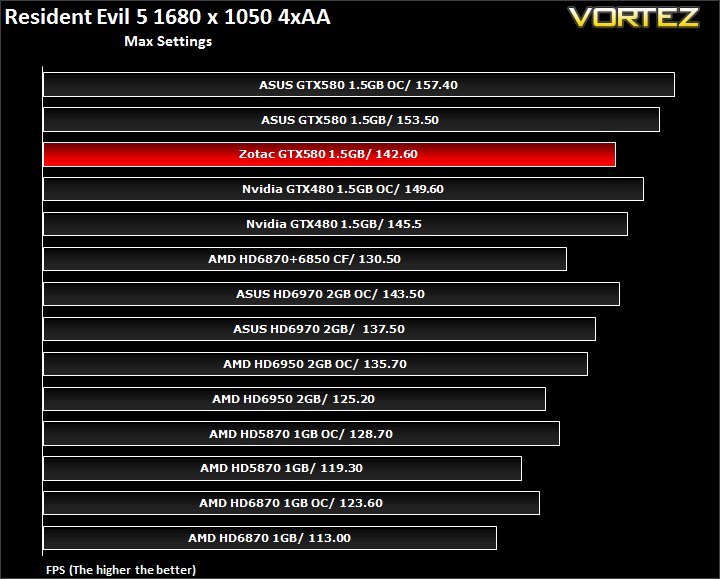
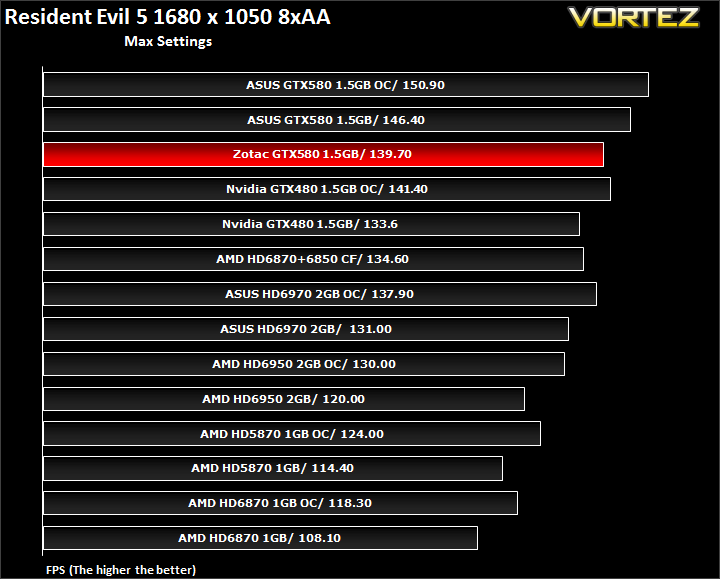
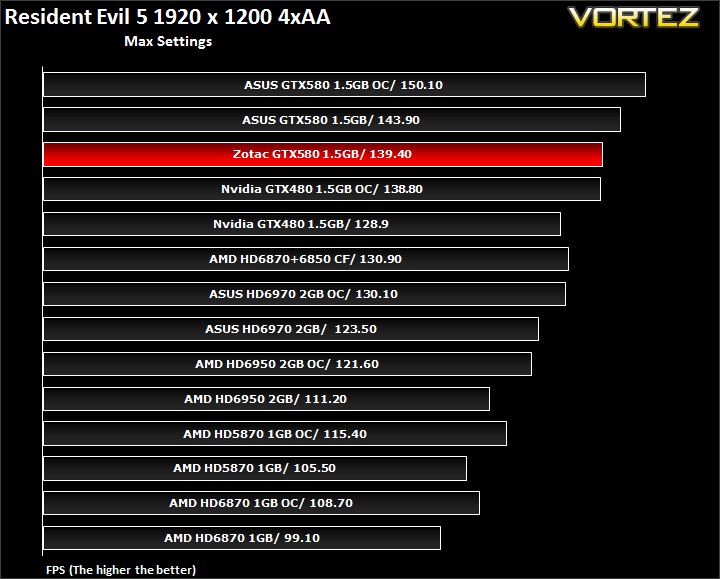
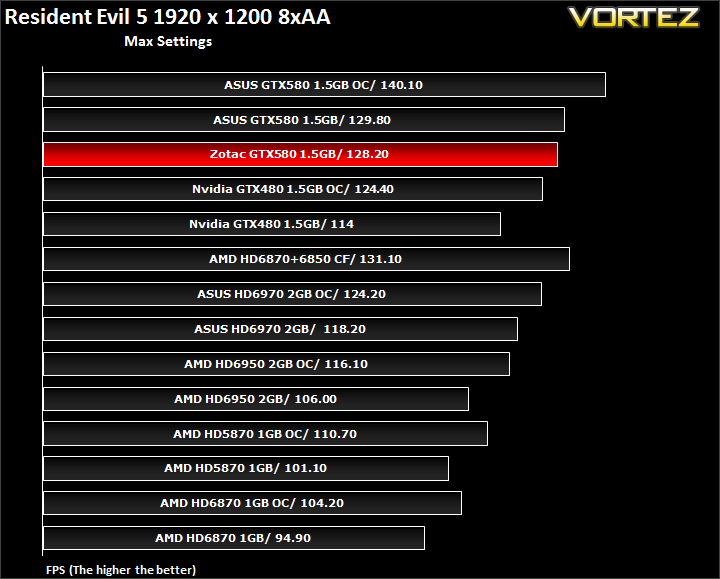
Again, the ZOTAC GTX580 loses out to the ASUS card with an average 4% difference. The performance margin reduces with the higher game settings.
Street Fighter IV
Street Fighter is back in its 4th iteration and it’s bigger and better than ever. Combining fluid, fast based sparring with stunning artistic visuals, the game delivers tremendous game play. Be reacquainted with some of the most popular characters in video game history while you battle your way to the top, be it with Ryu or the mighty Bison. The game might be frustratingly hard in some cases but there’s nothing like the satisfaction of K.O’ing your opponent with a well stringed death bringing combo.
The Street Fighter IV benchmark tool was used to test performance. All settings were set to the maximum possible and the average FPS was recorded at the end.
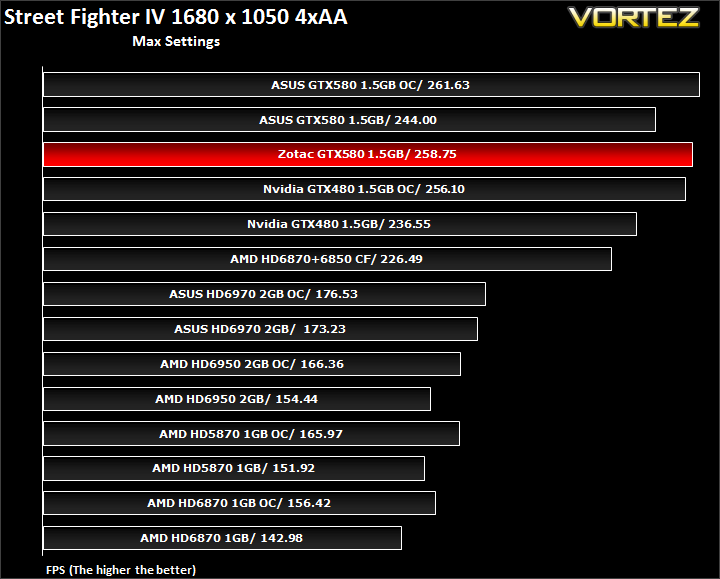
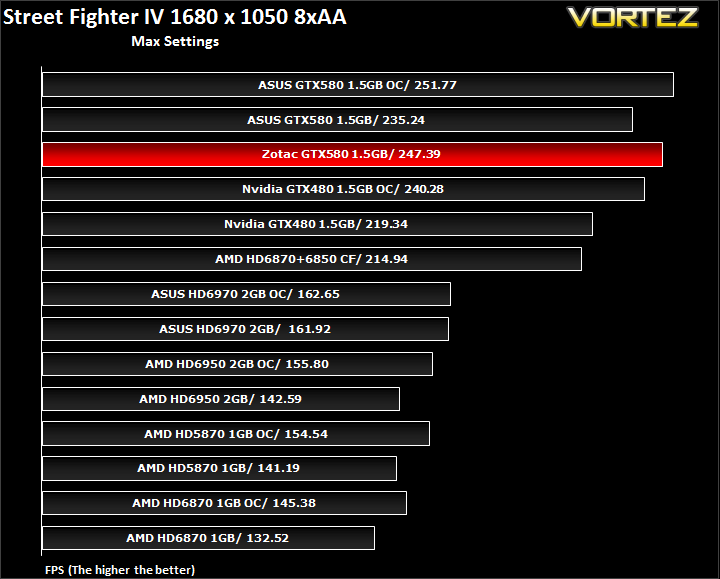
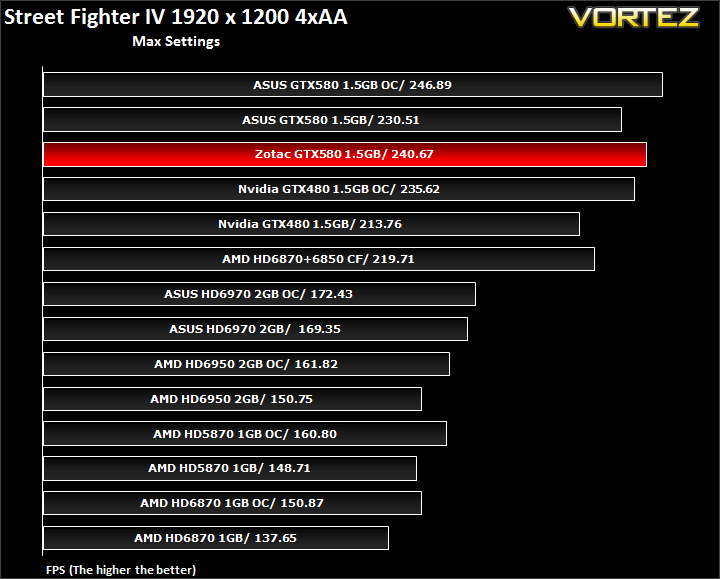
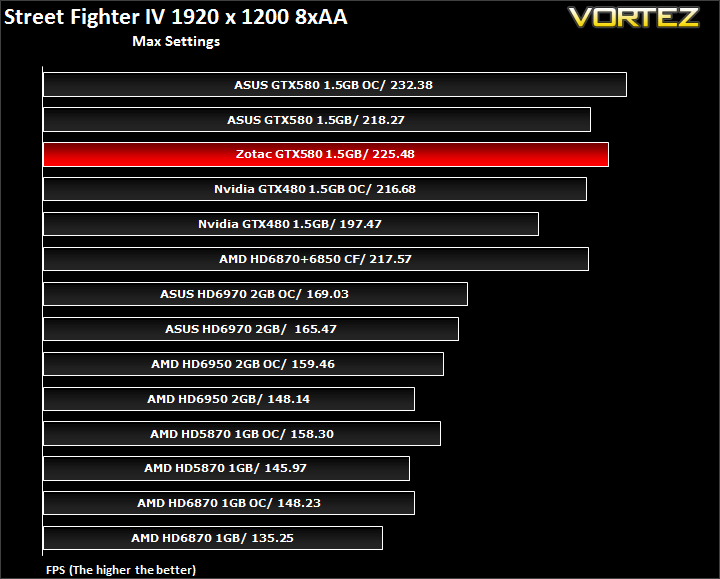
The trend changes with Street Fighter IV and the ZOTAC grabs an overall 4% performance lead over the ASUS card despite the lower core clock speed.
Unreal Tournament 3 & Batman Arkham Asylum
Unreal Tournament
Built around the unreal 3 engine, Unreal Tournament is all about mindless fast paced shooting, decapitation with a plethora of game modes to so in. Not much else can be said really except that it promises hours of enjoyment on multiplier whether it be against bots, your friends at a LAN or online. It was one of the more popular games out there to adopt PhysX in the form of partially destructible maps, tornadoes and hail.
The Hardware OC UT3 benchmarking tool was used to test the game. The maximum in game settings were used including motion blur. Anistropic filtering was set to 16x and no Anti-Aliasing was used. The Containment was benchmarked and the average FPS recorded at the end.
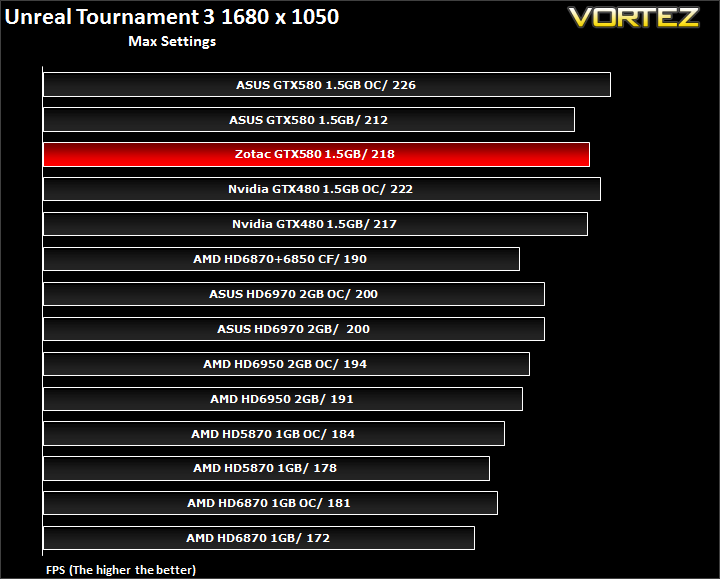
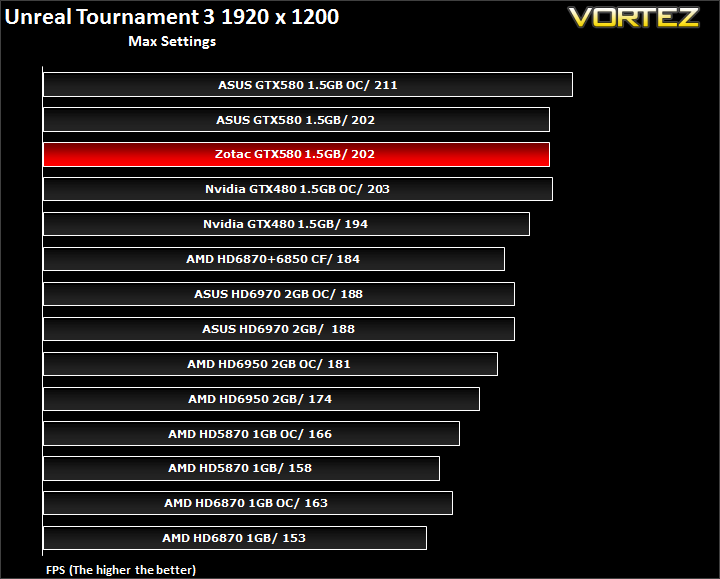
At 1920×1200, the two GTX580s perform the same and at the lower resolution, the ZOTAC card grabs another small lead of around 3%.
Batman Arkham Asylum
The Dark Knight takes on his greatest challenge yet when he becomes trapped with all of his most dangerous villains inside the insane asylum of Gotham City – Arkham Asylum. The game exposes you to a unique, dark and atmospheric adventure that takes you to the depths of Arkham Asylum, Gotham’s psychiatric hospital for the criminally insane.
The in-game benchmarking tool was used to test performance. All the display settings were set to very high. No AA was used and PhsyX was only enabled if specified in the charts. The average FPS was recorded at the end.
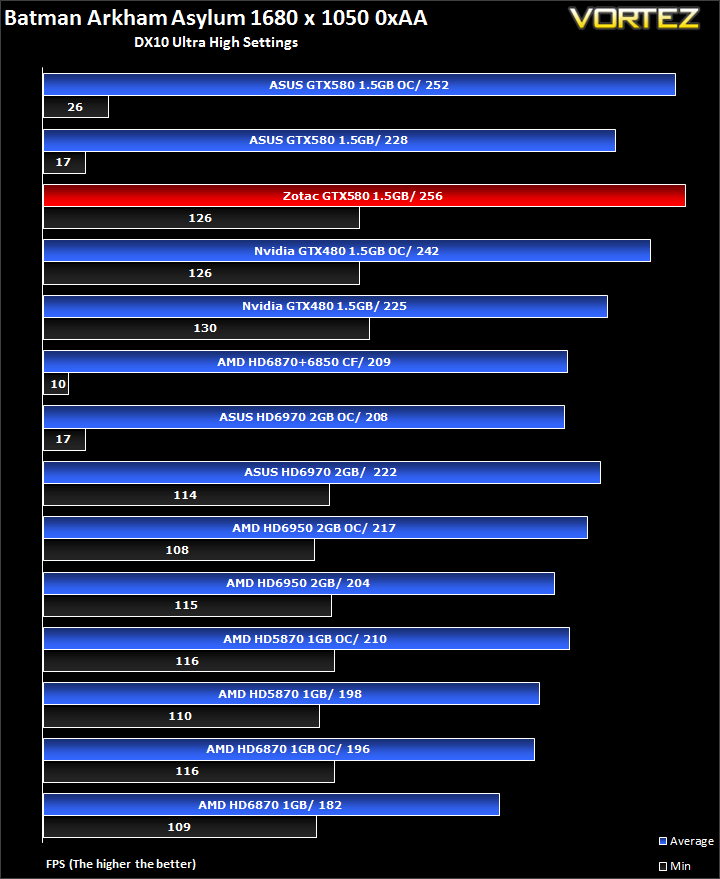
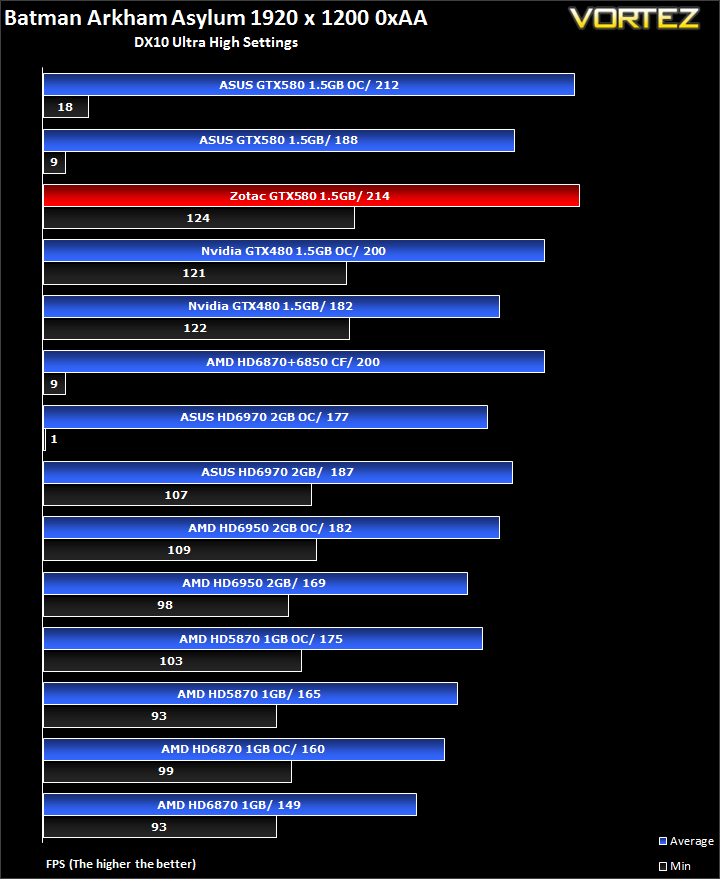
The strange performance experienced by the ASUS GTX580 means that the ZOTAC card takes a healthy 11.5% lead here.
Colin McRae DIRT 2
DIRT is back and it’s bigger than ever. With an onslaught of famous X-Games competitors such as Ken Block and Dave Mirra, extreme is being brought back to rally. The game not only delivers outstanding gameplay in lush environments but also stunning visuals in the form of Direct X 11 implementation. If you want some fast paced, arcade style racing, then look no further than Colin McRae DIRT 2.
The in-game benchmarking tool was used to test performance. All the display settings were set to the maximum available and DirectX 11 was applied. The average FPS was recorded at the end.
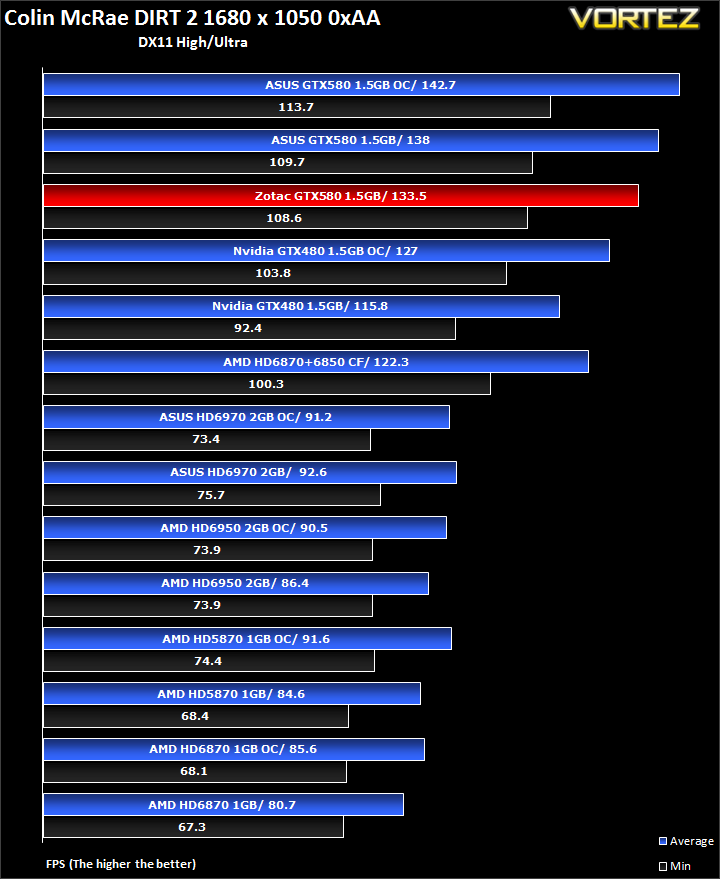
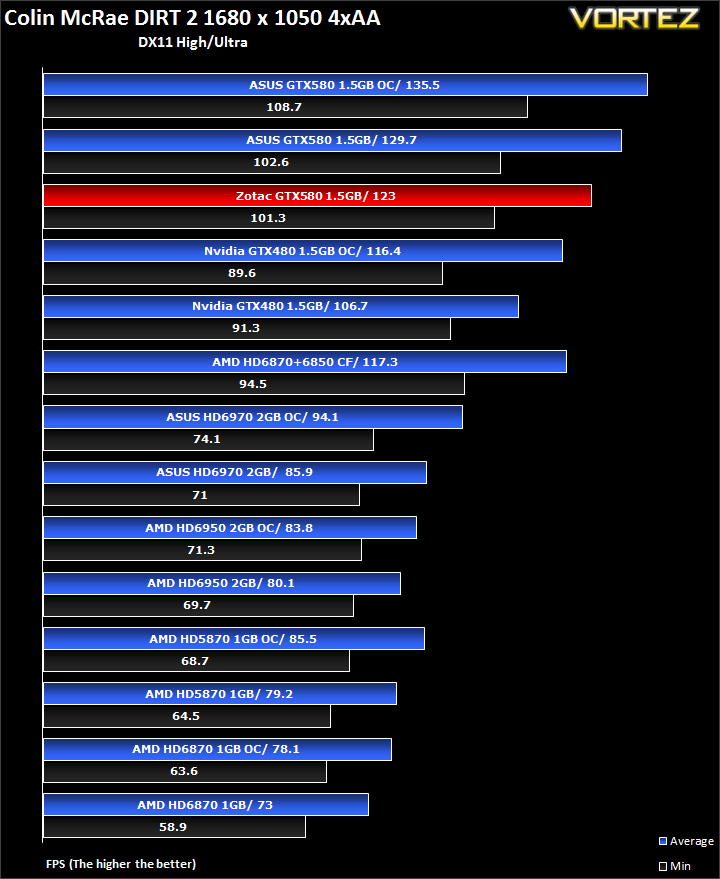
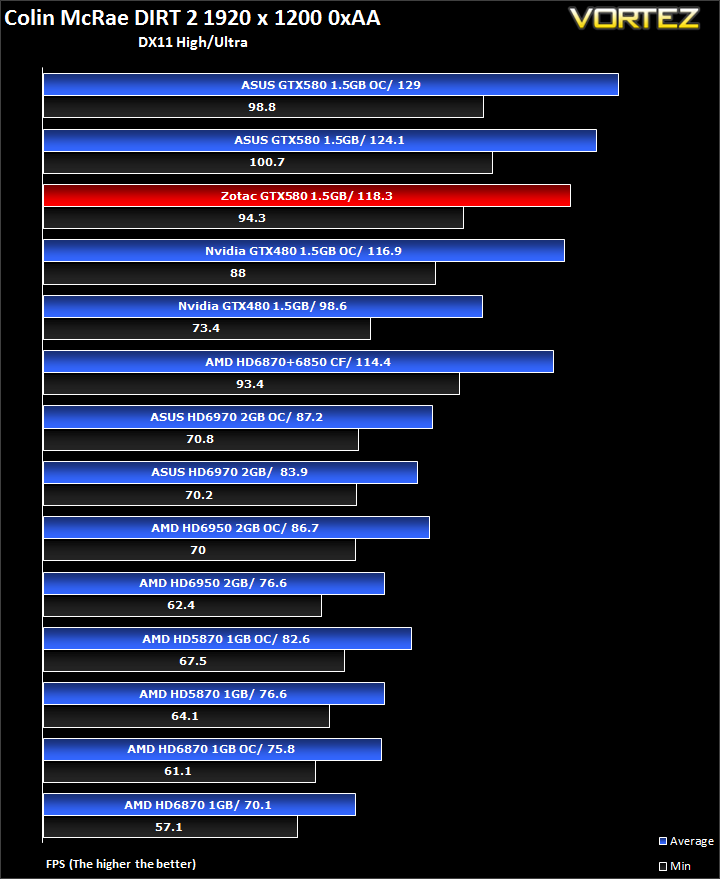
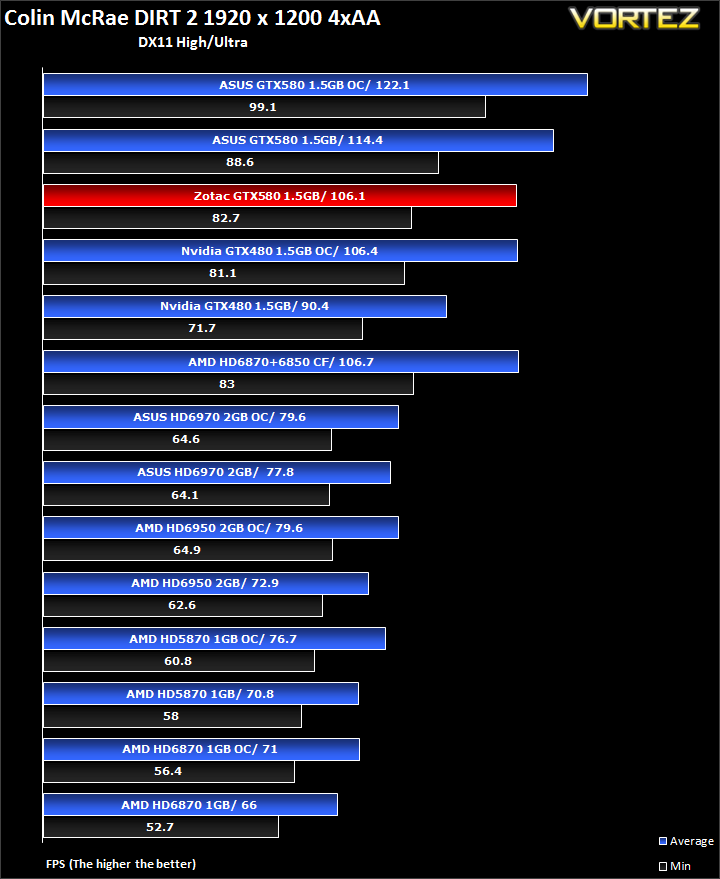
The ZOTAC GTX580 falls behind the ASUS offering by an average of 5%, with a greater performance gap when 4xAA is applied.
Battlefield Bad Company 2
Battlefield Bad Company 2 is the new rendition of the widely successful Battlefield series of game. Having more in common with the console release of Bad Company, the sequel hopes to inject the DNA of the timeless Battlefield 2 online experience with the witty action packed single player shooting adventure of the original. As Private Preston Marlowe, your goal as a member of Bad Company is to once again save the world by securing a scalar weapon device.
Fraps was used to test performance. Each test was conducted at the start of the ‘Upriver’ level ensuring that the same actions and paths were taken during the 2 minute sample. All settings were set to the highest available in game with AF set to 16x and HBAO turned on. The average FPS was recorded by FRAPS at the end of each walk through.
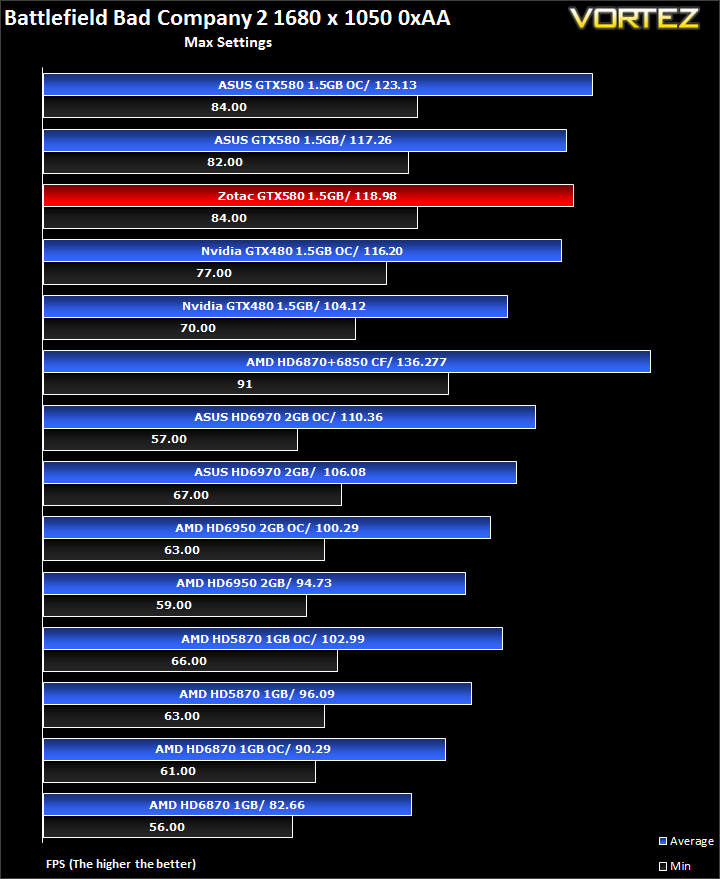
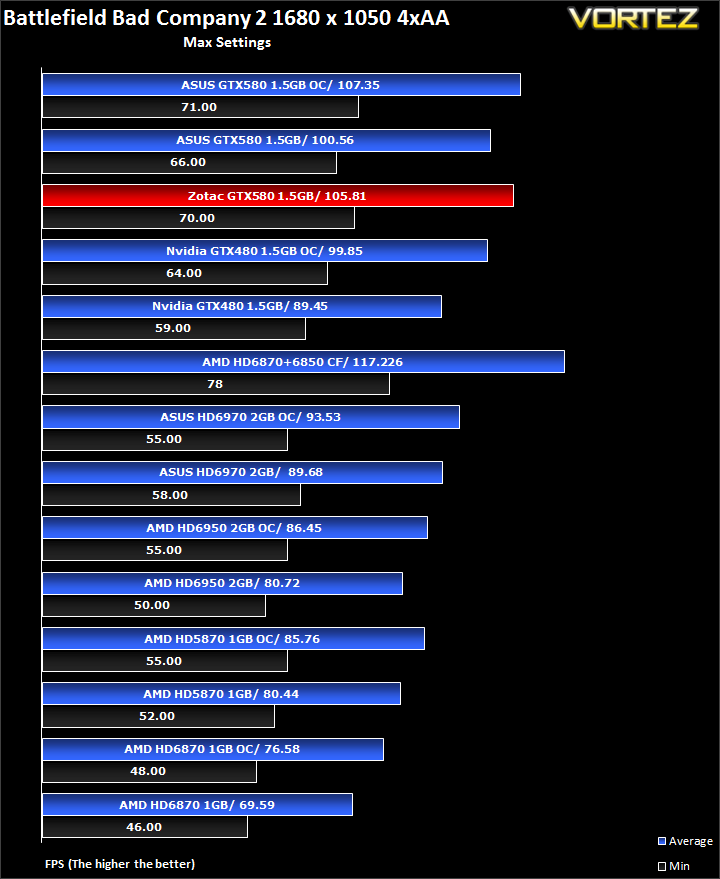
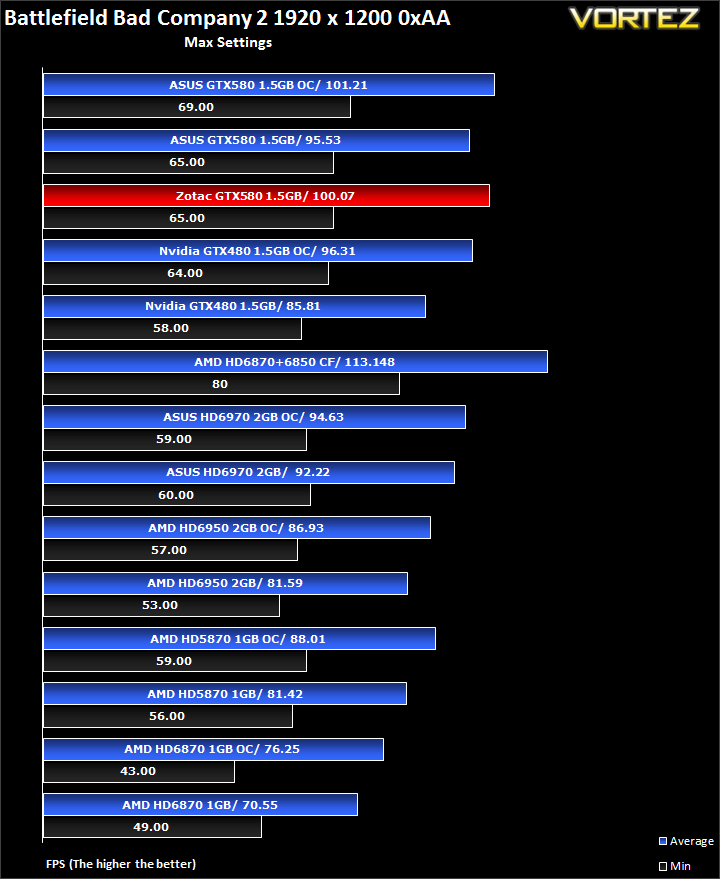
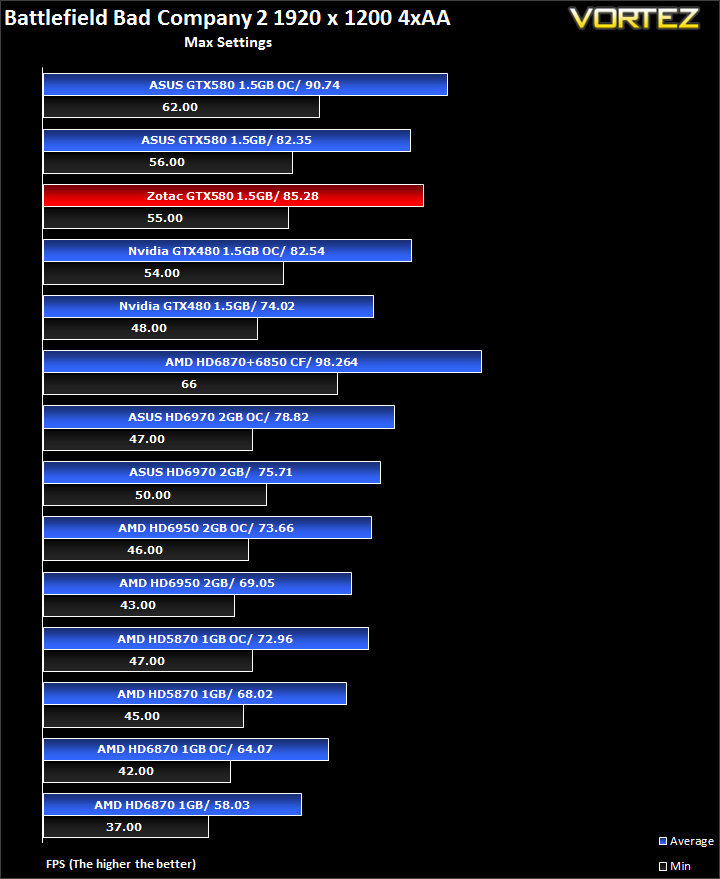
The ZOTAC card impresses by outperforming the higher clocked ASUS GTX580 by 3.5%.
Mafia II Demo
Following the success of Mafia back in 2002, the third person action adventure game is back with a new grittier and darker world. As Vito Scaletta, an aspiring made man, your job is to work through the twist and turns of Mafia lifestyle. The more blood spilt, the more you get in return but the lifestyle was never meant to be an ideal one. Set in the visually stunning Empire City, the wartime references provide the ever present back drop to a rife period in America’s history, in which potential for exploitation becomes Vito’s key focus.
The in-game benchmarking tool was used to test performance. All the display settings were set to the maximum available in-game. PhsyX was only enabled if specified in the charts. The average FPS was recorded at the end.
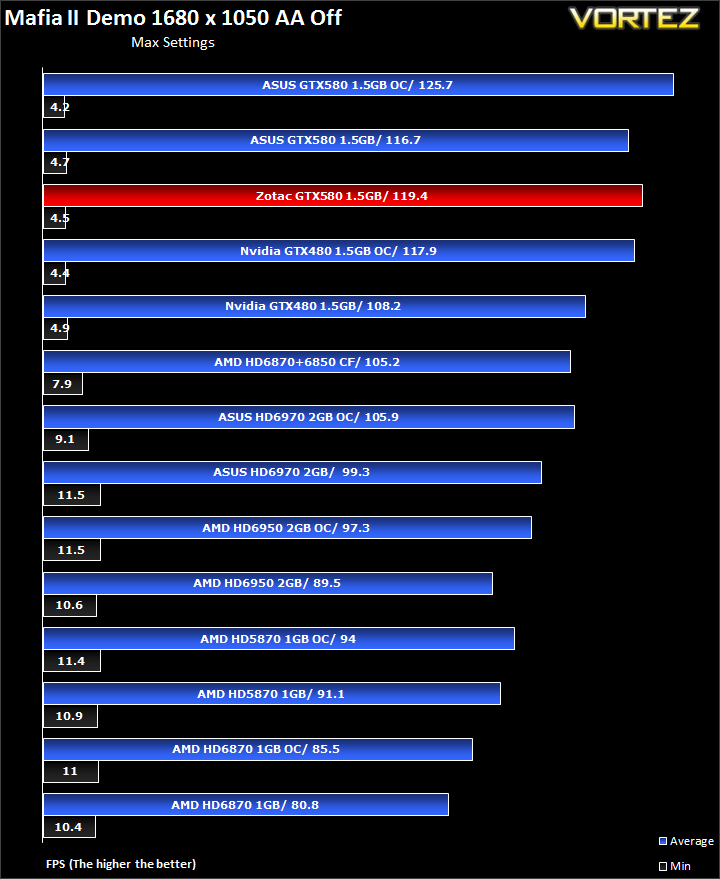
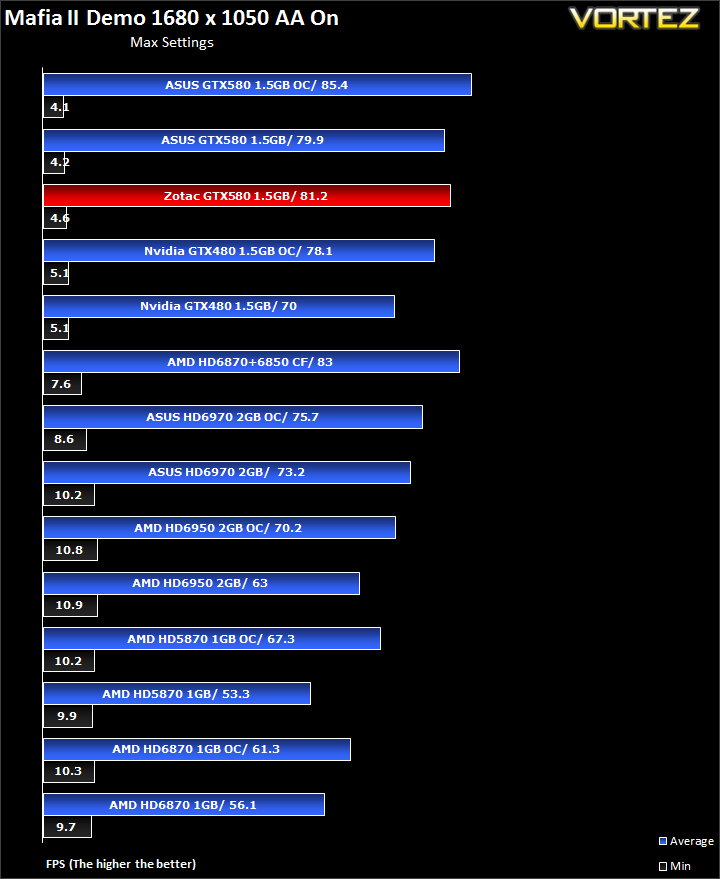
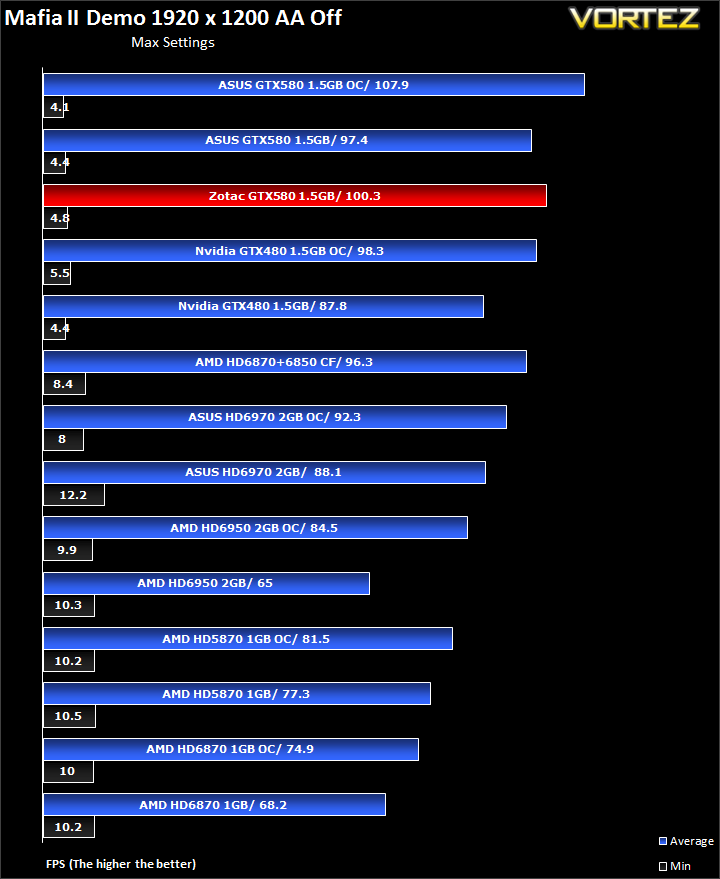
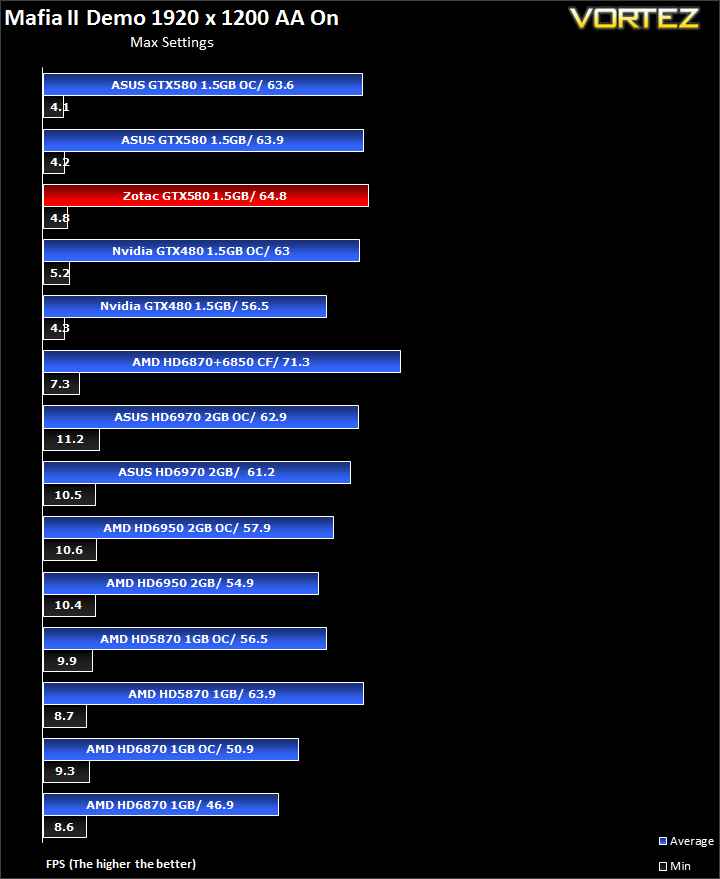
In Mafia II, the ZOTAC has a 2% lead over the ASUS GTX580, another outstanding result for the reference clocked card.
Alien VS Predator
Spawned from the popular Alien and Predator franchises, Rebellion have collaborated to bring the legendary war to us through the medium of a first-person shooter. The game forces you to hunt, prey and most importantly survive in the swamp colony of Freya’s prospect as a Predator, Alien or Marine. The stunning visuals add to the sense of dread and terror that we have become so accustomed to seeing with the series.
The stand-alone Alien VS Predator benchmark tool was used for testing here. All the settings were set to very high and Tessellation was applied. The average FPS was recorded at the end.
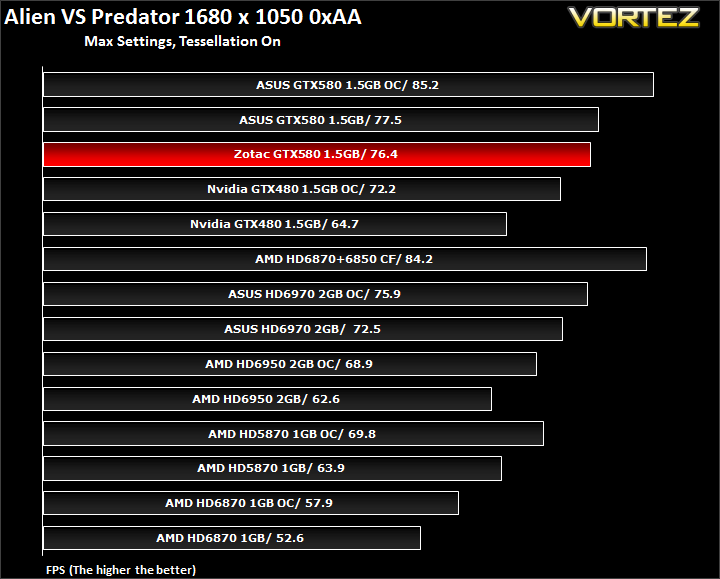
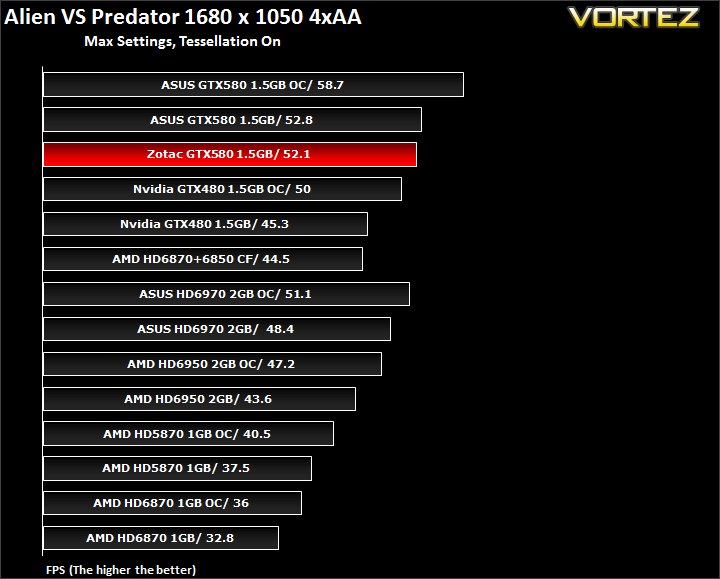
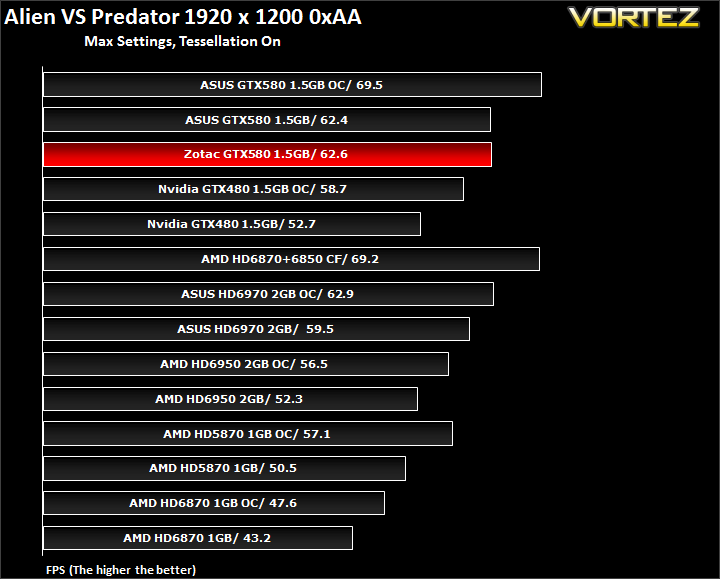
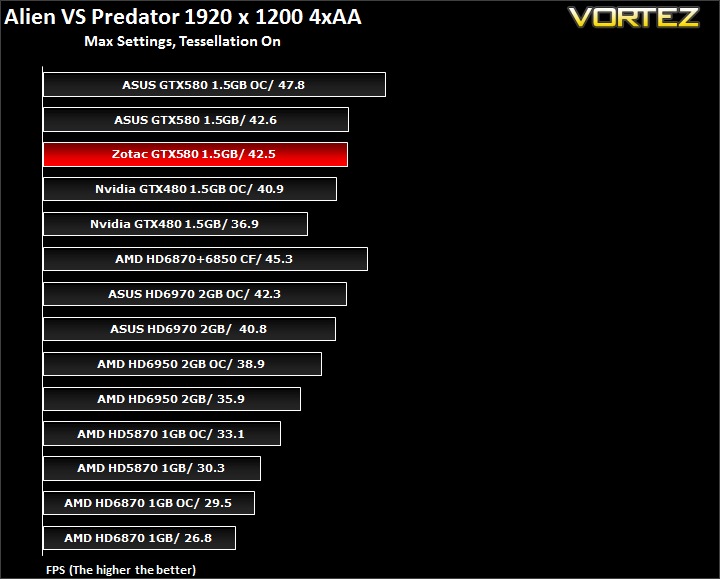
The performance difference is very minimal here at less than 1%. The ASUS card provides slightly better performance but nothing noticeable.
H.A.W.X 2
Tom Clancy’s H.A.W.X. 2 is an arcade-style flight action game from Ubisoft. H.A.W.X.2 is DX11 ready and therefore like other simulators such as DIRT2 has stunning scenery and a truly breath-taking visual experience. Using hardware terrain tessellation, H.A.W.X.2 relies on raw GPU power because a series of detailed triangles are required to be rendered. This surely has to be one of the most taxing benchmarks all our featured games, H.A.W.X.2 presents some of the best tessellation execution in any title to date.
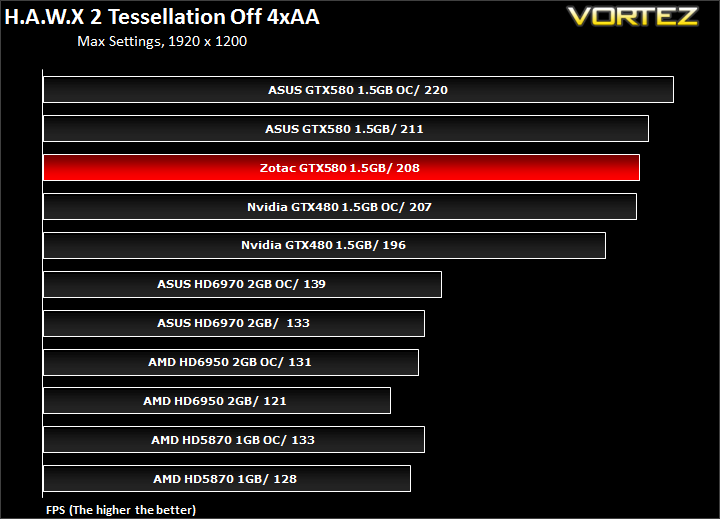
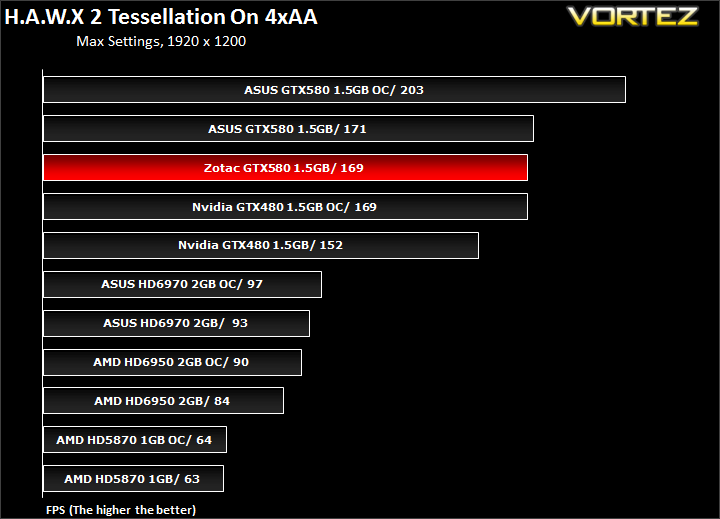
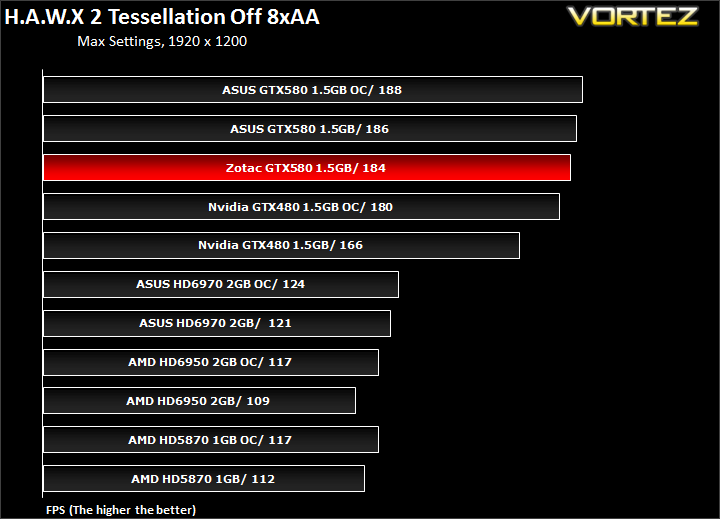
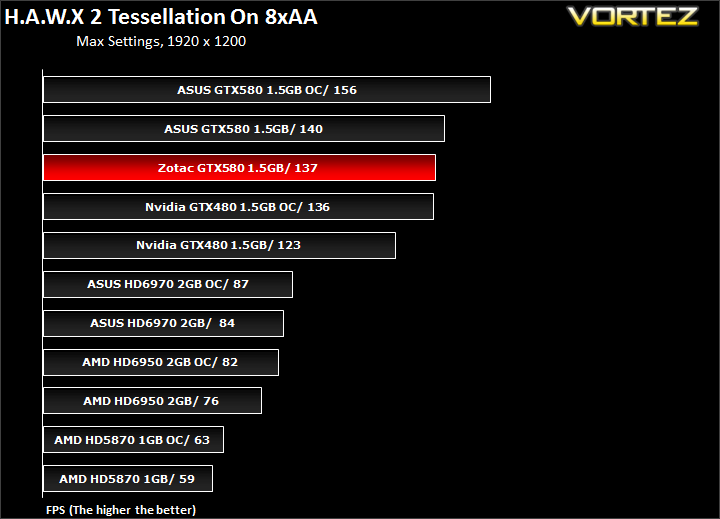
Here, the performance difference between the GTX580s is 1.5%, in favour of the ASUS card thus reflecting the 10MHz pre-overclock.
3DMark Vantage
This Vantage benchmark suite from Futuremark introduces DX 10 & PhysX support. Despite being on the verge of DX 11 games arriving, Vantage still proves a popular testing ground for enthusiasts.
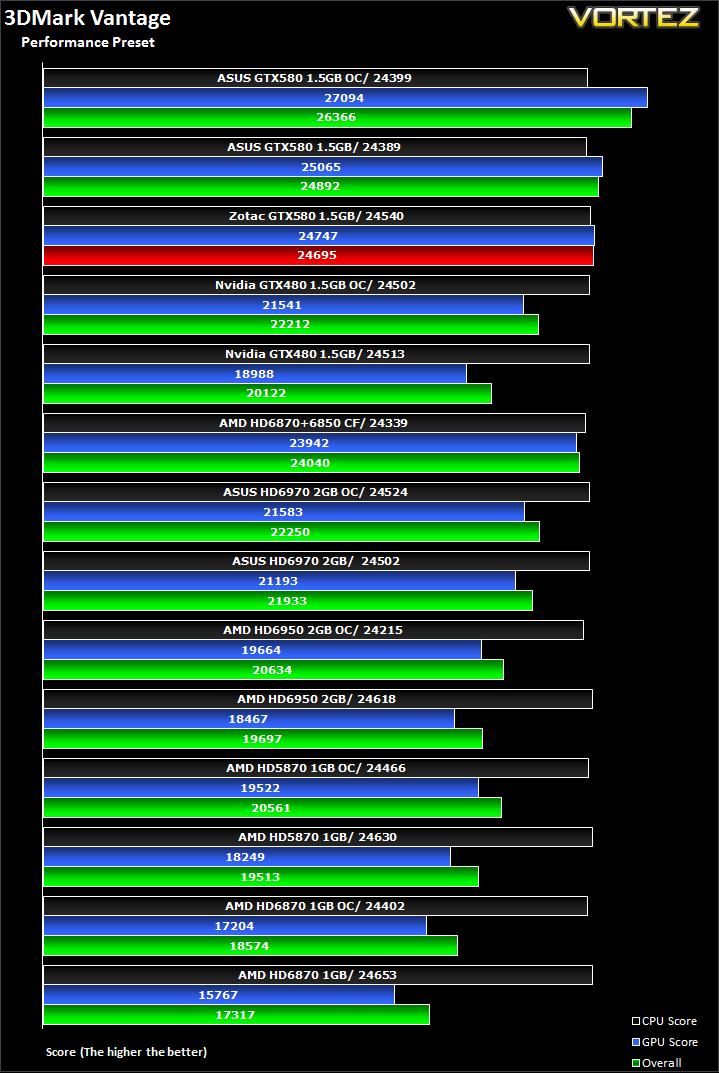
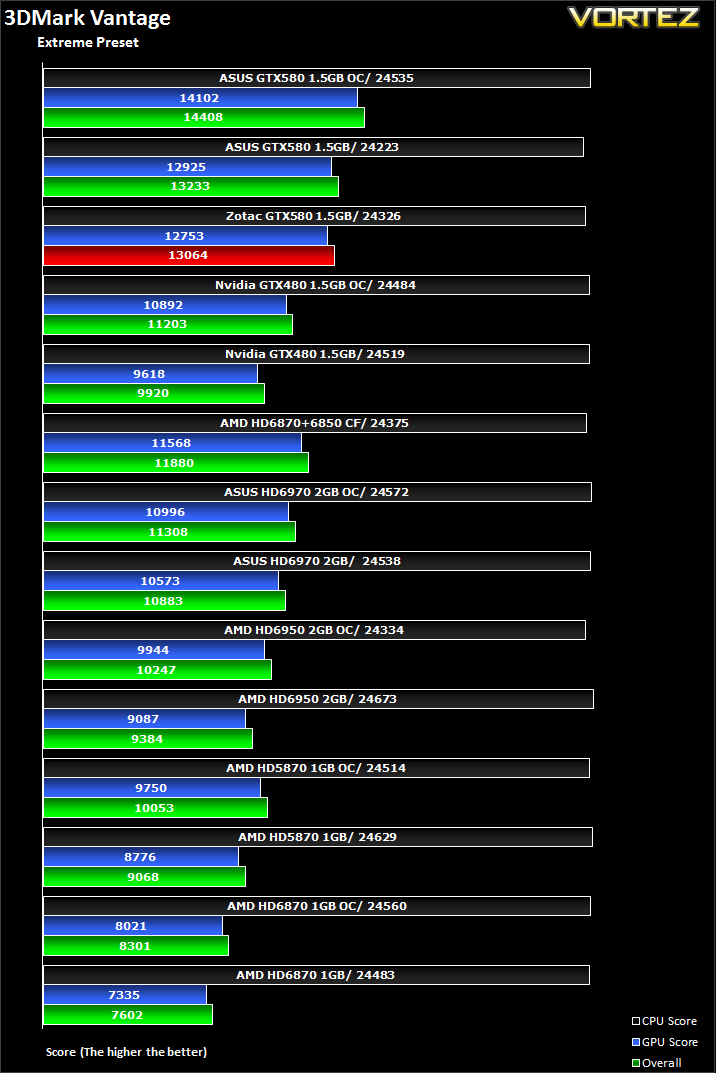
The difference between the two GTX580 is only 1%, favouring the slightly higher clocked ASUS card.
Unigine V2.1 Benchmark
Unigine’s benchmark is to showcase the benefits of DX 11 and the use of tessellation as opposed to normal rendering techniques. The demo has impressive visuals that give an insight into what we can expect from gaming in the future.
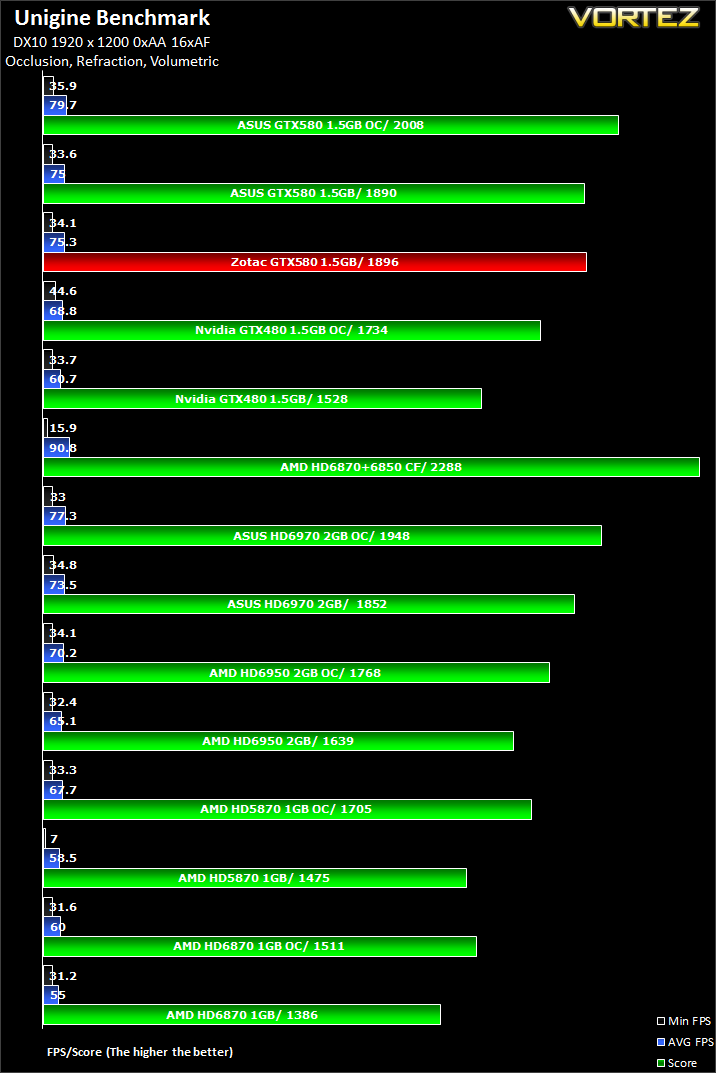
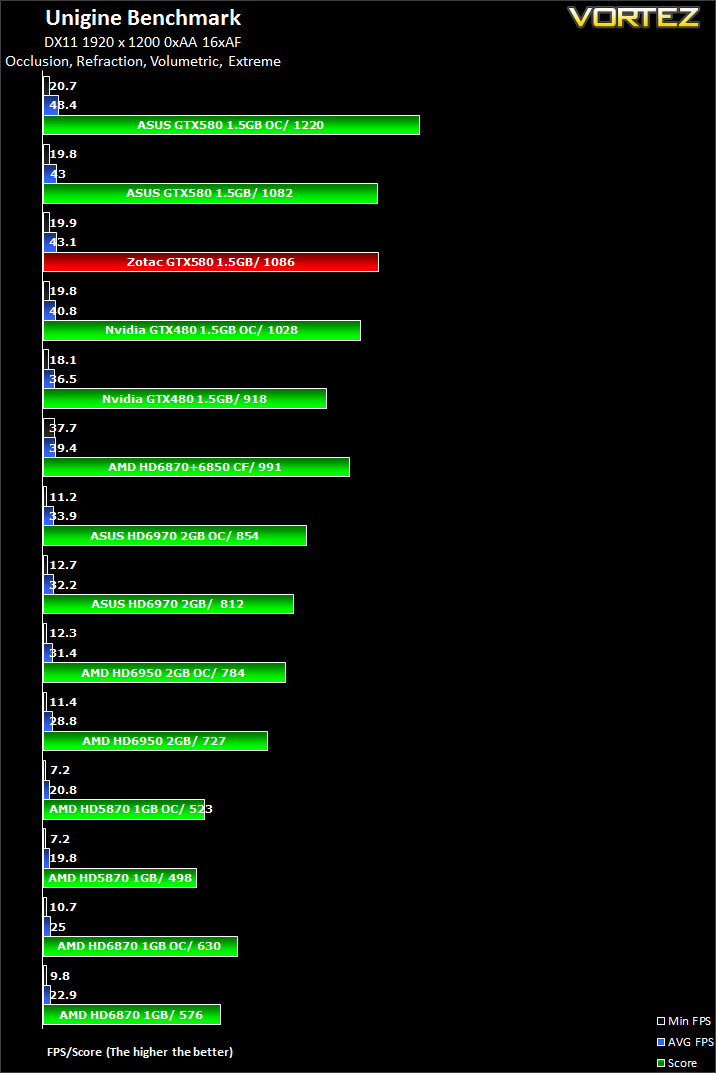
Again, the difference between the two GTX580s is minimal at best.
Power Consumption
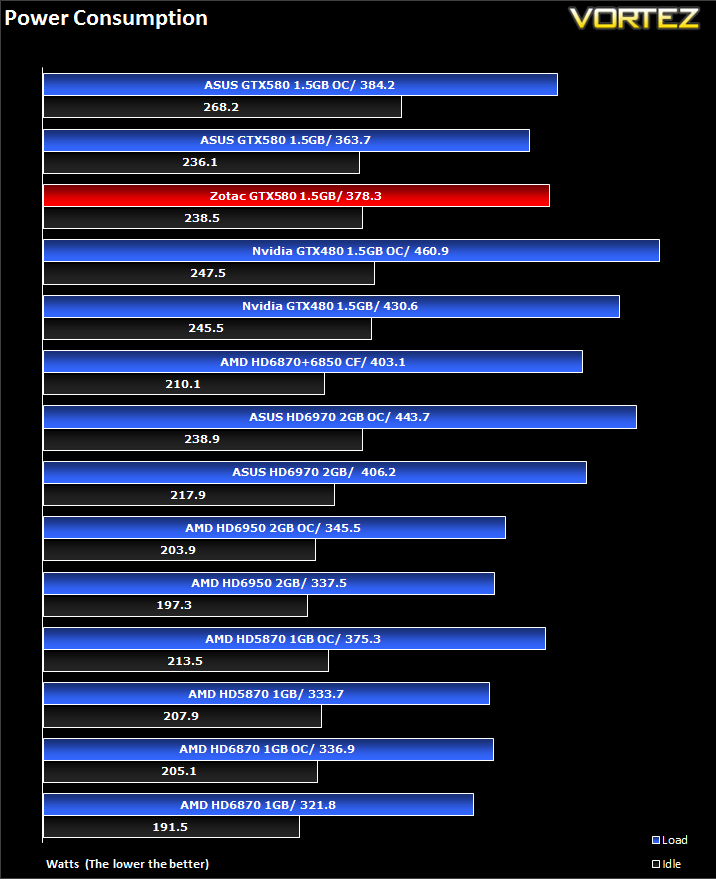
The GTX580 is indicative of Nvidia’s effort to lower power consumption, thermal and consequently the noise generated by their flagship cards. The GF110 is clearly a significant improvement over the previous GF100 core, drawing near 50W less than the GTX480 whilst maintaining superior performance. The lower power consumption was achieved by preventing leakages and implementing the power saving features discussed earlier on in a bid to keep the TDP in line. The ZOTAC was slightly more power hungry than the ASUS card at both idle and under load despite both following the same reference design. Impressively, the GTX580 proved to be more efficient that the Cayman based HD6970 from AMD.
Tessellation
DX 10
DX 11 Tessellation off
DX 11 Tessellation off – wireframe mode
DX 11 Tessellation on

DX 11 Tessellation on – wireframe mode
Let’s focus on a few characteristics of tessellation in the first image. Firstly, when we compare the wireframe mode, it is clear that tessellation, triangular in this case, is adding a lot more features and details, which may at first not be recognisable. The surfaces are divided in many more triangles, allowing the objects to replicate more complex structures. The ground for example is one of the features that benefits from it. To make it as efficient as possible, tessellation becomes a function of distance, generating more polygons closer to the viewer.
Now let’s look at the application of this. If we gaze at the rock pillar closest to us, we can immediately notice that with tessellation, they are not just mere square blocks but instead have irregular surfaces, more representative of a natural rock. Now, let’s move on to the stairs, which again is a notable improvement on past rendering methods. Rather than being flat, they have depth, giving the impression of real steps as opposed to a slide. The same applies to the cobbled road although the compressed/downsized pictures make it hard to judge. The last thing I’ll point out are the tiled roofs. With tessellation, the individual tiles form a more complex/realistic shape instead of appearing flat with repeated textures. You’ll have to take my word for it if you don’t notice them or try the demo for yourself!
Conclusion
There’s no doubt that Nvidia’s GTX580 is an impressive card. It leads the market as the best single GPU based graphics card with nothing within touch of its raw performance across all games and benchmarks. The only competition the card faces is from dual card configurations through SLI or CrossFire, which may also present better value for money. Nonetheless, it is hard not to be impressed by the GF110 GPU with its fully unlocked 512 CUDA cores and tolerance for higher frequencies than previous Nvidia flagship cards. The main purpose of the tweaked GF110 core has been achieved and users can expect lower power consumption, temperatures and noise levels thanks to the improved vapour chamber cooler and power management features. Even the latest Cayman powered HD6970 fail to keep up in that regard, a characteristic that was traditionally AMD’s forte.
In terms of performance, the ZOTAC GTX580 follows the same suit as the ASUS card. Although I didn’t give a card to card comparison for each benchmark (our previous ASUS GTX580 review covers that in greater depth), the performance trends are very similar. The ZOTAC GTX580 outperformed the superseded GTX480 by an average of 16%, in line with the 17% theoretical boost we expected from the 32 extra CUDA cores and higher clock speeds. Compared to AMD’s offerings, the GTX580 lead the HD6970 by approximately 19% looking at stock speeds. The HD6870+HD6850 CrossFire combination was only 2% behind the GTX580 when averaged across all the benchmarks.
Taking prices into consideration, the GTX580 doesn’t fare as admirably. The GTX480 is now priced at £250 whereas the GTX580 sports a hefty premium that places it above the £400 bracket. The performance gains alone do not warrant the £150 price hike and if users want the benefits of the GF110 core at a cheaper price, the GTX570 is a much more attractive alternative. Similarly, the HD6970 can also be found below the £300 mark, making it better value for money. Then again, diminishing returns has always been the drawback of high end graphics card whose purpose are to create a halo effect for the rest of the manufacturer’s line up. In most situations, users interested in the sheer performance of the GTX580 won’t let the price hinder their judgement and the results will meet their expectations.
Comparing the ZOTAC and ASUS cards, both use the same reference design and as such sport the same components, circuitry and cooler. The ASUS comes pre-overclocked by 10MHz on the core but performance wise, there is less that 1% on average between the two cards over the whole suite of benchmarks. One concerning observation was that the fan on the ZOTAC card had to work harder to maintain low temperatures, consequently making the card louder and intrusive under heavy load, something I didn’t experience with the ASUS card. This issue is probably reserved to our particular sample.
On the whole, ZOTAC’s GTX580 live up to the expectations Nvidia has built and ZOTAC themselves have made their card a more attractive prospect by bundling a free game and offering a lengthy 5 year warranty. It has always been the finer touches that differentiate one manufacturer from the vast selection of cards available in shops and ZOTAC have ensured that theirs offer the best support and longevity.
Pros
+Class leading performance
+Excellent tessellation and AA performance
+Efficient
+CUDA and PhysX support
+Well packaged
+Free game bundled
+5 years warranty
Cons
-Louder than ASUS card
-Price
+Class leading performance
+Excellent tessellation and AA performance
+Efficient
+CUDA and PhysX support
+Well packaged
+Free game bundled
+5 years warranty
Cons
-Louder than ASUS card
-Price
The ZOTAC GTX580 deserves the Vortez Silver Award.

