







NVIDIA look to strike a balance between cost and performance with their latest Kepler GPU, the GTX660. We pitch our Zotac sample against the current crop of GPU’s…

Product on Review: ZOTAC GTX 660 2GB GDDR5
Manufacturer and Sponsor: ZOTAC
Street Price: £179.99 At time of review
With the GTX660Ti we witnessed gaming prowess that beat off AMD competition and a GPU that almost rivals it’s own bigger brother, the GTX670. The enthusiast community reeled at the cost of what is in effect a mid-range GPU. Fussy bunch that we are, us enthusiasts want performance but we also demand bang per buck and so to answer our calls NVIDIA have released the slightly lower specced GTX660.
Still made up of the Kepler architecture that has impressed throughout it’s high end incarnations, the GTX660, NVIDIA claim the GeForce GTX 660 provides an ideal combination of performance, price, and power efficiency. At £190, the GTX660 will still put a considerable dent in one’s bank balance so while it is certainly cheaper than the GTX660ti, it’s not as much as we would have hoped for. Nonetheless, with Kepler cards now available for under £200, DX11 gaming is now within reach to some of the 53% of users (according to Steam) who are still clinging to their DirectX 10 graphics cards.
It is easy to draw comparisons with the magnificent (and still very popular) 8800GT/9800GT from four years ago. Those cards were a firm favorite of gamers who place value and performance in equal measure. So, while the card we are reviewing today may be 4 years younger and have 4 times the memory, fittingly it is just over 4 times as fast as a 9800GT and over twice as fast as a GTX460.
The NVIDIA GTX660 then is clearly pitched at tempting those 53% of gamers away from their beloved DX10 cards. Value for money or damp squib? People’s champion or the dastardly villain? We will attempt to answer these questions and more by the time we reach the conclusion…
About ZOTAC
Established in 2006, ZOTAC is the world’s largest and most innovative manufacturer of graphics cards, mini-ITX motherboards and mini-PCs. ZOTAC system components, and mini-PCs can be found in all continents around the globe.
Derived from the terms “zone,” for being distinct in the PC components and systems business, and “tact,” for our superior skill, experience, quality and manufacturing capabilities. Combined, “ZOTAC,” represents technological strength and experience blended with a fresh approach on the industry’s ever-changing needs.
ZOTAC entered the market with an expanded lineup of NVIDIA® GeForce® based graphics cards, which included the passive-cooled ZOTAC GeForce® ZONE Editions and class leading overclocked ZOTAC GeForce® AMP! Editions, in addition to the standard GeForce® series lineup. ZOTAC has since expanded its focus to include motherboards, mini-PCs and innovative accessories worldwide.
ZOTAC products are manufactured to the most rigorous quality standards that combine world-class quality control, reliability, features and performance with superior end-user and channel support.
Derived from the terms “zone,” for being distinct in the PC components and systems business, and “tact,” for our superior skill, experience, quality and manufacturing capabilities. Combined, “ZOTAC,” represents technological strength and experience blended with a fresh approach on the industry’s ever-changing needs.
ZOTAC entered the market with an expanded lineup of NVIDIA® GeForce® based graphics cards, which included the passive-cooled ZOTAC GeForce® ZONE Editions and class leading overclocked ZOTAC GeForce® AMP! Editions, in addition to the standard GeForce® series lineup. ZOTAC has since expanded its focus to include motherboards, mini-PCs and innovative accessories worldwide.
ZOTAC products are manufactured to the most rigorous quality standards that combine world-class quality control, reliability, features and performance with superior end-user and channel support.
Specification
Rather than trim back the GK104 found on the GTX680/670, the GTX660 features a totally new processing unit, the GK106.
The GK106 core still retains many of the features found on the flagship GK104 processor. SMX performance features are still there offering more shader, texture and processing performance while consuming less power than previous DX11 GPU’s. Indeed, NVIDIA claim that the new Kepler core is capable of delivering twice the performance/watt ratio than the 1st gen DX11 graphics cards!
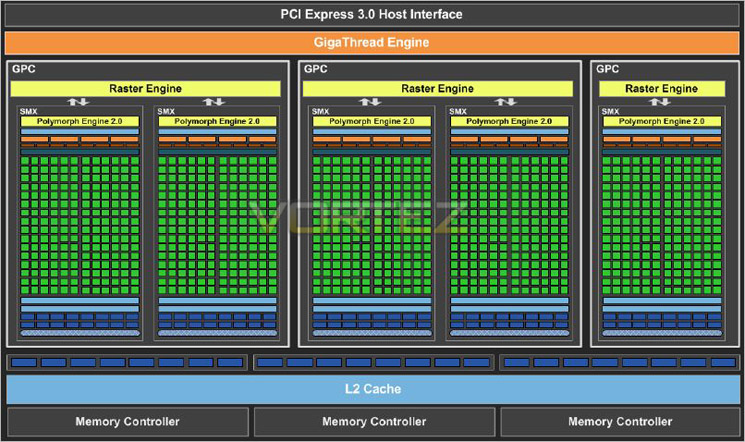
The new GTX660 contains five of these SMX units which gives us a total of 960 CUDA cores and 80 texture units spread across 3 Graphics processing clusters (GPC’s).
The GeForce GTX660 also reatins the GPU Boost Feature found on the GTX680/670. We have covered the GPU Boost feature many times before so we won’t go into it in-depth here too but suffice to say, GPU boost gives the gamer the processing power when he needs it while still remaining within predefined power limits – While not identical, think of it as Intel Turbo Boost technology on a GPU and you are not far wrong. Power saving when not stressed and turbo ‘boosted’ when under load.
The GTX660 ships with a 192-bit memory interface which allows NVIDIA to support mixed density memory modules (2GB instead of 1.5GB). As you can see from the picture above, there are 3 memory controllers:
Memory Controller 1: 4 pcs: 128M x 16 GDDR5 (1GB, 16-bit mode)
Memory Controller 2: 2 pcs: 64M x 32 GDDR5 (512MB, 32-bit mode)
Memory Controller 3: 2 pcs: 64M x 32 GDDR5 (512MB, 32-bit mode)
HEre’s where it gets a little complex. The above memory controllers each have 512MB to play with which totals 1.5GB and a 192-bit interface. The remaining 512MB is controlled by the 1st memory controller but via 64-bit width. All-in-all 2GB is available to the GTX660 though which is more than was found on the last generation flagship models. This 2GB of memory is needed as NVIDIA are pitching the card to users of today’s most popular resolution: 1920x1080p.
GTX660 Reference Specification
Graphics Processing Clusters 3
SMXs 5
CUDA Cores 960
Texture Units 80
ROP Units 24
Base Clock 980 MHz
Boost Clock 1033 MHz
Memory Clock (Data rate)6008 MHz
L2 Cache Size 384KB
Video Memory 2048MB GDDR5
Memory Interface 192-bit
Total Memory Bandwidth 144.2 GB/s
Texture Filtering Rate (Bilinear)78.4 GigaTexels/sec
Fabrication Process 28 nm
Transistor Count 2.54 Billion
Connectors 2 x Dual-Link DVI 1 x HDMI 1 x DisplayPort
Form Factor Dual Slot
Power Connectors 1 x 6-pin
Recommended Power Supply 450 Watts
Thermal Design Power 140 Watts
Thermal Threshold 98° C
SMXs 5
CUDA Cores 960
Texture Units 80
ROP Units 24
Base Clock 980 MHz
Boost Clock 1033 MHz
Memory Clock (Data rate)6008 MHz
L2 Cache Size 384KB
Video Memory 2048MB GDDR5
Memory Interface 192-bit
Total Memory Bandwidth 144.2 GB/s
Texture Filtering Rate (Bilinear)78.4 GigaTexels/sec
Fabrication Process 28 nm
Transistor Count 2.54 Billion
Connectors 2 x Dual-Link DVI 1 x HDMI 1 x DisplayPort
Form Factor Dual Slot
Power Connectors 1 x 6-pin
Recommended Power Supply 450 Watts
Thermal Design Power 140 Watts
Thermal Threshold 98° C
Features
SMX
Kepler GPUs feature our next-generation Streaming Multiprocessor, SMX. To improve performance, SMX features substantially more shader, texture, and geometry processing units, while the double speed processor clock present in prior GeForce GPUs has been eliminated in favor of more CUDA cores operating at the lower-speed graphics clock. This change dramatically improves Kepler’s performance per watt.
GPU Boost
GPU Boost dynamically adjusts the GPU’s clock speed automatically based on GPU operating conditions. Dedicated hardware circuitry constantly monitors GPU power consumption. GPU Boost automatically adjusts clocks to achieve the maximum possible clock speed while remaining within a predefined power target. GPU Boost operates completely autonomously with no game profiles and no intervention required by the end user, providing an instant performance boost to gamers.
Anti-Aliasing
NVIDIA FXAA technology harnesses the power of the GPU’s CUDA Cores to reduce visible aliasing. It is applied with other post-processing steps like motion blur and bloom. For game engines making use of deferred shading, FXAA provides a performance and memory advantage over deferred shading with multi-sample anti-aliasing (MSAA). FXAA reduces but does not completely eliminate shader aliasing. FXAA’s chief advantage over traditional MSAA is higher performance. In many cases, FXAA can be applied at a cost of 1ms per frame or less, resulting in frame rates that are often 2x higher than 4xMSAA with comparable image quality.
TXAA is a new film-style AA technique that’s designed to exploit GeForce GTX600 series high texture performance. TXAA combines the raw power of MSAA with sophisticated resolve filters similar to those employed in CG films. TXAA is available with two modes: TXAA 1 and TXAA 2. TXAA 1 offers visual quality on par with 8xMSAA with the performance similar to 2xMSAA, while TXAA 2 offers image quality that’s superior to 8xMSAA, with performance comparable to 4xMSAA.
NVIDIA 3D Vision
NVIDIA® 3D Vision™ technology is a combination of Graphics Processor Units (GPU), specialized 3D glasses, software, and certified displays and projectors that deliver an immersive 3D experience on your PC or workstation. For a complete list of system requirements for NVIDIA 3D Vision Technology
NVIDIA 3D Vision Surround
NVIDIA 3D Vision Surround expands your field of view across three 3D monitors for Breathtaking panoramic gaming. At an ultra-wide resolution of 5760×1080, games like Battlefield Bad Company 2 have to be played to be believed.
CUDA
CUDA is NVIDIA’s parallel computing architecture that enables dramatic increases in computing performance by harnessing the power of the GPU to speed up the most demanding tasks you can run on your PC.
SLI
NVIDIA SLI technology links multiple GeForce GPUs together for dramatically improved graphics performance. With over 1000 supported applications and used by over 94% of multi-GPU PCs on Steam, SLI is the technology of choice for gamers who demand the very best.
NVIDIA PureVideo
Blu-ray and HD DVD movies are bringing a new level of movie-viewing experience; with high-definition image quality far surpassing standard-definition DVDs. NVIDIA PureVideo™ HD2 technology provides unsurpassed Blu-ray and HD DVD movie picture quality.
Dual Link DVI
Dual-link DVI convertible output supports Video/Audio signal integration through DVI to HDMI interface, which drivers resolution of a digital display up to 1920×1200 or higher.
PhysiX
PhysX™ is designed specifically for hardware acceleration by powerful processors with hundreds of cores. Combined with the tremendous parallel processing capability of the GPU, PhysX™ will provide an exponential increase in physics processing power and will take gaming to a new level delivering rich, immersive physical gaming environments
Kepler GPUs feature our next-generation Streaming Multiprocessor, SMX. To improve performance, SMX features substantially more shader, texture, and geometry processing units, while the double speed processor clock present in prior GeForce GPUs has been eliminated in favor of more CUDA cores operating at the lower-speed graphics clock. This change dramatically improves Kepler’s performance per watt.
GPU Boost
GPU Boost dynamically adjusts the GPU’s clock speed automatically based on GPU operating conditions. Dedicated hardware circuitry constantly monitors GPU power consumption. GPU Boost automatically adjusts clocks to achieve the maximum possible clock speed while remaining within a predefined power target. GPU Boost operates completely autonomously with no game profiles and no intervention required by the end user, providing an instant performance boost to gamers.
Anti-Aliasing
NVIDIA FXAA technology harnesses the power of the GPU’s CUDA Cores to reduce visible aliasing. It is applied with other post-processing steps like motion blur and bloom. For game engines making use of deferred shading, FXAA provides a performance and memory advantage over deferred shading with multi-sample anti-aliasing (MSAA). FXAA reduces but does not completely eliminate shader aliasing. FXAA’s chief advantage over traditional MSAA is higher performance. In many cases, FXAA can be applied at a cost of 1ms per frame or less, resulting in frame rates that are often 2x higher than 4xMSAA with comparable image quality.
TXAA is a new film-style AA technique that’s designed to exploit GeForce GTX600 series high texture performance. TXAA combines the raw power of MSAA with sophisticated resolve filters similar to those employed in CG films. TXAA is available with two modes: TXAA 1 and TXAA 2. TXAA 1 offers visual quality on par with 8xMSAA with the performance similar to 2xMSAA, while TXAA 2 offers image quality that’s superior to 8xMSAA, with performance comparable to 4xMSAA.
NVIDIA 3D Vision
NVIDIA® 3D Vision™ technology is a combination of Graphics Processor Units (GPU), specialized 3D glasses, software, and certified displays and projectors that deliver an immersive 3D experience on your PC or workstation. For a complete list of system requirements for NVIDIA 3D Vision Technology
NVIDIA 3D Vision Surround
NVIDIA 3D Vision Surround expands your field of view across three 3D monitors for Breathtaking panoramic gaming. At an ultra-wide resolution of 5760×1080, games like Battlefield Bad Company 2 have to be played to be believed.
CUDA
CUDA is NVIDIA’s parallel computing architecture that enables dramatic increases in computing performance by harnessing the power of the GPU to speed up the most demanding tasks you can run on your PC.
SLI
NVIDIA SLI technology links multiple GeForce GPUs together for dramatically improved graphics performance. With over 1000 supported applications and used by over 94% of multi-GPU PCs on Steam, SLI is the technology of choice for gamers who demand the very best.
NVIDIA PureVideo
Blu-ray and HD DVD movies are bringing a new level of movie-viewing experience; with high-definition image quality far surpassing standard-definition DVDs. NVIDIA PureVideo™ HD2 technology provides unsurpassed Blu-ray and HD DVD movie picture quality.
Dual Link DVI
Dual-link DVI convertible output supports Video/Audio signal integration through DVI to HDMI interface, which drivers resolution of a digital display up to 1920×1200 or higher.
PhysiX
PhysX™ is designed specifically for hardware acceleration by powerful processors with hundreds of cores. Combined with the tremendous parallel processing capability of the GPU, PhysX™ will provide an exponential increase in physics processing power and will take gaming to a new level delivering rich, immersive physical gaming environments
Packaging & Accessories
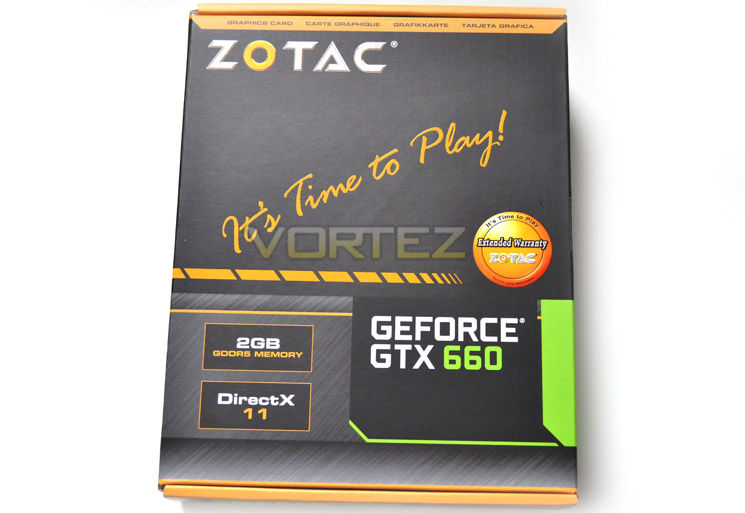
Box Front
The box front looks fairly understated yet holds true to the current ZOTAC theme of orange and black, ‘It’s time to play’ emblazoned across the front of the package hints that this is and out and out graphics card, backed up by the 2GB and DirectX 11 notifications beneath.
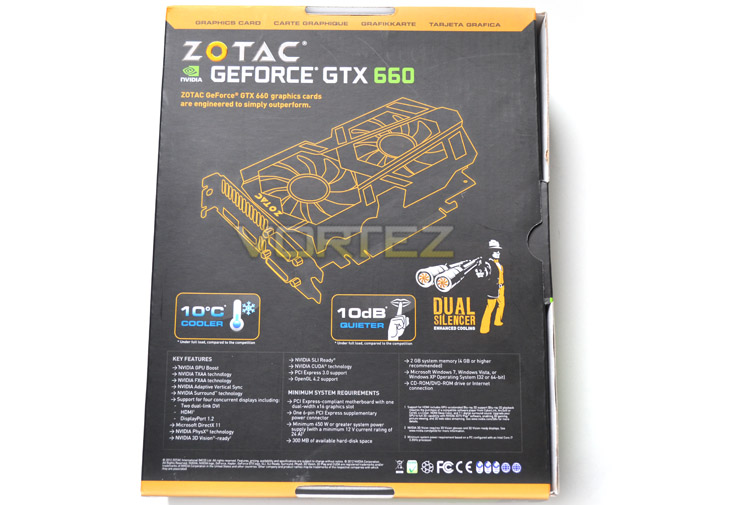
Box Rear
The rear of the box shows a line drawn image of the GTX660, particularly the cooling design which ZOTAC claim to be both 10c cooler and 10dB quieter than the competition, a bold claim indeed. Beneath these claims we find the key feature list and minimum requirements.
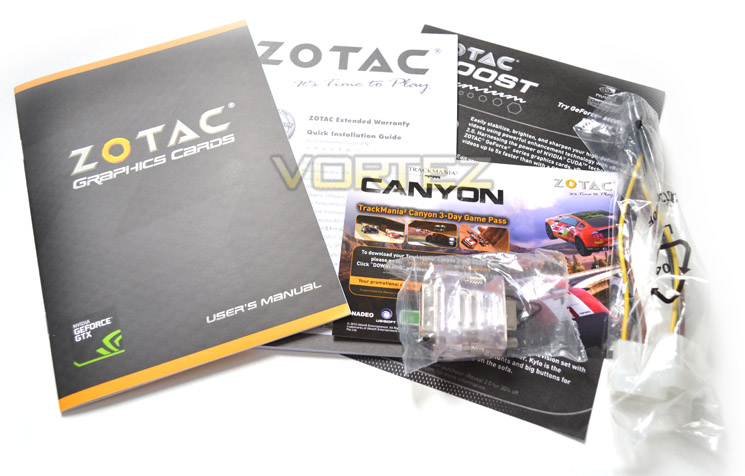
Accessories
The Accessory list contains everything you need to get going with three manuals, a VGA to DVI adapter, Twin MOLEX to 6pin PCIe power adapter and a Trackmania2 Canyon 3-day game pass. The card itself is packaged in a thick padded anti-static bag which is just as well because other than this there is very little other protection save for the cardboard surround. That said, I see no reason why this card should not reach its owner in anything other than perfect condition.
First Look
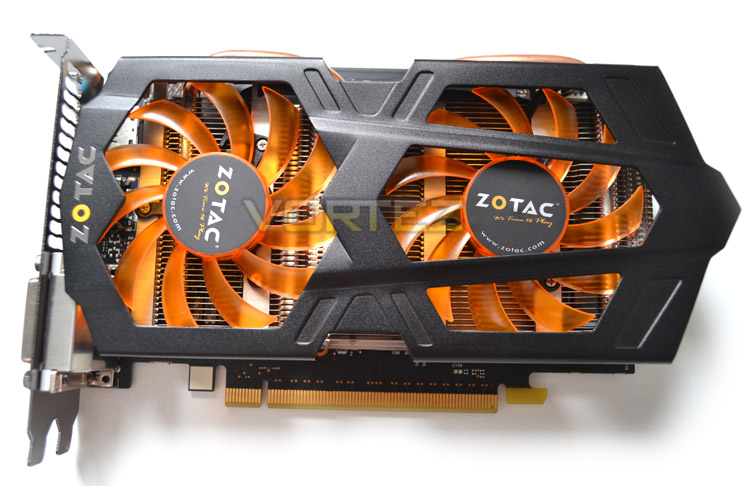
Card Top
The Twin Silencer dominates the cards appearance with two bright orange fans proudly on display hovering over what appears to be an aluminium finned heatsink shrouded by a black metal ‘open’ style frame with a couple of inserts to protect your fingers from the fans.
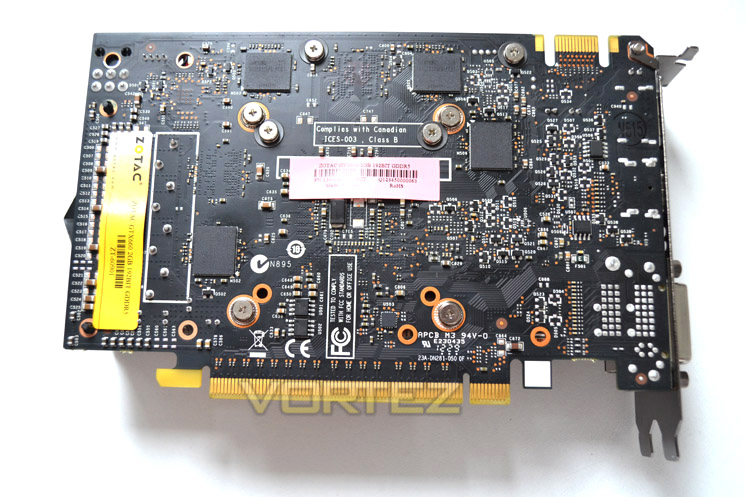
Black PCB
Again, we were impressed by ZOTAC’s PCB colouration which is a solid matt black, matching the GPU shroud perfectly. As with the GTX660Ti, The Zotac design has 4x256MB GDDR5 memory modules on the rear of the PCB which do not receive any active cooling. Hopefully this will not prevent memory overclocking!
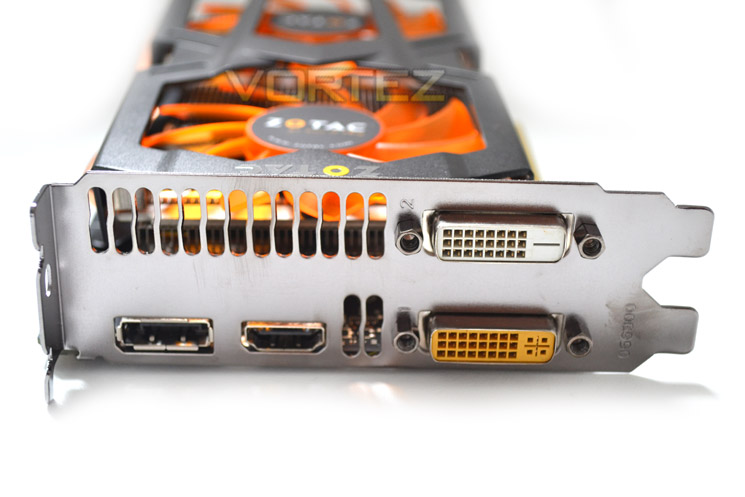
I/O Backplate
The I/O backplate of the card features a twin DVI ports, HDMI and a display ports along with a small vent not that it’s required in all honesty as the majority of hot air is exhausted back into the case.
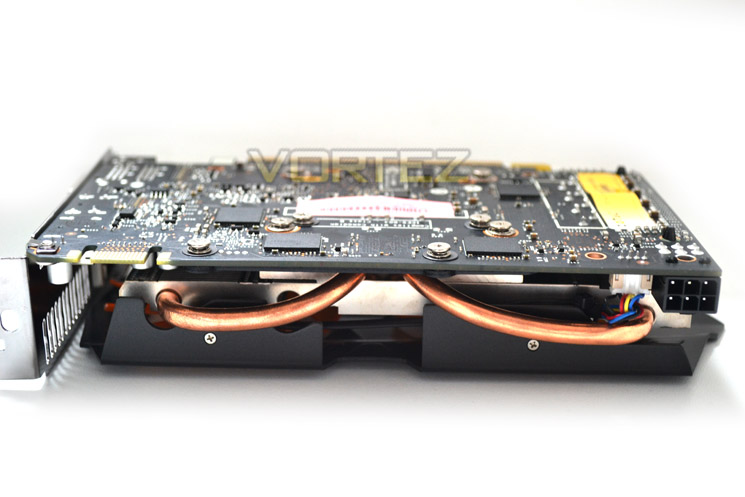
Profile
The cards profile is very small with it measuring just 175mm long (185mm including shroud). Unlike the Titanium version of the card, this version makes do with just 2 copper heatpipes, presumably because this card does not need the extra cooling capacity.
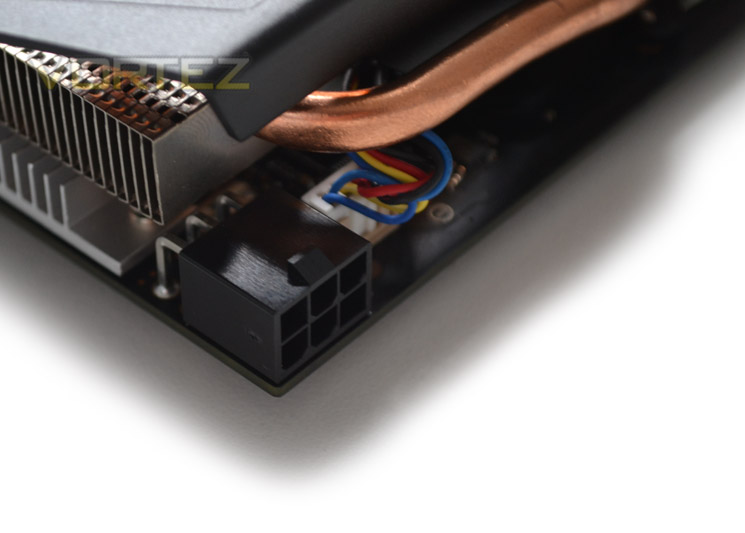
Power Ports
The card is powered by a single 6pin PCIe power plug which most modern PSU’s should have at least one of. If not the ZOTAC have thoughtfully added a MOLEX to PCIe adapter. A 450W PSU with a 24A rating is recommended by ZOTAC for this GPU.
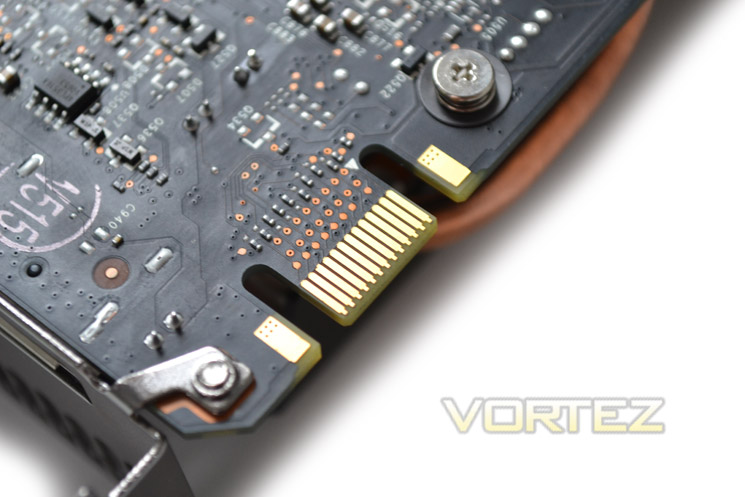
SLI
Unlike its bigger brother, the GTX660 has only one SLI tab meaning the maximum amount of cards you would be able to link together would be two.
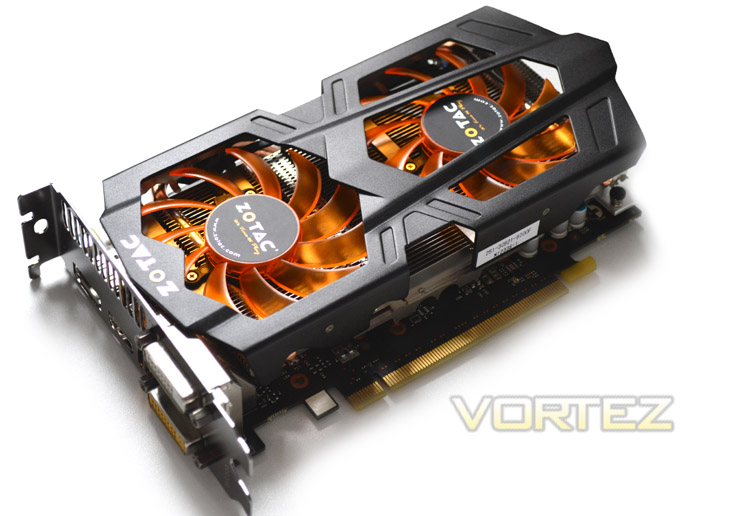
Overview
I like the look of the GTX660. IT is small enough to fit all but the smallest PC setups and would be perfect for an mATX or HTPC if you are short on space. The contrasting orange and black theme, as ever, works very well together and is immediately identifiable as a ZOTAC product.
Let’s delve a little deeper and take a closer look at today’s sample…
Closer Look
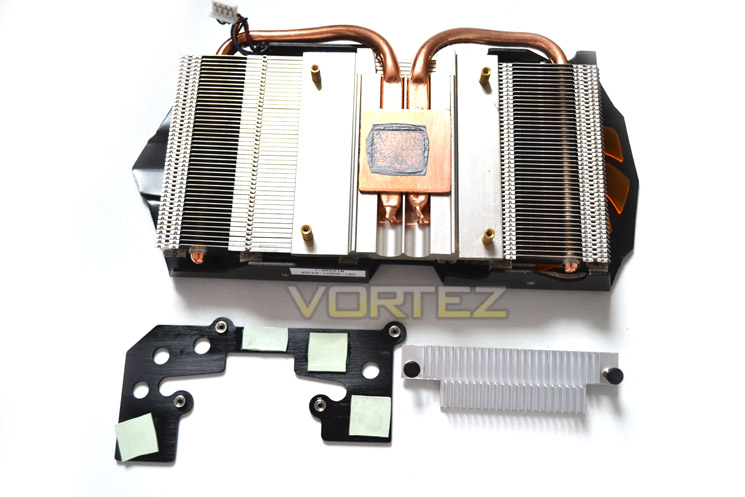
Heatsink
Here we see that the heatsink which is attached via four spring-loaded screws, has a twin heatpipe setup to dissipate the heat from the core. The VRM is cooled separately with a small aluminium heatsink which is attached via plastic push-pins.
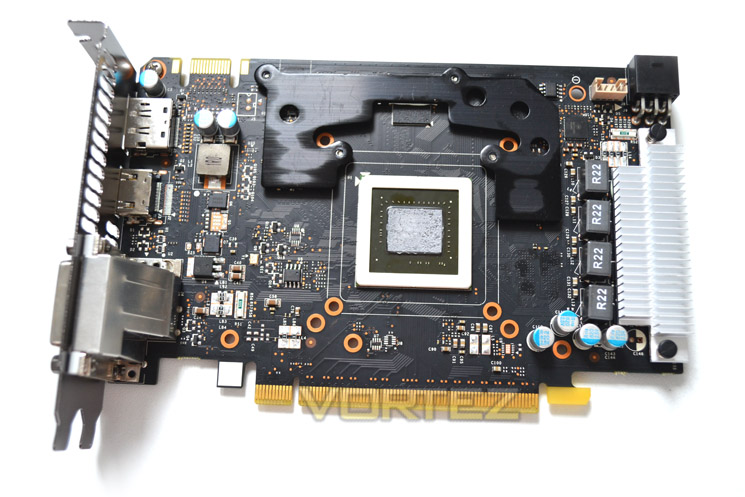
Naked GTX660Ti
With the main heatsink removed we can see that ZOTAC have also attached a separate heatspreader to the memory which is odd considering the rear memory modules receive no such luxury. The contact with the heasink and the core was near perfect with just the right amount of thermal interface material used.
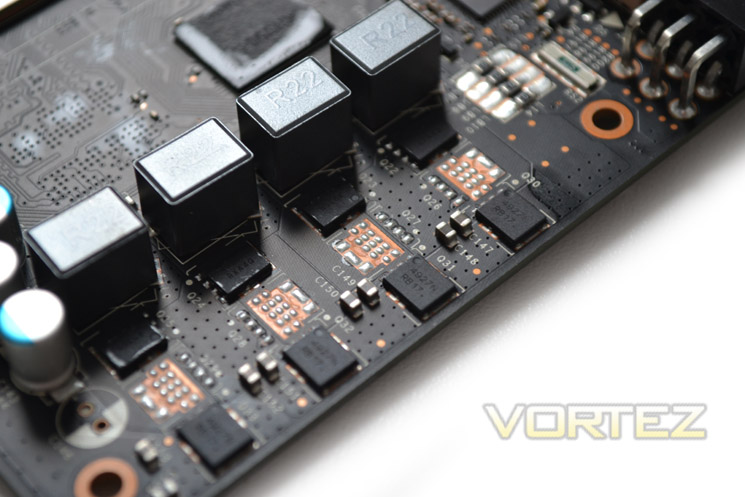
Voltage Regulation Module
Each of the four GPU R22 chokes are matched with 2 MOSFETs making a four phase power design for the voltage regulation module.
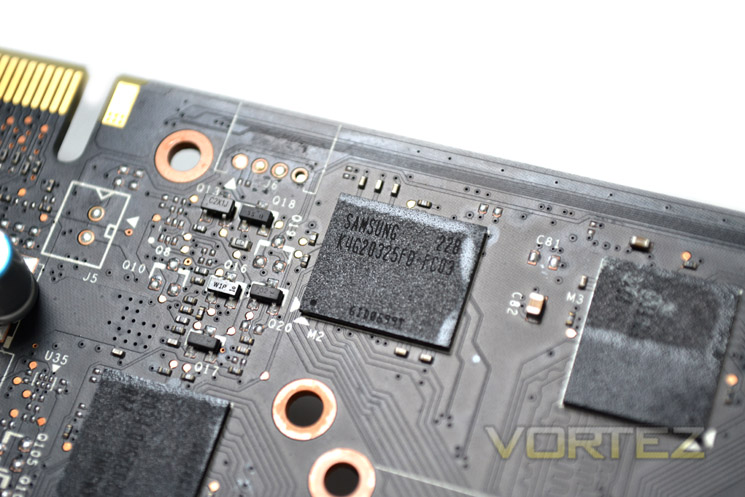
Memory
The memory modules hail from Samsung with a product line of K4G20325FD FC03. This memory is rated to 1500MHz at 1.5vdd. I dare say we can push the memory a little higher!
Core
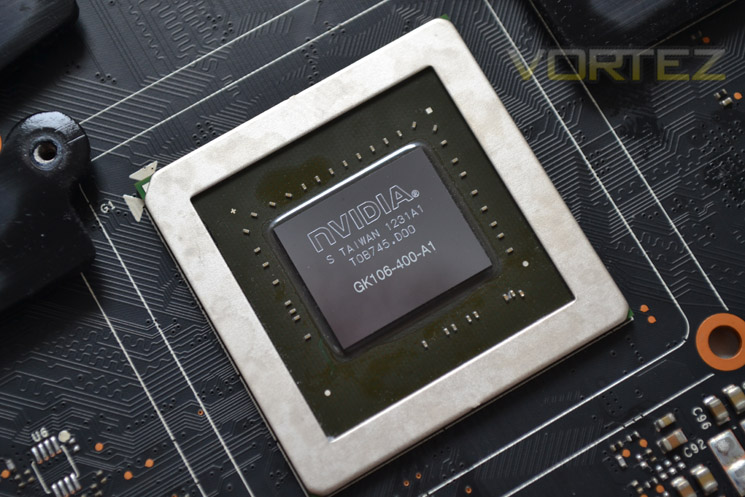
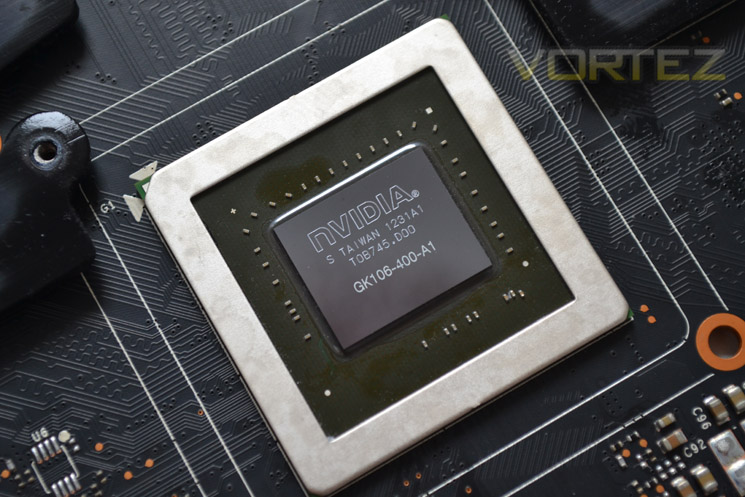
Finally we see the core of the ZOTAC GTX660: The all new GK106! Built on the same 28nm manufacturing process as the rest of the Kepler family. It also happens to have a massive 2.54billion transistor count so without further discussion, I think it’s time we put the card through it’s paces…
Test Setup
With the latest Intel chipset release we decided to update our ageing X58 setup to the new X79 chipset. Not only that but we will be using the flagship Core i7-3960X Extreme Edition processor clocked to 4.5GHz to ensure we have no CPU bottlenecks. With 16GB of ram on board there should be minimal paging so the benchmarks we run today will hopefully give a true reflection of the graphics card’s performance.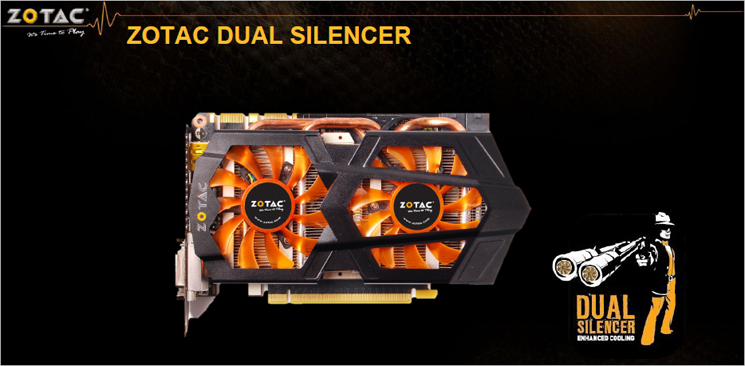
Some of the components for our test bench were kindly donated by CORSAIR who provided the majority of components without whom we would not have been able to bring you this review so a big thanks to them.
Graphics cards on test:
ZOTAC GTX660
ZOTAC GTX660 OC
GIGABYTE GTX680 Super Overclock
MSI GTX680 Twin Frozr
ZOTAC GTX660Ti AMP! Edition
MSI R7870 Hawk
EVGA GTX680 SuperClocked Signature
GIGABYTE GTX680 Windforce
NVIDIA GTX670
HIS HD 7870 IceQ Turbo
MSI HD 7870 Twin Frozr III OC
GIGABYTE HD7850 OC WindForce x2
ZOTAC GTX680 2GB GDDR5
AMD HD7870 2GB GDDR5
Zotac GTX580 AMP2! 3GB GDDR5
XFX R7970 Black Edition 3GB GDDR5
XFX R7770 Black Edition ‘S’ 1GB GDDR5
AMD HD7750 1GB GDDR5
AMD HD7770 1GB GDDR5
HIS HD7970 3GB GDDR5
XFX DD Radeon R7950 3072MB GDDR5
PowerColor PCS+ Radeon HD7950 3072MB GDDR5
AMD Radeon HD7950 3072MB GDDR5
AMD Radeon HD7970 3072MB GDDR5
ZOTAC GTX570 AMP! 1280MB GDDR5
NVIDIA GTX570 1280MB GDDR5
MSI GTX560Ti-448 Twin Frozr III 1280MB GDDR5
MSI GTX560Ti-384 Twin Frozr III 2GB GDDR5
AMD HD6990 4GB GDDR5
***NOTE*** Pre-release Forceware drivers (305.37) were used with the ZOTAC GTX660Ti.
Motherboard: MSI X79 Big Bang X-Power II
CPU: Intel Core i7-3960X Extreme Edition @ 4.5GHz
RAM – 16GB (4x4GB) Corsair Vengeance (Red) DDR3 @ 1866MHz 9-10-9-27
Power Supply – ANTEC High Current Pro 1200W
Hard Drive – Kingston HyperX 240GB
Cooler – Corsair H100
Benchmarks
We have also updated our range of benchmarks to include the following games which will give the graphics cards a challenge and sort the wheat from the chaff. Each benchmark will be run at both stock and maximum overclock settings and utilise 1920×1080 and 2560×1600 resolutions along with AA at various levels (application dependent):
Battlefield 3
Crysis 2
Crysis Warhead
Metro 2033
Batman: Arkham City
Elder Scrolls: Skyrim
DiRT 3
Futuremark 3DMark 2011
Unigine: Heaven 2.5
Crysis 2
Crysis Warhead
Metro 2033
Batman: Arkham City
Elder Scrolls: Skyrim
DiRT 3
Futuremark 3DMark 2011
Unigine: Heaven 2.5
Let’s see how today’s graphics card performed…
Overclocking (GPU Boost)
Overclocking via NVIDIA’s GPU Boost was covered in our ZOTAC GTX680 review so I won’t go into detail here on the attributes and pitfalls of using this method to overclock a GPU. Suffice to say though it is effective and as we shall see below, can be used to great effect..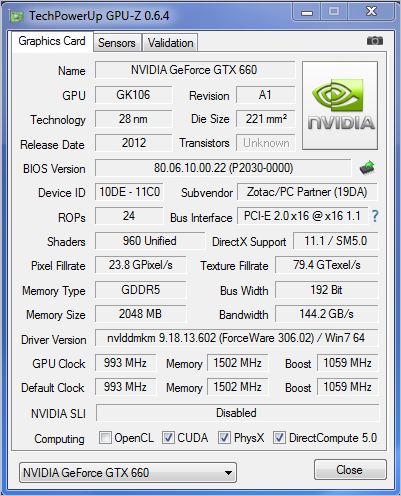
The reference card comes with the core clocked at an already impressive clockspeed of 993MHz and the memory set to 1502MHz (6004MHz effective). The core will however boost up to around the 1059MHz mark depending on load conditions which goes to show this should be no slouch even in stock format.
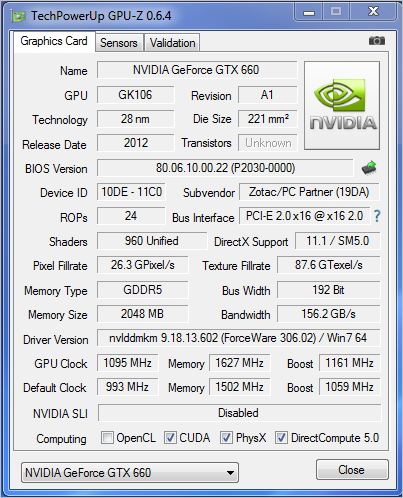
We raised the Power limit to its maximum to allow for maximum overclocks but sadly there were no voltage adjustments available in our favourite overclocking tool at the time of this review so we could not see if raising the voltage would have any effect on overclocking.
Regardless of the lack of voltage controls, we still managed a respectable overclock of 1095MHz which resulted in a boost clockspeed of 1161MHz. Better still, the memory overclocked very well reaching 6508MHz (effective).
Time to see how the graphics card performs in our suite of benchmarks…
Temperature, Acoustics and Power Consumption
Power ConsumptionTo test for power consumption we do not use anything too technical, just a wall meter which measures the total system power draw minus the monitor.
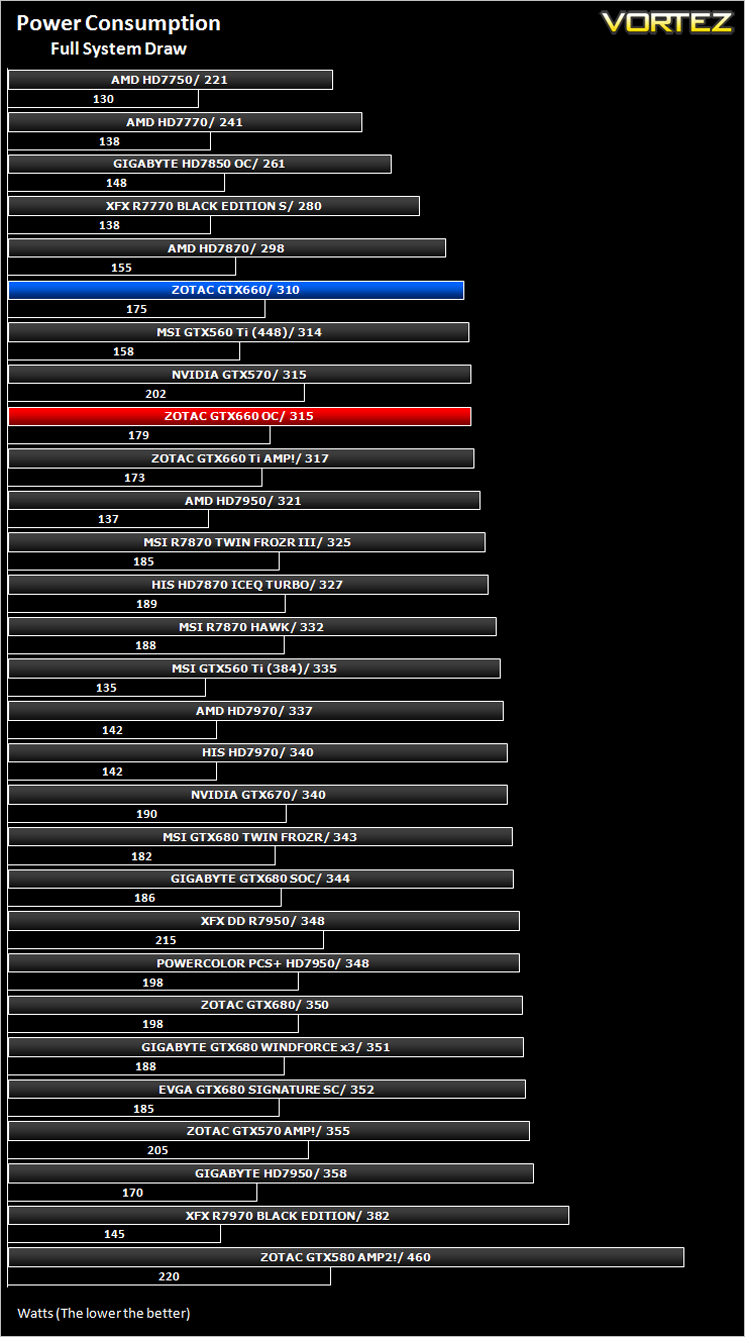
The Kepler range are much more efficient than the previous 5 series GPU’s and make the 4 series look like something from the industrial revolution in comparison to the GTX660’s inefficiencies. A 450w power supply with a single 6pin PCIe power cable is all that’s required to power the GTx660 and as you can see from the graph above, even our heavily overclocked test setup with the card installed didn’t reach anywhere near that wattage.
Temperature
To test temperatures we measured idle temperatures after booting windows, letting all applications finish loading and ran a few benchmarks. Once the benchmarks were complete we left the card to reach a cooling plateau where we then took the idle temperatures. For the load tests, we would normally run Furmark for 20 minutes, taking the absolute maximum temperature attained however we found that this throttled the card and resulted in spurious results. So we set Heaven running continuously for 20 minutes and used this as a temperature result as the card did not throttle with this application.
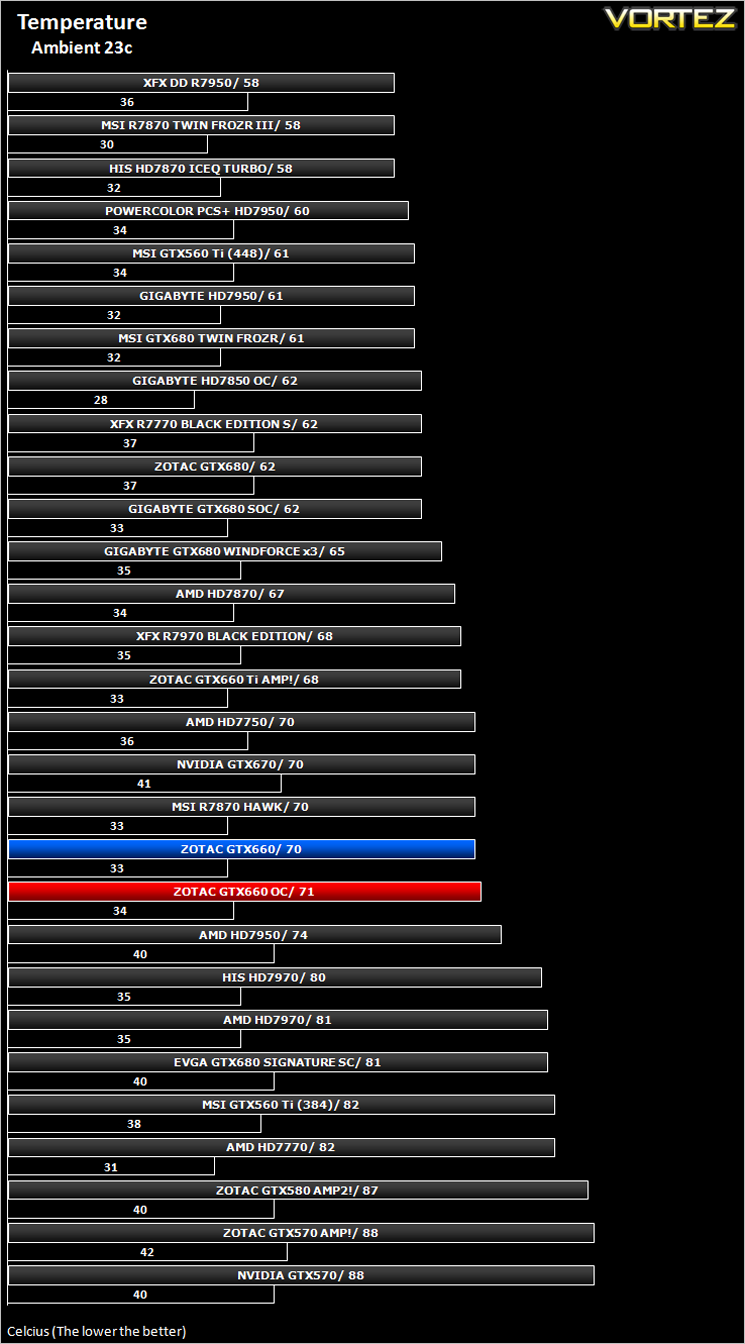
Hitting a maximum 70c under idle and load conditions we found the card to be pretty average with regards to cooling. The temperature would drop if we manually increased the fan speed but thankfully we felt no need to do so throughout testing as 70c is hardly worth worrying about.
Acoustics
The ZOTAC GTX660 was pretty much silent under both idle and load conditions to the point I deliberately increased the fan speed manually just to make the fans were working! Suffice to say this card is whisper quiet under normal operating conditions.
Let’s move on to our suite of gaming and synthetic benchmarks…
Battlefield 3
Battlefield 3 leaps ahead of its time with the power of Frostbite™ 2, the next instalment of DICE’s cutting-edge game engine. This state-of-the-art technology is the foundation on which Battlefield 3 is built, delivering enhanced visual quality, a grand sense of scale, massive destruction, dynamic audio and incredibly lifelike character animations. As bullets whiz by, walls crumble, and explosions throw you to the ground, the battlefield feels more alive and interactive than ever before. In Battlefield 3, players step into the role of the elite U.S. Marines where they will experience heart-pounding missions across diverse locations including Paris, Tehran and New York.
Average and minimum frames per second were measured using Fraps during the parking lot scene on Operation Sword Breaker. High and Ultra presets were loaded at both resolutions.
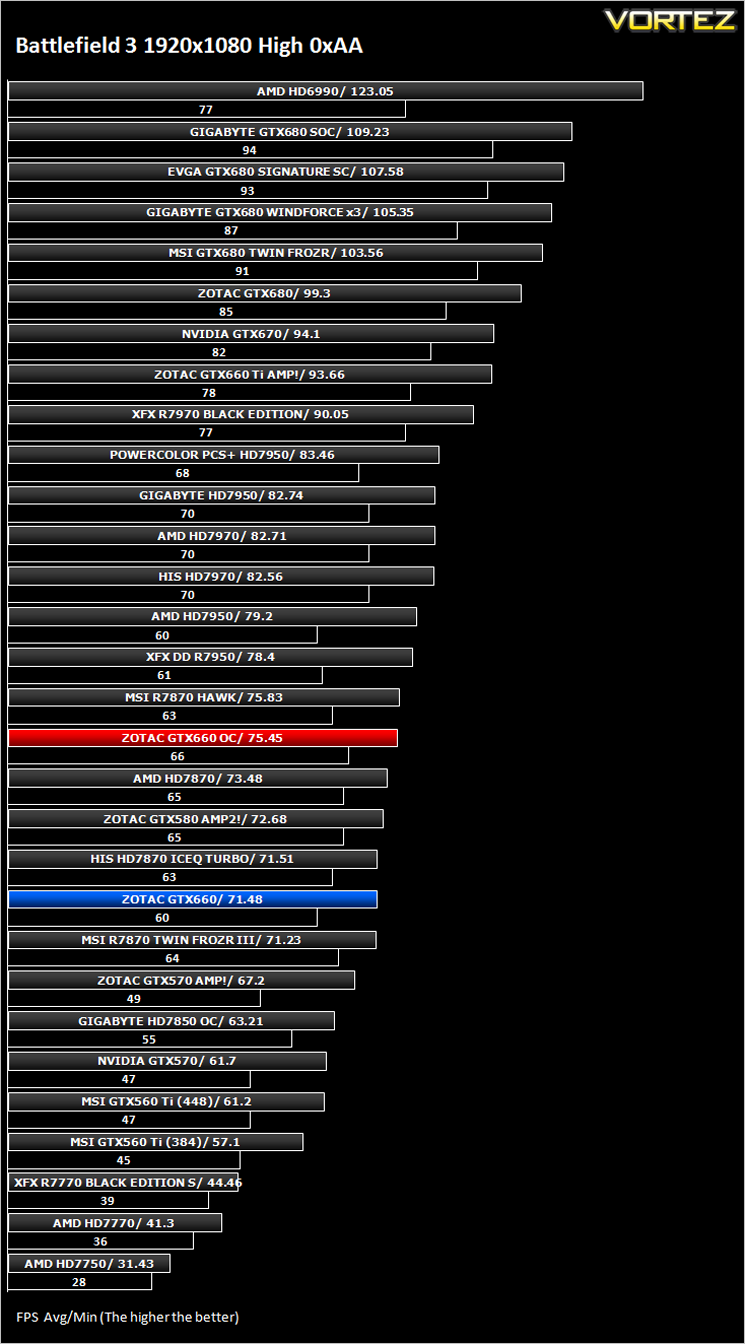
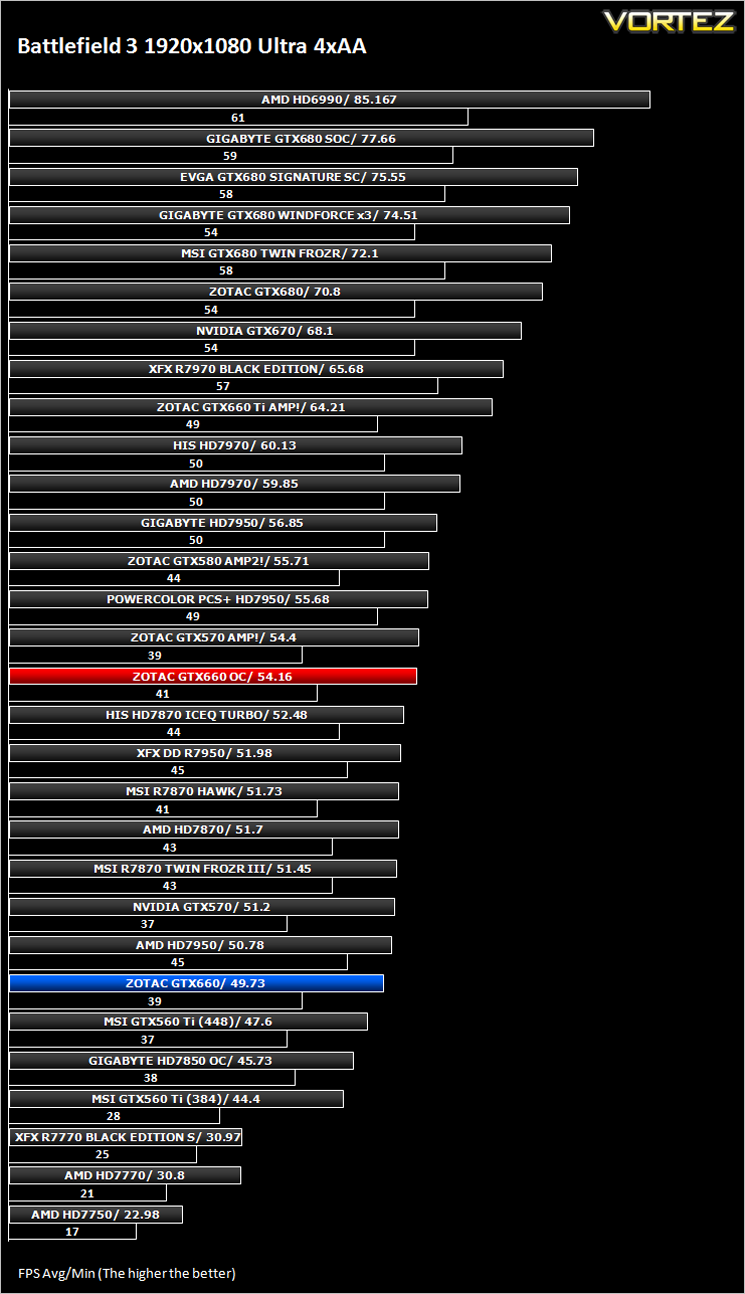
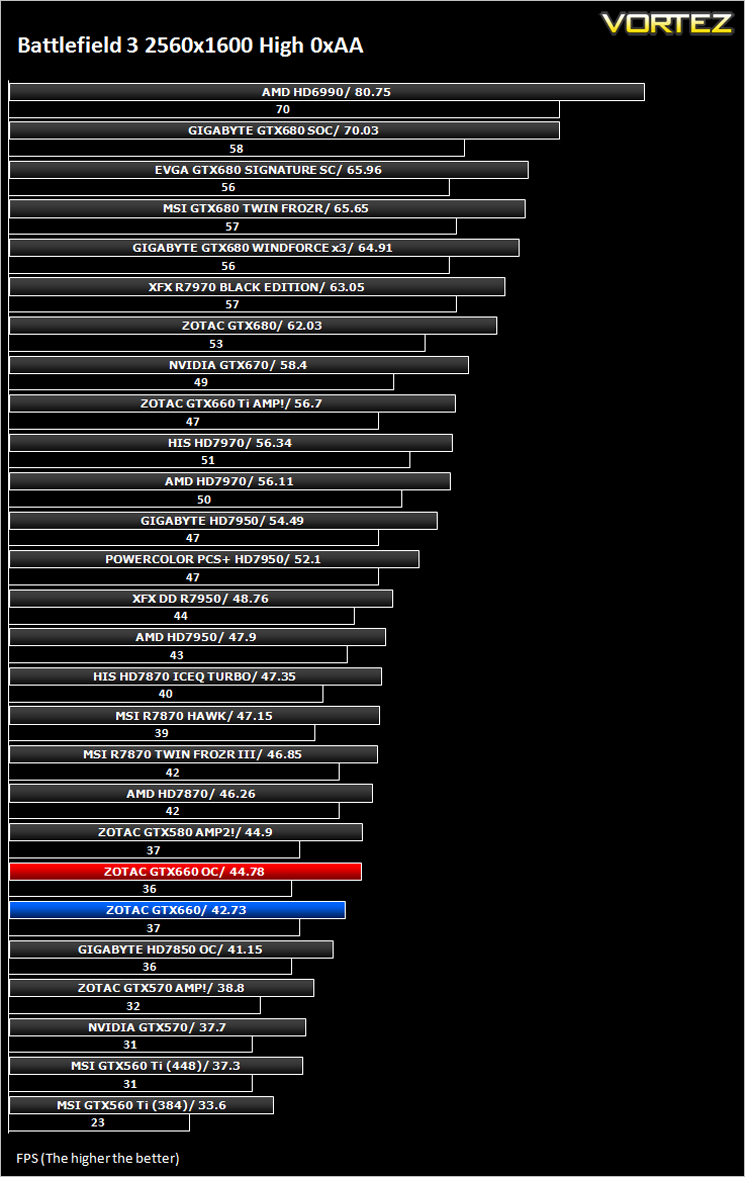
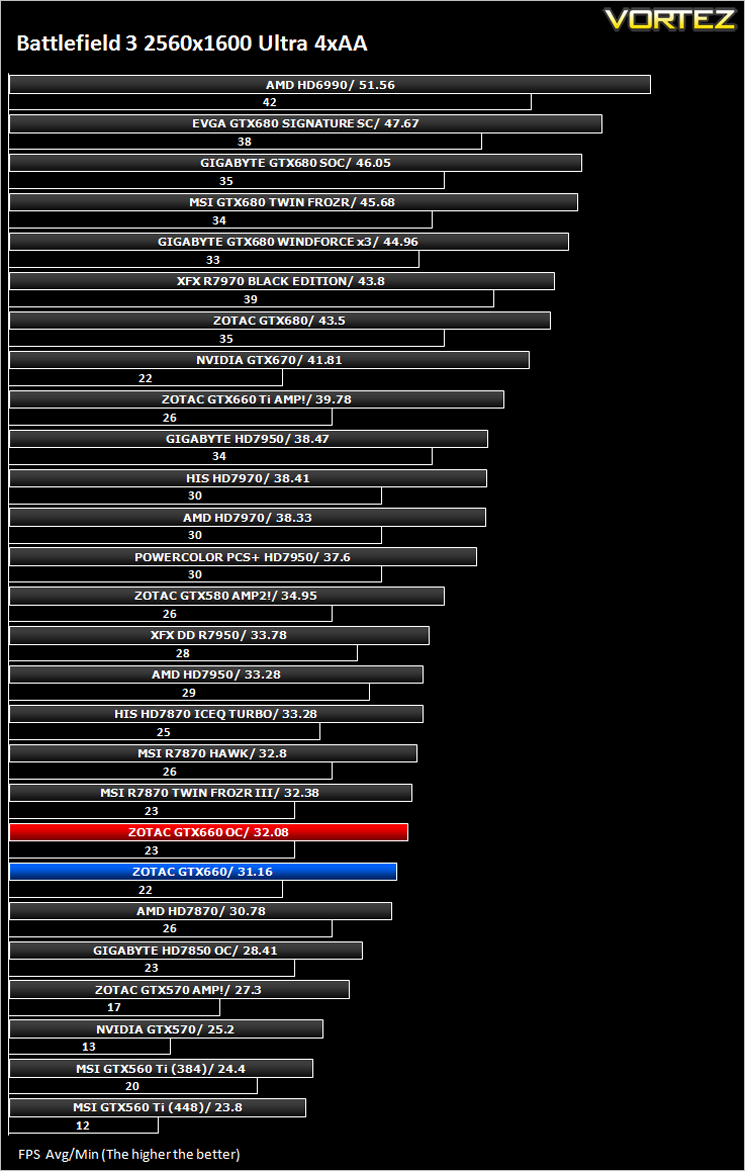
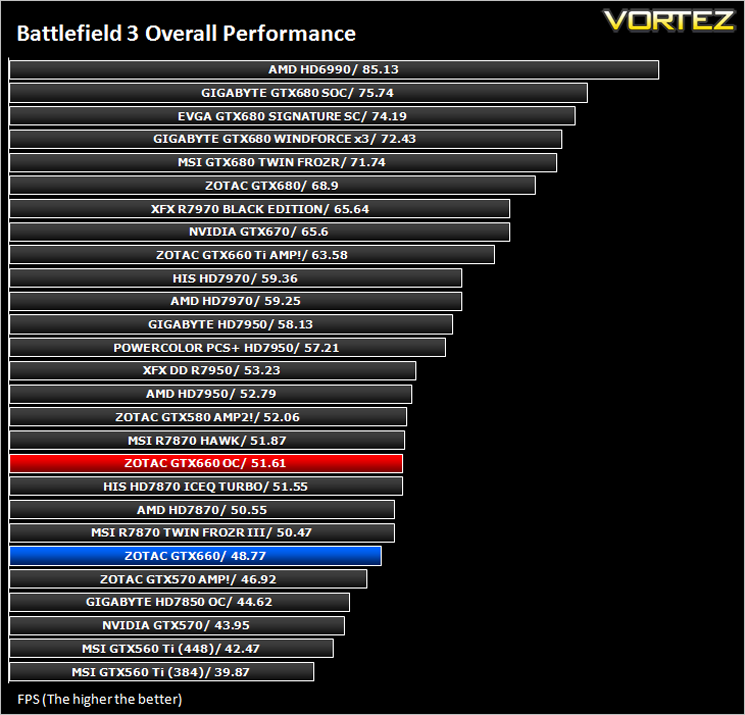
***NOTE*** Pre-release Forceware drivers (306.02) were used with the ZOTAC GTX660.
Crysis 2
Crytek took an internet beating from its loyal fans due to the fact that they pandered to the console masses and dumbed down the graphics to DirectX 9. Fortunately, fans of the PC version of Crysis managed to force Cryteks hand and they have since developed a DX11 patch and have also enhanced the textures with added tesselation. It is for this reason that we have decided to include it in our suite of benchmarks.
To test the cards we used the Crysis 2 benchmark courtesy of Adrenaline with both the 1.9 patch, DX11 update and Hi-res texture pack. Settings were manually placed to Ultra, DX11 and tessellation enabled with the Central Park map being run 3 times per resolution benchmark test.
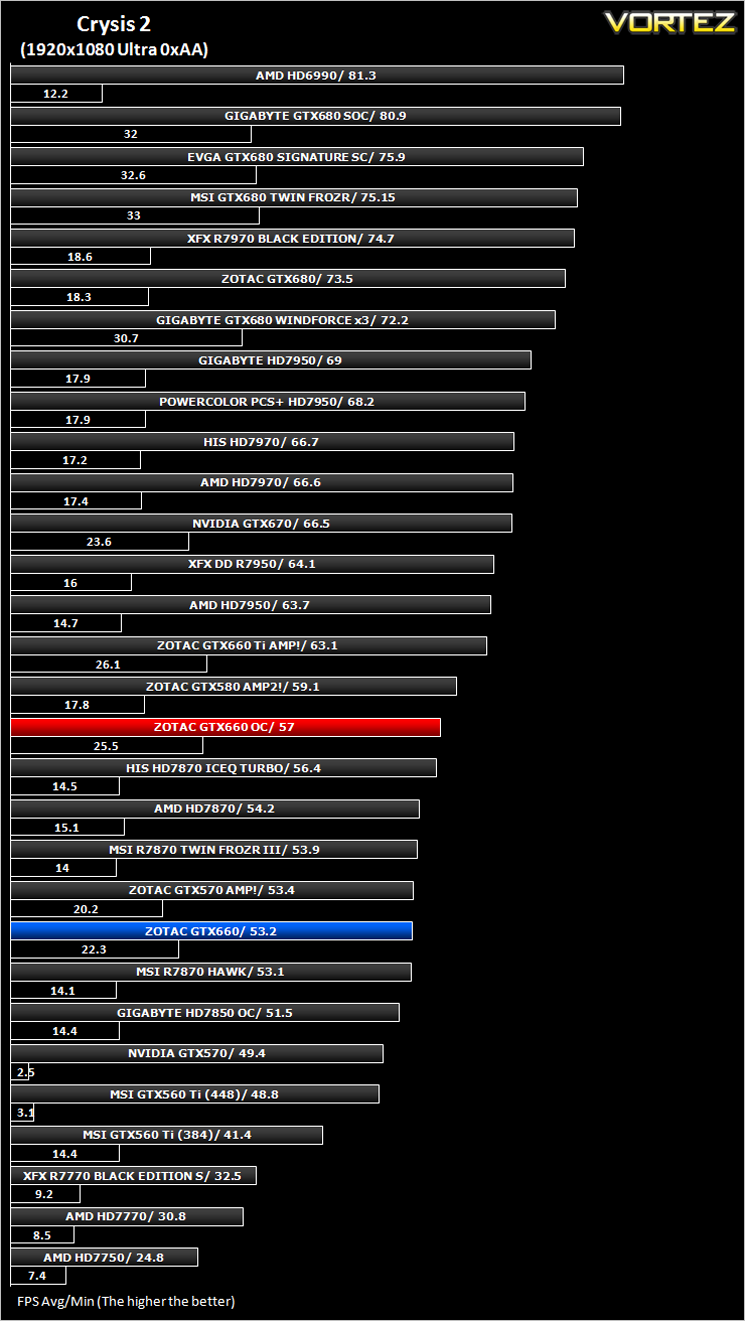
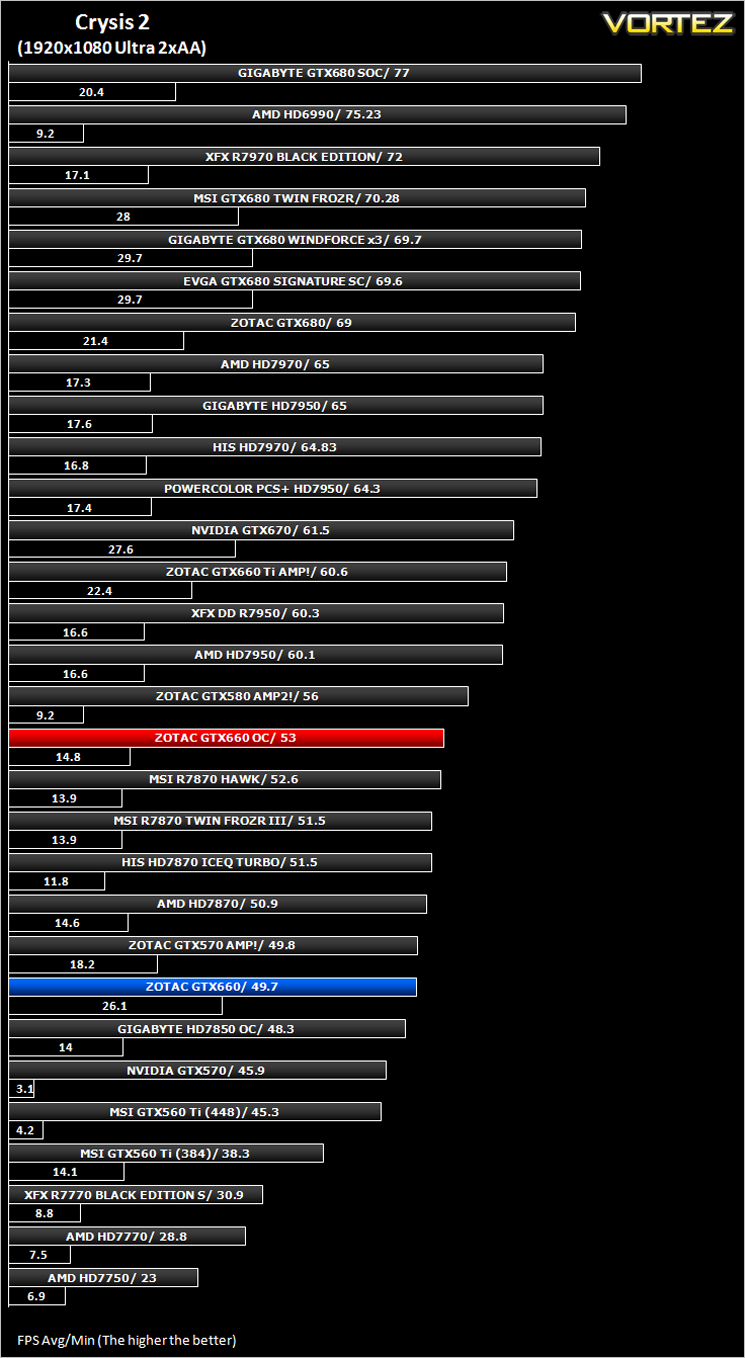
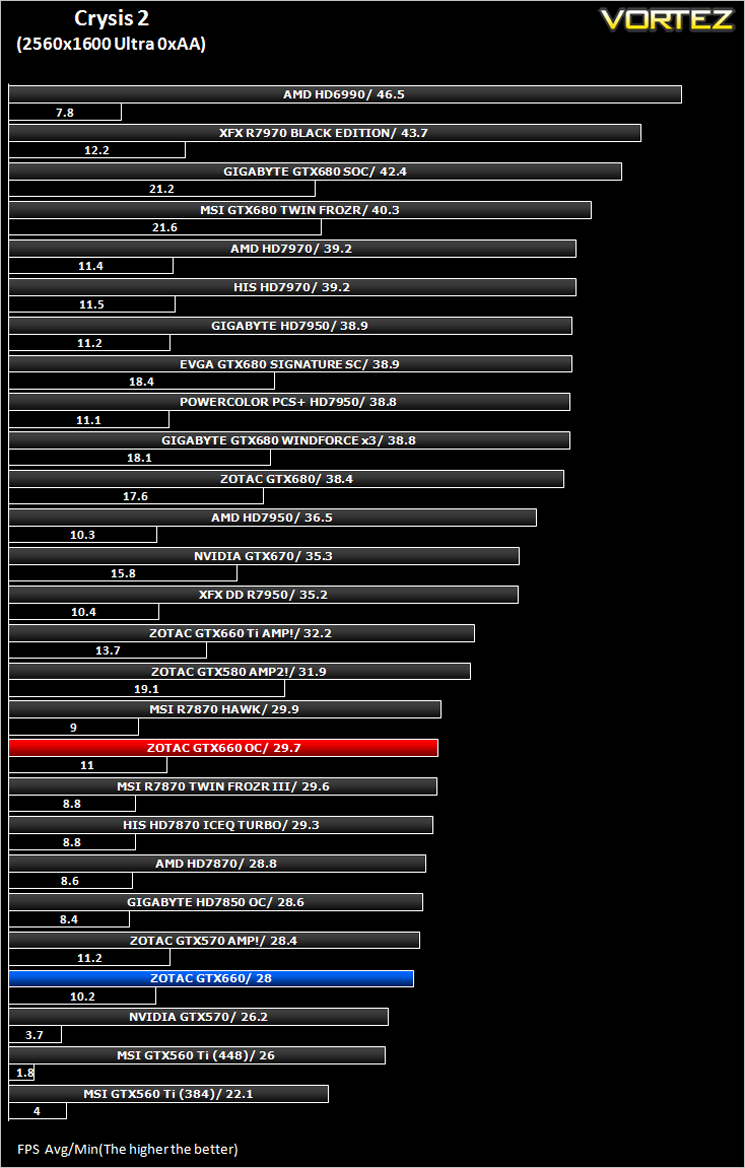
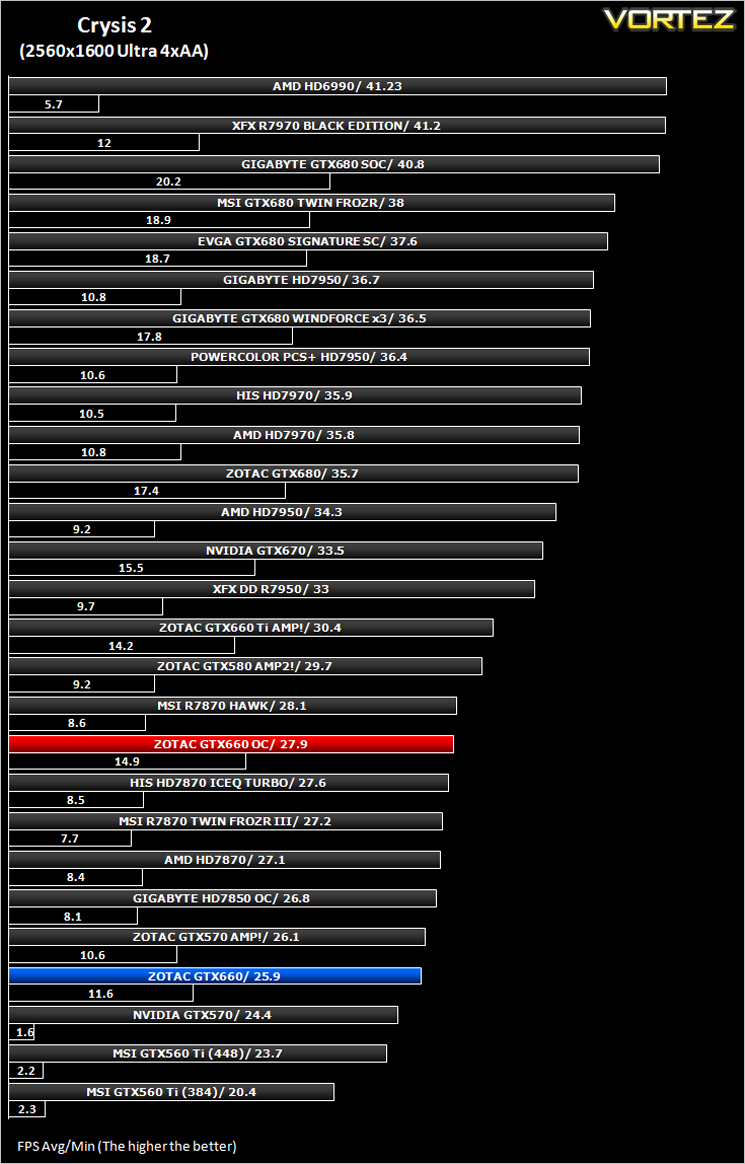
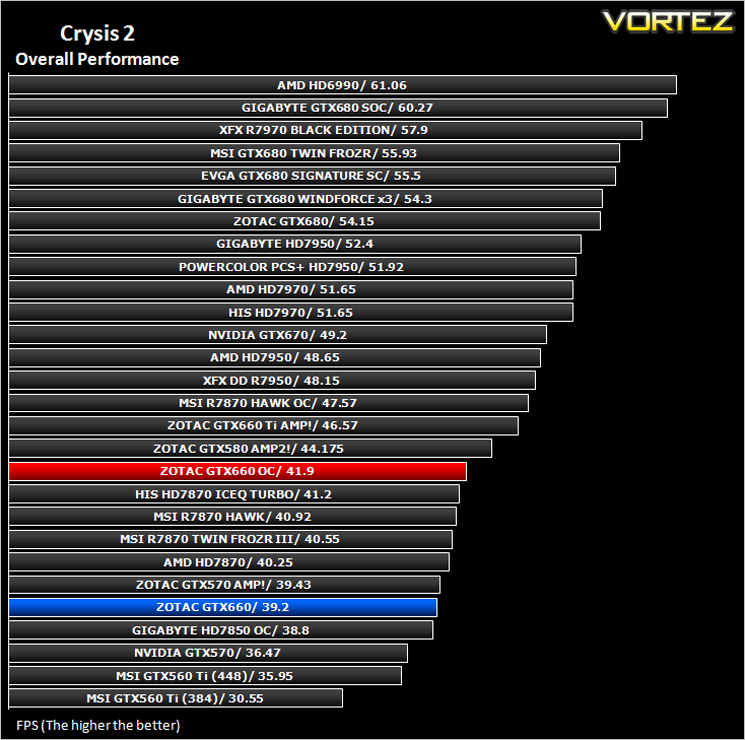
***NOTE*** Pre-release Forceware drivers (306.02) were used with the ZOTAC GTX660Ti.
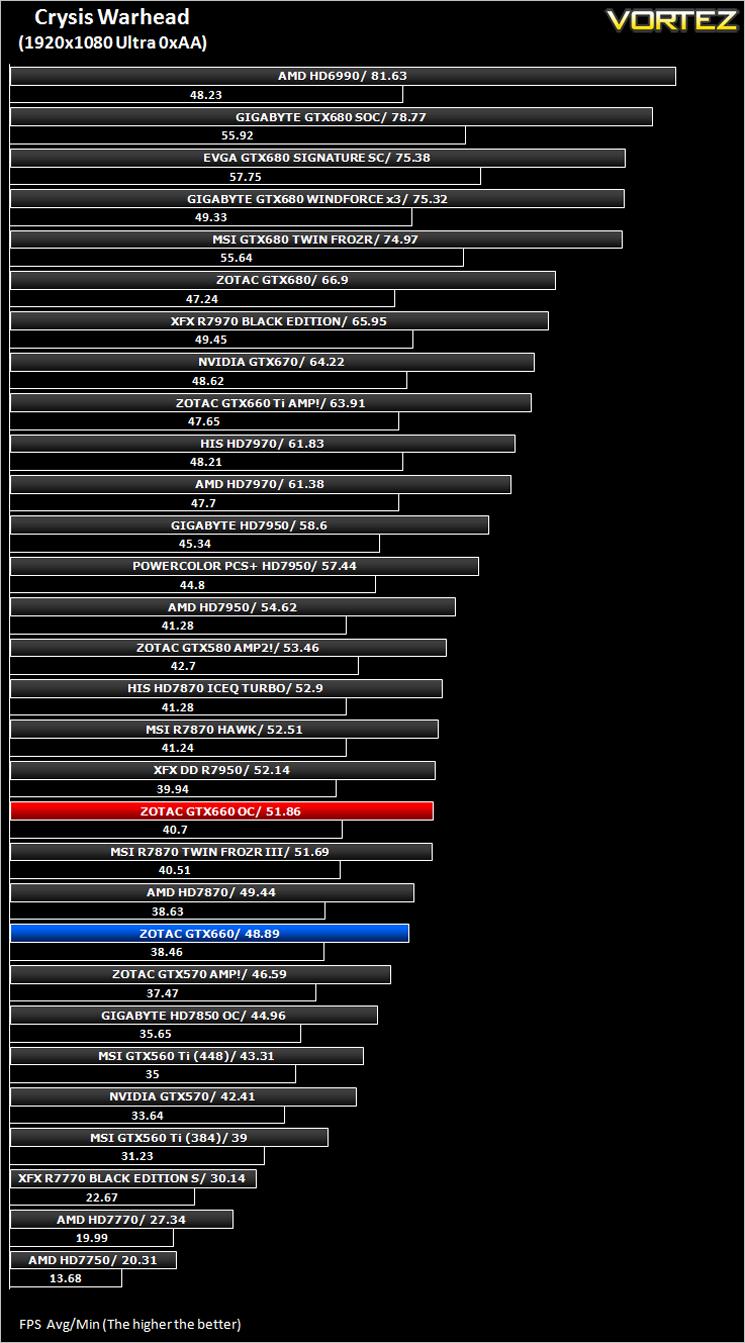
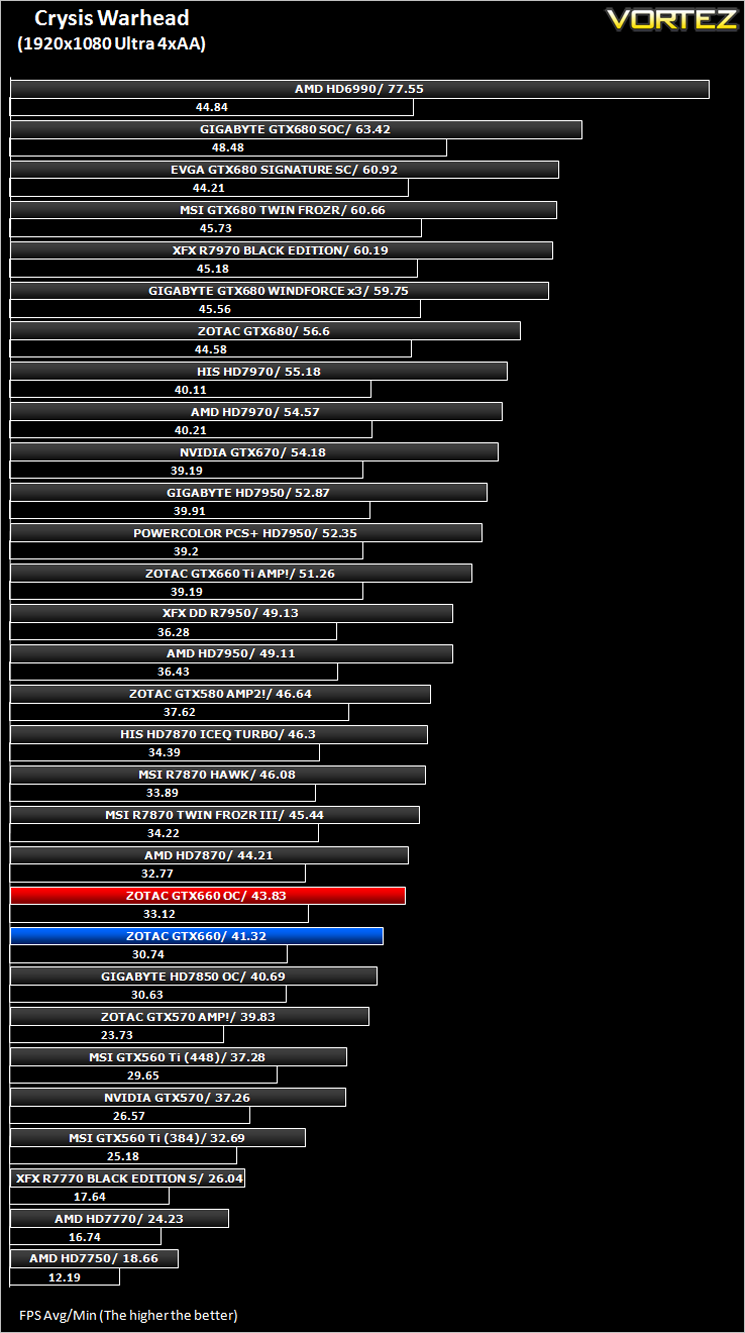
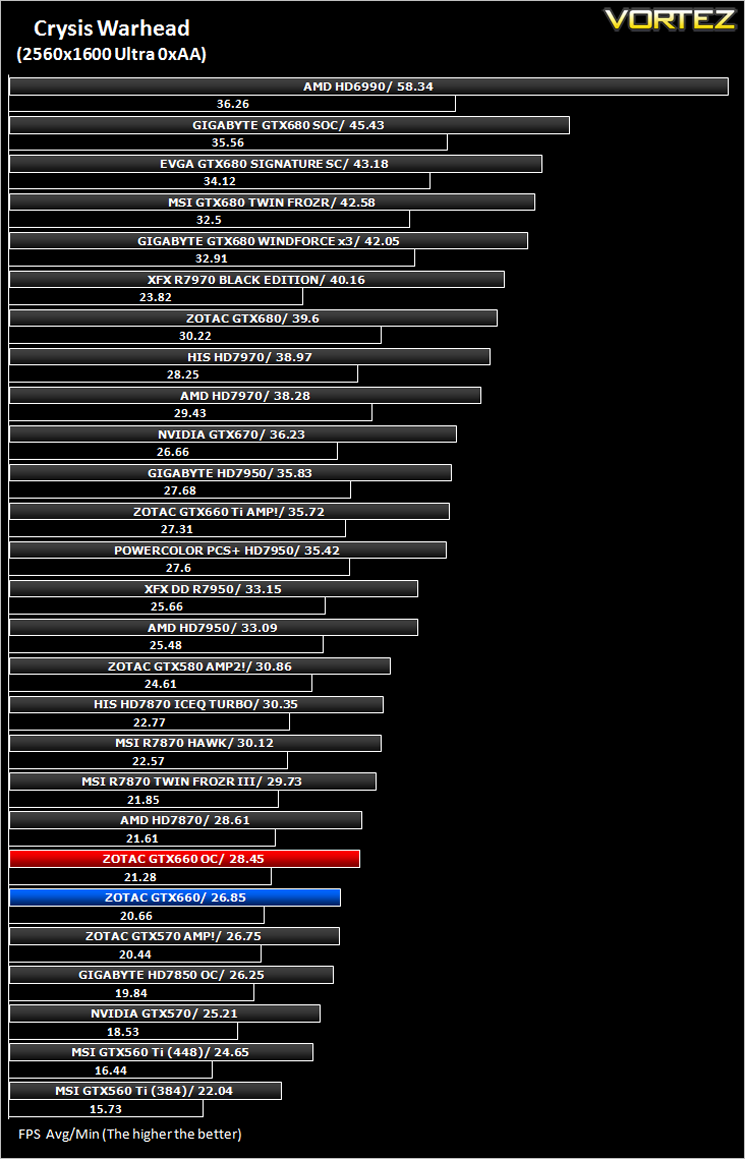
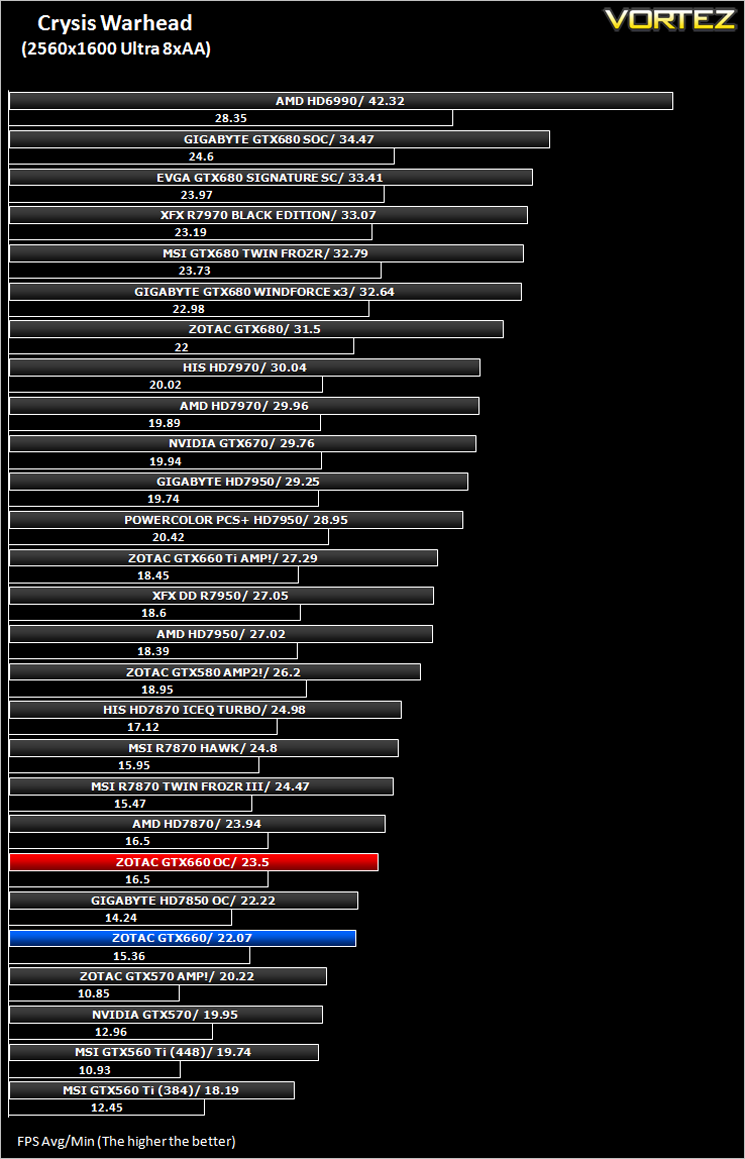
Crysis Warhead
Following the success of Crysis, the stand alone expansion “Warhead” was hotly anticipated to bring more game play, more weapons, improved visuals whilst maintaining better performance, the latter being what gamers wanted most. After all how many people upgraded their rigs just to play this game… In the game, you play as the upbeat Brit Sergeant “Psycho” Sykes, chasing down a Korean nuclear warhead. Throw in some ice shooting aliens and we’re bound to have a great game. It sure delivered.
Testing was done using Framebuffer’s Crysis Warhead benchmarking tool. The tests were configured to DirectX 10 at Enthusiast levels. Each test on the Ambush map was looped three times from which the average FPS was recorded.
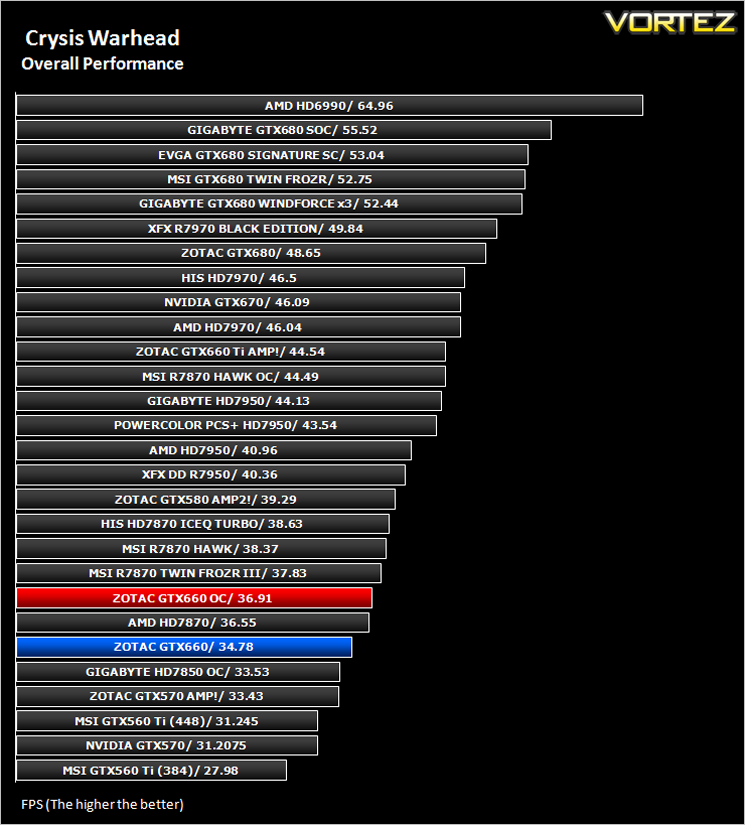
***NOTE*** Pre-release Forceware drivers (306.02) were used with the ZOTAC GTX660.
Batman: Arkham City
Batman: Arkham City builds upon the intense, atmospheric foundation of Batman: Arkham Asylum, sending players soaring into Arkham City, the new maximum security “home” for all of Gotham City’s thugs, gangsters and insane criminal masterminds. Set inside the heavily fortified walls of a sprawling district in the heart of Gotham City, this highly anticipated sequel introduces a brand-new story that draws together a new all-star cast of classic characters and murderous villains from the Batman universe, as well as a vast range of new and enhanced gameplay features to deliver the ultimate experience as the Dark Knight.
The results below were obtained from the built-in benchmark utility from the game.
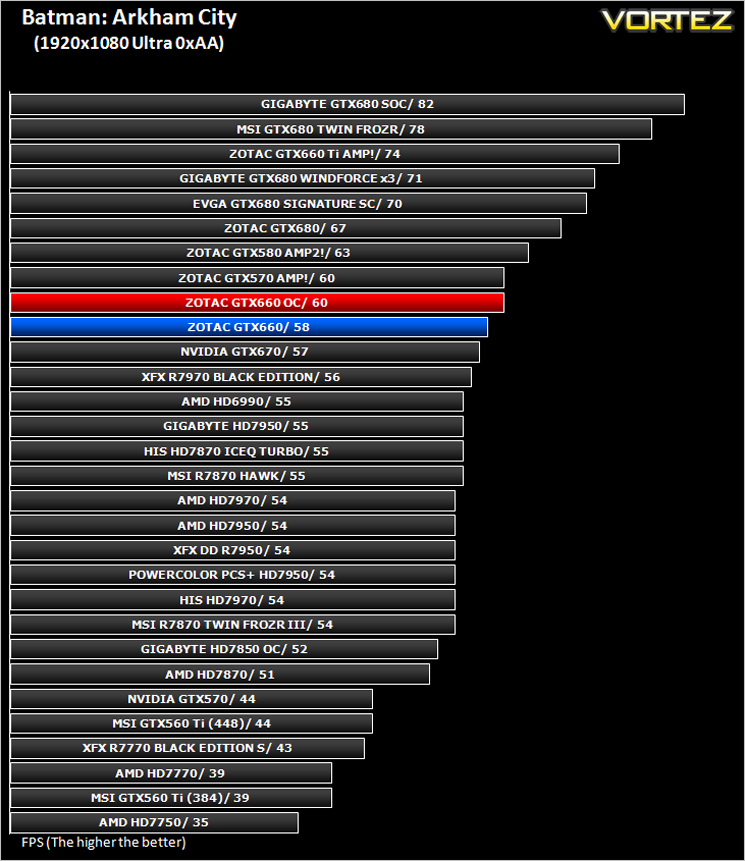
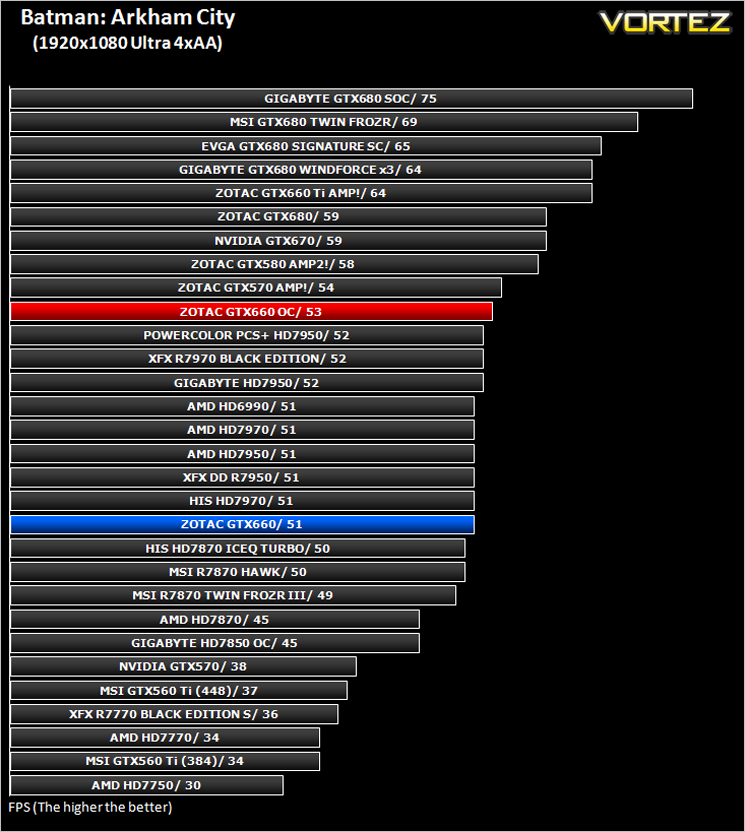
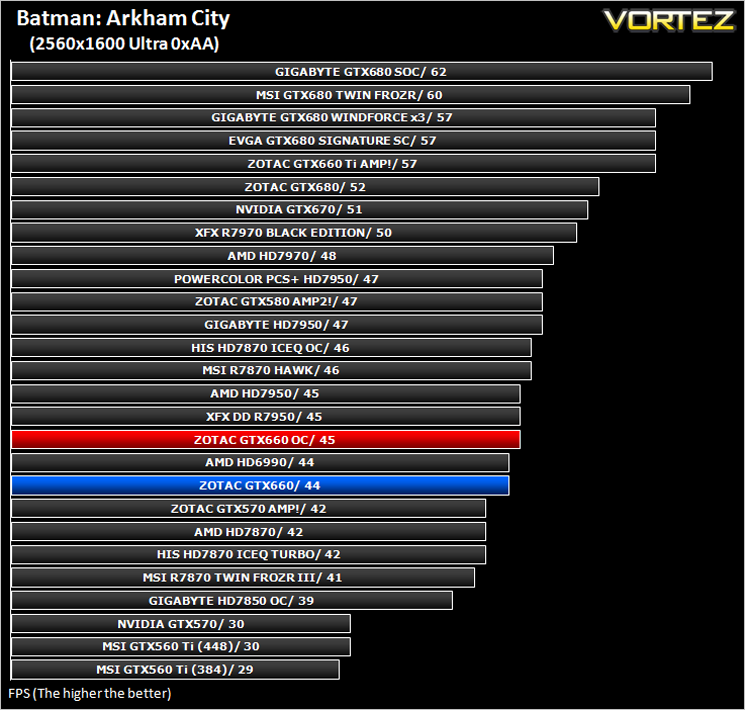
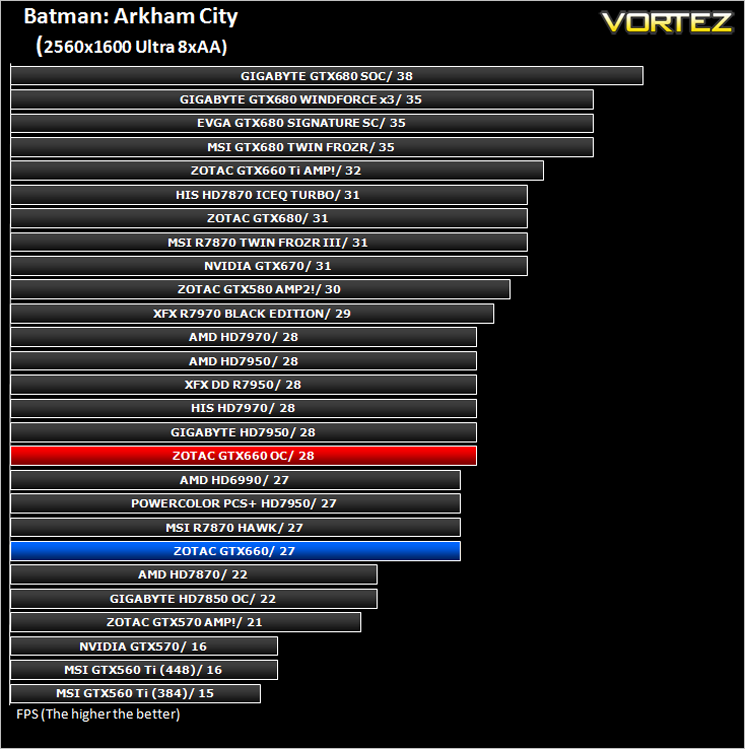
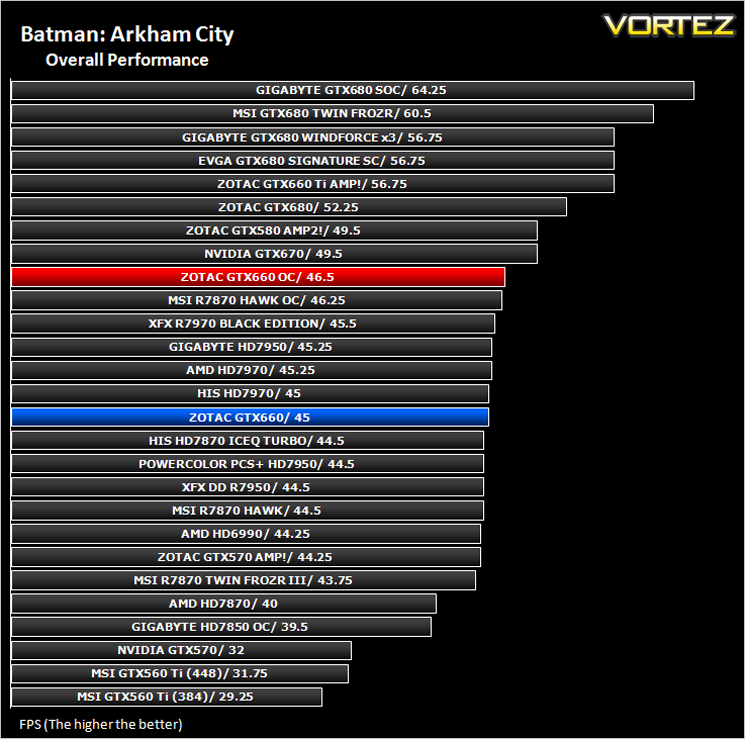
***NOTE*** Pre-release Forceware drivers (306.02) were used with the ZOTAC GTX660.
The Elder Scrolls: Skyrim
Skyrim is not a direct successor to the very popular Oblivion. Instead it takes place 200 years after the events of Oblivion. The non-linear playing that made the Elder Scrolls such a popular series does however make a return along with the beautiful scenery the encompasses the world of Skyrim.
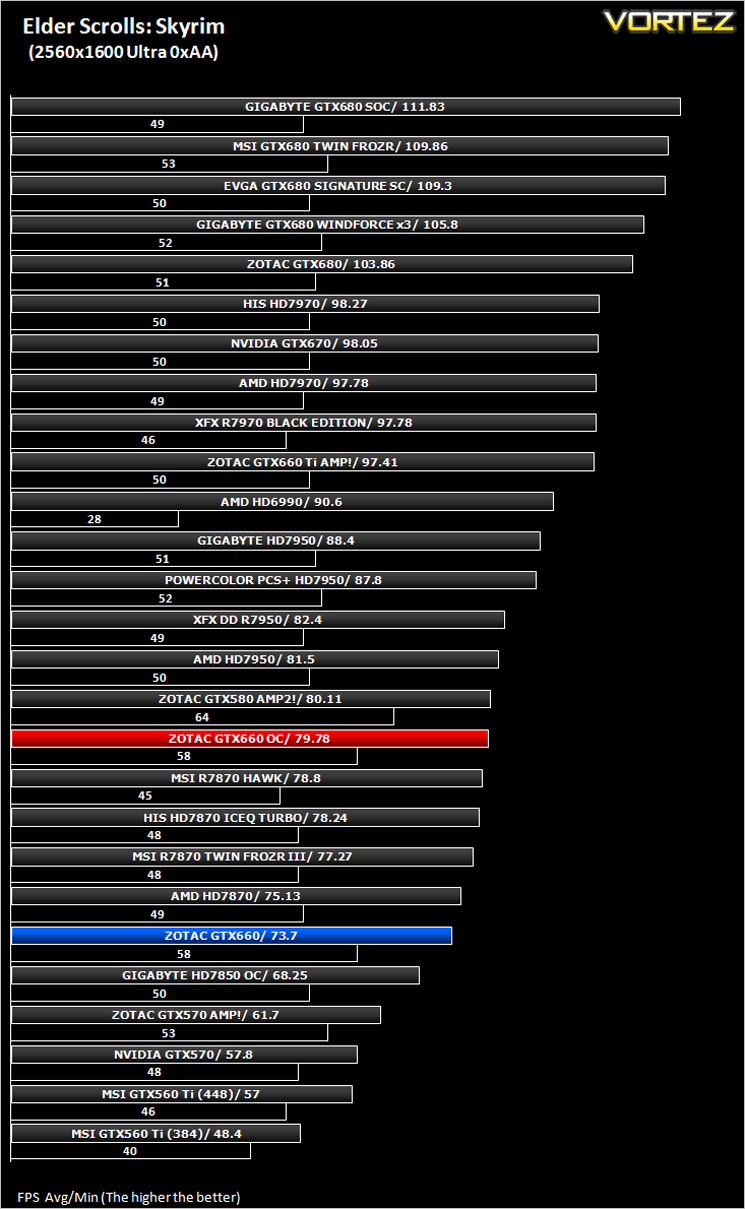
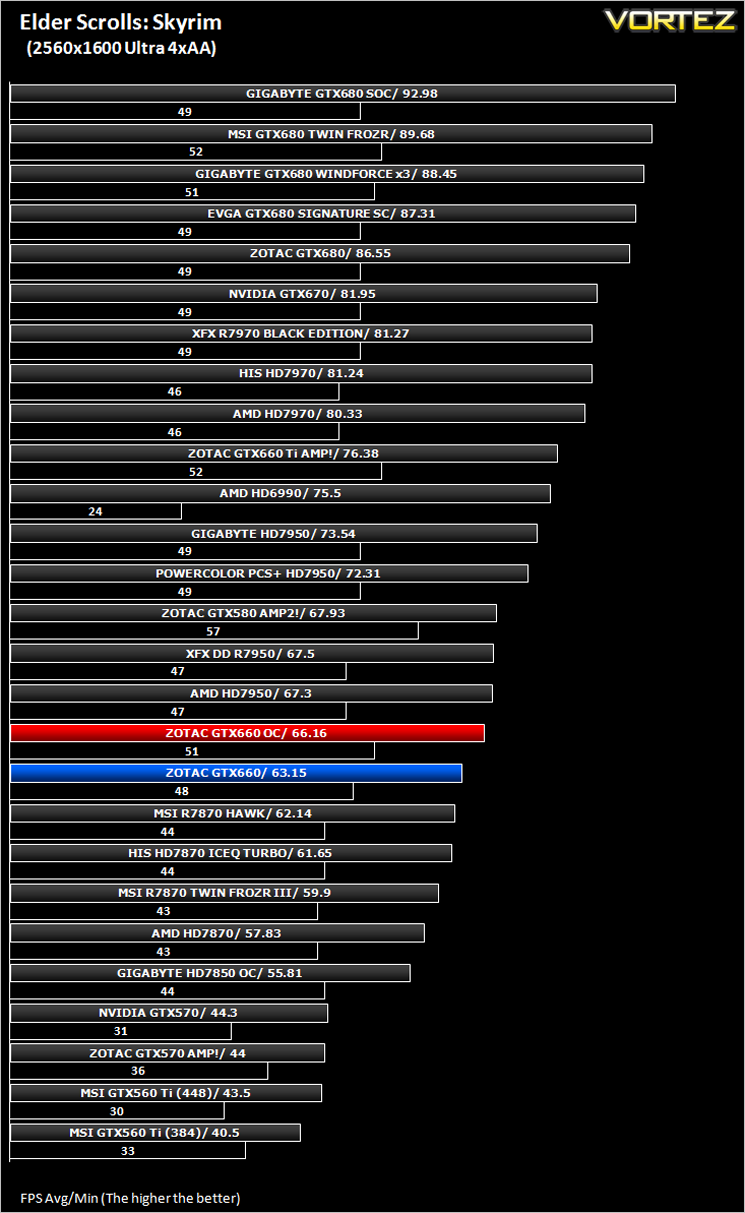
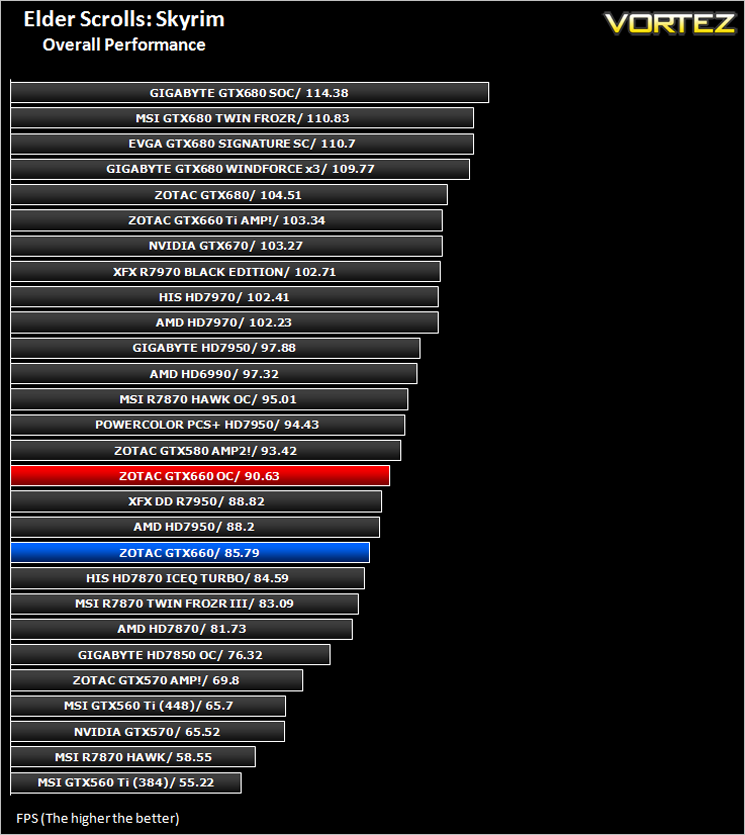
Average and minimum frames per second were measured using Fraps during the drop down passage to Riverwood. V-sync was disabled to allow fluctuating (higher the 60) FPS for these runs. It is however recommended that v-sync is left enabled during normal gameplay due to the games dynamics.
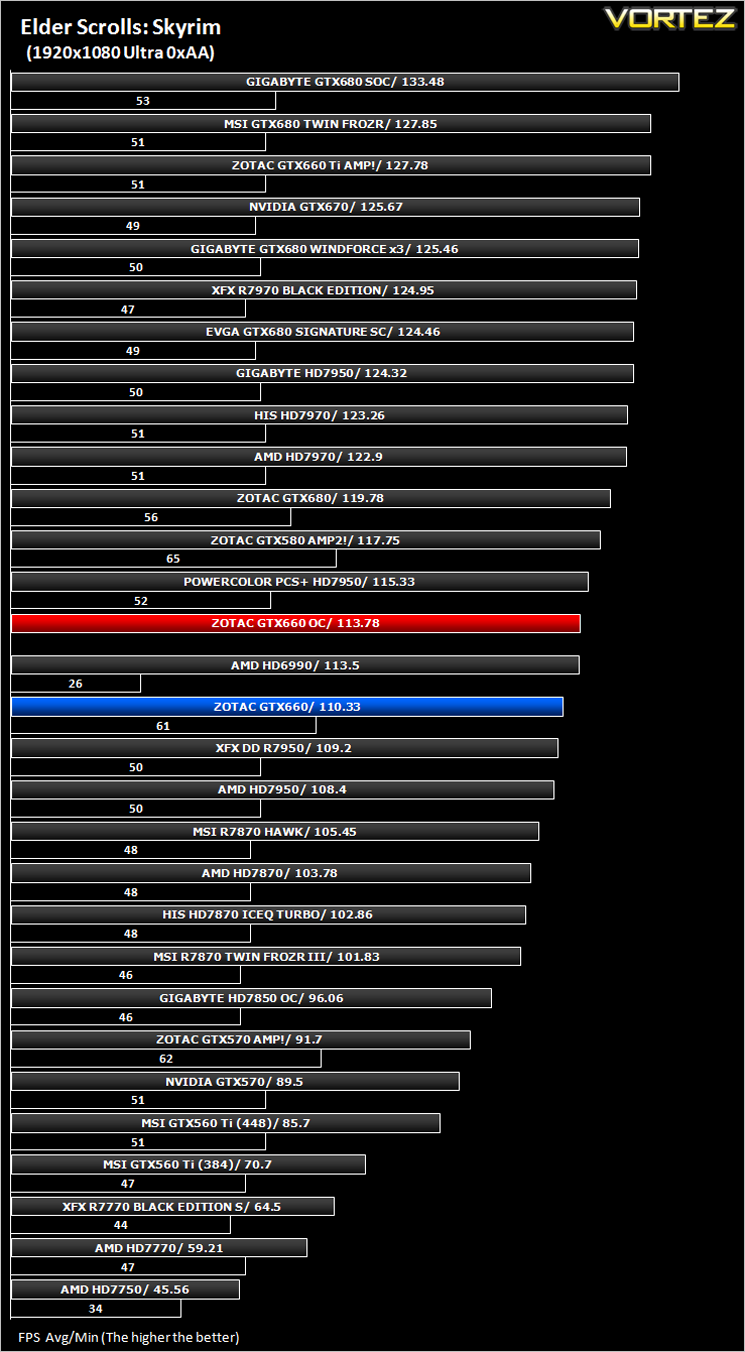
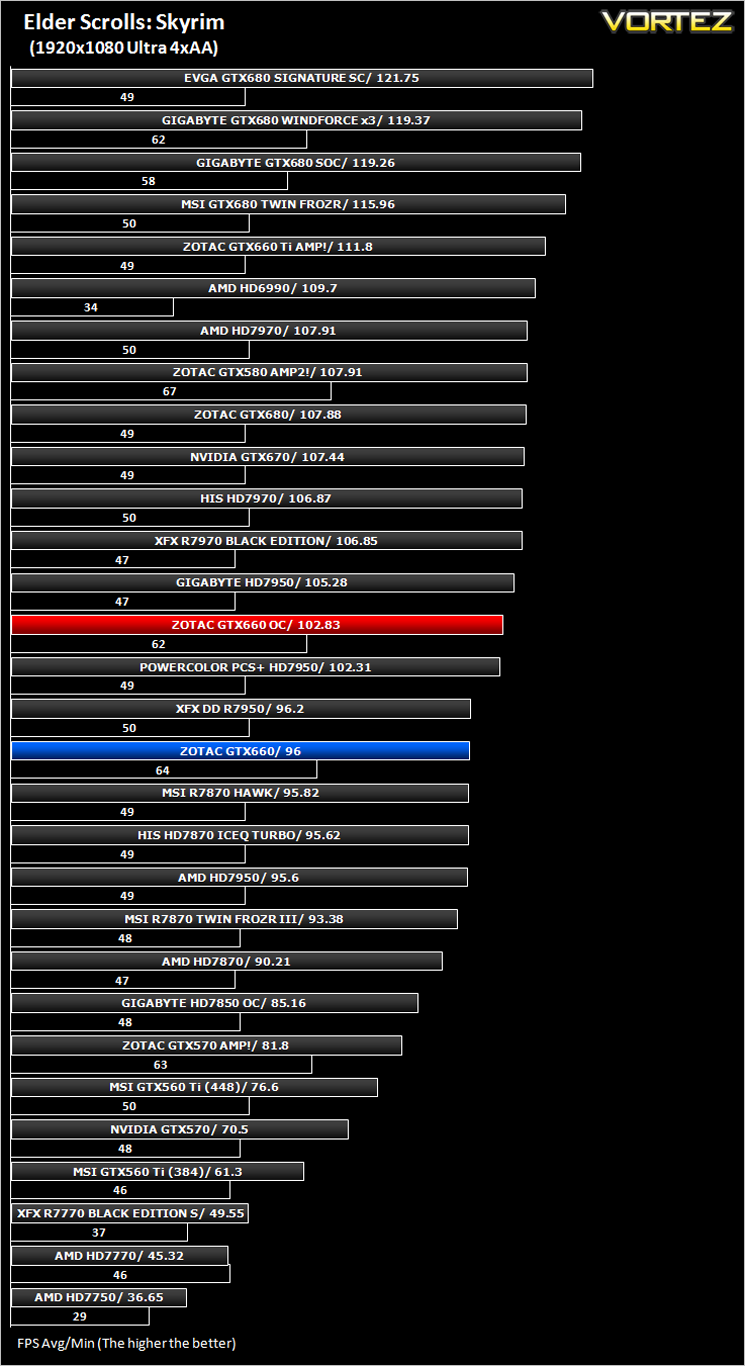
***NOTE*** Pre-release Forceware drivers (306.02) were used with the ZOTAC GTX660.
DiRT 3
As players race to elevate their global standing, DiRT 3 is back delivering mud, sweat and gears world over: from the intense weather-beaten rally stages of Europe, Africa and the US, to executing performance driving showcases and career challenges where car control is pushed to spectacular limits.
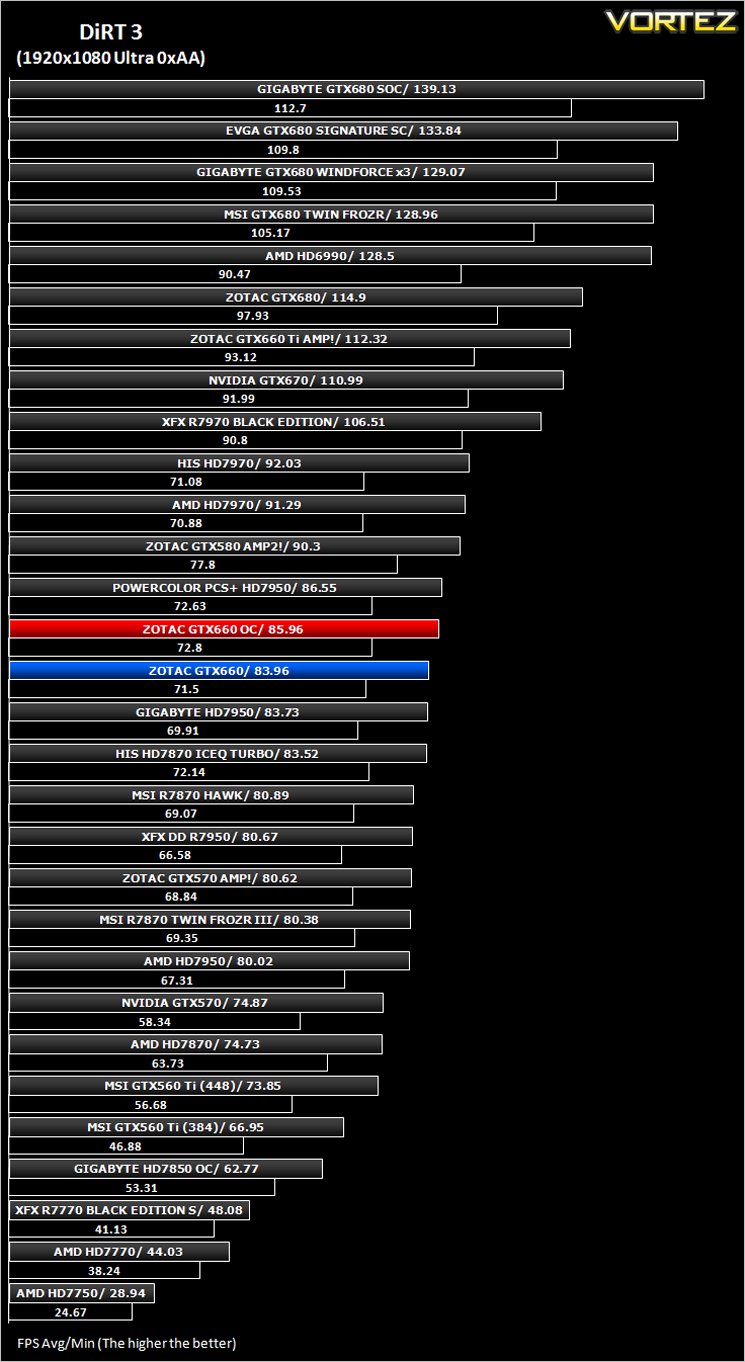
The in-game benchmarking tool was used to test performance. All the display settings were set to the maximum available and DirectX 11 was applied. The average FPS was recorded at the end.
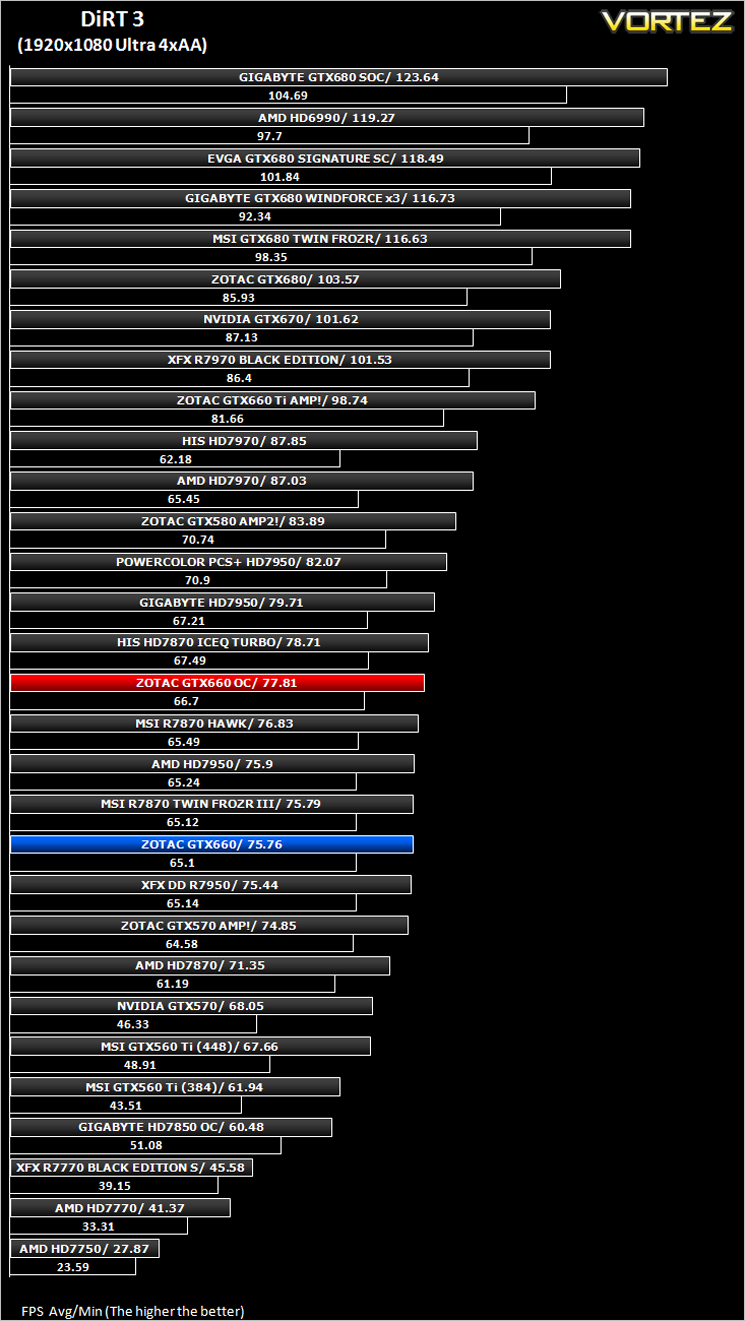
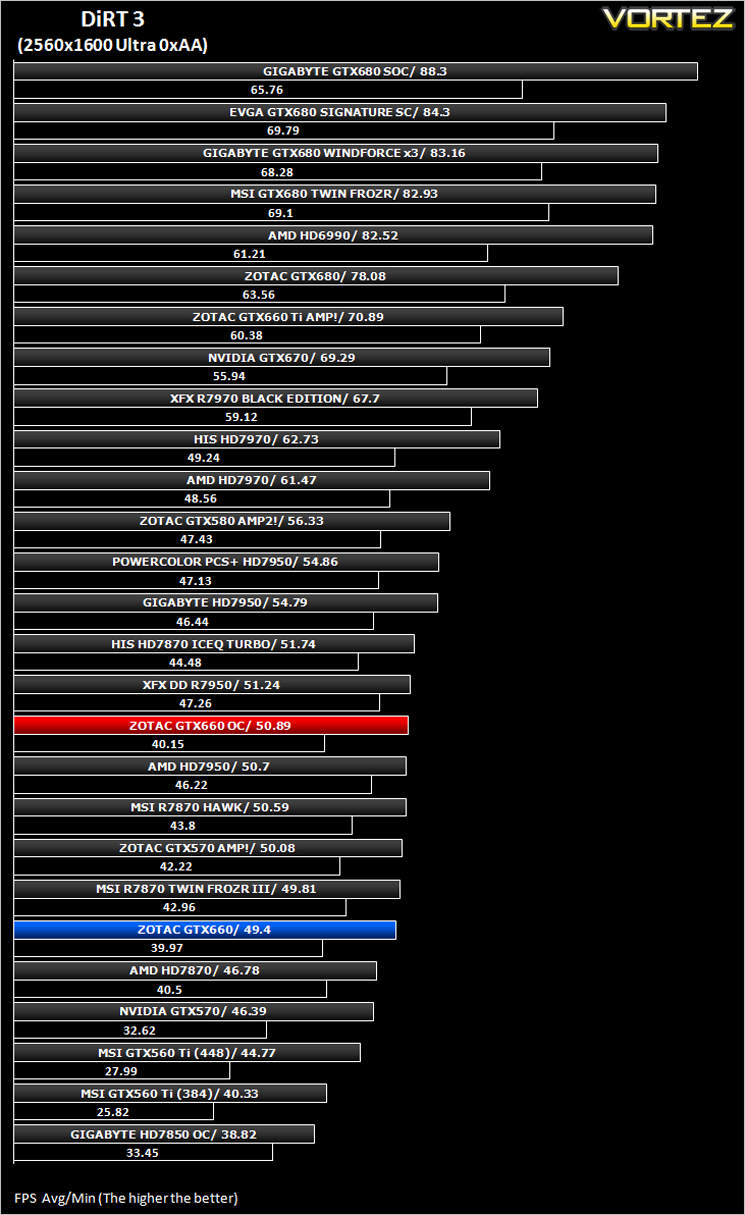
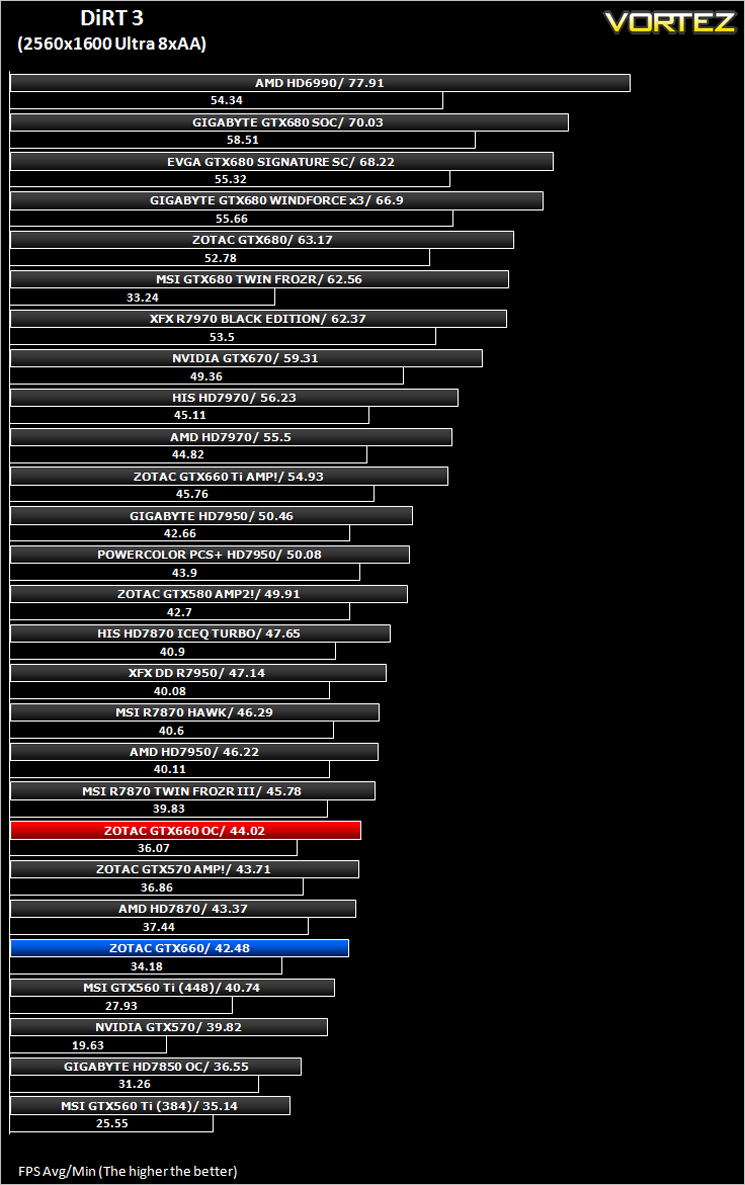
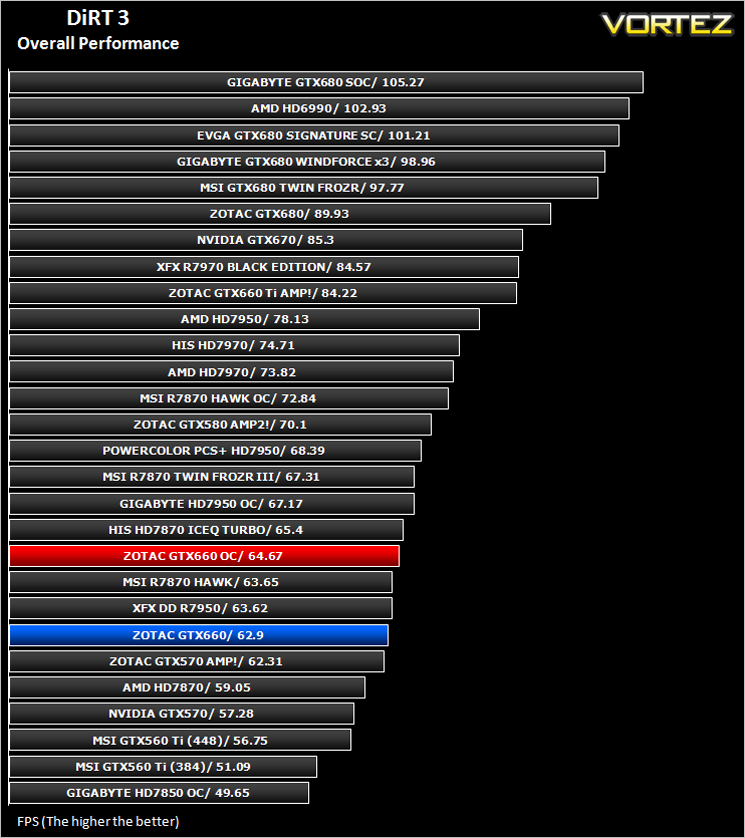
***NOTE*** Pre-release Forceware drivers (306.02) were used with the ZOTAC GTX660.
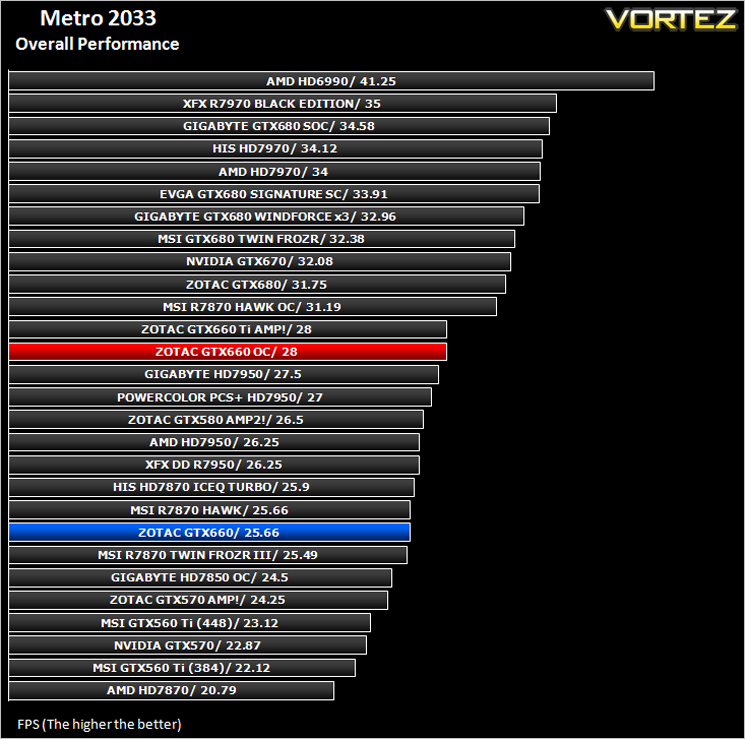
Metro 2033
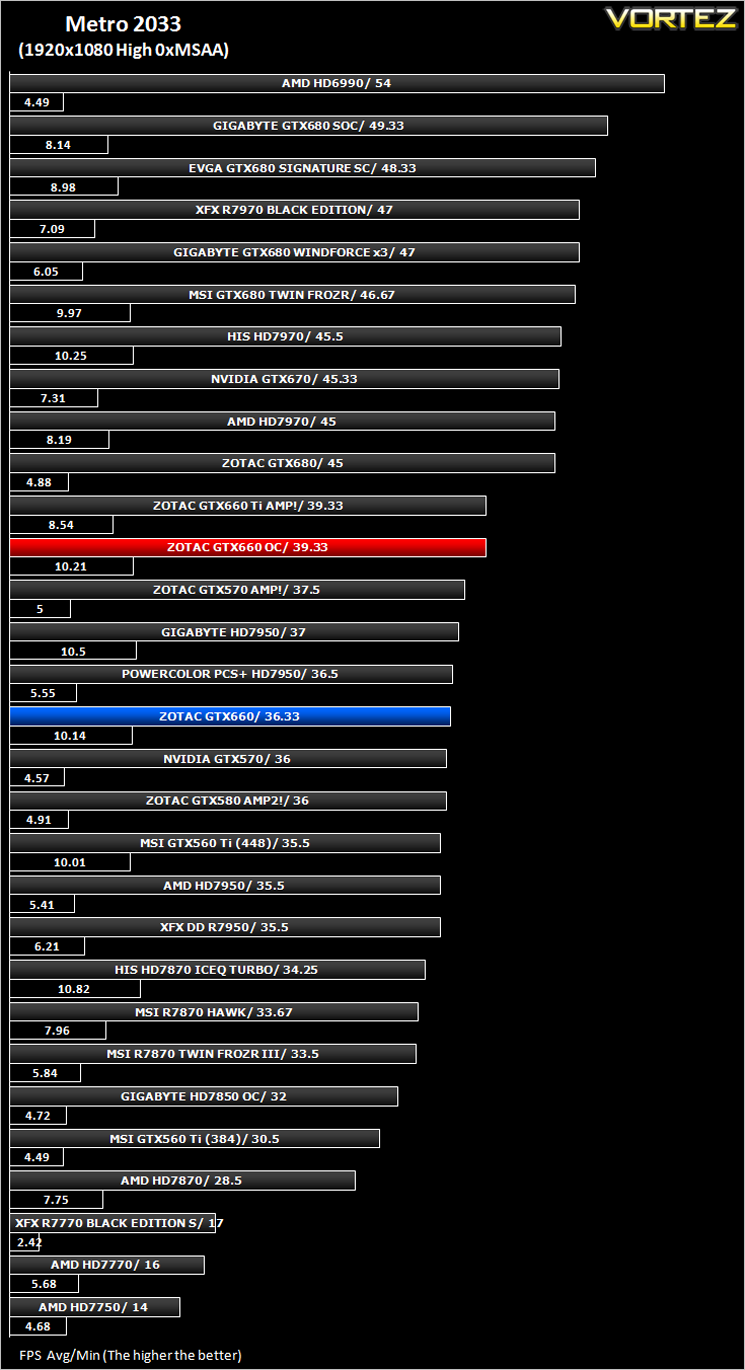
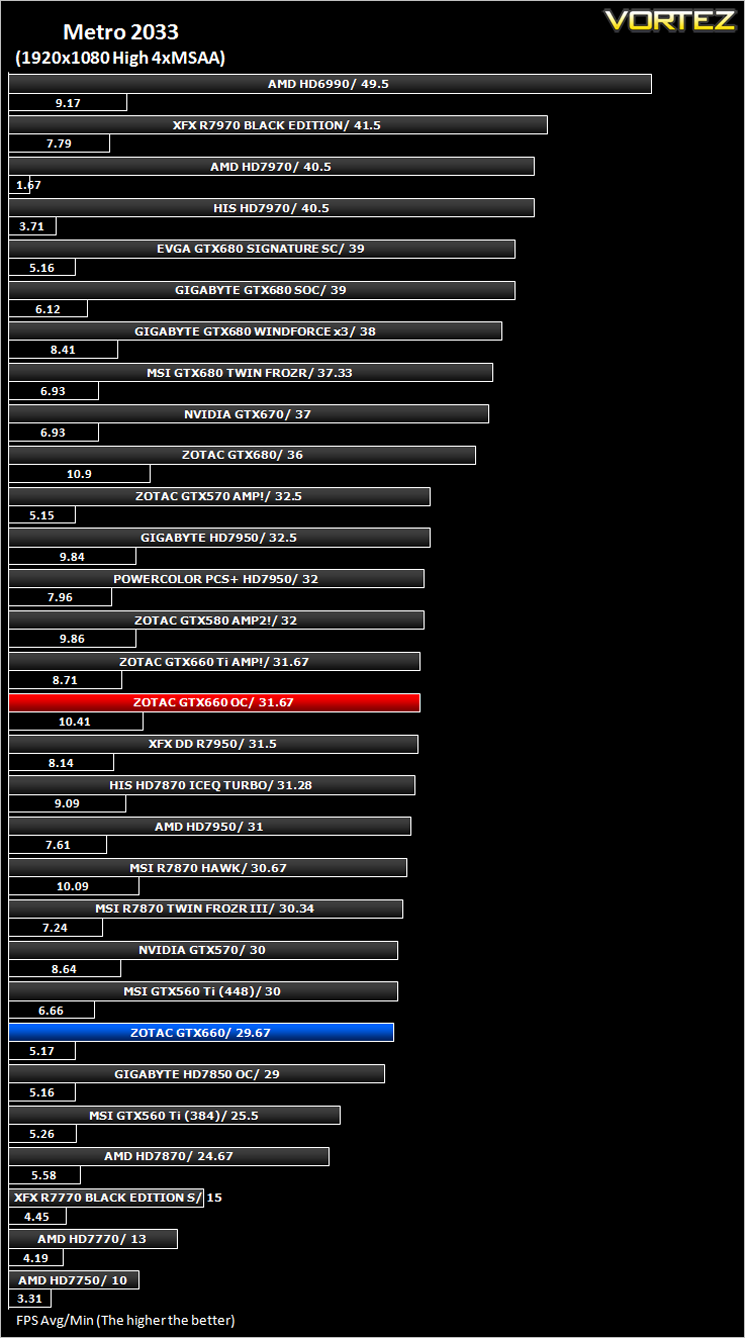
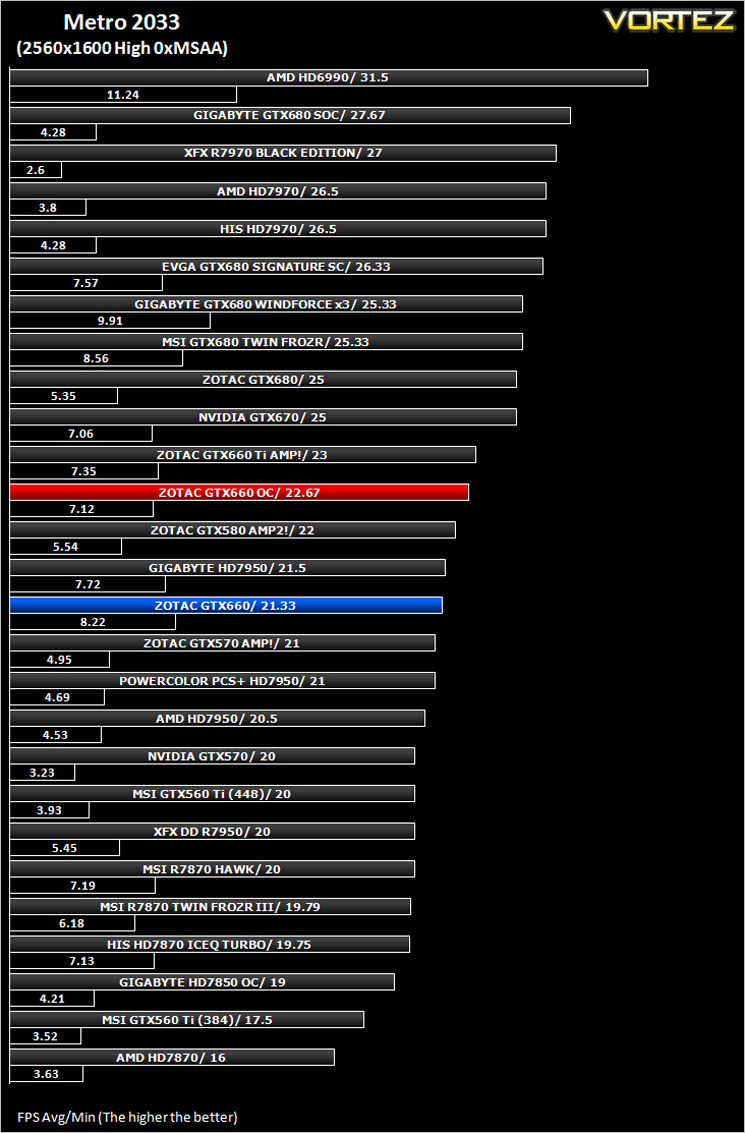
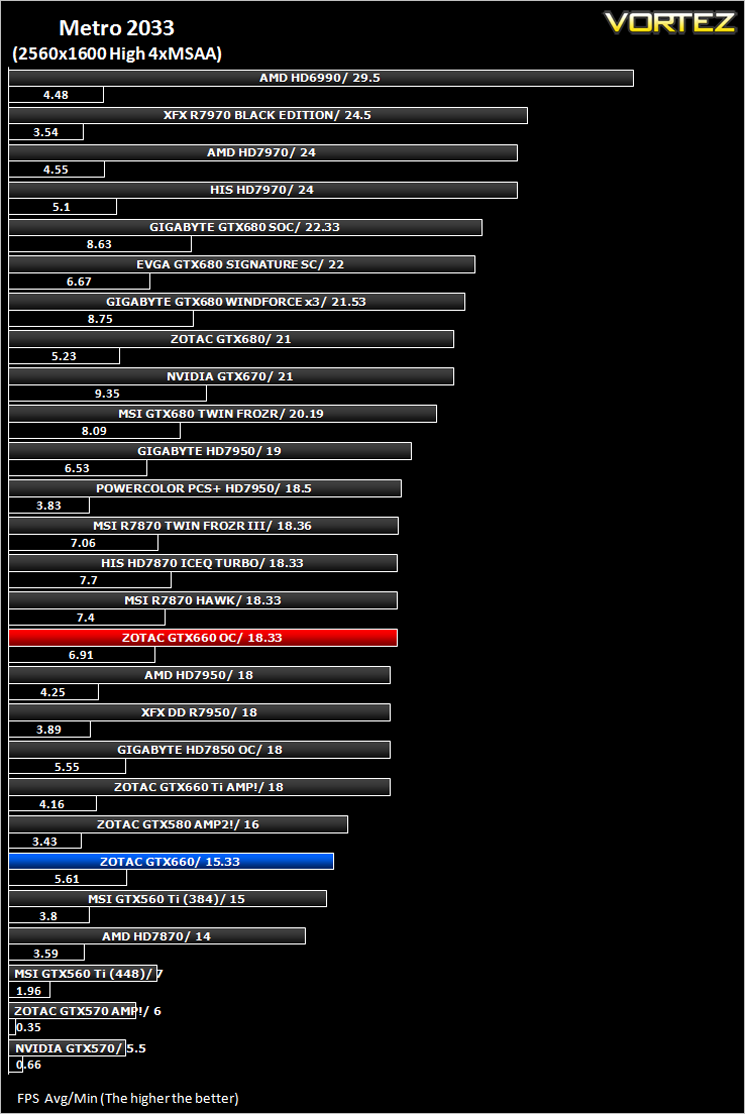
Based on the novel by the same name, Metro 2033 is a first person shooter with elements of survival horror. As Artyom, you trawl through the mutant infested metro systems of post-apocalyptic Moscow. The game delivers presents a grim ambience that reflects on the overall atmosphere of the underground setting. Metro 2033 uses the setting as a back drop to showcase some of the best visuals of any games out now, making it the ideal benchmark for those looking for the best graphics card.
The bundled benchmarking tool was used on Metro 2033, configuring the settings to High and making use of DirectX 11. The frontline scene was looped 3 times for each configuration. The average FPS was recorded at the end.
Futuremark 3DMark 11
3DMark 11 is the latest version of the world’s most popular benchmark. Designed to measure your PC’s gaming performance 3DMark 11 makes extensive use of all the new features in DirectX 11 including tessellation, compute shaders and multi-threading. The benchmark was run in both Performance and Extreme presets.
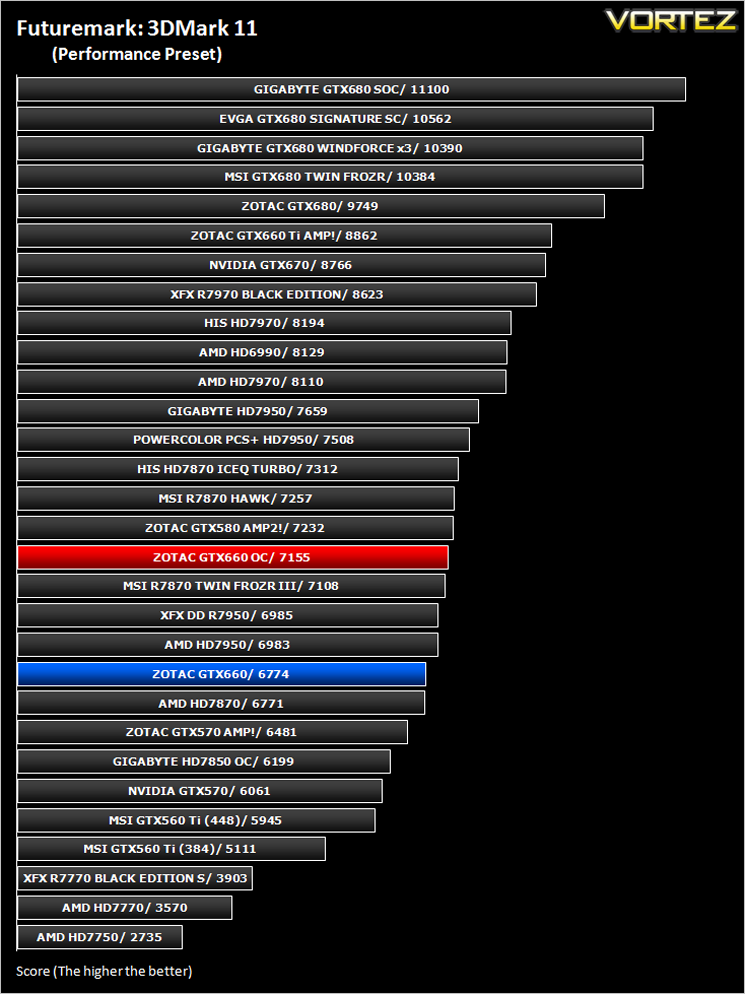
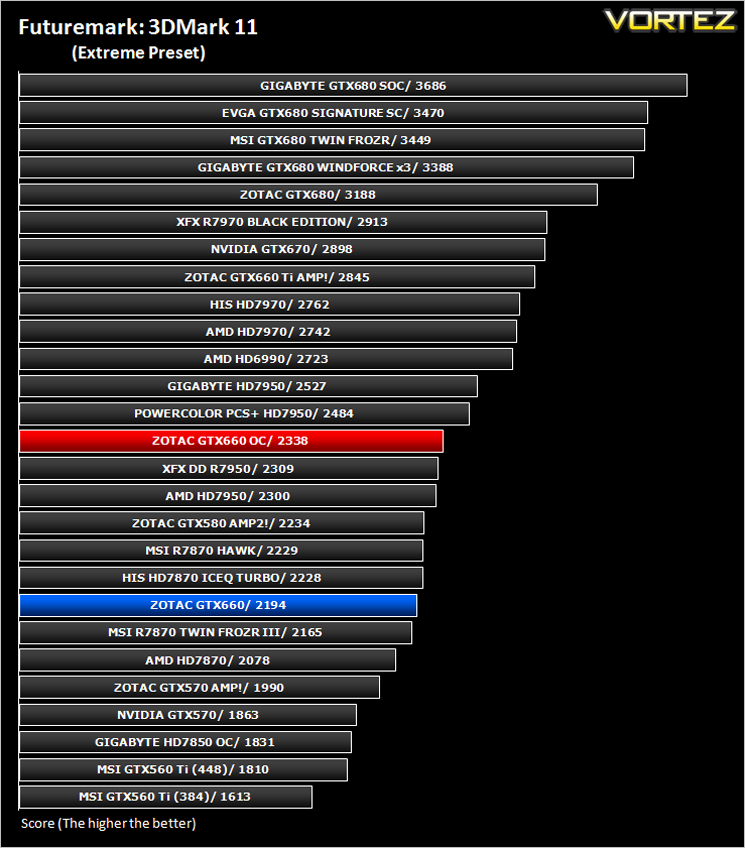
***NOTE*** Pre-release Forceware drivers (306.02) were used with the ZOTAC GTX660.
Unigine: Heaven 2.5
Heaven Benchmark is a DirectX 11 GPU benchmark based on advanced Unigine™ engine from Unigine Corp. It reveals the enchanting magic of floating islands with a tiny village hidden in the cloudy skies. Interactive mode provides emerging experience of exploring the intricate world of steampunk.
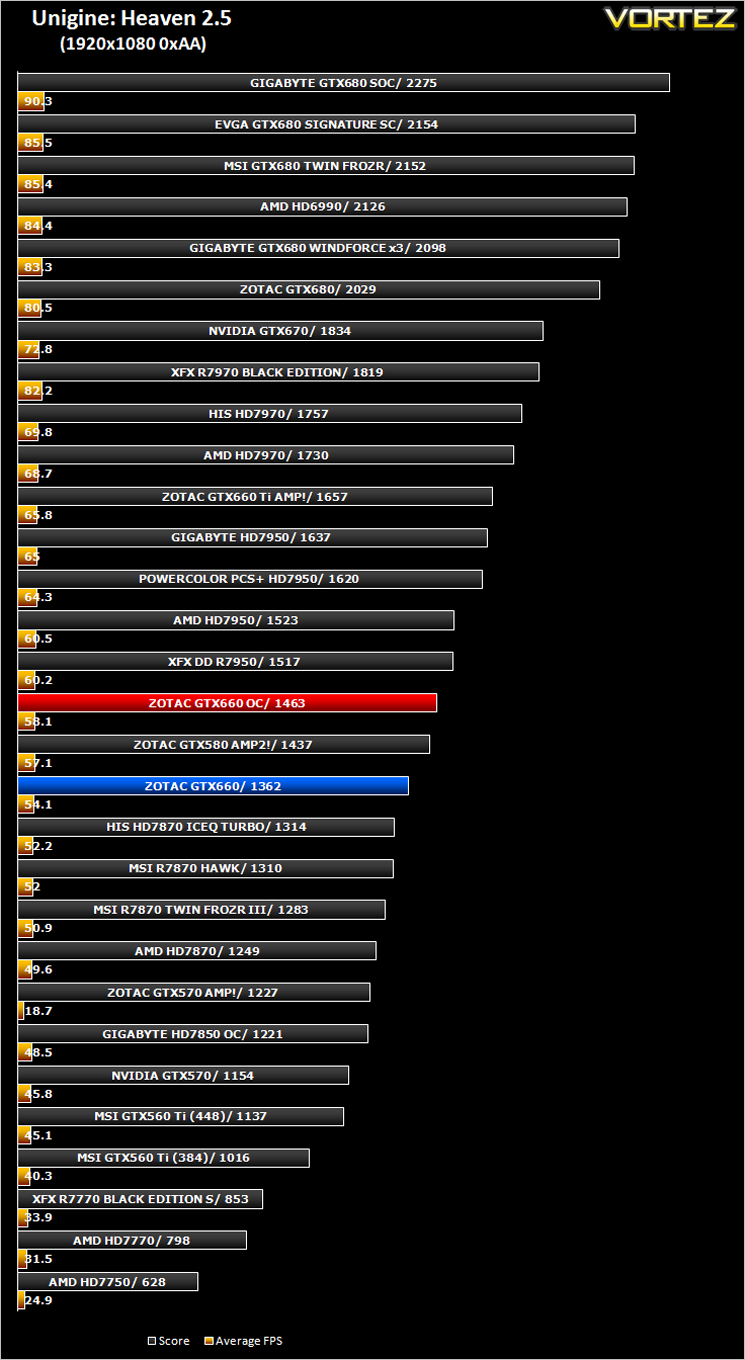
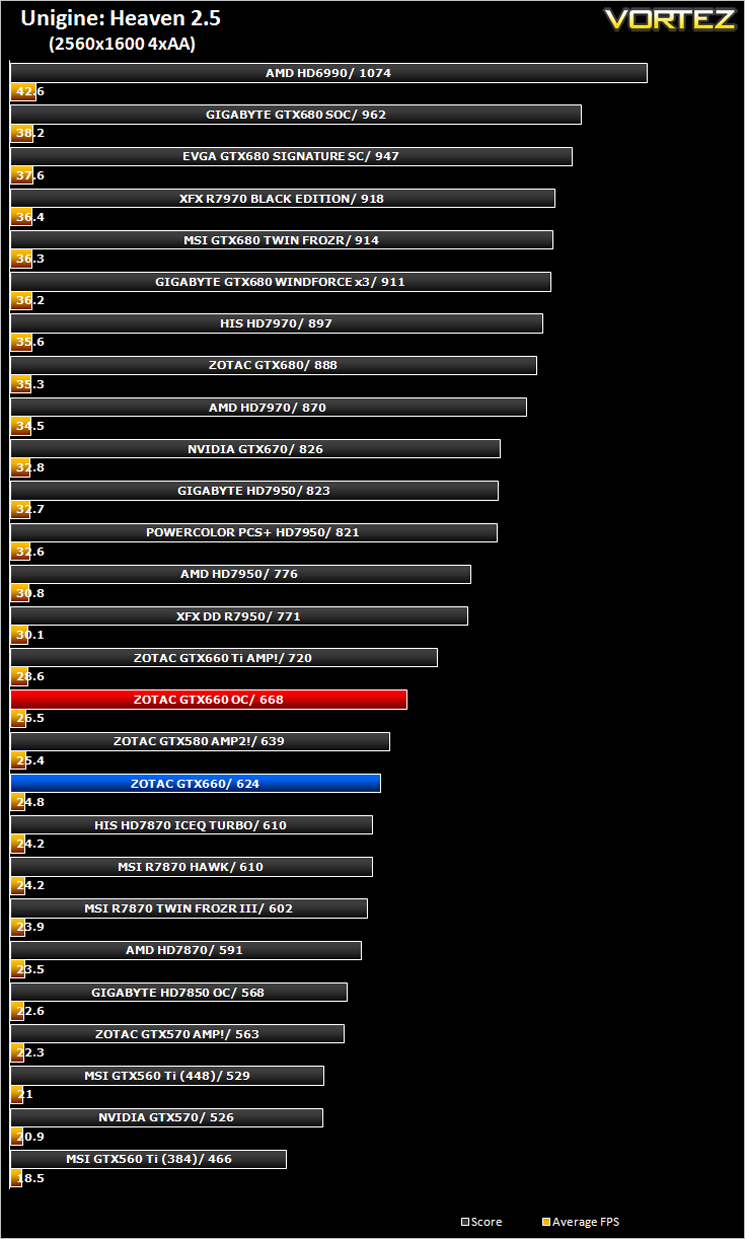
***NOTE*** Pre-release Forceware drivers (306.02) were used with the ZOTAC GTX660.
Conclusion
The ZOTAC GTX660 is a great little card. It has a small enough footprint to fit into a small enclosure and because of this it would be easy to dismiss this card as a poor gaming performer. You would however be wrong because for its size it is punching above its weight. In true David and Goliath style, it has enough power to beat not only the the AMD HD7850, the AMD equivalent of the GTX660 but also trade blows with the more expensive HD7870, even bettering that card on many occasions when overclocked. Equivalent in performance to the previous generations GTX570 is a fair leap in performance and while it will not break any benchmark records, it is certainly a capable performer at least at the resolutions NVIDIA have targeted this product for. Turn up the pixel numbers and the card starts to show it’s Achilles heal.
At our maximum test resolution of 2560×1600, the GTX660 began to fade away. Without anti-aliasing, the frames per second the card churns out were adequate. Start to add filtering however and the performance began to dip below 30fps. If you were optimistically hoping this card would be a good performer at the highest resolutions then I’m afraid you will be disappointed. With that said though, NVIDIA are not pitching it to the extreme end of the resolution scale which only make up a very small percentage of users, for these users the GTX680/GTX670 are clearly more suitable components.
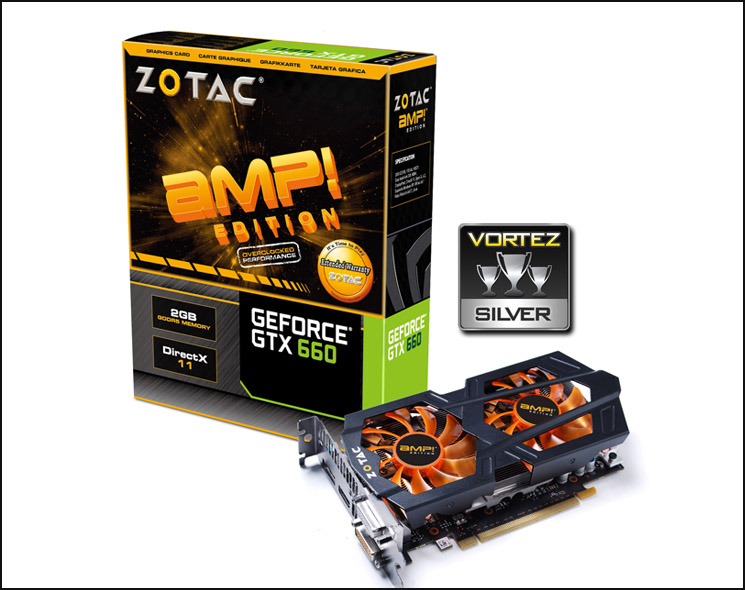
The NVIDIA’s pricing is still a bone of contention, with our sample having an MRRP of £179.99. At this price, the GTX660 does however slot neatly between the pricing of the AMD HD7850 and HD7870 graphics cards yet still weighs in cheaper than the last generation NVIDIA GTX560 and GTX570, both of which this card outperforms so in context, the GTX660 offers sound value for money in comparison. £180 is still a fair amount of cash to part with though but if you cannot afford one of the higher end Kepler products, this card still retains some of the Kepler DNA of its brethren at a much lower price point so it makes sense for NVIDIA to price it at this level. I would however have liked to have seen this card around the £150 price point which would certainly make it much more appealing and make it the card of choice for anyone looking for a sub £200 card. As it stands it is priced competitively but is not what could be described as a clear-cut bargain. The choice between slightly higher priced the HD7870 or this card would be a very hard call to make. What you are getting with the GTX660 though is a definite step up from the 8800/9800GT of old, so it is ‘mission complete’ for NVIDIA. Whether the price will be low enough to tempt you to upgrade only you can decide.
NVIDIA set out to build a card to tempt users of older DX9 hardware to upgrade to the latest technology without it costing the Earth to do so. For the most part they have succeeded because at 1920×1080, it’s a solid performer. Higher than this and the card may well begin to struggle but in all fairness it is unlikely that anyone running a 27″+ size monitor is going to be running a low-mid specification graphics card. So, if you are looking for a competitively priced card that won’t take up a large amount of real estate, has Kepler DNA and is capable of DirectX 11 with minimal power requirements then the ZOTAC GTX660 should be high on your shopping list. With all points considered it is a very worthy winner of our Vortez Silver award.
Pros:
+ Kepler Architecture
+ DirectX 11
+ Quiet
+ Small size
+ Faster than a HD7850
Cons:
– Begins to struggle at the highest resolutions
– Basic packaging
+ Kepler Architecture
+ DirectX 11
+ Quiet
+ Small size
+ Faster than a HD7850
Cons:
– Begins to struggle at the highest resolutions
– Basic packaging

Click here for an explanation of our awards at Vortez.net.


