Alex Hull on our forums takes a look at the new gaming headset from ASUS with features such as Rumble Feedback.
Product on Review: ASUS CineVibe (No product page)Manufacturer and Sponsor: ASUS
MSRP: £58.99

The world of audio headsets is an extremely competitive market. There are some 20+ brands that I can think of right away, and so, for a brand to enter such a domain is a rather brave journey. We’ve seen the likes of ARCTIC recently tackle the audio market with confidence and conviction, and there is no reason why a successful brand like ASUS cannot compete against the rivalry. They are a world-wide corporation that delights in delivering quality goods in an awful lot of genres.
This week I’ve been lucky enough to be reviewing an exciting new ASUS product to be launched under the gaming headset market, the CineVibe headset. This new audio peripheral makes use of ‘Rumble Feedback’. Used enhance the listening experience in a multitude of environments – games, movies and music.
ASUS Take on the CineVibe
Immerse yourself. Feel every glancing blow and get yourself in the game like never before. The ASUS CineVibe is here and brings tactile bass vibration to a level never found before to give you that competitive edge. With ASUS audio engineering at the heart of the CineVibe, there really has never been a headset like this. The CineVibe is a plug & play USB headset that delivers the full audio package without the need for pesky driver installation. Comfort and precision are the most important aspects of any gaming headset and the gamers spirit is captured here – Shoot first and ask questions later because with CineVibe, there are no points for second place.
– USB Plug & Play – No drivers needed!
– Tactile Vibrations – Get yourself in the game!
– Volume, Microphone and Vibration control – Adjust volume, microphone mute and vibration on or off at the flick of a switch!
– Fold Flat Design – Easy to transport to LANs!
– Directional Noise Cancelling Microphone – Clear communication is the key to victory!
– USB Plug & Play – No drivers needed!
– Tactile Vibrations – Get yourself in the game!
– Volume, Microphone and Vibration control – Adjust volume, microphone mute and vibration on or off at the flick of a switch!
– Fold Flat Design – Easy to transport to LANs!
– Directional Noise Cancelling Microphone – Clear communication is the key to victory!
Technical Speficications
Speaker Size – 30mm
Cable Length – 1.5M
Impedance – Vibration on: 16ohm +- 25% at 1kHz, Vibration off: 32ohm +- 25% at 1kHz
Frequency Response – Headset 20Hz-20kHz, Microphone 100Hz~10kHz
Input sensitivity – Vibration on: 105dB +- 5dB at 1mW from HATS 4158C at 1kHz, Vibration off: 103dB +- 5dB at 1mW from HATS 4158C at 1kHZ
Cable Length – 1.5M
Impedance – Vibration on: 16ohm +- 25% at 1kHz, Vibration off: 32ohm +- 25% at 1kHz
Frequency Response – Headset 20Hz-20kHz, Microphone 100Hz~10kHz
Input sensitivity – Vibration on: 105dB +- 5dB at 1mW from HATS 4158C at 1kHz, Vibration off: 103dB +- 5dB at 1mW from HATS 4158C at 1kHZ
Unboxing
The front of the box shows some basic information about the headset and a neat iconic features summary at the bottom. It’s also possible to see half of the headset from the front through a tough plastic box, which would protect the product in transport very easily. The sleeve is finished in an attractive but plain colour scheme with the ASUS and CineVibe logos.
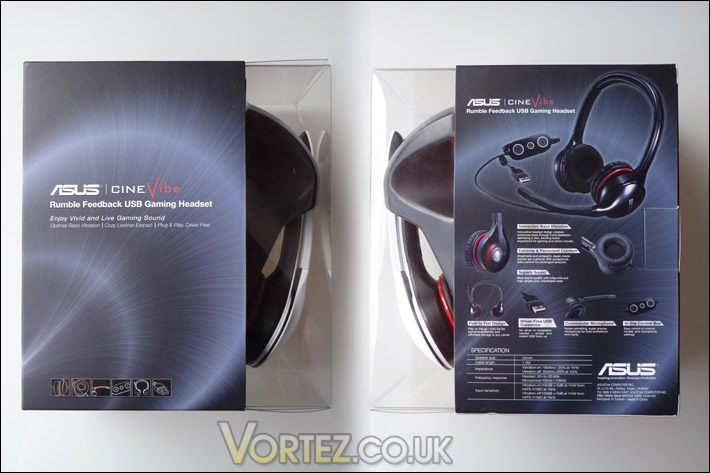
The top shows some basic pictorial instructions for removing the box from the sleeve. The printed side of the sleeve briefly outlines three features of the headset in a variety of European languages. The other side gives us a glimpse into the box itself, showing the white version of the CineVibe.
The back of the box is the most interesting. There are some pictures and text showing the key features of the headset as well as a table of technical specifications.
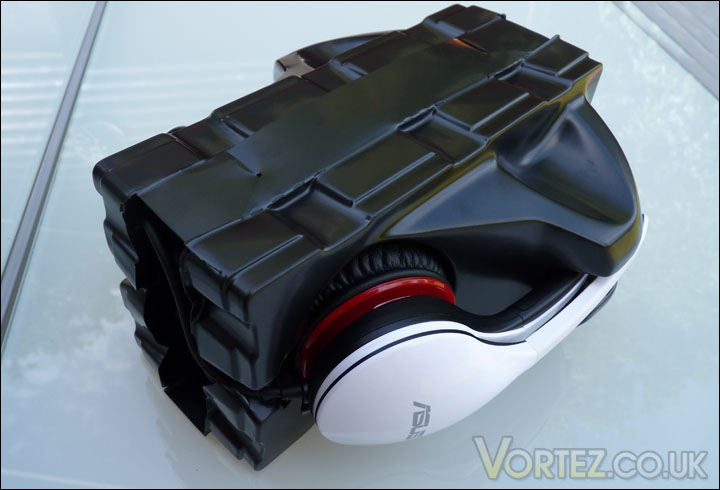
Once removed from the outer packaging, the CineVibe is pushed firmly into a black plastic insert, and also tied together at the base. Inside the plastic are the extras and surplus cable etc.
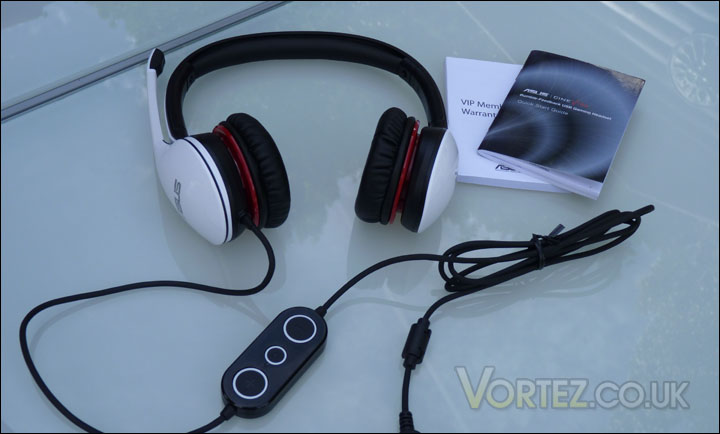
Here you can see the entire package contents, which isn’t a lot. No drivers, so no disc or similar, and no case or bag with the headset. You get a thick manual with basic instructions (it’s quite simple to use) in a vast number of languages, and a warranty notice in a similar vein. You can also see the full 1.5m cable and control pod, complete with digital volume buttons, microphone mute and a vibration on/off sliding switch.
Build, feel and design
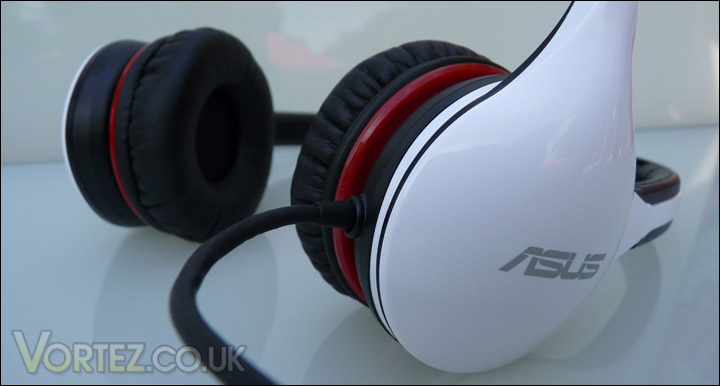
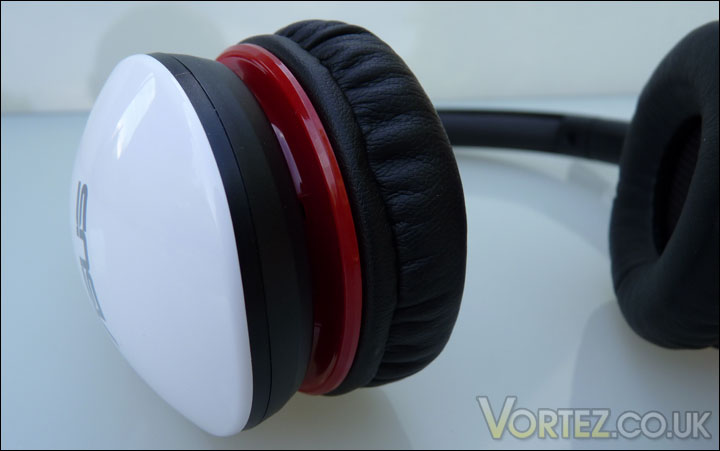
As you can see, the CineVibe is certainly a great looking headset. It will be available in both Black (as seen on the OcUK site) and this attractive white colour seen here, though having seen this version in the ‘flesh’, I really think the white is the better looking colour. The finish on the outside has a light shine to it, as well as the ASUS logo in grey on both sides. The microphone and headband section are also finished in the same fashion on their outer edges. Each earpiece itself is housed in a black plastic cover with a glossy red disc around the outside edge where it meets the main frame. This highlight of red is something we’ve seen in a lot of ASUS products in the last few years, and although it may allude to the Republic of Gamers brand, this headset does not fall squarely into that division (which is reserved for fairly specific gaming products). The earpieces also sport ‘Japan-Made protein ear cushions’, which have a nice soft feel both to touch and squeeze, but are also firm enough to ensure sufficient padding. The drivers themselves are covered by a black mesh cloth and plastic with cut holes beneath (as far as I can feel).
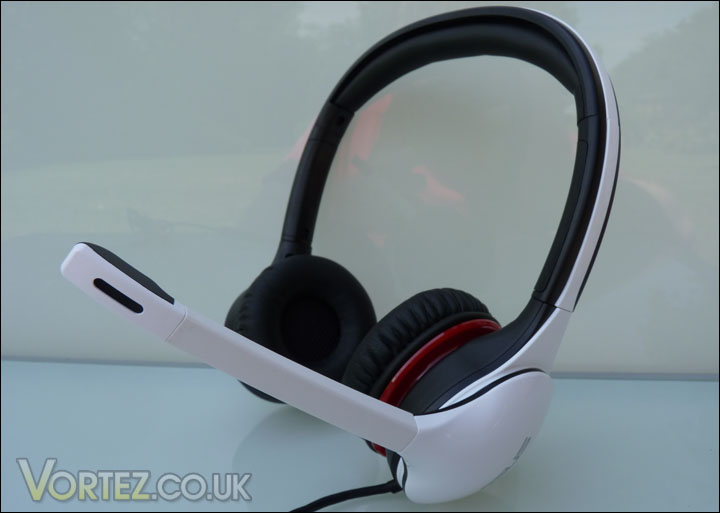
As shown, The earpieces also swivel 90 degrees to enable flat storage of the headset, though with the small size to begin with, the space saving advantages of this are negligible. Some of the marketing seen so far also suggests this function is for protection of the headset, though I’d still be very careful about putting it anywhere where it may be crushed, so again, this feature seems to hold no real benefit as far as my usage would allow. What may have been better would be to include a bag (as seen with the Creative Fatal1ty headset) or even a protective box (as seen with the Goldring NS1000), this way, protection is ensured, especially from tears, scratches and even snaps.
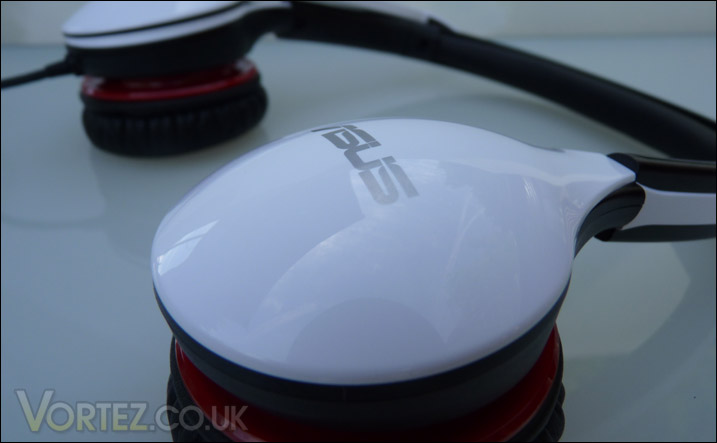
Having said all that, the feel and build of the headset is very robust compared to other headsets. The Creative feels very plasticy and cheap in comparison, the Goldring set also lack the beautiful finish that the CineVibe sports. I have no doubt that it’s made well, and with good quality plastics. It certainly justifies its price in this area.
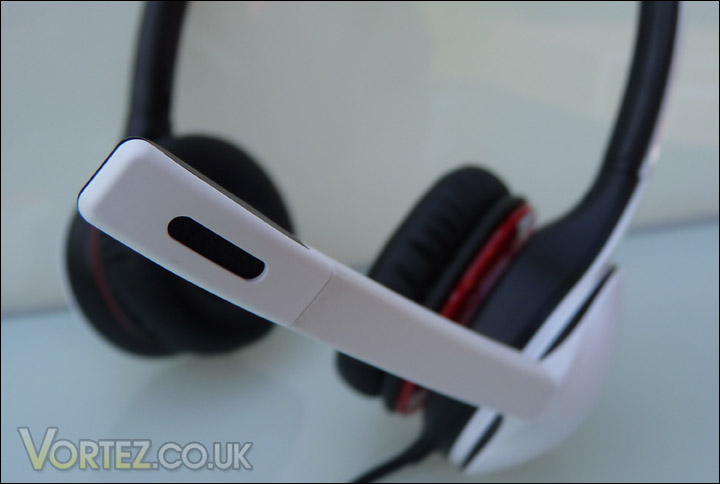
The fold-down microphone is a very nice touch. The feel of it sliding is great, and it stays in place perfectly at any angle. The mic is rigid, unlike the Creative set, but this is not a disadvantage since the microphone can easily pick up your voice clearly, even when it’s not right next to your mouth. It’s also worth noting that the microphone isn’t detatchable, unlike the Creative set. I know some may prefer that feature, but when the mic can slide up and out of the way, it’s actually more convenient and a lot more difficult to lose! The creative set requires removal of the microphone for storage, and it’s nigh on impossible to put back in when it’s on your head. The CineVibe eliminates both these issues with ease and style.
Comfort
Having felt the ear cushions, I expected the CineVibe to be quite comfortable, however I was a little disappointed, though it wasn’t the cushions, but the overall shape that was not perfect. I believe a lot of the problem is the fact I have a fairly small head and this doesn’t lend itself to headsets of this design, as if the earpieces are not flexible enough the bottoms of them can feel a little pushed down onto the ears. This is not an issue with the other two headsets as the earpieces are more freely rotatable, but with the CineVibe, there is only a flex in each earpiece, not allowing for as much movement and accommodation of head sizes and shapes.
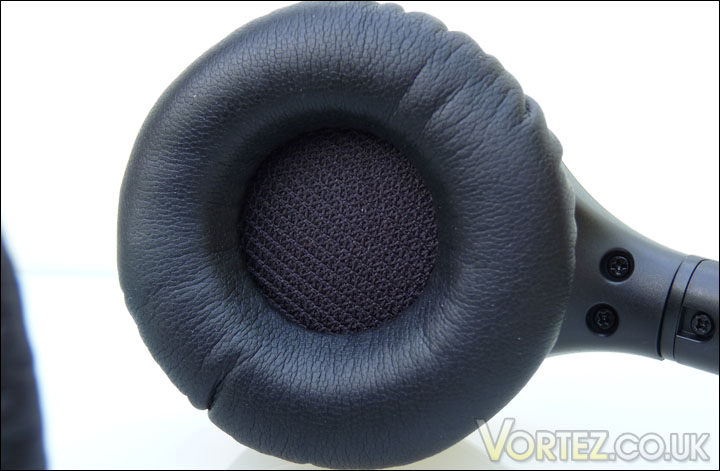
The next thing you notice is the actual size of the earpieces. Compared to the other sets, they’re very small. This means that instead of sitting around your ears, they sit on your ears. Coupled with the slightly unsuitable fit, this results in your ears being pushed down on a little. Over long periods of time I’ve found this can become uncomfortable, especially when, like me, you may be used to the ear-enveloping type of headphones or headset. For short blasts or even a short movie, depending on how the set fits you may never feel this problem. I think perhaps I’m slightly spoiled by the other two headsets being very comfortable examples. Overall, I’d say comfort was OK, but after an extended gaming session you may find (depending on the size of your head) it to be slightly uncomfortable on the ears.
Testing Performance
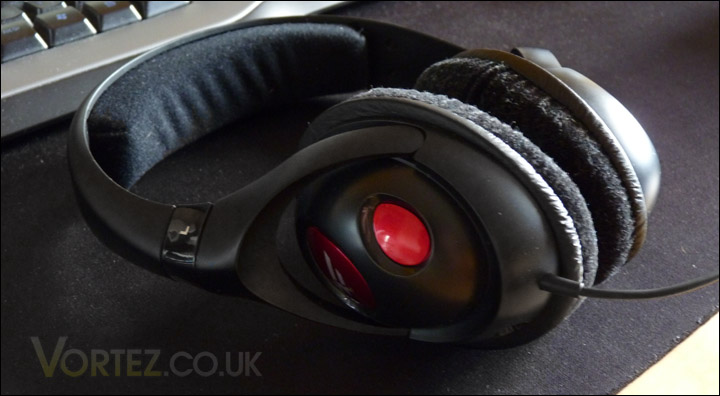
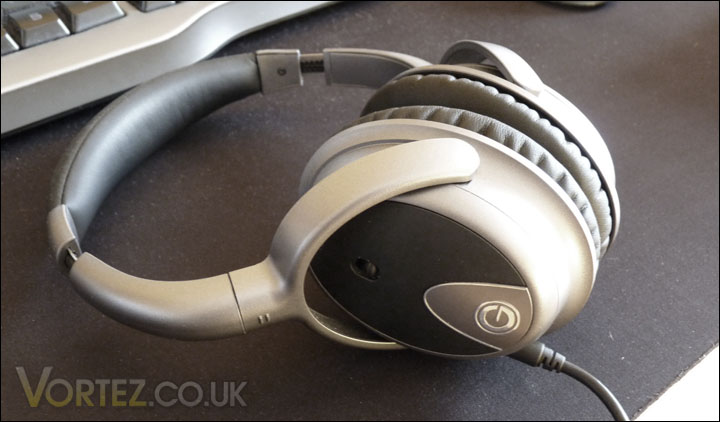
For the purposes of a meaningful comparison, I’ll be comparing the CineVibe to the two other headsets/headphones I already own. The first is the Creative Fatal1ty HS-800 headset and the Goldring NS1000 headphones. The fata1lty being just £30 – the cheaper of all three headsets and the Golring being priced exactly the same as the ASUS CineVibe. This will give us a good indication of audio performance, taking particular attention to the bass, high and low notes. All three headsets are good quality so it will be interesting to see how well the ASUS CineVibe fares in comparison.
Performance
Installation of the headset could not be easier. Simply plug in the USB connector and the drivers automatically install for you. These include:
+ USB composite device
+ USB Headset Venus HS-P10
+ USB Input Device
The headset will then work straight away, once you’ve selected it as the default audio device:
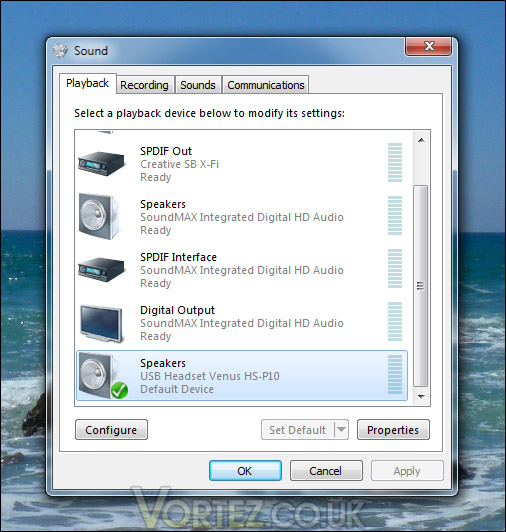
There are no settings or sound cards to mess around with, this is just pure plug and play. The only change I made was to run through the windows speaker options and select the headset as having full range speakers. The volume control on the pod directly changes the windows system volume, which may or may not be suitable for everyone. I’ve also found that you need it on very low volumes for sensible listening if your application doesn’t have it’s own volume control, and as such, even small changes at this level result in a large change in sound amplitude on the actual headset. Therefore, I think the inclusion of an analogue dial or similar to change the volume (like the Creative Fatal1ty headset) would be more suitable and offer more flexibility.
Sound Quality
The small size of the earpieces also alludes to the relatively small size of the drivers contained within. The size of each driver unit is 30mm, which is smaller than both the 40mm driver units used in the other two headsets. The frequency response for the CineVibe and Fatal1ty sets is the same (20Hz-20kHz), but the Goldring set delivers lower frequencies (15Hz-20kHz) by a small amount. This, I think, is enough to make a clear difference on bass response between the three sets in terms of the power and clarity of the bass. Here, the Goldring wins out (mainly thanks to the clarity), with the Fatal1ty set a distant second, closely followed by the CineVibe. I believe this is a result of the driver size really limiting the bass response on the CineVibe.
However, with the ‘Rumble Feedback’ enabled, the characteristics of the bass change. There is a loss in clarity (which was good before), but this is met with a gain in bass amplitude, almost like someone has changed the equalizer. There’s more about bass dynamics to come when I talk about the feedback in detail. Suffice to say, without the feedback, bass is only adequate. Perhaps this was a design decision rather than a sonic one, though at this point it leaves me wanting more.
Mids and highs on the CineVibe are amazingly clear, which certainly surprised me. They come across as very defined and sharp, which is great for games. The headset really makes up some ground here, though the sheer quality of the Goldrings is never quite matched (as to be expected). They outperform the Fatal1ty headset in this respect. Separation and the perceived ‘soundstage’ is average, roughly on par with the Fatal1ty headset, with both a long distance behind the Goldrings.
Now I’ll go onto more specific performance in three categories, Rumble Feedback aside for a moment.
Games Tested
DiRT 2
Need For Speed: Shift
Bioshock 2
Left 4 Dead
Grand Theft Auto: San Andreas
Gaming performance with the CineVibe is extremely pleasing. The sharp mids and highs are ideally suited to a large variety of games, and the microphone clarity is by far the best I’ve used on a headset to date. The noise cancelling features on the microphone must work wonders, as my voice is picked up effortlessly and VERY clearly. I’m sure the mic could rival a traditional desk stand version, or easily beat a clip-on type that are popular in conjunction with headphones (rather than a headset).

Another thing worth mentioning with regards to gaming is positional audio. As seen, the CineVibe doesn’t use a dedicated sound card, which is a major disadvantage when it comes to gaming. I normally use a Creative X-Fi xtremegamer with my headphones, and so any opinions and comparisons to those put forward is based on that established foundation of gaming features and quality. Hence, the CineVibe has no CMSS-3D or Dolby Headphone features. However, don’t let this deter you, as all things considered, the positional audio is brilliant. It doesn’t quite rival a £60+ sound card, but it’s still very good and easy to get used to. The performance in Left 4 Dead had me spinning around to catch zombies in the face as they approached, and coupled with the satisfying boom of the shotgun it made an intense and enjoyable experience. San Andreas also worked very well with this headset, with approaching cars and voices well-defined in space.
I’m also told that the CineVibe can be used with PS3 and XBOX 360, which is an area where I think it may shine. I don’t own either console unfortunately, but I would expect similar performance to the PC for gaming. Online, the good microphone and positional audio quickly make a lot of sense.
Movies
The movie performance was also very good. The clear mids and highs work well with any dialogue, and the low end power (particularly with Rumble Feedback) seems to come alive here, where in other tests it was a slight let down. This may be a quality of the source material used: The movie I used to test this was ‘Independence Day’, which comes with more than its fair share of crashes, loud noises and explosions, which best highlighted the main selling point of this headset, the rumble feedback. I also used the Transformers 2 : Revenge Of The Fallen HD trailer via youtube, which complements the headset perfectly by containing lots of low frequency rumbles and booms.
Music
I would say that music is the weak point of this headset. As you may have guessed, the performance over a range of frequencies is far from even, meaning that certain parts of music may be more distant than others, depending on the track. Where the headset improves is for well defined, simple music with a deep bassline or drums, such as dance tracks. The clarity also lends itself to more electronic effects, which come through nicely. I would not use this headset for regular or comfortable (sonically) listening, but my music tastes may differ from yours of course. The Goldring set is totally unrivalled in this category, with both the CineVibe and Fatal1ty sets destroyed in terms of overall sound quality.
Rumble Feedback
The main feature of this headset that differentiates it from the competition is the Rumble Feedback feature. This takes the bass frequencies and converts them into a vibration, produced in the case of each earpiece.
I expected a fairly strong effect, perhaps even tickly at times! This was based on the connotations of the words ‘Rumble’ and ‘Force’ feedback which are all used on the packaging and appear in product descriptions. In reality, this effect is subtle. It took a while to get used to this, and indeed even notice it in a large amount of content I tried. Others who I showed the headset to also observed this and shared my feelings. However, as noted above, some types of music and movies do accentuate the effect, obviously where the amount of bass is high. I have spoken to an ASUS representative about this and they informed me that a lot of time has gone into getting the feedback balanced just right, between being too strong and distracting/uncomfortable and too weak and worthless. Personally, I would have liked to see a controllable amplitude on this effect, as then you could tune it to your own preference. I don’t think it would have been a massive engineering challenge to incorporate that onto the control pad and headset, but I’m sure ASUS have their own reasons for this, most likely they want each user to experience the same optimised settings that they have spent time working on. I have tried playing various games and switching the vibration on and off in an attempt to find a large change in the experience, and although I discovered subtle differences in the perception of loud, bass frequency noises, I don’t think the experience was enhanced enough to justify this as the leading feature of what is an otherwise fine headset. I do think that this sort of feeling is very subjective, so you may find that it’s more or even less obvious to you. A good way to imagine the effect would be to think of a 2.0 speaker system, followed by adding a subwoofer at a really low volume.
Overall, I have to decide if this adds anything to the gaming, movie watching and music listening experience. I think it does, but it also leaves me wanting a bit more kick than I’m getting.
Conclusion
I’ve compared the CineVibe, perhaps unfairly in cases, to the two other headphones/headsets that I own. It hasn’t always come out on top, even being dead last in some comparisons. In others, however, I’ve been more impressed by it than anything. My feelings about the headset before I’d used it were initially sceptical about what the vibration would add. Having used it, I can say that the vibration does add an extra, missing effect in terms of bass to an already well-designed and performing headset. I can’t help but wonder why – with a headset so focussed on delivering spectacular audio, to explosive action thrillers, that the drivers could not have been made a bit bigger. Not least for comfort, but for improved bass right off the bat. It almost feels as though the presence of the Rumble Feedback is there to counteract this loss of low frequency handling, somewhat negating its effect and worth, at least in this incarnation.

Although flawed, the ASUS CineVibe is a very interesting and exciting product that just falls short of being brilliant. If you play lots of games where communication is key, you fancy something different with bass kick and great positional audio, look no further, this could well be the headset for you. Don’t buy one for sound detail and quality, as you will be disappointed compared to other headphone offerings at this price, but if you also regularly enjoy an action packed movie on your PC, this headset amplifies the action further with an immersive bass punch.
Pros
+ Great looking compact headset
+ Solid Construction
+ Easy to use and great performing microphone
+ Good mid/high performance
+ Rumble Feedback is new and interesting in this price bracket
+ Excellent positional audio with no sound card
+ Easy install
Cons
– Poor bass quality compared to it’s competitors
– No adjustment of Rumble Feedback
– May be uncomfortable for some over long periods
– Cable length may be limiting for console users
– Digital volume control lacks fine tuning
– Poor range of musical performance
Thanks to ASUS UK for allowing this review to happen. Discuss this review on our forums