







Nvidia have revamped their GF100 GPU. Let’s see what their latest GTX580 brings to the table.
Product on Review: ASUS ENGTX580/2DI/1536MD5
Manufacturer and Sponsor: ASUS
MSRP: $499
Street Price: £418-£459.99
Looking back over the past year, Nvidia have had a tough ride. Firstly, they were late with the release of their high end GPU, resulting in AMD taking the golden opportunity to grab some much needed market share, and secondly their Fermi architecture became notorious for its high power consumption, temperatures and noise. The GF100 core was without a shadow of doubt the most powerful GPU available but in the form of the GTX480, it remained unappealing to most users. Furthermore, the GTX480 was a cut down version of core specifications, which seemingly wasn’t enough to reduce all of its negative attributes. In its bid to take the performance crown, Nvidia had sacrificed user appeal. Fundamentally, Fermi is still a very successful architecture and we only have to look at its sheer compute power to realise that Nvidia have succeeded in producing what they set out to do despite the trade-offs.
Fast forward 8 months, Nvidia claim that they have refined their architecture to reduce power consumption, temperatures and most importantly improve performance by unlocking the full potential of the GF100 GPU. Built on a more mature 40nm manufacturing, the GF110 is the new successor to Nvidia’s flagship position. It comes to us in the form of the GTX580. With AMD announcing their Northern Island GPUs in the shape of the Barts Core and more recently the Cayman architecture, many saw Nvidia’s release as a pre-emptive response to AMD’s actions. The move reflected on AMD more, fuelling the idea that Nvidia were nervous about the then upcoming Cayman core.
The GF110 derivative in the GTX580 has had some crucial tweaks to make it faster, namely that it is a fully unlocked core sporting all 16 stream multi-processors for a total of 512 cores and 64 texture units. If that wasn’t enough, the clock speeds have also been boosted relative to the GTX480 to 772/4008MHz. Architectural tweaks have also been made to improve shader performance so the GTX580 is geared up to be a very promising card. Less noise, lower TDP and 20% better performance than a GTX480, can Nvidia really pull it off with the GTX580?

The card we have on review today is from none other than ASUS. As standard, it comes with a 10MHz pre-overclock at 782/4008MHz. As is typical of ASUS, Voltage Tweaking is also supported through their famed SmartDoctor application to provide additional overclocking headroom. Apart from that, the card has remained vastly unchanged from the reference design and thus sports the same cooler and components.
A bit about ASUS:
ASUS comes from the last four letters of Pegasus, the winged horse in Greek mythology that represents the inspiration of art and learning. ASUS embodies the strength, creative spirit and purity symbolized by this regal and agile mythical creature, soaring to new heights of quality and innovation with each product it introduces to the market.
ASUS pursues technological and aesthetic perfection through continuous innovation. We place ourselves in our customers’ shoes to develop a deep understanding of, and genuine empathy for, their needs—enabling us to create user experiences that transcend the norm.
ASUS Design Philosophy
ASUS Design develops high-quality solutions our customers will enjoy.
Our design process is built on thorough research, early anticipation and well-planned execution.
We act with a global vision and a focus on local strengths, conditions and heritage.
ASUS pursues technological and aesthetic perfection through continuous innovation. We place ourselves in our customers’ shoes to develop a deep understanding of, and genuine empathy for, their needs—enabling us to create user experiences that transcend the norm.
ASUS Design Philosophy
ASUS Design develops high-quality solutions our customers will enjoy.
Our design process is built on thorough research, early anticipation and well-planned execution.
We act with a global vision and a focus on local strengths, conditions and heritage.
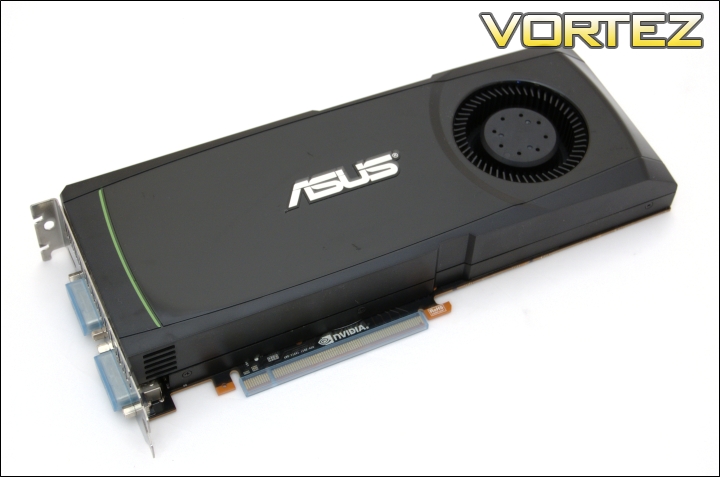
If you have read the recent AMD HD6970 2GB review, you will more than likely be familiar with the GTX580’s performance but I won’t spoil it for others so read on for an in-depth look at how it performs!
Specifications
The GF110 chip shares a lot of its roots with the GF100 core. The GPU still packs an impressive 3.2 billion transistors in a die seize 520mm squared. Its default internal configuration has been ported from GF100 in that the GPU features 512 CUDA cores or shader processors as we are more accustomed to. There are organised in a 4x16x32 block where 16 denotes the number of stream multi-processors (SM) and 32 being the number of cores on each SM. Each SM has its own L1 Cache and a common L2 Cache is shared by all 16. The GPU is still manufactured on the 40nm process.
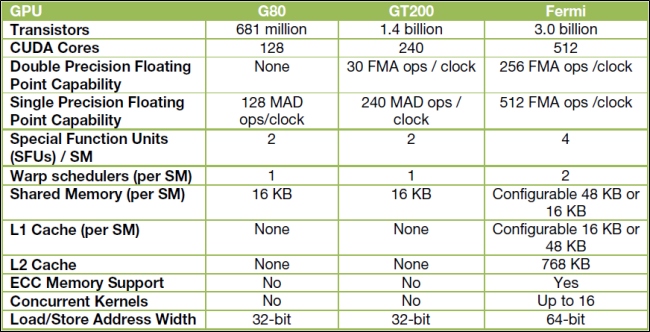
With the GTX480, only 15 of the total 16 SM were enabled to give it 480 CUDA cores and consequently, it boasted 60 texture units. The GTX580 uses a fully-fledged GF110 GPU and thus retains all 16 SM with none being disabled. The result is 512 fully operational CUDA cores and since the number of texture units is based on the number of stream-multiprocessors, the GTX580 sports 64 units instead of the 60. The number of ROPs has remained the same at 48 and the L2 Cache is still 768 KB. In terms of shader and texturing power, having 512 CUDA cores boosts performance by 6.6% over 480 CUDA cores. Nvidia have gone further with the GTX580 though. Not only have they increased the clock speed on the GTX580 compared to the GTX480, but they have also employed the GF104’s superior texture filtering capabilities in their tweaked GF110 GPU. Improvements have also been done to the tessellation engine so the already very capable performance that is expectant of the Fermi architecture has gone a step further.
The number of memory controller on the new GF110 GPU has remained untouched so the GTX580 has 6 memory controllers each sporting a 256MB framebuffer to give 1536MB of available memory. The GTX580, as with the GTX480 it is replacing, has a 384-bit memory interface that has been teamed up with GDDR5 memory for unmatched bandwidth.
GTX480: 15 SMs x 32 = 480 Core, 15 SMs x 4 = 60 texture units
32-bit channel x 12 = 384-bit interface, 256MB x 6 memory controllers = 1536MB memory
GTX580: 16 SMs x 32 = 512 Core, 16 SMs x 4 = 64 texture units
32-bit channel x 12 = 384-bit interface, 256MB x 6 memory controllers = 1536MB memory
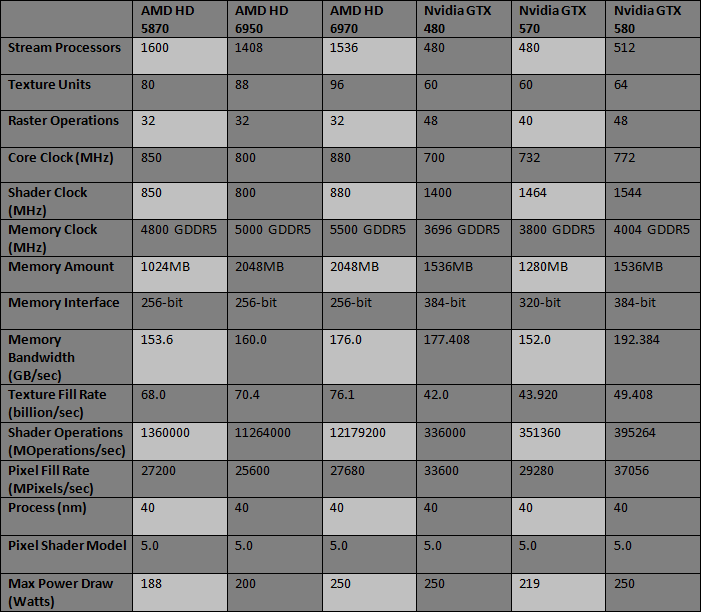
At the same clock speed, the extra 32 CUDA cores alone give the GTX580 a 6.6% shader and texturing performance advantage over the GTX480. Given the 10% and 8% increase in core clock speed and memory clocks respectively, we can expect the GTX580 to widen its lead. Looking at the texture fill rate and shader operations, the GTX580 theoretically provides 17% more performance that the GTX480 it replaces, not a bad upgrade considering that the price points at launch are the same. At a retail price of $499, it is currently the most expensive graphics card on the market but it is yet to be seen if the price premium is worth the performance benefits.
Product Specifications
Graphics Engine: Nvidia GeForce GTX580
Model: ASUS ENGTX580/2DI/1536MD5
Bus Standard: PCI Express x16 2.0 (Compatible with 1.1)
Memory Size (MB): 1536 GDDR5
Memory Interface: 384-bit
Core Clock Speed (MHz): 782
CUDA Cores: 512
Shader Clock (MHz): 1564
Memory Clock Speed (MHz): 4004
3D API: Direct X 11 & OpenGL 4.0
DVI Output: 2 (DVI-I)
HDMI: 1 (via Mini HDMI to HDMI adaptor)
VGA: Supported using DVI-to-VGA adapter
Display Output (Max Resolution): 2560 x 1600
SLI Support: Yes
Card Dimension (mm): 268 x 115mm
Graphics Engine: Nvidia GeForce GTX580
Model: ASUS ENGTX580/2DI/1536MD5
Bus Standard: PCI Express x16 2.0 (Compatible with 1.1)
Memory Size (MB): 1536 GDDR5
Memory Interface: 384-bit
Core Clock Speed (MHz): 782
CUDA Cores: 512
Shader Clock (MHz): 1564
Memory Clock Speed (MHz): 4004
3D API: Direct X 11 & OpenGL 4.0
DVI Output: 2 (DVI-I)
HDMI: 1 (via Mini HDMI to HDMI adaptor)
VGA: Supported using DVI-to-VGA adapter
Display Output (Max Resolution): 2560 x 1600
SLI Support: Yes
Card Dimension (mm): 268 x 115mm
Features
ASUS Exclusive Innovations
•Voltage Tweak: Full throttle overclocking with exclusive ASUS Voltage Tweak via Smart Doctor – boosting 50% more speed, performance and satisfaction! (The quoted figure of 50% is based on the increased headroom as opposed to actual 50% better performance)
•Overclocked: Factory overclocked to perform at 890MHz, 10MHzhigher than stock performance, resulting in higher frame rates in games.
•ASUS Smart Doctor: Intelligent system monitoring for efficient overclocking with an intuitive slide bar
•ASUS Gamer OSD: Real-time overclocking, benchmarking and video capturing in any PC game!
•Splendid Video Intelligence Technology: Optimizes colours in various entertainment scenarios with five special modes – standard, game, scenery, night view and theatre.
•Voltage Tweak: Full throttle overclocking with exclusive ASUS Voltage Tweak via Smart Doctor – boosting 50% more speed, performance and satisfaction! (The quoted figure of 50% is based on the increased headroom as opposed to actual 50% better performance)
•Overclocked: Factory overclocked to perform at 890MHz, 10MHzhigher than stock performance, resulting in higher frame rates in games.
•ASUS Smart Doctor: Intelligent system monitoring for efficient overclocking with an intuitive slide bar
•ASUS Gamer OSD: Real-time overclocking, benchmarking and video capturing in any PC game!
•Splendid Video Intelligence Technology: Optimizes colours in various entertainment scenarios with five special modes – standard, game, scenery, night view and theatre.
3D Graphics
•Full Microsoft® DirectX® 11 Shader Model 5.0 support: o NVIDIA PolyMorph Engine with distributed HW tessellation engines
•BC6H and BC7 texture compression formats
•Gather4 extensions
•OpenGL 4.1 support
•Advanced image quality features: o 32× coverage sample antialiasing
•Transparent multisampling and transparent supersampling
•16× angle independent anisotropic filtering
•128-bit floating point high dynamic-range (HDR) lighting with antialiasing; 32-bit per-component floating point texture filtering and blending
•Interactive ray tracing support
•Full-speed frame buffer blending
•Full-speed FP16 texture filtering
•Advanced lossless compression algorithms for color, texture, and zdata
•Support for normal map compression
•Adaptive z-cull
•Early-Z
GPU Computing
•NVIDIA CUDA™ technology—allows the GPU cores to provide performance improvements for applications such as video transcoding, gaming, ray tracing, and physics. API support includes: o CUDA C
•CUDA C++
•DirectCompute 5.0
•OpenCL
•Java, Python, and Fortran
•Third Generation Streaming Multiprocessor (SM) o 32 CUDA cores per SM
•Dual Warp Scheduler simultaneously schedules and dispatches instructions from two independent warps
•64 KB of RAM with a configurable partitioning of shared memory and L1 cache
•Second Generation Parallel Thread Execution ISA o Unified Address Space with Full C++ Support
•Optimized for OpenCL and DirectCompute
•Full IEEE 754-2008 32-bit and 64-bit precision
•Full 32-bit integer path with 64-bit extensions
•Memory access instructions to support transition to 64-bit addressing
•Improved Performance through Predication
•Improved Memory Subsystem o NVIDIA Parallel DataCacheTM hierarchy with Configurable L1 and Unified L2 Caches
•Greatly improved atomic memory operation performance
•NVIDIA GigaThreadTM Engine o 10x faster application context switching
•Concurrent kernel execution
•Out of order thread block execution
Nvidia Technology
•NVIDIA SLI® technology—patented hardware and software technology allows up to four NVIDIA GeForce GPUs to run in parallel to scale performance and enhance image quality on today’s top games.
•NVIDIA PhysX™ technology—allows advanced physics effects to be simulated and rendered on the GPU.
•NVIDIA 3D Vision™ Ready— GeForce GPU support for NVIDIA 3D Vision, bringing a fully immersive stereoscopic 3D experience to the PC.
•NVIDIA 3D Vision Surround™ Ready—scale games across 3 panels by leveraging the power of multiple GPUs in an NVIDIA SLI configuration. Combine with 3D Vision technology for the ultimate 3 panel stereoscopic 3D gaming experience.
Advanced Display Functionality
•Two pipelines for dual independent display
•Two dual-link DVI outputs for digital flat panel display resolutions up to 2560×1600
•Dual integrated 400 MHz RAMDACs for analog display resolutions up to and including 2048×1536 at 85 Hz
•HDMI 1.4a support including GPU accelerated Blu-ray 3D support, x.v.Color, HDMI Deep Color, and 7.1 digital surround sound. See www.nvidia.com/3dtv for more details.
•DisplayPort 1.1a support
•HDCP support up to 2560×1600 resolution on all digital outputs
•10-bit internal display processing, including support for 10-bit scan out
•Underscan/overscan compensation and hardware scaling
Video
• NVIDIA® Pure Video® HD technology with VP4 programmable video processor
•Decode acceleration for MPEG-2, MPEG-4 Part 2 Advanced Simple Profile, H.264, MVC, VC1, DivX (version 3.11 and later), and Flash (10.1 and later)
•Blu-ray dual-stream hardware acceleration (supporting HD picture-in-picture playback)
•Advanced spatial-temporal de-interlacing
•Noise reduction
•Edge enhancement
•Bad edit correction
•Inverse telecine (2:2 and 3:2 pull-down correction)
•High-quality scaling
•Motion Compensation
•Video color correction
•Dynamic contrast enhancement and color stretch
Digital Audio
•Support for the following audio modes: o Dolby Digital (AC3), DTS 5.1, Multi-channel (7.1) LPCM, Dolby Digital Plus (DD+), MPEG2/MPEG4 AAC
•Data rates of 44.1 KHz, 48 KHz, 88.2 KHz, 96 KHz, 176 KHz, and 192 KHz
•Word sizes of 16bit, 20bit, and 24bit
Power Management Technology
•Advanced power and thermal management for optimal acoustics, power, and performance based on usage:
•ASPM power management
•Adaptive Clocking
•Adaptive Power States
•Advanced fan control
•Power and temperature monitoring
Packaging and Content
The front of the box
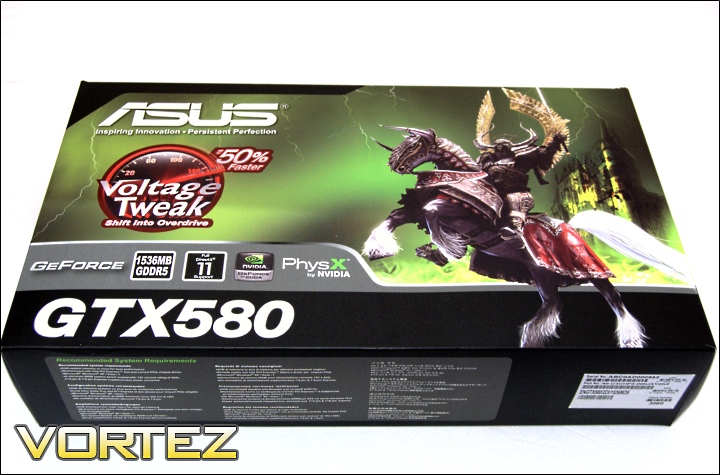
The design on the box is noticeably very similar to that used on all their graphics card such as the recently reviewed AMD HD6970. The main difference is the green and black theme as opposed to the red and black one, differentiating the packaging for their Nvidia products. The packaging depicts a rampaging horseman symbolising ASUS’s dominance and power. The highlight of the ASUS card is its unique voltage tweaking capability, shown on the front. The utility is claimed to potentially increase performance by 50% but this is most likely attributed to the increased overclocking headroom as opposed to actual performance. Some of the key features of the GTX580 are illustrated above the boldly printed model name, such as DirectX 11 and PhysX support. The graphics card comes with a 1536MB GDDR5 framebuffer, an impressive count on top of the 384 bit memory bus.
The back of the box
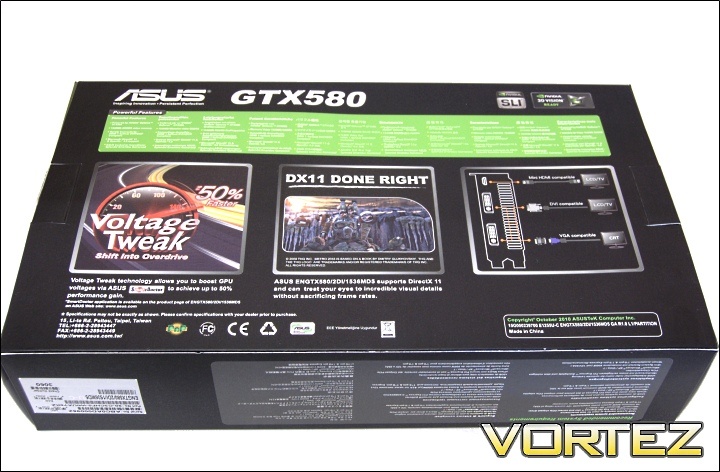
The back of the box is more informative and covers some of the card’s key characteristics is greater depth. At the top, the features are listed in 11 languages whilst below that are illustrations of DX11 in action and the Voltage Tweak tool, as well a short description of their benefits. Additionally there is an illustration of the different display connectors that can be found on the card’s I/O panel.
The specifications on the box
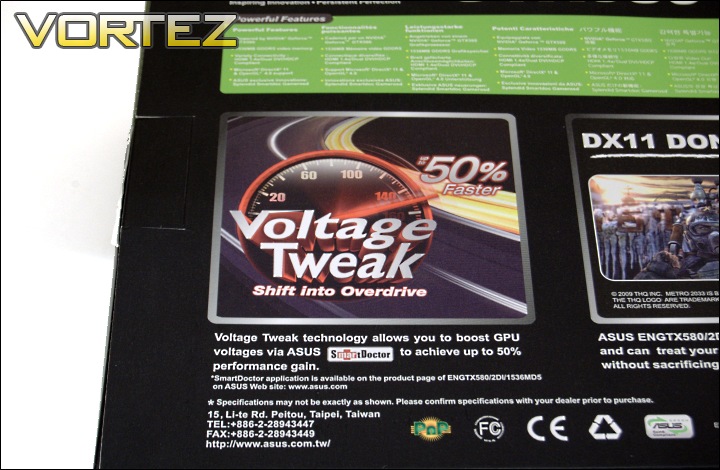
Voltage Tweaking has been one of ASUS’s dominating features since the launch of their HD5870 a year ago and it’s good to see that its implementation still appears on all their high end offerings. Voltages can be adjusted using the bundled SmartDoctor application and ASUS claim that the increased overclocking headroom can achieve up to 50% better performance. In reality, this will not be possible but the feature is still a welcomed addition.
Opening the box
Inside the main packaging is a blank box with the gold ASUS emblem in the middle.
The box compartments
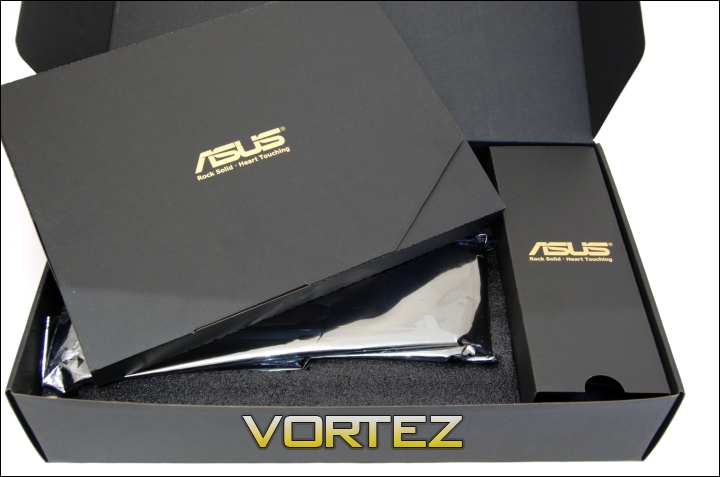
Inside are two compartments, one holding the manual and driver disk, and the other containing the accessories. The graphics card is neatly wrapped in a protective anti-static bag, enclosed within foam padding.
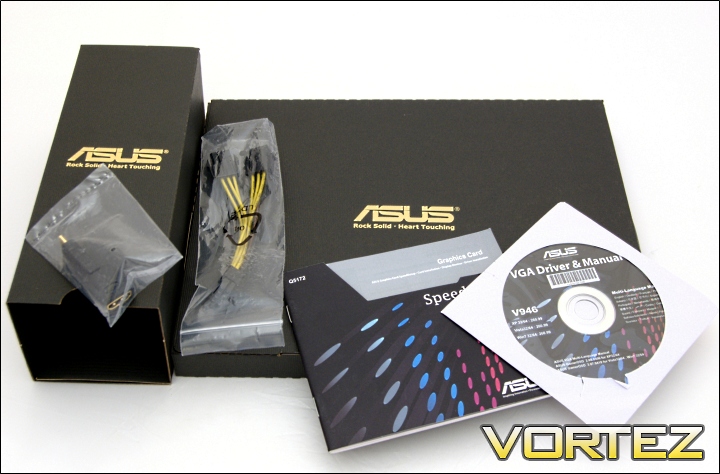
The bundle
The top compartment is reserved to the accessories and installation guide. Included are:
– 1 x Dual 6 Pin to 8 Pin power adapter
– 1 x Mini HDMI to HDMI adaptor
– 1 x Multi-lingual quick-installation guide
– Driver disc
The bundle is fairly mundane and provides no extras on top of the essential accessories. The Mini HDMI adapter is to provide compatibility for Mini HDMI port on the GTX580.
Closer Look
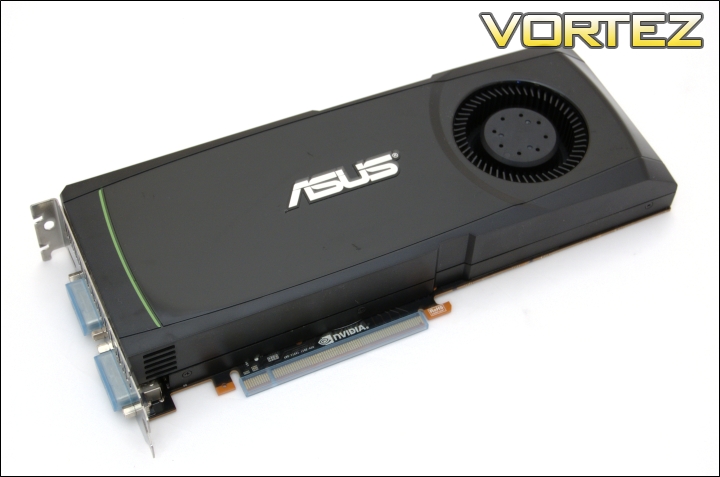
The graphics card
The ASUS GTX580 follows Nvidia’s reference design, sporting a black shroud with green accents depicting their traditional colours. ASUS have opted for a clean, simplistic look, preferring to place their badge in the center as opposed to using stickers to differentiate their card. The front end of the shroud is slightly slanted and lowered to accommodate the fan and to allow more air to flow through in tight SLI configurations. Unlike the Nvidia GTX480, the top of the metal heatsink has not been left exposed, most like because of the new cooler type being employed, which we will look at later on. Very conveniently, all the ports and connectors are protected by a blue plastic cover. The card is approximately 26.8cm in lengthm 6mm short of AMD’s HD6970.
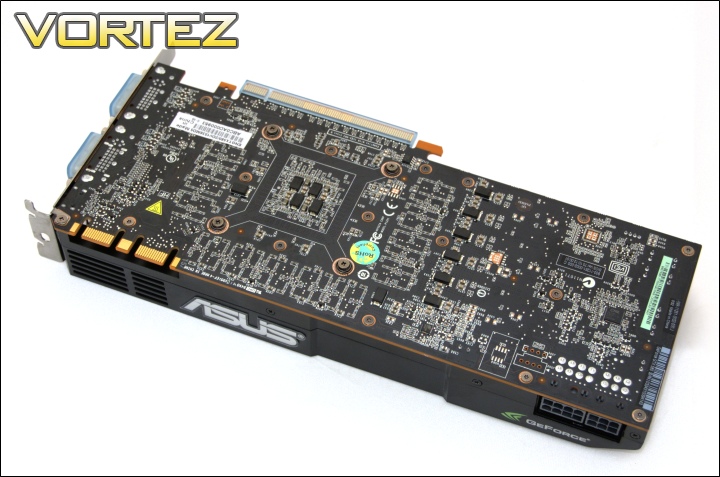
The back of the graphics card
The back of the card reveals the black PCB that has become favoured for its greater appeal in recent times. There is no backplate installed for additional cooling, indicating Nvidia’s confidence in a cooler and more efficient running card. Part of the VRM circuitry can also be seen at the back, making greater use of space to place the MOSFETs. The shroud below is attached using torx screws, shying away from the traditional ones used. The heatsink on the other hand is secured using spring loaded screws.
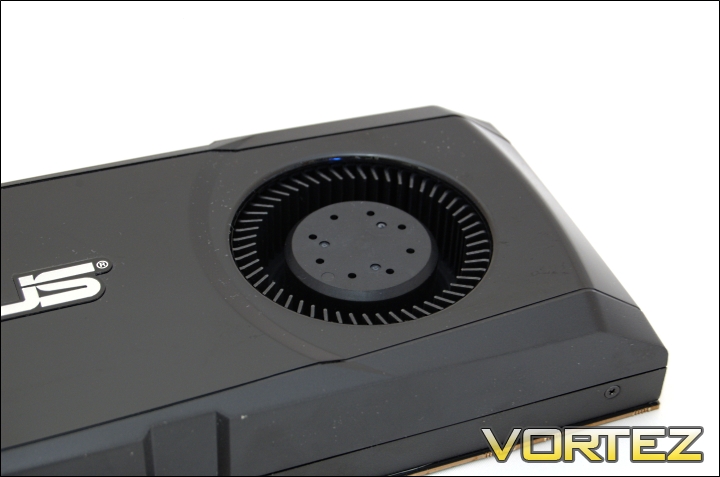
The fan
The fan uses a finned blower design to push air towards the rear of the card and hence out of the case. The fan supports PWM functionality and can be controlled by users or temperature based profiles. The fan is similar to those found on most blower style cooler, even ones from AMD such as that used on the reference HD6970.
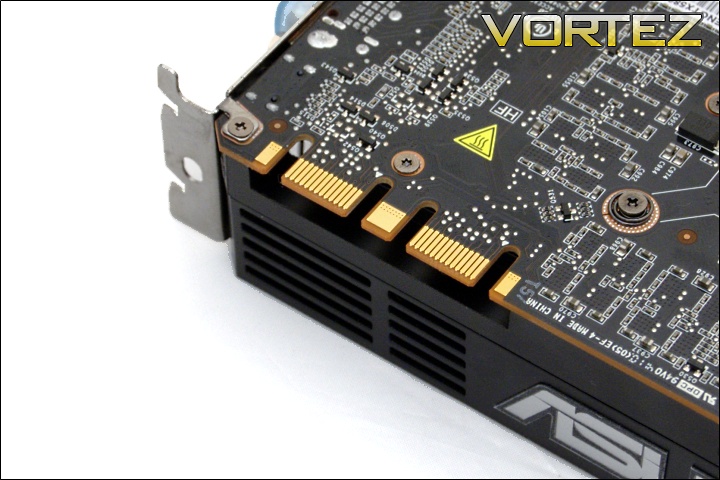
The SLI Connectors
On the side of the card are two SLI connectors. The GTX580 can be used in a quad-SLI setup should the motherboard permit (NF200 chipset required). If not tri-SLI is also supported.
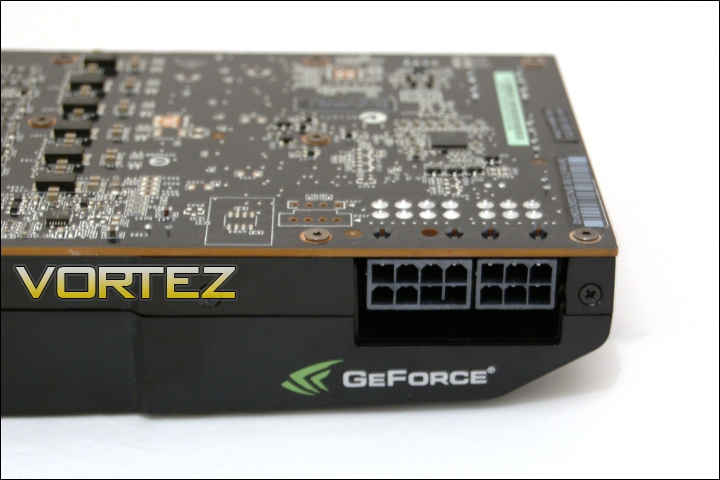
The 6 & 8 pin power connectors
Like the GTX480 and AMD’s HD6970, the GTX580 has one 6 pin and one 8 pin PCIe power connectors, immediately suggesting high power draw. These are conveniently situated on the side rather than at the end to ensure that the cables do not get in the way of HDD cages or other components. One dual 6 pin-to-8 pin adapter is bundled for power supplies lacking 8 pin power cables.
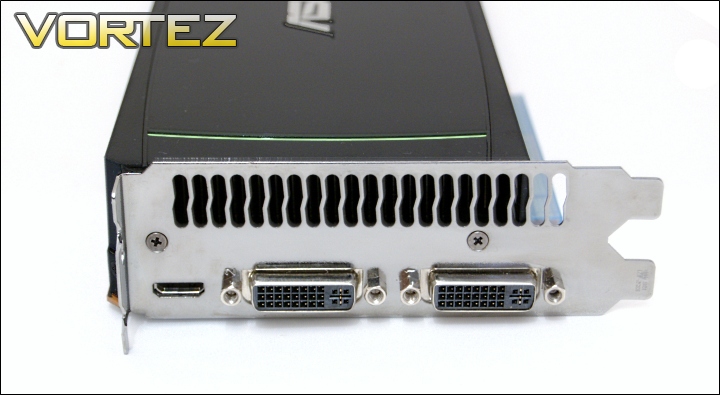
The I/O Panel ports
Nvidia are not as generous as AMD when it comes to connectivity. The ASUS card has two DVI connectors on the I/O panel and a single mini-HDMI port supporting the latest 1.4a standard. The ports also support Nvidia Surround technology, without requiring DisplayPort, as long as another GTX580 is used in SLI.
Closer Look (Continued)
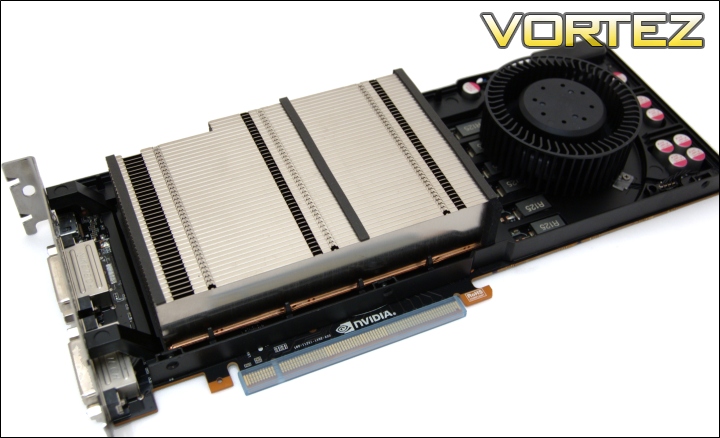
Taking off the shroud
Removing the shroud, we can see a bracket attached to the PCB supporting the fan and heatsink. The fan is a circular shaped with vertical fans as opposed to bladed, making it more ideally suited to pushing air towards the back. The ring surrounding the fins at the top provides stability to prevent fan vibrations. The heatsink itself has departed from heat piped based designs hence the smaller footprint.
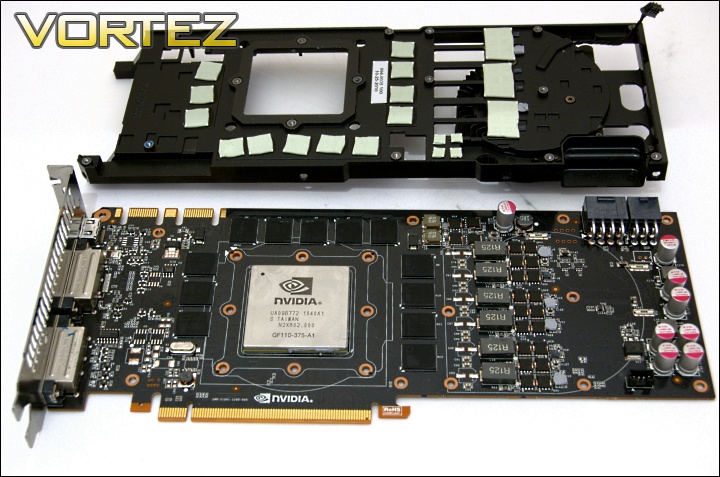
The PCB
And underneath the metal bracket, the PCB is exposed revealing the layout of the individual components. The PCB appears very packed with components and the VRM power circuitry looks very robust. The board employs a 6 phase power design for the core and further 2 phases for the memory, as indicated by the chokes. The thermal pads on the base of the metal brackets are for additional cooling of the memory modules and circuitry.
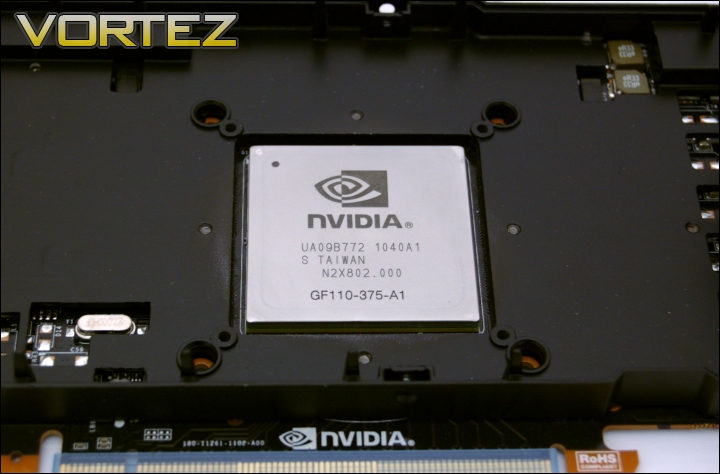
The GF110 core
The GF110 core is a monster of a chip, with a 520mm squared die size packing over 3 billion transistors. If anything, the integrated heat spreader is indicative of the core underneath, creating a large enough surface area for maximum heat dissipation.
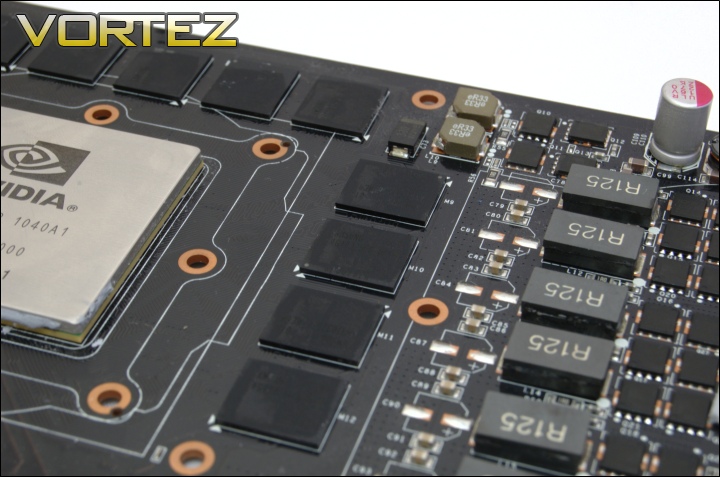
The Samsung K4G10325FE-HC04 memory modules
There are a total of 12 128MB memory modules for 1.5GB of on-board GDDR5 memory. The modules have been sourced from Samsung and carry the model name K4G10325FE-HC04. These are rated at 0.4ns for a rated speed of 5Gbps. The memory on the GTX580 only come clocked at 4004MHz, suggesting high overclocking headroom.
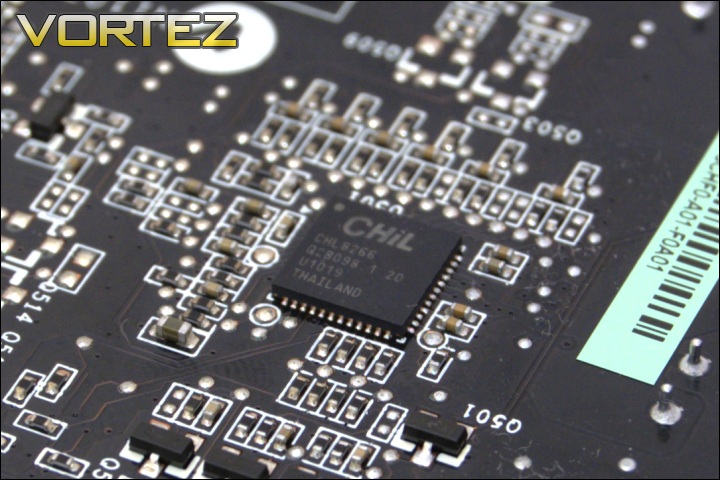
The CHiL CHL 8266 voltage controller
The CHiL CHL 8266 voltage controller enabled voltage control and monitoring, making it an excellent addition for overclockers.
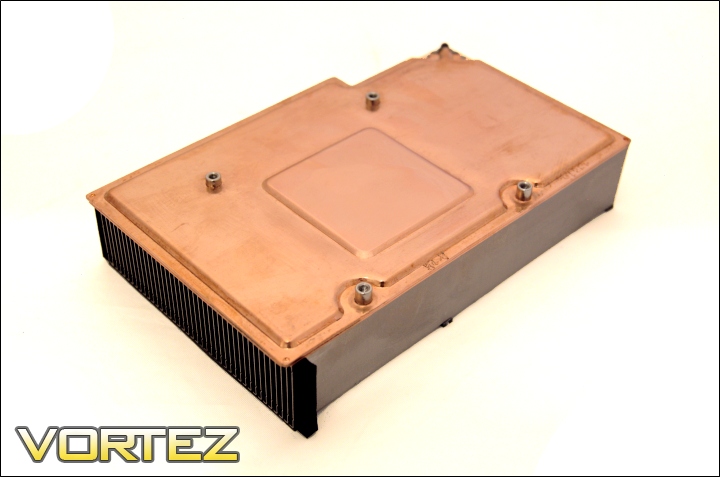
The vapour chamber heat plate
One of the ways Nvidia have attempted to tackle the heat generated by the core is a vapour chamber cooler. The copper heat plate contains liquid in the base (the raised middle portion of the plate that is in contact with the GPU). The liquid evaporates and absorbs further latent heat through its phase transition to vapour. The vapour rises and condenses on the outside upper part of the heat plate releasing heat which is then transmitted to the overlying fin array. The condenser fluid circulates around the outside of the heat plate. This type of cooler is a first for Nvidia, who have traditionally opted for heat pipe based heatsinks. The advantage of the vapour chamber is the larger surface area of the heat plate for greater heat transfer.
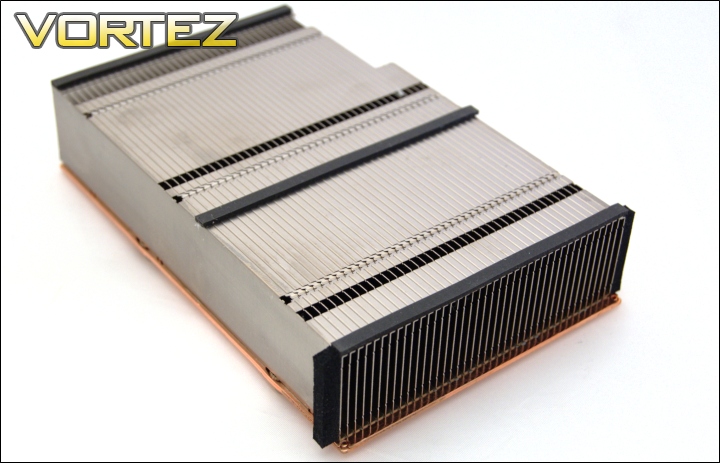
The heatsink fin array
Heat that is transferred to the heat sink across the fins is dissipated by airflow from the fan towards the exhaust port on the rear. The design is very efficient but it is yet to be seen how practical it is in real life applications.
Test Setup
CPU – Intel Core i7 920
RAM – 6GB (3x2GB) OCZ platinum DDR3 1333mhz
Motherboard – ASUS Rampage III Extreme
Power Supply – Enermax Revolution 85+ 850W
Hard Drive – OCZ Vertex 2E 120GB
Samsung F3 1TB
Samsung F1 320GB
Cooler – Noctua NH-C14
Graphics Cards:
ASUS GTX580 1536MB @ 782/4000MHz & 903/4220MHz Overclocked – Forceware 262.99
ASUS HD6970 2048MB @ 890/5500MHz & 949/5896MHz Overclocked – ATI Catalyst 10.12a (8.790.6.2)
HIS HD6950 2048MB @ 800/5000MHz & 865/5500MHz Overclocked – ATI Catalyst 10.11 (8.790.6.0, 8.790.6.2 & 8.800)
Nvidia GTX480 1536MB @ 700/3696MHz & 799/3906MHz Overclocked – Forceware 260.99
MSI R6870 2PM2D1GD5 1024MB @ 900/4200MHz – ATI Catalyst 10.10
ASUS EAH6850 DirectCU 1024MB @ 790/4000MHz – ATI Catalyst 10.10
XFX HD5870 1024MB @ 850/4800MHz & 942/5200MHz Overclocked – ATI Catalyst 10.10
Benchmark Suite
MSI Afterburner & Kombustor
ASUS SmartDoctor
GPU-z
Crysis Warhead using the FRAMEBUFFER Crysis benchmark tool
Far Cry 2
Metro 2033
Resident Evil 5
Street Fighter IV
Unreal Tournament 3 using the HOC Bench tool
Colin McRae DIRT 2
Batman: Arkham Asylum
Battlefield Bad Company 2
Mafia II Demo
Colin McRae DIRT 2
Alien VS Predator
H.A.W.X 2
3DMark 11
3DMark Vantage
Unigine V2.1 DX 11 Benchmark
Software Bundle
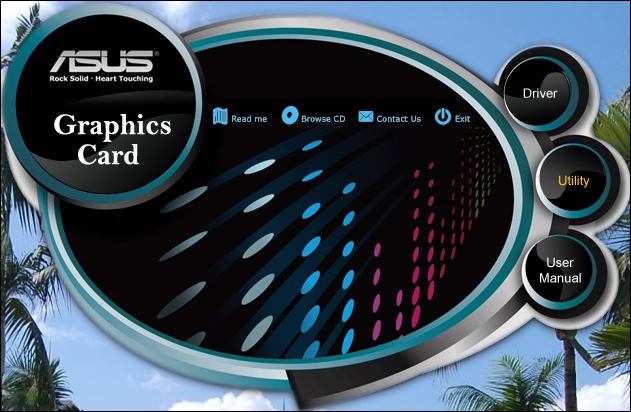
The driver CD includes the user manual, drivers and ASUS utilities, presenting them in an attractive bubbly user interface. For the latest Nvidia drivers, download them here.
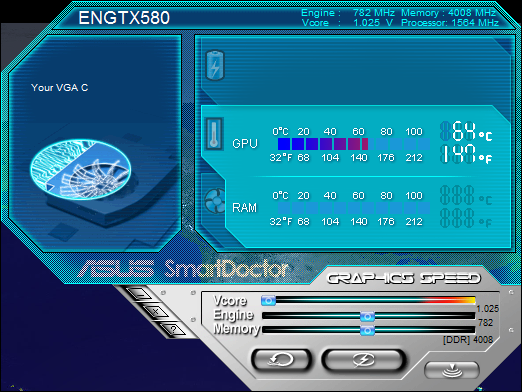
The ASUS SmartDoctor tool is an overclocking utility that has the unique capability of allowing users to increase the GPU core voltage. The user interface isn’t as sophisticated as MSI’s Afterburner application but keeping it simple is not always a disadvantage. At the bottom are three slider bars where users can select the VCore and clock speeds. The maximum limit for the voltage is 1.213V while the clock speeds are limited to 1000/5000MHz, plenty of headroom for this card. On the main screen, the application displays the temperature or selecting the fan tab will show you the fan speed. Going into the settings, it’s possible to create a fan profile based on temperatures.
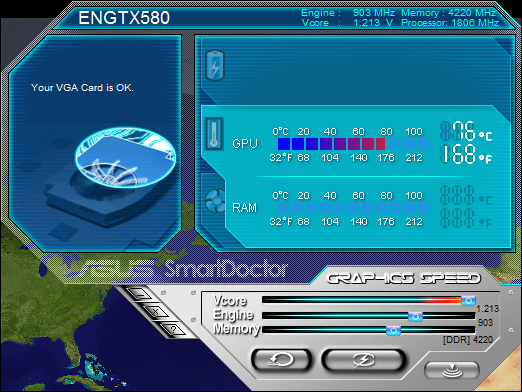
Here, we can see how easy it is to overclock. Simply use the sliders to set the desired clocks and it’s good to go. Of course, this doesn’t imply that all clock speeds will work and users will still have to go through the usual steps of testing for stability.
Power Monitoring
Overclocking is nothing without stability and for most enthusiasts; applications such as Furmark, OCCT or MSI Kombustor have been the stress test of choice to truly load graphics cards. However, both AMD and Nvidia have voiced their concerns against the use of such applications due to the number of cards killed as a result of high temperatures and unforgiving load. They believe that stress tests are not representative of gaming loads and should therefore not be used as an indicator for stability.
Last week we saw that AMD have implemented PowerTune to keep their cards’ TDP in line. Nvidia have to be given credit for being the first of the two manufacturers to actually deploy these power saving features on their GTX580. They have taken the hard line approach of making sure that the GTX580 doesn’t draw more than 300W of power by throttling the clock speeds under high load. Typically, such high power consumption can only be expected from stress testing applications such as Furmark, so games will continue to work without any throttling occurring. The main disadvantage compared to AMD’s implementation is that users have no control over the TDP at which the card will throttle and more annoyingly, clock speed changes are not recorded by any monitoring programs, making it harder to visualise any throttling. AMD also fall culprit to the latter issue. With regards to this, overclockers will find it hard to distinguish if their final clock speeds still fall within the limit of the TDP.
In this case, the benefits far outweigh the negatives, the positive being that the GTX580 will have a much longer life expectancy than the power hungry GTX480.
Temperature & Overclocking
Despite the heat associated with some of the latest Nvidia cards, they have proven to be good overclockers with adequate cooling, whether it is custom manufacturer’s design or third party coolers. The clock speed on the GTX580 have been boosted to 772/4004MHz compared to the GTX480 and ASUS have gone further and applied a 10MHz pre-overclock for a final speed of 782/4004MHz. At those clock speeds, the card operates at 1.014V at idle and 0.992V under load.
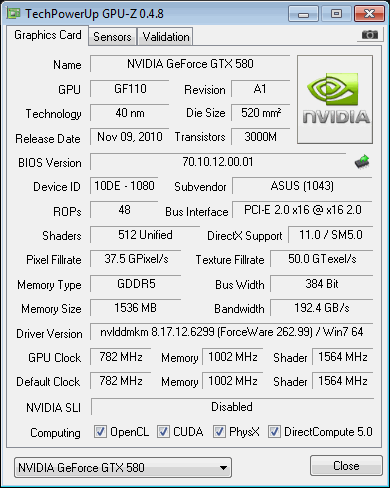
Stock speed
Overclocking on the GTX580 was a simple procedure. Although ASUS SmartDoctor provides support for voltage tweaking and overclocking, MSI Afterburner also provides the same functionality for all reference design GTX580s so I relied on that. First of all, the voltage was raised to the maximum possible at 1.213V and after constant overclocking and testing, a final speed of 903/4220MHz was reached. This represents a very healthy 17% overclock on the default core speed and 5% on the memory. Unfortunately, higher clocks were limited by the core rather than temperatures. At those clocks, the GTX580 operated at 1.195V at idle and 1.180V under load, showing a slight voltage drop from the value set.
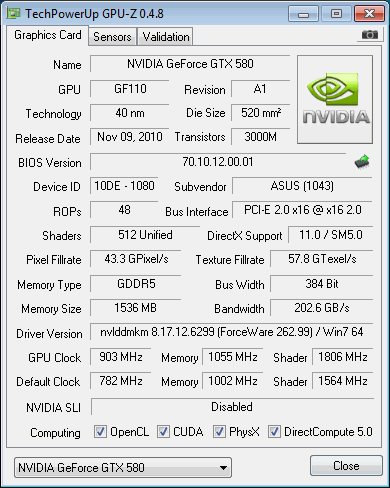
Overclocked speed
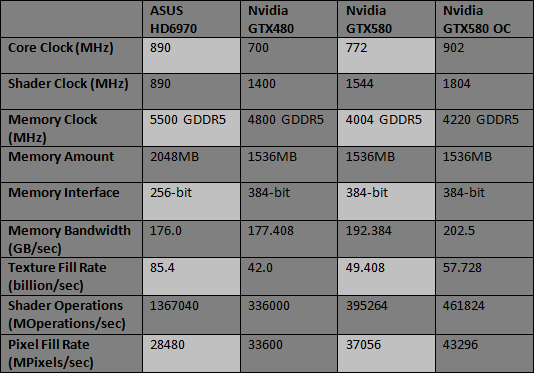
The 17% overclock on the core translates to the same boost in texture and pixel fill rate, and shader operations. Similarly, the 5% memory overclock generates the same gains in memory bandwidth. Compared to the AMD HD6970, the GTX580 has significantly better pixel fill rate but lower texture and shader performance. This is down to how they are calculated and will translate differently in real world performance because of the differences in architecture.
Overall, the overclock brings an average 8% increase in real world performance. This does not quite match up to the 17% overclock suggesting that the clock speed may have been throttling as a result of higher power consumption.
Temperature
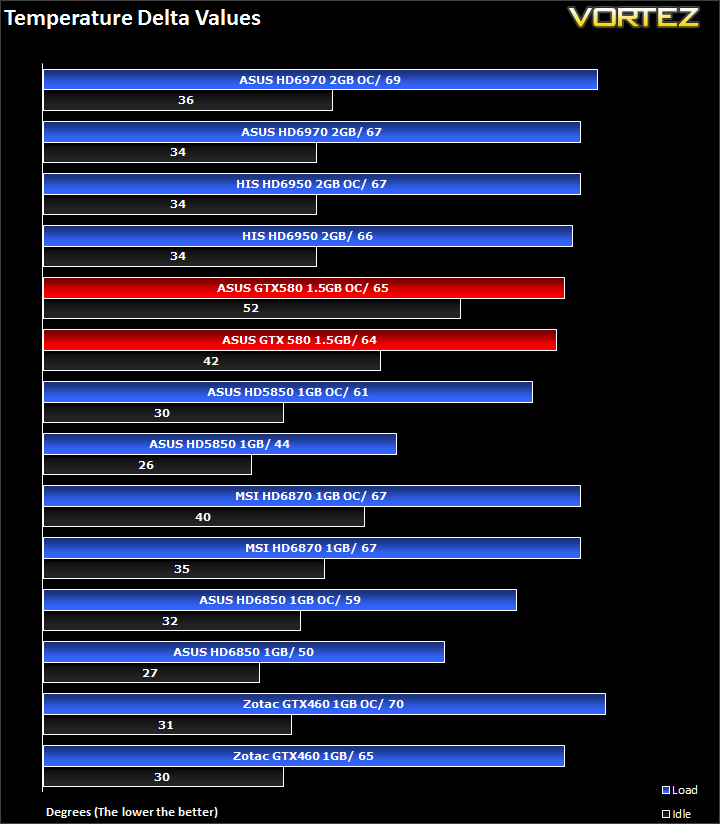
Temperatures on the GTX580 were very impressive. At stock clocks, the delta temperature was 64C, 3C less than the HD6970. The remarkable characteristic of the vapour chamber cooler was the noise, or the lack of it. Despite the fan spinning at a relatively quick 51% when idling, it remained inaudible over case fans. Under load, it operated at 69%, making the fan more audible but not significantly intrusive when gaming. The high idle temperature is attributed to the card not reducing its speed to 2D clocks. I was unsure of the reason but I expect that others won’t have the same problem.
When overclocked, the fan speed increased to compensate for the rising temperatures and in the end the delta was a mere 1C higher than stock speeds. However, the maximum fan speed reached 74% under load, making it somewhat intrusive. The solution; crank up the game volume.
Crysis Warhead
Following the success of Crysis, the stand alone expansion “Warhead” was hotly anticipated to bring more game play, more weapons, improved visuals whilst maintaining better performance, the latter being what gamers wanted most. After all how many people upgraded their rigs just to play this game… In the game, you play as the upbeat Brit Sergeant “Psycho” Sykes, chasing down a Korean nuclear warhead. Throw in some ice shooting aliens and we’re bound to have a great game. It sure delivered.
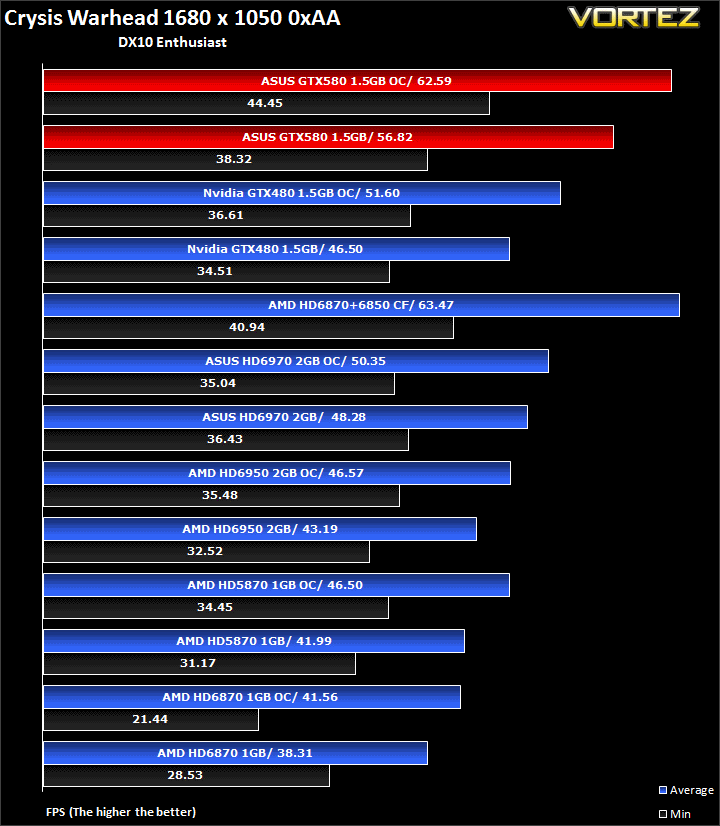
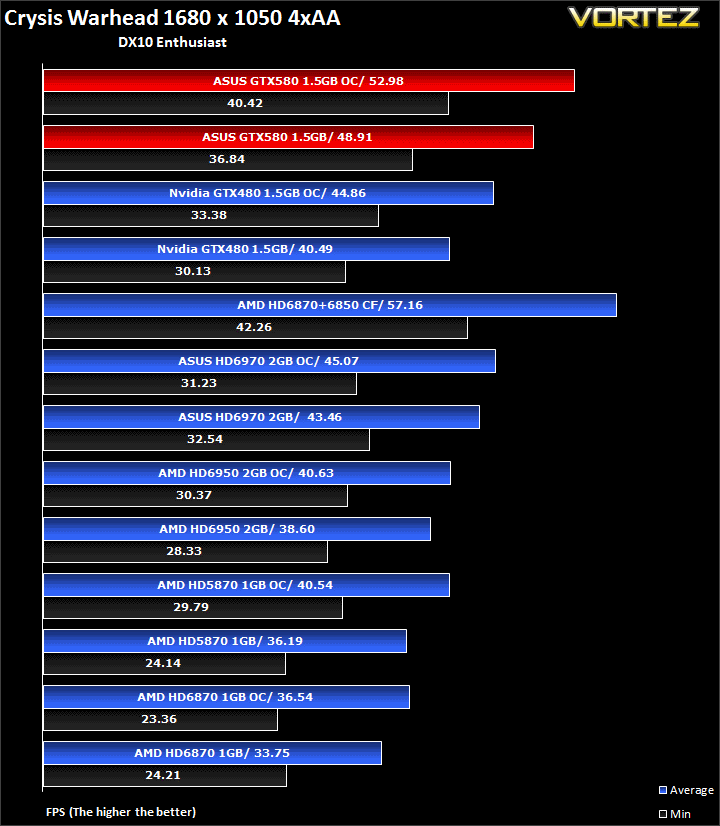
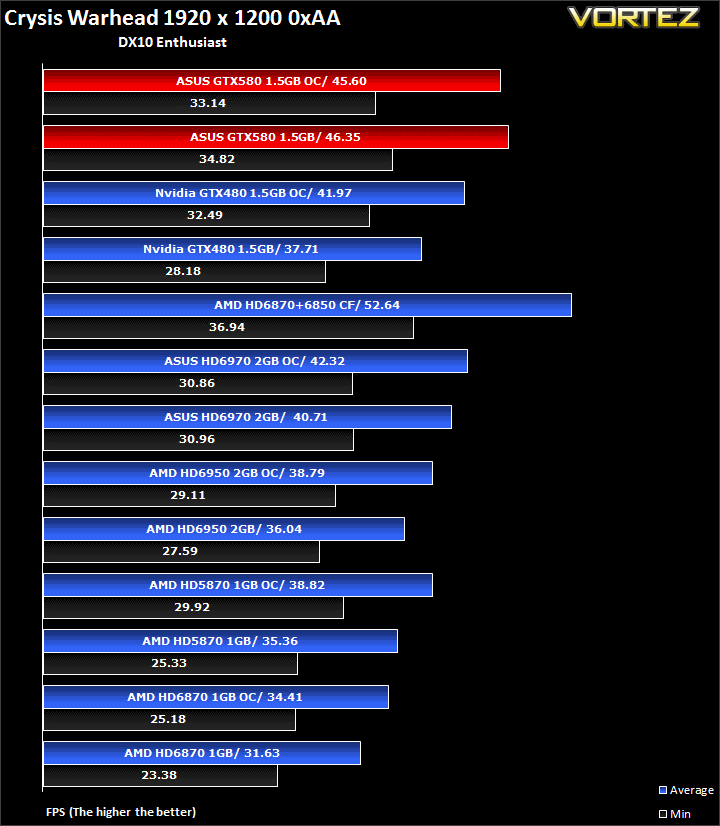
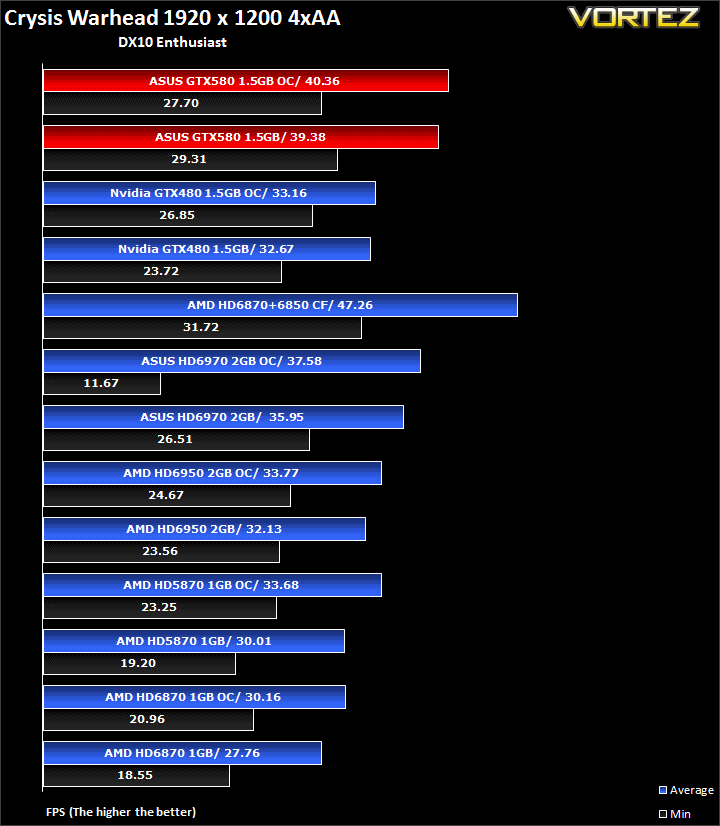
Testing was done using Framebuffer’s Crysis Warhead benchmarking tool. The tests were configured to DirectX 10 at Enthusiast levels. Each test on the Ambush map was looped three times from which the average FPS was recorded.
Stock
The GTX580 is clearly a brilliant performer, topping the chart as the best single GPU solution. It outperforms AMD’s flagship 6 series card by an average of 13%, losing its lead slightly with AA applied thanks to the HD6970’s 2GB framebuffer. Compared to the GTX480 it’s replacing, it leads by an impressive 20%. On the flip side, it loses out to the CrossFire setup by 13%.
Overclocked
The GTX580 extends its lead over AMD HD6970 to 14% but the performance gap between the GTX480 is reduced to 17.5%. Nonetheless, it still impresses as a single card solution.
Far Cry 2
One of the most hyped games of 2008, Far Cry 2 had some big shoes to fill. It was built to be the next best thing since well… Far Cry I suppose. Combining an open-world game play with highly detailed graphics, physics and AI, what more could we possibly want? The game puts us in the body of a malaria inflicted mercenary hunting down the “Jackal” in the heart of Africa, in a bid to stop an on-going conflict between two rival factions. The storyline can be hard to follow sometimes but I’m no game reviewer, so let’s concentrate on the graphics and performance. After all, we all need to know if our hardware will be able to handle the scorching savannah burning at the hands of our flamethrowers.
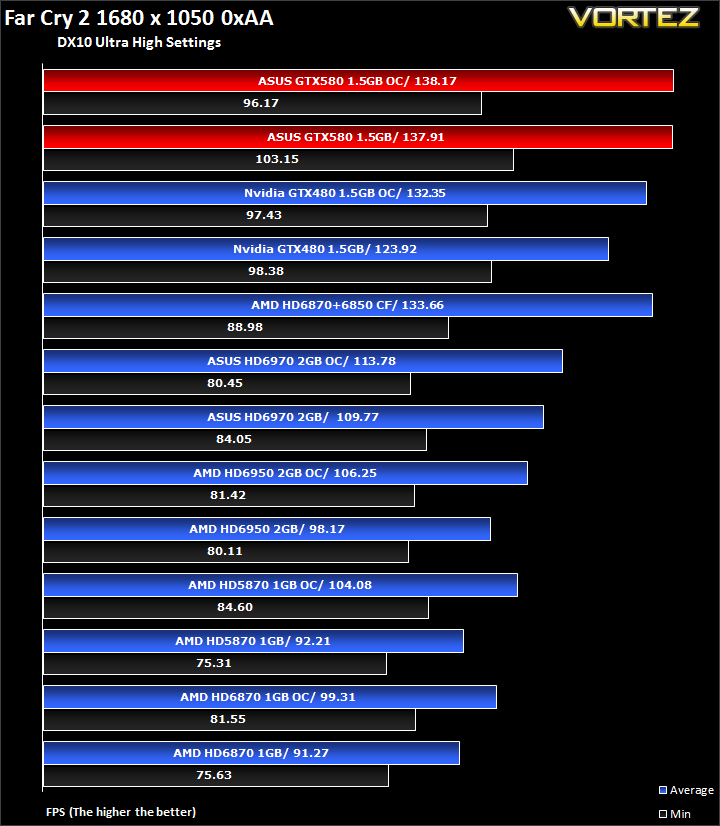
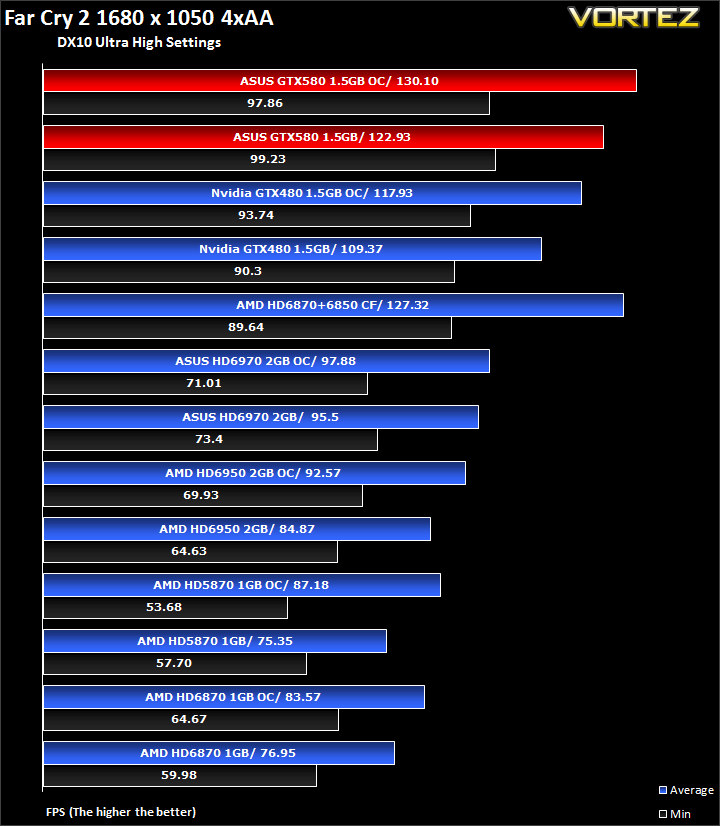
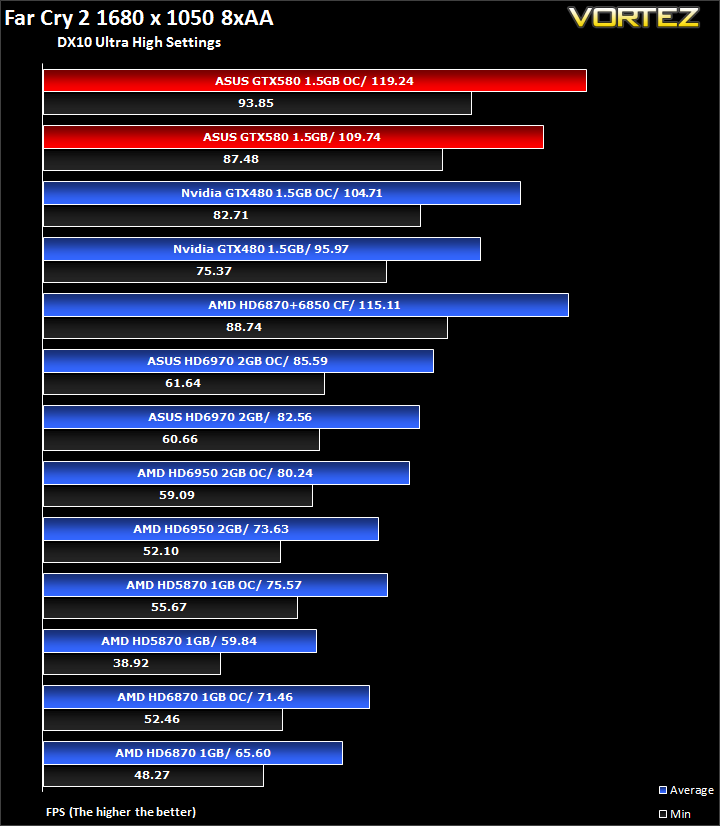
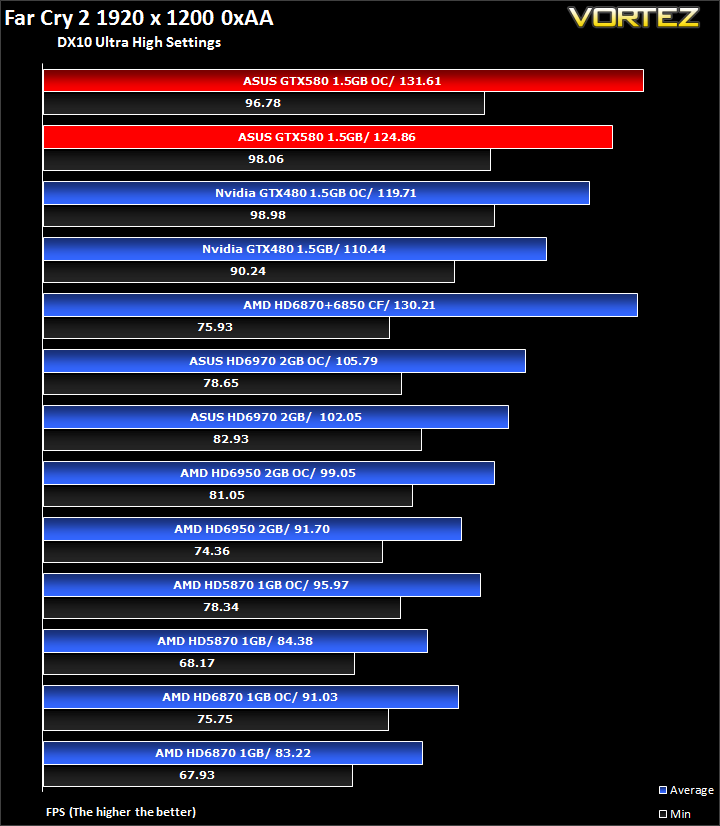
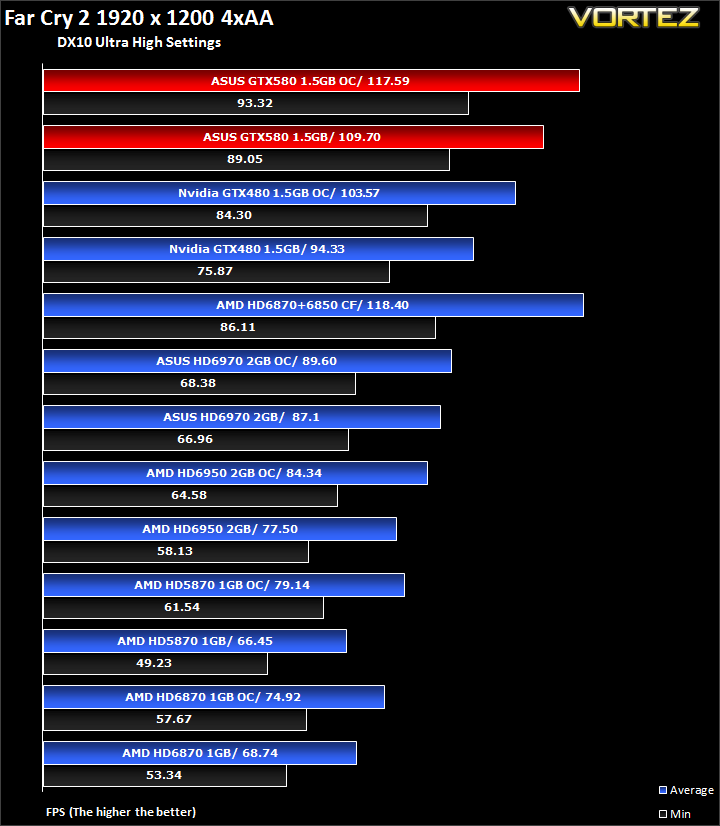
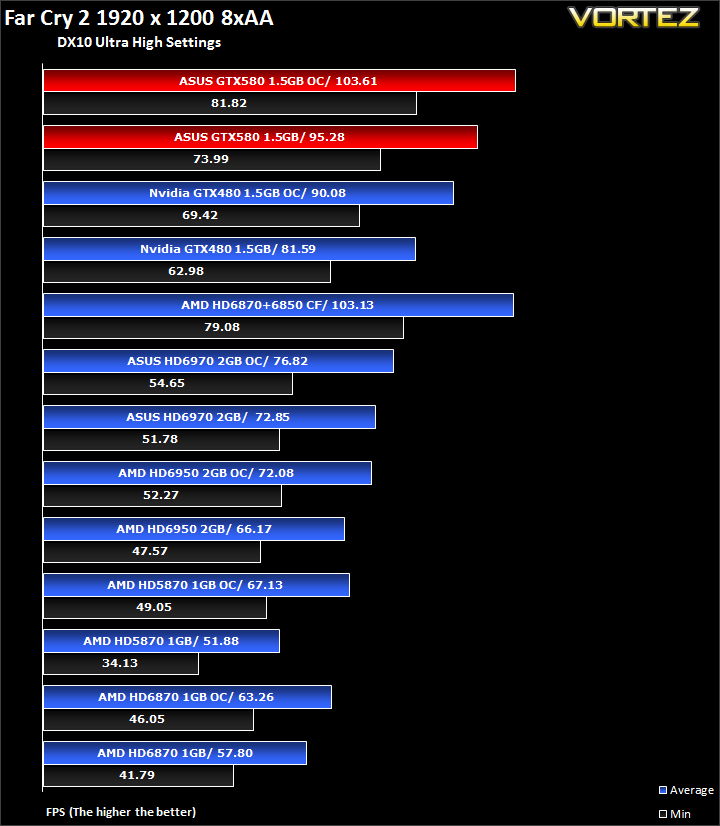
The bundled benchmarking tool was used on Far Cry 2, configuring the settings to Ultra and DX10. The small ranch level was chosen and each configuration was looped three times from which the average FPS was recorded.
Stock
Nvidia have continuously dominated in Far Cry 2 and it’s no different here. The GTX580 maintains a lead over the HD6970 by 28% on average. However, it does end up losing out to the Crossfire HD6870+HD6850 by 6%. Compared to its predecessor, the GTX580 holds a 15% advantage, winning out by a greater margin at higher resolutions.
Overclocked
Overclocked, the GTX580 extends its lead to 32.5% over a similarly overclocked HD6970. It still retains a performance advantage over the GTX480 but this is reduced to 13%.
Metro 2033
Based on Novel by the same name, Metro 2033 is a first person shooter with elements of survival horror. As Artyom, you trawl through the mutant infested metro systems of post-apocalyptic Moscow. The game delivers presents a grim ambience that reflects on the overall atmosphere of the underground setting. Metro 2033 uses the setting as a back drop to showcase some of the best visuals of any games out now, making it the ideal benchmark for those looking for the best graphics card.
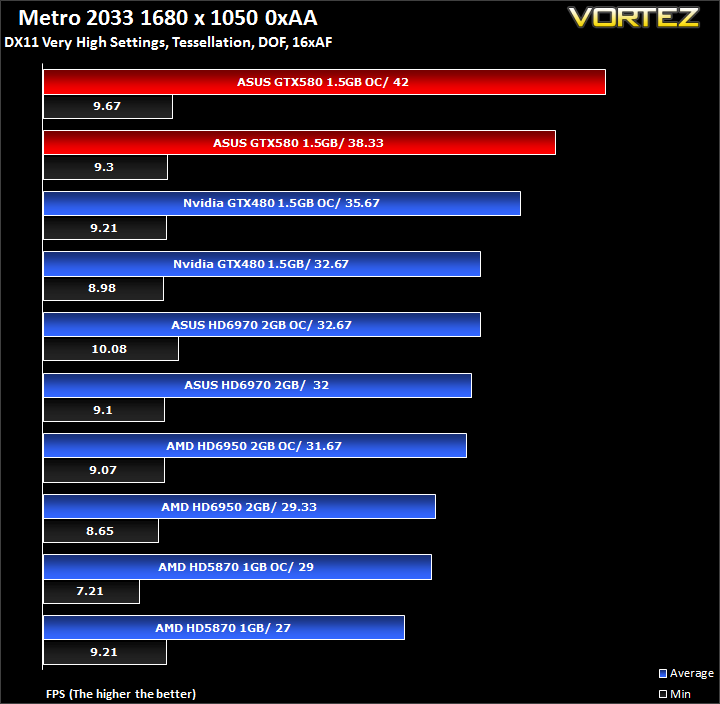
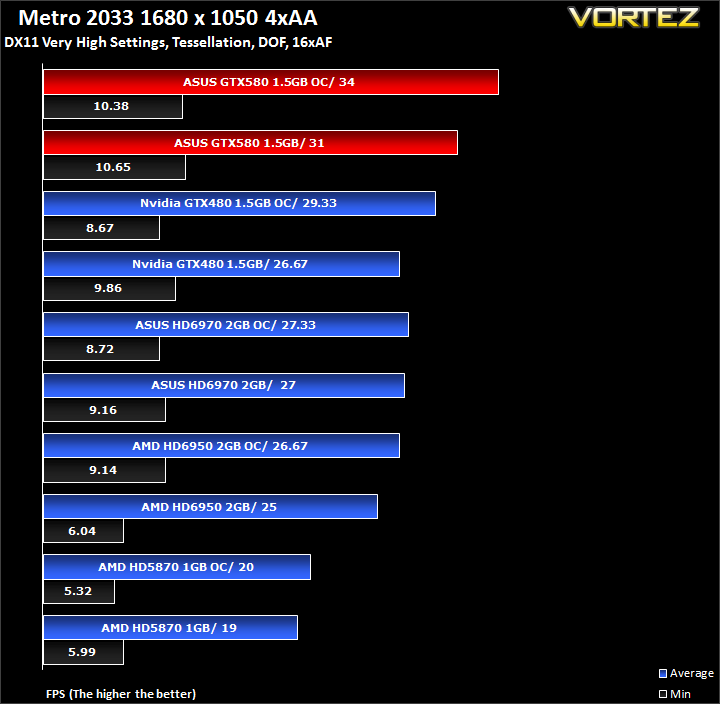
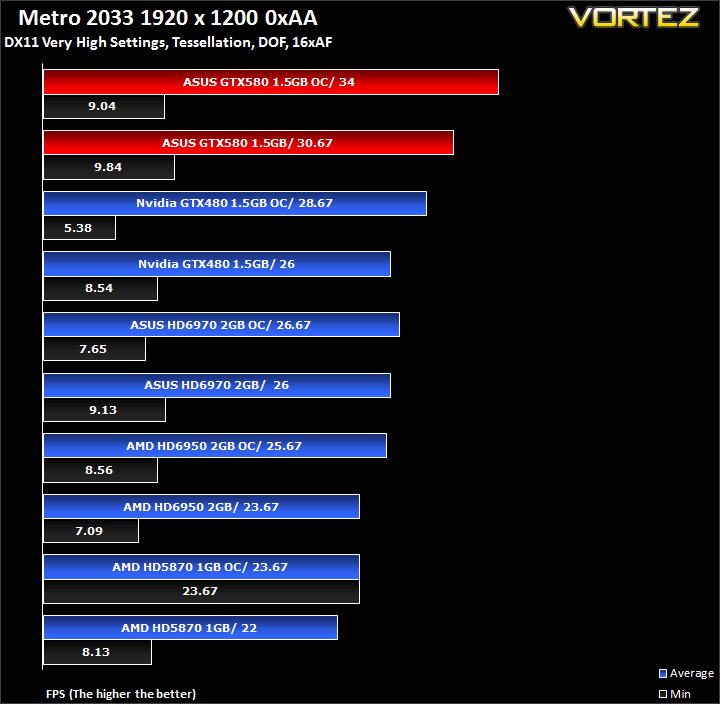
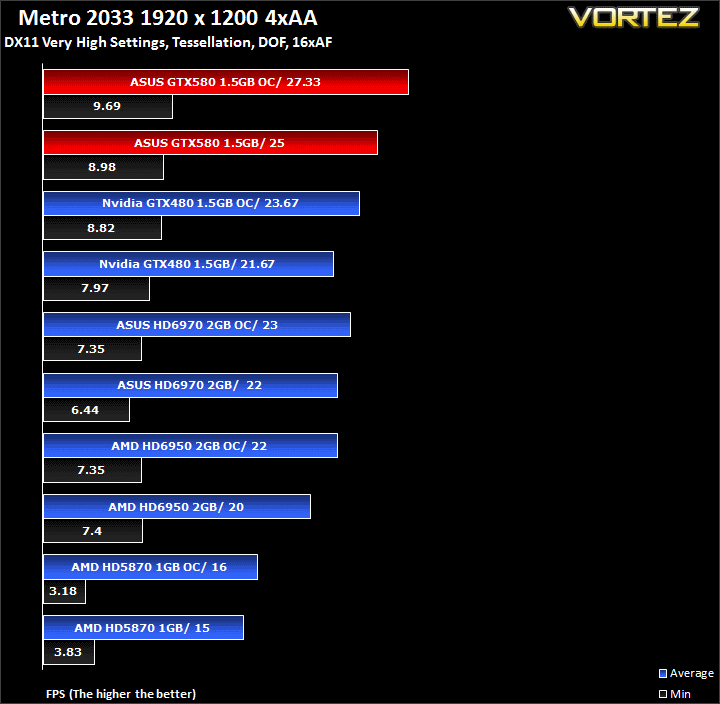
The bundled benchmarking tool was used on Metro 2033, configuring the settings to Very High and making use of DirectX 11. The frontline scene was looped 3 times for each configuration. The average FPS was recorded at the end.
Stock
The GTX580 continues its dominance in Metro 2033, being the only graphics card to generate near playable frame rates. It leads the HD6970 by 13-20%, the smaller margin at higher AA settings due to less available memory in this intensive game. Compared to the GTX480, its 17% advantage reflects the theoretical benefits of the GF110 core and the bumped clocked speeds on the GTX580.
Overclocked
When overclocked, it extends its lead on both the overclocked HD6970 and the GTX480, the difference over the former being more significant at 25%.
Resident Evil 5
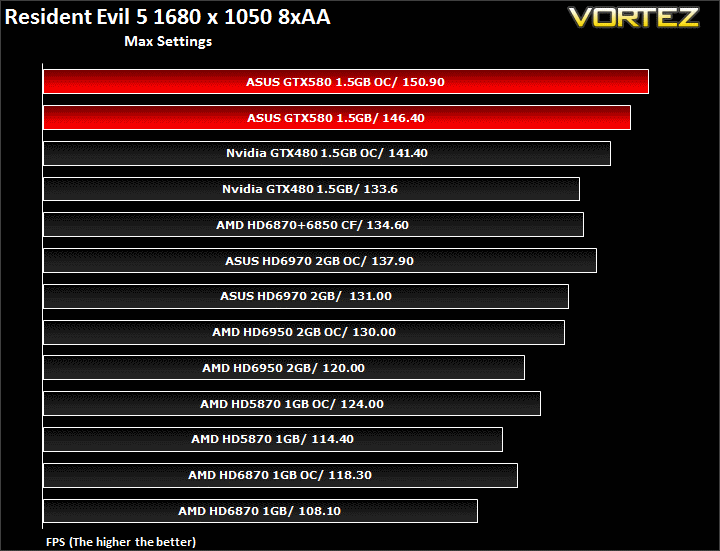
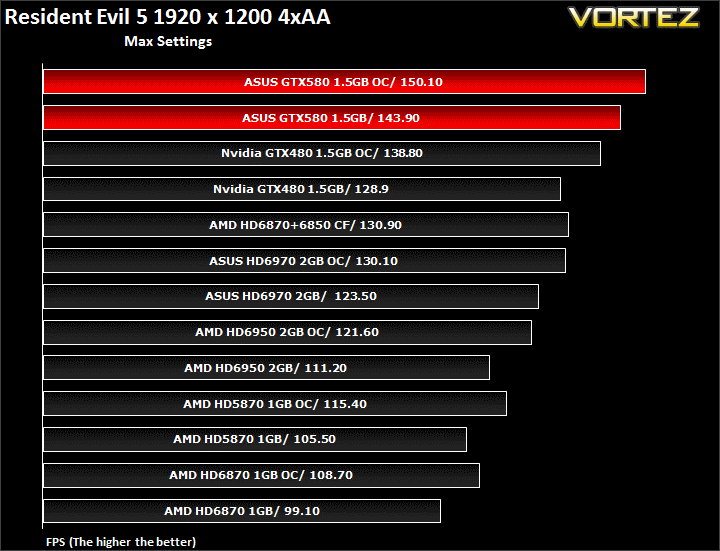
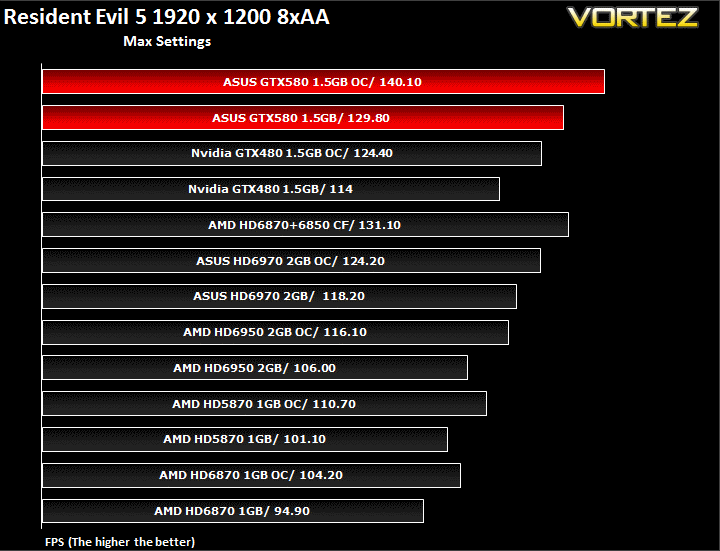
Resident Evil 5 is the sequel to the Resident Evil series, exploring the life of main protagonist, Chris Redfield. You play as either Chris Redfield or Sheva Alomar in an African desert area in Kijuju. In true Resident Evil fashion, your main objective is to investigate a terrorist bio-organic weapon threat whilst killing infected “Majinis” on your way.
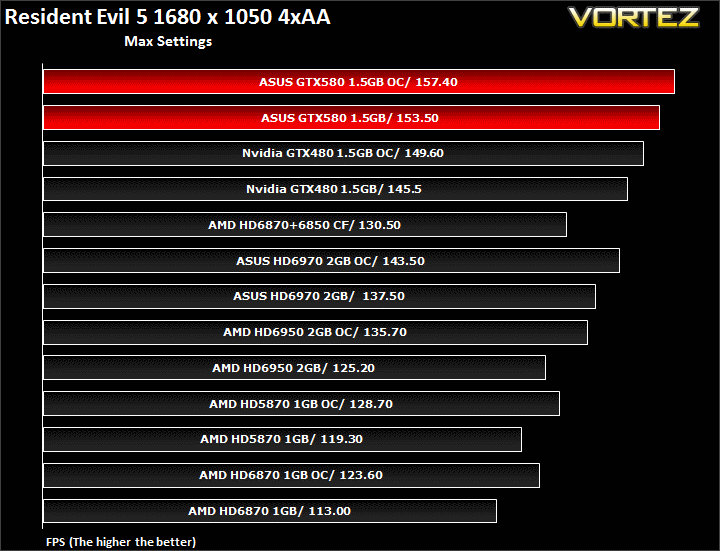
The Resident Evil 5 benchmark tool was used to test performance. All settings were set to the maximum possible and the average FPS was recorded at the end.
Stock
The GTX580 is once again the strongest performer, pulling ahead of the HD6970 by 12.5% and the GTX480 by 10%. Even against the CrossFire setup, the GTX580 manages to win by 9%.
Overclocked
Looking at the overclocked results, the GTX580 still retains a lead, albeit with slightly reduced performance advantages over the HD6970 and the GTX480. Compared to the former, the performance gap is 12% whilst against the latter, it’s reduced to 8%.
Street Fighter IV
Street Fighter is back in its 4th iteration and it’s bigger and better than ever. Combining fluid, fast based sparring with stunning artistic visuals, the game delivers tremendous game play. Be reacquainted with some of the most popular characters in video game history while you battle your way to the top, be it with Ryu or the mighty Bison. The game might be frustratingly hard in some cases but there’s nothing like the satisfaction of K.O’ing your opponent with a well stringed death bringing combo.
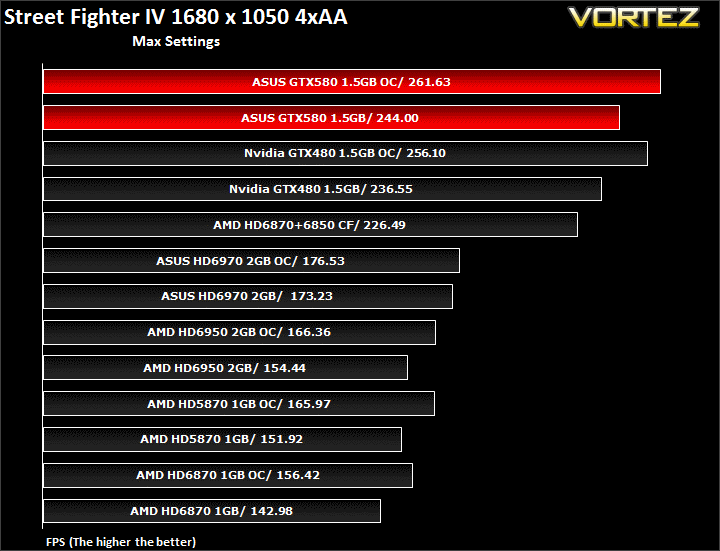
The Street Fighter IV benchmark tool was used to test performance. All settings were set to the maximum possible and the average FPS was recorded at the end.
Stock
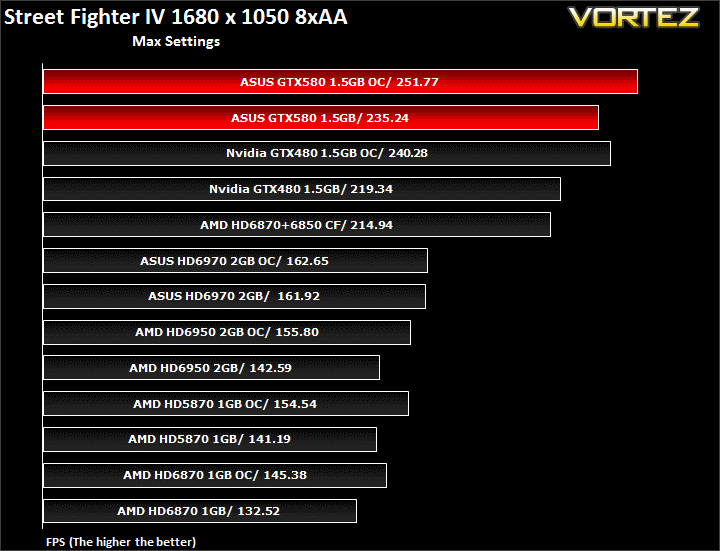
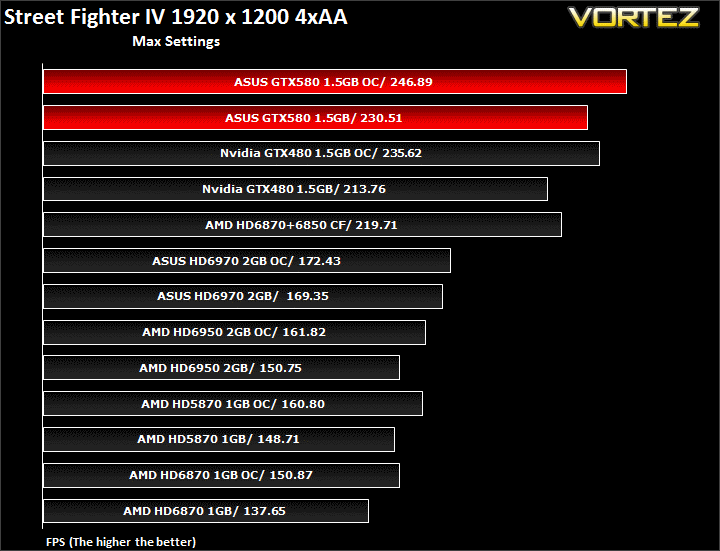
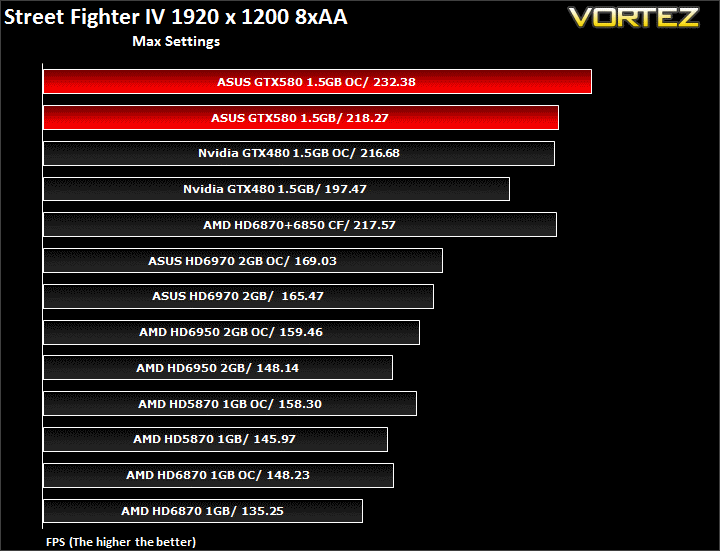
Nvidia have always dominated performance on Street Fighter IV and the GTX580 proves no different here. It leads the AMD HD6970 by an outstanding 38.5% and even the CrossFire setup by nearly 6%. The difference is much less when comparing the two Nvidia cards, at only 7%.
Overclocked
The overclocked cards show the GTX580 extending its performance superiority to 46% over the HD6970. On the other hand, the GTX480 is only behind by 5%, which is down to the its higher relative overclock.
Unreal Tournament 3 & Batman Arkham Asylum
Unreal Tournament 3
Built around the unreal 3 engine, Unreal Tournament is all about mindless fast paced shooting, decapitation with a plethora of game modes to so in. Not much else can be said really except that it promises hours of enjoyment on multiplier whether it be against bots, your friends at a LAN or online. It was one of the more popular games out there to adopt PhysX in the form of partially destructible maps, tornadoes and hail.
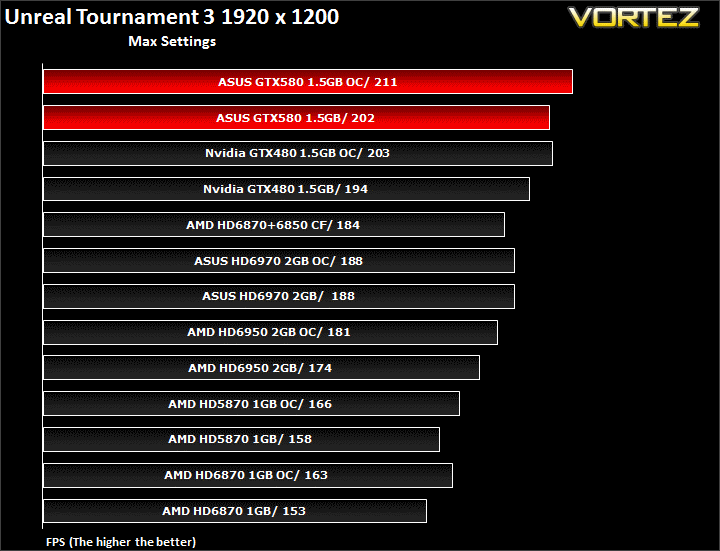
The Hardware OC UT3 benchmarking tool was used to test the game. The maximum in game settings were used including motion blur. Anistropic filtering was set to 16x and no Anti-Aliasing was used. The Containment was benchmarked and the average FPS recorded at the end.
Stock
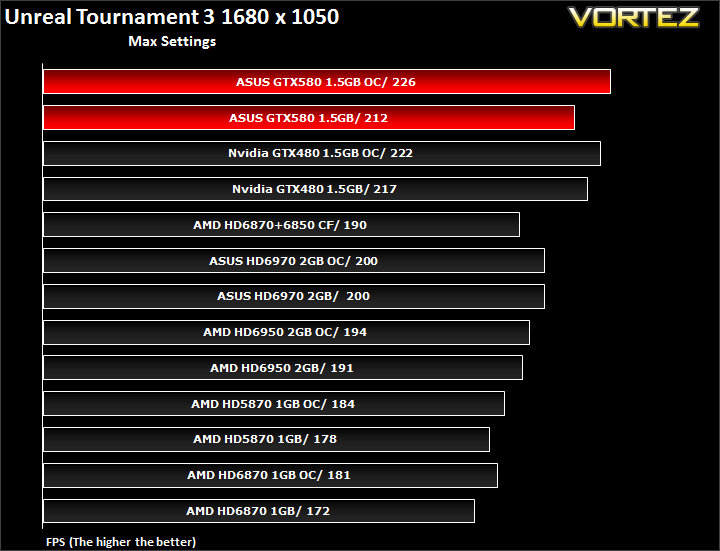
Unreal Tournament performance is very close between all high end GPUs. The GTX580 still leads the pack but the performance advantage it has over the HD6970 is a mere 7% and over the GTX480, it’s an even smaller gap of 1%. Surprisingly, the CrossFire setup performs worse than the latter two single graphics card and falls short of the GTX580 by 10.5%.
Overclocked
Overclocking all the cards works in favour of the GTX580 which manages to pull its lead ahead of the HD6970 to 12.5% and ahead of the by 3%.
Batman Arkham Asylum
The Dark Knight takes on his greatest challenge yet when he becomes trapped with all of his most dangerous villains inside the insane asylum of Gotham City – Arkham Asylum. The game exposes you to a unique, dark and atmospheric adventure that takes you to the depths of Arkham Asylum, Gotham’s psychiatric hospital for the criminally insane.
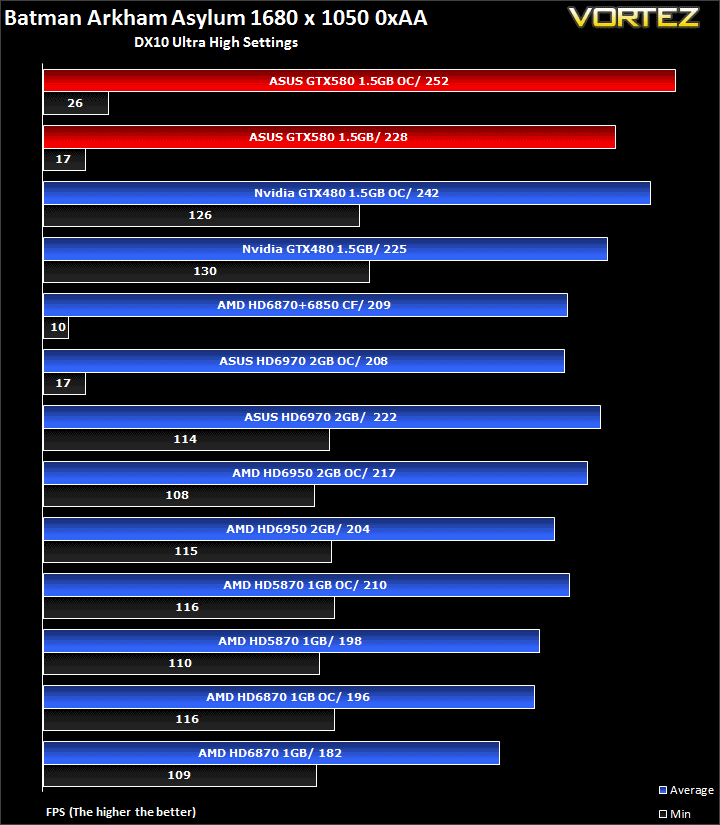
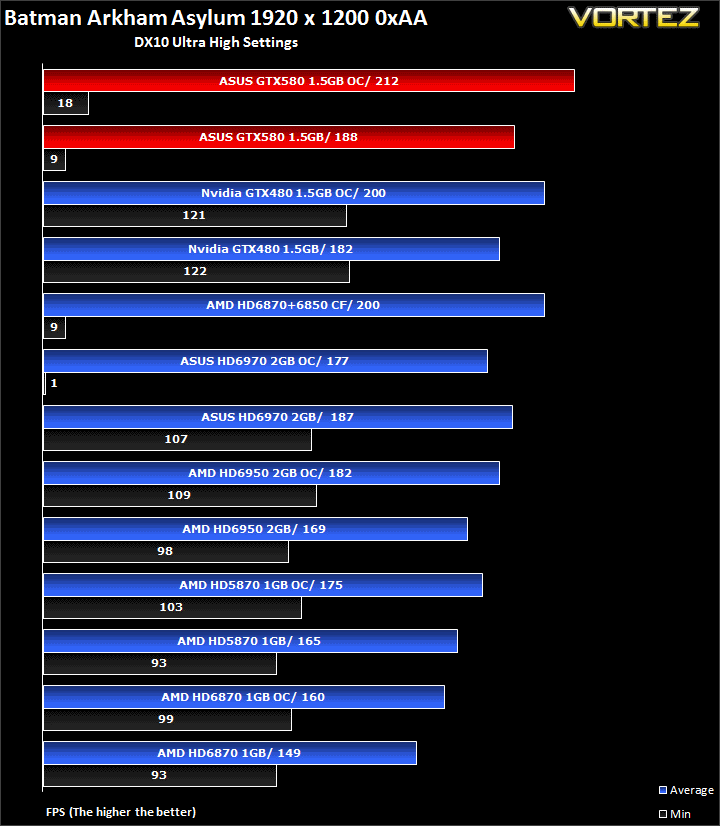
The in-game benchmarking tool was used to test performance. All the display settings were set to very high. No AA was used and PhsyX was only enabled if specified in the charts. The average FPS was recorded at the end.
Stock
The results here follow the same trend as Unreal Tournament 3. At stock speeds, there is very little difference between the high end graphics cards. The GTX580 leads the roost by 1.5% over the HD6970, by 2% over the GTX480 and 1.5% over the CrossFire results.
Overclocked
Overclocking does much to increase the GTX580’s lead. Due to the drop in performance experienced by the HD6970, the Nvidia card out shines it by 20.5%. It also widens its gap between itself and the GTX480 to 5%.
Colin McRae DIRT 2
DIRT is back and it’s bigger than ever. With an onslaught of famous X-Games competitors such as Ken Block and Dave Mirra, extreme is being brought back to rally. The game not only delivers outstanding gameplay in lush environments but also stunning visuals in the form of Direct X 11 implementation. If you want some fast paced, arcade style racing, then look no further than Colin McRae DIRT 2.
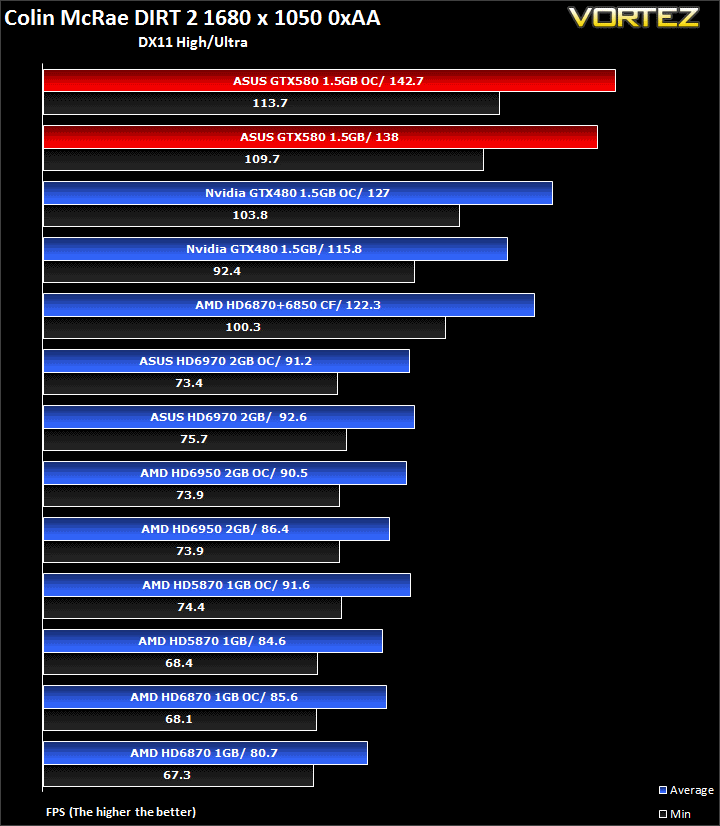
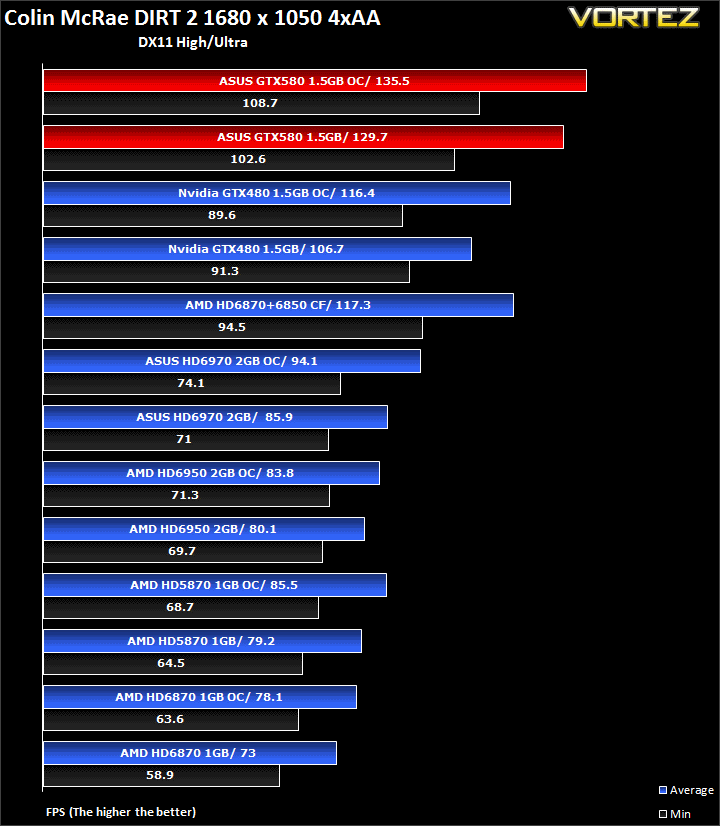
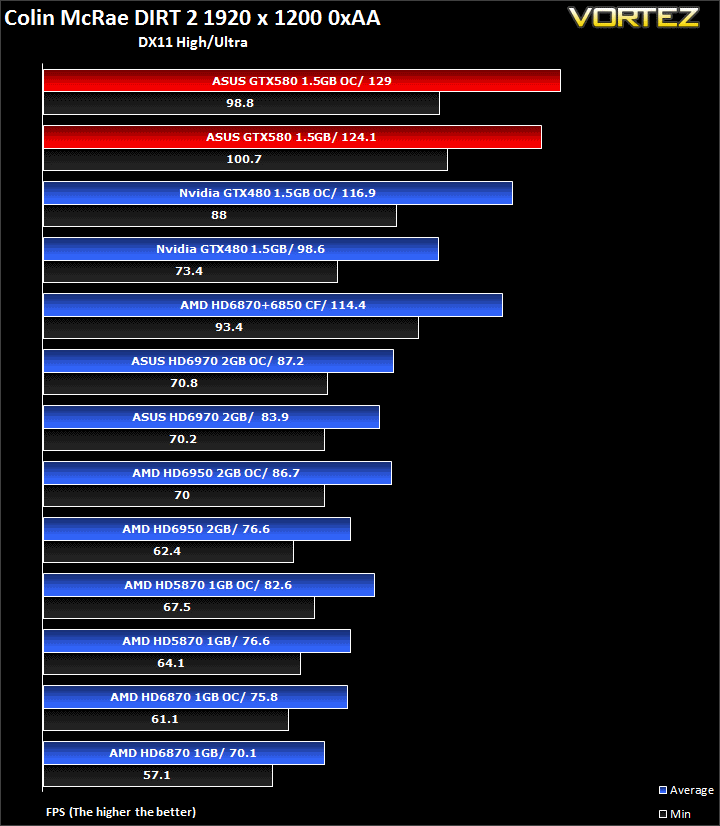
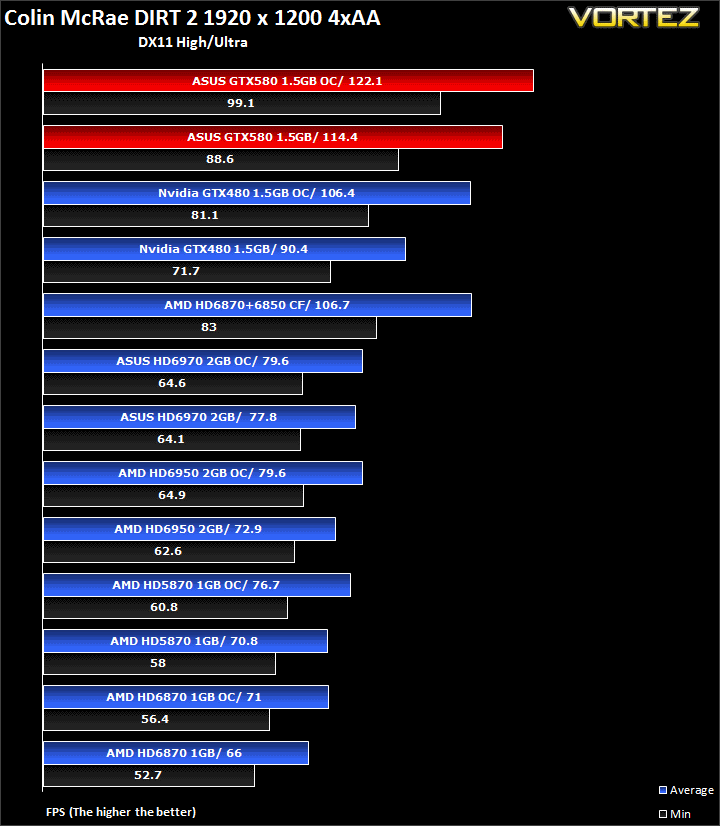
The in-game benchmarking tool was used to test performance. All the display settings were set to the maximum available and DirectX 11 was applied. The average FPS was recorded at the end.
Stock
The GTX580 is in a class of its own here, outpacing the HD6970 by an impressive 49% and even compared to the GTX480, the difference is 23%. The only solutions that can come close are the CrossFired HD6870+6850, which still lose out by 10%.
Overclocked
Overclocking extends the GTX580’s lead over the overclocked HD6970 to 50.5%, whereas the overclocked GTX480 reduces the gap to 13.5%.
Battlefield Bad Company 2
Battlefield Bad Company 2 is the new rendition of the widely successful Battlefield series of game. Having more in common with the console release of Bad Company, the sequel hopes to inject the DNA of the timeless Battlefield 2 online experience with the witty action packed single player shooting adventure of the original. As Private Preston Marlowe, your goal as a member of Bad Company is to once again save the world by securing a scalar weapon device.
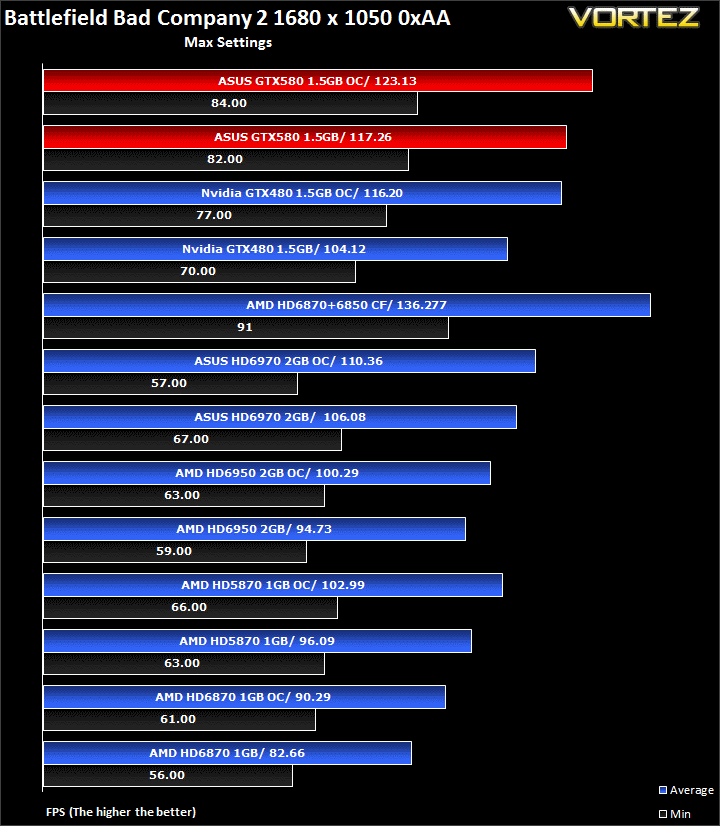
Fraps was used to test performance. Each test was conducted at the start of the ‘Upriver’ level ensuring that the same actions and paths were taken during the 2 minute sample. All settings were set to the highest available in game with AF set to 16x and HBAO turned on. The average FPS was recorded by FRAPS at the end of each walk through.
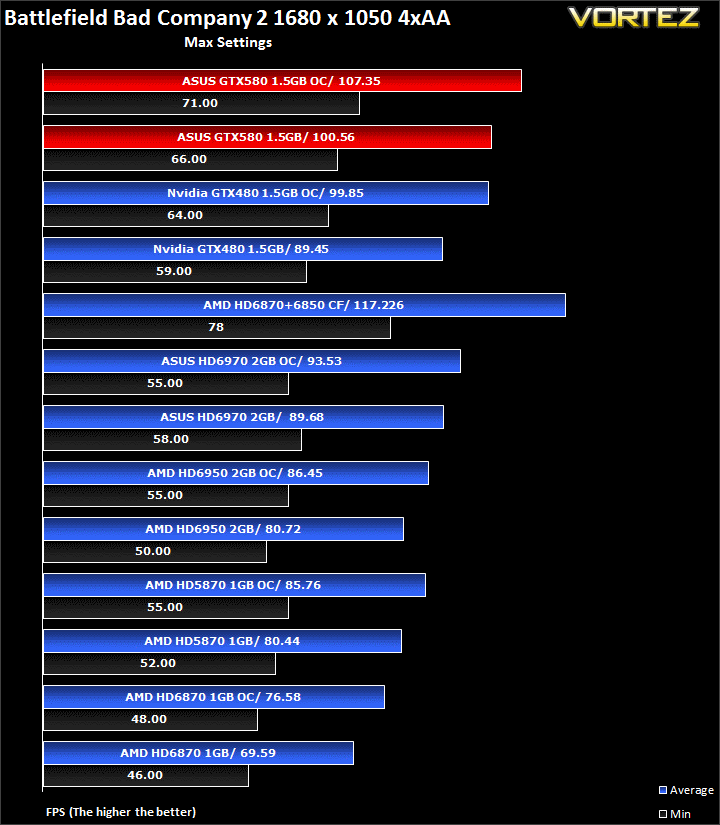
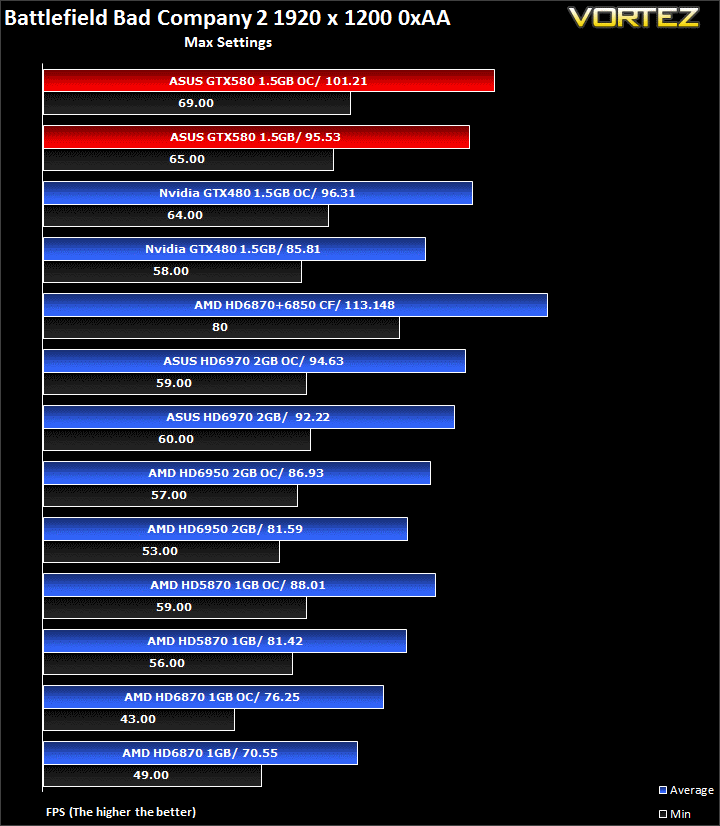
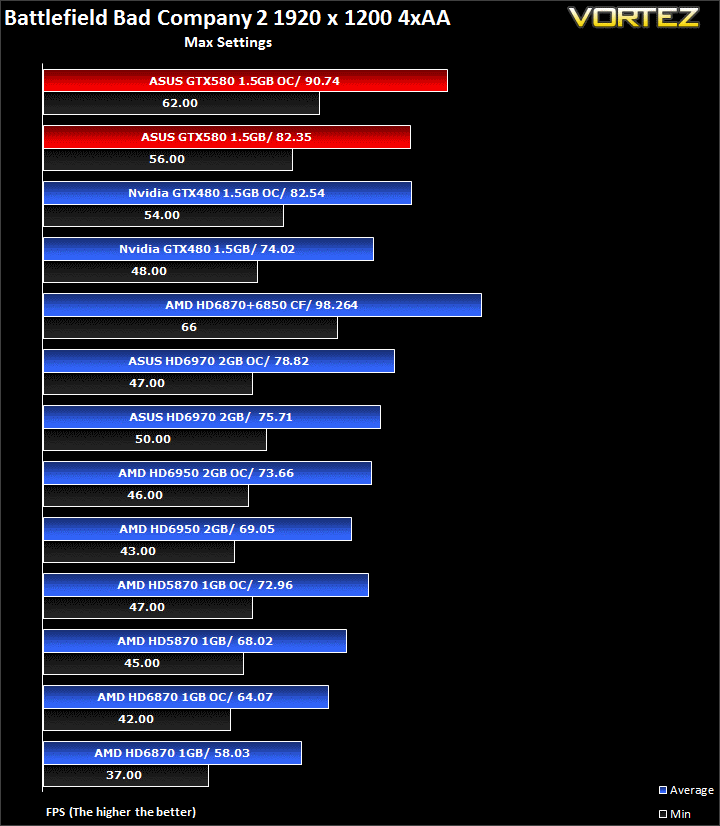
Stock
The vastly popular Bad Company 2 trembles amidst the sheer performance of the GTX580. Although it loses to the CrossFire setup by 15%, it retains its crown for single graphics card performance. It holds a 9% advantage over the HD6970 on average and outpaces the GTX480 by nearly 12%. Some of its lead is lost against the HD6970 at 1920×1200.
Overclocked
As with other games, the overclocked results show the GTX580 outpacing the HD6970 by an extended lead of 12%, whereas the gap between the GTX480 is reduced to 7% from 12%.
Mafia II Demo
Following the success of Mafia back in 2002, the third person action adventure game is back with a new grittier and darker world. As Vito Scaletta, an aspiring made man, your job is to work through the twist and turns of Mafia lifestyle. The more blood spilt, the more you get in return but the lifestyle was never meant to be an ideal one. Set in the visually stunning Empire City, the wartime references provide the ever present back drop to a rife period in America’s history, in which potential for exploitation becomes Vito’s key focus.
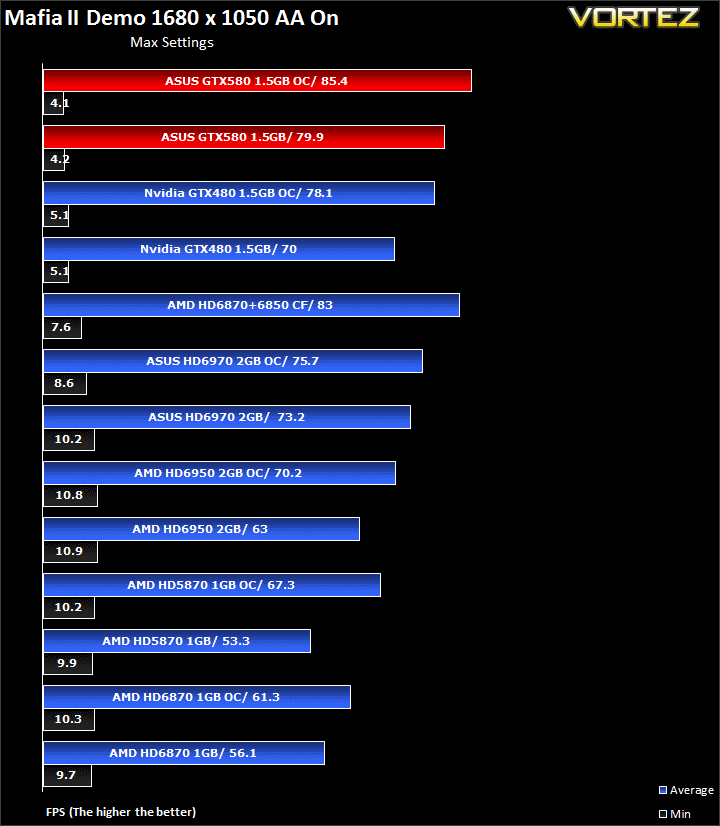
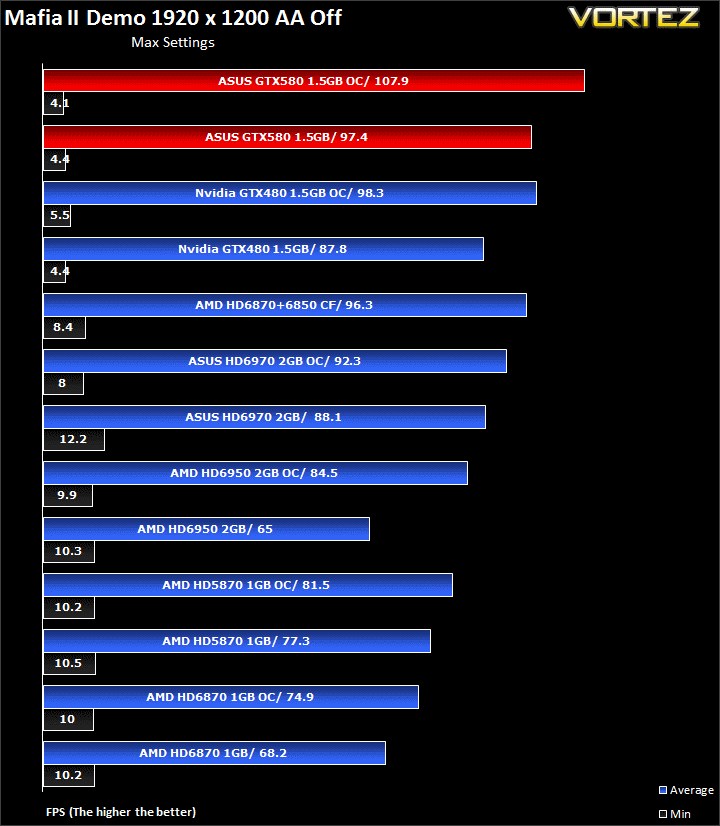
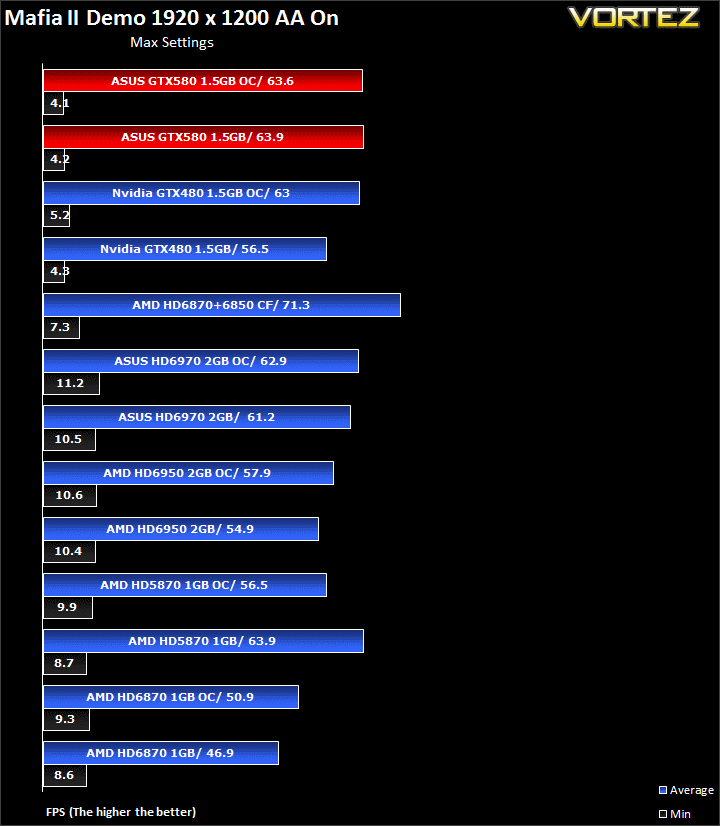
The in-game benchmarking tool was used to test performance. All the display settings were set to the maximum available in-game. PhsyX was only enabled if specified in the charts. The average FPS was recorded at the end.
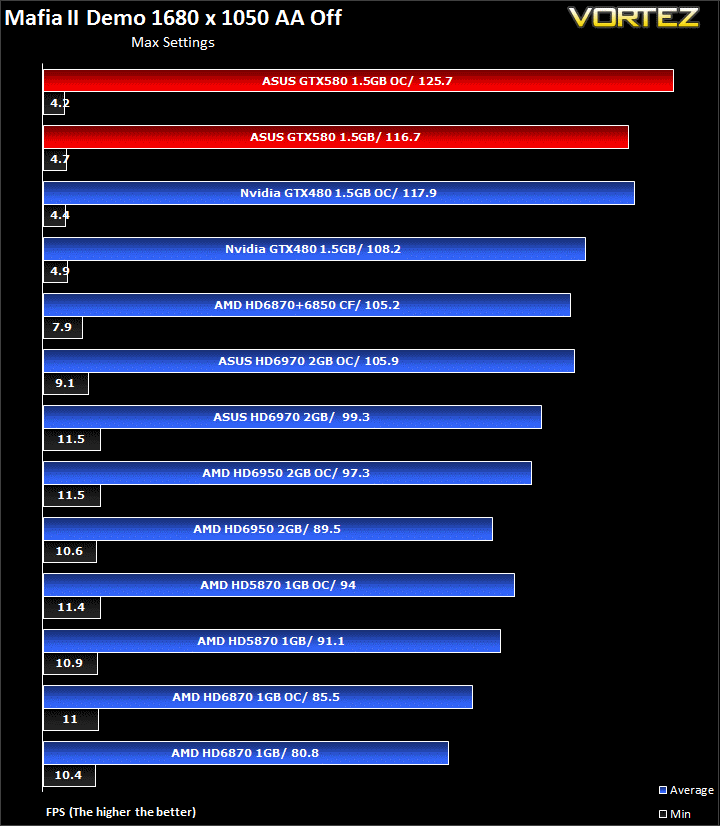
Stock
The HD6970 boasts some impressive results in Mafia II but not enough to beat the GTX580. With AA, the difference is smaller thanks to the 2GB framebuffer but overall it is still 10.5% behind. Similarly, the GTX480 falls behind by 11.5%. The CrossFired AMD Barts cards hold a slight lead overall and looking closely, it’s AA that gives AMD the edge in performance.
Overclocked
Once again, the relatively low overclock on the HD6970 means that it loses out much more to the overclocked GTX580 by 12%. The GTX480 closes its gap to 6.5%, which isn’t enough to claim a win.
Alien VS Predator
Spawned from the popular Alien and Predator franchises, Rebellion have collaborated to bring the legendary war to us through the medium of a first-person shooter. The game forces you to hunt, prey and most importantly survive in the swamp colony of Freya’s prospect as a Predator, Alien or Marine. The stunning visuals add to the sense of dread and terror that we have become so accustomed to seeing with the series.
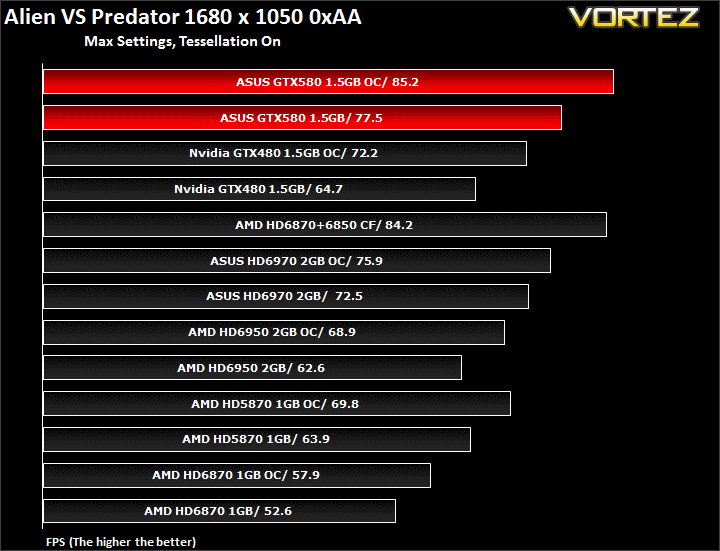
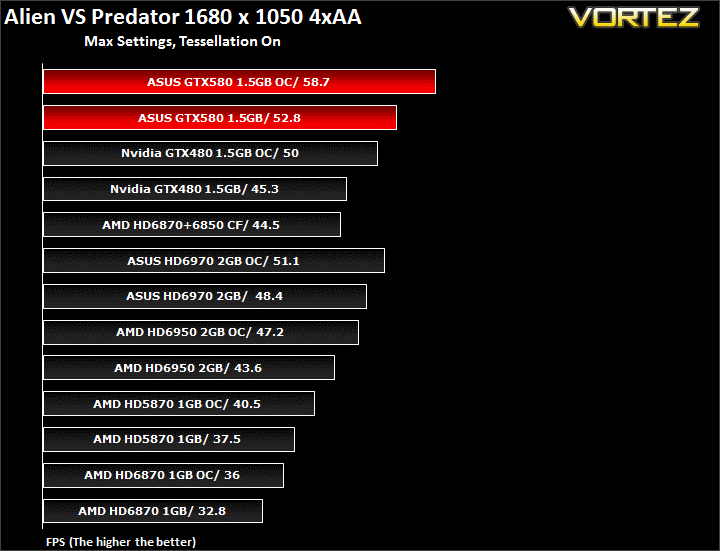
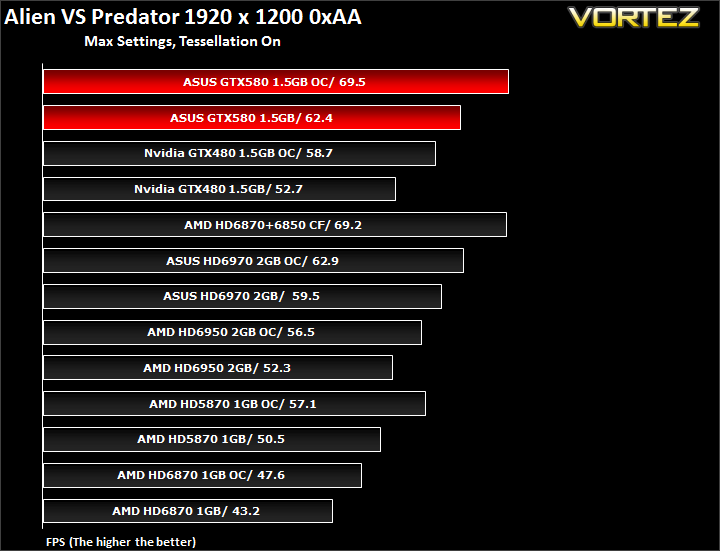
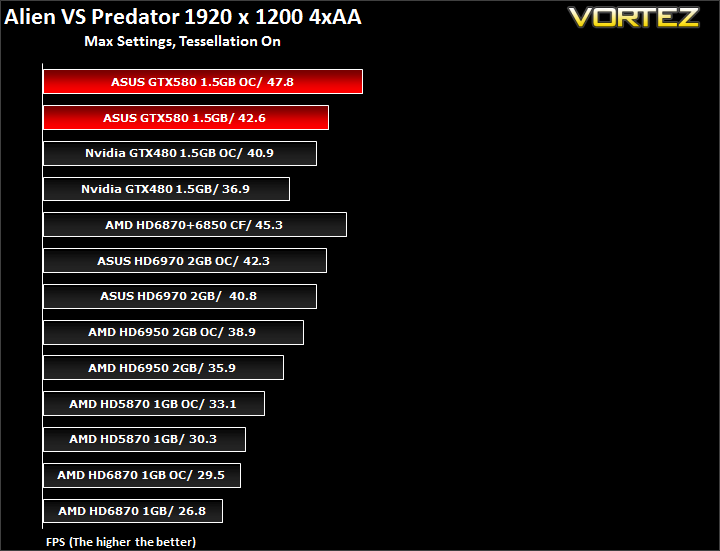
The stand-alone Alien VS Predator benchmark tool was used for testing here. All the settings were set to very high and Tessellation was applied. The average FPS was recorded at the end.
Stock
The GTX580 continues its dominance in Alien VS Predator, outperforming the HD6970 by 6% overall, despite close performance at 8xAA. The gains on the GTX480 reflect its theoretical performance advantage at 17.5%. However, the CrossFire setup demonstrates another strong showing and manages to beat the GTX580 by a small 1% margin.
Overclocked
And yet again, the GTX580 extends its lead to 12.5% when looking at the overclocked HD6970 results. This time however, the performance difference against the GTX480 remains unchanged.
H.A.W.X 2
Tom Clancy’s H.A.W.X. 2 is an arcade-style flight action game from Ubisoft. H.A.W.X.2 is DX11 ready and therefore like other simulators such as DIRT2 has stunning scenery and a truly breath-taking visual experience. Using hardware terrain tessellation, H.A.W.X.2 relies on raw GPU power because a series of detailed triangles are required to be rendered. This surely has to be one of the most taxing benchmarks all our featured games, H.A.W.X.2 presents some of the best tessellation execution in any title to date.
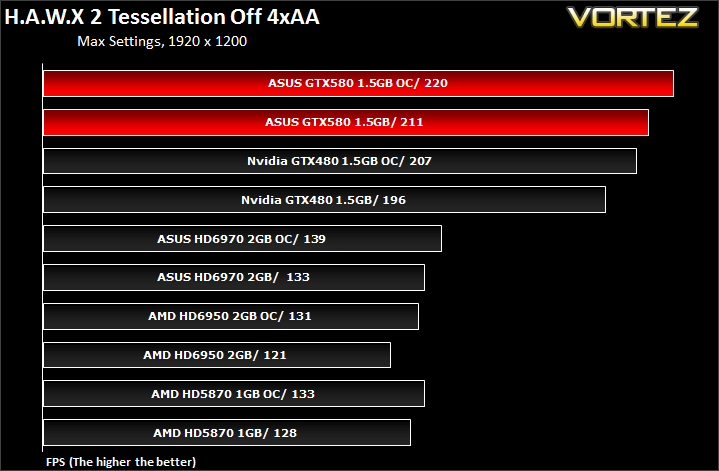
The in-game benchmark from the demo was used fort testing. All the maximum settings were used throughout testing. The average FPS was recorded at the end.
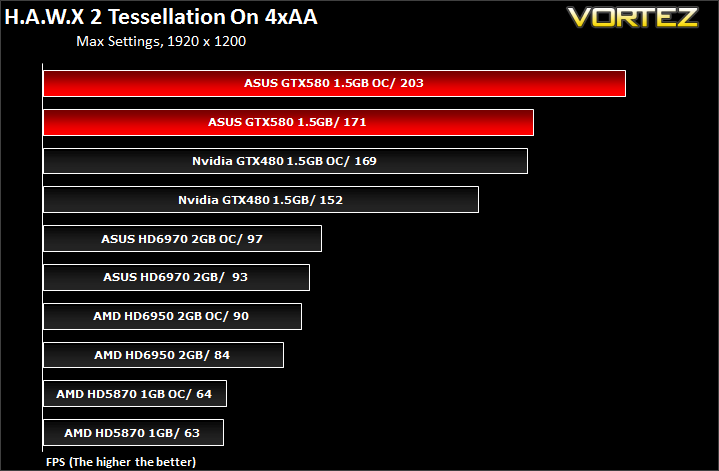
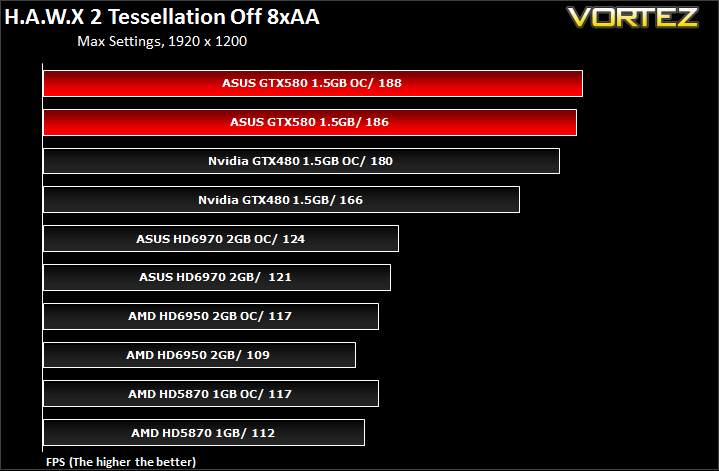
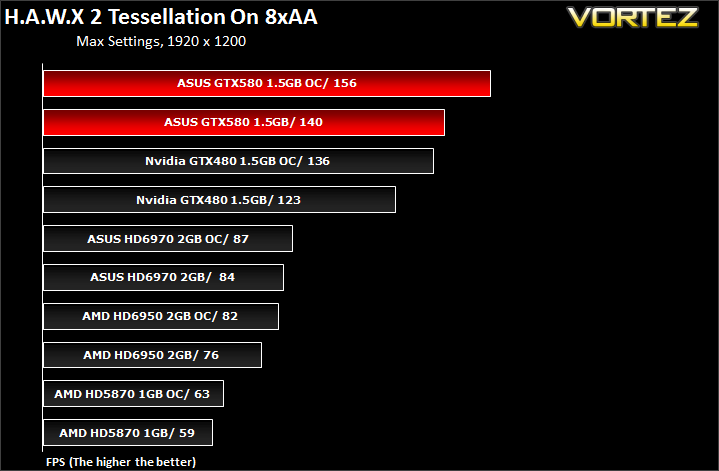
Stock
Performance in this game is heavily in favour of Nvidia with the GTX580 near doubling its lead over the HD6970 in some cases. Overall, it holds a 66% performance advantage. Its lead over the GTX480 is significantly less at 11.5%.
Overclocked
If stock results weren’t enough to show the GTX580’s supremacy, overclocked results show its lead over the HD6970 extending to 75%. The different between the two Nvidia cards remains unchanged overall despite varying results depending on the settings used.
3DMark 11 & Vantage
3DMark Vantage
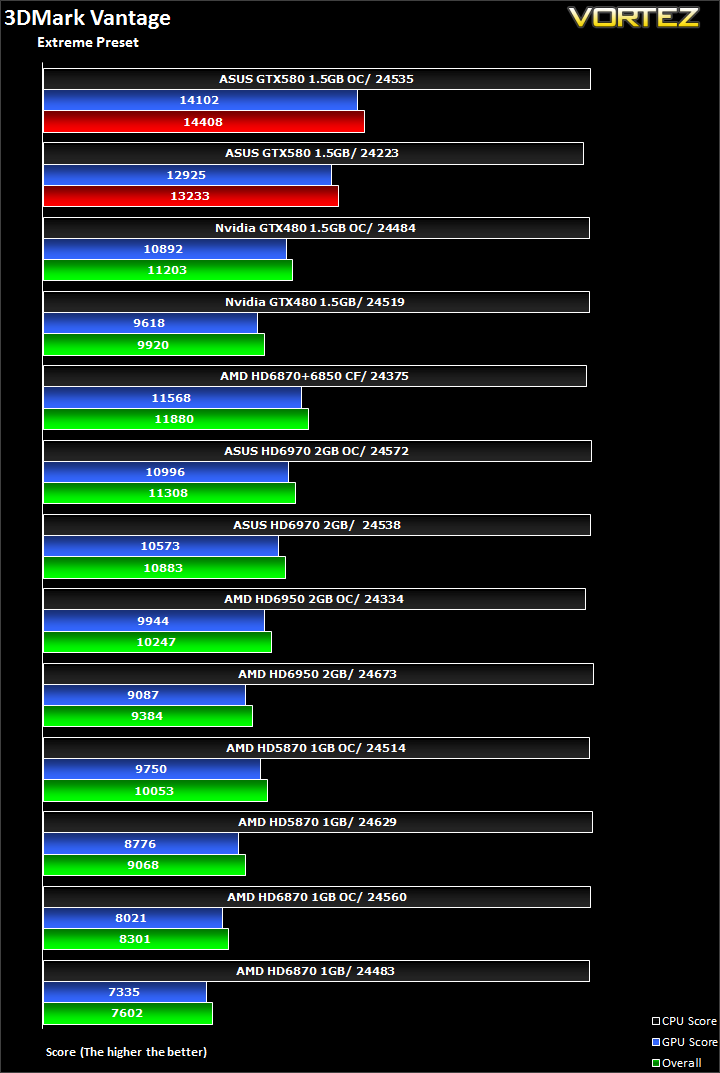
This Vantage benchmark suite from Futuremark introduces DX 10 & PhysX support. Despite being on the verge of DX 11 games arriving, Vantage still proves a popular testing ground for enthusiasts.
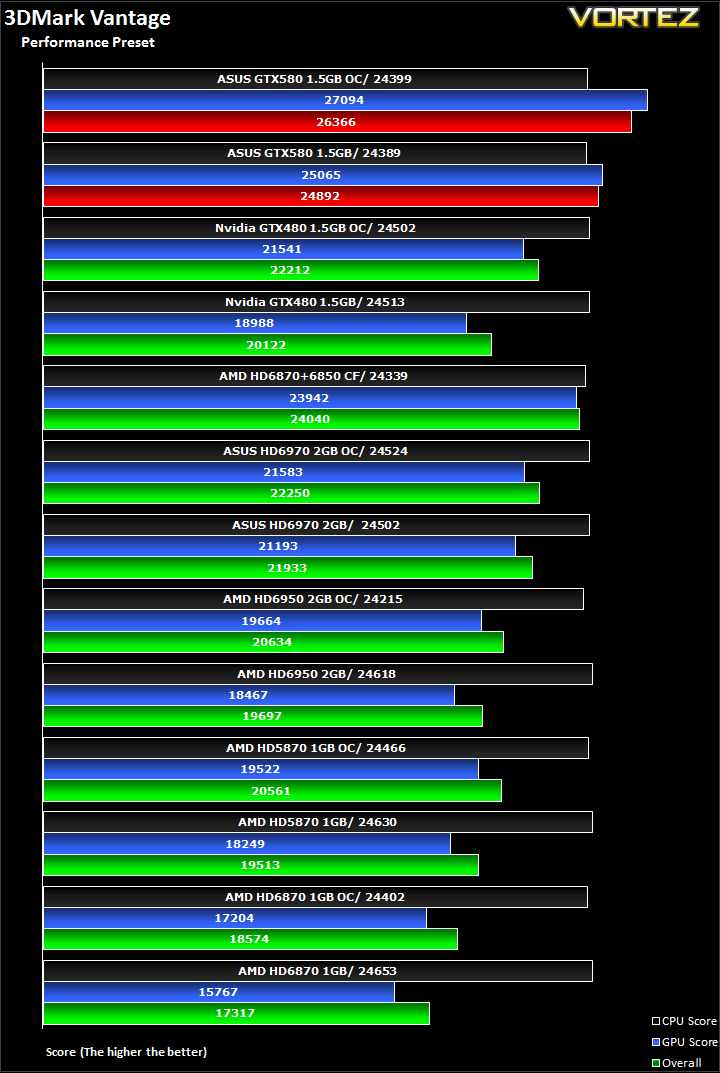
Stock
The GTX580 is a bencher’s dream churning out numbers that are unmatched by single graphics card solutions and even the CrossFire setup. It is ahead of the HD6970 by 17.5% and the GTX480 by an even bigger margin of 28.5%. The CrossFire Setup is no match for the GTX580 and loses out by 7.5%.
Overclocked
As seen previously, the overclocked results illustrate the GTX580 pulling ahead of the HD6970 by a further 5%. Conversely, its lead drops by 5% compared to the overclocked GTX580.
3DMark 11
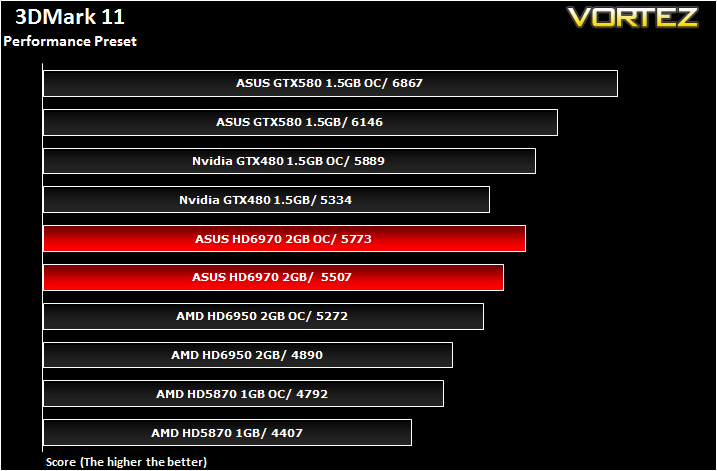
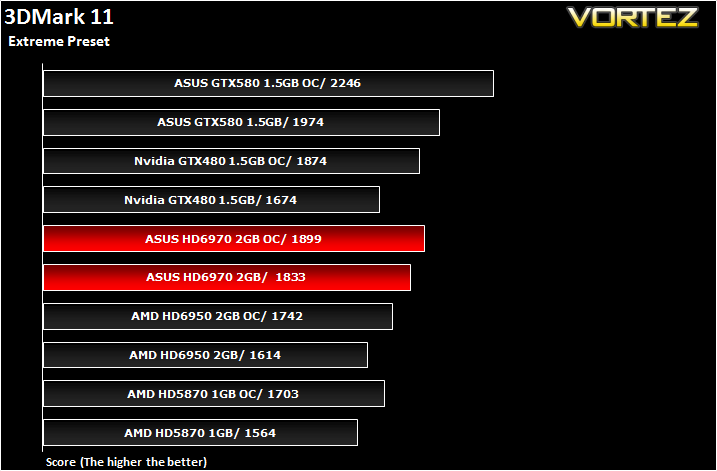
Finally here is the latest Futuremark benchmark suite, bringing DX11 and tessellation to benchmarkers. Will it bring your computers to their knees?
Stock
In the latest Futuremark benchmark, Nvidia’s GTX580 performs admirably to outperform the HD6970 by 11.6% under the performance preset and by 8% under the extreme preset. The GTX480 falls short by 15% under performance and by 18% under extreme settings.
Overclocked
Yet again, the GTX580 delivers a tough blow to AMD by extending it lead to 18% at both settings. And even the overclocked GTX480 loses a further 2% performance.
Unigine V2.1 Benchmark
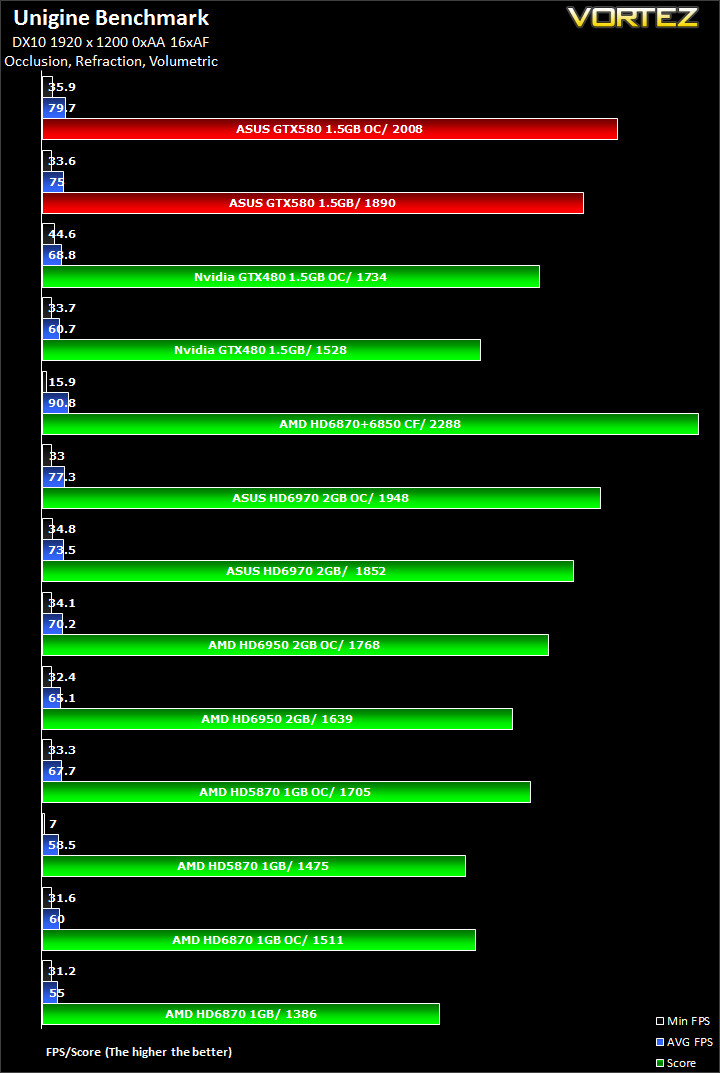
Unigine’s benchmark is to showcase the benefits of DX 11 and the use of tessellation as opposed to normal rendering techniques. The demo has impressive visuals that give an insight into what we can expect from gaming in the future.
Stock
The DX10 setting is the only situation where the HD6970 becomes very competitive against the GTX580 but it’s not surprising that it still falls short by a few per cents given its much lower price point. The GTX580 also loses out by 17% to the CrossFired AMD mid-range cards. The GTX580 does provide a significant 24% boost over its predecessor.
Overclocked
The overclocked GTX580 extends its lead over the HD6970 by a marginal 1% but its advantage over thee GTX480 drops to 16%.
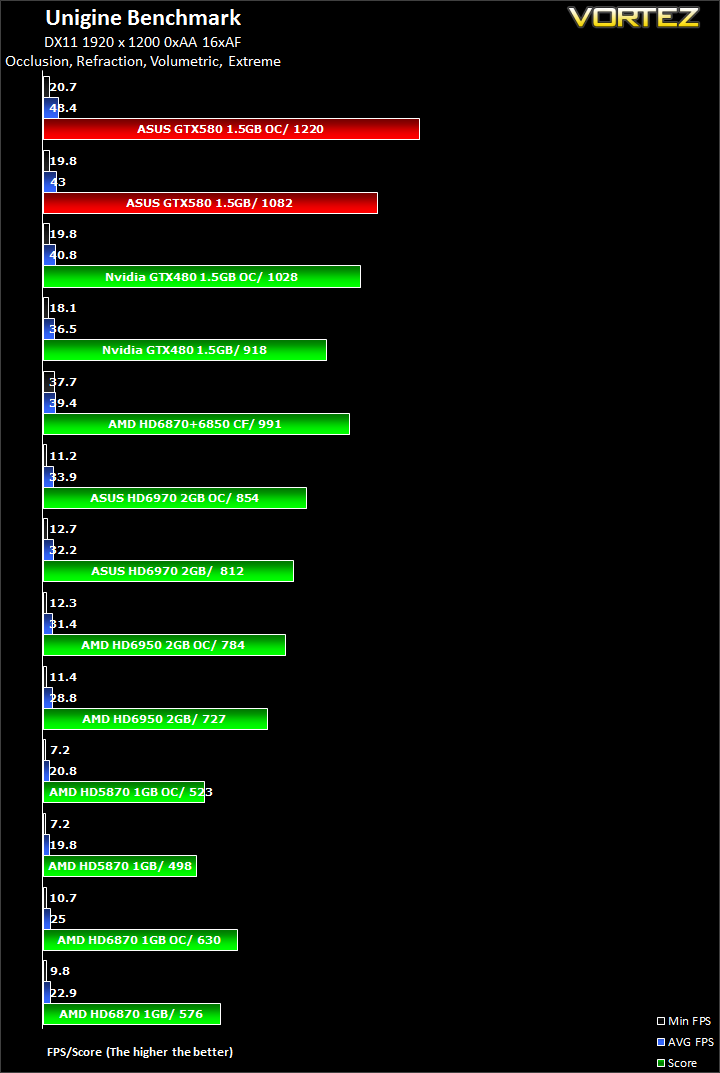
Stock
Tessellation performance is where Nvidia cards really shine, even though AMD have been hard at work improving their tessellation engine. In this case, the GTX580 still manages to outperform AMD’s flagship single GPU card by 33%. The difference is much lower against the CrossFire configuration at only 9%. Once again, the GTX580 proves to be an ideal replacement to the GTX480 by providing 18% better performance.
Overclocked
Overclocked, the GTX580 extends its lead over both the HD6970 and the GTX480.
Power Consumption
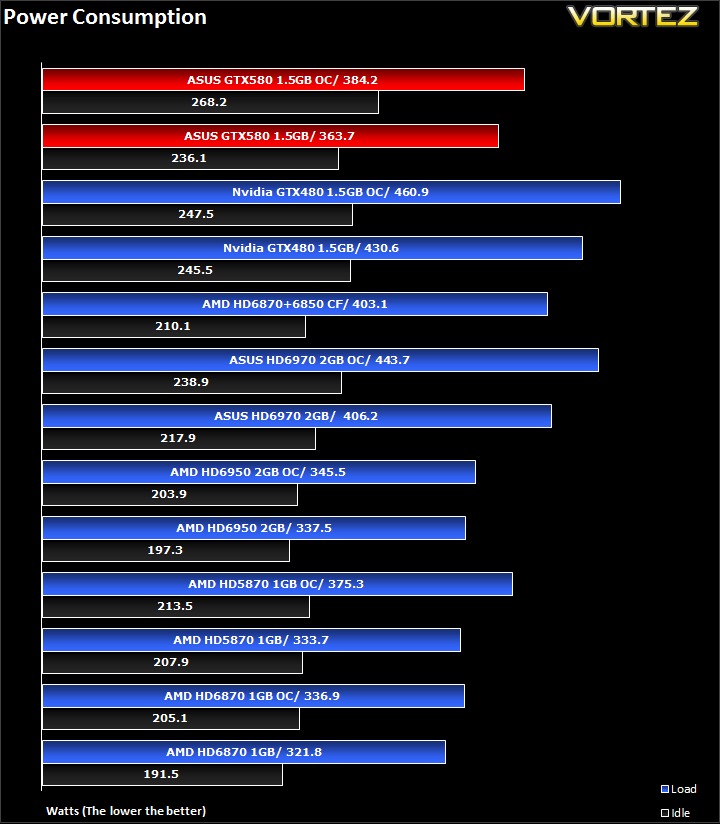
Nvidia have been hard at work trying to tame the thermals and power consumption of their Fermi based GPUs. GF104 was the first step and proved to be quite efficient in the mainstream market. The GTX460, in which the GPU was first used, was still no match for AMD’s Barts core. Nonetheless, it was a step in the right direction. With the GTX580, Nvidia have made some architectural tweaks to prevent leakage and they have implemented power saving features to keep the TDP in line. From the results, it appears that Nvidia have been very successful on that front, resolving the shortcomings of the GF100 core on the GTX480. Not only does it draw less power than the GTX480 by a significant 70-80W but it is also more efficient that the ASUS HD6970, delivering better performance with much lower power draw. Overclocking doesn’t appear to increase load power consumption significantly, despite raised voltages and a 17% core clock boost. It leads me to think that Nvidia’s power saving feature was kicking in to limit the TDP during stress testing.
Tessellation
DX 10
DX 11 Tessellation off
DX 11 Tessellation off – wireframe mode
DX 11 Tessellation on

DX 11 Tessellation on – wireframe mode
Let’s focus on a few characteristics of tessellation in the first image. Firstly, when we compare the wireframe mode, it is clear that tessellation, triangular in this case, is adding a lot more features and details, which may at first not be recognisable. The surfaces are divided in many more triangles, allowing the objects to replicate more complex structures. The ground for example is one of the features that benefits from it. To make it as efficient as possible, tessellation becomes a function of distance, generating more polygons closer to the viewer.
Now let’s look at the application of this. If we gaze at the rock pillar closest to us, we can immediately notice that with tessellation, they are not just mere square blocks but instead have irregular surfaces, more representative of a natural rock. Now, let’s move on to the stairs, which again is a notable improvement on past rendering methods. Rather than being flat, they have depth, giving the impression of real steps as opposed to a slide. The same applies to the cobbled road although the compressed/downsized pictures make it hard to judge. The last thing I’ll point out are the tiled roofs. With tessellation, the individual tiles form a more complex/realistic shape instead of appearing flat with repeated textures. You’ll have to take my word for it if you don’t notice them or try the demo for yourself!
Conclusion
Evaluating Nvidia’s GTX580 is fairly straightforward. It’s without a doubt the best single GPU graphics card available on the market. The only real competition would be from AMD HD5970, which unfortunately we didn’t have on test. However, given that the HD5970 is a dual GPU solution and relies on CrossFire, it is much harder to judge scaling. Hemlock has also been superseded by Cayman and the soon to be released Antilles dual GPU solution which should provide better competition for Nvidia’s GTX580. Regardless of what is to come, Nvidia have nailed the design of the GF110 core, delivering much better performance through its fully unlocked 512 CUDA cores and tolerance for higher frequencies. More importantly, they have addressed the shortcomings that marked Fermi’s initial downfall; its power consumption, temperatures and consequently the noise levels. The GTX580 has been tweaked on a GPU level to reduce power consumption and coupled with an improved vapour chamber cooling system to lower temperatures and noise levels. The result is a board that consumes less power than its predecessor and AMD’s new Cayman based HD6970.
Earlier on, we theorised that the GTX580 should hold a 17% performance advantage over the GF100 based GTX480 thanks to its altered architecture and higher clock speed. It turns out that in real world gaming performance, the difference between the two cards is an average of 16%. In their overclocked states, the GTX480 managed to close the gap slightly to 13.5%. In terms of pricing, the GTX480 has reached the end of its life but is still available for under £300. At over £400, the GTX580 is significantly more expensive, by too great a margin to warrant the performance increase. Of course, the added benefit of lower temperatures and power consumption is very appealing but it appears that Nvidia have found no real need to price it competitively.
The closest single GPU graphics card from AMD to compete with Nvidia’s high end cards is the newly released HD6970. In our last review, we found the difference between the AMD card and the GTX480 to be very marginal favouring Nvidia overall, so it’s not surprising that their GTX580 is the superior card here. It leads by approximately 19% at stock speeds and by a further 6% when overclocking is taken into account. As with the previous conclusion, price is the key differentiator here. The GTX580 is priced way beyond the AMD card for potential buyers to have a tough choice picking one of the two. For the best absolute performance regardless of price, the GTX580 is clearly in a league of its own. The HD6970 on the other hand, targets a slightly different market at under £300.
But is the GTX580 the ultimate choice for sheer performance? The answer isn’t as simple. SLI and CrossFire has become very popular over the last few generations of cards and scaling has never been as good as it is now, making dual configured mid-range cards a viable alternative to high end single GPU boards. In our test, we only included the HD6870+HD6850 results and the two in CrossFire was a mere 2% behind the GTX580. Together the two cards will cost under £350, still significantly less than a GTX580. And with the revelation that AMD’s HD6950s can unlock to fully fledged HD6970s, having two in CrossFire would provide significantly better performance for the same price as the GTX580.
ASUS once again have done their card justice by bundling their voltage tweaking SmartDoctor software and applying a 10MHz overclock on the core. However, it follows the same reference design as other boards which users will also be able to tweak the voltages on using MSI’s Afterburner application. The main appeal of the ASUS card is its 3 years warranty and excellent customer support. The downside is its price premium and availability. Looking around, the cheapest I could find it was for £418 although more reputable sites have it on pre-order for £459.99.
Pros
+Class leading performance
+Pre-overclocked
+Excellent overclocking headroom
+Excellent tessellation and AA performance
+Efficient and cool operation
+CUDA and PhysX support
+Well packaged
+Voltage Tweaking support
+3 years warranty
Cons
-Weak bundle
-Price
+Class leading performance
+Pre-overclocked
+Excellent overclocking headroom
+Excellent tessellation and AA performance
+Efficient and cool operation
+CUDA and PhysX support
+Well packaged
+Voltage Tweaking support
+3 years warranty
Cons
-Weak bundle
-Price
The ASUS GTX580 deserves the Vortez Silver Award.


