







Today Intel launches their 4th Generation of processors codenamed Haswell. We take a look at the Core i5 4670K and Core i7 4770K CPUs which are designed for LGA1150.

Product on Review: Core i5 4670K & Core i7 4770K
Manufacturer : Intel
Street Price: 4670K – £199.99 4770K – £285.99
Just over 12 months ago we were casting our critical eye over what was to be codenamed Intel Ivy Bridge and in such a short space of time we are to examine its successor, namely Haswell. Haswell discussion has been filling hardware forums the world-over and whilst some may be rolling their eyes at yet another necessary or unnecessary upgrade, there are many who are filled with excitement at the prospect of new technology hitting the market.
Haswell is Intel’s 4th Generation of Core i5 and i7 processors and is equipped for a new socket, LGA1150. Amongst other models, we will be taking a good look at the flagships within the Core i5 and i7 family, the unlocked variants: 4670K and 4770K.
The chips that are under close observation today promise to deliver further enhancements over the previous generations of processors and we will be seeing some interesting features rise from the ashes, with a return to BLCK overclocking.
Features, Specifications & Micro-architecture
• 8-Way Multi-Task Processing: Runs 8 independent processing threads in one physical package.
• Intel® Turbo Boost Technology 2.0: Dynamically increases the processor frequency up to 3.9 GHz when applications demand more performance. Speed when you need it, energy efficiency when you don’t.
• Intel® Hyper-Threading Technology: Allows each core of the processor to work on two tasks at the same time providing unprecedented processing capability for better multi-tasking, and for threaded applications.
• Intel® Smart Cache: 8MB of shared cached allows faster access to your data by enabling dynamic and efficient allocation of the cache to match the needs of each core significantly reducing latency to frequently used data and improving performance.
• CPU Overclocking Enabled (with Intel® Z87 Chipset)[1],2: Fully unlocked core multiplier, power, base clock and DDR3 memory ratios enable ultimate flexibility for overclocking.
• Graphics Overclocking Enabled (with Intel® 8 Series Chipset) 3: Unlocked graphics multiplier allows for overclocking to boost the graphics clock speed.
• Integrated Memory Controller: Supports 2 channels of DDR3-1600 memory with 2 DIMMs per channel. Support for memory based on the Intel® Extreme Memory Profile (Intel® XMP) specification2.
• Chipset/Motherboard Compatibility: Compatible with all Intel® 8 Series Chipsets
• AES-NI: Provides processor instructions that help to improve performance for AES encryption and decryption algorithms.
• Built-in Visuals3: New enhanced built-in visual features deliver a seamless visual PC experience for doing everything from simple e-mail to enjoying the latest 3D and HD entertainment. The built-in visuals suite includes:
– Intel® Quick Sync Video Technology: Media processing for incredibly fast conversion of video files for portable media players or online sharing.
– Intel®InTru™3D: Stereoscopic 3D Blu-ray* playback experience in full HD 1080p resolution over HDMI 1.4 with 3D.
– Intel® Clear Video HD Technology: Visual quality and color fidelity enhancements for spectacular HD playback and immersive web browsing.
– Intel® Advanced Vector Extensions 2.0 (Intel® AVX 2.0) : Increased performance for demanding visual applications like professional video & image editing.
– Intel® HD Graphics 4600: Significant 3D performance for immersive mainstream gaming on a broad range of titles. The dynamic graphics frequency ranges up to 1250MHz.
• Intel® Turbo Boost Technology 2.0: Dynamically increases the processor frequency up to 3.9 GHz when applications demand more performance. Speed when you need it, energy efficiency when you don’t.
• Intel® Hyper-Threading Technology: Allows each core of the processor to work on two tasks at the same time providing unprecedented processing capability for better multi-tasking, and for threaded applications.
• Intel® Smart Cache: 8MB of shared cached allows faster access to your data by enabling dynamic and efficient allocation of the cache to match the needs of each core significantly reducing latency to frequently used data and improving performance.
• CPU Overclocking Enabled (with Intel® Z87 Chipset)[1],2: Fully unlocked core multiplier, power, base clock and DDR3 memory ratios enable ultimate flexibility for overclocking.
• Graphics Overclocking Enabled (with Intel® 8 Series Chipset) 3: Unlocked graphics multiplier allows for overclocking to boost the graphics clock speed.
• Integrated Memory Controller: Supports 2 channels of DDR3-1600 memory with 2 DIMMs per channel. Support for memory based on the Intel® Extreme Memory Profile (Intel® XMP) specification2.
• Chipset/Motherboard Compatibility: Compatible with all Intel® 8 Series Chipsets
• AES-NI: Provides processor instructions that help to improve performance for AES encryption and decryption algorithms.
• Built-in Visuals3: New enhanced built-in visual features deliver a seamless visual PC experience for doing everything from simple e-mail to enjoying the latest 3D and HD entertainment. The built-in visuals suite includes:
– Intel® Quick Sync Video Technology: Media processing for incredibly fast conversion of video files for portable media players or online sharing.
– Intel®InTru™3D: Stereoscopic 3D Blu-ray* playback experience in full HD 1080p resolution over HDMI 1.4 with 3D.
– Intel® Clear Video HD Technology: Visual quality and color fidelity enhancements for spectacular HD playback and immersive web browsing.
– Intel® Advanced Vector Extensions 2.0 (Intel® AVX 2.0) : Increased performance for demanding visual applications like professional video & image editing.
– Intel® HD Graphics 4600: Significant 3D performance for immersive mainstream gaming on a broad range of titles. The dynamic graphics frequency ranges up to 1250MHz.
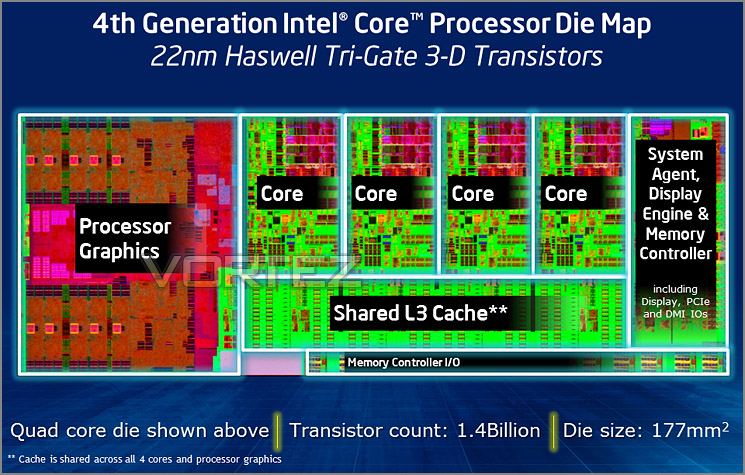
Haswell features new AVX2 instructions and although these extensions are not widely used by applications just yet, in the near future we expect them to be utilised by applications. As is typical of microprocessors nowadays, Haswell has an integrated graphics processor (IGP). This is the next iteration, namely Intel HD 4600 and allows for Bluray playback and light/casual gaming.

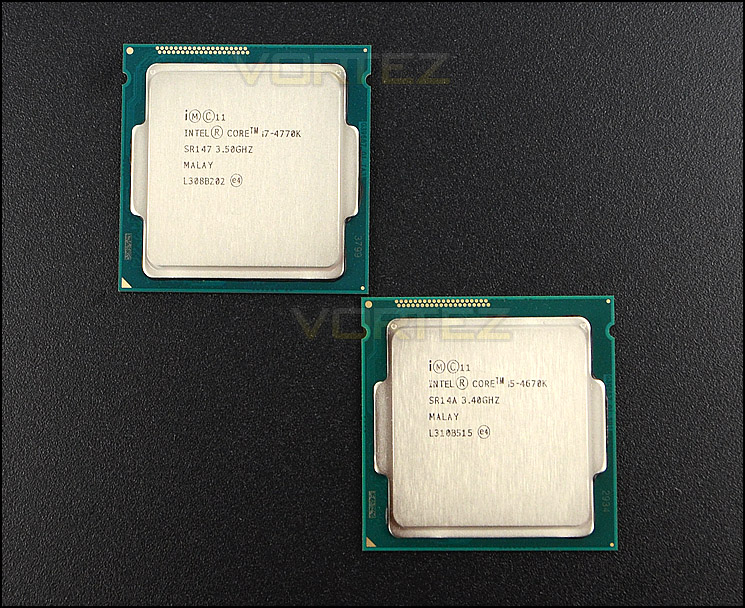
Core i5 4670K & Core i7 4770K in the flesh
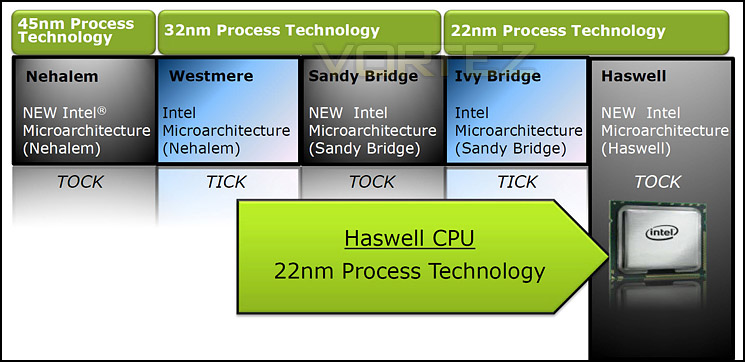
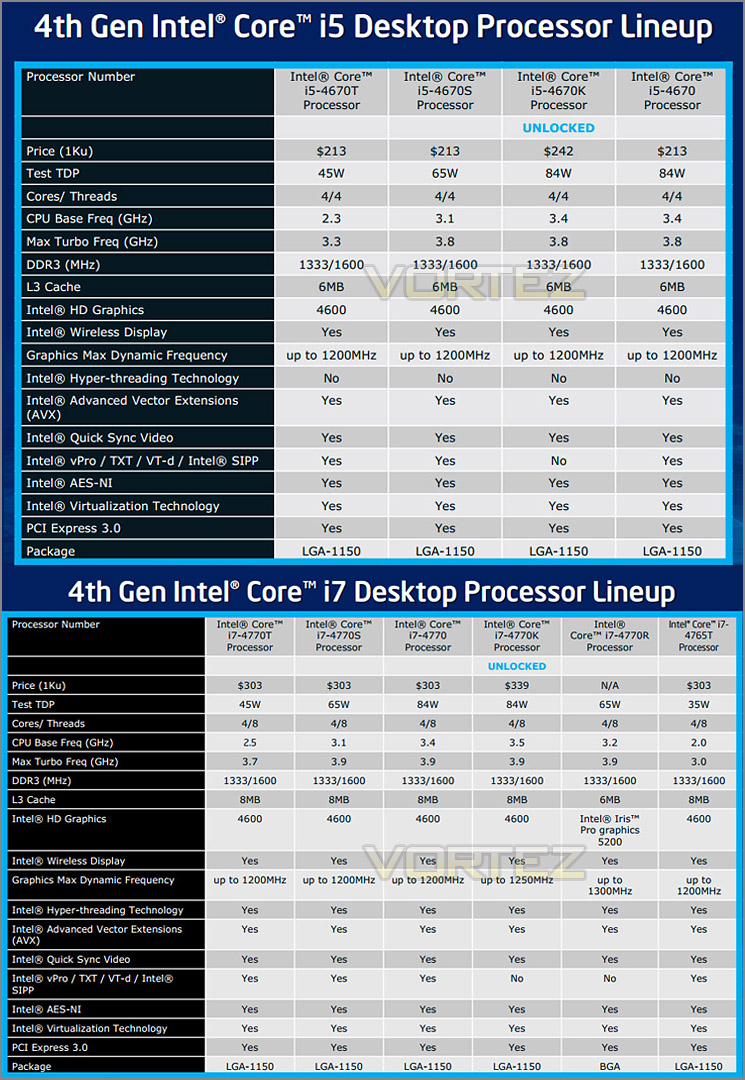
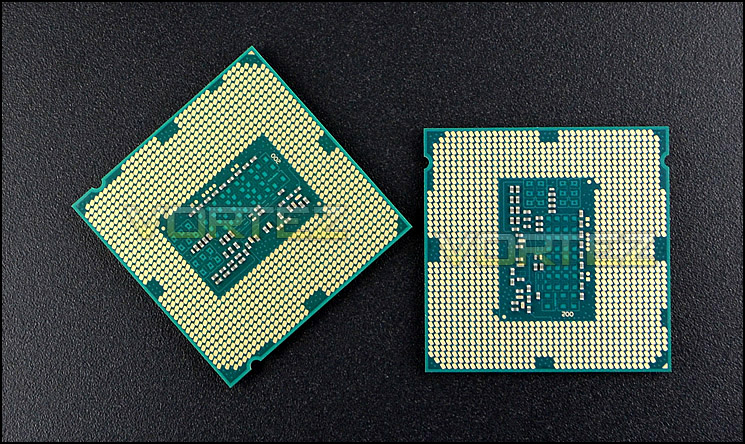
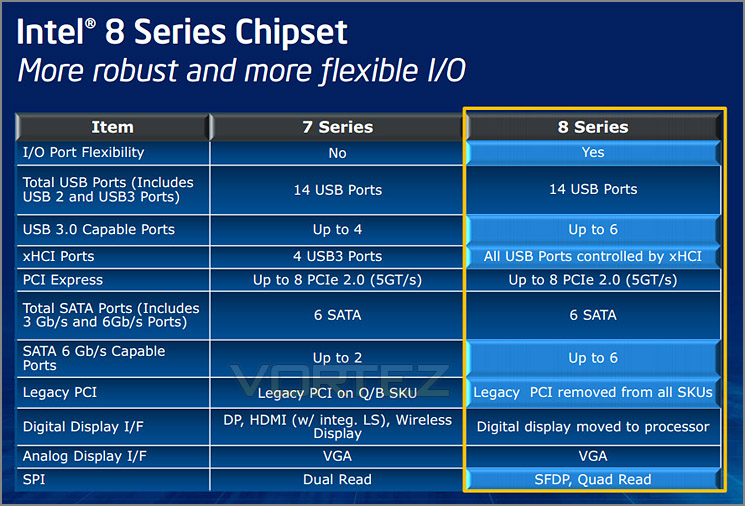
Intel’s new Haswell processors are the 4th Generation to enter the family of the Core i5 and i7 product line. Although the socket type has changed (LGA1150), all the processors remain the same physical size as previous generations from Ivy Bridge and Sandy Bridge. Haswell incorporate 22nm technology – this is the second time Intel have integrated such architecture with desktop products. All Haswell processors are design to work with new Intel 8 Series motherboards, typically using the Z87 chipset. The processors use a tri-gate transistor design similar to Ivy Bridge.The 4670K comes with four cores, four threads, 6MB L3 cache and with a base clock of 3.4GHz boosting to 3.8GHz via Turbo Boost 2.0 technology. The 4770K comes with four cores, eight threads, 8MB L3 cache and with a base clock of 3.5GHz boosting to 3.9GHz with Turbo Boost. By default, with Turbo Boost technology enabled the chip will idle at 800MHz – thus encouraging better energy efficiency compared to its predecessor which maintained 1600MHz during idle state.
Both 4670K and 4770K have integrated graphics via Intel HD 4600 and promise to deliver even greater performance compared to previous generations. Here is what Intel specify in regards to Intel HD 4600 graphics:
– Built-in Visuals3: New enhanced built-in visual features deliver a seamless visual PC experience for doing everything from simple e-mail to enjoying the latest 3D and HD entertainment. The built-in visuals suite includes:
– Intel® Quick Sync Video Technology: Media processing for incredibly fast conversion of video files for portable media players or online sharing.
– Intel®InTru™3D: Stereoscopic 3D Blu-ray* playback experience in full HD 1080p resolution over HDMI 1.4 with 3D.
– Intel® Clear Video HD Technology: Visual quality and color fidelity enhancements for spectacular HD playback and immersive web browsing.
– Intel® Advanced Vector Extensions 2.0 (Intel® AVX 2.0) : Increased performance for demanding visual applications like professional video & image editing.
– Intel® HD Graphics 4600: Significant 3D performance for immersive mainstream gaming on a broad range of titles. The dynamic graphics frequency ranges up to 1250MHz.
– Intel® Quick Sync Video Technology: Media processing for incredibly fast conversion of video files for portable media players or online sharing.
– Intel®InTru™3D: Stereoscopic 3D Blu-ray* playback experience in full HD 1080p resolution over HDMI 1.4 with 3D.
– Intel® Clear Video HD Technology: Visual quality and color fidelity enhancements for spectacular HD playback and immersive web browsing.
– Intel® Advanced Vector Extensions 2.0 (Intel® AVX 2.0) : Increased performance for demanding visual applications like professional video & image editing.
– Intel® HD Graphics 4600: Significant 3D performance for immersive mainstream gaming on a broad range of titles. The dynamic graphics frequency ranges up to 1250MHz.
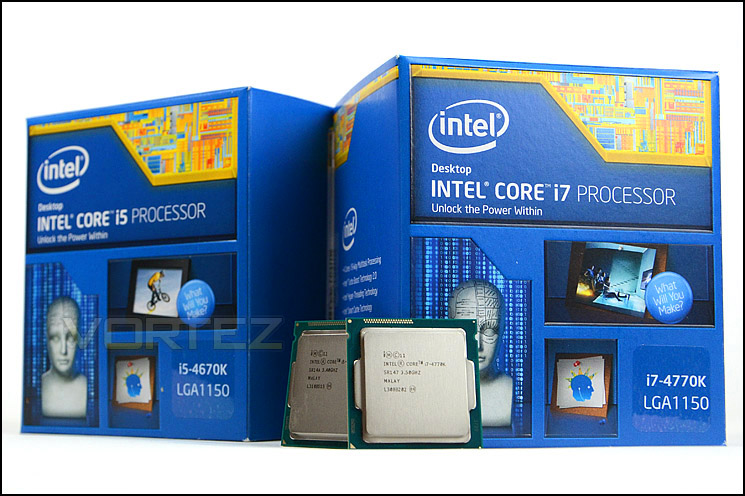
As can be expected, the packaging for both our Intel Core i5 4670K and Core i7 4770K arrive in a bright blue retail box. Retail versions also come with a fan-less option and OEM – without packaging altogether. Retail versions come with the added bonus of an extended warranty (3 years) and Intel reference fan.
Intel Haswell Core i5 4670K and Core i7 4770K
The underside of the chips
Test Setup & Overclocking
CPUs
Intel Core i5 2500K (3.3GHz) Sandy Bridge
Intel Core i5 3570K (3.40GHz) Ivy Bridge
Intel Core i7 3770K (3.50GHz) Ivy Bridge
Intel Core i5 4670K (3.40GHz) Haswell
Intel Core i7 4770K (3.50GHz) Haswell
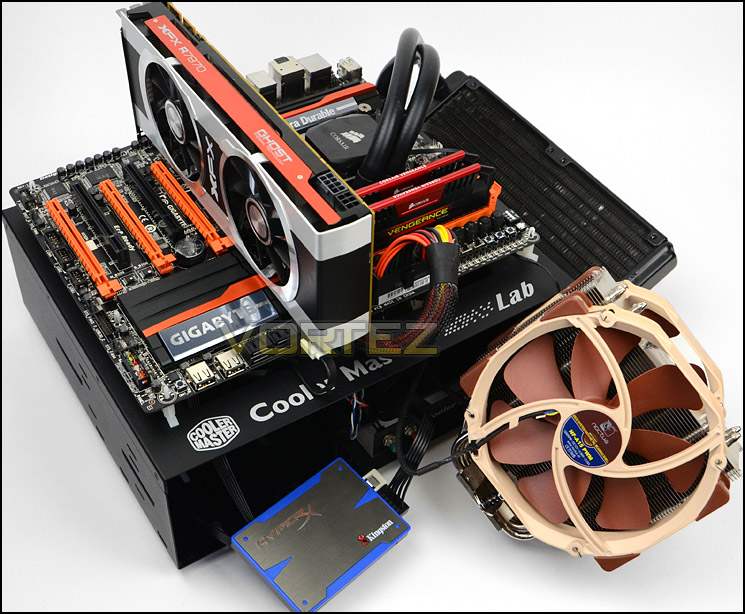
Cooling Noctua NH-U14S / Corsair H100i
Motherboard GIGABYTE Z87X-OC
Memory 16GB Corsair Vengeance Pro 2400MHz CL10
Graphics XFX R7970 Black Edition
Storage Kingston HyperX 240GB SSD
PSU Corsair HX1050 (GOLD)
Intel Core i5 2500K (3.3GHz) Sandy Bridge
Intel Core i5 3570K (3.40GHz) Ivy Bridge
Intel Core i7 3770K (3.50GHz) Ivy Bridge
Intel Core i5 4670K (3.40GHz) Haswell
Intel Core i7 4770K (3.50GHz) Haswell
Cooling Noctua NH-U14S / Corsair H100i
Motherboard GIGABYTE Z87X-OC
Memory 16GB Corsair Vengeance Pro 2400MHz CL10
Graphics XFX R7970 Black Edition
Storage Kingston HyperX 240GB SSD
PSU Corsair HX1050 (GOLD)
Since the CPUs being compared use different sockets it isn’t possible for us to use the same motherboard unfortunately. For Sandy Bridge and Ivy Bridge testing the MSI Z77A-GD65 is used, but with the hardware listed above – keeping variables the same aside from the motherboard.
Overclocking
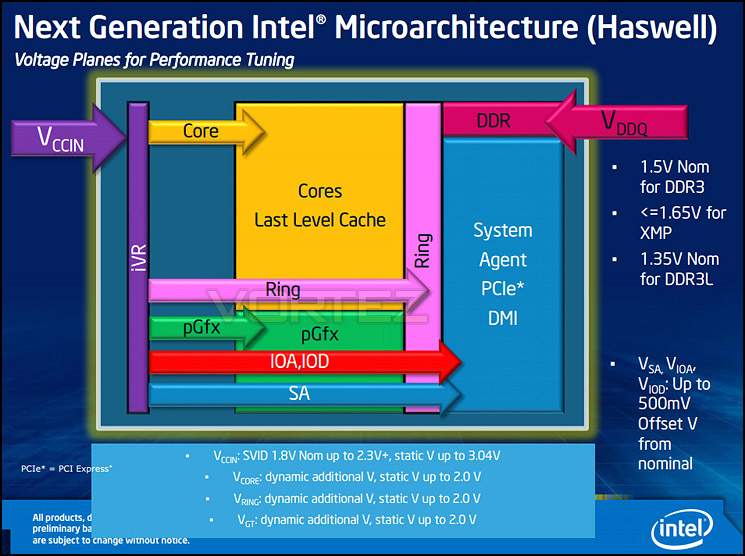
Unlike overclocking with Sandy Bridge and Ivy Bridge, Haswell allows for the BCLK override and is more in tune with modifications found using Sandy Bridge-E. This gives the end-user the ability to tweak more variables, thus giving more freedom in the overclocking arena. This will be music to many ears since previous generations lacked this control.
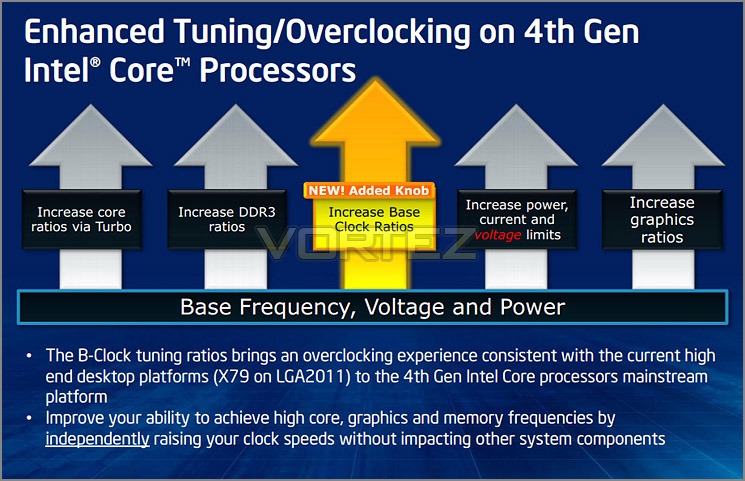
For this section of the review the maximum overclock was achieved by using both Noctua NH-U14S and Corsair H100i. We used both in order to identify if air cooling was us holding back.
The first objective for the overclocking phase of this review was to adjust the multiplier (ratio) in order to increase the frequency of the chip. For the 4770K we also experimented with BCLK modification to see if we were able to establish better results when compared to leaving BCLK at auto (100MHz).
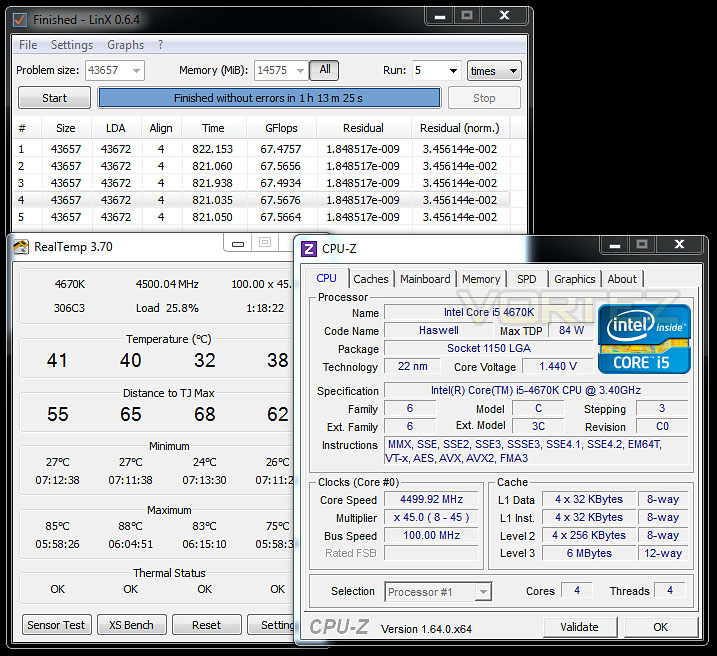
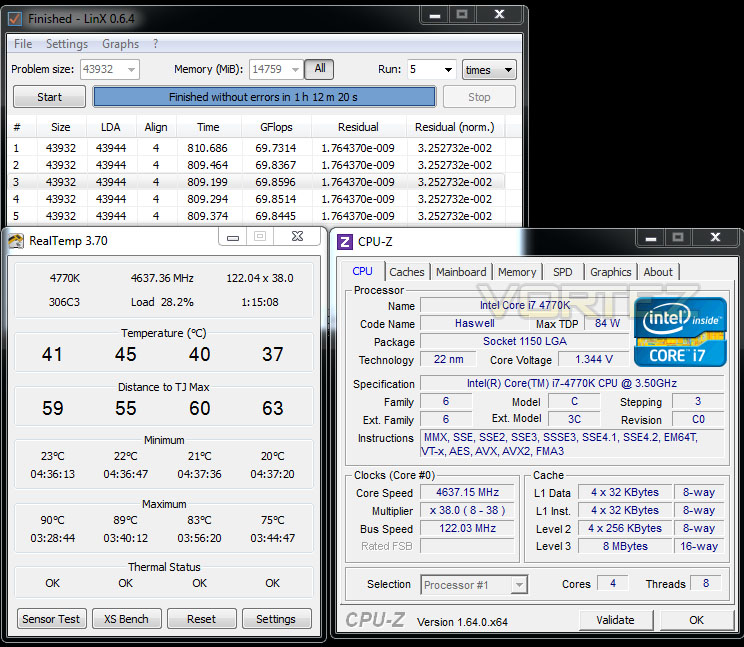
LinX is used to establish stability. Only once this has completed a 5 times run do we proceed benchmarking. By using LinX, the absolute maximum stress and temperatures are forced upon the chip – pushing the temperatures between 85-90C. Under normal usage such as gaming and other benchmarks the temperatures range between 65-70C.
Intel Core i5-4670K
The 4670K managed to overclock up to 45 – 4.5GHz from 3.40GHz, a 32% overclock. This is a significant increase but it did require a fair amount of vcore – 1.45v to be exact. After several hours of trial and error no amount of voltage increase within the barrier of safe temperatures (not exceeding 95C) would allow the core frequency to move beyond 4.6GHz and remain stable.
Intel Core i7-4770K
Our 4770K on the other hand, required much less voltage to achieve its milestone. The 4770K managed to overclock to 47 – 4.7GHz from 3.50GHz, a 34% overclock. Again this is an encouraging result. Furthermore we only needed 1.33v for this achievement. As with the 4670K, we tried to get closer to the 5GHz mark but again no amount of voltage increase within safe temperatures would allow more than 4.7GHz.
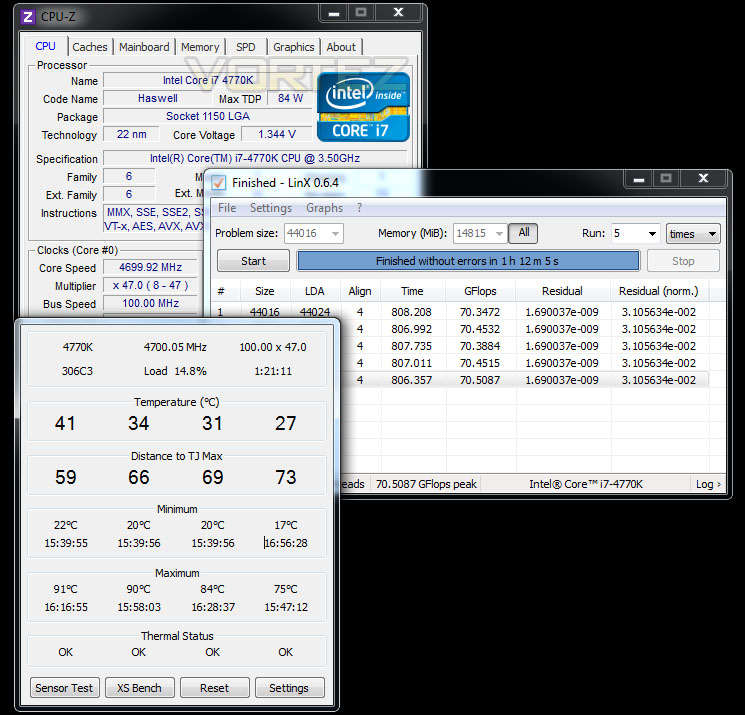
As an additional venture we moved away from the traditions we have become accustomed to with the 2nd and 3rd generations of processors by simply altering only the ratio for overclocking. As mentioned earlier, with the 4th generation (Haswell) we are able to adjust the base clock now and so we also ran a series of tests to establish how effective this works compared to only ratio adjustment.
The best result we could ascertain by modifying the BCLK was 122 and ratio of 38 giving a frequency of 4.65GHz. This required 1.33v and gave the same temperatures as our previous overclock. So this demonstrates that with this particular chip the maximum we can overclock to is the 4.7GHz mark.
Note: Some of the overclock results seen around the web with 5GHz results are using ES chips which are well-known for overclocking better in some cases compared to retail. Our overlcock results are using retail chips.
On the following pages we will be benchmarking our two Haswell CPUs at both stock and overclocked settings – 4.5GHz and 4.7GHz. The stock settings are obviously at default – with turbo boost enabled. Our overclocked settings are fixed at the overclock frequency with turbo boost disabled.
Power Consumption
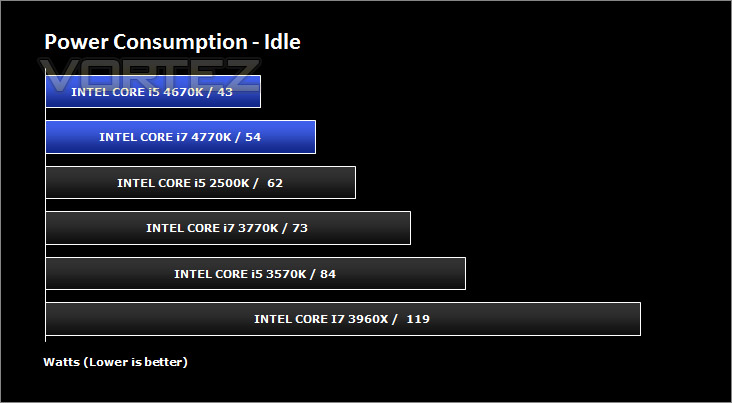
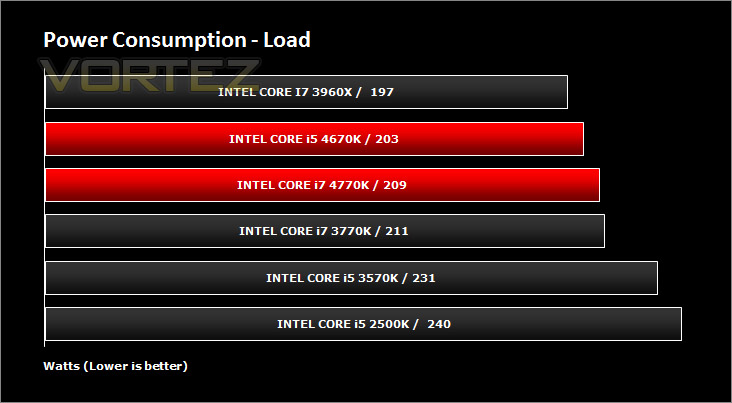
It’s interesting to note the power consumption across all motherboards. Although they are using P67 and Z68 chipsets, energy results can fluctuate between manufacturers due to the features and specifications that are integrated. First of all, for the idle tests the system is cold booted into Windows and no additional applications are executed – the watts are noted on the external energy monitor we use and then the system is loaded with 3DMark FireStrike – watts are again monitored for the duration of the test and the highest rated wattage result is then noted down. Below are the results of this energy test.
It’s worth mentioning that since the Haswell CPUs idle at 800MHz and then boost to 3.40GHz and 3.50GHz this translates to the new chips being much more energy efficient – this is pleasing to see.
IGP Performance Analysis
An interesting feature that first appeared on the desktop environment with the Sandy Bridge architecture was the integrated graphics on the CPU. This meant that regardless of if you had a discreet graphics solution you always had the ability to use “Built in” processing power to watch movies, view 3D content and take part in some casual gaming.
With Haswell, Intel have stepped up with new graphics architecture by delivering full DX11 functionality. HD-4600 has a significant increase in execution units compared to Sandy Bridge which means that even greater performance enhancements are there to be had compared to HD 2000/300. To the end user this should translate to being able to handle 1080p movies, more complex gaming titles and even more intense 3D renders.
Testing procedure
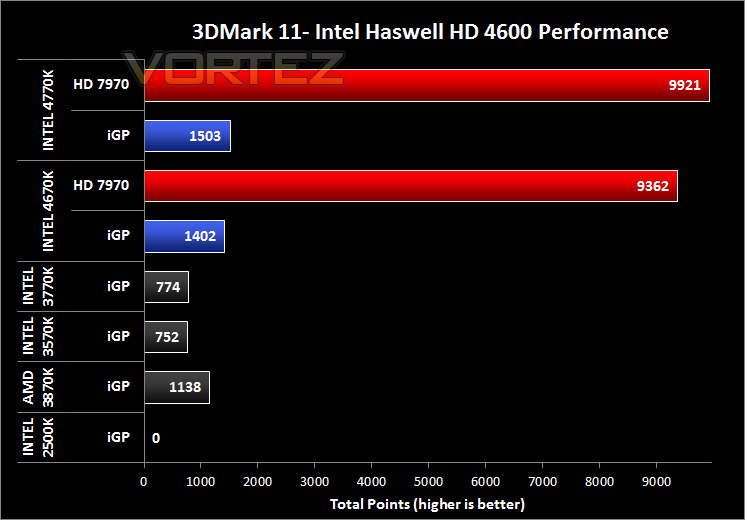
Now, in order to test the effectiveness of the iGP on both 4670K and 4770K there are a variety of benchmarks we can test but we have decided upon 3DMark 11 – performance preset 720p and DIRT 3 @ 1680×1050 with low settings and 4xMSAA. In times past we have tested both these applications with Sandy Bridge and Ivy Bridge so it makes sense to continue using them for comparison reasons. For this test AMD’s A8-3870K iGP along with Intel’s 2500K, 3570K and 3770K will be compared plus we will observe the performance advantage to combining integrated graphics with a discreet solution – XFX 7970 Black Edition.
With 3DMark 11 being DX11 only – the 2500K results could not be obtained, hence no score.
 /center]
Encoding Performance – X264 HD
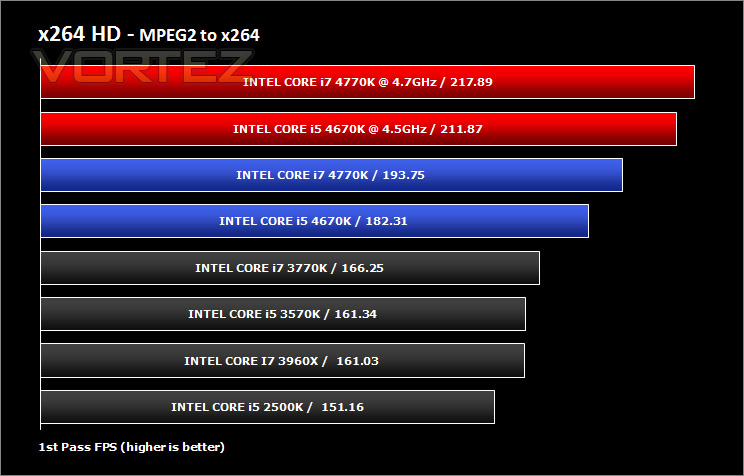
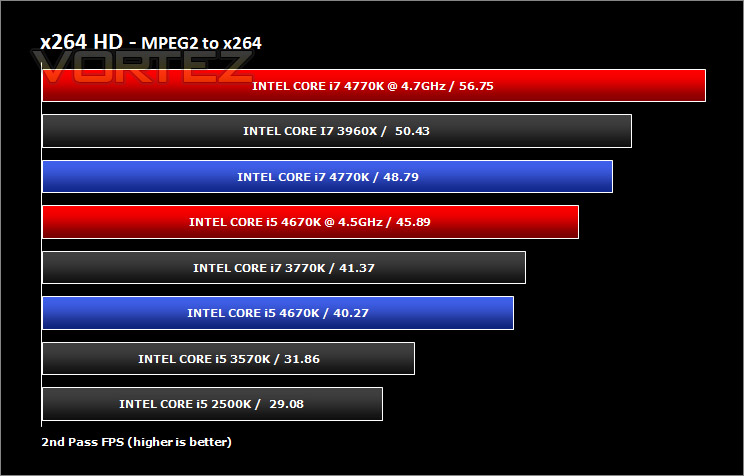
Simply put, this test measures how fast your machine can encode a short, DVD quality MPEG-2 video clip into a high-quality x264 video clip. What’s x264, you ask? It’s more or less the next-generation Xvid/DivX codec. I think it’s ideal for a benchmark because the application (x264.exe) reports fairly accurate compression results (in frames per second) for each pass of the video encoding process, and it uses multi-core processors very efficiently.
x264 HD gives results for 2 passes when compressing an MPEG-2 clip into x264. It presents 4 separate results for each pass giving a total of 8 – all results are given in FPS. For each pass I have averaged out the results.
Both the Haswell CPUs do well in the encoding tests. Both 1st and 2nd passes show significant advantages over the previous generation Ivy Bridge. An overclock optimises this, resulting in even greater efficiency.
Processing Features Performance – AIDA64
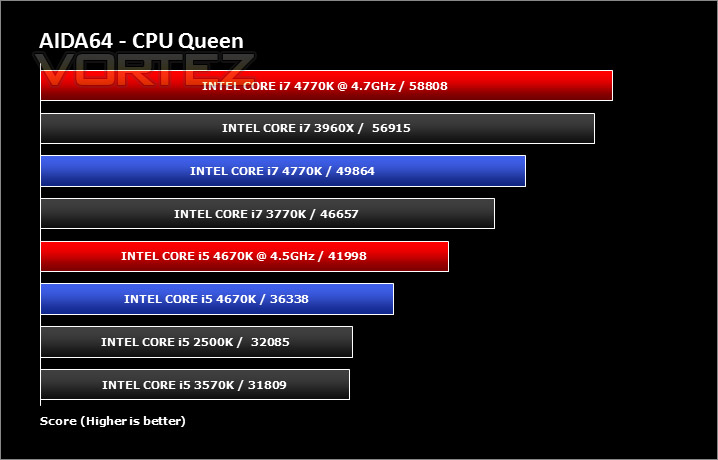
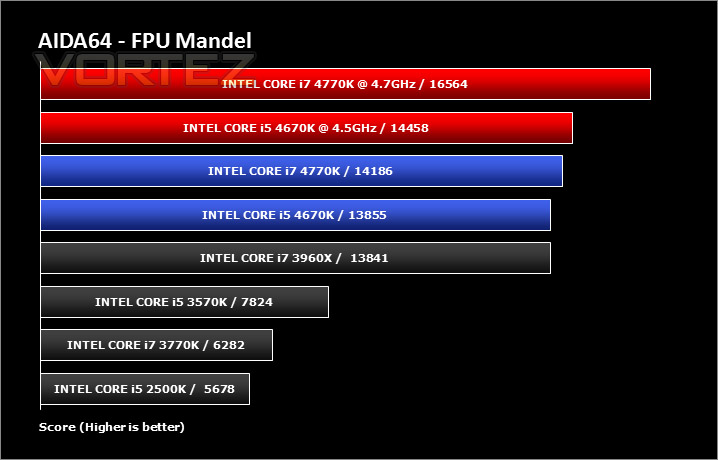
AIDA64 Product PageThis simple integer benchmark focuses on the branch prediction capabilities and the misprediction penalties of the CPU. It finds the solutions for the classic “Queens problem” on a 10 by 10 sized chessboard. At the same clock speed theoretically the processor with the shorter pipeline and smaller misprediction penalties will attain higher benchmark scores. For example — with HyperThreading disabled — the Intel Northwood core processors get higher scores than the Intel Prescott core based ones due to the 20-step vs 31-step long pipeline. CPU Queen test uses integer MMX, SSE2 and SSSE3 optimizations.
Between the SB,IVB and Haswell CPUs there isn’t that much of a gulf separating performance at stock but as we will come to learn throughout these benchmarks, overclocking presents a key advantage. (We usually show AES/Photoworrx performance too but AIDA64 wasn’t fully compliant with these instruction sets prior to launch so we omitted them for now).
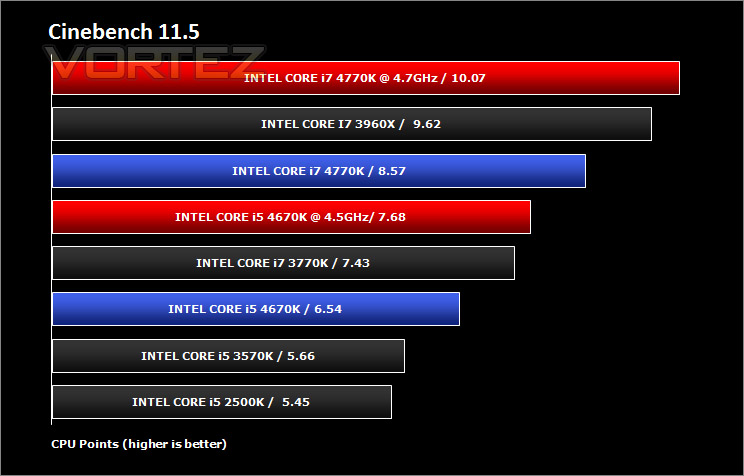
Processing Power Performance – Cinebench
CINEBENCH can measure systems with up to 64 processor threads. This test scene contains approximately 2,000 objects which in turn contain more than 300,000 polygons in total, and uses sharp and blurred reflections, area lights, shadows, procedural shaders, antialiasing, and much more. The result is displayed in points (pts). The higher the number, the faster your processor.
In the Cinebench test the raw processing power is challenged and both Haswell CPUs push the boundaries, showing significant advances over their predecessors.
Cache and Memory Performance – SiSoftware SANDRA
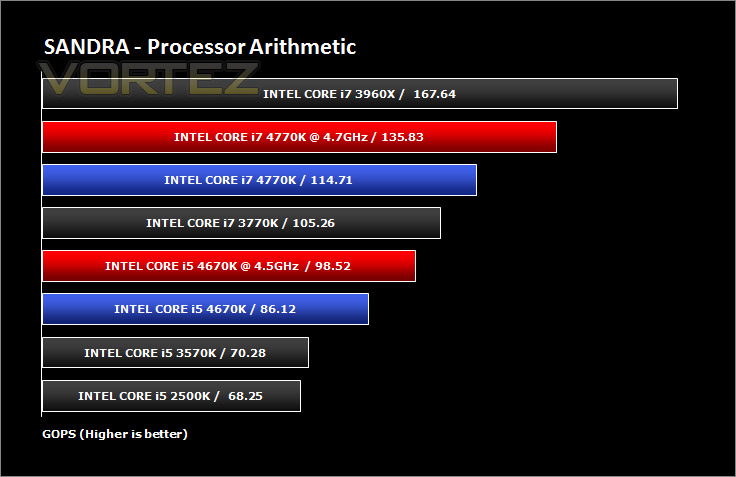
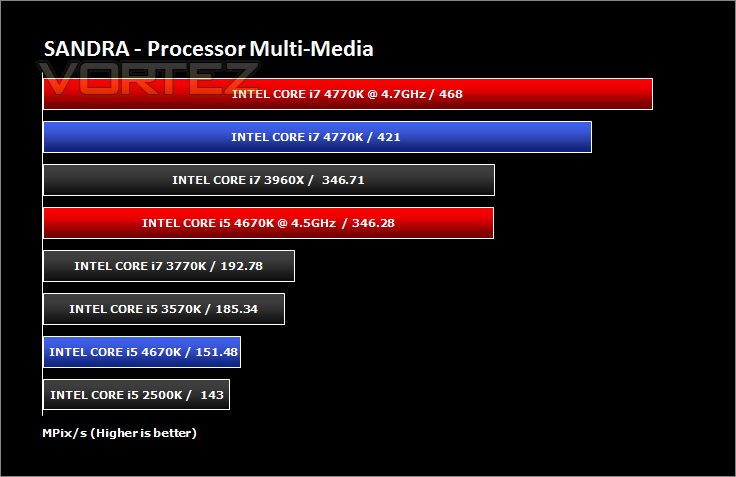
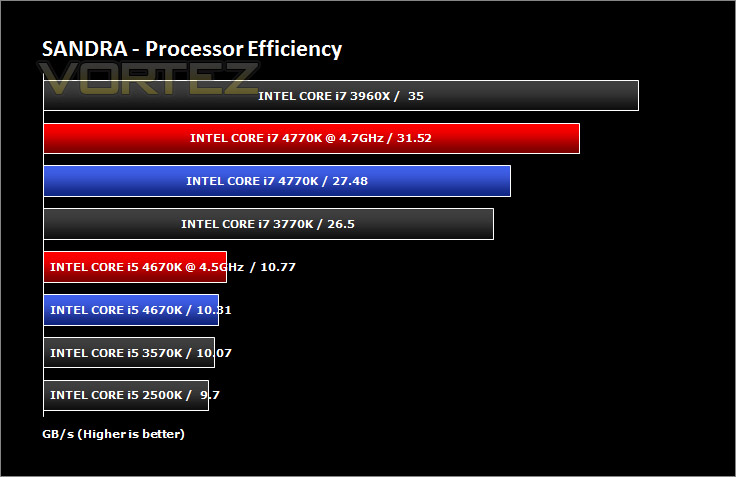
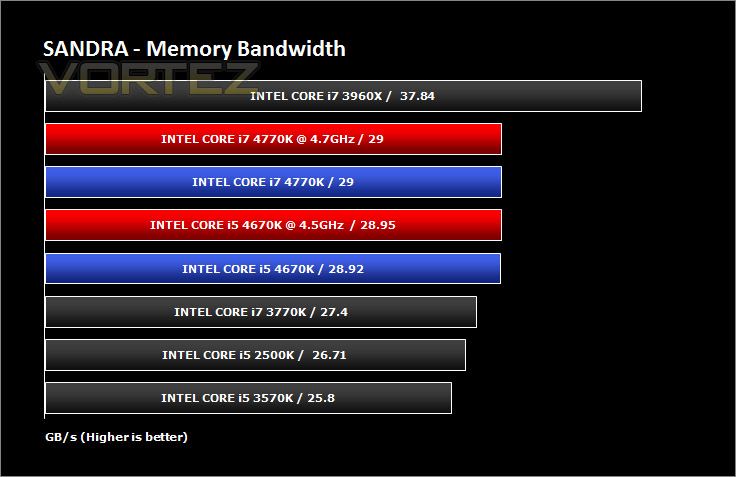
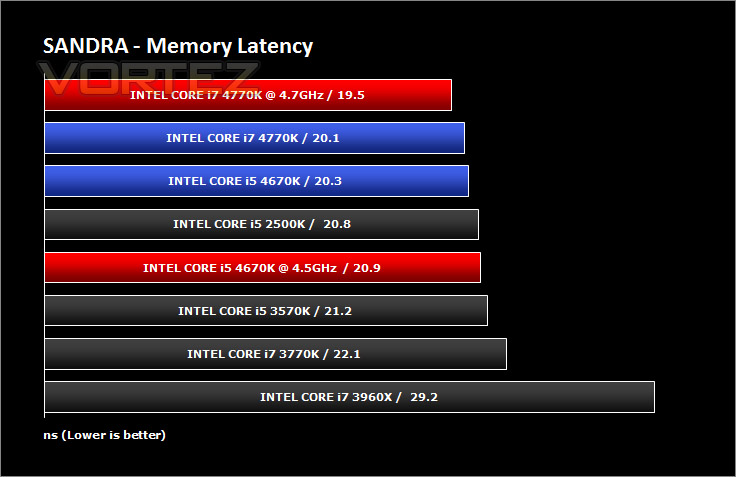
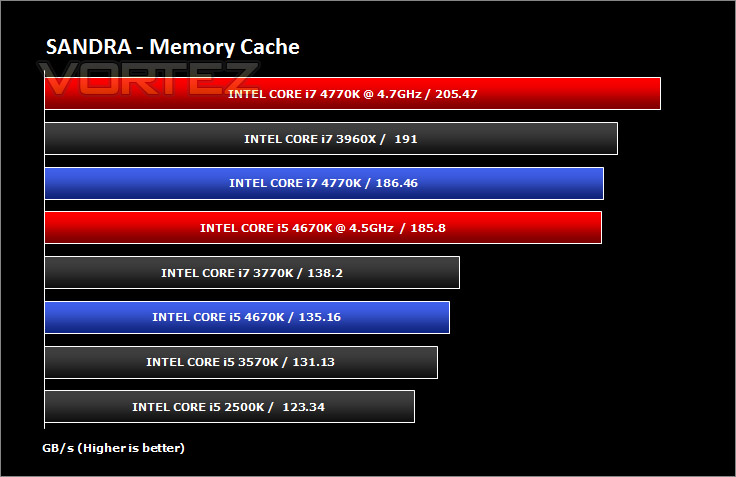
SANDRA isn’t always a benchmark that is included in hardware reviews but I believe it shouldn’t be ignored. SANDRA provides a vigorous package that tests your system in a rather large array of benchmarks. There are many aspects of benchmark that can be executed. We will be considering – CPU and memory tests.
Processor tests – In this series of tests the 4770K reveals a hidden strength. For multimedia tasks this processor pushes ahead and shows significant advantages over its i5 counter-part. Efficiency tests are also worth taking note of, the 4770K almost matches that of the SB-E chip.
3D Performance – 3DMARK FireStrike
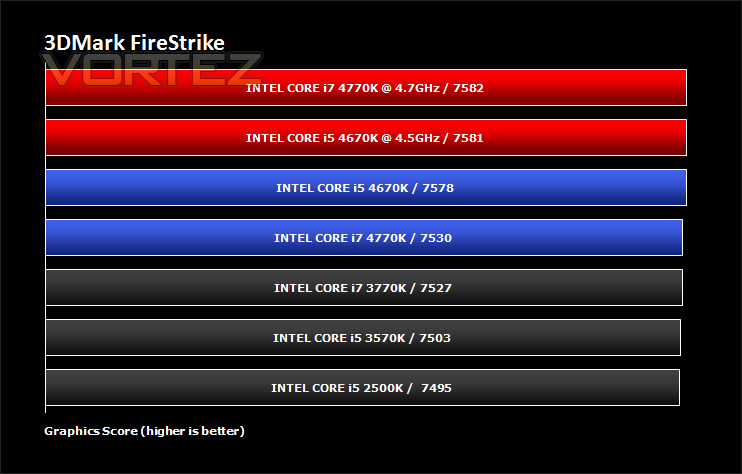
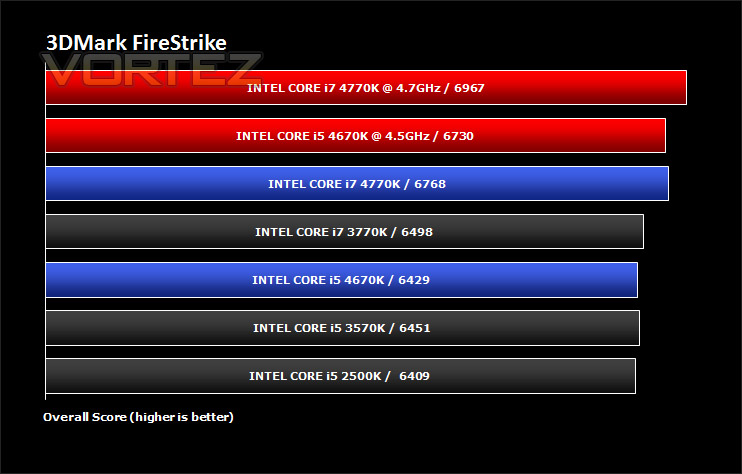
3DMark FireStrike Product PageFire Strike is our new showcase DirectX 11 benchmark designed for high-performance gaming PCs. It is our most ambitious and technical benchmark ever, featuring real-time graphics rendered with detail and complexity far beyond what is found in other benchmarks and games today. Fire Strike will only be available in the Windows editions of 3DMark initially.
Haswell handles FireStrike well but the gulf between the CPUs in the graphics test in particular shows little difference whilst the overall score gives marginal gains over previous generations.
3D Performance – 3DMARK 11
3DMark 11 Product Page[quote]Designed to measure your PC’s gaming performance 3DMark 11 makes extensive use of all the new features in DirectX 11 including tessellation, compute shaders and multi-threading. Trusted by gamers worldwide to give accurate and unbiased results, 3DMark 11 is the best way to consistently and reliably test DirectX 11 under game-like loads.
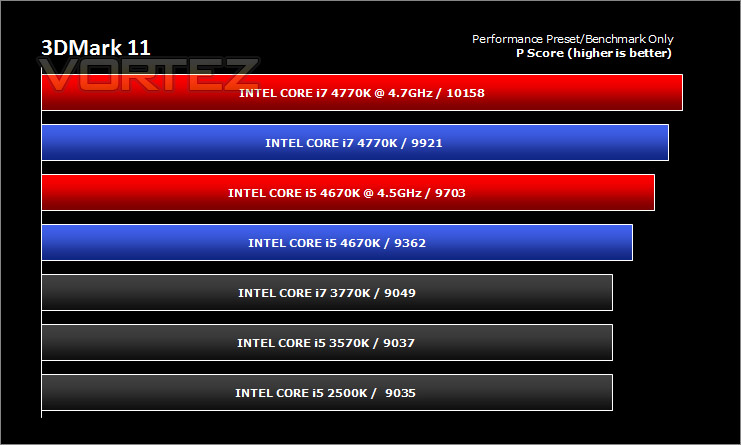
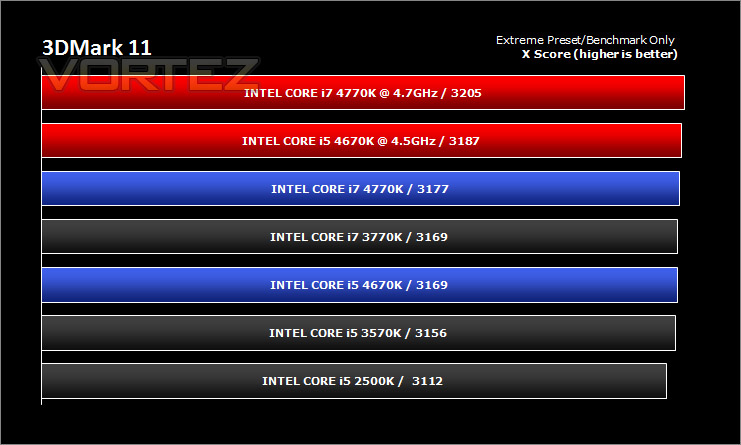
3DMark 11 is a very popular 3D performance benchmark suite and needs little introduction. For the test settings both Performance and Extreme presets are run with ‘benchmark only’ being selected. This provides good analysis. Many will only test the performance preset, using the extreme mode we can examine the board under much more severe stressing – at 720p and 1080p.
In both tests the difference in points is minimal but as is the case throughout most of the benchmark tests the trend continues with 4770K leading the way. The 720p test reveals more of a difference with results.
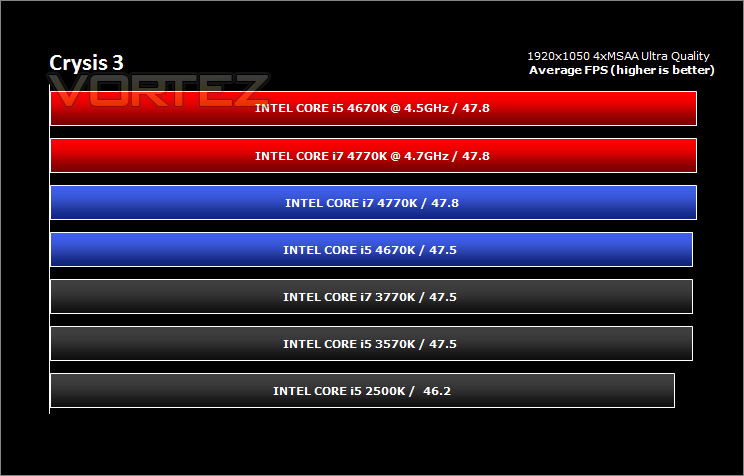
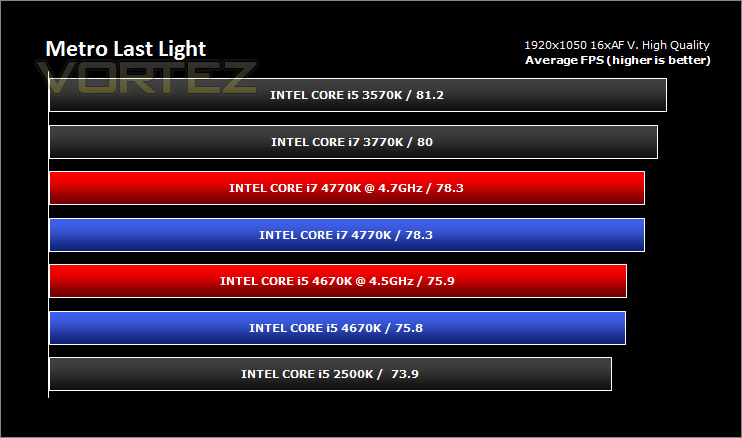
Gaming Performance – Tomb Raider, Crysis 3, Metro Last Light
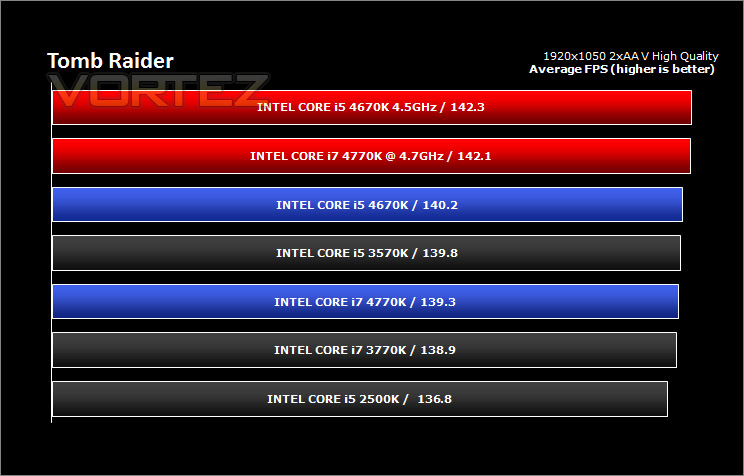
It’s important for us to perform a number of game benchmarks as well as the synthetic tests because gamers will want to know if there are any significant benefits. So here we have a selection of popular gaming titles, critically acclaimed and action-packed.
Settings
Tomb Raider
– 1920×1050 2xAA – Very High Quality *Benchmark tool*
Crysis 3
– 1920×1050 2xAA – Ultra Quality *FRAPS – 1st scene/gameplay*
Metro Last Light
– 1920×1050 16xAF – Very High Quality *FRAPS – 1st scene/gameplay*
The gaming titles selected demand GPU power over CPU power – in each test the difference is rather marginal. VSync is disabled in all titles.
Conclusion
Intel Haswell has been a hot topic for a considerable amount of time. Even before Ivy Bridge had even hit the shelves troops of enthusiasts were speculating about what could be, but some 12 months since Intel’s 3rd generation processor launch we are once again with the biggest name in the industry for that much anticipated showdown. So what do we think of Intel Haswell now that it is finally here?
With Haswell a new socket is required – this will probably exasperate some, especially if they have only just moved to Intel Z77. But with this new LGA 1150 socket, there is still compatibility with LGA115X CPU coolers and of course dual DDR3 memory kits which should help lower the cost for those wanting to jump ship.
In our benchmarks we examined the unlocked Core i5 and Core i7 flagships – 4670K and 4770K. Both chips revealed significant gains in most of the tests we conducted, demonstrating prowess and reasons to justify upgrading from previous generations. The 4770K in particular pushes the boundaries in a range of scenarios stretching from video encoding to multi-tasking.
Hardcore enthusiasts have had their qualms since the early days of Sandy Bridge in regards to overclocking due to BLCK being restricted. Up until now in order to indulge in more flexibility users had to invest in Intel’s premium SandyBridge-E platform. But fear not, Intel have brought back BCLK adjustments to Haswell and those who once complained that the “fun” had been taken out of overclocking are now silenced. Both the 4670K and 4770K overclocked well in our experience, the 4670K did struggle a little though and required more voltage but we know of others who have had better success. Nevertheless, our 4770K needed very little encouragement to reach the delights of 4.7GHz and we are certain that there will be other chips that will surface in the near future that can attain unto that 5GHz milestone without too much hassle. One thing to mention regarding Haswell is that it requires less voltage to gain good results for overclocking but voltage increase pushes temperatures up much higher than Ivy Bridge.
Compared to the Ivy Bridge launch prices, Haswell has been nudged up ever so slightly. The 4670K should retail for approx.. £199.99 and the 4770K £285.99. The step up in performance is significant in some areas but in others only marginal so in terms of value it’s quite a tricky one. There are definitely a number of key advantages to moving from Ivy Bridge to Haswell, but there are also reasons to resist an upgrade.
Intel’s Haswell Core i5-4670K and Core i7-4770K offer a generous boost in performance over the previous generation of processors in some arenas and we are pleased to see that overclocking is both effective and allows BLCK modifications. Upgrading from Ivy Bridge will be a costly pursuit with a new chip plus motherboard chipset being mandatory and its understandable that for some the performance leap won’t be as they expected. Nevertheless, we are pleased to hand out our Silver award to the Core i5-4670K and Gold award to i7-4770K
Pros
+ Good performance increase for different uses
+ Overclocking is easy and effective
+ Overclocking is flexible – BCLK adjustments
+ Overclocking realises significant performance improvements
+ Requires less voltage to overclock
+ Better heat dissipation compared to IVB at stock
Cons
– New socket/motherboard required
– Perhaps not the leap some were hoping for
– Gets hot with small voltage increases
– IGP FPS performance inferior to IVB
+ Good performance increase for different uses
+ Overclocking is easy and effective
+ Overclocking is flexible – BCLK adjustments
+ Overclocking realises significant performance improvements
+ Requires less voltage to overclock
+ Better heat dissipation compared to IVB at stock
Cons
– New socket/motherboard required
– Perhaps not the leap some were hoping for
– Gets hot with small voltage increases
– IGP FPS performance inferior to IVB


Click here for an explanation of our awards at Vortez.net.


