



Introducing HSA features, AMD’s APUs can boost user experiences by tapping into the power of the GPGPU, let’s see how much difference it can make.

Product on Review: AMD A10-7850K APU
Manufacturer and Sponsor: AMD
Street Price: £129.99 inc. VAT (GBP)
AMD’s vision of unifying CPU and GPU takes a step closer with the integration of HSA features in the latest line of APUs. Till now, the term ‘APU’ (Accelerated Processing Unit) has often been considered to be a buzzword, or euphemism for (competent GPU on die) that is often considered to be ‘OK’ for entry level gaming, but with hUMA (Heterogeneous Unified Memory Access), allowing both GPU and CPU to access the same system memory, for the first time in history, developers have instant access to the processing power of the GPU cores on a hardware level. Using the now mature 28nm fabrication we are likely to see an improvement in performance per watt as well as various improvements in regards to the GPU. The R7 GPU is using AMDs GCN architecture that has 8 compute cores and a total of 512 shader cores.
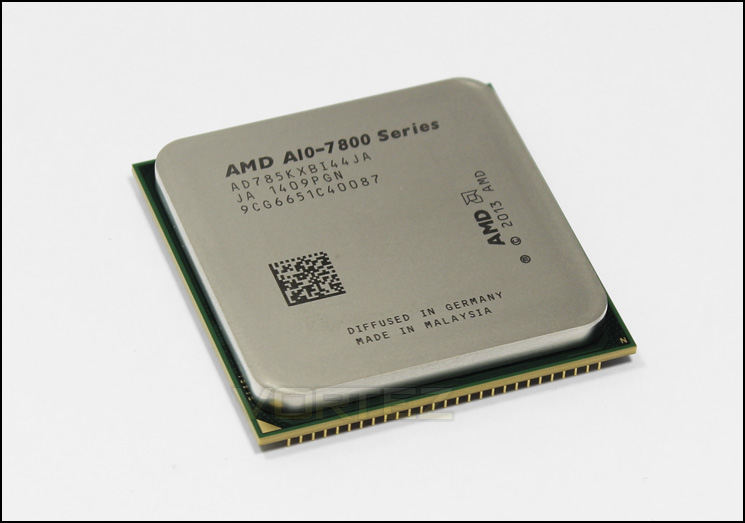
AMD’s Overview of the APU
AMD’s most advanced APU ever. Welcome to the revolution.
Introducing the AMD A10-7850K , AMD’s most advanced APU. So revolutionary, it challenges the very definition of a processor. With 12 Compute Cores (4 CPU + 8 GPU)4 with AMD Radeon™ R7 graphics and exclusive features like AMD TrueAudio technology for immersive audio, it can take on Battlefield 4™ or just about anything else you throw at it.
Introducing the AMD A10-7850K , AMD’s most advanced APU. So revolutionary, it challenges the very definition of a processor. With 12 Compute Cores (4 CPU + 8 GPU)4 with AMD Radeon™ R7 graphics and exclusive features like AMD TrueAudio technology for immersive audio, it can take on Battlefield 4™ or just about anything else you throw at it.
Specifications & Features
Model: A10-7850K
Radeon™ Brand: Radeon™ R7 Graphics
Compute Cores: 12(4 CPU + 8GPU)
CPU Clock Speed: 4.0GHz/3.7GHz
GPU Clock Speed: 720MHz
TDP: 95W
Total L2 Cache: 4MB
DDR3 Speed: 2133
Radeon™ Brand: Radeon™ R7 Graphics
Compute Cores: 12(4 CPU + 8GPU)
CPU Clock Speed: 4.0GHz/3.7GHz
GPU Clock Speed: 720MHz
TDP: 95W
Total L2 Cache: 4MB
DDR3 Speed: 2133
AMD A10 processors empower you to:
– Unlock your system’s full potential with the A10-7850K APU’s revolutionary HSA architecture
– Get extreme performance with the A10-7850K APU’s Graphics Core Next (GCN) Architecture, featuring supercharged AMD Radeon™ R7 graphics
– Tear through everyday applications with AMD Turbo Core 3.0 technology
– Experience breathtaking immersive audio with the A10-7850K APU’s AMD TrueAudio technology
Features
HSA
Unlock your system’s full potential with revolutionary HSA (Heterogeneous System Architecture) – the new standard in processor design – enabling the CPU and GPU to work in perfect harmony and blaze through compute tasks in Ultra HD resolution. Take processing performance and pure power efficiency to new extremes with hUMA, by enabling GPU’s full access to the entire system memory and the CPU and GPU to seamlessly share data.
Graphics Core Next (GCN) Architecture
Get extreme performance with Graphics Core Next (GCN) Architecture, featuring supercharged AMD Radeon™ R7 graphics.
Mantle Technology
AMD Mantle technology raises your game to unprecedented levels with hyper-efficient performance.
AMD TrueAudio Technology
Designed for breathtaking immersive audio, AMD TrueAudio technology sets a new level of immersion. Hear your enemy’s every move and anticipate their next.
AMD Eyefinity Technology
Connect up to 4 displays to see every angle of the battlefield with AMD Eyefinity technology in its full glory.
Packaging & First Look
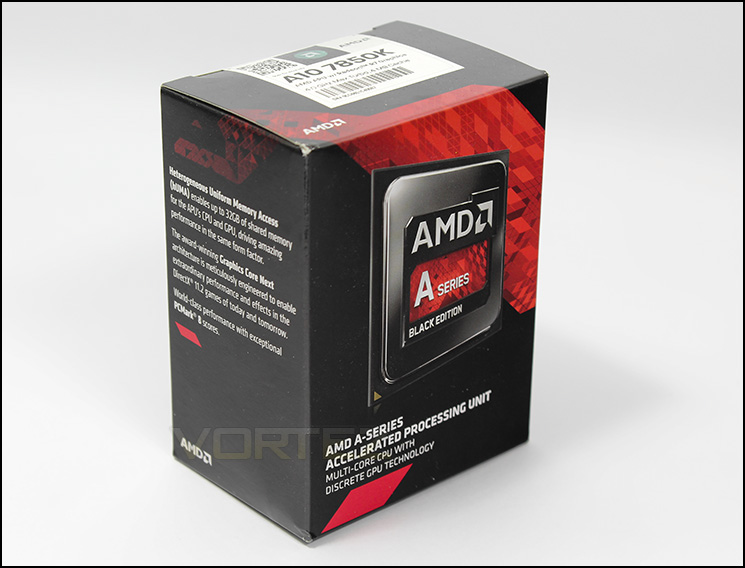
Box Front
The latest APU comes in the Elite black and red packaging that looks quite attractive, the box itself is quite small and is certainly more efficiently packaged than older processors.
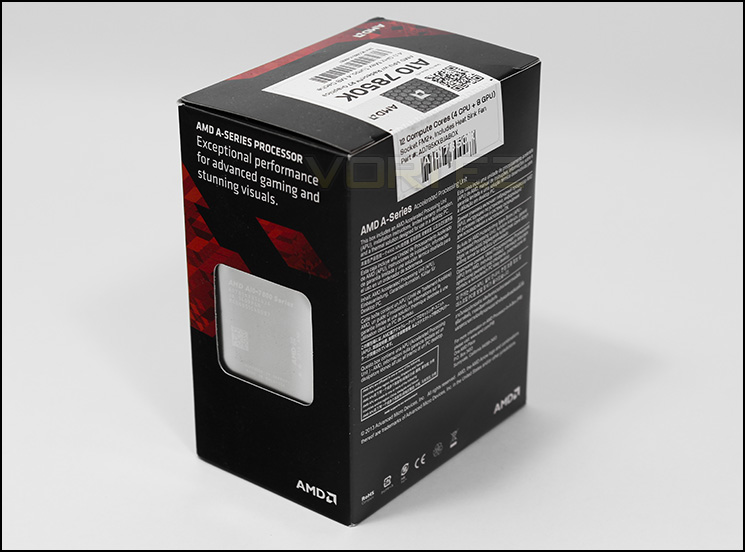
Reverse side
At the back we get some information about the APU and on the side we can clearly see the APU itself.
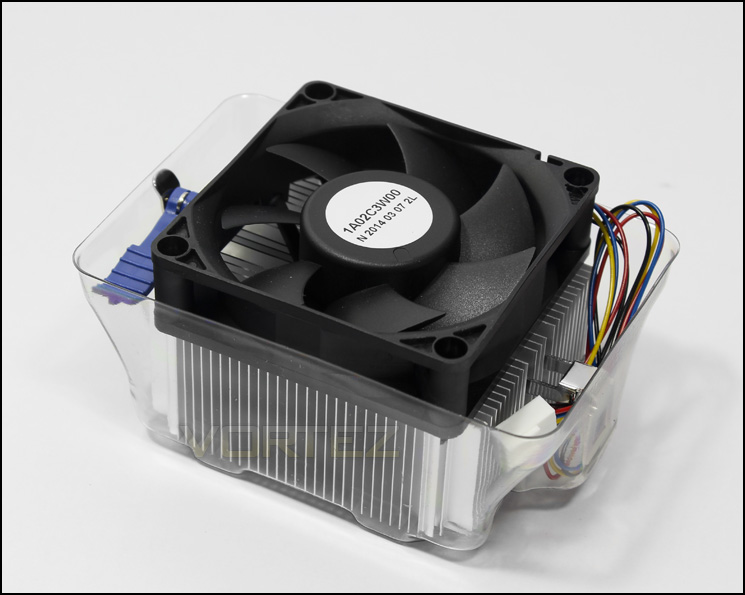
The included heatsink
The included heatsink is fairly small, no heatpipes or copper to be seen. While the A10 7850K only has a 95W TDP, it would have been good to see a heatsink that says ‘Increase my clock speed a little!’.
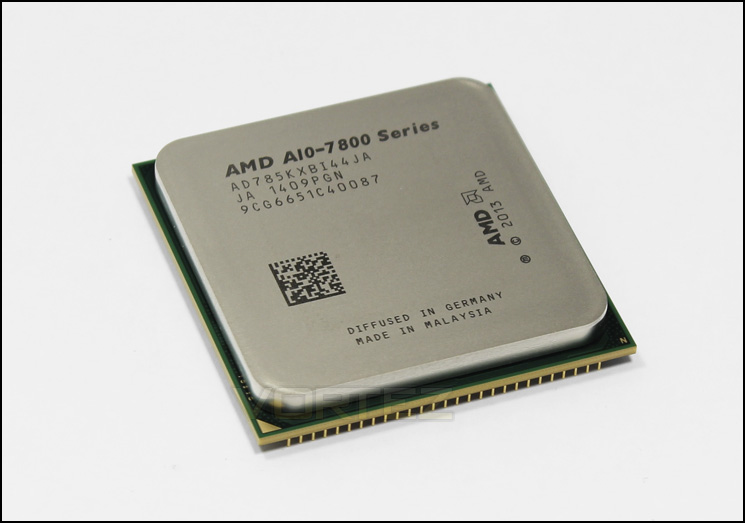
The A10 7850K
The overall product impression is still unmistakably AMD.
Test Setup
A88X Setup
Motherboard – GIGABYTE G1 Sniper A88X
RAM – Xtreem LV PC3 19200 DDR3 LV 2400
SSD – Kingston Hyper X 120GB
Power Supply – NZXT Hale82 650W
Cooler – Noctua U12S
Motherboard – GIGABYTE G1 Sniper A88X
RAM – Xtreem LV PC3 19200 DDR3 LV 2400
SSD – Kingston Hyper X 120GB
Power Supply – NZXT Hale82 650W
Cooler – Noctua U12S
APU/CPU Configurations
A10-7850K @ 3.7/4.0 GHz (100MHz x 37/40, 1333 MHz 9-9-9-24, 2133 MHz 10-11-11-33)
Radeon R7 Graphics @ 720 MHz
A10-7850K @ OC 4GHz (100 x 40, 2400 MHz 9-11-11-31)
A10-6790K @ 4.0 GHz/4.3 GHz (100MHz x 41/44, 1866 MHz 9-9-9-24), OC @ 4.71 GHz
HD 8670D integrated graphics @ 844 MHz
A10-6800K @ 4.1 GHz/4.4 GHz (100MHz x 41/44. 1333 MHz 9-9-9-24)
HD 8670D integrated graphics @ Stock
A10-5800K @ 3.8GHz/4.2GHz (100MHz x 38/42. 1333MHz 9-9-9-24)
HD 7660D integrated graphics @ Stock
AMD A8-3870K @ 3.0GHz (100MHz x 29, 1333MHz 9-9-9-24)
HD 6550D integrated graphics @ Stock
Intel Core i5-4430 @ 3.0 GHz/3.2 GHz, 1866 MHz memory
HD 4600 Dynamic Frequency 350 MHz – 1.1 GHz
Overclocking
When overclocking an APU you will need to disable any power saving or turbo feature, once done, I initially increased the base clock to 104MHz with a multiplier of 40 and the GPU set to 960MHz, this brought the CPU speed to a nice 4160MHz, the GPU to 998MHz and the memory to just under 2500MHz. At auto voltage it seemed to handle this fine but wouldn’t complete 3DMark11 or 3DMark without a BSOD. Aiming for top CPU speed, I managed to boot into windows at just over 4.8GHz however, I could not seem to get anything over 4.1GHz stable, maybe I was being too reserved on increasing the voltage. I did however manage to get the GPU running at 1100MHz but experienced another BSOD, maybe to do with the memory. Because of how intrinsically connected the CPU, GPU and memory are, getting the balance right is lightly more vital than ever before, at least this is what I was telling myself. So I decided to go for a sensible, cooler friendly 4GHz overclock with 960MHz on the GPU with 2400MHz memory.
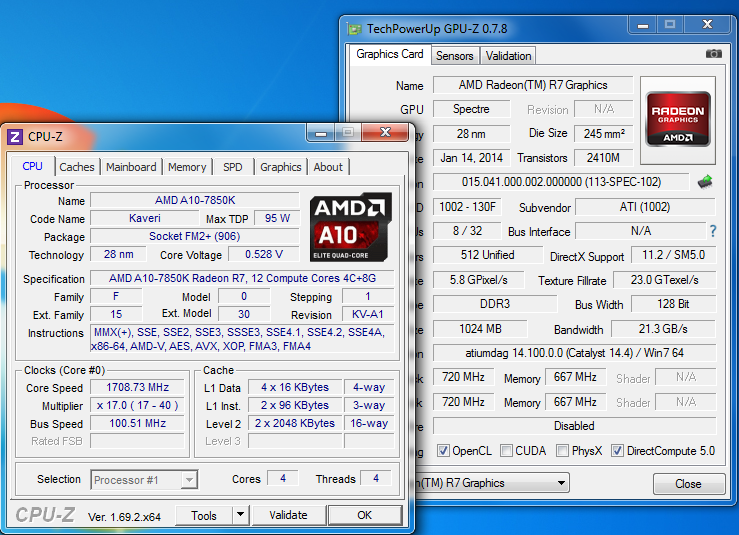
Stock settings
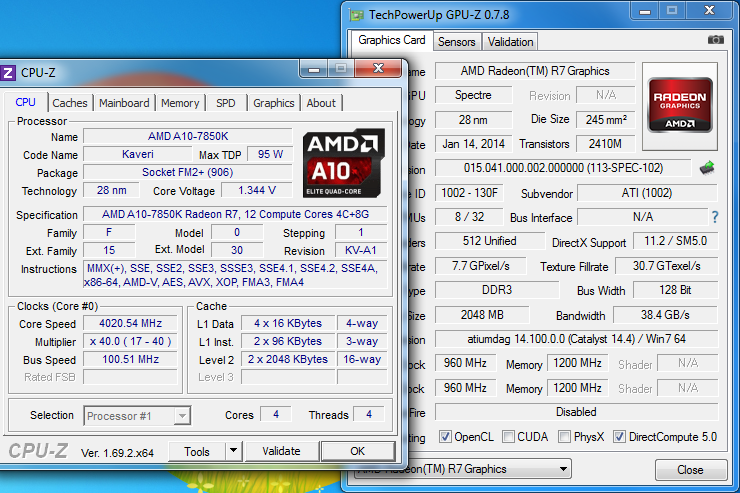
Overclocking the GPU and Memory
Power Consumption
It’s interesting to note the power consumption across all motherboards because energy results can fluctuate between manufacturers due to the features and specifications that are integrated. First of all, for the idle tests the system is cold booted into Windows and no additional applications are executed – the watts are noted on the external energy monitor we use. Then the system is loaded with LinX 0.6.4 and MSI Kombustor simultainiously – watts are again monitored throughout the period of testing and the highest rated watts are then noted down. Below are the results of this energy test.
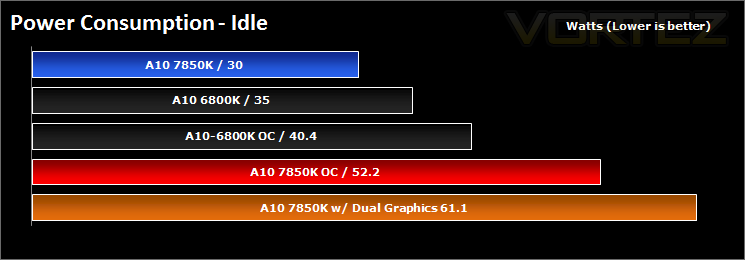
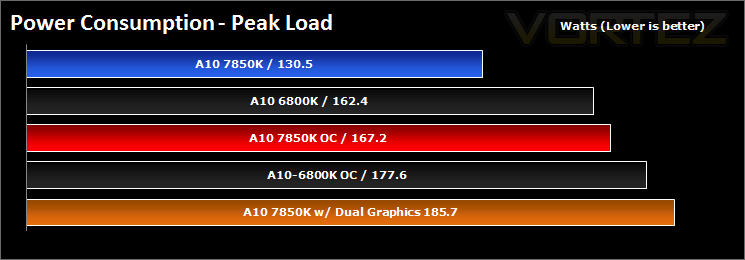
As a fair comparison, we took the readings measured on the A10 6800K using the G1.Sniper A88X which is the same setup we are testing the A10 7850K on. Generally speaking, the Kaveri chip manages to cut down the power usage a little over its predecessor.
Synthetic Benchmarks: AIDA64
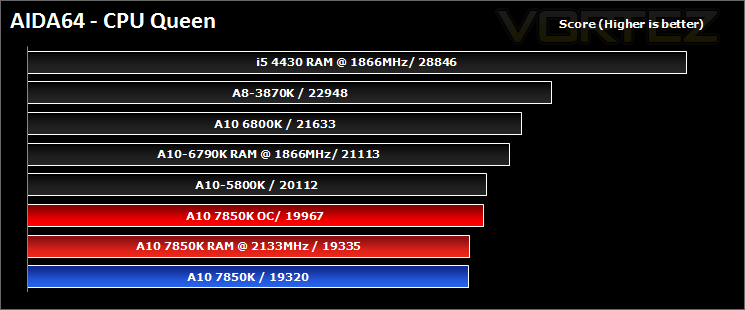
CPU Queen BenchmarkThis simple integer benchmark focuses on the branch prediction capabilities and the misprediction penalties of the CPU. It finds the solutions for the classic “Queens problem” on a 10 by 10 sized chessboard. At the same clock speed theoretically the processor with the shorter pipeline and smaller misprediction penalties will attain higher benchmark scores. For example — with HyperThreading disabled — the Intel Northwood core processors get higher scores than the Intel Prescott core based ones due to the 20-step vs 31-step long pipeline. CPU Queen test uses integer MMX, SSE2 and SSSE3 optimizations.
CPU Photoworxx Benchmark
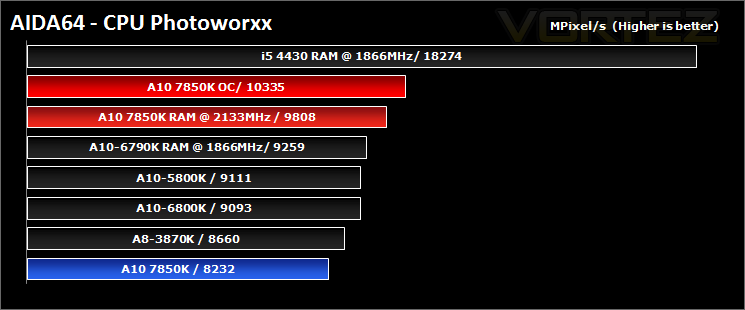
This benchmark stresses the integer arithmetic and multiplication execution units of the CPU and also the memory subsystem. Due to the fact that this test performs high memory read/write traffic, it cannot effectively scale in situations where more than 2 processing threads used. For example, on a 8-way Pentium III Xeon system the 8 processing threads will be “fighting” over the memory, creating a serious bottleneck that would lead to as low scores as a 2-way or 4-way similar processor based system could achieve. CPU PhotoWorxx test uses only the basic x86 instructions, and it is HyperThreading, multi-processor (SMP) and multi-core (CMP) aware.
FPU Mandel Benchmark
This benchmark measures the double precision (also known as 64-bit) floating-point performance through the computation of several frames of the popular “Mandelbrot” fractal. The code behind this benchmark method is written in Assembly, and it is extremely optimized for every popular AMD, Intel and VIA processor core variants by utilizing the appropriate x87, SSE2, AVX or FMA4 instruction set extension. FPU Mandel test is HyperThreading, multi-processor (SMP) and multi-core (CMP) aware.
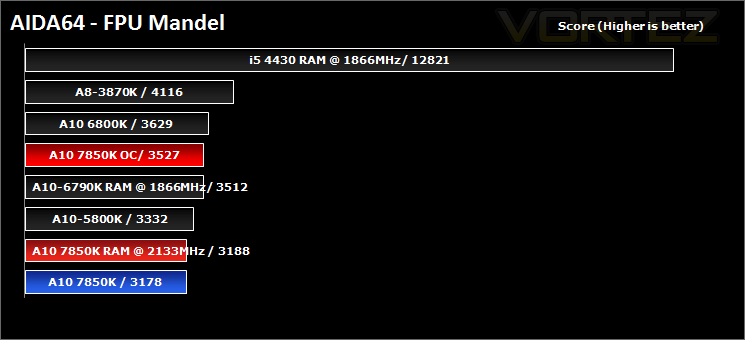
The A10 7850K appears to suffer from a lower CPU clock speed in the AIDA 64 tests, however, @ 4GHz it becomes comparable to the A10-6800K with a turbo to 4.2GHz.
Synthetic Benchmarks: x264 HD
Simply put, this test measures how fast your machine can encode a short, DVD quality MPEG-2 video clip into a high-quality x264 video clip. What’s x264, you ask? It’s more or less the next-generation Xvid/DivX codec. I think it’s ideal for a benchmark because the application (x264.exe) reports fairly accurate compression results (in frames per second) for each pass of the video encoding process, and it uses multi-core processors very efficiently.
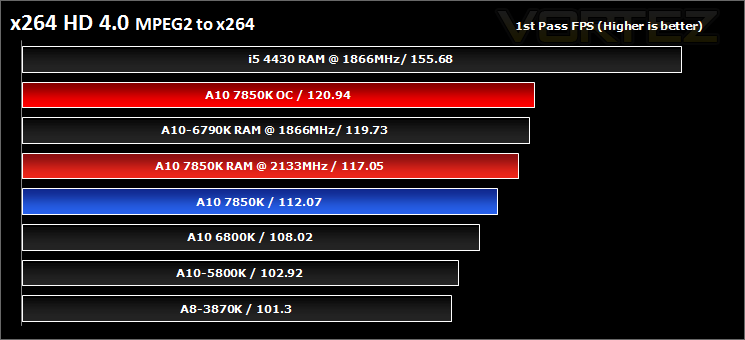
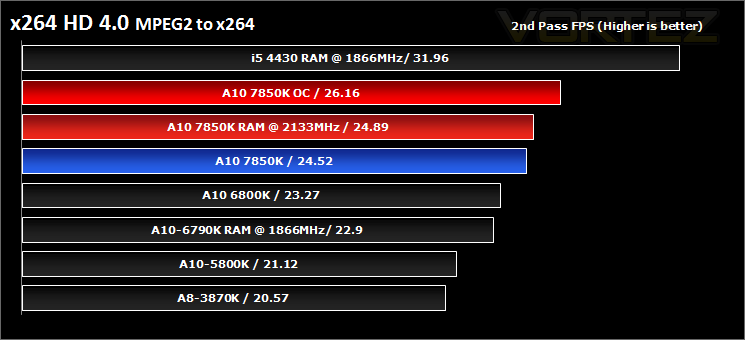
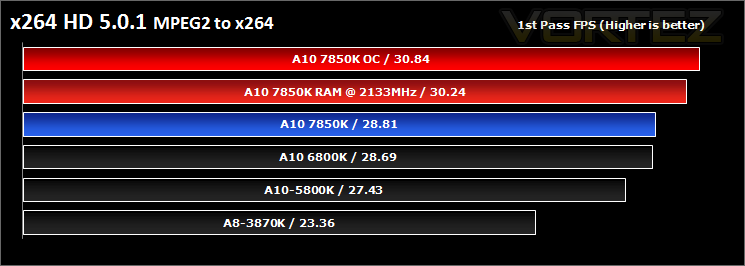
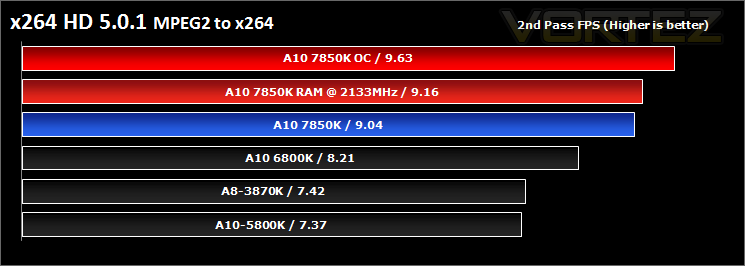
In this test we can see the improvements pay off in the new Steamroller cores over previous APUs, still a little way off from the Intel performance here.
Synthetic Benchmarks: Cinebench 11.5 & R15
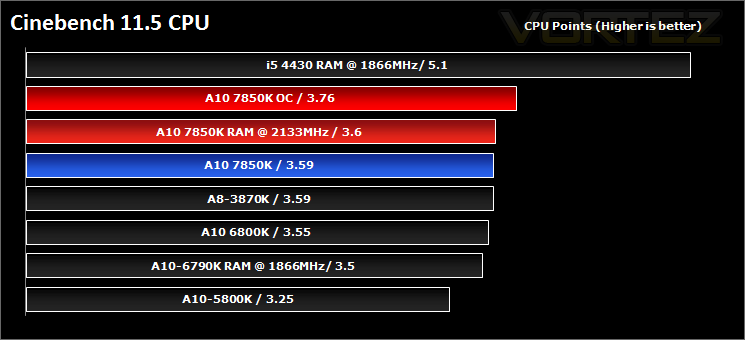
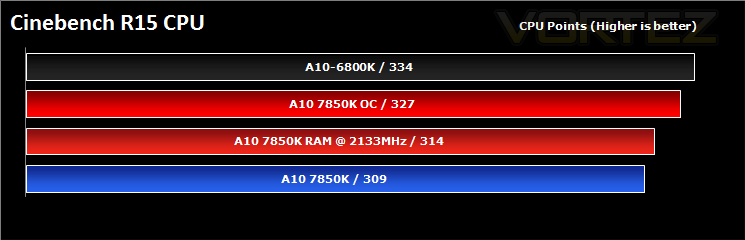
CPU RenderingCINEBENCH can measure systems with up to 64 processor threads. This test scene contains approximately 2,000 objects which in turn contain more than 300,000 polygons in total, and uses sharp and blurred reflections, area lights, shadows, procedural shaders, antialiasing, and much more. The result is displayed in points (pts). The higher the number, the faster your processor.
Open GL Graphics Rendering
This procedure uses a complex 3D scene depicting a car chase (by renderbaron) which measures the performance of your graphics card in OpenGL mode. The performance depends on various factors, such as the GPU processor on your hardware, but also on the drivers used. The graphics card has to display a huge amount of geometry (nearly 1 million polygons) and textures, as well as a variety of effects, such as environments, bump maps, transparency, lighting and more to evaluate the performance across different disciplines and give a good average overview of the capabilities of your graphics hardware.
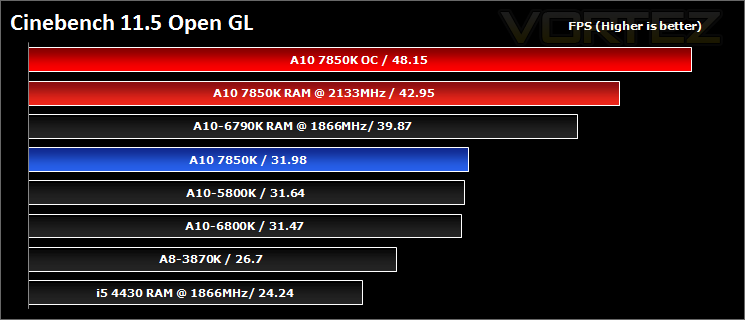
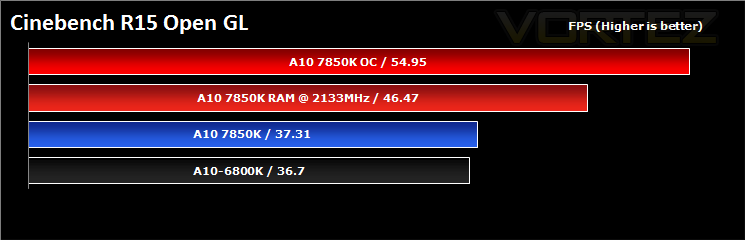
The A10 7850K is the first APU to match/ better the A8 3870K in the Cinebench CPU test, though in the R15 test we can see it suffers a little from the lower clock speed vs the A10 6800K.
Synthetic Benchmarks: SiSoftware SANDRA
SANDRA isn’t always a benchmark that is included in hardware reviews but I believe it shouldn’t be ignored. SANDRA provides a vigorous package that tests your system in a rather large array of benchmarks. There are many aspects of benchmark that can be executed. We will be considering – CPU, memory and GPGPU tests.
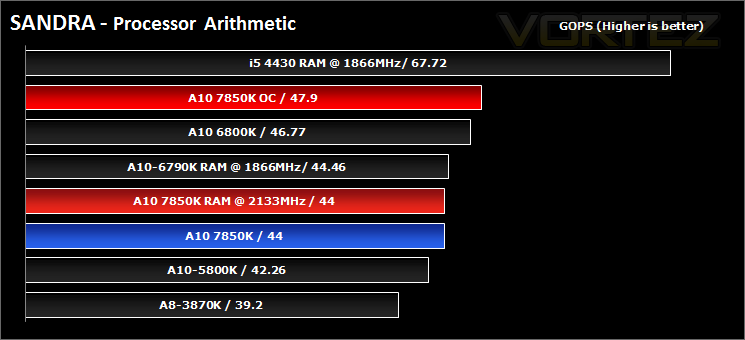
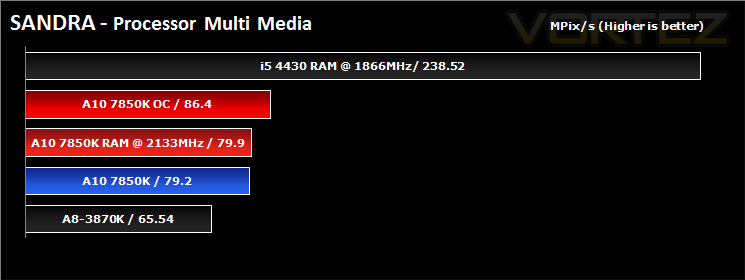
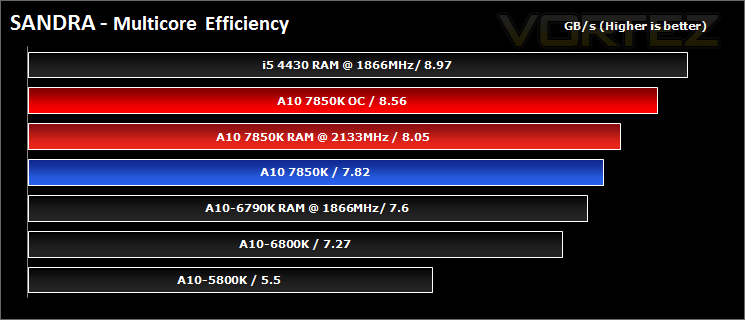
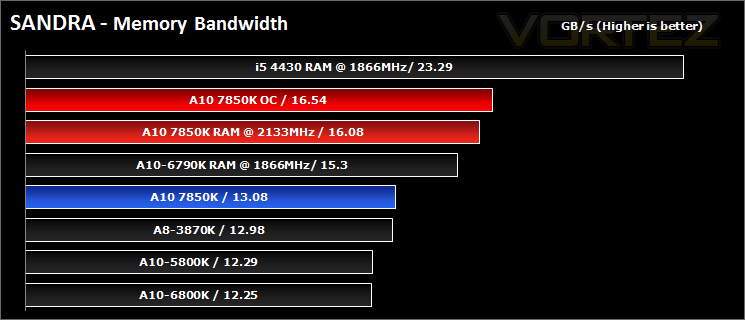
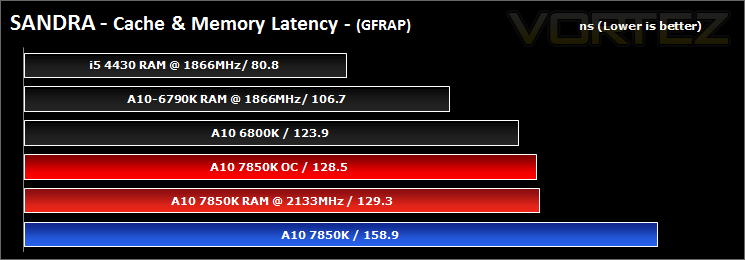
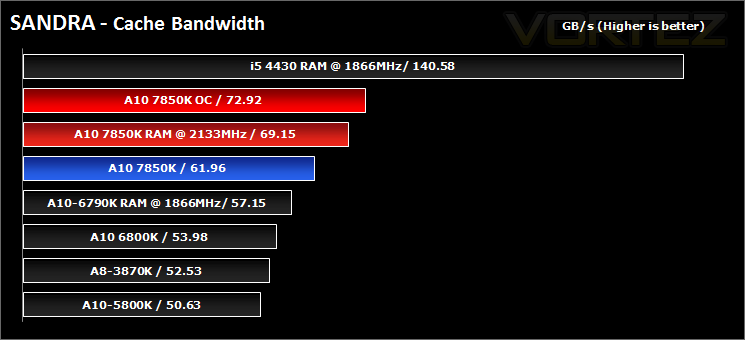
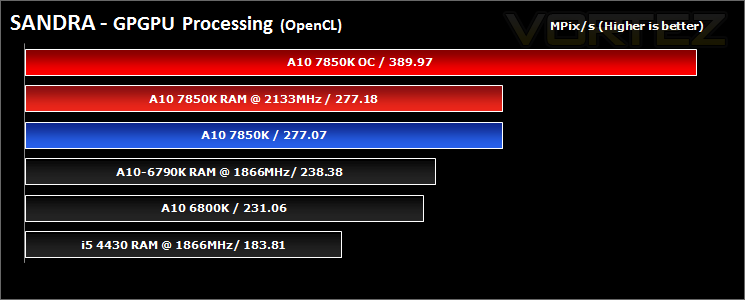
SANDRA shows off some very interesting results, at first it is clear that the A10 7850K does have a high IPC compared to Richland and Trinity APUs but suffers a little from the 3.7-4.0GHz clock speed compared to the 3.9-4.2GHz, however, in multicore efficiency and Memory bandwidth, we see a marginal improvement that makes gains on the Intel CPU. The largest shortcoming of the CPU side of the APU is the floating point operations as seen in the Processor Multimedia testing, with Intel having a clear lead. However, AMD are trying to fill this gap in performance using the GPGPU side, if AMD improve further upon HSA features, it would be very beneficial to have the GPU handling the floating point operations. The ones to compare for this would be the CPU MultiMedia result to the GPGPU Results.
Memory latency has increased a fair bit with the A10 7850K too, though this could be due to the hUMA (Heterogeneous Uniform Memory Access).
Synthetic Benchmarks: 3DMark 11 & 3DMark – Fire Strike
3DMark 11Designed to measure your PC’s gaming performance 3DMark 11 makes extensive use of all the new features in DirectX 11 including tessellation, compute shaders and multi-threading. Trusted by gamers worldwide to give accurate and unbiased results, 3DMark 11 is the best way to consistently and reliably test DirectX 11 under game-like loads.
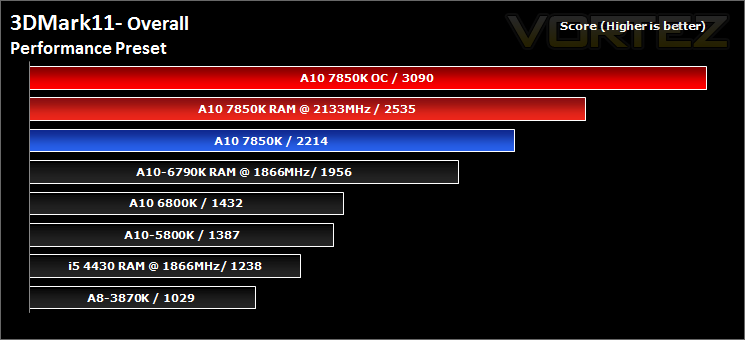
3DMark – Fire Strike
Fire Strike is our new showcase DirectX 11 benchmark designed for high-performance gaming PCs. It is our most ambitious and technical benchmark ever, featuring real-time graphics rendered with detail and complexity far beyond what is found in other benchmarks and games today. Fire Strike will only be available in the Windows editions of 3DMark initially.
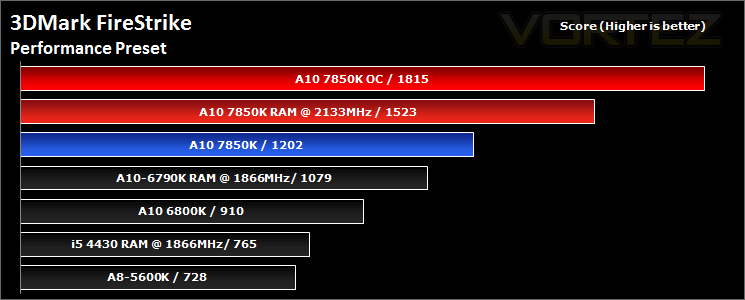
The A10 7850K shows its worth in the FutureMark benches.
Synthetic Benchmarks: PCMark 8 & Basemark CL
PCMark 8PCMark 8 is the latest version in our series of popular PC benchmarking tools. It is designed to test the performance of all types of PC, from tablets to desktops. With five separate benchmark tests plus battery life testing, PCMark 8 helps you find the devices that offer the perfect combination of efficiency and performance. PCMark 8 is the complete PC benchmark for home and business.
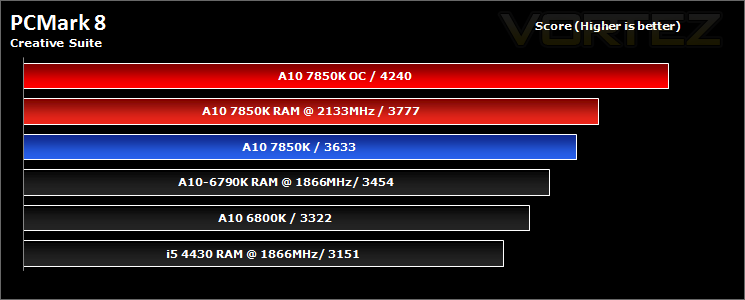
Basemark CL
Basemark CL by Rightware is a comprehensive benchmark tool designed to measure the performance of OpenCL 1.1 implementations on various devices ranging from desktops to embedded systems. Basemark CL uses OpenGL ES 2.0 or OpenGL 2.1 for rendering, depending on the platform.
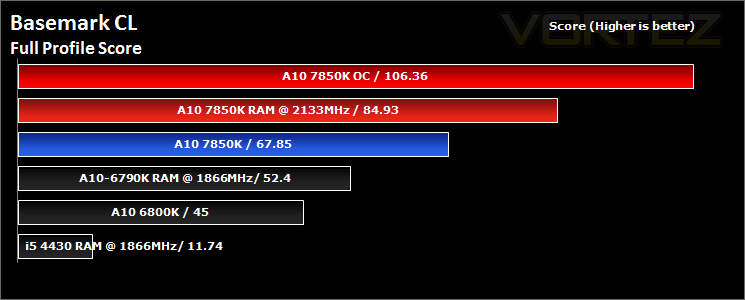
When it comes to Accelerated processing, the APU lives up to its name in these OpenCL enabled benchmarks.
Synthetic Benchmarks: UNIGINE Heaven 4.0 & Valley 1.0
UNIGINE Heaven 4.0Heaven Benchmark with its current version 4.0 is a GPU-intensive benchmark that hammers graphics cards to the limits. This powerful tool can be effectively used to determine the stability of a GPU under extremely stressful conditions, as well as check the cooling system’s potential under maximum heat output. It provides completely unbiased results and generates true in-game rendering workloads across all platforms, such as Windows, Linux and Mac OS X.
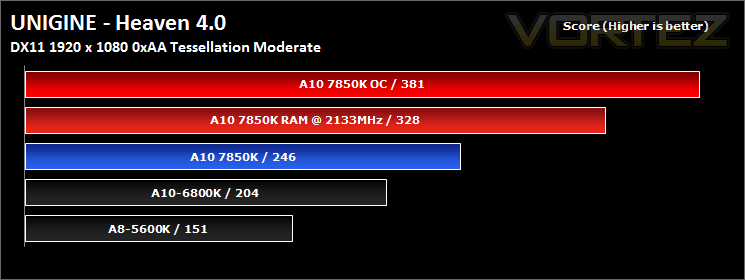
UNIGINE Valley 1.0
Valley Benchmark is a new GPU stress-testing tool from the developers of the very popular and highly acclaimed Heaven Benchmark. The forest-covered valley surrounded by vast mountains amazes with its scale from a bird’s-eye view and is extremely detailed down to every leaf and flower petal. This non-synthetic benchmark powered by the state-of-the art UNIGINE Engine showcases a comprehensive set of cutting-edge graphics technologies with a dynamic environment and fully interactive modes available to the end user.
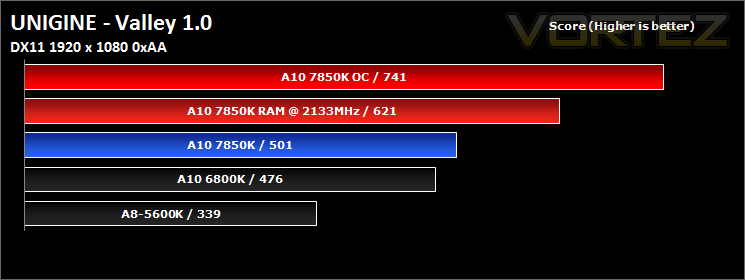
Clear lead for the A10 7850K in the Unigine Benchmarks.
Game Benchmarks: AVP, Deus Ex: HR, TESV, Tomb Raider
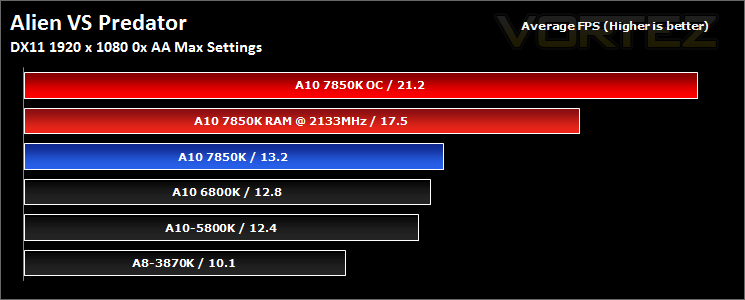
Alien Vs. PredatorSpawned from the popular Alien and Predator franchises, Rebellion have collaborated to bring the legendary war to us through the medium of a first-person shooter. The game forces you to hunt, prey and most importantly survive in the swamp colony of Freya’s prospect as a Predator, Alien or Marine. The stunning visuals add to the sense of dread and terror that we have become so accustomed to seeing with the series.
The stand-alone Alien VS Predator benchmark tool was used for testing here. All the settings were set to very high and Tessellation was applied. The average FPS was recorded at the end.
The stand-alone Alien VS Predator benchmark tool was used for testing here. All the settings were set to very high and Tessellation was applied. The average FPS was recorded at the end.
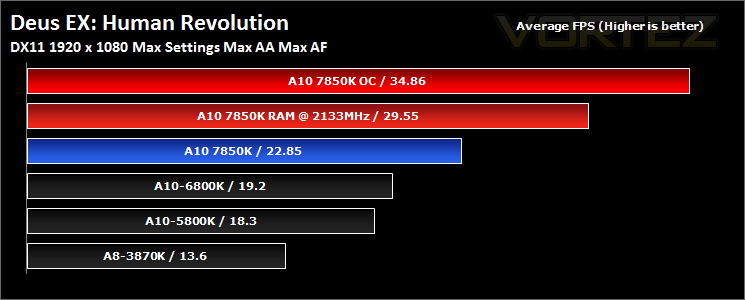
Deus Ex: Human Revolution
You play Adam Jensen, an ex-SWAT specialist who’s been handpicked to oversee the defensive needs of one of America’s most experimental biotechnology firms. Your job is to safeguard company secrets, but when a black ops team breaks in and kills the very scientists you were hired to protect, everything you thought you knew about your job changes.
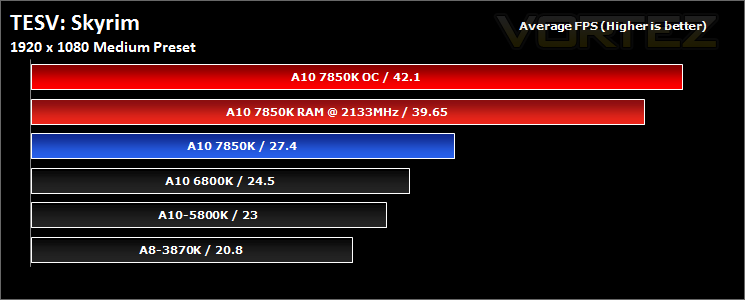
TESV: Skyrim
The Empire of Tamriel is on the edge. The High King of Skyrim has been murdered. Alliances form as claims to the throne are made. In the midst of this conflict, a far more dangerous, ancient evil is awakened. Dragons, long lost to the passages of the Elder Scrolls, have returned to Tamriel. The future of Skyrim, even the Empire itself, hangs in the balance as they wait for the prophesized Dragonborn to come; a hero born with the power of The Voice, and the only one who can stand amongst the dragons.
Tomb Raider
Tomb Raider explores the intense and gritty origin story of Lara Croft and her ascent from a frightened young woman to a hardened survivor. Armed only with raw instincts and the ability to push beyond the limits of human endurance, Lara must fight to unravel the dark history of a forgotten island to escape its relentless hold.
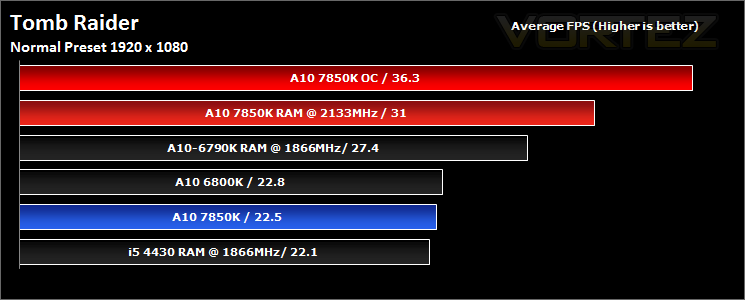
Game Benchmarks: Thief, Battlefield 4, DiRT SD, DOTA 2
ThiefGarrett, the Master Thief, steps out of the shadows into the City. In this treacherous place, where the Baron’s Watch spreads a rising tide of fear and oppression, his skills are the only things he can trust. Even the most cautious citizens and their best-guarded possessions are not safe from his reach.
As an uprising emerges, Garrett finds himself entangled in growing layers of conflict. Lead by Orion, the voice of the people, the tyrannized citizens will do everything they can to claim back the City from the Baron’s grasp. The revolution is inevitable. If Garrett doesn’t get involved, the streets will run red with blood and the City will tear itself apart.
As an uprising emerges, Garrett finds himself entangled in growing layers of conflict. Lead by Orion, the voice of the people, the tyrannized citizens will do everything they can to claim back the City from the Baron’s grasp. The revolution is inevitable. If Garrett doesn’t get involved, the streets will run red with blood and the City will tear itself apart.
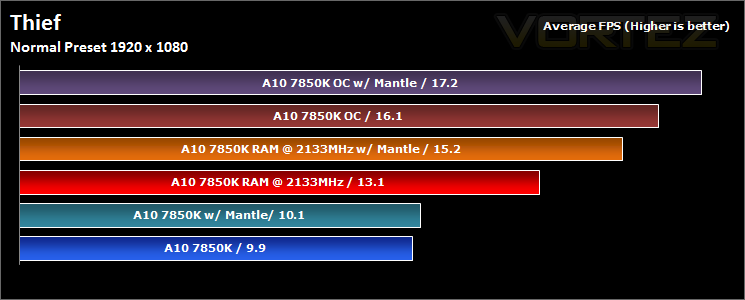
There is a small gain in using the Mantle API in Thief, however it is now the most demanding game in the benched lineup.
Battlefield 4
Battlefield 4™ is coming to PC, powered by the advanced technology of DICE’s proprietary Frostbite™ 3 engine. Blur the line between game and glory in Battlefield 4. With dynamic destructable environments, vehicular combat, and the chaos of all-out-war with 64 players, Battlefield 4 on PC will be an unmatched interactive experience.
In addition to its hallmark multiplayer, Battlefield 4 features an intense, dramatic character-driven campaign that starts with the evacuation of American VIPs from Shanghai and follows your squad’s struggle to find its way home.
There is no comparison. Immerse yourself in the glorious chaos of all-out war, found only in Battlefield.
In addition to its hallmark multiplayer, Battlefield 4 features an intense, dramatic character-driven campaign that starts with the evacuation of American VIPs from Shanghai and follows your squad’s struggle to find its way home.
There is no comparison. Immerse yourself in the glorious chaos of all-out war, found only in Battlefield.
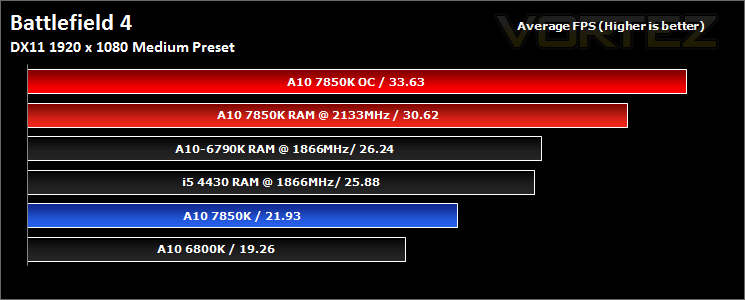
There was little difference observed in using the Mantle API in BF4 using the A10 7850K so the results were not included here.
DiRT Showdown
DiRT Showdown is the new arcade racing game from the team that brought you the award-winning DiRT series, uncaged in 2012. Pick up and play controls combine with electrifying events, frenzied crowds and stunning graphics to deliver high octane, dive in and drive thrills from event one. DiRT Showdown comes with phenomenal graphical performance, bone-jarring damage, and social online and split-screen multiplayer as standard. Welcome to DiRT Showdown – a new world of driving delirium.
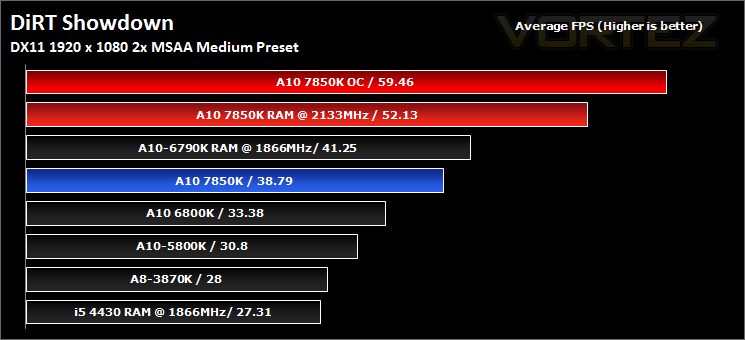
DiRT: Show Down was very playable at these settings using this APU.
DOTA 2
Dota is a competitive game of action and strategy, played both professionally and casually by millions of passionate fans worldwide. Players pick from a pool of over a hundred heroes, forming two teams of five players. Radiant heroes then battle their Dire counterparts to control a gorgeous fantasy landscape, waging campaigns of cunning, stealth, and outright warfare.
Irresistably colorful on the surface, Dota is a game of infinite depth and complexity. Every hero has an array of skills and abilities that combine with the skills of their allies in unexpected ways, to ensure that no game is ever remotely alike. This is one of the reasons that the Dota phenomenon has continued to grow.
Irresistably colorful on the surface, Dota is a game of infinite depth and complexity. Every hero has an array of skills and abilities that combine with the skills of their allies in unexpected ways, to ensure that no game is ever remotely alike. This is one of the reasons that the Dota phenomenon has continued to grow.
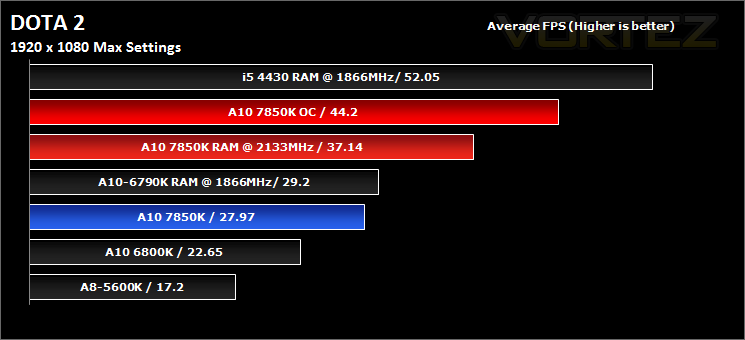
A huge improvement over previous APUs in the CPU bias DOTA2, catching up with the Intel processor when overclocked.
Dual Graphics & the Memory Advantage
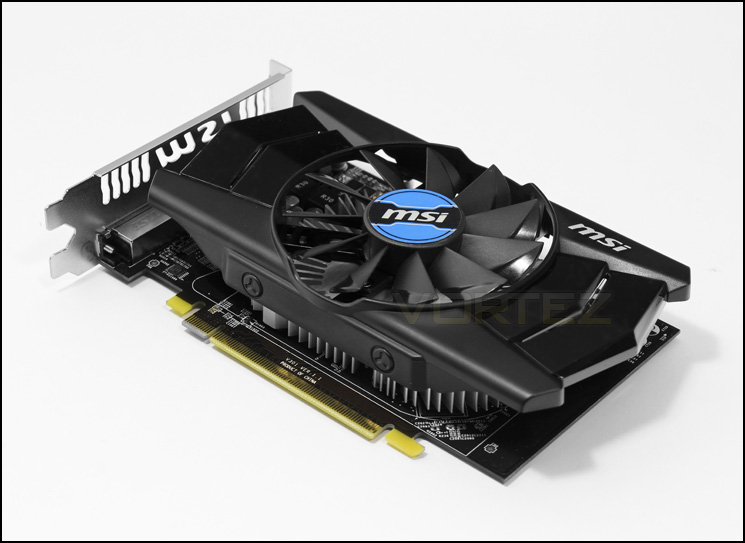
An AMD R7 250 discrete graphics card
If you desire extra horses in your games you can purchase a Radeon R7 series graphics card to pair with the APU as an affordable upgrade. It is well documented that this may not be the best performance to price option for outright capital, however, it does provide a reasonable upgrade path for those who choose to go with the A10 7850K later down the line. The DDR3 R7250 can be had for as little as £57 inc VAT but should still provide reasonable graphics increase, though if you want that little extra you may want to go for the DDR5 version or the R7 260X.
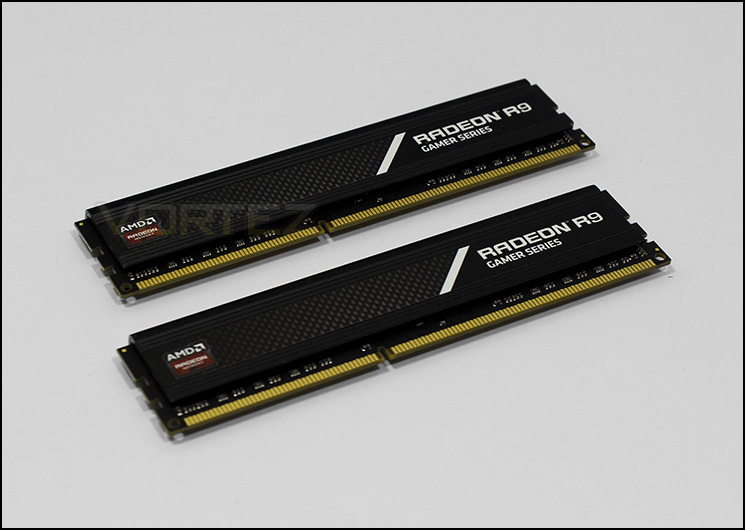
R9 Gamer Series Memory
For absolute performance from the APU, the powerful graphics compute cores are heavily dependent on memory bandwidth for good scaling. The Radeon R9 Gamer series is clocked at 2400MHz with a little room for overclocking and with 16GB, you will have no problem with offsetting 2GB+ for graphics use.
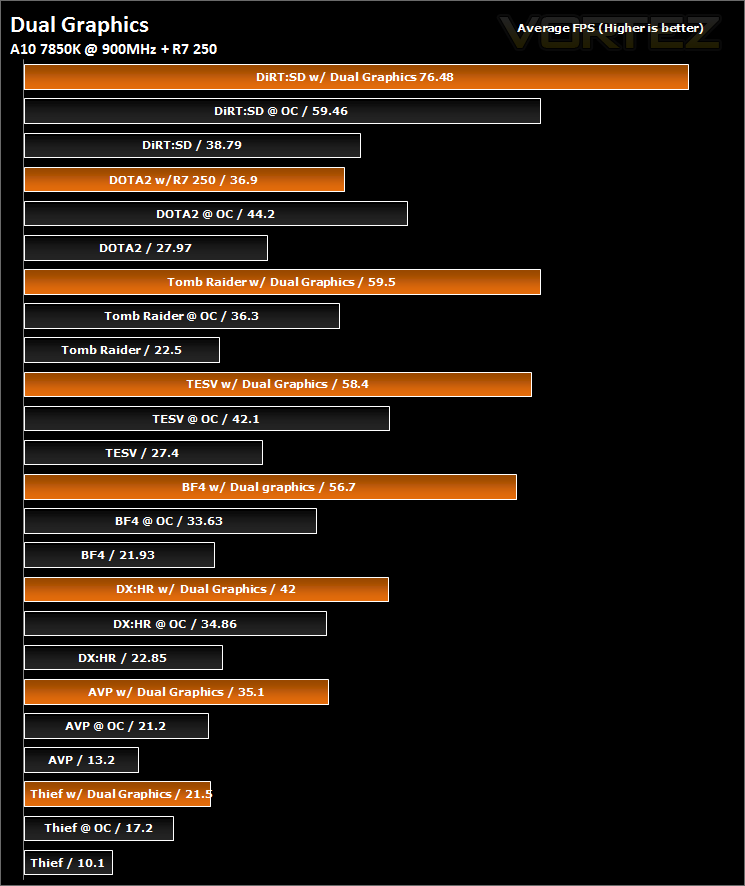
Dual graphics results
We see fair improvement for the most of our games except for DOTA2 which doesn’t support dual graphics, alone, the R7 250 fails to best the APU. In BF4, the mantle API doesn’t support dual graphics with the R7 250, so make sure you leave it set to DX11 if you go for this combination of hardware.
Accelerated Performance: What it means.
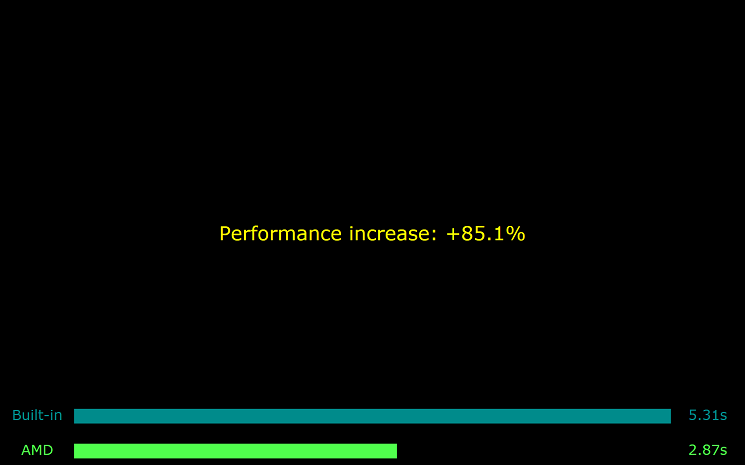
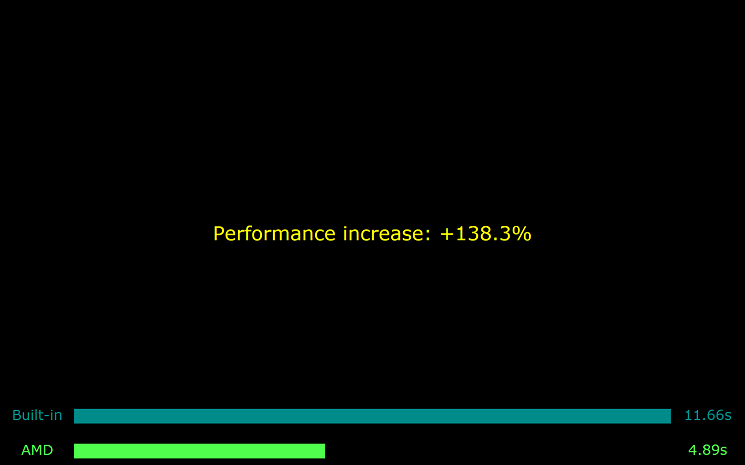
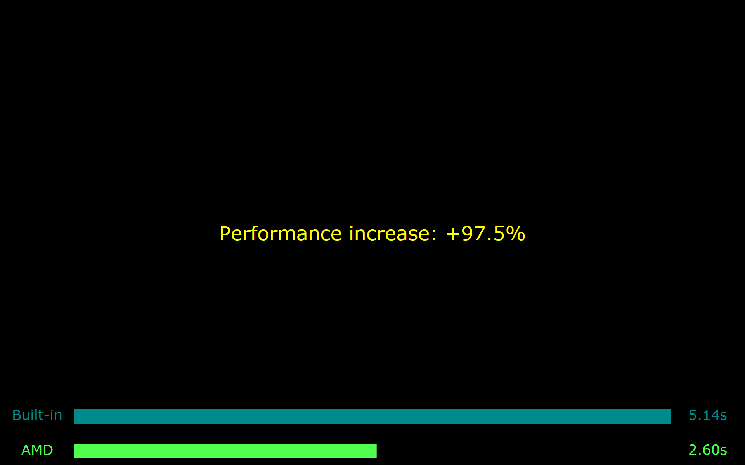
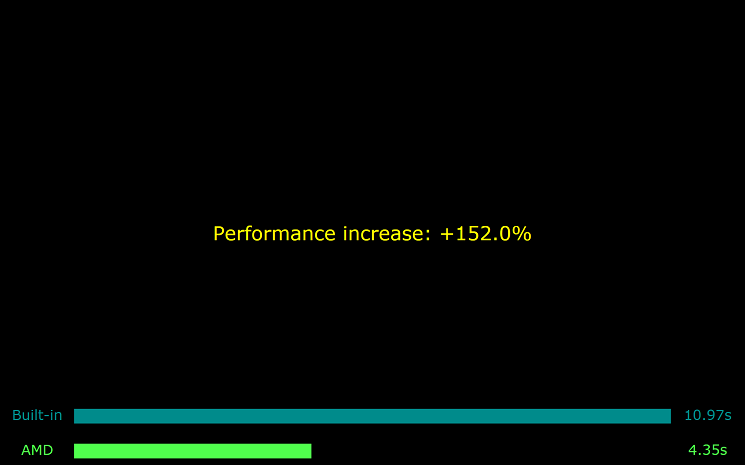
Since the advent of the APU, the introduction of HSA features and hUMA means that the APU is now distinct and separate from previous CPU and GPU designs. the GPGPU compute cores are now able to be utilised for general tasks that would otherwise be dealt with inefficiently by the CPU. This would mean that the term Accelerated Processing Unit isn’t just a buzzword anymore and this is why AMD are list the A10 7850K as having 12 compute cores. Even if you add a standalone discrete unit, the APU will benefit by tapping into those 8 extra GPGPU cores. This is to provide the best user experience possible in modern PC systems. A simple yet effective example of how this can help people in their computing needs would be with the simple demonstration of the AMD JPEG Decoder.
High
Enthusiast
What this test does is time how long it takes to decode a number of high resolution images using the integrated windows codec vs the AMD one that utilises the compute cores on the APU, saving time increases user experience. The below results are with our OC setting.
High
Enthusiast
A Counter to this demonstration however would be to remember the fact that the base comparative is representative of the CPU performance. Another interesting representation of overall system performance could be the use of the ASUS ROG Realbench application. Version 2.2 now utilises OpenCL within a selection of real world tasks from GIMP, Handbrake and Luxmark to measure performance.
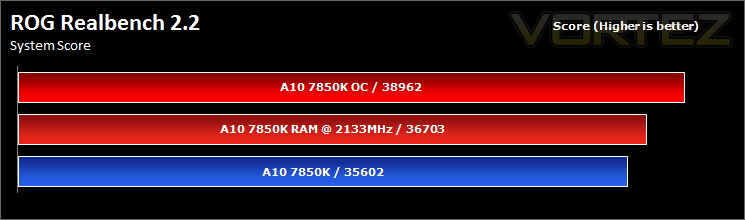
To put it into perspective, high end overclocked Intel processors with GTX 780/ R9 290 can score over 90000pts, while my own main rig, with a A8 3870K and a Radeon HD 6850 scores 29120.
Conclusion
In our testing it was clear to see that in the traditional sense, the CPU side of things does seem to struggle, coming with comparable performance out the box to predecessors, there isn’t much to shout about. However, it is not that the CPU has not been improved, especially in consideration to the lower clock speed compared to Trinity and Richland offerings, it is that the areas it has been improving are outside the scope of traditional testing. A good way to highlight this would be that the A10 7850K came bottom in all the tests in AIDA64, yet come out on top of the APUs in all the x264 tests.
A culture shift will be required to view the current and coming generations off APUs, and this is part of the redefinition of what a processor is (and why AMD list it as having 12 compute cores). The APU does accelerate applications with the on board GPU and OpenCL to provide a better user experience, much of which may actually go unnoticed by the average user within their operating system environment. There is a trend to try and judge the APU as a ‘gaming processor’, a CPU with a kick ass entry gaming GPU attached, this trend may create disappointment. In testing, dual graphics worked fairly well and its worth remembering that there are other benefits from using dual graphics too, such as retaining the fairly important HSA features that makes the A10 7850K as great as it is, as well as using the ZeroCorePower mode (where supported) to help keep the power consumption down when not in 3D mode. From this knowledge, if you want a gaming system at a great price, the A10 7850K alone will definitely give you that, and though it could be argued that adding in a discrete graphics card may lower the price to performance ratio, it will represent a feasible upgrade for some. From a gaming perspective, if your sole aim is gaming and you want to upgrade to the best you can get, the APU and the FM2+ platform will become fairly limited, so if you want a high end gaming system be prepared to pay out and make a gaming system.
As for the APU platform, it should no longer be considered as a CPU with a GPU on board, but a single entity with various compute solutions available, providing a great performance modern PC that, through the use of OpenCL, can accelerate your favourite applications. Whether it is Adobe products to Sony Vegas, the number of applications adopting OpenCL are ever expanding, making the APU platform a goldmine for developers that are seeking a modern solution that can do it all. This is what allows the A10 7850K give a sharp, responsive user experience with the power to game reasonably well. What is needed to put the A10 7850K in perspective is, to realise that “35% of gamers on steam use graphics slower than the A10 7850K” (from Nov 2013), while those sporting high end systems or even previous flagship APUs may not see the need to jump on board with it just yet, the APU is certainly coming into its own and is well recommended for any system build where the expectation is not solely for high end gaming.
Pros.
+ Excellent developer potential
+ Radeon R7 Graphics based on GCN – The best integrated graphics available
+ Excellent all round user experience with OpenCL
+ Competent gaming out the box
+ Improved power efficiency
+ Integrated DSP (TrueAudio)
+ 28nm Fabrication, (Finally)
Mediocre
+- Price
Cons.
– Little CPU performance gain over previous generation APUs
+ Excellent developer potential
+ Radeon R7 Graphics based on GCN – The best integrated graphics available
+ Excellent all round user experience with OpenCL
+ Competent gaming out the box
+ Improved power efficiency
+ Integrated DSP (TrueAudio)
+ 28nm Fabrication, (Finally)
Mediocre
+- Price
Cons.
– Little CPU performance gain over previous generation APUs

Click here for an explanation of our awards at Vortez.net. Thanks to AMD for providing today’s review sample.


