







The unlocked dual-core ‘bang for buck’ processor based on 22nm Intel Haswell technology.

Product on Review: Pentium K G3258
Manufacturer Intel
Street Price: £55 GBP / $70 USD
It’s been a busy year for Intel’s desktop division. Firstly, timed with Computex 2014 we had the release of Core i7-4790K along with the introduction of the Intel Z97 chipset just prior to the trade show, and just last month the enthusiast segment moved into its next stage with the mighty Haswell-E aka Core i7-5960X and again, another new chipset via the Intel X99.
During the summer months Intel released a special chip to celebrate 20 years of the Pentium brand. Although this processor lived in the shadow of Devil’s Canyon it still has an exciting story to tell. G3258 aka Pentium K is an unlocked dual-core processor based around 22nm Haswell architecture. G3258 is regarded as Intel’s best “bang for buck” offering because it sits at the low-cost price of just £55 GBP / $70 USD and promises to be highly overclockable. Will these claims hold true?
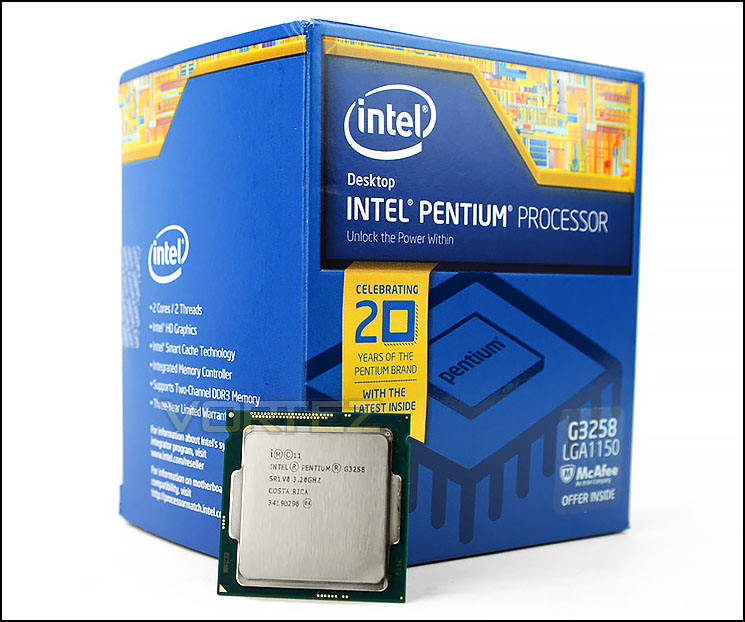
Intel on their Pentium K Anniversary Processor
Celebrating Pentium the G3258 is very special indeed as it is the only Pentium K series CPU. What does that mean? Well it means just like the Haswell K edition CPUs it is unlocked and overclockable. Designed by Intel to celebrate Pentium this CPU is Intel’s most overclockable CPU to date and a lot of fun can be had with this processor and it’s a keen favourite amongst overclockers or those looking for some incredible performance for a low price, especially when overclocked.
Features
Frequency
3.2GHz
Core
Haswell
Manufacturing process
22nm
Number of cores
2 physical
Cache
L1: 4 x 32KB instruction/ data caches)
L2: 2 x 256KB
L3: 3MB (shared)
Memory controller
Dual-channel DDR3, up to 1,333MHz
Socket LGA1150
Thermal design power (TDP)
53W
GPU
Intel HD Graphics (1,100MHz)
Features
SSE, SSE2, SSE3, SSSE3, SSE4, SSE4.2, EM64T, F16C, Quick Sync Video
3.2GHz
Core
Haswell
Manufacturing process
22nm
Number of cores
2 physical
Cache
L1: 4 x 32KB instruction/ data caches)
L2: 2 x 256KB
L3: 3MB (shared)
Memory controller
Dual-channel DDR3, up to 1,333MHz
Socket LGA1150
Thermal design power (TDP)
53W
GPU
Intel HD Graphics (1,100MHz)
Features
SSE, SSE2, SSE3, SSSE3, SSE4, SSE4.2, EM64T, F16C, Quick Sync Video
Pentium K G3258 In the Flesh
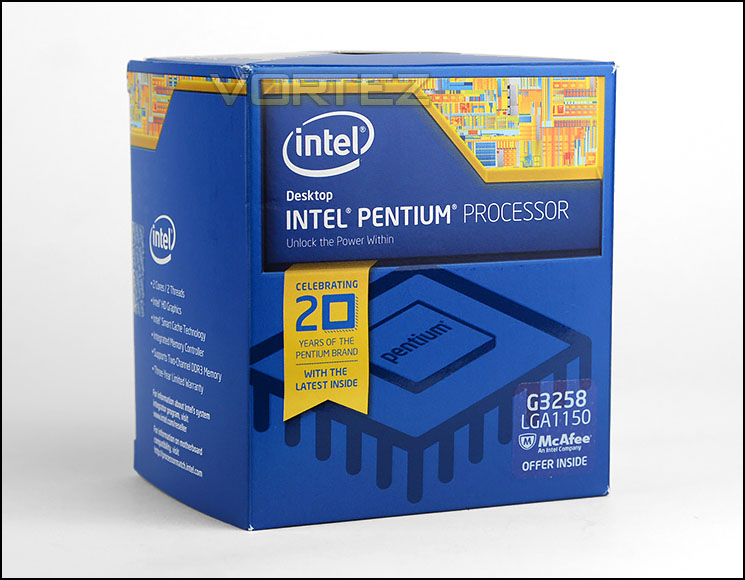
Packaging for G3258
The G3258 is an entry-level processor – its small price-tag reflects the specification this chip arrives with. In realistic terms G3258 is similar to that of the Core i3 family of Haswell options, touting a dual-core Haswell architecture, 3.2GHz frequency but lacking Hyper Threading and delivering less cache.
In the recent era of overclocking Intel has restrained their lineup by allowing only specific models to have their multiplier and base clock adjusted. These unlocked processors are designed with enthusiasts in mind and presents such a group with the ability to get more out of their kit. G3258 celebrates 20 years of Pentium and back in the earlier days of this product line any chip could be overclocked and there was no such thing as an “unlocked” chip.
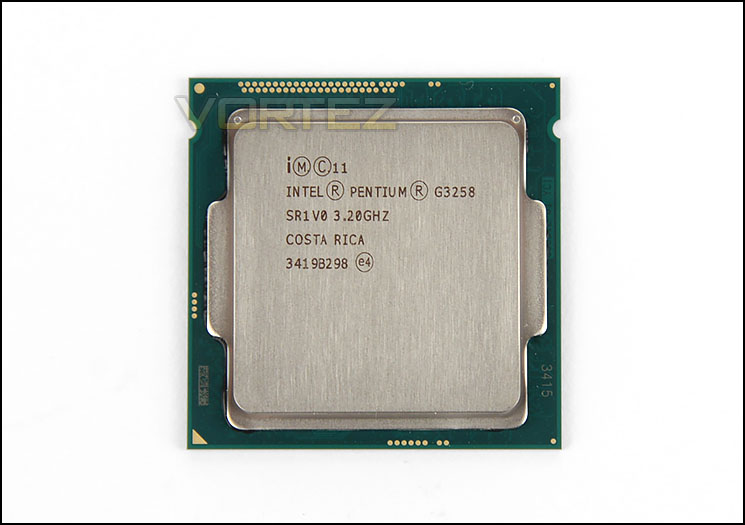
The Intel Pentium K G3258
In this anniversary edition, Intel has decided to allow a dual-core Pentium chip the freedom of an unlocked multiplier – something which has been missing for many generations.
Using Haswell architecture means this chip is based around 22nm technology and is designed to work in conjunction with LGA 1150 motherboards featuring the Intel Z97 chipset.
Below we compare the recently released Intel Core i7-4790K (on the right) to the G3258.
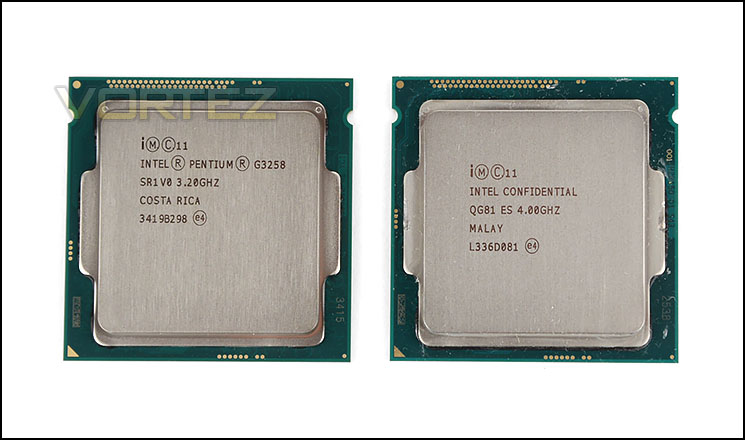
Comparing the chip to Intel Core i7-4790K (on the right)
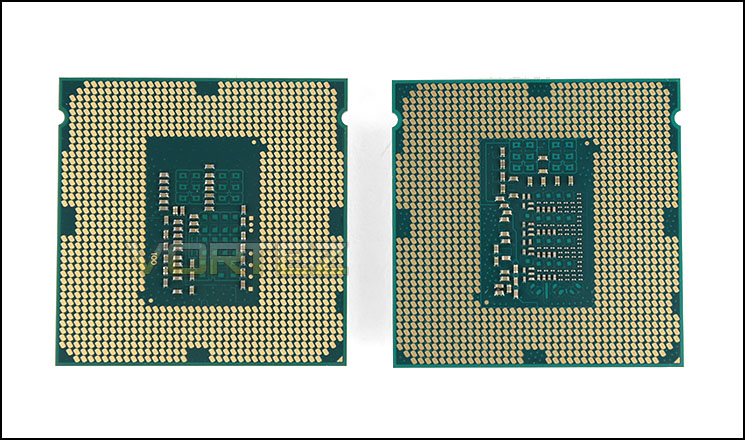
The reverse sides
Test Setup & Methodology
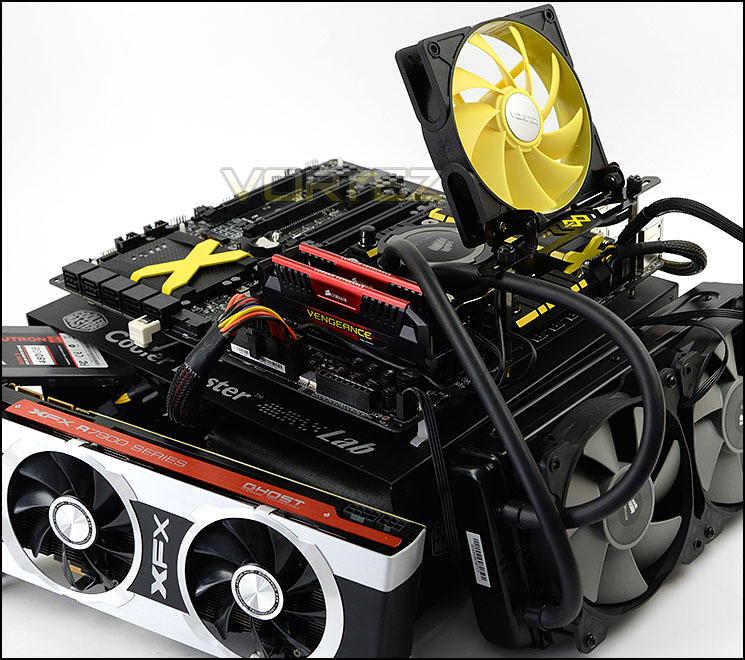
Test Setup
CPU: Intel Core i5 2500K (3.3GHz) Sandy Bridge
Intel Core i5-3570K (3.40GHz) Ivy Bridge
Intel Core i7-3770K (3.50GHz) Ivy Bridge
Intel Core i5-4670K (3.40GHz) Haswell
Intel Core i7-4770K (3.50GHz) Haswell
Intel Core i7-4790K (4.0GHz) Haswell Refresh
Pentium K G3258 (3.2GHz)
Cooling Corsair Hydro Series H105
Motherboard MSI Z97 XPOWER AC (Core i7-4790K & i7-4770K only)
Memory 16GB Corsair Vengeance Pro 2800MHz CL12 DDR3
Graphics XFX R7970 Black Edition
Storage Corsair Neutron GTX 480GB
PSU Corsair HX1050 80 Plus Gold Certified PSU
Intel Core i5-3570K (3.40GHz) Ivy Bridge
Intel Core i7-3770K (3.50GHz) Ivy Bridge
Intel Core i5-4670K (3.40GHz) Haswell
Intel Core i7-4770K (3.50GHz) Haswell
Intel Core i7-4790K (4.0GHz) Haswell Refresh
Pentium K G3258 (3.2GHz)
Cooling Corsair Hydro Series H105
Motherboard MSI Z97 XPOWER AC (Core i7-4790K & i7-4770K only)
Memory 16GB Corsair Vengeance Pro 2800MHz CL12 DDR3
Graphics XFX R7970 Black Edition
Storage Corsair Neutron GTX 480GB
PSU Corsair HX1050 80 Plus Gold Certified PSU
Benchmarks
Cinebench R15 – CPU/OpenGL Score
x264 HD 4.0 – 1st and 2nd pass encoding
SiSoftware SANDRA 2014 – CPU & Memory benchmarks
AIDA64 – CPU benchmarks
PCMark 8 – Home Suite
3DMark FireStrike – DX11 3D Benchmark
Games – Tomb Raider, THIEF
x264 HD 4.0 – 1st and 2nd pass encoding
SiSoftware SANDRA 2014 – CPU & Memory benchmarks
AIDA64 – CPU benchmarks
PCMark 8 – Home Suite
3DMark FireStrike – DX11 3D Benchmark
Games – Tomb Raider, THIEF
Other Software
Temperature Analysis: Core Temp
Stress Testing Software: LinX
CPU Specification Monitoring: CPU-Z
Stress Testing Software: LinX
CPU Specification Monitoring: CPU-Z
NOTE: Some benchmarks do not have full comparative models because we have since introduced new testing applications to give expand analysis and are not able to re-test older chips.
Temperatures and Overclocking
The inauguration of Intel Haswell via the Core i7-4770K brought heavy criticism over the thermal conductivity – Intel has since redeemed themselves with the introduction of Devil’s Canyon. Now whilst G3258 has lower specifications and is dual-core rather than quad-core it will still be worthwhile observing the temperatures to demonstrate how effective G3258’s thermal solution really is.
Temperatures
Having a low TDP, low frequency and low voltage presents us with a very cool Haswell chip indeed. Our processor idled around the 20C mark and the moved up to a mere 40C whilst under strenuous load. This is extremely encouraging and as we’ll see below, will pave the way for a decent overclock.
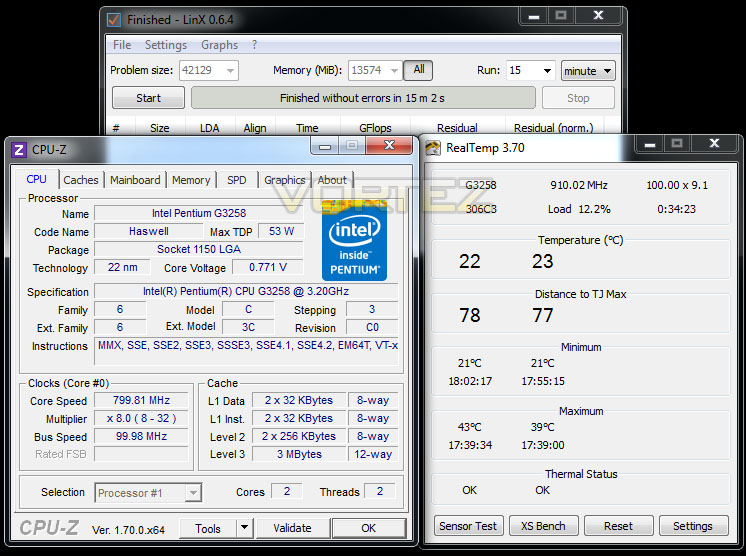
Overclocking
Since the introduction of Z87 back in 2013, there has been a return to BCLK overclocking. This type of functionality ensures flexibility for Overclockers compared to previous generations where the BCLK was locked to 100MHz and only the ratio could be adjusted. As many of you will know, when the Haswell CPUs hit the scene, reports revealed high temperatures with even small increases in voltage.
G3258 shys away from such weaknesses by remaining significantly cool even though the frequency and voltage is increased considerably.
G3258 overclocks in the same manner as other Haswell chips – the baseclock remains untouched and the multiplier is the feature which is modified. Our best achievement with this chip saw us hit 4.5GHz at 1.45/46 CPU voltage. This voltage may seem rather substantial but there is no cause for concern, the general health and heat emission is fine – in fact the temperatures are surprisingly low.
Hitting 4.5GHz represents a 40% overclock – an impressive achievement indeed. Although we could enter the operating system and perform the stress test, we unfortunately encountered errors when 50 minutes into the task. Applying 4.7GHz and 1.45v allowed us into Windows and we experienced no instability except when applying this significant strain from LinX – so it could very well be useable with these settings but for the purpose of accuracy we had to complete the test at an achievable result.
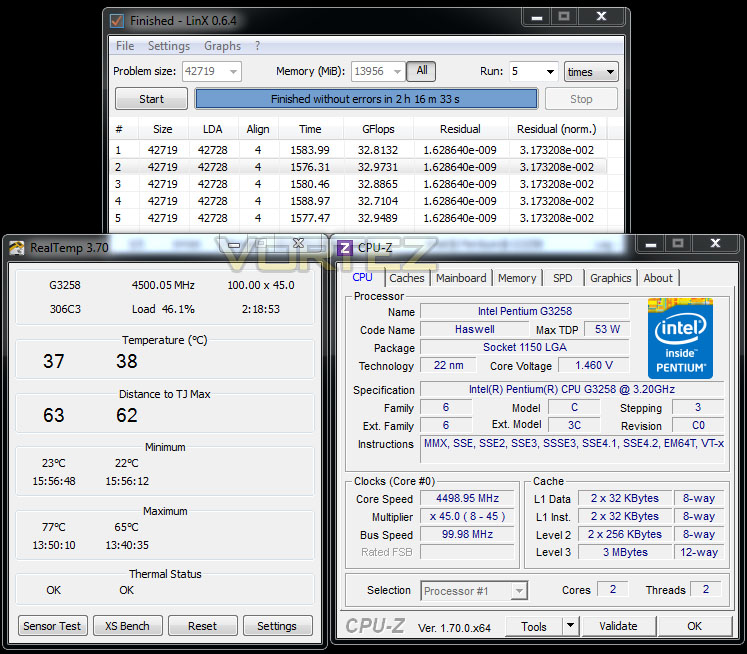
G3258 max. overclock & temps
Benchmarks: Power Consumption
It’s interesting to note the power consumption across all motherboards. Although some are using a mixture of chipsets, energy results can fluctuate between manufacturers due to the features and specifications that are integrated. First of all, for the idle tests the system is cold booted into Windows and no additional applications are executed – the watts are noted on the external energy monitor we use and then the system is loaded with 3DMark FireStrike – watts are again monitored for the duration of the test and the highest rated wattage result is then noted down. Below are the results of this energy test.
Benchmarks: Integrated GPU Performance
An interesting feature that first appeared on the desktop environment with the Sandy Bridge architecture was the integrated graphics on the CPU. This meant that regardless of the presence of a discreet graphics solution you always had the ability to use “Built in” processing power to watch movies, view 3D content and take part in some casual gaming.
Even with this entry-level dual-core processor, Intel has included the onboard graphics and this particular features delivers full DX11 functionality. G3258’s GPU capabilities are very similar in specification to that of the HD-4600 – found on the Core-i7 4790K. G3258 has a GPU base clock of 350MHz and a GPU turbo clock of 1100MHz. All of this allows the end user to indulge in 1080p movies, playing more complex gaming titles and rendering out 3D imagery.
Testing procedure
In order to test the effectiveness of the integrated graphics capabilities we have tested DIRT 3 and 3DMark 11 in our reviews of previous Intel generation processors – therefore, for this review we’ll continue with these two benchmark tests.
3DMark 11 Settings: Performance Preset – 720p
DIRT 3 Settings: 1680×1050 – Low settings (4xMSAA)
For this test AMD’s A8-3870K iGP along with Intel’s 2500K, 3570K and 3770K will be compared plus we will observe the performance advantage to combining integrated graphics with a discreet solution – XFX 7970 Black Edition.
With 3DMark 11 being DX11 only – the 2500K results could not be obtained, hence no score.
G3258 matched the performance of other Intel chips and gave us some impressive results in both the benchmark tests – proving that the integrated graphics can be relied upon for light gaming and multimedia purposes.
Benchmarks: X264 HD
Simply put, this test measures how fast your machine can encode a short, DVD quality MPEG-2 video clip into a high-quality x264 video clip. What’s x264, you ask? It’s more or less the next-generation Xvid/DivX codec. I think it’s ideal for a benchmark because the application (x264.exe) reports fairly accurate compression results (in frames per second) for each pass of the video encoding process, and it uses multi-core processors very efficiently.
Benchmarks: AIDA64
AIDA64 Product PageThis simple integer benchmark focuses on the branch prediction capabilities and the misprediction penalties of the CPU. It finds the solutions for the classic “Queens problem” on a 10 by 10 sized chessboard. At the same clock speed theoretically the processor with the shorter pipeline and smaller misprediction penalties will attain higher benchmark scores. For example — with HyperThreading disabled — the Intel Northwood core processors get higher scores than the Intel Prescott core based ones due to the 20-step vs 31-step long pipeline. CPU Queen test uses integer MMX, SSE2 and SSSE3 optimizations.
Benchmarks: Cinebench
CINEBENCH is a real-world cross platform test suite that evaluates your computer’s performance capabilities. CINEBENCH is based on MAXON’s animation software CINEMA 4D 3D content creation.
Benchmarks: SiSoftware SANDRA
SANDRA isn’t always a benchmark that is included in hardware reviews but I believe it shouldn’t be ignored. SANDRA provides a vigorous package that tests your system in a rather large array of benchmarks. There are many aspects of benchmark that can be executed. We will be considering – CPU and memory tests.
Benchmarks: 3DMark
3DMark FireStrike Product PageFire Strike is our new showcase DirectX 11 benchmark designed for high-performance gaming PCs. It is our most ambitious and technical benchmark ever, featuring real-time graphics rendered with detail and complexity far beyond what is found in other benchmarks and games today. Fire Strike will only be available in the Windows editions of 3DMark initially.
Benchmarks: PCMark 8
PCMark 8 combines performance benchmarking with battery life measurement and includes tests based on popular Adobe and Microsoft applications. Whether you are looking for long battery life, or maximum power, PCMark 8 will help you find the devices that offer the perfect combination of efficiency and performance for your needs. It’s the complete PC performance benchmark for home and business.
Benchmarks: Tomb Raider & THIEF
It’s important for us to perform a number of game benchmarks as well as the synthetic tests because gamers will want to know if there are any significant benefits. So here we have two popular and recent gaming titles which feature a dedicated benchmark tool within them to display results.
Conclusion
By introducing an unlocked Pentium processor, Intel has appealed to a number of different groups but especially the novice system builder. What better way to celebrate 20 years of Pentium with a fun and affordable processor for hardware enthusiasts. By focussing on G3258’s ability to overclock, such attributes as the cache, number of cores or level of frequency become insignificant because by pushing this particular chip beyond 40% users can enter the territory of some of the stronger options from the Core i5 family.
Throughout our tests G3258 tackled the benchmarks admirably. If we compare the out-of-the-box performance of this chip to such contenders as the Core i7-4770K or Core i7-4790K the Pentium offering falls behind, but applying a substantial overclock to this processor changes things quite dramatically and the improved frequency translates to mid-range performance.
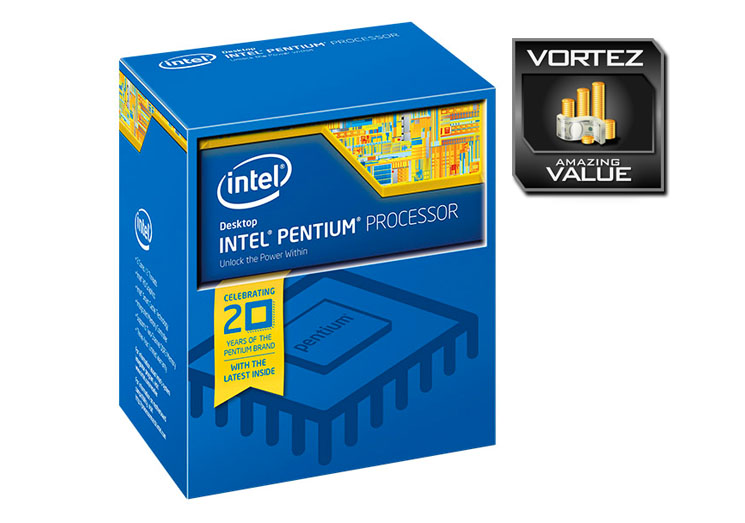
Being able to overclock this dual-core Haswell processor from a mere 3.2GHz to 4.5GHz is very advantageous and it can handle such a boost in modification without causing temperatures to sky-rocket. We were pleasantly surprised that G3258 can sit at 4.5GHz with the maximum temperature readout hitting approximately 70C. Leaving the processor at its stock 3.2GHz presents us with a mere low 20C at idle and just 40C loaded which will be music to the ears of those within hardware circles.
Intel’s G3258 can be purchased for £55 GBP / $70 USD. At such a cost, budget-conscious system builders can design and build a system based around Haswell and still reap similar performance to that of a Core i5/Core i7 chip if they apply an overclock… and really if you’re buying this unlocked processor you’d be a fool not to.
Choosing to celebrate 20 years of Pentium with a fun-packed processor has been a great decision by Intel. The G3258 surpasses expectations for such a low-cost option and really comes into its own when an overclock is applied.
Pros
+ Low-cost, affordable
+ Overclocks beyond 40%
+ Ideal for general purpose
+ Similar gaming results to enthusiast chips
Cons
– Struggles with demanding processing tasks
+ Low-cost, affordable
+ Overclocks beyond 40%
+ Ideal for general purpose
+ Similar gaming results to enthusiast chips
Cons
– Struggles with demanding processing tasks

Click here for an explanation of our awards at Vortez.net.


