After various rumours and anticipation, the GeForce GTX 1660 Ti is finally here under guise of ASUS ROG STRIX 1660 Ti – bearing the Direct CU III cooler and a factory overclock. Is this the new 1080p king?

Product on Review: ROG STRIX GTX 1660 Ti
Manufacturer: ASUS Republic of Gamers
Street Price: £339.99 inc. V.A.T. GBP / $300 USD / $569 AUD
It’s been a long six months since NVIDIA‘s announcement of the GeForce RTX 20-series at Gamescom. With the launch of the GeForce RTX 2060 last month that range is effectively complete, and in the absence of more affordable options the ageing GTX 10-series now serves as a stop-gap in the sub-£300 market. Price drops have made that market exceptionally competitive, but it cries out for a next-generation GPU that can take advantage of some, if not all, of the features NVIDIA’s Turing architecture has to offer.
Today marks the launch of the Geforce GTX 1660 Ti, starting at an MSRP of $279/£259.99. If you’re expecting a re-badge part you’d be (happily) disappointed as this new card is the first to incorporate brand new silicon. In NVIDIA’s product stack it largely replaces the GTX 1060 6GB and budget SKUs of the GTX 1070, although the older cards will remain on the market as stock is cleared through the channel.
Unlike the RTX 20-series, NVIDIA have opted not to release a Founders Edition of the GTX 1660Ti. Instead partners will be producing their own variants across the board, complete with custom PCB, non-reference cooling and optional I/O.
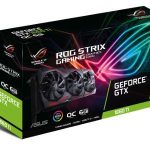
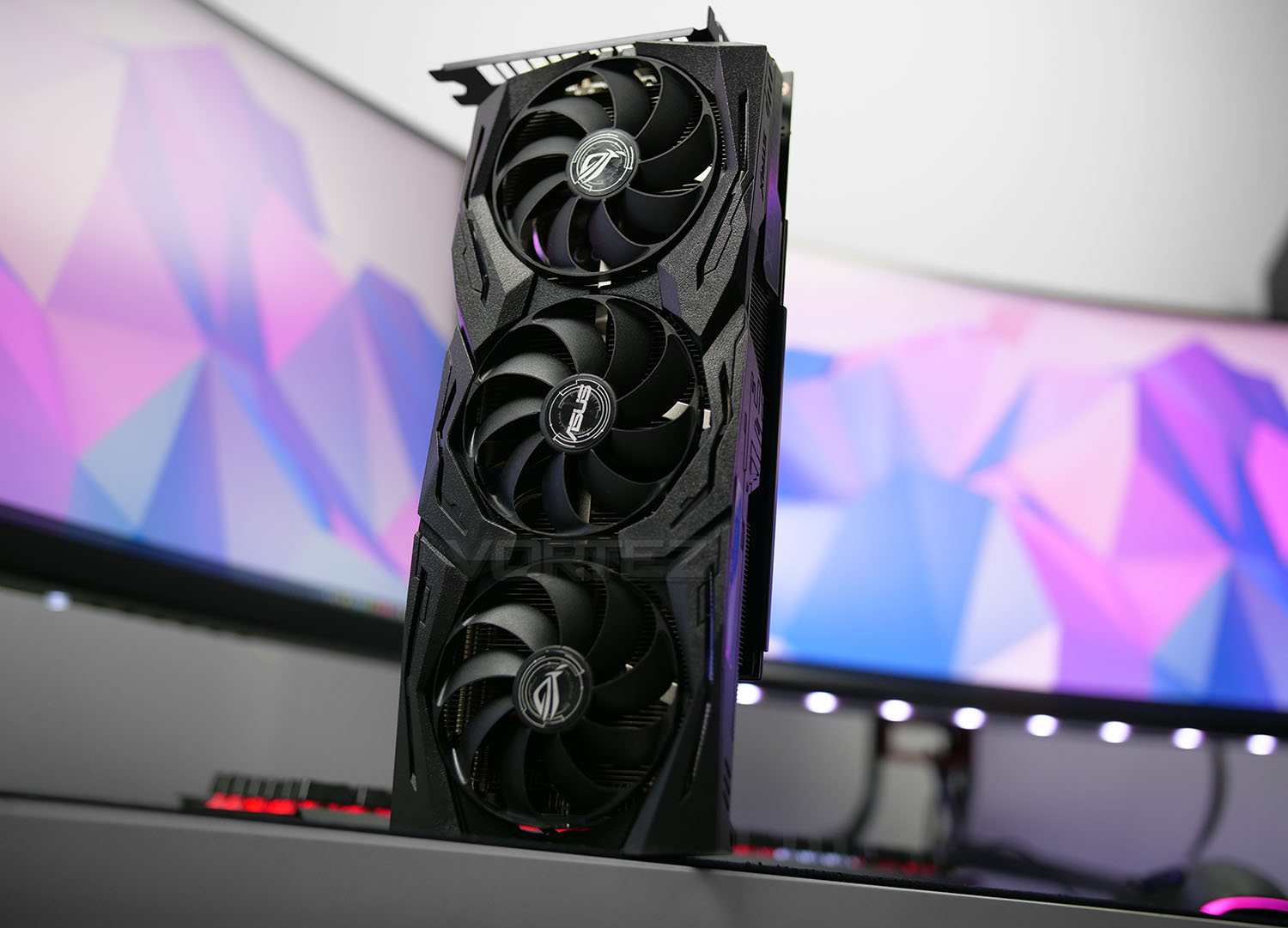
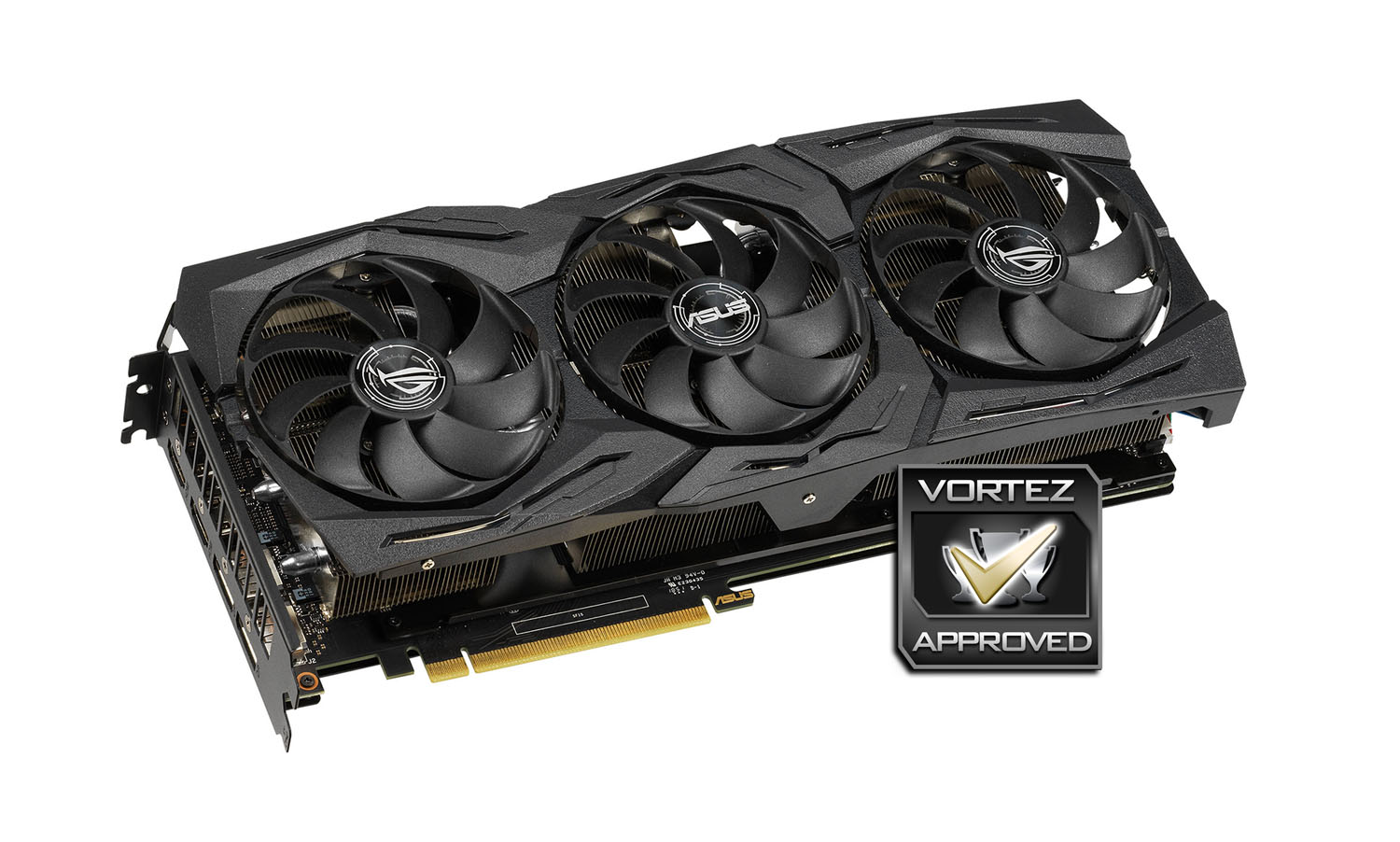
The model we’re reviewing for this launch is a real treat: the ASUS ROG STRIX GeForce GTX 1660Ti. ASUS ROG STRIX models typically push the envelope of performance and build quality no matter the range, and each has their high-end triple-fan cooling solution that incorporates customisable RGB lighting into the shroud.
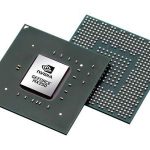
No matter the manufacturer each GeForce GTX 1660Ti has a TU116 GPU at its heart. Roughly analogous to a TU106 that’s been on a heavy diet, it’s a slimmed down GPU with approximately two thirds the number of shaders and no advanced RTX features. That means no real-time ray tracing or advanced AI features such as DLSS, but does help it stay within a more affordable price range.
Cunningly, rather than inherit RTX 20-series naming conventions, NVIDIA have opted to re-use GTX and place the series number squarely between the 10-series and 20-series. That draws an immediate contrast between it and cards from other series, helping to inform consumers of what they should and shouldn’t expect. NVIDIA have come in for a lot of criticism for confused naming schemes recently – most notably the four different GTX 1060 SKUs – and so in our mind this is a very welcome change of pace.
At least one headline Turing feature does make it into the GTX 1660 Ti though. The card makes use of 6GB of the newer and considerably faster GDDR6 memory, bolstering bandwidth while maintaining a good sized frame buffer for 1080p gaming. That’s a welcome addition considering industry concern that GDDR6 would balloon the price beyond affordability.
The chief advantage of ROG’s STRIX GeForce GTX 1660 Ti is in its advanced cooling solution and factory overclock. ASUS push the card to an impressive boost clock of 1890MHz, up from reference speeds of 1708 MHz (>10%), on the back of its triple-fan cooler. This cooler has also been tweaked for better air flow without increasing noise, while a switchable BIOS allows the user to configure with performance or silent mode presets. Fans of low-noise computing will be pleased to know that the silent mode will even stop fan rotation entirely under low temperatures, which is a pleasant addition if your system doesn’t just serve as a gaming machine 100% of the time.
As the name implies, the GTX 1660Ti is something of a generational mid-point between the GTX 1060 6GB and RTX 2060. As with prior mainstream releases NVIDIA are aiming to satisfy consumers who currently own similarly positioned cards that are a couple of generations (3+ years) old. In this instance that means the GTX 960, a workhorse card in its time but showing its age even at 1080p.
Now it’s time to take a closer look at the ROG STRIX GeForce GTX 1660 Ti and see what competitive advantage it offers as a premium variant of NVIDIA’s new series.
Technical Specifications
Below are the technical specifications surrounding GTX 1660 Ti supplied directly by ASUS:GPU
GTX 1660 Ti (TU116)
Stream Processor
1536
Video Memory
6GB GDDR6
Memory Bus
192-bit
Engine Clock
1500MHz
Engine Clock Boost
1890MHz
Memory Clock
1500MHz – 12000MHz Effective
PCI Express
3.0
Display Outputs
2x DisplayPort 1.4
2x HDMI 2.0b
Recommended Power Supply
450W
DirectX
12 API feature level 12_1
OpenGL
4.6
Cooling
Triple-fan solution
Slot Size
2.5
Supported OS
Windows 10
Card Length
300 x 118 x 50 mm
GTX 1660 Ti (TU116)
Stream Processor
1536
Video Memory
6GB GDDR6
Memory Bus
192-bit
Engine Clock
1500MHz
Engine Clock Boost
1890MHz
Memory Clock
1500MHz – 12000MHz Effective
PCI Express
3.0
Display Outputs
2x DisplayPort 1.4
2x HDMI 2.0b
Recommended Power Supply
450W
DirectX
12 API feature level 12_1
OpenGL
4.6
Cooling
Triple-fan solution
Slot Size
2.5
Supported OS
Windows 10
Card Length
300 x 118 x 50 mm
—
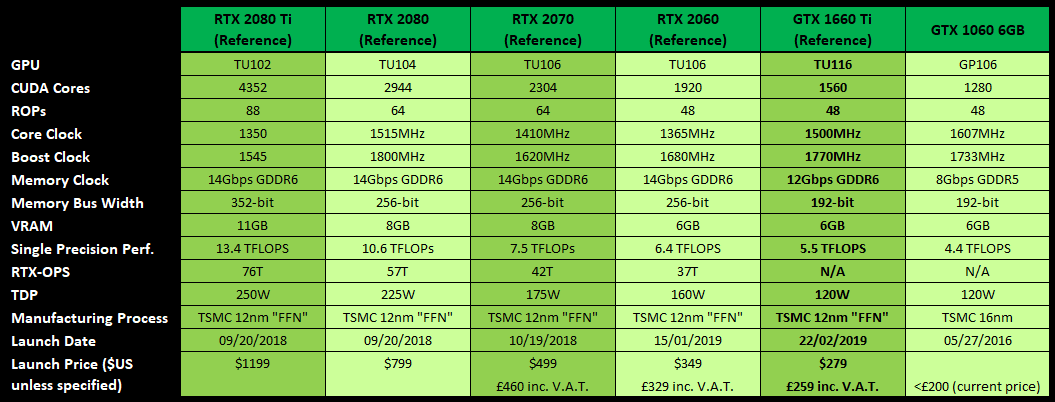
GeForce GTX 1660 Ti Comparative Specs.
Features
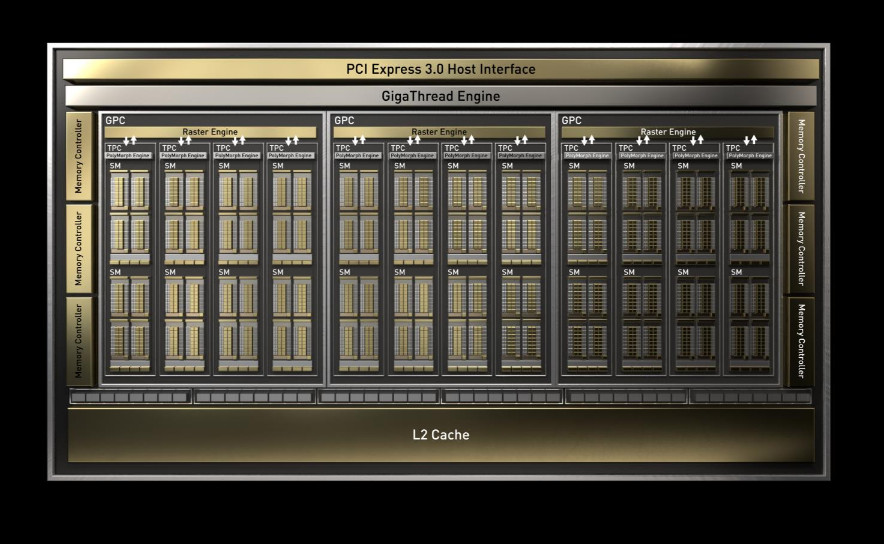
NVIDIA’s GeForce GTX 1660 Ti’s new TU116 GPU is a brand new design specifically for the mainstream gaming market. Manufactured using TSMC’s 12nm FinFET technology, it incorporates 1560 ‘Turing’ CUDA Cores arraigned in a Shader Module that differs considerably from that of the RTX 2060. Without both Tensor and RT Cores it lacks hardware support for NVIDIA RTX Hybrid/Real-Time Raytracing and AI features such as DLSS, but does roll in other improvements specific to the Turing architecture.
Updated Cache Model
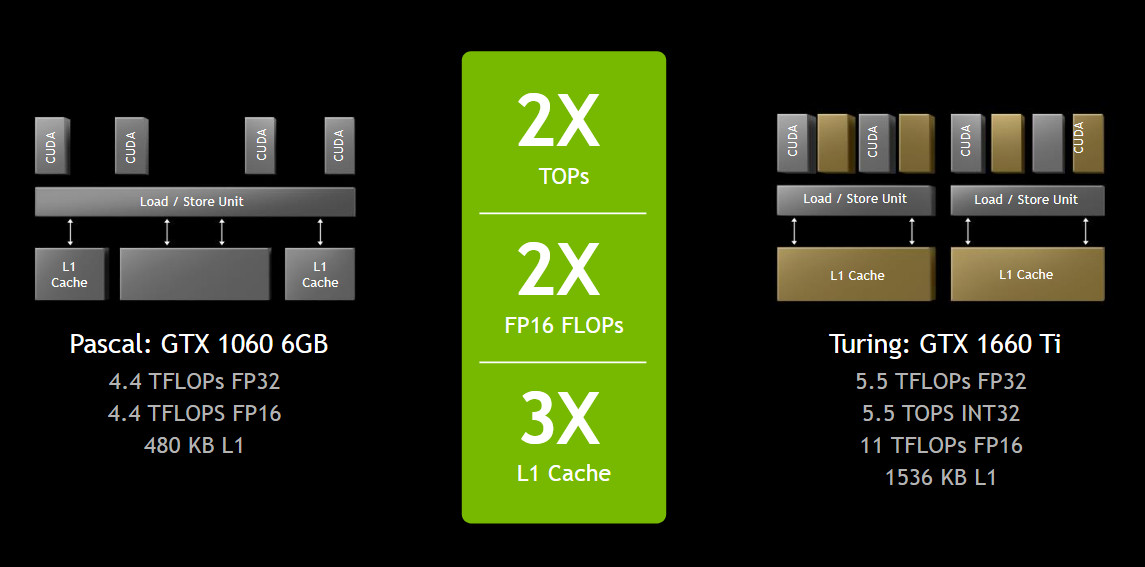
Turing moves to a Unified L1 Cache, a schema which offers lower latency, higher bandwidth, and higher capacity compared to Pascal and earlier architectures. NVIDIA describe the design as featuring a more ‘heavyweight’ shader thanks to a 3x increase in L1 Cache Size (from 48 to 128 KB) and 4x increase to L1 Cache Bandwidth.
These changes are likely to have a high impact on effective shader Instructions Per Clock, even without accounting for game engine optimisations that take advantage of new dynamic cache allocation features and support for larger data structures. Simply increasing the cache size will increase the chances for a cache ‘hit’, reducing how often slower cache and memory needs to be accessed.
Coherent Floating Point and Integer operations
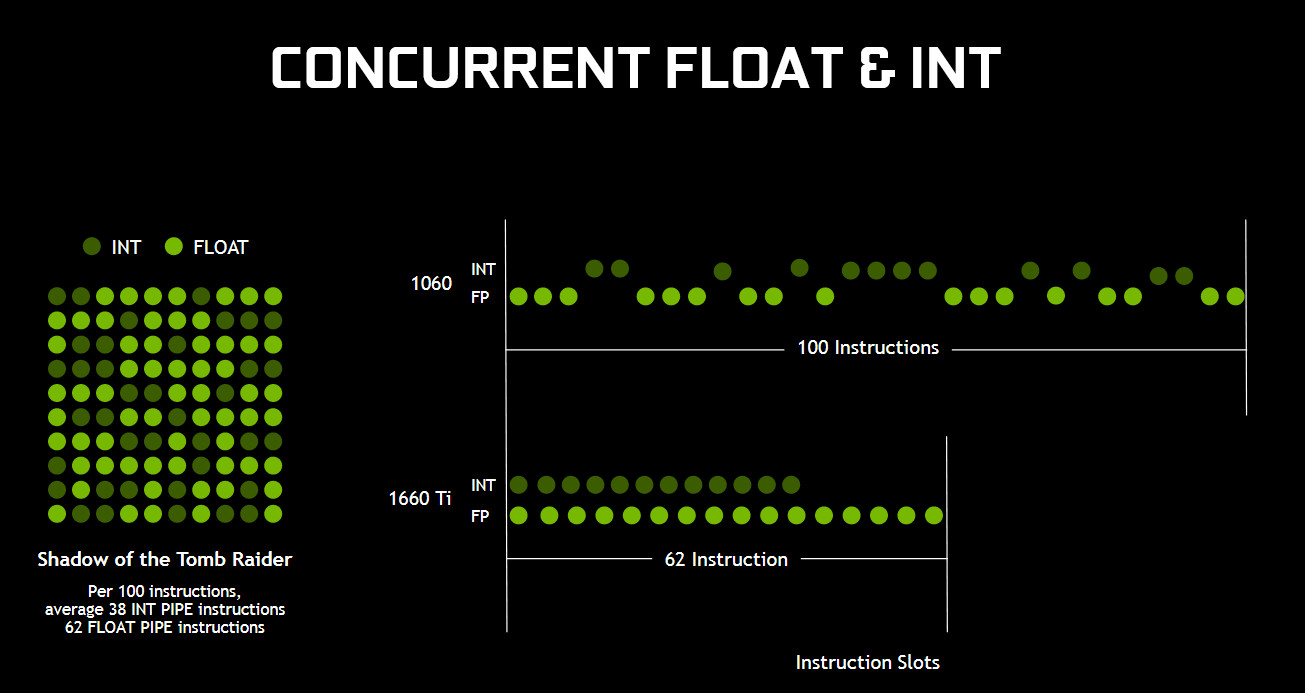
NVIDIA’s Pascal architecture is capable of executing both Floating and Integer operations, but only sequentially across the shader module by switching between the two modes. Turing shader processors by contrast can execute batches of mixed operations in parallel, greatly increasing total operations per second in mixed workloads.
While floating point operations have tended to dominate game engine workloads, modern titles are beginning to roll in integer operations where it’s deemed appropriate as GPU hardware broadens its mixed workload capabilities. As a result the GTX 1660 Ti has a certain amount of future-proofing when compared to a GPU from an older generation with similar performance characteristics.
Adaptive Shading
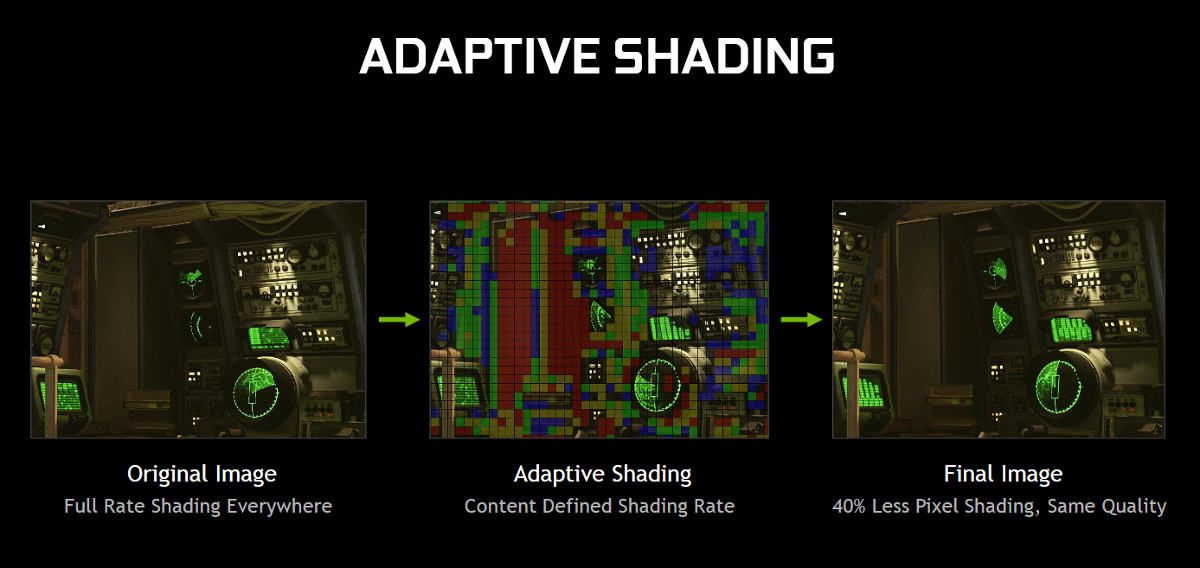
Sections of any rendered scene will differ in complexity, from heavily textured objects and surfaces to more plain walls with less detail. From frame to frame large areas with less detail may change very little over time. Adaptive Shading techniques are aware of that contextual difference, and can allocate fewer shading resources to these zones dynamically.
Adaptive Shading is one aspect of Variable Rate Shading possible under the RTX technologies umbrella. It’s not clear which aspects won’t be possible with the GTX 16-series, but that will no-doubt become clear as it is used in more games. For now, Adapative Shading is present in Wolfenstein: The New Colossus, and is a factor in the NVIDIA’s projection of a 1.4x performance advantage vs the 1060 6GB.
VirtualLink
The new VirtualLink VR connector standard is a optionally available on the GTX 1660 Ti. We already know of a number of partner cards which will not be incorporating the I/O connector, so approach each on a case-by-case basis if it is important to you. From a pure performance perspective the GTX 1660 Ti should be more than capable of current Premium VR rendering support as its anticipated performance exceeds that of the already-validated GTX 1060 6GB.
New NvEnc Encoding Engine
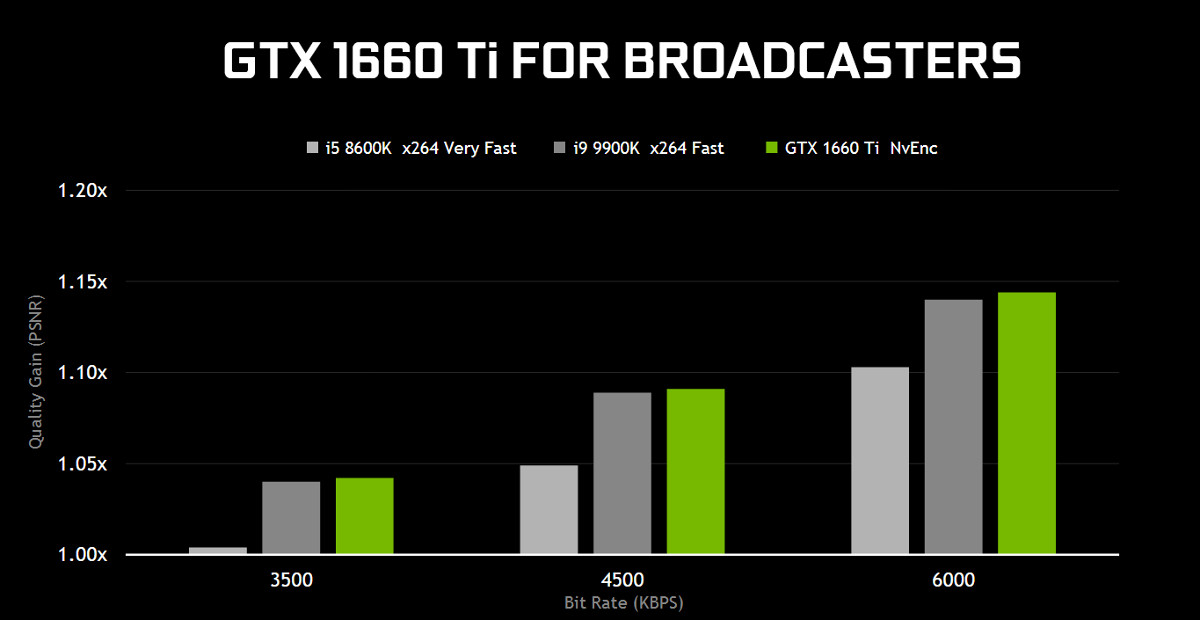
The GXT 1660Ti supports NVIDIA’s latest NvEnc hardware video encoder. Designed specifically for game broadcasting via Twitch and other streaming platforms, it improves the video stream (x264 fast) encoding bit rates to up to 6000KB/s. Video quality is also improved, now exceeding that of an Intel Core i9-9900K using the same encoding while also offloading processing from the CPU.
OC Scanner
OC Scanner was introduced alongside the RTX 20-series cards as a means of offering automated (one-click) overclocking for a ‘free’ performance boost, and has since been extended to older NVIDIA GPU architectures. It works by scanning for artefacts and other inconsistencies as operating frequencies increase, easing off when detected and failing safely rather than causing hard lockups. OC Scanner is now incorporated into the major aftermarket overclocking tools from EVGA, MSI and ASUS.
Power Efficiency
Currently Turing GPUs are manufactured using TSMC’s 12nm lithography, which has many similarities the GTX 1060 6GB’s 16nm manufacturing process. Power efficiency improvements will tend to be down to architectural changes rather than the manufacturing process, but higher frequencies on similar voltages aren’t out of the question.
NVIDIA boast of a 1.4x perf/watt improvement in optimal workloads over the GTX 1060 6GB, which is more than just a little significant. The GTX 1660 Ti has a reference TDP of 120W, the same as the GTX 1060 6GB, which speaks to the expected performance improvement you might see when comparing with the previous generation.
Most GTX 1660 Ti’s will ship with a single 6-Pin PCIe connector, but some (such as the ROG STRIX GTX 1660 Ti) are equipped with an 8-pin connector for a little more overhead.
Memory Subsystem
The GTX 1660 Ti is the first mainstream GPU to be configured with GDDR6 memory, a standard that until now has been exclusive to performance class RTX 20-series GPUs. An effective memory speed of 12000Gbps compares very favourably with the GTX 1060 6GB’s 8000Gbps, increasing the available memory bandwidth by 50% to 288 GB/sec.
ASUS-Specific Features
ASUS Specific Features
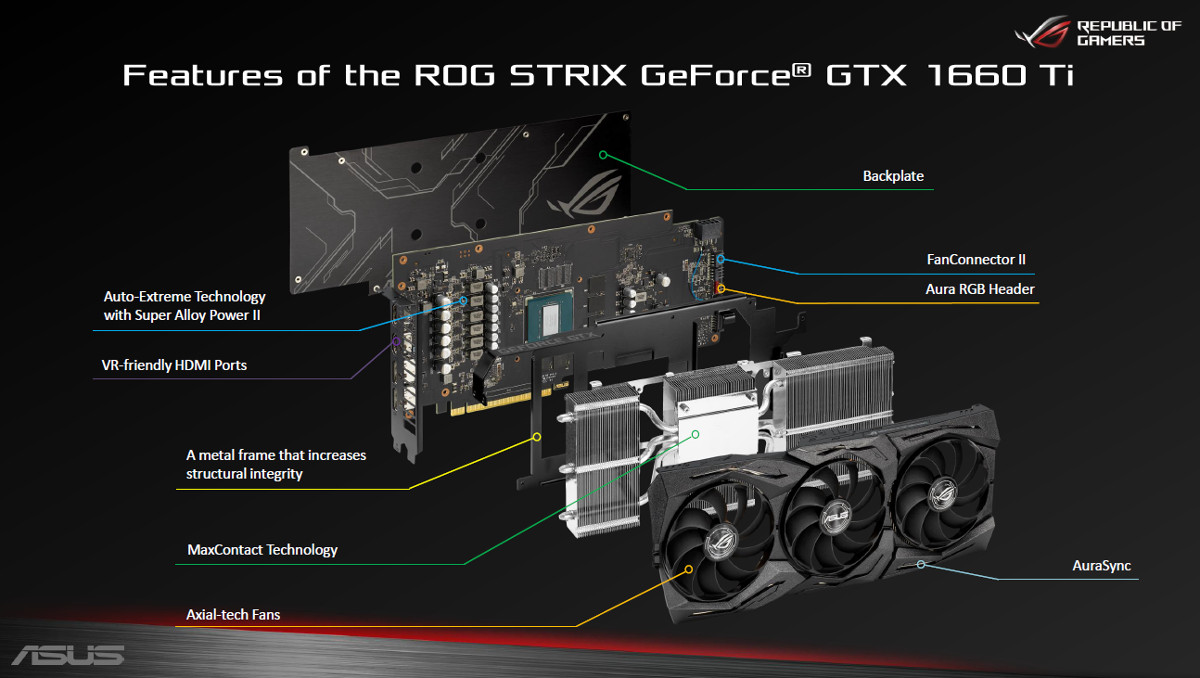
While certain features will be common across the GeForce GTX 1660 Ti family, some are specific to each vendor and SKU. It will come as no surprise that ASUS ROG claim plenty of distinctions between their STRIX variant and their competitors across performance, cooling and reliability categories.
Cooling Design
ASUS have once again matched their premium card variant with the now familiar ROG triple-fan cooler. In terms of maximum cooling potential this design is clearly over-engineered for the requirements of a mid-range 120W GPU. Nonetheless the design should allow for relatively low rpm operation across its three fans when the card is under load.
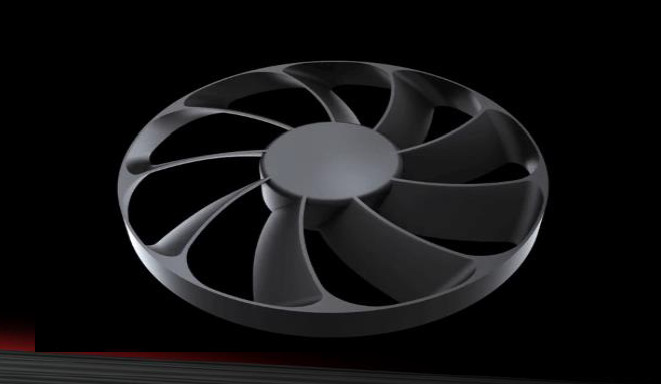
The current generation of this cooler has a tweaked ‘Axial-Tech’ fan design rather than the ‘wing-blade’ fan that’s been used until now. Within the same 35db acoustic envelope the new fans increase air flow by 27% and static pressure by 40% relative to the old design, and maintains high dust resistance standards.
ROG’s approach to cooling and performance is augmented by the card’s two BIOS options. This Dual-BIOS system switches between Performance and Silent Mode BIOS profiles that adjust default overclocks and fan curves. Fan curves are substantially more aggressive under Performance Mode, while the Silent Mode prioritises low noise and 0db operation below 55C by stopping the fans entirely. The oversized nature of the STRIX heatsink means that the Silent Mode has no chance of causing issues when GPU load spikes, and fans can ramp up gently.
ASUS ROG’s new Axial Fan design
Offering additional cooling control are two aux. headers compatible with 3-pin and 4-pin PWM fans. In concert with the Fan Connect II software, fans connected via these headers can be adjusted dynamically to both GPU and CPU temperatures in a manner that ensures balanced system thermals.
Factory Overclock
When utilising the Performance BIOS (the ROG STRIX GeForce 1660 Ti’s shipped default) the card has a substantial overclock of 1530MHz Base and 1890 MHz Boost. That’s a hefty increase when you compare it to reference specifications of 1500MHz Base and 1770 MHz Boost, and is compounded by the a high quality cooler allowing it to run at the higher Boost frequencies for longer than is typical. The likely performance gain from this overclock shouldn’t be understated, but may mean that the card has slightly less overclocking headroom beyond that point for enthusiasts.
ASUS Aura Sync RGB Lighting
In common with the rest of the ROG STRIX GPU range, this model incorporates configurable RGB LEDs utilising their proprietary Aura Sync lighting system. This allows for synchronisation of lighting effects across Aura Sync-enabled hardware and peripherals and a wide selection of customisable effects to choose from. As with all aesthetic options the value you place on it is down to personal taste, but Aura Sync remains one of the more comprehensive systems on the market in terms of both functionality and support (ASUS-specific and 3rd party). Plus, you can turn the entire lighting system off with the press of a button if you so desire.
This card also adds a single 4-pin RGB header at the rear for additional controllable lighting, which is a nice touch.
Reinforced Frame
RIG STRIX GPUs are the more heavily engineered cards on the market and often emphasise a rugged design that compensates for the more weighty cooler. Such is the case here, as the GTX 1660 Ti version incorporates both a hefty backplate and bracing front faceplate. Together they reinforce against torsional forces acting on the PCB, especially those focused around the PCI-E connector and cooler mounting points.
—
Clearly the ASUS ROG STRIX GeForce GTX 1660 Ti is in the upper echelons of feature sets, although we should note that it doesn’t incorporate the VirtualLink connector. ASUS enthusiasts who aren’t quite as demanding will be pleased to know that other SKUs with slightly lower feature options are available from the non-ROG side, including ASUS DUAL and TUF GTX 1660 Ti models with twin-fan cooling.
Closer Look Video
For this review we’ve produced a video of ASUS ROG STRIX GTX 1660 Ti. In this video we go into great detail about this graphics card, walking you through all of the features and detaching the cooler for a look at the thermal solution and innards. View the video here or watch below:
Test Setup & Methodology
HOW WE TEST GRAPHICS CARDS
Testing a graphics card is an extremely lengthy process. We sometimes see reviews where a graphics card has been tested using out of date equipment, out of date games and even out of date drivers. While the latter can be excused due to the sheer amount of driver updates making a thorough review impossible we will however notify the reader when we have used a different driver to the normal for example a pre-release driver. For the most part however we will always use the same hardware and latest drivers so this does certainly need to be taken into consideration when viewing our testing results. Each game and benchmark is tested times with the lowest and highest scores omitted out of the 5 results and the average then taken from the three remaining to give us our final result for each resolution and setting used.HARDWARE
Taking Intel’s High-End Desktop platform, our hardware utilises the Intel X99 chipset. Combined with this we use the Intel Core i7-5960X Extreme Edition processor clocked to a realistic and achievable 4GHz to ensure we have no CPU bottlenecks. With 16GB (4x4GB) of DDR4 at 2666MHz and a 750GB SSD there should be minimal paging so the benchmarks we run today will hopefully give a true reflection of the graphics card’s performance.Graphics Cards on test:
ASUS GTX 1660 Ti
NVIDIA GTX 1070
NVIDIA GTX 1060
NVIDIA GTX 1050 Ti
NVIDIA GTX 1050
AMD RX 590
AMD RX 580
AMD RX 570
Special thanks go to Avermedia, Intel, Corsair, MSI and AOC for providing the extreme spec components used for our test bench:
Motherboard: MSI X99A Workstation
CPU: Intel Core i7-5960X Extreme Edition @ 4GHz
RAM – 16GB (4x4GB) Corsair LPX Vengeance (Red) DDR3 @ 2666MHz 16-17-17-35 C1
Power Supply – CORSAIR HX1050
Hard Drive – Samsung 840 EVO 750GB
Cooler – CORSAIR Hydro Series™ H150i Pro 360mm Extreme Performance Liquid CPU Cooler
Monitor – AOC 28″ 4K U2879VF
Capture Card – Avermedia Live Gamer Extreme 2
CPU: Intel Core i7-5960X Extreme Edition @ 4GHz
RAM – 16GB (4x4GB) Corsair LPX Vengeance (Red) DDR3 @ 2666MHz 16-17-17-35 C1
Power Supply – CORSAIR HX1050
Hard Drive – Samsung 840 EVO 750GB
Cooler – CORSAIR Hydro Series™ H150i Pro 360mm Extreme Performance Liquid CPU Cooler
Monitor – AOC 28″ 4K U2879VF
Capture Card – Avermedia Live Gamer Extreme 2
BENCHMARKS
If you are a regular reader of our reviews you will know we like to test the latest hardware with the latest games and benchmarks on the market. Here are the games we’ve chosen:Fortnite
Middle Earth: Shadow of War
Apex Legends
Shadow of the Tomb Raider
F1 2018
Battlefield V
Middle Earth: Shadow of War
Apex Legends
Shadow of the Tomb Raider
F1 2018
Battlefield V
To capture framerates we use a combination of in-game benchmark tools and FRAPS.
We also take into consideration the benchmarkers out there so have included three of the more popular synthetic benchmarks available:
Let’s see how today’s graphics card performed…
Power, Temperatures, Acoustics
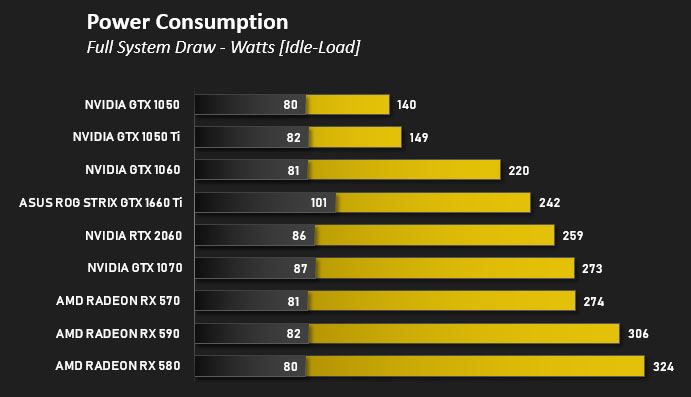
To test for power consumption, we take a measurement from the plug socket. It is important to note that the figures below represent total system power use and not just the GPU. The CPU was always in a fixed state (4GHz overclock) so did not affect the additional power load when the GPU was placed under 100% load using Heaven 4.0 which was ran for 20 minutes at which point a load reading was taken. Idle readings were taken 5 minutes after system boot to ensure any background services and applications had loaded.
TEMPERATURE
To test temperatures we measured idle temperatures after booting windows, letting all applications finish loading and ran a few benchmarks. Once the benchmarks were complete we left the card to reach a cooling plateau where we then took the idle temperatures. For the load tests we set Heaven 4.0 running continuously for ~30 minutes recorded the peak/maximum GPU temperature.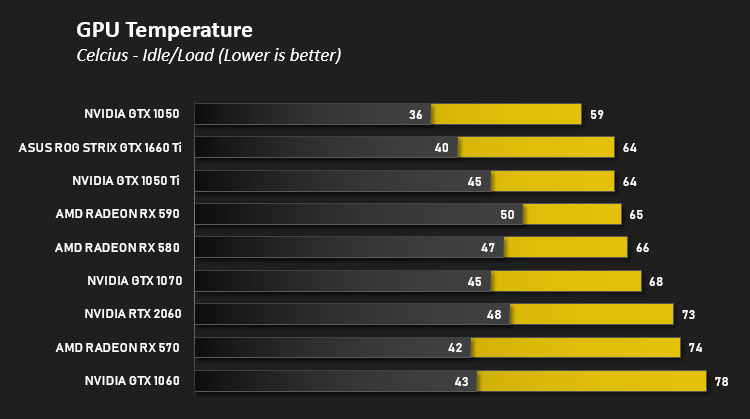
ACOUSTICS
The Direct CU 3 cooler with its Axial-tech fans are very quiet under load and are barely noticeable.DX12: 3DMark Time Spy
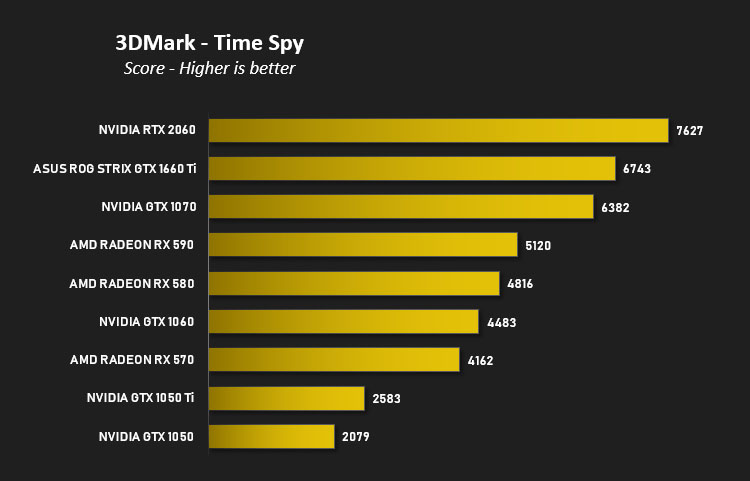
Download your copy nowWith its pure DirectX 12 engine, which supports new API features like asynchronous compute, explicit multi-adapter, and multi-threading, 3DMark Time Spy is the ideal benchmark for testing the DirectX 12 performance of the latest graphics cards.
DX11: 3DMark FireStrike
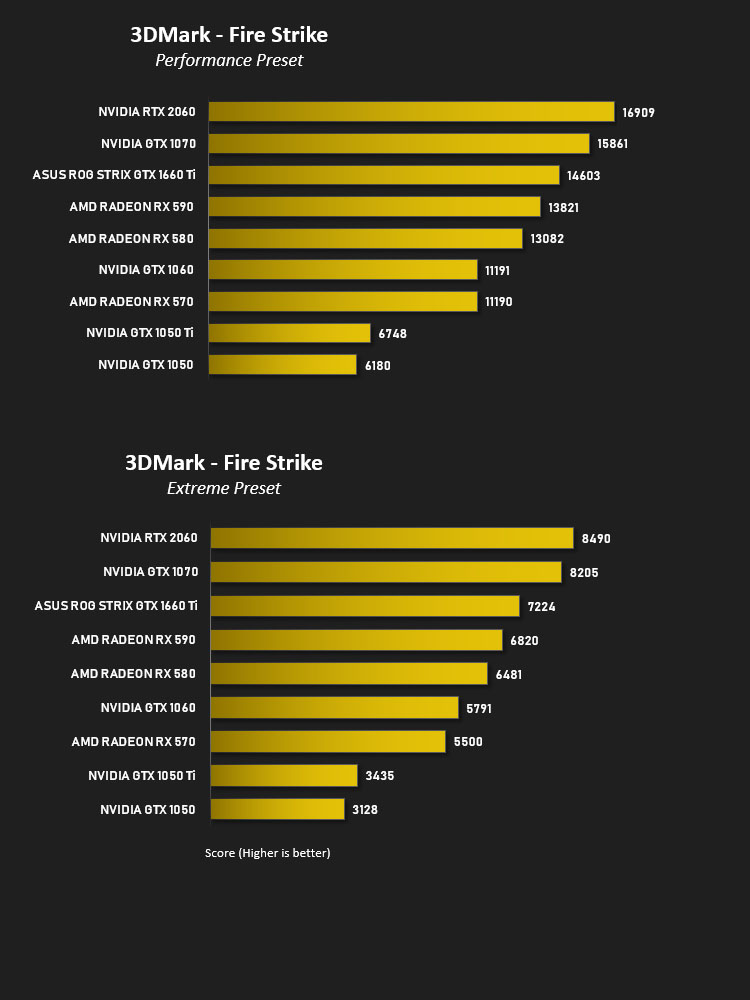
Download your copy nowFire Strike is the new showcase DirectX 11 benchmark designed for high-performance gaming PCs. It is UL’s most ambitious and technical benchmark ever, featuring real-time graphics rendered with detail and complexity far beyond what is found in other benchmarks and games today.
DX11: Unigine Heaven 4.0
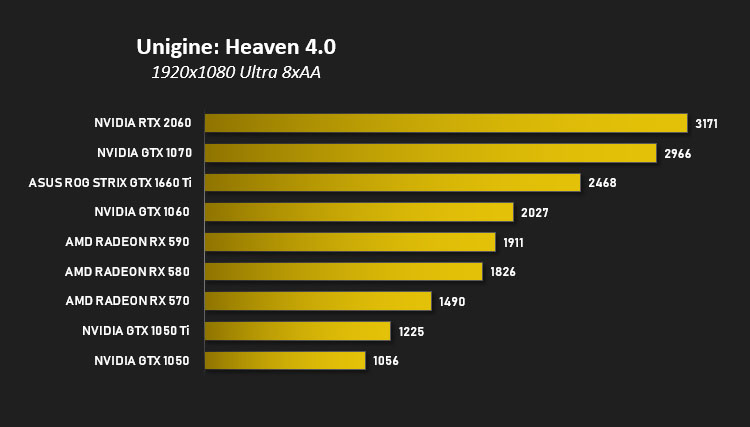
Heaven Benchmark with its current version 4.0 is a GPU-intensive benchmark that hammers graphics cards to the limits. This powerful tool can be effectively used to determine the stability of a GPU under extremely stressful conditions, as well as check the cooling system’s potential under maximum heat output. It provides completely unbiased results and generates true in-game rendering workloads across all platforms.
DX11: Unigine SuperPosition
Superposition is a new-generation benchmark tailored for testing reliability and performance of the latest GPUs. Top-notch visuals, support for VR-devices and an interactive mode with mini-games — the list of features built into Superposition could go on and on.
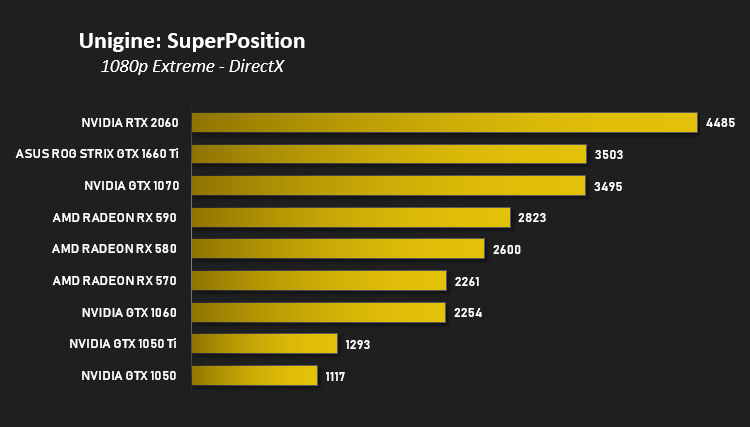
DX11: Fortnite
Fortnite Battle Royale is the FREE 100-player PvP mode in Fortnite. One giant map. A battle bus. Fortnite building skills and destructible environments combined with intense PvP combat. The last one standing wins.

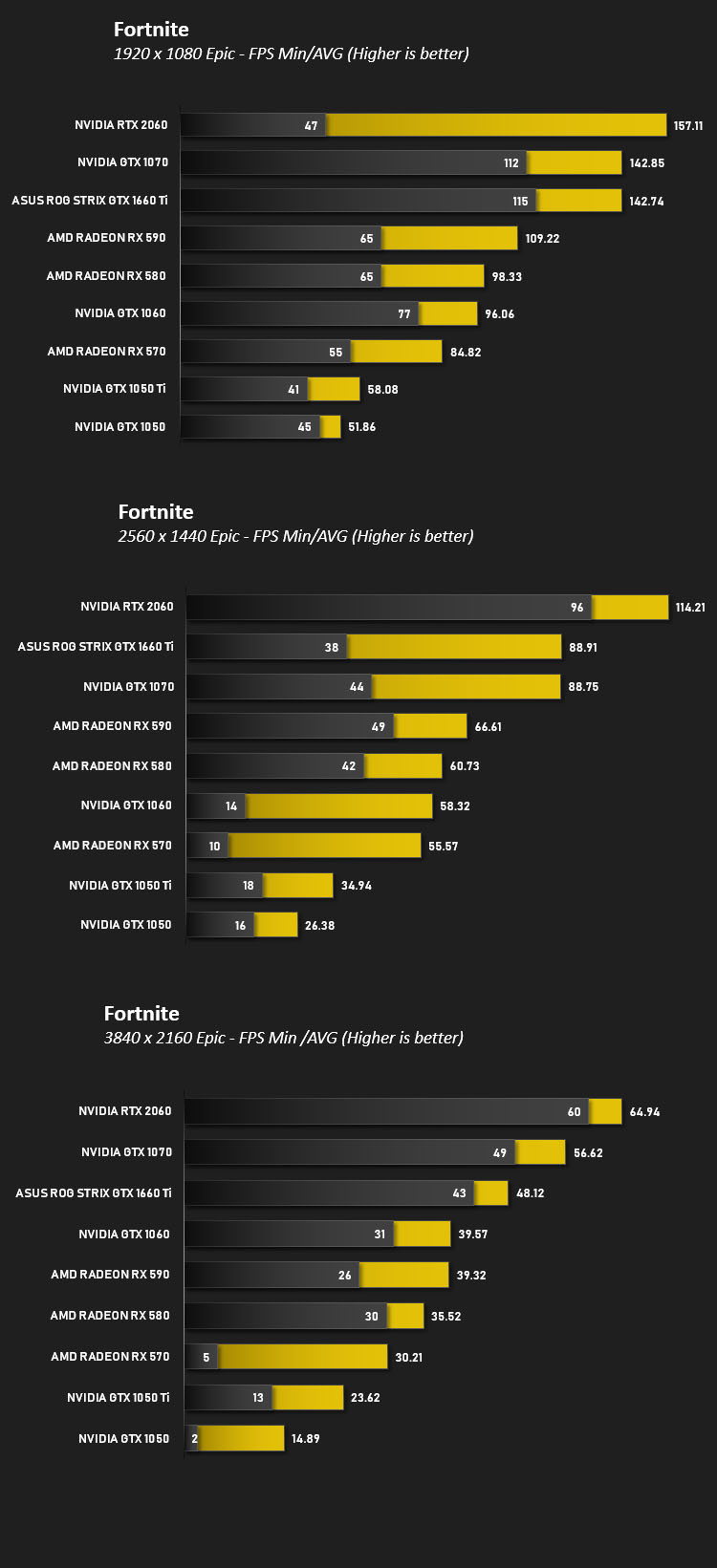
DX11: Middle Earth: Shadow of War
Middle-earth: Shadow of War is an action role-playing video game developed by Monolith Productions and published by Warner Bros. Interactive Entertainment. It is the sequel to 2014’s Middle-earth: Shadow of Mordor.

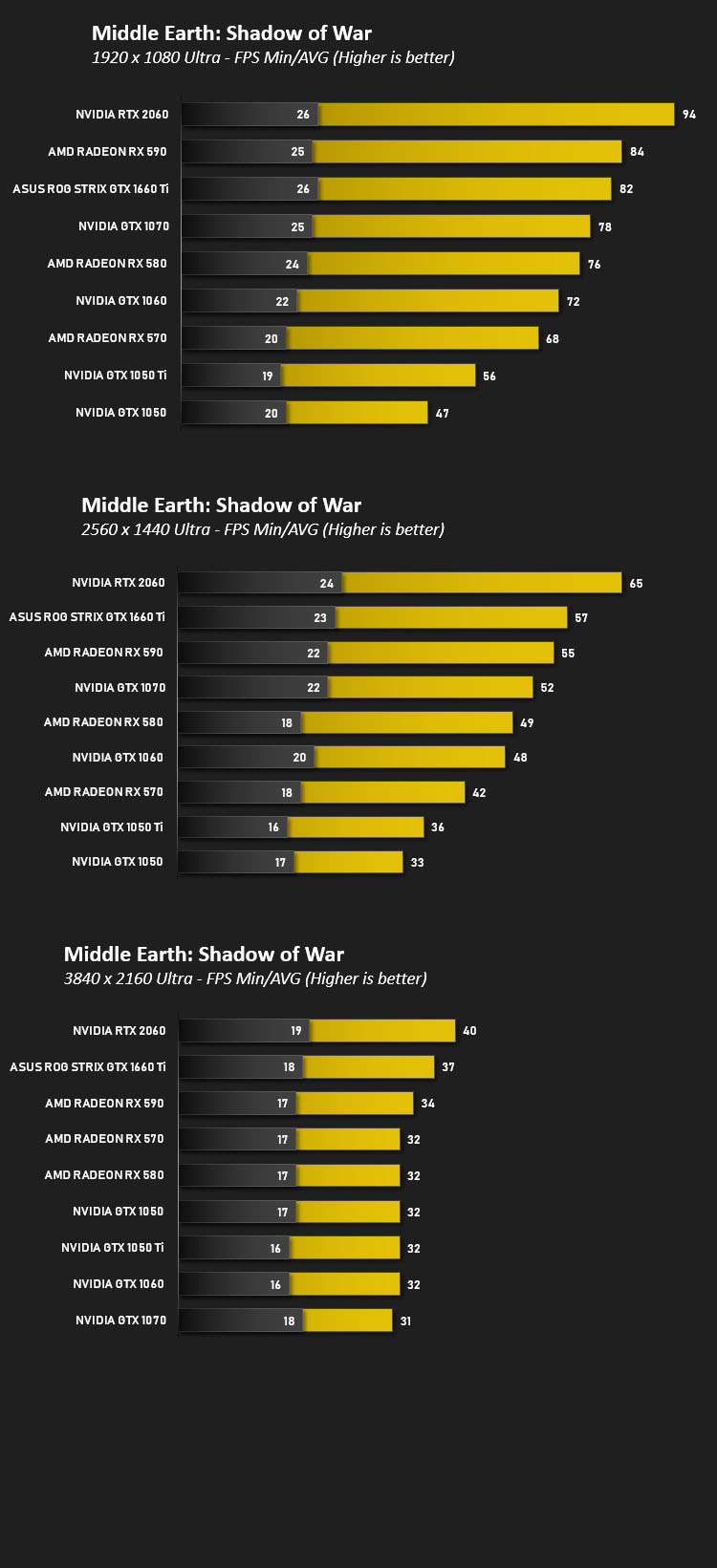
DX11: Apex Legends
Apex Legends is a free-to-play battle royale game developed by Respawn Entertainment and published by Electronic Arts. Set in the same universe as Titanfall, the game was released for Microsoft Windows, PlayStation 4, and Xbox One on February 4, 2019.

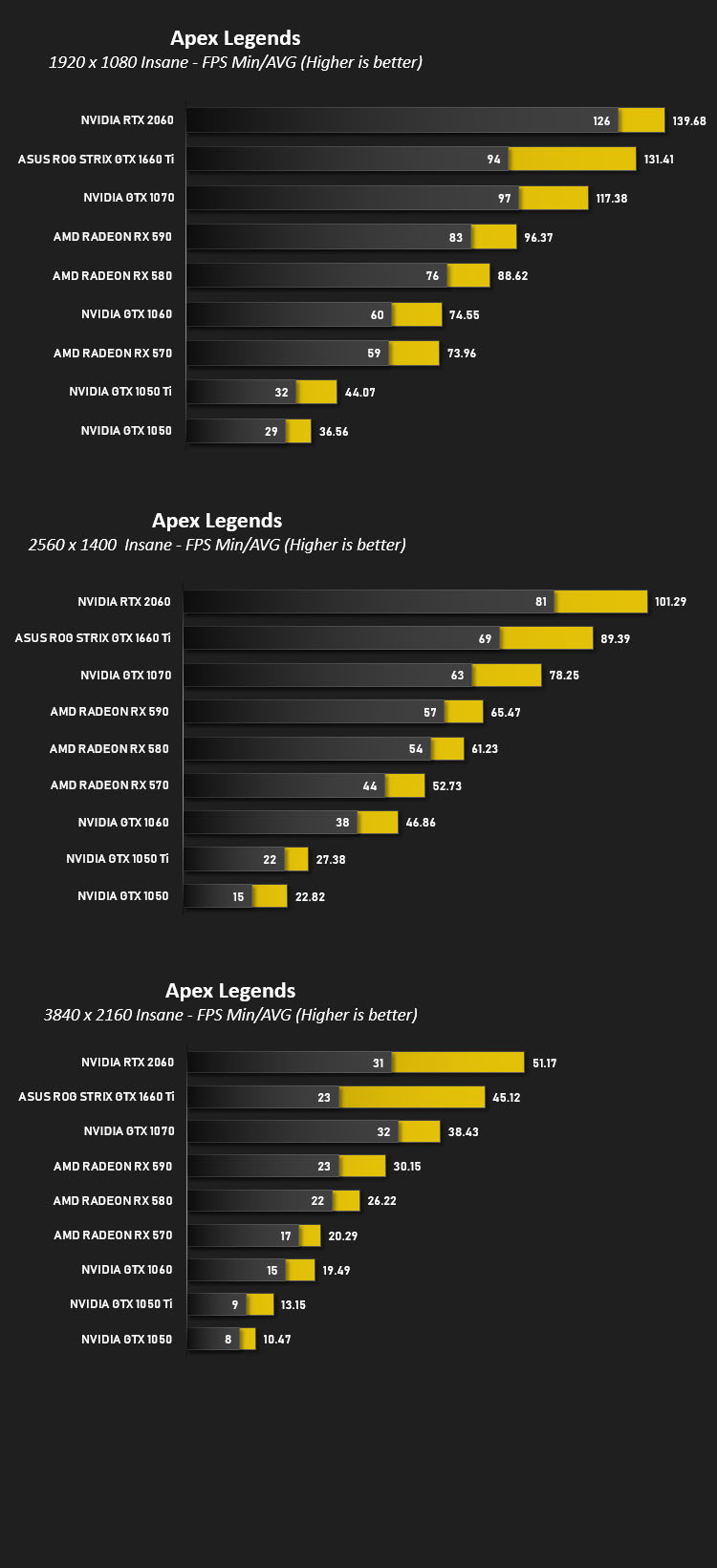
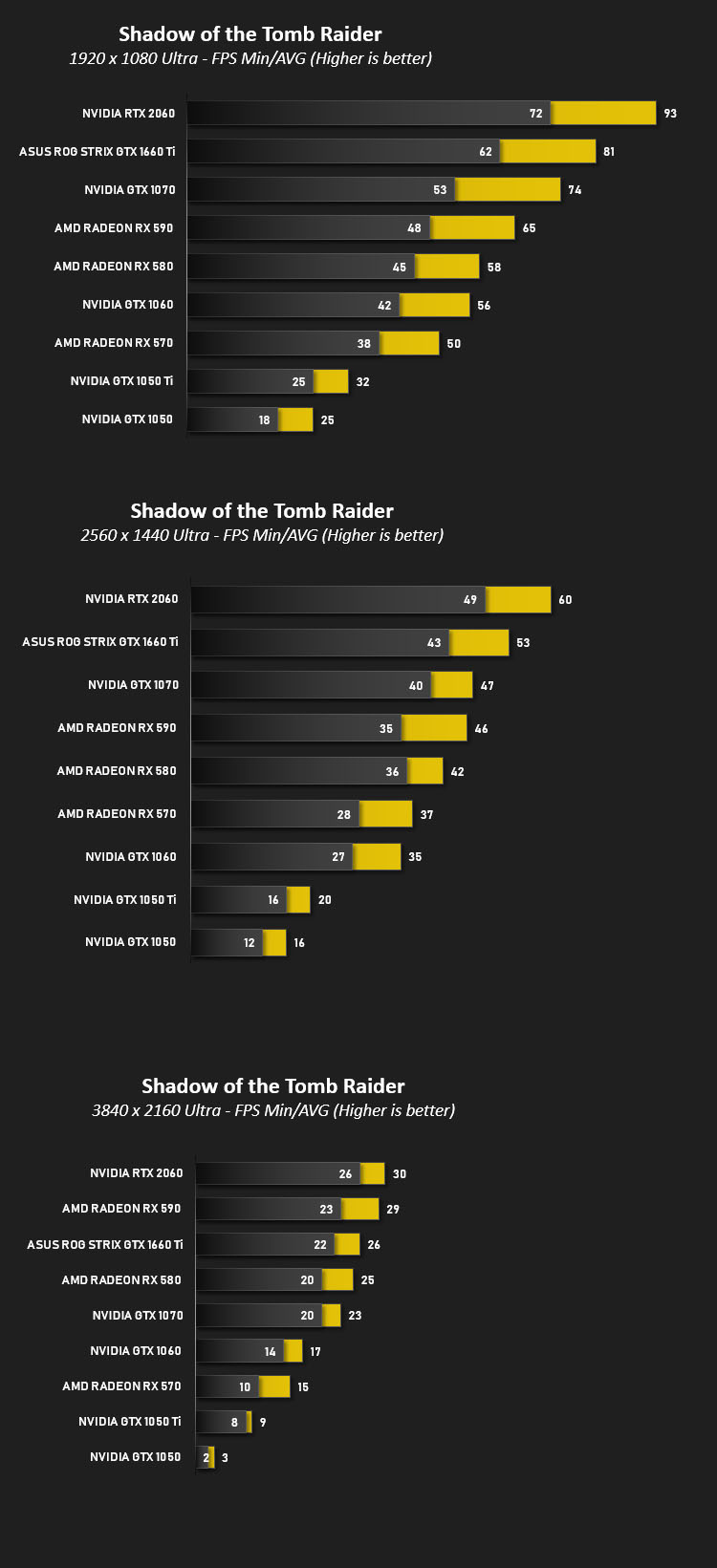
DX12: Shadow of the Tomb Raider
Shadow of the Tomb Raider is an action-adventure video game developed by Eidos Montréal in conjunction with Crystal Dynamics and published by Square Enix. It continues the narrative from the 2013 game Tomb Raider and its sequel Rise of the Tomb Raider, and is the twelfth mainline entry in the Tomb Raider series.

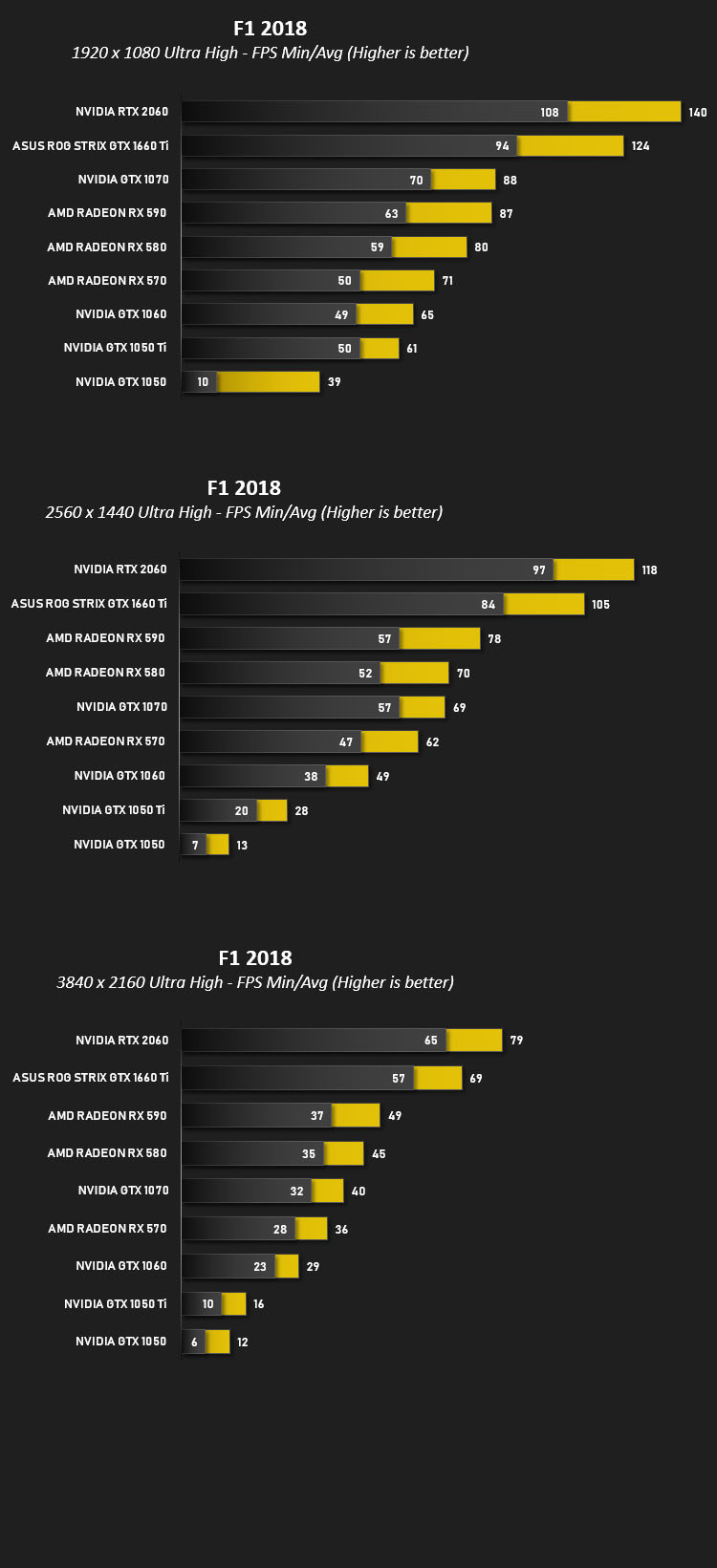
DX11: F1 2018
F1 2018 is a racing video game and the tenth instalment in the Formula One video game franchise developed and published by Codemasters. The game is based on the 2018 Formula One World Championship and includes all twenty-one circuits from the calendar and all twenty drivers and ten teams competing in the season.

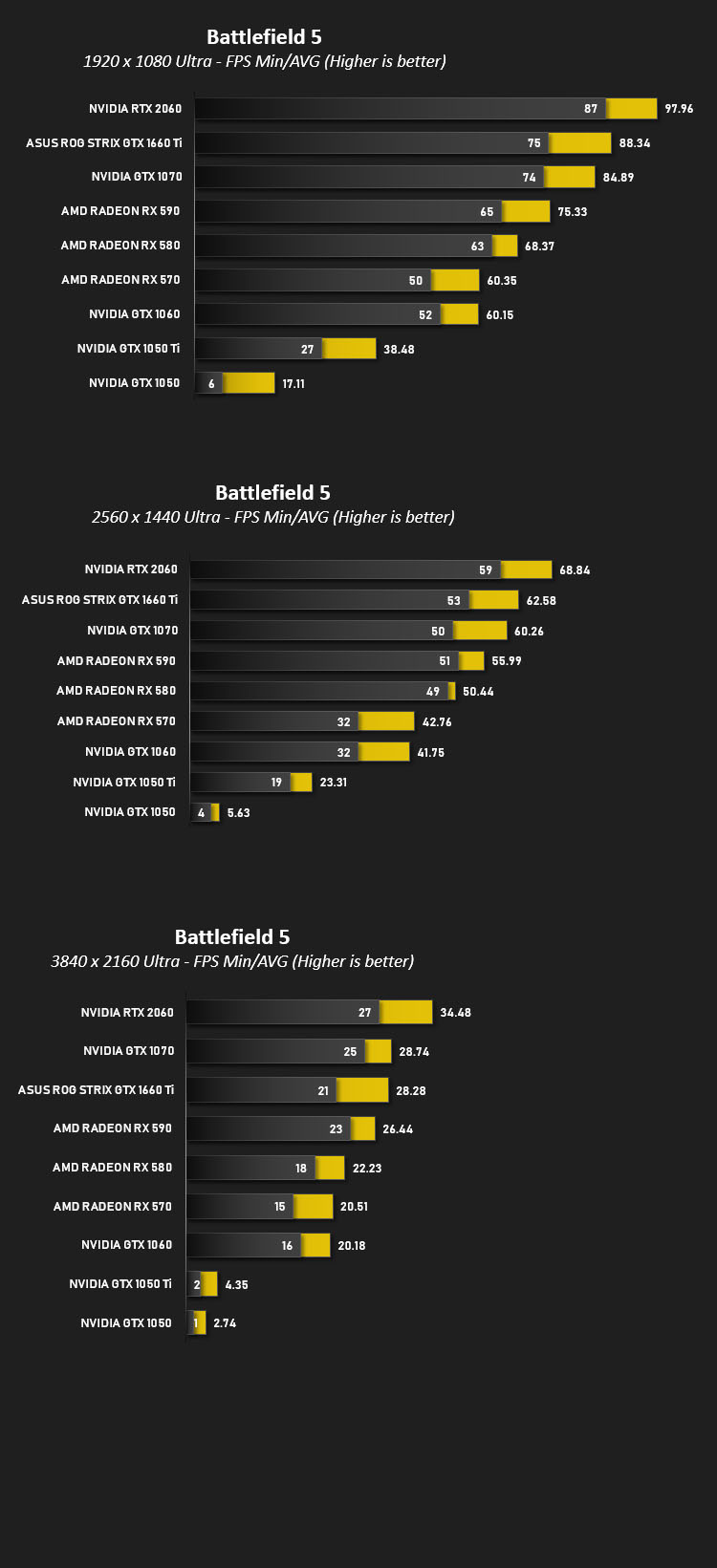
DX12: Battlefield V
Battlefield V is a first-person shooter video game developed by EA DICE and published by Electronic Arts. Battlefield V is the sixteenth installment in the Battlefield series.

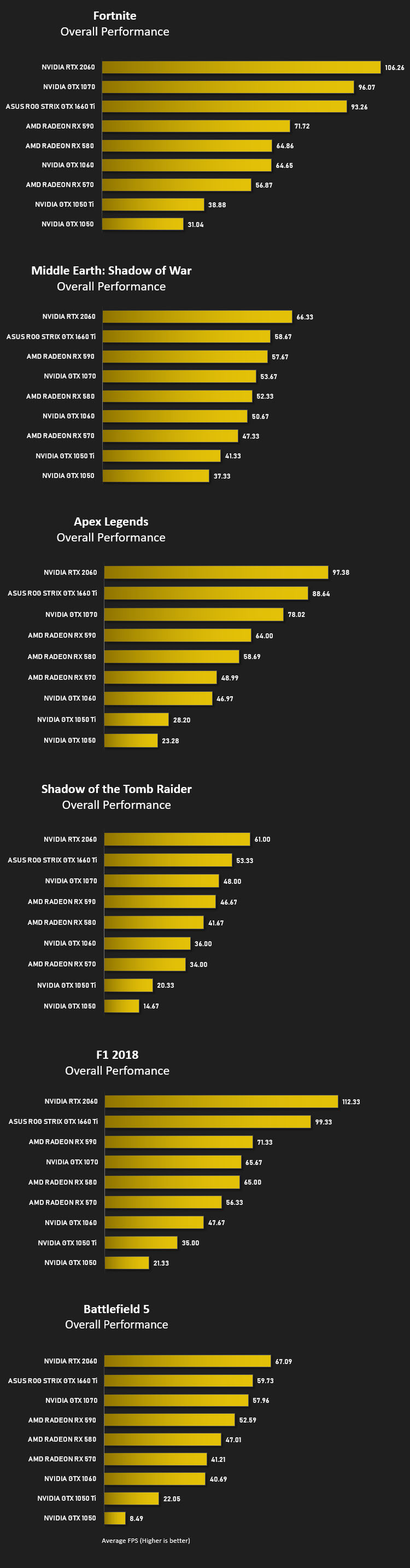
Overall Performance
Here we take a look at the overall performance of the graphics card. This figure is determined by finding the average FPS across all of the settings used in a particular benchmark(game) to give us an overall value.
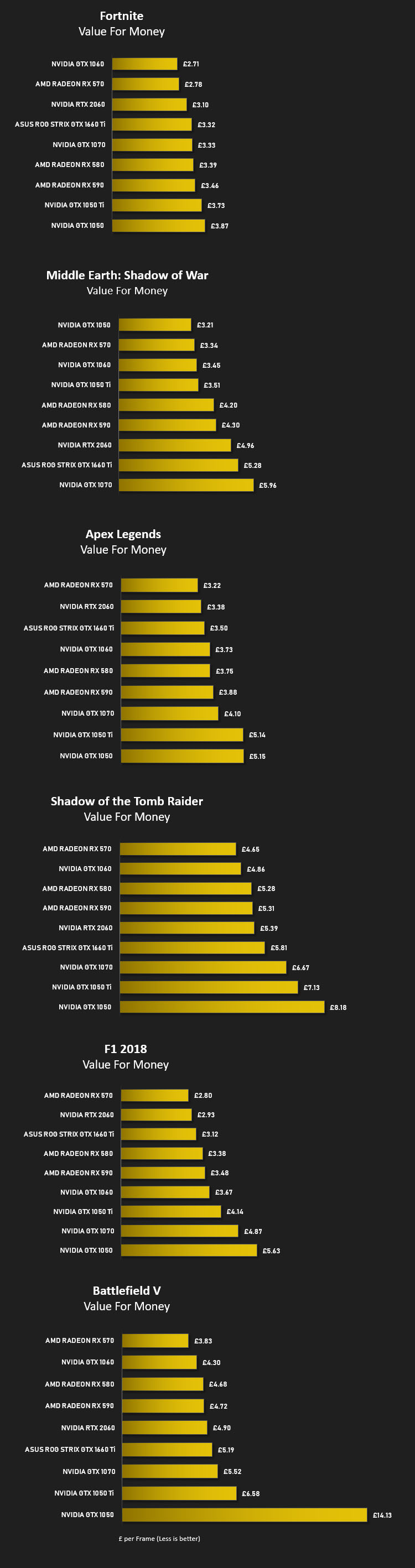
Value For Money
We make a simple calculation for this set of results. For each game we add all of the resulting FPS totals together and then divide by the four sets to give us an overall performance figure. While the figures alone do not give you an accurate picture of how the card will perform in any given scenario, they do tell you, when averaged, which GPU is the more capable across all of the benchmarks and settings tested.
Please note: we’ve used GBP for currency but since this is relative – regardless of which currency you use, this will give you a good indication of value for money.
Overclocking
To overclock our GTX 1660 Ti we used the latest version of ASUS GPU Tweak II since we are using an ASUS card.
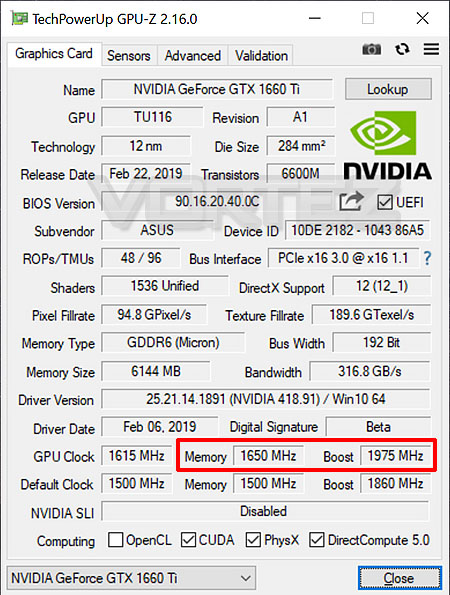
Out of the box this STRIX card has a GPU boost reaching: 1890MHz and the memory clock speed is at reference: 1500MHz.
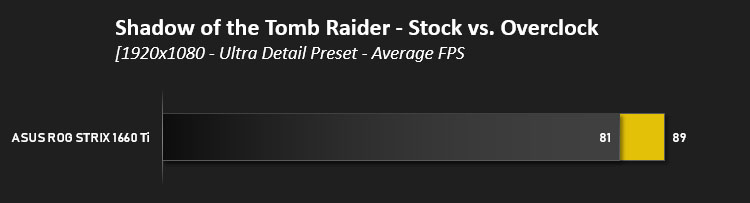
We were able to modify both parameters easily and achieved 1975MHz for the GPU clock and 1650MHz for the memory clock. This is a pleasing result and below you can see how these modifications change gaming performance figures. We’ll be adding more graphics cards to this chart over time, which will establish which is the best at manual overclocking.
Conclusion
While we all appreciate brand new technologies, sometimes there is nothing more satisfying than a mainstream slugfest caused by the introduction of a new GPU. That’s especially the case when a new architecture is brought in to supplant ageing cards with similar performance. NVIDIA’s unveiling of the GeForce GTX 1660 Ti is sure to accomplish that, and has already prompted price adjustments to older cards competing with the new upstart.
Without a reference design the full complexion of the segment will only become clear as more models are tested, but it’s obvious from ASUS’s pricing guidance that the ROG STRIX variant will be at the high end of this cohort of cards. NVIDIA have stipulated an MSRP starting from £259.99 inc. V.A.T.; this model sits beyond £330 in the UK (though actual retailer price is expected to vary and may stabilise closer to £300 than £350), and at a more aggressive $569 AUD in Australia. Such has been the penalty for the premium features incorporated into the STRIX graphics card range, often to its detriment when in the mainstream segment.
Make no mistake however, the performance of this card is exceptional for a relatively modest GPU. NVIDIA’s guidance consistently compares the GTX 1660 Ti with the GTX 1060 6GB, but the ASUS ROG STRIX trades blows with the GTX 1070. Taken in isolation, anyone upgrading from a graphics card three years old that isn’t a GTX 980 or 980Ti will get a huge boost in performance.
Furthermore, as good as the GTX 1070 is, it is an old technology. New games benefit more from Turing’s architectural features, and so opting for a GTX 1660 Ti will be future-proofing yourself to a certain extent. It would also be an exceptional partner to 1080p variable refresh rate monitors that adhere to NVIDIA’s G-SYNC or G-SYNC Compatible standards. This card in particular is more than capable of pushing >100Hz at 1080p in the most popular games on the market today, while being a solid if unexceptional GPU for 1440p gaming.
The trouble arrives when you compare the ROG STRIX GeForce GTX 1660 Ti with the RTX 2060. The latter is also new technology based on the Turing architecture, incorporates RT and Tensor to support NVIDIA RTX technologies that are slowly being added to games, and offers much better performance in rasterised rendering. All that would be fine if there was a clear price separation involved, but there isn’t. An RTX 2060 can be picked up for as little as £299.99 inc. V.A.T. at the time of writing, and proven good quality variants are available at NVIDIA’s £319.99 MSRP. In Australia however it comes in a little under the typical entry-level pricing of NVIDIA’s RTX 2060.
A better appreciation of the ASUS ROG STRIX GTX 1660 Ti’s position will be possible when we’ve gone over other GTX 1660 Ti models. The proprietary feature set ASUS ROG offer with this model is extremely compelling, especially if you already own an array of ROG/Aura Sync lighting system components. But many seem tailored to higher price brackets where there’s more separation between performance bands, and are out of place when competition is fiercer and consumers are more sensitive to pricing.
The ASUS ROG STRIX GeForce GTX 1660 Ti is likely to be one of the best GTX 1660 Ti’s available, but only the most ardent UK fans of ROG premium features will jump on one without considering similarly priced GeForce RTX 2060 alternatives. Australian gaming enthusiasts will however be much more positively inclined towards the ROG STRIX due to its more competitive price in that territory.
Pros
+ Matches up with other hardware easily
+ Reliable cooling solution – low noise/low temp
+ Excellent 1080p performance
+ Integrated RGB options
+ Extra features like Fan Connect II
Cons
– Very big
– Heavy
+ Matches up with other hardware easily
+ Reliable cooling solution – low noise/low temp
+ Excellent 1080p performance
+ Integrated RGB options
+ Extra features like Fan Connect II
Cons
– Very big
– Heavy
Click here for an explanation of our awards at Vortez.net.
Stay connected with the Vortez Social Media pages:
Join in with the discussions on Discord