A supersized graphics card from the XFX camp featuring the new THICC II cooler and under the Ultra Series. Can this new GPU rise to the top of the 5700 XT leaderboard?

Product on Review: 5700 XT THICC II ULTRA
Manufacturer: XFX
Street Price: USD $440 GBP £420
XFX carved a name for themselves under the AMD Tahiti – aka Radeon HD 7970, introducing their Ghost 2.0 thermal solution with the Double Dissipation design. Fast forward to 2019 and they are back with a new cooling configuration based on the design philosophy of that very cooler – THICC II.
Being announced this week is the XFX RX 5700 XT THICC II and THICC II Ultra. Both cards utilise the same cooler but the Ultra version benefits from optimisation under the hood – the GPU boost clock is able to achieve slightly higher frequencies at 1980 MHz and as a result of this will also consume slightly more power (20W).
There are a multitude of 5700 XT cards being released this September – is the THICC II Ultra worth considering? Let’s find out!
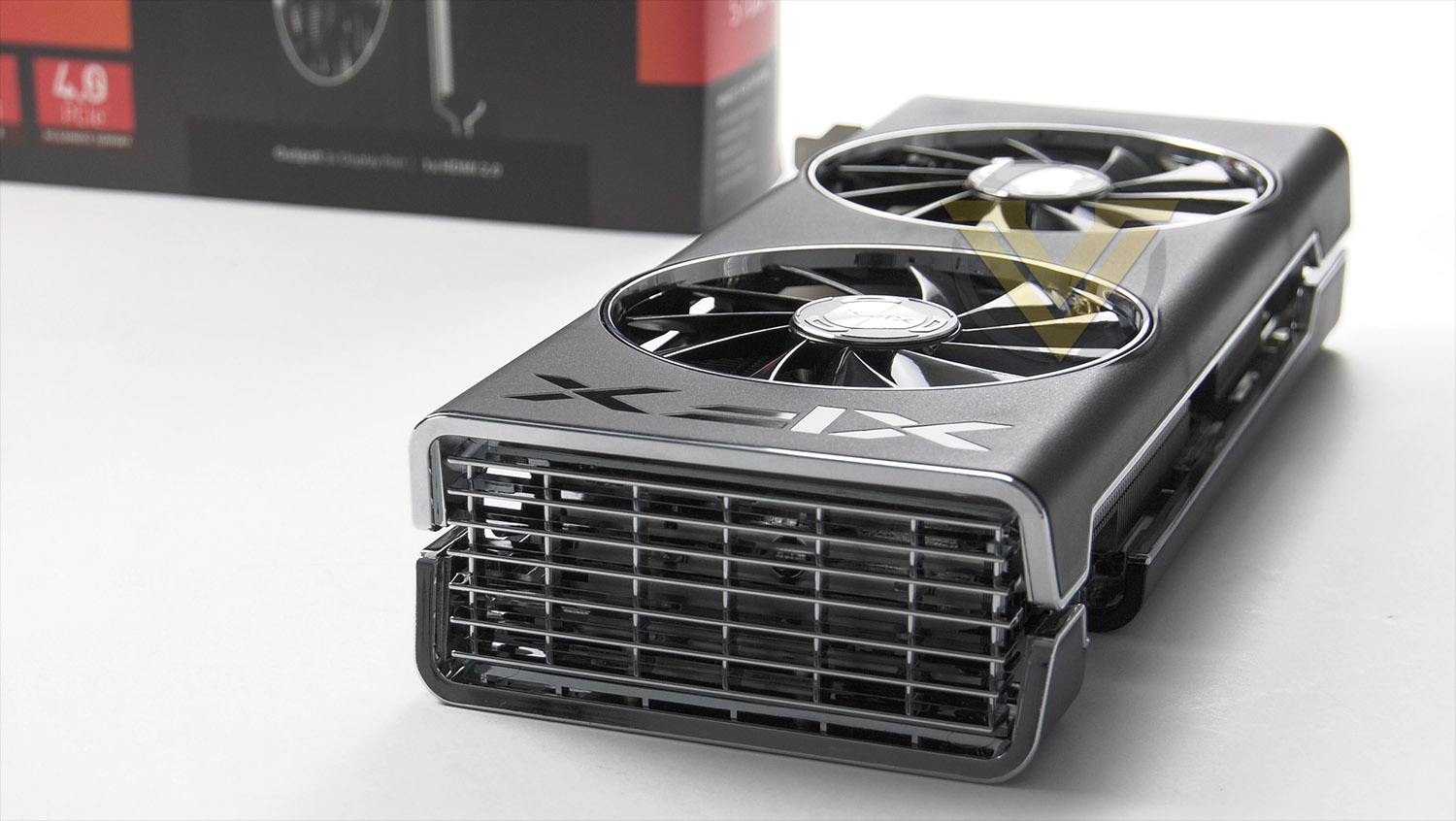
XFX on their ULTRA Series
THICC II cooling, combined with enhanced our power delivery and tuning gives the ULTRA Series Card the best performance the 5700 series has to offer. Achieve FPS and Higher clock speeds than ever.
Technical Specifications
Below are the technical specifications surrounding 5700 XT THICC II ULTRA supplied directly by XFX:
GPU
NAVI 10 XT
Stream Processor
2560
Video Memory
8GB GDDR6
Memory Bus
256-bit
Engine Clock
1840 MHz
Engine Clock Boost
1980MHz
Memory Clock
1750MHz – 14000MHz Effective
PCI Express
4.0
Display Outputs
3x DisplayPort 1.4
1x HDMI 2.0b
Recommended Power Supply
750W
DirectX
12 API feature level 12_1
OpenGL
4.6
Cooling
Dual-fan – THICC II
Slot Size
2.7
Supported OS
Windows 10
Card Length
390 x 128 x 56 mm
NAVI 10 XT
Stream Processor
2560
Video Memory
8GB GDDR6
Memory Bus
256-bit
Engine Clock
1840 MHz
Engine Clock Boost
1980MHz
Memory Clock
1750MHz – 14000MHz Effective
PCI Express
4.0
Display Outputs
3x DisplayPort 1.4
1x HDMI 2.0b
Recommended Power Supply
750W
DirectX
12 API feature level 12_1
OpenGL
4.6
Cooling
Dual-fan – THICC II
Slot Size
2.7
Supported OS
Windows 10
Card Length
390 x 128 x 56 mm
Closer Look Video Review
For this review we’ve produced a video review showing the physical design of this graphics card, highlighting its features and stripping it down by removing the thermal solution. You can watch the video below or click on this link to watch the 5700 XT THICC II ULTRA.
Test Setup & Methodology
HOW WE TEST GRAPHICS CARDS
Testing a graphics card is an extremely lengthy process. We sometimes see reviews where a graphics card has been tested using out of date equipment, out of date games and even out of date drivers. While the latter can be excused due to the sheer amount of driver updates making a thorough review impossible we will however notify the reader when we have used a different driver to the normal for example a pre-release driver. For the most part however we will always use the same hardware and latest drivers so this does certainly need to be taken into consideration when viewing our testing results. Each game and benchmark is tested times with the lowest and highest scores omitted out of the 5 results and the average then taken from the three remaining to give us our final result for each resolution and setting used.HARDWARE
Taking Intel’s High-End Desktop platform, our hardware utilises the Intel X99 chipset. Combined with this we use the Intel Core i7-5960X Extreme Edition processor clocked to a realistic and achievable 4GHz to ensure we have no CPU bottlenecks. With 16GB (4x4GB) of DDR4 at 2666MHz and a 750GB SSD there should be minimal paging so the benchmarks we run today will hopefully give a true reflection of the graphics card’s performance.Graphics Cards on test:
NVIDIA RTX 2080 Ti
NVIDIA RTX 2080 SUPER
NVIDIA RTX 2080
ZOTAC NVIDIA RTX 2070 SUPER Twin Fan
NVIDIA RTX 2070 SUPER
NVIDIA RTX 2070
NVIDIA RTX 2060 SUPER
NVIDIA RTX 2060
NVIDIA GTX 1080 Ti
NVIDIA GTX 1080
NVIDIA GTX 1070
NVIDIA GTX 1060
AMD Radeon Vega 56
AMD Radeon RX 5700
AMD Radeon RX 5700 XT
ASUS STRIX RX 5700 XT
XFX RX 5700 XT THICC II ULTRA
Special thanks go to Avermedia, Intel, Corsair, MSI and AOC for providing the extreme spec components used for our test bench:
Motherboard: MSI X99A Workstation
CPU: Intel Core i7-5960X Extreme Edition @ 4GHz
RAM – 16GB (4x4GB) Corsair LPX Vengeance (Red) DDR3 @ 2666MHz 16-17-17-35 C1
Power Supply – CORSAIR HX1050
Hard Drive – Samsung 840 EVO 750GB
Cooler – CORSAIR Hydro Series™ H150i Pro 360mm Extreme Performance Liquid CPU Cooler
Monitor – AOC 28″ 4K U2879VF
Capture Card – Avermedia Live Gamer Extreme 2
CPU: Intel Core i7-5960X Extreme Edition @ 4GHz
RAM – 16GB (4x4GB) Corsair LPX Vengeance (Red) DDR3 @ 2666MHz 16-17-17-35 C1
Power Supply – CORSAIR HX1050
Hard Drive – Samsung 840 EVO 750GB
Cooler – CORSAIR Hydro Series™ H150i Pro 360mm Extreme Performance Liquid CPU Cooler
Monitor – AOC 28″ 4K U2879VF
Capture Card – Avermedia Live Gamer Extreme 2
BENCHMARKS
If you are a regular reader of our reviews you will know we like to test the latest hardware with the latest games and benchmarks on the market. Here are the games we’ve chosen:Fortnite
Middle Earth: Shadow of War
Kingdom Come Deliverance
Shadow of the Tomb Raider
F1 2018
Middle Earth: Shadow of War
Kingdom Come Deliverance
Shadow of the Tomb Raider
F1 2018
To capture framerates we use a combination of in-game benchmark tools and FRAPS.
We also take into consideration the benchmarkers out there so have included three of the more popular synthetic benchmarks available:
Let’s see how today’s graphics card performed…
Power, Temperatures, Acoustics
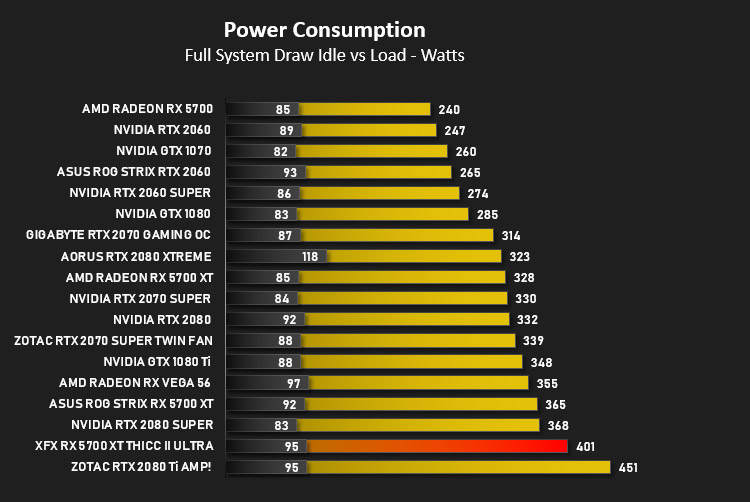
To test for power consumption, we take a measurement from the plug socket. It is important to note that the figures below represent total system power use and not just the GPU. The CPU was always in a fixed state (4GHz overclock) so did not affect the additional power load when the GPU was placed under 100% load using Heaven 4.0 which was ran for 20 minutes at which point a load reading was taken. Idle readings were taken 5 minutes after system boot to ensure any background services and applications had loaded.
TEMPERATURE
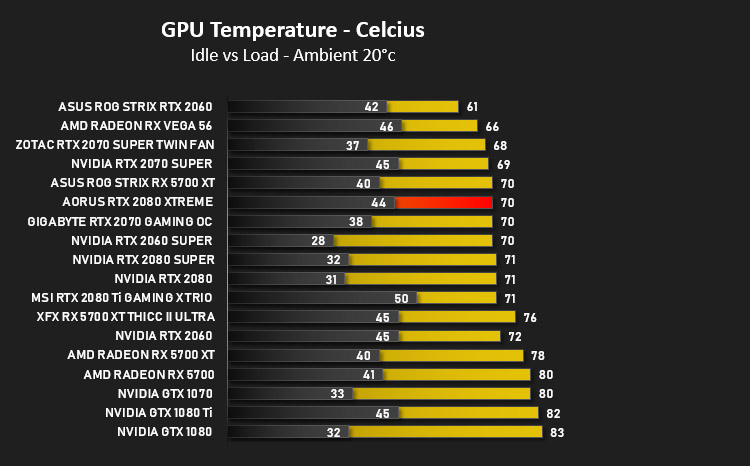
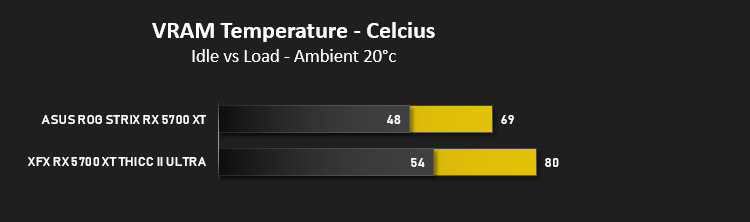
To test temperatures we measured idle temperatures after booting windows, letting all applications finish loading and ran a few benchmarks. Once the benchmarks were complete we left the card to reach a cooling plateau where we then took the idle temperatures. For the load tests we set Heaven 4.0 running continuously for ~30 minutes recorded the peak/maximum GPU temperature.With the 5700 XT we’ve also begun reporting on the max. VRAM temperature throughout this stress tests, the result is below.
ACOUSTICS
Even on performance mode the cooling fans on Ultra present no excess noise issues. Noise transmission is noticeable but not disruptive.DX12: 3DMark Time Spy
Download your copy nowWith its pure DirectX 12 engine, which supports new API features like asynchronous compute, explicit multi-adapter, and multi-threading, 3DMark Time Spy is the ideal benchmark for testing the DirectX 12 performance of the latest graphics cards.

DX11: 3DMark FireStrike
Download your copy nowFire Strike is the new showcase DirectX 11 benchmark designed for high-performance gaming PCs. It is UL’s most ambitious and technical benchmark ever, featuring real-time graphics rendered with detail and complexity far beyond what is found in other benchmarks and games today.

DX11: Unigine Heaven 4.0
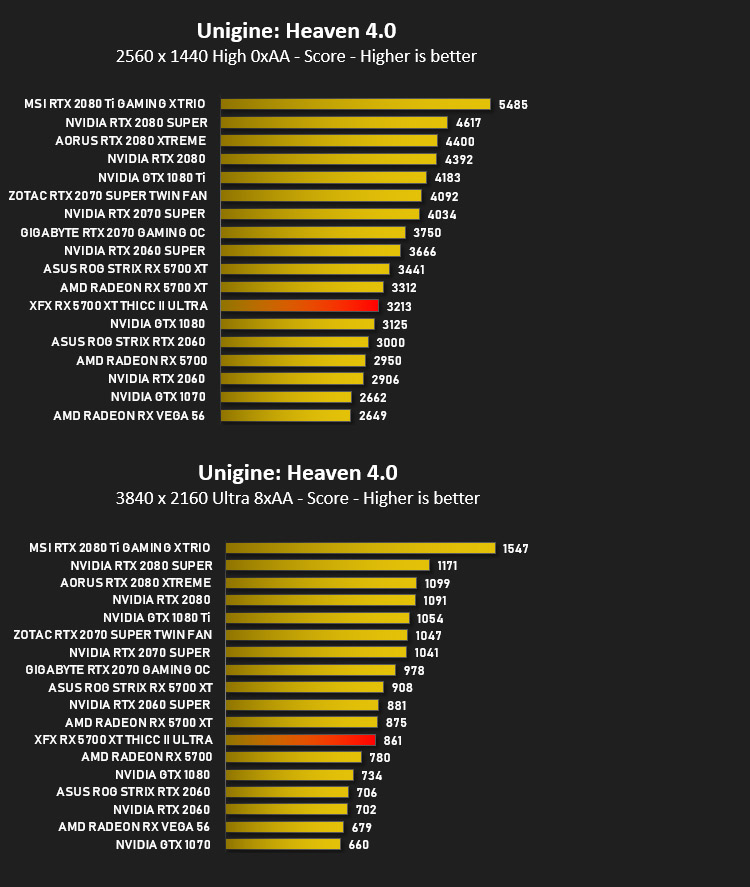
Heaven Benchmark with its current version 4.0 is a GPU-intensive benchmark that hammers graphics cards to the limits. This powerful tool can be effectively used to determine the stability of a GPU under extremely stressful conditions, as well as check the cooling system’s potential under maximum heat output. It provides completely unbiased results and generates true in-game rendering workloads across all platforms.
DX11: Unigine SuperPosition
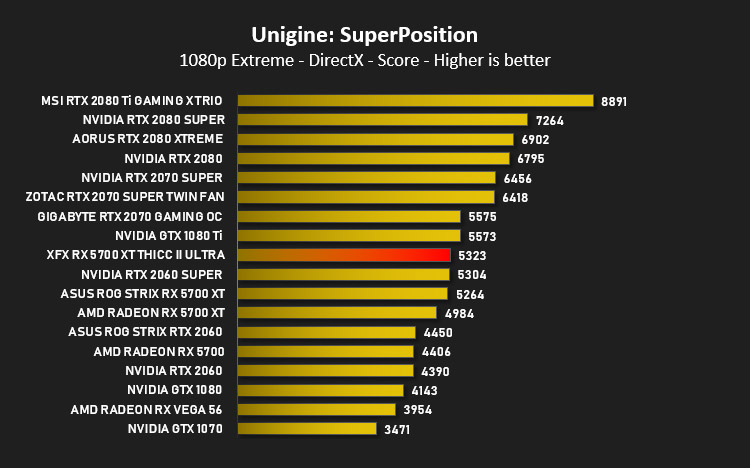
Superposition is a new-generation benchmark tailored for testing reliability and performance of the latest GPUs. Top-notch visuals, support for VR-devices and an interactive mode with mini-games — the list of features built into Superposition could go on and on.
DX11: Fortnite
Fortnite Battle Royale is the FREE 100-player PvP mode in Fortnite. One giant map. A battle bus. Fortnite building skills and destructible environments combined with intense PvP combat. The last one standing wins.


DX11: Middle Earth: Shadow of War
Middle-earth: Shadow of War is an action role-playing video game developed by Monolith Productions and published by Warner Bros. Interactive Entertainment. It is the sequel to 2014’s Middle-earth: Shadow of Mordor.


DX11: Kingdom Come: Deliverance
Kingdom Come: Deliverance is a story-driven open-world RPG that immerses you in an epic adventure in the Holy Roman Empire. Avenge your parents’ death as you battle invading forces, go on game-changing quests, and make influential choices.


DX12: Shadow of the Tomb Raider
Shadow of the Tomb Raider is an action-adventure video game developed by Eidos Montréal in conjunction with Crystal Dynamics and published by Square Enix. It continues the narrative from the 2013 game Tomb Raider and its sequel Rise of the Tomb Raider, and is the twelfth mainline entry in the Tomb Raider series.


DX11: F1 2018
F1 2018 is a racing video game and the tenth instalment in the Formula One video game franchise developed and published by Codemasters. The game is based on the 2018 Formula One World Championship and includes all twenty-one circuits from the calendar and all twenty drivers and ten teams competing in the season.


Overall Performance
Here we take a look at the overall performance of the graphics card. This figure is determined by finding the average FPS across all of the settings used in a particular benchmark(game) to give us an overall value.

Value For Money
We make a simple calculation for this set of results. For each game we add all of the resulting FPS totals together and then divide by the four sets to give us an overall performance figure. While the figures alone do not give you an accurate picture of how the card will perform in any given scenario, they do tell you, when averaged, which GPU is the more capable across all of the benchmarks and settings tested.
Please note: we’ve used GBP for currency but since this is relative – regardless of which currency you use, this will give you a good indication of value for money.

Overclocking
To overclock the 5700 XT we used ASUS Tweak II software.
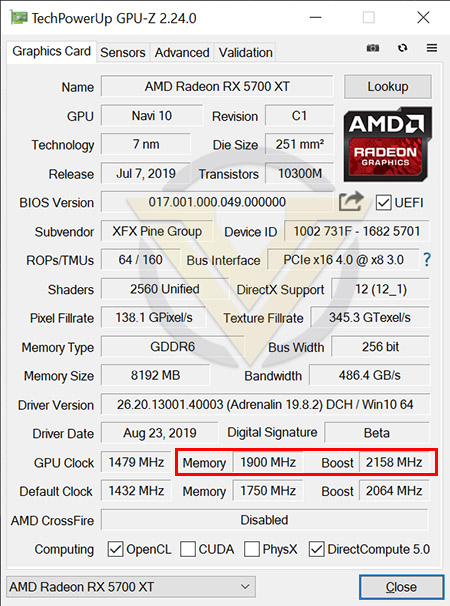
This card already has a factory overclock applied to the GPU but we’re interested to see how far we can push things – and even attempt to increase the memory values above stock.
We had some good results from this XFX card, increasing the power limit gave us the headroom to increase the GPU clock beyond our previously reviewed STRIX card. VRAM frequency was also nudged up to enhance performance – which is shown below!

Conclusion
XFX aren’t adverse to exotic naming systems and the arrival of THICC II only solidifies this.
Launching this week, there are two variants of the 5700 XT – THICC II and THICC II Ultra. Both graphics cards look identical in their appearance, it is underneath where the changes occur. XFX has given Ultra a beefier power delivery system and has optimised the GPU clock boost to reach higher possible averages. We recently reviewed the ROG STRIX 5700 XT and while this card boasts the highest clock speeds from any 5700 XT, Ultra still managed to comfortably compete, sometimes even bettering the STRIX solution.
The THICC II thermal solution consists of a huge double-heatsink and two 100mm cooling fans, both components work effectively to keep the GPU temperature much lower than the AMD reference design. On our video review we had feedback to include VRAM temperatures due to poor performance from XFX in the past and after sustained load we discovered the temperatures would reach the low 80s.
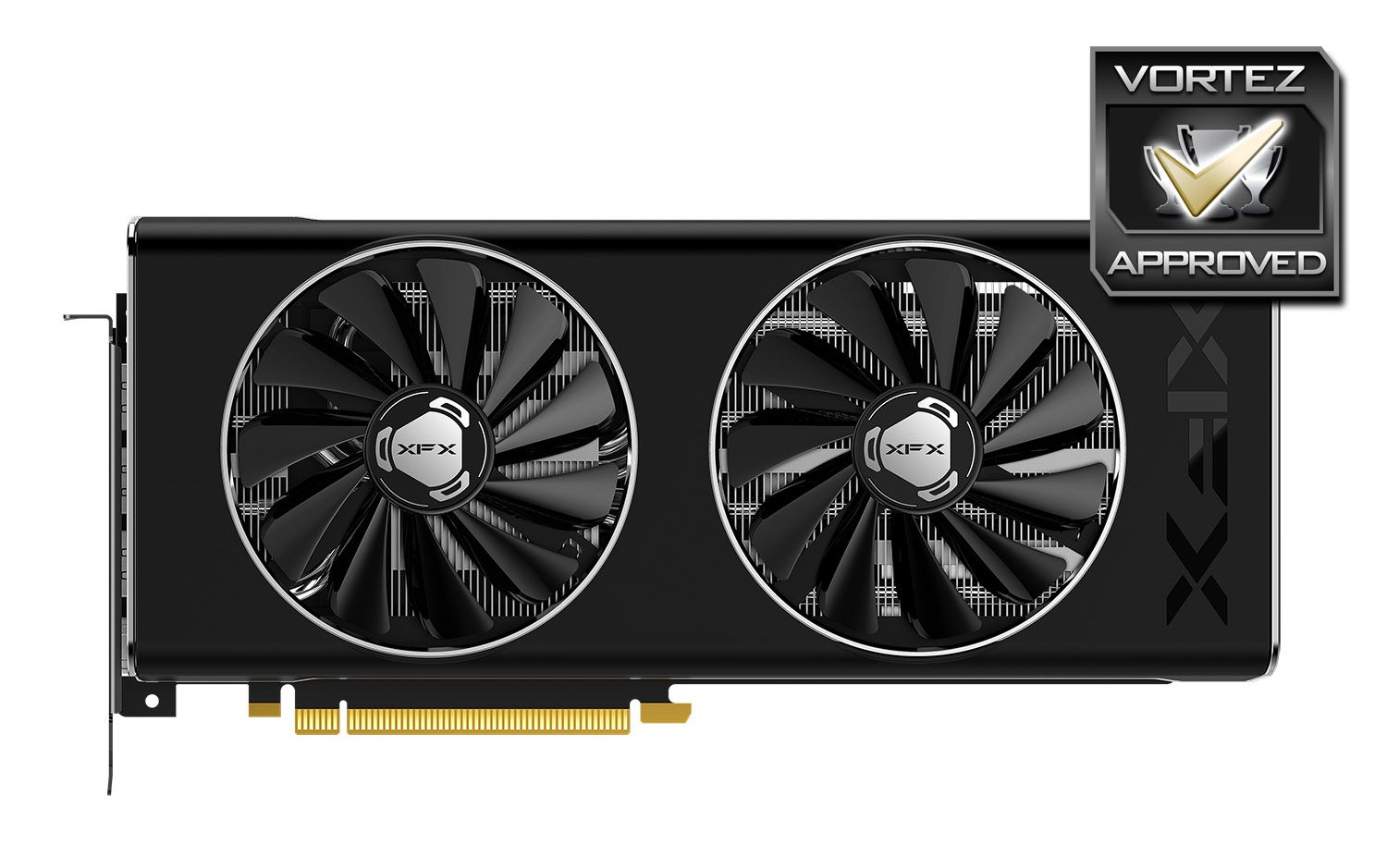
THICC II may not have all the bells and whistles that some graphics cards offer but for those wanting to simply tap into great 1440 performance, its great card to pick up.
Size is an obvious attribute which will need to be considered when upgrading to THICC II as it could struggle to slot into some computer cases.
XFX has priced THICC II Ultra at $440 USD – £420 GBP. We believe this represents good value for an aftermarket solution for 5700 XT and one which provides a reasonable factory overclock and backed by a 3 year warranty.
The THICC II Ultra is big in size and big on performance.
Pros
+ Unique, eye-catching design
+ Includes protective backplate
+ Features dual-BIOS
+ Idle fan stop technology
+ Decent thermal performance
+ Features a factory overclock
+ Overclocks reasonably well
Cons
– Big and bulky
– High power consumption
+ Unique, eye-catching design
+ Includes protective backplate
+ Features dual-BIOS
+ Idle fan stop technology
+ Decent thermal performance
+ Features a factory overclock
+ Overclocks reasonably well
Cons
– Big and bulky
– High power consumption
Click here for an explanation of our awards at Vortez.net.
Stay connected with the Vortez Social Media pages:
Join in with the discussions on Discord