AMD’s 3rd Gen Ryzen Threadripper is finally here and today we take a look at the new 3960X processor which carries an astounding feature-set including 24 cores and 48 threads.

Product on Review: Ryzen Threadripper 3960X
Manufacturer: AMD
Street Price: $1399 USD / $2249 AUD
It’s been nothing short of an astonishing year for AMD. The early promise of their Zen 2 CPU architecture materialised into a cracking 3rd Generation Ryzen platform for mainstream consumers, and today that lineup has been finalised with the release of the Ryzen R9 3950X. But can Zen 2 blow away the High End Desktop market in the same way? Let’s find out as we discuss the third generation of Ryzen Threadripper, a lineup that launches with two high-performance chips a cut above even the 3950X.
Third Generation Threadripper is based the Zen 2 architecture found in both EPYC ROME enterprise CPUs and desktop Ryzen chips. It’s a significant departure from the Zen+ architecture of Threadripper 2000-series CPUs, and is manufactured in a chiplet fashion utilising 7nm lithography. This allows them to cram in even more active cores running at higher operating frequencies than equivalent Zen+ models, pushing the bounds of performance outwards yet again.
The latest Threadripper, like many HEDT designs, is based on the manufacturer’s top of the range workstation/server models, in this case EPYC Rome. It’s not identical however; the requirements of these distinct markets dictate different priorities. It would nonetheless be misleading to call it a compromise; doing so would erroneously undermine a stable of products that are on-paper world breaters.
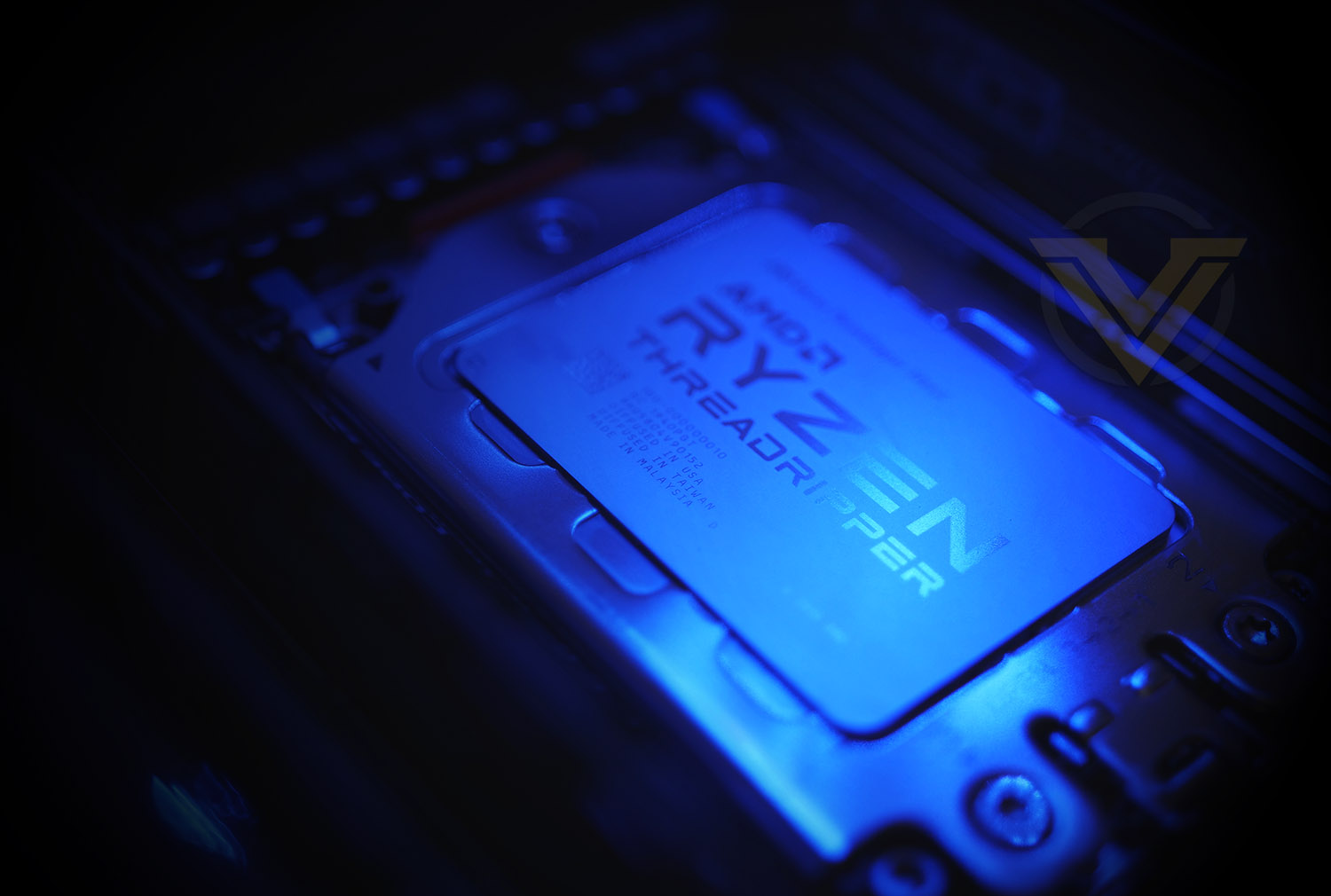
AMD’s Threadripper 3000-series is debuting with two models: the entry-level Threadripper 3960X and launch flagship 3970X. The occupy a performance space above even the blisteringly fast mainstream flagship 3950X, offering up to 32-core and 64-threads clocked at 4.5GHz, a level not even the accomplished Threadripper 2000-series could reach.
Introduced alongside these raw performance improvements is an upgrade to the PCIe I/O, which now supports the PCIe 4.0 standard. That’s another arrow in its quiver that the competition can’t presently match.
Unlike many instances in the past AMD are not undercutting on pricing. Starting at $1399 and reaching $1999, they’re priced to be enthusiast parts in every aspect; those who would typically opt for a <$1000 entry-level HEDT CPU are urged to look more closely at the 3950X.
Those seeking to close the affordability gap by opting for an aging X399 motherboard will be disappointed. Next-generation Threadripper and its motherboard chipset are not backwards compatible with the previous generation, unlike mainstream Ryzen/AM4, hence the launch of TRX40 motherboards alongside these CPUs.
The price, performance and capability differential from the 3950X necessitates products that will plug the gap, and for the time being that will be legacy Threadripper 2000-series CPUs. These highly recommended CPUs will come under fresh pressure from Intel’s Cascade Lake-X lineup, which significantly revises per-core pricing in light of AMD launch.
Superficially, the Treadripper 3000-series CPUs square up against Intel’s 10th Generation ‘Cascade Lake-X’ HEDT CPU’s. However Intel’s Cascade Lake-X platform has a marked ceiling of $1000 for the 18 cores/36 Thread Core i9-10980XE, putting it in a very different price category. Intel’s Cascade Lake -SP (Scalable Architecture) design offers up to 28 cores, but is a Xeon rather than consumer product and isn’t as widely available as a classically HEDT platform.
In many respects AMD have an open track in front of them, all they need to do is prove clearly superior performance to justify their premium price. That’s certainly no mean feat, but they days of having to jockey for position in the segment against a dominant Intel offering equivalent products are behind them – at least until Intel catch up.
AMD on Threadripper 3rd Gen.
AMD’s high-performance x86 Core “Zen 2” architecture enables 3rd Gen Ryzen™ Processors like the AMD Ryzen™ 9 3900X to deliver the highest single-thread and multi-thread performance of any mainstream desktop processor.1 For gamers and creators alike, that’s mission-critical performance built to help you win.
Tech. Specifications
Ryzen Threadripper 3960X
Architecture:- Zen 2
Lithography:- 7nm (TSMC) & 14nm (GloFo)
Socket:- sTRX4
Cores:- 24
Threads:- 48
Base Clock:- 3.8 GHz
Boost Clock:- 4.5GHz
Memory Support::- DDR4-3200, Quad Channel, 256GB Per Channel
Cache (L1 + L2 + L3):- 140MB
Core Configuration: 4 CCDs, 6 Cores per CCD
PCIe 4.0 Lanes:- 72
TDP:- 280W:
Lithography:- 7nm (TSMC) & 14nm (GloFo)
Socket:- sTRX4
Cores:- 24
Threads:- 48
Base Clock:- 3.8 GHz
Boost Clock:- 4.5GHz
Memory Support::- DDR4-3200, Quad Channel, 256GB Per Channel
Cache (L1 + L2 + L3):- 140MB
Core Configuration: 4 CCDs, 6 Cores per CCD
PCIe 4.0 Lanes:- 72
TDP:- 280W:
Ryzen Threadripper 3970X
Architecture:- Zen 2
Lithography:- 7nm (TSMC) & 14nm (GloFo)
Socket:- sTRX4
Cores:- 32
Threads:- 64
Base Clock:- 3.7 GHz
Boost Clock:- 4.5 GHz
Memory Support::- DDR4-3200, Quad Channel, 256GB Per Channel
Cache (L1 + L2 + L3):- 144MB
Core Configuration: 4 CCDs, 8 Cores per CCD
PCIe 4.0 Lanes:- 72
TDP:- 280W
Lithography:- 7nm (TSMC) & 14nm (GloFo)
Socket:- sTRX4
Cores:- 32
Threads:- 64
Base Clock:- 3.7 GHz
Boost Clock:- 4.5 GHz
Memory Support::- DDR4-3200, Quad Channel, 256GB Per Channel
Cache (L1 + L2 + L3):- 144MB
Core Configuration: 4 CCDs, 8 Cores per CCD
PCIe 4.0 Lanes:- 72
TDP:- 280W
Features
Third Generation Threadripper a middle-ground between 3rd Gen Ryzen and EPYC server-class chips: while still based on Zen 2 microarchitecture with the 8-core 7nm Core Complex Die as a key component, it incorporates a revised 14nm IO Die that reflects the requirements of the niche HEDT market. The range is launching with the 24-core Threadripper 3960X and 32-Core Threadripper 3970X that have the following unifying aspects to their design.
CPU SPECIFICATION
On a physical level, these CPUs incorporates four CCDs and an IOD onto a single substrate, offering up to 32-cores with Simultaneous Multithreading support. Thats a substantial change from Zen+, where each die on the CPU was in effect a fully working CPU that was working in tandem with up to three others to make up a processor that supported as many as 32 cores (or as few as .
.The specifications show the same increase in base and boost clocks that 3rd Generation Ryzen enjoyed, thanks in part to the 7nm lithography and new design. Both SKUs have high base and boost operating frequencies compared to their 2nd Gen counterparts, now reaching up to 4.5GHz, but multi-core load performance will be dictated by the boosting algorithm and cooling solution.
Augmenting the higher clocks is an expected improvement in IPC, which would mean that all-round performance compared to the last-generation 2990WRX will be higher. AMD estimate an approx. 30% improvement in 3970X vs 2990WX based on these parameters.
IPC improvements are in part due to the huge Cache increase in Zen 2. The amount of L3 Cache to has doubled to 128GB (compared to 64GB on the 32-core 2990 WRX), increasing hit rate and reducing how often slower memory accesses are required.
At an architectural level, substantial changes have been made in CPU front and back-end which may particularly impact workhorse compute tasks often expected of a pseudo-workstation HEDT platform. As we oulined in our Ryzen launch reviews, significant changes have been made to the L1 and L2 cache structures alongside the huge increase to the L3 cache size.
As with virtually every other Ryzen CPU these Threadripper are overclockable. A couple of words caution however: Ryzen CPUs already appear to be operating with little practical headway for overclocking (the Boosting algorithm generally performing an acceptable roll in reaching the CPUs potential), and as a 280W TDP part cooling for even modest overclocks will likely need to be exceptional.
Memory and Infinity Fabric overclocking may be good stand-ins for enthusiast overclockers looking to make the most of their benchmarking software. As with 3rd Gen Ryzen, Threadripper motherboards should offer infinity fabric frequency support decoupled from memory frequency in an optional 2:1 ratio.
SOCKET
For the first time in three years a new AMD CPU in being introduced alongside a new socket – sTRX4. AMD have stated that this socket specification is not backwards compatible with sTR4/X399 motherboards, and have explained that new features – particularly PCIe 4.0 signaling and platform scalability – made cross-support with the previous generation impractical. Those who recently bought X399 motherboards hoping for forwards compatibility will be kicking themselves.The rather novel slot-loading CPU installation makes a return from the previous HEDT range, and that lack of thousands of pins on the underside will mean it’s quite durable all things considered. Early adopter issues with that socket design should now be well and truly solved.
Users will not be lumbered with the spotty cooler support enjoyed by 1st Gen Threadripper when it launched a few years ago. An identical CPU footprint and cooler mounting point layout means that older sTR4 coolers are fully compatible, but need to be rated at up to 280W. Coolers certified for the top-end 2nd Generation Threadrippers should be acceptable for the 3rd Generation.
MEMORY & I/O
Memory and I/O signalling is routed through the IOD, which now needs to handle quad-channel memory at DDR4-3200MHz, up from DDR4-2933MHz on 2nd Generation Threadripper. Memory is overclockable, but the more robust Zen 2 memory controller (in addition to the decoupled infinity fabric clock) should mean higher achievable frequencies. Quite the boon for more memory-intensive applications common to HEDT workloads.While memory improvements could be viewed as only incremental, PCIe 4.0 is a major advanced. Still and AMD exclusive technology for the time being, it offers double the bandwidth compared to PCIe 3.0 for faster storage and graphics bandwidth capabilities on the HEDT platform.
The number of PCIe lanes available has also increased, from 64 to 72. More of these lanes are dedicated to Chipset communication (the GMI link in AMD parlance) than previously, boosting bandwidth 4x over the previous generation, and the chipset will offer downstream PCIe 4.0 depending on system configuration.
Motherboard loadouts will determine the use of the PCIe 4.0 lanes. By default 48 are apportioned to expansion slots and 8 to the chipset, but beyond that it could be utilised by NVMe, SATA or general PCIe peripheral use.
Last by not least, 3rd Gen. Threadripper supports up to 1TB of DDR4 RAM, 256GB per channel. This will require eight fully populated DIMM slots but not all TRX40 motherboards will necessarily be fitted with this many.
Test Setup & Testing
CPU being tested
Ryzen Threadripper 3960X (24-core, 48-thread)TEST SETUP
Cooling Noctua NH-U14S TR4-SP3Motherboard MSI TRX40 Creator
Memory 32GB Corsair Vengeance LPX 3000MHz
Graphics Radeon RX 480 8GB
Storage Kingston HyperX 240GB
PSU Corsair RMx 1000 80 Plus Gold Certified PSU
Monitor AOC U2879VF
Capture Device AVermedia Live Gamer Ultra
COMPARED AGAINST
AMD Ryzen 5 1400 (3.2GHz) Summit RidgeAMD Ryzen 3 2200G (3.5/3.7GHz) Raven Ridge
AMD Ryzen 5 2400G (3.6GHz/3.9GHz) Raven Ridge
AMD Ryzen 3 1200 (3.1/3.4GHz) Summit Ridge
AMD Ryzen 3 1300X (3.4/3.7GHz) Summit Ridge
AMD Ryzen 5 1400 (3.2GHz) Summit Ridge
AMD Ryzen 5 1600 (3.2GHz) Summit Ridge
AMD Ryzen 7 1700 (3.0GHz) Summit Ridge
AMD Ryzen 7 1700X (3.4GHz) Summit Ridge
AMD Ryzen 7 1800X 3.6GHz) Summit Ridge
AMD FX-8350 (4.0GHz) PileDriver
Intel Core i9-9900K (4.5GHz) Coffee Lake-S
Intel Core i7-8700K (4.5GHz) Coffee Lake
Intel Core i7-7900X (3.3GHz) Skylake-X
Intel Core i7-7800X (3.5GHz) Skylake-X
Intel Core i5-7700K (4.2GHz) Kaby Lake
Intel Core i7-6950X (3.0GHz) Broadwell-E
Intel Core 7-6900K (3.2GHz) Broadwell-E
BENCHMARKS
Cinebench R15 – CPU/OpenGL Scorex264 HD 4.0 – 1st and 2nd pass encoding
SiSoftware SANDRA – CPU & Memory benchmarks
POV-RAY – CPU benchmarks
TrueCrypt – CPU benchmarks
AIDA64 – CPU benchmarks & Memory
PCMark 8 – Home Suite & Photoshop
3DMark FireStrike – 3D Benchmark
Games – Rise of the Tomb Raider & Total War: WARHAMMER
OTHER SOFTWARE
Temperature Analysis: RealTempStress Testing Software: AIDA64 Stability Test
CPU Specification Monitoring: CPU-Z
Performance Monitoring: MSI Afterburner
Notes: AMD Threadripper uses an SP3 specific air cooler due to the large surface area specification. Newer benchmarks have been added and we are no longer in possession of some previously reviewed CPUs, hence their absence from results.
Temperatures
Below are the temperatures for each of the CPUs – without any overclock applied. We’ve also compared to previously released AMD Ryzen chips as well as the former Kaby Lake, Broadwell-E and Skylake counterparts (which we’ve also benchmarked against on the subsequent pages too):
Power Consumption
It’s interesting to note the power consumption across all processors. Although they are using a combination of different motherboard chipsets, energy results can fluctuate between manufacturers due to the features and specifications that are integrated. First of all, for the idle tests the system is cold booted into Windows and no additional applications are executed – the watts are noted on the external energy monitor we use and then the system is loaded with 3DMark FireStrike – watts are again monitored for the duration of the test and the highest rated wattage result is then noted down. Below are the results of this energy test.
Ray Tracing Performance – POV-Ray 3.7
Persistence of Vision Raytracer’s PovRay is a free and open source 3D animator application with versions for computers with different operating systems.
This product allows users to build their custom 3D worlds with excellent quality despite their computer’s hardware. It has adjustable options for levels of radiance, refraction, and reflection. Calculation time may vary depending on the computer model, but PovRay can adapt to many computer builds, and is supported by the open source community.
This product allows users to build their custom 3D worlds with excellent quality despite their computer’s hardware. It has adjustable options for levels of radiance, refraction, and reflection. Calculation time may vary depending on the computer model, but PovRay can adapt to many computer builds, and is supported by the open source community.
AES Encryption Performance – TrueCrypt 7.1a
TrueCrypt is a discontinued source-available freeware utility used for on-the-fly encryption (OTFE). It can create a virtual encrypted disk within a file or encrypt a partition or (under Microsoft Windows except Windows 8 with GPT) the entire storage device (pre-boot authentication).
Encoding Performance – X264 HD
Simply put, this test measures how fast your machine can encode a short, DVD quality MPEG-2 video clip into a high-quality x264 video clip. What’s x264, you ask? It’s more or less the next-generation Xvid/DivX codec. I think it’s ideal for a benchmark because the application (x264.exe) reports fairly accurate compression results (in frames per second) for each pass of the video encoding process, and it uses multi-core processors very efficiently.
x264 HD gives results for 2 passes when compressing an MPEG-2 clip into x264. It presents 4 separate results for each pass giving a total of 8 – all results are given in FPS. For each pass I have averaged out the results.
Processing Features Performance – AIDA64
AIDA64 Product PageThis simple integer benchmark focuses on the branch prediction capabilities and the misprediction penalties of the CPU. It finds the solutions for the classic “Queens problem” on a 10 by 10 sized chessboard. At the same clock speed theoretically the processor with the shorter pipeline and smaller misprediction penalties will attain higher benchmark scores. For example — with HyperThreading disabled — the Intel Northwood core processors get higher scores than the Intel Prescott core based ones due to the 20-step vs 31-step long pipeline. CPU Queen test uses integer MMX, SSE2 and SSSE3 optimizations.
Memory Transfer Performance – AIDA64
AIDA64 Product Page
This simple integer benchmark focuses on the branch prediction capabilities and the misprediction penalties of the CPU. It finds the solutions for the classic “Queens problem” on a 10 by 10 sized chessboard. At the same clock speed theoretically the processor with the shorter pipeline and smaller misprediction penalties will attain higher benchmark scores. For example — with HyperThreading disabled — the Intel Northwood core processors get higher scores than the Intel Prescott core based ones due to the 20-step vs 31-step long pipeline. CPU Queen test uses integer MMX, SSE2 and SSSE3 optimizations.
Processing Power Performance – Cinebench R15
CINEBENCH can measure systems with up to 64 processor threads. This test scene contains approximately 2,000 objects which in turn contain more than 300,000 polygons in total, and uses sharp and blurred reflections, area lights, shadows, procedural shaders, antialiasing, and much more. The result is displayed in points (pts). The higher the number, the faster your processor.
Processing Power Performance – Cinebench R20
Cinebench is a real-world cross-platform test suite that evaluates your computer’s hardware capabilities. Improvements to Cinebench Release 20 reflect the overall advancements to CPU and rendering technology in recent years, providing a more accurate measurement of Cinema 4D’s ability to take advantage of multiple CPU cores and modern processor features available to the average user. Best of all: It’s free.Bandwidth Performance – SiSoftware SANDRA
3DMark 11 Product Page
SANDRA isn’t always a benchmark that is included in hardware reviews but I believe it shouldn’t be ignored. SANDRA provides a vigorous package that tests your system in a rather large array of benchmarks. There are many aspects of benchmark that can be executed. We will be considering – CPU and memory tests.
Image Editing Performance – PCMark 8 Photoshop
PCMark 8 Product Page
Developed in partnership with Benchmark Development Program members Acer, AMD, Condusiv Technologies, Dell, HGST, HP, Intel, Microsoft, NVIDIA, Samsung, SanDisk, Seagate and Western Digital, PCMark 8 is the latest version in FutureMark’s popular series of PC benchmarking tools. Improving on previous releases, PCMark 8 includes new tests using popular applications from Adobe and Microsoft.
Overall System Performance – PCMark 10
PCMark 10 Product Page
PCMark 10 features a comprehensive set of tests that cover the wide variety of tasks performed in the modern workplace. With a range of performance tests, custom run options, and the new Battery Life Profile, PCMark 10 is the complete PC benchmark for the modern office.
VR Performance – VRMark
VRMark Product PageVRMark includes two VR benchmark tests that run on your monitor, no headset required, or on a connected HMD. At the end of each test, you’ll see whether your PC is VR ready, and if not, how far it falls short.
3D Performance – 3DMARK FireStrike
3DMark FireStrike Product PageFire Strike is our new showcase DirectX 11 benchmark designed for high-performance gaming PCs. It is our most ambitious and technical benchmark ever, featuring real-time graphics rendered with detail and complexity far beyond what is found in other benchmarks and games today. Fire Strike will only be available in the Windows editions of 3DMark initially.
Gaming Performance – Tomb Raider & Total War: WARHAMMER
It’s important for us to perform a number of game benchmarks as well as the synthetic tests because gamers will want to know if there are any significant benefits. So here we have two recent gaming titles benchmarked with a Radeon RX 480 installed.
Conclusion
Now in its third generation, the Ryzen Threadripper assignment has matured to take full grasp of the HEDT platform and it’s now Intel who seem to be playing catchup!
In some instances the performance results aren’t that dissimilar to the previous generation and certainly when single thread tests scenarios are in play 3960X blends in with lower spec counterparts. However, when multithread is under consideration there are significant advantages to be had. Tasks which demand an intense workflow tips the balance in favour of our new HEDT CPU.
Having 24-cores clearly offers little, to no advantage in the gaming arena – this CPU is designed for content creators rather than gaming advocates, the platform, with its specification and price-tag should be an obvious indicator of this.
Due to the physical size of the Threadripper CPU, a TR4 specific heatsink/cooler is necessary. The supply of such a thermal solution is still few and far between. Most all-in-one liquid coolers accommodate mainstream processors but there are some exceptions – be sure to factor this in with any new TRX40/Threadripper Gen.3 build.
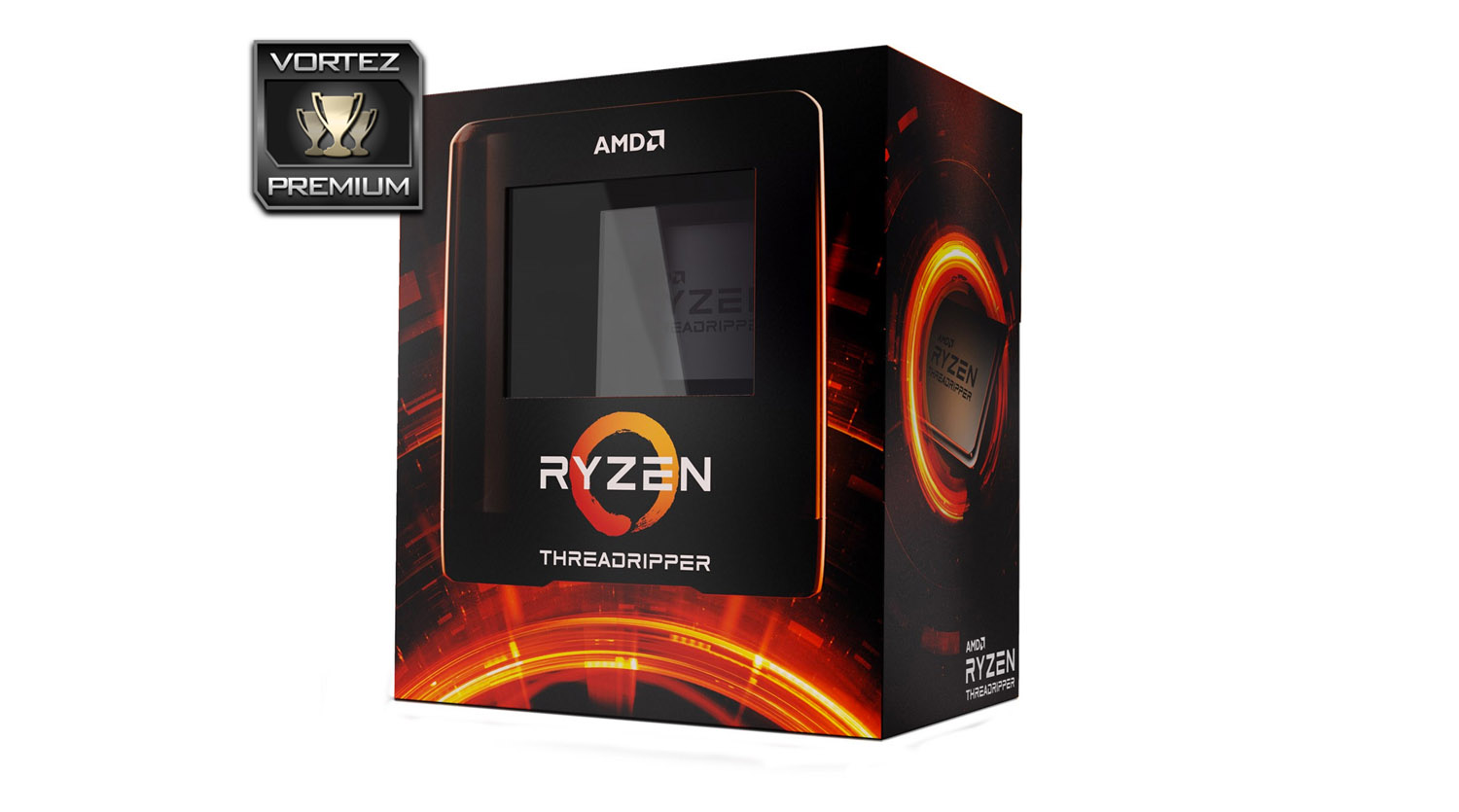
Another factor which should be taken into account is the power consumption, which is remarkably high compared to other models and platforms. A reputable power supply will be vital in supplying the system with good power delivery.
Ryzen Threadripper Gen. 3 will be ideal for true enthusiasts who are yet to experience the HEDT platform. It may also be relevant for users who have a system based around the first generation and require more horsepower for demanding workflows, core and thread count, along with decent clock speed with all play an important role in streamlining such tasks.
Unlike Intel’s 10th Gen launch today which use refreshed X299 boards, AMD’s new processors require a new motherboard chipset which introduces new technology and standards such as PCIe 4.0 and USB 20G to name just a few. This will be music to the ears of content creators who will have innovative features at their finger-tips.
Enthusiasts and avid content creators will salivate at the performance on offer by AMD’s latest Ryzen Threadripper Gen. 3. More cores, more threads, higher clock speeds and a wealth of creative new features!
Pros
+ Exciting unboxing experience
+ Excellent for intense workflows
+ Impressive specifications
+ Significant improvements made since 1st Gen.
+ Requires new, feature-rich motherboards
Cons
– TR4 specific coolers required
– Big on power consumption
– No longer a value option over Intel’s HEDT
+ Exciting unboxing experience
+ Excellent for intense workflows
+ Impressive specifications
+ Significant improvements made since 1st Gen.
+ Requires new, feature-rich motherboards
Cons
– TR4 specific coolers required
– Big on power consumption
– No longer a value option over Intel’s HEDT
Click here for an explanation of our awards at Vortez.net.
Stay connected with the Vortez Social Media pages:
Join in with the discussions on Discord