Intel’s 10th Gen Core-X Series arrives in the form of the Core i9-10980XE. Can this Extreme Edition CPU aka Cascade Lake-X take the fight to AMD’s Ryzen Threadripper in the HEDT division?

Product on Review: Core i9-10980XE Extreme Edition
Manufacturer Intel
Street Price: $989 USD
Competition in the High End Desktop market is heating up just as winter arrives, and Intel are staking their own claim for market recognition with an update to their already comprehensive range of HEDT CPUs. Launching as part of the 10th Generation Core X series (a delineation describing relative performance rather than technological advancement), the Cascade Lake-X series offers up to 18 cores and 36 threads for workloads that warrant more horsepower than even the 5GHz Core i9-9900KS can provide.
Cascade Lake-X is an optimisation of Intel’s Skylake-X architecture, modified for next-gen workloads and additional scaling in enterprise system configurations. Enthusiast HEDT systems retain the LGA 2066 socket of Skylake-X, and reserve some backwards compatibility for older X299 motherboards (with appropriate UEFI BIOS updates). Those who wish to fully unleash the capabilities of Cascade Lake-X can invest in X299X motherboard variants, part of a refreshed lineup that add features important to Intel’s long-term product strategy such as WiFi 6 support.
While Cascade Lake-X incorporates some Intel-exclusive features such as native AVX-512 and Optane memory support, a key factor in the platform update is a comprehensive repositioning of per core pricing. It’s no exaggeration to say that Intel have halved their price per core in the space of a generation, making their Core-X lineup extremely attractive compared to just one year ago.
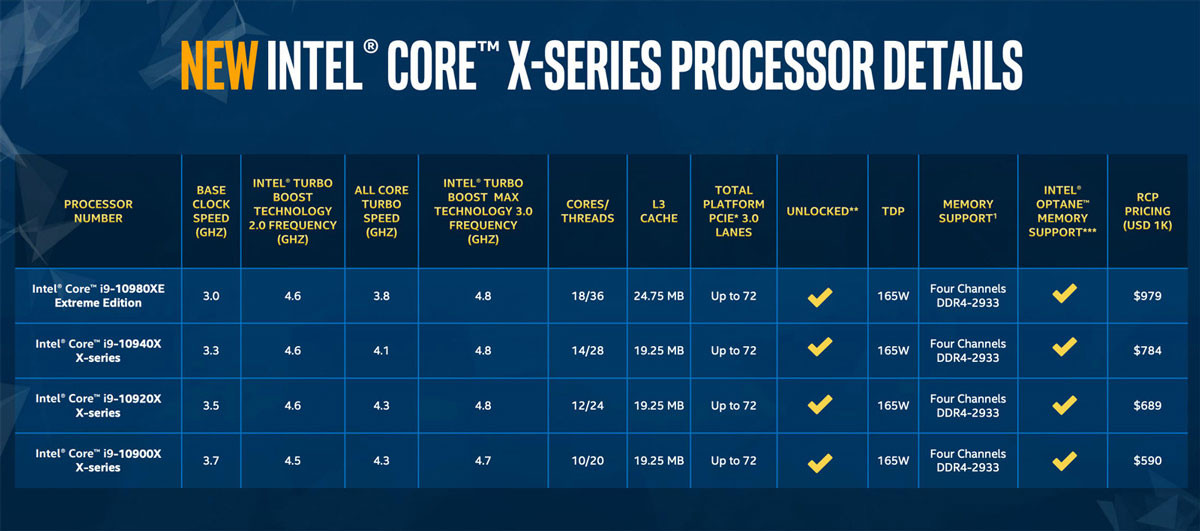
We’re lucky to be reviewing the flagship Core i9-10980XE Extreme Edition, the full-fat 18-core, 36-thread CPU which in the 9th generation would have set you back almost $2000. Its monolithic core boasts a 24.75MB Smartcache, 72* PCIe 3.0 lanes , 4.8GHz Max Turbo clock and quad-channel memory support. It is, by any metric, a brute of a CPU designed to crunch through heavy workloads without complaints.
The Core i9-10980XE Extreme Edition is priced aggressively at $979, while the 10-core/20 thread entry-level Core i9-10900X comes in at $590. Throughout the four CPU range you get more for your buck than any previous Intel HEDT lineup and also miss out on the considerable bloat which had afflicted the series in previous years.
Intel haven’t resisted also adding a few performance tweaks here and there. The Boost Clock has now been increased in every tier, notably up to 4.8 GHz at the 18-core top end (300MHz higher) while the TDP has remained with a 165W envelope. At the socket power draw is still the defining metric, but indications are that Intel have been successful in squeezing yet higher frequencies using the aging (though many times optimised) 14nm manufacturing process, without compromising power efficiency beyond acceptable limits

As far as target market goes, Core X remains the platform the blue team want enthusiasts and prosumers to invest in. Rendering, and particularly streaming, are key use cases which Intel can exploit, heavily backed up by their far reaching exposure in gaming and reputation for overall system stability and compatibility. It’s that confluence of gaming and workhorse application usage that Intel’s designs are most suited too.
For all the strides Intel have made to make their consumer desktop lineup more compelling, the competition Intel faces from AMD is impossible to disregard. Up-to 16 cores are available on the mainstream Ryzen platform at ~$750, and 2nd Generation Threadripper awaits significant price realignment in the wake of their 3rd generation’s release. It may be something of a relief that 3rd Gen. Threadripper is priced at a far greater premium (from $1399), steering well clear of current 10th Gen Core X models.
So the question now becomes: can Intel leverage their monolithic high-core-count architecture and aligned technology lead to prevail against AMD’s cunning chiplet design and exclusive features? And just as importantly, can they set up a compelling case against their own mighty gaming flagship, the Core i9-9900K 5GHz variant?
* The way Intel tallies the number of available PCI-Express lanes from the CPU has changed over the years, but now appears to be identical to AMD’s measure. Under this same measure, 72 lanes is 4 more than was available to comparable Skylake-X CPUs.
Technical Specifications
CPU SKU:- Core i9-10980XE Extreme Edition
Lithography:- 14 nm
Socket:- LGA 2066
Cores:- 18
Threads:- 36
Base Frequency:- 3.0 GHz
All Core Max Turbo:- 3.8 GHz
Max Turbo Frequency:- 4.6 GHz
Intel Turbo Boost Max Technology 3.0 Frequency:- 4.8 GHz
PCIe 3.0 Lanes:- up to 72
SmartCache:- 1.35MB per core, 24.75MB total
Memory Capacity:- 64GB per channel, 256GB total
Memory Speed:- 2933 MHz
TDP:- 165W
Lithography:- 14 nm
Socket:- LGA 2066
Cores:- 18
Threads:- 36
Base Frequency:- 3.0 GHz
All Core Max Turbo:- 3.8 GHz
Max Turbo Frequency:- 4.6 GHz
Intel Turbo Boost Max Technology 3.0 Frequency:- 4.8 GHz
PCIe 3.0 Lanes:- up to 72
SmartCache:- 1.35MB per core, 24.75MB total
Memory Capacity:- 64GB per channel, 256GB total
Memory Speed:- 2933 MHz
TDP:- 165W
Intel 10th Generation Core-X Lineup
Features
The Core i9-10980XE is a derivative of the Skylake-X Core i9-9980XE, and as a result shares many of its hallmarks and technological capabilities. It retains the LGA2066 of the previous generation, maintaining backwards compatibility with plethora of X299 motherboards currently on the market and making it a drop-in upgrade (after BIOS update) in a large number of systems. There are nonetheless a number of tweaks to the design that could do enough to set it apart from its predecessor even if the price per core weren’t so savagely reduced.
Core Frequencies
Intel’s Core i9-10980XE continues to make use of the monolithic core/single die design that’s in stark contrast to AMD’s multiple die per CPU approach. Such an architecture has a number of trade-offs, particularly when it comes to manufacturing cost and core latency (being higher and lower respectively), and a ring bus topology when utilised on high core count CPUs make for immensely complex designs. For our purposes however these minutiae are of less importance than the consequences to performance.
Further optimisations to the 14nm manufacturing process, now deep into its fifth year as Intel’s main consumer node, have meant that slightly higher frequencies can be squeezed from the silicon under certain conditions:
The Intel Turbo Boost Max Technology 3.0 Frequency, which operates for short periods on 1-2 cores, has been increased by 300MHz to 4.8GHz.
The Max Turbo Frequency, which operates for short periods on 4-6 cores, is up from 4.5GHz to 4.6GHz.
Base frequency and All Core Turbo is unchanged from a year ago.
The Max Turbo Frequency, which operates for short periods on 4-6 cores, is up from 4.5GHz to 4.6GHz.
Base frequency and All Core Turbo is unchanged from a year ago.
As a consequence performance on lightly threaded workloads should improve slightly, while heavily threaded workloads will tend to be on a par with the i9-9980XE (all other factors notwithstanding).
It’s possible that the all-core CPU frequency is constrained by remaining within the expected 165W TDP envelope, and when coupled to quality water cooling would overclock like a champion. Time will tell on that score.
Memory
Although not changed on any fundamental level, Intel’s DDR4 memory controller has been marginally beefed up to offer better performance and stability. Intel’s HEDT platform continues to leverage quad-channel memory, but now supports a baseline of DDR4-2933 MHz. Maximum memory capacity has doubled to 64GB per channel and 256GB in total, which could have a huge impact in some critical scenarios.
Deep Learning Boost
The 10th Generation Core series is the first to support a new technology Intel are calling ‘Deep Learning Boost’. It introduces a new series of AVX-512 instructions that accelerate complex AI workloads, leveraging the int8 data structures championed by NVIDIA for a similar purpose on their massively parallel GPUs. The following is a quick primer on the subject:
Intel’s Icelake architecture integrates these instructions natively, whereas as best we can tell the 10th Gen Cascade Lake-X CPUs implements them at a driver level. Nonetheless Deep Learning Boost is a forward-looking technology that has yet to be fully leveraged by application developers, and assessing it is beyond the bounds of this review.
More information on Intel Deep Learning Boost can be found at https://www.intel.ai/intel-deep-learning-boost/
Hardware Vulnerability Mitigations
It’s fair to say that Intel has been disproportionately impacted by hardware vulnerabilities in recent years, lead by the Spectre and Meltdown speculative branch prediction vulnerabilities uncovered in 2018. Software and firmware mitigations have been implemented where possible, but hardware-level mitigations require time to develop and implement in silicon.
Cascade Lake-X integrates hardware fixes that cut off some of these attack vectors at the knees, rather than rely on microcode updates and software patches (the up-take and effectiveness of which are often spotty). However these mitigations don’t come for free, and may adversely impact performance compared to the Skylake-X parts on which they are based. Such is the price for increased security.
Test Setup & Testing
CPU being tested
Core i9-10980XE (18-core, 36-thread)TEST SETUP
Cooling Corsair Hydro Series H110iMotherboard ASRock X299 Taichi CLX
Memory 32GB Corsair Vengeance LPX 3000MHz
Graphics Radeon RX 480 8GB
Storage Kingston HyperX 240GB
PSU Corsair RMx 1000 80 Plus Gold Certified PSU
Monitor AOC U2879VF
Capture Device AVermedia Live Gamer Ultra
COMPARED AGAINST
AMD Ryzen 5 1400 (3.2GHz) Summit RidgeAMD Ryzen 3 2200G (3.5/3.7GHz) Raven Ridge
AMD Ryzen 5 2400G (3.6GHz/3.9GHz) Raven Ridge
AMD Ryzen 3 1200 (3.1/3.4GHz) Summit Ridge
AMD Ryzen 3 1300X (3.4/3.7GHz) Summit Ridge
AMD Ryzen 5 1400 (3.2GHz) Summit Ridge
AMD Ryzen 5 1600 (3.2GHz) Summit Ridge
AMD Ryzen 7 1700 (3.0GHz) Summit Ridge
AMD Ryzen 7 1700X (3.4GHz) Summit Ridge
AMD Ryzen 7 1800X 3.6GHz) Summit Ridge
AMD FX-8350 (4.0GHz) PileDriver
Intel Core i9-9900K (4.5GHz) Coffee Lake-S
Intel Core i7-8700K (4.5GHz) Coffee Lake
Intel Core i7-7900X (3.3GHz) Skylake-X
Intel Core i7-7800X (3.5GHz) Skylake-X
Intel Core i5-7700K (4.2GHz) Kaby Lake
Intel Core i7-6950X (3.0GHz) Broadwell-E
Intel Core 7-6900K (3.2GHz) Broadwell-E
BENCHMARKS
Cinebench R15 – CPU/OpenGL Scorex264 HD 4.0 – 1st and 2nd pass encoding
SiSoftware SANDRA – CPU & Memory benchmarks
POV-RAY – CPU benchmarks
TrueCrypt – CPU benchmarks
AIDA64 – CPU benchmarks & Memory
PCMark 8 – Home Suite & Photoshop
3DMark FireStrike – 3D Benchmark
Games – Rise of the Tomb Raider & Total War: WARHAMMER
OTHER SOFTWARE
Temperature Analysis: RealTempStress Testing Software: AIDA64 Stability Test
CPU Specification Monitoring: CPU-Z
Performance Monitoring: MSI Afterburner
Notes: AMD Threadripper uses an SP3 specific air cooler due to the large surface area specification. Newer benchmarks have been added and we are no longer in possession of some previously reviewed CPUs, hence their absence from results.
Temperatures
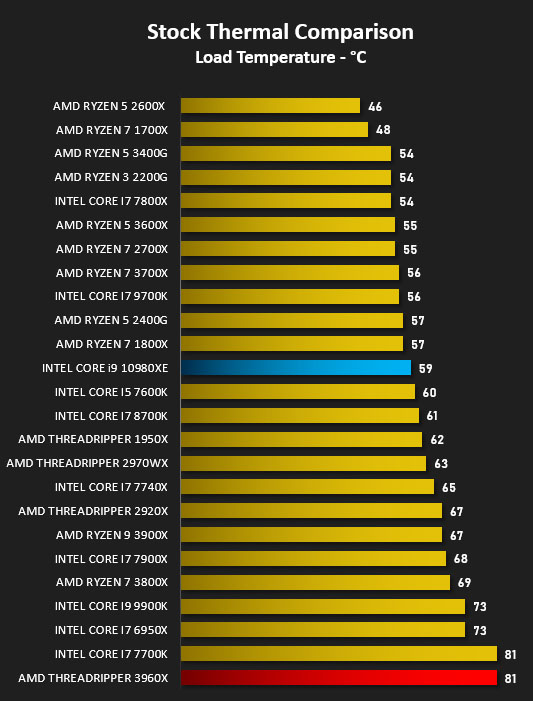
Below are the temperatures for each of the CPUs – without any overclock applied. We’ve also compared to previously released AMD and Intel counterparts for comparison, these CPUs are used in other benchmarks throughout this review.
Power Consumption
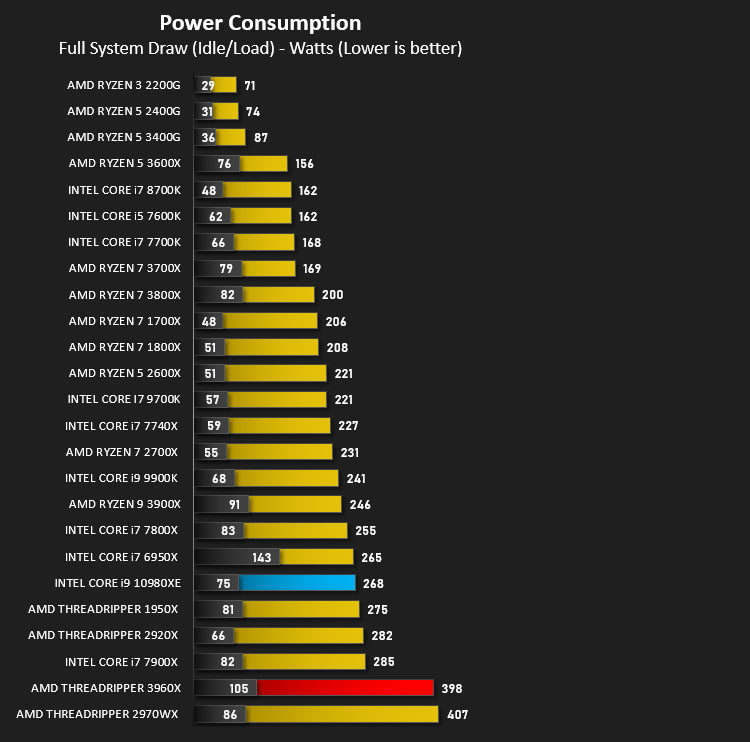
It’s interesting to note the power consumption across all processors. Although they are using a combination of different motherboard chipsets, energy results can fluctuate between manufacturers due to the features and specifications that are integrated. First of all, for the idle tests the system is cold booted into Windows and no additional applications are executed – the watts are noted on the external energy monitor we use and then the system is loaded with 3DMark FireStrike – watts are again monitored for the duration of the test and the highest rated wattage result is then noted down. Below are the results of this energy test.
Ray Tracing Performance – POV-Ray 3.7
Persistence of Vision Raytracer’s PovRay is a free and open source 3D animator application with versions for computers with different operating systems.
This product allows users to build their custom 3D worlds with excellent quality despite their computer’s hardware. It has adjustable options for levels of radiance, refraction, and reflection. Calculation time may vary depending on the computer model, but PovRay can adapt to many computer builds, and is supported by the open source community.
This product allows users to build their custom 3D worlds with excellent quality despite their computer’s hardware. It has adjustable options for levels of radiance, refraction, and reflection. Calculation time may vary depending on the computer model, but PovRay can adapt to many computer builds, and is supported by the open source community.
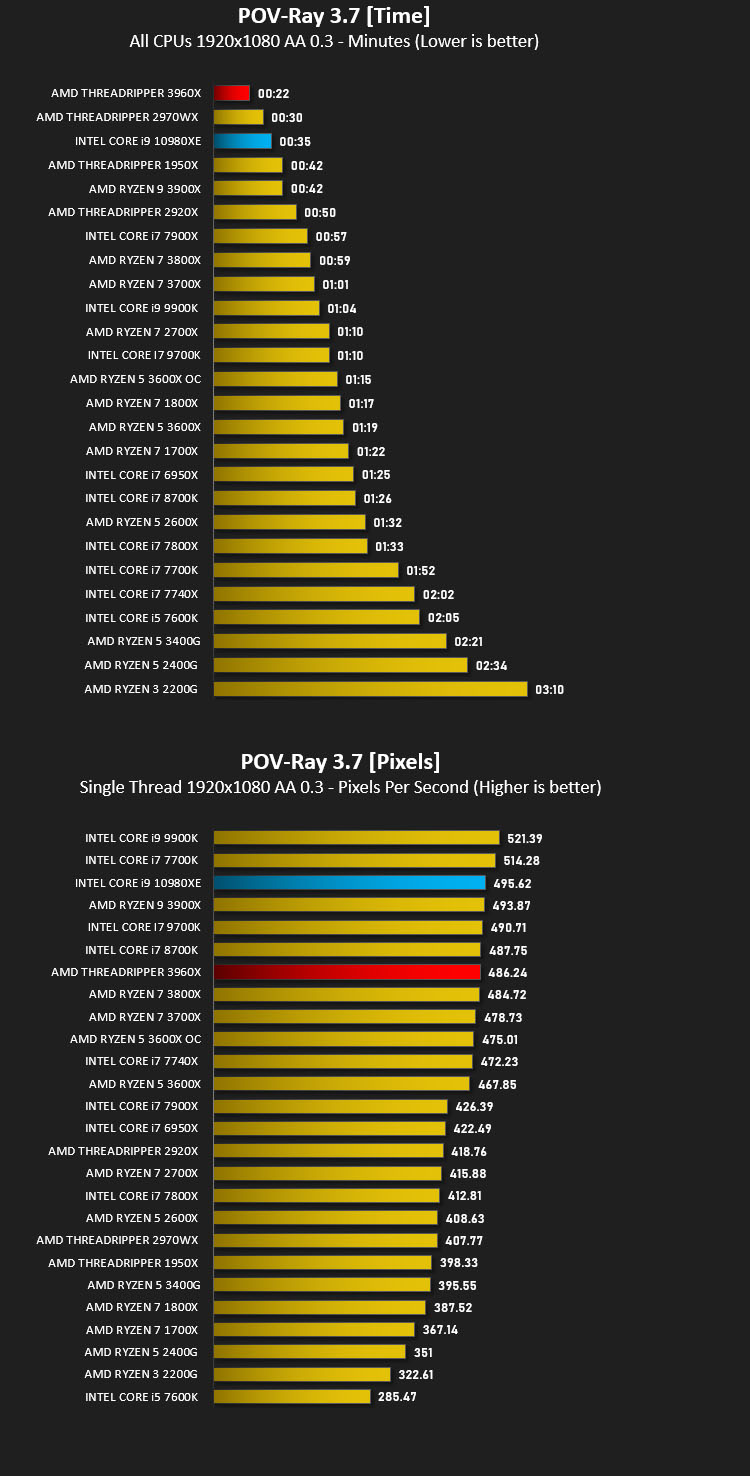
AES Encryption Performance – TrueCrypt 7.1a
TrueCrypt is a discontinued source-available freeware utility used for on-the-fly encryption (OTFE). It can create a virtual encrypted disk within a file or encrypt a partition or (under Microsoft Windows except Windows 8 with GPT) the entire storage device (pre-boot authentication).
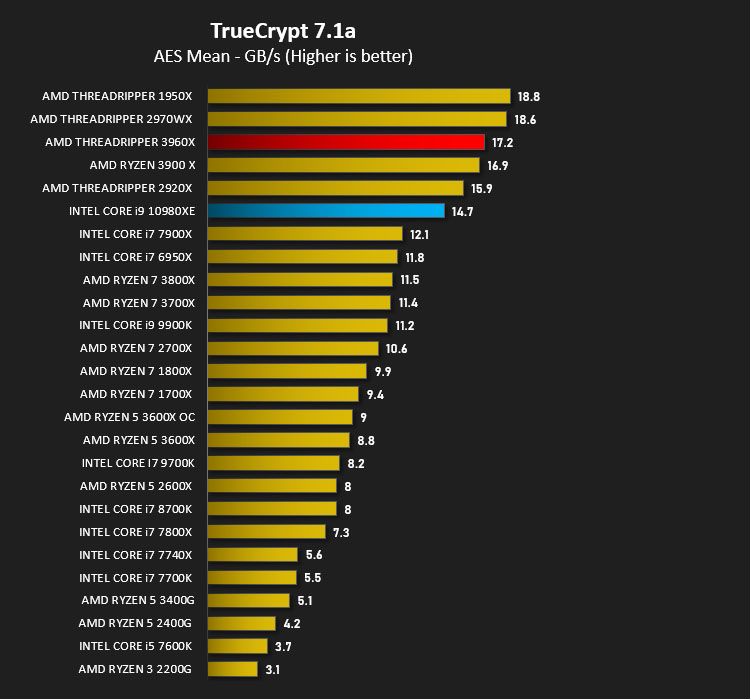
Encoding Performance – X264 HD
Simply put, this test measures how fast your machine can encode a short, DVD quality MPEG-2 video clip into a high-quality x264 video clip. What’s x264, you ask? It’s more or less the next-generation Xvid/DivX codec. I think it’s ideal for a benchmark because the application (x264.exe) reports fairly accurate compression results (in frames per second) for each pass of the video encoding process, and it uses multi-core processors very efficiently.
x264 HD gives results for 2 passes when compressing an MPEG-2 clip into x264. It presents 4 separate results for each pass giving a total of 8 – all results are given in FPS. For each pass I have averaged out the results.
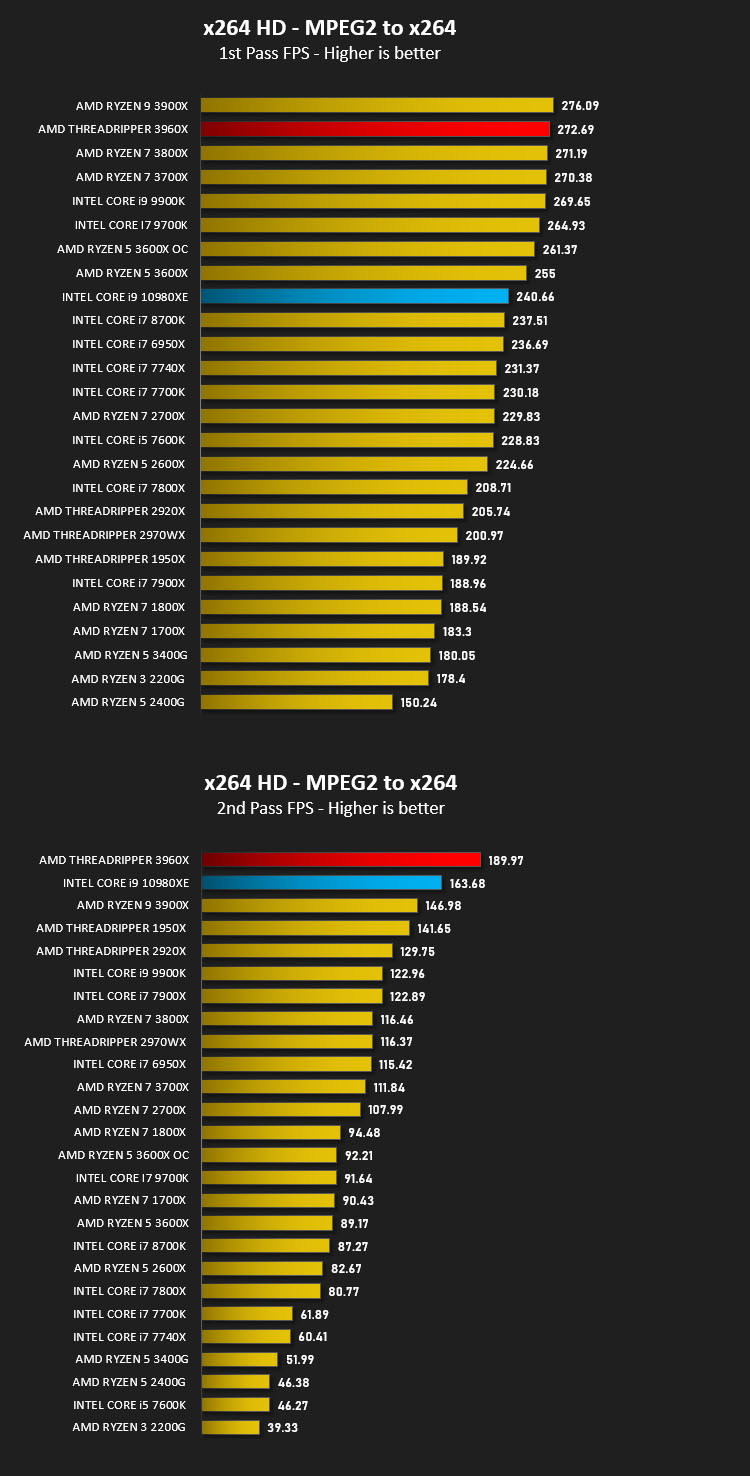
Processing Features Performance – AIDA64
AIDA64 Product Page
This simple integer benchmark focuses on the branch prediction capabilities and the misprediction penalties of the CPU. It finds the solutions for the classic “Queens problem” on a 10 by 10 sized chessboard. At the same clock speed theoretically the processor with the shorter pipeline and smaller misprediction penalties will attain higher benchmark scores. For example — with HyperThreading disabled — the Intel Northwood core processors get higher scores than the Intel Prescott core based ones due to the 20-step vs 31-step long pipeline. CPU Queen test uses integer MMX, SSE2 and SSSE3 optimizations.
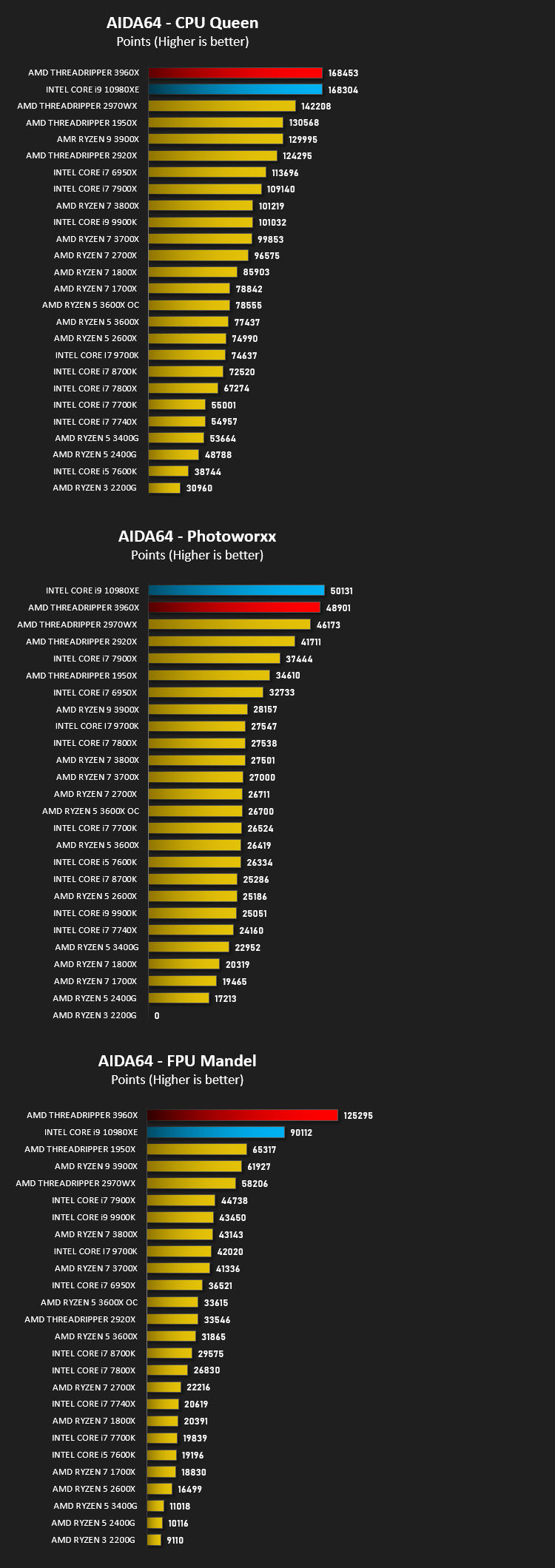
Memory Transfer Performance – AIDA64
AIDA64 Product Page
This simple integer benchmark focuses on the branch prediction capabilities and the misprediction penalties of the CPU. It finds the solutions for the classic “Queens problem” on a 10 by 10 sized chessboard. At the same clock speed theoretically the processor with the shorter pipeline and smaller misprediction penalties will attain higher benchmark scores. For example — with HyperThreading disabled — the Intel Northwood core processors get higher scores than the Intel Prescott core based ones due to the 20-step vs 31-step long pipeline. CPU Queen test uses integer MMX, SSE2 and SSSE3 optimizations.
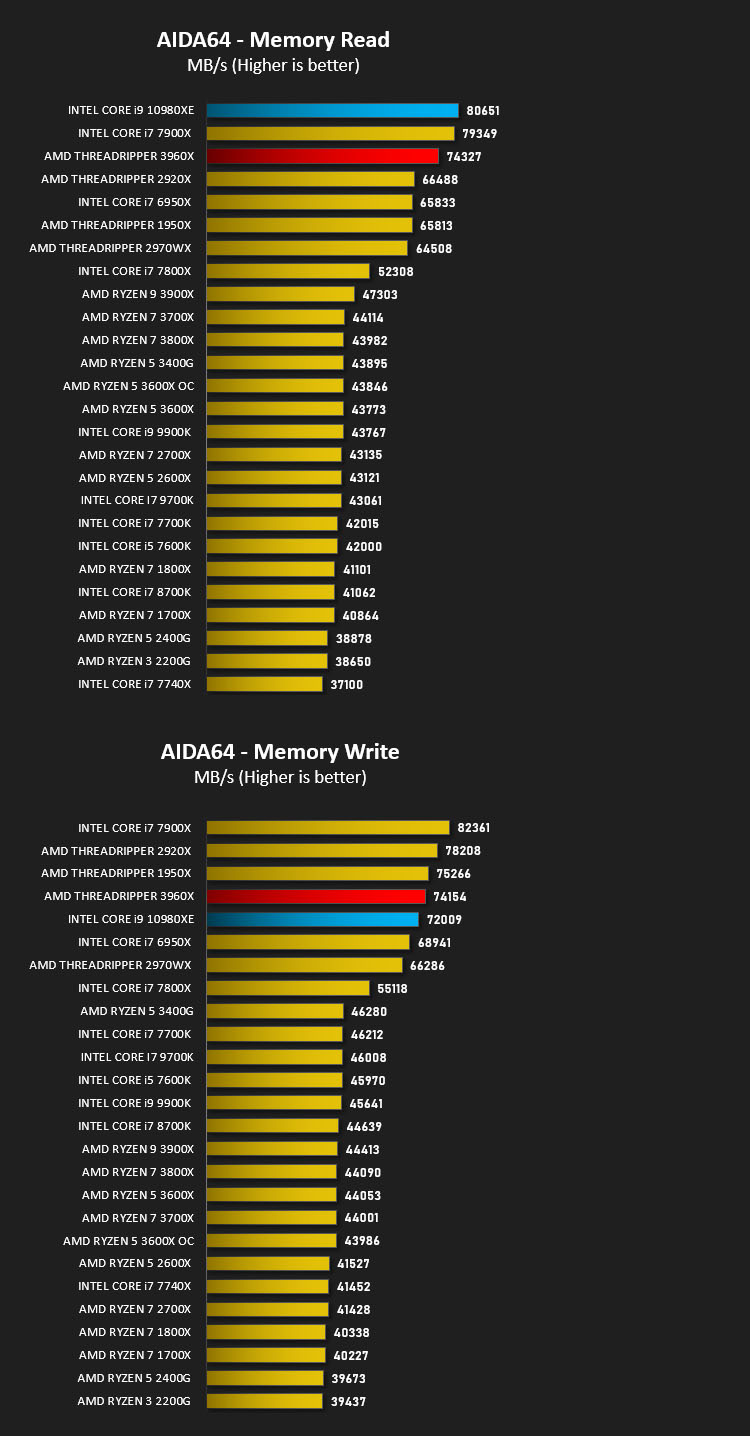
Processing Power Performance – Cinebench R15
CINEBENCH can measure systems with up to 64 processor threads. This test scene contains approximately 2,000 objects which in turn contain more than 300,000 polygons in total, and uses sharp and blurred reflections, area lights, shadows, procedural shaders, antialiasing, and much more. The result is displayed in points (pts). The higher the number, the faster your processor.
Again, there are marginal advantages for the processing power within Cinebench too. Applying an overclock will increase performance and achieve better results.
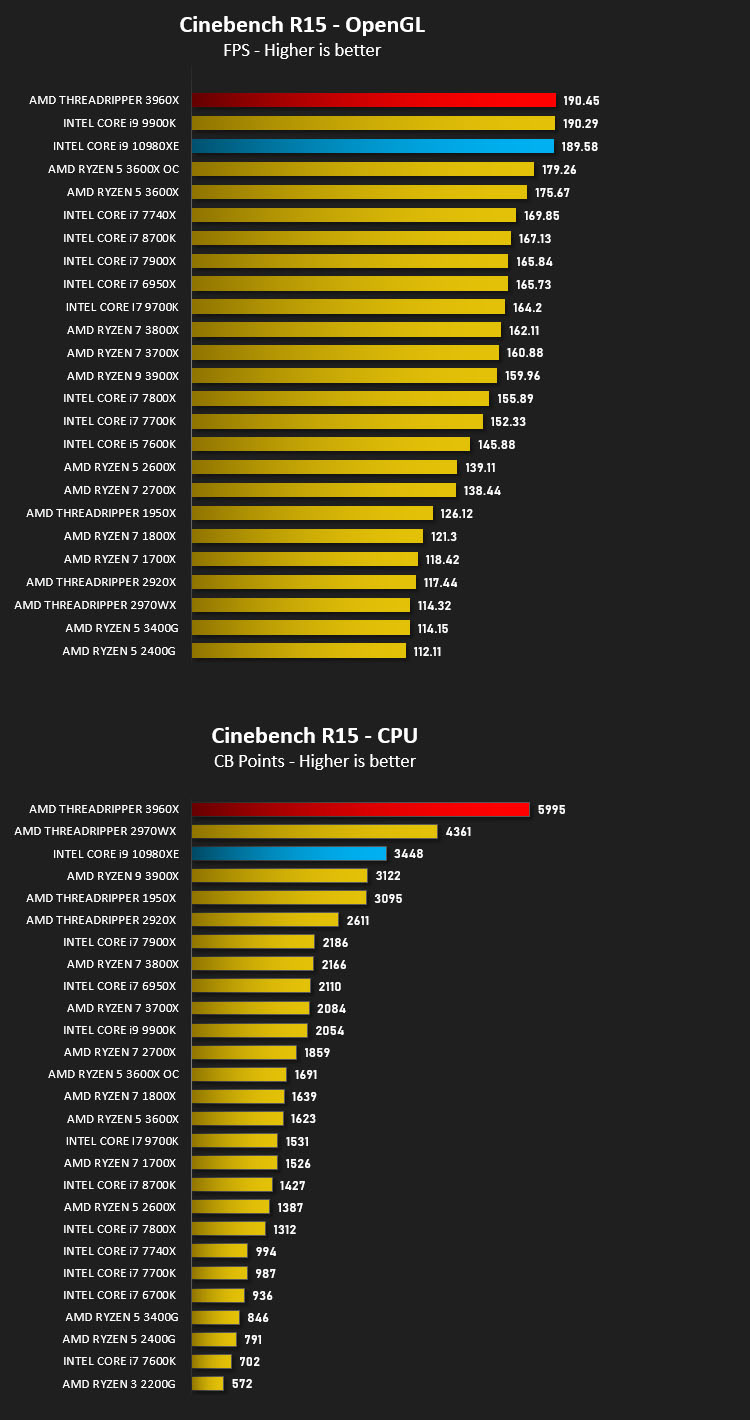
Processing Power Performance – Cinebench R20
Cinebench is a real-world cross-platform test suite that evaluates your computer’s hardware capabilities. Improvements to Cinebench Release 20 reflect the overall advancements to CPU and rendering technology in recent years, providing a more accurate measurement of Cinema 4D’s ability to take advantage of multiple CPU cores and modern processor features available to the average user. Best of all: It’s free.
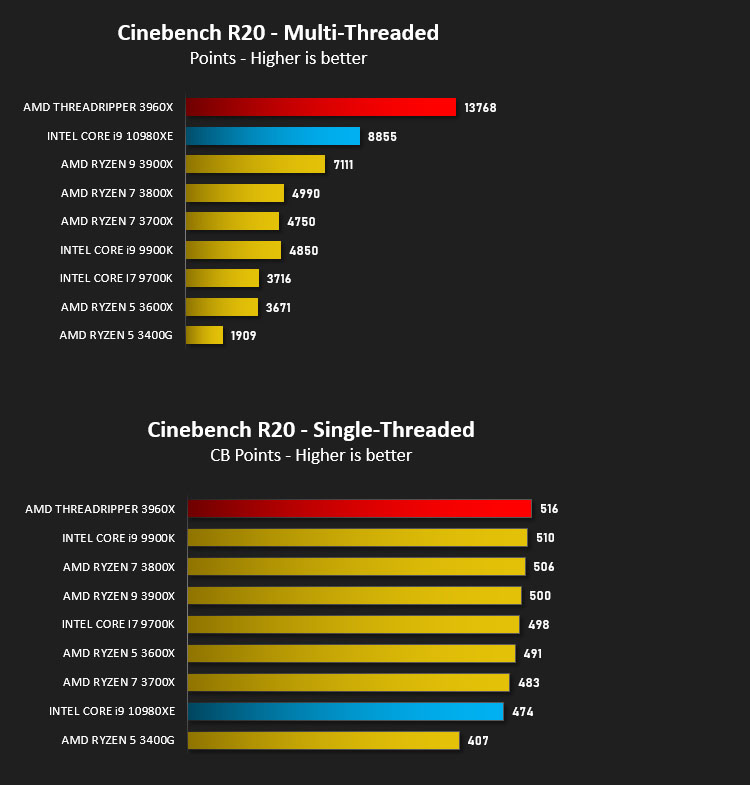
Bandwidth Performance – SiSoftware SANDRA
3DMark 11 Product Page
SANDRA isn’t always a benchmark that is included in hardware reviews but I believe it shouldn’t be ignored. SANDRA provides a vigorous package that tests your system in a rather large array of benchmarks. There are many aspects of benchmark that can be executed. We will be considering – CPU and memory tests.

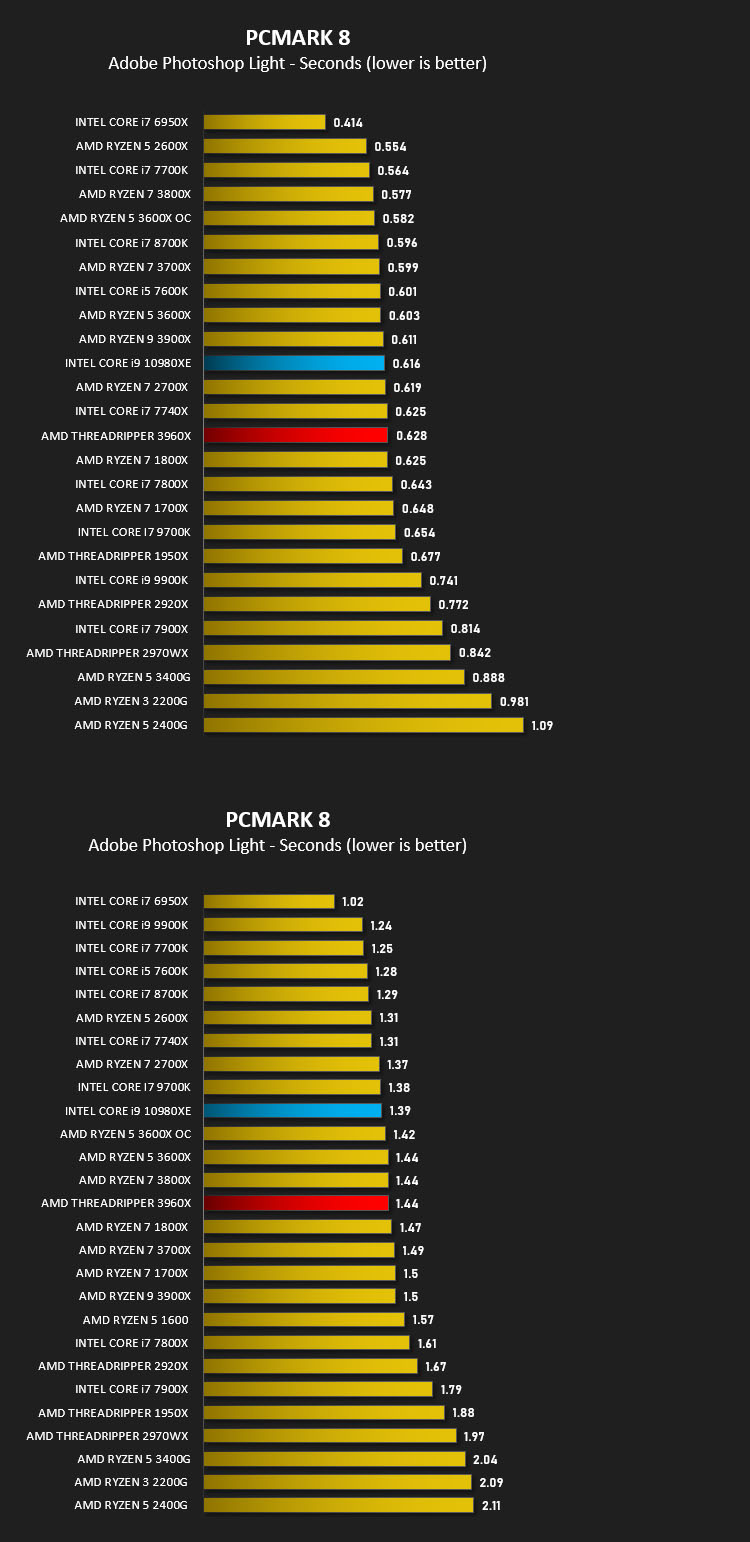
Image Editing Performance – PCMark 8 Photoshop
PCMark 8 Product Page
Developed in partnership with Benchmark Development Program members Acer, AMD, Condusiv Technologies, Dell, HGST, HP, Intel, Microsoft, NVIDIA, Samsung, SanDisk, Seagate and Western Digital, PCMark 8 is the latest version in FutureMark’s popular series of PC benchmarking tools. Improving on previous releases, PCMark 8 includes new tests using popular applications from Adobe and Microsoft.
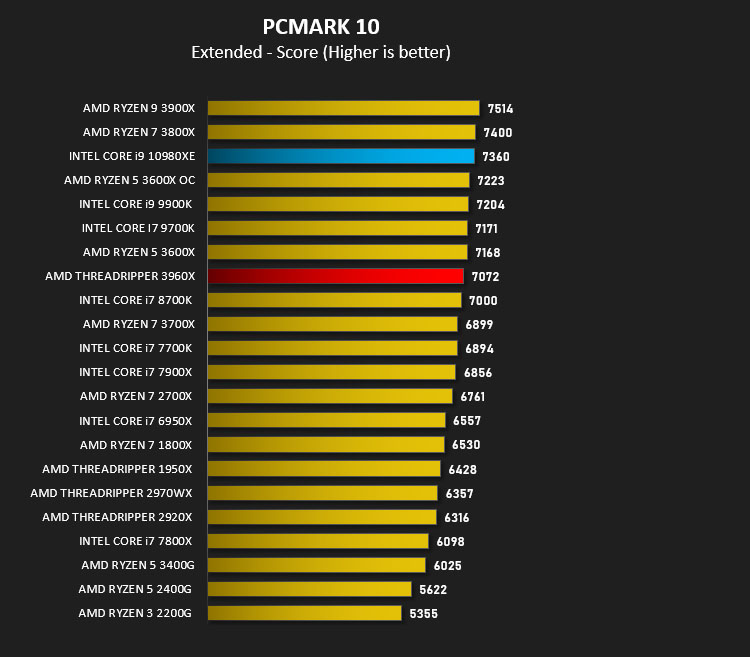
Overall System Performance – PCMark 10
PCMark 10 Product Page
PCMark 10 features a comprehensive set of tests that cover the wide variety of tasks performed in the modern workplace. With a range of performance tests, custom run options, and the new Battery Life Profile, PCMark 10 is the complete PC benchmark for the modern office.
VR Performance – VRMark
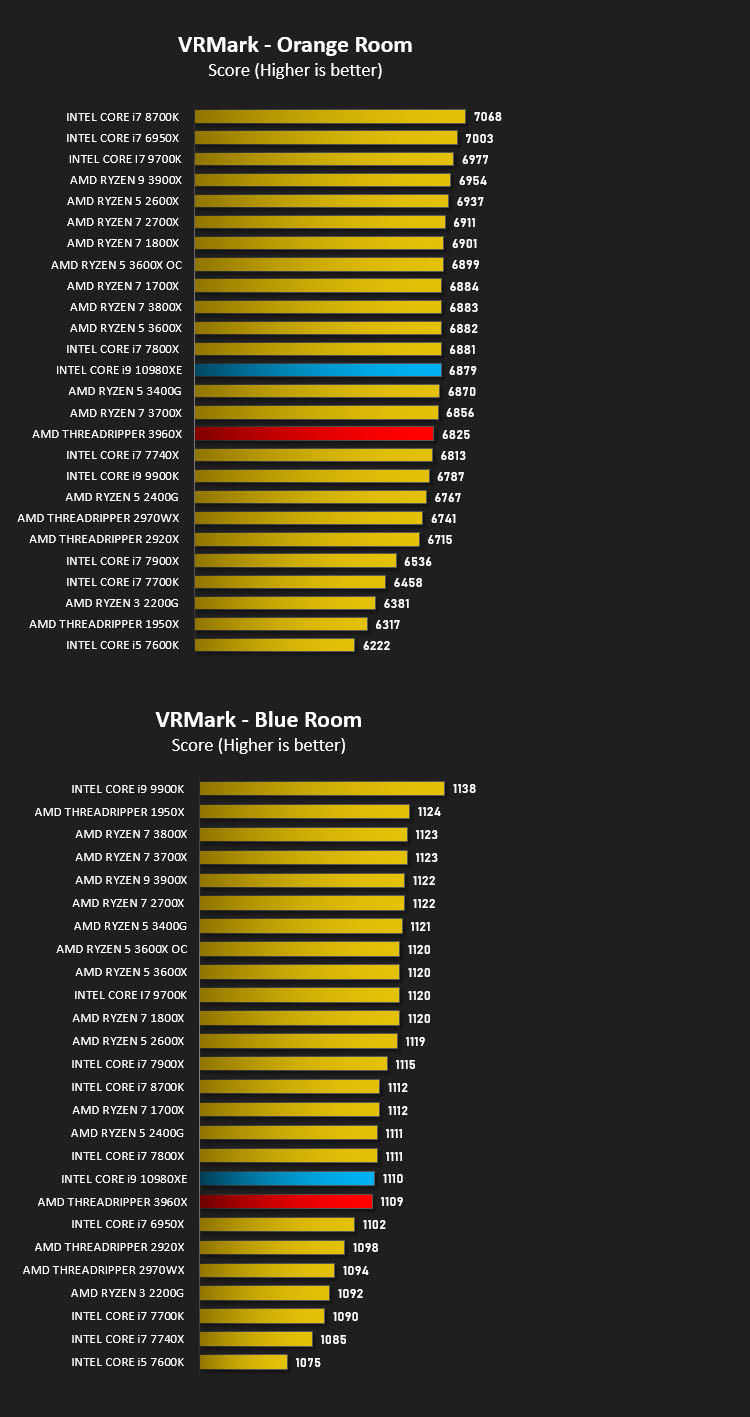
VRMark Product Page
VRMark includes two VR benchmark tests that run on your monitor, no headset required, or on a connected HMD. At the end of each test, you’ll see whether your PC is VR ready, and if not, how far it falls short.
3D Performance – 3DMARK FireStrike
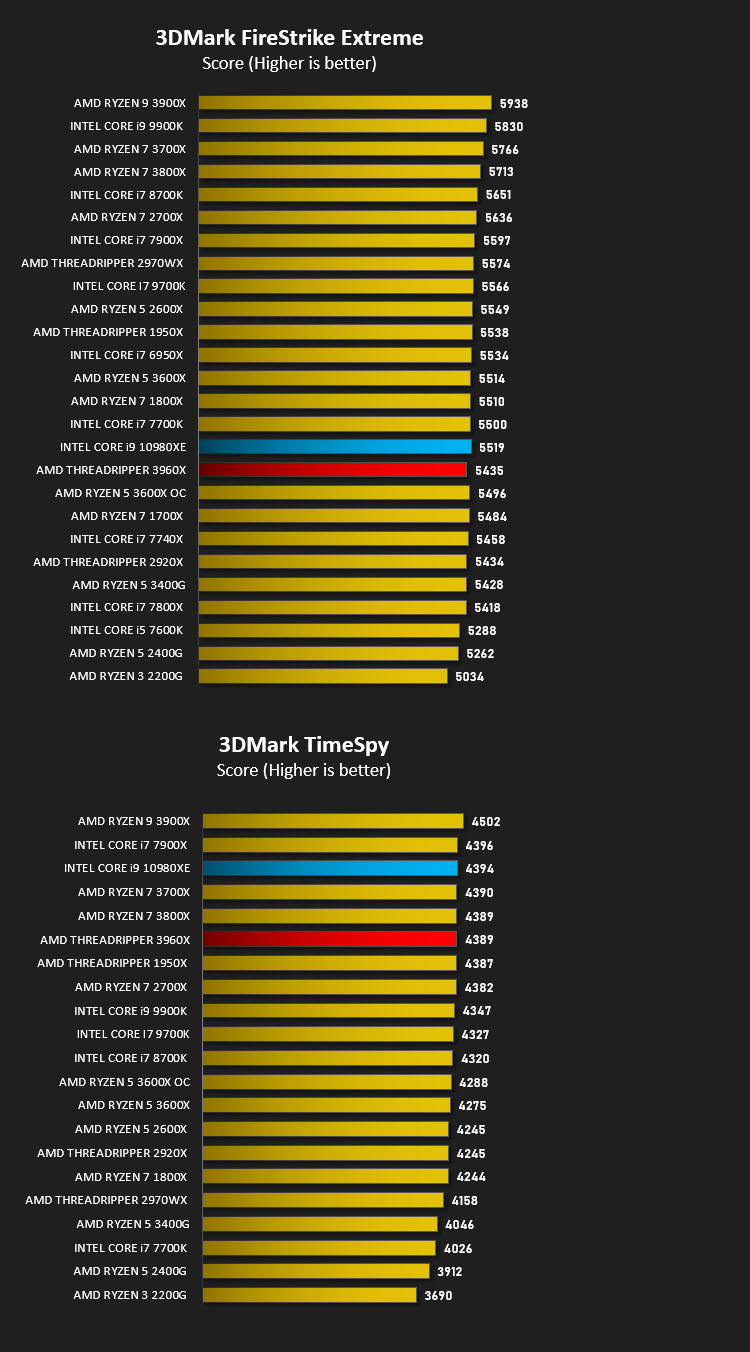
3DMark FireStrike Product Page
Fire Strike is our new showcase DirectX 11 benchmark designed for high-performance gaming PCs. It is our most ambitious and technical benchmark ever, featuring real-time graphics rendered with detail and complexity far beyond what is found in other benchmarks and games today. Fire Strike will only be available in the Windows editions of 3DMark initially.
Gaming Performance – Tomb Raider & Total War: WARHAMMER
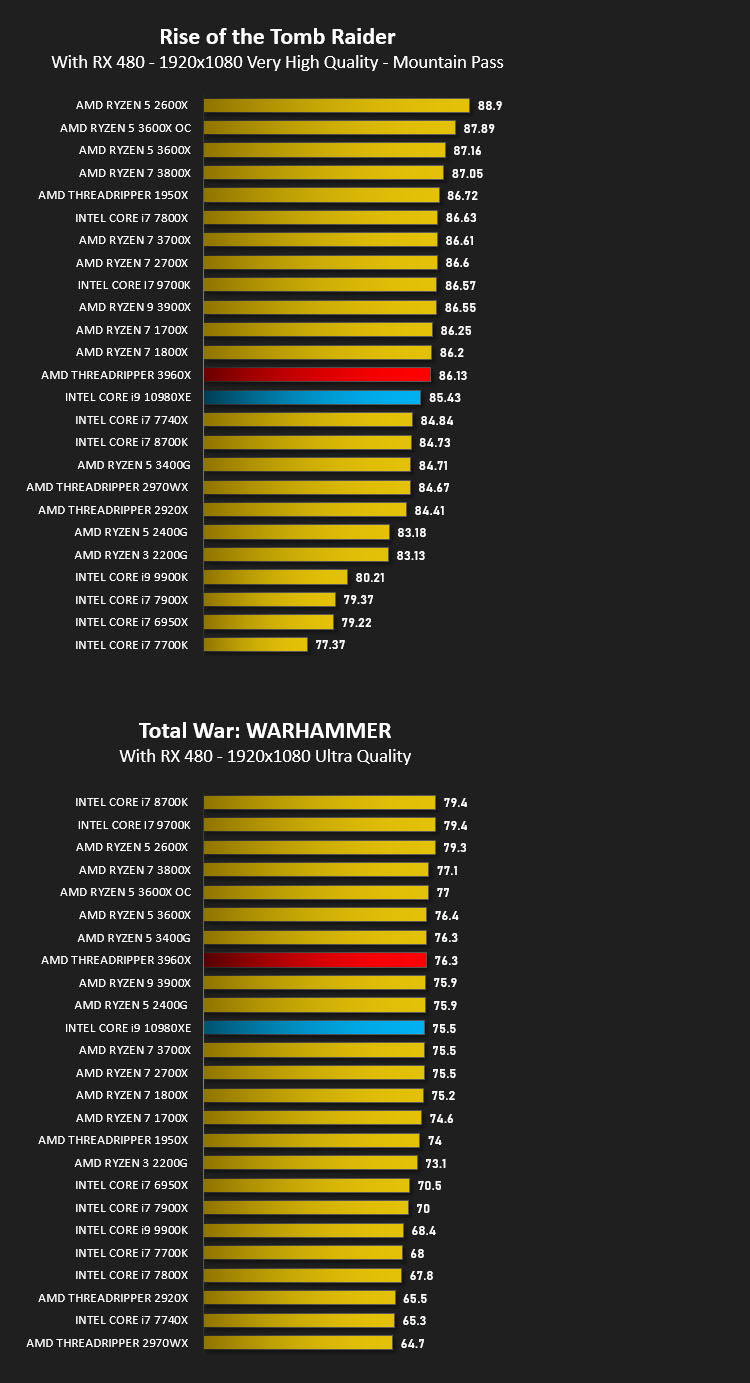
It’s important for us to perform a number of game benchmarks as well as the synthetic tests because gamers will want to know if there are any significant benefits. So here we have two recent gaming titles benchmarked with a Radeon RX 480 installed.
Conclusion
It’s difficult to ignore the impressive performance the Intel Core i9-10980XE offers when up against other processors which offer higher core/thread counts and clock speeds. Intel has done a good job in optimising the Skylake-X architecture in the form of Cascade Lake-X.
Sadly we were completely missed out on the seeding plan for the Skylake-X refresh, hence the last HEDT CPU to be included in our comparison results is the 7900X.
This Extreme Edition chip under examination today has some impressive specifications when you consider the price-point. On offer are 18-cores, 36-threads for a competitive $979 USD. Intel has obviously reconfigured their pricing structure now that AMD are a fierce contender in the HEDT division.
Since today marks the launch of AMD’s Ryzen Threadripper 3rd Gen. we’ve drawn comparison to the 3960X which is higher in spec yet Intel’s part does an admirable job in the range of performance tests we ran- sometimes even bettering the monolithic 24-core, 48 thread beast which costs $1399 USD. In some regards the Extreme Edition processor is a better value for money option, especially if you’re a prosumer/enthusiast who favours features like Optane.

Due to the fact there is no new socket or chipset, motherboard manufacturers have designed ‘refreshed’ versions of the X299 chipset which introduce a more robust feature-set, in a bid to entice content creators over to the blue team. The ASRock motherboard we used for this launch benefits from such features as WiFi 6, USB 20G and 2.5Gbit LAN – just some of the features which might be useful for those wanting to get the most out of their workflow.
So, Intel’s offering is a compelling option – especially given the pricepoint. It remains to be seen what their higher core/thread count models will bring to the table when pitted against AMD’s new platform but for now AMD are winning the core/thread count battle.
Intel’s new Core i9-10980XE Extreme Edition has the prowess to crunch through those heavy workloads and does so at an appealing pricepoint.
Pros
+ Excellent overall performance
+ Wide-range of CPU coolers available
+ Ideal for content creators
+ Plenty of motherboards to choose from
+ Low power consumption compared to AMD HEDT
+ Reasonably priced
+ Easy to overclock
Cons
– Platform lacks new/innovative features
+ Excellent overall performance
+ Wide-range of CPU coolers available
+ Ideal for content creators
+ Plenty of motherboards to choose from
+ Low power consumption compared to AMD HEDT
+ Reasonably priced
+ Easy to overclock
Cons
– Platform lacks new/innovative features
Click here for an explanation of our awards at Vortez.net.
Stay connected with the Vortez Social Media pages:
Join in with the discussions on Discord