




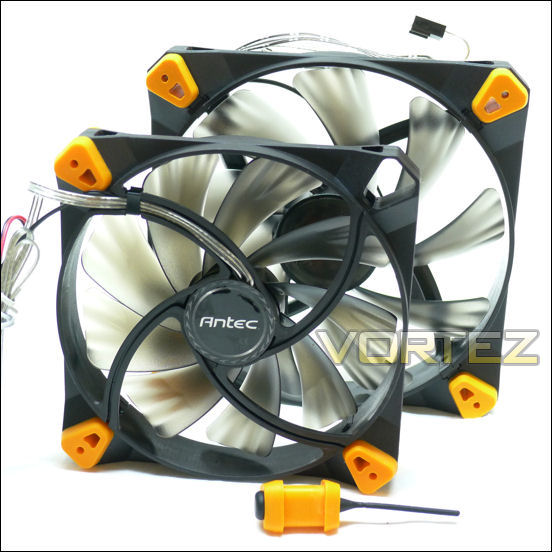
Antec has introduced a new series of fans they call TrueQuiet™, in 120mm and 140mm. Their design is elegant; how well do they cool? Are they truly quiet?

Products on Review:
Antec TrueQuiet 120
Antec TrueQuiet 140
Manufacturer and Sponsor: Antec
Street Price:
TrueQuiet™ 120mm: £8.50 / $12.99 (At time of review)
TrueQuiet™ 140mm: £9.94 / $15.26 (At time of review)
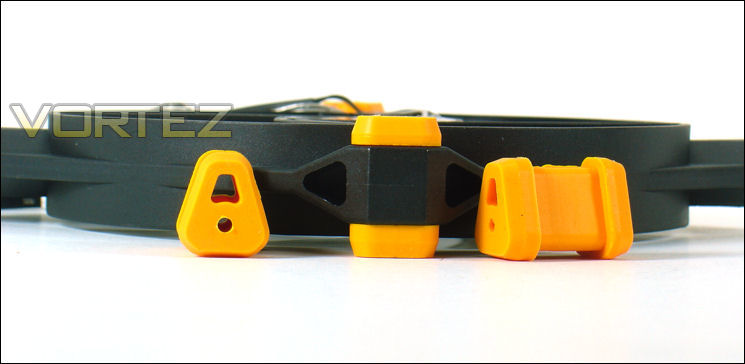
Antec has been producing strongly-built cases for years. The fans they made for them – the Antec TriCool – came with a 3-speed switch that allowed users of their cases to customize their cooling effects. More recently Antec has switched to TwoCool™ fans. One suspects a play on words: ‘Too Cool.’ In any ‘case’ Antec fans are available retail. And apparently to maintain the ‘True’ metaphor (as in TruePower) Antec now has TrueQuiet™ branded fans. The frames are sculpted. The nine blades are a smoky translucent gray, with wavy tips. They come with built-in two-speed switches as well as vibration-dampening inserts in their corners. Vibration-resistant connectors are included in the package. It looks great.
Antec on their TrueQuiet™ fans:
Antec’s TrueQuiet fans bring proven cooling and Quiet Computing™ to your system. Constructed for versatility, TrueQuiet fans include a convenient 2-speed switch that allows you to easily choose either silent or maximum RPM cooling. Because a functional computer relies on more than just cooling, TrueQuiet is equipped with silicone grommets and a uniquely-designed fan blade to reduce turbulence, vibration and noise for overall quiet operation. TrueQuiet comes in two models, 120 mm and 140 mm fan, and is backed by a 2-year limited warranty on parts and labor. Upgrade your fans and add optimal cooling and functionality to your PC with TrueQuiet.
Technical Specifications
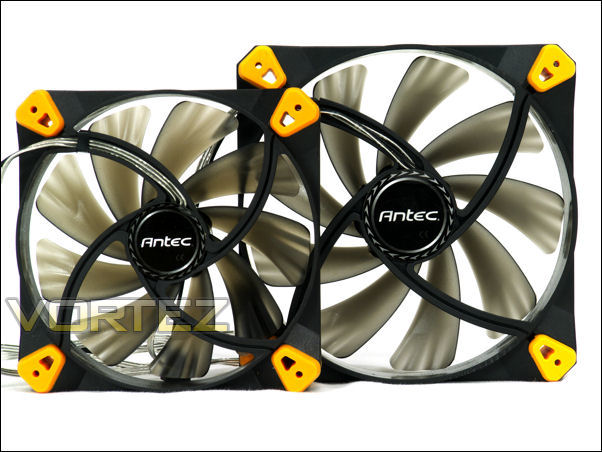
Specifications:
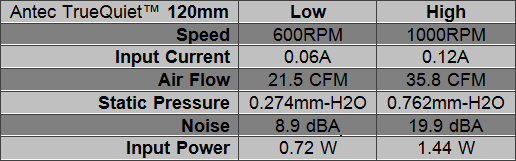
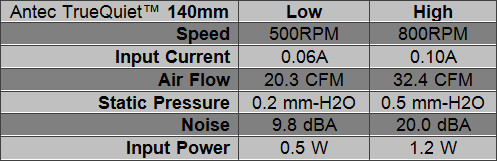
Antec tells us what to expect from their TrueQuiet™ fans:
• 2-way switch to select fan speed
• unique fan blade and silicone grommets to reduce turbulence and noise
• tool-less mounting screws for quick and easy installation
• unique fan blade and silicone grommets to reduce turbulence and noise
• tool-less mounting screws for quick and easy installation
See the next page for a closer look at these features.
Packaging & Bundle
The TrueQuiet™ fans come in blister packs:
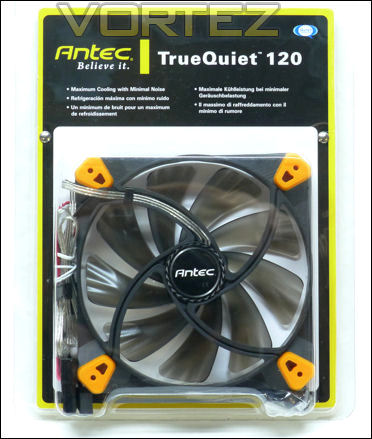
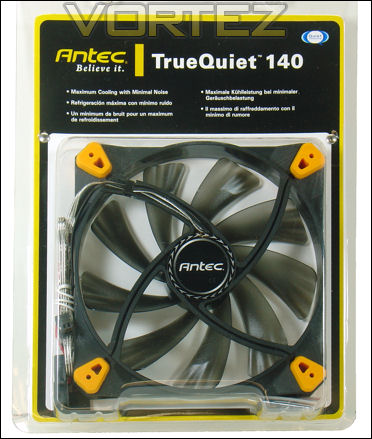
Which, when opened reveal a truly elegant design. Here is the 120mm TrueQuiet™:
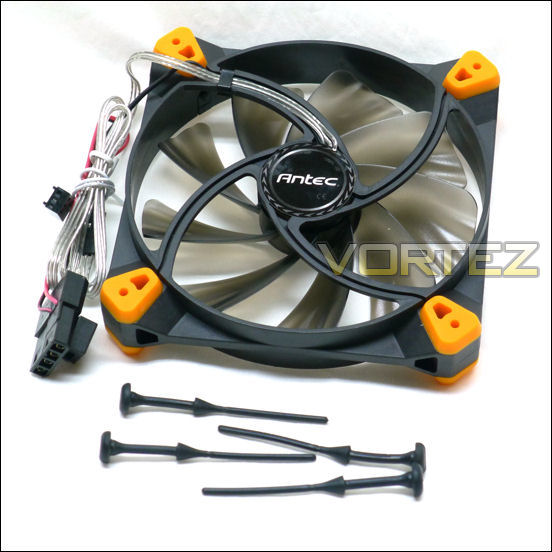
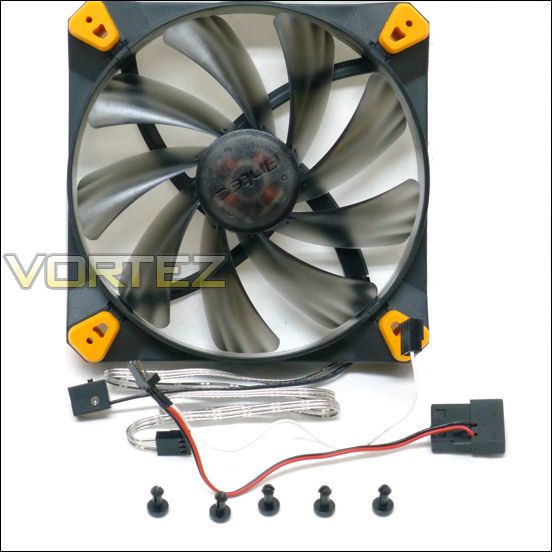
Antec includes a nice bundle of accessories. Note that their Molex 3-pin adapter has an RPM reporting line, a nice feature, as can be seen with the 140mm TrueQuiet™:
Test Setup & Methodologies
The Antec TrueQuiet™ 120 and 140 were tested on the same Megahalems setup as the recent Ultimate Cooling Fan Grouptest 2012 Review.
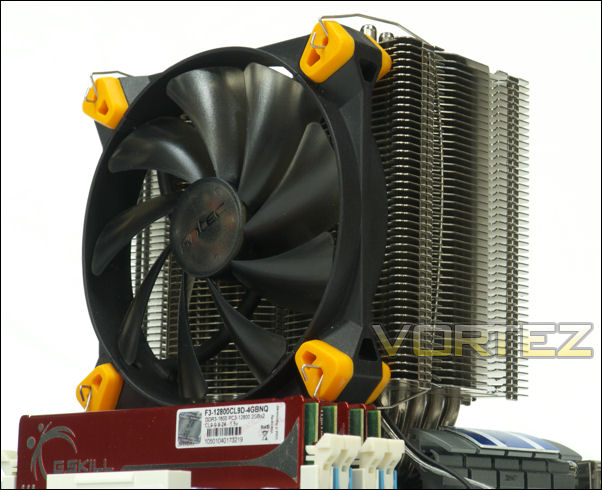
Test Setup
CPU Intel Core i7 860 at 3.6GHz and stock
Cooling Prolimatech Megahalems
Motherboard GIGABYTE GA-P55A-UD3P
Memory G.Skill 8GB 1600MHz low profile RAM
Storage Kingston SSDNow V+100 64GB SSD
PSU Seasonic X-750
Sound Level Meter Tenma 72-942
Stress software and CPU temp logger OCCT 3.1
Cooling Prolimatech Megahalems
Motherboard GIGABYTE GA-P55A-UD3P
Memory G.Skill 8GB 1600MHz low profile RAM
Storage Kingston SSDNow V+100 64GB SSD
PSU Seasonic X-750
Sound Level Meter Tenma 72-942
Stress software and CPU temp logger OCCT 3.1
At their High setting the fans were each tested at least five times on the 3.6GHz overclocked system, with the results averaged. After establishing that both fans did not fare well on the overclocked system at their Low setting, they were each tested three times at stock — switches set to Low. The results were then averaged.
The Antec TrueQuiet™ were also tested in the open. At the High setting the 120mm ran at 1138 rpm in free air, with an equivalent one-meter sound pressure level (SPL) of 21 dBA. Antec specifications are 1000 RPM, 19.9 dBA. At Low the 120mm ran 715 RPM, 12.5 dBA. Remember that this setup cannot measure noise below about 12-13 dBA, so the fan was probably quieter than what was measured. Antec specifications are 600 RPM, 8.9 dBA for this fan at the Low speed setting.
At High the 140mm TrueQuiet™ ran at 770 RPM in free air, making an equivalent one-meter sound pressure level (SPL) of 16.5 dBA. Antecs specifications are 800 RPM and 20.0 dBA. At Low the 140mm ran at 525 RPM and 13 dBA (probably quieter). Antec specs are 500 RPM and 9.8 dBA.
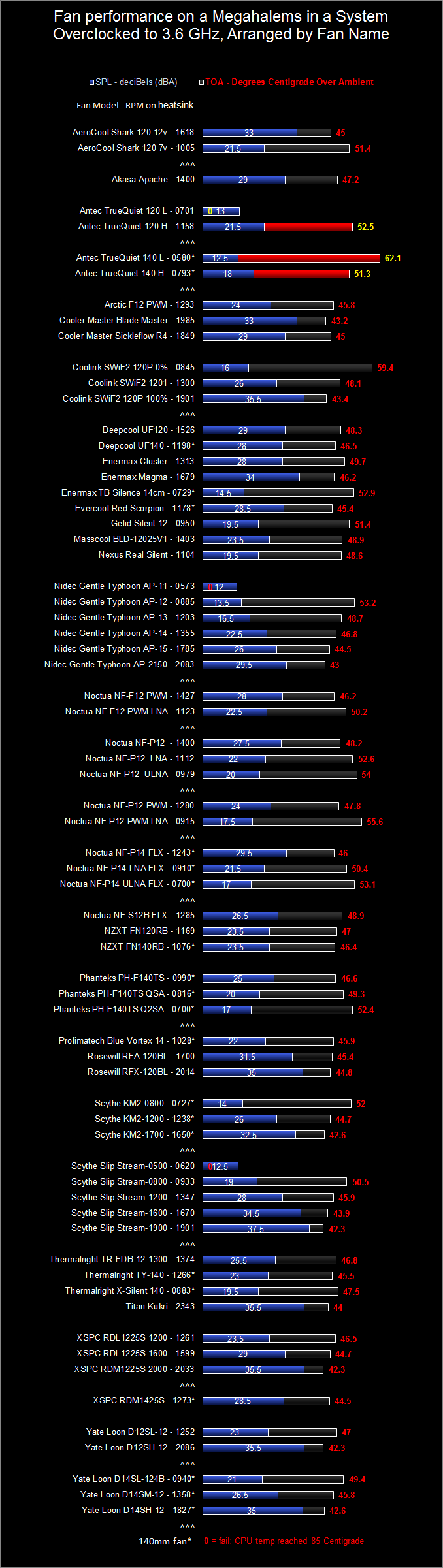
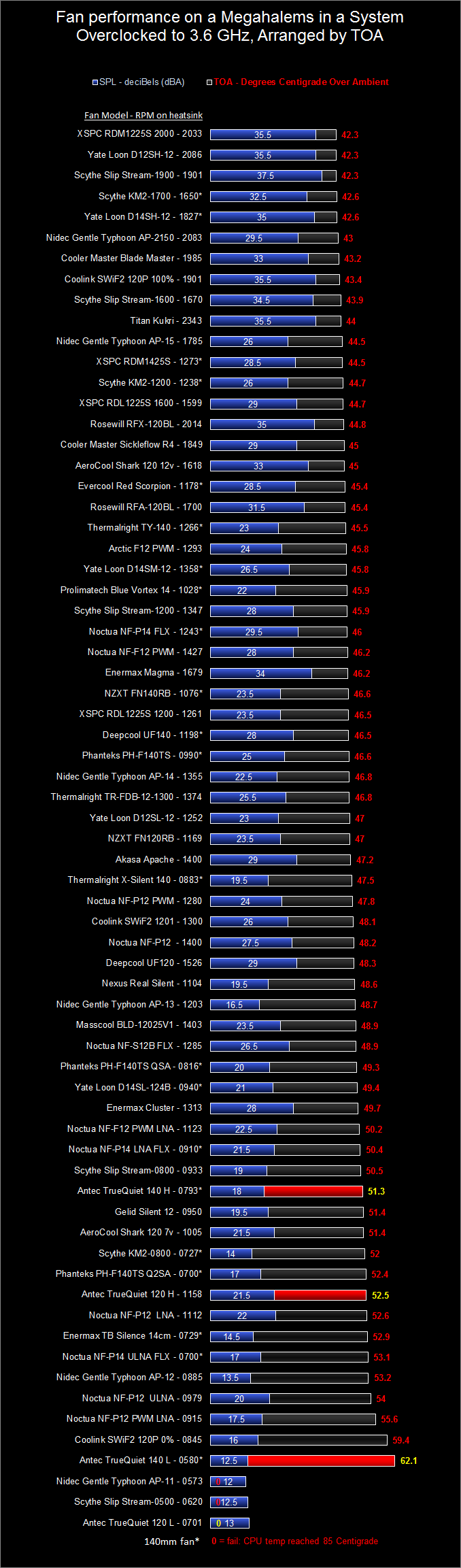
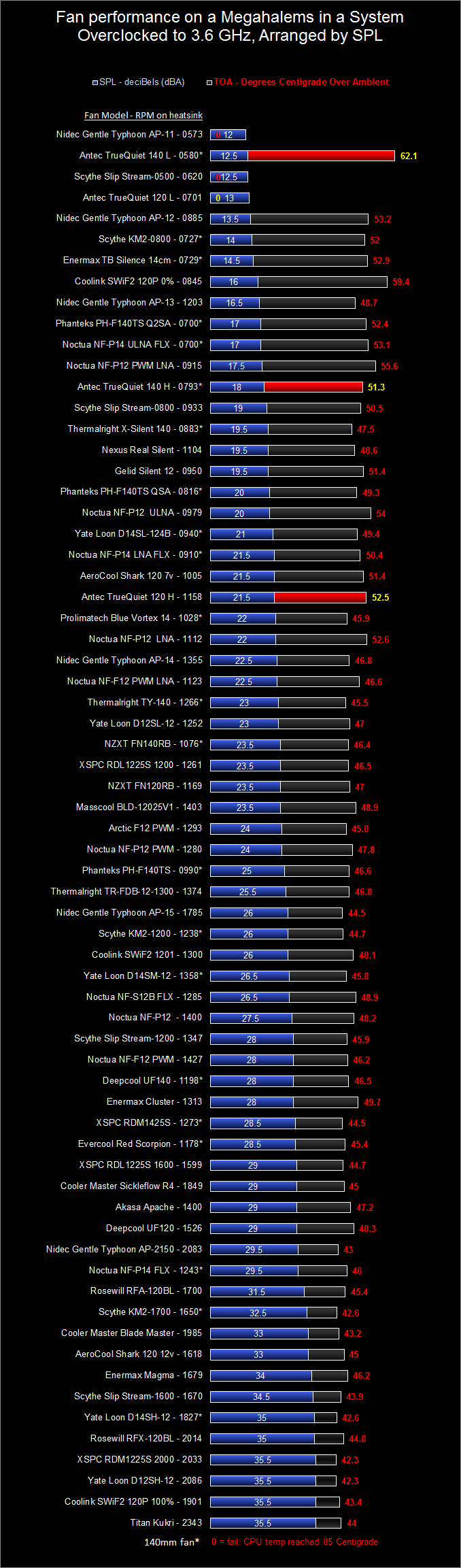
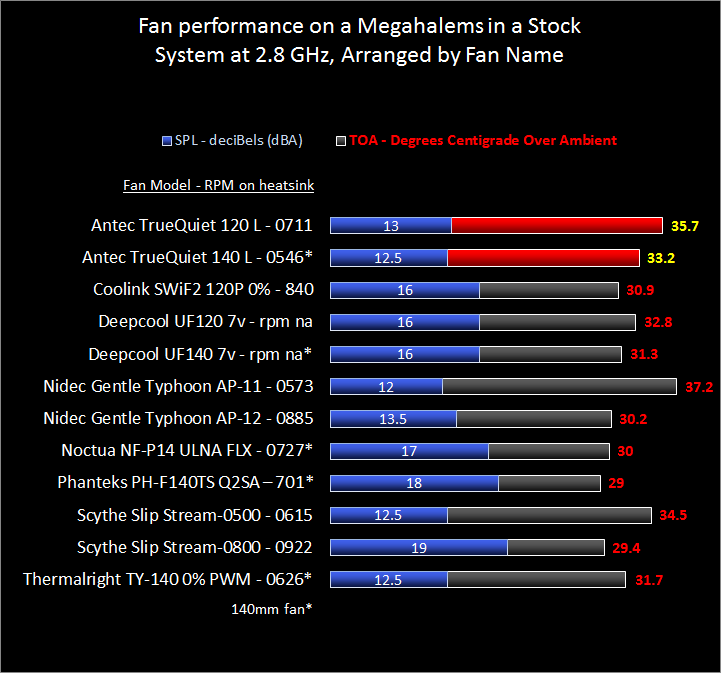
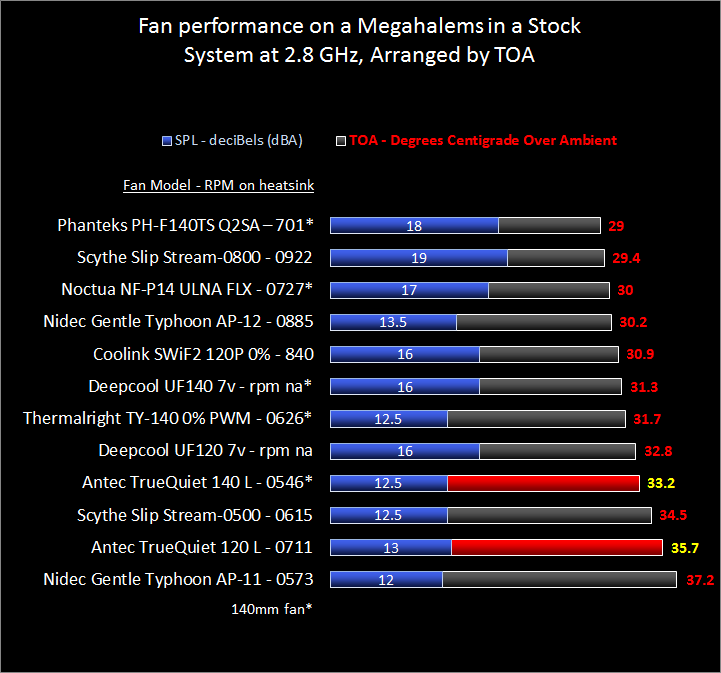
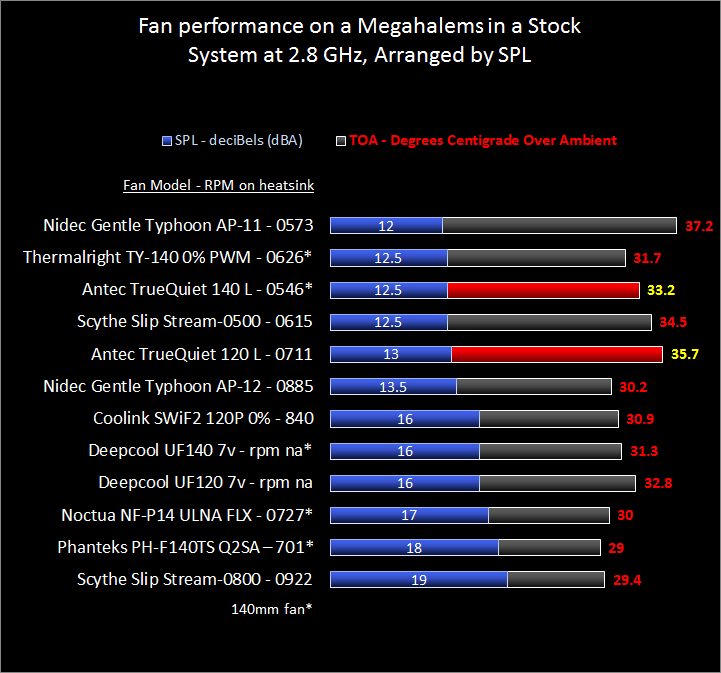
The next three pages will show the fan performance on the heatsink, arranged by name, by temperature over ambient, and by sound pressure level. A fourth page will show performance on the non-overclocked system.
Performance: Overclocked System (Arranged by Name)
Performance: Overclocked System (Arranged by Temp/Ambient)
Performance: Overclocked System (Arranged by Sound Pressure Level)
Remember that this setup cannot measure noise below about 12-13 dBA, so the quietest fans were quieter than what was measured, sometimes a lot quieter.
Performance: Non-Overclocked System
Conclusion
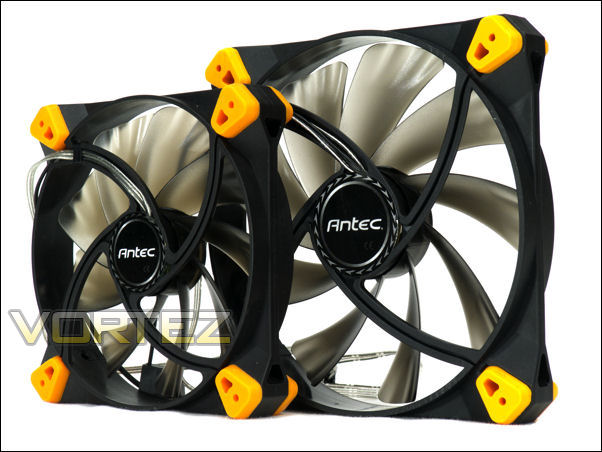
The Antec TrueQuiet™ are very lovely fans. Their anti-vibration corner buffers not only are pretty, but should keep whatever vibrations these fans make from reaching your case. They further this approach by supplying you with vibration-reducing connectors. Antec clearly wants you to have a quiet experience. But whether you look at their noise or their cooling performance, on High or Low settings, these are at best average fans. There are quieter fans that cool better and cool not as well. There are fans with comparable cooling that are quieter and noisier.
That said, these are quiet fans, especially the TrueQuiet 140: on the High switch setting it makes only 16.5 decibels of noise in free air. You will barely hear that. And with the Low switch settings both fans probably do make their specified 10 dB. You will not hear that outside your case.
Since these are sleeve bearing fans, before you put them in service you should lubricate their center wells with a light machine oil (do not use a penetrant like WD-40), and re-lubricate them every six months as you would your car.
Best used for case fans, especially in situations where you wish to show off your kit. These are, after all, beautiful creations.
Pros
+ Quiet
+ Beautiful
+ Switchable Low and High settings
+ Care taken to reduce transmitted vibrations
+ 3-pin Molex adapter has an RPM-reporting line
Cons
– Middling performance
+ Quiet
+ Beautiful
+ Switchable Low and High settings
+ Care taken to reduce transmitted vibrations
+ 3-pin Molex adapter has an RPM-reporting line
Cons
– Middling performance


