When ARCTIC announces a new thermal paste, enthusiasts take heed. So let’s see how their new MX-4 compares.
Product on Review: ARCTIC MX-4
Manufacturer and Sponsor: ARCTIC
MSRP: €3,90
Street Price: Not listed
ARCTIC recently underwent a brand redesign to reflect their diversification into new market segments. However, their primary focus will no doubt still be on cooling solutions, of which we’ve seen a number reviewed here at Vortez under the ARCTIC Cooling sub brand. Their latest addition to an already successful line of cooling products is the ARCTIC MX-4 thermal paste. Last year saw the release of the ARCTIC MX-3 thermal paste which easily topped our chart as a risk free, non conductive and excellent performer. ARCTIC is hoping to improve on their winning formula to deliver a solution that is not only superior in quality but also much lower in price.

ARCTIC Cooling has been the first port of call for enthusiasts for a long time but for those unfamiliar with the brand, here is a few words from them:
ARCTIC COOLING is a leader in creating thermal cooling solutions for personal computer systems that enable CPU (Central Processing Unit), GPU (Graphic Processing Unit) and PC case cooling whilst reducing the noise level. Increased heat generated by modern computer systems has overwhelmed most existing cooler manufacturers in their efforts to keep pace with the demands in terms of noise level and cooling. The noise pollution caused by today´s IT systems has increased, severely affecting productivity in open office environments. ARCTIC COOLING has been working closely with globally recognized companies such as Inno3D, ECS, Galaxy, Sapphire, Powercolor and ATI. Through these partnerships ARCTIC COOLING has been able to adapt to the changing market requirements and has quickly developed the optimal solutions. ARCTIC COOLING combines the Swiss art of engineering to realize innovative cooling ideas. Thanks to the low labour cost in Asia, ARCTIC COOLING has consistently produced innovative solutions which lead the market in price / performance. Cooling solutions are created from the demand of our customers. Due to the continuous product development at ARCTIC COOLING the demands of end-users will always be satisfied. As a result of the head-start ARCTIC COOLING has in knowing end-user´s requirements, manufacturing possibilities and ARCTIC COOLING´s strong R&
 , ARCTIC´s products will continue to be market leaders in cooling solutions and provide assemblers, computer hardware distributors and IT-technicians with innovative, virtually silent, cost-effective cooling solutions for CPU, GPU and PC-case worldwide.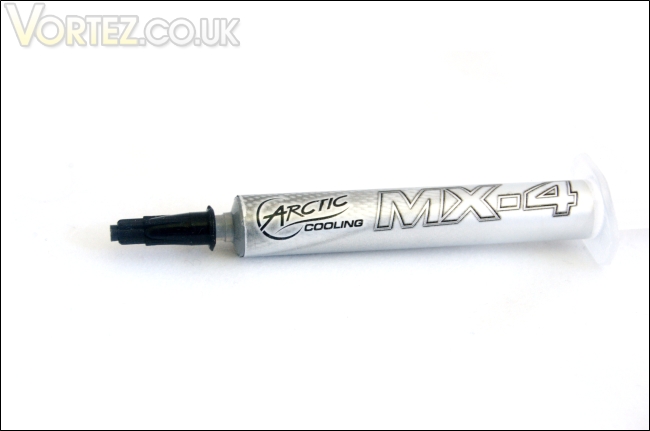
Following the footsteps of the MX-3 thermal paste, ARCTIC has big shoes to fill with the MX-4 so let’s see how it fares against its predecessor and the growing competition.
Feature and Specifications
Currently, ARCTIC haven’t published any specifications on the MX-4 and with the sample lacking the final packaging, it is unknown how the thermal compound differs to other products. This will be updated as soon as more information is released.
In terms of features, we can expect to see more of what made the MX-3 popular:
•High Thermal Conductivity
•Low thermal resistance
•Electrically non-conductive
•Non-capacitive
•Non-curing
•Non-corrosive
•Non-bleeding
Closer Look
The thermal paste tube
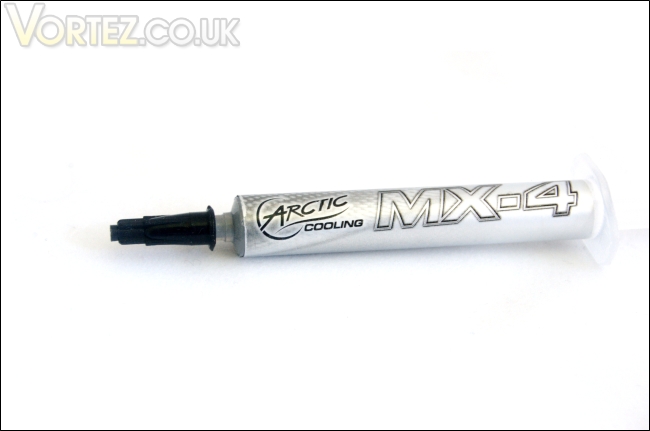
The sample received was merely a standalone tube but the ARCTIC MX-4 will no doubt use the same plastic clamshell design employed by the ARCTIC MX-3 packaging when it hits retail. The tube measures 11.8cm and contains a net weight of 4g of paste. The paper strip wrapped around the tube sports the brand new ARCTIC logo and not surprisingly, the MX-4 name. The tube is akin to a syringe, as typically used by most thermal paste manufacturer, and unlike the Coollaboratory Liquid Pro’s usage of a needle and syringe, the MX-4 has a wide plastic neck that is much safer for application.
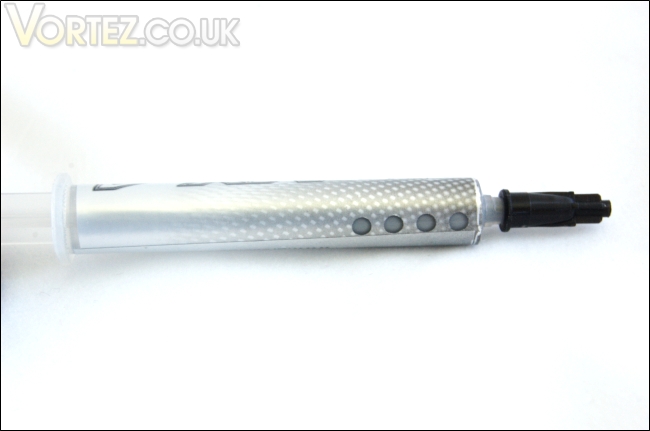
The indicator metre
Quite handily, 4 circular holes have been cut out on the paper strip to indicate how much thermal paste is left in the tube after application. The paper strip settles for a minimalistic white and grey colour scheme that we have grown accustomed to seeing from ARCTIC’s packaging.
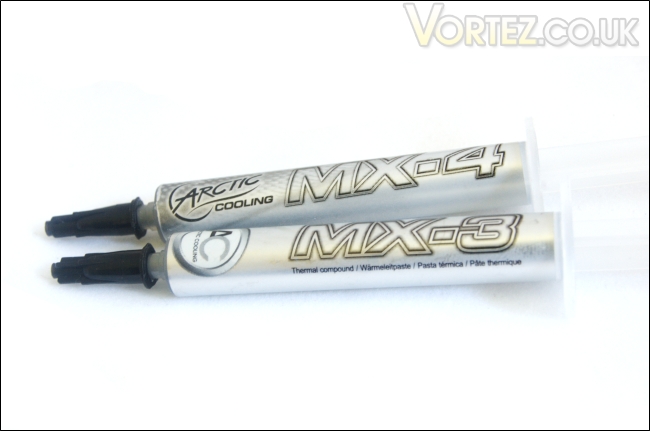
ARCTIC MX-3 VS MX-4
The design of the tube itself has remained vastly unaltered compared to the MX-3. They are both the same length, use a black plastic cap and similar colour scheme on the paper strip. In fact the only noticeable difference, apart from the name, is the changed logo reflecting ARCTIC’s diversified branding.
The thermal paste
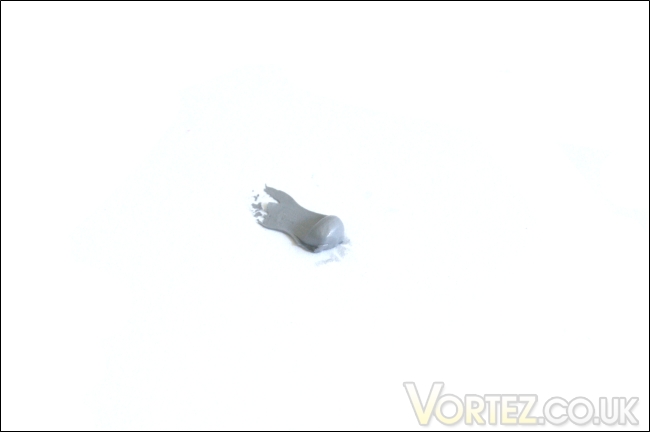
The paste has a very different consistency to the MX-3. The ARCTIC MX-4 is more viscous making it harder to apply and to spread manually. Unlike the MX-3, it doesn’t flow out as easily and the advantage of this is that users can determine the amount to apply more precisely when pressing on the syringe. Although application is consequently harder, my advice would be to allow the pressure of the cooler on top to do the job. Simply apply a small blob onto the CPU or GPU and install the cooler. This method also minimizes the formation of air pockets.
Test Setup
CPU – Intel Core i7 920 – 4.0ghz
RAM – 6GB (3x2GB) OCZ platinum DDR3 1333mhz
Motherboard – ASUS Rampage III Extreme
Graphics card – XFX HD5870 1024MB
Power Supply – Enermax Revolution 85+ 850W
Cooling – Noctua NH-D14
Hard Drive – Samsung F1 320GB
Western Digital Caviar WD3200AAKS 320GB
Drivers – Catalyst 10.5
Thermal pastes:
Thermalright Chill Factor II
ARCTIC Silver 5
ARCTIC MX-4
ARCTIC MX-3
Coollaboratory Liquid Pro
Program Suite:
Core Temp 0.99.5
LinX stress Test
CPUID HWMonitor
How I Tested:
Each paste was applied as recommended by the manufacturers and was tested over a period of 48 hours to observe if they required any curing time. An initial test was done at stock (2.66GHz) speed and overclocked (4GHz) speed. The idle and load temperatures were measured using coretemp by looking at the minimum temperatures while idling and the maximum temperature after 20 passes of LinX. This was repeated after 48 hours.
Due to varying temperatures, an average temperature was calculated across the CPU cores and the ambient temperature was subtracted to obtain a delta value. This is presented in the graphs.
Results
Stock
Initial Results
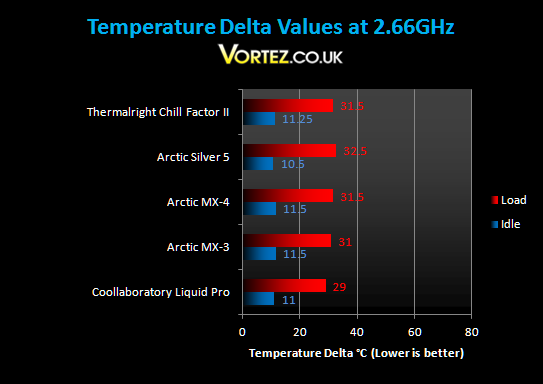
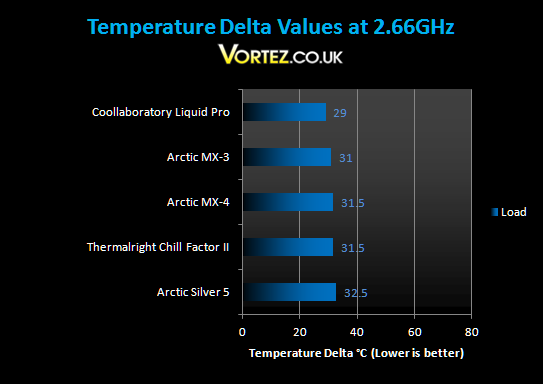
At stock speed, the ARCTIC MX-4 performs well. It doesn’t match up to the Coollaboratory Liquid Pro but given the risk associated with the latter, most users would up for regular thermal paste. And in that situation, the ARCTIC MX-4 is a serious contender. It falls short of the ARCTIC MX-3 by a mere 0.5C, which in this case remains the champion in terms of performance. Factor in the lower price of the ARCTIC MX-4 and it proves to be a more attractive offering. The highly popular ARCTIC Silver 5 trails behind by a larger 1C margin.
After 48 Hours
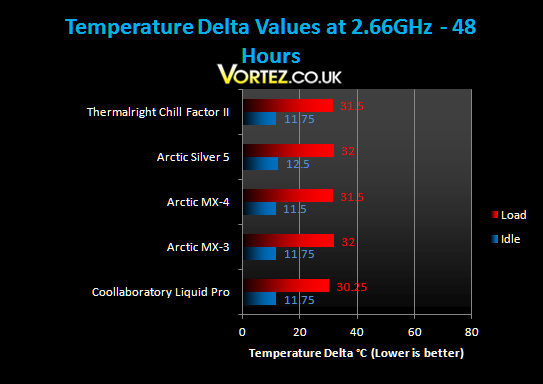
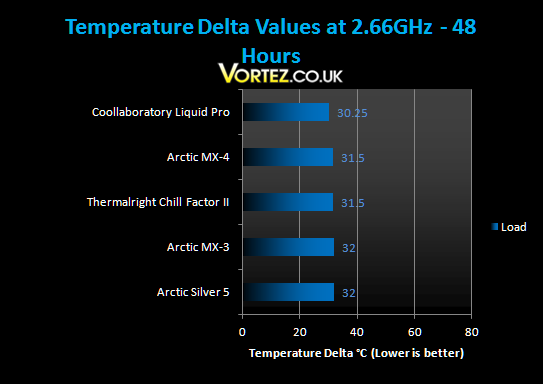
After 48 hours, we can see that the cooling potential of the ARCTIC MX-4 remains unchanged, demonstrating the lack of curing needed to get the best out of the thermal paste. On the other hand, there’s a slight drop in performance when using the Coollaboratory Liquid Pro and ARCTIC MX-3. Conversely, the ARCTIC Silver 5 performs better, as expected due to it requiring curing time. The ARCTIC MX-4 takes the lead here as the best thermal paste along with the Thermalright Chill Factor II.
Curing
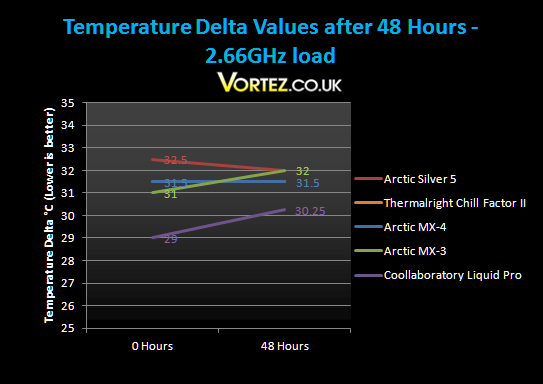
A closer look and we can see how the thermal compounds vary over time. The ARCTIC MX-4 retains the same performance over time so users can expect to see good results throughout their usage after application. The Thermalright Chill Factor II demonstrates the same trend, making it ARCTIC’s toughest competitor.
Results (Overclocked)
4GHz
Initial Results
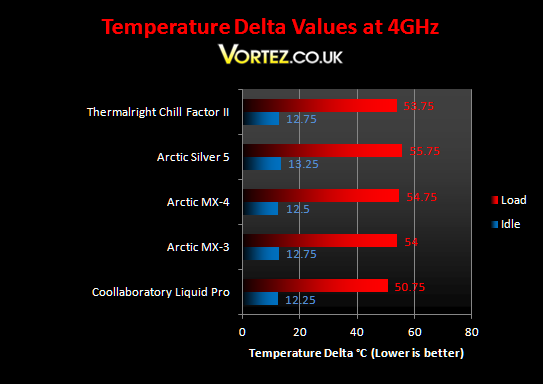
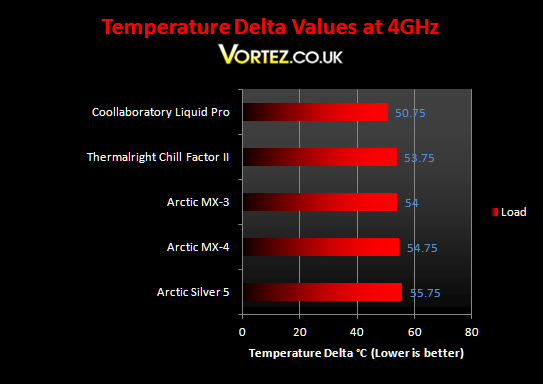
At 4GHz, the ARCTIC MX-4 disappoints. Although idle temperatures are class leading, the load temperatures are what we are concerned about. Trailing a whole degree behind the Thermalright Chill Factor II, ARCTIC loses its crown. 1C may seem to be within error margins but repeated tests showed that the ARCTIC MX-4 consistently performed worse than the competition and its own predecessor by 0.75C. The Coollaboratory Liquid Pro only extends its lead at the overclocked speeds.
After 48 Hours
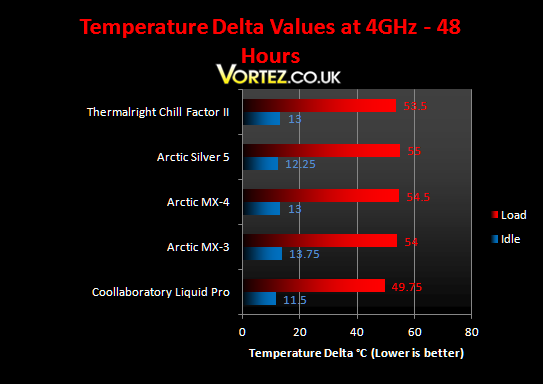
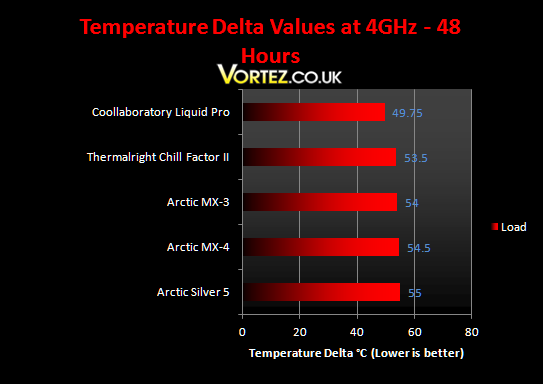
Even after 48 hours, there’s very little change that can give the ARCTIC MX-4 the advantage. The Thermalright Chill Factor II mirrors the 0.25C difference and thus retains its 1C lead. The ARCTIC Silver 5 fails to match up to the other thermal pastes, concluding that it’s no longer the choice for enthusiasts.
Curing
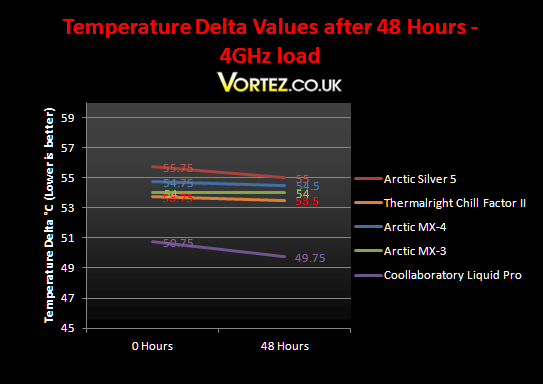
After 48 hours, there was very little change in performance, suggesting that the ARCTIC MX-3 and MX-4 lived up to their non-curing reputation. The Thermalright Chill Factor II also shows similar properties. over the 2 days period, the ARCTIC Silver 5 yielded lower temperatures but not enough to warrant consideration. The Coollaboratory Liquid Pro is still the best solution but for risk free application, Thermalright’s answer comes out as the winner.
Conclusion
Concluding the ARCTIC MX-4 is a lot harder this time than it was last year with the release of the ARCTIC MX-3. Back then, it was clear that ARCTIC was ahead of its competition, ruling the roost unchallenged. But the world of thermal paste moves fast, especially with growing emphasis on cooling even hotter cores whether they be CPUs or GPUs. Unfortunately, the ARCTIC MX-4 failed to deliver a shattering blow, a tough feat to follow after reviewing the ARCTIC MX-3. At stock speed, it gave good results but those were easily matched by the Chill Factor II. Looking at the overclocked results, it starts to trail behind both the Thermalright offering and the ARCTIC MX-3, not ideal when the higher suffix was meant to denote better performance.
Conversely, it\’s not all doom for ARCTIC. They are marketing the MX-4 as a much cheaper alternative and at €3,90/£3.25, it is half the price of a similarly sized tube of ARCTIC MX-3. So the question is if the small performance difference is really worth the premium when considering the latter. Personally I would always opt for the better product but the process is rendered easier when we look at the Thermalright Chill Factor II, which is not only the best performer but also as cheap as the ARCTIC MX-4.
Nonetheless, the ARCTIC MX-4 is still a good product and users will no doubt ignore the 1C difference when buying from such a reputable brand.

Pros
+ Decent performance
+ Handy level indicator on tube
+ 4g net content for multiple application
+ Price
Cons
– Better alternatives exist
The ARCTIC MX-4 earns the Vortez Hardware Bronze Award.