


Coming in ready to support the next-gen APUs due sometime early next year, we take a look at the A88X-PRO FM2+ motherboard from ASUS.

Product on Review: ASUS A88X-PRO
Manufacturer and Sponsor: ASUS
Street Price: £120 inc. VAT (GBP)
In lieu of the ‘Kaveri’ APUs, ASUS release a full featured ATX motherboard based on the A88X chipset dressed up in their current garb of golden heatsinks on a darkened background. As ever with ASUS, who are keen to include as many exclusive features as they can cram in, we find the new Dual intelligent processors 4 along with the new AI Suite 3 that aims to give users maximum control over their system performance and power efficiency.
Overview by ASUS
A88X motherboard with FM2+ Socket offers perfect one-stop system optimization and boosts integrated graphics on all APUs.
Specifications & Features
CPU
AMD Socket FM2+ Athlon™/A- Series Processors
Supports CPU up to 4 cores
Supports AMD® Turbo Core 3.0 Technology
* Refer to www.asus.com for CPU support list
Chipset
AMD A88X (Bolton D4)
Memory
4 x DIMM, Max. 64GB, DDR3 2400(O.C.)/2250(O.C.)/2200(O.C.)/2133/1866/1600/1333 MHz Non-ECC, Un-buffered Memory
Dual Channel Memory Architecture
Support AMD Memory Profile (AMP) memory
* The Max. 64GB memory capacity can be supported with DIMMs of 16GB (or above). ASUS will update QVL once the DIMMs are available on the market.
* Hyper DIMM support is subject to the physical characteristics of individual CPUs.
* Refer to www.asus.com for the Memory QVL (Qualified Vendors Lists).
* Due to OS limitation, when installing total memory of 4GB capacity or more, Windows® 32-bit operation system may only recognize less than 3GB. Install a 64-bit Windows® OS when you want to install 4GB or more memory on the motherboard.
Graphic
Integrated AMD Radeon™ HD 7000/8000 Series Graphics in A-series APU
Multi-VGA output support : HDMI/DVI/RGB/DisplayPort ports
– Supports HDMI with max. resolution 4096 x 2160 @ 24 Hz / 1920 x 1200 @ 60 Hz*1
– Supports DVI with max. resolution 2560 x 1600 @ 60 Hz
– Supports RGB with max. resolution 1920 x 1600 @ 60 Hz
– Supports DisplayPort with max. resolution 4096 x 2160 @ 60 Hz
Maximum shared memory of 2048 MB
AMD® Dual Graphics technology support *2
Multi-GPU Support
Supports AMD 3-Way CrossFireX™ Technology
Expansion Slots
2 x PCIe 3.0/2.0 x16 (x16 or dual x8) *3
1 x PCIe 2.0 x16 (x4 mode)
2 x PCIe 2.0 x1
2 x PCI
Storage
AMD A88X FCH(Bolton D4) chipset :
6 x SATA 6Gb/s port(s), yellow
2 x eSATA 6Gb/s port(s), red
Support Raid 0, 1, 5, 10, JBOD
LAN
Realtek® 8111GR, 1 x Gigabit LAN Controller(s)
Audio
Realtek® ALC1150 8-Channel High Definition Audio CODEC
– Supports : Jack-detection, Multi-streaming, Front Panel Jack-retasking
USB Ports
AMD A88X FCH(Bolton D4) chipset :
4 x USB 3.0 port(s) (2 at back panel, blue, 2 at mid-board)
AMD A88X FCH(Bolton D4) chipset :
10 x USB 2.0 port(s) (2 at back panel, black, 8 at mid-board)
ASMedia® ASM1042 controller :
2 x USB 3.0 port(s) (2 at back panel, blue)
Special Features
ASUS Dual Intelligent Processors 4 with 4-Way Optimization :
– The tuning key perfectly consolidates ASUS-exclusive DIGI+ Power Control, TPU, EPU, and Fan Xpert 2 optimize the digital power setting, system performance, power saving and whole system cooling configuration
ASUS 5X Protection :
– ASUS DIGI+ VRM – 6 + 2 Phase digital power design
– ASUS Enhanced DRAM Overcurrent Protection – Short circuit damage prevention
– ASUS ESD Guards – Enhanced ESD protection
– ASUS High-Quality 5K-Hour Solid Capacitors – 2.5x long lifespan with excellent durability
– ASUS Stainless Steel Back I/O – 3x more durable corrosion-resistant coating
ASUS EPU :
– EPU switch
ASUS Exclusive Features :
– GPU Boost
– Remote GO!
– USB BIOS Flashback
– MemOK!
– AI Suite 3
– Ai Charger+
– USB Charger+ *4
– Anti-Surge
– Low EMI Solution
– ESD Guards
– ASUS UEFI BIOS EZ Mode featuring friendly graphics user interface
– Network iControl
– USB 3.0 Boost
– Disk Unlocker
ASUS Quiet Thermal Solution :
– Stylish Fanless Design Heat-pipe solution
– ASUS Fan Xpert 2
ASUS EZ DIY :
– DirectKey
– Precision Tweaker 2
– ASUS O.C. Tuner
– ASUS CrashFree BIOS 3
– ASUS EZ Flash 2
– ASUS MyLogo 2
– ASUS USB BIOS Flashback
– ASUS UEFI BIOS EZ Mode
– Multi-language BIOS
ASUS Q-Design :
– ASUS Q-Shield
– ASUS Q-Code
– ASUS Q-Slot
– ASUS Q-Connector
Operating System Support
Windows® 8.1
Windows® 8 , 32bit/64bit
Windows® 7 , 32bit/64bit
Windows® XP , 32bit
Back I/O Ports
1 x PS/2 keyboard/mouse combo port(s)
1 x DVI
1 x D-Sub
1 x DisplayPort
1 x HDMI
2 x eSATA 6Gb/s
1 x LAN (RJ45) port(s)
4 x USB 3.0
2 x USB 2.0
1 x Optical S/PDIF out
5 x Audio jack(s)
Internal I/O Ports
1 x USB 3.0 connector(s) support(s) additional 2 USB 3.0 port(s) (19-pin)
4 x USB 2.0 connector(s) support(s) additional 8 USB 2.0 port(s)
1 x COM port(s) connector(s)
6 x SATA 6Gb/s connector(s)
1 x CPU Fan connector(s) (4 -pin)
4 x Chassis Fan connector(s) (4 -pin)
1 x S/PDIF out header(s)
1 x 24-pin EATX Power connector(s)
1 x 8-pin ATX 12V Power connector(s)
1 x Front panel audio connector(s) (AAFP)
1 x System panel(s) (Q-Connector)
1 x DirectKey Button(s)
1 x DRCT header(s)
1 x MemOK! button(s)
1 x TPU switch(es)
1 x EPU switch(es)
1 x Clear CMOS jumper(s)
1 x USB BIOS Flashback button(s)
Accessories
User’s manual
ASUS Q-Shield
4 x SATA 6Gb/s cable(s)
1 x Q-connector(s) (2 in 1)
BIOS
64 Mb Flash ROM, UEFI AMI BIOS, PnP, DMI2.0, WfM2.0, SM BIOS 2.7, ACPI 2.0a, Multi-language BIOS, ASUS EZ Flash 2, ASUS CrashFree BIOS 3, F12 PrintScreen Function, F3 Shortcut Function and ASUS DRAM SPD (Serial Presence Detect) memory information
Support Disc
Drivers, ASUS utilities, ASUS Update, Anti-virus software (OEM version)
Note
*1: *Only FM2+ APU can support up to 4096 x 2160 resolution display via HDMI port.
*2: Refer to HYPERLINK “http://www.amd.com/us/products/technologies/dual-graphics/Pages/dual-graphics.aspx”http://www.amd.com/us/products/technologies/dual-graphics/Pages/dual-graphics.aspx#3 for the discrete GPUs which support Dual Graphics technology.
*3: Only FM2+ Processors can support PCIe3.0.
*4 USB Charger+ is only supported in Windows®7 and later versions.
AMD Socket FM2+ Athlon™/A- Series Processors
Supports CPU up to 4 cores
Supports AMD® Turbo Core 3.0 Technology
* Refer to www.asus.com for CPU support list
Chipset
AMD A88X (Bolton D4)
Memory
4 x DIMM, Max. 64GB, DDR3 2400(O.C.)/2250(O.C.)/2200(O.C.)/2133/1866/1600/1333 MHz Non-ECC, Un-buffered Memory
Dual Channel Memory Architecture
Support AMD Memory Profile (AMP) memory
* The Max. 64GB memory capacity can be supported with DIMMs of 16GB (or above). ASUS will update QVL once the DIMMs are available on the market.
* Hyper DIMM support is subject to the physical characteristics of individual CPUs.
* Refer to www.asus.com for the Memory QVL (Qualified Vendors Lists).
* Due to OS limitation, when installing total memory of 4GB capacity or more, Windows® 32-bit operation system may only recognize less than 3GB. Install a 64-bit Windows® OS when you want to install 4GB or more memory on the motherboard.
Graphic
Integrated AMD Radeon™ HD 7000/8000 Series Graphics in A-series APU
Multi-VGA output support : HDMI/DVI/RGB/DisplayPort ports
– Supports HDMI with max. resolution 4096 x 2160 @ 24 Hz / 1920 x 1200 @ 60 Hz*1
– Supports DVI with max. resolution 2560 x 1600 @ 60 Hz
– Supports RGB with max. resolution 1920 x 1600 @ 60 Hz
– Supports DisplayPort with max. resolution 4096 x 2160 @ 60 Hz
Maximum shared memory of 2048 MB
AMD® Dual Graphics technology support *2
Multi-GPU Support
Supports AMD 3-Way CrossFireX™ Technology
Expansion Slots
2 x PCIe 3.0/2.0 x16 (x16 or dual x8) *3
1 x PCIe 2.0 x16 (x4 mode)
2 x PCIe 2.0 x1
2 x PCI
Storage
AMD A88X FCH(Bolton D4) chipset :
6 x SATA 6Gb/s port(s), yellow
2 x eSATA 6Gb/s port(s), red
Support Raid 0, 1, 5, 10, JBOD
LAN
Realtek® 8111GR, 1 x Gigabit LAN Controller(s)
Audio
Realtek® ALC1150 8-Channel High Definition Audio CODEC
– Supports : Jack-detection, Multi-streaming, Front Panel Jack-retasking
USB Ports
AMD A88X FCH(Bolton D4) chipset :
4 x USB 3.0 port(s) (2 at back panel, blue, 2 at mid-board)
AMD A88X FCH(Bolton D4) chipset :
10 x USB 2.0 port(s) (2 at back panel, black, 8 at mid-board)
ASMedia® ASM1042 controller :
2 x USB 3.0 port(s) (2 at back panel, blue)
Special Features
ASUS Dual Intelligent Processors 4 with 4-Way Optimization :
– The tuning key perfectly consolidates ASUS-exclusive DIGI+ Power Control, TPU, EPU, and Fan Xpert 2 optimize the digital power setting, system performance, power saving and whole system cooling configuration
ASUS 5X Protection :
– ASUS DIGI+ VRM – 6 + 2 Phase digital power design
– ASUS Enhanced DRAM Overcurrent Protection – Short circuit damage prevention
– ASUS ESD Guards – Enhanced ESD protection
– ASUS High-Quality 5K-Hour Solid Capacitors – 2.5x long lifespan with excellent durability
– ASUS Stainless Steel Back I/O – 3x more durable corrosion-resistant coating
ASUS EPU :
– EPU switch
ASUS Exclusive Features :
– GPU Boost
– Remote GO!
– USB BIOS Flashback
– MemOK!
– AI Suite 3
– Ai Charger+
– USB Charger+ *4
– Anti-Surge
– Low EMI Solution
– ESD Guards
– ASUS UEFI BIOS EZ Mode featuring friendly graphics user interface
– Network iControl
– USB 3.0 Boost
– Disk Unlocker
ASUS Quiet Thermal Solution :
– Stylish Fanless Design Heat-pipe solution
– ASUS Fan Xpert 2
ASUS EZ DIY :
– DirectKey
– Precision Tweaker 2
– ASUS O.C. Tuner
– ASUS CrashFree BIOS 3
– ASUS EZ Flash 2
– ASUS MyLogo 2
– ASUS USB BIOS Flashback
– ASUS UEFI BIOS EZ Mode
– Multi-language BIOS
ASUS Q-Design :
– ASUS Q-Shield
– ASUS Q-Code
– ASUS Q-Slot
– ASUS Q-Connector
Operating System Support
Windows® 8.1
Windows® 8 , 32bit/64bit
Windows® 7 , 32bit/64bit
Windows® XP , 32bit
Back I/O Ports
1 x PS/2 keyboard/mouse combo port(s)
1 x DVI
1 x D-Sub
1 x DisplayPort
1 x HDMI
2 x eSATA 6Gb/s
1 x LAN (RJ45) port(s)
4 x USB 3.0
2 x USB 2.0
1 x Optical S/PDIF out
5 x Audio jack(s)
Internal I/O Ports
1 x USB 3.0 connector(s) support(s) additional 2 USB 3.0 port(s) (19-pin)
4 x USB 2.0 connector(s) support(s) additional 8 USB 2.0 port(s)
1 x COM port(s) connector(s)
6 x SATA 6Gb/s connector(s)
1 x CPU Fan connector(s) (4 -pin)
4 x Chassis Fan connector(s) (4 -pin)
1 x S/PDIF out header(s)
1 x 24-pin EATX Power connector(s)
1 x 8-pin ATX 12V Power connector(s)
1 x Front panel audio connector(s) (AAFP)
1 x System panel(s) (Q-Connector)
1 x DirectKey Button(s)
1 x DRCT header(s)
1 x MemOK! button(s)
1 x TPU switch(es)
1 x EPU switch(es)
1 x Clear CMOS jumper(s)
1 x USB BIOS Flashback button(s)
Accessories
User’s manual
ASUS Q-Shield
4 x SATA 6Gb/s cable(s)
1 x Q-connector(s) (2 in 1)
BIOS
64 Mb Flash ROM, UEFI AMI BIOS, PnP, DMI2.0, WfM2.0, SM BIOS 2.7, ACPI 2.0a, Multi-language BIOS, ASUS EZ Flash 2, ASUS CrashFree BIOS 3, F12 PrintScreen Function, F3 Shortcut Function and ASUS DRAM SPD (Serial Presence Detect) memory information
Support Disc
Drivers, ASUS utilities, ASUS Update, Anti-virus software (OEM version)
Note
*1: *Only FM2+ APU can support up to 4096 x 2160 resolution display via HDMI port.
*2: Refer to HYPERLINK “http://www.amd.com/us/products/technologies/dual-graphics/Pages/dual-graphics.aspx”http://www.amd.com/us/products/technologies/dual-graphics/Pages/dual-graphics.aspx#3 for the discrete GPUs which support Dual Graphics technology.
*3: Only FM2+ Processors can support PCIe3.0.
*4 USB Charger+ is only supported in Windows®7 and later versions.
Packaging & First Look
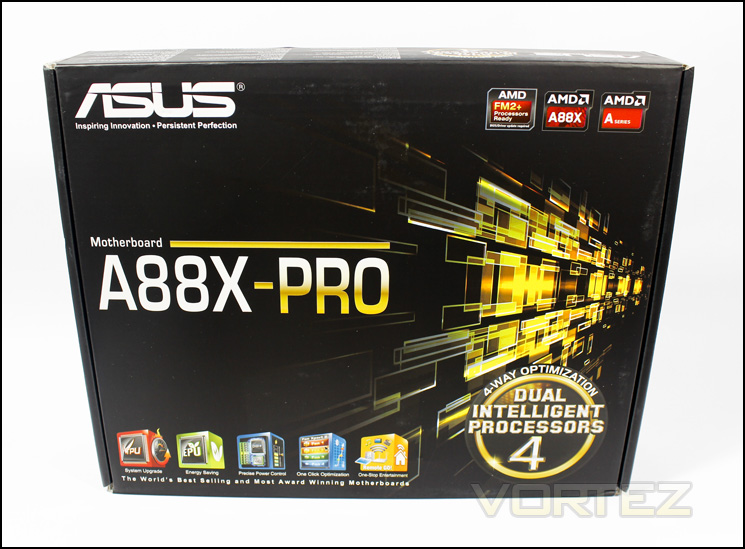
The box front
The outer display shows the product name in large with a similar colour scheme to the motherboard itself. Icons at the edges show clearly that the board is for the FM2+ socket and displays a few of the ASUS exclusive features.
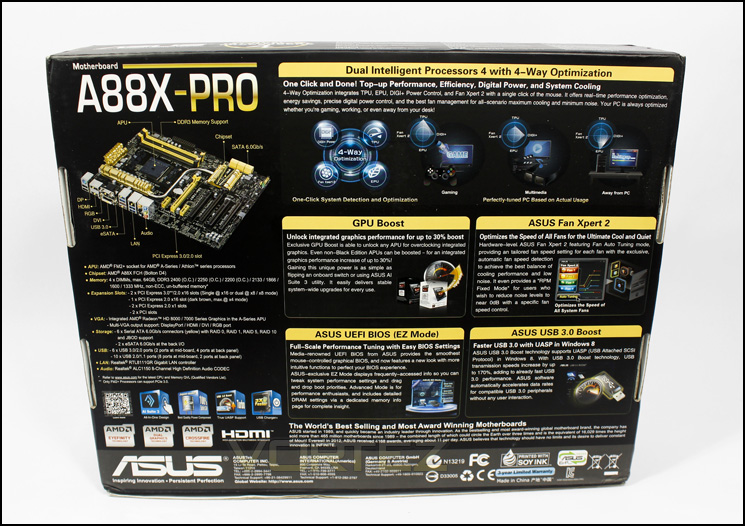
Rear side of package
On the rear we find detailed specifications of the product and information about some of the features.
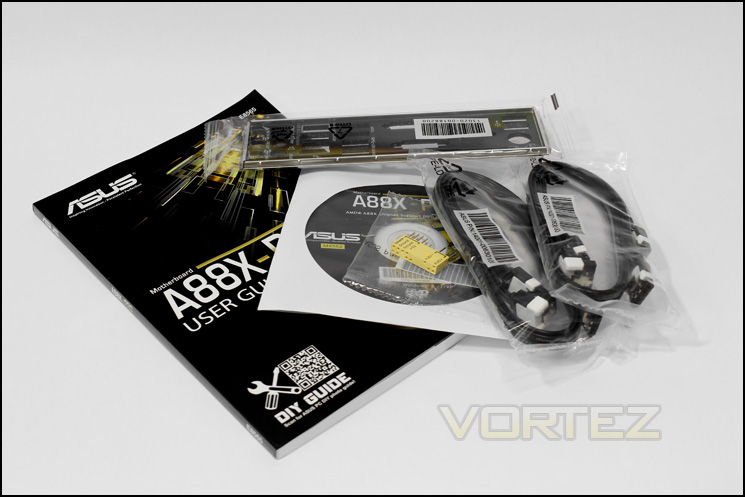
Included accessories
Standard inclusive items, I/O backplate, manual, sata cables and drivers/utility discas well as an ASUS Qcable header plug.
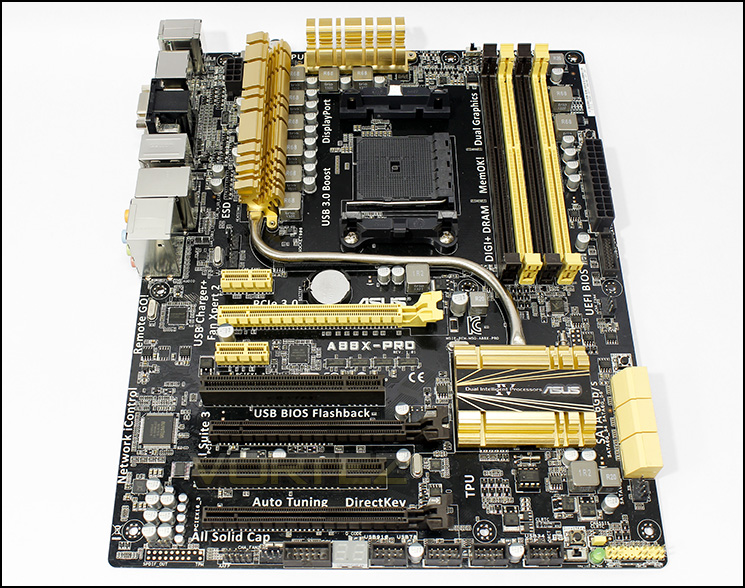
Overview of the A88X-PRO
The aesthetic may be a little hit and miss with some people, but realistically the colour of a motherboard is rarely going to stand out too much in a build once you get everything plugged in. Regardless, the yellow/gold on black/dark brown looks great and is well organised. The expansion slot layout is pretty much ideal with a PCIe x1 at the top followed by the primary x16 (PCIe 3.0 enabled with Kaveri APUs) that has two slots of space before the next PCIe 3.0/2.0 x16 (electrical x8) slot. There are also 2 legacy PCI slots with a final PCIe 2.0 x16.
Closer Look
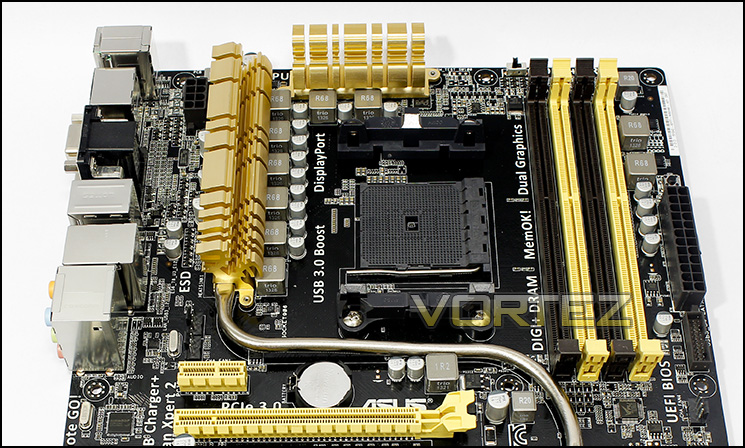
The top region
At the top left we find an 8pin 12v ATX socket, running down the left hand side we find a dual 4pin pwm fan header beneath the large golden headsink. At the top right there is the ASUS EPU switch just above the DIMMs. Along the right side of the motherboard we can find a MEMOK! button, the 24pin ATX socket followed by a front panel USB 3.0 header and another 4pin PWM fan header.
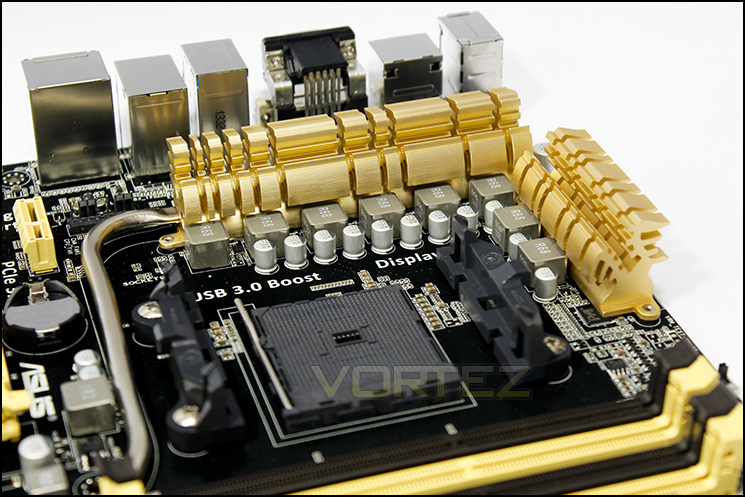
Socket area
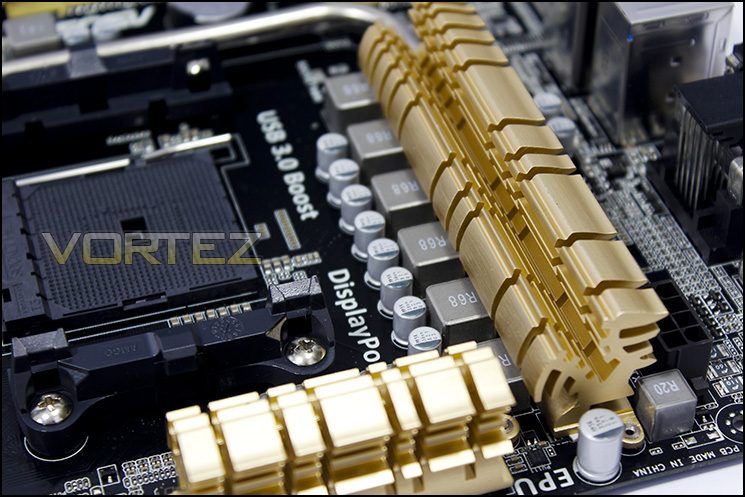
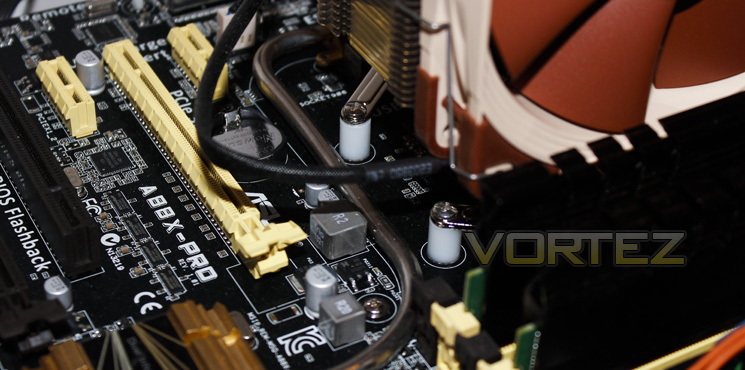
The FM2+ socket is powered by a 6+2 digital power phase system and the whole board uses Japanese made 5K solid capacitors. The FM2+ socket allows an extra pin for the new APUs, likely enabling the use of the PCIe 3.0 feature.
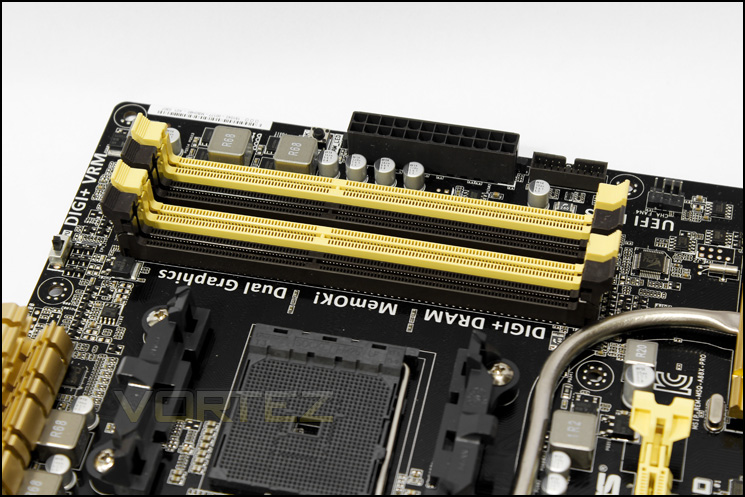
DIMMs
An attractive resting place for some high performance memory modules.
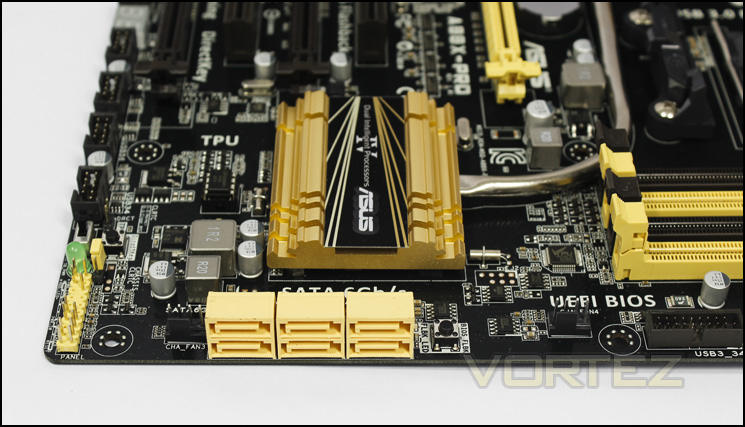
Right angle SATA
From left to right we find a 4pin PWM fan header, 6x SATA 6Gb/s, the right angle mount is the preference for many, followed by the BIOS flashback button.
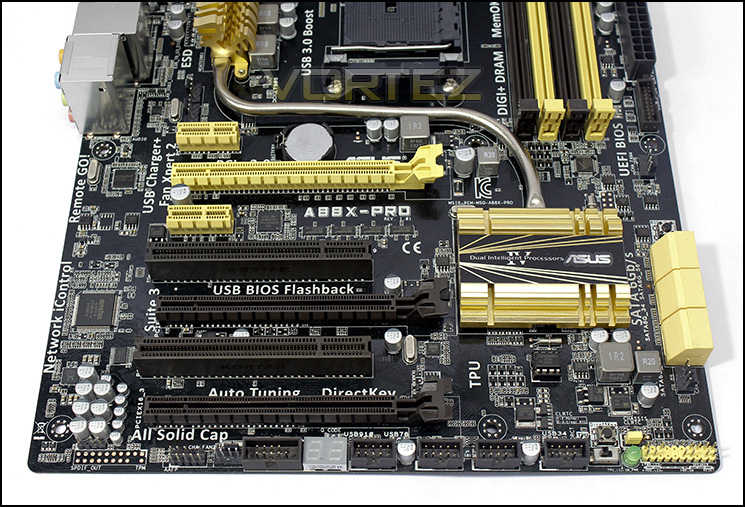
Bottom region
Along the bottom (left to right) we find the front panel audio header, another 4pin PWM fan header, COM headers, debug LED display, 4x 2 USB 2.0 headers, the TPU switch and Direct Key button, the Power LED, CMOS jumper and finally the front panel connection headers.
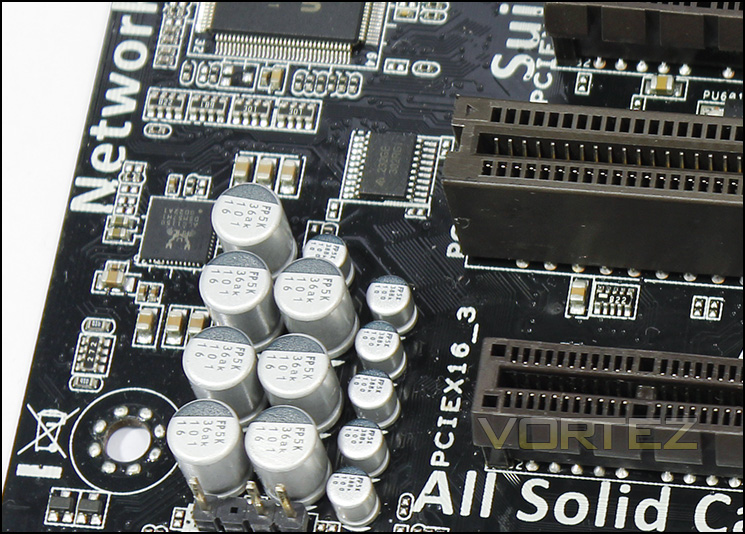
Audio chipset
The A88X-PRO uses Realtek’s latest and greatest audio chip being the ALC1150 that provides 7.1 channels with 24bit 192Khz sampling rate on each.
rear I/O
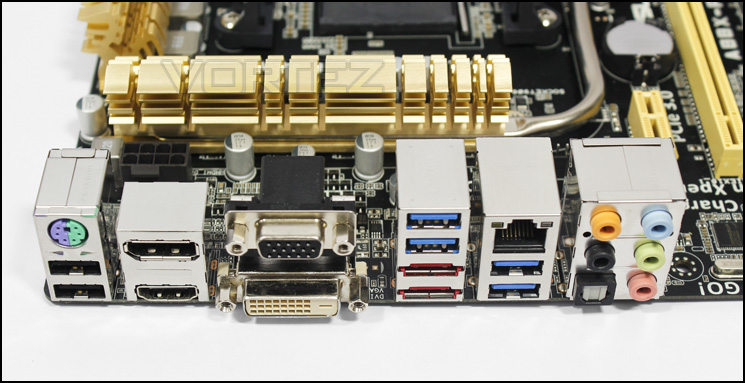
The rear I/O gives us a universal PS2, 2x USB 2.0, displayport, HDMI, VGA, DVI video outputs, 2x eSATA, 4x USB 3.0, RJ45 gigabit lan port, optical S/PDIF out and 5x 3.5mm audio jacks.
BIOS & Software
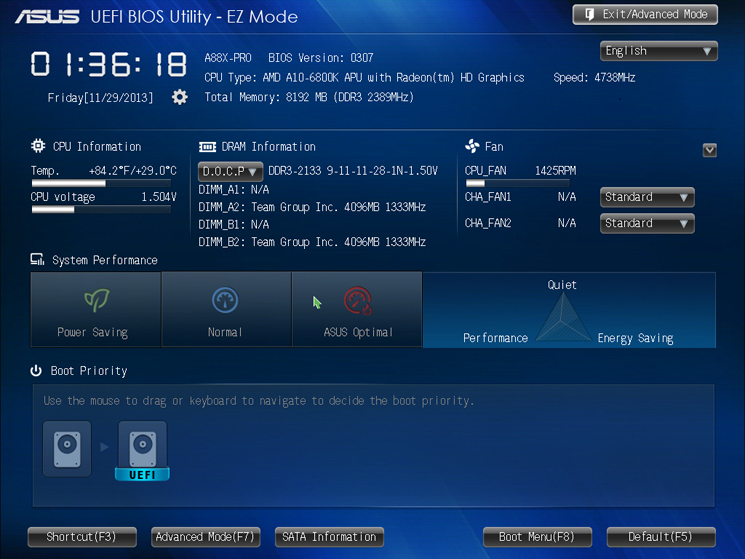
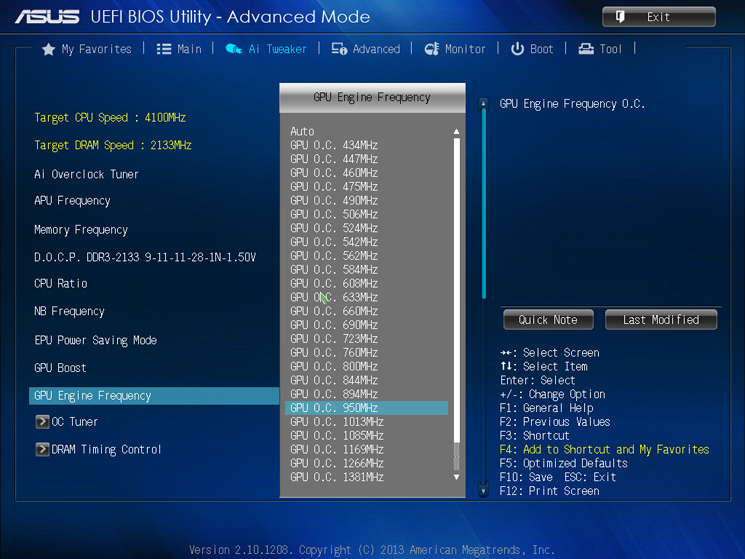
The ASUS BIOS we find on the A88X are not as pretty as say the ROG motherboards but it is smooth, simple and easy to understand. The EZ mode provides all the basic information while the advanced mode gives all the functions you need to control your system. Interestingly I took a look at the GPU boost mode which displays all the GPU clock speed straps and is capable of even overclocking non-K (unlocked black editions)APUs.
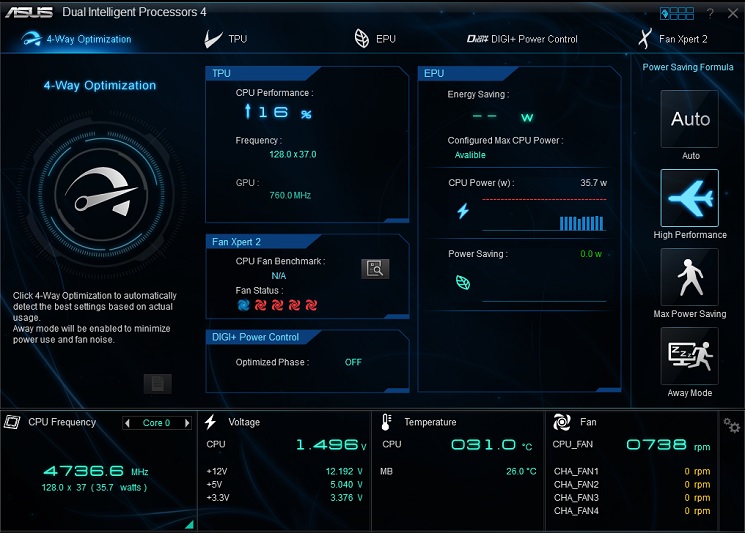
The ASUS AI Suite 3 is now a unified software bundle featuring all of ASUS previous functions in one place including energy saving features via the EPU, Performance tweaking features via the TPU, noise and cooling control via the Fan Xpert 2 and the DIGI+ Power Control allows you to control the CPU power settings. If that wasn’t enough control, this motherboard is also compatible to use the NFC Express should you wish to control your PC via mobile phone.
Test Setup
A85X Setup
APU – A10-6800K
Motherboard – GIGABYTE F2A85X-UP4
RAM – Xtreem LV PC3 19200 DDR3 LV 2400
SSD – Kingston Hyper X 120GB
Power Supply – NZXT Hale82 650W
Cooler – Noctua NH-U12S
APU – A10-6800K
Motherboard – GIGABYTE F2A85X-UP4
RAM – Xtreem LV PC3 19200 DDR3 LV 2400
SSD – Kingston Hyper X 120GB
Power Supply – NZXT Hale82 650W
Cooler – Noctua NH-U12S
A88X Setup
APU – A10-6800K
Motherboard – ASUS A88X-PRO
RAM – Xtreem LV PC3 19200 DDR3 LV 2400
SSD – Kingston Hyper X 120GB
Power Supply – NZXT Hale82 650W
Cooler – Noctua
APU – A10-6800K
Motherboard – ASUS A88X-PRO
RAM – Xtreem LV PC3 19200 DDR3 LV 2400
SSD – Kingston Hyper X 120GB
Power Supply – NZXT Hale82 650W
Cooler – Noctua
APU Configurations
A10-6800K @ 4.1 GHz/4.4 GHz @ 100MHz x 41/44, OC 4.736GHz @ 37 x 128MHz
HD 8670D integrated graphics @ 844 MHz, OC @ 973MHz
Memory @ 1333 MHz 9-9-9-24, OC @ 973 MHz, 2389 MHz 11-11-11-28)
Overclocking
Overclocking via BIOS was simple using the advanced settings. Using the TPU switch/ OC Tuner for an automatic overclock was simple and stable, giving a static 4.4GHz CPU clock speed with a GPU OC of 950MHz. Unfortunately however, it did not automatically overclock the memory. Not a massive issue considering you can load the XMP files or manually input them. As previously discussed when looking at the A10-6800K APU, for best performance-per-watt gains, a small bump in CPU speed, like seen using the OC Tuner with a decent OC on the GPU paired with high performance memory is best. Reaching for top performance however, The A88X-PRO managed to hold the APU shy of 4.8GHz with a GPU speed of 973MHz.
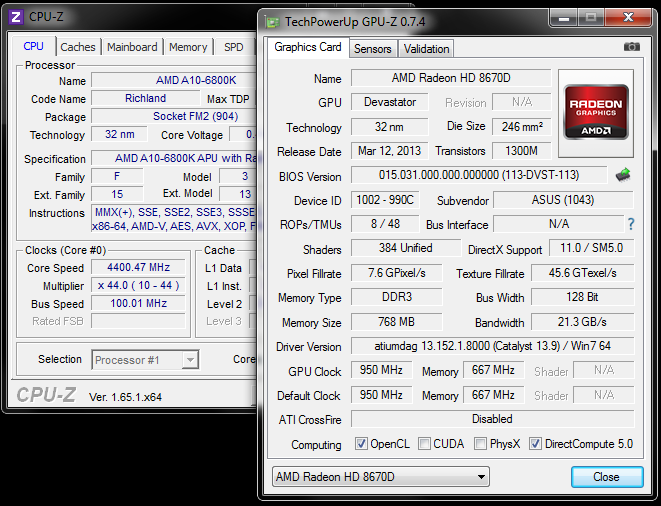
Results using TPU/OC Tuner
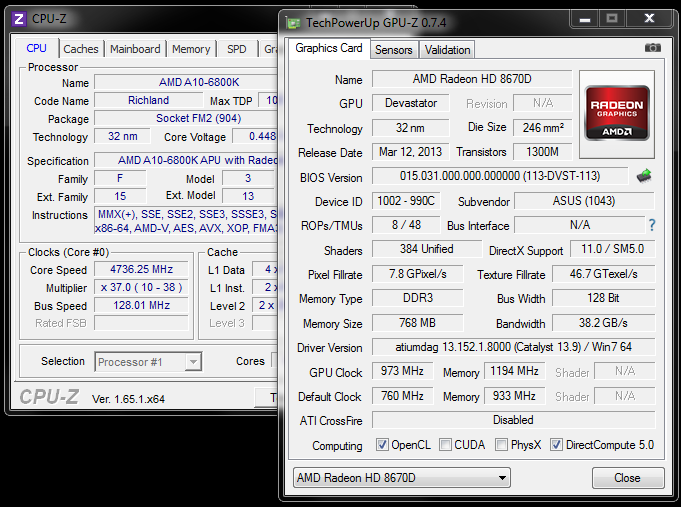
Final Overclock result
Power Consumption
It’s interesting to note the power consumption across all motherboards because energy results can fluctuate between manufacturers due to the features and specifications that are integrated. First of all, for the idle tests the system is cold booted into Windows and no additional applications are executed – the watts are noted on the external energy monitor we use. Then the system is loaded with LinX 0.6.4 and MSI Kombustor simultainiously – watts are again monitored throughout the period of testing and the highest rated watts are then noted down. Below are the results of this energy test.
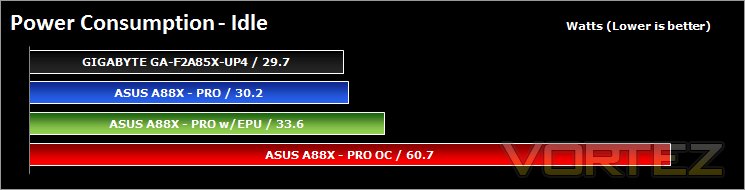
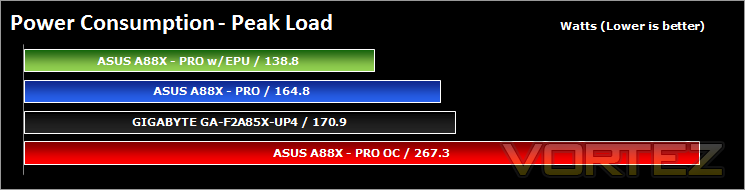
The A88x-PRO manages to control the power consumed under full load in comparison to the GIGABYTE motherboard. For curiosity, we test the idle and peak load when using the EPU power saving mode. Idle consumption had risen a little, but under full load EPU managed to save a full 26W, pretty impressive. As expected with a CPU frequency and voltage increase, power consumption sky rockets when overclocked.
Synthetic Benchmarks: AIDA64
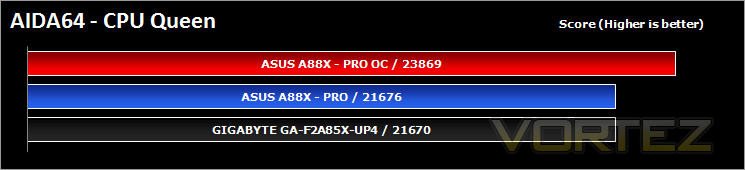
CPU Queen Benchmark
This simple integer benchmark focuses on the branch prediction capabilities and the misprediction penalties of the CPU. It finds the solutions for the classic “Queens problem” on a 10 by 10 sized chessboard. At the same clock speed theoretically the processor with the shorter pipeline and smaller misprediction penalties will attain higher benchmark scores. For example — with HyperThreading disabled — the Intel Northwood core processors get higher scores than the Intel Prescott core based ones due to the 20-step vs 31-step long pipeline. CPU Queen test uses integer MMX, SSE2 and SSSE3 optimizations.
CPU Photoworxx Benchmark
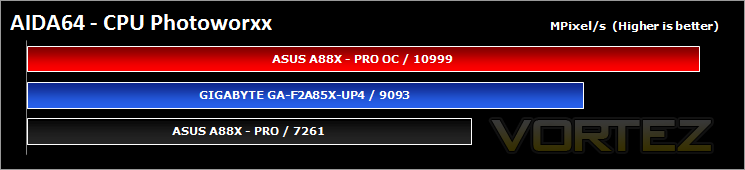
This benchmark stresses the integer arithmetic and multiplication execution units of the CPU and also the memory subsystem. Due to the fact that this test performs high memory read/write traffic, it cannot effectively scale in situations where more than 2 processing threads used. For example, on a 8-way Pentium III Xeon system the 8 processing threads will be “fighting” over the memory, creating a serious bottleneck that would lead to as low scores as a 2-way or 4-way similar processor based system could achieve. CPU PhotoWorxx test uses only the basic x86 instructions, and it is HyperThreading, multi-processor (SMP) and multi-core (CMP) aware.
We find the ASUS board falls short here, though is likely an error due to the FM2+ platform being new.
FPU Mandel Benchmark
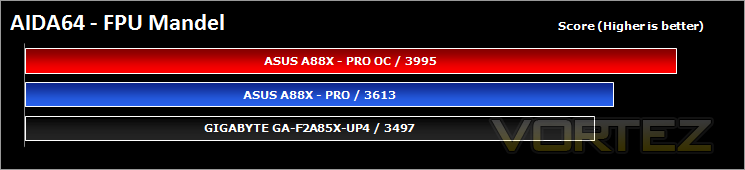
This benchmark measures the double precision (also known as 64-bit) floating-point performance through the computation of several frames of the popular “Mandelbrot” fractal. The code behind this benchmark method is written in Assembly, and it is extremely optimized for every popular AMD, Intel and VIA processor core variants by utilizing the appropriate x87, SSE2, AVX or FMA4 instruction set extension. FPU Mandel test is HyperThreading, multi-processor (SMP) and multi-core (CMP) aware.
Synthetic Benchmarks: x264 HD
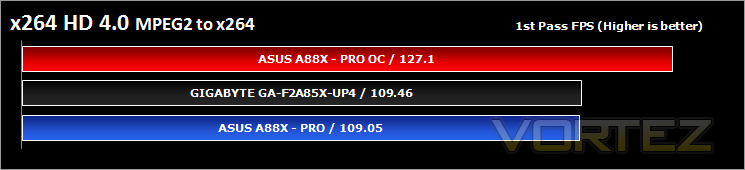
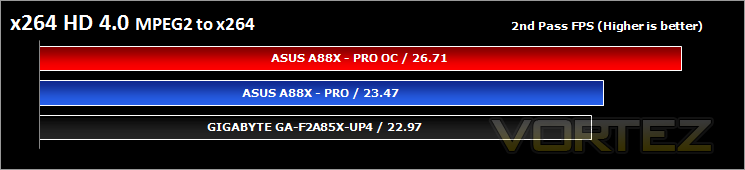
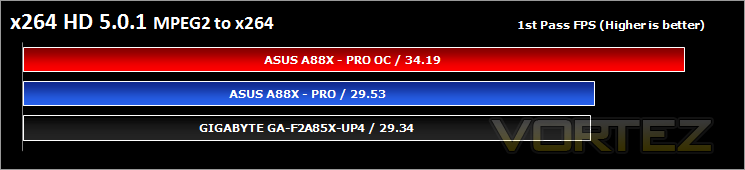
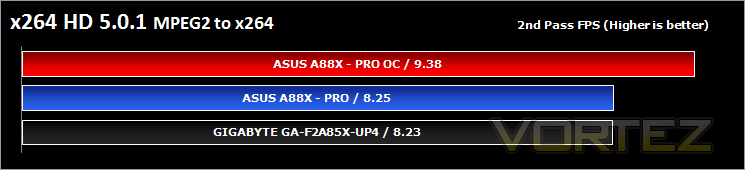
Simply put, this test measures how fast your machine can encode a short, DVD quality MPEG-2 video clip into a high-quality x264 video clip. What’s x264, you ask? It’s more or less the next-generation Xvid/DivX codec. I think it’s ideal for a benchmark because the application (x264.exe) reports fairly accurate compression results (in frames per second) for each pass of the video encoding process, and it uses multi-core processors very efficiently.
Synthetic Benchmarks: Cinebench 11.5
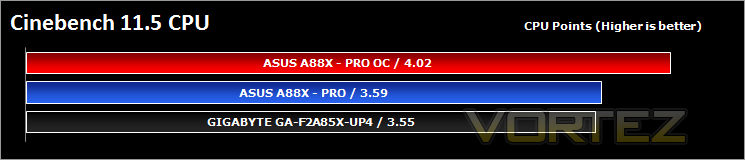
CPU Rendering
CINEBENCH can measure systems with up to 64 processor threads. This test scene contains approximately 2,000 objects which in turn contain more than 300,000 polygons in total, and uses sharp and blurred reflections, area lights, shadows, procedural shaders, antialiasing, and much more. The result is displayed in points (pts). The higher the number, the faster your processor.
Open GL Graphics Rendering
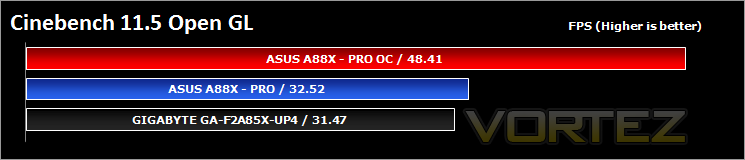
This procedure uses a complex 3D scene depicting a car chase (by renderbaron) which measures the performance of your graphics card in OpenGL mode. The performance depends on various factors, such as the GPU processor on your hardware, but also on the drivers used. The graphics card has to display a huge amount of geometry (nearly 1 million polygons) and textures, as well as a variety of effects, such as environments, bump maps, transparency, lighting and more to evaluate the performance across different disciplines and give a good average overview of the capabilities of your graphics hardware.
Synthetic Benchmarks: SiSoftware SANDRA
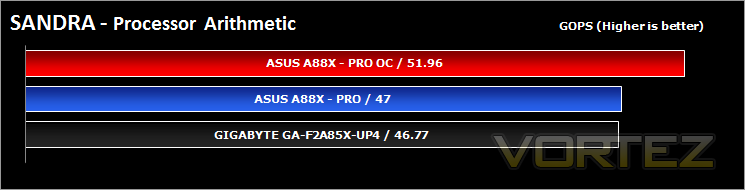
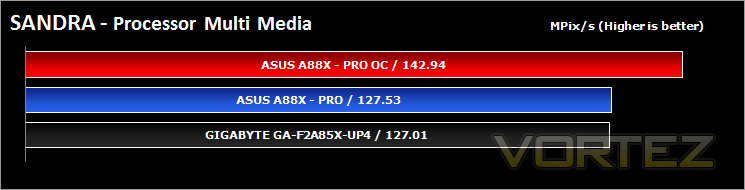
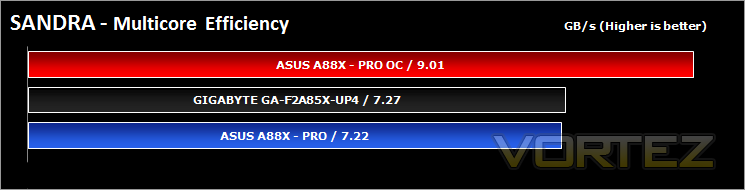
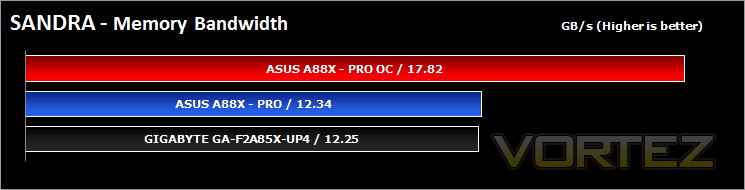
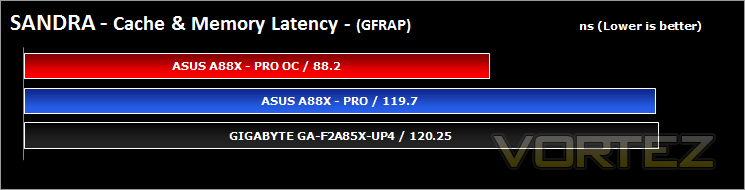
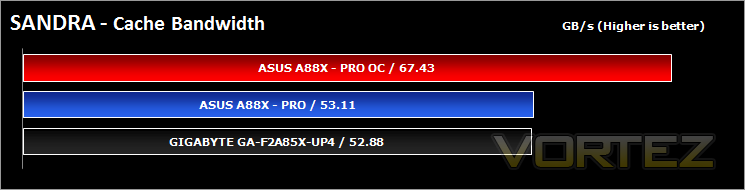
SANDRA isn’t always a benchmark that is included in hardware reviews but I believe it shouldn’t be ignored. SANDRA provides a vigorous package that tests your system in a rather large array of benchmarks. There are many aspects of benchmark that can be executed. We will be considering – CPU, memory and GPGPU tests.
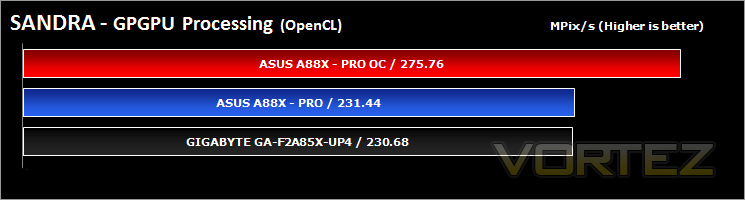
Synthetic Benchmarks: 3DMark 11 & 3DMark – Fire Strike
3DMark 11
Designed to measure your PC’s gaming performance 3DMark 11 makes extensive use of all the new features in DirectX 11 including tessellation, compute shaders and multi-threading. Trusted by gamers worldwide to give accurate and unbiased results, 3DMark 11 is the best way to consistently and reliably test DirectX 11 under game-like loads.
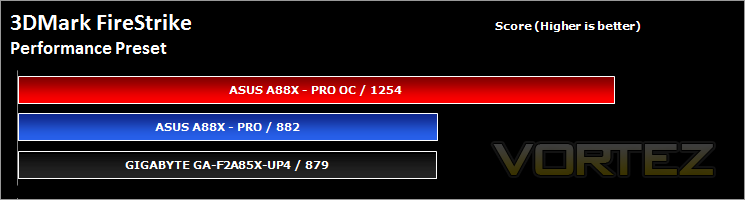
3DMark – Fire Strike
Fire Strike is our new showcase DirectX 11 benchmark designed for high-performance gaming PCs. It is our most ambitious and technical benchmark ever, featuring real-time graphics rendered with detail and complexity far beyond what is found in other benchmarks and games today. Fire Strike will only be available in the Windows editions of 3DMark initially.
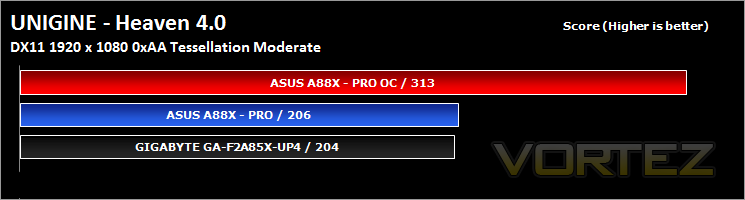
Synthetic Benchmarks: UNIGINE Heaven 4.0 & Valley 1.0
UNIGINE Heaven 4.0
Heaven Benchmark with its current version 4.0 is a GPU-intensive benchmark that hammers graphics cards to the limits. This powerful tool can be effectively used to determine the stability of a GPU under extremely stressful conditions, as well as check the cooling system’s potential under maximum heat output. It provides completely unbiased results and generates true in-game rendering workloads across all platforms, such as Windows, Linux and Mac OS X.
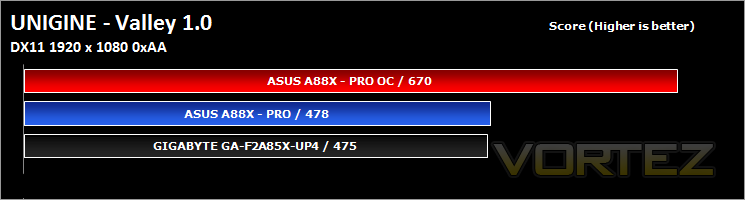
UNIGINE Valley 1.0
Valley Benchmark is a new GPU stress-testing tool from the developers of the very popular and highly acclaimed Heaven Benchmark. The forest-covered valley surrounded by vast mountains amazes with its scale from a bird’s-eye view and is extremely detailed down to every leaf and flower petal. This non-synthetic benchmark powered by the state-of-the art UNIGINE Engine showcases a comprehensive set of cutting-edge graphics technologies with a dynamic environment and fully interactive modes available to the end user.
Game Benchmarks: AVP, Deus Ex:HR, TESV, DiRT SD, DOTA 2
Alien Vs. Predator
Spawned from the popular Alien and Predator franchises, Rebellion have collaborated to bring the legendary war to us through the medium of a first-person shooter. The game forces you to hunt, prey and most importantly survive in the swamp colony of Freya’s prospect as a Predator, Alien or Marine. The stunning visuals add to the sense of dread and terror that we have become so accustomed to seeing with the series.
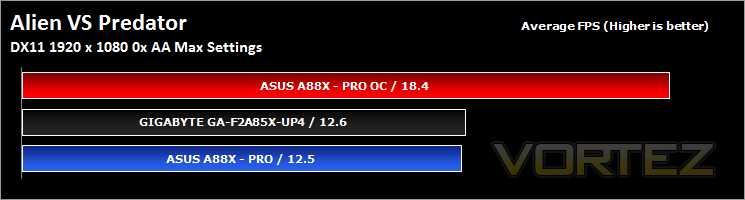
The stand-alone Alien VS Predator benchmark tool was used for testing here. All the settings were set to very high and Tessellation was applied. The average FPS was recorded at the end.
The stand-alone Alien VS Predator benchmark tool was used for testing here. All the settings were set to very high and Tessellation was applied. The average FPS was recorded at the end.
Deus Ex: Human Revolution
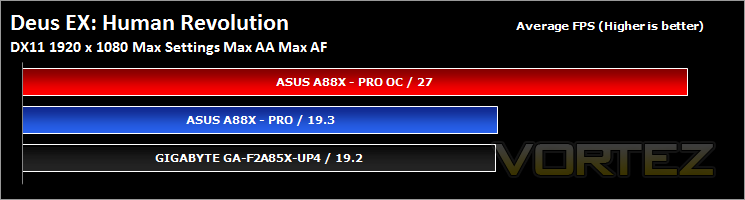
You play Adam Jensen, an ex-SWAT specialist who’s been handpicked to oversee the defensive needs of one of America’s most experimental biotechnology firms. Your job is to safeguard company secrets, but when a black ops team breaks in and kills the very scientists you were hired to protect, everything you thought you knew about your job changes.
TESV: Skyrim
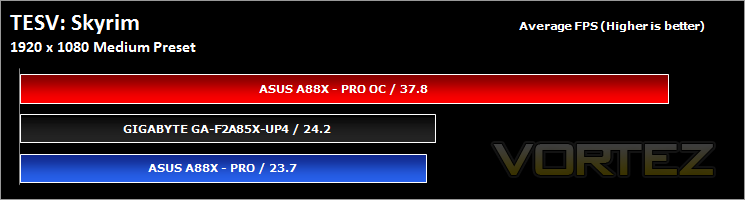
The Empire of Tamriel is on the edge. The High King of Skyrim has been murdered. Alliances form as claims to the throne are made. In the midst of this conflict, a far more dangerous, ancient evil is awakened. Dragons, long lost to the passages of the Elder Scrolls, have returned to Tamriel. The future of Skyrim, even the Empire itself, hangs in the balance as they wait for the prophesized Dragonborn to come; a hero born with the power of The Voice, and the only one who can stand amongst the dragons.
DiRT Showdown
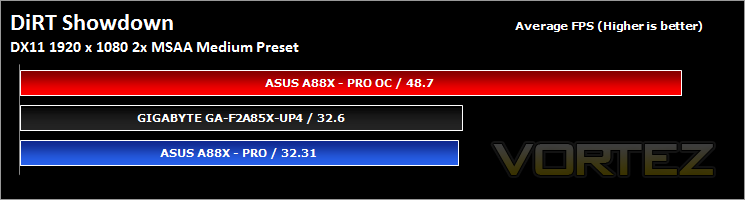
DiRT Showdown is the new arcade racing game from the team that brought you the award-winning DiRT series, uncaged in 2012. Pick up and play controls combine with electrifying events, frenzied crowds and stunning graphics to deliver high octane, dive in and drive thrills from event one. DiRT Showdown comes with phenomenal graphical performance, bone-jarring damage, and social online and split-screen multiplayer as standard. Welcome to DiRT Showdown – a new world of driving delirium.
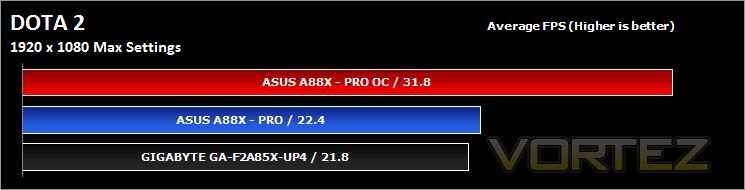
DOTA 2
Dota is a competitive game of action and strategy, played both professionally and casually by millions of passionate fans worldwide. Players pick from a pool of over a hundred heroes, forming two teams of five players. Radiant heroes then battle their Dire counterparts to control a gorgeous fantasy landscape, waging campaigns of cunning, stealth, and outright warfare.
Irresistably colorful on the surface, Dota is a game of infinite depth and complexity. Every hero has an array of skills and abilities that combine with the skills of their allies in unexpected ways, to ensure that no game is ever remotely alike. This is one of the reasons that the Dota phenomenon has continued to grow.
Irresistably colorful on the surface, Dota is a game of infinite depth and complexity. Every hero has an array of skills and abilities that combine with the skills of their allies in unexpected ways, to ensure that no game is ever remotely alike. This is one of the reasons that the Dota phenomenon has continued to grow.
Conclusion
After using the A88X-PRO for a while, you really start to feel confident while playing around with the optimisation features via the AI Suite 3. Everything just works, or recovers instantly. Not once did I witness a BSOD or lockup while tinkering with overclocking features, simply a restart with an ‘overclock failed’ notice. From setup to start up ASUS have your back, quality components give you stability and reassurance, usability gives you courage and the software provides you with the means to pull the best out of the platform.
There are few if any downsides, the price will be alongside the top tier of the FM2+ motherboards but you get what you pay for. The only real thing the A88X-PRO lacks, is ‘enthusiast appeal’. There are no power or reset buttons found onboard, no fancy over the top features like high end circuitry for the audio, however, that is not the appeal of this board. The A88X-PRO provides all the latest technology ready for AMD’s next-gen APUs in a no nonsense platform that enables you maximum potential for the mainstream user and ‘sensible’ enthusiast alike. I guess what I should be saying is, this is the most you will get out of an ASUS motherboard for the FM2+ platform that will not be labelled ‘Republic of Gamers or TUF’.
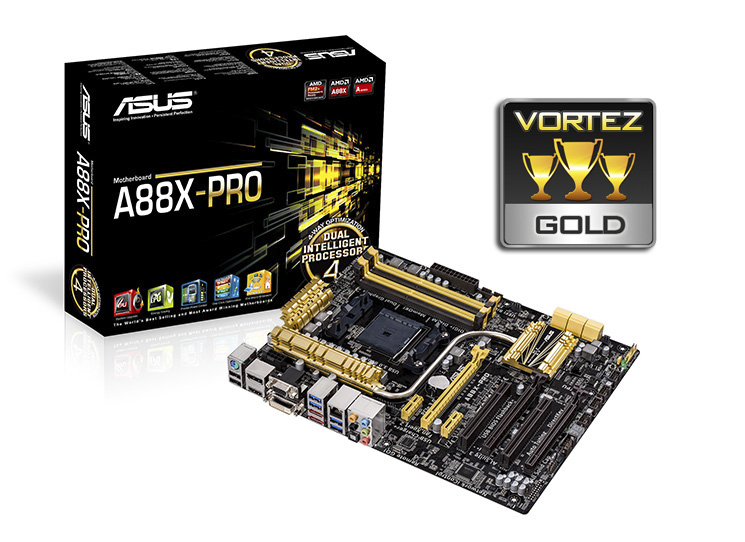
ASUS show us again why they are a powerhouse of innovation. From aesthetics and layout to features and supporting software the A88X-PRO is literally Gold all over!
Pros.
+ Glamourous aesthetic
+ Well laid out
+ Robust, quality components
+ Dual Intelligent Processors 4
+ ALC 1150 audio processor
+ FM2+ – Will support next-gen APUs
Cons.
– None
+ Glamourous aesthetic
+ Well laid out
+ Robust, quality components
+ Dual Intelligent Processors 4
+ ALC 1150 audio processor
+ FM2+ – Will support next-gen APUs
Cons.
– None

Click here for an explanation of our awards at Vortez.net. Thanks to ASUS for providing today’s review sample.


