







ASUS Republic of Gamers add their fourth addition to Maximus VI Series. Impact is a Mini-ITX Intel Z87 motherboard, delivering numerous features to Intel Haswell.

Product on Review: Maximus VI Impact
Manufacturer and Sponsor: ASUS
Street Price: £180 (At time of review)
A number of vendors used Intel’s last generation Ivy Bridge and Z77 chipset to introduce a number of Mini-ITX motherboards and ever since, (along with the inclusion of numerous computer chassis) this particular form factor has been gathering lots of momentum as system builders choose to downsize their systems, opting for a condensed configuration and yet still harnessing plenty of horsepower.
ASUS Republic of Gamers (ROG) division have been hard at work in designing and bringing to market their perception of the very first Mini-ITX motherboard this series has undertaken. The Maximus VI series has thus far given enthusiasts and gamers alike, the choice of Hero, Formula and Extreme and today we are to look at the fourth instalment to the series by way of a dainty little offering named Impact.
Maximus VI Impact is ROG’s first Mini-ITX motherboard which takes advantage of Intel’s Z87 chipset. ASUS claim that opting for an offering of such size does not mean a compromise on quality and features and today we will be taking an indepth look at what layout choices the ROG designers have made and indeed, what features have been implemented.
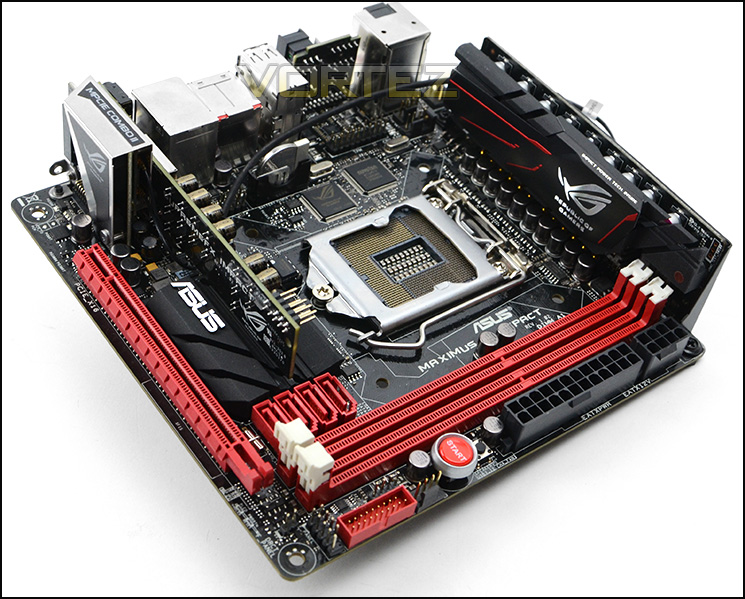
ASUS on their Maximus VI Impact
ROG hits the road with mini-ITX – size is no longer any indicator of performance.
They said it couldn’t be done, but ROG’s devoted crew of designers and engineers has finally delivered on the dream of a proper mini-ITX gaming board. Fans of LAN parties and gaming tournaments love to make a strong impression — and that’s why more gamers choose Maximus VI Impact. Balancing great performance with excellent stability, power efficiency and thermal innovation, Maximus VI Impact fits in highly elegant and portable home-theater PC (HTPC) and Shuttle-style compact cases while retaining ROG’s renowned cachet – so being a champion is more flexible than ever. or couch-bound living room champion becomes easier than ever.
They said it couldn’t be done, but ROG’s devoted crew of designers and engineers has finally delivered on the dream of a proper mini-ITX gaming board. Fans of LAN parties and gaming tournaments love to make a strong impression — and that’s why more gamers choose Maximus VI Impact. Balancing great performance with excellent stability, power efficiency and thermal innovation, Maximus VI Impact fits in highly elegant and portable home-theater PC (HTPC) and Shuttle-style compact cases while retaining ROG’s renowned cachet – so being a champion is more flexible than ever. or couch-bound living room champion becomes easier than ever.
Technical Specifications
CPU
Intel® Socket 1150 for 4th Generation Core™ i7/Core™ i5/Core™ i3/Pentium®/Celeron® Processors
Supports Intel® 22 nm CPU
Supports Intel® Turbo Boost Technology 2.0
Chipset
Intel® Z87
Memory
2 x DIMM, Max. 16GB, DDR3 3000(O.C.)/2933(O.C.)/2800(O.C.)/2666(O.C.)/2600(O.C.)
2400(O.C.)/2200(O.C.)/2133(O.C.)/2000(O.C.)/1866(O.C.)/1800(O.C.)/1600/1333 MHz
Non-ECC, Un-buffered Memory
Dual Channel Memory Architecture
Supports Intel® Extreme Memory Profile (XMP)
Graphic
Integrated Graphics Processor
Multi-VGA output support : HDMI/DisplayPort ports
– Supports HDMI with max. resolution 4096 x 2160 @ 24 Hz / 2560 x 1600 @ 60 Hz
– Supports DisplayPort with max. resolution 4096 x 2160 @ 24 Hz / 3840 x 2160 @ 60 Hz
Supports Intel® InTru™ 3D, Quick Sync Video, Clear Video HD Technology, Insider™
Expansion Slots
1 x PCIe 3.0/2.0 x16
1 x mini-PCIe 2.0 x1 *1
Storage
Intel® Z87 chipset :
4 x SATA 6Gb/s port(s), red
Support Raid 0, 1, 5, 10
Supports Intel® Smart Response Technology, Intel® Rapid Start Technology, Intel® Smart Connect Technology *2
Intel® Z87 chipset :
1 x eSATA port(s), red
Intel® Z87 chipset :
1 x M.2 (NGFF) Socket 2 on mPCIe Combo II expansion card(s), black
Support M.2 (NGFF) Type 2242/2260/2280/22110 SSD card (up to 110mm in length), support PCI express 2.0 x1 and SATA 6Gb/s standards
LAN
Intel® I217V, 1 x Gigabit LAN Controller(s)
Wireless Data Network
Wi-Fi 802.11a/b/g/n/ac*3
Supports dual band frequency 2.4/5 GHz
Bluetooth
Bluetooth V4.0
Bluetooth V3.0+HS
Audio
ROG SupremeFX Impact 8-Channel High Definition Audio CODEC *4
– Supports : Jack-detection, Multi-streaming, Front Panel Jack-retasking
– Lineout DAC playback Signal-to-Noise Ratio (A-weighted, Differential output): 115 dB
– Headphone DAC playback Signal-to-Noise Ratio (A-weighted, Differential output):110 dB
– TI LM4562 high-fidelity audio OP AMP(s)
Audio Feature :
– SupremeFX Shielding™ Technology
– ELNA premium audio capacitors
– Blu-ray audio layer Content Protection
– Sonic Radar
– DTS Connect
– Optical S/PDIF out port(s) at back panel
– Music PnP
USB Ports
Intel® Z87 chipset : *5
6 x USB 3.0 port(s) (4 at back panel, blue, 2 at mid-board)
Intel® Z87 chipset : *6
6 x USB 2.0 port(s) (4 at back panel, black, 2 at mid-board)
ROG Exclusive Features
SupremeFX Impact
mPCIe Combo II (mPCIe/M.2 combo card)
Impact Power :
– 8 + 2 phase power design
– 60A BlackWing Chokes
– 10K Black Metallic Capacitors
ProbeIt
UEFI BIOS features :
– ROG BIOS Print
– GPU.DIMM Post
– Tweakers’ Paradise
– ROG SSD Secure Erase
ROG RAMDisk
GameFirst II
Extreme Tweaker
Special Features
ASUS Dual Intelligent Processors 4 with 4-Way Optimization :
– The tuning key perfectly consolidates ASUS-exclusive DIGI+ Power Control, TPU, EPU, and Fan Xpert 2 optimize the digital power setting, system performance, power saving and whole system cooling configuration
CPU Level Up
ASUS Wi-Fi GO!
– Wi-Fi GO! Function: Cloud GO!, Media Streaming Hub, Smart Sensor Control, Remote Desktop, Remote Keyboard & Mouse, File Transfer, Capture & Send
– Wi-Fi Engine for network sharing and connection: Client Mode, AP Mode
ASUS Exclusive Features :
– USB BIOS Flashback
– MemOK!
– AI Suite 3
– Ai Charger
– USB Charger+
– USB 3.0 Boost
– Disk Unlocker
ASUS EZ DIY :
– ASUS O.C. Profile
– ASUS CrashFree BIOS 3
– ASUS EZ Flash 2
ASUS Q-Design :
– ASUS Q-Shield
– ASUS Q-Cable
– ASUS Q-Code
– ASUS Q-LED (CPU, DRAM, VGA, Boot Device LED)
– ASUS Q-DIMM
Overclocking Protection :
– ASUS C.P.R.(CPU Parameter Recall)
Operating System Support
Windows® 8
Windows® 7
Back I/O Ports
1 x DisplayPort
1 x HDMI
1 x eSATA
1 x LAN (RJ45) port(s)
4 x USB 3.0 (blue)
4 x USB 2.0
1 x Optical S/PDIF out
3 x Audio jack(s)
1 x Clear CMOS button(s)
1 x ROG Connect On/ Off switch(es)
1 x Q-Code LED
1 x DirectKey button
1 x MemOK! button
Internal I/O Ports
1 x USB 3.0 connector(s) support(s) additional 2 USB 3.0 port(s)
1 x USB 2.0 connector(s) support(s) additional 2 USB 2.0 port(s)
1 x TPM connector(s)
4 x SATA 6Gb/s connector(s)
1 x CPU Fan connector(s)
3 x Chassis Fan connector(s)
1 x 8-pin EATX 12 V Power connector
1 x 24-pin EATX Power connector(s)
1 x Front panel audio connector(s) (AAFP)
1 x System panel(s)
1 x DRCT header(s)
10 x ProbeIt Measurement Points
1 x Power-on button(s)
1 x Reset button(s)
1 x LN2 Mode jumper(s)
1 x FastBoot jumper(s)
1 x SupremeFX Impact connector(s)
1 x ROG extension (ROG_EXT) header(s)
1 x mPCIe Combo II connector(s)
Accessories
User’s manual
1 x ASUS Q-Cable
1 x SupremeFX Impact audio card(s)
1 x Optional 4-in-1 washers for CPU cooler backplate
I/O Shield
4 x SATA 6Gb/s cable(s)
1 x ASUS 2T2R dual band Wi-Fi moving antennas (Wi-Fi 802.11a/b/g/n/ac compliant)
1 x 12 in 1 ROG Cable Label(s)
1 x mPCIe Combo II card(s) with dual-band WiFi 802.11 a/b/g/n/ac + Bluetooth v4.0/3.0+HS module
BIOS
64Mb UEFI AMI BIOS, PnP, DMI2.7, WfM2.0, SM BIOS 2.7, ACPI5.0a Multi-Language BIOS
Manageability
WfM 2.0, DMI 2.7, WOL by PME, PXE
Support Disc
Drivers
ROG GameFirst II
ROG RAMDisk
ROG CPU-Z
ROG Mem TweakIt
Kaspersky® Anti-Virus
DAEMON Tools Pro Standard
ASUS WebStorage
ASUS Utilities
Form Factor
Mini ITX Form Factor
6.7 inch x 6.7 inch ( 17 cm x 17 cm )
Intel® Socket 1150 for 4th Generation Core™ i7/Core™ i5/Core™ i3/Pentium®/Celeron® Processors
Supports Intel® 22 nm CPU
Supports Intel® Turbo Boost Technology 2.0
Chipset
Intel® Z87
Memory
2 x DIMM, Max. 16GB, DDR3 3000(O.C.)/2933(O.C.)/2800(O.C.)/2666(O.C.)/2600(O.C.)
2400(O.C.)/2200(O.C.)/2133(O.C.)/2000(O.C.)/1866(O.C.)/1800(O.C.)/1600/1333 MHz
Non-ECC, Un-buffered Memory
Dual Channel Memory Architecture
Supports Intel® Extreme Memory Profile (XMP)
Graphic
Integrated Graphics Processor
Multi-VGA output support : HDMI/DisplayPort ports
– Supports HDMI with max. resolution 4096 x 2160 @ 24 Hz / 2560 x 1600 @ 60 Hz
– Supports DisplayPort with max. resolution 4096 x 2160 @ 24 Hz / 3840 x 2160 @ 60 Hz
Supports Intel® InTru™ 3D, Quick Sync Video, Clear Video HD Technology, Insider™
Expansion Slots
1 x PCIe 3.0/2.0 x16
1 x mini-PCIe 2.0 x1 *1
Storage
Intel® Z87 chipset :
4 x SATA 6Gb/s port(s), red
Support Raid 0, 1, 5, 10
Supports Intel® Smart Response Technology, Intel® Rapid Start Technology, Intel® Smart Connect Technology *2
Intel® Z87 chipset :
1 x eSATA port(s), red
Intel® Z87 chipset :
1 x M.2 (NGFF) Socket 2 on mPCIe Combo II expansion card(s), black
Support M.2 (NGFF) Type 2242/2260/2280/22110 SSD card (up to 110mm in length), support PCI express 2.0 x1 and SATA 6Gb/s standards
LAN
Intel® I217V, 1 x Gigabit LAN Controller(s)
Wireless Data Network
Wi-Fi 802.11a/b/g/n/ac*3
Supports dual band frequency 2.4/5 GHz
Bluetooth
Bluetooth V4.0
Bluetooth V3.0+HS
Audio
ROG SupremeFX Impact 8-Channel High Definition Audio CODEC *4
– Supports : Jack-detection, Multi-streaming, Front Panel Jack-retasking
– Lineout DAC playback Signal-to-Noise Ratio (A-weighted, Differential output): 115 dB
– Headphone DAC playback Signal-to-Noise Ratio (A-weighted, Differential output):110 dB
– TI LM4562 high-fidelity audio OP AMP(s)
Audio Feature :
– SupremeFX Shielding™ Technology
– ELNA premium audio capacitors
– Blu-ray audio layer Content Protection
– Sonic Radar
– DTS Connect
– Optical S/PDIF out port(s) at back panel
– Music PnP
USB Ports
Intel® Z87 chipset : *5
6 x USB 3.0 port(s) (4 at back panel, blue, 2 at mid-board)
Intel® Z87 chipset : *6
6 x USB 2.0 port(s) (4 at back panel, black, 2 at mid-board)
ROG Exclusive Features
SupremeFX Impact
mPCIe Combo II (mPCIe/M.2 combo card)
Impact Power :
– 8 + 2 phase power design
– 60A BlackWing Chokes
– 10K Black Metallic Capacitors
ProbeIt
UEFI BIOS features :
– ROG BIOS Print
– GPU.DIMM Post
– Tweakers’ Paradise
– ROG SSD Secure Erase
ROG RAMDisk
GameFirst II
Extreme Tweaker
Special Features
ASUS Dual Intelligent Processors 4 with 4-Way Optimization :
– The tuning key perfectly consolidates ASUS-exclusive DIGI+ Power Control, TPU, EPU, and Fan Xpert 2 optimize the digital power setting, system performance, power saving and whole system cooling configuration
CPU Level Up
ASUS Wi-Fi GO!
– Wi-Fi GO! Function: Cloud GO!, Media Streaming Hub, Smart Sensor Control, Remote Desktop, Remote Keyboard & Mouse, File Transfer, Capture & Send
– Wi-Fi Engine for network sharing and connection: Client Mode, AP Mode
ASUS Exclusive Features :
– USB BIOS Flashback
– MemOK!
– AI Suite 3
– Ai Charger
– USB Charger+
– USB 3.0 Boost
– Disk Unlocker
ASUS EZ DIY :
– ASUS O.C. Profile
– ASUS CrashFree BIOS 3
– ASUS EZ Flash 2
ASUS Q-Design :
– ASUS Q-Shield
– ASUS Q-Cable
– ASUS Q-Code
– ASUS Q-LED (CPU, DRAM, VGA, Boot Device LED)
– ASUS Q-DIMM
Overclocking Protection :
– ASUS C.P.R.(CPU Parameter Recall)
Operating System Support
Windows® 8
Windows® 7
Back I/O Ports
1 x DisplayPort
1 x HDMI
1 x eSATA
1 x LAN (RJ45) port(s)
4 x USB 3.0 (blue)
4 x USB 2.0
1 x Optical S/PDIF out
3 x Audio jack(s)
1 x Clear CMOS button(s)
1 x ROG Connect On/ Off switch(es)
1 x Q-Code LED
1 x DirectKey button
1 x MemOK! button
Internal I/O Ports
1 x USB 3.0 connector(s) support(s) additional 2 USB 3.0 port(s)
1 x USB 2.0 connector(s) support(s) additional 2 USB 2.0 port(s)
1 x TPM connector(s)
4 x SATA 6Gb/s connector(s)
1 x CPU Fan connector(s)
3 x Chassis Fan connector(s)
1 x 8-pin EATX 12 V Power connector
1 x 24-pin EATX Power connector(s)
1 x Front panel audio connector(s) (AAFP)
1 x System panel(s)
1 x DRCT header(s)
10 x ProbeIt Measurement Points
1 x Power-on button(s)
1 x Reset button(s)
1 x LN2 Mode jumper(s)
1 x FastBoot jumper(s)
1 x SupremeFX Impact connector(s)
1 x ROG extension (ROG_EXT) header(s)
1 x mPCIe Combo II connector(s)
Accessories
User’s manual
1 x ASUS Q-Cable
1 x SupremeFX Impact audio card(s)
1 x Optional 4-in-1 washers for CPU cooler backplate
I/O Shield
4 x SATA 6Gb/s cable(s)
1 x ASUS 2T2R dual band Wi-Fi moving antennas (Wi-Fi 802.11a/b/g/n/ac compliant)
1 x 12 in 1 ROG Cable Label(s)
1 x mPCIe Combo II card(s) with dual-band WiFi 802.11 a/b/g/n/ac + Bluetooth v4.0/3.0+HS module
BIOS
64Mb UEFI AMI BIOS, PnP, DMI2.7, WfM2.0, SM BIOS 2.7, ACPI5.0a Multi-Language BIOS
Manageability
WfM 2.0, DMI 2.7, WOL by PME, PXE
Support Disc
Drivers
ROG GameFirst II
ROG RAMDisk
ROG CPU-Z
ROG Mem TweakIt
Kaspersky® Anti-Virus
DAEMON Tools Pro Standard
ASUS WebStorage
ASUS Utilities
Form Factor
Mini ITX Form Factor
6.7 inch x 6.7 inch ( 17 cm x 17 cm )
Packaging & Bundle
Impact is presented in a mini-version of the typical packaging which motherboards usually are delivered in. As you would expect from a ROG counterpart, Impact has a lid attached to the box which highlights key features and the reverse also goes into some detail for those who are interested.
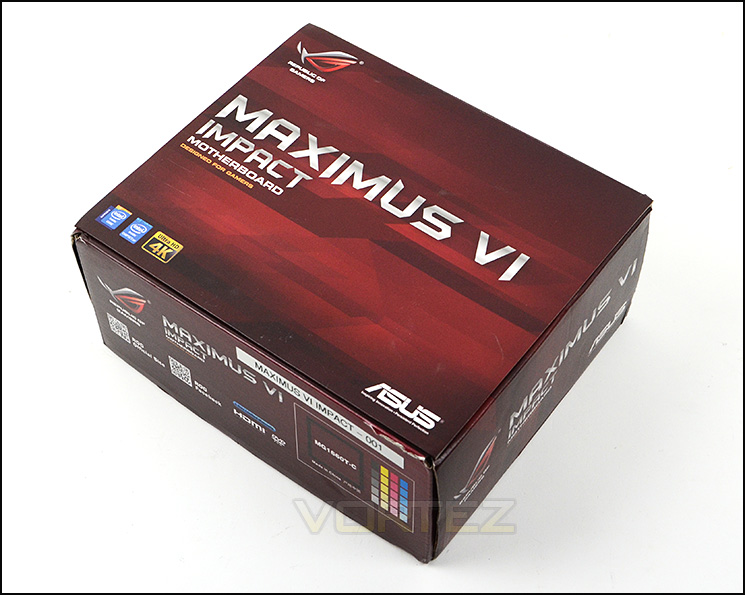
Packaging for Maximus VI Impact
Combined with the packaging the bundle also features additional items compared to the standard motherboard. The included items consist of the following:
• User’s manual
• 1 x ASUS Q-Cable
• 1 x SupremeFX Impact audio card(s)
• 1 x Optional 4-in-1 washers for CPU cooler backplate
• I/O Shield
• 4 x SATA 6Gb/s cable(s)
• 1 x ASUS 2T2R dual band Wi-Fi moving antennas (Wi-Fi 802.11a/b/g/n/ac compliant)
• 1 x 12 in 1 ROG Cable Label(s)
• 1 x mPCIe Combo II card(s) with dual-band WiFi 802.11 a/b/g/n/ac + Bluetooth v4.0/3.0+HS module
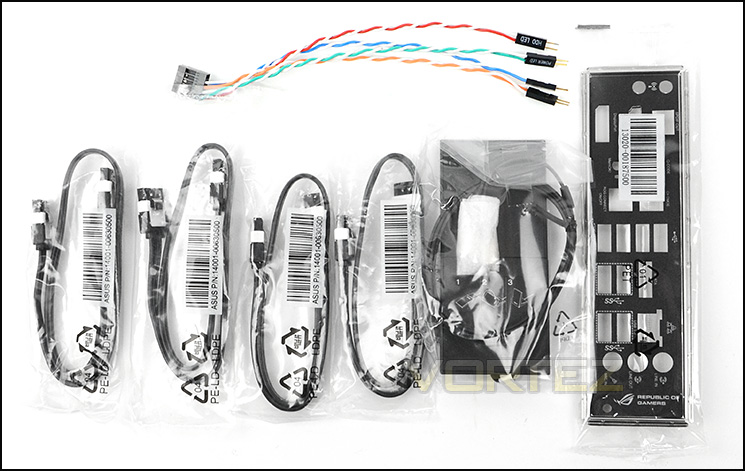
Various items included within bundle
The motherboard itself is covered with an anti-static bag and sits in another box above the bundled accessories.
If you haven’t guessed by now, Impact complements ASUS ROG’s Intel Z87 product line by introducing a downsized, Mini-ITX option. This is a first for this division and demonstrates ASUS ability to condense well-loved and newly introduced features found on larger, premium offerings.
For a board of this size there is an awful lot of features packed in. Certain aspects have been arranged in a specific way in order to allow enough room for ports – such as the EPS power sitting beside 24-pin ATX power and MOSFETs/Phases being placed horizontally across the top of the board instead of vertically (as is typical of most Z87 motherboards).
Maximus VI Impact conforms to Mini-ITX standards measuring: 6.7 inch x 6.7 inch ( 17 cm x 17 cm )
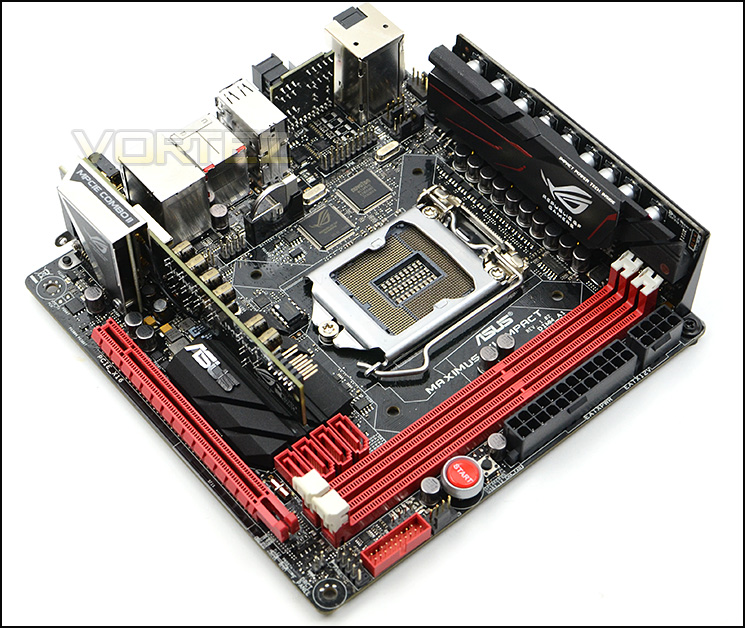
Impact certainly makes an impact!
Closer Look
This motherboard is of course designed to work with Intel’s 4th Generation of processors – Haswell. The socket is LGA1150 but has the mounting holes for LGA115X so if you have a cooler that has been used on another socket such as LGA1155 then it will work fine here too. ASUS have actually included dual fan headers for the CPU cooler just behind the top heatsink which we are pleased to see.
Just like its counterparts within the ROG series, Impact utilises Extreme Engine Digi+ III which include a selection of exclusive hardware upgrades used throughout the motherboard. The MOSFETS are NexFET handle up to 90% efficiency under normal load and offer enhanced stability compared to standard MOSFETs, and at half the size which is rather impressive. The other components that make an appearance are the BlackWing chokes which have been given some gold ‘bling’ – these chokes can sustain 60A per unit and up to 125C. Japanese 10K black solid CAPs are used throughout the motherboard for long-life and are generally able to tolerate higher temperatures compared to standard solid CAPs.
The CPU chokes/phases have been placed on a secondary PCB which vertically extends and carries with it a unique heatsink. ASUS term this “Impact Power” and is an innovative way of freeing up valuable space on the motherboard whilst still retaining substantial power delivery.
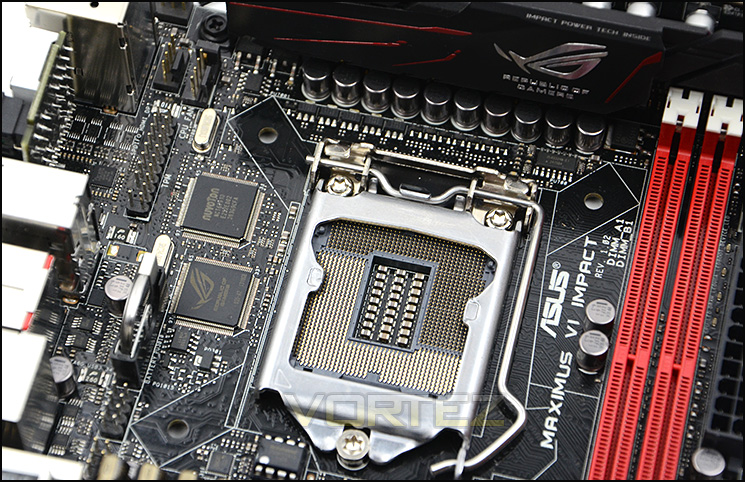
The socket area for Impact
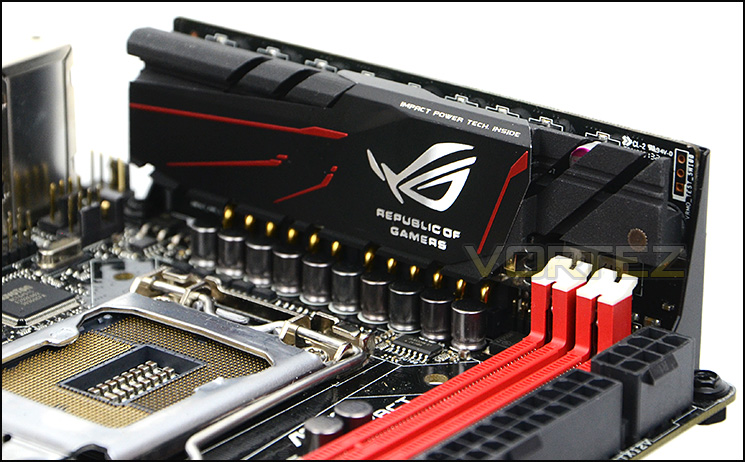
Secondary PCB and unique heatsink design
ASUS have given Impact just two memory slots due to limited space on the motherboard. Most system builders tend to only use a single memory kit for this platform anyway so there is no real constraint as such. Impact supports dual channel DDR3 – up to 16GB and Intel XMP. The following frequencies are supported too:
3000(O.C.)/2933(O.C.)/2800(O.C.)/2666(O.C.)/2600(O.C.)/2400(O.C.)
2200(O.C.)/2133(O.C.)/2000(O.C.)/1866(O.C.)/1800(O.C.)/1600/1333
There are a number of other features nearby too. The Eagle eyed amongst you will notice that EPS CPU power socket sits beside the 24-pin ATX power due to the space restriction around the socket. Further along the edge of the motherboard there are also onboard power and reset buttons and a native USB 3.0 port.
Directly above the memory slots are four SATA 3.0 (6GB/s) ports for storage functionality.
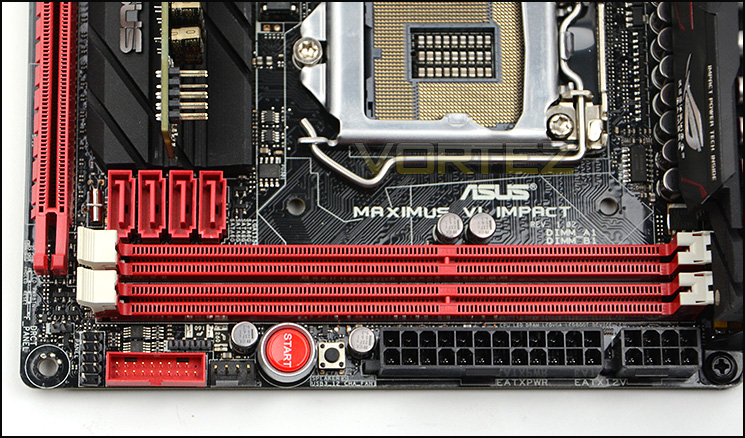
Plenty of features even for such a condensed motherboard
At the bottom of Impact there is a single PCI-E slot which supports PCI-E 3.0/2.0 @ x16. Directly above this is the heatsink covering the Intel Z87 chip.
Touted as the two integral features on our motherboard are the mPCIe Combo II and SupremeFX Impact. The combo card brings extended functionality for WiFi, Bluetooth and even M.2 SSD. This is what ASUS have to say about it:
The next evolution of the mPCIe Combo card gives you even better expandability with the latest standards in connectivity and easy install. You get mini PCI Express 2.0 plus USB 2.0 with an included dual-band 2.4GHz/5GHz Wi-Fi 802.11ac and Bluetooth 4.0 module, powered by ASUS-exclusive Wi-Fi GO! Remote and Wi-Fi Engine, which maximize performance for better experiences. It’s an instant upgrade to the fastest wireless right on your desktop. All without having to sacrifice a PCI Express slot!
The compact but versatile mPCIe Combo II further future-proofs your build with M.2 (NGFF, Next Generation Form Factor) connectivity for SSDs. M.2 is a fast and power-efficient standard that aims to replace mPCIe and mSATA, designed to optimize SSD performance. mPCIe Combo II works with your high speed M.2 SSDs and makes the most of their potential, helping you reduce load times to run your OS and games even faster.
The compact but versatile mPCIe Combo II further future-proofs your build with M.2 (NGFF, Next Generation Form Factor) connectivity for SSDs. M.2 is a fast and power-efficient standard that aims to replace mPCIe and mSATA, designed to optimize SSD performance. mPCIe Combo II works with your high speed M.2 SSDs and makes the most of their potential, helping you reduce load times to run your OS and games even faster.
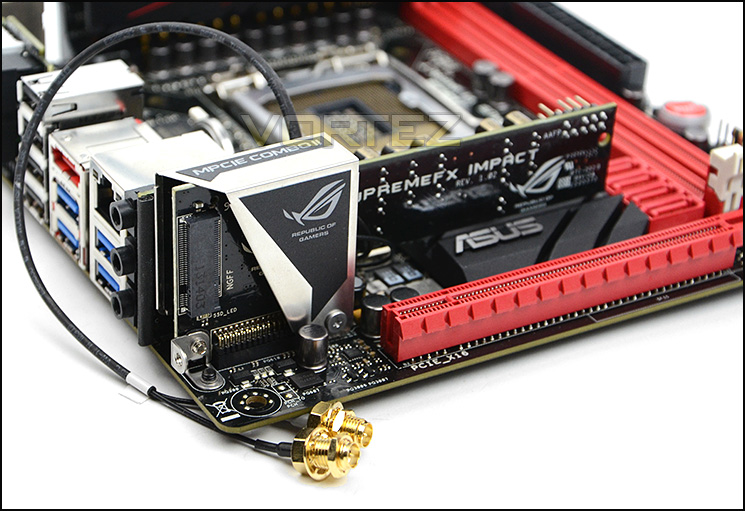
WiFi and Bluetooth ready via mPCIe Combo II
Turning our attention to the rear IO ports we have numerous ports and buttons available. These consist of the following:
• 1 x DisplayPort
• 1 x HDMI
• 1 x eSATA
• 1 x LAN (RJ45) port(s)
• 4 x USB 3.0 (blue)
• 4 x USB 2.0
• 1 x Optical S/PDIF out
• 3 x Audio jack(s)
• 1 x Clear CMOS button(s)
• 1 x ROG Connect On/ Off switch(es)
• 1 x Q-Code LED
• 1 x DirectKey button
• 1 x MemOK! Button
Our motherboard has a section called “Impact Control” this plug-in PCB features an LED diagnostic panel, MemOK! Direct Key, Clear CMOS and ROG Connect. Some of these features would usually be found in various regions on the motherboard but since Impact is tight for space, by ASUS attaching them to the rear IO this is rather inventive.
The high-quality audio is delivered via SupremeFX Impact. This brings 115dB signal-to-noise ratio, premium ENLA audio capacitors which are Japanese-made and assist with providing excellent clarity and fidelity.
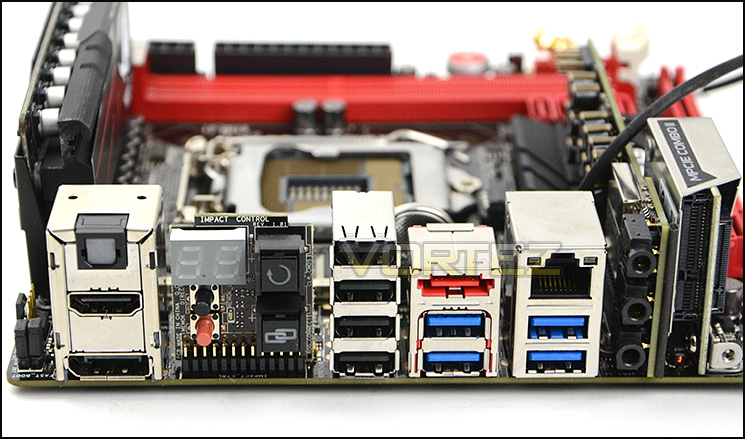
The rear IO panel is packed with features
ASUS ROG UEFI BIOS
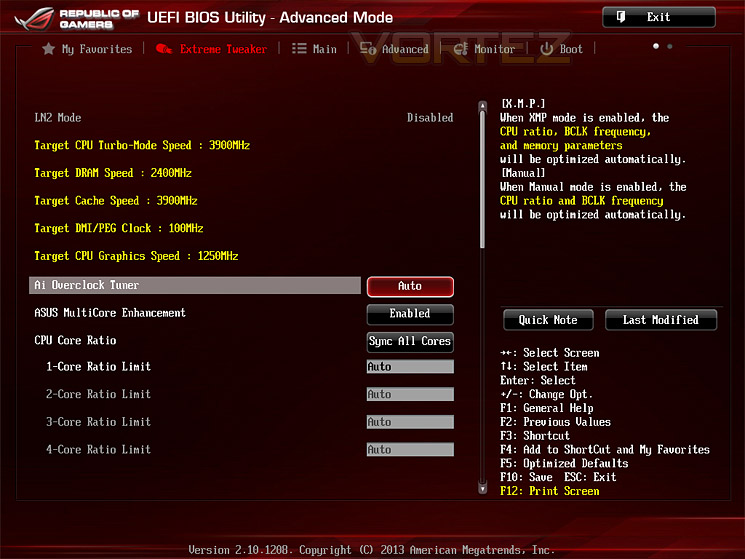
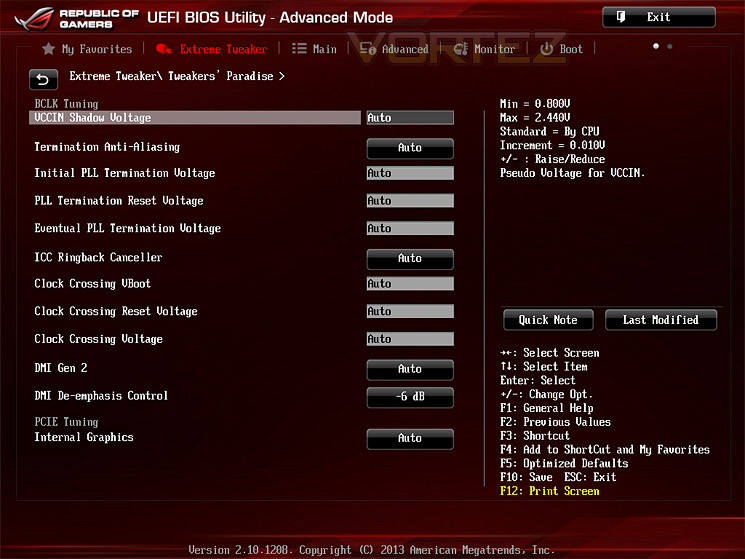
The UEFI BIOS which comes with Maximus VI Impact is amongst other things, very easy to use. We really like what ASUS have done with their design choices. Rather than opt for flashy interactions and overcomplicate things they have designed something which is just simple and that just works and this is paramount for advanced tweakers and more particularly, Overclockers. They want to be in and out of the BIOS without having to navigate through countless menu systems, and with ASUS UEFI this is possible.
Those who aren’t advanced users will find the UEFI BIOS a dream to work with since each option that can be tweaked has a full explanation to the right side – not just a brief note but an explanation of what enabling/disabling a particular option will do and its benefits.
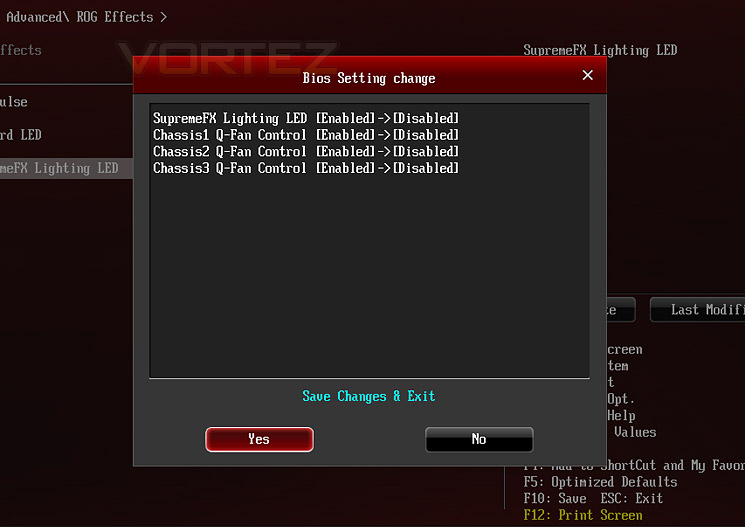
One notable aspect which is especially nice is the change log summary which pops up when saving settings to exit – this prompt gives you a quick summary of the options that have been adjusted to ensure you are certain nothing untoward has been altered – however small this feature is, it’s extremely useful.
Test Setup & Overclocking
Test Setup
CPU Intel Core i7 4770K (Haswell) 3.50GHz
Cooling Noctua NH-U14
Motherboard ASUS Maximus VI Impact
Memory 16GB Corsair Vengeance Pro 2400MHz CL10 DDR3
Graphics XFX R7970 Black Edition
Storage Kingston HyperX 240GB SSD
PSU Corsair HX1050 80 Plus Gold Certified PSU
Cooling Noctua NH-U14
Motherboard ASUS Maximus VI Impact
Memory 16GB Corsair Vengeance Pro 2400MHz CL10 DDR3
Graphics XFX R7970 Black Edition
Storage Kingston HyperX 240GB SSD
PSU Corsair HX1050 80 Plus Gold Certified PSU
Benchmarks
Cinebench 11.5 – CPU Score
x264 HD 4.0 – 1st and 2nd pass encoding
SiSoftware SANDRA 2013 – CPU & Memory benchmarks
AIDA64 – CPU benchmarks
3DMark FireStrike – DX11 3D Benchmark
3DMark 11 – DX11 3D Performance and Extreme preset
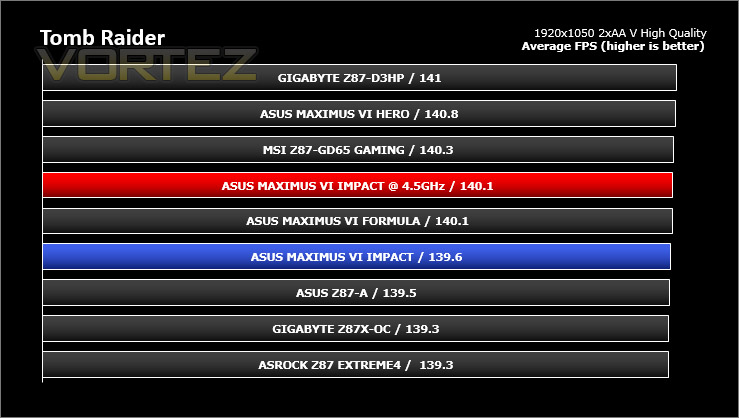
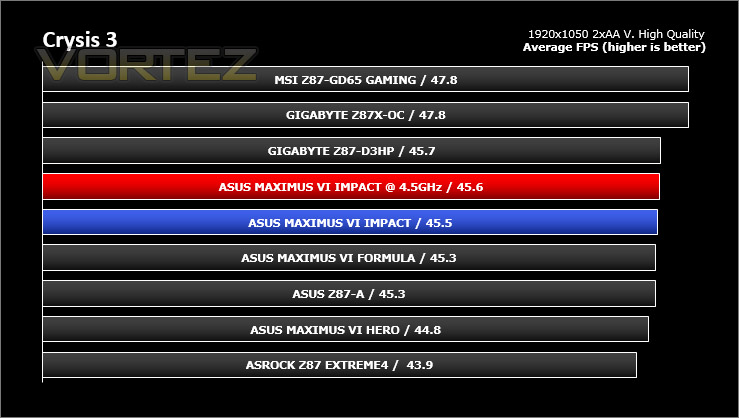
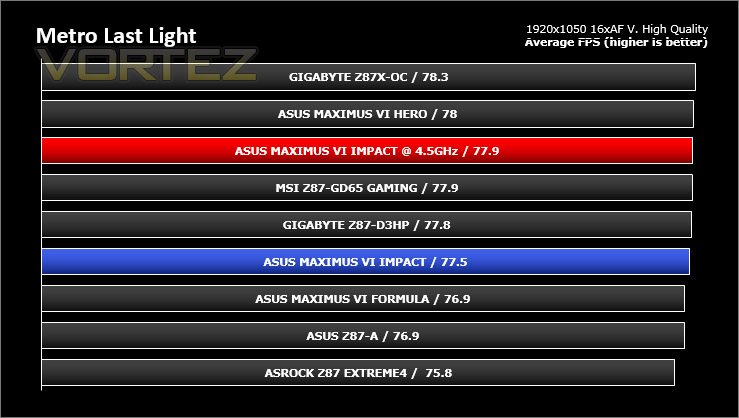
Games – Tomb Raider, Crysis 3, Metro Last Light
x264 HD 4.0 – 1st and 2nd pass encoding
SiSoftware SANDRA 2013 – CPU & Memory benchmarks
AIDA64 – CPU benchmarks
3DMark FireStrike – DX11 3D Benchmark
3DMark 11 – DX11 3D Performance and Extreme preset
Games – Tomb Raider, Crysis 3, Metro Last Light
Other Software
Temperature Analysis: Core Temp
Stress Testing Software: LinX
CPU Specification Monitoring: CPU-Z
Stress Testing Software: LinX
CPU Specification Monitoring: CPU-Z
Overclocking
The introduction of Z87 brings a return to BCLK overclocking. This will in turn deliver more flexibility for Overclockers compared to previous generations where the BCLK was locked to 100MHz and only the ratio could be adjusted. As many of you will know, Haswell CPUs get very hot with little voltage increase therefore the flexibility and headroom for overclocking can be limited.
Maximus VI Impact managed to take our Intel Core i7-4770K to 4.5GHz @ 1.28v. Anything above 4.5GHz required more voltage and as you can see from the maximum temperatures reported, some of the cores even at 4.5GHz with 1.28v reached 90C. We draw the line at 90C, extended usage beyond these temperatures can have a detrimental effect on the longevity of the chip.
This is a great achievement for such a motherboard and demonstrates that even small form factors can accomplish impressive milestones.
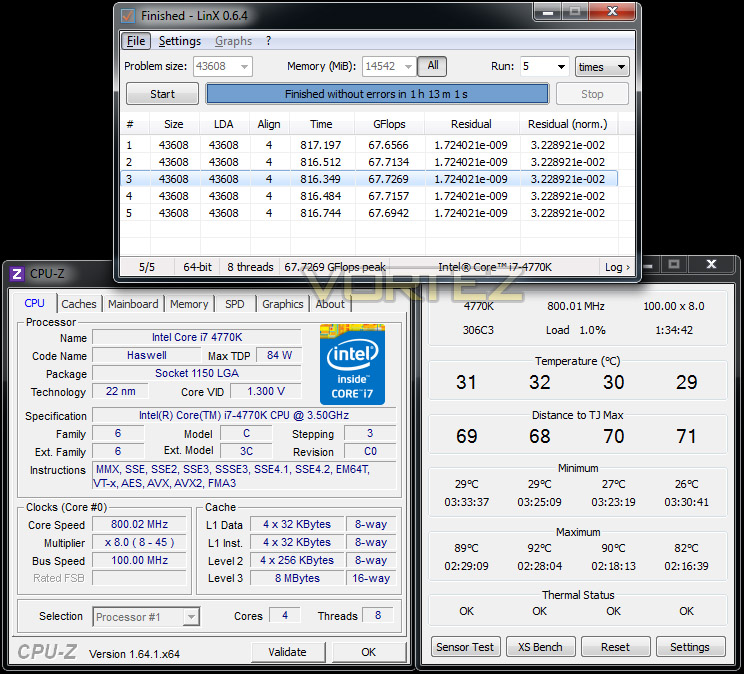
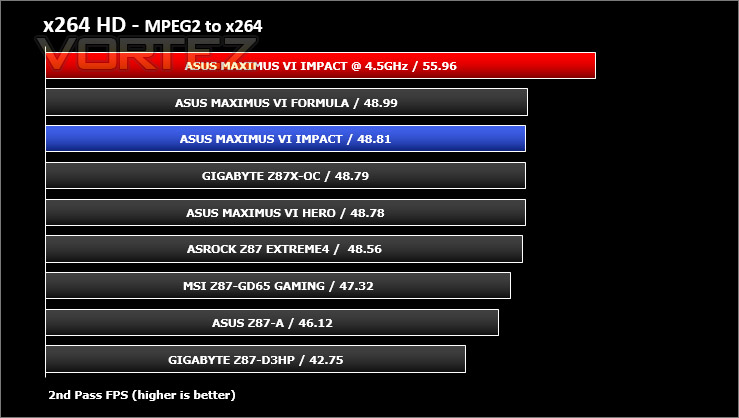
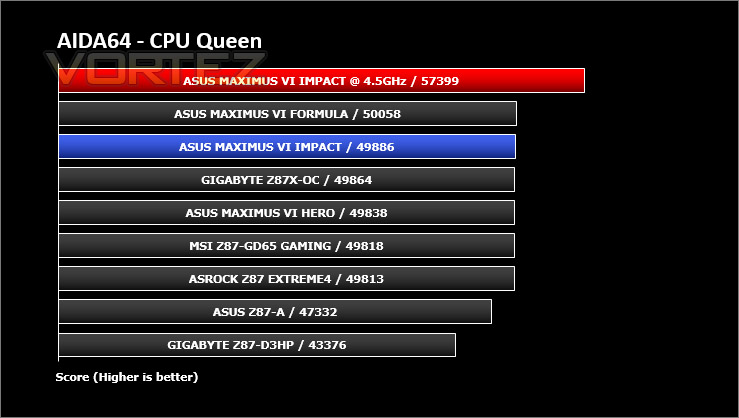
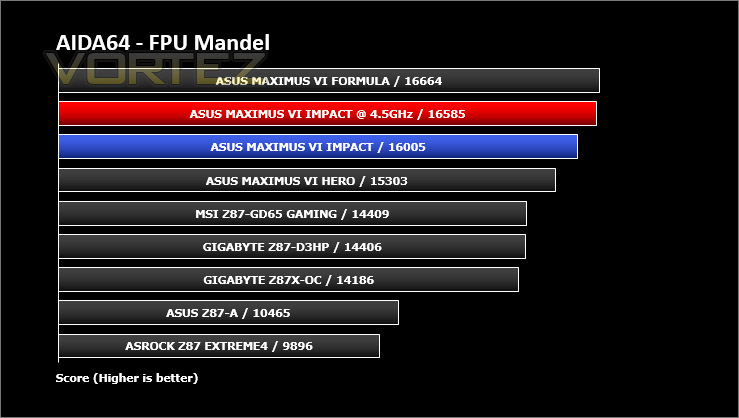
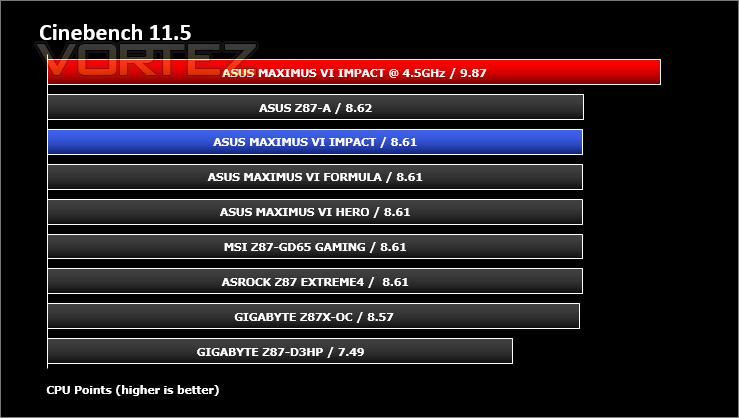
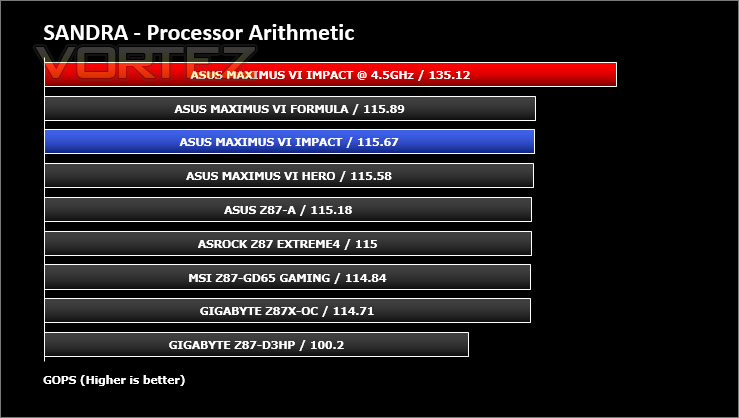
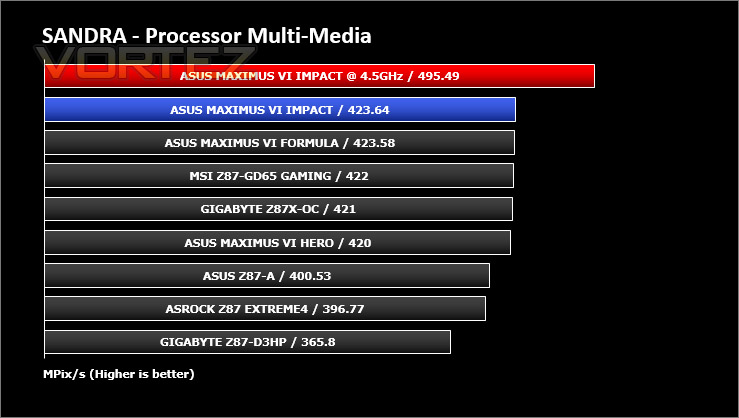
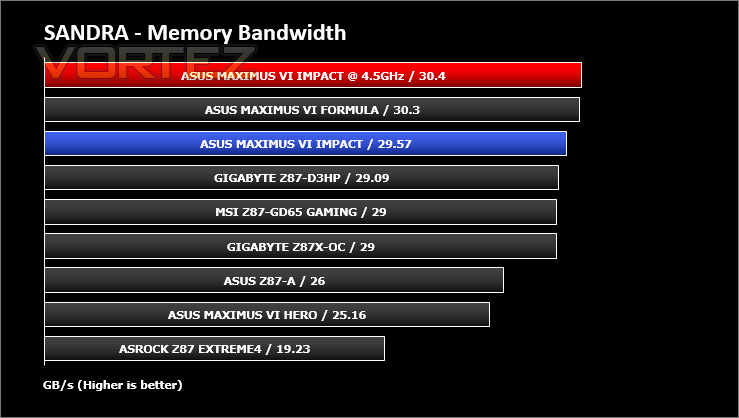
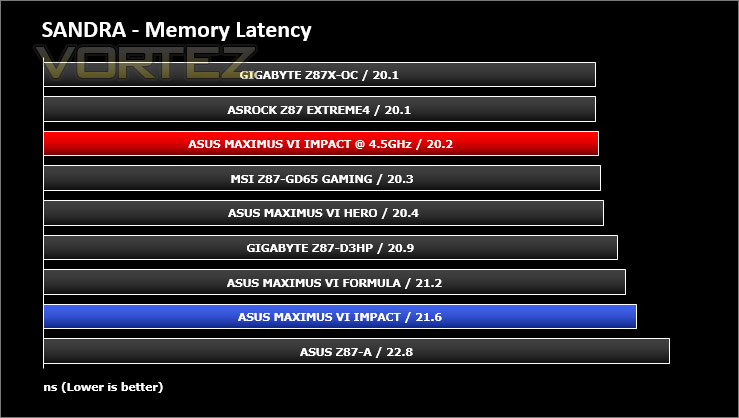
With the 4.5GHz overclock being our best, we will take this into our benchmark suite and test both stock and overclocked results on the subsequent pages. Our comparison results will obviously grow in the forthcoming weeks as we review more and more Z87 motherboards.
Power Consumption
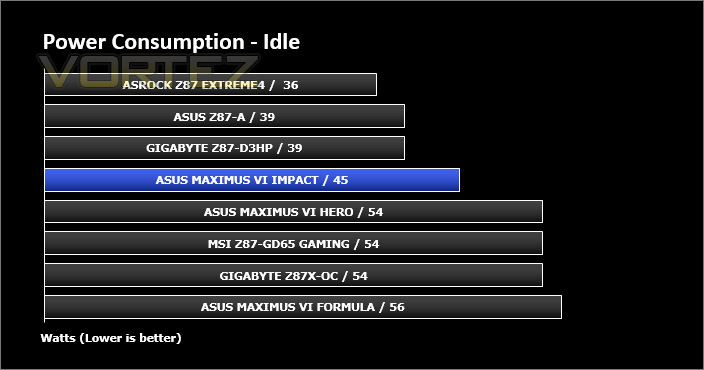
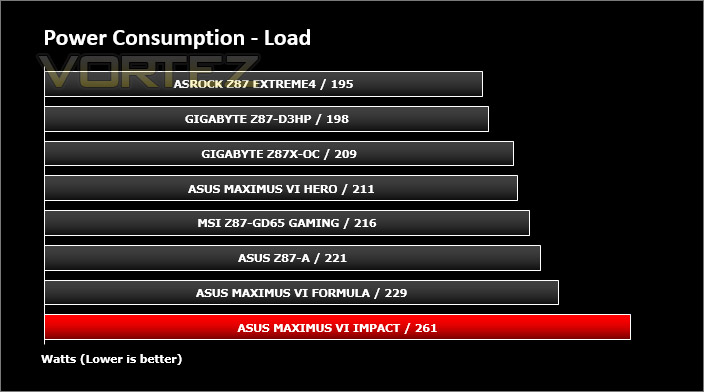
It’s interesting to note the power consumption across all motherboards. Although they are using Z87 chipsets, energy results can fluctuate between manufacturers due to the features and specifications that are integrated. First of all, for the idle tests the system is cold booted into Windows and no additional applications are executed – the watts are noted on the external energy monitor we use and then the system is loaded with 3DMark FireStrike – watts are again monitored for the duration of the test and the highest rated wattage result is then noted down. Below are the results of this energy test.
Benchmarks: X264 HD
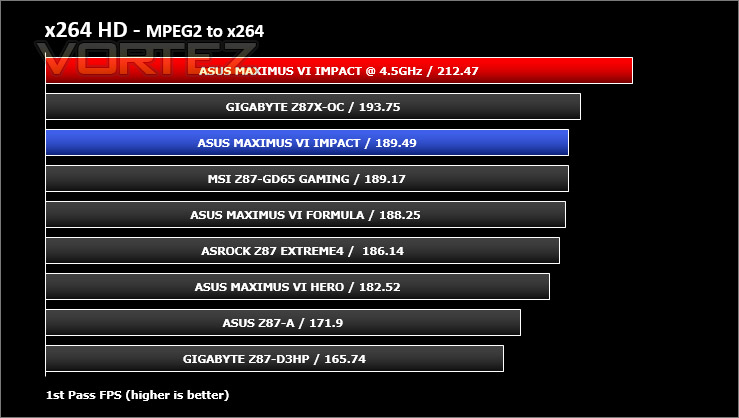
Simply put, this test measures how fast your machine can encode a short, DVD quality MPEG-2 video clip into a high-quality x264 video clip. What’s x264, you ask? It’s more or less the next-generation Xvid/DivX codec. I think it’s ideal for a benchmark because the application (x264.exe) reports fairly accurate compression results (in frames per second) for each pass of the video encoding process, and it uses multi-core processors very efficiently.
Benchmarks: AIDA64
AIDA64 Product PageThis simple integer benchmark focuses on the branch prediction capabilities and the misprediction penalties of the CPU. It finds the solutions for the classic “Queens problem” on a 10 by 10 sized chessboard. At the same clock speed theoretically the processor with the shorter pipeline and smaller misprediction penalties will attain higher benchmark scores. For example — with HyperThreading disabled — the Intel Northwood core processors get higher scores than the Intel Prescott core based ones due to the 20-step vs 31-step long pipeline. CPU Queen test uses integer MMX, SSE2 and SSSE3 optimizations.
Benchmarks: Cinebench
CINEBENCH can measure systems with up to 64 processor threads. This test scene contains approximately 2,000 objects which in turn contain more than 300,000 polygons in total, and uses sharp and blurred reflections, area lights, shadows, procedural shaders, antialiasing, and much more. The result is displayed in points (pts). The higher the number, the faster your processor.
Benchmarks: SiSoftware SANDRA
3DMark 11 Product PageSANDRA isn’t always a benchmark that is included in hardware reviews but I believe it shouldn’t be ignored. SANDRA provides a vigorous package that tests your system in a rather large array of benchmarks. There are many aspects of benchmark that can be executed. We will be considering – CPU and memory tests.

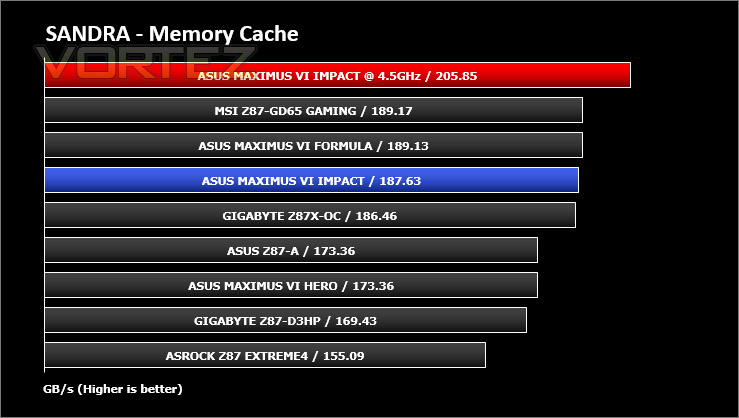
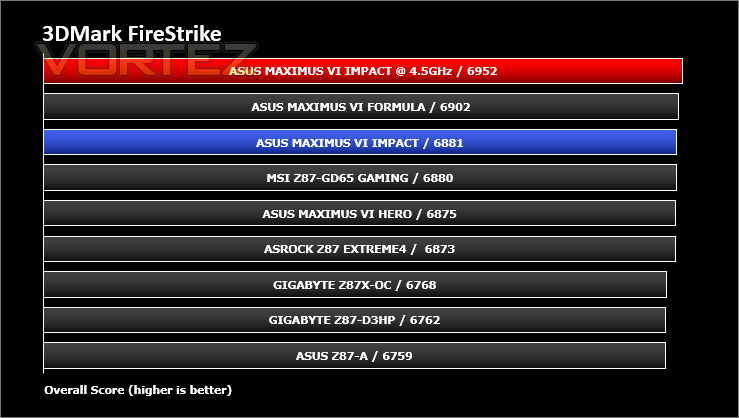
Benchmarks: 3DMARK FireStrike
3DMark FireStrike Product PageFire Strike is our new showcase DirectX 11 benchmark designed for high-performance gaming PCs. It is our most ambitious and technical benchmark ever, featuring real-time graphics rendered with detail and complexity far beyond what is found in other benchmarks and games today. Fire Strike will only be available in the Windows editions of 3DMark initially.
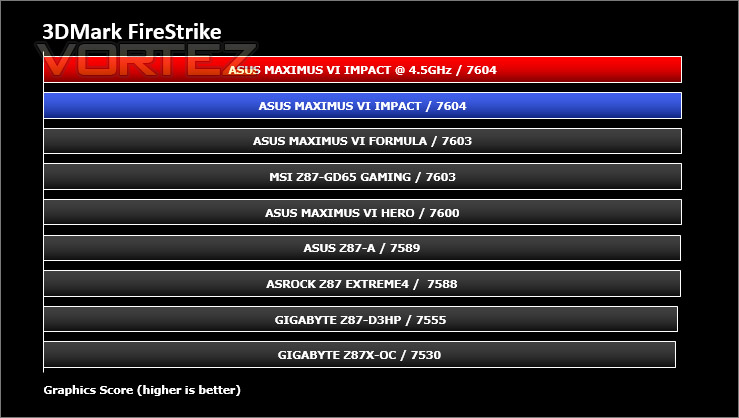
Benchmarks: 3DMARK 11
]Designed to measure your PC’s gaming performance 3DMark 11 makes extensive use of all the new features in DirectX 11 including tessellation, compute shaders and multi-threading. Trusted by gamers worldwide to give accurate and unbiased results, 3DMark 11 is the best way to consistently and reliably test DirectX 11 under game-like loads.
3DMark 11 is a very popular 3D performance benchmark suite and needs little introduction. For the test settings both Performance and Extreme presets are run with ‘benchmark only’ being selected. This provides good analysis. Many will only test the performance preset, using the extreme mode we can examine the board under much more severe stressing – at 720p and 1080p.

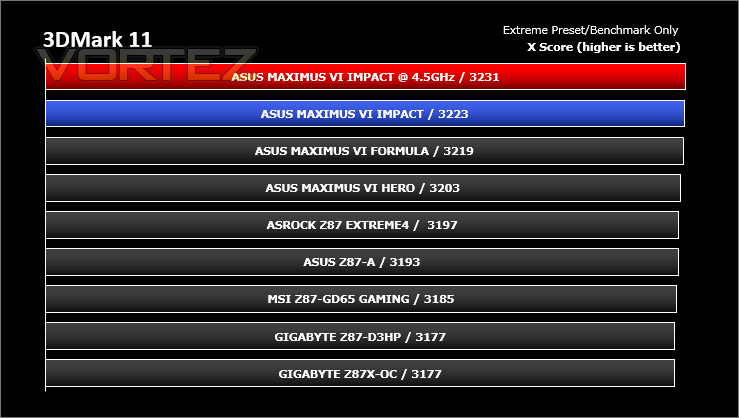
Benchmarks: Tomb Raider, Crysis 3, Metro Last Light
It’s important for us to perform a number of game benchmarks as well as the synthetic tests because gamers will want to know if there are any significant benefits. So here we have a selection of popular gaming titles, critically acclaimed and action-packed.
Settings
Tomb Raider
– 1920×1050 2xAA – Very High Quality *Benchmark tool*
Crysis 3
– 1920×1050 2xAA – Very High Quality *FRAPS – 1st scene/gameplay*
Metro Last Light
– 1920×1050 16xAF – Very High Quality *FRAPS – 1st scene/gameplay*
The gaming titles selected demand GPU power over CPU power – in each test the difference is rather marginal. VSync is disabled in all titles.
Conclusion
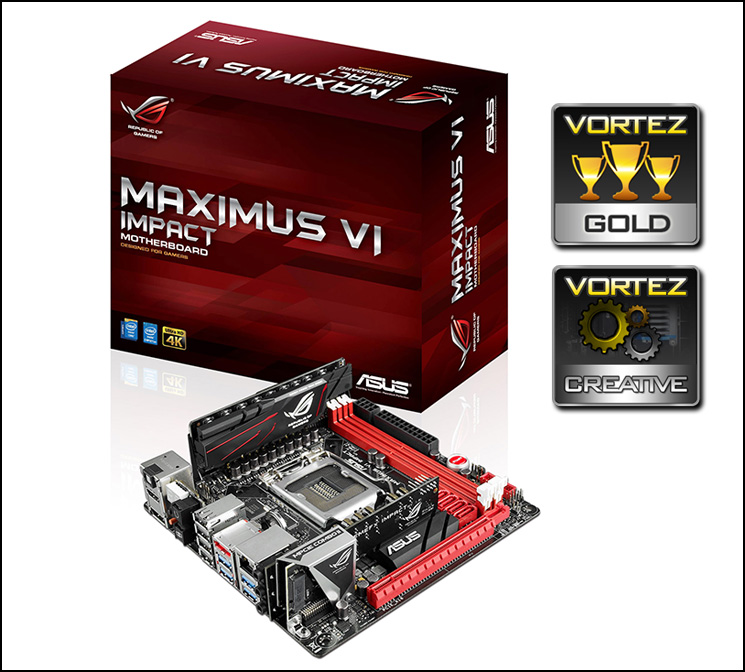
The Maximus VI line has already given us the Hero, Formula and Extreme and once again we turn to ROG for another Z87 counterpart, with a twist. Mini-ITX is now a popular form factor of choice for enthusiasts choosing to downsize and the new Impact is a first attempt for ASUS ROG Division in this particular arena.
Maximus VI Impact may be significantly smaller than its siblings but this dainty motherboard still retains many of the features found on the bigger motherboards in the series. ASUS are to be commended for packing in so many features on a condensed playing field – they haven’t just slapped them anywhere either, careful design choices have clearly been made in order to implement within such small confines.
Sacrifices do sometimes have to be made and the usual course of events would point towards a smaller product lacking performance or having certain elements restrained but this is not so with Impact. In our experience, this petite offering performed just as well as other popular choices which have been previously reviewed here at Vortez. Furthermore, overclocking was easy to engage in and yielded great results in just a few adjustments.
We especially like the plethora of features which have been packed onto this motherboard, the likes of which we wouldn’t have enough time to mention every single one. The mPCIe Combo II brings in WiFi/Bluetooth support and extra connections for next generation functionality.
Embarking on their first Mini-ITX motherboard, the ASUS ROG crew have brought to market a stellar product in the Maximus VI Impact. Although small in stature, it does not compromise on quality of feature-set and we highly recommend it for condensed system builds.
Pros
+ Asthetically very pleasing
+ Great performance results
+ Easy to overclock
+ Advanced overclocking features
+ Excellent features layout and choices
+ No compromise on number of features
+ Smooth and feature rich UEFI BIOS
+ Equipped with SupremeFX Impact
+ mPCIe Combo II
Cons
– Short on fan headers
+ Asthetically very pleasing
+ Great performance results
+ Easy to overclock
+ Advanced overclocking features
+ Excellent features layout and choices
+ No compromise on number of features
+ Smooth and feature rich UEFI BIOS
+ Equipped with SupremeFX Impact
+ mPCIe Combo II
Cons
– Short on fan headers

Click here for an explanation of our awards at Vortez.net.


