







Today we put the Xonar U5 to the test, it is a compact USB soundcard featuring 5.1 surround and a headphone amp to which promises great value for gamers.
Product on review: ASUS Xonar U5
Manufacturer & Sponsor: ASUS
Street Price: £65 inc. VAT
ASUS ‘Xonar’ has made their presence felt in the audio world and due to their relentless will to cover all corners of the market, from the elite Essence family of DACs and soundcards, to those in a situation where audio output is often lackluster and limited, directly speaking, laptops and notebooks. After reviewing the Xonar U7, it is clear that there are some good options to consider, and now ASUS make another tempting offer with the Xonar U5.
Plugging the gap between the U3 and the U7 and aptly named, the Xonar U5 USB soundcard comes in priced competitively at a notch below the U7 at around £65. Primarily aimed at audio starved laptop gamers, the U5 comes packed with features set to bolster the output of anyone needing that little bit more in audio fidelity. Offering 192kHz/24-bit high-definition audio in 5.1 surround, also equipped with a headphone amp supporting up to 150 Ohm headphones, microphone-in and SPDIF out. The compact lightweight shell itself looks very similar to the U7, just with less gold and misses out a few 3.5mm and RCA ports. So we get a large on the fly volume dial as well microphone volume controls on the fly. There is a white LED indicator to let you know which audio channel is in use, which can be swapped by pressing in the volume dial.
Overview by ASUS
With its easy plug-and-play setup, Xonar U5 is an ideal solution for laptop gamers looking to experience true 5.1-channel surround sound, and for PC gamers who want an incredible audio performance without the hassle of having to open their PC’s case to install a sound card.
Specifications & Features
Audio Performance
Output Signal-to-Noise Ratio (A-Weighted) (Front-out): 104 dB
Output THD+N at 1kHz (Front-out): >0.005 %(-86 dB)
Frequency Response (-3dB, 24bit/96KHz input): 10 Hz to 44 KHz
Output/Input Full-Scale Voltage :
Line output (RCA, 3.5) : 1 Vrms (2.828 Vp-p)
Headphone output : 1.3 Vrms (3.677 Vp-p)
Chipset
Audio Processor :C-Media CM6631A High-Definition Sound Processor
Sample Rate and Resolution
Analog Playback Sample Rate and Resolution :
44.1K/48K/88.2K/96K/192KHz @ 16bit/24bit
Analog Recording Sample Rate and Resolution :
44.1K/48K/88.2K/96K/192KHz @ 16bit/24bit
S/PDIF Digital Output :
44.1K/48K/88.2K/96K/192KHz @ 16bit/24bit
ASIO Driver Support :
44.1K/48K/88.2K/96K/192KHz @ 16bit/24bit
Connectivity
Analog Output
4 x 3.5 mm jack (1/8″) (Headphone out /Front out/Center-Subwoofer out/Rear out)
Analog Input
1 x 3.5 mm jack (1/8″) (Line-in/ Mic-in combo)
Digital
1 x S/PDIF out (1 x Coaxial)
Special Features
Sonic Studio
Operating System
Windows® 8.1
Windows® 8 , 32bit/64bit
Windows® 7 , 32bit/64bit
Mac OS X *
Accessories
S/PDIF adapter x 1
USB cable x 1
Driver CD x 1
User manual x 1
Dimensions
130 x 80 x 25 mm ( L x W x H )
Note
* Xonar U5 playback under OS X without any driver needed.
– True 5.1-channel HD (192kHz/24-bit) surround sound from a compact USB-powered device
– 104dB signal-to-analog ratio (SNR) ensures pure sound
– Sonic Studio provides complete control over loads of sound technologies
– Perfect Voice technology eliminates noises for clear in-game communications
– Independent mic and master-volume controls for instant in-game adjustments
– Integrated headphone amplifier provides clear, detailed sound for an immersive audio experience
A compact audio solution for incredible sound
Xonar U5 is a compact 5.1-channel USB sound card designed to provide PC gamers with high quality audio for games, music and movies. It follows in the footsteps of the award-winning Xonar U7 – providing you with strong and clear sound via headphones, and producing more impactful and detailed audio than onboard hardware. The Xonar U5 has no standalone power supply and connects to your PC via USB, allowing you to instantly plug-in without having to open the PC case.
Take complete control of your audio with Sonic Studio
Xonar U5 features the latest Sonic Studio software suite, so you have full control over every audio setting ranging from equalization (EQ) to 5.1-speaker level-balancing. Sonic Studio has a single navigation page that puts everything in front of you, with an intuitive point-and-click interface that allows you to pre-set audio profiles to suit different audio requirements.
Incredible input-noise reduction from Perfect Voice
Unlike noise-reduction technologies that rely on inverse phase noise cancellation, Xonar U5’s Perfect Voice technology uses advanced algorithms to separate ambient noise from speech. The result is crystal clear in-game voice communication, so you can be heard even in noisy gaming environments like LAN parties.
Enjoy powerful audio quality from a compact and portable device
The compact and lightweight Xonar U5 features 192KHz/24-bit audio quality, a 104dB signal-to-noise ratio (SNR) and true 5.1-channel surround sound for true high-definition output and consistent quality across all surround channels. Go big on audio with a sound card this small!
Pumps up every sound detail with the integrated headphone amplifier!
Xonar U5 includes a headphone amplifier that supports headphones all the way up to 150ohm impedance — so you can plug in some seriously powerful gaming headsets to hear every in-game detail!
Dedicated microphone and master volume controls
Dedicated controls let you tweak audio settings without interrupting your game – you can quickly adjust master and microphone volumes without pausing or entering menus.The master volume controls even doubles as an instant switch for selecting between headphone output and speakers with just a simple click.
Packaging & First Look
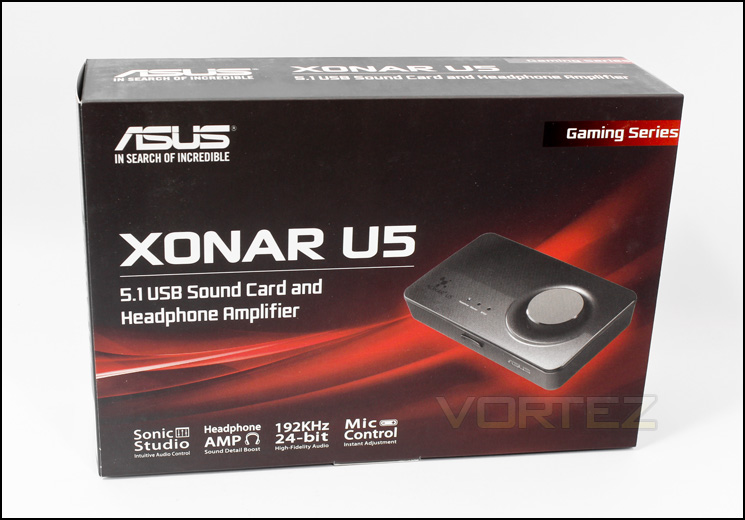
The Xonar U5 packaging comes decorated in a gaming red, not too distant to what you may find with ROG products, with a statement saying ‘Gaming Series’.
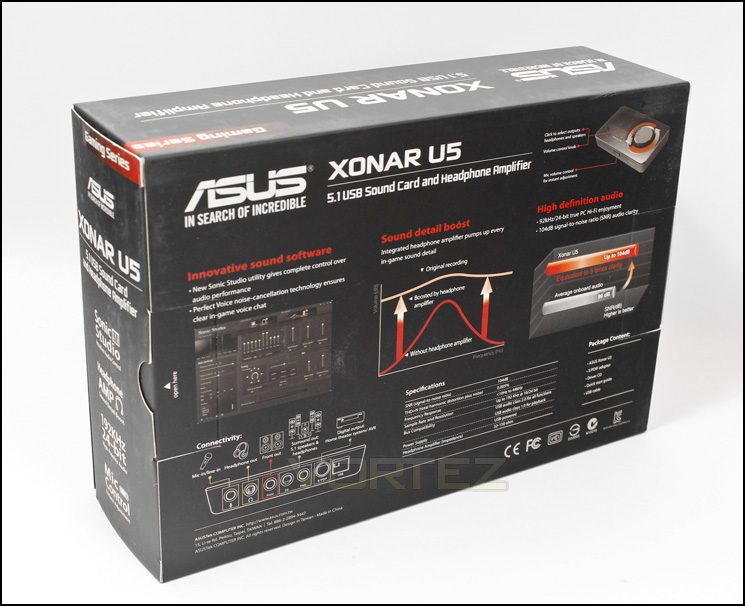
At the back we get some details about some of the features and technology, as well as a guide to each of the ports. There is a specific mention, several times, of the Sonic Studio software.
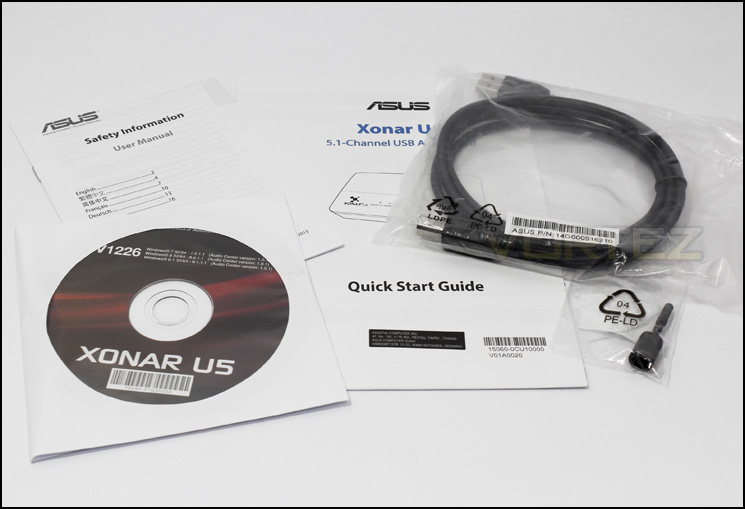
The accessories are everything you need to get going, with the USB cable, and optical TOSLINK adaptor.
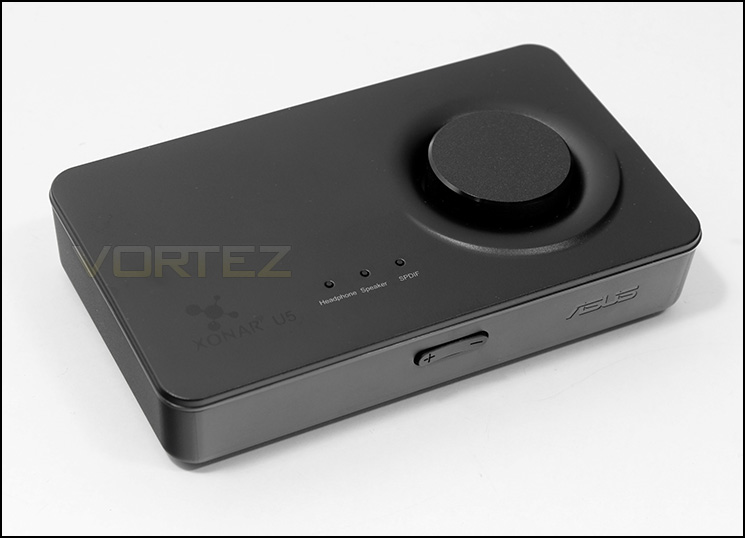
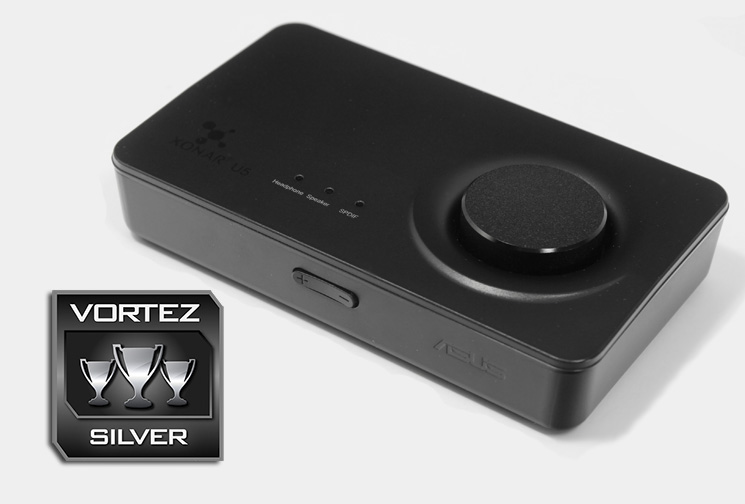
Compact, slim and attractive, there is nothing offensive nor outstanding in the design and is well suited for portability and wouldnt look too out of place anywhere.
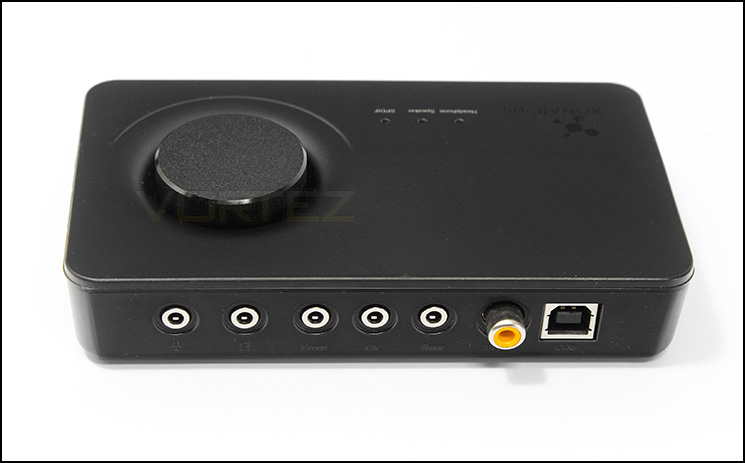
At the back are 3.5mm ports for microphone, headphone amp, front, center/sub, rear and SPDIF and of course the USB connection.
Software
The Xonar U5 is fully plug and play capable out the box, but to get the most of out it, ASUS have included their pretty and comprehensive Sonic Studio that features various audio enhancement and microphone noise cancelling technologies. There is also an equaliser, option to use virtual surround and direct access to adjust the bit depth and sample resolution. The application is attractive, seamless and easy to use, and if you have an ASUS headset, there may be an included profile for you to use too.
Performance Testing
Setup, Design & Observations
The setup is remarkably easy, plug the USB cable in, and wait for the drivers to install and away you go. Of course to get the best out of the U5, it is best you install the Sonic Studio software. The body is light and tough, the microphone control buttons click nicely, and the dial turns with squishy increments. Clicking in the dial changes the output channel which is quick and convenient compared to having to do it via Windows Sound menu. When you plug in a headset, it will automatically detect the impedance, to which it registered the Bitfenix FLO as high (68 Ohm). The max volume of the headset was fairly weak, similar to the U7, but was acceptable.
Multi-Media
Headphones
Listening at 16/44 and 24/96 with the headphones, the bass seemed very sludgy, with the highs diminished quite noticeably, like if someone had poured custard into your ears. Upping the resolution to 24bit/192KHz was like waking up from a bad dream as the audio became clear and acceptable. Listening through a list of go-to music tracks in lossless format was enjoyable though seemed to drop various nuances. Testing out the virtual surround was actually interesting, as it seemed to work fairly well in Battlefield 4 in a way that made the game feel more open, but lacked spatial precision, but that is the same with most virtual surround features. The effectiveness of virtual surround can also depend on the headset you are using so it is worth considering that too.
Speakers
Plugging in my Logitech X540 5.1 speakers, the surround sound was good in games and gave that cinematic immersion for films and games. Running around in Battlefield 4 with shots whizzing by, explosions rumbling up ahead places you right in the action. The downside to this surround setup for gaming, is that, to get the best of it, you need to be playing with some room shaking volume, and while the audio reproduction too will depend on your speakers, the U5 will be enough for most £80-150 5.1 speaker systems, but the saving grace for the U5 is being able to playback in 24/192 as the sludginess was still present in the speakers at lower audio resolutions.
Microphone
Something that has always confused me, is that many complain about the quality of their headset microphone. To which many end up complaining, or resolve to get a USB headset and are more-often-than-not, impressed with the results. So I would like to use this as an opportunity to remind people that audio processing has a big impact of the quality of the recorded input too, I have friends who have that ‘static’, ‘hissy’, ‘picks up loads of noise’, microphone and it turns out they are often gaming on a laptop, or have poor onboard motherboard audio, a simple upgrade in the soundcard department can often solve all of those issues, and the Xonar U5 would be a great option for laptop gamers who not only want to improve their own sound, but if they consistently get complaits about their crackly microphone audio others receive too. The recording ability in 24/192 in tandem with the ‘clear voice’ feature went down very will in DOTA2 and in SKYPE conversations, with little to no background noise recieved and crystal clear voice picked up.
Performance Testing Continued…
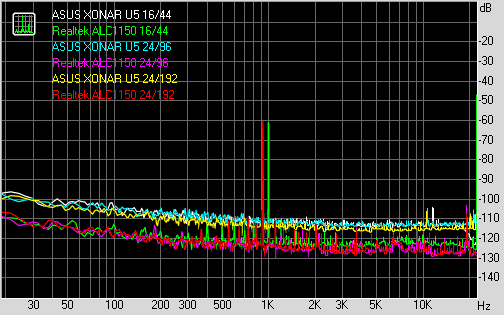
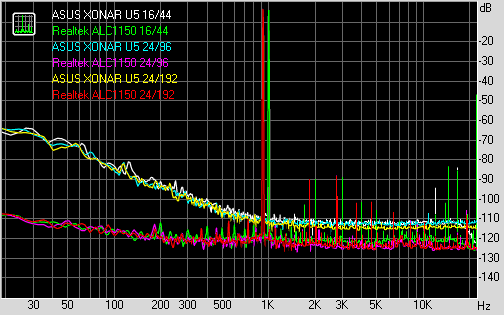
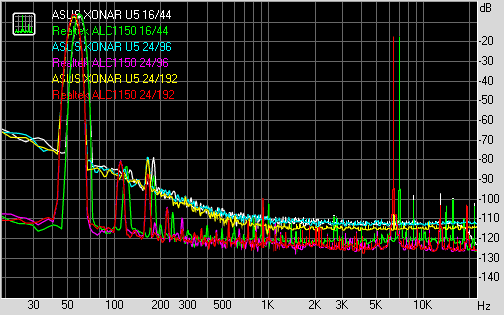
Right Mark Audio Analyzer
Understanding the limitations of a test is something that should be addressed in regards to giving an accurate portrayal. RMAA is a useful tool but testing has many variables thus results are only comparable under similar set standards and parameters and shouldn’t be compared directly to other results that may have been obtained under different testing conditions. Remember that audio preference too is subjective and numbers do not tell the full story.
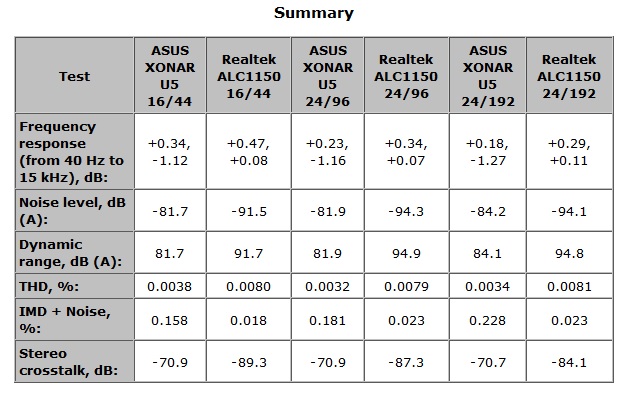
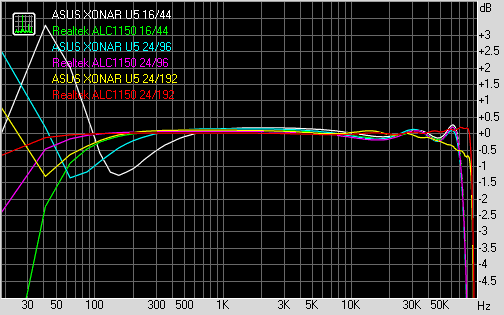
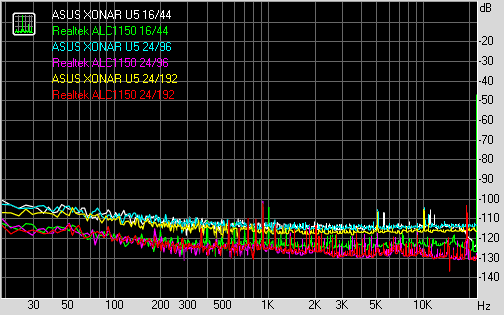
In this test, I compared the Xonar U5 against the cream of the crop in latest inregrated audio solutions, the Realtek ALC1150. This has become a popular choice for most motherboard manufacturers offering onboard premium audio solutions. This will also be the premium solution that will eventually work its way into more premium notebook and laptops.
Frequency response: Closer to 0 = Better
Noise: Lower = Better
Dynamic Range: Higher = Better
Total Harmonic Distortion (THD): lower = Better
Intermodular distortion (IMD): Lower = Better
Stereo Crosstalk: Lower = Better
Conclusion
The Xonar U5 comes in a touch underwhelming with the listening experience at anything other than 24-bit/192KHz is next to abysmal. The U5 does offer great expandability and features for those with fairly restricted options from their laptop/notebook though it is priced too close to the U7, considering the U7 is only a little more expensive at (currently) £68-£75. The primary competitor to this product I could imagine would be the ALC1150, which is considered to be the best thing since sliced bread in regards to integrated audio solutions. Laptop users are considered to be a dying breed, those who want to game on a laptop will generally get a premium gaming laptop, the likes of which tend have a premium audio solution, such as the ALC1150, already in use. So in conclusion, it becomes difficult to understand who the Xonar U5 is specfically aimed at, regardless of the useful and neat ‘gaming’ appeal. Desktops are better off with a discrete solution, while for £65, mobile/laptop gamers could be better off considering the competition from Creative or even the U7 itself, whichever may better suit their needs.
Regardless, the Xonar U5 is a good product and offers a lot of situational expandability that may be more suited to those who live on their entry/midrange laptop at home and want to get more out of it in regards to their audio fidelity. These same people may want to invest in a static desktop PC which will suit their needs better than clamouring to the past luxury appeal that laptops stigmatised half a decade ago. The thought of having so many cables protruding from a little box that is connected to a laptop and a 5.1 speaker system that is used inconjunction with a TV, creates a trip hazard for my brain, let alone for the people actually in the same room as such a setup. Though in fairness, with a little effort it is a setup that could work fine for some and the U7 will be the device you will want to use with it, failing that, the U5 will be ok for that too.
The Xonar U5 offers a simple solution for clear, high fidelity audio that is supported by powerful, easy to use software. Offering a suitable improvement to the sound quality of your games and media from your notebook or laptop.
+ Light and compact
+ Plug and Play
+ Easy to use Sonic Studio software which includes ‘Clear Voice’ and ‘Virtual Surround’
+ 5.1 surround, headphone amp
Cons.
– Price (Too close to the U7)
– Can be bettered by premium integrated solutions

Click here for an explanation of our awards at Vortez.net. Thanks to ASUS for providing today’s review sample.


