







Plugging the gap between the U3 and the Xonar Essence DACs, we take a look at the Xonar U7 USB sound card. Read on for our verdict!

Product on review: ASUS Xonar U7
Manufacturer: ASUS
Street Price: £78 inc VAT
Using external sound cards is a common practice for those who desire higher quality audio from their notebook or even desktop when there are space or technical restrictions in place limiting their options available. Till recently, the only available audio processing via USB from the Xonar camp was the lightweight U3, or the ultra high end Xonar Essence DACs that require the sale of essential body parts and organs to afford. The Xonar U7 offers 7.1 surround sound, S/PDIF out and a headphone amp for maximum versatility in a lightweight and compact case.
Overview by ASUS
The wonder of incredible compact audio!
Xonar U7 serves the needs of PC gamers who want to enjoy strong and clear sound via headphones, and is also ideal for listening to music as it produces much more impactful and detailed audio than onboard hardware. Connecting via USB, it requires no standalone power supply and works instantly setup-free with no need to open the PC case.
Powerful sound from a compact and portable device
Xonar U7 engineering overcomes the space and power supply limitations of other external USB-based audio devices to offer precise and immersive 7.1-channel surround. Sound processing uses 192kHz/24-bit fidelity for true high definition output, maintaining consistent quality across all surround channels.
Xonar U7 serves the needs of PC gamers who want to enjoy strong and clear sound via headphones, and is also ideal for listening to music as it produces much more impactful and detailed audio than onboard hardware. Connecting via USB, it requires no standalone power supply and works instantly setup-free with no need to open the PC case.
Powerful sound from a compact and portable device
Xonar U7 engineering overcomes the space and power supply limitations of other external USB-based audio devices to offer precise and immersive 7.1-channel surround. Sound processing uses 192kHz/24-bit fidelity for true high definition output, maintaining consistent quality across all surround channels.
Specifications & Features
Audio Performance
Output Signal-to-Noise Ratio (A-Weighted) (Front-out): 114 dB
Input Signal-to-Noise Ratio (A-Weighted): 110 dB
Output THD+N at 1kHz (Front-out) : >0.0006 %(104 dB)
Frequency Response (-3dB, 24bit/96KHz input): 10 Hz to 46 KHz
Output/Input Full-Scale Voltage :
Unbalanced Output : 1 Vrms (2.828 Vp-p)
Headphone : 1.3 Vrms (3.677 Vp-p)
Bus Compatibility
USB
Chipset
Audio Processor :C-Media 6632A High-Performance Sound Processor (Max. 192KHz/24bit)
Sample Rate and Resolution
Analog Playback Sample Rate and Resolution : 44.1K/48K/88.2K/96K/176.4K/192KHz @ 16bit/24bit
Analog Recording Sample Rate and Resolution : 44.1K/48K/88.2K/96K/176.4K/192KHz @ 16bit/24bit
S/PDIF Digital Output : 44.1K/48K/88.2K/96K/176.4K/192KHz @ 16bit/24bit
ASIO Driver Support : 44.1K/48K/88.2K/96K/176.4K/192KHz @ 16bit/24bit
Connectivity
Analog Output:
4 x 3.5 mm jack (1/8″ ) (Headphone out /Side out/Center-Subwoofer out/Rear out)
2 x RCA (Un-Balanced) (Front out)
Analog Input:
1 x 3.5 mm jack (1/8″ ) (Line-in/ Mic-in combo)
Digital:
1 x S/PDIF out (1 x Coaxial)
Special Features:
Dolby® Technologies : Dolby® Home Theater v4
Operating System:
Windows® 8 , 32bit/64bit
Windows® 7 , 32bit/64bit
Windows® XP , 32bit/64bit
Accessories:
S/PDIF adaptor x 1
USB cable x 1
Driver CD x 1
User manual x 1
Output Signal-to-Noise Ratio (A-Weighted) (Front-out): 114 dB
Input Signal-to-Noise Ratio (A-Weighted): 110 dB
Output THD+N at 1kHz (Front-out) : >0.0006 %(104 dB)
Frequency Response (-3dB, 24bit/96KHz input): 10 Hz to 46 KHz
Output/Input Full-Scale Voltage :
Unbalanced Output : 1 Vrms (2.828 Vp-p)
Headphone : 1.3 Vrms (3.677 Vp-p)
Bus Compatibility
USB
Chipset
Audio Processor :C-Media 6632A High-Performance Sound Processor (Max. 192KHz/24bit)
Sample Rate and Resolution
Analog Playback Sample Rate and Resolution : 44.1K/48K/88.2K/96K/176.4K/192KHz @ 16bit/24bit
Analog Recording Sample Rate and Resolution : 44.1K/48K/88.2K/96K/176.4K/192KHz @ 16bit/24bit
S/PDIF Digital Output : 44.1K/48K/88.2K/96K/176.4K/192KHz @ 16bit/24bit
ASIO Driver Support : 44.1K/48K/88.2K/96K/176.4K/192KHz @ 16bit/24bit
Connectivity
Analog Output:
4 x 3.5 mm jack (1/8″ ) (Headphone out /Side out/Center-Subwoofer out/Rear out)
2 x RCA (Un-Balanced) (Front out)
Analog Input:
1 x 3.5 mm jack (1/8″ ) (Line-in/ Mic-in combo)
Digital:
1 x S/PDIF out (1 x Coaxial)
Special Features:
Dolby® Technologies : Dolby® Home Theater v4
Operating System:
Windows® 8 , 32bit/64bit
Windows® 7 , 32bit/64bit
Windows® XP , 32bit/64bit
Accessories:
S/PDIF adaptor x 1
USB cable x 1
Driver CD x 1
User manual x 1
114dB signal-to-noise ratio (SNR)
Up to 16X audio clarity compared with the SNR ratios of average onboard audio.
Hyper Grounding technology
Exclusive ASUS Hyper Grounding PCB fabrication ensures strong signal insulation to reduce distortion and interference, also known as component crosstalk.
Digital to analog converter (DAC)
High quality Cirrus Logic® CS4398 DAC (digital-to-analog converter) brings clarity with excellent signal-to-noise ratio (SNR) and low total harmonic distortion (THD)
Integrated headphone amplifier pumps up every sound detail
Since many gamers choose to refrain from disturbing others while insisting on the best sound quality, Xonar teams integrate a headphone amplifier on Xonar U7 to boost immersive headphone output.
Gamer-friendly design
Dedicated controls allow gamers to quickly adjust master and microphone volume without pausing games or going into software menus, ensuring uninterrupted action. The master volume control doubles as a clickable switch for selecting between headphone input (front panel) and speakers (back panel).
USB convenience
Xonar U7 connects to PCs via USB. It also gets power directly from the USB port, removing the need for a power adapter. Combined with its compact dimensions, these turn Xonar U7 into a highly portable audio-enhancer that can be easily carried and placed anywhere.
Realistic surround
– Surround decoder ― converts 2-channel audio sources to multi-channel, so you experience more immersive sound
– Surround virtualizer ― delivers stunning virtual surround playback for standard stereo headphones or speakers.
Sound enhancement
– Intelligent equalizer ― allows users to adjust tone dynamically with easy visual controls
– Dialogue enhancer ― improves premium clarity for in-game communications
– Volume leveler ― helps maintain chosen volume consistently across audio sources
Packaging & First Look
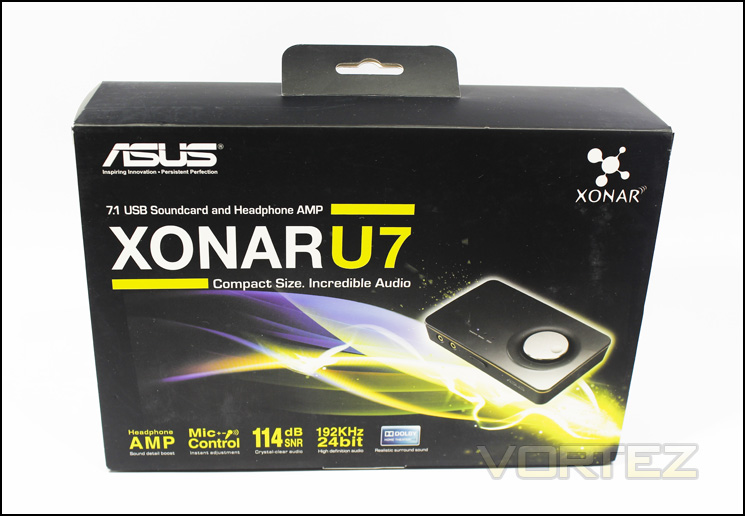
The box front
The box is made from good quality cardboard and feels like high quality printing, keeping up with other ASUS products. Clear information with the product name clear to see as with some features along the bottom. Some interesting artwork dies the design together with a photo of the product.
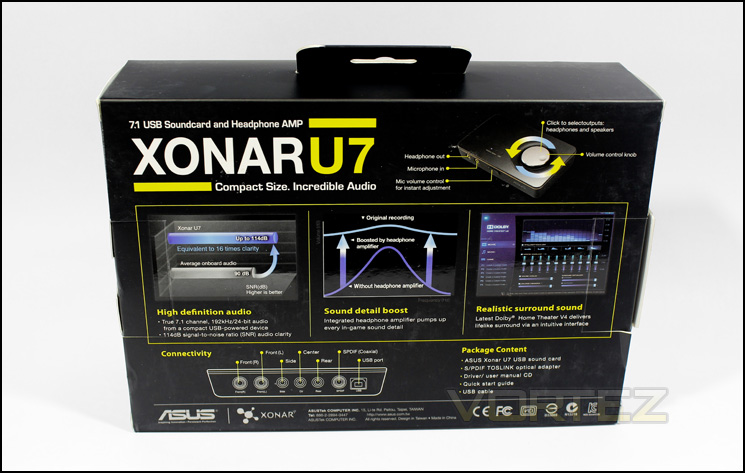
Rear side
At the back we find details of some features as expected.
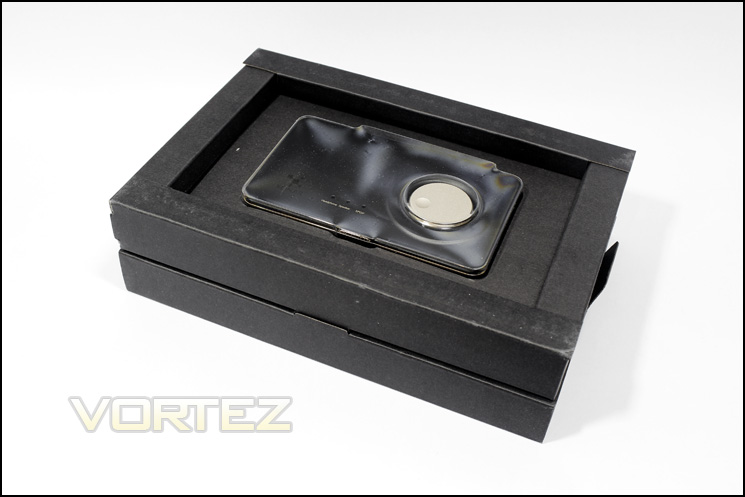
Inside the box
The outer packaging does open up to show a window displaying the product, inside we find the protective blister. The inner box opens up to release the Xonar U7 and reveals a compartment for the included accessories.
Inclusive bundle
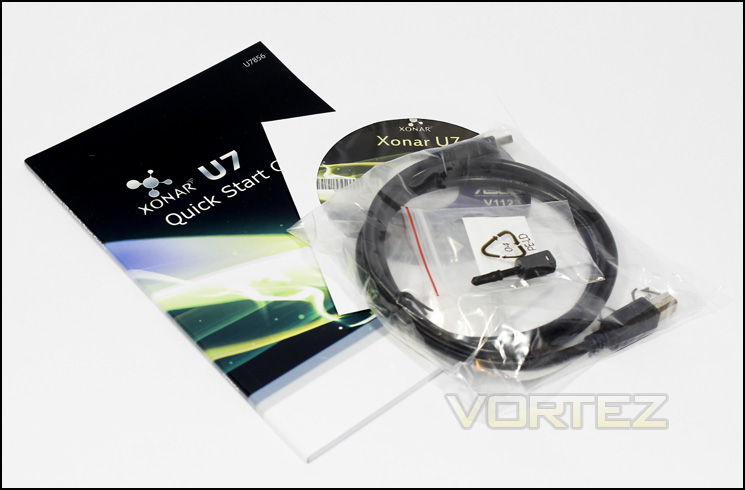
Shipped alongside the U7 we can find the instruction manual, the USB cable, S/PDIF adaptor and driver CD.
The Xonar U7
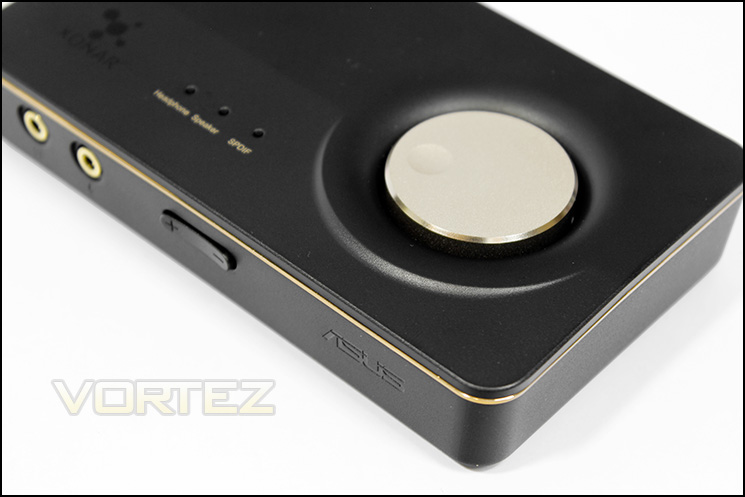
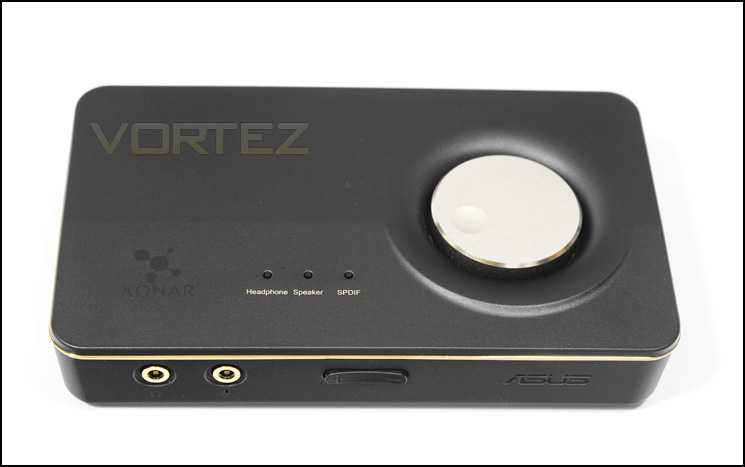
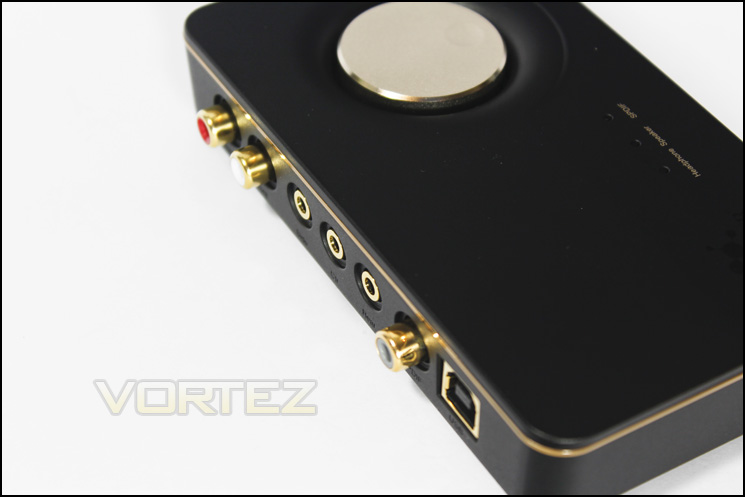
The Xonar is attractive with its gold trims, simple styling and compact size. At the front we have the 3.5mm headphone and microphone ports with a -+ on the fly control for mic volume. The dial on top is an easy access master volume control that also acts like a switch to swap between speakers and headphone on the fly, very handy.
Ports galore
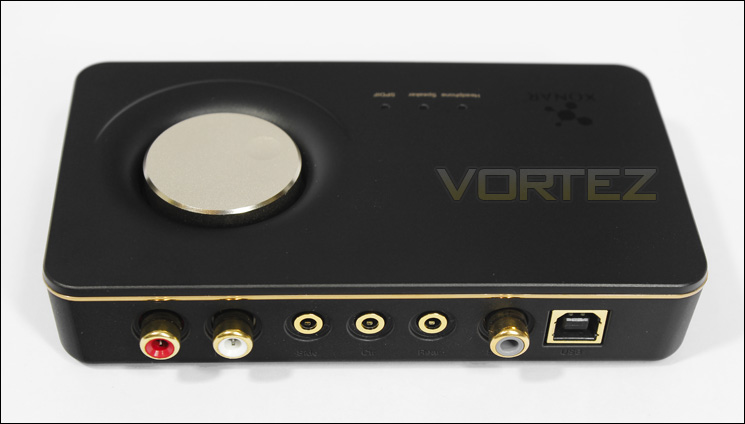
Some may require an RCA splitter for the dedicated stereo ports, and we also have 3.5mm ports for the side, centre and rear channels. On the right we find the S/PDIF port and the USB port.
Software
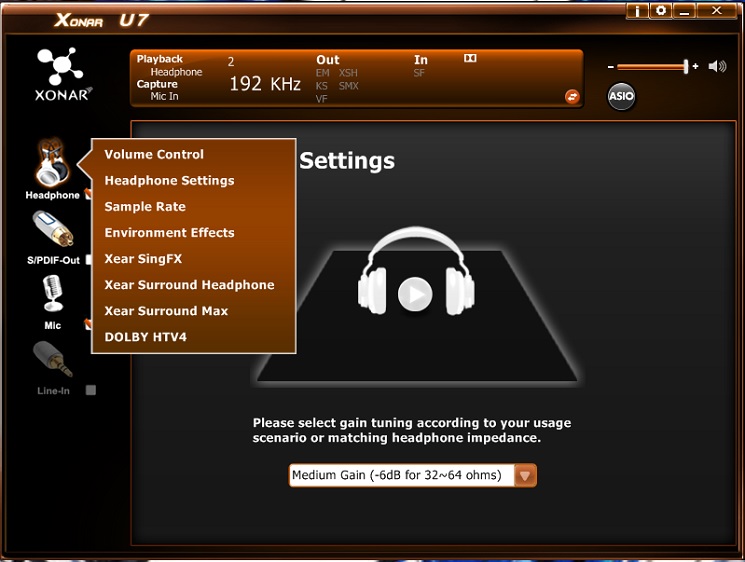
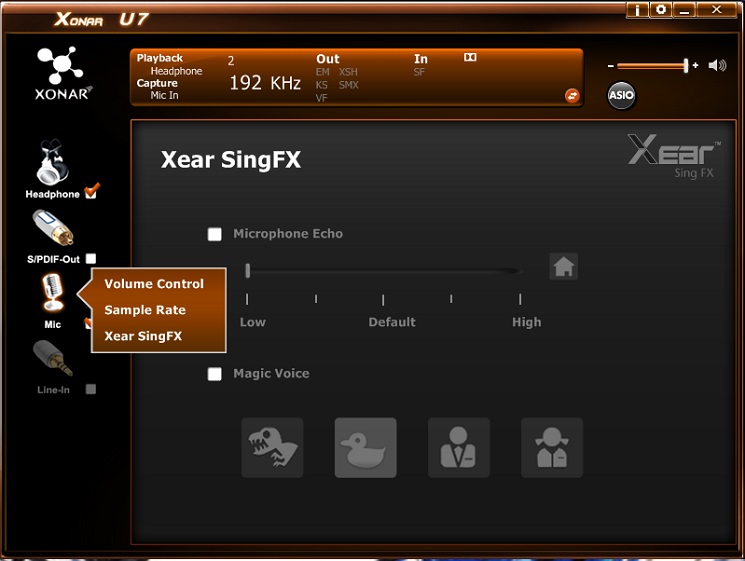
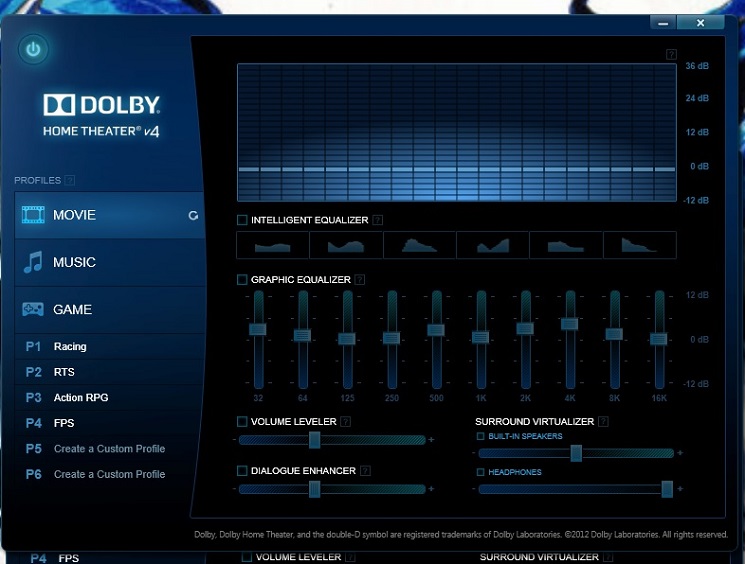
The software supplied is not too dissimilar to what we saw with the Phoebus. The options for each output/input are revealed when you right click and is fairly simple to browse. The supporting dolby Home Theatre v4 gives intuitive audio control and equalisation on the side.
Performance Testing
Setup, Design & Observations
Setting up was simple with consideration. Plug in the Xonar via USB 2.0 using the cable provided, install drivers then plug in audio device of choice. Some may need a RCA splitter for their speakers which isn’t provided unfortunately but otherwise straight forward. One consideration is, on the underside of the product there is a small switch saying ‘USB 1.1 – 2.0’, make sure it is in the 2.0 position otherwise you may run into issues with installing the driver. The Xonar U7 is fairly light and compact and looks sleek enough to have on your desktop. As I understand it, the audio processor used is the CM6632A which is a high performance USB audio processor with the CS4398 DAC handling the 24-Bit/ 192 kHz needs of the primary stereo inputs with the CS4362A chip handling the rest of the channels. The headphone amp appears to be integrated on the CM6632A processor, something that is slightly questionable but may be fine. Another mention is that the Xonar U7 supports AISO.
The microphone volume control and master volume control dial is handy and easy to access while being able to swap between speakers and headphone by just clicking in the dial is genius, a feature many will enjoy.
Right Mark Audio Analyzer
RMAA suite is designed for testing quality of analog and digital paths of any audio devices, be it a sound card, an MP3 player, a consumer CD/DVD player or an acoustic set. The results are obtained by playing and recording test signals passed through the tested audio path by means of frequency analysis algorithms. A more common mark is also provided for those unfamiliar with measured technical parameters.
Understanding the limitations of a test is something that should be addressed in regards to giving an accurate portrayal. RMAA is a useful tool but testing has many variables thus results are only comparable under similar set standards and parameters and shouldn’t be compared directly to other results that may have been obtained under different testing conditions.
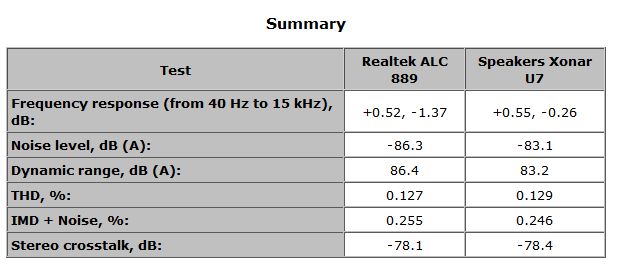
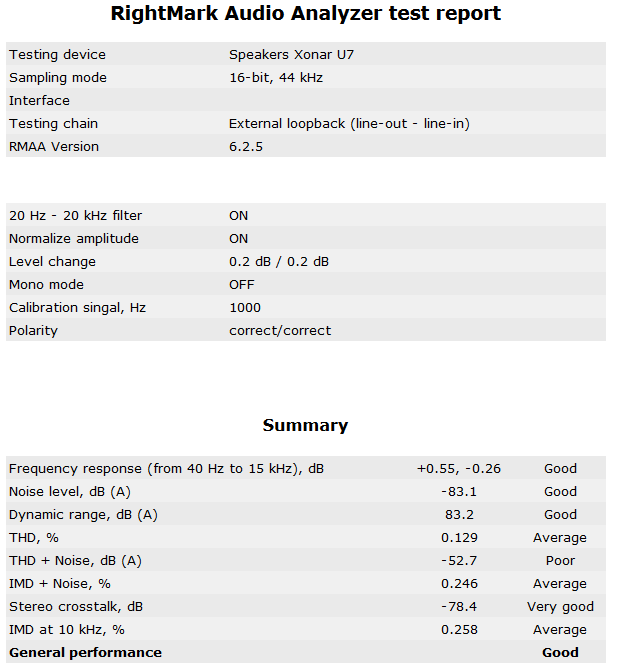
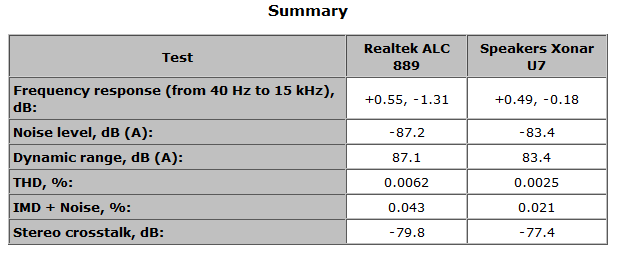
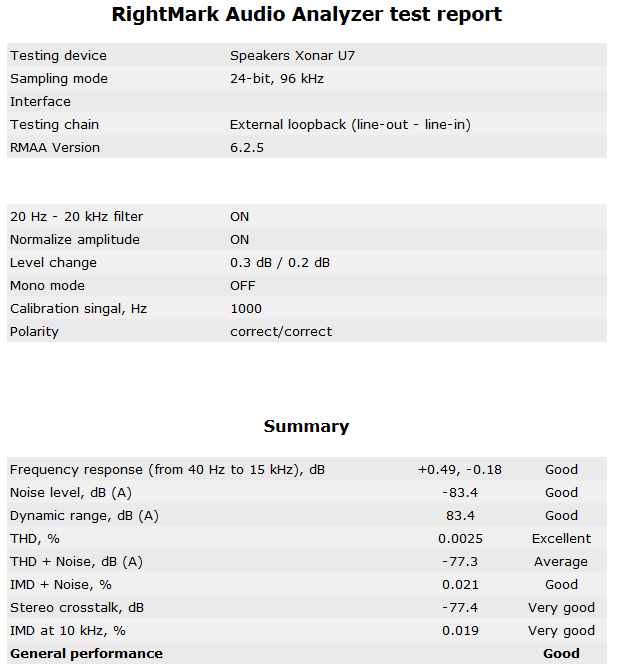
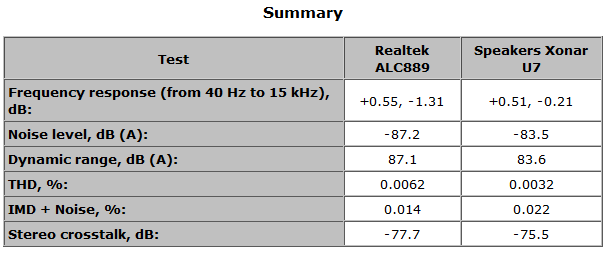
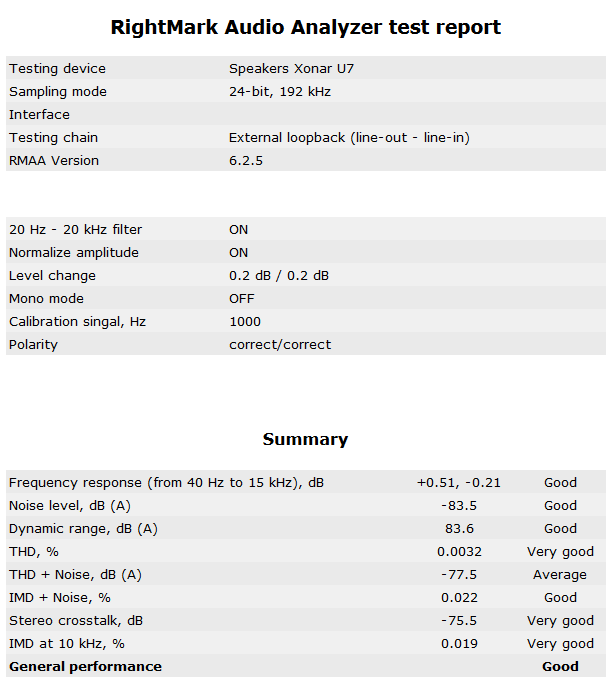
In this comparison, I used the backlooping method of plugging an ‘out’ jack into the ‘in’ jack. The Xonar U7 allows for 24bit 192kHz recording so I also tested at this sample rate. Mostly the Xonar U7 performed on par with the reference integrated solution, this doesn’t mean to say that the Xonar U7 didn’t perform well when you consider that the Realtek ALC 889 is fairly high performance in regards to integrated solutions. However, it does raise the question ‘how much difference does it make subjectively?’
16 bit 44kHz
24 bit 96kHz
24 bit 192 kHz
Multi-Media
Upon using the Xonar U7 there is definitely better fidelity over the integrated solution giving clarity and shine to the highs and bass. This difference was noticeable via speakers and headphone and the Xonar U7 does give better perceived audio fidelity than the RMAA results suggest. The headphone amp feature seems a bit weak, with normal gain being too quiet (using just a 32Ohm headset) and the medium gain setting was needed to be used. Even on medium, the volume seemed dipped compared to normal use as I would expect, however, I didn’t want to use the high gain setting in case it could give too much power.
Overall the Xonar U7 can provide those big sounds gamers and movie enthusiasts enjoy with improved fidelity. Of course, with such a product you will want some capable speakers to compliment such a thing.
Conclusion
The ASUS Xonar U7 does bring a bundle of features to those who need an external soundcard should they be using a notebook or not have space internally for their desktop. Providing up to 7.1 channels and a line in/mic with 24bit/192kHz sample rates as well as including a headphone amp (despite being weak) there is a lot to like about this product. The sleek looks allow it to look at home on the desktop and the functional design giving you control of microphone, master volume and switching between output sources (speakers/headphone/ and S/PDIF if in use) makes life that little easier.
If we were to state some obvious things, there are various downsides to using a USB soundcard, most of them universal and inherent. Though if you are someone who requires such a product then all are oversights. We could say something like, ‘a comparable discrete option would be better’ but that would be pointless. The only real negative to this product is the weakness of the headphone amp and the lack of a 6.4mm jack (Quarter inch). If you are someone who primarily uses high impedance headphones, then simply, do not buy this product as you will be better served by a true dedicated headphone amp/DAC. Though if you do use various audio output devices and want them all connected to a capable hub that is functional, portable and improves your audio fidelity over legacy options, then the Xonar U7 is certainly one to consider as this does all of that very well at a good price too.
The ASUS Xonar U7 is full of functional features in a fantastic finish giving fine fidelity. Deserving of our Gold award.
Pros.
+ Improved audio fidelity
+ Sleek looks
+ Compact/portable
+ Good price
Cons.
– Weak headphone amp
+ Improved audio fidelity
+ Sleek looks
+ Compact/portable
+ Good price
Cons.
– Weak headphone amp

Click here for an explanation of our awards at Vortez.net. Thanks to ASUS for providing today’s review sample.


