







ASUS have redesigned their mainstream LGA1150 motherboard with the Intel 8 Series – gold is the new theme. We take a look and see how it handles Intel 4770K.

Product on Review: Z87-A
Manufacturer and Sponsor: ASUS
Street Price: £115 (At time of review)
Whilst ASUS’ Republic of Gamers series has enjoyed lots of attention throughout the Intel 6 and 7 series, their mainstream segment motherboards have been somewhat pushed into the background compared to rival brands and their more affordable options. But with the introduction of Intel’s 8 series motherboards ASUS have redesigned their motherboards in a bid to diversify and today we are turning to their mainstream category to see whether the new wave of Z87 motherboards compare against the popular motherboards we have already reviewed.
The Z87-A is an affordable LGA1150 motherboard with plenty of features to keep even avid enthusiasts entertained. Modelling the new gold theme, this motherboard promises to perform and overclock just as well as other mainstream and even higher-end models – will it have what it takes to impress us?
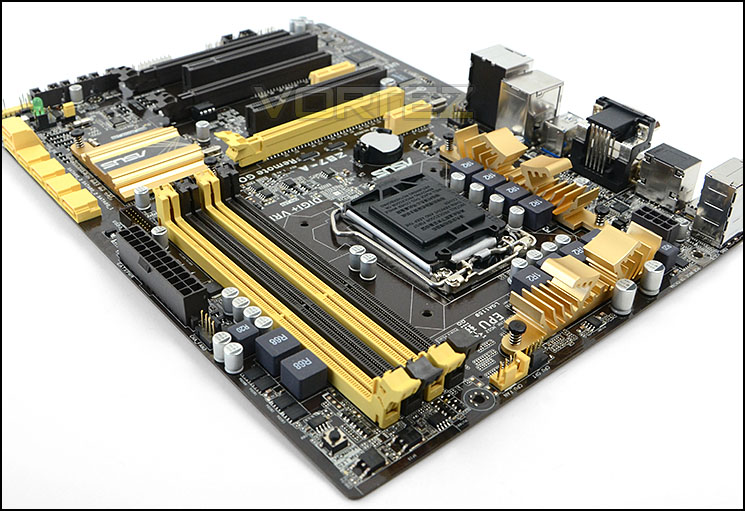
ASUS on their Z87-A
The ASUS Z87-A features digital power design for higher power efficiency, greater performance, and rock-solid stability. USB 3.0 Boost technology lets you to enjoy high data transfer speeds. Thanks to the Windows 8 support, users can experience the next-generation operating system on ASUS hardware. ASUS Remote GO! ensures one-stop PC Remote Control and home entertainment.
Technical Specifications
CPU
Intel® Socket 1150 for 4th Generation Core™ i7/Core™ i5/Core™ i3/Pentium®/Celeron® Processors
Supports Intel® 22 nm CPU
Supports Intel® Turbo Boost Technology 2.0
Chipset
Intel® Z87
Memory
4 x DIMM, Max. 32GB, DDR3 3000(O.C.)/2933(O.C.)/2800(O.C.)/2666(O.C.)/2600(O.C.)/2500(O.C.)/
2400(O.C.)/2200(O.C.)/2133(O.C.)/2000(O.C.)/1866(O.C.)/1800(O.C.)/1600/1333 MHz Non-ECC, Un-buffered Memory
Dual Channel Memory Architecture
Supports Intel® Extreme Memory Profile (XMP)
Graphic
Integrated Graphics Processor
Multi-VGA output support : HDMI/DVI-D/RGB/DisplayPort 1.2 ports *1
– Supports HDMI with max. resolution 4096 x 2160 @ 24 Hz / 2560 x 1600 @ 60 Hz
– Supports DVI-D with max. resolution 1920 x 1200 @ 60 Hz
– Supports RGB with max. resolution 1920 x 1200 @ 60 Hz
– Supports DisplayPort with max. resolution 4096 x 2160 @ 24 Hz / 3840 x 2160 @ 60 Hz
Maximum shared memory of 1024 MB
Supports up to 3 displays simultaneously
Multi-GPU Support
Supports NVIDIA® Quad-GPU SLI™ Technology *2
Supports AMD Quad-GPU CrossFireX™ Technology
Expansion Slots
2 x PCIe 3.0/2.0 x16 (x16 or dual x8)
1 x PCIe 2.0 x16 (x2 mode)
2 x PCIe 2.0 x1
2 x PCI
Storage
Intel® Z87 chipset :
6 x eSATA port(s), yellow
Support Raid 0, 1, 5, 10
Supports Intel® Dynamic Storage Accelerator, Intel® Smart Response Technology,
Intel® Rapid Start Technology, Intel® Smart Connect Technology*3
LAN
Realtek® 8111GR, 1 x Gigabit LAN Controller(s)
Audio
Realtek® ALC892 8-Channel High Definition Audio CODEC
– Supports : Jack-detection, Multi-streaming, Front Panel Jack-retasking
Audio Feature :
– Absolute Pitch 192kHz/ 24-bit True BD Lossless Sound
– DTS Ultra PC II
– DTS Connect
– Optical S/PDIF out port(s) at back panel
– BD Audio Layer Content Protection
USB Ports
Intel® Z87 chipset :
6 x USB 3.0/2.0 port(s) (4 at back panel, blue, 2 at mid-board)
Intel® Z87 chipset :
8 x USB 2.0/1.1 port(s)
Special Features
ASUS Dual Intelligent Processors 2 with DIGI+ VRM :
ASUS 5X PROTECTION :
– ASUS DIGI+ VRM – 8 Phase digital power design
– ASUS Enhanced DRAM Overcurrent Protection – Short circuit damage prevention
– ASUS ESD Guards – Enhanced ESD protection
– ASUS All 5K-Hour Solid Capacitors – 2.5x long lifespan with excellent durability
– ASUS Stainless Steel Back I/O – 3x more durable corrosion-resistant coating
ASUS EPU :
– EPU
– EPU switch
ASUS Digital Power Design :
– Industry leading Digital 8 Phase CPU Power Design
– ASUS DIGI+ VRM Utility
ASUS Exclusive Features :
– Remote GO!
– MemOK!
– AI Suite 3
– Ai Charger
– Anti-Surge
– Front Panel USB 3.0 Support
– ASUS UEFI BIOS EZ Mode featuring friendly graphics user interface
– Network iControl
– USB 3.0 Boost
– Disk Unlocker
ASUS Quiet Thermal Solution :
– Stylish Fanless Design Heat-sink solution
– ASUS Fan Xpert 2
ASUS EZ DIY :
– DirectKey
– Precision Tweaker 2
– ASUS O.C. Profile
– ASUS CrashFree BIOS 3
– ASUS EZ Flash 2
– Multi-language BIOS
ASUS Q-Design :
– ASUS Q-LED (CPU, DRAM, VGA, Boot Device LED)
– ASUS Q-Slot
– ASUS Q-DIMM
– ASUS Q-Connector
100% All High-quality Conductive Polymer Capacitors
Overclocking Protection :
– ASUS C.P.R.(CPU Parameter Recall)
Back I/O Ports
1 x PS/2 keyboard/mouse combo port(s)
1 x DVI-D
1 x D-Sub
1 x DisplayPort
1 x HDMI
1 x LAN (RJ45) port(s)
4 x USB 3.0 (blue)
2 x USB 2.0
1 x Optical S/PDIF out
6 x Audio jack(s)
Internal I/O Ports
1 x USB 3.0 connector(s) support(s) additional 2 USB 3.0 port(s) (19-pin)
3 x USB 2.0 connector(s) support(s) additional 6 USB 2.0 port(s)
1 x TPM header
6 x SATA 6Gb/s connector(s)
1 x CPU Fan connector(s) (1 x 4 -pin)
1 x CPU OPT Fan connector(s) (1 x 4 -pin)
3 x Chassis Fan connector(s) (3 x 4 -pin)
1 x S/PDIF out header(s)
1 x 24-pin EATX Power connector(s)
1 x 8-pin ATX 12V Power connector(s)
1 x Front panel audio connector(s) (AAFP)
1 x System panel(s) (Q-Connector)
1 x DirectKey Button(s)
1 x DRCT header(s)
1 x MemOK! button(s)
1 x TPU switch(es)
1 x EPU switch(es)
1 x Clear CMOS jumper(s)
Accessories
User’s manual
I/O Shield
2 x SATA 6Gb/s cable(s)
1 x SLI bridge(s)
1 x Q-connector(s) (2 in 1)
BIOS
64 Mb Flash ROM, UEFI AMI BIOS, PnP, DMI2.7, WfM2.0, SM BIOS 2.7, ACPI 5.0, Multi-language BIOS,
ASUS EZ Flash 2, ASUS CrashFree BIOS 3, My Favorites, Quick Note, Last Modified log, F12 PrintScreen,
F3 Shortcut functions, and ASUS DRAM SPD (Serial Presence Detect) memory information
Manageability
WfM 2.0, DMI 2.7, WOL by PME, PXE
Support Disc
Drivers
ASUS Utilities
EZ Update
Anti-virus software (OEM Version Only)
Form Factor
ATX Form Factor
12 inch x 8.8 inch ( 30.5 cm x 22.35 cm )
Intel® Socket 1150 for 4th Generation Core™ i7/Core™ i5/Core™ i3/Pentium®/Celeron® Processors
Supports Intel® 22 nm CPU
Supports Intel® Turbo Boost Technology 2.0
Chipset
Intel® Z87
Memory
4 x DIMM, Max. 32GB, DDR3 3000(O.C.)/2933(O.C.)/2800(O.C.)/2666(O.C.)/2600(O.C.)/2500(O.C.)/
2400(O.C.)/2200(O.C.)/2133(O.C.)/2000(O.C.)/1866(O.C.)/1800(O.C.)/1600/1333 MHz Non-ECC, Un-buffered Memory
Dual Channel Memory Architecture
Supports Intel® Extreme Memory Profile (XMP)
Graphic
Integrated Graphics Processor
Multi-VGA output support : HDMI/DVI-D/RGB/DisplayPort 1.2 ports *1
– Supports HDMI with max. resolution 4096 x 2160 @ 24 Hz / 2560 x 1600 @ 60 Hz
– Supports DVI-D with max. resolution 1920 x 1200 @ 60 Hz
– Supports RGB with max. resolution 1920 x 1200 @ 60 Hz
– Supports DisplayPort with max. resolution 4096 x 2160 @ 24 Hz / 3840 x 2160 @ 60 Hz
Maximum shared memory of 1024 MB
Supports up to 3 displays simultaneously
Multi-GPU Support
Supports NVIDIA® Quad-GPU SLI™ Technology *2
Supports AMD Quad-GPU CrossFireX™ Technology
Expansion Slots
2 x PCIe 3.0/2.0 x16 (x16 or dual x8)
1 x PCIe 2.0 x16 (x2 mode)
2 x PCIe 2.0 x1
2 x PCI
Storage
Intel® Z87 chipset :
6 x eSATA port(s), yellow
Support Raid 0, 1, 5, 10
Supports Intel® Dynamic Storage Accelerator, Intel® Smart Response Technology,
Intel® Rapid Start Technology, Intel® Smart Connect Technology*3
LAN
Realtek® 8111GR, 1 x Gigabit LAN Controller(s)
Audio
Realtek® ALC892 8-Channel High Definition Audio CODEC
– Supports : Jack-detection, Multi-streaming, Front Panel Jack-retasking
Audio Feature :
– Absolute Pitch 192kHz/ 24-bit True BD Lossless Sound
– DTS Ultra PC II
– DTS Connect
– Optical S/PDIF out port(s) at back panel
– BD Audio Layer Content Protection
USB Ports
Intel® Z87 chipset :
6 x USB 3.0/2.0 port(s) (4 at back panel, blue, 2 at mid-board)
Intel® Z87 chipset :
8 x USB 2.0/1.1 port(s)
Special Features
ASUS Dual Intelligent Processors 2 with DIGI+ VRM :
ASUS 5X PROTECTION :
– ASUS DIGI+ VRM – 8 Phase digital power design
– ASUS Enhanced DRAM Overcurrent Protection – Short circuit damage prevention
– ASUS ESD Guards – Enhanced ESD protection
– ASUS All 5K-Hour Solid Capacitors – 2.5x long lifespan with excellent durability
– ASUS Stainless Steel Back I/O – 3x more durable corrosion-resistant coating
ASUS EPU :
– EPU
– EPU switch
ASUS Digital Power Design :
– Industry leading Digital 8 Phase CPU Power Design
– ASUS DIGI+ VRM Utility
ASUS Exclusive Features :
– Remote GO!
– MemOK!
– AI Suite 3
– Ai Charger
– Anti-Surge
– Front Panel USB 3.0 Support
– ASUS UEFI BIOS EZ Mode featuring friendly graphics user interface
– Network iControl
– USB 3.0 Boost
– Disk Unlocker
ASUS Quiet Thermal Solution :
– Stylish Fanless Design Heat-sink solution
– ASUS Fan Xpert 2
ASUS EZ DIY :
– DirectKey
– Precision Tweaker 2
– ASUS O.C. Profile
– ASUS CrashFree BIOS 3
– ASUS EZ Flash 2
– Multi-language BIOS
ASUS Q-Design :
– ASUS Q-LED (CPU, DRAM, VGA, Boot Device LED)
– ASUS Q-Slot
– ASUS Q-DIMM
– ASUS Q-Connector
100% All High-quality Conductive Polymer Capacitors
Overclocking Protection :
– ASUS C.P.R.(CPU Parameter Recall)
Back I/O Ports
1 x PS/2 keyboard/mouse combo port(s)
1 x DVI-D
1 x D-Sub
1 x DisplayPort
1 x HDMI
1 x LAN (RJ45) port(s)
4 x USB 3.0 (blue)
2 x USB 2.0
1 x Optical S/PDIF out
6 x Audio jack(s)
Internal I/O Ports
1 x USB 3.0 connector(s) support(s) additional 2 USB 3.0 port(s) (19-pin)
3 x USB 2.0 connector(s) support(s) additional 6 USB 2.0 port(s)
1 x TPM header
6 x SATA 6Gb/s connector(s)
1 x CPU Fan connector(s) (1 x 4 -pin)
1 x CPU OPT Fan connector(s) (1 x 4 -pin)
3 x Chassis Fan connector(s) (3 x 4 -pin)
1 x S/PDIF out header(s)
1 x 24-pin EATX Power connector(s)
1 x 8-pin ATX 12V Power connector(s)
1 x Front panel audio connector(s) (AAFP)
1 x System panel(s) (Q-Connector)
1 x DirectKey Button(s)
1 x DRCT header(s)
1 x MemOK! button(s)
1 x TPU switch(es)
1 x EPU switch(es)
1 x Clear CMOS jumper(s)
Accessories
User’s manual
I/O Shield
2 x SATA 6Gb/s cable(s)
1 x SLI bridge(s)
1 x Q-connector(s) (2 in 1)
BIOS
64 Mb Flash ROM, UEFI AMI BIOS, PnP, DMI2.7, WfM2.0, SM BIOS 2.7, ACPI 5.0, Multi-language BIOS,
ASUS EZ Flash 2, ASUS CrashFree BIOS 3, My Favorites, Quick Note, Last Modified log, F12 PrintScreen,
F3 Shortcut functions, and ASUS DRAM SPD (Serial Presence Detect) memory information
Manageability
WfM 2.0, DMI 2.7, WOL by PME, PXE
Support Disc
Drivers
ASUS Utilities
EZ Update
Anti-virus software (OEM Version Only)
Form Factor
ATX Form Factor
12 inch x 8.8 inch ( 30.5 cm x 22.35 cm )
Packaging & First Look
The Z87-A is presented in a large, attractive box which has been designed to clearly catch the eye. Essential features are covered on the front of the box along with the standards that are employed and the back goes into further detail about these features listing the technical spec. Inside, as you would expect the motherboard is covered in an anti-static bag for protection.
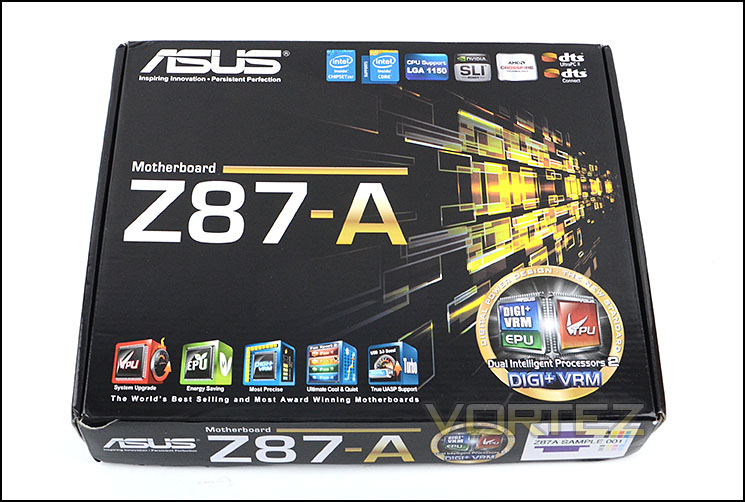
Packaging is eye-catching
Along with the motherboard, there are a number items included within the bundle – less than you would find with a high-end motherboard – here they are:
• User’s manual
• Driver CD
• I/O Shield
• 2 x SATA 6Gb/s cables
• SLI Bridge (flexible)
• Q-connectors
Z87-A occupies the mainstream and with its focus being on value the included items are kept to a minimum compared to something at the opposite end of the spectrum or even from the ROG series.
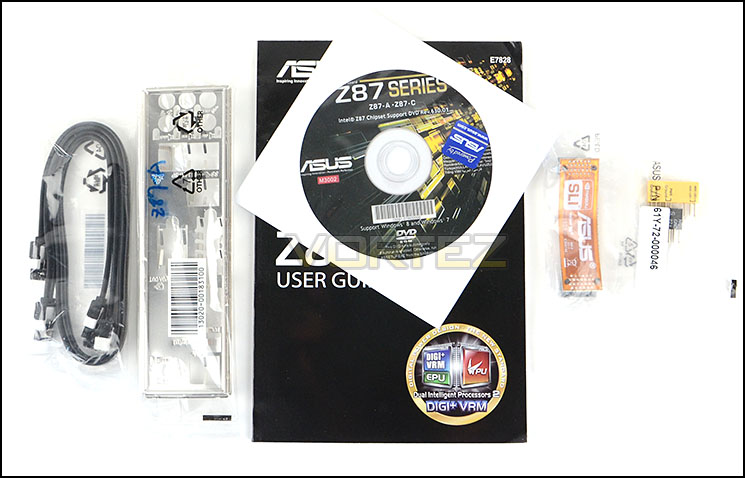
The included items that consist of the bundle
Casting our eyes on the Z87-A for the first time with a fresh new look for Z87, we have to say we are a little undecided on its styling. We understand that ASUS are wanting to diversify with this new gold theme but sadly the SATA/PCI-E/DIMM slots are all a different colour tone to the metallic parts and the only aspects which are indeed “Gold” are the heatsinks. Matching metal and plastic can be a difficult task but we can see the colour of this motherboard coming under fire – especially when aesthetics are so important with enthusiasts and system builders nowadays.
The eagle eyed amongst you will notice that this motherboard isn’t full ATX in its form factor, it is indeed thinner, with the dimensions: 30.5 cm x 22.35 cm. With these measurements the right hand edge and more particularly the 24-pin power and memory slots do not have support underneath so care must be taken when applying pressure in these areas.
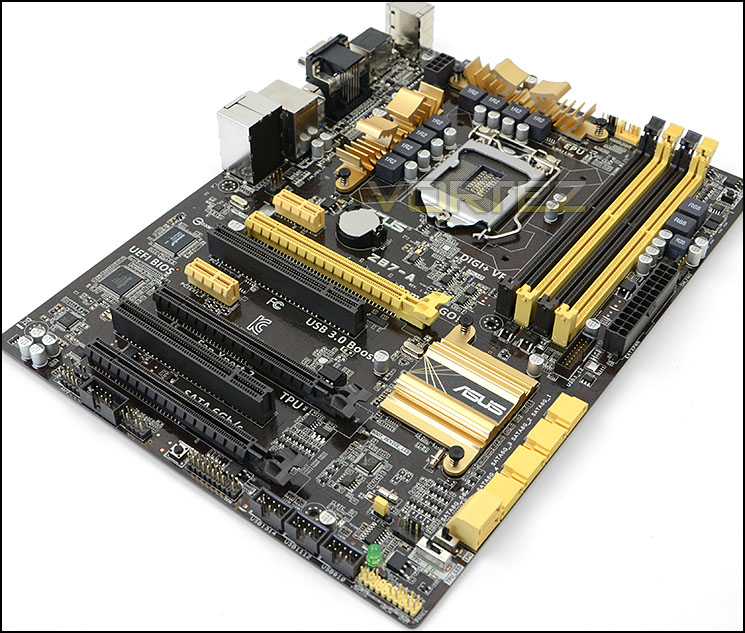
An overview of Z87-A
Closer Look
We’ll now move in for a closer look at the different features found on Z87-A, starting with the socket area. This motherboard is of course designed to work with Intel’s 4th Generation of processors – Haswell. The socket is LGA1150 but has the mounting holes for LGA115X so if you have a cooler that has been used on another socket such as LGA1155 then it will work fine here too. ASUS have actually included dual fan headers for the CPU cooler just beside the top heatsink which we are pleased to see.
Around the socket the CPU has been given eight fully digital phases – whilst the memory have been given a further two. Ironically, covering the MOSFETs are two rather lack-lustre heatsinks. Whilst they may be much smaller than we have seen on other motherboards, one particular aspect is in its favour – CPU cooler clearance.
Behind the heatsinks is an 8-pin EPS port for CPU power delivery. Furthermore Z87-A and all other ASUS motherboards now have Dual Intelligent Processors 2 which brings in DIGI+VRM – a fully digital power design system.
Due to Z87-A being a value for money, mainstream offering – the components used on this motherboard are standard phases and capacitors rather than the premium parts found on models such as the recently reviewed Maximus VI Hero.
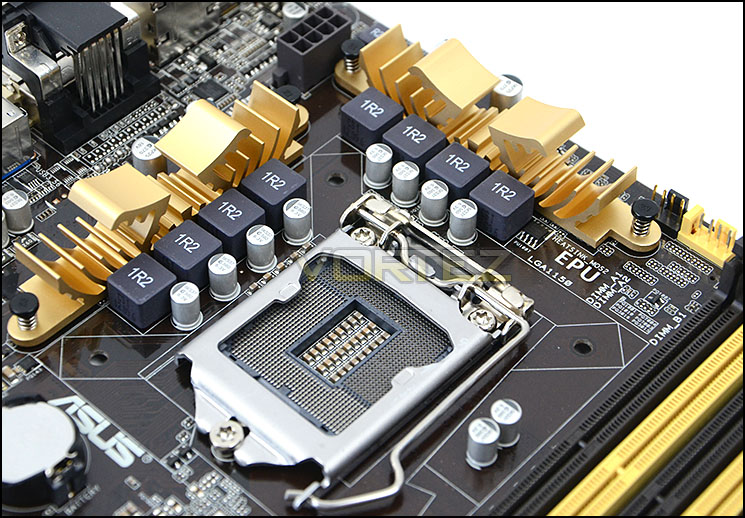
Z87-A uses an 8-phase power design for CPU delivery
Turning our attention to the memory slots – there is dual channel DDR3 support. Z87-A has support for 32GB capacity and up to 3000(OC). There are a single set of clips on the right side rather than on both sides.
On the corner, ASUS have placed MemOK! Button which provides a failsafe boot with troublesome memory modules. On the other side of the 24-pin ATX power is a single USB 3.0 header for gaining USB 3.0 connectivity at the front of the case.
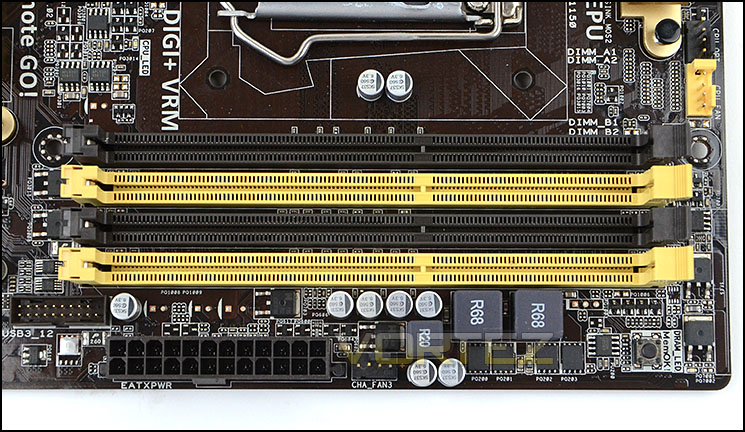
Dual channel DDR3 support – up to 32GB and up to 3000(OC)
Further along the motherboard are six SATA 3 (6GB/s) ports. No longer do we have SATA 2, and since SATA 3 is backwards compatible older SATA 2 devices will work fine anyway, their speed will just be capped.
Next to the SATA ports are the two switches: TPU and EPU. TPU allows for an automatic adjustment to the CPU ratio and clock speed. Ratio can be altered and BCLK because this switch has three modes which include disable. With EPU enabled the current loads are altered to moderate the power consumption. It’s important to only modify this switch when the system is powered down.
Behind the SATA ports sits the Z87 chip which is covered by a small golden heatsink. The Z87 chip delivers functionality such as SATA/USB and more.
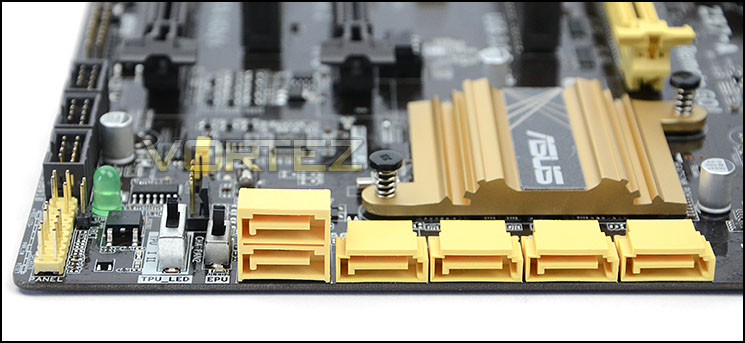
A total of six SATA 3 (6GB/s) ports
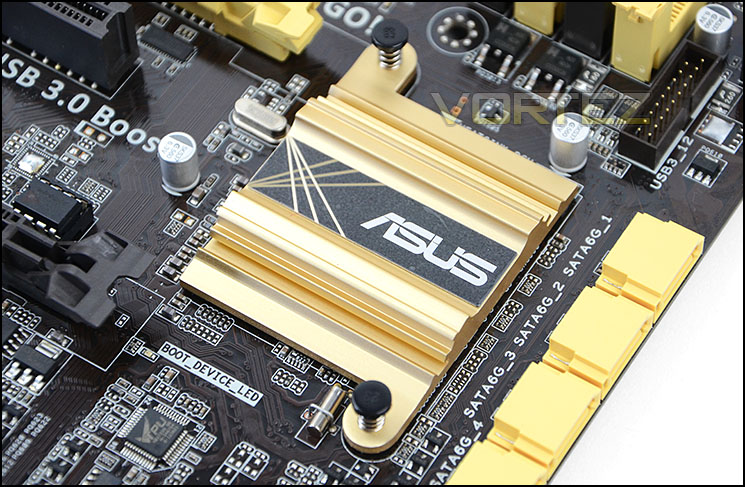
A golden heatsink covering Intel Z87 chip
Z87-A has a good assortment of different expansion slots – the PCI-E supports NVIDIA SLI for multi-GPU configuration. The slots are as follows:
1 x PCI Express 3.0 x16 slot – Yellow (Running @x16)
1 x PCI Express 3.0 x16 slot – Black (Running @x8)
1 x PCI Express 2.0 x16 slot – BLACK (Running @x4)
2 x PCI Express 2.0 x1 slot – Yellow
2 x PCI legacy slot
If you are planning to use a single graphics card, use the top slot since this runs at x16.
Below the expansion slots is a direct key button – this allows entry into the BIOS with a single click. Therefore there is no need to repeatedly hit the delete button and no need for a keyboard.
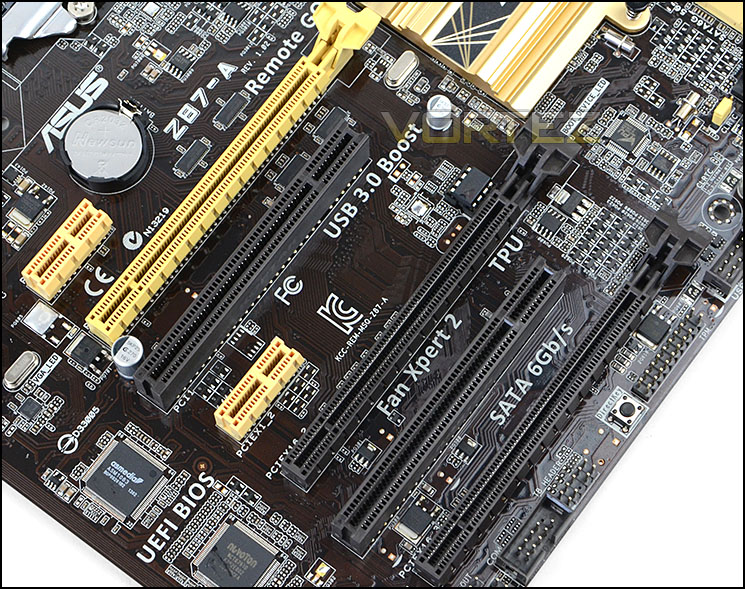
Lots of options including legacy PCI
The rear IO section of Z87-A has a plethora of functionality which include the following:
• 1 x PS/2 keyboard/mouse combo port(s)
• 1 x DVI-D
• 1 x D-Sub
• 1 x DisplayPort
• 1 x HDMI
• 1 x Gigabit LAN (RJ45) port
• 4 x USB 3.0 (blue)
• 2 x USB 2.0
• 1 x Optical S/PDIF out
• 6 x Audio jacks
The respective video ports are to work in conjunction with integrated graphics from Haswell – its nice to see such a varied selection of options here. The audio jacks are given their audio support via Realtek® ALC892 8-Channel High Definition Audio CODEC.
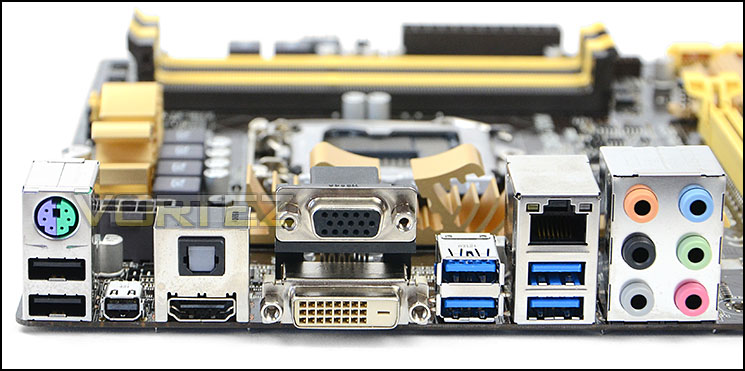
The Rear IO with plenty of USB 3.0
ASUS UEFI BIOS
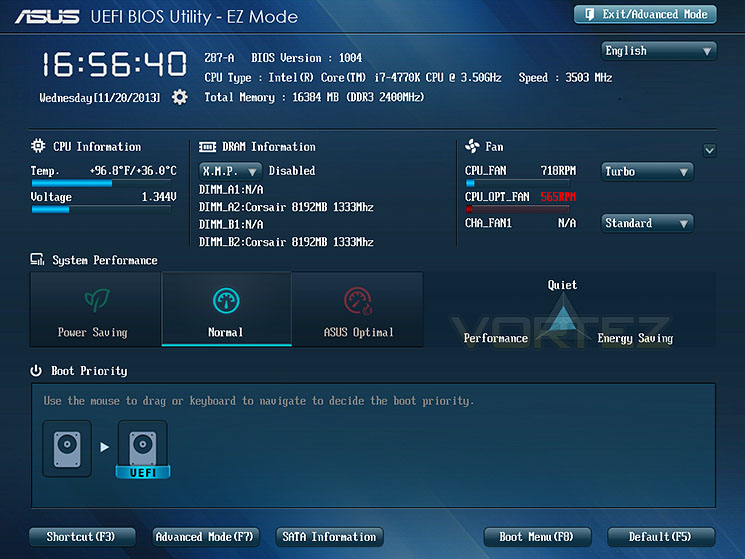
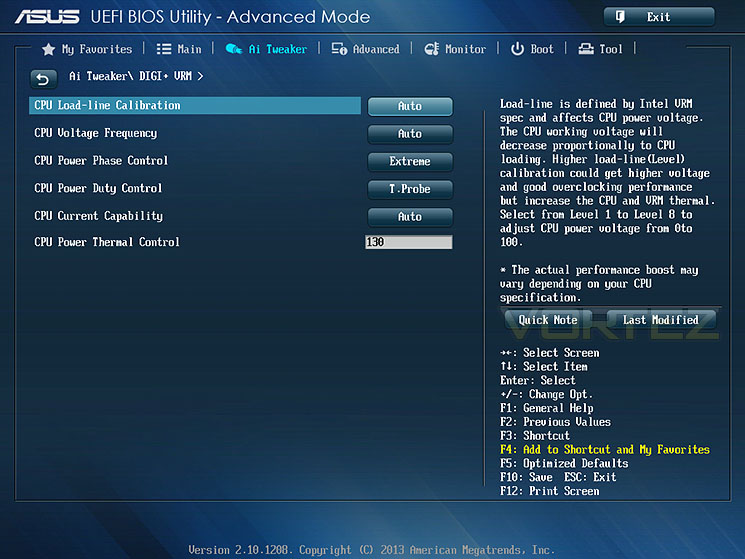
The UEFI BIOS which comes with Z87-A is amongst other things, very easy to use. We really like what ASUS have done with their design choices. Rather than opt for flashy interactions and overcomplicate things they have designed something which is just simple and that just works and this is paramount for advanced tweakers and more particularly, Overclockers. They want to be in and out of the BIOS without having to navigate through countless menu systems, and with ASUS UEFI this is possible.
Those who aren’t advanced users will find the UEFI BIOS a dream to work with since each option that can be tweaked has a full explanation to the right side – not just a brief note but an explanation of what enabling/disabling a particular option will do and its benefits.
One notable aspect which is especially nice is the change log summary which pops up when saving settings to exit – this prompt gives you a quick summary of the options that have been adjusted to ensure you are certain nothing untoward has been altered – however small this feature is, it’s extremely useful.
Test Setup & Overclocking
Test Setup
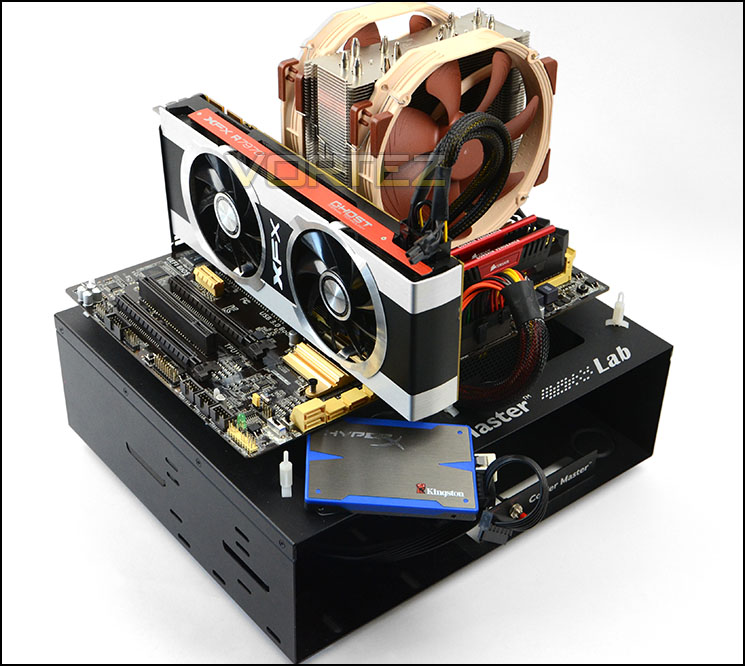
CPU Intel Core i7 4770K (Haswell) 3.50GHz
Cooling Noctua NH-U14
Motherboard ASUS Z87-A
Memory 16GB Corsair Vengeance Pro 2400MHz CL10 DDR3
Graphics XFX R7970 Black Edition
Storage Kingston HyperX 240GB SSD
PSU Corsair HX1050 80 Plus Gold Certified PSU
Cooling Noctua NH-U14
Motherboard ASUS Z87-A
Memory 16GB Corsair Vengeance Pro 2400MHz CL10 DDR3
Graphics XFX R7970 Black Edition
Storage Kingston HyperX 240GB SSD
PSU Corsair HX1050 80 Plus Gold Certified PSU
Benchmarks
Cinebench 11.5 – CPU Score
x264 HD 4.0 – 1st and 2nd pass encoding
SiSoftware SANDRA 2013 – CPU & Memory benchmarks
AIDA64 – CPU benchmarks
3DMark FireStrike – DX11 3D Benchmark
3DMark 11 – DX11 3D Performance and Extreme preset
Games – Tomb Raider, Crysis 3, Metro Last Light
x264 HD 4.0 – 1st and 2nd pass encoding
SiSoftware SANDRA 2013 – CPU & Memory benchmarks
AIDA64 – CPU benchmarks
3DMark FireStrike – DX11 3D Benchmark
3DMark 11 – DX11 3D Performance and Extreme preset
Games – Tomb Raider, Crysis 3, Metro Last Light
Other Software
Temperature Analysis: Core Temp
Stress Testing Software: LinX
CPU Specification Monitoring: CPU-Z
Stress Testing Software: LinX
CPU Specification Monitoring: CPU-Z
Overclocking
The introduction of Z87 brings a return to BCLK overclocking. This will in turn deliver more flexibility for Overclockers compared to previous generations where the BCLK was locked to 100MHz and only the ratio could be adjusted. As many of you will know, Haswell CPUs get very hot with little voltage increase therefore the flexibility and headroom for overclocking can be limited.
Z87-A managed to push our Intel Core i7-4770K to 4.6GHz with 1.34v. As we found with other motherboards, higher frequencies were bootable but failed during high levels of load via LinX. No amount of increase to voltage would assist in helping maintain stability – even with 1.34v at 4.6GHz the temperatures soared to 95C so this is certainly the best result we can hope for. We tried to lower the voltage for 4.6GHz but 1.34v was the minimum required.
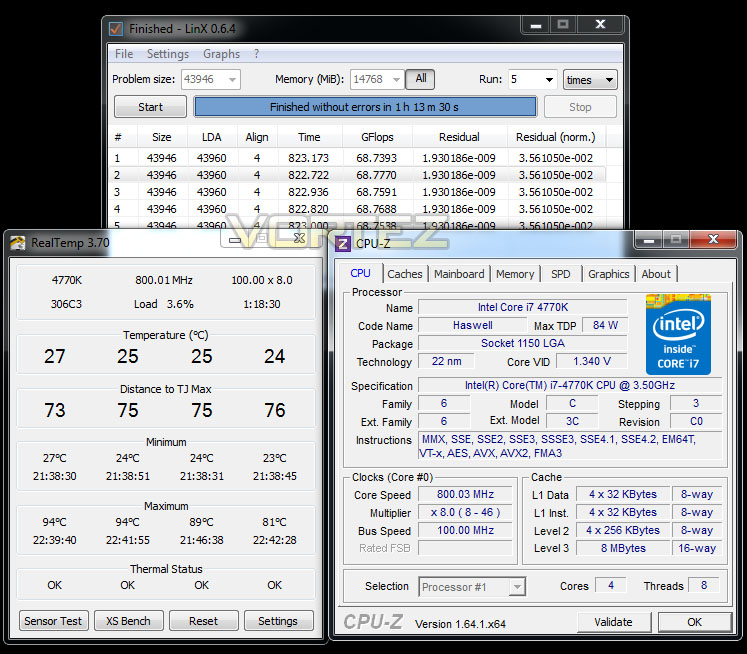
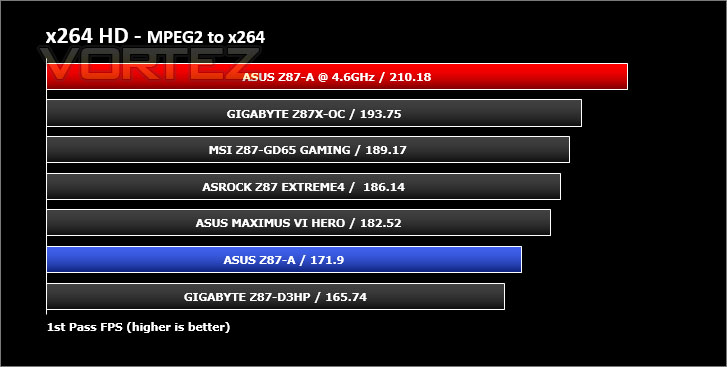
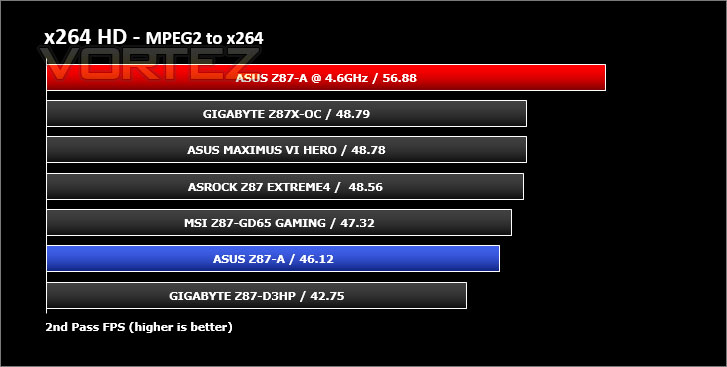
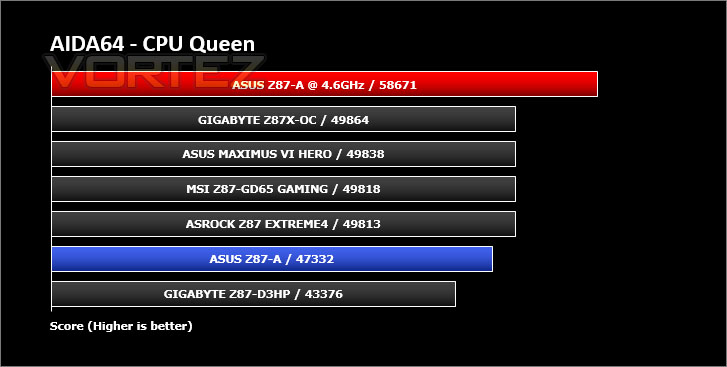
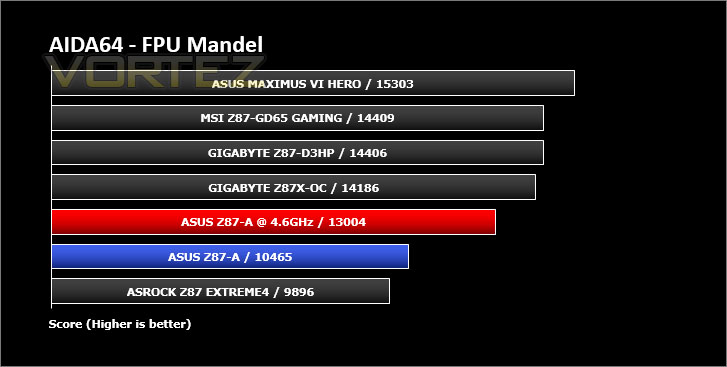
With the 4.6GHz overclock being our best, we will take this into our benchmark suite and test both stock and overclocked results on the subsequent pages. Our comparison results will obviously grow in the forthcoming weeks as we review more and more Z87 motherboards.
Power Consumption
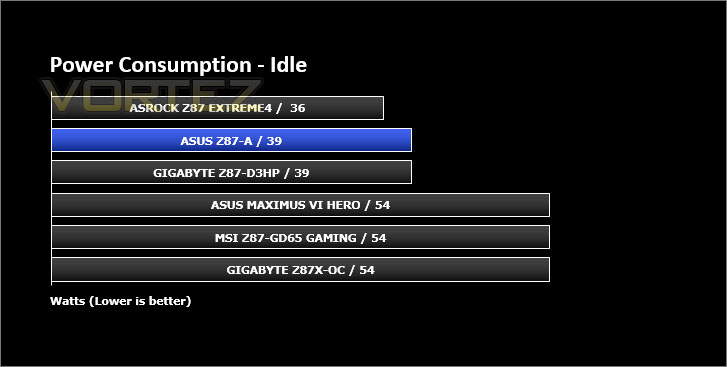
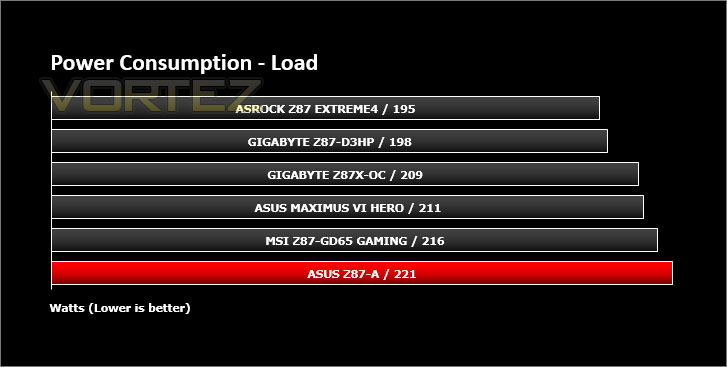
It’s interesting to note the power consumption across all motherboards. Although they are using Z87 chipsets, energy results can fluctuate between manufacturers due to the features and specifications that are integrated. First of all, for the idle tests the system is cold booted into Windows and no additional applications are executed – the watts are noted on the external energy monitor we use and then the system is loaded with 3DMark FireStrike – watts are again monitored for the duration of the test and the highest rated wattage result is then noted down. Below are the results of this energy test.
Benchmarks: X264 HD
Simply put, this test measures how fast your machine can encode a short, DVD quality MPEG-2 video clip into a high-quality x264 video clip. What’s x264, you ask? It’s more or less the next-generation Xvid/DivX codec. I think it’s ideal for a benchmark because the application (x264.exe) reports fairly accurate compression results (in frames per second) for each pass of the video encoding process, and it uses multi-core processors very efficiently.
Benchmarks: AIDA64
AIDA64 Product PageThis simple integer benchmark focuses on the branch prediction capabilities and the misprediction penalties of the CPU. It finds the solutions for the classic “Queens problem” on a 10 by 10 sized chessboard. At the same clock speed theoretically the processor with the shorter pipeline and smaller misprediction penalties will attain higher benchmark scores. For example — with HyperThreading disabled — the Intel Northwood core processors get higher scores than the Intel Prescott core based ones due to the 20-step vs 31-step long pipeline. CPU Queen test uses integer MMX, SSE2 and SSSE3 optimizations.
Benchmarks: Cinebench
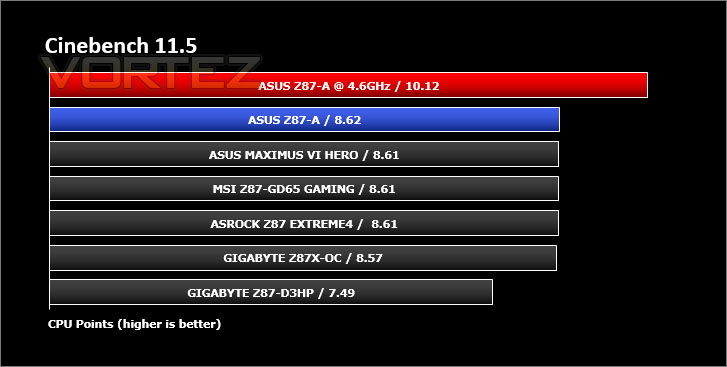
CINEBENCH can measure systems with up to 64 processor threads. This test scene contains approximately 2,000 objects which in turn contain more than 300,000 polygons in total, and uses sharp and blurred reflections, area lights, shadows, procedural shaders, antialiasing, and much more. The result is displayed in points (pts). The higher the number, the faster your processor.
Benchmarks: SiSoftware SANDRA
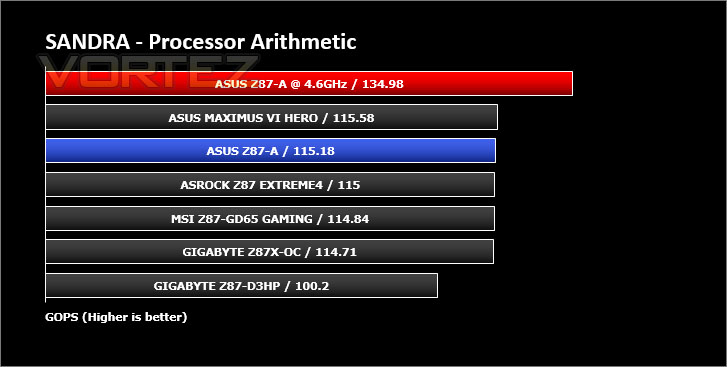
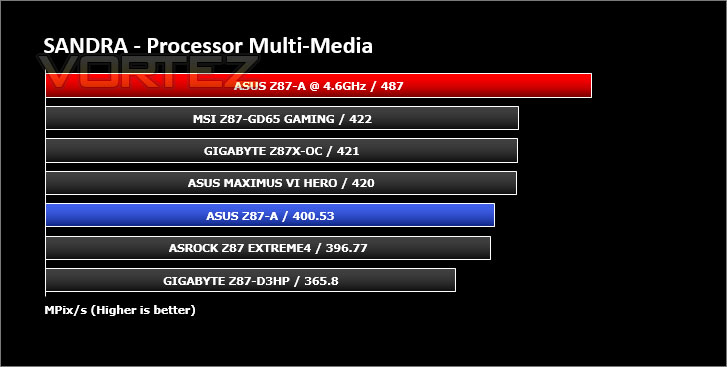
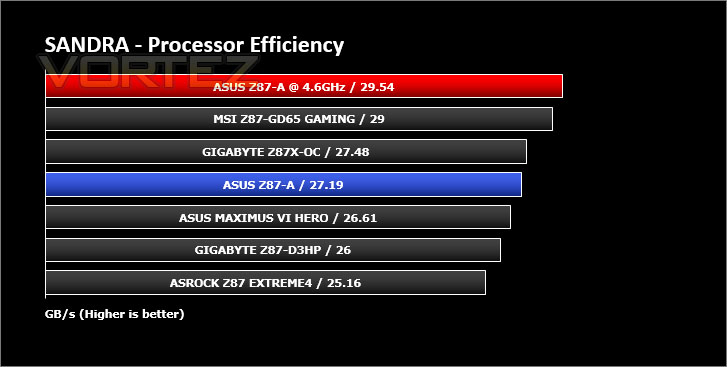
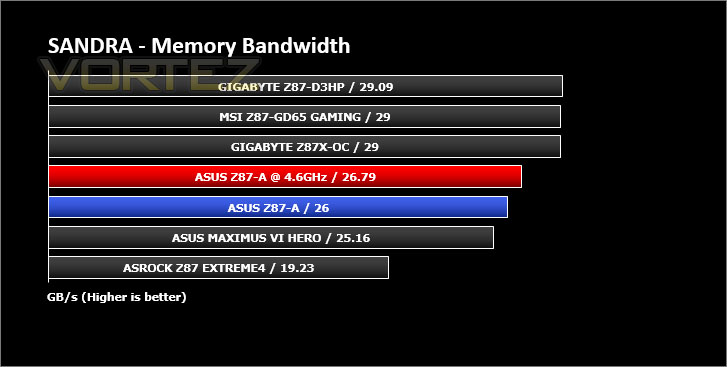
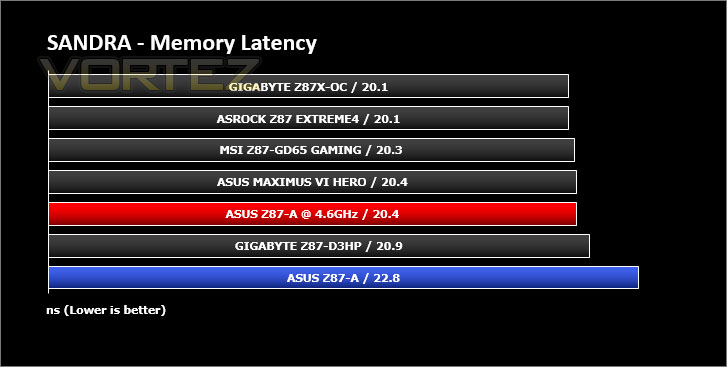
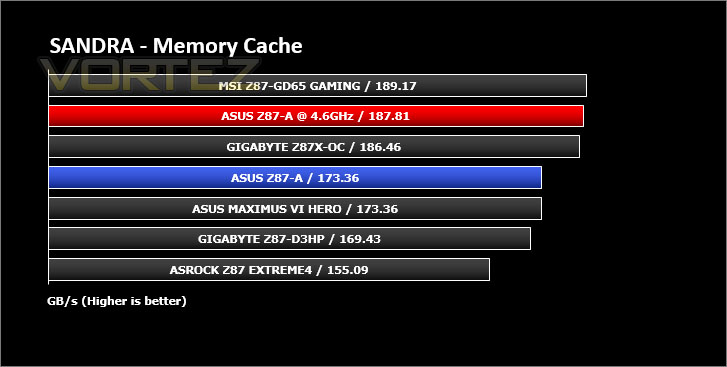
3DMark 11 Product PageSANDRA isn’t always a benchmark that is included in hardware reviews but I believe it shouldn’t be ignored. SANDRA provides a vigorous package that tests your system in a rather large array of benchmarks. There are many aspects of benchmark that can be executed. We will be considering – CPU and memory tests.
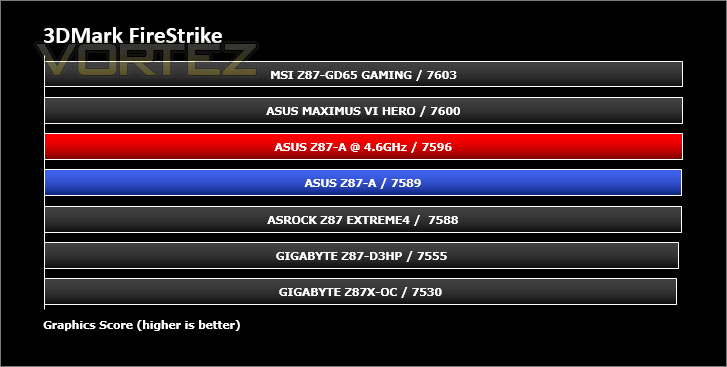
Benchmarks: 3DMARK FireStrike
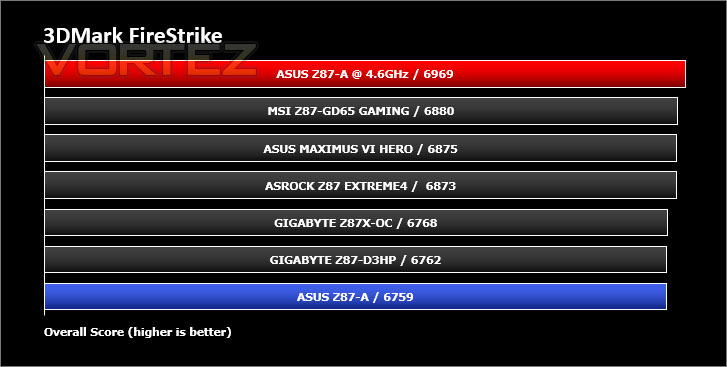
3DMark FireStrike Product PageFire Strike is our new showcase DirectX 11 benchmark designed for high-performance gaming PCs. It is our most ambitious and technical benchmark ever, featuring real-time graphics rendered with detail and complexity far beyond what is found in other benchmarks and games today. Fire Strike will only be available in the Windows editions of 3DMark initially.
Benchmarks: 3DMARK 11
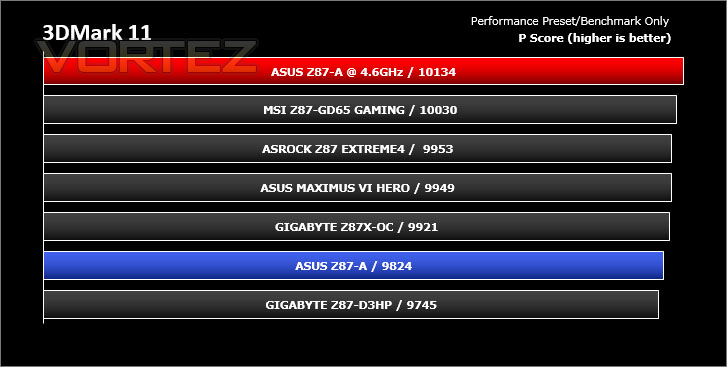
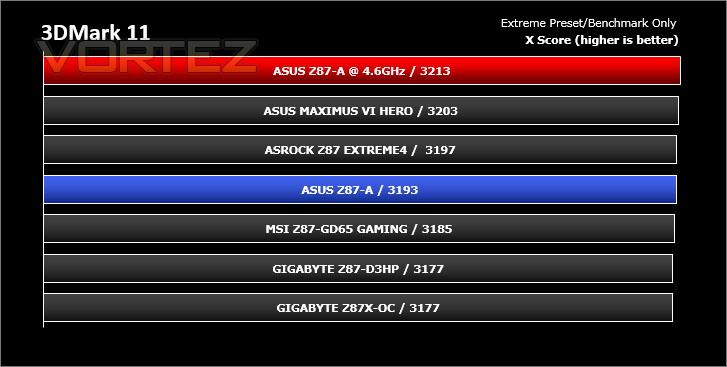
[quote]Designed to measure your PC’s gaming performance 3DMark 11 makes extensive use of all the new features in DirectX 11 including tessellation, compute shaders and multi-threading. Trusted by gamers worldwide to give accurate and unbiased results, 3DMark 11 is the best way to consistently and reliably test DirectX 11 under game-like loads.3DMark 11 is a very popular 3D performance benchmark suite and needs little introduction. For the test settings both Performance and Extreme presets are run with ‘benchmark only’ being selected. This provides good analysis. Many will only test the performance preset, using the extreme mode we can examine the board under much more severe stressing – at 720p and 1080p.
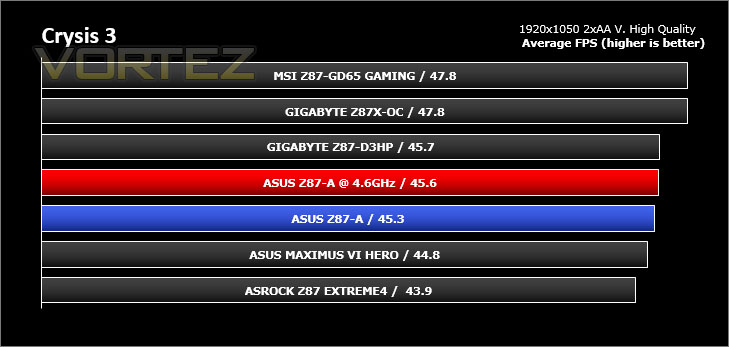
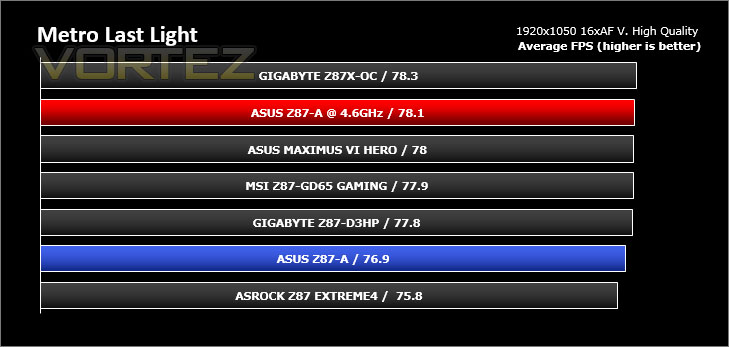
Benchmarks: Tomb Raider, Crysis 3, Metro Last Light
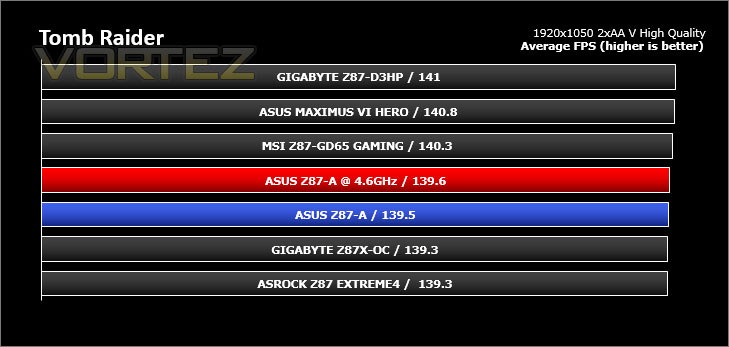
It’s important for us to perform a number of game benchmarks as well as the synthetic tests because gamers will want to know if there are any significant benefits. So here we have a selection of popular gaming titles, critically acclaimed and action-packed.
Settings
Tomb Raider
– 1920×1050 2xAA – Very High Quality *Benchmark tool*
Crysis 3
– 1920×1050 2xAA – Very High Quality *FRAPS – 1st scene/gameplay*
Metro Last Light
– 1920×1050 16xAF – Very High Quality *FRAPS – 1st scene/gameplay*
The gaming titles selected demand GPU power over CPU power – in each test the difference is rather marginal. VSync is disabled in all titles.
Conclusion
The new ‘golden theme’ which ASUS have brought to Z87 was met with mixed views upon launch back at the beginning of June.
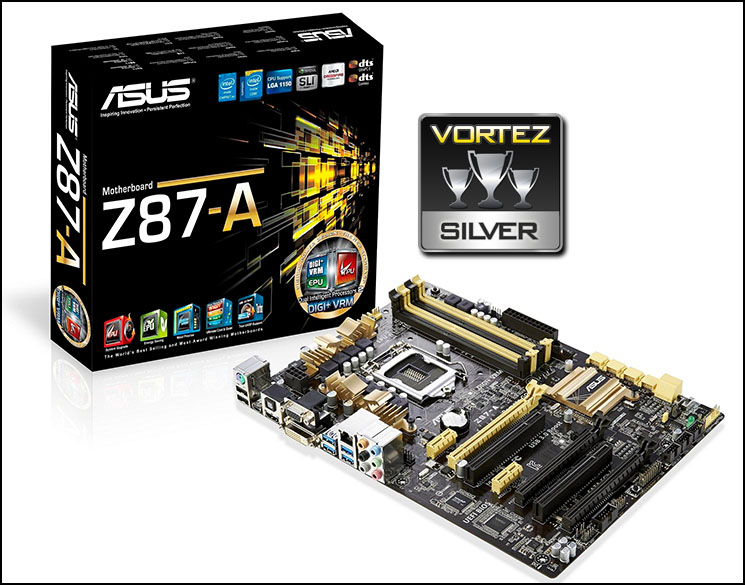
After had first-hand experience with the Z87-A, we have to say that seeing it in the flesh, we aren’t too impressed by the aesthetics and styling. The gold heatsinks look good but the colour tone used on the ports and slots aren’t matched very well and thus resemble a yellowy, beige type colour. Stepping away from the norm and diversifying is a good thing but these colours used will limit hardware which can be coordinated with the motherboard.
On the performance front the Z87-A did well in a range of benchmarks we tested and overclocking only helped to obtain even better results. Overclocking was very easy thanks to the very well designed UEFI BIOS – which we have to say is one of the smoothest we have used thus far. Although on the surface many would think this board could hold back on its ability to overclock compared to more expensive offerings – this isn’t the case. We managed to push our Intel Core i7-4770K to 4.6GHz – just 100MHz below our best result.
For the princely cost of £115 the Z87-A is an affordable motherboard for anyone wanting a piece of Z87 pie. Furthermore, our ASUS offering comes with an assortment of handy features such as Mem OK!, direct key, EPU and TPU.
The Z87-A is a great choice for enthusiasts, system builders or even gamers who want a decent mainstream motherboard with an easy to use UEFI BIOS and handy onboard features. Moreover the price-point for this motherboard makes it affordable to all and it is our pleasure to give Z87-A our Silver award.
Pros
+ Good overall performance
+ Overclocks well
+ UEFI BIOS is nice and easy to use
+ ASUS unique features – MemOK! Direct Key, EPU, TPU
+ Affordable
Cons
– Questionable aesthetics – difficult to pair with hardware
– Only two SATA cables supplied
+ Good overall performance
+ Overclocks well
+ UEFI BIOS is nice and easy to use
+ ASUS unique features – MemOK! Direct Key, EPU, TPU
+ Affordable
Cons
– Questionable aesthetics – difficult to pair with hardware
– Only two SATA cables supplied

Click here for an explanation of our awards at Vortez.net.


