We preview the Vertex 4, multiple form-factor Kilimanjaro platform, and OCZ’s first Thunderbolt device: Lightfoot.

OCZ ruled the proverbial SSD roost for much of 2011, but as our viewing of their booth at CeBIT this year proves they certainly aren’t resting on their laurels. Instead, they took the opportunity to show off some new products sure to interest those with enterprise-level storage requirements, or the more modest requirements of the average PC enthusiast. Of particular note is the movement towards Indilinx and Marvell controllers over Sandforce, the brand most often seen in their performance range over the previous year.
Included amongst the new products were the fourth generation of the Vertex, the Kilimanjaro platform, the new Chiron SSD with up-to 4TB capacity and the Thunderbolt-enabled Lightfoot.
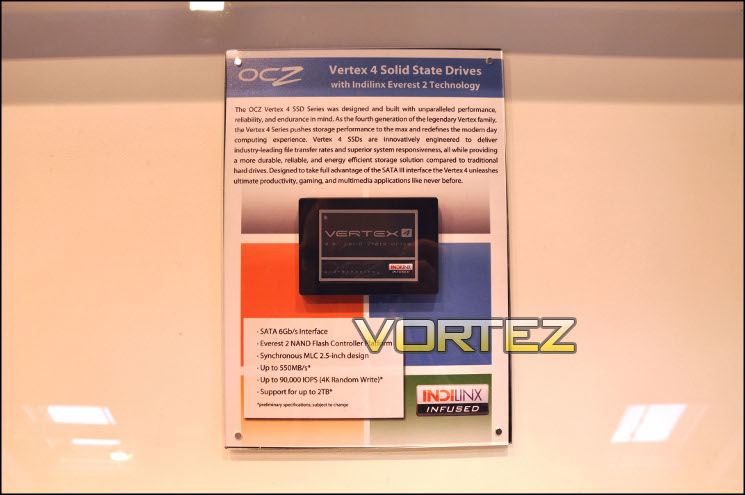
Continuing the well regarded Vertex line, the Vertex 4 is OCZ’s latest Performance/Enthusiast 2.5″ form factor drive with SATAIII interface. Unlike previous generations however, the Vertex 4 moves from Sandforce to an Indilinx Everest 2 flash controller, capable of 550MB’s Read, 500MB Write and 90,000 IOPS according to preliminary specifications.
Featuring up to 2TB of NAND storage in a 2.5″ form factor, the Vertex 4 looks set to push the price/performance/capacity barrier out further in Q2 of this year.
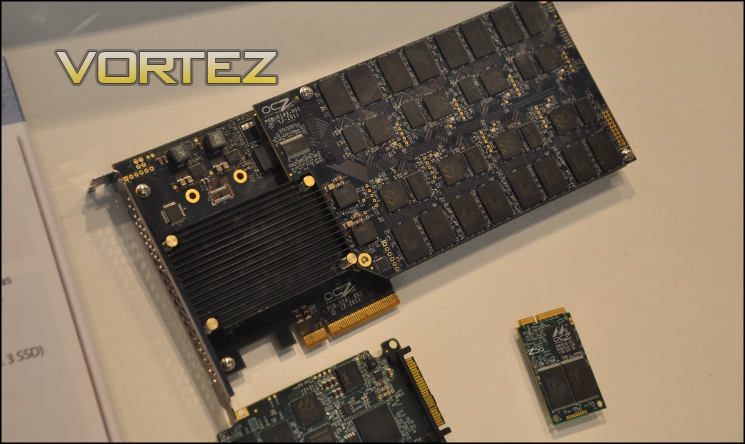
OCZ claim Kilimanjaro – a collaboration between OCZ and Marvell – to be the “World’s first modularly scalable native PCIe SSD controller paired with a sophisticated combination of software and hardware (OCZ Virtualized Controller Architecture™ 3.0)”. The platform will be available in a wide range of form factors and offer unparalleled performance: full and half-height PCI Express supporting up to 2.5 Million IOPS and 7GB/s; 2.5-inch supporting 100k IOPS and 1GB/s; and Mini PCIe at 50K IOPS and 500MB/s. Storage for the platform caps out at 12TB with power fail protection and MLC, eMLC and SLC NAND Flash Options.
OCZ’s Z-Drive R5 – based on the Kilimanjaro platform – promises to be the worlds first PCI Express Gen 3 x16 SSD. The card makes use of Marvell’s native PCIe-to-NAND flash controller, eliminating the need for a separate storage controller and hence reducing cost to deploy in data centres. OS compatibility is high: Linux, Windows Server 2008, OSX VMware ESXi and ESX all support the platform ensuring reliable use on a wide range of systems and servers. Performance figures of 2.5 Million IOPS and 7GB/s with an up-to 12TB capacity strongly define the enterprise-level SSD solution.
The Chiron, Everest with Triple-Layer Cells and aeonDrive DRAM SSDs
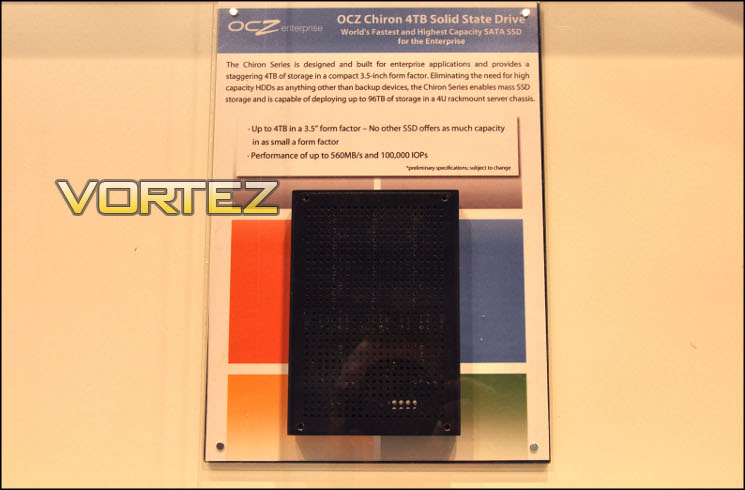
Chiron was also announced at CES 2012 and stakes a claim to be the ‘world’s fastest and highest capacity SATA SSD’. The highest capacity award certainly seems to be a shoe-in with a roomy 4TBs in 3.5″ form factor, with the additional benefit of the ability to deploy up-to 96TB of storage in a 4U rackmount server chassis. Based on an Indilinx controller, performance is still up there at 100,000 IOPS and 560MB/s; whilst such performance can sometimes lead to a build-up of heat the perforated chassis design of the Chiron ensures cool operation and no reliability issues due to temperature.
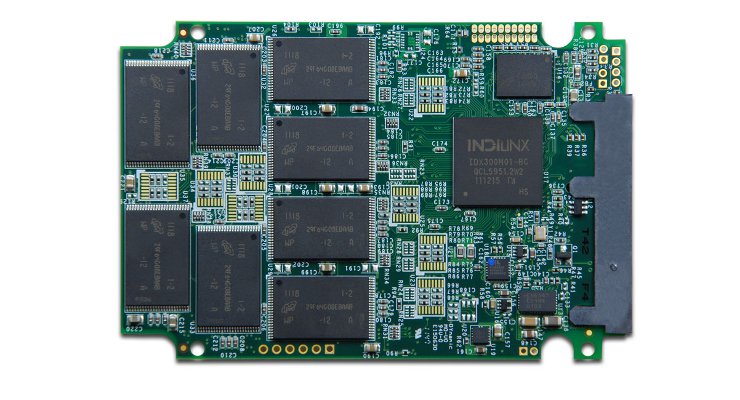
Of particular interest to the consumer sector should be the revamped Everest platform which now features Triple-Level Cell NAND Flash. TLC SSDs have up-to 30% lower cost than standard MLC SSDs, making it ideal for tablets, laptops and workstations that have previously been considered too price-sensitive. The Indilinx controller of the platform has solid performance figures of 500MB/s and 30K IOPS, ample for most consumer-level applications.
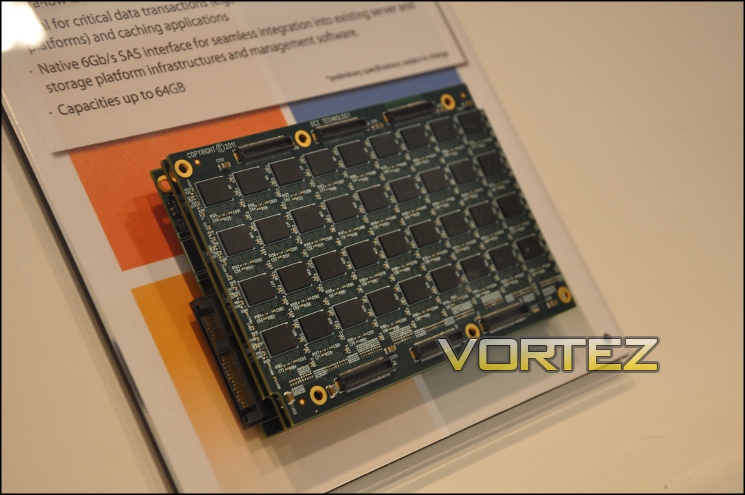
The æonDrive is something of a departure from the drives listed previously. Rather than NAND, the æonDrive leverages the high IOPS and low latency of DRAM to create a drive composed of ‘Pseudo-Nonvolatile memory’ as a low-cost, high-performance alternative. Via a proprietry controller, the drive is capable of up to 140,000 4K IOPS and 540,000 512 Byte IOPS and ultra-low latency (>20 μs); this makes the solution ideal for caching applications and critical data transactions.
The æonDrive makes use of a native 6GB/s SAS interface for integration into existing server infrastructure and management software, and will be available in capacities of up to 64GB.
Lightfoot External SSD and Silencer MkIII PSU
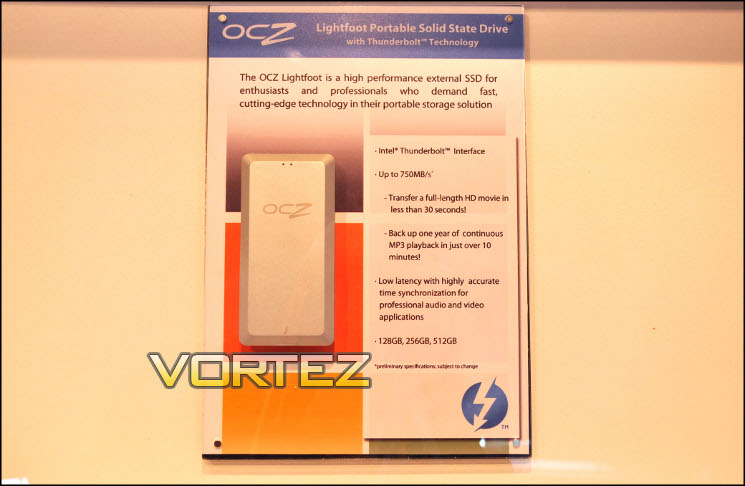
Lightfoot is the first OCZ drive to make use of Intel’s high bandwidth Thunderbolt external interface, targeted firmly at enthusiasts and audio/video professionals. It’s not clear which controller Lightfoot uses; with data transfer rates of up to 750MB/s and the PCI Express signalling of the Thunderbolt interface the device may move from the expected Everest 2 to the Marvell PCIe to NAND controller seen on Kilomanjaro. Pricing is set at the $2 per GB of storage level.
At present Thunderbolt is only available through Apple computing solutions; however with the exclusivity agreement expiring this year Thunderbolt is expected to appear on high-end Intel motherboard chipsets at some point after the release of Z77/Panther Point.
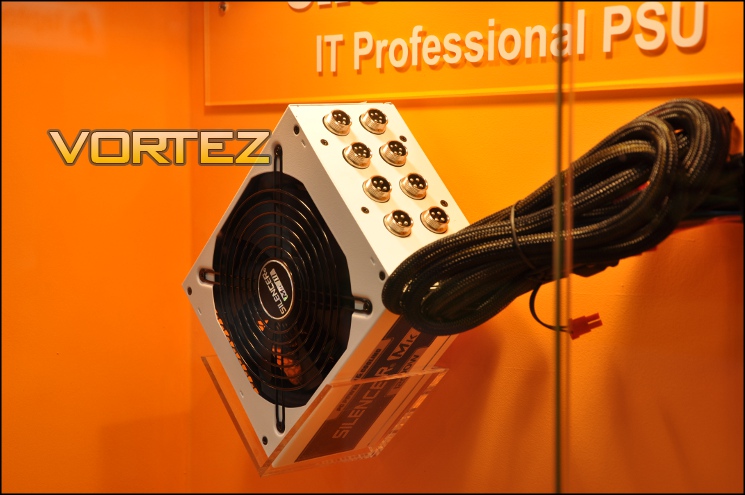
Somewhat incongruous in this article, yet still well worth mentioning, was a sighting of OCZ-subsidiary PC Power and Cooling‘s new Silencer MkIII range of PSU’s. On show were 600W and 1200W versions, the former of which has been in circulation for some time whilst the latter remains unlisted. The Silencer MkIII range is built on 100% Japanese capacitors, 80+ Bronze efficiency and modular cabling. The low wattage range utilises a plastic plug/socket arrangement for modular cabling, whereas the high-end 1200W version appears to use much less infrequently seen high quality metal terminations.
To sum up, OCZ’s 2012 line-up looks extremely strong as they continue to push the boundaries of SSD speed, reliability and capacity. Our thanks to them for this quick tour of their upcoming products.