







A new iteration of Cooler Master’s notorious Hyper 212 is here with us. Will it be the evolution its name implies?

Product on Review: Cooler Master Hyper 212 EVO
Manufacturer and Sponsor: Cooler Master
MSRP: N/A
Street Price: £23.98
Cooler Master’s Forte has always been cost effective solutions be they cases, coolers, power supplies or the rest of their vast catalogue of products. An impressive feat however is their constant commitment to quality and more importantly the lack of compromises made in achieving this affordably. It’s no surprise then that Cooler Master is a household name spanning from the mainstream to the enthusiasts. A key product that has defined Cooler Master’s philosophy has been the Hyper 212, a budget four heat-piped tower cooler that has somehow managed to withstand the test of time by outcompeting more expensive solutions even from the likes of Noctua. Without breaking this winning formula, Cooler Master have recently revamped their cooler line-up with several new additions to their ‘Hyper’ series including the recently reviewed Hyper 612S including several variants of that, and the Hyper 414S/PWM. At the lower end, the Hyper 212 has undergone some minor changes aimed at further improving performance without increased costs. Dubbed the EVO, the new Hyper 212 boasts some very impressive innovations.
The Hyper 212 EVO is very similar to the original Hyper 212+ we reviewed two and a half years ago. It builds on the same concept of a four heat-piped tower heatsink as its predecessor sharing the same fin structure and fin count. As before the heat pipes are 6mm in diameter. The main difference is the evolution of Cooler Master’s Direct Contact heat pipes which now feature ‘Continuous Direct Contact’ technology. The concept is quite a simple but one that Cooler Master hopes to prove effective as we will see later. The other main difference is the fan which now operates at a quieter maximum speed of 1600RPM and yet still supporting PWM functionality. The Hyper 212 EVO’s main competitor comes in the shape of Enermax’s ETS-T40, their answer to the mainstream cooler market. With both sharing similar feature sets, it remains to be seen which will come out on top. More importantly, can Cooler Master one-up themselves?
Our Mission
Cooler Master was founded with the mission of providing the industry’s best thermal solutions. Since its establishment a decade ago, the company has remained faithful to this mission, emerging as a world leader in products and services for companies dealing with devices where heat issues must be resolved.
In pursuing this mission, Cooler Master is absolutely committed to delivering solutions that precisely meet customer requirements for features, performance, and quality. Moreover, we strive to be a reliable long-term partner for our customers that they can truly depend on. It aims to be the first and foremost name that comes to mind for companies around the world seeking thermal solutions, and seeks to build such a reputation through outstanding technology, sophisticated design, and superior service.
Cooler Master’s current business encompasses a comprehensive lineup of thermal solutions for a full range of applications. Its products range from heat sinks and fans to component housing, chassis, and ducting for computers, industrial machinery, telecommunications equipment, and many other devices.
A critical component of Cooler Master’s ability to successfully pursue its mission is an unstinting commitment to quality, as demonstrated by the ISO 9001 certification granted to its main manufacturing plant in Taiwan. It has also enforced ISO guidelines and is in the process of applying for ISO 9002 certification at its second and third plants, located in China. Cooler Master has also implemented a number of analytical and testing protocols to ensure top quality, including at subcontractors, to further ensure thorough quality control. Moreover, Cooler Master’s dedication to quality extends beyond manufacturing to every aspect of its operation, including service.
Coolermaster strives on providing innovative and speed with their products whilst maintaining a level of customer satisfaction above that of its competition.
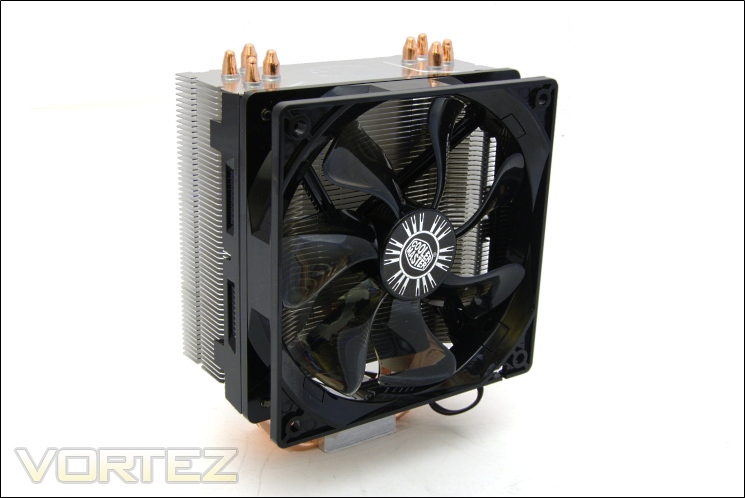
Let’s take a closer look at the Cooler Master Hyper 212 EVO.
Features & Specifications
The Hyper 212 EVO now features four Cooler Master patented Continuous Direct Contact™ (CDC) heat pipes that are tightly packed into a flat array on the CPU Cooler base. This acts as a virtual vapour chamber that dissipates a large amount of heat. The aluminium fin structure has been optimized to provide the perfect performance balance between high and low speed fan operations.
•Well balanced cooling performance provides fin optimisations with perfect balance between high and low speed operations
•4 Direct Contact heat pipes with the patented CDC (Continuous Direct Contact) technology – creating a perfect, sleek surface for heat conduction.
•Wide-range PWM fan with unique wave-shaped blade design for excellent airflow.
•Versatile all-in-one mounting solution supporting the latest Intel LGA 1366/1155 and AMD FM1/AM3+
•Upgradeable to second fan with quick-snap fan bracket.
Specifications
Socket Compatibility: AMD AM2/3/3+/FM1, Intel LGA 1155/1156/1366/775
Heatsink Dimensions: 116 x 51 x 159 mm (L x W x H)
Heatsink Dimensions with fan: 120 x 80 x 159 mm (L x W x H)
Weight: 580g
Heatsink Weight: 465g
Fan Weight: 104g
Heat pipes: 4mm x 6pcs
Heatsink material: 4 direct copper heat pipes/Aluminium fins
Fan dimensions: 120 x 120 x 25 mm (W x H x D)
Fan Speed: 600-1600R.P.M +/-10%
Fan Airflow: 24.9-66.3CFM +/-10%
Air pressure (mmH2O): 0.3-1.7 mmH2O +/-10%
Bearing Type: Long life sleeve bearing
Fan life expectancy: 40,000 hours
Fan Noise Level (dB-A): 9-31
Connector: 4-pin
Rated Voltage: 12 VDC
Rated Current: 0.19A
Power Consumption: 2.28W
The features and specifications list are not dissimilar to Cooler Master’s Hyper 212+ for obvious reasons but let’s take a look at how the two differ. Superficially, both look the same sporting the same aluminium fin and copper heat pipe construction. Both use Direct Touch technology although the EVO has all four heat pipes connected to each other at the base to minimise gaps and thus promote heat transfer. In terms of dimensions, not much has changed. The EVO uses a very different fan mounting mechanism through the use of plastic mounting brackets, akin to the Hyper 612S, but these don’t take significant real estate. Surprisingly, the overall weight has been reduced from 626g to 580g with the EVO. With regards to the larger Hyper 612S, the thickness of the Hyper 212 EVO heatsink is half the former’s dimension, which comes in handy in cases where space is tight. Its Enermax rival, the ETS-T40, is 19mm longer and 19mm wider for comparison.
The fan is the other factor differentiating the Hyper 212 Plus and the EVO. Although both bundle a PWM fan, the latter operates up to a maximum of 1600RPM rather than 2000RPM, making it quieter but also generating less airflow. As the feature set describes, the Cooler Master Hyper 212 EVO represents a versatile solution so let’s have a look at the actual cooler.
Packaging and Content
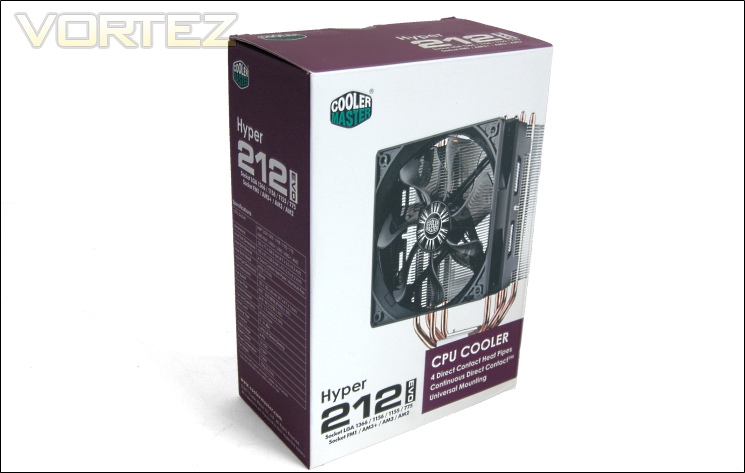
The front of the box
The Cooler Master Hyper 212 EVO cooler comes packaged in a fairly compact pink and white cardboard box, following the same design scheme as the Hyper 612S packaging. Depicted on the front is the heatsink and fan along with the model name below it as well as some of the key features. For the most part, the aesthetics aren’t remarkable but does a very good job informing potential buyers what to expect.
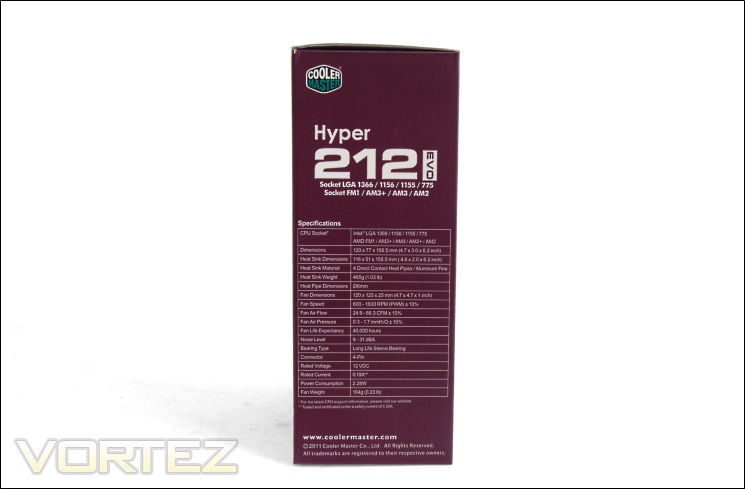
The specifications
On one side of the box is listed all the specifications of the heatsink and fan. The table in which they are listed in is very comprehensive and gives users an idea of the size and weight of the cooler, a list of compatible sockets, and the rated fan rotation speed and noise level. The cooler supports all current Intel and AMD sockets including AMD FM1. On the Intel side, socket support dates back to LGA775 whereas on the AMD side, only the AM2/3(+) and FM1 sockets are supported with no compatibility with the ageing socket 939/754.
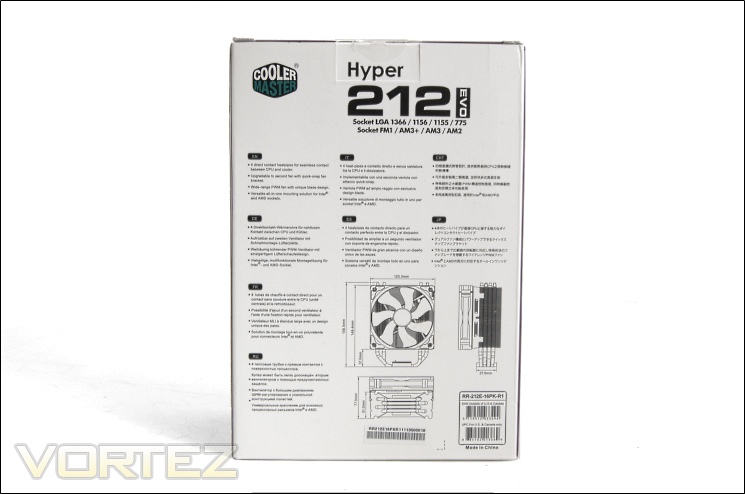
The list of features
At the back, Cooler Master details some of the features of their Hyper 212 EVO along with an illustration of the cooler dimensions so users can see if it will fit in their cases or not. These are repeated in 7 other languages, demonstrating Cooler Master’s global marketing.
The bundle
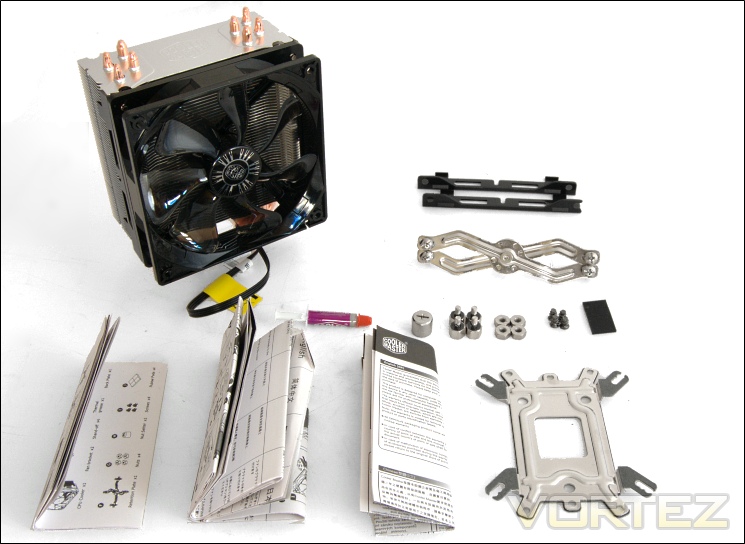
The mounting mechanism remains vastly unchanged from the Hyper 212+. Here’s a list of what’s included:
-Cooler x1
-Fan x1
-Stand-offs x4
-Nuts x4
-Fan screws x4
-Universal Back plate x1
-Retention Bracket x1
-Fan Bracket x2
-Hexagonal wrench x1
-Rubber pads x4
-Thermal Paste tube x1
-Installation manual x3
Remarkably, the installation kit doesn’t have a lot of components which promises ease of installation and less chance of losing pieces. There are also 3 manuals, one quick installation guide, one multilingual one, and one for warranty purposes.
The Cooler Master Hyper 212 EVO
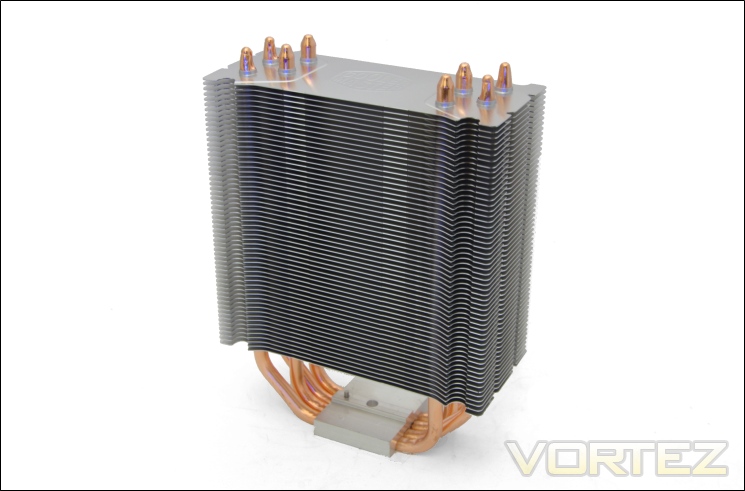
The Cooler Master Hyper 212 EVO retains the same familiar look of its predecessor. Mounted to the heatsink is the fan through the use of plastic brackets that can simply be clipped on. The rest of the cooler looks fairly mundane, without having to resort to presumptuous features for marketing purposes. Instead, it is as ordinary as a tower cooler gets; a series of parallel aluminium fins with four U-shaped copper heat pipes rising through. That’s not to say that the Hyper EVO isn’t optimised for better performance but what is clear is that Cooler Master believe in simplicity which we are keen to agree with given their history.
The bare heatsink
The Hyper 212 EVO is a very compact cooler. At 159mm, it will fit most mid-tower case (I wouldn’t suggest buying a case that can’t even house such coolers) and at 51mm wide, it is even narrower than Thermalright’s Archon. What really stands out is its simplicity. The fins are made of aluminium whereas the copper heat pipes are left without any nickel plating to provide a contrast in colour. Aesthetically, there isn’t much to complain about. The heatsink alone weighs a mere 465g making it one of the lightest coolers we have come across.
Closer Look
The front of the cooler
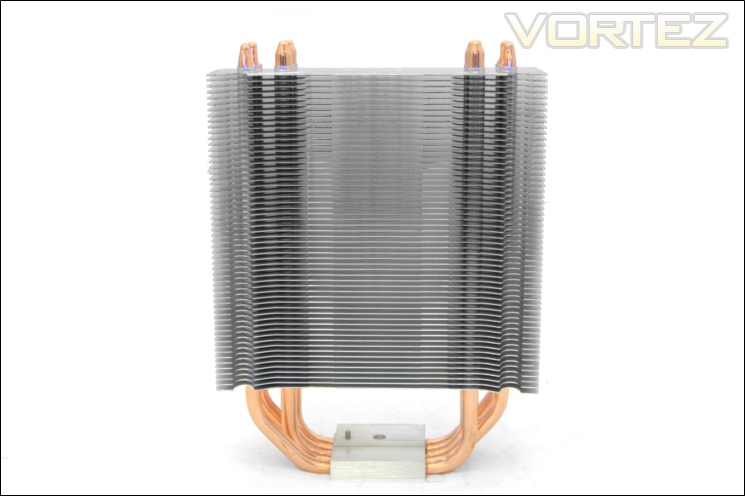
From the front, we see that the heatsink is built using a 57 fin array separated by 2mm to produce a fairly dense stack. The fins are all laminar and lie parallel to each other. The surface area of each fin is slightly less than the Enermax ETS-T40 but thanks to an extra 5 fins, the EVO is still competitive in terms of cooling potential. The four U-shaped heat pipes have each end distributed to one side of the fin array. Due to how closely space the heat pipes are, heat can’t be distributed effectively over a larger surface area.
The side of the cooler
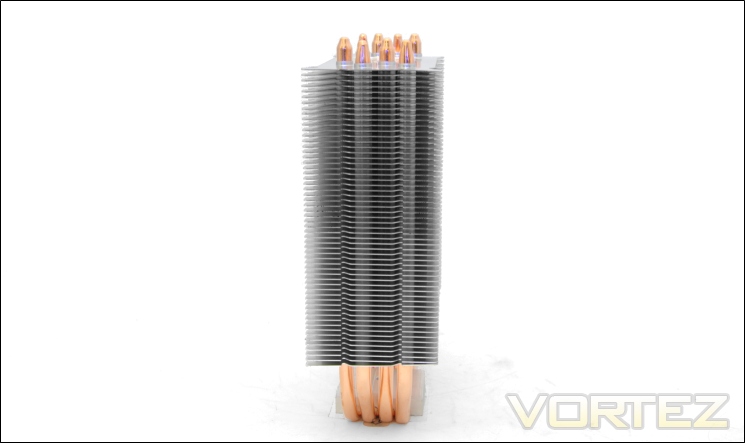
From the side, we can see just how narrow the cooler is. Again, we see that the fins are flat with no winglets or other features to increase turbulence, opting in favour of a narrower fin pitch instead. Two grooves running down the length of each side are for the fan brackets to be clipped in.
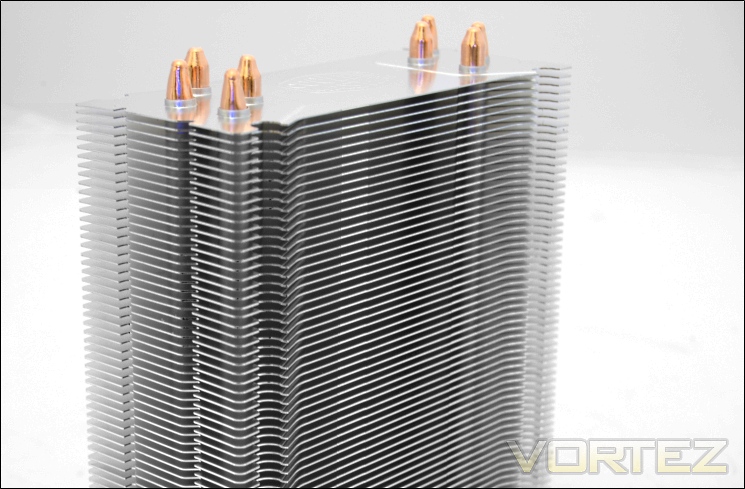
The fin array
The fin array has remained unchanged from the older Hyper 212s. The shape of each fan is exactly the same and characterised by semi-circular grooves along the length of the fins.
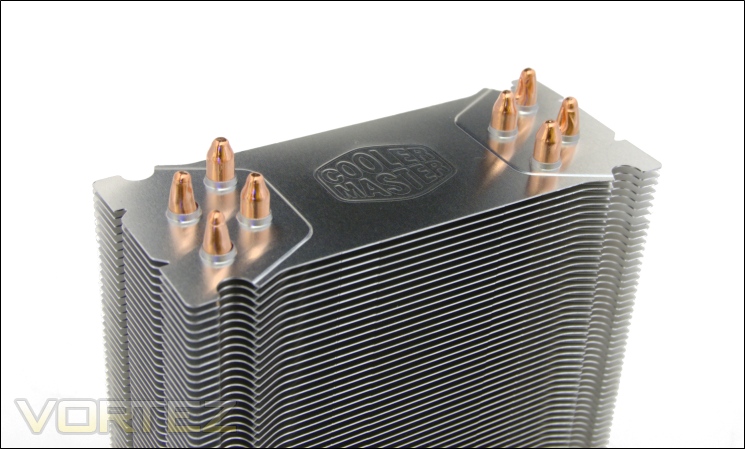
The top of the heat pipes
At the top, the fin has the Cooler Master logo engraved onto it. The heat pipe ends are all exposed and form two clusters for each end of the heat pipes. We also see that the fins have a matte finish rather than a polished mirror finished. Personally, this is welcomed as it reduces the appearance of finger prints.
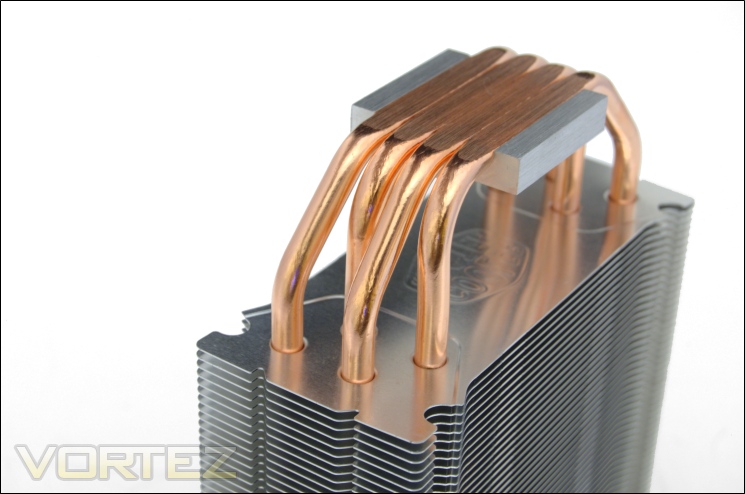
The heat pipes
Here we see the four heat U-shaped heat pipes all 6mm in diameter. As usual, these are made of copper for optimum thermal conductivity. The heat pipes are more closely spaced than before to create the Continuous Direct Contact effect at the base.
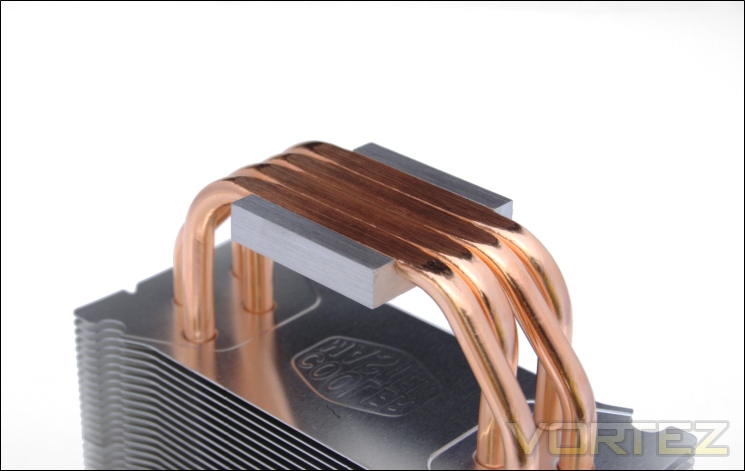
The base
One of the key highlights of the EVO is its new Continuous Direct Contact technology which simply means having all four heat pipes in contact with each other such that no gaps are created in between. This is very useful when couple with Direct Touch technology because heat can dissipate from the CPU without any impedance. We should also note how flat the base is as a result. The size of the base is also perfectly suited to larger i7 CPUs so heat transfer is efficient.
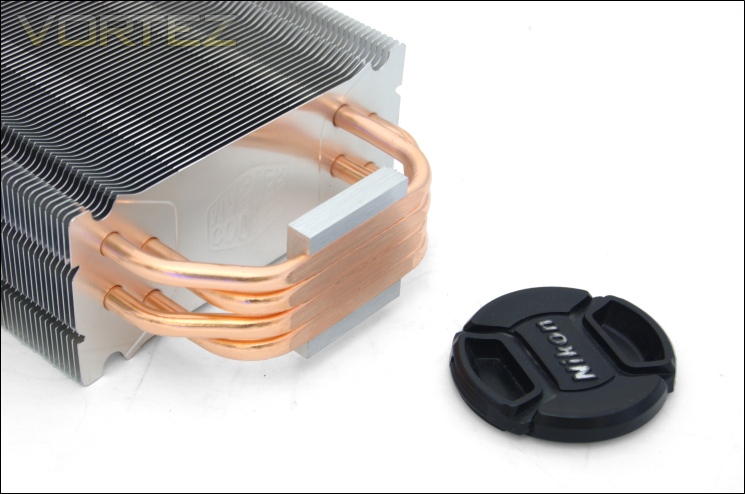
The flatness of the base
The base lacks a perfectly mirror finish but it is still flat enough to make good contact with the CPU.
Closer Look (Continued)
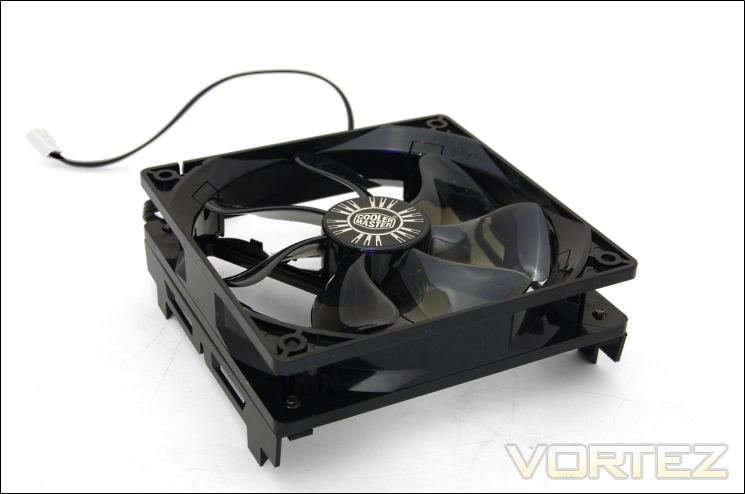
The front of the fan
The single 120mm fan provided with the Hyper 212 EVO operates between 600 and 1600RPM through PWM functionality. This makes for a quieter than the 2000RPM one bundled with the Hyper 212+. The fan is characterised by its ‘S’-shaped blades and small rotor compared to the span of its blades. The fan uses sleeve bearing to reduce costs. Its black frame and dark translucent blade make for a very attractive design.
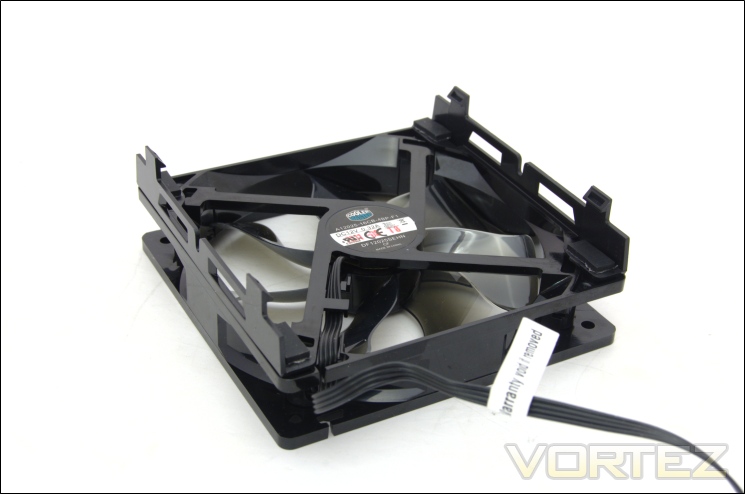
The back of the fan
Looking at the back, we see that the frame is held by 4 arms branching out from the rotor.
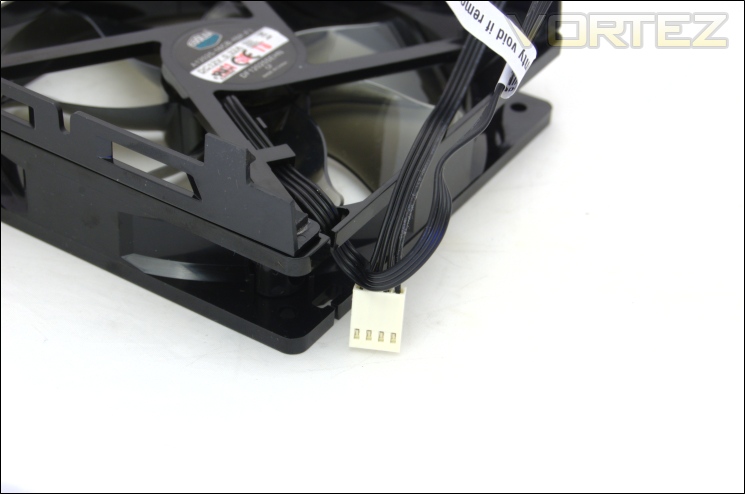
The four pin PWM header
The fan features a four pin header for PWM functionality allowing users to customise the fan speed based on temperatures. The cable is made of four black wires stuck together for a neat, non-braided finish.

Installing the plastic fan adapters
Installing the fan requires two plastic adapters to be screwed onto the fan so that it can simply be clipped onto the heatsink. This method, whilst somewhat more time consuming than typical wire clips, proves very effective at securing the fan and makes fan installation onto the heatsink a breeze. To do so, simply use the provided screws to attach the two fan brackets, and cover them using the rubber pads. These help reduce vibrations. These fan brackets are also compatible with 140mm fans that have 120mm mounting holes.
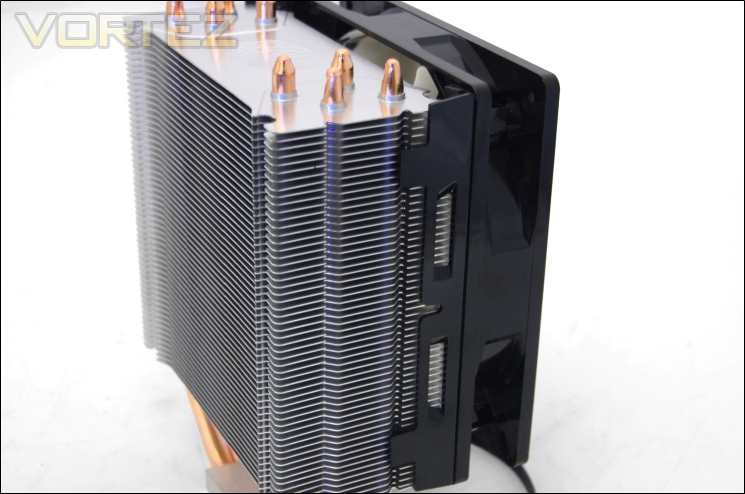
Installing the fan
To mount the fan, simply press the brackets into place and they should latch into the side heatsink grooves. Taking them off requires a bit of effort but an easy way to do so is to simply slide the brackets upwards out of the grooves.
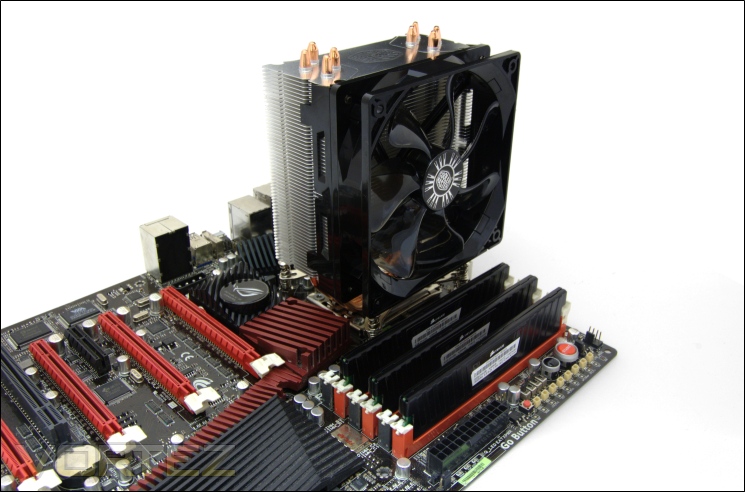
The cooler installed
After installation, the Hyper 212 EVO still keeps its compact profile ensuring access to all memory slots and no conflicts with other components.
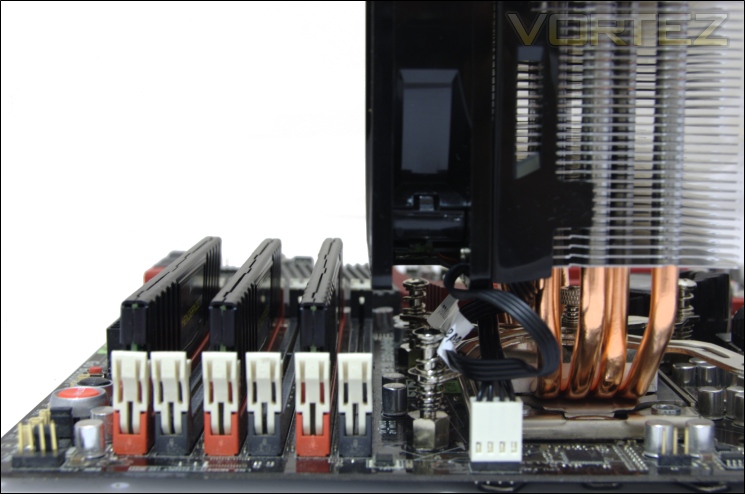
Memory compatibility
There are absolutely no memory compatibility issues with the Hyper 212 EVO thanks to its narrow width, so users are free to install any sized modules they want.
Test Setup
CPU – Intel Core i7 920 – 2.66/4.0GHz
RAM – 6GB (3x2GB) OCZ Platinum DDR3 1333MHz
Motherboard – ASUS Rampage III Extreme
Graphics card – Inno3D GTX570 1.25GB
Power Supply – Enermax Revolution 85+ 850W
Hard Drive – OCZ Vertex 2E 120GB
Samsung F1 320GB
Samsung F3 1TB
Case – Lian Li B25B
Drivers – Nvidia ForceWare 285.38
CPU Coolers:
Retail Alpenföhn K2 including tests using 2 stock fans, 2 Föhn 120, 2/3 Noctua NF-P12s/NF-P14s and 2 SWiF2-120Ps
Zero Infinity Free Flow+ including passive and tests using 1/2/3 stock fans, 2 Noctua NF-P12s/NF-P14s and 2 SWiF2-120Ps
Enermax ETS-T40-TA including tests using 1 stock fan, 2 Noctua NF-P12s and 2 SWiF2-120Ps
Alpenföhn Himalaya including tests using 1/ 2 Föhn 140, 2 Noctua NF-P12s/NF-P14s and 2 SWiF2-120Ps
Cooler Master Hyper 612S including tests using 1 stock fan, 2 Noctua NF-P12s/NF-P14s and 2 SWiF2-120Ps
Corsair H100 including tests using 2/4 stock fans, 2 Noctua NF-P12s and 2 SWiF2-120Ps
Phanteks PH-TC14PE including tests using 3 Phanteks PH-F140TS, 2 Noctua NF-P12s/NF-P14s and 2 SWiF2-120Ps
Alpenföhn Triglav including tests using 1 stock fan, 2 Noctua NF-P12s/NF-P14s and 2 SWiF2-120Ps
Antec KÜHLER H2O 620 including tests using 1 stock fan, 2 Noctua NF-P12s and 2 SWiF2-120Ps
Antec KÜHLER H2O 920 including tests using 2 stock fans, 2 Noctua NF-P12s and 2 SWiF2-120Ps
Prolimatech Genesis including tests using 2 Noctua NF-P12s/NF-P14s, 2 SWiF2-120Ps and 2 Prolimatech Blue Vortex 14s
NZXT Havik 140 including tests using 2 NZXT fans, 2 Noctua NF-P12s/NF-P14s and 2 SWiF2-120Ps
Alpenföhn Matterhorn including tests using 2 Noctua NF-P12s/NF-P14s, 2 SWiF2-120Ps and 2 Föhn 120 Wing Boost fans
Prolimatech Super Mega including tests using 2 Noctua NF-P12s/NF-P14s, 2 SWiF2-120Ps and 2 Prolimatech Blue Vortex 14s
Noctua NH-C14 (U.L.N.A and default speed) including tests using 2 SWiF2-120Ps
Thermalright Silver Arrow including passive and tests using 2 Noctua NF-P12s and 2 SWiF2-120Ps
Thermalright HR-02 including passive and tests using Noctua NF-12/NF-P14s and Thermalright TR TY-140
Thermaltake Frio (Low/med/high speed) including tests using 2 Noctua NF-P12s
Corsair H50 including tests using 2 Noctua NF-P12s and 2 SWiF2-120Ps
CoolIT ECO A.L.C including tests using 2 Noctua NF-P12s and 2 SWiF2-120Ps
Thermalright Venomous X using 2 Noctua NF-P12s and 2 SWiF2-120Ps
Coolink Corator DS including tests with dual fan setups
Tuniq Propeller 120(High speed fan)
Noctua NH-C12P SE14
Prolimatech Megahalem
Noctua NH-D14 (U.L.N.A and default speed)
Noctua NH-U12P SE1366
Thermolab Baram (with 2 Noctua NF-P12 fans)
CoolIT Domino A.L.C
Sunbeam Core Contact Freezer
Cooler Master Hyper 212 Plus including test with 2 Noctua NF-P12 fans
Alpenföhn Nordwand including test with 2 Noctua NF-P12 fans
Tuniq Tower 120 Extreme (Low/med/high speed)
Program Suite:
Core Temp 0.99.5
LinX stress Test
CPUID HWMonitor
How I tested:
Testing will be based on temperatures recorded by Core Temp and HWMonitor after 20 passes of LinX stress test. The maximum absolute temperatures will be recorded after the test and averaged over the 4 cores. The delta is then calculated by substituting the ambient temperature recorded near the intake fans. All tests are conducted with the i7 920 at its default 2.66GHz stock speed and overclocked to 4GHz. As always, the tests are done inside my own Lian Li B25B case to simulate real world conditions. To keep the tests standardised and based on people’s tendency to use their own thermal paste, we apply Thermalright’s ChillFactor II thermal paste to all coolers unless specified in the result entries (where the bundled thermal paste performs better).
Installation
Installation is fairly straightforward and those with the older Hyper 212+ will be familiar with the method. Unlike the Hyper 612S, the EVO goes back to using a universal retention bracket.
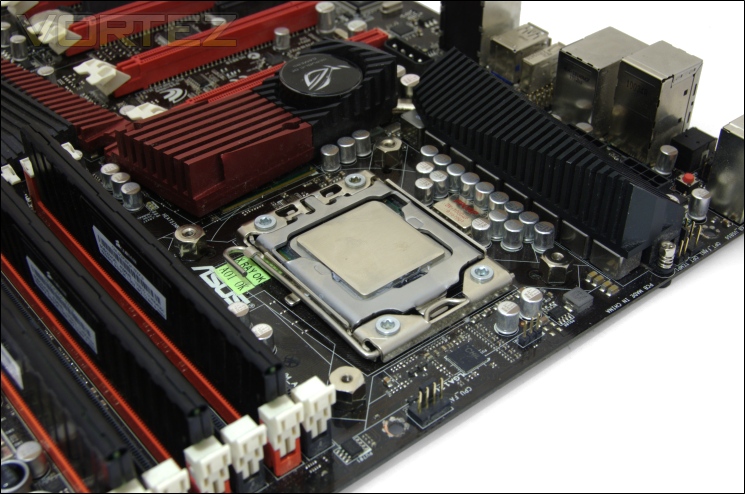
1. Place the stand-offs in each mounting hole so they protrude at the back of the motherboard.
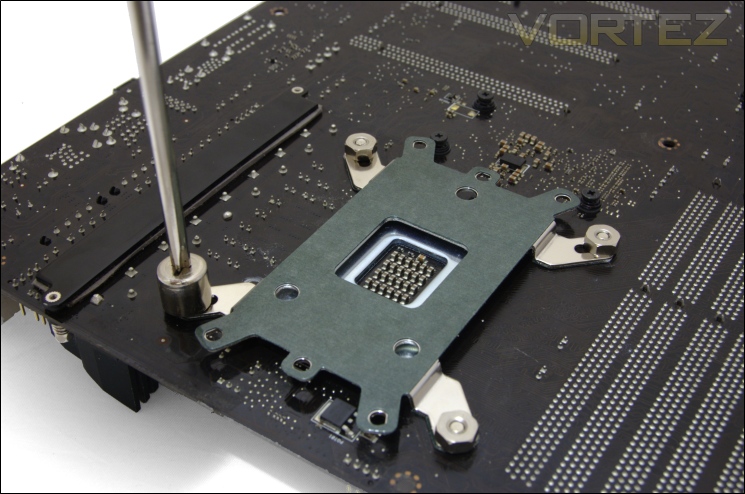
2. Mount the back-plate so that the ends of the stand-offs go through each corner. Secure using the nuts and the hexagonal wrench.
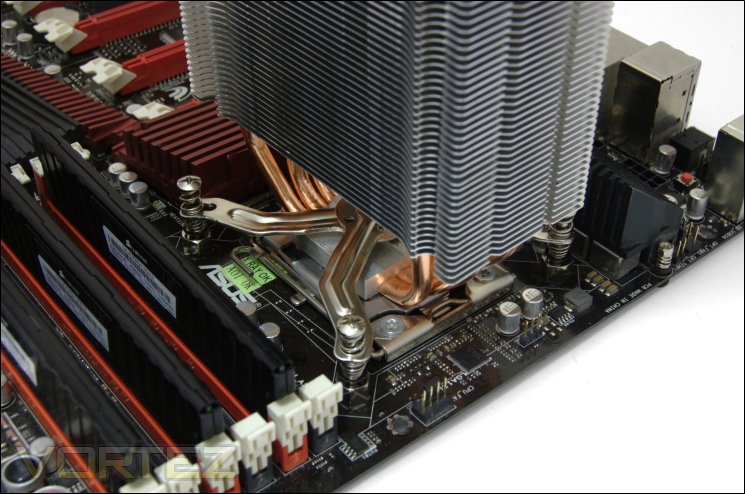
3. Position the retention bracket above the cooler base in between the U-shaped heat pipes and twist the bracket into its appropriate position. Make sure the spring loaded screws at the end of each arm are aligned with the motherboard mounting holes below and screw them in. Do each corner incrementally by small amount to ease the process.
The process only requires three steps so it’s fairly straight-forward. There are a few niggles I have to point out however. Having to secure the stand-offs from the back of the motherboard can be quite frustrating as you have to make sure they don’t fall out the front while you secure them at the back. The retention bracket also has many different positions it can be set to, so it is important to follow the instructions carefully when twisting in into the correct position.
Results (Grouped)
The results have been arranged in terms of the fan configuration that yields the best results for each cooler. However, it is important to take into account that many coolers come with their own fans and changing those increases the costs significantly, so the “out of the box” cooler configurations have been highlighted in red each group.
Stock

In its default configuration, the temperature delta is a respectable 35C at stock speed. Switching to two Noctua NF-P12s improves temperatures by 1.75C whereas the 140mm NF-P14s reduce the temperatures by a further 0.5C. The best result comes from the Coolink fans which yield 2.75C lower temperatures than the stock configurations.
Results (Ascending order)
Stock

The Hyper 212 EVO in its stock single fan configuration is able to match the Thermolab Baram with two Noctua fans and can outperform the likes of the Matterhorn and the Antec KUHLER 620, an impressive feat for such a small cooler. With two NF-P12s, it can match the Frio using the same fans and the Tuniq Tower 120 Extreme which at one time was our best performing cooler. Switching to the NF-P14s allows the EVO to compete with even the Corsair H100 with two Coolink fans, and match the Zero Infinity Free Flow+ with two fans. At its best, the EVO matches the Prolimatech Genesis with three NF-P14s.
Results (In-depth analysis)
In the next comparison, we look at the default cooler performance as they come out of the box with their bundled fans. Coolers that come with no fans have been coupled with Noctua’s NF-P12 or fans that the manufacturers intended their coolers to be used with.
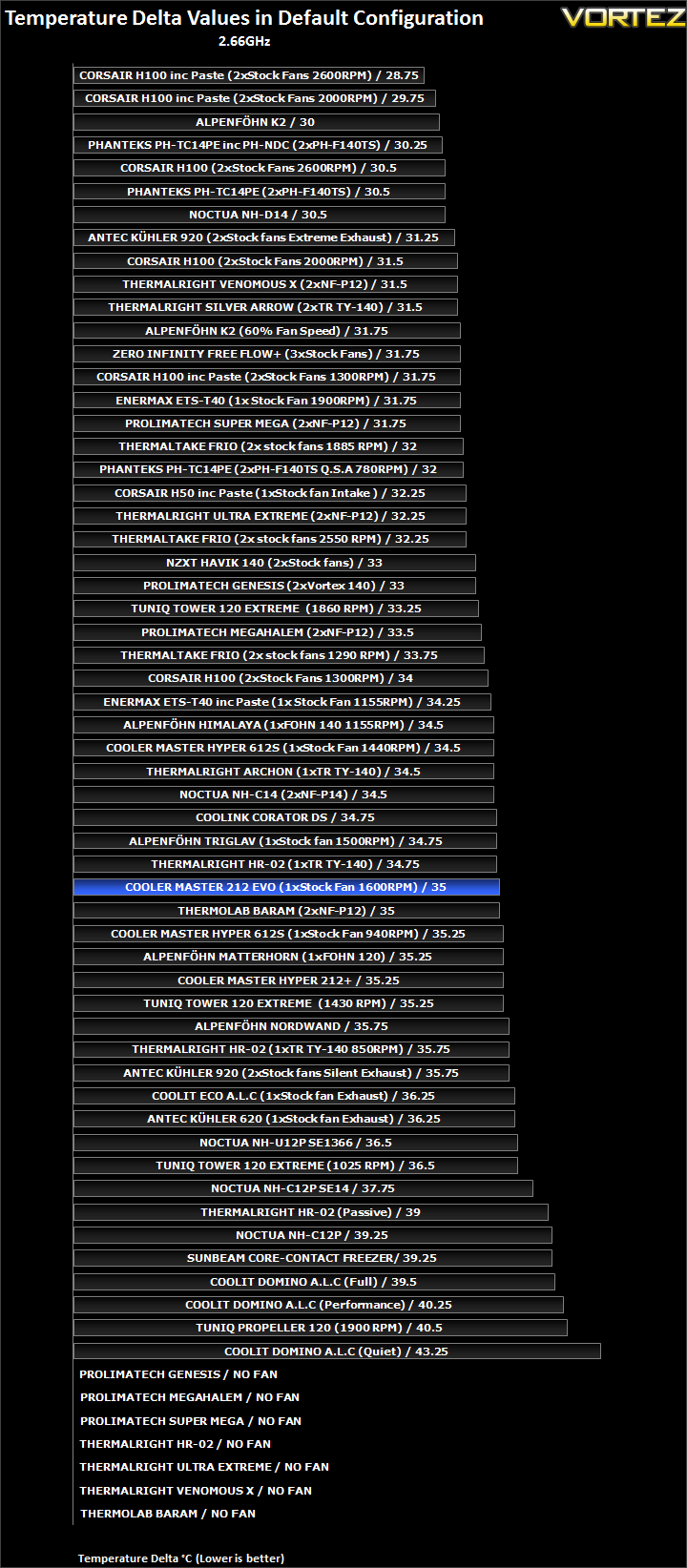
In its default configuration, the Cooler Master Hyper 212 EVO performs impressively. It beats its older sibling by 0.25C and the Matterhorn by the same margin. Remarkably, it finds itself outperforming a lot of cooler twice its price or more, for example ALC units like the Antec KUHLER 620 and the CoolIT ECO. Unfortunately, the Enermax ETS-T40 leaves it in the dust at this point.
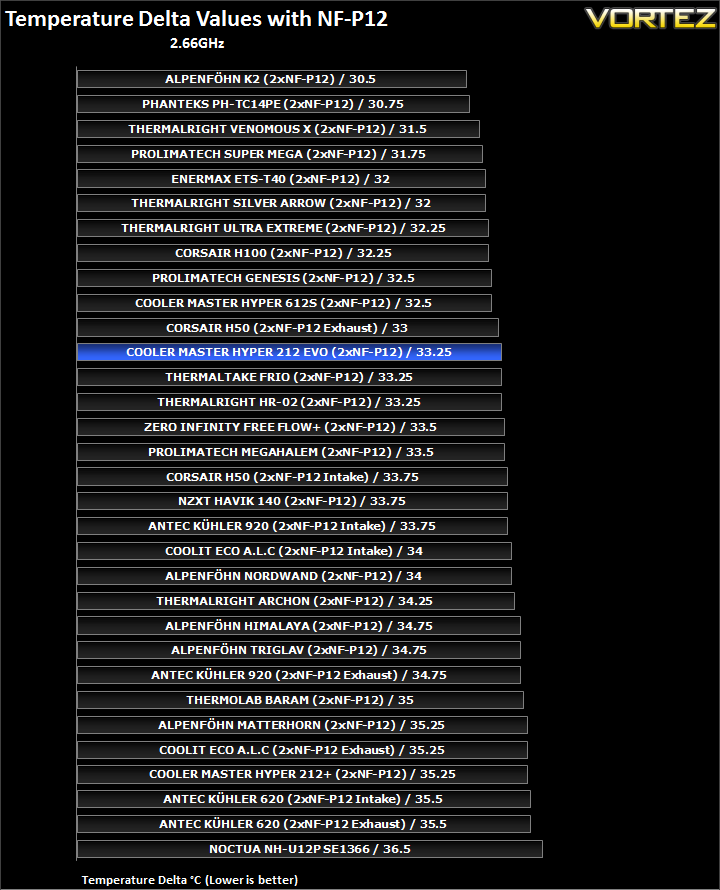
With two Noctua NF-P12s, the Hyper 212 EVO is surprisingly efficient. It manages to match the Frio, Thermalright HR-02 and can even outperform the much larger Zero Infinity Free Flow+. The Enermax still comes out ahead by 1.25C.
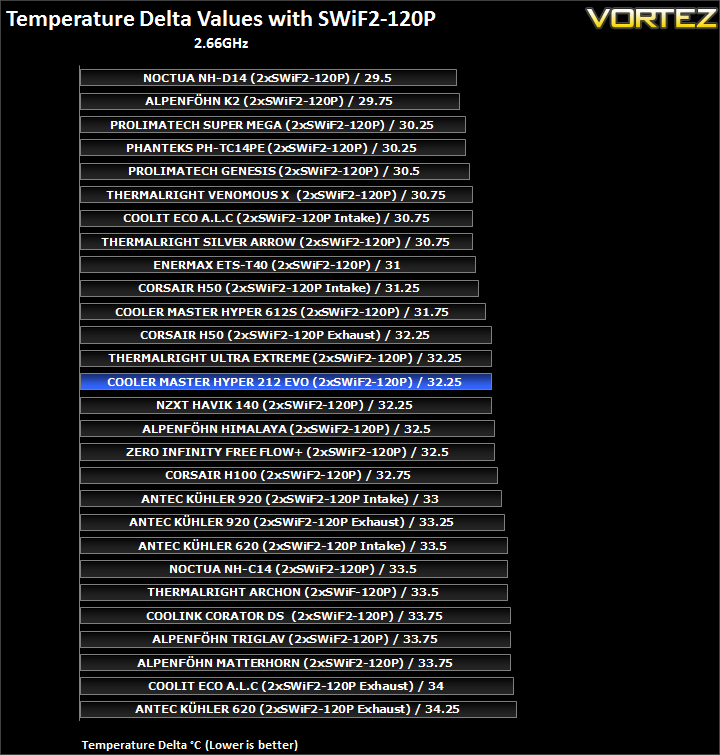
With the Coolink fans, the Hyper 212 EVO continues to impress and matches the Thermalright Ultra Extreme’s performance. It even outdoes the Corsair H100 and the Antec KUHLER 920, coolers several times the price of the EVO’s.
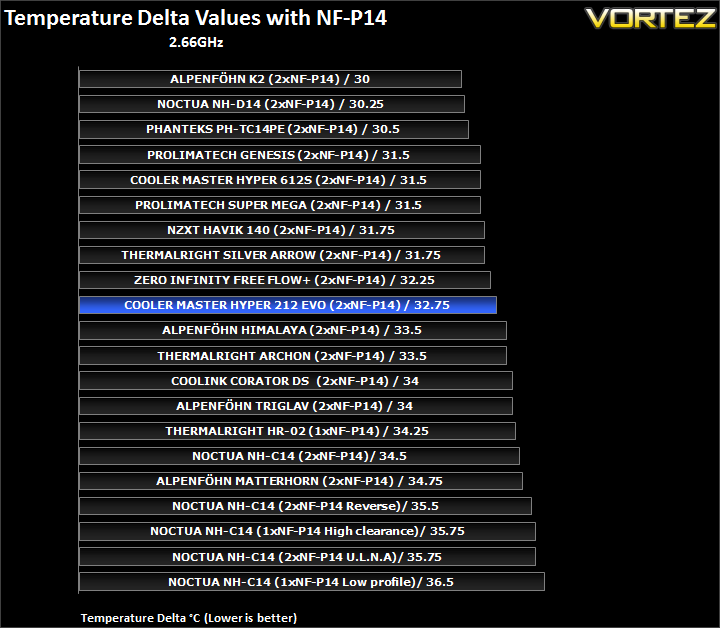
The NF-P14s also perform very well on the EVO. Performance is ahead of the Himalaya and the Archon. The graph also highlights the advantage the EVO has over the Enermax which is that the former supports 140mm fans with 120mm mounting holes.
Results Overclocked (Grouped)
The results have been arranged in terms of the fan configuration that yields the best results for each cooler. However, it is important to take into account that many coolers come with their own fans and changing those increases the costs significantly, so the “out of the box” cooler configurations have been highlighted in red each group.
4GHz

The Cooler Master Hyper 212 EVO performs reasonably with its single stock fan at 1600RPM yielding a delta temperature of 64.5C. The Noctua NF-P12s shed 0.75C off those temperatures whereas the NF-P14s drastically reduce temperatures to 61.25C. A further 0.25C reduction in the delta temperature is achieved using the Coolink fans. This shows that the heatsink’s performance scales well with additional fans.
Results Overclocked (Ascending order)
4GHz

In its default setup, the Hyper 212 EVO outperforms its predecessor by 1.25C, doing so using lower RPM fans and thus demonstrating the efficiency of the new base design. This is also enough to outperform the Enermax ETS-T40 and the Noctua NH-U12P with two stock NF-P12 fans. Using the latter two fans, the Hyper 212 EVO proves more efficient and matches the Triglav sharing the same configuration. Using two Noctua NF-P14s, performance matches the Zero Infinity Free Flow+ using a single stock fan and the Matterhorn also using a single stock fan. In its best configuration, the performance is only 0.25C less than before but it lies very close to the Noctua NH-C14.
Results Overclocked (In-depth analysis)
In the next comparison, we look at the default cooler performance as they come out of the box with their bundled fans. Coolers that come with no fans have been coupled with Noctua’s NF-P12 or fans that the manufacturers intended their coolers to be used with.
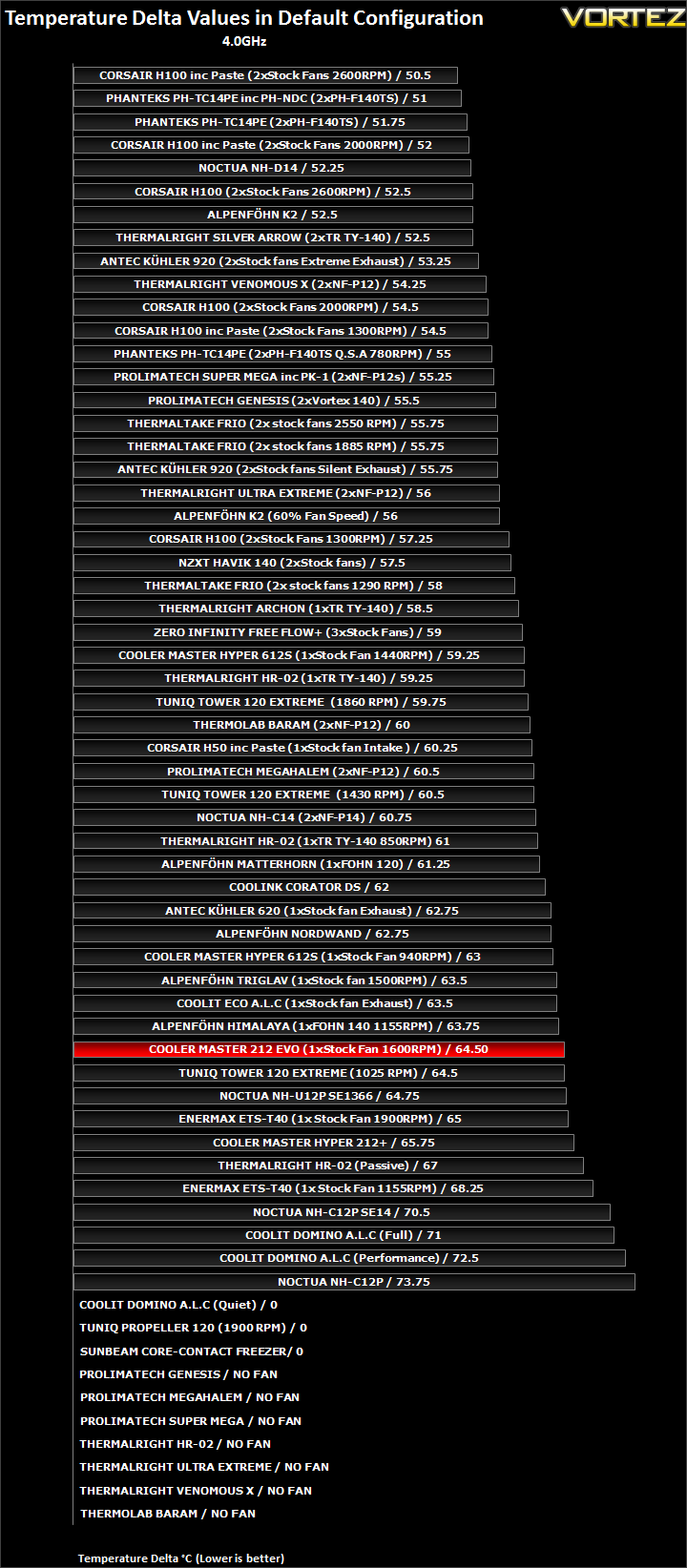
default, the Hyper 212 EVO proves to be very good. It outperforms its predecessor as well as its closest rival; the Enermax ETS-T40.
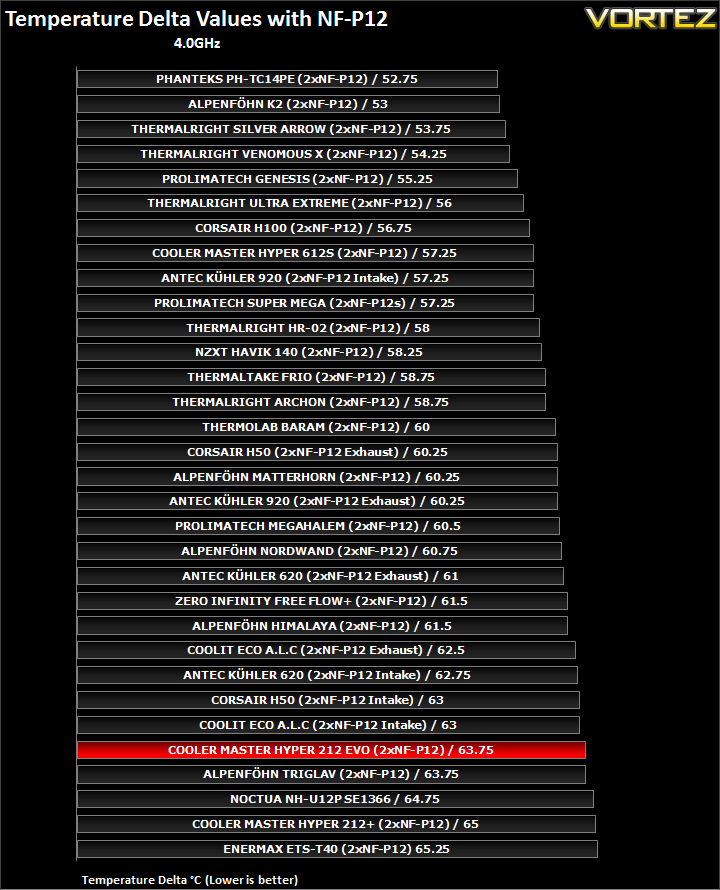
With two Noctua NF-P12s, efficiency matches the Triglav and even beats the Noctua NH-U12P by 1C.
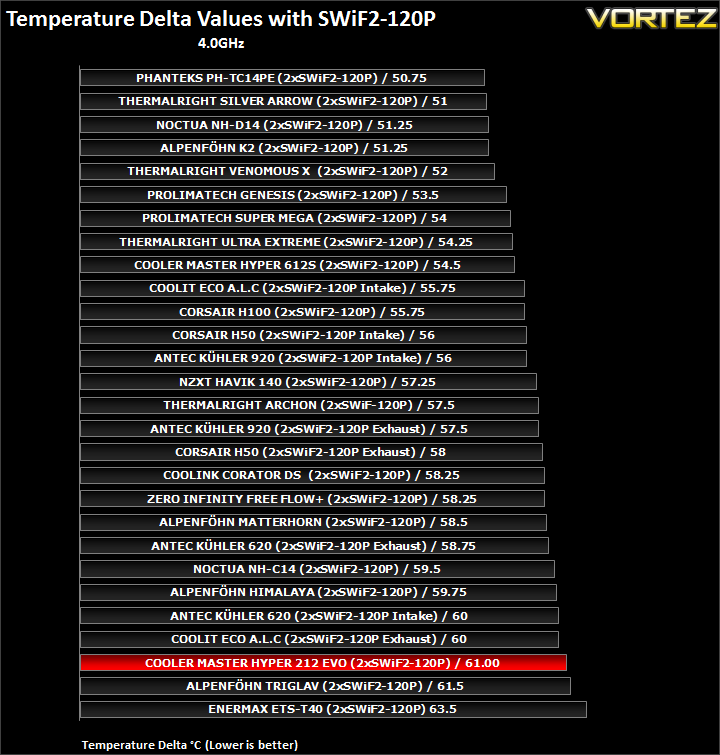
Coupled with the Coolink fans, the Hyper 212 EVO still proves superior to the Triglav and Enermax, both designed to target the same market as the Cooler Master.
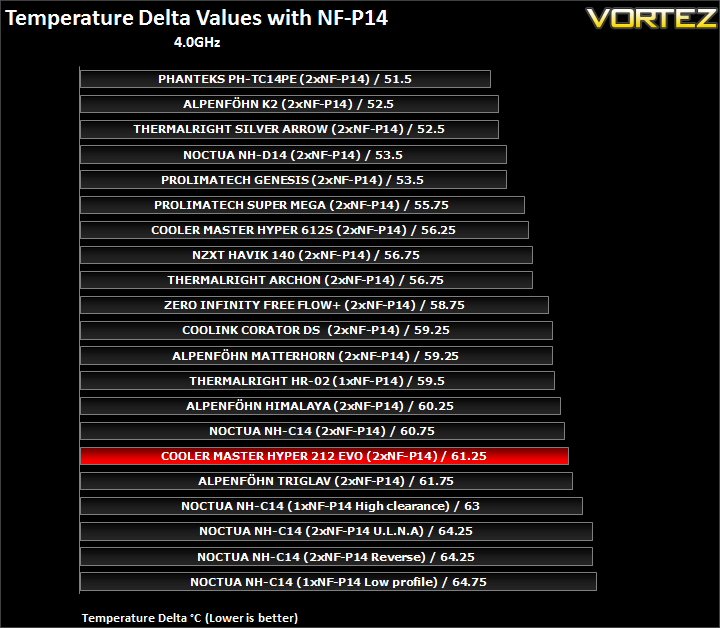
The NF-P14s are very effective on the Hyper 212 EVO, again outperforming the Triglav. Since the Enermax doesn’t support 140mm fans with 120mm mounting holes, the Cooler Master heatsink takes another win.
Other Observations
Noise
When it comes to acoustics, the Hyper 212 EVO fared surprisingly well given its cost and performance. Relying on a single 1600RPM fan, it comes as no surprise that it ends up quieter than the original Hyper 212+ which bundles a 2000RPM fan instead. Although audible from outside the case it was tested in, the noise was very slight and easily attenuated by the case panels. As such, it was never intrusive at its maximum operation speed. Closer up, there is some apparent motor whine, an inherent flaw of the cheaper sleeve bearing employed, but I have to stress that I had to have my ears next to the fan to hear it. On the whole, it turned out quieter than its predecessor and its Enermax rival. Another bonus is the fan’s PWM functionality which allows users to customise the fan speed to their needs.
Conclusion
Cooler Master have to be created for not only surpassing their own highly successful Hyper 212+ in performance but also in acoustics. On initial impressions, there didn’t appear to be much difference between the EVO and its predecessor and the reality is that there wasn’t. Instead the changes were far more subtle. I say changes in plural but the truth is that the only noticeable difference is the Continuous Direct Contact technology whereby all the heat pipes are in contact with each other. The other difference is the lower RPM fan on the EVO but remarkably, performance was never inferior to the 2000RPM fan bundled with the Hyper 212+ thereby highlighting the EVO’s better cooling efficiency. This was further highlighted when we switched the stock fan to the Noctua and Coolink fans in order to do a proper apple-to-apple comparison and observed better efficiency with the EVO. The difference in performance is admittedly marginal but we have to remember that for the given price, it represents even better value for money than the outgoing Hyper 212+.
The Enermax ETS-T40 is the Cooler Master’s closest competition at this end of the spectrum and although the latter delivered better performance at stock speed, it failed to keep up with the EVO at 4GHz. The EVO also holds several other key advantages such as its lower price, quieter fan, more compact size and support for 140mm fans with 120mm mounting holes. It demonstrates the EVO’s versatility and makes it the perfect entry level cooler for enthusiasts and budget-conscious builders alike.
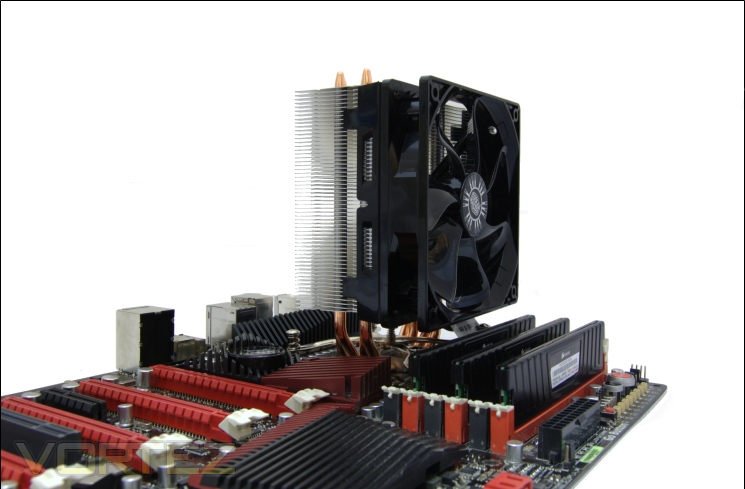
It’s certainly hard to think of ways to fault the Cooler Master Hyper 212 EVO. It is unmatched by any cooler at its price-point, manages to comfortably sustain an overclocked i7 920, and is compact enough to not cause compatibility issues inside users’ chassis. My only complaint is the somewhat awkward method of installing the back plate but apart from that, installation was straightforward and most importantly very secure.
To sum it up, the Cooler Master Hyper 212 EVO follows in the footsteps of its predecessor by providing excellent performance at a very competitive price-point. It’s by no means amongst our best performers but that was never its goal, and there’s already the Cooler Master Hyper 612S to fill those larger boots. For a mere £23.98, there’s no point looking at anything else.
+Very good all-round performance
+Versatile and efficient
+Cheap
+Bundled PWM fan and support for extra fan
+Reasonably quiet
+Support for Intel and AMD sockets
+Memory compatibility
+Size
+Compatibility with 140mm fans featuring 120mm mounting holes
Cons:
-Backplate installation
-Fairly mundane heatsink aesthetics
The Cooler Master Hyper 212 EVO highly deserves our Vortez Gold Award and the Amazing Value Award.


Click here for an explanation of our awards at Vortez.net.


