







Enermax have sent Vortez a selection of their Twister series of fans. The Apollish heads the group so lets see how these fans perform!
Product on Review: Apollish, Magma, Cluster and Everest
Manufacturer and Sponsor: Enermax
Street Price: Apollish around £12
Enermax are a legendary manufacturer of some of the best high end power supplies on the market. Their Galaxy series in particular were truly high end units that were the definition of ultimate performance. Since this success they have chosen to branch out with an equally successful ‘Air Cooling by Enermax’ brand.
Following on from this they have kindly sent us a selection of their 120mm fans including their very newest model the Apollish!

First let’s hear a little from the company themselves:
The Enermax Technology Corporation was founded in Taiwan in 1990 and today is one of the leading producers of PC power supplies, PC cases and other peripheral stuff. Since 2000 the head quarter is located in Taoyuan, Taiwan. Founded by a group of high-tech oriented young professionals Enermax gained an excellent reputation over the last almost 20 years.
Unlike most competitors Enermax has its own design and development groups as well as its own production line. Enermax products are well known for their innovative technology, high quality, excellent design and efficiency.
Main customers are assemblers and do-it-yourself PC builders focussing on high-quality PC components.
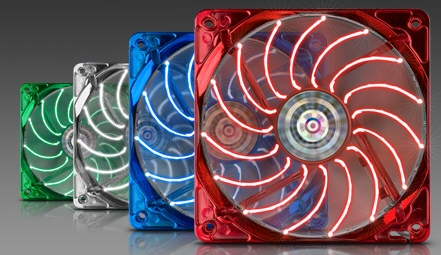
Alongside the Apollish Enermax have also provided their Magma, Cluster and Everest models for comparison too. Let’s take a look…
Specifications
Below are the specifications of each of the 120mm fans from the Enermax site itself.
In all instances concentrate on the 120mm data as that is what applies to the fans on test.
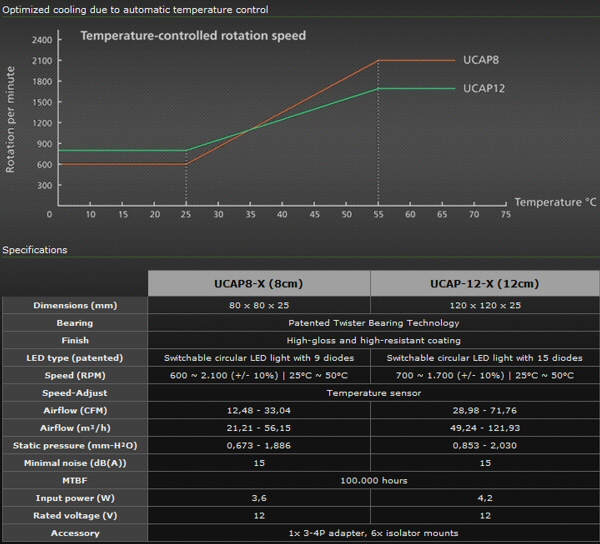
Apollish.
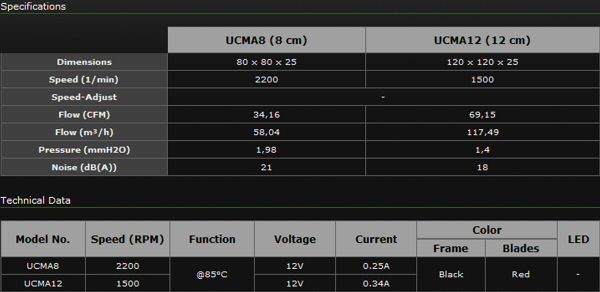
Magma.
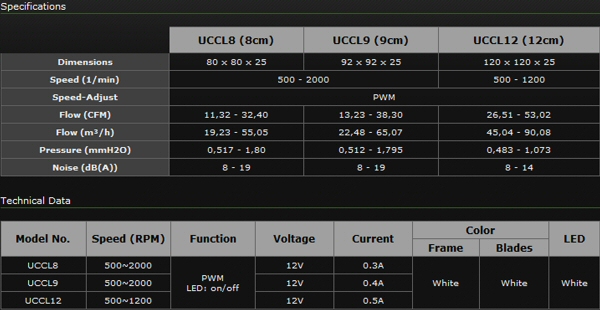
Cluster.
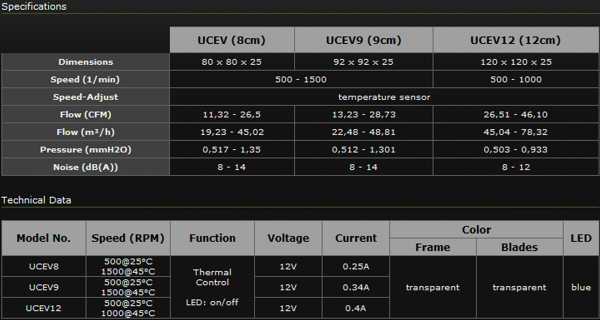
Everest.
Lastly here is a diagram showing the specific features of Enermax’s patented Twister Bearing Technology.
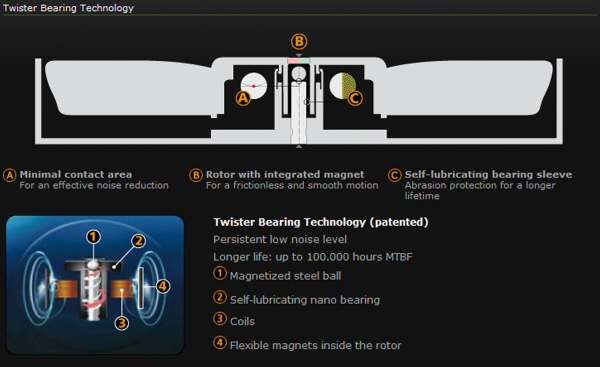
Twister Bearing Technology.
Apollish
First up is Enermax’s newest fan design and the focus of the review the Apollish.
Specifically designed as a ‘design and modding enthusiasts’ fan of choice its primary functions are design and performance.
The packaging allows the fan to be seen in all its glory. Details outlining some of the fans features are shown along the bottom as is an image showing the four colours the Apollish range of fans come in.
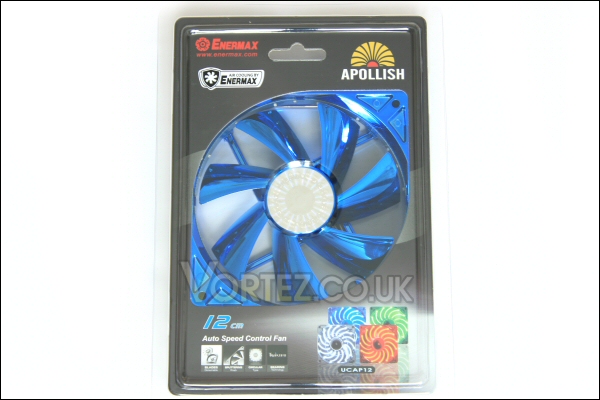
Box front.
The rear provides more specific details on the fan, its performance and a list of the bundled accessories.
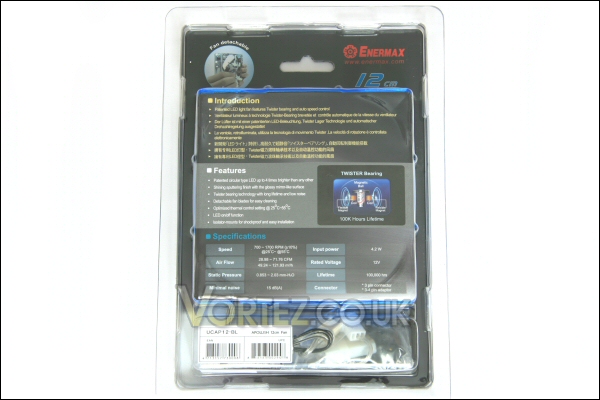
Box rear.
It’s a temperature controlled unit that utilises a small temperature sensor which can be placed around 30cm away from the fan itself.
Out of its packaging the Apollish is a very flashy and imposing looking fan. Its chromed finish is produced using Enermax’s innovative sputtering technique. This produces a high-gloss and highly-resistant finish. It also has a snazzy Enermax hologram which only adds to its vibrant design!
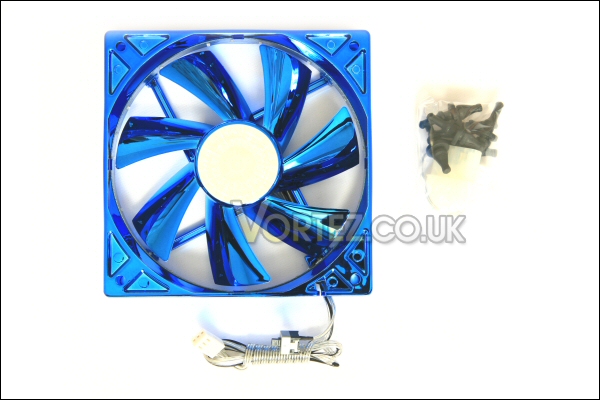
Fan front.
The Apollish has an extra trump card too – the inner portion of the frame surrounding the fan contains 15 high performance diodes which shine around 4 times brighter than standard LED’s. You can see the switch for these next to the fan and temperature sensor cable. This allows the user to switch the lighting on and off at will.
The rear is quite standard looking and simply provides the manufacturer name, model number and identifies the use of the Twister Bearing Technology used in the fan.
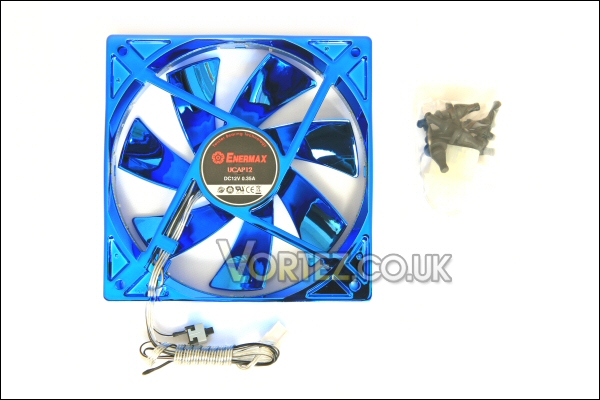
Fan rear.
Also within the packaging a set of isolator mounts, a molex to 3-pin adapter and an instruction sheet are provided.
Another interesting feature, and one shared by the other Enermax fans here, is the ability to detach the fan for easy cleaning. A simple ‘click’ and the fan comes away from the frame.
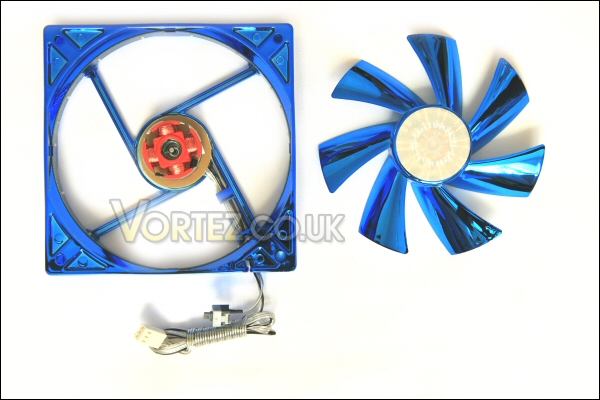
Fan seperated from frame.
Magma
Next we see the Magma.
This fan has been specifically designed for ‘Extreme’ users. Consequently its focus is performance with the ability to stand up to harsh situations through the use of highly resistant materials.
Its packaging lists these features including the Magma’s ability to withstand 85c for its rated 100k hour lifetime. The packaging also allows the purchaser to see the fan itself.
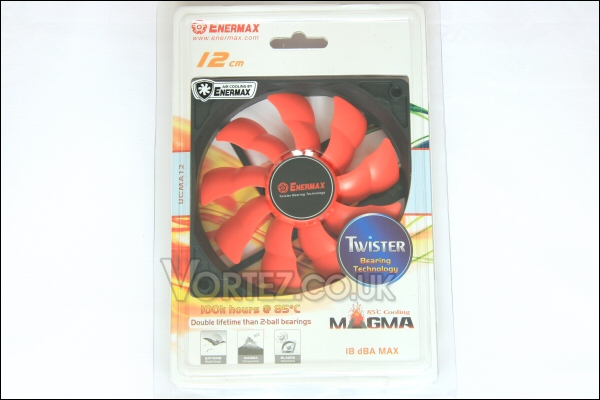
Box front.
The rear of the packaging lists specific details about fan performance and design. Like the Apollish the Magma is supplied with a set of isolator mounts, a molex to 3-pin adapter and an instruction sheet. Also provided are a set of standard metal fan screws.
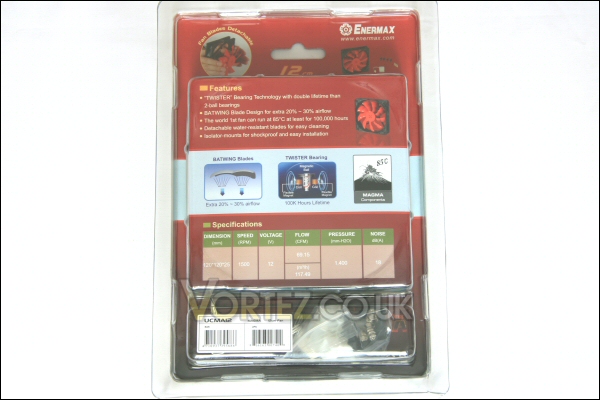
Box rear.
Out of its packaging you can see Enermax’s interesting BATWING fan design. This style of fan is said to provide from 20% – 30% more airflow than a standard design.
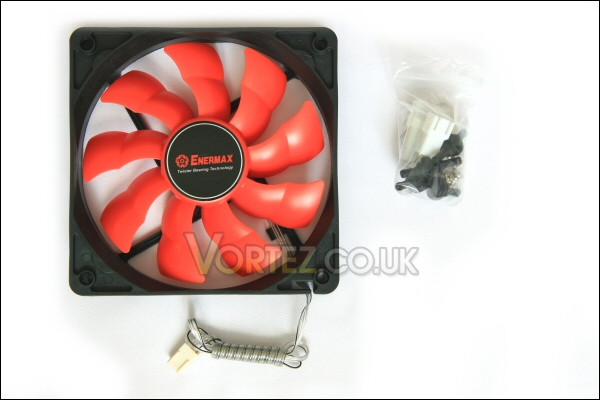
Fan front.
Besides the interesting fan blades the rear is once again a standard looking affair. Simply providing the manufacturer name, model number and identifies the use of the Twister Bearing Technology.
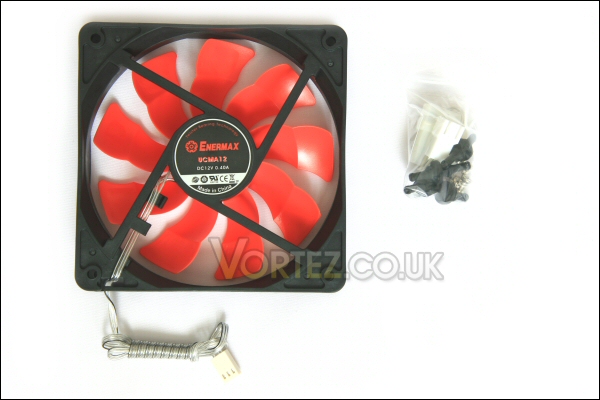
Fan rear.
Here we can see the fan detached from the frame. A useful feature that more manufacturers should look into adopting.
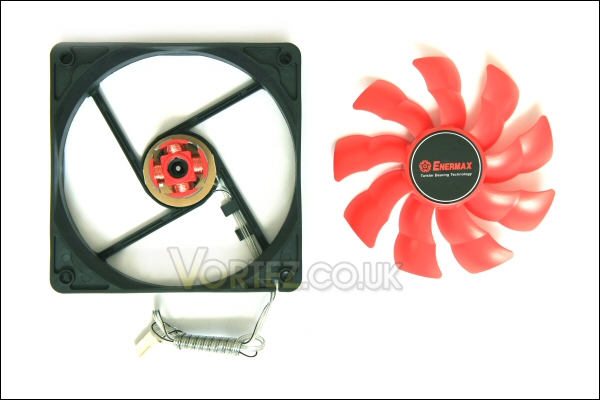
Fan seperated from frane.
Cluster
Next up is Enermax’s Cluster model.
This fan focuses on ‘Advanced’ users primarily so has been designed with silence and good looks. It does offer some performance based features like PWM speed control.
The box is another identical blister pack style design. There’s a window for viewing the fan and basic feature information.
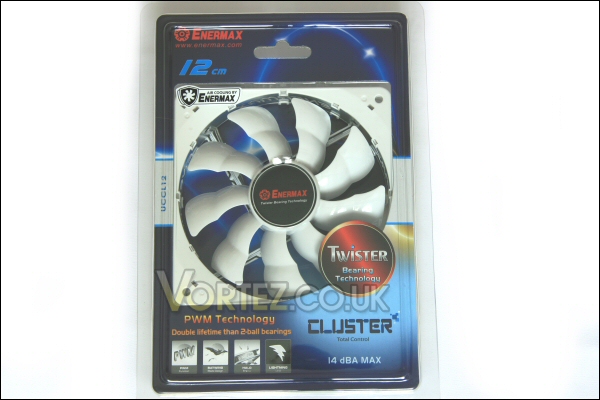
Box front.
The rear again offers more in depth specification data. The content list is identical to the Magma.
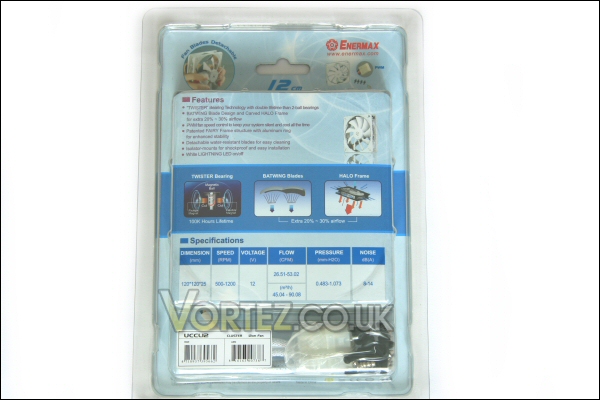
Box rear.
The Cluster is another BATWING design in a simple but very good looking white livery.
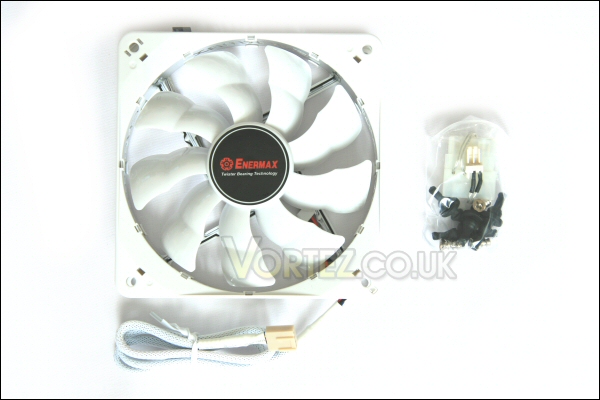
Fan front.
Around the back the Cluster looks like any other fan however there is one difference these shots haven’t identified.
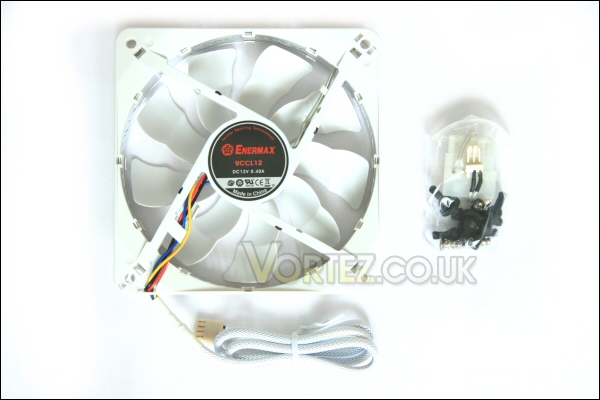
Fan rear.
The inner edge of the Cluster uses Enermax’s ‘Halo’ frame. This is part of their patented ‘FAIRY’ frame structure which includes this aluminium ring which is meant to provide enhanced stability. Also in this shot is the LED control switch which turns the four frame mounted LED’s on and off.
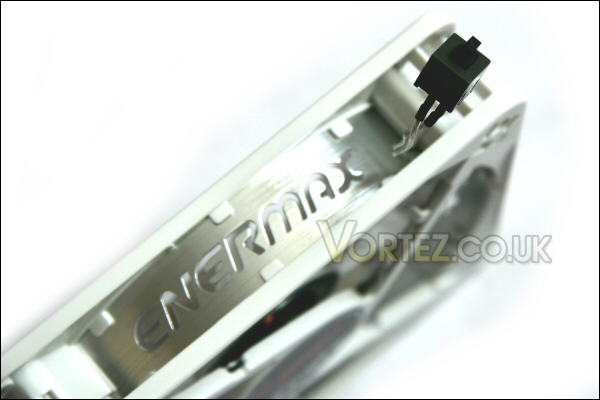
Halo edge and LED switch.
Everest
Finally we see the Everest.
This is the quiet cousin of the Cluster. An ultra quiet design designed for basic users. It’s meant to look good while doing its job silently.
By now i’m sure you’ll recognise the packaging style!
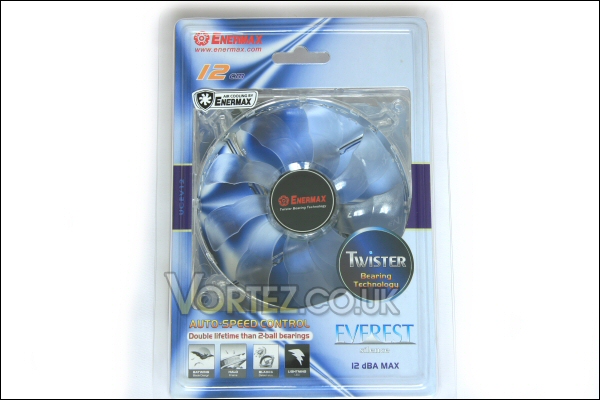
Box front.
The rear again provides all the useful information you’d need and the bundles accessories are again the same as the Magma.
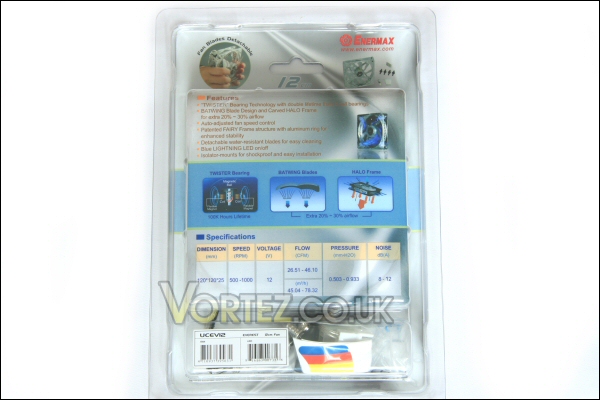
Box front.
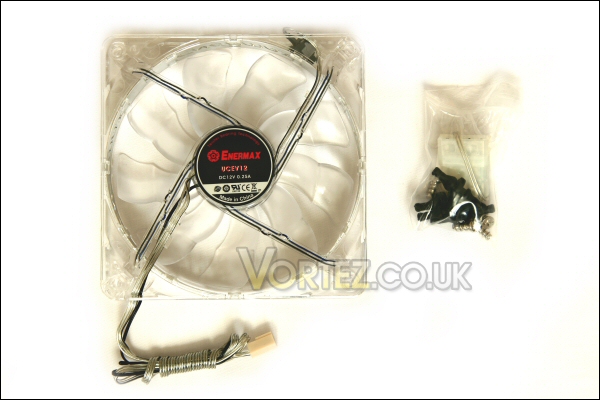
Besides the clear casing and a temperature controlled fan speed system the Everest is virtually identical to the Cluster – it’s clear casing and fan should look great when the surrounding LED’s fire up.
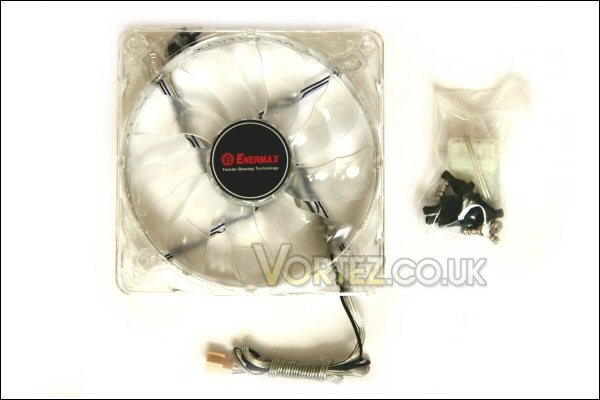
Box front.
You can see the switch for controlling the LED’s beneath the clear casing at the top of the fan – the temperature sensor is wound up within the fan’s power cable.
Box front.
Testing
I will be comparing the Apollish to the three other fans that have been so kindly provided by Enermax.
I used the sound pressure level meter below to test the db rating of the fans at both 12v and 7v.
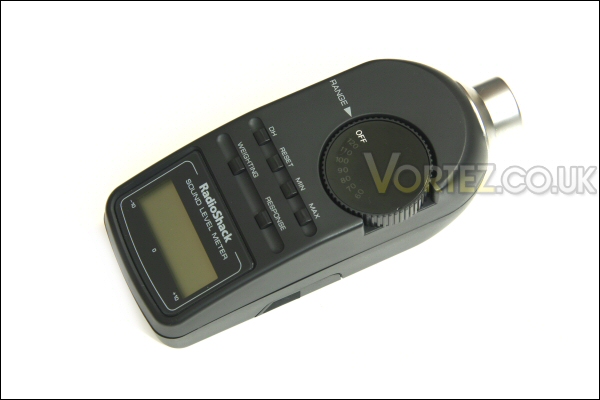
The sound meter used for testing.
Due to the sound level meter only registering a db rating of 50db+ i will have to adjust the sampling distance to allow the fan to register on the meter.
Originally i decided to test the fan at each rated voltage at a distance of 2cm but since this can introduce some proximity based noise issues i have changed my testing method.
I will instead identify the distance at which the fan (running @ 7v) produces a 50db reading. Once a reading is taken i will then identify the decibel rating @ 12v.
When the data is complete i will use a ‘damping of sound level with distance’ calculator to work out the db rating for a greater listening distance. This will give a clearer understanding of the actual volume of the fans we have here.
For testing i used a hotwired ITX PSU which is a fanless silent model. This will provide power for the fan’s without producing any noise interference itself.
Results
Running @ 12v and recorded @ varying distances
Apollish – 65 db @ 3cm
Magma – 58 db @ 6cm
Cluster – 62 db @ 3cm
Everest – 65 db @ 2cm
After conversion the results @ 2m are as follows
Apollish – 28 db
Magma – 27.5 db
Cluster – 26 db
Everest – 25 db
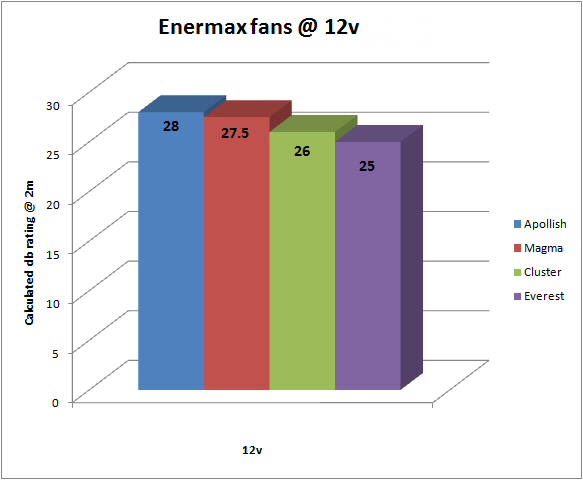
12v results.
Running @ 7v and recorded @ varying distances
Apollish – 50db @ 3cm
Magma – 50 db @ 6cm
Cluster – 50 db @ 3cm
Everest – 50 db @ 2cm
After conversion the results @ 2m are as follows
Apollish – 14 db
Magma – 19.5 db
Cluster – 14 db
Everest – 10 db
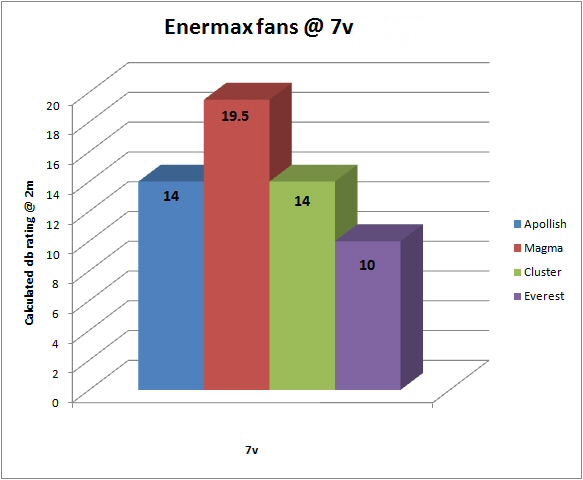
7v results.
Summary of performance
As with my previous review the first thing to consider is that the db rating doesn’t tell the whole story. Tone, resonance and other factors can be more important than pure sound levels.
Motor wine and rhythmic speed related clicking may not show up on the sound meter but when present i can confirm that they are very apparent and can be annoyingly intrusive. On the flip side you could have a fan that made no discernable whining or clicking but was ‘showing’ as rating high on decibels!
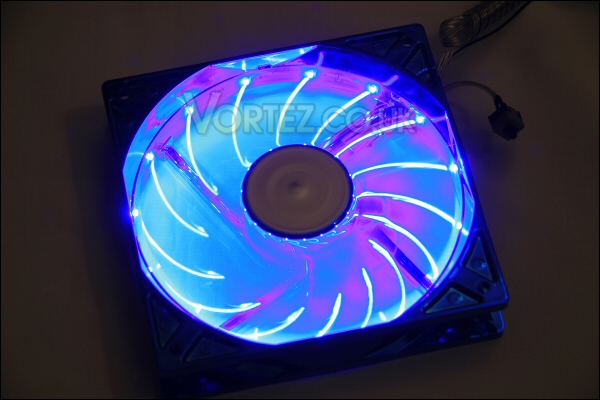
Apollish LED’s in action.
All the Enermax’s here fall into the 2nd category – most particularly at the full speed 12v sampling stage.
The Apollish produced no motor whine or hum of any kind. It registered as the loudest @ 12v but was not as intrusive as the Magma in my opinion. Back pressure also seemed good and airflow was maintained even when the voltage was dropped to 7v.
I must also mention that the temperature controlled speed setting was very smooth. Any kind of stepping with this kind of fan becomes very noticeable as a sudden change in the audible pitch of the fan. No such worries here.
It also looked amazing with all the LED’s illuminating the highly polished chrome surface!
The Magma returned a powerful performance. Unsurprising considering its ‘Extreme user’ rating. Back pressure and airflow were both exemplary from what i could see. At 7v the Magma was not intrusive at all but at 12v it did make its presence known with a mild chuffing. Similar to the sound of a prop driven aircraft. Certainly not a major problem but compared to the others it was apparent.
The Cluster seems a good midpoint for most users. It was very quiet at both the tested voltages and did seem to push air well even at the lower RPM. It’s LED’s combined with the bright white livery really make a good looking fan!
Finally came the Everest. This is definitely a quiet fan. Very smooth running just like the others. It didn’t push a massive amount of air but did a fine job considering the low RPM especially when @ 7v.
Definitely a silent PC fan design – it’s temperature controlled fan speed system would work wonders in that environment and did a very good job here. Not intrusive yet very effective.
As with the Cluster the Everest looked beautiful with the four frame mounted LED illuminating the transparent fan and casing.
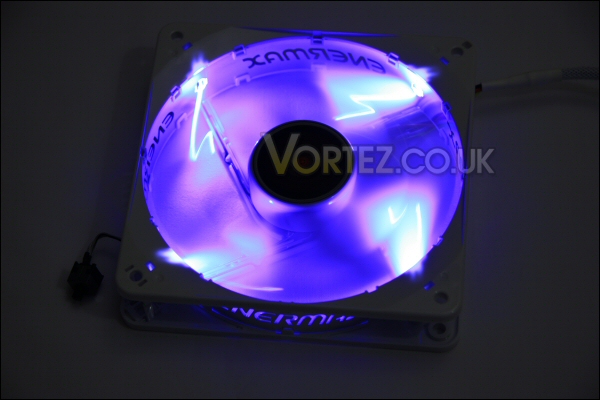
Cluster looked great.
Conclusion
Thia is a very impressive range of fans from Enermax. Each shares varying aspects of the others specifications which makes a compelling collection of fans able to compete in several cooling sectors.
There\\\’s a model for the performance coolers out there in the shape of the Magma. While the Cluster offers stunning looks coupled with the performance advantage of PWM control. The Everest in turn covers the silent end of the market with its low RPM temperature controlled functionality.
The star of the show – the Enermax Apollish!
To complete the set the Apollish offers vibrant and striking design through its chromed effect (in four colours remember!!!) and abundance of LED lighting. In fact, of all the fans the Apollish is most definitely the \\\’in yer face\\\’ model as far as looks go. However in terms of cooling it does its job in a very effective, efficient and subtle way. The thermal control (also shared by the Everest) means it\\\’s only ever as loud as it needs to be and as that\\\’s not very lout at all it gets a big thumbs up from me!
Pros
+ Great performance vs sound level
+ Good airflow and pressure at almost all speeds
+ Varied choice of fans for any user
+ Resonance, chuffing and click free performance
+ Colourful and striking designs
+ Decent value considering the performance returns
Cons
– Lack of cable braiding for the Apollish, Magma and Everest
I can happily say that all the fans on test here have performed exceptionally well – the Apollish being the star of the collection. It offers the best combination of style vs performance vs sound level in my opinion.
All in all there\\\’s a fan for everyone in Enermax\\\’s line up and as a result i choose to award the entire \\\’Twister\\\’ series of fans reviewed here with Vortez\\\’s Gold Award.
We would like to thank Enermax for supplying the Apollish, Magma, Cluster and Everest fans seen in this review. Discuss this review on our forums


