







Taken from the G1 Gaming Series, Gaming 7 is packed with oodles of features but is actually quite an affordable Z97 motherboard, including SATA Express AND M.2.

Product on Review: Z97X-Gaming 7
Manufacturer & Sponsor: GIGABYTE
Street Price: £140 GBP / $179 USD
So far on our Intel Z97 venture we’ve analysed a number of motherboards which focus on being affordable. Those who are perhaps on tight budget constraints will appreciate an offering which retains high-end features but sits at an attractive price-point and today’s sample achieves exactly that.
Z97X-Gaming 7 sits within the well-regarded G1 gaming line. This motherboard upholds many of the features and characteristics from the Gaming G1 motherboard but doesn’t end up costing the earth.
GIGABYTE on their Z97 G1 motherboards
GIGABYTE 9 series G1 gaming motherboards were designed to deliver top-notch features that matter most to gamers. From incorporating industry-leading GIGABYTE AMP-UP Audio technologies that allow gamers and audiophiles to experience crisp, ultra sound effects while gaming and the richest possible sound experience while listening to their favorite music and movies, to ultra-fast onboard Gigabit LAN solutions from Killer and Intel, GIGABYTE G1 motherboards were designed for gamers that aren’t satisfied with second best.
With a full range of top-to-bottom G1 gaming motherboards including the compact, yet powerful Z97N-Gaming 5 Mini-ITX motherboard, GIGABYTE has a gaming motherboard suited for any type of gamer, no matter what type of game they play. Featuring the distinctive G1 detailing and sexy new red and black styling, GIGABYTE G1 motherboards are sure to make gamers stand out from the horde.
With a full range of top-to-bottom G1 gaming motherboards including the compact, yet powerful Z97N-Gaming 5 Mini-ITX motherboard, GIGABYTE has a gaming motherboard suited for any type of gamer, no matter what type of game they play. Featuring the distinctive G1 detailing and sexy new red and black styling, GIGABYTE G1 motherboards are sure to make gamers stand out from the horde.
Technical Specifications
CPU
Support for Intel® Core™ i7 processors/Intel® Core™ i5 processors/ Intel® Core™ i3 processors/Intel® Pentium® processors/ Intel® Celeron® processors in the LGA1150 package
L3 cache varies with CPU
Chipset
Intel® Z97 Express Chipset
Memory
4 x DDR3 DIMM sockets supporting up to 32 GB of system memory
Dual channel memory architecture
Support for DDR3 3200(O.C.) / 3100(O.C.) / 3000(O.C.) / 2933(O.C.) / 2800(O.C.) /
2666(O.C.) / 2600(O.C.) / 2500(O.C.) / 2400(O.C.) / 2200(O.C.) / 2133(O.C.) /
2000(O.C.) / 1866(O.C.) / 1800(O.C.) / 1600 / 1333 MHz memory modules
Support for non-ECC memory modules
Support for Extreme Memory Profile (XMP) memory modules
Onboard Graphics
Integrated Graphics Processor:
1 x D-Sub port, supporting a maximum resolution of 1920×1200@60Hz
1 x DVI-D port, supporting a maximum resolution of 1920×1200@60Hz
* The DVI-D port does not support D-Sub connection by adapter.
1 x HDMI port, supporting a maximum resolution of 4096×2160@24Hz or 2560×1600@60Hz
Support for up to 3 displays at the same time
Maximum shared memory of 1 GB
Audio
Realtek® ALC1150 codec
Support for Sound Blaster X-Fi MB3
High Definition Audio
2/4/5.1/7.1-channel
Support for S/PDIF Out
LAN
Qualcomm® Atheros Killer E2201 LAN chip (10/100/1000 Mbit)
Expansion Slots
1 x PCI Express x16 slot, running at x16 (PCIEX16)
* For optimum performance, if only one PCI Express graphics card is to be installed, be sure to install it in the PCIEX16 slot.
1 x PCI Express x16 slot, running at x8 (PCIEX8)
* The PCIEX8 slot shares bandwidth with the PCIEX16 slot. When the PCIEX8 slot is populated, the PCIEX16 slot will operate at up to x8 mode.
1 x PCI Express x16 slot, running at x4 (PCIEX4)
* The PCIEX4 slot shares bandwidth with the PCIEX8 and PCIEX16 slots. When the PCIEX4 slot is populated, the PCIEX16 slot will operate at up to x8 mode and the PCIEX8 will operate at up to x4 mode.
* When installing a x8 or above card in the PCIEX4 slot, make sure to set PCIE Slot Configuration (CPU) in BIOS Setup to x4. (Refer to Chapter 2, “BIOS Setup,” “Peripherals,” for more information.)
(The PCIEX16, PCIEX8 and PCIEX4 slots conform to PCI Express 3.0 standard.)
3 x PCI Express x1 slots
(The PCI Express x1 slots conform to PCI Express 2.0 standard.)
1 x PCI slot
Multi-Graphics Technology
Support for 3-Way/2-Way AMD CrossFire™and 2-Way NVIDIA® SLI™ Technology
Storage Interface Chipset:
1 x M.2 PCIe connector
(Socket 3, M key, type 2242/2260/2280 SATA & PCIe SSD support)
1 x SATA Express connector
6 x SATA 6Gb/s connectors (SATA3 0~5)
(M.2, SATA Express, and SATA3 4/5 connectors can only be used one at a time. The SATA3 4/5 connectors will become unavailable when an M.2 SSD is installed.)
Support for RAID 0, RAID 1, RAID 5, and RAID 10
Marvell® 88SE9172 chip:
2 x SATA 6Gb/s connectors (GSATA3 6~7)
Support for RAID 0 and RAID 1
USB Chipset:
6 x USB 3.0/2.0 ports (4 ports on the back panel, 2 ports available through the internal USB header)
8 x USB 2.0/1.1 ports (4 ports on the back panel, 4 ports available through the internal USB headers)
Internal I/O Connectors
1 x 24-pin ATX main power connector
1 x 8-pin ATX 12V power connector
1 x PCIe power connector
1 x M.2 PCIe connector
1 x SATA Express connector
8 x SATA 6Gb/s connectors
1 x CPU fan header
1 x water cooling fan header (CPU_OPT)
4 x system fan headers
1 x front panel header
1 x front panel audio header
1 x S/PDIF Out header
1 x USB 3.0/2.0 header
2 x USB 2.0/1.1 headers
1 x serial port header
1 x Clear CMOS jumper
1 x Trusted Platform Module (TPM) header
1 x power button
1 x reset button
1 x Clear CMOS button
2 x BIOS switches
Voltage measurement points
Back Panel Connectors
1 x PS/2 mouse port
1 x PS/2 Keyboard port
1 x D-Sub port
1 x DVI-D port
1 x HDMI port
4 x USB 3.0/2.0 ports
4 x USB 2.0/1.1 ports
1 x RJ-45 port
1 x optical S/PDIF Out connector
5 x audio jacks (Center/Subwoofer Speaker Out, Rear Speaker Out, Line In, Line Out, Mic In)
I/O Controller
iTE® I/O Controller Chip
H/W Monitoring
System voltage detection
CPU/Chipset/System temperature detection
CPU/CPU OPT/System fan speed detection
CPU/System overheating warning
CPU/CPU OPT/System fan fail warning
CPU/CPU OPT/System fan speed control
BIOS
2 x 128 Mbit flash
Use of licensed AMI UEFI BIOS
Support for DualBIOS™
PnP 1.0a, DMI 2.7, WfM 2.0, SM BIOS 2.7, ACPI 5.0
Unique Features
Support for APP Center
@BIOS
EasyTune
EZ Setup
Fast Boot
Game Controller
ON/OFF Charge
Smart TimeLock
Smart Recovery 2
System Information Viewer
USB Blocker
Support for Q-Flash
Support for Smart Switch
Support for Xpress Install
Bundle Software
Norton® Internet Security (OEM version)
Intel® Rapid Start Technology
Intel® Smart Connect Technology
Intel® Smart Response Technology
Operating System
Support for Windows 8.1/8/7
Form Factor
ATX Form Factor; 30.5cm x 24.4cm
Support for Intel® Core™ i7 processors/Intel® Core™ i5 processors/ Intel® Core™ i3 processors/Intel® Pentium® processors/ Intel® Celeron® processors in the LGA1150 package
L3 cache varies with CPU
Chipset
Intel® Z97 Express Chipset
Memory
4 x DDR3 DIMM sockets supporting up to 32 GB of system memory
Dual channel memory architecture
Support for DDR3 3200(O.C.) / 3100(O.C.) / 3000(O.C.) / 2933(O.C.) / 2800(O.C.) /
2666(O.C.) / 2600(O.C.) / 2500(O.C.) / 2400(O.C.) / 2200(O.C.) / 2133(O.C.) /
2000(O.C.) / 1866(O.C.) / 1800(O.C.) / 1600 / 1333 MHz memory modules
Support for non-ECC memory modules
Support for Extreme Memory Profile (XMP) memory modules
Onboard Graphics
Integrated Graphics Processor:
1 x D-Sub port, supporting a maximum resolution of 1920×1200@60Hz
1 x DVI-D port, supporting a maximum resolution of 1920×1200@60Hz
* The DVI-D port does not support D-Sub connection by adapter.
1 x HDMI port, supporting a maximum resolution of 4096×2160@24Hz or 2560×1600@60Hz
Support for up to 3 displays at the same time
Maximum shared memory of 1 GB
Audio
Realtek® ALC1150 codec
Support for Sound Blaster X-Fi MB3
High Definition Audio
2/4/5.1/7.1-channel
Support for S/PDIF Out
LAN
Qualcomm® Atheros Killer E2201 LAN chip (10/100/1000 Mbit)
Expansion Slots
1 x PCI Express x16 slot, running at x16 (PCIEX16)
* For optimum performance, if only one PCI Express graphics card is to be installed, be sure to install it in the PCIEX16 slot.
1 x PCI Express x16 slot, running at x8 (PCIEX8)
* The PCIEX8 slot shares bandwidth with the PCIEX16 slot. When the PCIEX8 slot is populated, the PCIEX16 slot will operate at up to x8 mode.
1 x PCI Express x16 slot, running at x4 (PCIEX4)
* The PCIEX4 slot shares bandwidth with the PCIEX8 and PCIEX16 slots. When the PCIEX4 slot is populated, the PCIEX16 slot will operate at up to x8 mode and the PCIEX8 will operate at up to x4 mode.
* When installing a x8 or above card in the PCIEX4 slot, make sure to set PCIE Slot Configuration (CPU) in BIOS Setup to x4. (Refer to Chapter 2, “BIOS Setup,” “Peripherals,” for more information.)
(The PCIEX16, PCIEX8 and PCIEX4 slots conform to PCI Express 3.0 standard.)
3 x PCI Express x1 slots
(The PCI Express x1 slots conform to PCI Express 2.0 standard.)
1 x PCI slot
Multi-Graphics Technology
Support for 3-Way/2-Way AMD CrossFire™and 2-Way NVIDIA® SLI™ Technology
Storage Interface Chipset:
1 x M.2 PCIe connector
(Socket 3, M key, type 2242/2260/2280 SATA & PCIe SSD support)
1 x SATA Express connector
6 x SATA 6Gb/s connectors (SATA3 0~5)
(M.2, SATA Express, and SATA3 4/5 connectors can only be used one at a time. The SATA3 4/5 connectors will become unavailable when an M.2 SSD is installed.)
Support for RAID 0, RAID 1, RAID 5, and RAID 10
Marvell® 88SE9172 chip:
2 x SATA 6Gb/s connectors (GSATA3 6~7)
Support for RAID 0 and RAID 1
USB Chipset:
6 x USB 3.0/2.0 ports (4 ports on the back panel, 2 ports available through the internal USB header)
8 x USB 2.0/1.1 ports (4 ports on the back panel, 4 ports available through the internal USB headers)
Internal I/O Connectors
1 x 24-pin ATX main power connector
1 x 8-pin ATX 12V power connector
1 x PCIe power connector
1 x M.2 PCIe connector
1 x SATA Express connector
8 x SATA 6Gb/s connectors
1 x CPU fan header
1 x water cooling fan header (CPU_OPT)
4 x system fan headers
1 x front panel header
1 x front panel audio header
1 x S/PDIF Out header
1 x USB 3.0/2.0 header
2 x USB 2.0/1.1 headers
1 x serial port header
1 x Clear CMOS jumper
1 x Trusted Platform Module (TPM) header
1 x power button
1 x reset button
1 x Clear CMOS button
2 x BIOS switches
Voltage measurement points
Back Panel Connectors
1 x PS/2 mouse port
1 x PS/2 Keyboard port
1 x D-Sub port
1 x DVI-D port
1 x HDMI port
4 x USB 3.0/2.0 ports
4 x USB 2.0/1.1 ports
1 x RJ-45 port
1 x optical S/PDIF Out connector
5 x audio jacks (Center/Subwoofer Speaker Out, Rear Speaker Out, Line In, Line Out, Mic In)
I/O Controller
iTE® I/O Controller Chip
H/W Monitoring
System voltage detection
CPU/Chipset/System temperature detection
CPU/CPU OPT/System fan speed detection
CPU/System overheating warning
CPU/CPU OPT/System fan fail warning
CPU/CPU OPT/System fan speed control
BIOS
2 x 128 Mbit flash
Use of licensed AMI UEFI BIOS
Support for DualBIOS™
PnP 1.0a, DMI 2.7, WfM 2.0, SM BIOS 2.7, ACPI 5.0
Unique Features
Support for APP Center
@BIOS
EasyTune
EZ Setup
Fast Boot
Game Controller
ON/OFF Charge
Smart TimeLock
Smart Recovery 2
System Information Viewer
USB Blocker
Support for Q-Flash
Support for Smart Switch
Support for Xpress Install
Bundle Software
Norton® Internet Security (OEM version)
Intel® Rapid Start Technology
Intel® Smart Connect Technology
Intel® Smart Response Technology
Operating System
Support for Windows 8.1/8/7
Form Factor
ATX Form Factor; 30.5cm x 24.4cm
Packaging & First Look
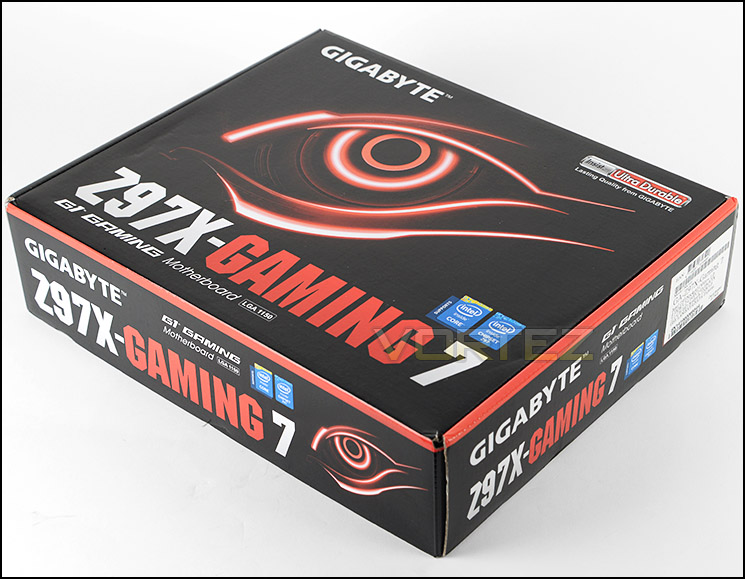
Packaging for Z97X-Gaming 7
In similar fashion to the rest of their Z97 range, GIGABYTE present Gaming 7 within a box which features the gaming eye insignia. Around the back of this box there are a number of noteworthy features listed for those wanting to understand how Gaming 7 works.
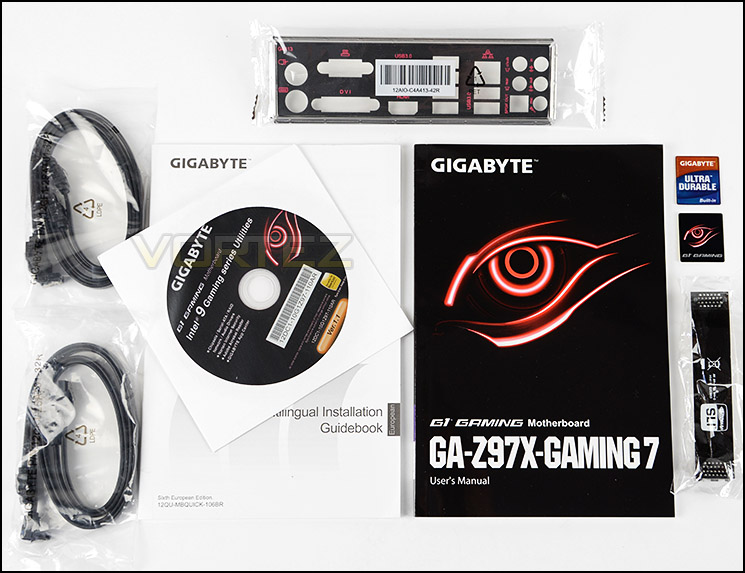
The accessories bundle
Opening the box up reveals a number of included items which form the bundle for Gaming 7. These items include:
• Documentation: User’s Manual, Multilingual Installation Guide
• Software CD: Drivers, Utilities
• Rear IO Shield
• 2x Case Badges
• 4x SATA 3 (6G) cables
• Flexible SLI Bridge
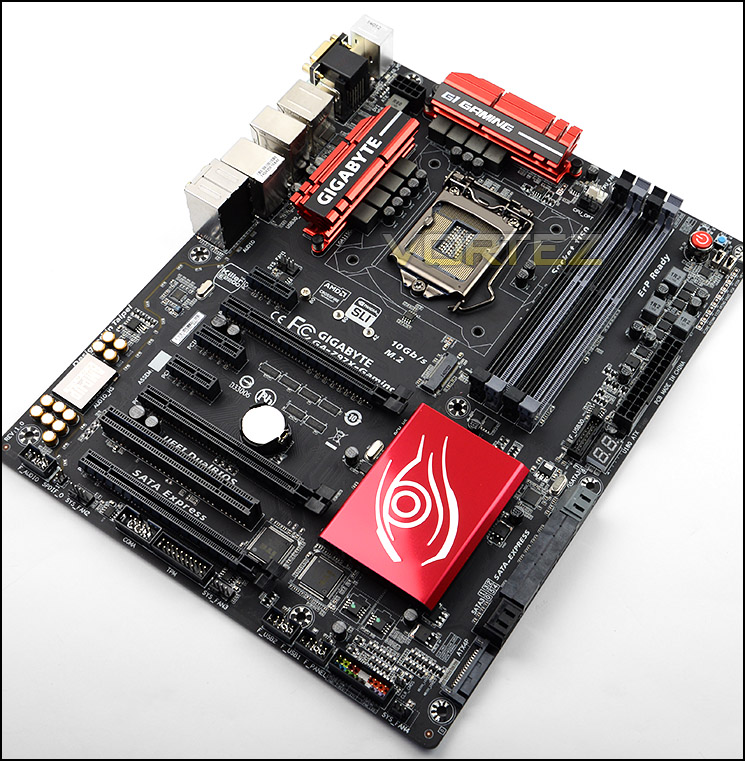
Gaming 7 in all its glory
Gaming 7 remains consistent with the previously reviewed Z97X-Gaming G1 and indeed the rest of the G1 gaming line in terms of styling.
Our board uses the standard ATX form factor and uses a matt black PCB. The combination of black and red works very well together and is appealing to the eye. This board packs in a wealth of features and over the next page we will be exploring these attributes in detail.
Closer Look
Digi+ 8-Phase VRM design
GIGABYTE has given Gaming 7 two sleek black and red heatsinks. These heatsinks cover the MOSFETs and are substantial in size but not bulky enough to cause obstruction for such devices as a CPU cooler.
An 8-Phase VRM design is fundamental to Gaming 7’s power delivery and just behind the heatsinks resides an 8-pin EPS (CPU Power) socket.
Dotted around the motherboard and indeed the VRM area are 10K-Solid CAPs. These capacitors promise to deliver at least 10K hours of usage, offering ultra-low ESR even under severe CPU load. These black CAPs are also exclusively designed by Nippon Chemi-Con for GIGABYTE motherboards – complimenting the overall look and aesthetics.
The actual socket on our Gaming 7 motherboard is LGA 1150 and has compatibility for 4th / 5th Generation of Core i5/i7 Processors. Power delivery on this board is completely digital for CPU and memory via IR Digital Engine.
DDR3 memory support and overclocking features
Z97X-Gaming 7 has 4x DIMM slots which support dual-channel DDR3. These slots can accommodate 32GB of capacity and up to 3200 (OC).
This particular region lends itself to having a number of useful features. In the very corner there are a variety of onboard buttons including: power, reset and clear CMOS. Having these buttons in such a place makes it much easier to access when needed. LED Debug also sits immediately next to the USB 3.0 header and gives LED codes throughout the POST process and helps to ascertain any issues with booting (codes can be verified by looking at the manual). On the outer edge, GIGABYTE has placed voltage measurement points for advanced users to read voltages from DRAM, CPU and other such areas.
Next to the power button, there are two switches – one enables/disables dual BIOS and one allows you to switch between the primary and secondary BIOS.
SATA and SATA Express functionality
Moving along we come to the SATA storage which combines SATA III (6Gb/s) and SATA Express (10Gb/s). SATA Express is an integral feature with Z97 and combines the benefits of PCI-Express and SATA.
GIGABYTE has also placed an ATX4P (SATA power) connector which serves as auxiliary power for the X16 slots. When multiple graphics cards are used, it’s recommended to use this connector to ensure better stability.
Large heatsink covering Z97 chip
Placed over the Intel Z97 chip is a large heatsink which has GIGABYTE’s gaming icon etched onto the top-side. Aside from the USB headers there are no other significant features in this area.
Multi-GPU support
Turning our attention to the PCI express slots we have a number of options available. The slots in this area include:
1 x PCI Express 3.0 x16 slots (Running @x16)
1 x PCI Express 3.0 x16 slots (Running @x8)
2 x PCI Express 2.0 x16 slots (Running @x4)
3 x PCI Express 2.0 x1 slots
1x PCI Legacy slot
Since the top PCI Express x16 slot operates at x16 it’s important to use that slot if you are planning on going with a single graphics card configuration.
Above the PCI Express slots there is an M.2 slot for an M.2 SSD which can allow up to 10G transfer rates.
In the lower region of Gaming 7 there are various audio components. These include the following:
Realtek ALC1150 Chip
Built-in Rear Audio Amplifier
Nichicon audio capacitors
EMI shield
Gaming 7 uses ALC1150 which offers 115dB SNR HD audio and 7.1 channel sound playback. The amplifier promises to deliver higher fidelity whilst maintaining crisp playback with less distortion. An EMI shield separates all of the audio components from the rest of the motherboard to reduce noise interference.
Lots of functionality on the Rear IO panel
Lastly, we come to the Rear IO panel which has a plethora of ports to take advantage of. The list of options available are as follows:
1 x PS/2 mouse port
1 x PS/2 Keyboard port
1 x D-Sub port
1 x DVI-D port
1 x HDMI port
4 x USB 3.0/2.0 ports
4 x USB 2.0/1.1 ports
1 x RJ-45 port
1 x optical S/PDIF Out connector
5 x audio jacks (Center/Subwoofer Speaker Out, Rear Speaker Out, Line In, Line Out, Mic In)
You’ll also notice that some of the connectors are gold plated. GIGABYTE has chosen to incorporate this to improve signal conductivity – thus helping to alleviate electrostatic interference.
The LAN connectivity is via Killer E2200 and offers gigabit transfer rates from two RJ45 ports which both work in conjunction with Killer LAN software.
GIGABYTE 9 Series Features
DuraBlack – 10K Black Solid CAPs
GIGABYTE continue their Ultra Durable theme by teaming up with Nippon Chemi-Con who have developed a range of solid capacitors exclusively for the brand. These durable black solid CAPs (DuraBlack) offer a minimum of 10K hours of intense operation at temperatures up to 105C. Regardless of how much load is applied to the CPU, ultra-low ESR is achieved.
Audio inc. Creative Sound Core3D
GIGABYTE bundle a series of high-grade audio components with the 9 Series motherboards including a quad-core audio processor from Creative – Sound Core3D. This processor works in conjunction with Bi-Polarized Audio Capacitors which are audio-class MUSE ES acoustic CAPS – these components promise to deliver the highest quality sound resolution to ensure great audio both in games and when watching movies or listening to music.
Furthermore, GIGABYTE motherboards feature upgradable OP-AMP (World’s 1st Upgradable) were user can choose the audio quality based on their own taste. OP-AMPs can be obtained and installed onto the motherboard, providing an alternative route to enhancing the audio preference on the motherboard.
An EMI noise guard sections off all audio components from the rest of the motherboard to reinforce quality and ensure no noise interference takes place. An LED trace line glows when the system is powered.
Killer E2200
A reoccurring feature is integrated with GIGABYTE’s motherboards – Killer E2200. An adaptive gigabit controller is present and combining this with the full Killer software suite, users can enhance their network performance by taking advantage of improved performance over standard LAN connectivity.
DualBIOS
Having two BIOS on a motherboard is an extremely useful feature to have, especially for those who modify settings and are seeking to push the system to the limits. DualBIOS offers a backup scenario so that users can switch between BIOS should one become unstable and fail. So, even if the BIOS is infected with a virus or malfunctions the secondary option is completely independent and can be used without having to send the motherboard back – thus preventing inconvenient downtime.
App Center
GIGABYTE Intel 9 series MB features the latest ‘App Center’ utility, integrating all of GIGABYTE’s unique software applications into one convenient location. Live Updates ensure you are always using the latest software version.
GIGABYTE UEFI Video Tour
Below is a video tour showing the interface of GIGABYTE’s UEFI BIOS and the options which are available. As you can see, GIGABYTE haven’t really altered the BIOS experience except for the welcome screen. The Advanced Mode area remains the same and doesn’t feel as smooth or professional as rival UEFI BIOS’.
Test Setup, Methodology & Overclocking
Test Setup
CPU Intel Core i7 4770K (Haswell) 3.50GHz
Cooling Corsair Hydro Series H105
Motherboard Z97X-Gaming 7
Memory 16GB Corsair Vengeance Pro 2800MHz CL12 DDR3
Graphics XFX R7970 Black Edition
Storage Corsair Neutron GTX 480GB
PSU Corsair HX1050 80 Plus Gold Certified PSU
Cooling Corsair Hydro Series H105
Motherboard Z97X-Gaming 7
Memory 16GB Corsair Vengeance Pro 2800MHz CL12 DDR3
Graphics XFX R7970 Black Edition
Storage Corsair Neutron GTX 480GB
PSU Corsair HX1050 80 Plus Gold Certified PSU
Benchmarks
Cinebench R15 – CPU/OpenGL Score
x264 HD 4.0 – 1st and 2nd pass encoding
SiSoftware SANDRA 2014 – CPU & Memory benchmarks
AIDA64 – CPU benchmarks
PCMark 8 – Home Suite
3DMark FireStrike – DX11 3D Benchmark
Games – Tomb Raider, THIEF
x264 HD 4.0 – 1st and 2nd pass encoding
SiSoftware SANDRA 2014 – CPU & Memory benchmarks
AIDA64 – CPU benchmarks
PCMark 8 – Home Suite
3DMark FireStrike – DX11 3D Benchmark
Games – Tomb Raider, THIEF
Other Software
Temperature Analysis: Core Temp
Stress Testing Software: LinX
CPU Specification Monitoring: CPU-Z
Stress Testing Software: LinX
CPU Specification Monitoring: CPU-Z
Overclocking
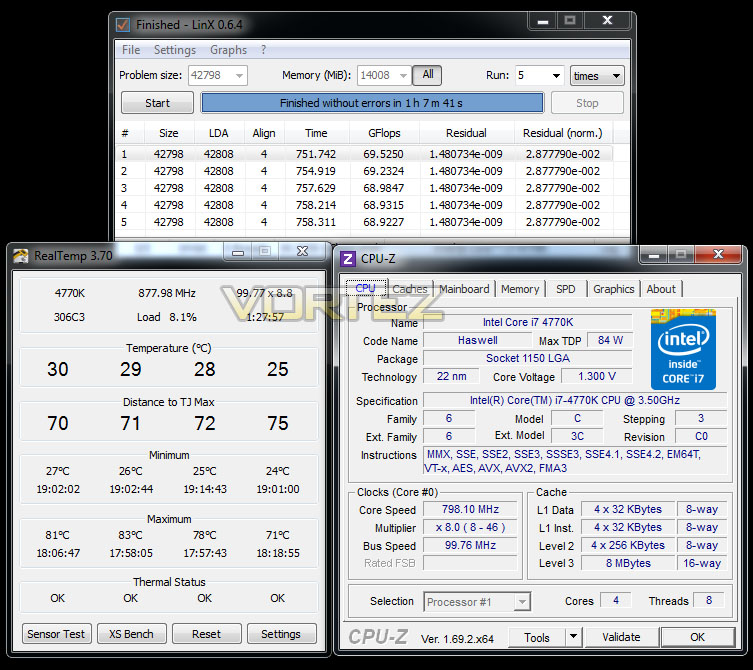
Since the introduction of Z87 back in 2013, there has been a return to BCLK overclocking. This type of functionality ensures flexibility for Overclockers compared to previous generations were the BCLK was locked to 100MHz and only the ratio could be adjusted. As many of you will know, Haswell CPUs get very hot with little voltage increase therefore the flexibility and headroom for overclocking can be limited. For the Z97 launch, we are testing with the Intel Core i7-4770K which from previous, extensive testing, has a maximum overclock of 4.6GHz.
Z97X-Gaming 7 managed to achieve that milestone of 4.6GHz with Core Voltage being set to 1.3v. Adjusting the voltage any lower than 1.3v resulted in instability but even so, this is a great achievement.
Benchmarks: Power Consumption
It’s interesting to note the power consumption across all motherboards. Although they are using Z97 chipsets, energy results can fluctuate between manufacturers due to the features and specifications that are integrated. First of all, for the idle tests the system is cold booted into Windows and no additional applications are executed – the watts are noted on the external energy monitor we use and then the system is loaded with 3DMark FireStrike – watts are again monitored for the duration of the test and the highest rated wattage result is then noted down. Below are the results of this energy test.
Benchmarks: X264 HD
Simply put, this test measures how fast your machine can encode a short, DVD quality MPEG-2 video clip into a high-quality x264 video clip. What’s x264, you ask? It’s more or less the next-generation Xvid/DivX codec. I think it’s ideal for a benchmark because the application (x264.exe) reports fairly accurate compression results (in frames per second) for each pass of the video encoding process, and it uses multi-core processors very efficiently.
Benchmarks: AIDA64
AIDA64 Product PageThis simple integer benchmark focuses on the branch prediction capabilities and the misprediction penalties of the CPU. It finds the solutions for the classic “Queens problem” on a 10 by 10 sized chessboard. At the same clock speed theoretically the processor with the shorter pipeline and smaller misprediction penalties will attain higher benchmark scores. For example — with HyperThreading disabled — the Intel Northwood core processors get higher scores than the Intel Prescott core based ones due to the 20-step vs 31-step long pipeline. CPU Queen test uses integer MMX, SSE2 and SSSE3 optimizations.
Benchmarks: Cinebench
CINEBENCH is a real-world cross platform test suite that evaluates your computer’s performance capabilities. CINEBENCH is based on MAXON’s animation software CINEMA 4D 3D content creation.
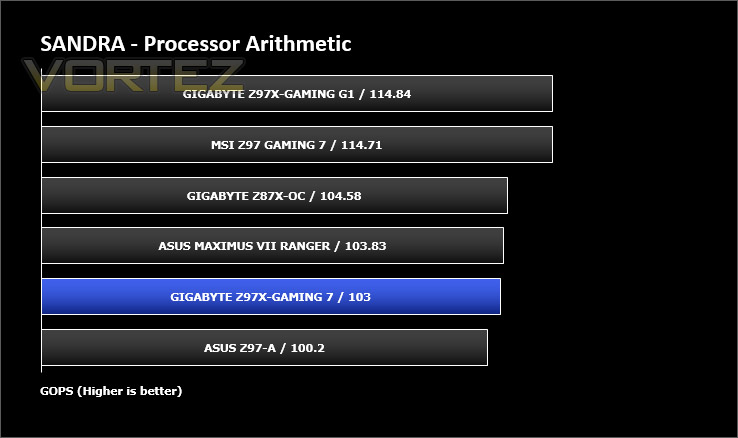
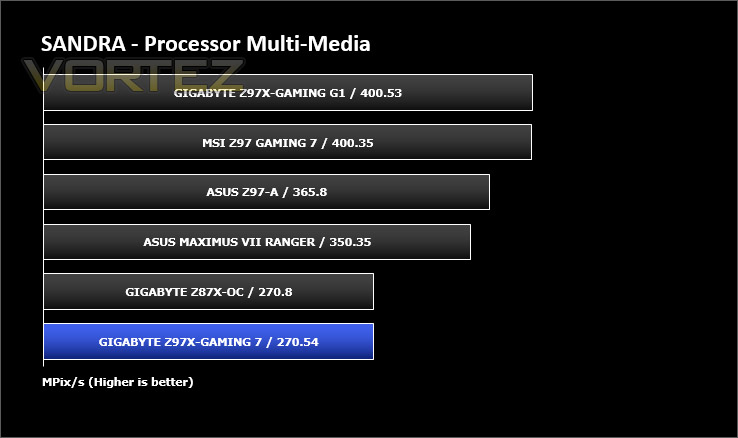
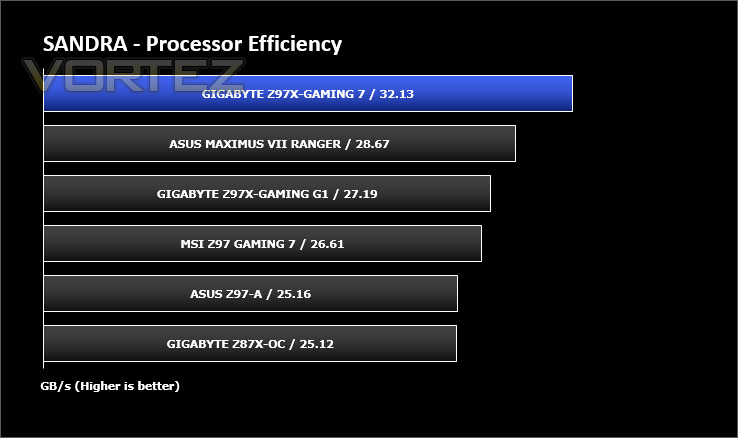
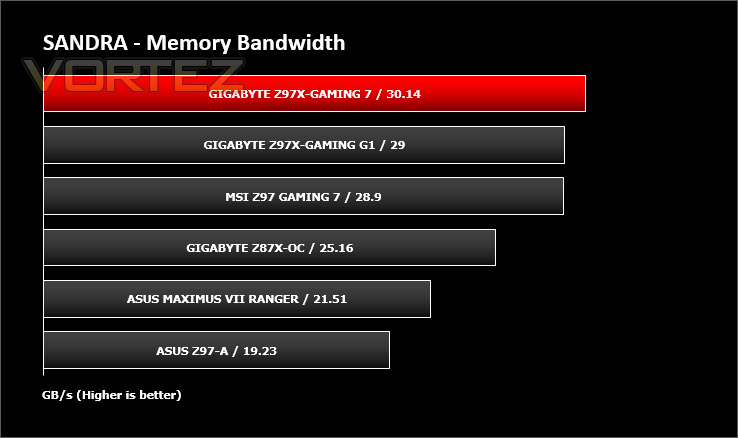
Benchmarks: SiSoftware SANDRA
SANDRA isn’t always a benchmark that is included in hardware reviews but I believe it shouldn’t be ignored. SANDRA provides a vigorous package that tests your system in a rather large array of benchmarks. There are many aspects of benchmark that can be executed. We will be considering – CPU and memory tests.
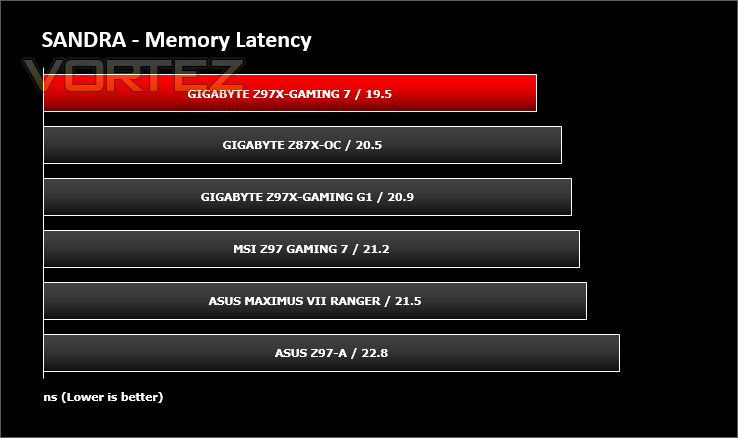
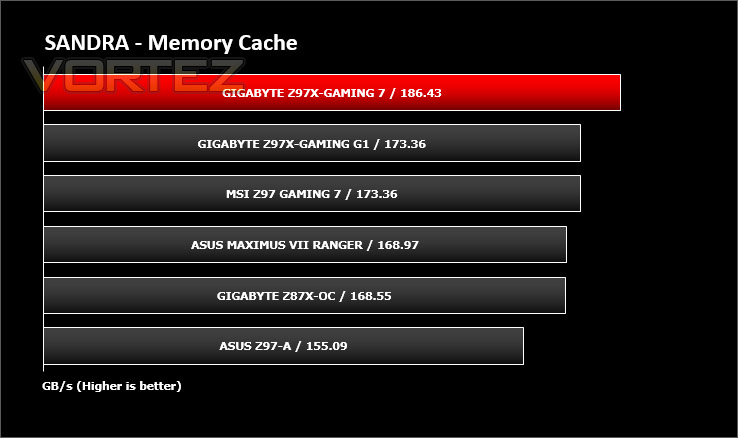
Benchmarks: 3DMark
3DMark FireStrike Product PageFire Strike is our new showcase DirectX 11 benchmark designed for high-performance gaming PCs. It is our most ambitious and technical benchmark ever, featuring real-time graphics rendered with detail and complexity far beyond what is found in other benchmarks and games today. Fire Strike will only be available in the Windows editions of 3DMark initially.
Benchmarks: PCMark 8
PCMark 8 combines performance benchmarking with battery life measurement and includes tests based on popular Adobe and Microsoft applications. Whether you are looking for long battery life, or maximum power, PCMark 8 will help you find the devices that offer the perfect combination of efficiency and performance for your needs. It’s the complete PC performance benchmark for home and business.
Benchmarks: Tomb Raider & THIEF
It’s important for us to perform a number of game benchmarks as well as the synthetic tests because gamers will want to know if there are any significant benefits. So here we have two popular and recent gaming titles which feature a dedicated benchmark tool within them to display results.
Conclusion
In our first phase of Intel Z97 reviews we looked at GIGABYTE’s high-end gaming motherboard, Z97X-Gaming G1. While this motherboard may be a superb offering, some gamers (and enthusiasts) will regard such a motherboard as overkill. It’s wealth of features also places it in the upper bracket for pricing but today we’ve been looking at something very similar but with a smaller price-tag.
There is little to differentiate the visual appearance of GIGABYTE’s G1 product line and this close resemblance ensures consistency throughout the varying models. We have to say, the black and red theme is very appealing to the eye. The general layout and use of components across our Gaming 7 are also very good, we’re left in no doubt that this particular offering projects itself forward as a resilient counterpart.
Dotted around the motherboard are a selection of useful features including versatile storage options from the two new interfaces – SATA Express and M.2. Having these two new standards as an additional to the conventional SATA III (6G) ports future proofs Gaming 7 and leaves the door open to other possibilities later on down the road.
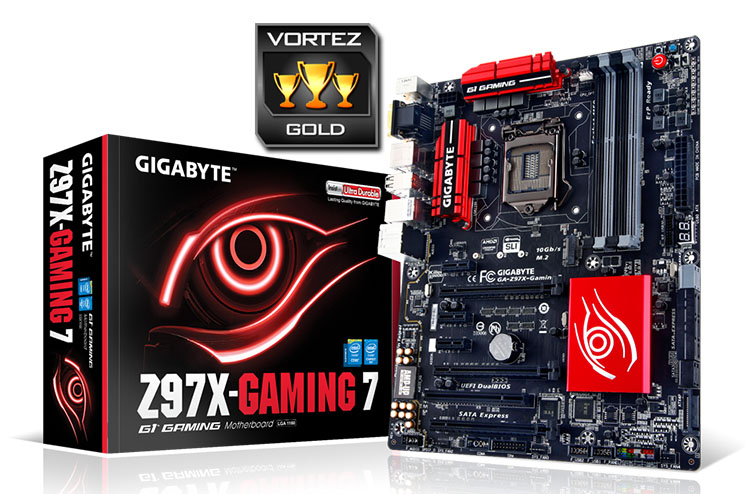
In all our testing, Gaming 7 demonstrated consistent performance in a range of scenarios and even managed to attain the 4.6GHz milestone which our Intel Core i7-4770K cannot go beyond. This highlights that in the overclocking department Gaming 7 is well-equipped. But as we discovered with the Gaming G1 counterpart, the BIOS hasn’t really had much of a facelift from the previous generation and the interface, compared to other vendors, feels dated is far from fluid.
The pricing for Gaming 7 is a particular highlight. It sits at just shy of £140 GBP / $179 USD – making it a sensible choice for those with tighter budget constraints.
Gaming 7 retains the high-end features expected from the G1 line. In all our testing we found this motherboard to be a consistent performer and we therefore regard Gaming 7 a smart choice for gamers and enthusiasts who are looking for an inexpensive path to Intel Z97.
Pros
+ Clean & attractive aesthetics
+ Good quality components
+ Consistently good performance
+ SATA Express & M.2 storage support
+ Useful features
+ Reasonably priced
Cons
– BIOS interface hasn’t improved
+ Clean & attractive aesthetics
+ Good quality components
+ Consistently good performance
+ SATA Express & M.2 storage support
+ Useful features
+ Reasonably priced
Cons
– BIOS interface hasn’t improved

Click here for an explanation of our awards at Vortez.net.


