







Ubisoft brings us an open world title based in Chicago of the near-future, but does it bring us up to date with the much heralded ‘next generation’ of games?

Title: Watch_Dogs
Developer: Ubisoft Montreal
Publisher: Ubisoft
Platform: PC, XBOX One, Playstation 4
Genre: Third Person Action/Adventure
Price: £39.99 MSRP
Approx Completion Time: >13 hours
Review Sponsor: NVIDIA
Minimum Specifications
OS: Windows Vista (SP2), Windows 7 (SP1) or Windows 8 (Please note that we only support 64 bit OSs.)
Processor: Intel Core 2 Quad Q8400 @ 2.66Ghz or AMD Phenom II X4 940 @ 3.0Ghz
Memory: 6 GB RAM
Graphics: DirectX 11 graphics card with 1 GB Video RAM – Nvidia Geforce GTX 460 or AMD Radeon HD 5770
DirectX: Version 11
Hard Drive: 25 GB available space
Sound Card: DirectX 9.0c Compatible Sound Card with Latest Drivers
Additional Notes: Broadband connection and service required for multiplayer mode.
Supported Video Cards at Time of Release: nVidia GeForce GTX460 or better, GT500, GT600, GT700 series; AMD Radeon HD5850 or better, HD6000, HD7000, R7 and R9 series Intel® Iris™ Pro HD 5200
Processor: Intel Core 2 Quad Q8400 @ 2.66Ghz or AMD Phenom II X4 940 @ 3.0Ghz
Memory: 6 GB RAM
Graphics: DirectX 11 graphics card with 1 GB Video RAM – Nvidia Geforce GTX 460 or AMD Radeon HD 5770
DirectX: Version 11
Hard Drive: 25 GB available space
Sound Card: DirectX 9.0c Compatible Sound Card with Latest Drivers
Additional Notes: Broadband connection and service required for multiplayer mode.
Supported Video Cards at Time of Release: nVidia GeForce GTX460 or better, GT500, GT600, GT700 series; AMD Radeon HD5850 or better, HD6000, HD7000, R7 and R9 series Intel® Iris™ Pro HD 5200
Recommended Specifications
As above except:
Processor: Eight core – Intel Core i7-3770 @3.5 GHz or AMD FX-8350 X8 @ 4 GHz
Memory: 8 GB RAM
Graphics: DirectX 11 graphics card with 2 GB Video RAM – Nvidia Geforce GTX 560 ti or AMD Radeon HD 7850
Processor: Eight core – Intel Core i7-3770 @3.5 GHz or AMD FX-8350 X8 @ 4 GHz
Memory: 8 GB RAM
Graphics: DirectX 11 graphics card with 2 GB Video RAM – Nvidia Geforce GTX 560 ti or AMD Radeon HD 7850
This review contains mild spoilers from the first hour of gameplay
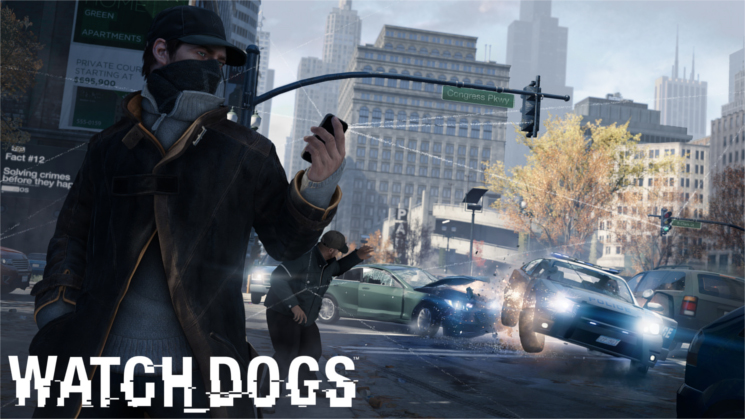
Watch_Dogs was announced to a great deal of fanfare at Ubisoft’s E3 2012 press conference, swiftly gaining a media narrative as the first truly next-generation title. More so both presentation and marketing latched onto the Zeitgeist surrounding the potential for a monolithic surveillance state – real or imagined – administered by powerful corporations tracking your every move. The Edward Snowden leaks and further revelations on the nature of government spying by the NSA et al unsurprisingly lent Watch_Dogs an aura of relevancy long before concrete details of the project were known.
Trailers looked stunning, naturally, but the major development milestone was the concept of drop-in multiplayer – playing a game which was for all intents and purposes single player and then being ‘invaded’ by competing players to fight over some objective. And yet even though hacking was a major plot point the mechanics were heavily downplayed, giving way to fare more in common with major action/adventure franchises such as Grand Theft Auto or Uncharted. Nonetheless being able to do all this in a near seamless open world is alluring.
Unfortunately since its announcement Watch_Dogs went through a series of delays; at one stage due to be a launch title for the PS4, the game was pushed to the Spring (and finally May 27th) with only weeks to go. Hopefully Ubisoft have had enough time to smooth out the rough edges and unveil a title which excels on all platforms.
The Setting: Chicago of the not-to-distant future.
Chicago, long recognised as a crime hotspot in the US, has in the near-future had all city infrastructure integrated into one seamless system – the Central Operating System (ctOS) – with a highly pervasive reach into all corners of life. Apparently intended to streamline city resource allocation and improve emergency response times, the depth of ctOS’s tendrils have proved to be fertile ground for high tech. criminals in search of information or cold hard cash.
You are Aiden Pearce, Watch_Dogs’ not-so-silent protagonist. Whilst some of Chicago’s underworld try to exploit the new regime in the comfort of their basement, advances have meant that you sometimes need to get your hands dirty – Aiden is just the man for the job. He specialises in getting physically close to computer nodes undetected so a hack can be deployed via his smartphone, and then getting away clean.
Unfortunately not all goes well for Aiden and his partner in crime Damien Brenks. When on an ill-fated mission for illicit information they are compromised by another hacker, leading to Aiden and Brenks being targeted and the death of Aiden’s niece. One year on and Aiden is playing the role of solo ‘Vigilante’, divorcing himself from a reckless and now-crippled Brenks whom he blames for his niece’s murder, carving out a name for himself on the streets of Chicago in the process. Just starting to regain some semblance of a relationship with his sister Nikki and nephew Jacks, he is also still searching for answers in his niece’s death. This search has led to associations with yet more unsavoury characters, putting himself and others at further risk.
Watch_Dogs immediately sets itself in the mould of revenge thriller attempting to lead the player through twists and turns as well as underworld politics. It’s a testament to the writing team that many of the twists don’t feel too contrived, but from hour one you are at times left wondering why Aiden and Brenks haven’t been summarily dispatched long before now. Aiden himself hardly seems to be a heroic figure despite the repute of his alter-ego ‘The Vigilante’, and continually places others as well as himself in harms way. The strong narrative focus of the game therefore drives you onwards if such stories hold your interest, but may make subsequent playthroughs for additional content unnecessary. A deep philosophical discussion on the nature of privacy in the information age it isn’t.
Who Watches The Watch_Dogs?
As the first title in what Ubisoft hope will be a successful ‘Assassin’s Creed’-esq franchise it’s no surprise that the characters are painted with very broad strokes rather than nuance and subtlety.
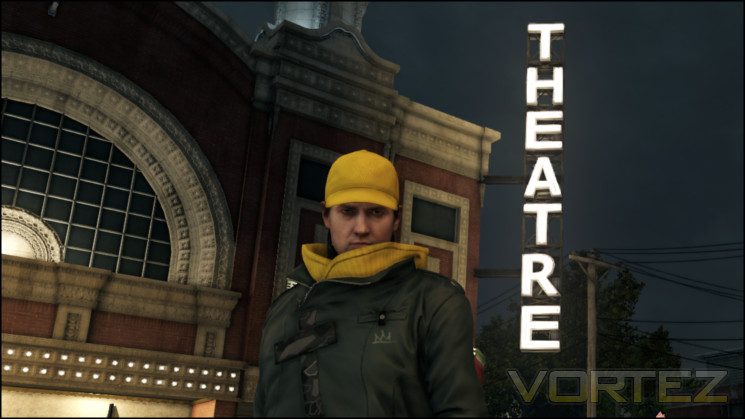
Aiden Pearce is part rogue, part film-noire private detective. Seemingly callous at times, especially with regards to his family and more physically vulnerable allies, the mechanics of the game tend to dictate that he is an anti-hero of sorts. Although he shows himself as caring, primarily in conversation with family or Clara, both life and individual privacies are troublingly irrelevant both in terms of the ongoing narrative and the wider themes Watch_Dogs could bring to bear. As the Vigilante the public at wide seem to gawp and stare rather than react assertively, perhaps reflecting how minor a part such a character could play in their day-to-day lives.
Brenks is a loose cannon, driven almost beyond sanity to discover who took both his health and ill-gotten wealth. Belligerent and manipulative, he’s swiftly set up as the chief antagonist of Watch_Dogs. Even given his unpleasantness it’s difficult to sympathise with Aiden, who you want to succeed in this conflict purely because it might help keep innocents out of harms way rather than sympathy for either him or great antipathy for Brenks in his antagonism towards Aiden.
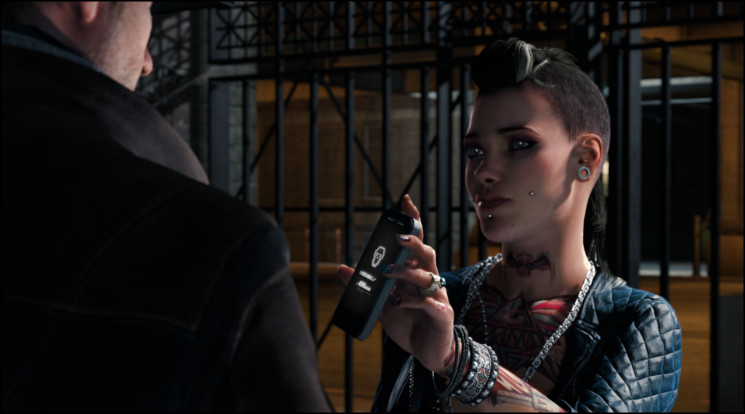
Clara Lille AKA BadBoy17 is a member of the DedSec anti-corporate hacking group and general rebel-seeking-a-cause eager to take down the Blume Corporation. Clara has largely replaced Brenks in Aiden’s world, providing him with leads and the hacking tools to complete missions with the minimum of fuss. What isn’t known is her underlying motivation, if she really is just against Blume or if there’s something more personal at play.
Jordi Chin is Aiden’s fixer, supplying the more… solid tools of the trade. He is Aiden’s link to the seed(-ier) elements of Chicago’s underworld, supplying cars, weapons and explosives to order as well as muscle when Aiden needs backup. Jordi’s relationship with Aiden is complicated by to his psychopathic tendencies, for Jordi problem-solving usually begins and ends with at least one body. For his part Aiden resists in being drawn too far down Jordi’s path.
The Blume Corporation are the designers and operators of ctOS for the city of Chicago, but rumours persist of an involvement in some of the shadier aspects of Chicago business. Their chief opposition is DedSec, an apparently loose coalition of hackers and anarchists thematically similar to Anonymous but with a willingness to stretch their reach into actively disrupting city operations. You will often hear the competing views of Blume and DedSec in news reports over the radio.
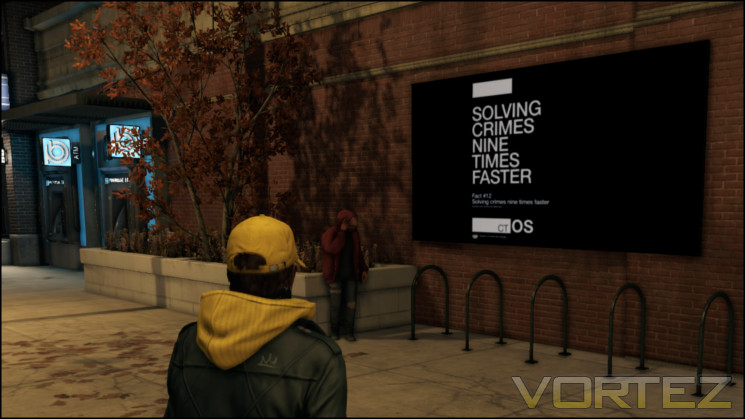
Other major characters also appear throughout the game but revealing them would venture too far into spoiler territory. Suffice it to say that these broad strokes are repeated throughout.
–
While the named characters do express unique and distinct personalities this isn’t the case for the wider population of Chicago. The vast majority of your interactions are entirely mundane, generally relegated to getting a stern look from a passer-by as you bump into them or cries of alarm as you gas of your vehicle. Even without your input the NPCs and their cars wander aimlessly, with the occasional traffic accident or theft occurring if you are within earshot as a means of adding colour.
Depth is added to the world when you ‘profile’ them & ‘hack’ NPCs to discover unusual facts about them and gain access to their smartphone. Although this will generally yield only cash, it will sometimes reveal the location of a cache of goods hidden nearby or a crime about to be committed. Rarely, hacking phones will allow you to uncover ‘fixer’ opportunities or find gang hideouts, triggering sub-missions which grant experience and reputation. There’s validation to this interaction however; you won’t meet them again later with an updated backstory, they just blend right back into the crowd.
The hackneyed dialogue belies the voice acting quality from all quarters. Noam Jenkins in particular is excellent as Aiden Pearce, but throughout the actors have done sterling work giving life to what otherwise would have been pretty bland characters.
Audio Logs & Sub-Plot Elements
Much like BioShock and Deus Ex a large portion of the game outside of the main campaign revolves around collections of audio logs and completion of minor tasks. Within Watch_Dogs these titbits of information flesh out the social conflicts in near-future Chicago and teach you more about Blume, DedSec and ancillary characters important to the genesis of both organisations. Completing all these collections – a fairly trivial task that requires time rather than applied effort – will yield additional missions focussing on the game sub-plots.
Watch_Dogs also gets a point in the credit column for fully voice acting each of these logs, as well as including voiced telephone conversation intercepts rather than relying on transcripts/diaries as many other games have done in the past.
Next Generation Graphics, Hardware Dependent
Test System
CPU: Intel Core i5 3570K @ Stock
Memory: 8GB (2 x 4GB) GSkill DDR3 1333MHz @ Stock
GPU: ZOTAC GTX 660 AMP! Edition *
OS: Window 7
OS HDD: 256GB Samsung 840 EVO SSD
Uplay Folder: As above
Monitor Resolution: 1920 x 1080 (1080p)
Memory: 8GB (2 x 4GB) GSkill DDR3 1333MHz @ Stock
GPU: ZOTAC GTX 660 AMP! Edition *
OS: Window 7
OS HDD: 256GB Samsung 840 EVO SSD
Uplay Folder: As above
Monitor Resolution: 1920 x 1080 (1080p)
*For the purposes of this review we had access to the unreleased NVIDIA GeForce 337.88 WHQL drivers. These drivers should be available upon the release of Watch_Dogs and are highly recommended for all users of NVIDIA GPUs.
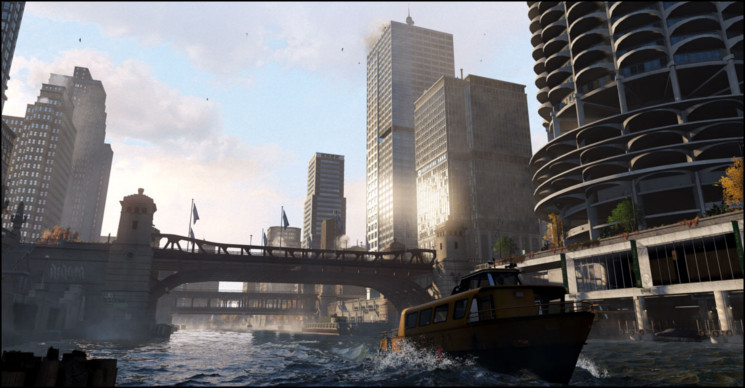
Near future Chicago is based on the Chicago of the real world and so few liberties have been taken with the design, layout and art direction. Instead Ubisoft have pushed for as close to a realistic representation of Chicago as possible, including locally famous landmarks and transport systems whilst giving a slightly futuristic feel. In building this world Ubisoft created Disrupt, a game engine designed to enable an open world rather than the typical walled corridors funnelling gameplay or fixed zone transitions, and in that regard is very much in the mould of the Grand Theft Auto franchise.
Unlike similar titles Watch_Dogs doesn’t have some of the more ‘zany’ in-world interactions, instead relying on solid in-game physics for a realistic take – at least, as realistic as possible when the protagonist wields a magic smartphone which can cause pipes to burst at a keypress. As a consequence you’re unlikely to see some of the more ridiculous highlight reels compared to Just Cause 2, but it also lacks a charm and humour such titles bring to bear.
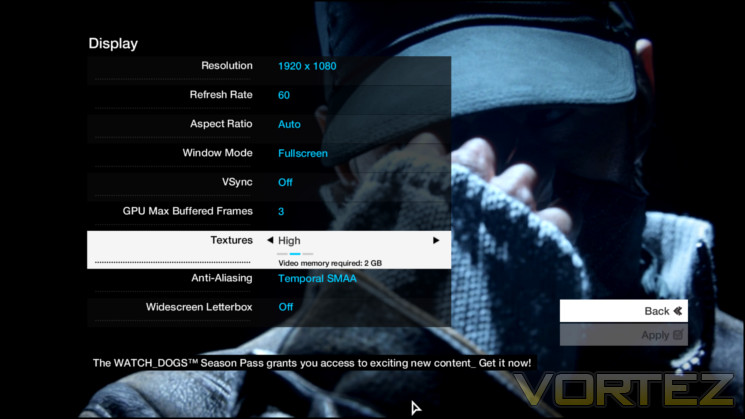
For its PC adaptation Ubisoft enlisted the aid of NVIDIA, and with their help also implemented two NVIDIA-specific technologies for those with suitable hardware.
Both HBOA+ and TXAA increase graphical quality with a relatively low performance overhead compared to more widely used methods, leading to improved in-game visuals for PC systems at each level of hardware power. Those without NVIDIA graphics hardware can make use of traditional Ambient Occlusion and Anti Aliasing techniques, but these will have a more significant impact on performance.
Note that for the highest graphics quality levels 3GB of VRAM are required.
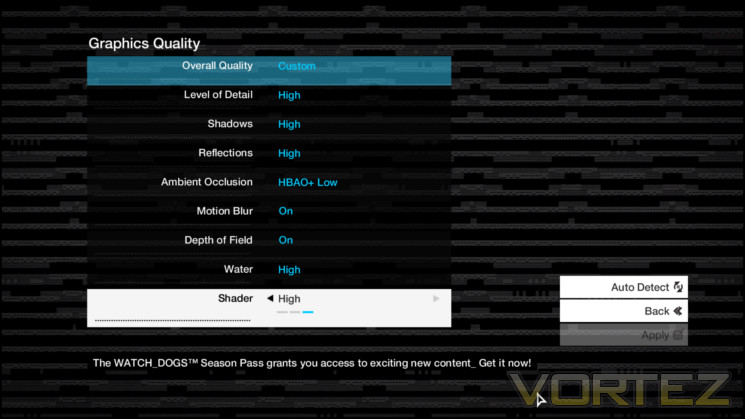
The level of customisation available in the in-game is inadequate, but continues a trend in Ubisoft releases whereby PC ports are often grudging and rarely support the full range of customisation gamers expect. AA and AF sliders are welcome inclusions in the half-dozen options not in some way automated, and we also see the inclusion of texture and shadow quality adjustment which are critically important to optimising gameplay settings in a way that prioritises smooth frame-rates.
We played the game at the above settings (broadly close to the High preset) which resulted in a comfortable, if not optimal, 35-45fps. At these generally High (although certainly not Ultra) settings Watch_Dogs still looked great, even if it didn’t match the visual fidelity of trailers and gameplay videos released by Ubisoft to date. Ultra settings were impossible to sustain on our test PC, resulting in unacceptable frame rates and high-order stuttering likely down to inadequacies in GPU, CPU and/or memory system.
Although it looks good during the day-time, the engine really shines at night and when applying the weather effects. Disrupt does a great job showing off diffuse lighting and partially reflective surfaces, giving them a sheen which it wouldn’t have otherwise and really building an almost oppressive atmosphere. In contrast to other recent PC releases particle and fabric physics effects are much more subtle, benefiting the game as well as retaining decent frame rates on non-optimal systems.
As the game is played by the public post-release both NVIDIA and AMD will come up with optimum PC settings for a range of system specs. thanks to data gathered by GeForce Experience and Raptr respectively, and should distribute them post-haste. If you note the implicit irony of this arrangement don’t worry, it just means you’re still human.
One slight niggle we discovered was a little frame-rate stuttering at the tail end of long gameplay sessions. After around three hours we began to notice fractional pauses, after which the game then caught up; the longer we played after this point the more frequent said stutters became. We can’t tell if this was a result of our system, engine or driver, but the problem cleared up after restarting the game client.
—
Update
We’ve now read reports of a significant performance dip in systems that make use of AMD GPU due to Ubisoft’s apparent integration of proprietary NVIDIA GameWorks technologies in generating certain high quality effects. Some testers have AMD R9 290 GPUs running substantially slower than GTX 770, and although still providing highly playable rates this could be extremely detrimental in the mid-range.
Launch disparities between GPU vendors is nothing new, and both AMD and NVIDIA have been the beneficiaries of close relationships with developers in the past. Typically however these differences in expected performance tend to even out over time as driver engineers are able to tailor releases once exposed to launch code. Such was the case for Tomb Raider 2013 where AMD benefited, and we hope will be the case with Watch_Dogs. Like NVIDIA’s 337.88 WHQL drivers AMD should be in the process of releasing their first optimised drivers – likely the Catalyst 14.6 betas – soon.
We would also say that it would be an extremely disappointing development if one vendor’s performance were throttled unfairly, and more in keeping with the bad old days of vendor-specific optimisations and anticompetitive practices.
General Gameplay
Superficially Watch_Dogs resembles many other third-person shooters without fixed camera angle, although it does have a fixed zoom level. The majority of the gameplay is split between your typical explore/run/gun model in third person view and driving in one of a modest range of vehicles.
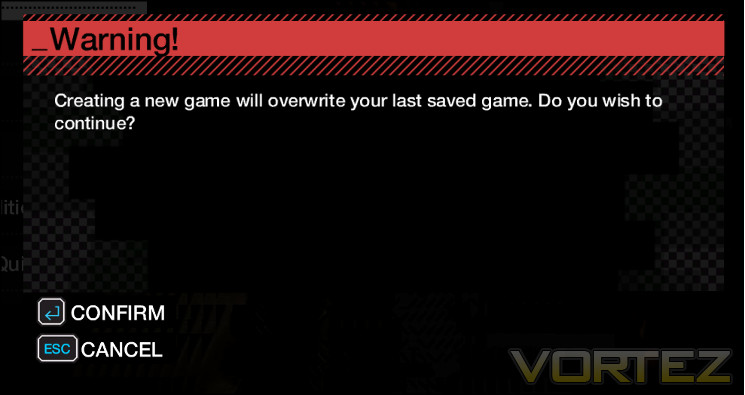
First off, we should mention the one save per retail copy problem. Watch_Dogs makes use of an automatic saving system that updates on game progress with no direct input from the player, and only one game profile is available per account. We can accept the lack of quick-save/quick-load to improve immersion but to not support additional profiles is very disappointing, even after noting that (real-world) smartphone integration could make this potentially difficult. We’re not sure what the process is like on console but this should be a major stumbling block for multi-gamer households. Frankly there’s no real excuse for this in a PC title, whether or not there is little consequence to your in-game decisions.
We should additionally note that by default large amounts of mouse acceleration is incorporated into the standard Keyboard/Mouse control system. Although this can be diminished by reducing X and Y-axis sensitivity there doesn’t appear to be a means of eliminating it entirely using only in-game options. Hopefully Ubisoft will provide a means of patching it out.
As you explore the Windy City it swiftly becomes clear that whilst it has an open world feel the narrative progression is anything but; there are no branching stories, multiple-objective tasks that can be completed out-of-order, or even ways to redo specific missions within the main campaign. Still, while in-game maps direct you between missions as well as highlighting points of interest using a waypoint system, you are free to roam anywhere on the map without loading screens and engage in side-quests or mini-games at leisure.
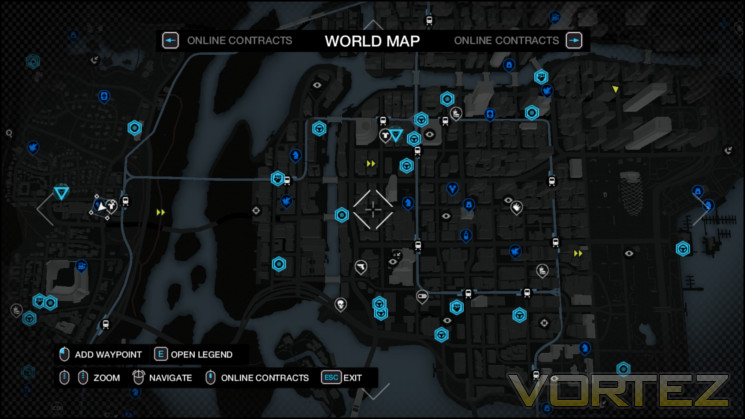
The in-game map has all sorts of points of interest
In the course of your gameplay you’ll also uncover side-missions, generally by hacking the phones of persons of interest. These quests, most often called ‘Fixer Contracts’, have you perform a task such as waylaying a criminal convoy or hunting down a getaway car for cash and experience. There’s no time limit on Fixer Contracts, nor most of the offbeat activities you can partake outside of the main campaign, and many will persist between gameplay sessions.
Activating a mission or contract will zero the game world, despawning any cars you were using and spawning all the items you need to complete the mission. Reloading from death spawns you at your most recent mission completion point, also respawning any mission-critical doodads along the way rather than keeping track of the exact state the game was in at that time. The feeling that you make little impact on the world is therefore reinforced quite heavily.
Travel through Chicago can be performed on foot, in a vehicle, or via unlockable fast travel locations. The latter should probably be discouraged unless you are time-limited as it drastically reduces the chance of random missions spawning.
Enemies and Overall Difficulty
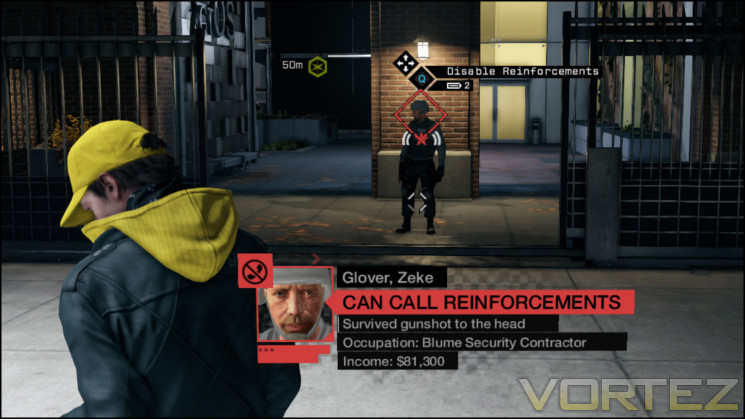
Watch_Dogs is essentially grounded in realism and so keeps the range of enemy NPCs to a minimum. Gunplay typically pits you against footmen with varying levels of armour, equipment and weaponry, whilst driving is generally more of a pursuit mode concluded on foot or evasion mode against increasingly fast vehicles. With the exception of heavily armoured Enforcers no enemy poses much of a problem unless you’re caught in open ground, at which point you can be killed easily. Headshots are as always critical.
Missions are most often time consuming rather than difficult, the exception being criminal convoy missions which often demand precise driving that isn’t easy using the default control scheme. ‘Realistic’ difficulty (one higher than ‘hard) setting is genuinely tough due to the need to avoid gunfire if at all possible, but although higher difficulty levels pose a reasonable challenge defeating them doesn’t feel any more satisfying than lower difficulties. Difficulty can be changed at any time via an in-game menu.
The challenge in Watch_Dogs will likely be in finishing the game through the use of stealth rather than force of arms, much like Deus Ex where stealth was more of a central theme. Unfortunately there appears to be little reward in going down this route.
The Three Pillars Of Watch_Dogs
Combat
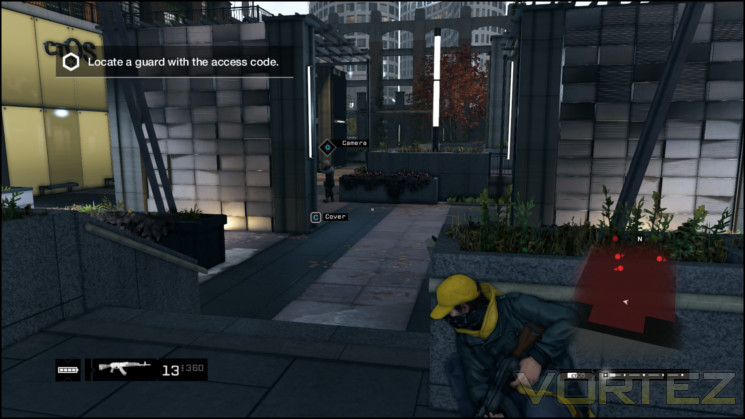
Cover mechanics, the bane of many console port
In-game combat makes use of the tried and tested sticky cover combat system common to console titles, but moving into and out of cover by mean of a keypress causes problems when timing needs to be precise. You’d be excused for finding it a hamfisted system initially – it gets easier over time – but even without these limitations it lends a staccato feeling to combat which should be more fluid in nature. Consider switching hotkeys to mouse buttons for easier access, but even with that in mind we’ve certainly seen better implementations elsewhere.
The game also makes use of a bullet-time-esq mechanic which Ubisoft are calling ‘Focus’. Use of Focus (default as CTRL) slows down time to make aiming easier and reduce the skill required to defeat any particular encounter. Once again the default key is poorly chosen; yet more excuse to break out those many-buttoned mice and play around with hotkeys.
Health is of course a major mechanic and in Watch_Dogs it regenerates swiftly, if slower at higher difficulty levels; staying out of trouble for relatively little time will allow you to get back into trouble with relative impunity. Health loss thanks to fall from great heights and vehicle crashes are a part of the game but rarely fatal on lower difficulties. This does reduce the overall level of complexity in the game, leaving it more accessible and certainly more familiar to those weaned on a steady diet of console shooters.
Hacking
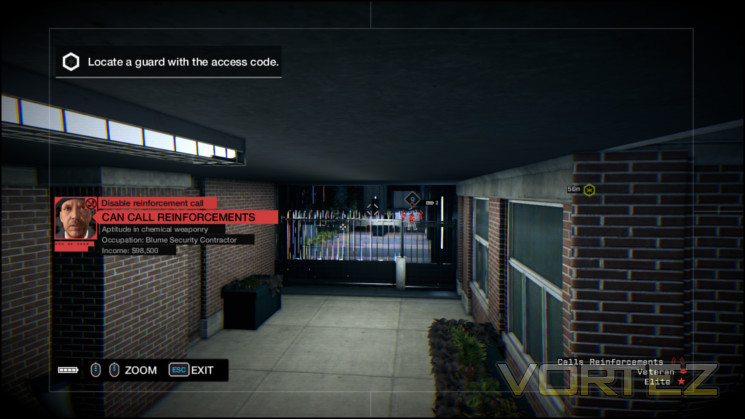
A guarded gated compound as seen through a hacked CCTV camera
We had high hopes for the hacking mechanic, and to be frank we found it to be troublingly superficial for such an important thematic element. Aiden’s super-smartphone is the chief conceit, a device which all but automates hacking to a fixed effect on a given object or target. As a consequence the only option given to players is if/when a ‘hack’ is used with only one hack available per object.
Outside of combat Hacking boils down to ‘press Q to steal money from an NPC’, ‘press Q to look through CCTV cameras’ or ‘press Q to interact with the environment’; yes once again your ‘Q’ key will be getting a workout. Only objects or NPCs in line-of-sight can be hacked, leading to a peculiar (and not fun) camera-hopping exercise where you’re trying to find the one at just to right angle for your next goal. Also frustrating is discovering that only one object on your screen can be interacted with at any time, resulting in an awkward ‘glance-and-look-back’ exercise as you try and highlight the one environmental element you want to interact with rather than that camera nearer and in close angular proximity.
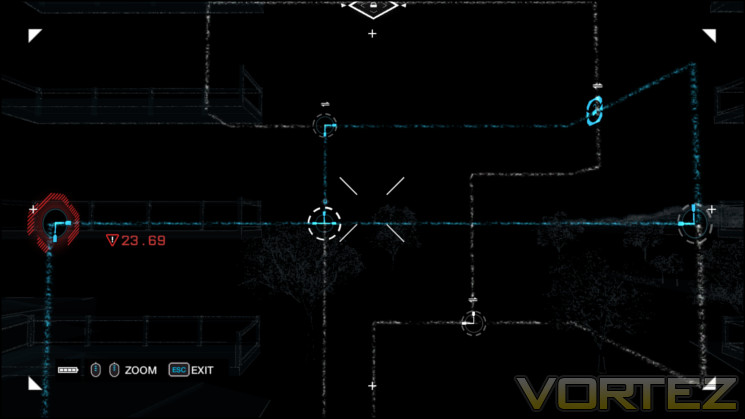
An Intrusion is often the objective of a hacking session, and requires the solving of a simple logic puzzle
In combat hacking is slightly more dynamic. Through it you can interface with ctOS to perform major changes such as raising/lowering a bridge, or minor ones like disrupting enemy comms to briefly stun them. The dynamism is however based on the limited window in which their use is appropriate rather than solutions becoming novel, plus they’re almost required in driving/evasion missions. At no point do you feel particularly empowered by your skills as a tool, and combat will often be seen as a break from monotony.
Driving
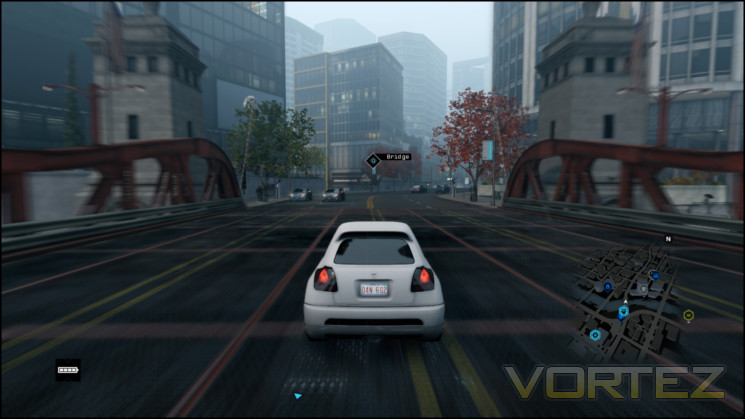
The third leg to the mechanic tripod is driving. In Watch_Dogs any car is your plaything, so long as you find it in the world or unlock it, and when you’re not on a mission you can call one to you via Aiden’s smartphone. What the game doesn’t do is approach it from a fetishistic standpoint – there are only a few car categories and no real performance ratings, so there’s no real sense of what’s ‘better’ by some arbitrary yardstick. Instead it’s very much framed as process of collection, with out-of-game achievements to match.
Controls are, of course, awkward but in this case we don’t blame Ubisoft too much. Keyboards are inherently poor for driving games thanks to their lack of analogue input options and so is perhaps the one aspect naturally enriched by using a controller; the keyboard is okay for getting from points A to B, but not fantastic and rarely precise.
In the right vehicle we have to admit that Watch_Dogs simulates a feeling of speed pretty well, and especially when riding on a motorcycle and weaving in and out of traffic. This may be partially down to feeling ever so slightly out of control, but given that even dedicated driving games often fail at this hurdle it’s worthy of mention.
Hacking as it intersects with driving is important as a test of both skill and navigation. Plotting escape or interdiction routes is a real strength to the game, and using hacking to elude foes is critical to prevent the onset of monotony. Our one reservation is slow-motion special effect to showing off collisions caused by your neutralisation of a foe; as fun as it was the first time it later becomes a distraction, and then a distinct annoyance which you wish could be disabled.
Speaking of NPC AI, a slight in-game oversight is the uncanny way that Aiden can jump into large bodies of water and completely evade police and gang members. Any evasion is therefore trivial if you’re close to water, with the added benefit of motorboats being faster than any helicopter they might send after you!
Perhaps aspects which could be improved all involve the NPC AI. There appears to be very little reaction to stealing cards, and driving past the police with a clearly banged-up vehicle doesn’t make them so much as blink. On the other hand you can be stuck in traffic and a police car can hit you, triggering an alert and having the whole precinct hunting you. To say the least it is inconsistent.
Overall Ubisoft could have done more with this part of the game, but it serves as a strong complement slightly undermined by the controls on the standard PC. Building on it though meaningful DLC and multiplayer content could really bring it to the fore.
Side-Show Attractions
As with other open-world videogames repeated content is very much a part of Watch_Dogs. Quite apart form the myriad side missions – each of which follow a set theme – the game also offers a range of minor stories, collectables and mini-games in which to sink time and in-game dollars.
Games
Play Poker, Chess and more in events dotted around Chicago, wagering money as you go. Naturally superficial, they a familiar sight in most open-word games and don’t bear much discussion.
AR Phone Games
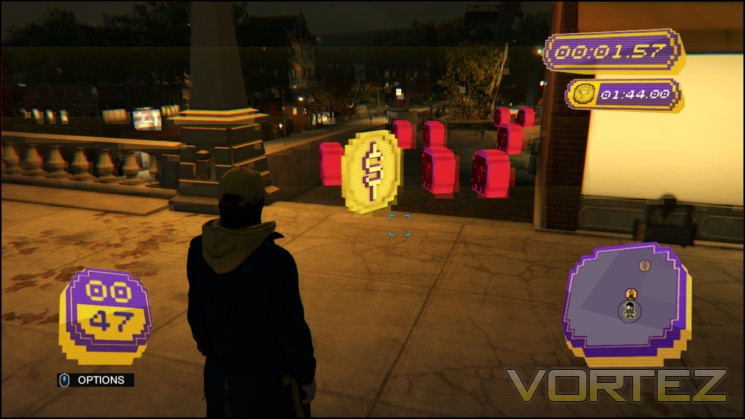
Located around the in-game world are location triggers for smartphone apps which use augmented reality to create time-attack and score-attack games.
Cash Run takes you through short courses, collecting coins and avoiding skulls as you go. With a varied course depending on location and online leaderboards which grant Notariety based on your time, it can be one route for long-term competitive replaybility.
Invasion, stylised NVZN, is an AR app re-imaging the alien invasion games of yesteryear through the representation of a wormhole through which insect-like neon aliens emerge. Score attack is the name of the game with this app as you progress through invasion stages, and enjoyment will be directly proportional to how much you enjoy the gunplay.
Digital Trips
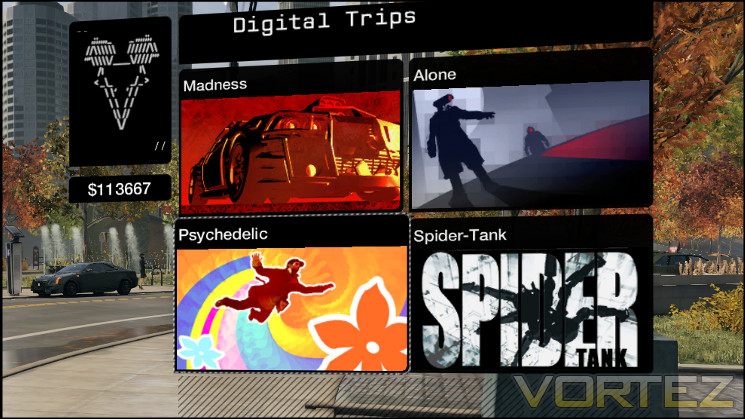
Tired of the mundane? Then Digital Trips may be just for you! By pushing Aiden into an unconscious state the Trips alter reality on a grander scale than the games, changing your perception to simulate a wide range of scenarios from a hellish Chicago to rampaging through the city as an enormous robotic Spider Tank. They’re a smart way to include wilder themes and are already a part of the launch DLC, implying that they will be a significant part of optional (paid-for) DLC in the future. The quality is mixed, but well worth trying out a few times for the wow factor alone.
Investigations & QR Code Scans
Dotted around Chicago are collectable story elements fleshing out the world and provide more context to the motivations of both DedSec and the Blume Corporation, usually in the form of hidden audio logs. Collecting them all unlocks a unique mission which rounds of this storyline, and each also grants a little XP and chance at reputation.
Privacy Invasions
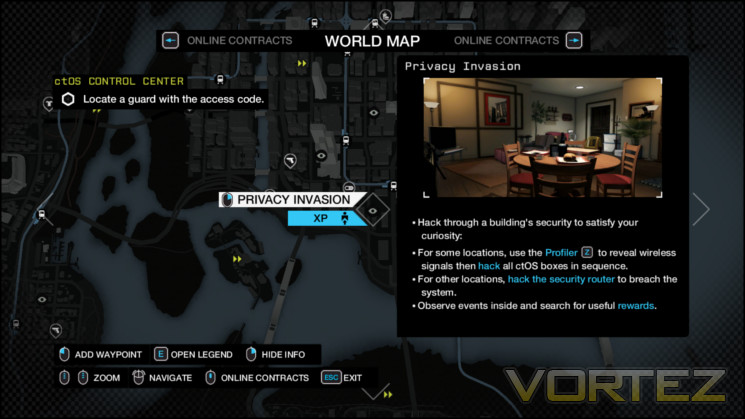
A standalone means of practising your hacking skills, Privacy Invasions (shown as an eye on the maps) require that you use a deeper hack to unlock access to cameras in the homes of residents. Undoubtedly one for voyeurs, it’s a neat sideline in developing out the human side of this Chicago. Sadly they have no in-game impact and your experience with the characters you glimpse progresses no further, leaving you tragically unable to act on some of the sadder circumstances you see. Nor does this hacking impact your reputation, even when discovered.
–
There’s more which can be discussed, but that is a good gist. Essentially beyond the main mission there are a huge number of activities which balloon out the completion time to a huge degree, even if completed in an optimal fashion and without failure. Typically this would be the sole province for completionists, but leaderboards may add a layer of replayability which would otherwise be lacking. That said the content is repetitious and doesn’t deviate gameplay all that much, so there’s not much to recommend if you’re not already hooked by the core game.
Skills To Pay The Bills
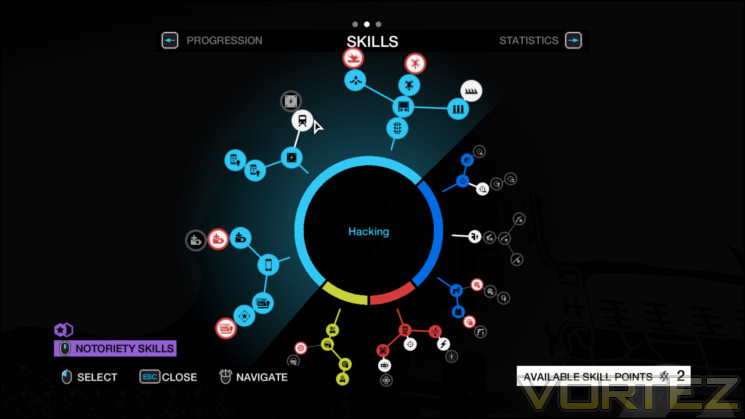
Watch_Dogs makes use of a fairly straightforward XP and skill tree system to unlock a series of perks for use in missions and the open world. Each task you complete, be it a major campaign mission or simply collecting the next step in a trail of audio logs, will grant some amount of XP towards your next level, with each new level granting a single skill point. Skill points are also awarded for completing other in-game tasks and achievements such as evading the police a number of times, adding to the pool of resources to spend on perks.
Perks are arraigned in a tree structure with four main branches – Combat, Hacking, Driving and Crafting. Each tree grants access to passive and active benefits such as greater armour for firefights or the ability to hack the Chicago tram system to more easily evade capture, increasing the scope of gameplay. The deeper one goes down a tree the more expensive skills become, but not all skills are created equal.
We found the passive skills to be largely incidental, whilst the value of active ones depended largely on your own style of play. Unsurprisingly the improved handling whilst driving was an immediate benefit, but the most useful were the hacking skills which improved evasion or vehicle takedowns as this was what was typically most difficult to accomplish. The game needed greater dimensions for customisation and certainly gets it, but we’re left wondering if Ubisoft really went far enough down this route.
Reputation
Alongside the XP accumulation is a reputation system gauging how well the citizens of Chicago regard you. Completing certain side-missions such as preventing crimes, apprehending criminals and saving victims will earn you reputation, but killing cops and civilians will harm it.
You reputation level is reflected in the news reports you hear in your travels, whilst CTOS’s disquiet over your vigilante activities will also be reflected in opinion pieces. News is also updated as you complete the stages in major and minor missions, reflecting the progression you have made in the story.
Overall it appears to be fairly ancillary, apart from making you extremely frustrated with any failure of civilians to stay out of the way. If there is any deeper meaning to this bar we haven’t seen it. There’s something troubling about just how minor an impact killing a civilian in full view of the public has to your standing, going deeper than believing all the NPCs to be morons and making you doubt the value which Ubisoft placed on the system as a whole.
Notoriety
Running parallel to the XP system is Notoriety, a progression system for online play. Granted only to those who engage in the online elements of the game – certain mini-games and all open-world multiplayer events – you’re rewarded points based on your success and docked points if you fail heinously. Reaching higher levels of Notoriety grants skills specifically for use against online opponents, but is entirely ancillary for completion of the single-player story.
Tools To Survive
Aiden’s Smartphone
It will become something of a cliché in retrospective discussions of Watch_Dogs but Aiden’s smartphone truly is a catch-all. Part game UI element, part mythical skeleton key to the vaults of Croesus, through a simple tap on the screen our protagonist can unlock doors or hack cameras half a mile away by catching a glimpse of it from another camera. Thematically skills unlock complex hacking apps which Aiden can use so effortlessly, but it all serves as a massive layer of abstraction to shield the player from any underlying complexity. Supposedly Ubisoft consulted with Kaspersky on the real-world capabilities of such software, but one imagines that a certain amount of creative licence was still applied. Of course this portrays Aiden as less of a master hacker, more a disgruntled Facebook app power user.
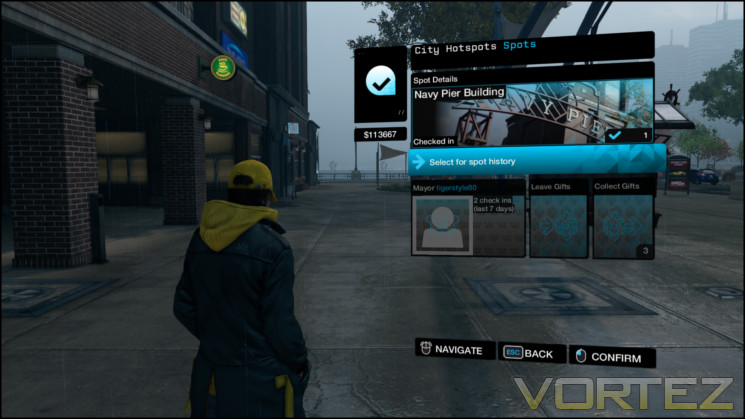
The smartphone UI, well represented in-game and brought up with a middle mouse click, is the major means you have of accessing in-game statistics and gameplay features. You can also check-in at local landmarks as if it were 4-square, if that’s your thing. Navigation is via mouse movement but without a visible pointer it is clumsy at best, perhaps some indication of how silly such a system is to represent and invest with gameplay significance.
Weapons and Equipment
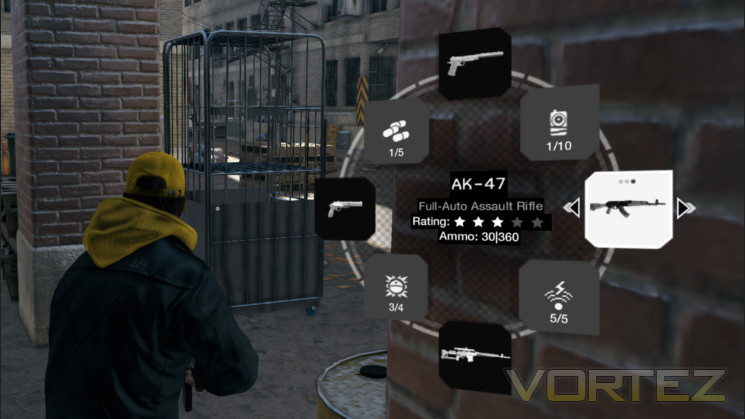
As you would expect from any shooter title Watch_Dogs includes a wide selection of weapons and miscellaneous equipment for the deadly encounters within the game. In time-honoured fashion you start with a pistol, but swiftly unlock both rifle and SMG via mission rewards and pickups from foes you defeat. Advanced versions are available via mission unlocks or purchasable in-game from vendors.
At least initially the choice of weapons is largely irrelevant as pistol and assault rifle are more than sufficient for your needs. Recoil is a factor given how obnoxious the in-game controls can be, and sometimes Focus should be used just so it is less difficult to deal with. Later sniper rifles, useful by virtue of their extended range, are more optimal as stealth sections become more complex; sadly non-lethal weapons don’t seem to be a part of your possible arsenal.
Watch_Dogs also includes a rudimentary crafting system, allowing the creation of helpful pieces of equipment such as portable distraction devices and even IEDs for use during missions. Typically you’ll unlock items via the crafting skill tree but some may also be granted temporarily if they’re critical to the completion of certain critical tasks. Crafting materials can be found around the world, and limited inventory space means that you’re well served by crafting equipment only as you need them.
Perhaps unsurprisingly the wide array of crafted items are most useful in challenging areas of gameplay, either where you want equalise the numbers in combat or avoid it altogether. The most valuable are probably jammers, which help you to avoid ctOS police scanners during random encounters in the wider game world as well as specific missions. Distraction devices are less useful as they’re so sensitive to timing, something problematic given the already ropey control system.
Mission-specific hacks and equipment are often granted you when they’re necessary to complete a specific objective, but to use them in multiplayer or in the open world they typically need to be unlocked beforehand.
Online Gameplay
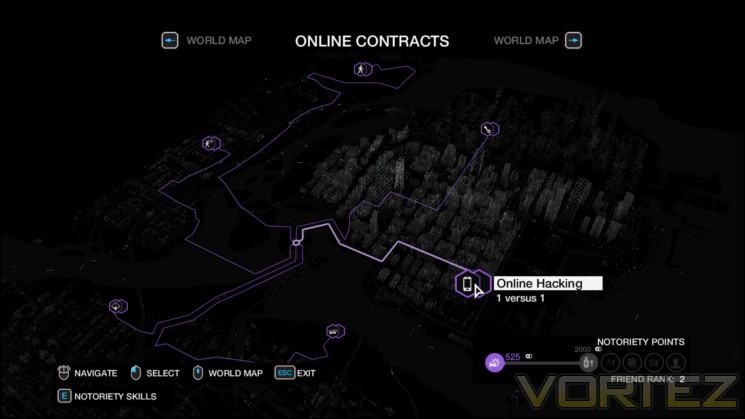
Some games have a set multiplayer mode. Others use an MMO-esq system, where each playing is playing on the same server and interacting in realtime. Watch_Dogs aims to be different though the use of so-called asynchronous online gameplay.
Early on you become very comfortable with Fixer Contract and Criminal Activity pop-ups based on certain in-game triggers, recognisable thanks to their light-blue colouring and represented on the in-game map. Similarly once you’ve reached a certain part in Act I, and at any point beyond then if you’re online, a purple prompt will indicate an available multiplayer mission known as an Online Contract.
If you accept the prompt the servers will then attempt to match you with other players local to you in the in-game world to compete in a task or series of tasks including hacking each other, 8-Player Free Roam and racing along a route. During these tasks you’ll be able to use skills granted via the in-game Notoriety system, with the goal of earning cash and Notoriety based on your performance. Note that poor performance can also lead to you losing Notoriety, making that the stakes go beyond time sunk.
If you’re starting a play session with an aim to get in multiplayer practice you can request an Online Contract via the in-game map, side-stepping the random encounter process and immediately placing you in a queue for the appropriate area.
Sadly a lack of player engagement during the press review period made these encounters exceedingly rare and hard to experience, but the few times we were able to engage it was a great diversion from the main single-player missions. By contrast the progression system felt tacked-on, perhaps it was included because such systems are ‘needed’ in games these days, but the pure act of playing with others in both co-operative and competitive modes felt both natural and fun. It left us looking forward to trying it out with greater numbers to work from post-release.
Bounties
Reach a certain point in the game and in-game actions such as hacking has the chance to trigger a bounty on your sorry head. If this happens you have to defend yourself against an invasion by another player as they hack you, where they join your world and try to stay out of sight for the duration of the hack. If you spot them they will make a run for it, at which time you have to disable them by any means necessary.
Starting from 1%, the hack continues until you find them and kill/disable them or it reaches 100%. Chasing down a fleeing hacker is one of the more fun moments in the game, but the extreme skill disparity between players could become a problem in need of a decent matchmaking system.
As you would expect the reward is Notoriety, but if you’re not keen you can go offline at any time by selecting the appropriate option in the game menus.
Conclusion
If there was one word that could some up Watch_Dogs it would be this: Ambitious. In creating one of the first titles intended to be deemed next generation Ubisoft Montreal had to be seen to cram in as many ideas as they could whilst still coming up with a coherent and engaging product. To a certain extent they have, but in many respects the game is stretched very thin indeed.
The drop-in online multiplayer is perhaps one of the most striking successes, mainly because it is so seamless with the rest of the game content. It’s also not a design which ‘builds community’ or forces a progression treadmill on players, going against prevailing wisdom to the detriment of a long-term investment. Unfortunately it is often undermined by its seamless nature – making them appear thematically like in-game tasks means they mechanically resemble the weak single player missions.
Very much in the plus side is that the same looks very much like a next-generation title so long as you have the hardware. The Disrupt engine is extremely promising technologically and even in its debut outing blows many competitors away with weather and lighting effects that could be oh so atmospheric elsewhere. Here is it window-dressing – very pretty, but with potential to mask failings behind a glossy veneer.
And so it’s disappointing to see that so much of the game is utterly superficial. Open world single player games are supposed to let you make your mark on that world but swathes of content in Watch_Dogs have all the impact of footprints on a beach as the tide comes in, wholly reflected in an apparently meaningless reputation system. There’s hour upon hour of content to complete but very little of it leaves you satisfied; still worse, none stoke an appetite for more.
A hollow world goes hand in hand with the inferior quality of the port. Performance is fine – as we stated a consistent 35-40fps with a modest NVIDIA-powered system is achievable on great looking High settings – but PC optimisations for control method and UI are poorly thought out. Couple that with the single profile preventing you from running more than one playthrough at once and you kind of get the picture of a game built on restricting the player rather than letting them play their way, a supposed hallmark of an open world.
Core gameplay is fine but not exceptional. Once again the cover mechanic gets in the way rather than greatly improving upon the experience, but Watch_Dogs is hardly unique in this regard and we’ve suffered through worse. Hacking disappoints though because it’s so superfluous a mechanic in the main, only really coming into its own during the car chases and selected skirmishes with hostile forces. It should make you feel smarter than the foolish NPCs relying on their silly high-tech equipment, instead you lament how formulaic camera-hopping has become after your second incursion into a ctOS hub.
So the question largely comes down to if the game can succeed on the single player storyline alone, to which we would respond a qualified ‘Yes’. Although it had the potential to be a deep discussion of the impact a pervasive surveillance state and technological integration has on society, we’re instead treated to a relatively run-of-the-mill thriller with cardboard cut-out characters and mere hints of shadowy organisations. It doesn’t raise the questions of the reach of technology as in Deus Ex, nor confound like Bioshock, nor lead you on a character-driven journey as in Tomb Raider; in this respect it is at best underwhelming. Nonetheless it is enough to maintain interest in a pulpy sort of way.
Despite promising much in its E3 reveal Watch_Dogs descends into the mundane far too quickly thanks to repetitious content and a problematic control scheme. With a simplistic hacking mechanic best thought of as ‘Deus Ex Smartphone’, hints at something grander have been ground down into a near standard third person shooter. The single player story will be enough to keep many interested, and the visuals are often arresting, but the game has to go down as a missed opportunity.
Pros
+ Looks great, even below the recommended
+ Interesting storyline
+ Engaging characters
+ Innovative use of flexible multiplayer system
+ Well voice acted
+ Low barrier to entry with regards to player skill
Cons
– Disappoints those looking for a deeper hacking system
– Average/poor default keyboard/mouse controls inc mouse acceleration
– Chicago isn’t quite as alive as you might expect
– Small range of mission types
– Often results in an exercise in camera-hopping
+ Looks great, even below the recommended
+ Interesting storyline
+ Engaging characters
+ Innovative use of flexible multiplayer system
+ Well voice acted
+ Low barrier to entry with regards to player skill
Cons
– Disappoints those looking for a deeper hacking system
– Average/poor default keyboard/mouse controls inc mouse acceleration
– Chicago isn’t quite as alive as you might expect
– Small range of mission types
– Often results in an exercise in camera-hopping

Click here for an explanation of our awards at Vortez.net. Our thanks go to NVIDIA for supplying our review copy.


