Intel’s next-generation HEDT platform is here in the form of Skylake-X, Kaby Lake-X and the X299 chipset. Today we weigh up whether the quad-core Kaby Lake-X Core i7-7740X is a better investment over the well-established 7700K.

Product on Review: Core i7-7740X
Manufacturer: Intel
Street Price: £334.99 GBP / $369 USD
Just two weeks ago, at Computex2017 in Taiwan, Intel dropped a momentous bombshell: a new High End Desktop Platform was on its way, and the number of cores it could support will put everything which came before it to shame.
The name of this new platform? Intel’s Core X series.
Today Intel’s Core X series CPUs, alongside ‘Lewisburg’ X299 chipset motherboards from partner manufacturers, become available to pre-order. Retailer availability is expected from June 26th, so reviews for this new platform are coming at just the right time.
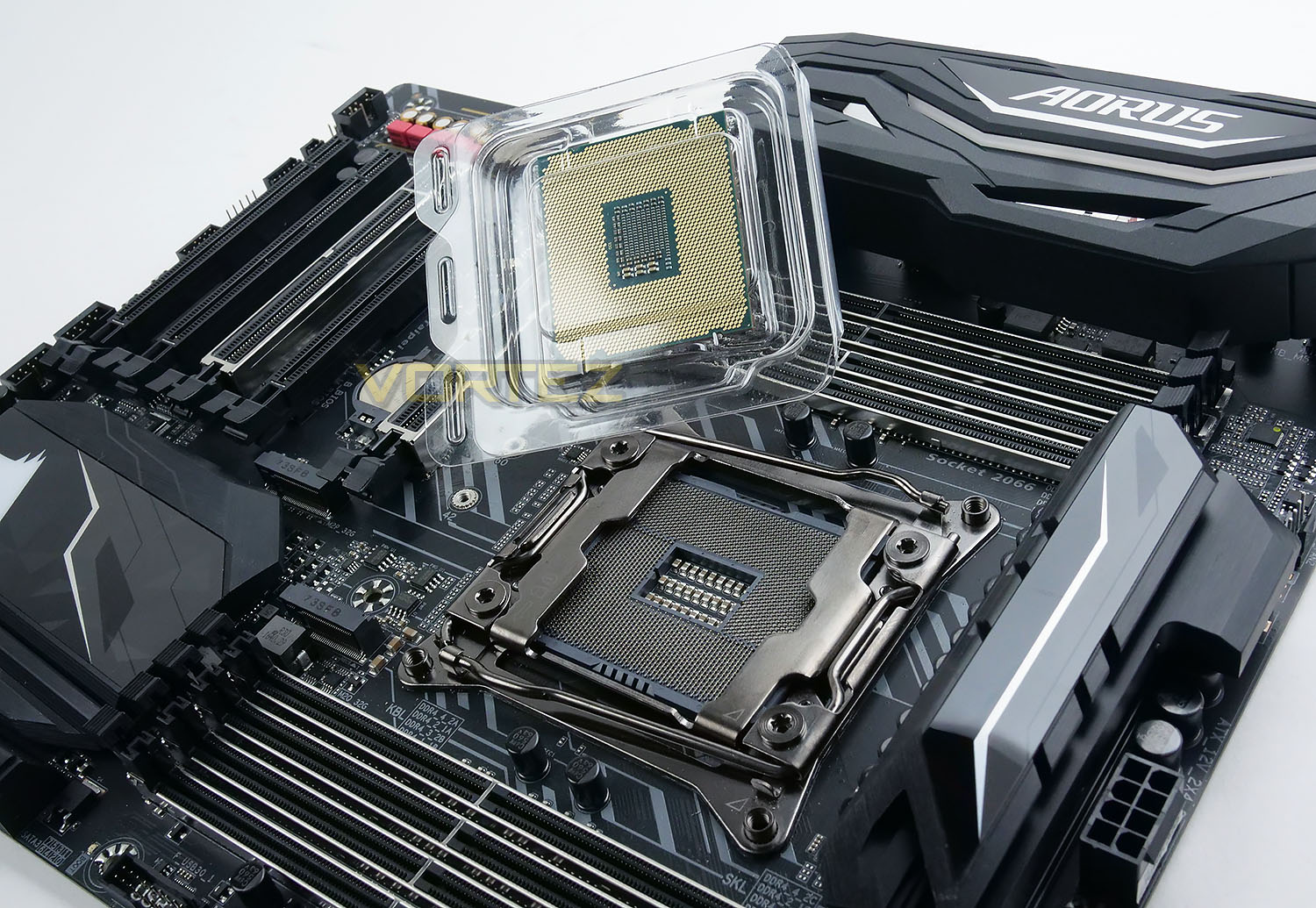
Before we begin however, we need to take a moment to be transparent with you, dear readers. Intel have been unable to provide us with a review sample for the CPUs involved in this launch, so we should be clear that the model tested was sourced from elsewhere. With the sampling situation unclear, we were very lucky to have any CPU whatsoever to pair with X299 motherboards amply provided by their respective manufacturers.
Before we get into the nitty-gritty, let’s outline some basic terminology. Launching this week are the ‘Low Core Count’ models in the Core X series, but that label is a little deceptive. LCC Core X CPUs range from 4 to 10 cores, widening the cores available on the platform and reducing its entrance cost, and feature two distinct CPU architectures. Also announced at Computex, but available at a later date, are Core X CPUs with between 12 and 18 cores known informally as the ‘High Core Count’ SKUs; this figure of 18 cores and 36 threads represents a new high watermark for the HEDT terms of supported cores. Scalability is definitely the watchword for Intel’s new range.
Intel’s LCC Core X series is comprised of five models from two distinct architectures – Skylake-X, and Kaby Lake-X. The Skylake-X models range from 6-core/12-thread to 10-core, 20-thread models, each with the newly minted Core i9 branding. Kaby Lake-X CPUs are currently limited to quad-core chips only, including one SKU without hyperthreading.
In this article we’re looking at one of those new entry points into the HEDT platform, the Kaby Lake-X Core i7-7740X. This quad-core with Hyperthreading design is joined by its sister CPU – the Core i5-7640X which doesn’t support Hyperthreading – with both sitting under the £350 price point.
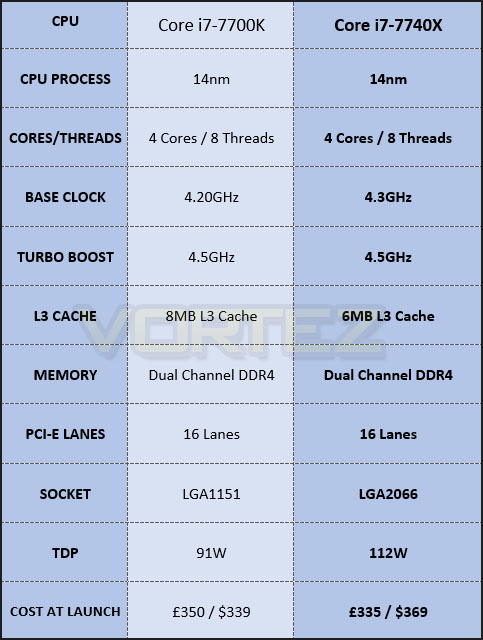
You’ll note the naming scheme, and the specification similarity between them and the mainstream Kaby Lake Core i7-7700K and i5-7600K; this isn’t a coincidence. Intel have effectively transplanted the Kaby Lake die onto an LGA2066 PCB, rather than formulate an updated architecture or salvage Skylake-X parts specifically for the quad-core selection. Gone however is the ‘K’ suffix from the entirety of the Core X lineup, an essential piece of housekeeping for the HEDT market to reduce inevitable confusion created by the new Kaby Lake-X Core i5 and Core i7 parts.
Debate has raged over Intel’s reasoning for re-purposing Kaby Lake within the Core X range, but even a fortnight after its announcement the picture remains unclear. It’s true that a new price point is opened up for the Intel’s HEDT platform but, with the anticipated cost of X299 motherboards likely to be higher than Z270, consumers are expected to be paying more for equivalent out-the-box performance. We have speculated that the Kaby Lake-X parts are intended as something of a stepping-stone or stop-gap for anyone planning on upgrading to the HCC Core i9’s, but it’s increasingly looking likely that these CPUs will launch over the summer rather than being delayed until 2018 (when such a stop-gap would have made more sense).
Thankfully, the realities of Kaby Lake’s introduction into the Core X series gives us a clear benchmark to hold it up against: it’s mainstream counterparts. Performance should be at least on par with these models, and that’s exactly what we will test. The slight price premium will however need to be justifiable, and that’s going to be a tough ask.
Features
Technical SpecificationsSKU: Core i7-7740X
TDP: 112W
Lithography:- Intel 14nm FinFET+ (optimised 14nm)
Socket:- LGA2066
Cores:- 4
Memory:- Up to 64GB Dual Channel DDR4-2666 (4 DIMMs Max)
Hyperthreading Support:- Yes
Base Frequency:- 4.3 GHz
Turbo:- 4.5 GHz (all cores)
L2 Cache:- 256KB
L3 Cache:- 2MB per core (8MB Total)
PCI-Express 3.0:- 16 Lanes from the CPU, 24 from the X299 PCH
Graphics:- N/A
TDP: 112W
Lithography:- Intel 14nm FinFET+ (optimised 14nm)
Socket:- LGA2066
Cores:- 4
Memory:- Up to 64GB Dual Channel DDR4-2666 (4 DIMMs Max)
Hyperthreading Support:- Yes
Base Frequency:- 4.3 GHz
Turbo:- 4.5 GHz (all cores)
L2 Cache:- 256KB
L3 Cache:- 2MB per core (8MB Total)
PCI-Express 3.0:- 16 Lanes from the CPU, 24 from the X299 PCH
Graphics:- N/A
As part of Intel’s revised “Process, Architecture, Optimisation” development strategy for desktop CPU architectures – a strategy which replaced the enormously successful “Tic Toc” methodology – Kaby Lake was classified as an ‘Optimisation’ update. At an architectural level not much changed between Skylake and Kaby Lake, however it is manufactured using an optimised 14nm FinFET+ process with the aim of higher power efficiency and operating frequencies. Kaby Lake-X inherits these aspects to its design.
When comparing directly to the Core i7-7700K, the Base CPU frequency of i7-7740X has been increased modestly. Turbo mode frequency remains pegged at 4.5GHz, however the i7-7740X applies that 4.5GHz maximum across all four cores under appropriate workloads (rather than a maximum of 4.4GHz across all four cores).
Time to delve a little deeper…
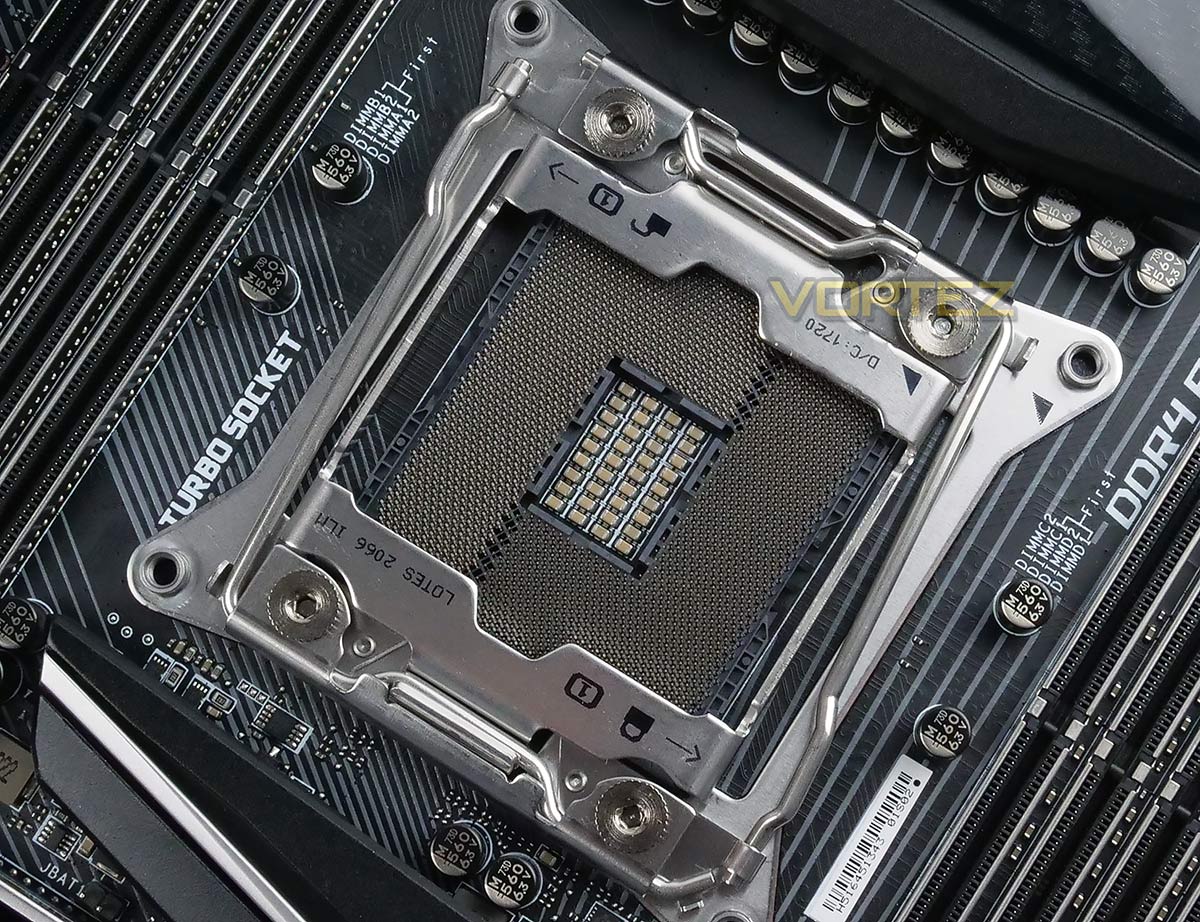
A New Socket: LGA2066
It’s out with the old and in with the new as Core X and X299 introduce Socket LGA2066. This new standard is similar in size to LGA 2011 and LGA 2011v3, but not at all compatible in pin-out. As a result Core X CPUs are not backwards compatible to X99, nor are Broadwell-E CPUs supported on the X299 chipset.
Nonetheless, the similarities across the generations have had one significant benefit: CPU coolers compatible with LGA2011v3 are also compatible with LGA2066 CPUs. If you are upgrading to a new X299 system, and already make use of premium air and water-cooling solutions that supported LGA2011, you should have no issues with the transition (assuming they’re rated for the appropriate TDP). As usual, it will be best to double-check with manufacturer, but reusing your old HEDT CPU cooler should be the least of any difficulties you have.
Cache
We will addresses the improvements made to Skylake-X’s cache design in the review for those chips. Suffice it to say that Kaby Lake-X does not implement these improvements. Kaby Lake-X shares the cache structure of mainstream Kaby Lake – specifically 256KB private L2 cache per core, and 8MB shared L3 Cache on the Core i7-7740X. The Core i5-7640X is equipped with only 6MB cache, and as noted doesn’t support hyperthreading.
Memory
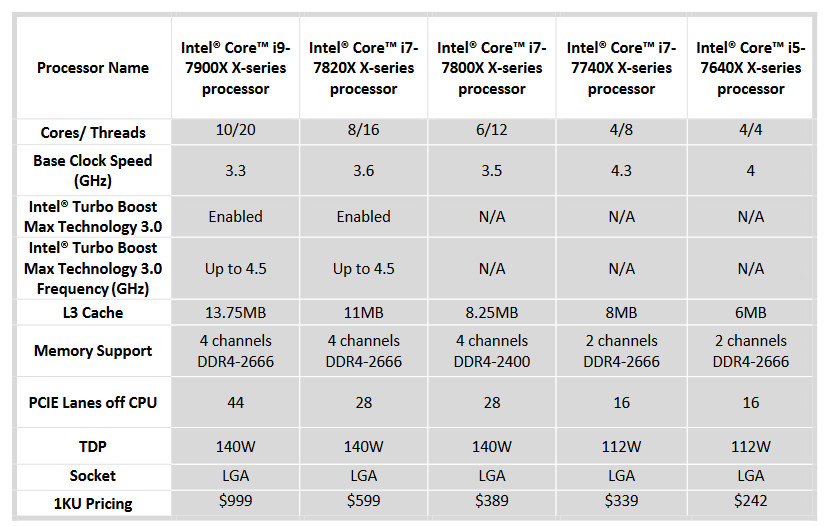
The Core i7-7740X supports DDR4 memory in dual-channel configuration and with speeds up to DDR4-2666. You may have already anticipated one key flaw with this limitation, and that is motherboard support.
We now know that when Kaby Lake-X CPUs are installed in an X299 motherboard only four of the up to eight DIMM slots will be enabled, but the specific slots disabled aren’t standard. Whilst one motherboard may well disable all four DIMMs on one side of the motherboard, another from a different manufacturer may simply disable every other slot from left to right. It’s critical that you refer to your manual before installing RAM.
PCI-Express Lanes
As with Kaby Lake, Kaby Lake-X supports up to 16 PCI-Express 3.0 lanes from the CPU. This is in contrast to the Skylake-X CPUs they’re being released alongside, each of which support at least 28 PCI-E lanes up to a maximum of 44 on the Core i9-7900X. The most significant consequence of this more restrictive multi-GPU support on Kaby Lake-X compared to even the lowest tier Skylake-X CPU, but could also impact more exotic system configurations with PCI Express storage (which doesn’t make use of Chipset provision).
Like Z270, the platform supports up to 24 PCI-Express 3.0 lanes from the X299 Platform Controller Hub. Communication between PCH and CPU is via a DMI 3.0 interface limited to 8GT/s, an upgrade from DMI2’s 5GT/s sported by X99. The PCH is capable of supporting up to three M.2 Gen3 x4 PCIe storage devices, although it currently isn’t clear whether those devices are sharing I/O bandwidth to the PCH or have a dedicated four lanes each.
Overclocking
Like its mainstream K-series counterpart, the Core i7 7740X supports overclocking both BCLK and Multiplier. Discrete voltage control for multiple lines are also exposed to the motherboard BIOS, allowing a high level of control on motherboards tailored towards overclocking.
While enthusiasts should be well catered to, those with less interest in the intricacies of overclocking will still be able to take advantage of the automatic CPU overclocking many motherboard manufacturers have integrated into their enthusiast designs.
Cutting edge overclocking experts will be disappointed to hear that Core X CPUs are unlikely to use anything other than high-quality TIM as the interface between CPU die and integrated heatspreader. De-lidding is an option, and a risky one at that, but it will be interesting to see how these boffins adapt.
Intel Optane
Follow the launch of Kaby Lake and the Z270 motherboard range in January Intel Optane Memory has finally been introduced. These devices, outwardly similar to M.2 PCIe SSDs, integrate 3DXPoint non-volatile memory rather than conventional NAND for higher performance than even the fastest M.2 PCIe SSD on the market today.
Intel Optane memory, in this incarnation at least, has been exclusive to 7th Generation (Kaby Lake) CPUs and Z270 motherboards; today however that supports extends into the HEDT market with both Skylake-X and Kaby Lake-X on X299. Current implementations continue to be as an intermediary ‘caching’ drive well suited to systems which rely on mechanical HDDs, but as costs decrease and capacities increase the status quo may change.
Features You Won't See On Kaby Lake-X
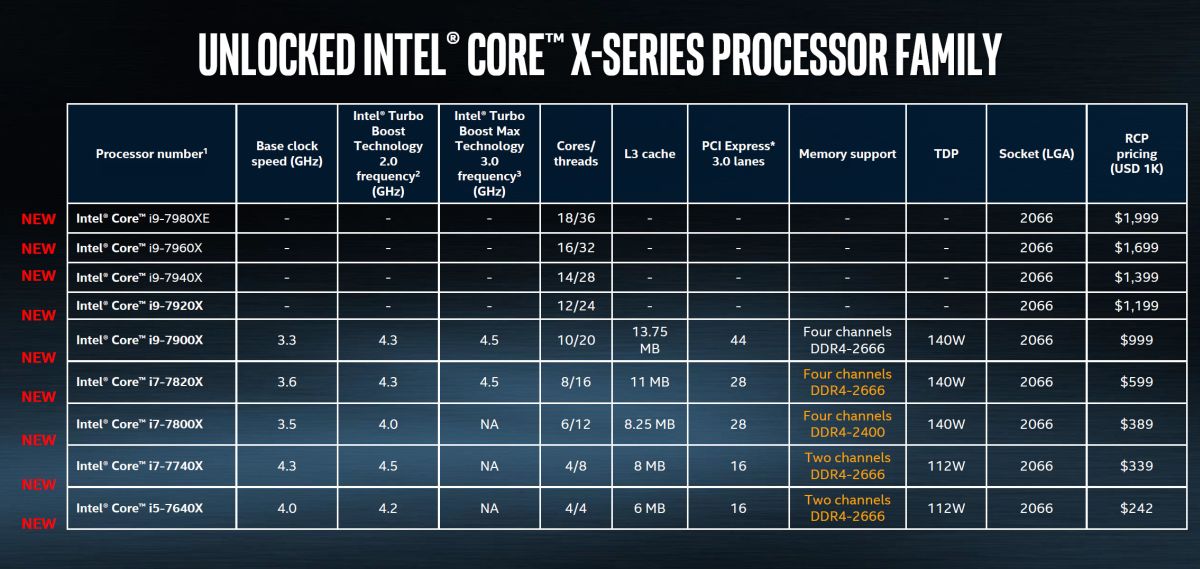
The Core i5-7640X and Core i7-7740X are CPUs which occupy a strange place in the Core X range and Intel’s product stack as a whole. Due to that we feel it’s necessary to outline exactly what these CPUs specifically are missing, compared to both the mainstream Core CPUs they share a price-point with, and the Skylake-X high performance CPUs which they ostensibly share a range with.
No on-board graphics.
Unlike Kaby Lake, the HEDT platform has no on-chip graphic components. The graphics capabilities of Kaby Lake, particularly HEVC encode/decode for 4K streams and exclusive hardware support for Microsoft’s PlayReady 3.0 DRM, are therefore entirely absent from both the Core i7-7740X and Core i5-7640X.
The Core X series also loses support for Intel’s QuickSync hardware video encoding and transcoding, another pillar of functionality highlighted by Intel when the Kaby Lake range was introduced in January.
On-chip graphics have another benefit not always apparent – an additional monitor output. This can be handy when troubleshooting in circumstances where the discrete GPU is suspected to be at fault, and an immense time-saver if the GPU is plumbed into an in-situ water cooling loop.
To be clear, Skylake-X has the same downside. However Skylake-X also offers tangible benefits which Kaby Lake-X has no access to.
No Support for AVX-512
AVX-512 are 512-bit extensions to the 256-bit Advanced Vector Extensions SIMD instructions for x86 systems. AVX and AVX 2 are both supported by Intel and AMD’s current crop of desktop CPUs, but AVX-512 is currently exclusive to Skylake-X on consumer CPUs.
Skylake-X also supports an overclocking ratio for AVX-512 operations. AVX-512 workloads substancially increase the thermal output of the CPU, and so a negative ratio offset allows the CPU to selectively downclock when facing these tasks and remain within thermal limits.
Dual Channel, Not Quad Channel Memory
Simply being limited to dual-channel memory operation would be galling enough on Kaby Lake-X, but to really put the boot in motherboard manufacturers have to selectively disable DIMM slots when Kaby Lake-X CPUs are installed in an X299 motherboard. As the premier PC platform these issues really should not be apparent, or at the very least the process by which they’re disabled should be standard across all manufacturers.
A further depressing downside is that if you install dual-channel memory in the recommended 2-DIMM configuration you will face hurdles when upgrading to Skylake-X. Ideally you would be able to buy two more identical DIMMs, but in reality it may be more feasible to instead purchase a brand new 4-DIMM kit.
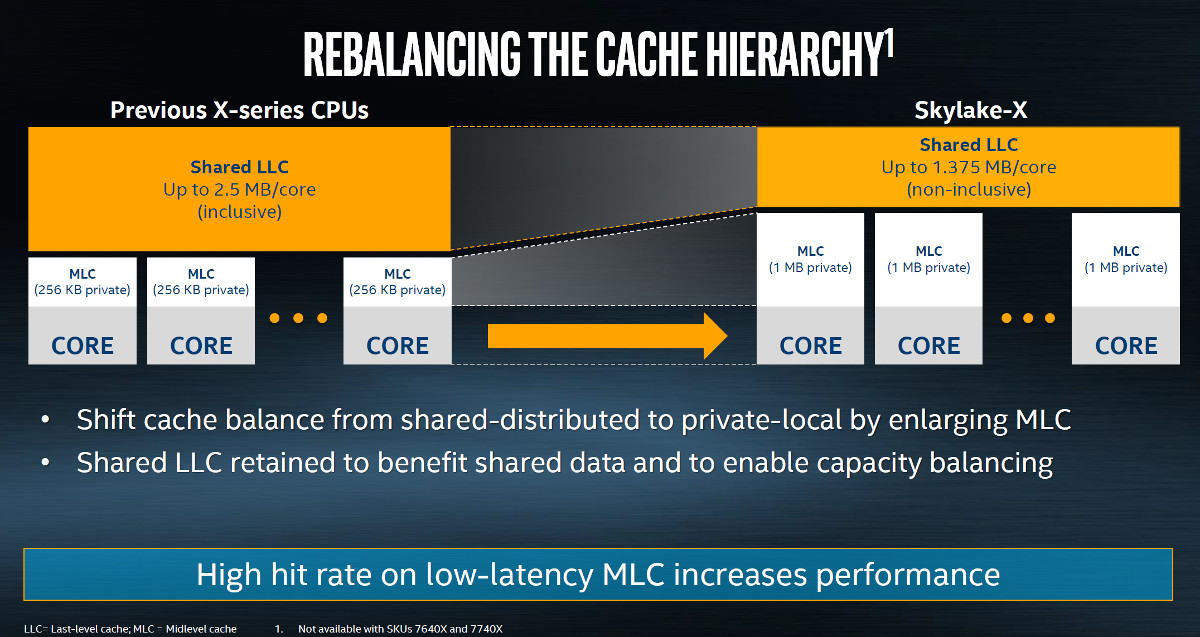
Does Not Benefit From Skylake-X’s Revised Cache Design
It’s beyond the scope of this article, but with Skylake-X Intel have altered the design of L2 and L3 cache. The new architecture greatly increases the per-core private L2 cache, increasing the hit-rate and hence reducing how often slower L3 cache and DRAM need to accessed. At the time of writing comprehensive benchmarks for these CPUs aren’t available, but it’s possible that this design could increase IPC by as much as 15% with appropriate workloads.
You will see a lot of marketing trumping this development in articles discussing the Core X range, but it’s very easy to lose sight of the fact that Kaby Lake-X CPUs will not have this feature. In fact, their IPC should be nearly identical to mainstream Kaby Lake.
No More Cores
The one major benefit of Intel’s HEDT platform, at least since the Sandybridge-E Era, has been an increase in the number of cores. Implicitly this means greater performance in heavily multi-threaded environments than mainstream CPUs, aiding in the execution of parallel tasks and (more recently) Megatasking. On that principle alone Kaby Lake-X is a step back.
Price
Kaby Lake-X is priced roughly in line with Kaby Lake, which means UK MSRP of £239.99 and £334.99 for the Core i5-7640X and Core i7-7740X respectively. Despite a reduced feature set, marginal expected performance improvement and more expensive motherboard platform, that’s still in line with their mainstream counterparts. Furthermore, Intel’s Core i9-7800X – complete with 6 cores and Skylake-X architecture – is only £40 more expensive than the i7-7740X.
Test Setup & Testing
For the purpose of testing the Intel Core i7-7740X we used the AORUS X299-GAMING 3 since this motherboard gave us the best overclock for this chip out of all the Intel X299 motherboards we tested.
CPU being tested
Intel Core i7-7740X (4.5GHz) Kaby Lake-X
TEST SETUP
Cooling NZXT Kraken X52Motherboard AORUS X299-GAMING 3
Memory 32GB Corsair Vengeance LPX 3000MHz
Graphics Radeon RX 480 8GB
Storage Kingston HyperX 240GB
PSU Corsair RM 1000 80 Plus Gold Certified PSU
Monitor AOC U2879VF
Capture Device Epiphan AV.iO 4K
COMPARED AGAINST
AMD Ryzen 5 1400 (3.2GHz) Summit RidgeAMD Ryzen 5 1600 (3.2GHz) Summit Ridge
AMD Ryzen 7 1700 (3.0GHz) Summit Ridge
AMD Ryzen 7 1700X (3.4GHz) Summit Ridge
AMD Ryzen 7 1800X 3.6GHz) Summit Ridge
AMD FX-8350 (4.0GHz) PileDriver
Intel Core i5-7700K (4.2GHz) Kaby Lake
Intel Core i5-7600K (3.8GHz) Kaby Lake
Intel Core i7-6950X (3.0GHz) Broadwell-E
Intel Core 7-6900K (3.2GHz) Broadwell-E
Intel Core i7-5960X (3.0GHz) Haswell-E
Intel Core i7-6700K (4GHz) Skylake
BENCHMARKS
Cinebench R15 – CPU/OpenGL Scorex264 HD 4.0 – 1st and 2nd pass encoding
SiSoftware SANDRA – CPU & Memory benchmarks
POV-RAY – CPU benchmarks
TrueCrypt – CPU benchmarks
AIDA64 – CPU benchmarks & Memory
PCMark 8 – Home Suite & Photoshop
3DMark FireStrike – 3D Benchmark
Games – Rise of the Tomb Raider & Total War: WARHAMMER
OTHER SOFTWARE
Temperature Analysis: RealTempStress Testing Software: AIDA64 Stability Test
CPU Specification Monitoring: CPU-Z
Performance Monitoring: MSI Afterburner
Temperatures & Overclocking
Below are the temperatures for each of the CPUs – without any overclock applied. We’ve also compared to previously released AMD Ryzen chips as well as the former Kaby Lake, Broadwell-E and Skylake counterparts (which we’ve also benchmarked against on the subsequent pages too):
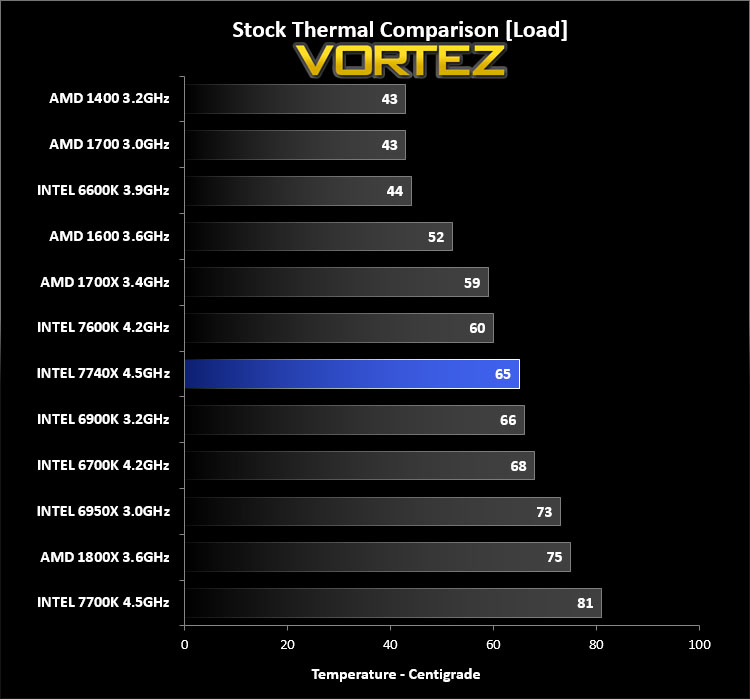
The 7740X shares similar attributes to the 7700K yet we see in the temperature test that the 7740X on the X299 platform presents significantly lower temperatures. 7700Ks are notorious for presenting high temperature spikes under load and this appears to have been improved under the 7740X – perhaps with better TIM under the IHS?
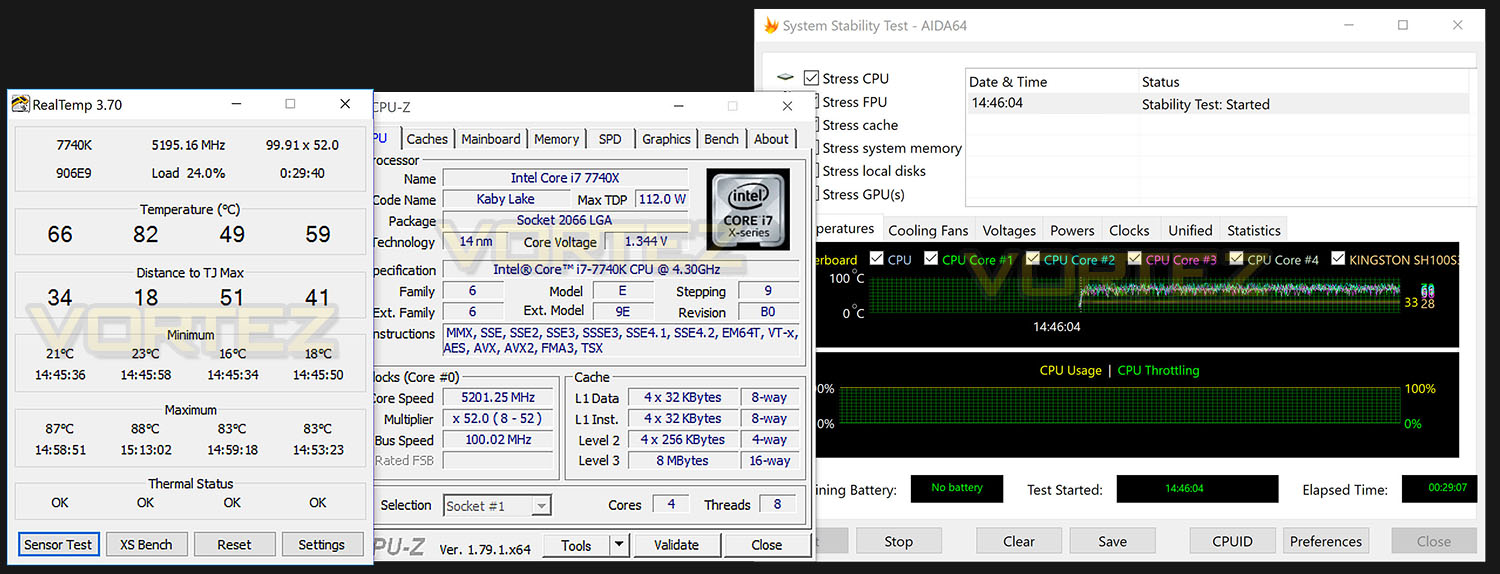
Overclocking
Moving to the overclocking phase of our review the above result further reinforces that we’re able to shift up to higher overclocks with the new quad-core 7740X.
Across the X299 motherboards we’ve tested for this new platform launch, the AORUS X299-GAMING 3 allowed us to achieve the best result. What became clear rather early on is that 7740X is able to nudge to the golden heights of 5GHz without much encouragement.
So, our best result saw us hit 5.2GHz with just 1.33v applied to the CPU voltage. The CPU would boot and bench beyond 5.2GHz but temperatures crept past the 90C mark which we set as the safe-zone parameter.
This is a fantastic result and a milestone which the 7700K wasn’t able to climb to. Our 7700K has a maximum overclock of 4.8GHz.
Power Consumption
It’s interesting to note the power consumption across all processors. Although they are using a combination of different motherboard chipsets, energy results can fluctuate between manufacturers due to the features and specifications that are integrated. First of all, for the idle tests the system is cold booted into Windows and no additional applications are executed – the watts are noted on the external energy monitor we use and then the system is loaded with 3DMark FireStrike – watts are again monitored for the duration of the test and the highest rated wattage result is then noted down. Below are the results of this energy test.

Ray Tracing Performance – POV-Ray 3.7
Persistence of Vision Raytracer’s PovRay is a free and open source 3D animator application with versions for computers with different operating systems.
This product allows users to build their custom 3D worlds with excellent quality despite their computer’s hardware. It has adjustable options for levels of radiance, refraction, and reflection. Calculation time may vary depending on the computer model, but PovRay can adapt to many computer builds, and is supported by the open source community.
This product allows users to build their custom 3D worlds with excellent quality despite their computer’s hardware. It has adjustable options for levels of radiance, refraction, and reflection. Calculation time may vary depending on the computer model, but PovRay can adapt to many computer builds, and is supported by the open source community.

AES Encryption Performance – TrueCrypt 7.1a
TrueCrypt is a discontinued source-available freeware utility used for on-the-fly encryption (OTFE). It can create a virtual encrypted disk within a file or encrypt a partition or (under Microsoft Windows except Windows 8 with GPT) the entire storage device (pre-boot authentication).

Encoding Performance – X264 HD
Simply put, this test measures how fast your machine can encode a short, DVD quality MPEG-2 video clip into a high-quality x264 video clip. What’s x264, you ask? It’s more or less the next-generation Xvid/DivX codec. I think it’s ideal for a benchmark because the application (x264.exe) reports fairly accurate compression results (in frames per second) for each pass of the video encoding process, and it uses multi-core processors very efficiently.
x264 HD gives results for 2 passes when compressing an MPEG-2 clip into x264. It presents 4 separate results for each pass giving a total of 8 – all results are given in FPS. For each pass I have averaged out the results.

Processing Features Performance – AIDA64
AIDA64 Product PageThis simple integer benchmark focuses on the branch prediction capabilities and the misprediction penalties of the CPU. It finds the solutions for the classic “Queens problem” on a 10 by 10 sized chessboard. At the same clock speed theoretically the processor with the shorter pipeline and smaller misprediction penalties will attain higher benchmark scores. For example — with HyperThreading disabled — the Intel Northwood core processors get higher scores than the Intel Prescott core based ones due to the 20-step vs 31-step long pipeline. CPU Queen test uses integer MMX, SSE2 and SSSE3 optimizations.

Memory Transfer Performance – AIDA64
AIDA64 Product PageThis simple integer benchmark focuses on the branch prediction capabilities and the misprediction penalties of the CPU. It finds the solutions for the classic “Queens problem” on a 10 by 10 sized chessboard. At the same clock speed theoretically the processor with the shorter pipeline and smaller misprediction penalties will attain higher benchmark scores. For example — with HyperThreading disabled — the Intel Northwood core processors get higher scores than the Intel Prescott core based ones due to the 20-step vs 31-step long pipeline. CPU Queen test uses integer MMX, SSE2 and SSSE3 optimizations.
Processing Power Performance – Cinebench R15
CINEBENCH can measure systems with up to 64 processor threads. This test scene contains approximately 2,000 objects which in turn contain more than 300,000 polygons in total, and uses sharp and blurred reflections, area lights, shadows, procedural shaders, antialiasing, and much more. The result is displayed in points (pts). The higher the number, the faster your processor.

Bandwidth Performance – SiSoftware SANDRA
3DMark 11 Product PageSANDRA isn’t always a benchmark that is included in hardware reviews but I believe it shouldn’t be ignored. SANDRA provides a vigorous package that tests your system in a rather large array of benchmarks. There are many aspects of benchmark that can be executed. We will be considering – CPU and memory tests.


Image Editing Performance – PCMark 8 Photoshop
PCMark 8 Product Page Developed in partnership with Benchmark Development Program members Acer, AMD, Condusiv Technologies, Dell, HGST, HP, Intel, Microsoft, NVIDIA, Samsung, SanDisk, Seagate and Western Digital, PCMark 8 is the latest version in FutureMark’s popular series of PC benchmarking tools. Improving on previous releases, PCMark 8 includes new tests using popular applications from Adobe and Microsoft.

Overall System Performance – PCMark 8
PCMark 8 Product Page Developed in partnership with Benchmark Development Program members Acer, AMD, Condusiv Technologies, Dell, HGST, HP, Intel, Microsoft, NVIDIA, Samsung, SanDisk, Seagate and Western Digital, PCMark 8 is the latest version in FutureMark’s popular series of PC benchmarking tools. Improving on previous releases, PCMark 8 includes new tests using popular applications from Adobe and Microsoft.

VR Performance – VRMark
VRMark Product PageVRMark includes two VR benchmark tests that run on your monitor, no headset required, or on a connected HMD. At the end of each test, you’ll see whether your PC is VR ready, and if not, how far it falls short.

3D Performance – 3DMARK FireStrike
3DMark FireStrike Product PageFire Strike is our new showcase DirectX 11 benchmark designed for high-performance gaming PCs. It is our most ambitious and technical benchmark ever, featuring real-time graphics rendered with detail and complexity far beyond what is found in other benchmarks and games today. Fire Strike will only be available in the Windows editions of 3DMark initially.

Gaming Performance – Tomb Raider & Total War: WARHAMMER
It’s important for us to perform a number of game benchmarks as well as the synthetic tests because gamers will want to know if there are any significant benefits. So here we have two recent gaming titles benchmarked with a Radeon RX 480 installed.

Conclusion
Small, incremental adjustments to architecture has been the procedure to which Intel has operated by for countless years – with no real competition in the market it’s easy to become complacent. For both the consumer and manufacturer involved, a lack of competition has significant consequences – prices can soar and innovation can be somewhat absent. Thankfully, the tide is changing with the shakeup which arrived in Spring with AMD’s Ryzen CPUs and Intel’s launch of today’s Basin Falls platform has been brought forward as strategies have had to be readjusted.
While we can’t yet comment on Skylake-X, what we’ve been presented with in the form of the quad-core Kaby Lake-X has been quite a mixed bag. Pitting the 7740X against the 7700K we can see very similar performance – sometimes moving in the 7700Ks favour, sometimes the 7740X. The reason we frequently refer to both of these chips in the same sentence is due to their almost identical features and attributes. The 7740X could almost be regarded as the 7700K on the LGA2066/X299 platform and while we do get some improvement in the thermal performance and overclocking longevity consumers will have to fork out for a move to the HEDT platform which isn’t the most economical route to take.
Supplying a quad-core variant on the HEDT platform is quite a puzzling move. Investing in an X299 motherboard won’t be cheap and furthermore, certain features will be absent should a Kabylake-X CPU be installed, by nature Kabylake-X only supports dual-channel DDR4 so users won’t be able to take advantage of quad-channel kits – nor will they be able to enjoy the delights of a full 44-lane PCI Express configuration, only 16 are supplied under this CPU.
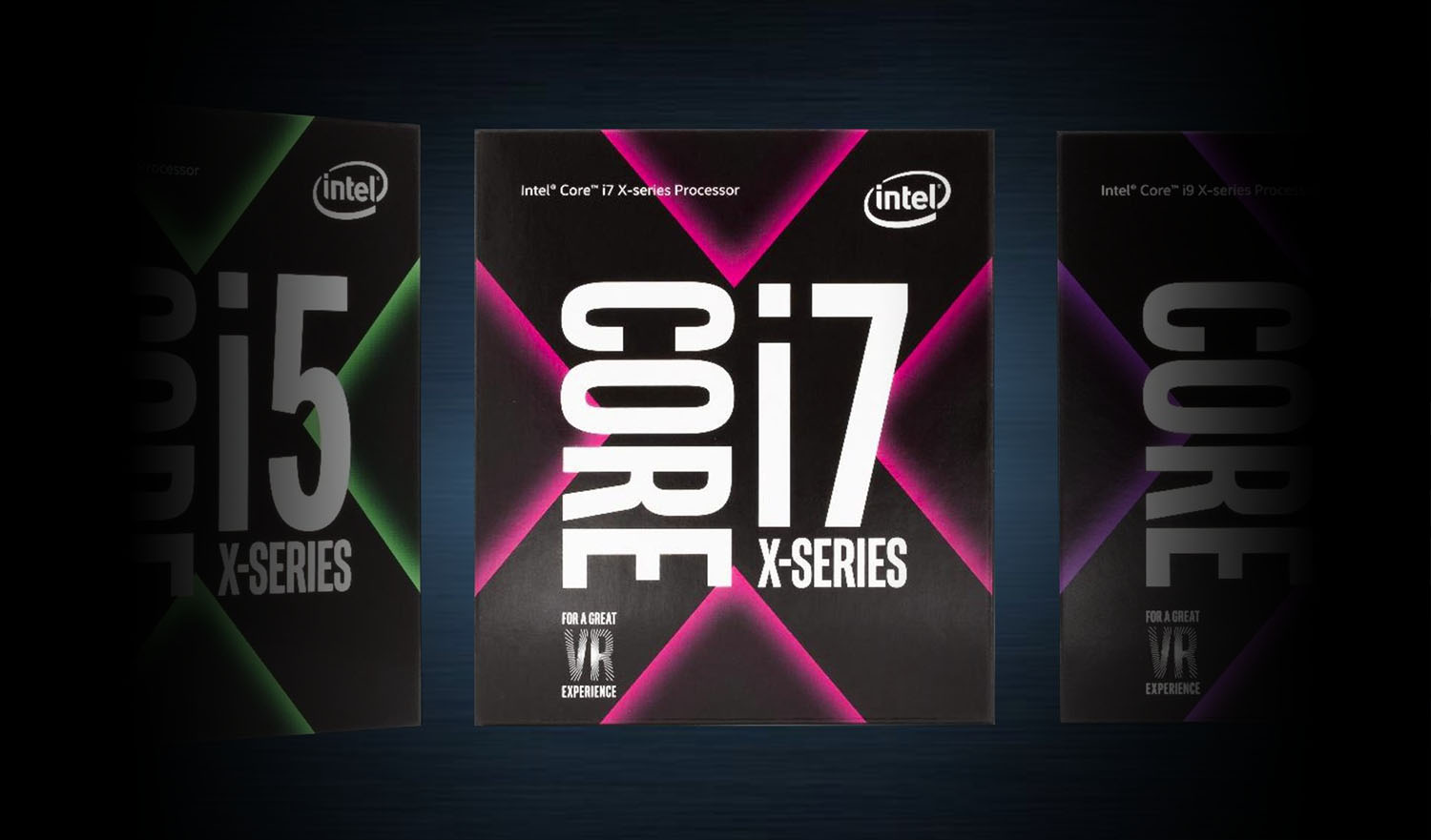
Incidentally, care should be taken when installing your DDR4 kit onto any X299 motherboard to ensure both sticks are being utilised – if DIMMs are placed into incorrect slots, they simply won’t be recognised (so always refer to the manual to double-check which slots should be used for Kabylake-X).
So, if these restrictions are a concern, sticking with the mainstream Z270 chipset and its 7700K will be a much more affordable avenue to go down. It makes little sense to invest in a platform for similar performance, more expense and a limitation on specific features.
One thing standing in the 7740X’s favour is how rewarding the overclocking is. We were able to push all of our boards to around the 5GHz mark – the AORUS X299-GAMING 3 gets a special mention by being able to nudge the frequency of the quad-core 7740X up to 5.2GHz at just 1.33v. Both the temperatures and voltage parameters for this 5.2GHz overclock can be regarded as safe – running this configuration on a 24/7 basis would be without any concerns and the performance benefits are significant. The same cannot be said of the 7700K – we tested 2/3 CPUs which weren’t able to hit the golden heights of 5GHz, temperatures and voltage threshold having a small ceiling.
At a cost of £334.99 GBP / $369 USD, the 7740X sits alongside the 7740X (no Hyper Threading and half the threads) as the cheapest of the Intel Core X-Series family. Pricing does indeed appear to be less than the 7700K at time of launch. For roughly an extra £20/$20 enthusiasts can purchase the Skylake-X 7800X, take advantage of six cores, quad-core channel DDR4 and 28 PCI-Express lanes – side stepping the restrictions placed on Kabylake-X on the 2066/X299 platform. The latter seems like a no-brainer to us.
Intel’s modest Core i7-7740X may have some limitations placed on it, but it does offer up some decent performance especially in the thermals and overclocking departments. However, enthusiasts looking to get more ‘bang for their buck’ would be well-advised to either look at the 7900X or Z270/7700K.
Pros
+ Offers excellent performance
+ Improved thermal performance
+ Overclocks very well
Cons
– Cannot maximise multi-GPU configurations
– Costly platform compared to Z270/7700K
– Only dual channel DDR4
– 16 PCIe lane functionality only
+ Offers excellent performance
+ Improved thermal performance
+ Overclocks very well
Cons
– Cannot maximise multi-GPU configurations
– Costly platform compared to Z270/7700K
– Only dual channel DDR4
– 16 PCIe lane functionality only