







Celebrating their collaboration with eSports champions Na’Vi, Kingston have released a limited edition DDR3 memory kit.
Product On Review: HyperX Genesis – Na’Vi Edition DDR3
Manufacturer and Sponsor: Kingston Technology
Street Price: 16GB (2×8) – £119 (at time of review)
Kingstons HyperX branding is a signature of performance and what better way to exemplify that performance than a collaboration with one of the worlds top performing eSports teams – Na’Vi or more formally known as Natus Vincere.
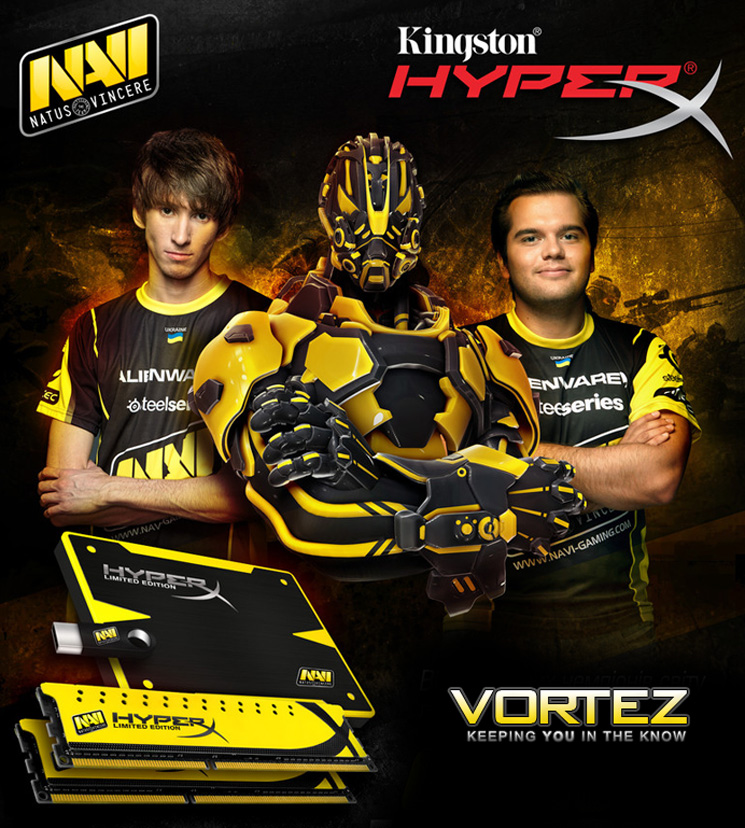
The kit we have for review today is based upon two 16GB kits (4x8GB) and will be tested in Quad channel on the X79 platform. The kits are however available to buy separately in either 16GB (2×8) or 8GB (2×4) in dual channel configuration which is ideally suited to wider range of platforms from both AMD and Intel.
Natus Vincere or Na `Vi (Latin: Born to Win) is a multi-gaming eSports Club. In 2010, the Counter-Strike 1.6 lineup of the team won three major tournaments in one year for the first time in the history – Intel Extreme Masters, Electronic Sports World Cup and the World Cyber Games. In the summer of 2011 DotA-lineup of the team was the best on DotA 2 tournament – The International, having won $ 1 million for the first place. Over the past 2 years Na `Vi have visited more than 52 tournaments in 25 countries on three continents. Official site – www.navi-gaming.com.
Specification
Basic
Kits: 8 GB (2*4GB), 16GB (2*8GB)
Memory Type: DDR3
Operating Frequency: 1600 MHz
Voltage: 1.5 V
Memory Timings: 9-9-9
Maximum input power (in normal mode)*: 2.4 W (for a kit of 8 GB), 2.46 watts (for a kit of 16 GB)
Technical
VDD = VDDQ = 1.5V ± 0.075V (JEDEC Standard
Power Supply)
VDD = VDDQ = 1.35V -0.0675V/+0.1V
(Backward Compatible to VDD = VDDQ = 1.5V
±0.075V)
8 Internal memory banks (BA0- BA2)
Differential clock input (CK, 61507;61515; )
Programmable Latency: 5, 6, 7, 8, 9, 10, 11
WRITE Latency (CWL): 5,6,7,8,9
POSTED CAS ADDITIVE Programmable Additive
Latency (AL): 0, CL-1, CL-2 clock
Programmable Sequential / Interleave Burst Type
Programmable Burst Length: 4, 8
8n-bit prefetch architecture
Output Driver Impedance Control
Differential bidirectional data strobe
Internal(self) calibration:Internal self calibration
OCD Calibration
Dynamic ODT (Rtt_Nom & Rtt_WR)
Auto Self-Refresh
Self-Refresh Temperature
RoHS compliance and Halogen free
Packages:
78-Balls BGA for x4/x8 components
96-Ball BGA for x16 components
Through ZQ pin (RZQ:240 ohm±1%)
VDD = VDDQ = 1.5V ± 0.075V (JEDEC Standard
Power Supply)
VDD = VDDQ = 1.35V -0.0675V/+0.1V
(Backward Compatible to VDD = VDDQ = 1.5V
±0.075V)
8 Internal memory banks (BA0- BA2)
Differential clock input (CK, 61507;61515; )
Programmable Latency: 5, 6, 7, 8, 9, 10, 11
WRITE Latency (CWL): 5,6,7,8,9
POSTED CAS ADDITIVE Programmable Additive
Latency (AL): 0, CL-1, CL-2 clock
Programmable Sequential / Interleave Burst Type
Programmable Burst Length: 4, 8
8n-bit prefetch architecture
Output Driver Impedance Control
Differential bidirectional data strobe
Internal(self) calibration:Internal self calibration
OCD Calibration
Dynamic ODT (Rtt_Nom & Rtt_WR)
Auto Self-Refresh
Self-Refresh Temperature
RoHS compliance and Halogen free
Packages:
78-Balls BGA for x4/x8 components
96-Ball BGA for x16 components
Through ZQ pin (RZQ:240 ohm±1%)
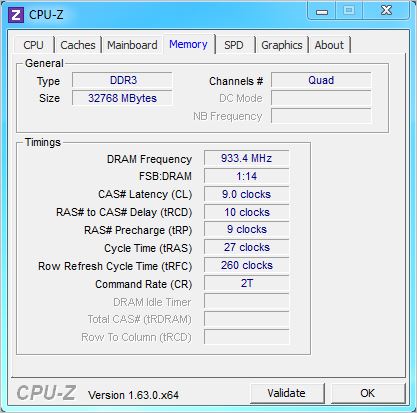
As you can see from the screen shot above, the timings for this memory are quite good. Sadly the same cannot be said for the bandwidth because at just 1600MHz, this is not what we would class as a performance kit. As previously stated, we will be using two of these kits in Quad channel (32GB total) so hopefully so of the extra GB will make up for the shortfall in speed.
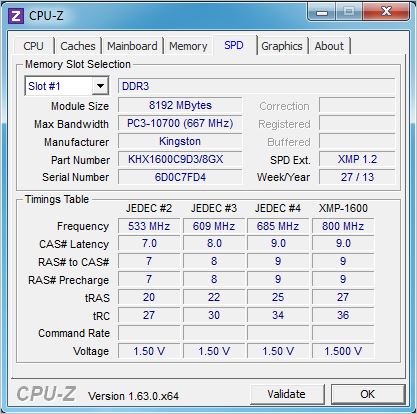
Above are the JEDEC and as we can see the single XMP profile is set to run these memory sticks at 1600MHz 9-9-9-27 at 1.5v. Hopefully there will be plenty of room left for overclocking!
Packaging & First Look
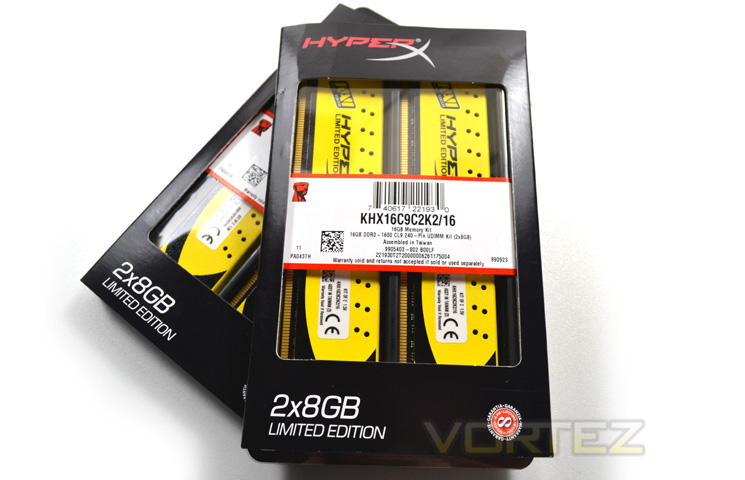
Each Kingston HyperX Na’Vi kit arrives in a cardboard presentation box. This is a slight break from the norm from Kingston who generally package their products in a simple, yet effective blister pack (see below).
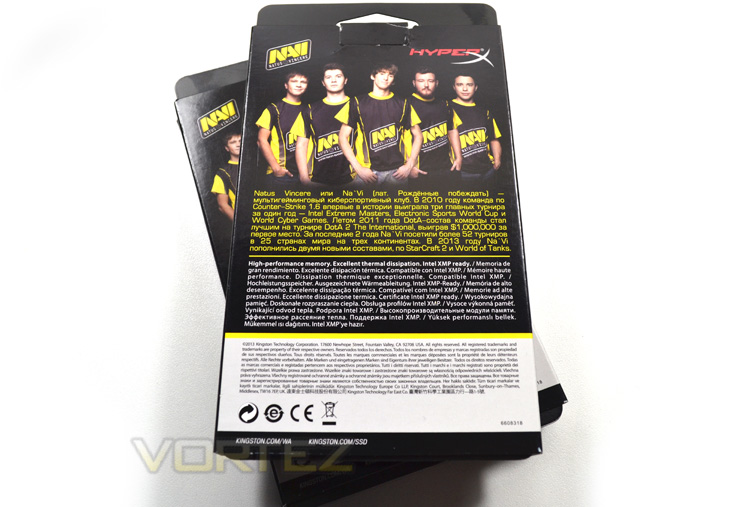
The rear of the outer packaging has a picture of the Na’Vi eSports team in the same colours as this memory kit. Beneath this there is a catalogue of awards won by Natus Vincere.
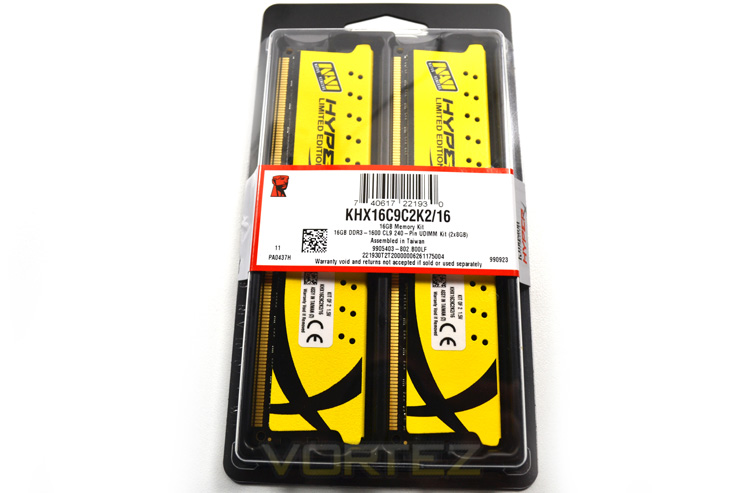
With the outer packaging removed we find the familiar blister pack which is sealed with the product description sticker.
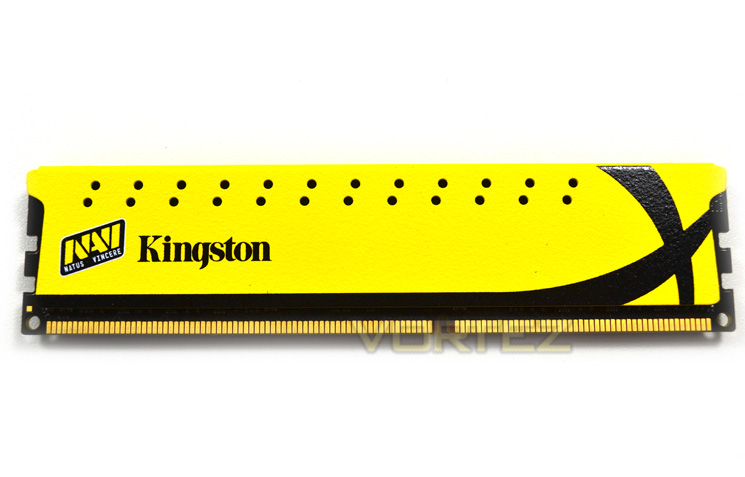
Breaking out the sticks from their vice like hold of the blister packaging we can see them in all their glory. A shade above canary yellow, they cannot be described as dull! Each stick features the Na’Vi moniker along with Kingston branding. The yellow is matt effect with the contrasting trim being a gloss black.
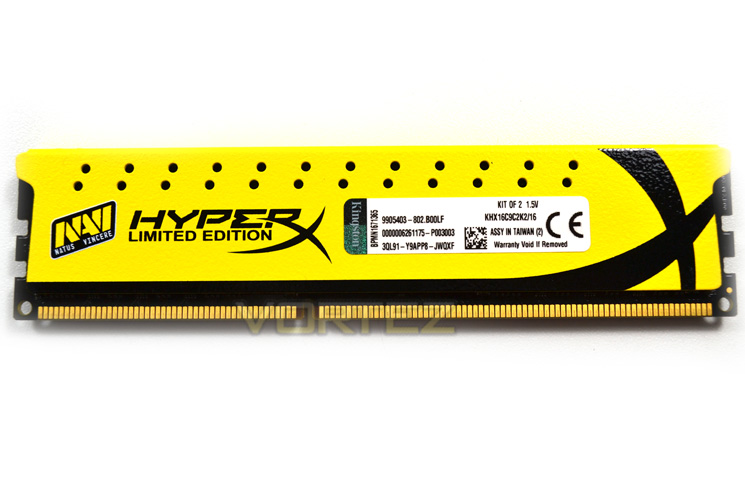
The rear of the modules is similar in appearance to the front but features both the product code complete with the voltage required on a holographic sticker.
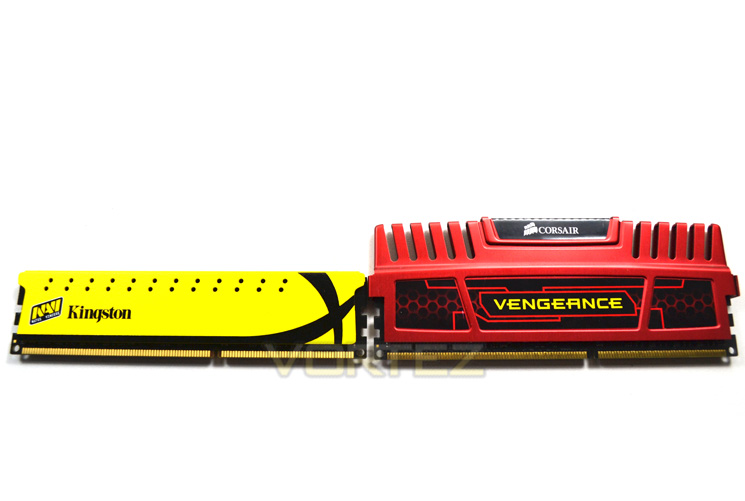
The modules are ideally suited for air cooling thanks to the low profile. As you can see from the comparison above, they are much lower than memory modules with oversized heatsinks so should have no trouble fitting beneath large CPU coolers.
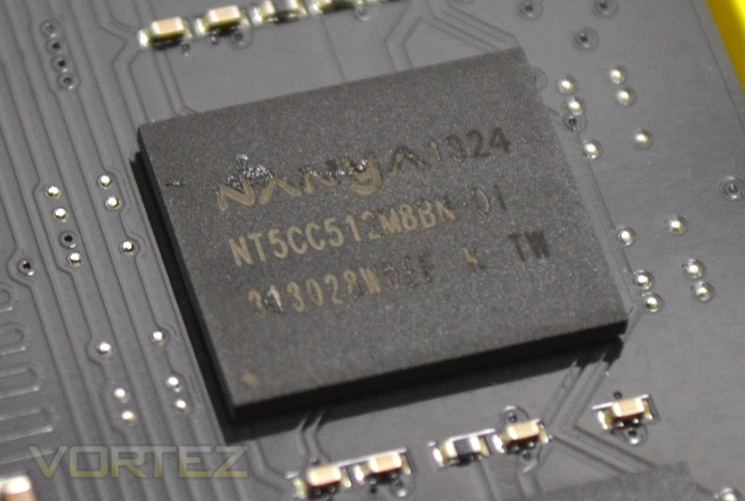
Taking those low profile heatspreaders off was tricky due to the very sticky thermal interface material connecting the integrated chips to the heatspreader. This WILL invalidate Kingston’s lifetime warranty so don’t try this at home!
The chips used on this kit were from NANYA and carry the product code of NT5CC512M8BN DI.
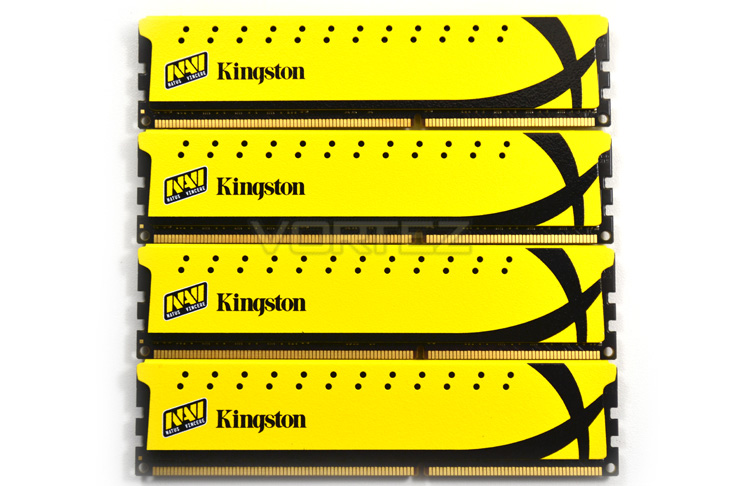
Overall, we think the kit looks great. This kit would suit an MSI MPOWER build extremely well as it perfectly matches the yellow/black theme MSI employ for their extreme range of components.
Test Setup & Methodology
Test SystemMotherboard MSI X79 Big Bang X-Power II
CPU Intel Core i7-3960X Extreme Edition @ 3.3GHz
Power Supply ANTEC High Current Pro 1200W
Hard Drive Kingston HyperX 240GB
Cooler Corsair H100
CPU Intel Core i7-3960X Extreme Edition @ 3.3GHz
Power Supply ANTEC High Current Pro 1200W
Hard Drive Kingston HyperX 240GB
Cooler Corsair H100
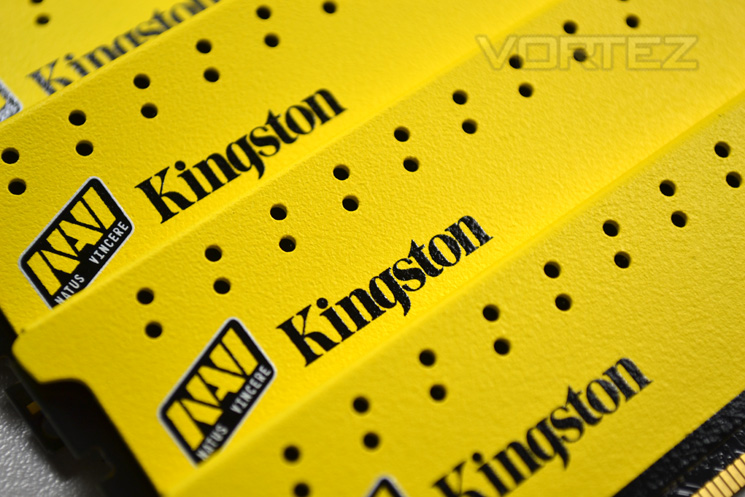
Memory kits on test:
Kingston HyperX Genesis Na’Vi 32GB (OC) 10-11-10 1866MHz
Kingston HyperX Genesis Na’Vi 32GB (XMP) 9-9-9 1600MHz
Corsair Dominator Platinum 32GB (XMP) 9-11-11 2133MHz
Kingston HyperX 10th Anniversary 16GB 11-12-11 2133MHz
AVEXIR MPOWER 16GB 9-9-9 1600MHz
Kingston HyperX Beast 32GB 11-13-13 2133MHz
Kingston HyperX Predator 16GB 9-11-9-27 1866MHz
G.SKILL ARES 16GB 9-11-10-28 2133MHz
Patriot Division 4 Viper Extreme 16GB 9-11-9-27 1866MHz
Corsair Vengeance 16GB 9-10-9-27 1866MHz
G.SKILL RipjawsZ 16GB 9-10-9-28 1866MHz
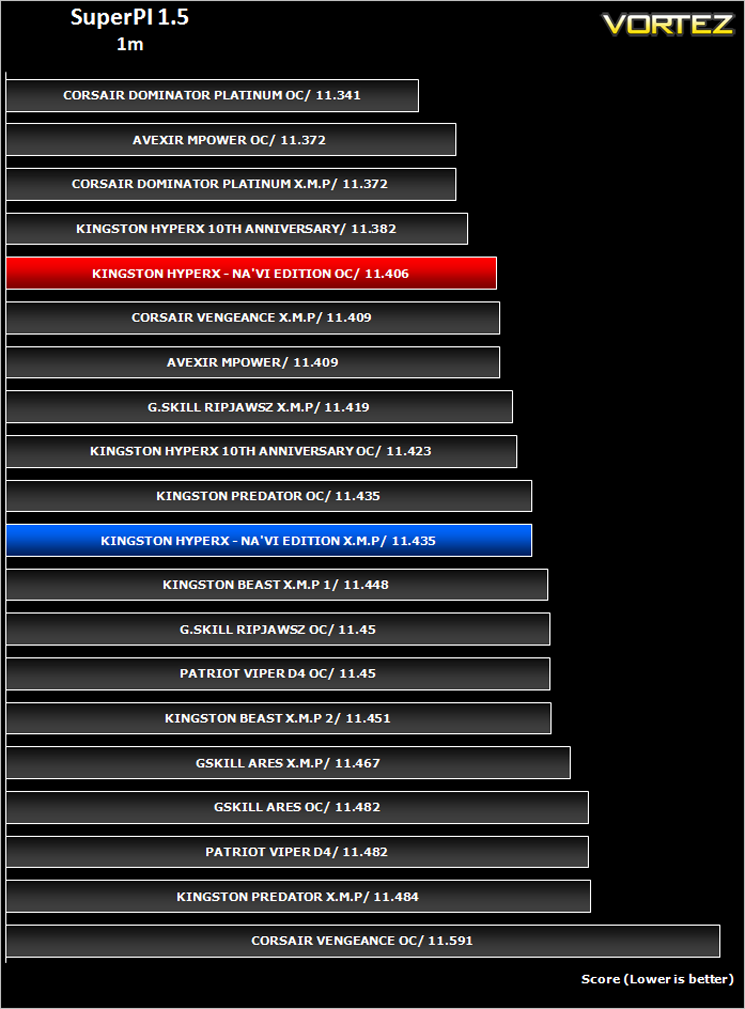
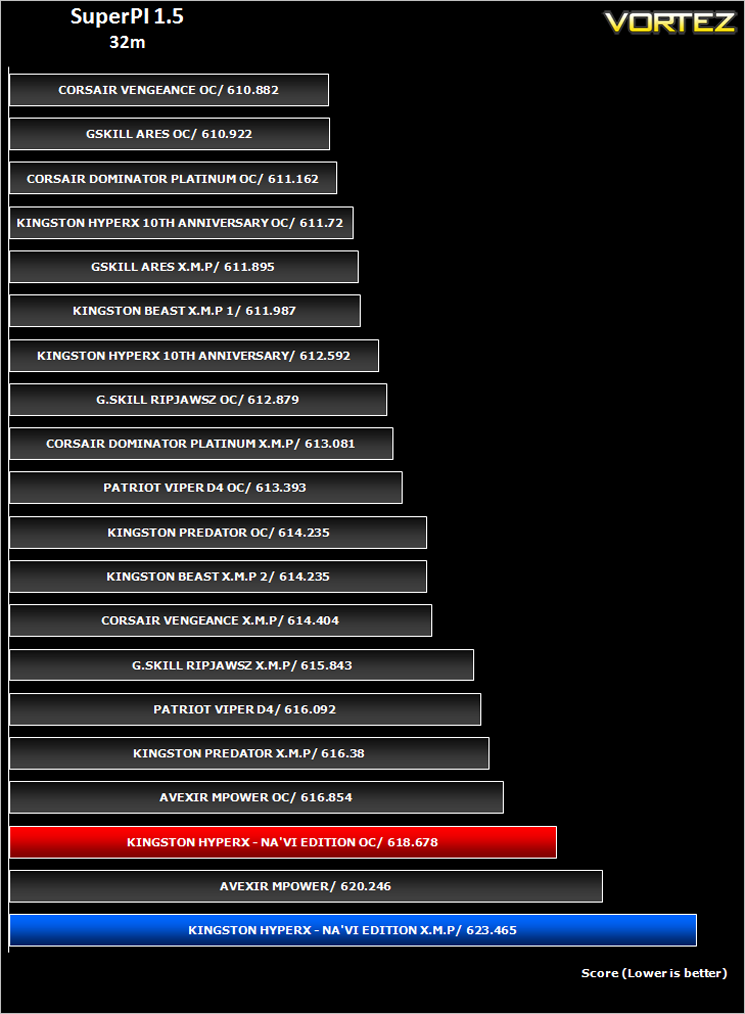
SuperPI (1.5)
In August 1995, the calculation of pi up to 4,294,960,000 decimal digits was succeeded by using a supercomputer at the University of Tokyo. The program was written by D.Takahashi and he collaborated with Dr. Y.Kanada at the computer center, the University of Tokyo. This record should be the current world record. ( Details is shown in the windows help. ) This record-breaking program was ported to personal computer environment such as Windows NT and Windows 95 and called Super PI. In order to calculate 33.55 million digits, it takes within 3 days with Pentium 90MHz, 40MB main memory and 340MB available storage.
HyperPI 0.99b
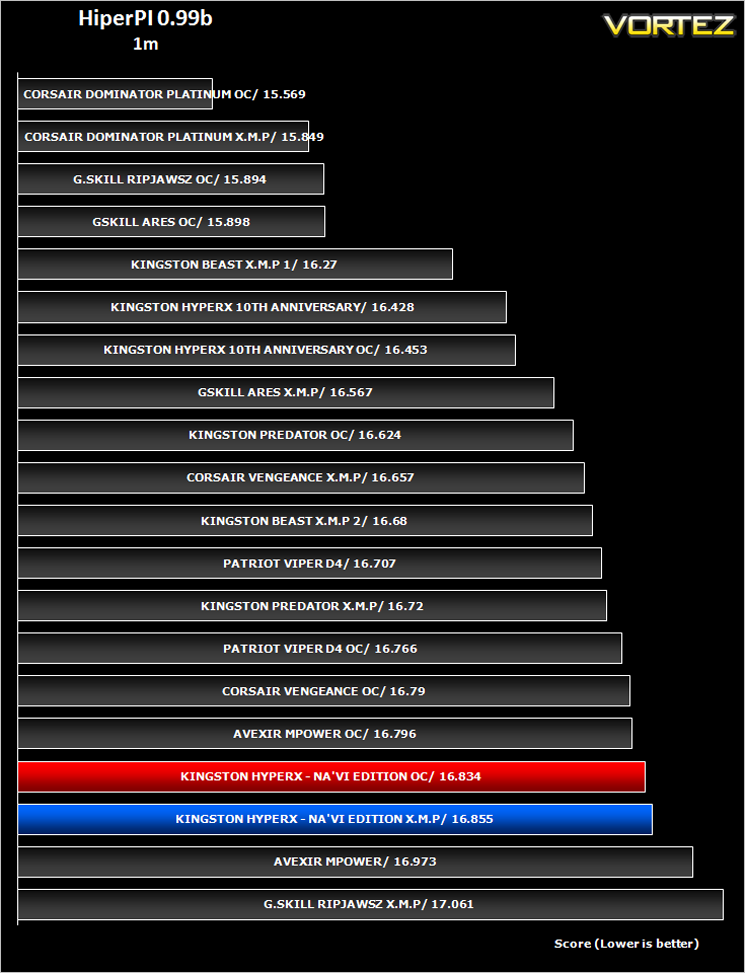
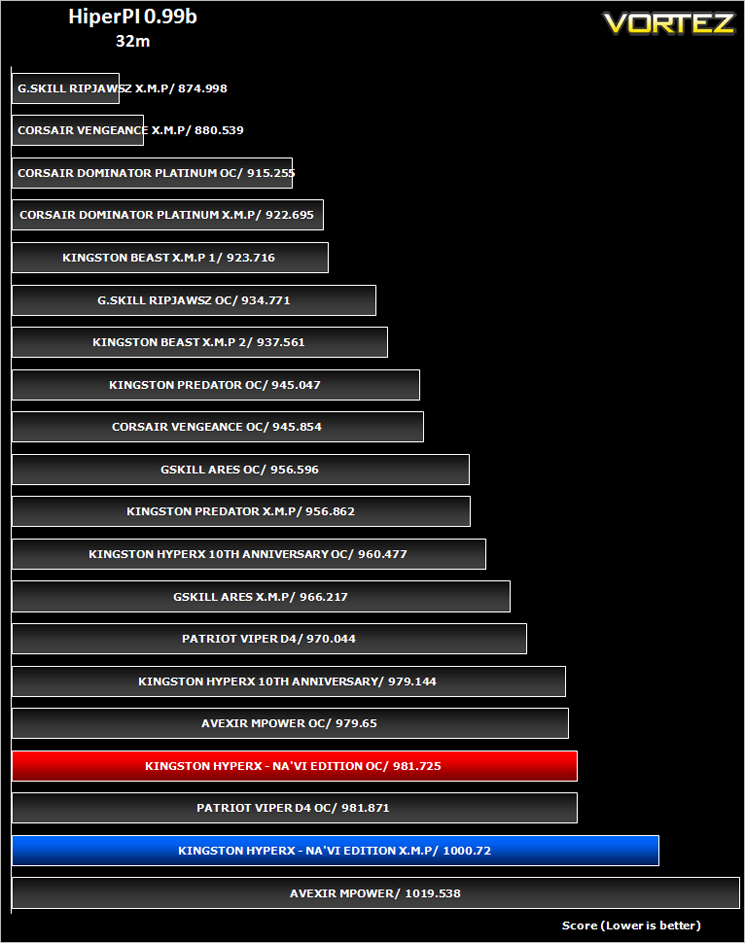
The HiperPI front-end is basicly a program which allows selecting multiple threads of SuperPi to be run at the same time so you can test the stability and performance on multi-core machines.
AIDA64
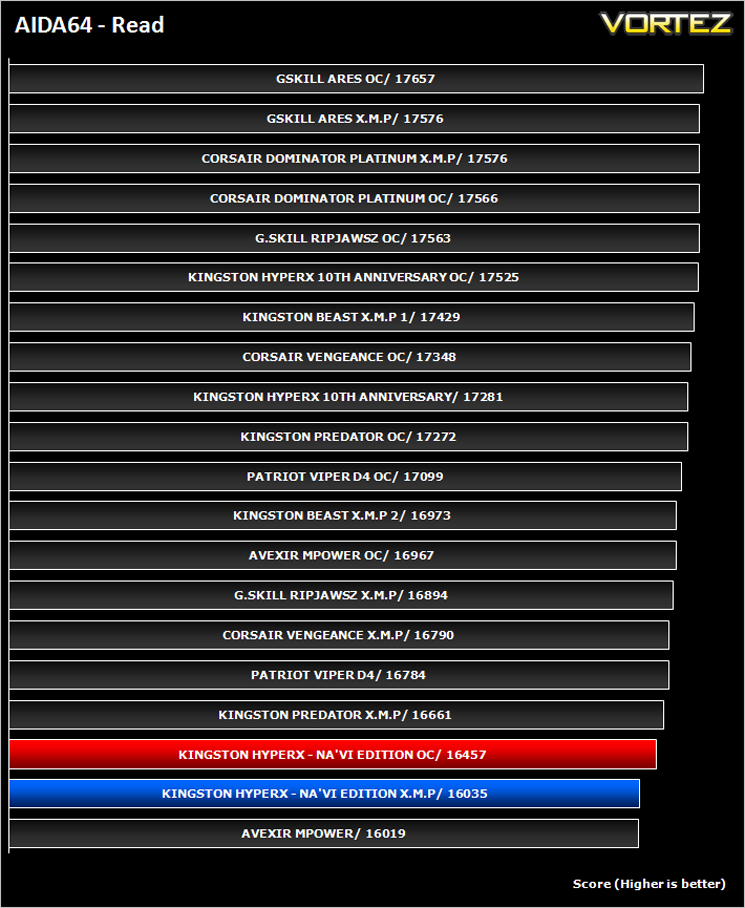
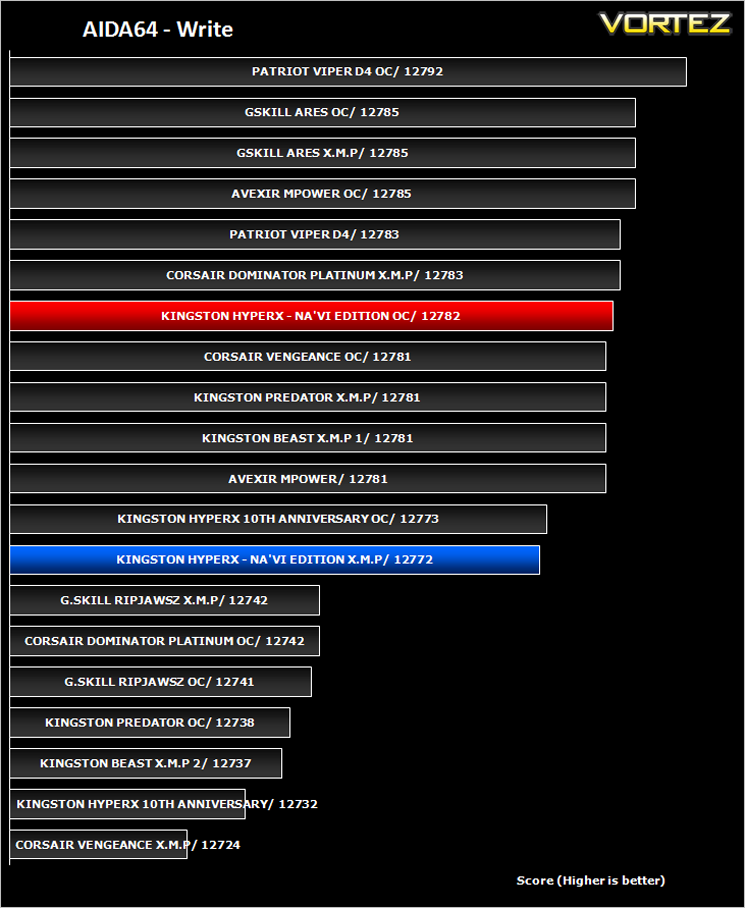
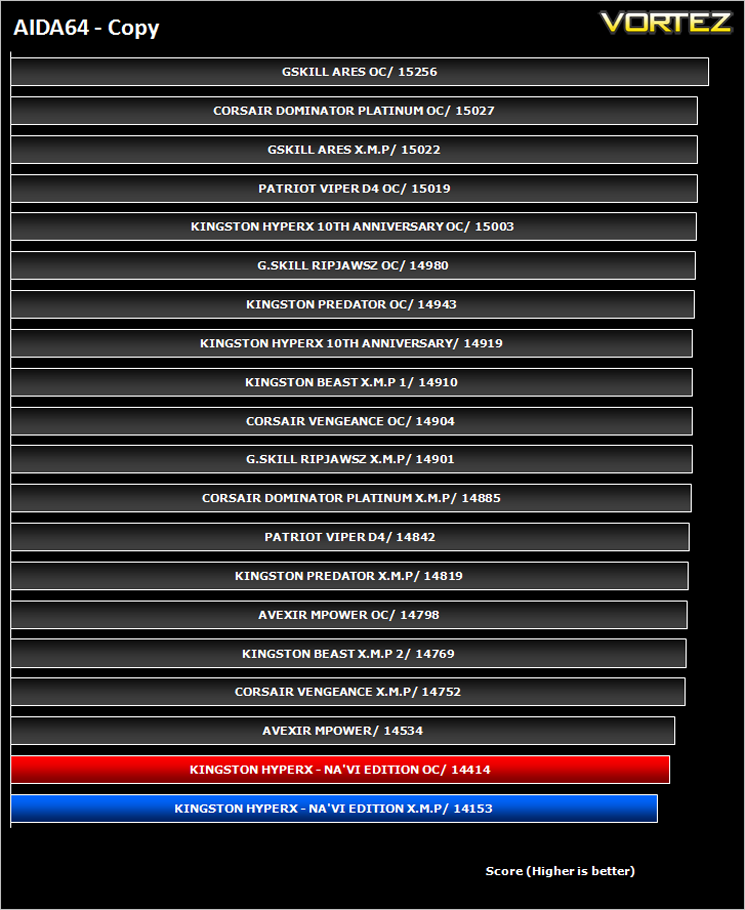
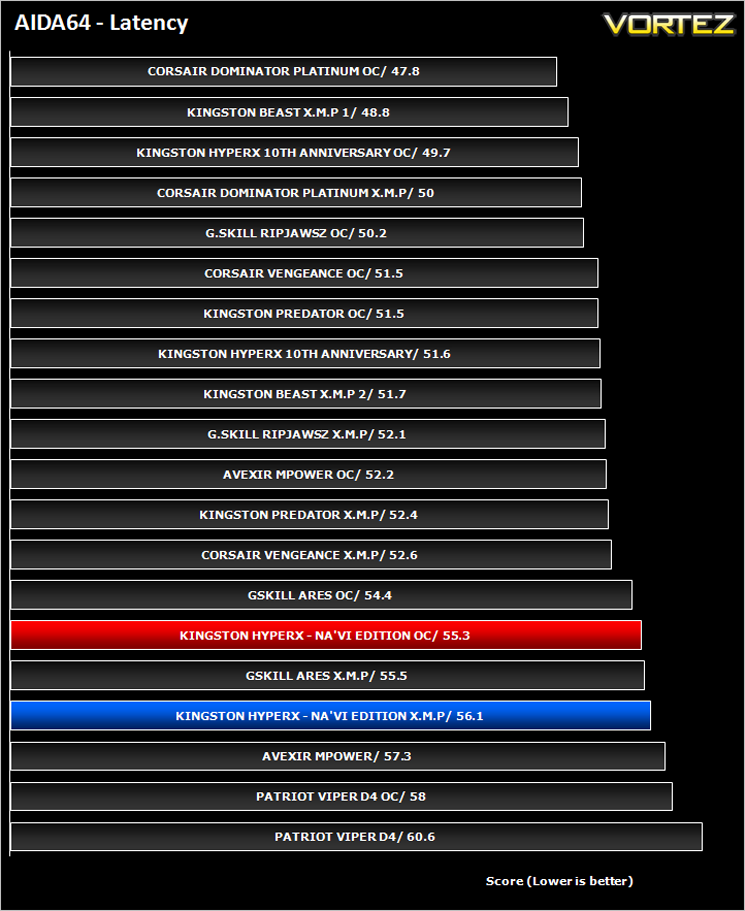
AIDA64 is the successor to Everest ULTIMATE. This application not only details every component within a system but it also incorporates a comprehensive memory benchmarking tool that will ascertain bandwidth and latency figures.
Sisoft Sandra 2012
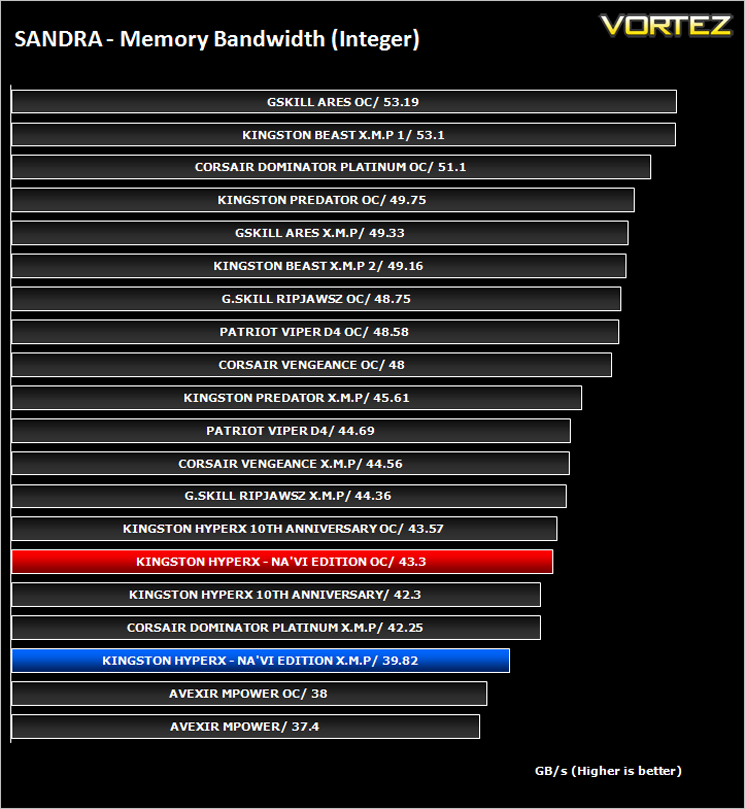
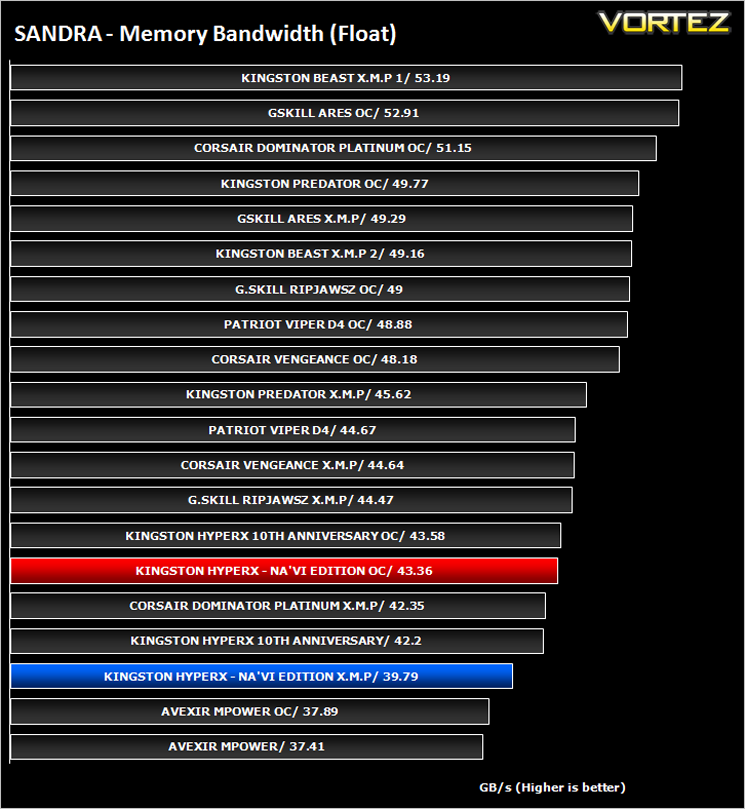
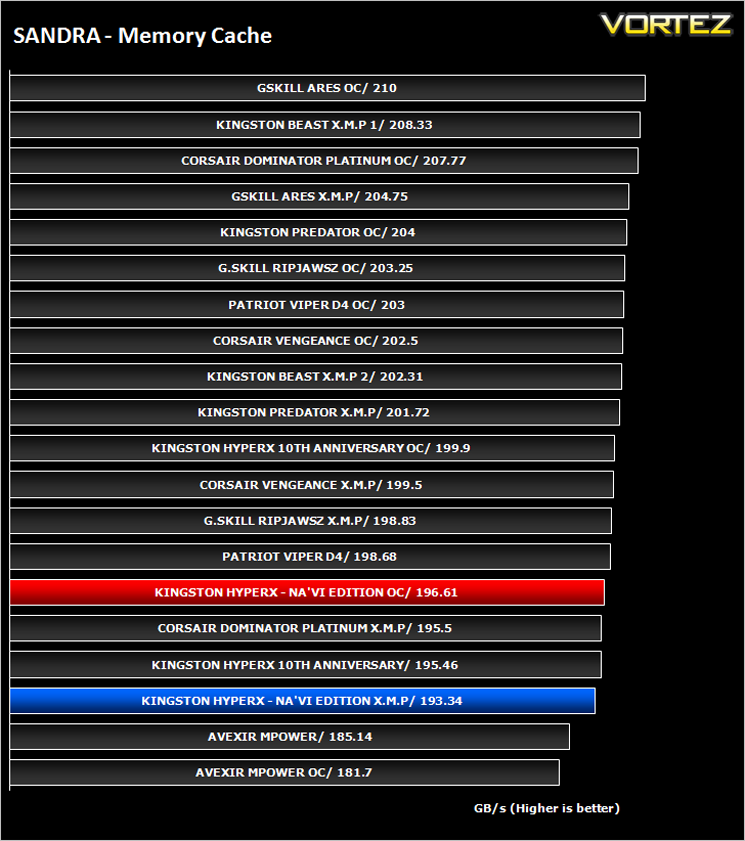
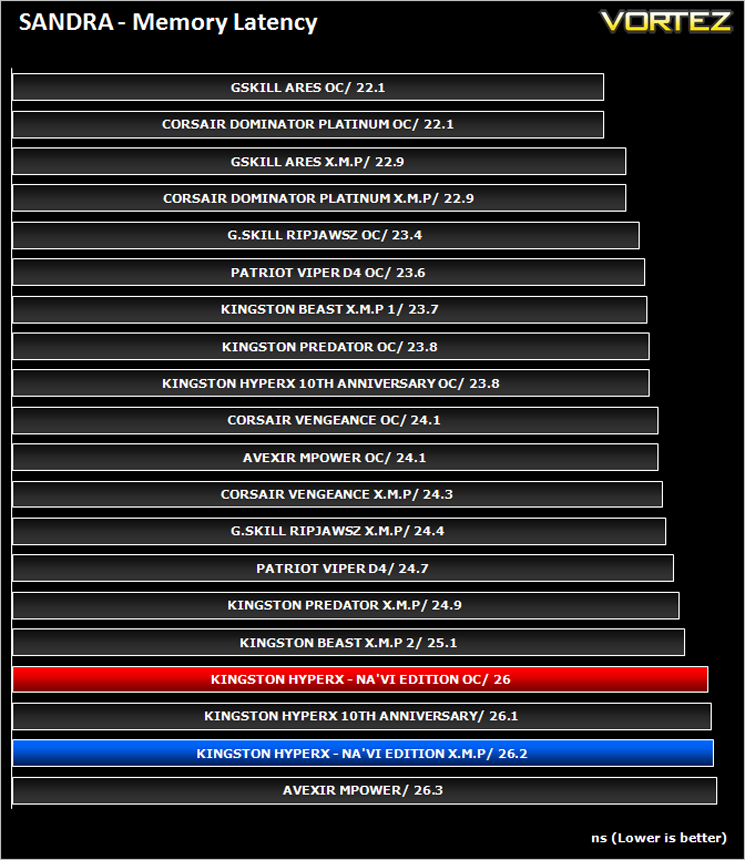
SANDRA isn’t always a benchmark that is included in hardware reviews but I believe it shouldn’t be ignored. SANDRA provides a vigorous package that tests your system in a rather large array of benchmarks. There are many aspects of benchmark that can be executed. We will be considering – CPU and memory tests.
Futuremark 3DMark 11
Designed to measure your PC’s gaming performance 3DMark 11 makes extensive use of all the new features in DirectX 11 including tessellation, compute shaders and multi-threading. Trusted by gamers worldwide to give accurate and unbiased results, 3DMark 11 is the best way to consistently and reliably test DirectX 11 under game-like loads.
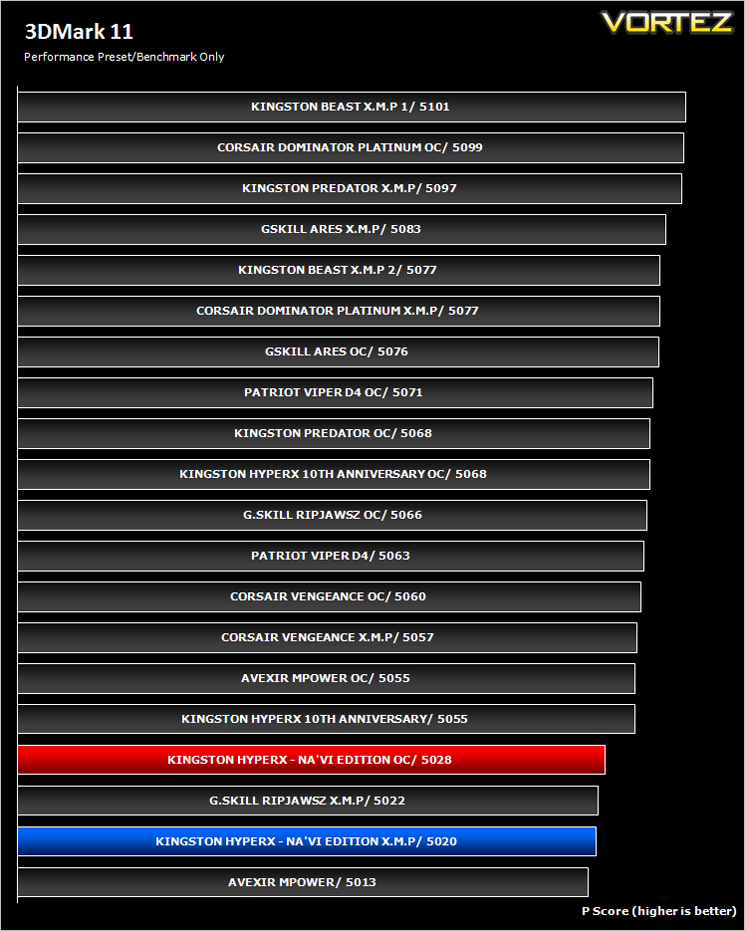
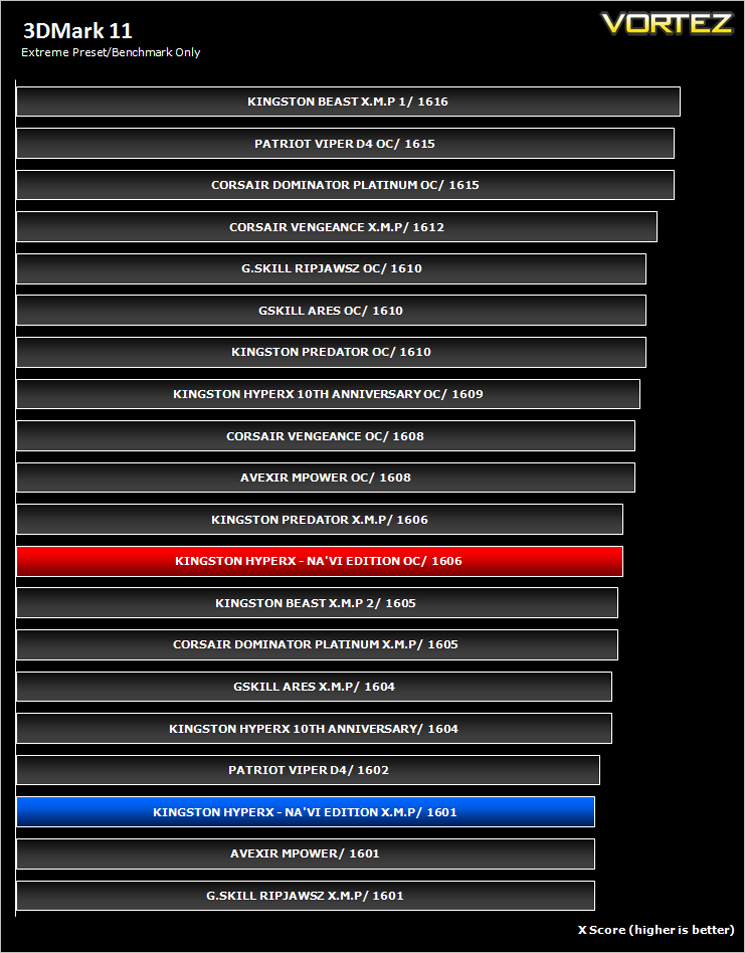
DiRT 3
As players race to elevate their global standing, DiRT 3 is back delivering mud, sweat and gears world over: from the intense weather-beaten rally stages of Europe, Africa and the US, to executing performance driving showcases and career challenges where car control is pushed to spectacular limits.
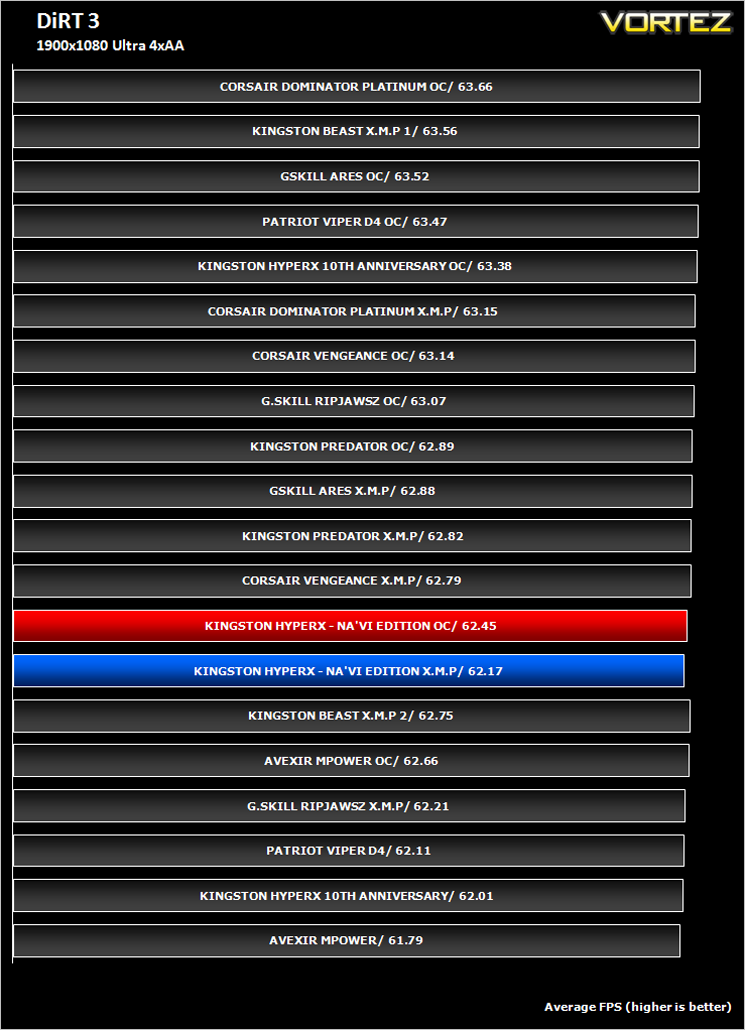
Conclusion
When we first heard of this kit we were excited because any pro gamer will want the best kit. The best in the case of memory usually equates to the fastest meaning this kit needed to both look the part and scream along at a blistering pace. If yellow is your thing then it certainly fits the bill. Even if you don’t particularly like yellow there can be no denying that the contrasting yellow heatsinks atop of a black PCB scream performance. Sadly that is where the performance of this kit ends because beneath those lush heatsinks sits nothing more than an entry level memory kit.
For a 1600MHz kit we have no complaints whatsoever as it ‘does exactly what it says on the tin’however (and here is the clincher), for a kit aimed towards a gamer, it only satisfies one of the two requirements. If 1600MHz is ‘fast enough’ and you are a big fan of yellow then this is the kit for you. For the rest of us, a ‘limited edition’ memory kit that is geared towards gaming should really be faster than this. Our last hope remained with overclocking. Surely a Kingston HyperX kit with such a low speed would be great overclockers? Sadly not because it took dangerously high voltage to extract a small increase in performance. So it appears this kit is certainly not geared towards the enthusiast either. So who would buy such a kit? Primarily it would be someone who wants the minimal of hassle, a good looking kit at a fair price and just wants to ‘plug in and go’. Speed is of little concern to the buyer of these kits.
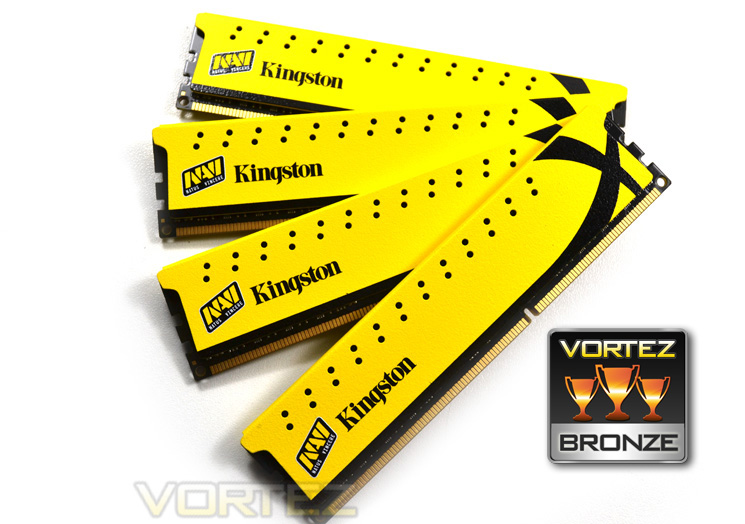
That said, it is faster than some other 1600MHz kits on the market and with relatively tight timings of 9-9-9 it should serve most entry level gaming systems well. At £120 for 16GB it is also competitively priced and with the cost of DDR3 creeping upwards, if you plan on an upgrade, now is the time to buy. Whether you opt for this kit or another will however be determined not by your craving for performance but whether you wear sunglasses while gaming on your PC!
Overall, we found the Kingston Na’Vi memory kit to be good for a 1600MHz kit but not up to our high expectations. We hoped for high performance due to the kit being endorsed by a pro gaming team. Sadly our hopes were dashed when the benchmarks unfurled and confirmed our suspicions that this is an entry level kit with entry level performance.
Pros:
+ Low Profile
+ Good looking heatsinks
+ Black PCB
+ Lifetime Warranty
+ Fair price point
Cons:
– Average performance
+ Low Profile
+ Good looking heatsinks
+ Black PCB
+ Lifetime Warranty
+ Fair price point
Cons:
– Average performance

Click here for an explanation of our awards at Vortez.net.


