The GAMING PRO CARBON AC is back under the Intel Z370 chipset. Can this sleek and stylish motherboard squeeze the most out of the Intel Core i7-8700K?

Product on Review: Z370 Gaming Pro Carbon AC
Manufacturer & Sponsor: MSI
Street Price: UK £200 US $230
Intel’s Coffee Lake launch has well and truly delivered the expected counter-response to AMD Ryzen and for the most part, this can certainly be regarded as a positive thing for those on the consumer and manufacturer side of the fence. Competition in this market place is great news for enthusiasts and gamers, and long may it continue!
So far in our endeavours with Intel Coffee Lake and the Intel Z370 chipset, we’ve examined a number of boards from various partners but today we’ll be putting MSI’s efforts under the spotlight.
In our hands today, we have the MSI Z370 GAMING PRO CARBON AC which, as its name suggests supplies us with 802.11ac functionality straight out of the box. Along with the WiFi capabilities, this board also arrives with dual M.2 slots, trademark MSI features like Audio Boost 4 and MYSTIC LIGHT RGB functionality.
About MSI
As a world leading gaming brand, MSI’s goal is to become the most trusted name in gaming and e-sport. We’ve dedicated countless hours and committed numerous resources to the eSports community to support the world’s most aspiring and best gamers and use their knowledge and expertise in our products in return. The insistence on 100% in-house design and manufacturing gives MSI the solid capability to implement innovative ideas and optimized design in our products.
Technical Specifications
Below are the technical specifications concerning the GAMING PRO CARBON AC:
CPU
• Supports 8th Gen Intel® Core™ i3/i5/i7 processors for Socket LGA1151
Chipset
• Intel® Z370 Chipset
Main Memory
• 4 x DDR4 memory slots, support up to 64GB
– Supports DDR4 Up to 4000MHz
• Dual channel memory architecture
• Supports ECC, un-buffered memory
– ECC UDIMM memory (non-ECC mode)
• Supports Intel® Extreme Memory Profile (XMP)
Slots
• 3 x PCIe 3.0 x16 slots (Modes: 16, 8, 4)
• 3 x PCIe 3.0 x1 slot
Onboard Graphics
• 1 x HDMI™ port (1.4b)
• 1 x Displayport™ port (1.2)
Multi-GPU
• Supports 3-Way AMD® CrossFire™ Technology
• Supports 2-Way NVIDIA® SLI™ Technology
Storage
• Intel® Z370 Chipset
• 6 x SATA 6Gb/s ports
• 2 x M.2 slots (Supports Intel Optane Memory – 8th Gen Processor required)
RAID
• Intel® Z370 Chipset
– Supports RAID 0, RAID1, RAID 5 and RAID 10 for SATA storage devices
Audio
• Realtek ALC 1220 Codec
– 7.1-Channel High Definition Audio
– Supports S/PDIF output
LAN
• 1 x Intel i219 Gigabit LAN controller
WiFi & Bluetooth
• Intel Dual Band Wireless-AC 8265 card
– Supports Wi-Fi 802.11 a/b/g/n/ac, dual band (2.4GHz, 5GHz) up to 867 Mbps speed.
– Supports Dual Mode Bluetooth® 2.1, 2.1+EDR, 3.0, 4.0, BLE, 4.2
Back Panel I/O Ports
– 1 x PS/2 keyboard/ mouse combo port
– 2 x USB 2.0 Type-A ports
– 1 x DisplayPort port
– 1 x USB 3.1 Gen2 Type-A port
– 1 x USB 3.1 Gen2 Type-C port
– 4 x USB 3.1 Gen1 Type-A ports
– 1 x HDMI™ port
– 1 x LAN (RJ45) port
– 5 x OFC audio jacks
– 1 x Optical S/PDIF OUT connector
Dimension
• 12 inch x 9.6 inch ( 30.5 cm x 24.4 cm )
• ATX Form Factor
• Supports 8th Gen Intel® Core™ i3/i5/i7 processors for Socket LGA1151
Chipset
• Intel® Z370 Chipset
Main Memory
• 4 x DDR4 memory slots, support up to 64GB
– Supports DDR4 Up to 4000MHz
• Dual channel memory architecture
• Supports ECC, un-buffered memory
– ECC UDIMM memory (non-ECC mode)
• Supports Intel® Extreme Memory Profile (XMP)
Slots
• 3 x PCIe 3.0 x16 slots (Modes: 16, 8, 4)
• 3 x PCIe 3.0 x1 slot
Onboard Graphics
• 1 x HDMI™ port (1.4b)
• 1 x Displayport™ port (1.2)
Multi-GPU
• Supports 3-Way AMD® CrossFire™ Technology
• Supports 2-Way NVIDIA® SLI™ Technology
Storage
• Intel® Z370 Chipset
• 6 x SATA 6Gb/s ports
• 2 x M.2 slots (Supports Intel Optane Memory – 8th Gen Processor required)
RAID
• Intel® Z370 Chipset
– Supports RAID 0, RAID1, RAID 5 and RAID 10 for SATA storage devices
Audio
• Realtek ALC 1220 Codec
– 7.1-Channel High Definition Audio
– Supports S/PDIF output
LAN
• 1 x Intel i219 Gigabit LAN controller
WiFi & Bluetooth
• Intel Dual Band Wireless-AC 8265 card
– Supports Wi-Fi 802.11 a/b/g/n/ac, dual band (2.4GHz, 5GHz) up to 867 Mbps speed.
– Supports Dual Mode Bluetooth® 2.1, 2.1+EDR, 3.0, 4.0, BLE, 4.2
Back Panel I/O Ports
– 1 x PS/2 keyboard/ mouse combo port
– 2 x USB 2.0 Type-A ports
– 1 x DisplayPort port
– 1 x USB 3.1 Gen2 Type-A port
– 1 x USB 3.1 Gen2 Type-C port
– 4 x USB 3.1 Gen1 Type-A ports
– 1 x HDMI™ port
– 1 x LAN (RJ45) port
– 5 x OFC audio jacks
– 1 x Optical S/PDIF OUT connector
Dimension
• 12 inch x 9.6 inch ( 30.5 cm x 24.4 cm )
• ATX Form Factor
Packaging & First Look
GAMING PRO CARBON AC arrives in a well-designed box which is in keeping with previous motherboard releases of the GAMING PRO series in the past. On the front of this box we’re left in no doubt that our motherboard is designed for gamers as, along with its name, this board sits within the performance gaming section of MSI’s portfolio.
Inside the box there are an assortment of included accessories which include:
• User Manual
• Quick Start Guide
• Register Leaflet
• Driver CD
• Rear IO Shield
• SLI HB Bridge
• Dual-band Wireless-AC 8265 Card w/ two antennas
• 4x SATA Cables
• Corsair Link Cable
• RGB lighting cables
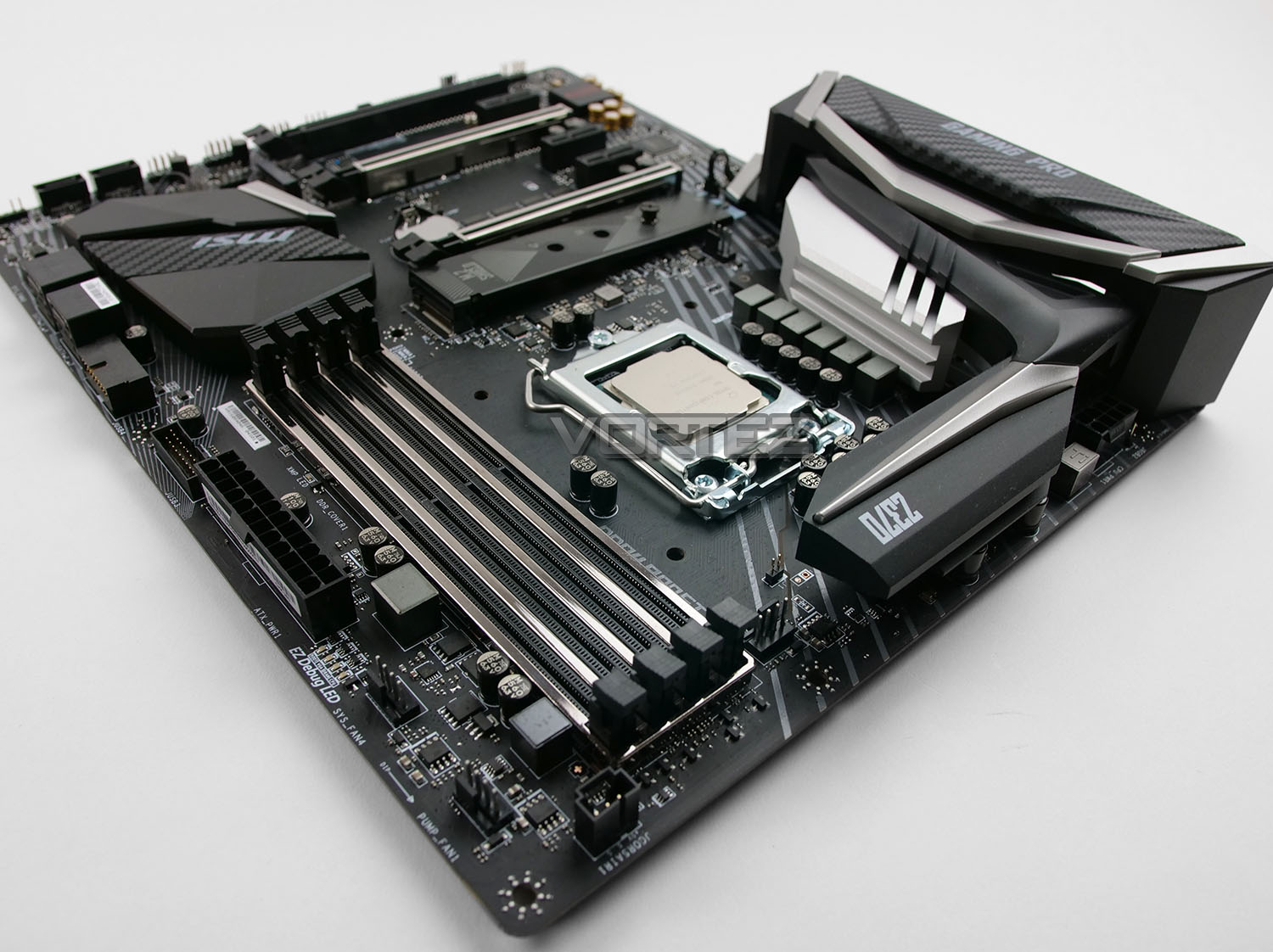
The theme of GAMING PRO CARBON AC will come as no surprise if you’ve been observing MSI’s releases under the recent HEDT platforms. Our motherboard adopts a simple design with modest styling. Black and silver are the two primary tones being used – since they are both neutral, other components will pair up nicely. Like many of the motherboards being unveiled this year, there is very little to separate or distinguish this design from another. Depending on your point of view this could be deemed good, or bad.
GAMING PRO CARBON AC conforms to the ATX form factor and therefore will install into most mid-tower cases.
Closer Look
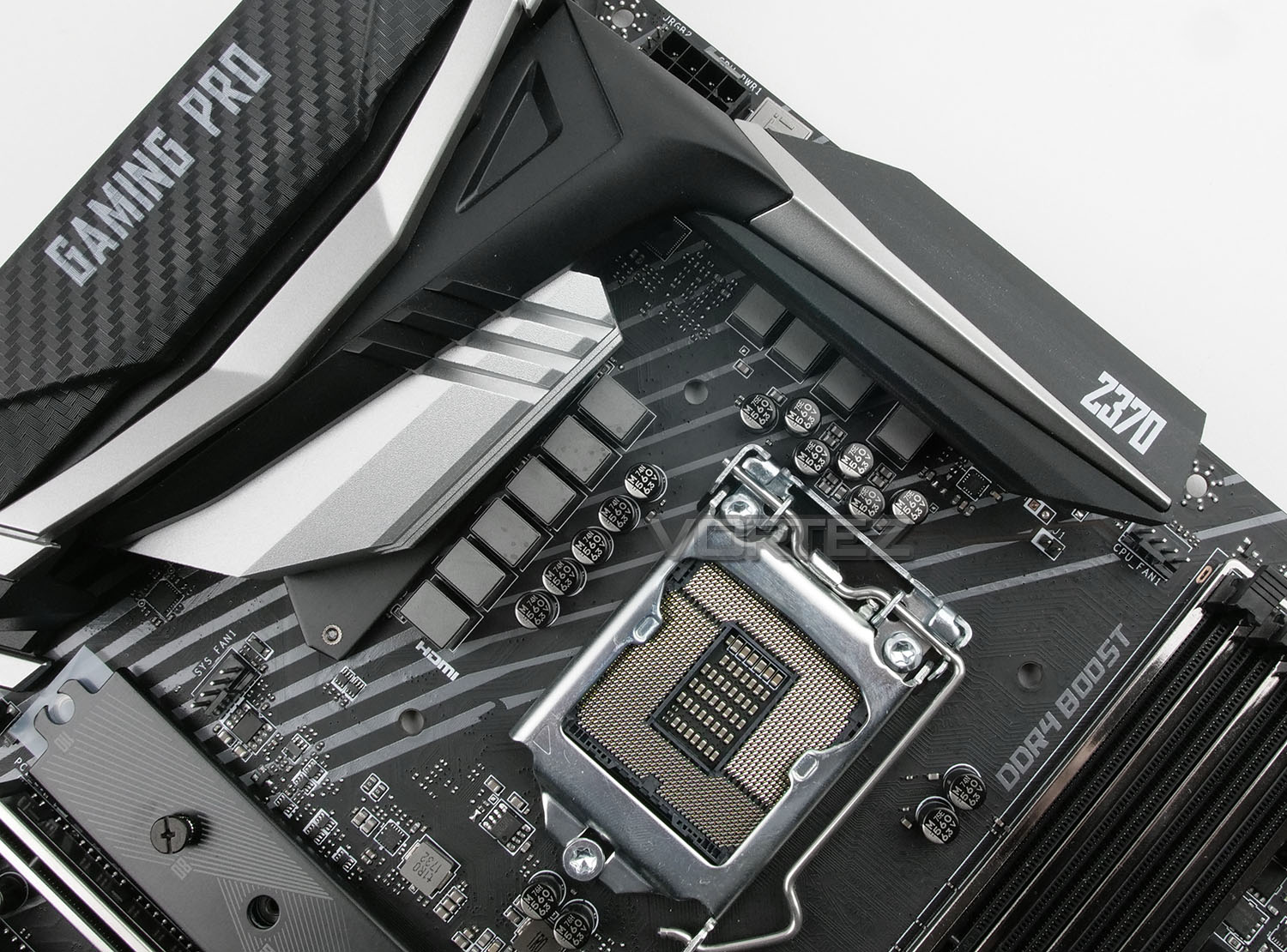
Venturing on to the finer details of our MSI motherboard, at the CPU socket we have LGA1151 being used and with the Intel Z370 chipset, this motherboard is able to work in conjunction with Intel’s 8the Generation of processors. If you do have a 7th Generation processor, it will not work.
A digital 10-phase power delivery system has been integrated onto our board and there is an 8-pin CPU EPS socket in the top-left corner. Covering the MOSFETs there are two large independent heatsinks which marry up to the plastic rear IO cover. Aesthetically, this all blends together very well.
A total of seven fan headers can be found on GAMING PRO CARBON AC. Three of these are – CPU, PUMP and Corsair LINK ready. The latter is a collaboration between MSI and Corsair which allows users to have a connection point for one of Corsair’s Hydro Series coolers.
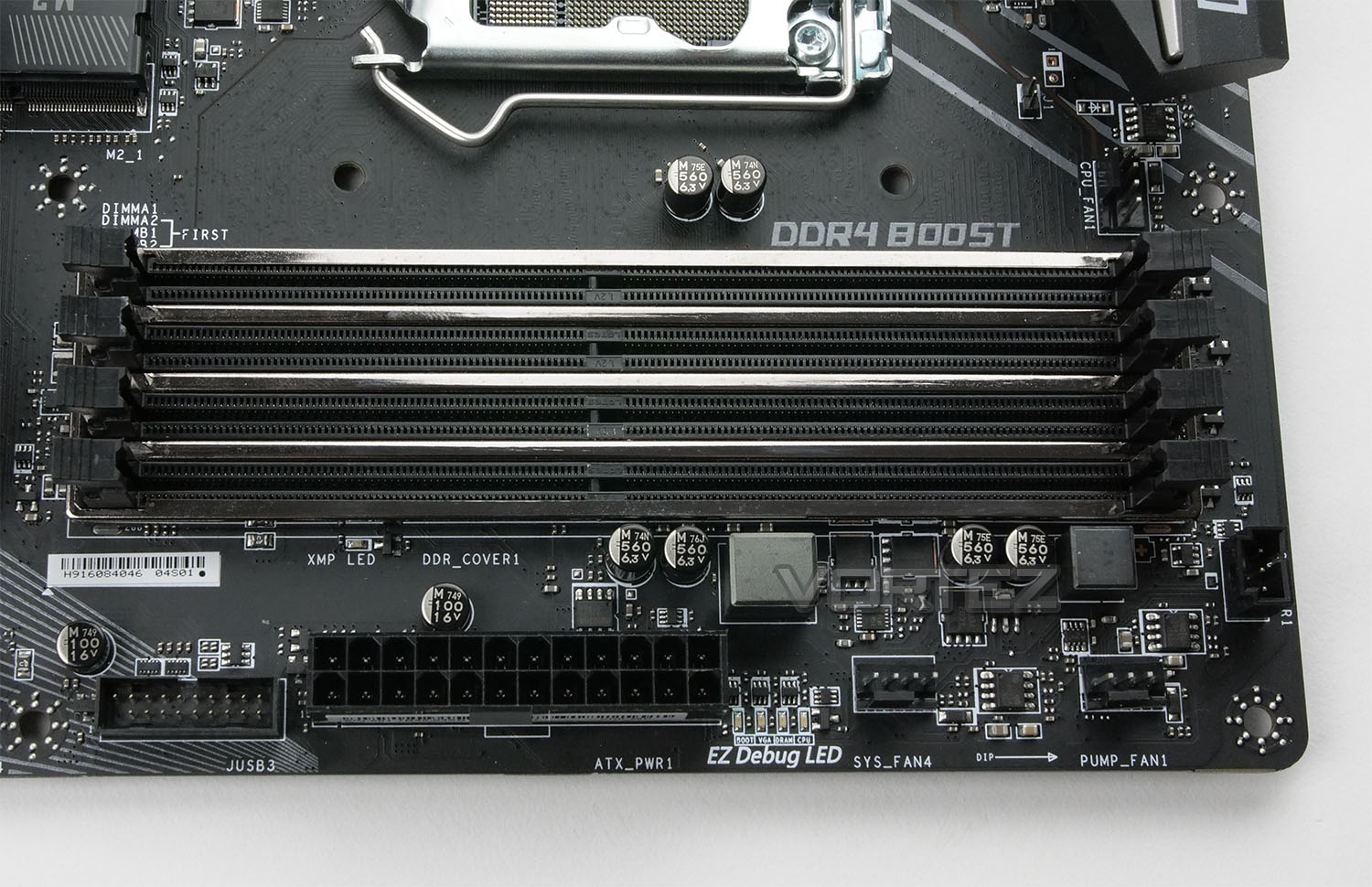
Moving on to the memory area, we have four DIMM slots capable of accommodating dual-channel DDR4 – up to 64GB, 4000MHz and XMP is supported. There is even a tiny XMP LED to specify if XMP is enabled. MSI has given the slots some steel reinforcement to enhance the durability and it’s also worth mentioning that their DDR4 Boost technology has been applied also – this isolates the circuitry path to the CPU.
In the memory region MSI has included EZ Debug LED which indicates each stage of the boot process, easily identifying if there are any problems with BOOT, VGA, DRAM or CPU. Also included is a USB 3.0 header immediately next to the 24-pin ATX.
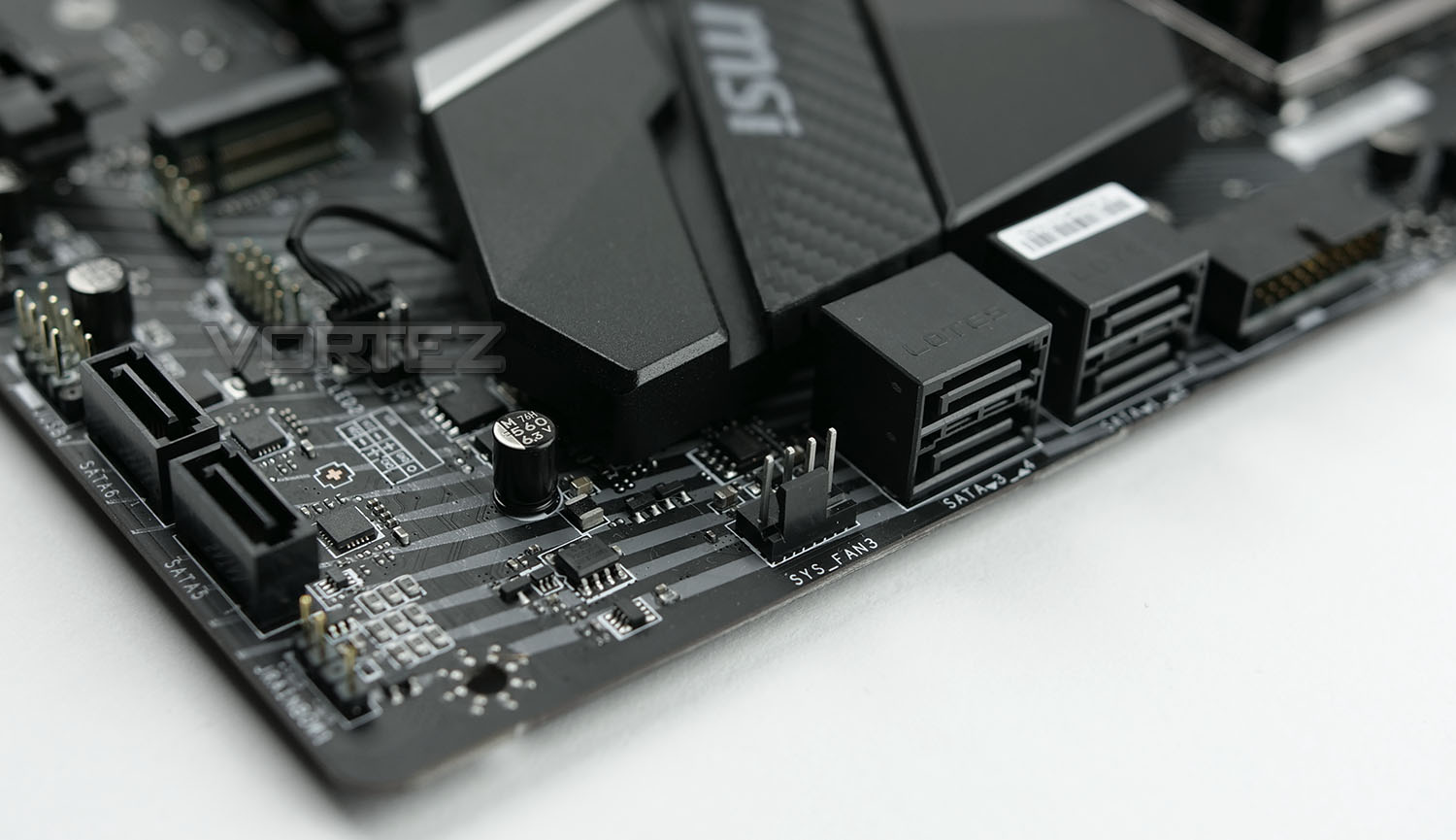
Immediately next to the storage ports we have another USB 3.0 header, this one is right-angled. Our only criticism with this is the exclusion of USB 3.1 headers. Case manufacturers are beginning to design cases with USB 3.1 on the front panel, including a compatible header would have future-proofed the motherboard.
As far as storage options go, there are six SATA 3 (6Gbps) ports – four are right-angled, while two are top facing.
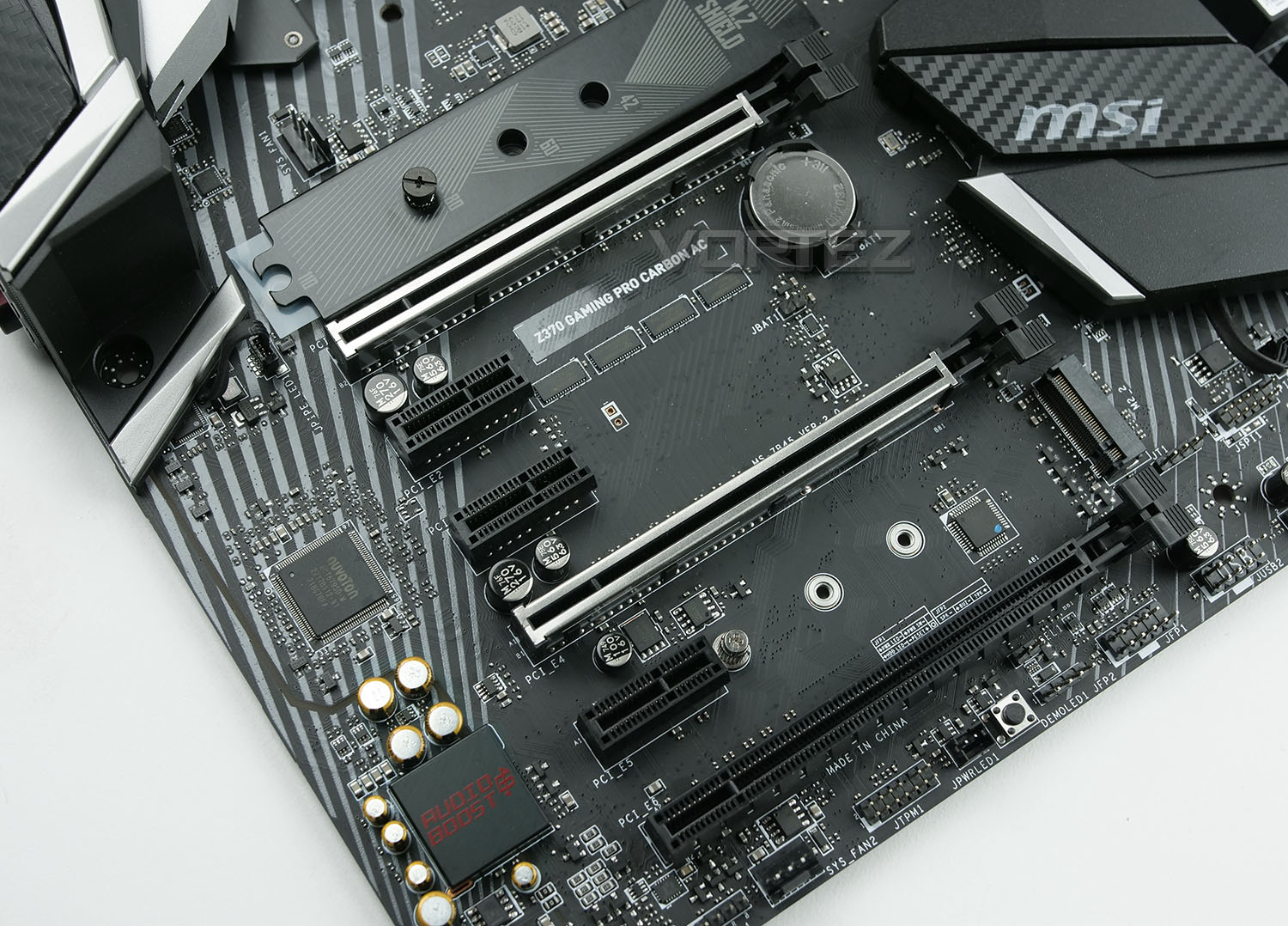
Storage continues when we look at the PCI Express section too. Included on GAMING PRO CARBON AC are two M.2 slots which are PCI Express Gen3 x4 and Intel Optane Ready. The upper M.2 slot provides an “M.2 Shield” which is claims to reduce temperatures on M.2 drives – a thermal pad sits underneath and attaches to the chips on the M.2 drive and we have support for 42, 60 and 80mm SSDs.
Looking at the PCI Express slots specifically, this is populated by three PCI Express 3.0 X16 and three PCI Express 3.0 x1 slots. These X16s are wired for the following modes: 16, 8 and 4. The two upper X16 slots are again, reinforced with steel to help with EMI protection and particularly heavy graphics cards which can stress standard slots.
Taking care of the audio (to the left of the PCI Express), we have Audio Boost 4 which is driven by dual Realtec ALC1220 codec. This audio solution comprises of:
• Chemicon Audio CAPs
• Dedicated Headphone AMP
• De-Pop Protection
• Separated Audio Layers
All of which are physically isolated and the trace line has RGB lighting.
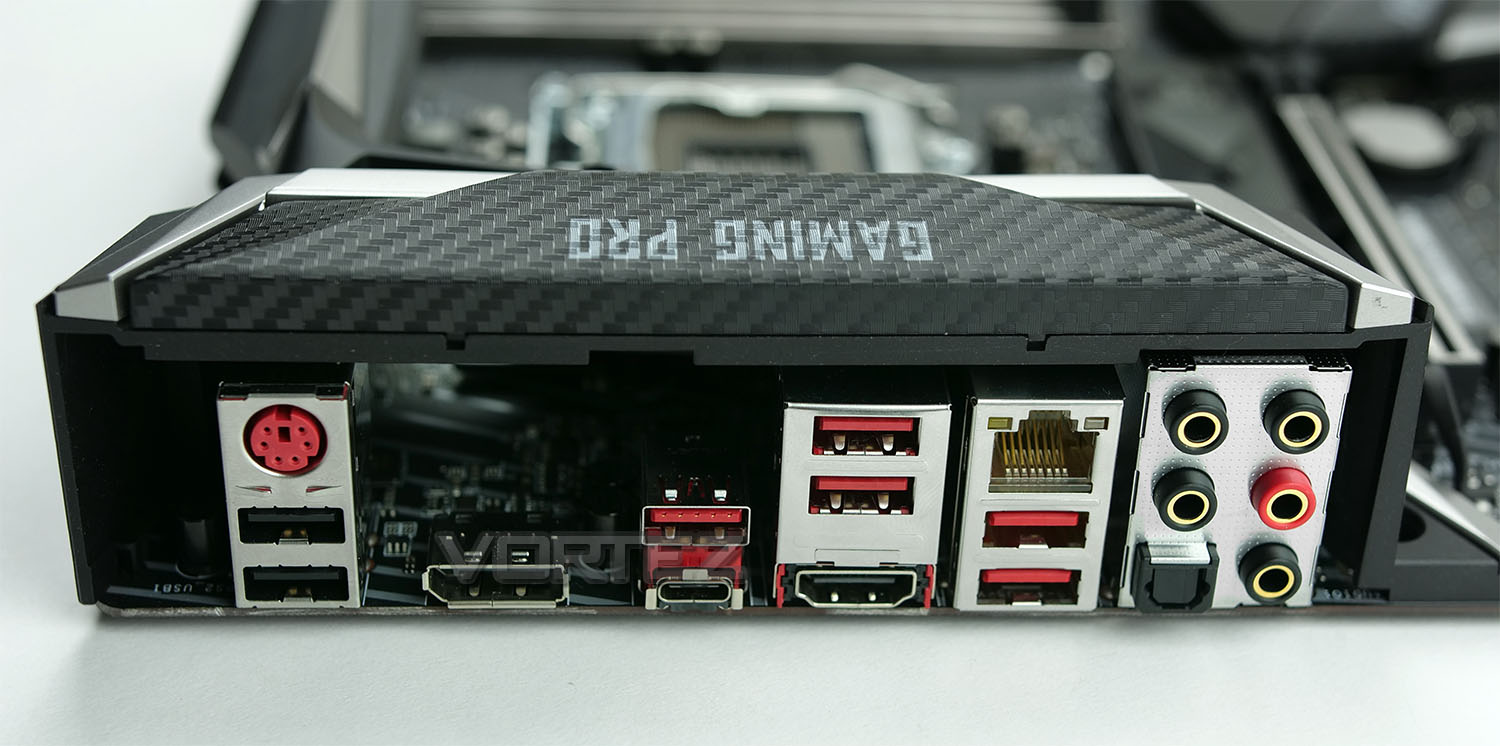
Last of all we arrive at the Rear IO section which includes:
– 1 x PS/2 keyboard/ mouse combo port
– 2 x USB 2.0 Type-A ports
– 1 x DisplayPort port
– 1 x USB 3.1 Gen2 Type-A port
– 1 x USB 3.1 Gen2 Type-C port
– 4 x USB 3.1 Gen1 Type-A ports
– 1 x HDMI™ port
– 1 x LAN (RJ45) port
– 5 x OFC audio jacks
– 1 x Optical S/PDIF OUT connector
Along with the Gigabit LAN port for wired connections, there is also the option to utilise WiFi with this “AC” version of MSI’s motherboard. Included in the bundle we have an Intel Dual Band Wireless-AC 8265 card which offers 802.11ac and Bluetooth 4.2 technologies, a handy inclusion if you aren’t within distance of the router.
Test Setup, Methodology & Overclocking
Test Setup
CPU Intel Core i7-8700K
Cooling Corsair H100i GTX
Motherboard MSI Z370 Gaming Pro Carbon AC
Memory 16GB Corsair Vengeance LPX 3000MHz
Graphics GIGABYTE GTX 1080 G1 Gaming
Storage OCZ Vector 180 240GB SSD
PSU Corsair HX1050 80 Plus Gold Certified PSU
Monitor AOC U2879VF
Capture Device Epiphan AV.iO 4K
Cooling Corsair H100i GTX
Motherboard MSI Z370 Gaming Pro Carbon AC
Memory 16GB Corsair Vengeance LPX 3000MHz
Graphics GIGABYTE GTX 1080 G1 Gaming
Storage OCZ Vector 180 240GB SSD
PSU Corsair HX1050 80 Plus Gold Certified PSU
Monitor AOC U2879VF
Capture Device Epiphan AV.iO 4K
Benchmarks
Cinebench R15 – CPU/OpenGL Score
x264 HD 4.0 – 1st and 2nd pass encoding
SiSoftware SANDRA – CPU & Memory benchmarks
POV-RAY – CPU benchmarks
TrueCrypt – CPU benchmarks
AIDA64 – CPU benchmarks & Memory
PCMark 8 – Home Suite & Photoshop
3DMark FireStrike – 3D Benchmark
Games – Rise of the Tomb Raider & Total War: WARHAMMER
x264 HD 4.0 – 1st and 2nd pass encoding
SiSoftware SANDRA – CPU & Memory benchmarks
POV-RAY – CPU benchmarks
TrueCrypt – CPU benchmarks
AIDA64 – CPU benchmarks & Memory
PCMark 8 – Home Suite & Photoshop
3DMark FireStrike – 3D Benchmark
Games – Rise of the Tomb Raider & Total War: WARHAMMER
Other Software
Temperature Analysis: Real Temp
Stress Testing Software: AIDA64 Stability Test
CPU Specification Monitoring: CPU-Z
Stress Testing Software: AIDA64 Stability Test
CPU Specification Monitoring: CPU-Z
Overclocking
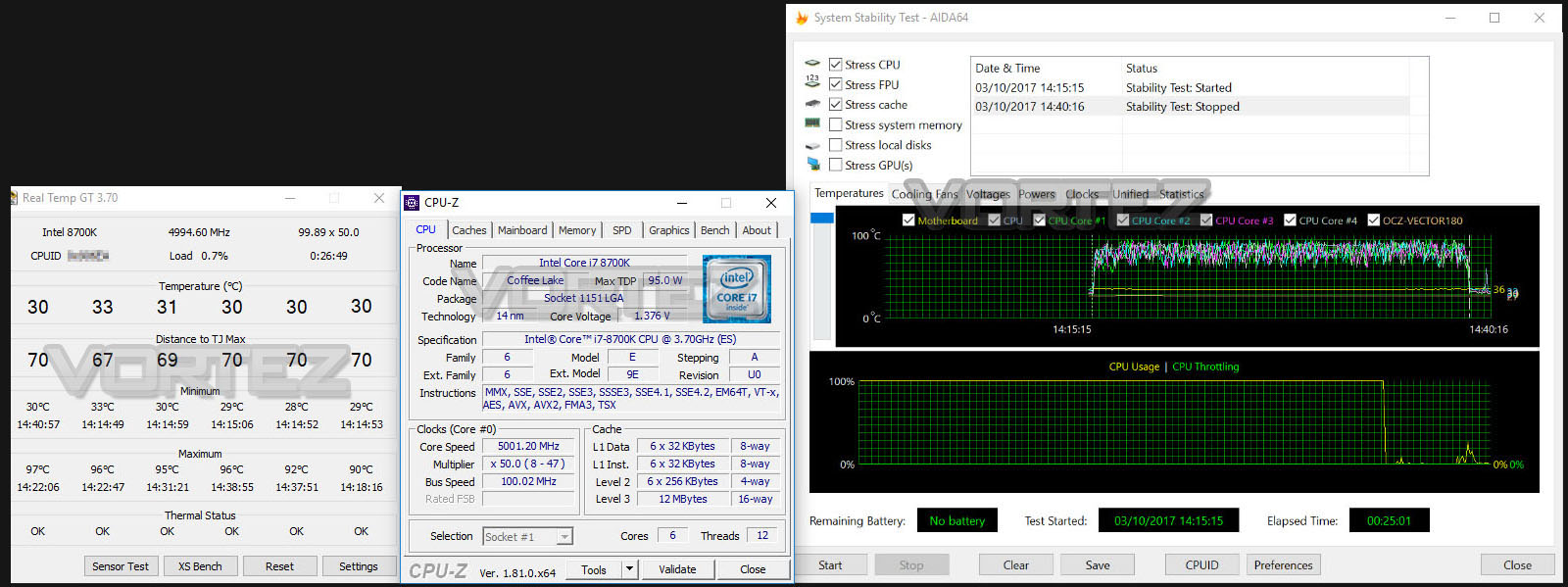
Like previous generations, the Intel Core i7-8700K is unlocked and also has flexible attributes in terms of the BCLK and ratio/multiplier. This makes the job of overclocking much easier.
We managed to nudge the 8700K up to the current milestone of 5GHz. To achieve this result we needed to use 1.39v. This was the lowest possible voltage at such a frequency and adding more voltage to nudge up the frequency was unsuccessful.
Benchmarks: Power Consumption
It’s interesting to note the power consumption across all motherboards. Although they are using the Z370 chipset, energy results can fluctuate between manufacturers due to the features and specifications that are integrated. First of all, for the idle tests the system is cold booted into Windows and no additional applications are executed – the watts are noted on the external energy monitor we use and then the system is loaded with 3DMark FireStrike – watts are again monitored for the duration of the test and the highest rated wattage result is then noted down. Below are the results of this energy test.
Benchmarks: Cinebench R15
CINEBENCH is a real-world cross platform test suite that evaluates your computer’s performance capabilities. CINEBENCH is based on MAXON’s award-winning animation software CINEMA 4D, which is used extensively by studios and production houses worldwide for 3D content creation. MAXON software has been used in blockbuster movies such as Iron Man 3, Oblivion, Life of Pi or Prometheus and many more.
Benchmarks: X264 HD
Simply put, this test measures how fast your machine can encode a short, DVD quality MPEG-2 video clip into a high-quality x264 video clip. What’s x264, you ask? It’s more or less the next-generation Xvid/DivX codec. I think it’s ideal for a benchmark because the application (x264.exe) reports fairly accurate compression results (in frames per second) for each pass of the video encoding process, and it uses multi-core processors very efficiently.
Benchmarks: SiSoftware SANDRA
SANDRA isn’t always a benchmark that is included in hardware reviews but we believe it shouldn’t be ignored. SANDRA provides a vigorous package that tests your system in a rather large array of benchmarks. There are many aspects of benchmark that can be executed. We will be considering – CPU and memory tests.
Benchmarks: POV-RAY
Persistence of Vision Raytracer’s PovRay is a free and open source 3D animator application with versions for computers with different operating systems.
This product allows users to build their custom 3D worlds with excellent quality despite their computer’s hardware. It has adjustable options for levels of radiance, refraction, and reflection. Calculation time may vary depending on the computer model, but PovRay can adapt to many computer builds, and is supported by the open source community.
This product allows users to build their custom 3D worlds with excellent quality despite their computer’s hardware. It has adjustable options for levels of radiance, refraction, and reflection. Calculation time may vary depending on the computer model, but PovRay can adapt to many computer builds, and is supported by the open source community.
Benchmarks: TrueCrypt
TrueCrypt is a discontinued source-available freeware utility used for on-the-fly encryption (OTFE). It can create a virtual encrypted disk within a file or encrypt a partition or (under Microsoft Windows except Windows 8 with GPT) the entire storage device (pre-boot authentication).
Benchmarks: AIDA64
AIDA64 Product PageThis simple integer benchmark focuses on the branch prediction capabilities and the misprediction penalties of the CPU. It finds the solutions for the classic “Queens problem” on a 10 by 10 sized chessboard. At the same clock speed theoretically the processor with the shorter pipeline and smaller misprediction penalties will attain higher benchmark scores. For example — with HyperThreading disabled — the Intel Northwood core processors get higher scores than the Intel Prescott core based ones due to the 20-step vs 31-step long pipeline. CPU Queen test uses integer MMX, SSE2 and SSSE3 optimizations.
Benchmarks: PCMark 8 & PCMark 10
PCMark 8 combines performance benchmarking with battery life measurement and includes tests based on popular Adobe and Microsoft applications. Whether you are looking for long battery life, or maximum power, PCMark 8 will help you find the devices that offer the perfect combination of efficiency and performance for your needs. It’s the complete PC performance benchmark for home and business.
Benchmarks: PCMark 8 Photoshop
The PCMark 8 Applications benchmark measures system performance using popular applications from the Adobe Creative Suite and Microsoft Office. You can choose which tests to run based on the applications installed on your system. Each test automatically steps through a series of actions such as opening, editing and saving a file. The results are used to calculate the PCMark 8 Applications scores for the system.
Benchmarks: 3DMark FireStrike & TimeSpy
3DMark FireStrike Product PageFire Strike is our new showcase DirectX 11 benchmark designed for high-performance gaming PCs. It is our most ambitious and technical benchmark ever, featuring real-time graphics rendered with detail and complexity far beyond what is found in other benchmarks and games today. Fire Strike will only be available in the Windows editions of 3DMark initially.
Benchmarks: ROT Tomb Raider & Total War: WARHAMMER
It’s important for us to perform a number of game benchmarks as well as the synthetic tests because gamers will want to know if there are any significant benefits. So here we have two recent gaming titles.
Conclusion
So far in our venture into the world of Intel’s Z370 chipset we’ve experienced some capable mid-range options and in today’s review we’ve clearly seen what MSI brings to the table in their GAMING PRO CARBON AC.
Casting a look back to the Z270 GAMING PRO CARBON, we can see quite a positive improvement with this new Z370 variant from a visual standpoint. MSI has tweaked the design somewhat and it definitely looks more aggressive while still maintaining the popular, neutral theme that a variety of brands are pursuing at the moment.
There actually isn’t a lot that separates this motherboard from other mid-range solutions we’ve already encountered. The differentiator which sits in MSI’s favour would probably boil down to the inclusion of wireless connectivity with the 802.11ac and Bluetooth add-in card. Though we are paying an extra £20-30 and we don’t get some extras we’d expect, like a USB 3.1 header.
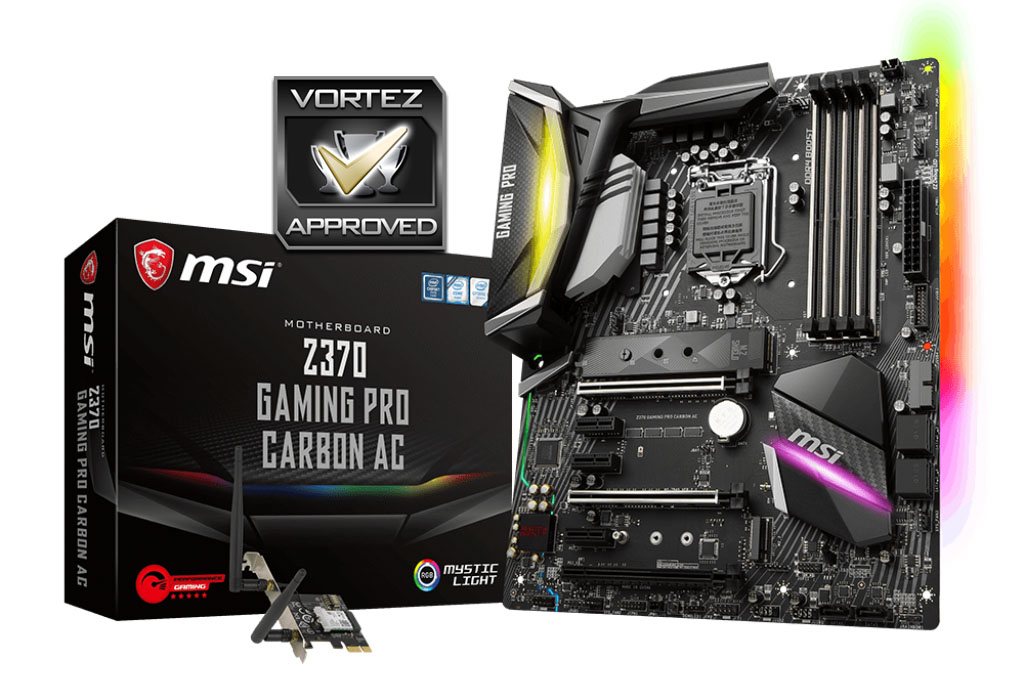
Feature-wise, this motherboard does carry quite an extensive set of options for those wanting to get the most out of Intel’s 8th Generation processors. There is support for up to 4000MHz DDR4, dual M.2 slots with an M.2 shield, RGB headers and RGB lighting out of the box and a plethora of fan headers – including one which is specially designed to work in conjunction with Corair’s LINK technology.
Shifting on to the performance, MSI’s efforts do not shy away from delivering great performance in a range of different scenarios. Against other boards, GAMING PRO CARBON AC managed to provide us with reliable results, and even managed to allow us to overclock our 8700K to 5GHz, which is currently our best result.
Current pricing means that Z370 GAMING PRO CARBON AC is positioned at £200 / $220. This is nudged up by the wireless capabilities, but looking at other options of the same calibre (minus the WiFi) and there are boards for around £160-180 boasting equivalent features/performance. However, there aren’t many options which include WiFi and if this is a must, then GAMING PRO CARBON AC is a great choice!
MSI’s Z370 GAMING PRO CARBON AC is doesn’t shy away from showcasing top-class features and performance. Gamers unable to use a wired LAN connection will be pleased to know wireless connectivity too!
Pros
+ Neutral, desirable theme
+ Arrives with 802.11ac + Bluetooth 4.2
+ Includes RGB features
+ Excellent performance
+ Great for overclocking
+ Uses strengthened PCI Express & memory slots
+ Plenty of fan headers inc. Corsair LINK
+ Features dual-M.2
+ Decent audio capabilities
Cons
– Pricey
– No USB 3.1 header
+ Neutral, desirable theme
+ Arrives with 802.11ac + Bluetooth 4.2
+ Includes RGB features
+ Excellent performance
+ Great for overclocking
+ Uses strengthened PCI Express & memory slots
+ Plenty of fan headers inc. Corsair LINK
+ Features dual-M.2
+ Decent audio capabilities
Cons
– Pricey
– No USB 3.1 header
Click here for an explanation of our awards at Vortez.net.
Stay connected with Vortez social media pages: