







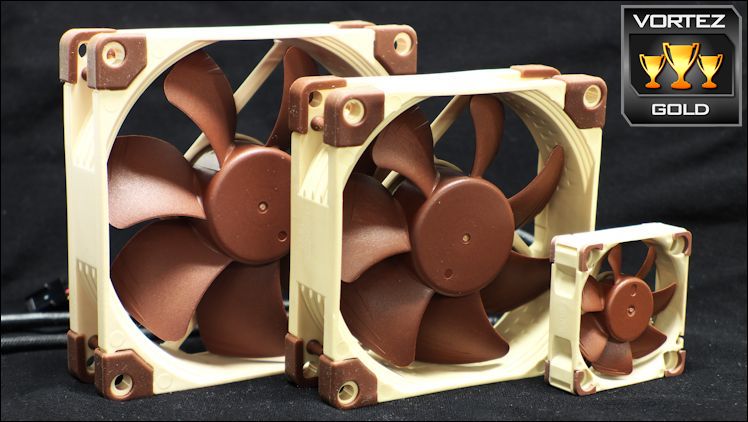
Noctua recently announced new additions to the A series cooling fan range in the form of 40mm, 80mm and 92mm options. Today we look at them in close detail.

Product on Review:
NF-A9 FLX, NF-A9 PWM
NF-A8 FLX, NF-A8 PWM, NF-A8 ULN
NF-A4x10 5V
Manufacturer & Sponsor: Noctua
Street Price:
NF-A9 (PWM / FLX): EUR 17.90 / USD 20.90
NF-A8 (PWM / FLX / ULN): EUR 15.90 / USD 17.90
NF-A4x10 5V: EUR 12.90 / USD 15.90
Noctua has added to their A-series by giving us a collection of smaller fans. Their line now runs from 40mm to 140mm. But do the smaller fans hold up their end? Do they perform as well for their size as their larger brethren do? Noctua sent us 40mm, 80mm and 92mm fans. Let us run them through their paces and see how they do.
Noctua is well-known for its premium fans, the complete set of accessories that accompany each of these fans, and the elegant packaging that protects them all. These fans are no different, but they come with Noctua’s A-series packaging, the accessories labeled with model numbers, and the A-series suite of acoustic and aerodynamic features built in to each fan.
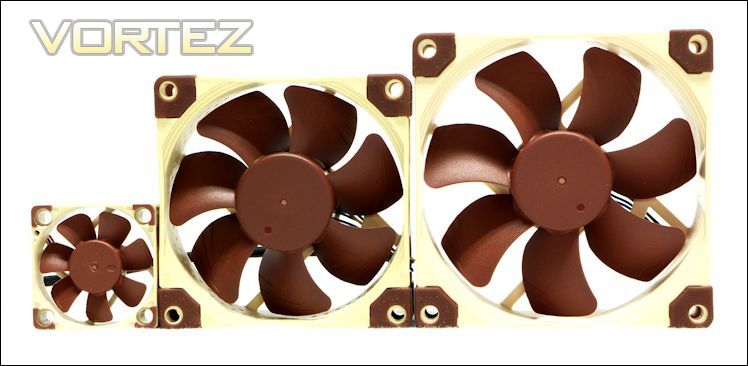
It makes sense that Noctua would build 80mm and 92mm fans. In compact systems, some case fans are 80mm and 92mm; some CPU heatsinks use 92mm fans. But why do they need a 40mm fan? Noctua told Vortez:
Most of the 40mm and 60mm fans we sell in retail are used to replace broken or noisy units in devices such as network or storage solutions. This is also why we came up with the 5V version because some of these need 5V instead of 12V. This is also why we include the OminJoin adaptor set because it allows you to run the fan on proprietary connectors without doing any soldering.
We sell in bulk or customised packaging to our industrial clients of course.
We sell in bulk or customised packaging to our industrial clients of course.
Curious about this OmniJoin fastener? You can read about it in the NF-A4x10 5V user’s manual (PDF). That’s another thing about Noctua’s A-series fans: they all come with Users Manuals, and those manuals can all be accessed on line PDF’s. That allows you to download them and enlarge them to whatever magnification you need. That’s a feature you will begin to appreciate as you advance into your 40’s. Noctua follows this accessibility feature as a standard practice.
Specifications
Gathered together here are the specifications for the fans being tested for this review. You can see that someone has been thinking hard about the specs of these fans. For example, the PWM fans have a maximum speed consistently higher than the FLX fans. Considering that the variable speed of a PWM fan only maxes out when the demand is greatest, and the fan usually runs at an intermediate speed, having the higher headroom makes sense – it is quiet most of the time but has the extra output when you really need it. If you don’t need that max, Noctua sends you a Low Noise Adapter that limits the speed the fan can go.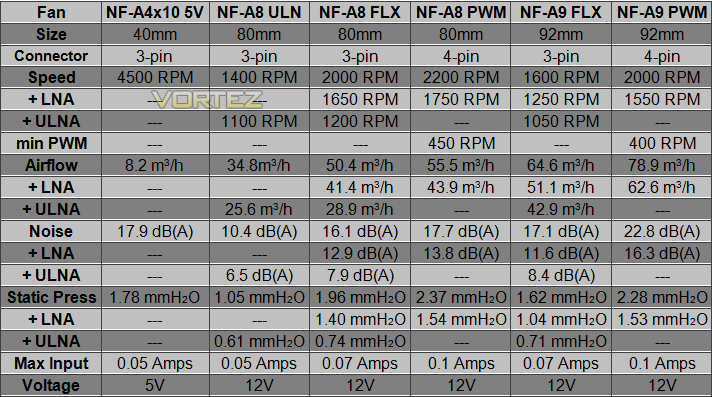
Another point to ponder is this: Noctua provides you with the static pressure of each fan with each intermediate setting. This is the kind of fine-grained specification you don’t often see with other brands.
Packaging and bundle
Noctua has a standard box and a standard two-piece plastic shell that protects each of its premium fans. The plastic covers are visible from the fronts of the boxes, as you can see in the bottom picture of page 1 of this review. Close the covers and you can see a consistent front view that tells you exactly what kind of fan is inside.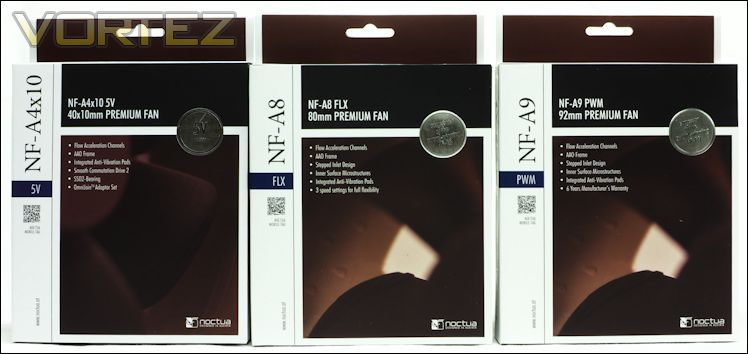
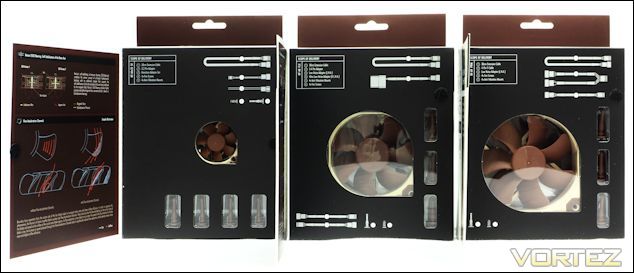
These boxes fold out to show you the fans, their accessories and their features.
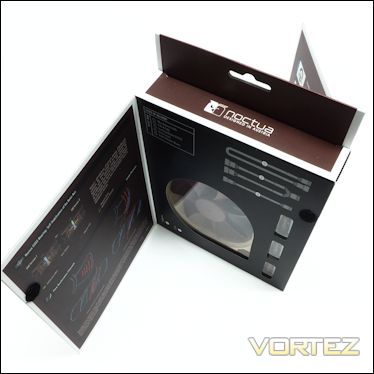
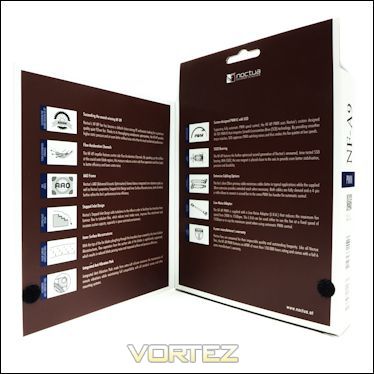
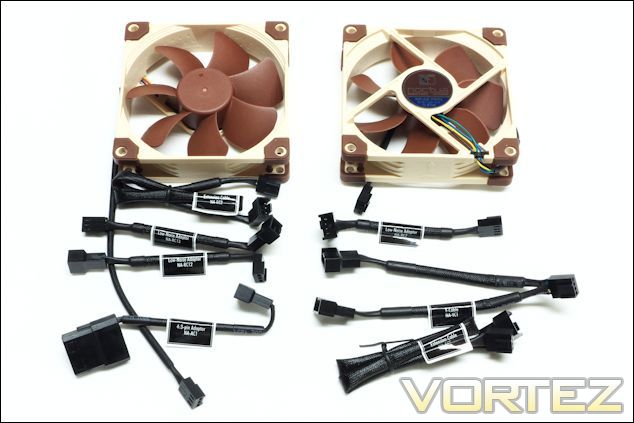
Each fan comes with its own specific set of accessories. The accessories may be standard, but the choice is customised for each fan:
NF-A4x10 5V: 3:2 Pin Adaptor, OmniJoin Adaptor Set, 30cm Extension Cable, 4 Vibration-Compensators and 4 Fan Screws.
NF-A8 ULN: Ultra-Low-Noise Adaptor (U.L.N.A.), 3:4-Pin Adaptor, 30cm Extension Cable, 4 Vibration-Compensators and 4 Fan Screws.
NF-A8 FLX: Low-Noise Adaptor (L.N.A.), Ultra-Low-Noise Adaptor (U.L.N.A.), 3:4-Pin Adaptor, 30cm Extension Cable, 4 Vibration-Compensators and 4 Fan Screws.
NF-A8 PWM: Low-Noise Adaptor (L.N.A.), 4-Pin Y-Cable, 30cm Extension Cable, 4 Vibration-Compensators and 4 Fan Screws.
NF-A9 FLX: Low-Noise Adaptor (L.N.A.), Ultra-Low-Noise Adaptor (U.L.N.A.), 3:4-Pin Adaptor, 30cm Extension Cable, 4 Vibration-Compensators and 4 Fan Screws.
NF-A9 PWM: Low-Noise Adaptor (L.N.A.), 4-Pin Y-Cable, 30cm Extension Cable, 4 Vibration-Compensators, 4 Fan Screws.
All come with the standard Noctua 6-year warranty and their world-class customer service. And each fan features an AAO frame for (Advanced Acoustic Optimisation), Flow Acceleration Channels to reduce suction side flow separation, and “inner surface microstructures.” Noctua says
With the tips of the fan blades ploughing through the boundary layer created by the Inner Surface Microstructures, flow separation from the suction side of the blades is significantly suppressed, which results in reduced blade passing noise and improved airflow and pressure efficiency.
The only drawback is literally a shortcoming: the vibration absorbers that come with these fans do not protrude through the entire frame; you cannot grab them and pull them through.
A Closer Look at the NF-A9 FLX and PWM
The NF-A9 differs greatly from the NF-B9, as you can see: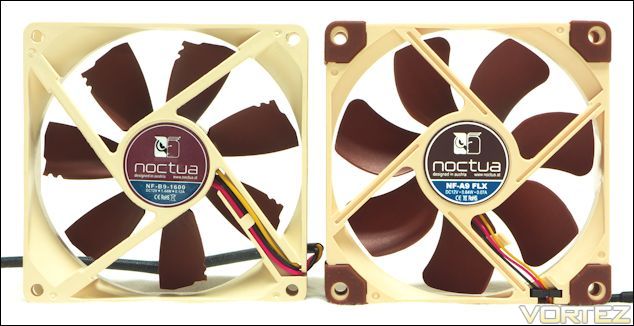
All Noctua premium fans come encased in a plastic shock-absorbing shell. With the clear plastic cover off, the NF-A9 looks like this:
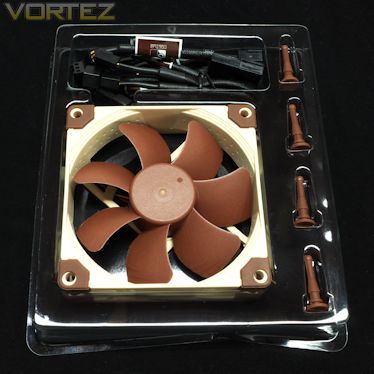
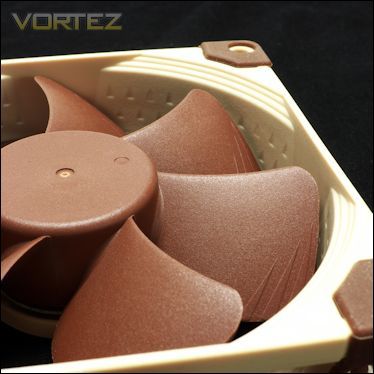
In the second picture you can see the various features of Noctua’s A Series — the AAO, the stepped inlet, for example. Of the inlet, Noctua says:
Our Stepped Inlet Design adds turbulence to the influx in order to facilitate the transition from laminar flow to turbulent flow, which reduces tonal intake noise, improves flow attachment and increases suction capacity, especially in space restricted environments.
One can also see the Flow Acceleration Channels and the Inner Surface Microstructures that will be constant features of all these fans. Of the flow acceleration channels, Noctua says:
By speeding up the airflow at the crucial outer blade regions, Flow Acceleration Channels reduce suction side flow separation and thus lead to better efficiency and lower vortex noise.
You can really see the Inner Surface Microstructures.
As noted previously, each fan has a custom set of accessories. By looking at the more important accessories, one can see how accessories for an NF-A9 FLX differ from accessories for an NF-A9 PWM.
A Closer Look at the NF-A8 ULN, FLX and PWM
The NF-R8 is a fine fan. As you will see, the NF-A8 is a better one. Below we can see that the R8 was a really good try, a fan you wouldn’t hesitate to put in your system. And yet it looks plain next to the A8: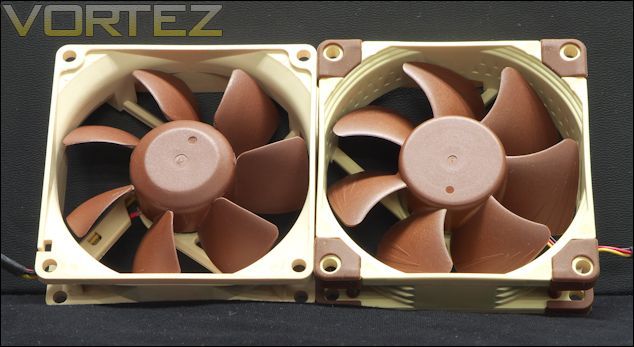
The NF-A8 fans look good, front and back.
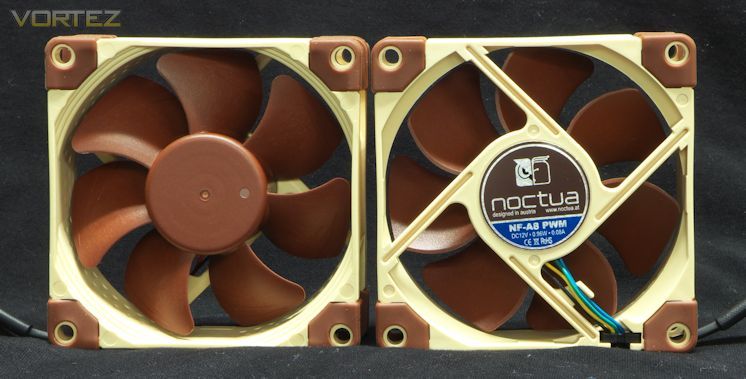
In most ways, it is very similar to its big brother. The difference is that there is a quieter ULN version of this fan available.
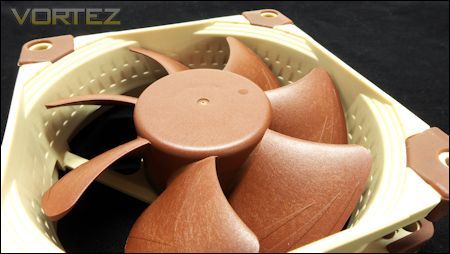
Note the various features visible here. Pretty fancy for a small fan.
A Closer Look at the NF-A4x10 5V
There is no earlier version of the NF-A4x10 to look at. The fan comes in a full-sized box, nestled in a full-sized plastic case. What Noctua didn’t tell you in the specs is that this little fan is only 10mm thick.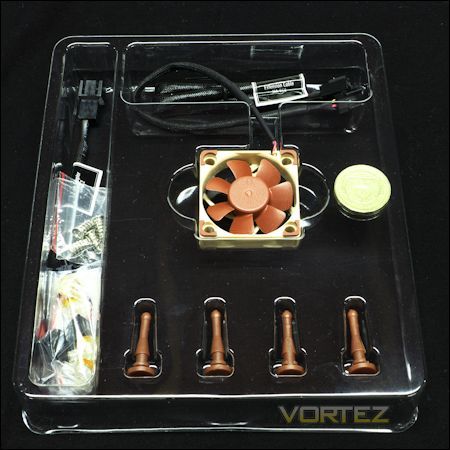
The gold colored disk on the case is a one pound coin, BTW. It was included for perspective.
The NF-A4x10 5V also comes with accessories. The OminJoin adaptor set allows you to crimp wires together. You only need two, but Noctua included four – I guess so you can destroy a couple, or move the fan. The PDF file that tells you how to use them is here.
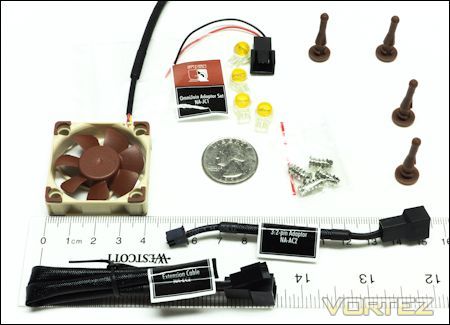
The 3:2 adaptor allows you to plug into a 2-lead socket and connect with a 3-pin fan connector.
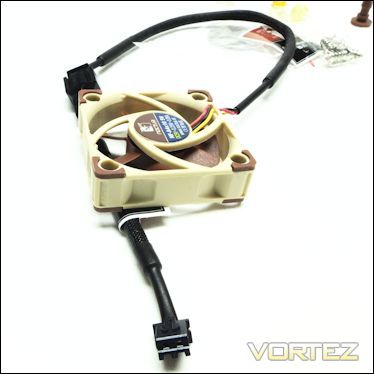
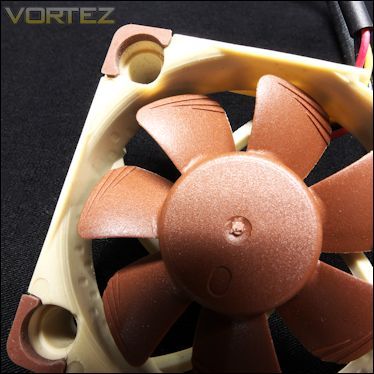
And the closeup reveals that even this tiny little fan has the AAO, the stepped inlet, the Flow Acceleration Channels and the Inner Surface Microstructures.
Testing Setup
Fans have four performance aspects that can be measured: their speed (RPM), the noise they make (approximated by measuring the Sound Pressure Level), the amount of air they push (CFM, for example) and their static pressure (here, in mmH2O). Since Noctua fans report their RPM’s, the speed can be obtained directly from software. SPL (in dBA) and CFM must be measured. The measurement tools used in this review are the Tenma 72-942 SPL meter and the Extech AN100 Anemometer.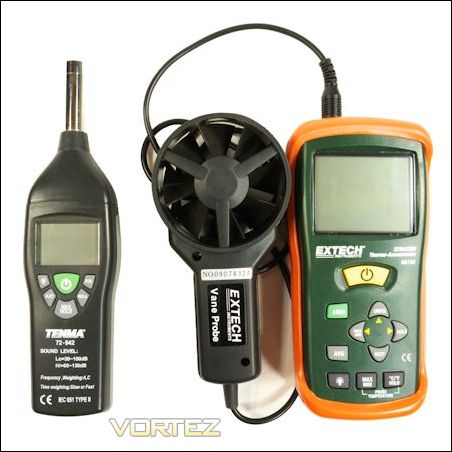
The Tenma is advertised as measuring sound pressure levels accurately down to 30 dBA. Not coincidentally, 30 dB is the SPL of what sounds like silence to you (so much for equating SPL with perceived noise). Outside of a room-sized anechoic chamber, a 31-dB basement is about as quiet a place as any to measure SPL. These Noctua fans had their SPL measured at 10 cm. A correction was applied to give the equivalent of the industry-standard 1 meter. While this is not a perfect system, it does give you a practical measure of how loud each fan is.
Fans have hubs, so the airflow is annular. The airflow also changes as you get further from the centre of the fan. To get a single measurement of the airflow from a fan you must mix the air before you measure that flow. Special testing boxes were made to test these fans, with inlet and outlet holes fitted to each size class. Basically, the theory is that what goes in must come out. You measure what comes out. The anemometer can average measurements; each run represents an average of at least 10 readings.
The one exception to the foregoing comes with the 40mm fan. A special testing box was made with an entrance hole fitted to the fan (40mm), and the exit hole fitted to the measuring head of the anemometer (70mm). This anemometer is designed to be placed in an airstream and measure to flow. It is not designed to capture the whole flow, but it should give us a decent approximation.
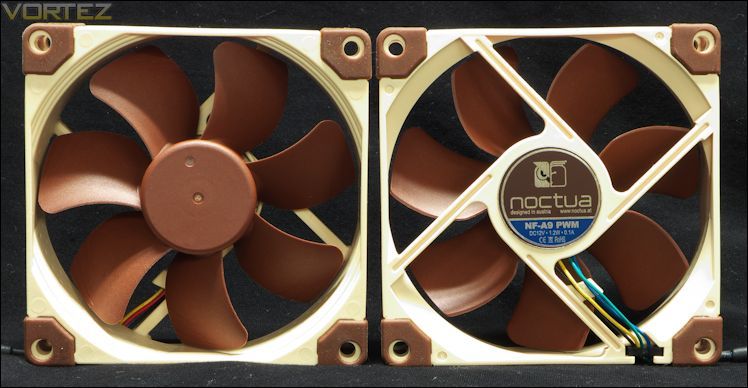
Noctua sent pairs of each one of these fans for testing:
Results of Testing
You may wish to grab a drink and a snack at this point: it’s a long chart for you to read. The chart below sets out all the fans we have reviewed. The older fans are represented by single specimens. The new A-Series fans came in pairs, so they were tested in pairs. The average values are set out below. Remember that any reading below 20 dBA or so cannot be too accurate. If a fan’s reading is that low, it is a quiet fan.Oh yes, one thing you can’t hear: the PWM fans have no clicking at all. One thing you can’t see: even with the speed-reducing adaptor in place, the PWM fans respond to PWM speed commands.
One other item that proved fascinating we will take up at the bottom of the page, below this long chart.
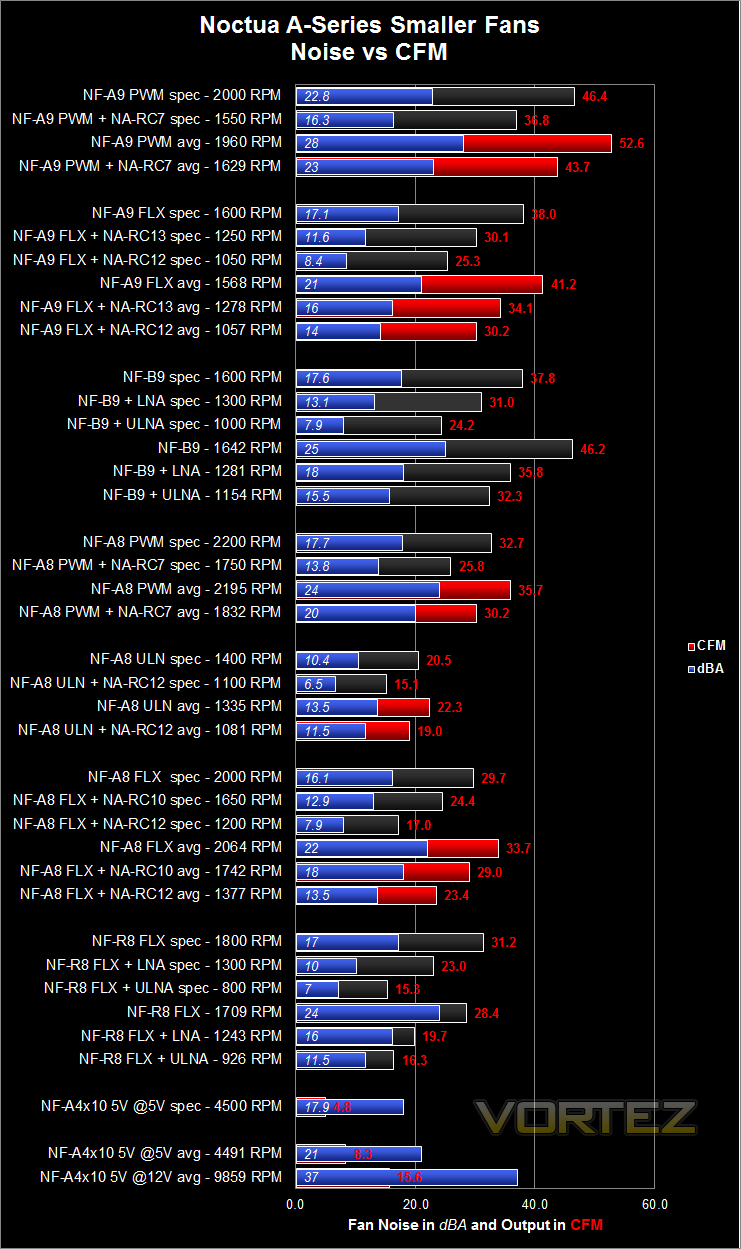
The little NF-A4x10-5V fans are designed for five Volts. Noctua warns you not to put 12 Volts through them; but the fans came with the same plugs as the 12V fans. So of course these fans got 12 Volts put though them.
Boy, are they little screamers when they have 12 Volts up their tails. You can really feel the output when they have 12V. In fact, I wasn’t going to test the 40mm fan’s output until I felt what it could do at 12V. Then I had to measure the output. The anemometer measured about 16 CFM, but it felt like more. And it didn’t sound as loud as 37 dB, either. Here is where the SPL meter registered something louder on the dBA scale than we can hear.
Ah, well. Noctua says 12V will damage these things, and I don’t doubt that they would not last their 6 years with 12V running through them. But it sure was a fun test run.
Conclusion
Noctua started with really good fans, and made them better. On 10 September of this year when Noctua introduced their smaller A-Series fans, their CEO said:
The NF-R8 and NF-B9 have become well established references in the field of quiet 80 and 92mm fans and it took us almost 3 years of development to achieve consistently better efficiency. We’re very happy with how the NF-A8 and NF-A9 turned out in the end, they really push the limits in their fields.
One thing that strikes you if you handle the old fans is that they are very good fans, so it makes sense that Noctua still sells them in their redux line. You can see why it took three years to improve those older fans. Yet these A-Series fans are better, and they can join their big brothers in the A-Series lineup.
The A-Series fans present a consistent set of features across the whole line. By itself, each feature seems like such a little thing. But each small feature contributes to the whole constellation. Those soft rubber corners, for example, really do prevent vibration from moving from the fan to your case. It is the same for each one of the other elements: the entire package of small features adds up to a solid improvement in total fan experience.
When you stock your system for years of use, high quality fans show their value. Noctua is bringing us the highest quality fans for every use. Their six-year warranty for fans is unsurpassed, and they provide world-class service to their customers.
Pros
+ They are quiet fans.
+ They have good output for such quiet fans.
+ The speed reducers still allow for PWM control.
+ The PWM circuits do not click at all. Totally Silent.
+ They come with well-chosen accessories.
+ They come in resilient packaging.
+ Each fan comes with a Users Manual
+ Each Users Manual is online as a PDF, and can be expanded so you can really see it.
Cons
– The vibration absorbers that come with these fans are too short.
+ They are quiet fans.
+ They have good output for such quiet fans.
+ The speed reducers still allow for PWM control.
+ The PWM circuits do not click at all. Totally Silent.
+ They come with well-chosen accessories.
+ They come in resilient packaging.
+ Each fan comes with a Users Manual
+ Each Users Manual is online as a PDF, and can be expanded so you can really see it.
Cons
– The vibration absorbers that come with these fans are too short.

Click here for an explanation of our awards at Vortez.net.


