







Today, we take a look at the previously reviewed KÜHLER H2O 920’s baby brother, the 620. Let’s see how it compares.

Product on Review: Antec KÜHLER H2O 620
Manufacturer and Sponsor: Antec
Street Price: £44.98
Last week, we had an in-depth look at Antec’s KÜHLER H2O 920. We concluded that despite the good performance, it was let down by its noise and reliance on high RPM fans to achieve its full potential. On the whole, it still proved to be an improvement over previous all-contained liquid cooling (ALC) units such as the CoolIT Eco and the Corsair H50, not surprising given the thicker radiator of the KÜHLER H2O 920. However, those not convinced by the price of the latter can opt for Antec’s cheaper offering, the KÜHLER H2O 620. This unit is more akin to the like of the Corsair and CoolIT mentioned above, featuring a thinner radiator than the 920 and a single fan. At around half the price of the 920, the 620 is a promising unit that features many of the former’s main advantages such as a compact package that can fit into an system regardless of size, zero-maintenance and leak-proof design, and warranty that covers any faults.
The KÜHLER H2O 620, like its bigger brother, is also based on the latest Asetek design using their third generation copper cold plate to ensure better cooling than other ALC units. As I mentioned in the previous review, Corsair’s H50 and H70 used the first generation Asetek technology so we expect the Antec KÜHLER H2O 620 to be a marked improvement over Corsair’s equivalent unit. The new units also feature a low profile CPU block and pump unit as seen on the KÜHLER H2O 920. The other notable difference between the Corsair H50 and the Antec unit is the orientation of the fan. Whereas the former is designed with a fan drawing cool air inside the chassis, the Antec features an exhaust fan instead to extract hot air from the radiator outside of the case. It remains to be seen which design works better and whether the KÜHLER H2O 620 is indeed a viable purchase in this ever competitive segment.
About Antec:
Antec, Inc. is the global leader in high-performance computer components and accessories for the gaming, PC upgrade and Do-It-Yourself markets. Founded in 1986, Antec is recognized as a pioneer in the industry and has maintained its position as a worldwide market leader and international provider of quiet, efficient and innovative products. Antec has also achieved great success in the distribution channel, meeting the demands of quality-conscious system builders, VARs and integrators.
Antec, Inc. is the global leader in high-performance computer components and accessories for the gaming, PC upgrade and Do-It-Yourself markets. Founded in 1986, Antec is recognized as a pioneer in the industry and has maintained its position as a worldwide market leader and international provider of quiet, efficient and innovative products. Antec has also achieved great success in the distribution channel, meeting the demands of quality-conscious system builders, VARs and integrators.
About Asetek:
Founded in 2000, Asetek is a world leading thermal management solution provider of vapour phase, vapour chamber and liquid cooling solutions. These solutions are designed for OEM integration, servers/data centres, PC enthusiasts, gamers, and professionals who demands exceptional performance, maximum reliability and low noise. Asetek R& works with state-of-the-art lab facilities and thermal simulation tools in its design process.
For a decade, Asetek has developed the very strong brand names VapoChill® and WaterChill™, to become the preferred choice of enthusiast grade cooling solutions. The VapoChill® and WaterChill™ product lines have won more than 200 international press awards.
With headquarters in Denmark, a marketing and FAE office in San José, California, a QA and sourcing office in China, and a sales office in Taiwan, Asetek works actively with world leading companies within the industry to ensure maximum reliability, cost effectiveness, and performance for its products, while providing global logistical support for its customers.
Founded in 2000, Asetek is a world leading thermal management solution provider of vapour phase, vapour chamber and liquid cooling solutions. These solutions are designed for OEM integration, servers/data centres, PC enthusiasts, gamers, and professionals who demands exceptional performance, maximum reliability and low noise. Asetek R&
works with state-of-the-art lab facilities and thermal simulation tools in its design process. For a decade, Asetek has developed the very strong brand names VapoChill® and WaterChill™, to become the preferred choice of enthusiast grade cooling solutions. The VapoChill® and WaterChill™ product lines have won more than 200 international press awards.
With headquarters in Denmark, a marketing and FAE office in San José, California, a QA and sourcing office in China, and a sales office in Taiwan, Asetek works actively with world leading companies within the industry to ensure maximum reliability, cost effectiveness, and performance for its products, while providing global logistical support for its customers.
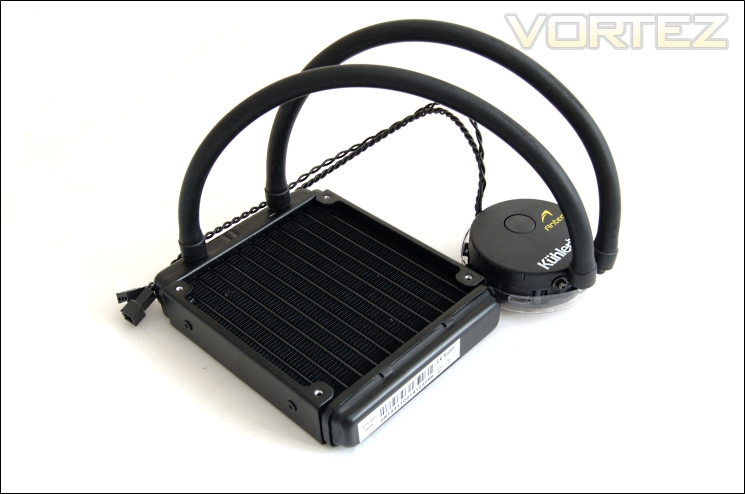
Let’s take a closer look at what the Antec KÜHLER H2O 620 has to offer…
Features & Specifications
Antec’s take on the KÜHLER H2O 620:
The Antec KÜHLER H2O 620 delivers high-performance liquid cooling for your CPU in a quick, easy-to-install package. Unlike traditional liquid cooling systems, this self-contained unit comes prefilled and requires no maintenance. The voltage-controlled 120 mm fan and 3rd generation copper coldplate ensure efficient cooling, while the estimated 50,000 hour pump lifetime means this cooler is even likely to outlast the system it cools. Lastly, easy-bend flexible tubing allows the KÜHLER H2O 620 to be installed in nearly any orientation. Take your PC’s Quiet Computing™ to the next level with liquid cooling performance at a price that rivals aftermarket air coolers.
The Antec KÜHLER H2O 620 delivers high-performance liquid cooling for your CPU in a quick, easy-to-install package. Unlike traditional liquid cooling systems, this self-contained unit comes prefilled and requires no maintenance. The voltage-controlled 120 mm fan and 3rd generation copper coldplate ensure efficient cooling, while the estimated 50,000 hour pump lifetime means this cooler is even likely to outlast the system it cools. Lastly, easy-bend flexible tubing allows the KÜHLER H2O 620 to be installed in nearly any orientation. Take your PC’s Quiet Computing™ to the next level with liquid cooling performance at a price that rivals aftermarket air coolers.
Features
-CPU Socket Compatibility: Intel LGA 775/1156/1155/1366, AMD AM2/AM2+/AM3/AM3+
-Low profile pump ensures exceptional liquid circulation while preserving internal airflow
-Non-corrugated easy-bend tubes for maximum flexibility in radiator positioning.
-Intelligent noise/speed-control fan for quiet, efficient cooling
-Latest generation copper cold plate for optimal conduction
-Cooling Liquid: Safe, environmentally-friendly, anti-corrosive
-Pre-applied thermal paste
-Low profile pump ensures exceptional liquid circulation while preserving internal airflow
-Non-corrugated easy-bend tubes for maximum flexibility in radiator positioning.
-Intelligent noise/speed-control fan for quiet, efficient cooling
-Latest generation copper cold plate for optimal conduction
-Cooling Liquid: Safe, environmentally-friendly, anti-corrosive
-Pre-applied thermal paste
Specifications
-Fan Speed: 1450-2000RPM
-Radiator Dimensions: 151mm x 120mm x 27mm (HxWxD)
-Fan Dimensions: 120mm x 25mm
-Air Flow: 81.3 CFM
-Cold Plate + Pump Height: 27mm
-Tubing Length: 330mm
-Net Weight: 0.7kg
-Radiator Dimensions: 151mm x 120mm x 27mm (HxWxD)
-Fan Dimensions: 120mm x 25mm
-Air Flow: 81.3 CFM
-Cold Plate + Pump Height: 27mm
-Tubing Length: 330mm
-Net Weight: 0.7kg
The Antec KÜHLER H2O 620 seems to take a slightly different approach to its bigger brother. Firstly, it features a slower spinning non PWM fan so we can expect the KÜHLER H2O 620 to be a quieter unit. Size wise, the radiator is 22mm thinner and as such it is lighter and more compact. Only a single fan is included and no software control is provided making ChillControl unique to the bigger KÜHLER H2O 920 unit.
The specifications are not too dissimilar to Corsair’s H50 since they both use Asetek designs. Interestingly, Antec have opted for slightly faster 2000 RPM compared to the Corsair’s 1700 RPM one. The other difference, as previously mentioned, is that Antec have oriented the fan as an exhaust which makes more sense in a regular chassis as it compliments airflow. The unit themselves are very similar, both integrating the reservoir to the 120.1 radiator and combining the pump with the CPU cold plate.
Packaging and Content
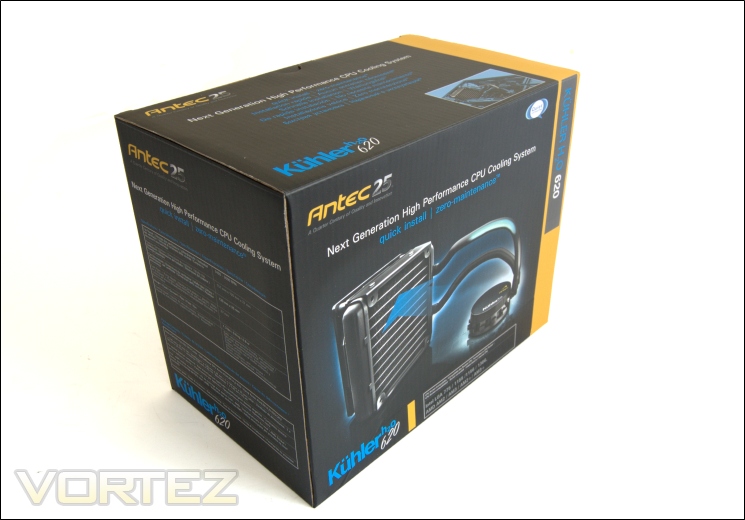
The packaging
The packaging employed by Antec follows on the same trend as that used with their KÜHLER H2O 920, with its black and yellow colour scheme. Initially the box comes wrapped in a plastic film for added protection. This helps the box retain a very clean look. Antec make the most of the box to display as much information as possible about the cooler including the specifications and features.
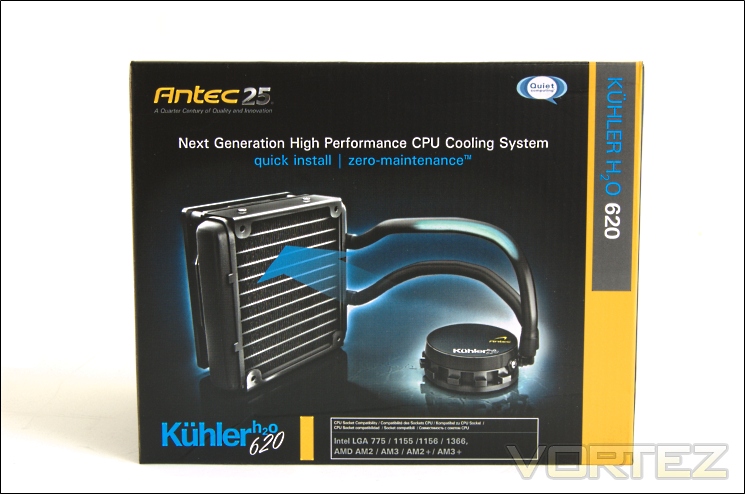
The front of the box
At the front, Antec illustrate the ALC unit so users know exactly what to expect, i.e. a single fan and 120mm radiator setup with cool air being pulled through. Antec also list some of the unit’s key attributes over other water cooling units such as quick installation and zero-maintenance. Like most other coolers these days, the KÜHLER H2O 620 supports all current AMD and Intel sockets. The ‘Antec 25’ branding showcases the company’s 25 years of experience in the business delivering quality and innovation. We certainly revere Antec as one of the most popular manufacturers out there so it remains to be seen if their expertise translates well into the KÜHLER H2O 620 as it did with the 920.
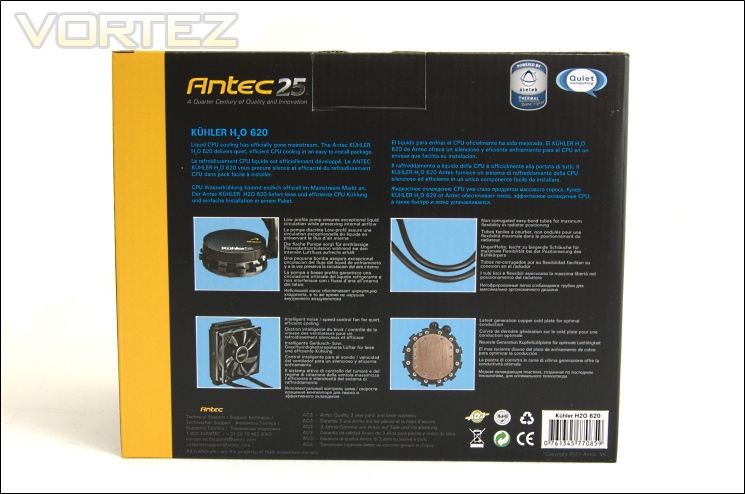
The back of the box
At the back, Antec describe some of the cooler’s features in more detail with illustrations depicting them. Antec’s global appeal is reflected in the 5 other languages the features are described in. Again, this is very similar to the KÜHLER H2O 920’s packaging.
The specifications
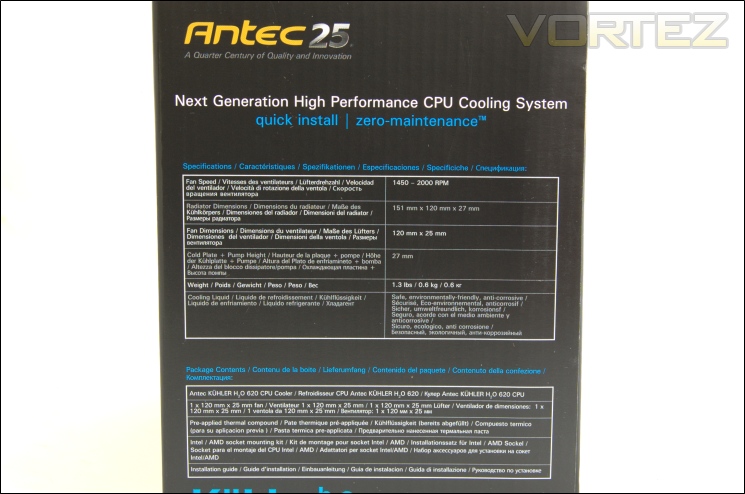
On the side, all the specifications are listed as described on the previous page. All the radiator size specifications are listed so users can check to see if the cooler will fit inside their cases. The hose and pump sizes are also listed.
Inside of the box
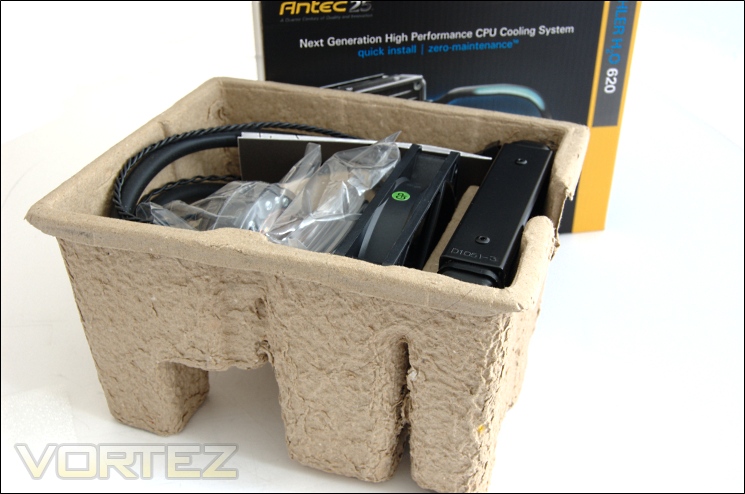
The cooler comes packaged in what looks like an egg carton. The specially shaped cardboard does a good housing the cooler and protecting it so that the fins on the radiator are not bent out of shape. Compared to the CoolIT Eco and Corsair H50 packaging, Antec’s is a clear step above. The fan and mounting kit also have their own compartment in the middle.
The bundle
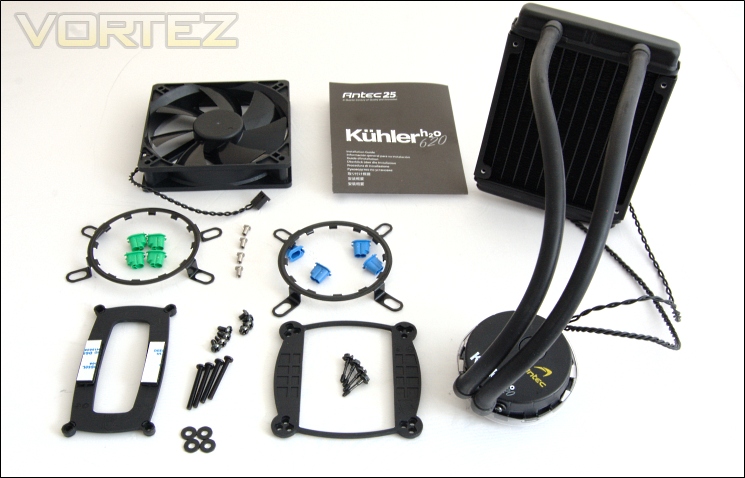
Bundled in the packaging are the mounting kits and the cooler itself. Included are the:
-AMD back plate
-Intel back plate
-AMD retention ring
-Intel retention ring
-Washers x4
-Metal back plate inserts x4
-Mounting screws x4
-Adhesive backings x2
-Long fan screws x4
-Green retention inserts x4
-Blue retention inserts x4
-120mm fan x1
-Installation guide
-KÜHLER H2O 620
The mounting kit is very comprehensive and exactly the same as Corsair’s H50 and H70 units as well as Antec’s own KÜHLER H2O 920 due to their Asetek origin. We will have a closer look at the installation later on.
Closer Look
The cooler
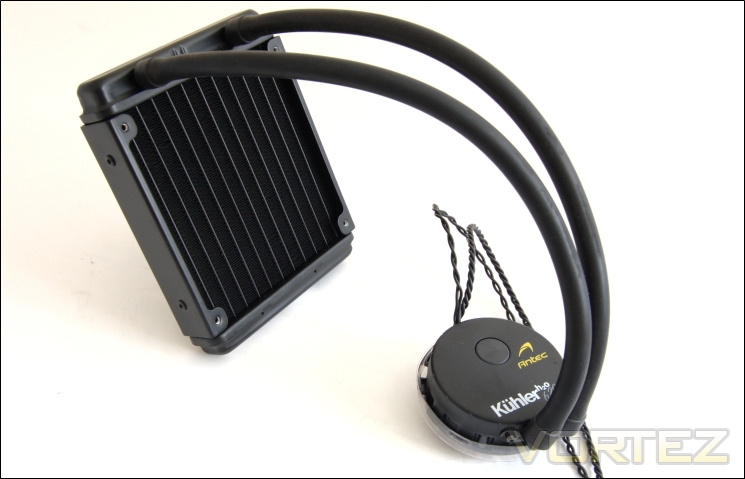
The Antec KÜHLER H2O 620 is a single 120mm radiator unit comprised of components integrated together to create a simple maintenance-free enclosed system. Unlike custom water cooling kits, no assembly is needed and users don’t need to worry about leakages making this ALC unit very practical and trouble free. Unlike the thicker 920 variant, the 620 is more akin to the Corsair H50 and CoolIT Eco with its smaller radiator. It is also clear that Antec are not aiming at raw performance since it only bundles one fan but it’s understandable given they are targeting a lower price bracket.
Compact size
With everything being pre-assembled and designed to be leak proof, the Antec KÜHLER H2O 620 is a very compact package. All the components are tightly pre-assembled to reduce the risk of damaging the cooler and prevent leakages. The radiator is the largest and heaviest component but due to being installed to the chassis instead of the motherboard, it is more secure that a heavy air cooler. This leaves the CPU block and pump being the only components being installed to the motherboard, thereby not putting a lot of pressure.
The 120mm radiator
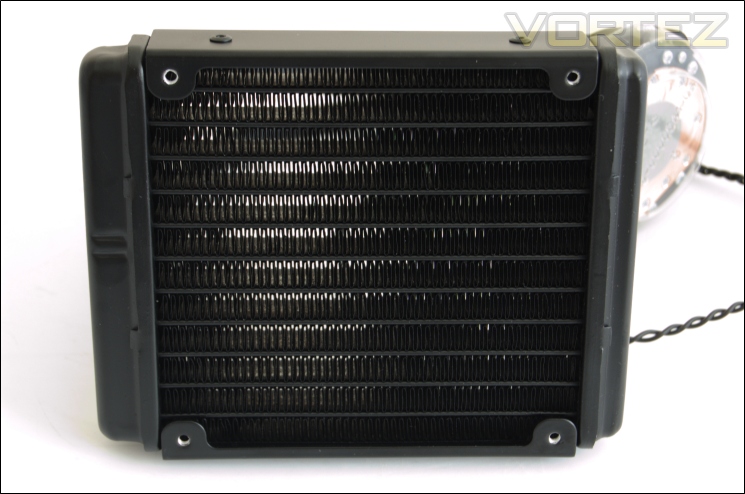
The radiator is 27mm thick and features 12 banks of fins separated by bands carrying the coolant throughout the entire radiator to dissipate heat. The fin spacing is very tight at 1.25mm and the width of each individual fin is 8.5mm. The fins have a corrugated pattern to maximum surface area as is typical with all water cooling radiators. Antec’s packaging ensured that the fins remained undamaged to retain a cleaner look.
Radiator fan spacing
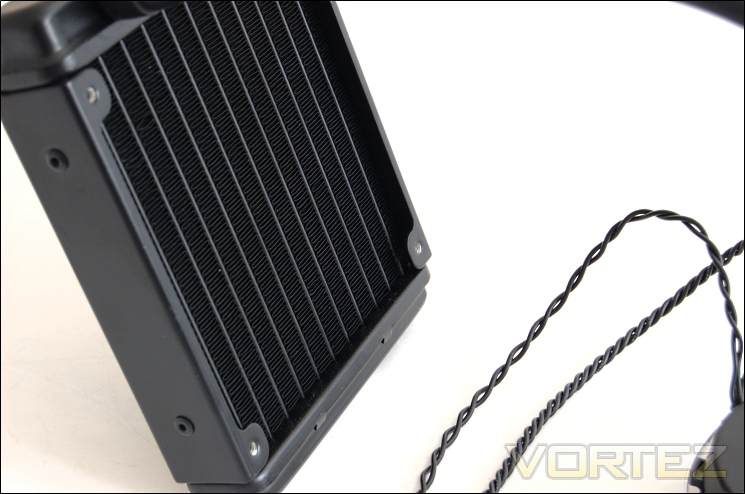
To make sure that users don’t accidentally knock the fins and bend them out of shape, there is a gap left between the fins the four fan mounting holes. It also reduces the likelihood of puncturing the narrow linear bands through which the liquid flows through across the radiator. Another benefit is that the fan doesn’t sit as close to the fins and thereby generate a higher pitched noise. This shroud also allows two fans to be installed even if one fan and 4 screws are provided in the bundle.
The reservoir
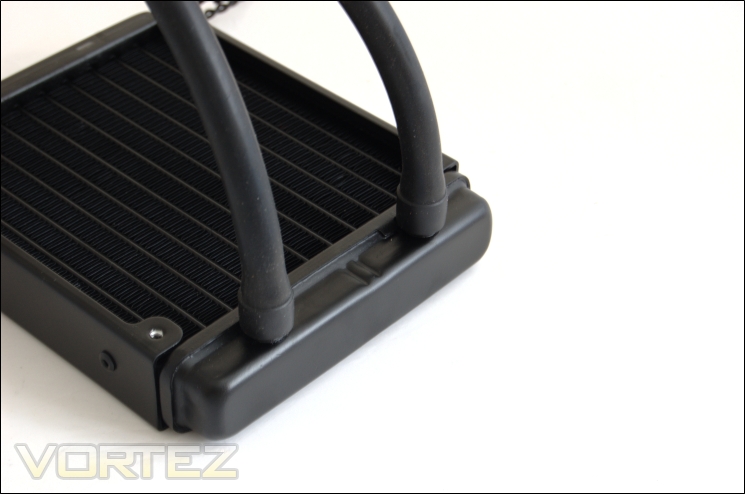
Like the KÜHLER H2O 920 and other ALC units, the reservoir is integrated to the radiator. The two compartments are each connected to separate tubing so the liquid flows into one and out of the other once it flows through the entire radiator. The tubes are connected to barbs and tightly secured so users can’t pull them off and to prevent leakages. These barbs are designed to withstand high pressures and temperatures although they are not comparable to those used in custom water cooling loops. The fluid used in the system is de-ionised water with a propylene-glycol additive to prevent corrosion of the components.
The tubing
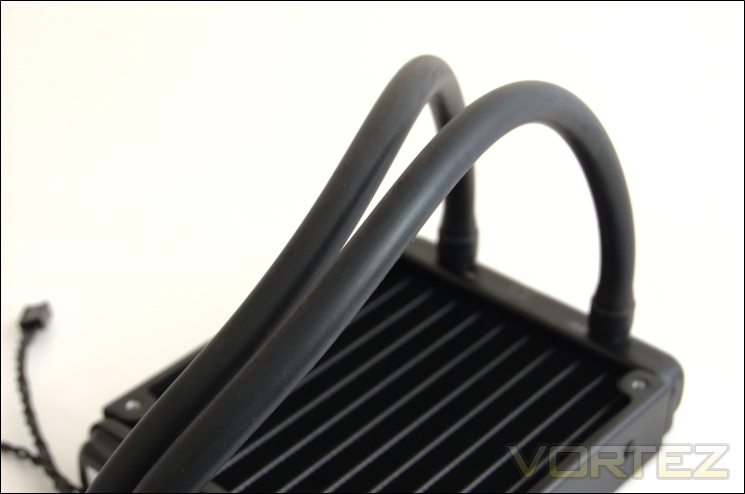
The tubes are 33cm in length and have a rubberised feel. They are fairly tough but at the same time designed to be flexible. This is achieved by using a non-corrugated design as found on previous Asetek designs. In practise, the tube was quite flexible but the length made it restrictive went trying to install the block and bending the tube into shape. Thankfully the length of the tubing is perfectly distanced such that the radiator can be installed to the exhaust of a chassis.
Closer Look (Continued)
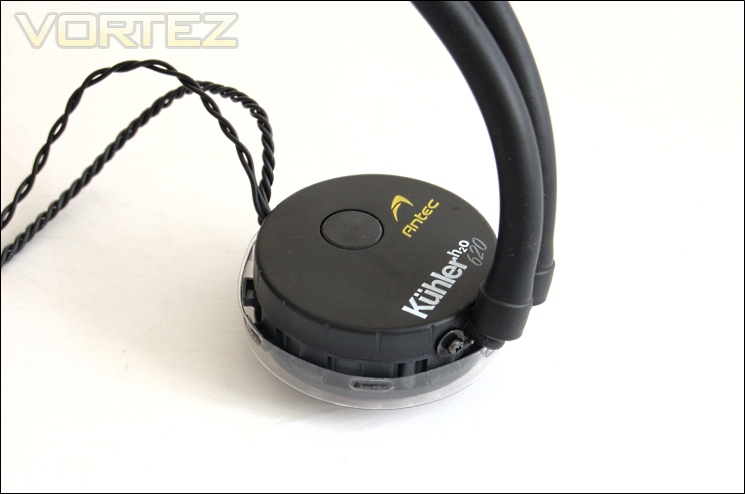
The CPU block with integrated pump
Connected to the other end of the tubes is the CPU block and pump. According to the CPUID Hardware monitor, the pump operated at 1400RPM, which is substantially lower than the KÜHLER H2O 920’s 3000RPM pump. Despite that, the size of the KÜHLER H2O 620’s block is a mere 2mm less than its bigger brother. Unlike the KÜHLER H2O 920, the 620 doesn’t support RGB LED lighting, hence the yellow Antec logo instead to follow the product’s colour theme. The model name is also imprinted on top. The top of the block also features a small disc, which doesn’t seem to do much as it doesn’t move.
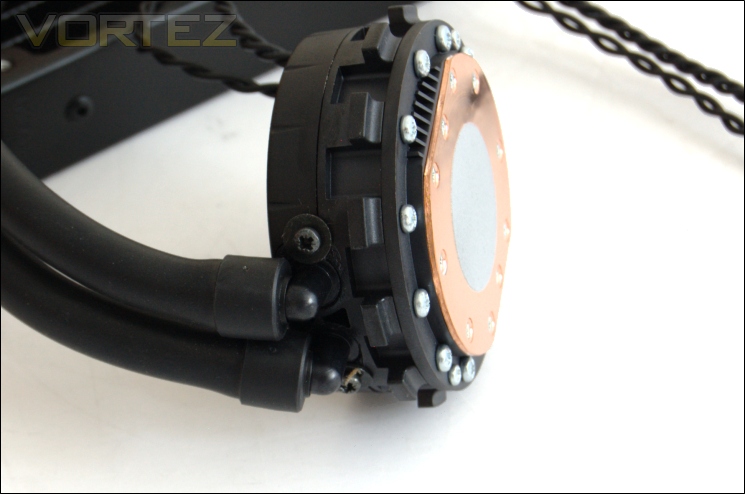
The barb fittings
The tubes are connected to 90 degree barbs on the pump. The plastic shroud at the top is secured by screws which also keep the barbs in place. Near the base are alternate grooves and clips for installation using the mounting kit.
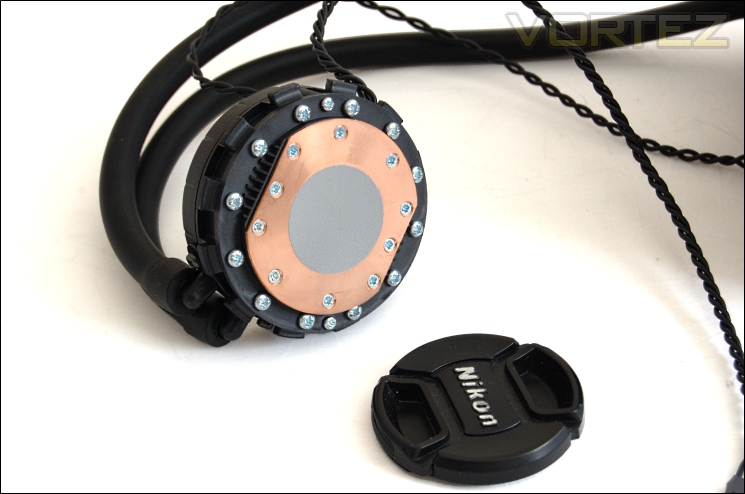
The CPU cold plate with pre-applied thermal paste
The copper cold plate at the base comes pre-applied with thermal paste that spreads very well onto the CPU when installed. The copper base is flat but lacks a mirror finish. The base is not dissimilar to other Asetek based Corsair units with its circular shape. However, Antec highlight that their coolers feature Asetek’s third generation copper cold plate whereas Corsair uses their first generation.
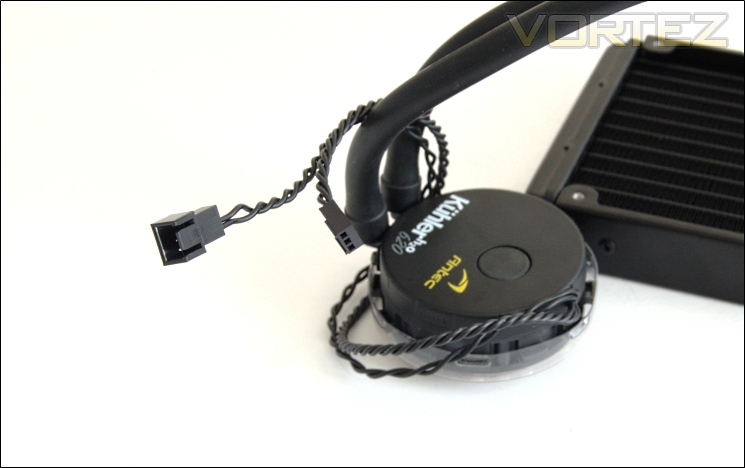
Pump and fan cables
Like the 920, the KÜHLER H2O 620 has an array of cables connected to the CPU block, although not an extensive one. The first cable is a fan header acting as an extension for the bundled 120mm, and the other cable is for the pump and power which connects directly to a fan header on the motherboard. What is strange is that the fan cable is only 2 pin and therefore lacks an RPM readout. Based on what Antec have said, fan control comes through voltage regulation via the CPU block and changes according to the coolant temperatures. Unfortunately, there are no temperature or RPM readout like on the 920.
The fan
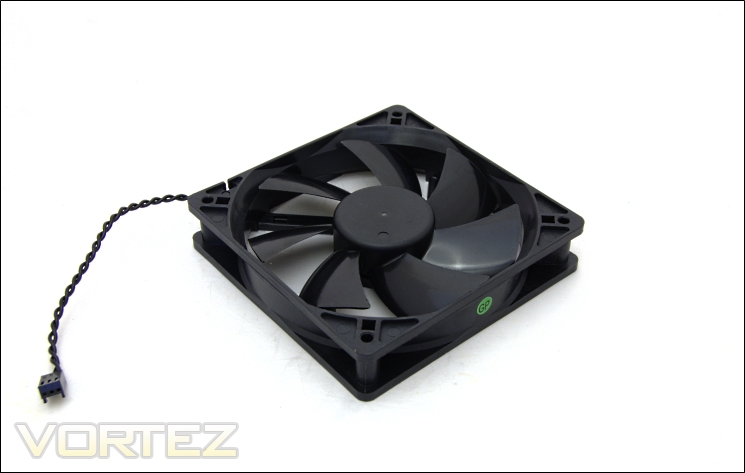
The single bundled 120mm fan is seven bladed and is advertised to work between 1450 and 2000 RPM. However, although it connects to 3 pin fan headers there are only two cables attached to it; the 12v and ground cable. As such, there is no RPM read out or PWM functionality so how the fan speed is adjusted, I am not sure. The corners are also closed to allow the long provided screws to feed in much easier when installing to the radiator. The fan cable uses a twisted weave over standard braided. Thankfully, this somewhat cheap approach works well.
Installing one fan
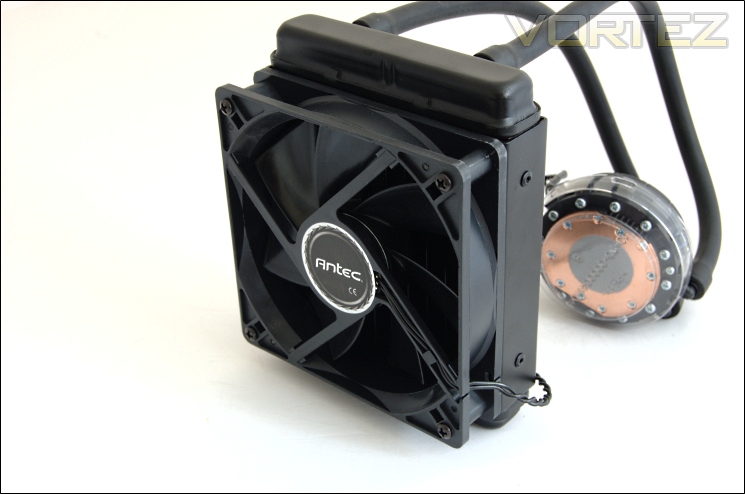
The fan is designed to act as an exhaust fan extracting hot air from the radiator. The closed corners ensure the long screws can reach the radiator more easily when installing. Since the length of the fan cable is very short, the extension cable from the pump helps.
Adding a second fan
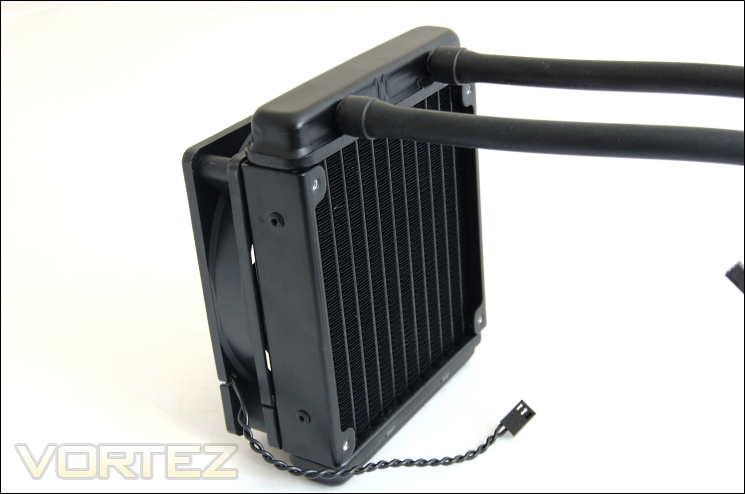
On the front side of the radiator are 4 additional holes to mount a second fan. Unfortunately, Antec don’t provide 4 more long screws but it is possible to simply mount the back pull fan with 2 screws at opposite corners and use two spare ones on the front push fan.
Closer Look (Size Comparison)
Antec KÜHLER H2O 620 VS 920
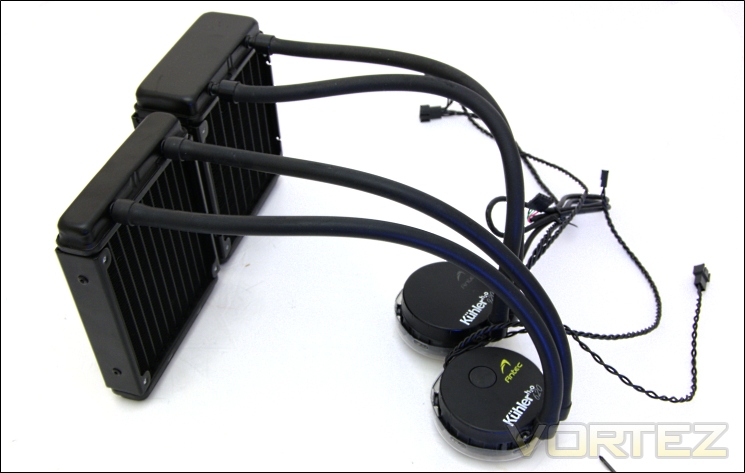
Comparing the Antec coolers, we see that both the 620 and the 920 are very similar in concept, the 920 being thicker and featuring a USB cable on top. Both support 120mm fans and have the same length tubes. The other notable difference is the arrangements of the fins on the respective radiators. The KÜHLER H2O 620 has 12 columns of fins where the 920 only has 9 but the fin width is 8.5mm instead of 11.5 on the latter. The KÜHLER H2O 620 also has narrower fin spacing of 1.25mm whereas the spacing on the KÜHLER H2O 920 is 1.5mm on average.
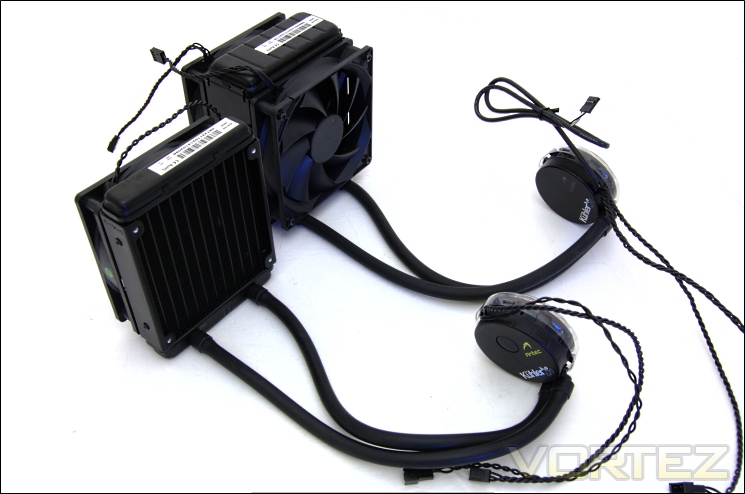
Antec KÜHLER H2O 620 VS 920 with fans
The KÜHLER H2O 920 features two 9 bladed PWM fans operating between 660-2580RPM whereas the KÜHLER H2O 620 features a single 7 bladed fan operating at 1450-2000RPM.
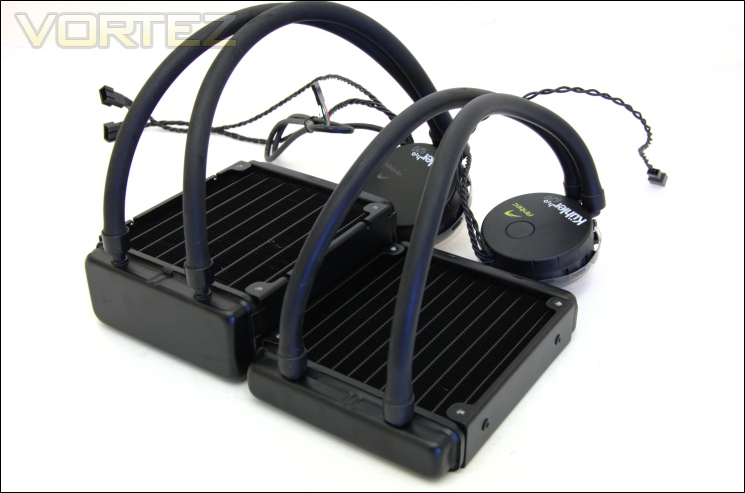
Antec KÜHLER H2O 620 VS 920 lying flat
The KÜHLER H2O 620 radiator is 27mm in thickness whereas the KÜHLER H2O 920’s radiator is 48mm thick. For comparison, a single radiator on the Noctua NH-D14 is 52mm deep.
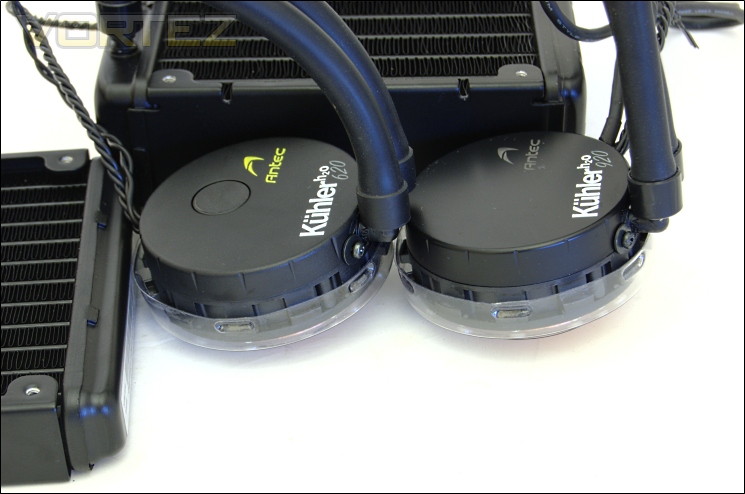
Antec KÜHLER H2O 620 VS 920 pumps
Test Setup
CPU – Intel Core i7 920 – 2.66/4.0GHz
RAM – 6GB (3x2GB) OCZ Platinum DDR3 1333MHz
Motherboard – ASUS Rampage III Extreme
Graphics card – XFX HD5870 1024MB
Power Supply – Enermax Revolution 85+ 850W
Hard Drive – OCZ Vertex 2E 120GB
Samsung F1 320GB
Samsung F3 1TB
Drivers – ATI Catalyst 10.10
CPU Coolers:
Antec KÜHLER H2O 620 including tests using 1 stock fan, 2 Noctua NF-P12s and 2 SWiF2-120Ps.
Antec KÜHLER H2O 920 including tests using 2 stock fans, 2 Noctua NF-P12s and 2 SWiF2-120Ps.
Prolimatech Genesis including tests using 2 Noctua NF-P12s/NF-P14s, 2 SWiF2-120Ps and 2 Prolimatech Blue Vortex 14s
NZXT Havik 140 including tests using 2 NZXT fans, 2 Noctua NF-P12s/NF-P14s and 2 SWiF2-120Ps
Alpenföhn Matterhorn including tests using 2 Noctua NF-P12s/NF-P14s, 2 SWiF2-120Ps and 2 Föhn 120 Wing Boost fans
Prolimatech Super Mega including tests using 2 Noctua NF-P12s/NF-P14s, 2 SWiF2-120Ps and 2 Prolimatech Blue Vortex 14s
Noctua NH-C14 (U.L.N.A and default speed) including tests using 2 SWiF2-120Ps
Thermalright Silver Arrow including passive and tests using 2 Noctua NF-P12s and 2 SWiF2-120Ps
Thermalright HR-02 including passive and tests using Noctua NF-12/NF-P14s and Thermalright TR TY-140
Thermaltake Frio (Low/med/high speed) including tests using 2 Noctua NF-P12s
Corsair H50 including tests using 2 Noctua NF-P12s and 2 SWiF2-120Ps
CoolIT ECO A.L.C including tests using 2 Noctua NF-P12s and 2 SWiF2-120Ps
Thermalright Venomous X using 2 Noctua NF-P12s and 2 SWiF2-120Ps
Coolink Corator DS including tests with dual fan setups
Tuniq Propeller 120(High speed fan)
Noctua NH-C12P SE14
Prolimatech Megahalem
Noctua NH-D14 (U.L.N.A and default speed)
Noctua NH-U12P SE1366
Thermolab Baram (with 2 Noctua NF-P12 fans)
CoolIT Domino A.L.C
Sunbeam Core Contact Freezer
Coolermaster Hyper 212 Plus including test with 2 Noctua NF-P12 fans
Alpenföhn Nordwand including test with 2 Noctua NF-P12 fans
Tuniq Tower 120 Extreme (Low/med/high speed)
Program Suite:
Core Temp 0.99.5
LinX stress Test
CPUID HWMonitor
How I tested:
Testing will be based on temperatures recorded by Core Temp and PC wizard after 20 passes of LinX stress test. The absolute temperatures recorded in the tables are averages of the 4 cores and the delta value provided for a fair comparison, taking into account ambient temperatures. The test will be run at stock speed and at an overclocked speed of 4GHz.
Installation
Installing the Antec KÜHLER H2O 620 is exactly the same as the 920. The process is fairly straightforward thanks to the user manual but it can be fiddly due to the number of small components included in the mounting kit. In our guide, we will focus on installation on LGA1366 but the process is similar for other sockets.
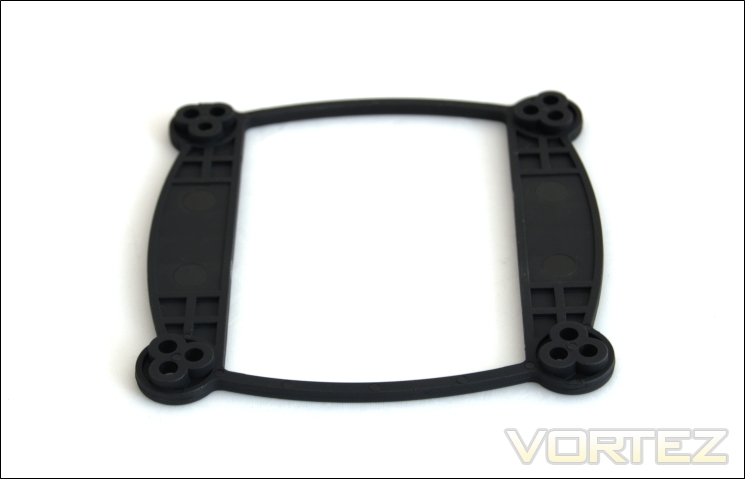
1.) Choose the appropriate backplate for either AMD or Intel. The rectangular one is for AMD whereas the above is for Intel sockets.
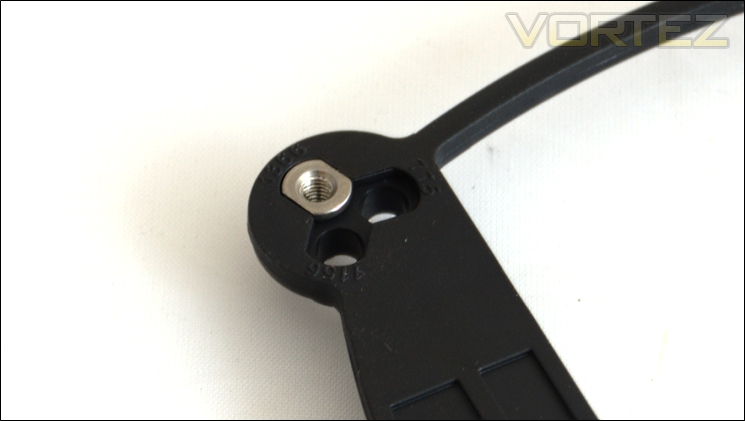
2.) Insert the metal backplate inserts into the appropriate labelled holes for socket 77/1156/1155/1366.
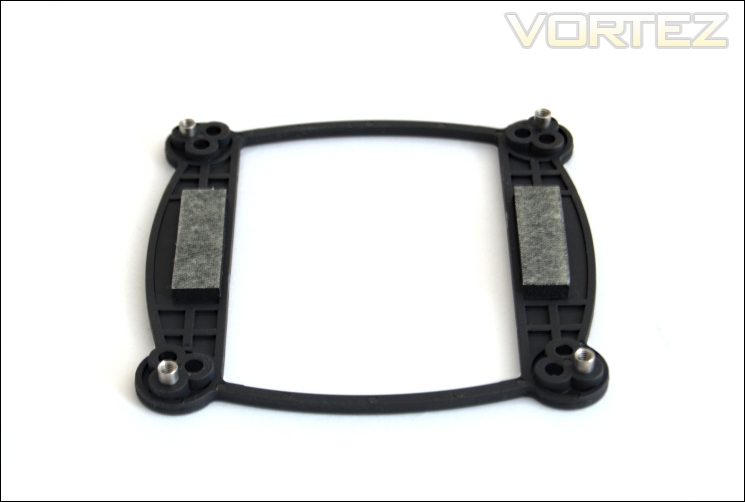
3.) Attach the adhesive pads to the backplate.
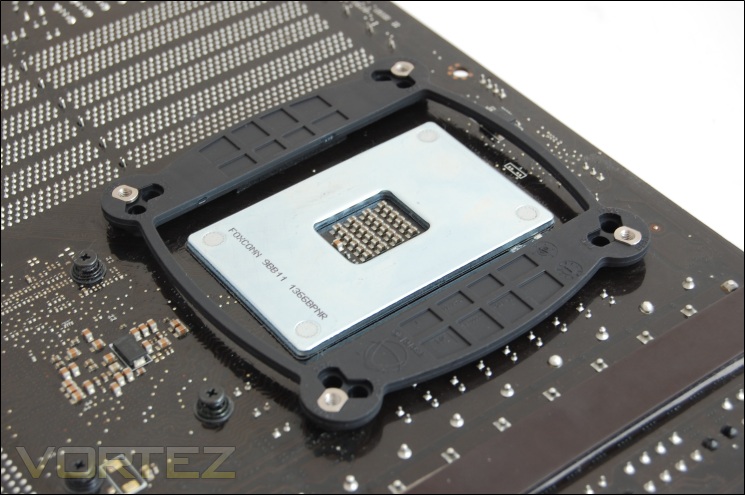
4.) Install the backplate to the back of the motherboard making sure each corner has gone through the holes.
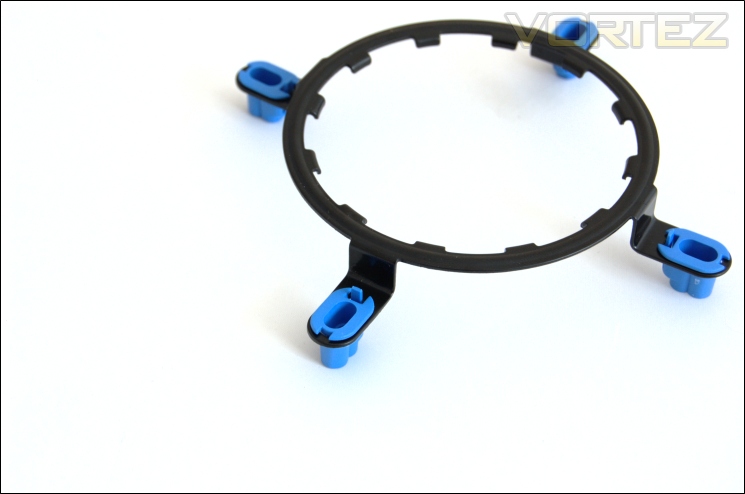
5.) Place the blue inserts into each corner of the retention ring making sure the clips are on the inside.
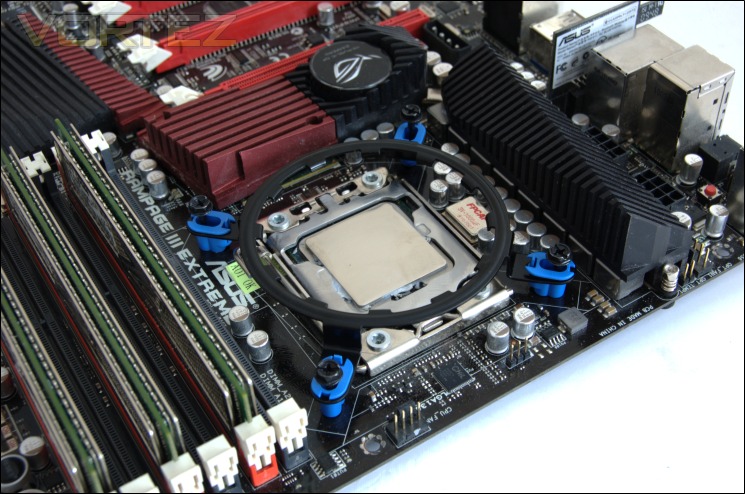
6.) Install the 4 mounting screws into the outer most holes of the inserts and line up the retention ring with the backplate on the front of the motherboard. Screw each corner in slightly so that they are in place but don’t tighten them just yet.
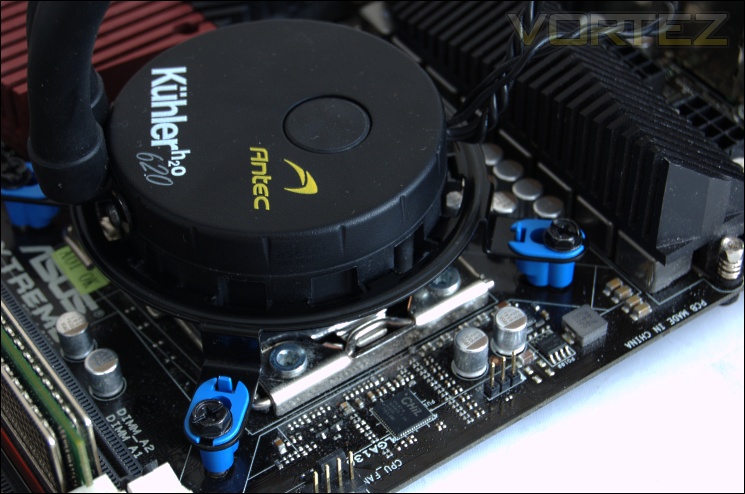
7.) Install the CPU block in the retention ring and twist it so that it is latched onto the bracket. Once secured, tighten the screws on the retention bracket. Do not over tighten as it may damage the plastic inserts.
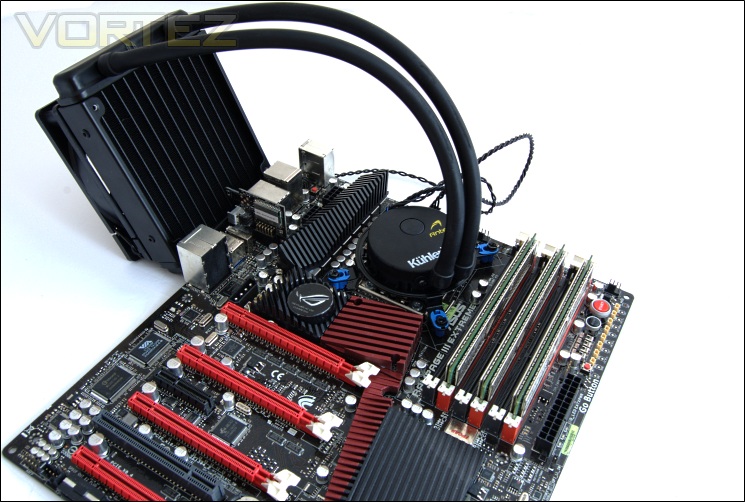
8.) Connect the fan cable to the extension lead and plug the pump cable into a fan header on the motherboard. Install the back fan and radiator using the 4 provided long screws.
Those familiar with earlier Corsair units will recognise the installation procedure as the process is exactly the same here using the same kit. All the Asetek units will be compatible with one another. A major downside that I observed is that the screws don’t give any feedback as when to stop turning unlike spring-loaded ones that merely stopped as soon as enough pressure is put through. The problem is that screwing down too much can not only damage the blue retention clips but also flex the motherboard. In my case, it caused the first DIMM slot to stop working until I loosened the screws. Another complaint is that it can be a pain to hold the radiator while trying to feed the long screws through the fan and to the radiator when installing the unit to the case.
Results (Grouped)
The results have been arranged in terms of the fan configuration that yields the best results for each cooler. However, it is important to take into account that many coolers come with their own fans and changing those increases the costs significantly, so the “out of the box” cooler configurations have been highlighted in red each group.
Stock
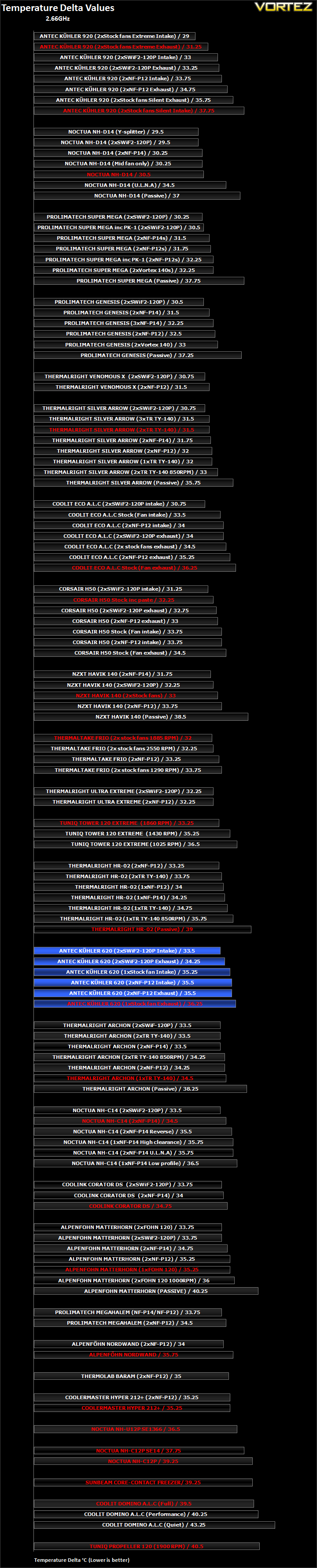
The Antec KÜHLER H2O 620 gets off to a rather mediocre start here unlike its bigger brother that went straight to the top. The unit was tested in a number of fan configurations as usual. In its default single fan exhaust setup, it produced a delta temperature of 36.25C which isn’t very impressive. Changing the fan to an intake seems to yield better temperatures and reduces the delta by 1C. The problem here is that the fan did not output an RPM reading so I was uncertain whether it was working to its full capability. On the plus side, the fan did operate quietly. Switching to two Noctua fans produced slightly better results but not enough to warrant the cost. For a 0.75C difference over the stock configuration, the NF-P12s were lacklustre although it may be due to the radiator’s inefficiency. As usual, the best results were generated by the Coolink SWiF2-120P fans. As exhaust fans, the delta was reduced by 2C and a further 0.75C when orientated as intakes.
Results (Ascending order)
Stock
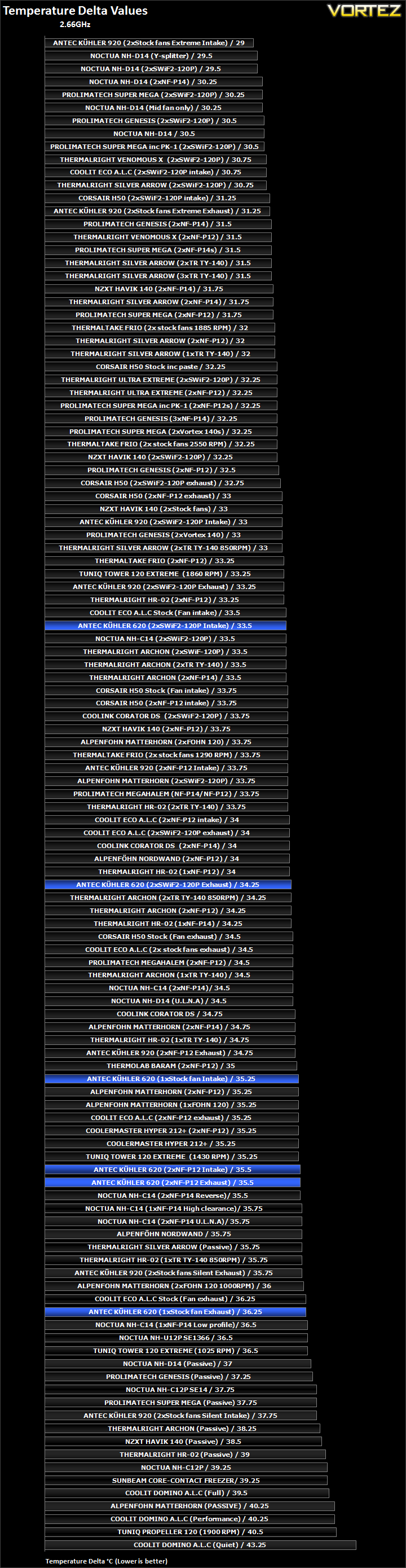
On this graph, we get a better picture of how the KÜHLER H2O 620 compares to other coolers. In its default configuration, the Antec is on par with a CoolIT Eco in its default configuration and only 0.25C better than a Noctua NH-C14 with a single fan. With the fan switched to an intake, it becomes comparable to the Matterhorn sporting two Noctua fans or the Coolermaster 212+ in a similar setup. Conversely when the Antec is teamed up with the Noctua fans, the cooler performs slightly worse. In its best configuration, it starts to compete with our better air coolers such as the Thermalright Archon and HR-02. Overall, the results tend to concentrate towards the lower end of the table but competition is tougher with a stock clocked i7.
Results (In-depth analysis)
In the next comparison, we look at the default cooler performance as they come out of the box with their bundled fans. Coolers that come with no fans have been coupled with Noctua’s NF-P12 or fans that the manufacturers intended their coolers to be used with.
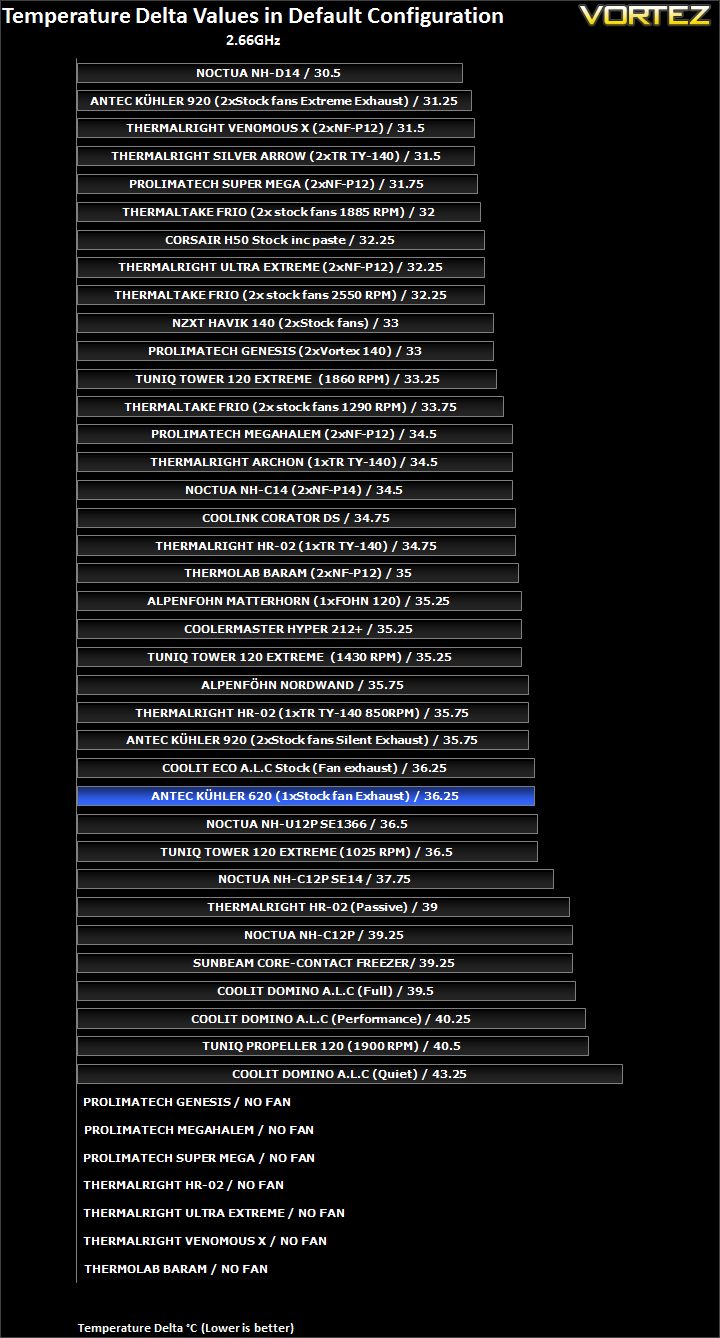
In its default setup, the KÜHLER H2O 620 is comparable to the CoolIT Eco and slightly better than the Noctua NH-U12P, a good achievement but not an impressive one seeing as the latter two are much older.
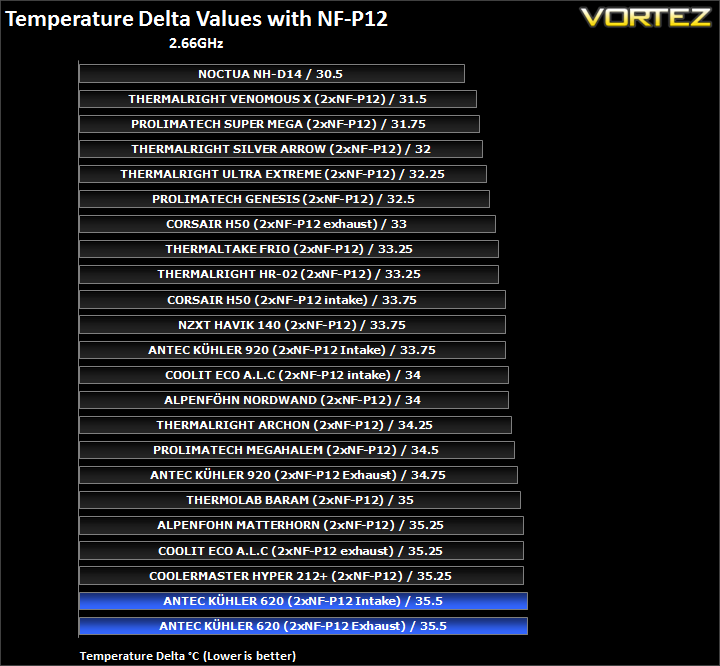
In terms of efficiency with two NF-P12s, the KÜHLER H2O 620 sadly goes to the bottom of our table being beaten by the CoolIT Eco and the Corsair H50 quite comfortably. Even the £20 Coolermaster Hyper 212+ produced slightly better results in this case.
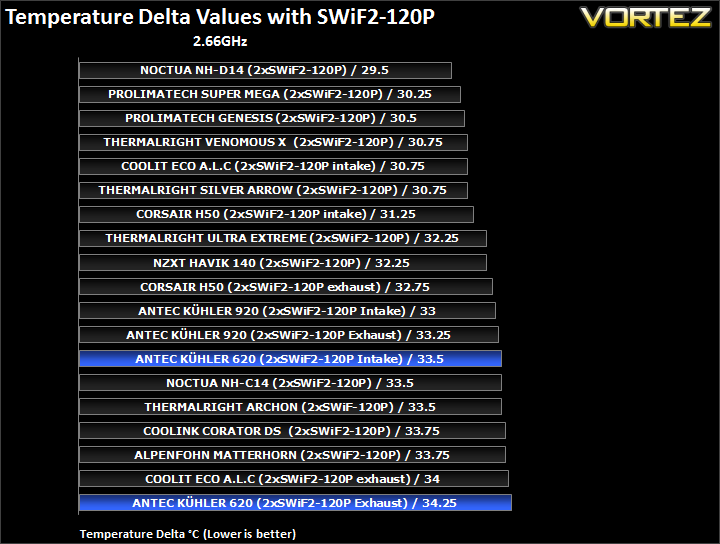
Again we see a similar story with the CoolIT Eco coming out just slightly on top with the fans as exhausts. Although they act better as intake fans, the margin widens against its competition even more drastically. However, it was still comparable to a Noctua NH-C14 and the Thermalright Archon.
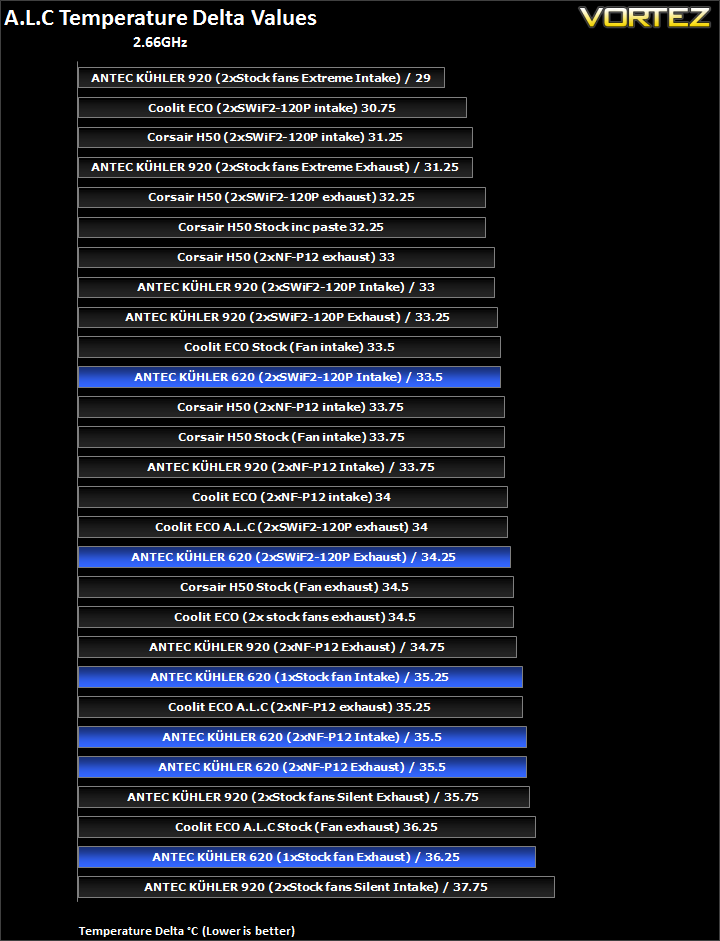
In each of the fan setups, we find that the CoolIT Eco and Corsair H50 perform better. Despite being based on a newer Asetek design, the KÜHLER H2O 620 simply couldn’t match Corsair’s alternative.
Results Overclocked (Grouped)
The results have been arranged in terms of the fan configuration that yields the best results for each cooler. However, it is important to take into account that many coolers come with their own fans and changing those increases the costs significantly, so the “out of the box” cooler configurations have been highlighted in red each group.
4GHz
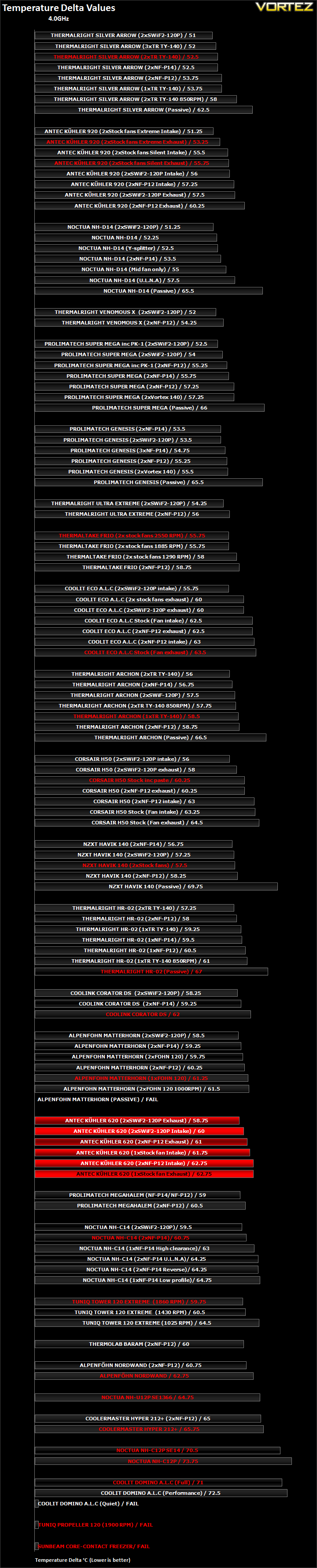
The Antec KÜHLER H2O 620 once again finds itself near the bottom of our table when we test with the overclocked CPU. In its default configuration, the delta temperature is 62.75C and switching the fan to an intake only reduces the delta temperature by 1C. With two Noctua fans as exhausts, the results improve by 1.75C. The Coolink fans yield the best results with a delta of 58.75C although the gains are not as significant as they are when they are teamed with the other ALC units. Surprisingly here, the Coolink and Noctua fans produce worse results when switched to an intake position despite finding the opposite to be true with the KÜHLER H2O 920. This could actually be because the ambient temperatures were not increased as much when compared to the effect of the KÜHLER H2O 920.
Results Overclocked (Ascending order)
4GHz
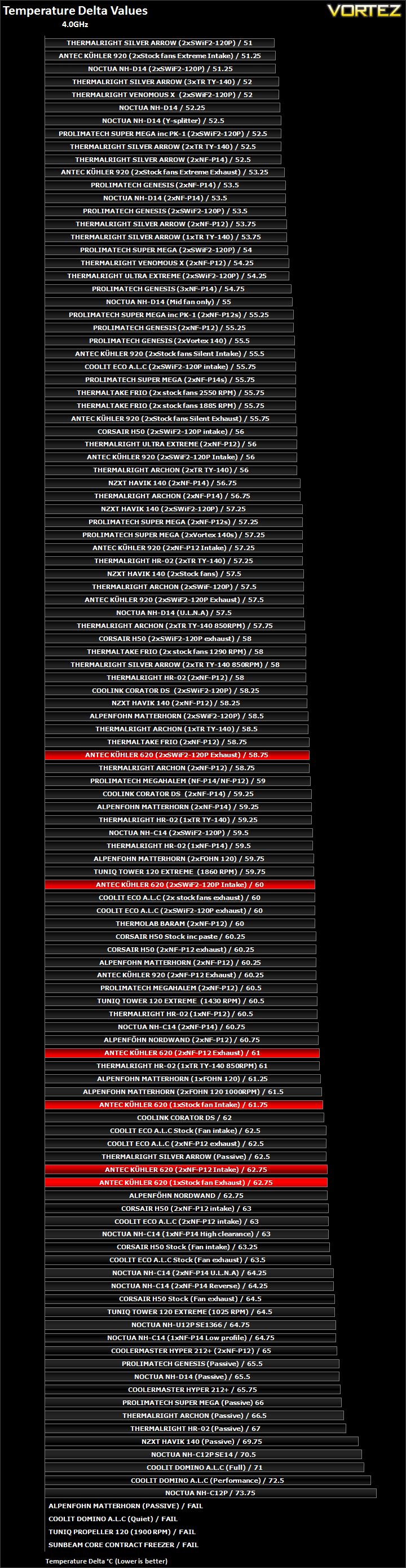
In its default configuration with a single fan and with two NF-P12s as intakes, the KÜHLER H2O 620 is comparable to a passive Silver Arrow or an Alpenföhn Nordwand. It does manage to beat the CoolIT Eco and even the Corsair H50 in two configurations. In its best setup, the KÜHLER H2O 620 closely follows the Matterhorn also using two Coolink fans but other air coolers such as the Thermalright Archon and Thermaltake Frio can keep up using slower operating Noctua fans.
Results Overclocked (In-depth analysis)
In the next comparison, we look at the default cooler performance as they come out of the box with their bundled fans. Coolers that come with no fans have been coupled with Noctua’s NF-P12 or fans that the manufacturers intended their coolers to be used with.
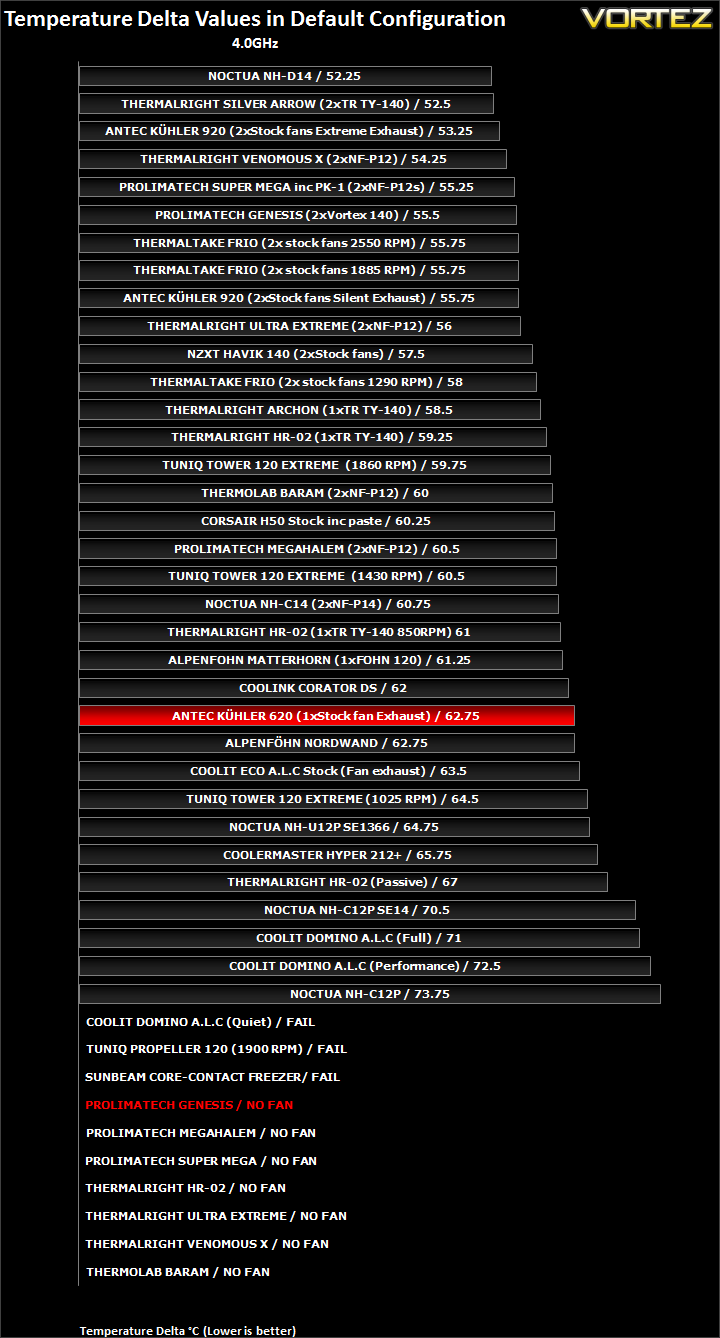
We see that the KÜHLER H2O 620 performs better than the CoolIT Eco here but not quite as well as the Corsair H50 with its pre-applied thermal paste. Unfortunately we didn’t manage to test the KÜHLER H2O 620 using its pre-applied thermal paste which is in fact the same Shin-Etsu compound used by the H50. If we consider the H50 results using our standard ChillFactor II thermal paste, we see it lagging behind the Antec unit. Compared to air coolers, the Antec unit just can’t compare to the higher end offerings. The KÜHLER H2O 920 is in a clear league ahead here thanks to its two fans and larger radiator.
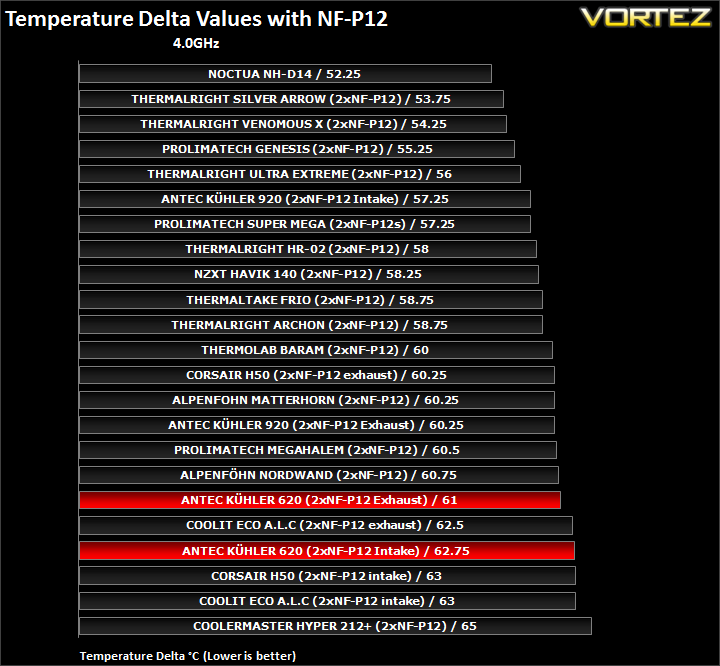
With two Noctua fans, the intake orientation beats the Corsair and the CoolIT whereas in the exhaust orientation, the Antec only beats the CoolIT. Overall performance is still not good enough to compare against similarly priced air coolers.
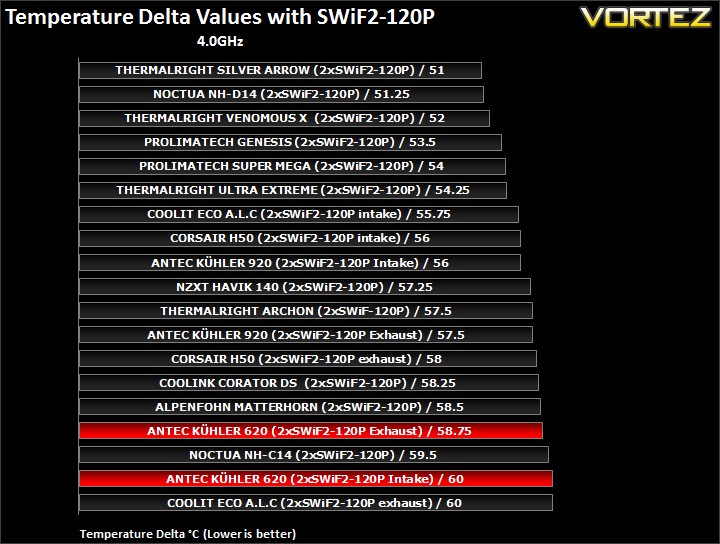
With two Coolink fans, the Antec’s efficiency doesn’t appear to match its competition be they ALC units or air coolers.
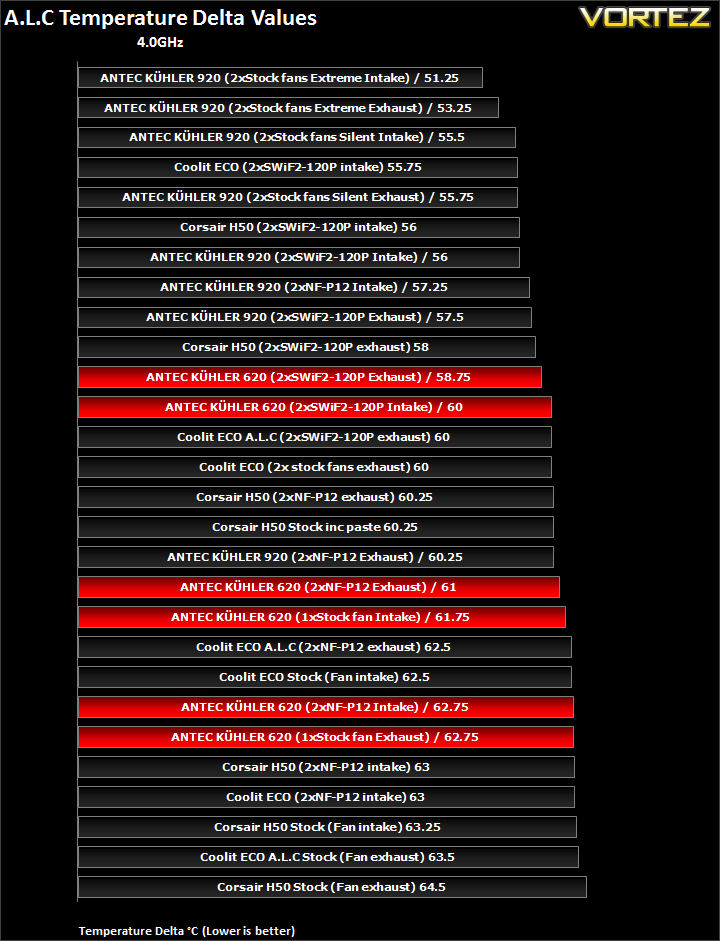
The results here can be quite hard to decipher. In its default configuration, the Antec starts off well. This may be due to its higher RPM fan. Even with the NF-P12s, it compared very well against the other ALC units apart from the 920. However, the KÜHLER H2O 620 doesn’t seem to work as well as the other two units when coupled with the SWiF2-120P. Another observation is that the intake orientation performs worse in this case when the opposite is true with the Corsair and CoolIT units.
Conclusion
Where do we start with the Antec KÜHLER H2O 620? A year ago when we reviewed the Corsair H50 and CoolIT Eco, we found that the units matched some of the high end air coolers at the time but since then we have seen major developments in the field and ever more competitive air coolers. Unfortunately, it seems that the Antec ALC unit hasn’t managed to keep with the growing competition thus finding itself lagging behind in the lower parts of our charts. There are two ways we can analyse the KÜHLER H2O 620; one way being to compare it against other ALC units and the other against air coolers. Since it is based on Asetek’s latest design and technology, we expected the KÜHLER H2O 620 to be ahead of the Corsair H50. Our results at stock speed suggest that this was not the case and in terms of efficiency with different fan setups, the Corsair unit still won. At 4GHz, the Antec cooler proved to be more effective and in a few cases outperformed both the Corsair and CoolIT units. However, the difference was marginal at best and not enough to differentiate itself from the competition. On the positive side, the KÜHLER H2O 620’s fan proved to be relatively quiet. Most of you who have read my previous reviews of ALC units will know how much I detest the noise that is emitted from such units. Thankfully, the Antec was more pleasant despite featuring a faster fan. While it was audible, it was in no way intrusive even during general usage.
Comparing against air coolers, the Antec just cannot compete. At the price point it is being sold at, there are many air cooling alternatives such as the Thermalright Archon, Thermalright Venomous X, Thermaltake Frio or even the Thermalright Silver Arrow for a mere £5. There is no denying that those units are large but they also provide superior cooling at much lower noise levels. Those only worried about performance should opt for these air coolers over the ALC units, the Corsair and CoolIT being no exceptions. The Antec KÜHLER H2O 620 is, however, a viable solution if space is restricted but in this case, I would opt for the cheaper cooler of the three ALC units.
There were a few other annoyances with the KÜHLER H2O 620, these relating to the installation kit. The lack of spring loaded screws mean that there is no indication of whether the screws are over tightened. As a result, they might damage the mounting inserts or even flex the motherboard such that adjacent memory slots stop working.
To sum up, the KÜHLER H2O 620 is a viable solution when considering coolers for a small case but for sheer cooling performance, air coolers are the better alternatives. Pricing is a bit better than Corsair’s H50 and other ALC units which is a positive.
Pros
+Very well packaged
+Support for Intel and AMD sockets
+Relatively quiet fan
+Memory compatibility
+Compact size
+3 Years Warranty
Cons
-Performance isn’t improved from previous generation ALCs
-Fragile retention kit
-Too much pressure on installation can flex motherboard
-No RPM readout from fan
-Efficiency with different fans
+Very well packaged
+Support for Intel and AMD sockets
+Relatively quiet fan
+Memory compatibility
+Compact size
+3 Years Warranty
Cons
-Performance isn’t improved from previous generation ALCs
-Fragile retention kit
-Too much pressure on installation can flex motherboard
-No RPM readout from fan
-Efficiency with different fans


